



Abstract
Being amongst strangers is a definitive aspect of life in the modern city. To understand social inclusion in cities, it is necessary to consider not only the strength and extent of social networks of familiarity, but also the role of interactions with strangers in the public realm. People with intellectual disability are considered one of the most marginalised groups in society and the study applies the concept of encounter to offer a new perspective on their inclusion/exclusion, informed by contemporary urban theory rather than more nostalgic notions of community. The paper discusses encounters between people with and without intellectual disability in one suburb in Melbourne, Australia. The study is based, primarily, on field observations in a variety of settings in the public realm. Through analysis of these data, a typology of urban encounters is proposed that involves people with and without intellectual disability.
Introduction
Being amongst strangers is a definitive aspect of life in the modern city. Encounters, social interactions between strangers in the urban public realm, are moments where differences and boundaries of inclusion and exclusion are negotiated between individuals, contested or reaffirmed. New visions of urbanism valorise the transformative potential of the encounter between strangers as an alternative to more traditional visions idealising community that is based on familiarity and likeness (Fincher and Iveson, 2008). However, in studies concerning the inclusion or exclusion of people with intellectual disability, the ideal of ‘community participation’ (as relationships between people with and without intellectual disability) that is central to scholarly and policy debate is still entrenched to a large extent with the more traditional vision of community. The concept of encounter challenges this way of thinking and the policies and practices that are associated with it, by emphasising interactions between strangers which may not always fall within what is typically considered as ‘community participation’ (Bigby and Wiesel, 2011). However, the unique and extreme forms of social exclusion experienced by people with intellectual disability raise some important conceptual challenges in the theorisation of encounter. An emerging body of research has studied urban encounters between people from diverse socioeconomic and cultural backgrounds (Valentine, 2008; Fincher and Iveson, 2008; Watson, 2006; Ahmed, 2000). This work has highlighted the significance of even fleeting exchanges between strangers in shaping boundaries of social inclusion and exclusion in cities. In this paper, the focus on encounters which involve people with intellectual disability, many of whom have very limited social networks (Bigby, 2008), offers a unique case study of urban encounters involving an extremely marginalised social group, raising the question as to whether fleeting encounters with strangers are significant in light of far deeper forms of isolation and exclusion.
Encounters between strangers in the city in general, and those involving people with intellectual disability in particular, can take diverse forms. Some encounters can reflect—and reinforce—exclusionary practices, while other types of encounter may serve to promote greater social inclusion of people with intellectual disability, particularly when considered cumulatively. The principal aim of this paper is therefore to develop a better understanding of the nature and variety of encounters between people with and without intellectual disability in a suburban environment. We do so by presenting and discussing findings from a study concerning encounters between people with and without intellectual disability in one inner suburb in Melbourne, Australia. The study is based, primarily, on field observations in a variety of settings in the public realm, including the street, shops, public transport, a bowling club as well as some activities that were organised specifically for people with intellectual disability. The aim of our analysis is to identify the different types of encounter and the key factors that influence encounters in such places, as well as the potential positive or negative contribution of each to the wider objective of social inclusion.
From Community Presence and Participation to Encounter
Deinstitutionalisation and the community care movement advocated rehousing people with intellectual and other disabilities, moving them out of secluded institutions into geographically dispersed and much smaller residential settings ‘in the community’ (Mansell and Beadle-Brown, 2010, p. 104). Community care was argued to improve the quality of services and minimise restrictions on individual liberties, and also to “promote the re-integration of dependent peoples into the broader community” (Gleeson, 1999, p. 153). Since deinstitutionalisation began to unfold, a wealth of research has demonstrated that community care has indeed significantly improved the quality of services in many ways (Noonan Walsh et al., 2008). However, the extent to which people with intellectual disability have ‘re-integrated’ in the broader community as hoped is still in question. It has been argued that deinstitutionalisation, rather than heralding a new era of community inclusion and participation, resulted in a new forms of exclusion where people with intellectual disability are still not a part of the community despite their presence there (O’Brien and Lyle, 1987).
The notion of ‘re-integration’, or the more commonly used term ‘social inclusion’, has typically been interpreted using O’Brien and Lyle’s (1987) distinction between ‘community presence’ and ‘community participation’. Whereas community presence entails the use of facilities or services in the community available to everyone, community participation suggests being part of a growing network of relationships that includes people with and without intellectual disability (Clement and Bigby, 2009; Kozma et al., 2009). It has generally been agreed by researchers in the field—in Australia and elsewhere—that, while deinstitutionalisation has increased community presence for people with intellectual disability, few inroads have been made into increasing their community participation. People with intellectual disability continue to inhabit a ‘distinct social space’ made up of family, co-residents with disabilities and support staff (Clement and Bigby, 2010; Forrester-Jones et al., 2006). Many adults and elderly people with intellectual disability, years after moving out of institutions, are still not well known in the community (Bigby, 2008).
Metzel (2005, p. 102) describes the failure to progress from community presence towards community participation as an expression of “how place failed people with intellectual disabilities”. Indeed, the expectation that community presence will eventually lead to community participation reflects, to a large extent, a tendency to identify community and place as the same thing, communities imagined as geographical places where people live, work, play and have strong social ties. From this perspective, being present in a place inevitably involves a range of opportunities for individuals to become part of its community.
Yet, this conception of community and place has been criticised in academic research, particularly in the field of urban studies, on both empirical and normative grounds. Empirically, a wealth of evidence has been produced to show that communities are not necessarily tied to any particular place in a world of flows and mobility (Castells, 1996; Urry, 2000). From a normative perspective, the ideal of a place-based community was also criticised as reflecting a desire for an exclusionary and homogeneous social order, that inevitably privileges the values of some groups over others (Young 1990, p. 235).
Following such critiques, urban studies offer a different way to think about the social life of cities as characterised by estrangement and difference rather than familiarity and homogeneity (Sennett, 1994; Young, 1990). Much of the recent literature on encounters between strangers derives from such a vision of the city. The concept of encounter was originally described by Goffman (1961, p. 298) as a situation “where people effectively agree to sustain for a time a single focus of cognitive and visual attention” and is well suited to describe the type of interactions which unfold on a daily basis in urban spaces. Exchanges that are fleeting or more sustained, between neighbours, participants with a shared purpose in a public place, consumers and shopkeepers, passengers and taxi drivers, strangers standing in a queue or sitting at the bar, beggars and passers-by are all examples of the range of encounters which are central to life in the city (Fincher and Iveson, 2008; Laurier et al., 2002; Valentine, 2008; Young, 1990). Several decades ago, Jane Jacobs described the value of fleeting exchanges between residents in urban neighbourhoods as follows Most of it is ostensibly utterly trivial but the sum is not trivial at all. The sum of such casual, public contact at a local level—most of it fortuitous, most of it associated with errands, all of it metered by the person concerned and not thrust upon him by anyone—is a feeling for the public identity of people, a web of public respect and trust, and a resource in time of personal or neighbourhood need (Jacobs, 1962, p. 56).
While Jacobs considered encounters between individuals as an inherent part of a communal public identity, the notion of encounter in more recent urban literature reflects a move away from communal interpretations, following a relational rather than an affirmative model of group recognition (Fincher and Iveson, 2008). In an affirmative model of recognition, individuals are identified by their belonging to a particular social group, such as women, the elderly or people with intellectual disability. The differences between these groups are seen as natural and fixed boundaries between them are often protected even by those who are oppressed, as they call for recognition of their identities. In contrast, in a relational model of recognition, identities and ‘social groups’ are understood to be socially constructed through the politics of identity, rather than natural. In a relational model, certain group identities are recognised, but this recognition is not essential and universal; rather, it emerges in relation to a specific political issue in specific circumstances. It is also acknowledged that no individual should be identified solely by their belonging to a certain group (Fincher and Iveson, 2008, p. 90).
From the perspective of a relational model of recognition, each encounter between strangers in a city involves a unique opportunity for individuals to be identified in ways that are different from their more fixed identities. Fincher and Iveson (2008, p. 145) use the term “conviviality” to describe encounters that allow people to step outside a fixed identity and explore more transient shared identifications with those they meet, but which do not repress the differences between them. Such encounters typically occur when strangers are involved in a shared activity with a common purpose. At their best, encounters can provide an individual with the “pleasure and excitement of being drawn out of one’s secure routine to encounter the novel, the strange, the surprising” (Young, 1990, p. 239) and an opportunity to “explore different sides of ourselves” (Fincher and Iveson, 2008, p. 145). Meeting strangers exposes one to different opinions and different ways of life, contesting “enclave consciousness” (Tajbakhsh, 2001, p. 182).
However, encounters between strangers in the city can take diverse forms and, while some allow individuals an opportunity to step outside their fixed identity, others serve to further establish prejudice and an essentialist model of recognition. Further to nuance the distinction between different types of encounter, the analysis presented in the second part of the paper offers a typology of the encounters we observed between people with and without intellectual disability in a suburban environment.
Observing Encounters in the Public Realm
This paper presents findings from a study concerning encounters between people with and without intellectual disability in one inner suburb in Melbourne, Australia. Melbourne is the second-largest city in Australia and the capital of the state of Victoria which is located on the east coast of Australia. Two of Melbourne’s defining characteristics are the dominance of low-density suburban form and significant cultural diversity. The suburb under examination in this study is located approximately 10 kilometres from Melbourne’s central business district. It is a well-established residential area with a mix of residents from diverse ethnic and cultural backgrounds, and overall relatively high socioeconomic status (ABS, 2010). Over 80 000 people live within the suburb, with 2 per cent identified as living on a Disability Support Pension (ABS, 2010), including a small number of people with intellectual disability, some of whom are living in a small number of group homes and an independent living facility 1 dispersed across the suburb, from which participants in our study were selected.
The primary method of data collection for each case study was observations in which a member of our research team (Rachel Carling-Jenkins) joined research participants with an intellectual disability when going out to a variety of settings. The participants were well aware of the researcher’s presence and the aim of the observation and, while the researcher did not seek to disguise her presence, she aimed to avoid any involvement in the social interactions occurring and to remain as passive as possible, taking notes from the utmost distance that would allow her to hear conversations. Nevertheless, both participants and the strangers they encountered occasionally initiated a conversation with the researcher and these interactions too were acknowledged and addressed in our analysis.
Previous studies (such as Hall, 2005) used interviews with people with intellectual disability to develop deep insight, based on firsthand accounts, about their subjective lived experiences of social interactions with others. Yet the subjective experience of belonging or rejection—the psycho-emotional dimension of disablism (Reeve, 2012)—is only one aspect of inclusion and exclusion. In our study, the method of observation did not provide insight into the psycho-emotional aspects of encounters, but helped to shed light on other dimensions, providing an external perspective as to the factors shaping the encounter. Furthermore, the method of observation allowed us to include in the study people with more severe intellectual disability or complex communication needs who would have difficulty communicating their experiences in an interview.
Over 50 hours of observations took place in the case study area, with five participants. Recruitment of participants was carried out with the assistance of our partner organisation, particularly by introducing us to their clients in the initial recruitment and consent process, and in some cases by assisting us to schedule time for observations. Most observations involved note-taking of a qualitative nature, seeking to provide a ‘rich description’ (Geertz, 1973) of the social interactions observed. Transcripts from these observation notes are presented in this paper as a primary source of data for analysis. Close to a quarter of the observations were recorded using an alternative quantitative approach, but the findings reported in this paper are based primarily on the qualitative data. The paper does not include analysis of data collected through other means including a focus group with support workers, a survey of and interviews with local residents and interviews with staff in local community services. These will be reported elsewhere.
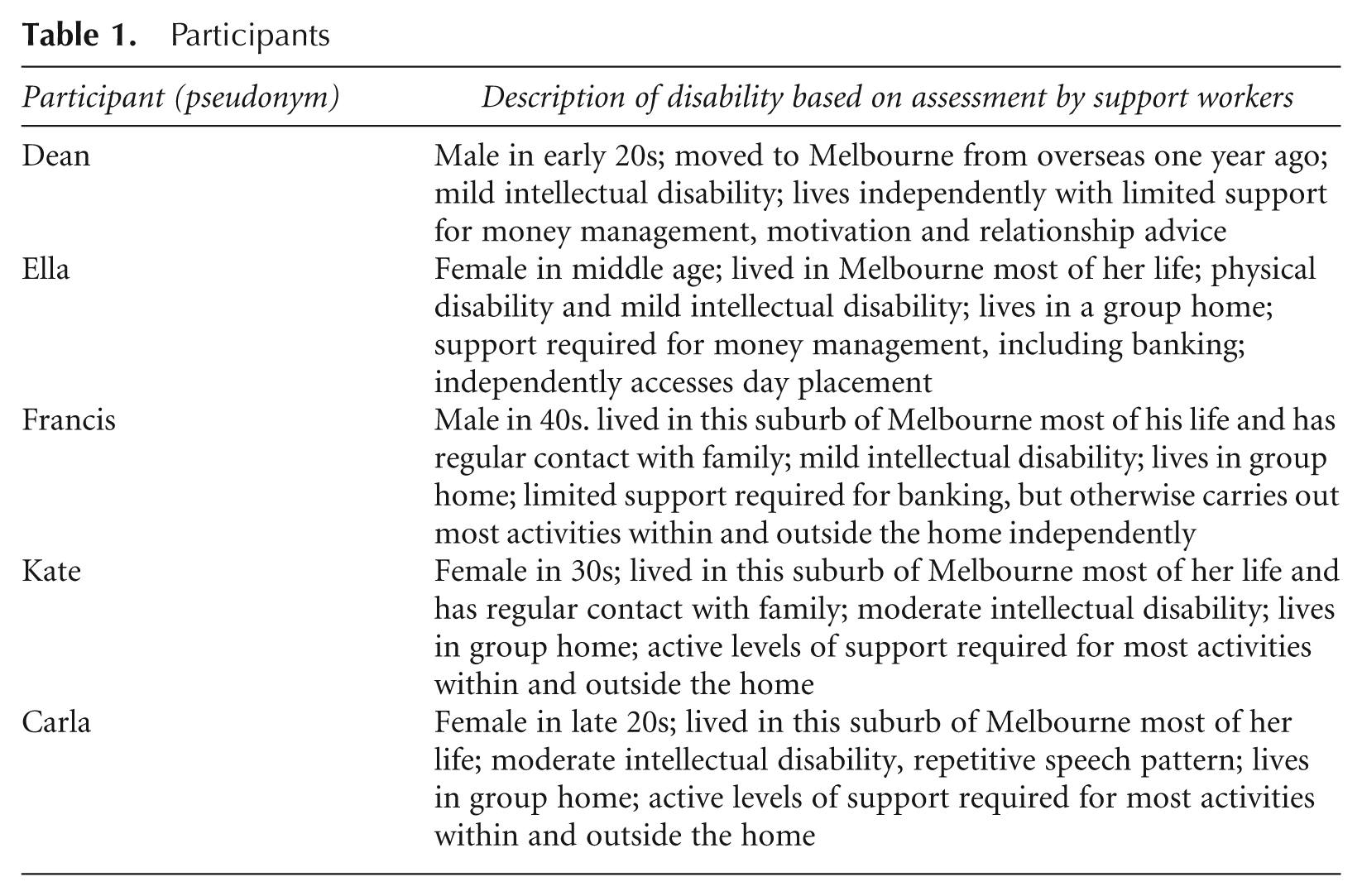
We included in our study participants with different levels of intellectual disability and support requirements, in order to be able to examine how this factor influences encounters (Table 1).
Participants
Findings
In this section, we present detailed analysis of transcripts from some of our qualitative observation notes. Through this analysis, we developed a typology of encounters that involve people with and without intellectual disability. The following types of encounter were identified through observation: convivial encounters, fleeting exchanges, exclusionary encounters, service transactions, encounters within a distinct social space and unfulfilled encounters.
Fleeting Exchanges
Most interactions between strangers are merely fleeting exchanges. They do not always involve a momentary shared identification and often can be better described as superficial communication rather than a convivial interaction. For individuals, these casual fleeting exchanges are an important part of being included in what Jacobs (1962, p. 56) describes as a ‘web’ of public respect and trust. Each on its own seems unimportant, but the sum of random fleeting encounters means being acknowledged by others as members of the public. Trivial fleeting exchanges are therefore critical elements of social inclusion. The pharmacy encounter described here is one of many fleeting encounters we observed in our study
The pharmacy. Carla can’t decide what to buy. She asks another female customer, “What lollies should I buy?”. The female customer appears startled for a moment by Carla’s question, then says, “They are expensive here, maybe you should go to the supermarket”. Carla does not appear to know how to respond to this comment. She stands there as if trying to think what to say and the female customer hurriedly moves on.
This encounter between Carla and the shopper is an example of a fleeting encounter, not necessarily convivial, and yet valuable in its own way. The female shopper’s response is friendly and she shares with Carla a minor but practical shopping tip. Carla’s exposure to local knowledge, and the very act of social interaction, can both be seen as a small but valuable moment of inclusion in what Jacobs (1962) described as a web of public respect and trust.
Exclusionary Encounters
Exclusionary encounters contribute to the exclusion of a person from the public realm. A disrespectful comment or non-verbal interaction can signal to a person that they are not welcome in certain places because of their difference. Rather than allowing conviviality and new momentary identifications, an exclusionary encounter can reinforce existing fixed identities, stigma and spatial segregation. As noted by Fincher and Iveson (2008, p. 152), “racist responses to the presence of individuals of particular bodily appearance, in certain places, are not uncommon in cities”. This hostile response is often associated in the literature with communitarian desires to overcome the estrangement characteristic of urban life through the creation of boundaries which will facilitate harmony, consensus and mutual understanding. In our study we observed several encounters of an exclusionary nature, that were based to some extent on their bodily appearance, but also on their behaviour in public spaces.
The street. Dean was walking ahead of the group when he encountered a woman waiting at pedestrian lights. The woman (mid 50s) was unaware that she was standing in the middle of the footpath and Dean wanted to walk straight ahead. … He “grunted” which got her attention. … The woman looked startled then moved so that Dean could use the footpath. She smiled nervously at Dean who simply ignored her and resumed his brisk pace towards the library. The woman ignored the people with disability in the group and spoke only to me (as I was bringing up the rear). She said something like “How sweet, good to see them out”.
This brief street encounter occurred unexpectedly in the street. It was initially prompted by an ‘accident’—a woman unaware that she is blocking the way. Dean’s reaction—grunting rather than moving around her or politely asking her to clear the way—was the first negative turn for this encounter. The woman’s intentions may have been positive (“how sweet”), but her response, and her decision to talk only to the non-disabled person, can be interpreted as condescending and disrespectful in nature.
Public transport: Francis took up two seats by sitting on the outside of a seat for two and having his arm across the second seat. As more people boarded the bus, he did get several rude looks, especially from older ladies who boarded the bus. There were no verbal comments. … Other people vacated their seats, including women with shopping bags, but Francis remained oblivious to their needs.
The public transport encounter was based on non-verbal communication in the form of scowling looks. Francis’s oblivion to other people’s needs or his inability to interpret social cues, and the choice of other passengers not to communicate verbally with him, all contributed to an exclusionary encounter where Francis was singled out from the other passengers in a negative way.
Service Transactions
Service encounters involve some exchange of goods or services such as buying in a shop or paying a bus driver. Unlike a convivial encounter, the distinction between the ‘client’ and the ‘service provider’ in such transactions limits opportunities for momentary shared identification. Even then, two persons involved in a service transaction will inevitably recognise each other as more than just a service provider and client. As noted by Solomon et al. (1985, p. 101), a service encounter is first and foremost a human interaction. There is a potential for exclusionary service transactions, where a person is treated with disrespect; and a potential for fleeting or even convivial service transactions. A primary value of a positive service encounter is the recognition of a person as a respected consumer. In a consumerist society, this recognition is an important aspect of inclusion. In contrast, an exclusionary service encounter may signal to people with intellectual disability that they are not welcome in certain shops or businesses, and may severely impact their sense of inclusion and their ability to live more independent lives.
Many disability support workers encourage and support their clients with an intellectual disability to engage in various service transactions such as shopping and banking. The aim is typically to provide people with intellectual disability with the skills to carry out such tasks independently. The social interaction with the service provider is not typically seen as an end in its own right, but is an integral part of the service transaction. The bank encounter described next provides an example of how a service transaction is mediated by a disability support worker
The bank: Rick (Disability Support Worker) and Kate approach Teller 5. [Kate] is talking about her sister in Adelaide. Rick hands over Kate’s banking … Rick stands at the Teller’s window and stands off to the side, facing Kate … The Teller asks how much money. She directs her question at Rick, and Rick answers briefly … When it is time to sign the withdrawal slip, the Teller does not talk—she simply hands the slip over the counter with the pen. The Teller has no eye contact with Kate. Kate understands that she needs to sign, and does so … A second signature is required … This time, Rick shows Kate where to sign. Kate has continued to talk throughout this time—and is now talking about a former support worker … Kate hands the bank slip back and starts to walk away. Rick places a hand gently on Kate’s arm, prompting her to stay. The Teller asks Rick for Kate’s ID. Rick directs the question—pointedly and deliberately—to Kate. Kate has to get this from her purse and appears unsure of what she is doing. Rick prompts her gently. Kate gets out her ID and hands it to the Teller. The Teller continues to ignore Kate, not maintaining any eye contact. She continues not to work. Then she asks Rick about the money. Rick again deliberately involves Kate in the conversation. Kate is getting restless and tries to move away from the window. Rick works to keep Kate engaged and to stay at the counter.
Much of the interaction occurs between the teller and the disability support worker. The client herself, Kate, is excluded. However, the disability support worker consciously seeks to include Kate in the transaction, facing her rather than the teller. The support worker tries to guide not only Kate, but also the teller when she does not communicate with Kate directly. This way, an exclusionary encounter has turned into a learning experience for both Kate and the teller, and yet remains within the confines of a service transaction.
The gym: [Kate has worked with her current personal trainer Annie for 8 years now, half-an-hour sessions twice a week.] Kate is working out with a personal trainer at a gym. They sing together as they do their exercise programme. Most of the time Kate interacts primarily with the trainer, but occasionally different members of the gym talk with Kate and her trainer. The exchanges are teasing and light in nature. I have never seen Kate so animated or engaged. Her eyes were constantly lit up and she held eye contact with her trainer.
Unlike the previous example, the encounter between Kate and her trainer is a service encounter in which the interaction between service provider and recipient has developed beyond the transaction itself and entails some elements of conviviality. Kate and the trainer are engaged in an activity with a shared purpose—the training itself. The relationship between the trainer and Kate has developed over the years around this activity, and now involves a level of intimacy (singing together) that extends beyond the purpose of the activity itself and beyond their formal relationship and fixed roles as a service provider and recipient. Further, Kate’s and her trainer’s excitement is infectious and opens opportunities for other encounters to occur between Kate and the rest of the members training in the gym.
Encounters within a ‘Distinct Social Space’
When using specialist services and settings, and when engaged in group-based activities, the encounters people with intellectual disability experience will primarily involve other people with intellectual disability or disability support staff, as opposed to other non-disabled people. These encounters will occur within what has been described as a ‘distinct social space’ made up of family, co-residents with disabilities and staff (Clement and Bigby, 2010). Nevertheless, the types of encounter that can occur within this distinct social space are as varied as those in the public realm.
On the one hand, encounters that occur within this distinct social space do not necessarily contribute to inclusion in the wider community, and may be seen as reaffirming the boundaries between people with intellectual disability and others. On the other hand, such encounters provide people with an intellectual disability with an opportunity to interact and make friends in an environment where their intellectual disability is nothing exceptional and where other aspects of their identity are recognised. Hall (2005, p. 110), defines such an environment as “a place of bounded safety from the rolling turmoil of a discriminatory and often confusing world”, where inclusion by those within the space is entangled with their exclusion from outside.
Disco for people with disabilities: Carla uses the door which takes her first to the refreshments area. She immediately finds someone she knows and goes over to give them a hug. No words are exchanged but the reception is warm. The loud music inhibits good quality conversation. Carla then sees a small man … whom she obviously knows. She approaches him and he smiles. He holds out his arms for a hug and Carla hugs him … [Carla] continues to look around as if trying to find someone … Carla moves around slowly, doing a ‘360’ as she continues to look out. She does not appear happy, nor is she distressed. For 20 minutes, she has no interaction with anyone … She appears to be scanning the tables, still looking for someone. I am not sure if she is looking for someone in particular or if she is just looking for a familiar face.
The disco is set up by a disability support service, specifically for people with disabilities. It provides them with an opportunity to go out at night, dance, catch up with friends and meet new people. In this sense, the disco is a place that provides valuable opportunities for encounters, but also restricts them to the ‘distinct social space’ made up of family, other people with disabilities and staff (Clement and Bigby, 2010). The weekly routine means that encounters with strangers can develop into longer-term relationships over time, but also that the level of excitement, novelty and the opportunity to meet new people diminish over time. The environment itself plays a dual role in shaping the encounters. On the one hand, the loud music makes conversation quite difficult; on the other hand, it provides opportunities for less verbal encounters to occur such as physical contact, dancing or sharing drinks. The participants spend a couple of hours at the disco, and their number is large, so the range and the nature of the encounters they experience are diverse: warm hugs with familiar friends; conversations and dancing with new and unfamiliar people; but, also, long minutes of isolation in the crowd.
While a specialist activity for people with disabilities might seem to reinforce their segregation, it can also be experienced as an opportunity for social interactions in an environment where moments of conviviality are possible because their disability is not exceptional.
Bowling. At 9am, they were able to enter the Bowling Alley. The manager knew everyone by name, and while taking the money asked, “How was work this week?”, “Is that a new shirt?”, etc. She appeared to have a good rapport with everyone … Francis paid his money and spoke briefly to the manager, saying work had been good this week … He greeted people he knew as they came in, “Hi [name]. How are you?”. [The bowling competition begins.] … Staring at the screen (score board) was [Francis’s] default position … Even though they were playing competition bowling, once the team they were playing against finished, they packed up and left. They did not wait for Francis’s team to finish to see the final scores. There was no competitive feel.
The participants in the bowling competition are all people with disabilities. However, unlike the disco event described earlier, the bowling competition takes place in a mainstream commercial venue and is managed by the venue’s staff rather than disability support providers.
The more inclusionary aspect of this activity is the encounter between the participants with an intellectual disability and the staff of a mainstream community service treating them as highly valued customers. In this sense, the bowling encounter could also be described as an inclusionary service transaction. Yet most of the interactions are between people with intellectual disability and, in this sense, the encounter remains confined to their ‘distinct social space’.
The bowling competition, as an activity with a shared purpose, provides an opportunity for convivial exchanges between team members and rivals, but the interactions within Francis’s team are neither communal nor convivial: as with Carla in the disco, Francis too experiences long minutes of disengagement and isolation.
Unfulfilled Encounters
Strangers do not always choose to interact with each other and, in many ways, non-interaction rather than encounter may be seen as the default in most cases where strangers pass by. As noted by Sennett (1994, p. 357), “the sheer fact of diversity does not prompt people to interact”. Nevertheless, under certain circumstances, some form of encounter between strangers may be expected—for example, because one of them needs help; because they share a certain experience; because two strangers are alone in a place; or because they are almost forced to interact by severe overcrowding. When such circumstances arise and are ripe for encounter, and yet no interaction takes place, the situation may be described as an unfulfilled encounter. A variety of reasons for unfulfilled encounters may be imagined: a person who is too busy, tired, shy or simply uninterested to communicate with a stranger. Some people (including some people with intellectual disability) may not value fleeting encounters with strangers and will make no effort to engage even when the opportunity is there. Yet, for some people with intellectual disability who are ‘unknown’ in their own communities (Bigby, 2008), an unfulfilled encounter can be seen as a missed opportunity for some form of inclusion and participation.
The supermarket: Ella gets a basket and heads to the cold aisle. She wants to buy a dip. She locates it quickly; however, she cannot reach the item [as it is too high on the shelf] … A man notices Ella’s dilemma. He is shopping on his own with a shopping basket. He is in his late 20s perhaps and dressed in work clothes. He stands a few steps behind Ella, watching her, trying to figure out how to ask her if she needs help. He tries—moving towards her once—then frowns, steps back and moves away. Ella has not noticed the man. She continues to stand in front of the fridge. She begins to look around—seeking out someone to help her perhaps, and she spots me.
The man’s hesitation and then reluctance to assist Ella suggests that her disability deterred him in some way. In many ways, this unfulfilled encounter can be seen as a missed opportunity because, had that person offered his help, it is possible that the brief encounter would have challenged some of the assumptions and concerns that made him turn back; it may have been a positive fleeting encounter that would have enriched the experience of shopping for both that person and for Ella; further, Ella would have avoided the frustration of unsuccessfully reaching out for the dip.
Moments of Conviviality
Following Fincher and Iveson (2008), we use the term ‘conviviality’ to describe encounters which provide people with an opportunity to step outside a fixed identity and explore more transient shared identifications with those they meet. Convivial encounters often occur when strangers engage in a shared activity with a common purpose or intent. For example, a convivial encounter may occur during a one-off activity at the local community centre or may last over a longer period as people come together periodically for activities such as tending a community garden or attending a literacy class in a public library. A convivial encounter between strangers may lead to friendship and a long-term relationship and, in this sense can be understood as a bridge between community presence and community participation. A convivial encounter is, however, a valued social interaction in itself and is an essential element of social inclusion, even when it does not lead to a long-term relationship.
In this case study, we did not observe any encounter involving people with intellectual disability that could be fully described as convivial in a way that reflects Fincher and Iveson’s (2008) understanding of this notion, in terms of the formation of transient shared identifications between people with and without intellectual disability. However, we have noticed some elements of conviviality—or at least its potential—in a few cases, such as the gym example described earlier as a service transaction, or this grocery shopping example
Grocery shopping:
Hello.
Hello.
How are you?
I’m good. How are you? [Woman is starting visibly to relax, as if she is thinking, this is not so bad].
Good. What’s your name?
Sonya. What’s your name?
Carla. [Pause for a few seconds.] Can I ask you a question?
Yes.
Do you think I’m stupid?
I’ve never met you before! [Slight look of panic goes over her face as she searches for something to say].
[Carla: continues to look at Sonya waiting for an answer.]
No, I don’t think that.
smiles, looking relieved.
Time to get back to shopping.
OK [smiles and moves on].
This encounter between Carla and Sonya fits best in the category of ‘fleeting exchanges’ discussed earlier, but it does entail some elements of conviviality as it involves renegotiation of boundaries and identifications between two strangers. In asking “Do you think I’m stupid?”, Carla consciously brings to the surface the ‘elephant in the room’—her intellectual disability and the stigma that is attached to it. This opens an opportunity for Carla to renegotiate identifications and boundaries. The “slight look of panic” on Sonya’s face suggests discomfort, but her response (“I’ve never met you before!”, “No, I don’t think that”) is not only tactful, but also expresses willingness for conviviality, avoiding making assumptions about Carla. When Sonya says “Time to get back to shopping”, she obviously seeks to end a conversation that causes her some discomfort, but nevertheless does so in a way which is again not just tactful, but also to some extent convivial; she identifies both Carla and herself as shoppers who have a task to complete. This can be seen as a momentary shared identification, yet one that is very superficial and also involves some negative aspects (Sonya’s discomfort). This encounter was shaped, primarily, by Carla’s personality and skills: her daring willingness not only to initiate a conversation with a stranger, but also openly to discuss her identity as a person with an intellectual disability. Sonya’s tactful and respectful responses—despite her obvious discomfort—have also contributed to the conviviality of this encounter.
Discussion
The analysis in this paper points to some of the key factors that influence the nature and outcomes of an encounter in terms of social inclusion and conviviality. First, the environment in which the encounter takes place is a primary factor influencing its nature and outcomes. For example, the loud music played at the disco, restricted conversation, but encouraged other types of encounter based on non-verbal communication such as dancing and physical contact. Similarly, the internal design of grocery shops and supermarkets influenced the encounters within them: the free movement of people along aisles creates a range of opportunities for encounters between them, at the same time as it creates space for more intimate conversations in the relative privacy of a semi-open space. Furthermore, this design allows people intentionally to avoid an encounter (as in the supermarket example) or to bring a convivial but awkward encounter to a swift ending by simply walking away (as in the grocery shopping example). As noted by Jacobs (1962, p. 56), a positive encounter is never ‘thrust upon’ a person, but is experienced as a choice; hence, spaces that allow people to experience encounter, but as a choice rather than an obligation, can be seen as more conducive environments for convivial encounters.
Secondly, the nature of activity in which participants were involved had a major influence on the types of encounter they experienced. Our observation at the gym suggested that the shared-purpose activity (training) allowed some degree of conviviality between Kate and her trainer. What initially began as an encounter between strangers—a client and a service user—over time developed into an on-going relationship that extends beyond these formal roles. Yet, we have also witnessed some very structured activities where encounters were far from convivial, as well as some degree of conviviality that occurred in more fleeting encounters with no particular purpose. These findings suggest that, while shared-purpose activity does involve a potential for conviviality—as noted by Fincher and Iveson (2008, p. 154)—this is not always the case and other important factors need to be considered as well.
A third factor concerning the nature of activity is whether or not it is exclusively for people with intellectual disability. Group-based activities for people with intellectual disability are not conducive to social interactions beyond the distinct social space of people with intellectual disability, their families and support staff (Clement and Bigby, 2010; Forrester-Jones et al., 2006). Indeed, encounters we observed in group-based activities for people with intellectual disability typically remained within this ‘distinct social space’, regardless of whether they occurred in mainstream public spaces (bowling) or in specialised disability services settings (the disco). In one case, an encounter between a group of people with intellectual disability and a person without a disability in the street was interpreted as an exclusionary encounter.
The value of encounters that occur within this ‘distinct social space’ should not be dismissed. In fact, it is precisely in this space where encounters can be experienced as convivial, in an environment where having an intellectual disability is not exceptional, allowing other aspects of people’s identity to be recognised. Yet, the range of identifications that can be explored in such a ‘distinct social space’ is limited by the fact that it is a very closed environment. Perhaps a mix of encounters within and outside this distinct social space may prove most useful: encounters outside this distinct space will allow individuals to explore a far greater range of identifications (often at the risk of being singled out as ‘people with intellectual disability’); then, they will be able to share these new identifications with other people with intellectual disability in a safer environment where they are not singled out. To some extent, this can also be seen as a mix of what Fincher and Iveson (2008) define as planning for encounter and planning for community. While the first is focused on creating the conditions for convivial encounters between strangers, the latter is focused on creating conditions for the strengthening of longer-lasting relationships, networks and shared identities.
Fourthly, disability support staff play an important role in facilitating encounters for people with intellectual disability. Disability support staff often plan where and when their clients go out. They often accompany people with more severe disability when they are out in the public realm and can intervene in encounters as they occur. In the bank encounter described in the paper, a disability support staff member negotiated what was essentially an exclusionary encounter, in attempt to turn it into a positive learning experience for both the bank teller and Kate. At the same time, to some degree, some practices of support can have an exclusionary effect limiting opportunities for a person with an intellectual disability to explore other aspects of their identities. There is much scope for further research on the potential role of support workers in training for encounters, planning activities and supporting people with intellectual disability through the different types of encounters that they experience.
Lastly, the individual personality of a person with an intellectual disability and the personality of those they encounter will have a major influence on the interaction between them. For example, an outgoing person may be able to initiate encounters, whereas a shy person might need more time or a very secure environment in order to initiate or even respond to an opportunity for encounter. Encounters between individuals take place within the constraints of broader social structures, yet are moments where individuals actively challenge these structures. In this sense, the concept of encounter brings individual agency back to theoretical debates about disability, social structure and the city.
Conclusion
While each encounter on its own may seem as having a marginal significance in the broader sense of social inclusion, as noted by Jacobs (1962, p. 156) the sum of all encounters is meaningful, as they constitute an important dimension of the social life of cities. What, then, is the sum of the encounters we have observed in this study? Overall, the study demonstrates that the interactions of people with intellectual disability cannot be simply described in a passive term such as ‘community presence’. Rather, they actively interact with other members of the public in a variety of ways. At their best, in moments of conviviality, encounters allow a person to step outside a fixed identity, explore other aspects of their own hybridity and challenge exclusionary social and spatial boundaries. At their worst, encounters can serve further to exclude individuals, signalling to them that they are unwelcome in certain places, while reinforcing existing fixed identities. Yet within this spectrum, nearly each and every encounter we observed reflected what Hall (2005) described as the entanglement of inclusion/exclusion. However, we did not observe encounters that could be described as genuinely convivial, in the same way that this concept has been understood in other contexts. This is yet another example of the extreme marginalisation of people with intellectual disability in society. Nevertheless, we did identify some limited forms of conviviality in other types of encounter suggesting that the potential is there. Further, we have also identified some of the factors that can allow fulfilling this potential and we argue that much can be done to actively prepare for and support more positive encounters and, in doing so, to promote the social inclusion of people with intellectual disability.
Footnotes
Funding
This work was supported by the Australian Research Council in partnership with Jewish Care (Victoria) and Yooralla. Grant number LP110100462.