




Abstract
Rising concern about the negative impacts of students on ‘host communities’ has triggered debates about the consequences of studentification in the UK. For some commentators, purpose-built student accommodation (PBSA) appears the panacea for studentification, as it offers the potential to reintroduce balance to studentified communities by redistributing student populations in regulated ways. This paper explores this contention, drawing upon focus groups and household surveys conducted in the vicinity of a PBSA development in Brighton, UK. The paper concludes that the location of this development in a densely populated neighbourhood has engendered adverse student/community relations, conflict, feelings of dispossession and displacement of established local residents. It is asserted that future developments of PBSA should be mindful of these issues and their implications for questions of community cohesion, quality-of-life and belonging in established residential communities. These findings are discussed in relation to debates of age differentials, segregation and new-build gentrification.
Introduction
Off-campus student residence has long been a thorny issue in political and public circles, with the growing density of student occupation in distinct neighbourhoods provoking vituperative debates about studentification (Munro and Livingston, 2012; Munro et al., 2009). Hyperbolic accounts allege the ‘takeover’ of parts of university towns by “the most unsavoury characters society has to offer” (The Guardian, 2004), leaving ‘student ghettos’ where balanced residential communities once stood: The effect on community life has been devastating. Pubs have been converted into theme bars … fast-food takeaways and off-licences selling cheap alcohol dominate the shopping streets. Schools have seen their class sizes plummet as families move out of the area … house prices have … rocketed as landlords have created a property boom and … people wishing to … stay in the area have found themselves priced out of the market (The Observer, 2002).
Hence, the question of where and how to accommodate students, while engendering harmonious and sustainable communities, has penetrated community, political and institutional agendas, most notably in the UK (Raco, 2004), but also in other nations where there are traditions of higher education students living off-campus and away from home (see discussions of student accommodation and gentrification in Melbourne, Australia: Fincher and Shaw, 2009; Davison, 2009).
Studentification only emerged as a significant issue for urban research in the mid 2000s (Rugg et al., 2004; Smith, 2005) but even since then, studentified landscapes have transformed markedly (Tallon, 2009). Now, large blocks of commercially provided off-campus student accommodation dominate the skyline in many university towns, attracting premium rents for luxury amenities and styled interiors (Hubbard, 2009; Smith, 2009; Chatterton, 2010a). The rise of such purpose-built student accommodation (PBSA) in recent years has been paralleled by the proliferation of new-build gentrification in UK cities, which has sparked debates in gentrification scholarship about whether this can be viewed as ‘positive’ regeneration or is complicit in processes of displacement (Davidson and Lees, 2010). It is not only the size, form and shared politics underpinning these developments that unite them, but also the new (and lucrative) commercial property niches they have carved out, marketed at middle-class students and gentrifiers with similar socio-cultural preferences, including a predilection for city living, consumption-based lifestyles and proximity to nightlife (see Hubbard, 2009). The rise of PBSA can thus be related to the commodification of student spaces (Chatterton and Hollands, 2002; Chatterton, 1999); the neo-liberalisation of studenthood (Chatterton, 2010a); and the position of the student in a gentrifier ‘lifecourse’ (Smith and Holt, 2007; Bailey, 2009).
Irrespective, PBSA has become the backbone of many local authority policies seeking to disperse students in order to reinstate social mixing in studentified enclaves and to pursue social ‘diversity’ in line with the UK government sustainable communities agenda (Raco, 2004; Raco and Imrie, 2003). Critiques of urban policies that subscribe to the merits of ‘positive gentrification’ (i.e. introducing middle-class occupants to deprived urban areas) have exposed the tendency for policy-makers to cloak gentrification in languages of urban ‘renaissance’ and ‘regeneration’ (Davidson, 2008).
In marked contrast, Smith (2008) has traced the emergence of a critical politics of studentification, fuelled by local community groups seeking to resist urban changes associated with the in-migration of student populations. The shortcomings of housing and planning legislation in the UK, considered by some to have enabled the ‘overproduction’ of houses in multiple occupation (HMO) (Leyshon and French, 2009; Gibb and Nygaard, 2005), have been identified by well-organised groups such as the National HMO Lobby, constituted in 2001 to “ameliorate the impact of concentrations of HMO on their host communities” (National HMO Lobby, 2009). However, the rise of PBSA has been marginalised in these debates, as public and political discussions of studentification have remained fixated on the wholesale conversion of single-family housing to student HMO, and the transformation of established residential communities into ‘student areas’ (Allinson, 2006). This is despite academic commentaries identifying the diverse residential geographies of students (Smith, 2009), including the provision of new forms of PBSA—i.e. commercially provided PBSAs developed within off-campus locations (often on brownfield sites), as opposed to on-campus university-managed halls of residence (see Hubbard, 2009)—to meet sophisticated demands for high-specification student accommodation in desirable locations.
Noting this, we draw on evidence gathered from focus groups and questionnaires with residents in close proximity to the Phoenix Development, an off-campus PBSA located in Hanover, a densely populated residential community in Brighton. The paper has three main aims that map onto the sections that follow. First, we examine the links between PBSA, gentrification and regeneration within the context of local authority planning responses to the overproduction of student HMO in university towns and the neo-liberalisation of higher education and the ‘student experience’. Secondly, we respond to the absence of critical appraisal of PBSA, by mapping the specific impacts of a PBSA development on a residential neighbourhood in Brighton. Thirdly, we discuss the potential for PBSA to have unintended social consequences in UK towns and cities in relation to debates of segregation and an age-dividing society.
PBSA: Gentrification or Regeneration?
According to some authors, local policy formulated to mediate the negative impacts of studentification has been largely ineffectual (Smith, 2008) and focused primarily on the regulation of HMOs to prevent further conversion of housing stock in areas where studentification is most entrenched (see National HMO, Lobby, 2010 for examples). More recently, policy-makers have turned their attention to the potential of PBSA for decanting students from areas of ‘overconcentration’, exemplified by the Housing Strategies and Supplementary Planning Documents (SPDs) of local authorities in a range of university towns across the UK (for example, Manchester, Plymouth, Edinburgh). For example, Oxford City Council states that Both Oxford City Council and the two Universities have agreed that they should try to reduce the number of students living outside purpose built student accommodation. This is in order to reduce the resulting pressure on communities and the housing market. Furthermore, both Universities are keen to offer prospective students attractive accommodation since this helps them to compete with other universities for high calibre students (Oxford City Council, 2010, p. 3).
Since developments of PBSA are commercial enterprises, it should of course be noted that their location is subject to complex negotiations involving a number of stakeholders. These include: local authorities seeking to disperse students in more controlled ways around university towns while ensuring that the effects of new developments of PBSA on surrounding areas are minimised; commercial providers of PBSA seeking to maximise the attractiveness of new developments to students by situating them in areas where students want to live (i.e. close to university campuses’, city centres and/or on direct transport routes connecting the two); and universities who are simultaneously concerned with mitigating town–gown relations and developing new accommodation that is attractive to students (for example, see the earlier quote from Oxford City Council). Indeed, it is vital to acknowledge that universities will continually monitor and revise student accommodation strategies in light of commodification pressures and issues related to these factors (such as recruitment and the ‘student experience’). The dispersal of students from areas of overconcentrated HMO production is, therefore, one of a number of desired outcomes of PBSA.
Nevertheless, in the wake of largely failed attempts to develop alternative planning responses to the overproduction of student HMO in residential communities (such as the Area of Student Housing Restraint pioneered by Leeds City Council which was deemed to be discriminatory and thus illegal, and the ‘threshold approach’ mooted by Charnwood Borough Council, which was considered unsustainable due to insufficient small-area data on students—see Hubbard, 2008), local authorities in university towns have fixed on PBSA as the solution.
This has resulted in a 65 per cent increase in bed-spaces in commercially provided PBSA in the UK between 2005 and 2009 (to 120 107 bed spaces, accommodating around 6 per cent of students in the UK at the end of this period), with rental growth of 10 per cent in 2008/09 (compared with the IPD-based forecast for all UK commercial property of −7 per cent) making PBSA the “best performing property asset in the UK” during the global economic downturn (King Sturge, 2009, p. 3).
Where PBSA has been the subject of national media focus, it has tended to be uncritically represented as the solution to improving student living standards and remedying the social ills of the ‘traditional’ studentified urban enclave (i.e. where the overproduction of HMO has instigated urban decline) One effect of these student blocks has been de-studentification. Parts of cities once dominated by students have become the preserve of professional couples instead … so in theory, everyone is happy: students get plush accommodation, developers invest and residents get their streets back (The Times Higher Education Supplement, 2006).
PBSAs have been packaged by commercial providers to appeal to students seeking a 24-hour metropolitan lifestyle. The Director of Public Affairs for Unite Group notes We call ourselves a student hospitality company … it is more about giving that warm welcome you get from a hotel rather than being a landlord (qoted in The Times Higher Education Supplement, 2006).
Unite Group’s packages offer insurance for students’ possessions, welcome packs and hospitality managers. Throughout the sector, en suite bathrooms, gyms, spas, steam rooms and pools are common. Wireless Internet, security and CCTV are standard. High-quality accommodation and security are likely to broaden the appeal of PBSA to parents and the accommodation packaged in this way is also likely to be attractive to international students to whom alternative forms of student renting may lack certainty. Such facilities do not come cheap, however. For example, the Nido development in Kings Cross London charges £255–310 per week for a single studio room, making this PBSA more expensive than the average weekly rental price for a studio apartment in the same postcode (£220), within the broader Borough of Camden (£230); and across Greater London (£169) (GLA, 2011). This poses questions about the effects of PBSA on student indebtedness (Christie et al., 2001), a debate that is important given the apparent commodification of the student experience and the neo-liberalisation of the UK university business model (Maringe et al., 2009).
These observations on the mass-produced commodification of student accommodation (PBSA) resonate with the development of gated communities and branded landscapes marketed at gentrifiers (Atkinson and Flint, 2004), illuminating the blurred distinction between students and gentrifiers (Chatterton, 2010b). Given these overlaps, political recognition that the strategic siting of new-build student developments can be a stimulus for urban regeneration is not surprising. For example, the regenerative benefits of a PBSA development planned for a declining area of Newcastle were highlighted by local planners It is considered that the provision of purpose built student accommodation in the area will contribute to the diversity of residential accommodation and long-term regeneration of the area (Newcastle Evening Chronicle, 15/10/2009).
Despite this, the problematisation, in some quarters, of PBSA as a solution to dispersing concentrated student populations should not be overlooked, with the National HMO Lobby cautioning that Purpose-built development in the wrong place (within areas of concentration) can exacerbate the situation; and insensitively sited, can actually generate new problems with demographic imbalance (which generates social, economic and environmental problems) (Tyler, 2007; quoted in Hubbard, 2009, p. 1909).
These concerns highlight an important distinction between PBSA located on-campus or in peripheral locations away from established residential areas, and PBSA developed on sites located in close proximity to pre-existing residential communities. The latter form of PBSA is the focus of this paper, which sheds light on the challenges facing local policy-makers seeking simultaneously to disperse students from areas of overconcentrated HMO and meet the demand for new-build student accommodation in inner-city locations where students wish to reside.
The pressures these conflicting demands place on residential space have become evident in Islington, where more than 1000 PBSA bed-spaces have been built since 2008, adding to 4000 existing rooms, with another 2650 under construction (Islington Gazette, 2010). In 2010, the waiting-list for social-rented accommodation in Islington Borough exceeded 13 000 people (7.4 per cent of the usual resident population of 175,797; UK Census 2001), which prompted established residents to question why investment in affordable housing had not been prioritised We need social housing, not more student hostels (Islington Tribune, 2010).
In Newcastle, similar objections were voiced by local residents to plans for a new 254-bed development to be situated in a residential community People living nearby have lodged objections … saying the area is being turned into a ‘student ghetto’ … objections include a claim that there is already too much student accommodation in this area, that further student accommodation will add to the existing noise, vandalism and disruption experienced in the area (Newcastle Evening Chronicle, 2009).
Student representatives, landlords (of student HMO in Newcastle) and opposition councillors also objected. Their argument, however, was not concerned with the impacts of the new PBSA on the local area in which it was to be built, instead focusing on the perceived injustice of forcing students out of HMO in areas where they have traditionally chosen to live, by locating the new PBSA in another part of the city.
Such debates highlight the importance of the location of PBSA and suggest that new-build accommodation is capable of provoking sharp differences of opinion about its role as a catalyst for regeneration and ‘destudentification’. This mirrors debates concerning the impacts of new-build development, instigated by Lambert and Boddy (2002), who argue that new-build developments do not stimulate displacement of existing populations. This contention has been vigorously countered by Davidson and Lees (2005; 2010, p. 396) in their call for “a critical geography of new-build gentrification”. They note that new-build residential developments are commonly constructed on brownfield sites and, hence, that direct displacement of population is unusual. However, two forms of indirect displacement are noted. The first, ‘exclusionary displacement’, is described by Davidson and Lees (2010, p. 399) as “price-shadowing, where lower income groups would be unable to access property”. In studentified areas, this is recognised to occur as landlords hike property prices by converting living space into extra bedrooms. The second is ‘socio-cultural displacement’, whereby the characteristics of an area become aligned with the values of the social groups moving in, invoking feelings of dispossession among pre-existing populations. It is thus contended that a purely spatial account of displacement may be inadequate and that there is a need to consider “displacement pressure” (Marcuse, 1985, p. 214).
The self-exclusionary tendencies evident of residents in gated new-build developments (Kenna and Dunn, 2009) are relevant here. Butler (2007, p. 777) argues that residents of such developments are more akin to suburbanisers than gentrifiers in their desire “to be near but not in or of the city”. The instilling of such attitudes in student residents living in PBSA may infuse expectations of isolation and social withdrawal from ‘other’ social groups (Hubbard, 2009) in favour of residing in urban enclaves with other ‘people like us’ (Savage et al., 2005).
Building on these suggestions, we contend that PBSA has potentially important implications for deepening extant patterns of socio-spatial segregation along age and class divides; something we explore through an empirical study of a PBSA in Brighton.
Studentification in Hanover and the Impact of the Phoenix PBSA
This section focuses on the Phoenix development, a PBSA opened in 1992 in Hanover, a residential community in Brighton, UK. The PBSA comprises 298 single rooms, all en suite, arranged in self-contained flats of 6–8 rooms sharing kitchens and living space. Internet access is standard and a single room costs £110 per week. Phoenix is currently the only off-campus PBSA in Brighton. The location of the PBSA in Hanover, one of Brighton’s most vibrant neighbourhoods situated in close proximity to the city centre (see Figure 1), is undoubtedly a key aspect of its popularity. Hanover is typified by Victorian cottages painted in vivid colours, ‘boho-chic’ pubs and ‘alternative’ lifestyles. The following excerpt, from a website collating local resident’s descriptions and observations of Brighton’s communities, describes the area What’s in Hanover? Good pubs, famously. Plus narrow streets … pastel houses … problems with parking, and a sense of community. An estate agent will tell you it’s a desirable area. It has a reputation as a muesli belt, inhabited by social workers, students and teachers (mybrightonandhove.org.uk, 2009).
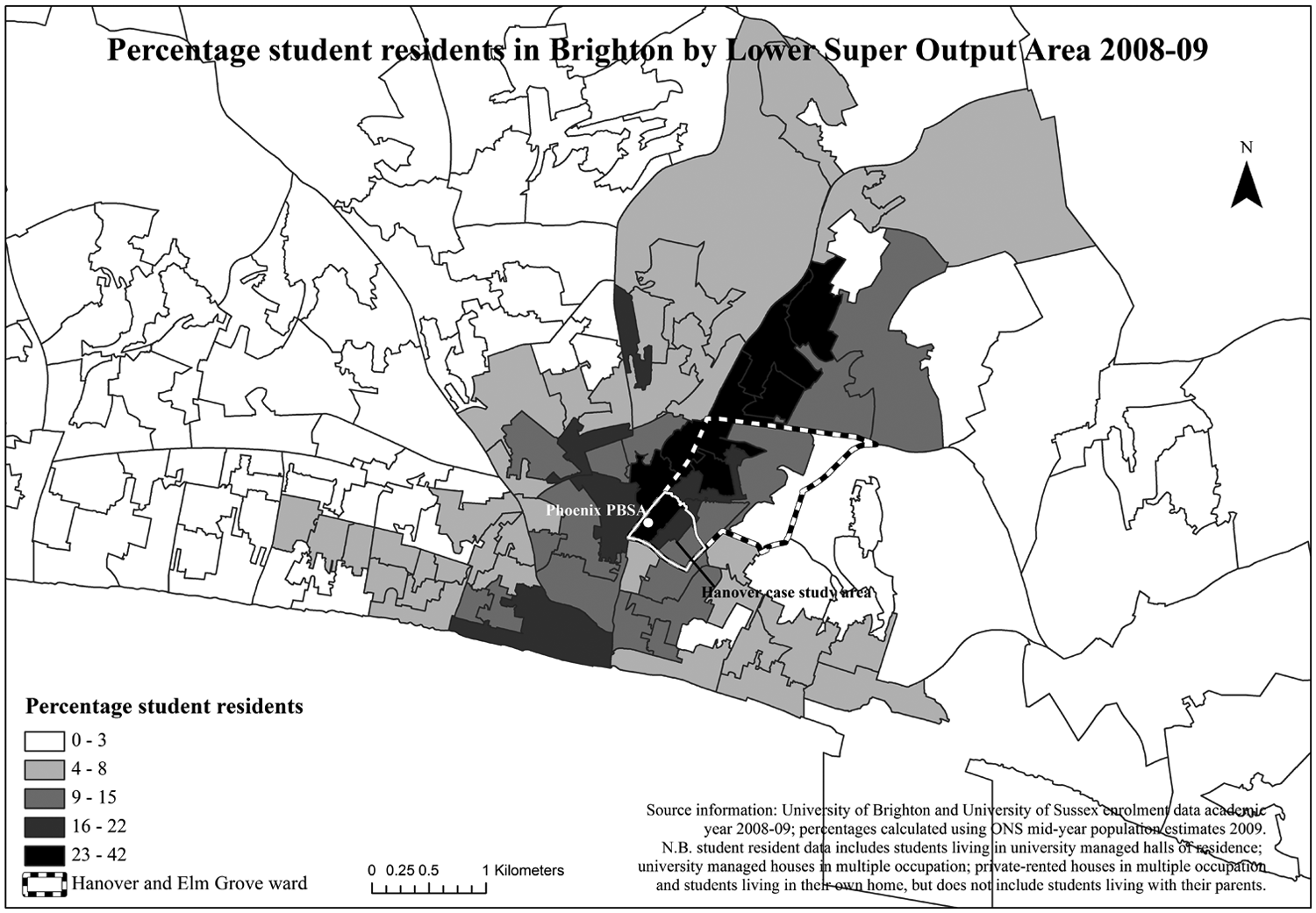
The percentage of student residents in Brighton, by Lower Super Output Area, academic year 2008-09.
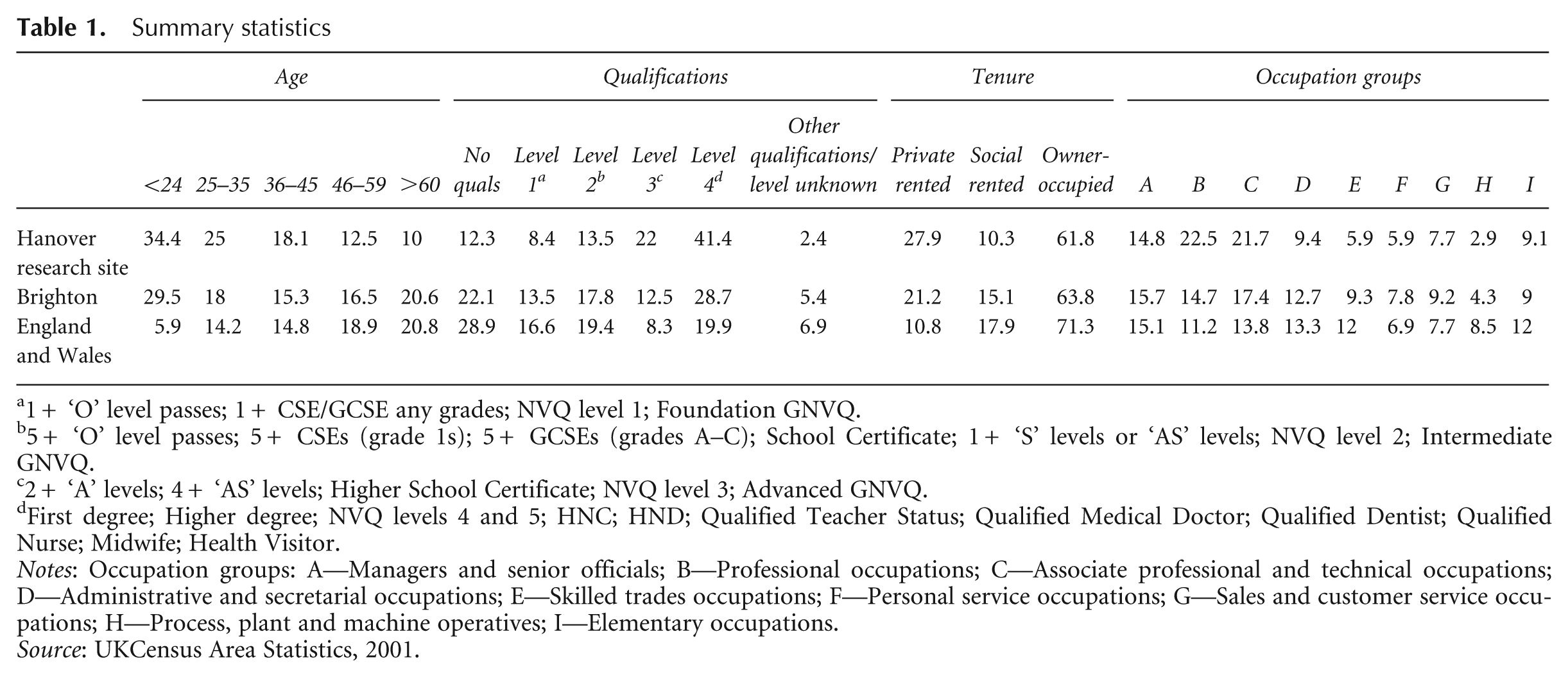
Representations of the residents of “Muesli Mountain” (BBC, 2003), as Hanover has been referred to, describe an educated and politically engaged group, including, since the 1970s, students and ex-students. Evidence from focus group and survey respondents indicates that the structure of the local population changed, however, as studentification took hold during the 2000s, associated with the expansion of the two universities in the city (University of Brighton and University of Sussex). Illustrating the extent of studentification and population restructuring in Hanover is challenging due to the limitations of 2001 UK Census data, ONS mid-year population and migration estimates, and local administrative population registers (such as electoral registers and GP registers) for analysing student populations. These data constraints have been discussed in detail in previous studies (see Sage et al., 2012; Duke-Williams, 2009). With these significant limitations noted, a comparison of the number of residents living in private-rented-sector dwellings (which could be used as a proxy indicator of the type of residential transformation which occurs in studentifying neighbourhoods) in the ward area containing the research neighbourhood (Hanover and Elm Grove Ward, see Figure 1) between 1991 and 2001 reveals a 161 per cent increase, from 1424 to 3772 residents. An analysis of the number of people living in private-rented dwellings in ward areas in the UK with 10 per cent or more ‘student’ populations in 2001 (i.e. those where studentification was most likely to have unfolded) revealed that Hanover and Elm Grove was ranked 31st (of a total of 130 wards across the UK). This analysis aligns with the perceptions of population change reported by residents in Hanover over this period (detailed later). Of course, this analysis could also indicate a proliferation of other social groups who typically reside in private-rented dwellings, such as young professionals. Indeed, 2001 Census data indicate a relatively high proportion of both students and young professionals (with 25 per cent aged 25-35 and 41 per cent of the population educated to degree level or equivalent; see Table 1 for a fuller summary of census area statistics for Hanover).
Summary statistics
1+ ‘O’ level passes; 1+ CSE/GCSE any grades; NVQ level 1; Foundation GNVQ.
5+ ‘O’ level passes; 5+ CSEs (grade 1s); 5+ GCSEs (grades A–C); School Certificate; 1+ ‘S’ levels or ‘AS’ levels; NVQ level 2; Intermediate GNVQ.
2+ ‘A’ levels; 4+ ‘AS’ levels; Higher School Certificate; NVQ level 3; Advanced GNVQ.
First degree; Higher degree; NVQ levels 4 and 5; HNC; HND; Qualified Teacher Status; Qualified Medical Doctor; Qualified Dentist; Qualified Nurse; Midwife; Health Visitor.
Notes: Occupation groups: A—Managers and senior officials; B—Professional occupations; C—Associate professional and technical occupations; D—Administrative and secretarial occupations; E—Skilled trades occupations; F—Personal service occupations; G—Sales and customer service occupations; H—Process, plant and machine operatives; I—Elementary occupations.
Source: UKCensus Area Statistics, 2001.
Given the deficiencies of commonly available datasets for analysing the extent and impact of studentification, enrolment datasets from the two universities in Brighton (academic year 2008–09) have been sourced and mapped at Lower Super Output Area level (LSOA; see Figure 1). The Black LSOAs have the highest percentage student population in Brighton, with 23–42 per cent student residents. The LSOA containing the Phoenix PBSA has 42 per cent and the LSOAs surrounding this area have 16–42 per cent student residents. The concept of a threshold at which the population of one social group becomes dominant is problematic (Hubbard, 2008) and the introduction of threshold-based planning policies in some university towns has resulted in residents’ groups and local authorities contesting the proportion of student residents/households that represent the studentification ‘tipping point’ and how this is calculated. There is no national-level policy or guidance (Smith, 2008). However, The National HMO Lobby (which was formed in 2000 to ameliorate the impact of concentrations of HMOs) states that, when the student population exceeds 20 per cent, a neighbourhood has become studentified (National HMO Lobby, 2008).
This study of Hanover was multimethod, combining: two focus groups with local established residents (which took place in January 2007); a ‘door-step’ questionnaire survey undertaken in Hanover between January 2007 and August 2008; the analysis of archives of The Argus (a local newspaper in Brighton) between 2001 and 2009 for coverage of studentification in Hanover; and the analysis of letters from local residents in Hanover, submitted as evidence to a Scrutiny Review Investigative Panel formed by Brighton and Hove City Council in 2008, to investigate how studentification was impacting on residential communities in the city. Focus group participants were identified via attendance at meetings organised to encourage dialogue between residents living in proximity to the Phoenix PBSA, and members of the Phoenix PBSA Management Team; although insights from these participants were valuable, it might be suggested that the composition of focus groups is largely self-selected and thus biased. The questionnaire survey countered this bias, 1 being administered ‘on the door-step’ to a random sample of 70 ‘established local residents’ in Hanover—respondents were identified by knocking on doors at random across the research neighbourhood. 2 The sampling frame for the survey targeted the established population, defined as those who had been resident in the neighbourhood for five or more years (see Halfacree, 1995). ‘Established residents’ were explicitly defined in this way with a view to exploring residents’ perceptions of urban change in Bevendean over time and how these changes might be connected to the in-migration of student populations. It is important to note that evidence of both positive and negative perceptions of student populations in Hanover was gathered during the survey—this is highlighted later in the section. Further to this, the multimethod research design was intended to reduce the potential for bias.
Since the 1970s, residents perceived a net out-movement of older people and families, and an in-movement of students. Typical comments include There were a lot more … older people than there are now … they seem to have disappeared and in their place have come more and more students so there’s now a real imbalance (Hanover resident, focus group participant).
Positive views of student incomers were evident, suggesting that their lifestyles and tastes reinforced the pre-existing cultural offerings of Hanover (such as the street festivals and open-house art exhibitions). Residents perceived the local population to have retained a balanced profile during the 1970s. The onset of the 1980s marked a period of change, however, with residents noting some of the hallmarks of gentrification—the in-migration of ‘middle-class’ residents and increasing property prices When we moved in … there were a lot of old people, there were working-class people … dustmen … plumbers … and then the artistic community and the students … in the ’80’s that changed when properties were going up … we saw middle-class people moving in (Hanover resident, focus group participant).
At this juncture, it is appropriate to situate the discussion historically, with an observation of the vast increase in HE (and the significant enlargement of HE student populations), embourgoisement and urban transformation that have occurred in the UK since the 1970s and the conflict that has prevailed between established local residents and students (or ‘town and gown’) since the birth of the university system in the UK.
Residents identified the expansion of student populations in the 1990s as the next pivotal change in the neighbourhood (aligned with the national increase in student numbers during this period, tied to the government’s drive to widen HE participation). Two changes in Hanover were associated with the enlargement of student populations—the development of the Phoenix PBSA and the ‘buy-to-let boom’ The buy-to-let phenomenon … the mid ’90s, when landlords were buying back into it … the couples that I’m talking [about] who moved in with their children in the ’80’s, they moved out in the ’90s to the schools (Hanover resident, focus group participant). I have seen how the Phoenix Halls, which accommodates 300-plus students … has transformed the area from one which had a balanced mix of older and younger residents into one which has been … saturated by students (Hanover resident, letter submitted to the studentification investigative panel, BHCC, 2009a).
In the remainder of this paper, we explore these discourses about ‘saturation’, to delimit the perceived impacts of PBSA on Hanover, comparing these with more benign narratives concerning (non-PBSA) student occupation in other parts of the city. This is not to deny that some Hanover residents reported positive attitudes towards the presence of students. For example I like the younger demographic of the area. I like the diversity it brings. I like to go past windows and hear guitars being played, people laughing (Hanover resident, letter submitted to the studentification investigative panel, BHCC, 2009a).
However, by focusing on discourses of exclusion and dispossession, the negative attitudes of residents to PBSA are bought into sharp focus; tellingly, no-one commented positively on the Phoenix development or its residents.
Exclusionary Discourse: Noise, Nuisance and Fear
The intensification of studentification in Hanover, associated by residents with the development of the PBSA, was implicated in a series of complaints about students and their perceived impacts. Statements from residents stressed a range of issues, such as litter, parking and, in particular, noise-nuisance Can someone tell me why students thought it was okay to play their drums during the day in a non-sound-proofed terraced house? (The Argus, 2005).
Intensified noise-nuisance is commonly reported by those living alongside HMOs (UUK, 2006) but, significantly, residents alleged particular noise-nuisance and other low-level anti-social behaviour occurring around the PBSA I had to call the patrol the other day because they were sitting out there [in front of PBSA] and … they were talking, laughing and it … carries at night … any group that’s … sitting there having a … party it’s … going to carry across (Hanover resident, focus group participant).
This suggestion is validated by an article published by The Argus reporting that residents “just don’t get a break, it’s a year round problem. The noise can be quite ferocious” (The Argus, 21 August, 2007). This comment refers to the year-round challenges associated with the arrival and departure of university students, followed by cohorts of ‘language students’ during the summer.
Moreover, the occurrence of confrontation was reported by many living in the vicinity of the PBSA Countless examples of squaring up to the trouble-makers and receiving nothing but abuse. The security staff … aren’t interested. We feel completely on our own here … isolated from the community we used to love living in (Hanover resident, questionnaire respondent).
Residents felt that the misuse of alcohol and drugs by students residing in the PBSA was an influence on these anti-social behaviours. One respondent noted that students were consuming large quantities of alcohol in the PBSA before making their way to central Brighton to continue drinking, a practice referred to as ‘pre-loading’ (Boyle et al., 2010), which resulted in noise-nuisance events when students left and returned to the PBSA Students seem to drink in their accommodation before going out therefore … they’re much louder because they’re higher already before they go out … I think that exacerbates the situation (Hanover resident, questionnaire respondent).
These experiences suggest that the PBSA is producing more volatile student/community relations in its immediate vicinity. The perceived ineffectual management of these relations resulted in local residents forming a campaign group in 2007 “to do more to stop the noisy antics of students at the Phoenix Halls of Residence” (The Argus, 21 August, 2007). Noise-nuisance was the dominant issue here, as has been the case in other areas where residents’ groups have lobbied against the proliferation of student HMOs (Allinson, 2005). The tendency for PBSA to house large numbers of first-year students, many of whom are experiencing independence from the parental home for the first time was also noted I don’t understand why we’ve got 300 freshers when we could have 3rd and 4th years … people who have to study more and get some sleep … it’s a huge problem for us … the turn-over of freshers (Hanover resident, focus group respondent).
The arrival of new PBSA residents over the summer months, such as young people visiting to undertake language courses, was noted to perpetuate noise-nuisance throughout the calendar year, where these challenges might be restricted to term-time in an area dominated by student HMOs.
In this context it is worth noting that high-level anti-social activity such as abusive and threatening behaviour has rarely been reported elsewhere in Hanover, or more widely in other enclaves in Brighton with high concentrations of student HMOs. As stated by an officer working on anti-social behaviour at Brighton and Hove City Council (BHCC) What we’ve dealt with is mainly low-level noise … and noise from visitors at anti-social hours (BHCC officer).
Discourses of Dispossession: Ownership, Withdrawal and Surveillance
Concerns of ‘loss of ownership’ were expressed in distinct ways by Hanover’s residents, compared with other studentified enclaves in Brighton. These anxieties stemmed from the perceived inscribing of a ‘campus identity’ onto the local area R1: There’s a lot of resentment with people because of this student noise and … the students now feel it’s their territory. R2: There’s a tendency … to see it as a campus. R2: Yes, it was “all our friends live in these streets, this is a student area, what are you worried about” (Hanover residents, focus group participants).
More explicit in the following quotes is the sense of dispossession felt by local residents in response to this perceived shift in ‘ownership’ It feels that we’re losing it, our community (Hanover resident, focus group participant). It’s that feeling of being a stranger in your own street really … disenfranchised (Hanover resident, focus group participant).
Dispossession was also expressed in relation to the imposition of student temporalities. Noise disturbances surrounding the PBSA had become so persistent during night-time and weekend leisure time that the rhythms of the neighbourhood had begun to fall in line with those established by PBSA residents and not ‘normal’ residents But what about our leisure time … when the students have gone. We’ve got the problem of the language students now. … we don’t get a break (Hanover resident, focus group participant). We don’t have any time to ourselves at all (Hanover resident, focus group participant).
Focus group respondents spoke of social withdrawal and ‘imprisonment’, their natural instinct being to retreat into their homes away from on-street disturbances surrounding the PBSA One is sort of in a fortress … we’re having to sort of like in a warzone take precautions you know, which is crazy really (Hanover resident, focus group participant).
Social networks stretching out from the PBSA across rented student HMO in Hanover were perceived to have lengthened noise-nuisance events. It was interpreted that attempts by staff at the Phoenix PBSA to quell these noise events had on many occasions simply resulted in their displacement to nearby HMO It is a known fact over in the halls that when a party is closed down, they all shoot off to one of the houses round here (Hanover resident, focus group participant).
Respondents felt that the position of the Phoenix development at the ‘heart’ of the Hanover community identified the area as a suitable place for students moving out of the PBSA at the end of their first year at university to seek HMO, thus encouraging further concentration of student residence in the area. Residents described this as being akin to “bees round a honey-pot” (Hanover resident, focus group participant). They considered the cumulative impact of students living in halls, and increasing concentrations of private-rented student HMO in the area, to have made students the dominant group in the neighbourhood. Hanover was perceived, therefore, to have become a “student area” (Hanover resident, focus group participant) When the first students moved in there [PBSA] … 10 years ago, I overheard the students saying ‘oh, I pity the residents here’ … it was the first year and it was still very much a residents’ area. But now, because this has escalated and there are so many more students the students feel that they don’t have that obligation—there’s a link between the student houses and the halls of residence (Hanover resident, focus group participant).
Such narratives place some emphasis on the university’s culpability for urban change in Hanover, which in turn raises questions of the regulation of urban space We feel like we’re being watched over by the university … we don’t want this ivory tower beacon flashing at the bottom of the hill, we want our neighbourhood to be like it used to be … without the need for this constant surveillance (Hanover resident, questionnaire respondent).
Indeed, a political intervention under the auspices of a regeneration strategy, approved in 2007, located the city’s HEI campuses at the centre of a new vision for the development of an ‘academic corridor’ in Brighton (BHCC, 2009b).
3
The document sets out the overall vision for the area as follows To provide strong and attractive gateways to the city, and create distinctive, integrated quarters which strengthens and enhances the overall character and diversity of the city (BHCC, 2009b).
The ‘academic corridor’ (including the lower section of Hanover where the PBSA is sited) is seen to take its core identity—“a neighbourhood of knowledge and enterprise”—from the university campuses situated within it. The key proposals underpinning this vision include Creating a vibrant, balanced residential neighbourhood in this accessible location to bring life to the streets and assist viability of local shops and services (BHCC, 2009b).
Paradoxically, the creation of a “balanced residential neighbourhood” is emphasised as a strategic aim, when in many senses, the experience of residents neighbouring the PBSA suggests that the notion of creating ‘balanced academic communities’ remains something of an oxymoron.
Discussion: PBSA and the Age-divided City?
Demonstrating some of the ‘unintentional’ impacts of PBSA in Brighton, this paper disentangles the ties between gentrification and studentification by developing understandings of the ‘local’ impacts of PBSA. Davidson and Lees’ (2005) work provides the point of departure here, given its insistence on the need for local examinations of new-build gentrification and the ‘secondary displacements’ it can set in motion. Like the new-build gentrification they examine in London, it appears that the PBSA in Brighton was implicated in simultaneous processes of neighbourhood improvement and decline, associated variously with the provision of additional accommodation and a contribution to the vibrancy of an area, as well as increased noise, disorder and a decline in social mixing. The contested position of new-build development within discourses of gentrification therefore appears equally to apply to PBSA, suggesting that the theoretical distinction between the production of student HMO, and the development of new-build PBSA, needs to be problematised.
Discussing PBSA in the context of gentrification thus helps to flag up the potential for PBSA to instigate long-term processes of neighbourhood change and social displacement. Some analyses of the emergence of gated communities as ‘urban fortresses’ indicating increased levels of social division and privatism are also pertinent here, given that they encourage discussion of the ways new-build developments can precipitate the deterioration of attachment to place among local residents, effectively splitting existing communities. In contrast, the areas in which PBSA are sited may be comparatively diverse and, for long-term residents, can have a familiarity, belonging and rootedness which are profoundly challenged by the emergence of formulaic student space. However, the parallels between PBSA and gated communities must be couched with caution, given that PBSA developments do not typically reproduce the shareholder democracies and club economies that have typified (some) more recent conceptualisations of private neighbourhoods (for example, Glasze, 2005; Manzi and Smith-Bowers, 2005). It is suggested that there is a need for PBSAs to be considered in the context of perennial debates around the increasing spatial segregation of society, and especially the differentiation of residential space on the basis of age (Dorling and Rees, 2004).
The fact that the presence of the PBSA in Hanover appeared to encourage other students to occupy HMOs nearby, also suggests that the establishment of PBSA can precipitate changes in the nature of residential communities. Whether or not such accommodation discourages those graduating to choose particular areas for their post-graduate or post-student accommodation requires further longitudinal analysis, but is crucial if the role of studentification in reproducing deep social divides along age cleavages (Duke-Williams, 2009) is to be better understood.
So what of PBSA within this context? Our analysis hints at the importance of PBSA in influencing the socio-spatial segregation of populations in Brighton along generational lines. As the proportion of students residing in PBSA increases (with off-campus PBSA currently accounting for nearly 20 per cent of student bed-spaces in the UK), the formation of households capable of engaging positively with others declines. Despite this, rapidly increasing numbers of students are making residential choices that expose them to potent forms of segregation—i.e. gated communal living—contributing to the “huge rise in the proportion of people in Britain no longer living in households” (Dorling and Rees, 2003, p. 1294). These (non-)experiences are likely to shape (post-)students’ social withdrawal and a tendency to cluster residentially alongside other ‘people like us’ (Butler, 1997; Butler and Robson, 2003; Savage et al., 2005). More penetrating interpretations of such processes of ‘self-segregation’ that affirm the exclusivity of student and non-student groups, may place some emphasis on the supply side of the relationship, perhaps even suggesting that housing developers are strategically cultivating socio-spatial inequalities and finessing the insecurities and fears of difference that they breed, ultimately to profit from the withdrawal of students into PBSA.
Irrespective of culpability, it appears that the rise of PBSA has the potential to exacerbate extant processes of age/class segregation in university towns and cities and, with caution, it is suggested that such exclusionary dispositions inculcated during studenthood might become magnified as future student cohorts progress through the life-course. This extends the concept of segregation beyond its immediate residential context to consider the divergence of housing trajectories (Heath, 2008) which can be established early in the student/gentrifier life-course. As pathways to adulthood extend (Bailey, 2009), arguably distinctions between the lifestyle and consumption practices of pre-student, student, post-student and (adult) gentrifier groups become more ambiguous. However, the social withdrawal of students into PBSA, it is suggested, forges deeper socio-spatial divisions between student and ‘non-student’ groups, creating intensely age-homogeneous residential environments. Importantly, these arguments broaden the focus of much geographical work exploring the age-homogeneous self-segregation of older populations (Laws, 1994), instead identifying the emerging significance (and relative undertheorisation) of age-homogeneous self-segregation among young (adult) populations in contemporary urban societies.
This is not to suggest that students will not have (potentially) experienced more residentially mixed environments prior to studenthood. Indeed, we are mindful that viewing the student residential experience as somehow disengaged from students’ past and future residential biographies, and overprivileging the impact of the student experience on future housing careers, would be parochial. However, the particular ways in which the rise of PBSA has disrupted what has often been considered the ‘traditional’ housing pathway through studenthood is significant in terms of future patterns of segregation. The taken-for-granted transition from university-managed halls of residence in year one, to shared occupancy of a private-rented house in a residential enclave in years two and three (the ‘traditional student housing pathway’) is underpinned by notions of ‘moving on’ from halls of residence. The faltering appeal of this type of institutionalised accommodation towards the end of year one was reflected in the findings of an accommodation survey of first-year students at the University of Brighton, which noted a growing sense of dissatisfaction and a clear expectation of transition from halls of residence to independent living in HMO (Smith and Holt, 2007).
The popularity of PBSA as an accommodation choice for returning students in year two and beyond (Hubbard, 2009) may appear surprising within this context, given the superficial commonalities between halls of residence and PBSA. Indeed, given this parallel, it is important to be clear that the argument for PBSA engendering social withdrawal both now, and in the future, does not have the same relevance when considering the impacts of student’s lived experiences of halls of residence. This clarification is important since, historically, prior to the enlargement of student populations in the 1990s and 2000s, the vast majority of students were accommodated in halls of residence. Thus it might be tempting to suggest that the ‘student housing experience’ during this period (homogeneous student-only halls of residence) was equally as divisive, in its tendency to encourage social withdrawal and inhibit social mixing, as PBSA is today. What must be understood, however, is the clear distinction between (negative) student perceptions of halls of residence as a necessary yet undesirable phase of the student housing pathway, during which cultural preferences are necessarily stifled. Comparatively, Hubbard’s (2009) study of students’ perceptions of PBSA in Loughborough reveals quite different (positive) perceptions of these developments. Here, the location (closer to the town centre) and the modern, clean interiors and facilities made the privately managed PBSA a desirable alternative to shared student HMO (despite the cost being significantly higher in some developments), which aligned with students’ pre-dispositions for contemporary city-centre living. Although the authors are cautious of overprivileging the influence of the form and location of PBSA on the segregatory tendencies of its occupants (while overlooking the significance of residential ‘flocking’), it is suggested that this ‘buy-in’ to the aesthetics, location and convenience of PBSA, and the easy passage into similar post-student (gated) new-build gentrification developments in city centres across the UK today, makes the potential impact of PBSA on future patterns of segregation (and gentrification) arguably powerful.
Conclusion
In conclusion, while PBSA has sometimes been identified as the panacea to studentification, this paper has outlined a set of economic, social and cultural displacement processes set in motion by the development of PBSA in Brighton. It has shown that this has indirectly caused the displacement of established residents, with those remaining alleging negative experiences of living alongside the PBSA.
These findings challenge the uncritical encouragement of PBSA by political and institutional actors in university towns. Undoubtedly, PBSA has facilitated the out-migration of students from some neighbourhoods where student HMO has become overconcentrated. However, it has been shown that PBSA gives rise to particular, and often magnified, expressions of studentification when in proximity to existing communities. It is therefore mooted that the location of PBSA is crucial to determining the success of housing strategies aiming to mediate the negative impacts of studentification—and is also of significance in shaping the housing trajectories of an increasing proportion of the population. In the context of the UK’s ‘housing bubble’ (Bone and O’Reilly, 2010), vital questions thus remain about the role of PBSA in creating sustainable individual, household and community living.
Footnotes
Funding
This research received no specific grant from any funding agency in the public, commercial or not-for-profit sectors.