




Abstract
Increasingly, the widely established, globalisation-driven agenda of economic competitiveness meets a growing concern with sustainability. Yet, the practical and conceptual co-existence—or fusion—of these two agendas is not always easy. This includes finding and operationalising the ‘right’ scale of governance, an important question for the pursuit of the distinctly transscalar nature of these two policy fields. ‘New regionalism’ has increasingly been discussed as a pragmatic way of tackling the variable spatialities associated with these policy fields and their changing articulation. This paper introduces ‘smart (new) city-regionalism’, derived from the principles of smart growth and new regionalism, as a policy-shaping mechanism and analytical framework. It brings together the rationales, agreed principles and legitimacies of publicly negotiated polity with collaborative, network-based and policy-driven spatiality. The notion of ‘smartness’, as suggested here as central feature, goes beyond the implicit meaning of ‘smart’ as in ‘smart growth’. When introduced in the later 1990s the term embraced a focus on planning and transport. Since then, the adjective ‘smart’ has become used ever more widely, advocating innovativeness, participation, collaboration and co-ordination. The resulting ‘smart city regionalism’ is circumscribed by the interface between the sectorality and territoriality of policy-making processes. Using the examples of Vancouver and Seattle, the paper looks at the effects of the resulting specific local conditions on adopting ‘smartness’ in the scalar positioning of policy-making.
Introduction
Increasingly, in economic development, the established dominant neoliberalism-driven agenda of competitiveness (Boschma, 2005; Camagni et al., 1998; Bristow, 2005), set against the paradigm of globalisation (Gordon, 1999), meets a growing concern with sustainability (Campbell, 1997). Yet, the practical and conceptual co-existence, or fusion, of these two agendas is not always easy, as they allow differing interpretations, weightings and forms of implementation. Negotiations, debates and contestations are required across both spatial scales and policy fields. This complexity, even possible contradiction, between the two agendas, and its effects on policy-making, is the subject of a recent article by Haughton et al. (2008) who observe that sustainable development illustrates well the inherent contradictions of meta governance as a means and mechanism for defining and implementing collaborative policy. The two policy fields produce their own agendas, are advocated by ‘their’ respective actors and established ways of making policies and building networks in response to policy opportunities, and produce their separate associated (new regionalist) territorialities. And it is this multifaceted process of negotiated co-ordination and collaboration that is central to the concept of ‘smartness’ as discussed here.
The 1987 Brundtland Report first drew attention to the importance of cities in both challenging—through their growing size and number and associated environmental costs (Gibbs and Jonas, 2000; Gibbs et al., 2002)—and, eventually, helping to address, sustainable development as a global task. Subsequently, the 1992 UN Conference on Sustainable Development in Rio de Janeiro explicitly placed local (especially urban) government in a leading role to seek and develop partnerships with local stakeholders and communities in the search for more sustainable ways and forms of development (Selman, 1998; Portney, 2003). This reflected the realisation that the quest for sustainability requires acknowledgement of, and thus responsiveness to, the interconnectedness of local and wider (global) processes. Local policies thus needed to fuse wider strategic perspectives with specific local interests by the electorate. It was thus from the late 1980s/early 1990s onwards that such debates were moving into mainstream politics, such as in the form of the Local Agenda 21 which, in the UK, has since translated into a framework for developing ‘sustainable communities’ (Bulkeley and Betsill, 2005, p. 42).
As part of this shift in the public policy realm, Local Agenda 21 triggered a growing and increasingly more visible local government engagement in policies on sustainability. This included the accepted need to reach beyond, and across, divisions between actors, their strategic scalar perspectives, policy agendas and associated spatialities. And negotiated collaborative approaches were considered key to that. While sitting within their respective national frameworks, municipalities began to become more proactive in sustainability policy-making which, especially in metropolitan areas, brought together new political and strategic agendas, alliances, but also divisions. These were based on the particular interpretations of ‘sustainability’ between a narrower focus on ‘greenness’ and a more holistic notion of ‘quality of life’ and civic engagement (Selman, 1998). There was thus emphasis not merely on technocratically oriented policy instrumentation, but rather an encouragement of broader debate and consensus building, starting at the local level and reaching ‘upwards’ in scale. This involved innovativeness and entrepreneurialism in identifying, shaping and implementing sustainability-focused policies—all key characteristics of ‘smartness’ in spatial governance, as discussed later.
In that process, city-regions have emerged as the most prominent scale of negotiating and implementing conflictual agendas of those pursuing sustainability and competitiveness respectively (Camagni et al., 1998; Portney, 2003): neoliberalism-inspired and globalisation-driven place-based competitive economic policies; and critical reflections about the immediate and longer-term ecological costs of growth, including ‘quality of life’ (Begg, 1999). Both policy agendas come with their respective own internal policy-making dynamics, their particular range, roles and relevance of actors and actor networks, their varying public acceptances, and their particular forms of institutionalisation and territoriality. By their very nature, both agendas transgress institutional, jurisdictional and spatial boundaries and divisions, as they seek continued relevance and effectiveness. And policy efficacy is a further key feature of ‘smartness’ in spatial governance.
There are thus two dimensions which are addressed here and which are intrinsically interconnected in the proposed concept of ‘smart (new) city regionalism’: territoriality (scale) and sectorality (agenda) (see Figure 1). The former revolves around the varying territorial ‘reach’ of policies—i.e. their variable scalar perspectives which are negotiated and adopted, or defended, by the participating policy-makers. This is achieved through rescaling governance and policy-making arrangements, either by modifying existing governmental-administrative territory or by newly territorialising the identified (necessary) varying ‘reach’ of policies. This may be done by either superimposing a new (higher) spatial level of governance altogether, or rescaling competencies by shifting them ‘upwards’ between existing levels of government. Consequently, spatial scale shapes policy perspectives and thus detail. A wider spatial dimension often goes along with a broader, more strategic, rather than detailed project-specific policy perspective. This matters when local competencies are affected by a regionally co-ordinative agenda, such as advocated by ‘smart growth’, for instance.
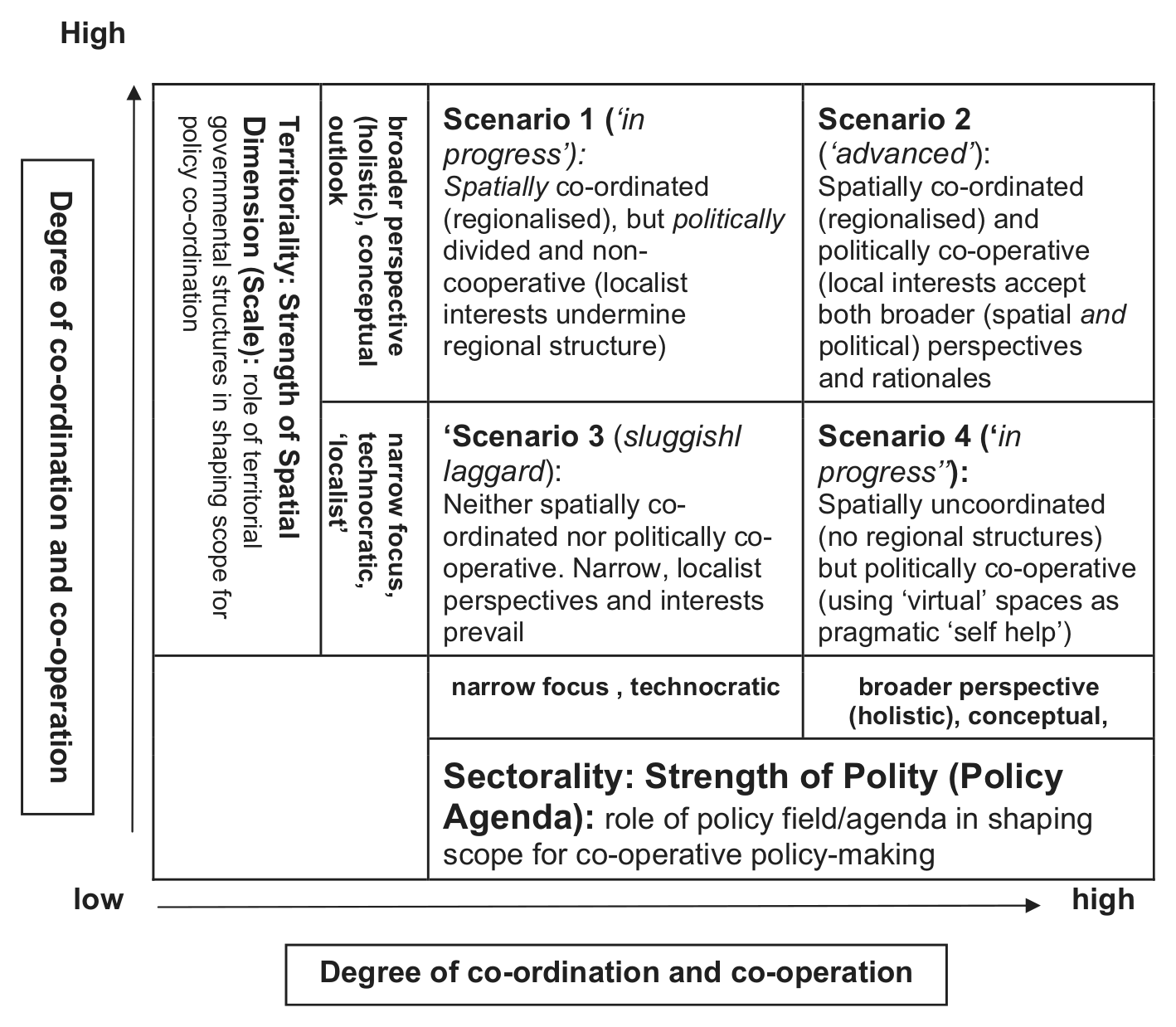
Smart city regionalism as a product of spatial and political co-operative and co-ordinative engagement.
Political ‘sectorality’ refers to equally scalarly variable policy negotiations and topical constellations, only here dealing with the sectoral policy agenda. And this may involve reaching across institutional and/or governmental-administrative structures in pursuit of greater policy efficacy, such as is expected by participating actors to benefit them all, and that brings them ‘round the table’ (Bae and Feiock, 2012). They may represent different policy sectors, possibly associated with ‘silo mentalities’ and their separate ‘own’ agendas. It is here that the notion of ‘smartness’, as implicit in ‘smart city-regionalism’, can offer an operational framework for linking the spatial and policy-sectoral perspectives to the more strategic-conceptual ‘bigger picture’ with its lesser implementational detail and thus perceived reduced ‘threat’ to individual interests and policy-making autonomy. ‘Smartness’ can do this by facilitating interactor communication, collaboration and political negotiations through a combination of both spatial scale (for example, regionalisation) as driver of policy negotiation and co-ordination, and political agenda as lead agent of co-operation (for example, competitiveness, sustainability). Smart city regionalism thus brings together the rationales, principles and legitimacies of publicly negotiated, collaborative sectoral polity with network-based and policy-described spatiality (see Figure 1). In both instances, reaching across boundaries and divisions is intrinsic to the notion of ‘smartness’.
Figure 1 shows the intersection between the two variables ‘sectorality’ (political agenda) and ‘territoriality’ (geographic dimension) in their respective varying roles in shaping degrees of policy co-ordination and co-operation. Both variables are also illustrated for their relative ‘extreme’ positions of ‘narrow focus’ (for example, localism, technocratic concern) versus ‘broader perspective’ (‘bigger picture’, strategic). This matters for the likelihood of collaborative engagement. The different scenarios shown may serve as a conceptual framework for future case study analyses to investigate the varying factor combinations in the interaction and negotiation between two (or more) policy fields and narratives, such as ‘sustainability’ and ‘competitiveness’, and the corresponding territorial outcomes. Each policy sector may be expected to seek staking out its own, most effective territory to underpin its specific policy agendas. The resulting spaces may intersect to a lesser or greater degree, including near-complete separateness or almost-complete congruence. Scope to achieve such territorialisation will vary in response to local conditions, including political capacity and capability among key actors, and acceptance of such moves among the local electorate. Involved political capital, and the degree of complexity of negotiated shared agendas, may change over time in response to learning experiences—a further feature of ‘smartness’—and shifting public debates.
‘Smartness’ as Policy Conflict Resolution through Collaborative Engagement between Policy Sectors and Spaces
The notion of ‘smartness’ in managing urban growth emerged in the US in the early 1990s (Downs, 2005; Burchell et al., 2000) as a central feature of the new smart growth concept. In its essential rationale—and there are many variations in its definition (Knaap and Talen, 2005)—it is an inherently North American, specifically US-based, concept, and needs to be understood in its specific neoliberal, locality-centric and ‘home rule’ context with its strong sense of local self-government. ‘Smart growth’ emerged as a concern about the environmental, social and economic costs of continuous suburban sprawl (Alexander and Tomalty, 2001; Dierwechter, 2008). The concept is thus inherently political. Following Scott What smart growth advocates have done is to weave together various strands of anti-sprawl discourse into a coherent polemic of sustainable development that integrates economic, environmental and social equity issues (Scott, 2007, p. 20).
From a more partisan, anti-regulation angle, some view smart growth strategies as a ‘folly’ (O’Toole, 2001) and even inherently counter-productive in making housing increasingly unaffordable. This, it is claimed, turns a “planner’s dream” into a “middle-class nightmare” (O’Toole, 2001, p. 20). It is a problem generally associated with planning control and protecting open land, such as urban green belt policies (Jones, 2007). A critical blog from 26 June 2011 on smart growth policies in the Seattle city-region put the choice like this: “Do you want 5 acres, or 5 feet?”, referring to the contrast in size—for the same price—between the building plots inside and outside the set regional growth boundary. 1
This interpretation contrasts with the praise heaped on Portland’s (Oregon) smart growth strategies, as offered by a commentator in one of Vancouver’s (British Columbia) main newspapers, the Vancouver Sun. He is entirely taken by the success of Portland’s urban growth boundaries as fixed demarcation lines for permitted development, accompanied by investment in ‘green’ transport and living, which also produces economic dividends. This, he labels ‘progressive’ policy-making (Tammemagi, 2008). Yet, it is far from clear, as Downs (2005) points out, that such a visibly and formally restrictive policy could be applied and replicated at will, given differing local political and societal milieux. Yet, the concept of ‘smartness’ per se is less place-specific and thus more widely applicable than ‘smart growth’ with its inherently more pragmatic, task-specific and technical-instrumental outlook (Bulkeley and Betsill, 2005). This draws on an underlying techno-rationalist notion that technical fixes may be possible (Guy and Shove, 2000) to allow squaring the circle of pursuing both a growth agenda and quests for more sustainability.
Such a search may facilitate engagements among policy-makers to negotiate and, eventually, implement more co-ordinated and co-operative policies across both institutional and territorial boundaries And this may go beyond the immediate focus on smart growth as a planning-based policy tool as first introduced by the American Planning Association. One of its main, rather conventional, policy tools is the drawing up of urban growth boundaries as fixed spatial limits for permitted suburban development (see inter alia, Katz, 2002; Downs, 2005; Brain, 2005; Dierwechter, 2008). Thus, Smart Growth is not no growth; rather it seeks to … foster efficient development at the edges of the regions, in the process creating more livable communities (emphasis added.)
2
Now, what is ‘smartness’ in ‘smart growth’, which also, as argued here, sits at the centre of ‘smart (new) city regionalism’? This distinction between ‘smartness’ and ‘smart growth’ matters, as the argument here is about the very nature of the idea of ‘smartness’ as a vehicle for reconciling conflicting policies and their associated territorialities, rather than an instrumentalised mechanism of development control. Thus, for instance, Ramirez de la Cruz (2009) associates ‘smartness’ with greater democratic input and a search for broader legitimacy of development goals in housing policies. Yet, there is a growing range of applications of the adjective ‘smart’. Taking its very meaning of ‘intelligent’ and ‘shrewd’, and contrasting it with ‘unintelligent’ or ‘dumb’, makes it, unsurprisingly, a favoured quality for a wide range of spaces and policy agendas. The result has been a certain ‘trendiness’ in using the adjective ‘smart’ in policy discourses—for example, ‘smart cities’ or ‘smart state’, ‘smart energy region’ or ‘smart defence’. There is thus a clear spatial (scalar) and sectoral (policy agenda) dimension to being ‘smart’. This revolves around the efficacy of policies through a best effective use of resources to produce the desired policy outcomes. These are inherently negotiated and compromised by nature, seeking policy solutions which are both publicly accepted and politically supported. Predictably, co-ordination, co-operation, innovativeness and learning are key adjectives associated with the notion of ‘smartness’ across its varying applications. This includes pursuing such seemingly conflictual policy fields as ‘competitiveness’ and ‘sustainability’ concurrently (Portney, 2003). ‘Smartness’ is thus essentially about finding a formula to bridge institutional and territorial separateness. External factors may add important stimuli to ‘kick start’ a change in local policy agenda and policy-making, or may be obstructive to such. The outcome is a product of local conditions, political leadership and external ‘stimuli’, or hindrances. Spatially, this translates into ‘new regionalist’-style forms of collaborative policy-making, based on variable spatial networks of co-operation and collaboration, with their associated (‘virtual’) policy spaces (Herrschel, 2009). These are circumscribed by functional networks (Ernst and Kim, 2002; Coe et al., 2004), rather than administrative boundaries, expressing a ‘new spatial logic’ (Castells, 1989). And it is the underlying “interactive effects that contribute to regional development” (Coe et al., 2004, p. 469), or, just as well, the development of regions as space-political entities (Brenner, 2004).
Smart city-regionalism is one particular scalar application of ‘smartness’ as outcome of the interlocking of two key dimensions: policy sector and territoriality. For once, it focuses on the regional level as the negotiated collaborative territoriality and, secondly, it flows out of a perceived need to find a more effective scale for representing, negotiating and implementing two (or more) sectoral policy agendas—as negotiated between municipalities, for instance. By the same token, the negotiated spatiality, here ‘virtual regions’, also feeds back into the co-ordinative policy-making process per se, ideally enhancing it. There is thus some form of feed-back loop between identifying a collaborative policy agenda and the willingness to engage with, in the case of smart city-regionalism, a regionalisation process/agenda, however ‘virtual’ or ‘real’ in the end. As part of that, policy networks and relations between actors with shared objectives and priorities have become increasingly important. They transgress established institutional and associated territorial structures, as they renegotiate and re-allocate responsibilities and powers in the pursuit of collaborative policy-making. In some instances, as Healey (2003, p. 107) points out, this “may have the potential to be transformative, to change the practices, cultures and outcomes of ‘place governance’”, drawing on the ‘political calibre’ of relevant actors (Healey, 1999).
This may include new interest and pressure groups and political groupings with their respective networks, as they seek to gain access to the main policy-making platforms. The inherent conceptual broadness of ‘smartness’ permits a variety of interpretations and implementations, with conflict resolution and policy efficacy as defining qualities. Yet, while such networks and informal linkages may be more responsive and problem-solving than their more bureaucratised, formalised counterparts, they are also less predictable. Chisholm (1989), based on observations from the San Francisco Bay Area, identified informal networks as more capable of solving policy conflicts, than formal mechanisms and procedures. Their relative ‘messiness’ may add, as well as reflect and allow, the varied searches for compromise and mutual accommodation of differences in policy objectives, such as subsumed under ‘new regionalism’ in all its fuzzy, yet dynamic, variable and ‘virtual’ spatiality (Keating, 1998; Söderbaum and Shaw, 2002; MacLeod, 2001b; Herrschel, 2009).
‘Smart (new) city regionalism’ as the fusion of the two concepts—new regionalism and smart growth—may thus offer a way forward to bridging divisions in associated governance, both spatial and sectoral, and between the public and governmental spheres. Thus, it may help to locate individual city-regions in a framework based on the relative importance of ‘smartness’ in relation to cross-sectoral policy-making and/or ‘new regionalist’ cross-border spatial policies. This highlights the link between new regionalist virtual, policy-based territoriality, and an innovative, learning-based framing of policies, as suggested here as underpinning ‘smart city regionalism’. This thus offers flexibility in formulating negotiated intersectoral policies, together with associated variably scaled policy spaces. Just as importantly, the notion of ‘smartness’ also offers a more visible ‘rallying point’ for public debate on the balancing between competing policy agendas—be that based on topicality, political conviction, or position inside or outside public administration, and the implications of such for rescaling and/or rebordering policy spaces.
‘Smart City Regionalism’ in the American Pacific North West: Adopting Spatial and Sectoral ‘Smartness’ in Vancouver and Seattle
The two North American examples discussed here, Vancouver and Seattle, were chosen because they: exemplify North American ‘smart growth’ conditions; possess quite similar geographical characteristics and functionalites to allow comparisons; show different historical-developmental and governmental arrangements and national circumstances; and illustrate different local historical-cultural circumstances as determinants of local policy-making characteristics. Both cities are renowned for their livability and ‘trendy’ urbanity and thus offer interesting cases to explore processes of adopting and operationalising the concept of ‘smart (new) city regionalism’ as a fusion of intersectoral policy co-ordination with interlocal co-operation at the regional scale. Seattle and Vancouver illustrate differing city-regional milieux with their specific local and external characteristics which circumscribe scope for, and practice of, smart city-regionalism. The two policy fields of seeking greater economic competitiveness and sustainability exemplify frequently conflictual policy agendas. By the same token, the cities possess similar qualitative economic and environmental features to serve as common ground for a comparative appraisal of their responses to ‘smart city regionalisation’. External differences include a greater acceptance of state regulation and state presence in society in Canada than in the US, where ‘home rule’ is a defining ideology. While both share a strong sense of local democracy, they differ in the degree to which central government (province, state) may get directly involved in Canadian compared with US cities’ affairs, including planning regulation.
Among internal factors, there are variations in the recognition and political kudos of ‘quality of life’ as a general policy agenda, subsequent acceptance of the value of intermunicipal co-operation, the need for a regional perspective, including guidance for local policy-making, a politically active urban-based (as against suburban) citizenry and its values and, importantly, the political skill and shared values among local government and interest-groups. It is here that Vancouver scores particularly strongly, helped by a city-centred active citizenry going back to the early 1970s (Donald, 2005). This reinforced Vancouver’s position as the primary focus of the city-region, whereas in Seattle urban flight has left a politically much weakened core city vis-a-vis strengthening sub/exurbs and a strong sense of independence (for example, Renton with a Boeing production site, and Redmond with Microsoft).
The analysis broadly follows the conceptualisation and criteria shown in Figure 1, with Vancouver showing characteristics of relatively ‘advanced’ smart city regionalism (scenario 2), and Seattle featuring smart city regionalism ‘in progress’ (scenario 1). Here, a city-region-wide, territorially based and technocratically focused (‘narrow’) institutionalisation, the Puget Sound Regional Council (PSRC), gained in policy contents and responsibility as a result of shifting political discourse towards broader, more strategic, agendas. This shift became evident from information gained over a 10-year period since 2002 through personal interviews with key local and regional organisations in the two city-regions. They include local economic development units and planning departments, business representations and advocacy groups (Chambers of Commerce). These embrace both the core cities and, as suburban cities (exurbs), Surrey (Greater Vancouver region), and Renton and Tacoma respectively in the Puget Sound region. In addition, the respective primary region-wide governmental planning organisations, PSRC and Greater Vancouver Regional District (GVRD), were included. These interviews were essential for obtaining insights into the local political ‘climates’ and debates, as well as experienced challenges. This information was supplemented by documentary analysis of strategy papers and plans from different points of the past decade, with a particular focus on economic development as strategic context for addressing both competitiveness (of course) and sustainability (increasingly so). Key factors examined concerned evidence of spatial collaboration between municipalities, a sense of regionality in the two city-regions, the nature of leaders in shaping policies (citizenry, the Vancouver mayor) and business interests (chambers of commerce). Evidence thus gained suggests a positioning of Vancouver’s ‘smart city regionalisation’ under scenario 2, owing to its stronger reflection of smart growth principles at a more fundamental, holistic level. Seattle, by contrast, emerges as nearer scenario 1, reflecting a greater influence of the relatively ‘soft’—and thus perceived as less ‘threatening’ for local autonomy—‘new regional’ governance arrangements. Yet, their initially limited, technocratically centred policy brief broadened over time under the auspices of ‘smartness’, following its growing profile in public policy discourse.
Both cities show distinct differences in their adoption of a city-regional perspective, including readiness to engage in topical and spatial collaborations across municipal and institutional boundaries, although with different timing and at varying pace. Differences emerged in particular between core city and respective suburbs. Sharing comparable geographical-environmental settings, economic qualities and polycentric functional structures, Seattle and Vancouver differ in their awareness and adoption of ‘smartness’, exemplified by ‘smart growth’, as a conduit for collaborative policy-making across spatial and institutional boundaries, and thus as a vehicle to seemingly ‘square the circle’ between the quests for economic competitiveness and more sustainability. Both cities, irrespective of their somewhat different national contexts for governance, share elements of a distinct Pacific Northwestern mentality (interview with PSRC, 14 November 2002) shaped by a not always easy fusion of elements of a strong sense of individuality and independence vis-à-vis an attractive ‘great outdoors’ as highly valued (common) good and equally valued metropolitan characteristics of livability and urban lifestyle. Both cities have acquired an internationally well established visibility and image as ‘trendy’ and desirable, urbane places to live (and work), such as associated with Richard Florida’s (2005) ‘creative class’, all of which are key ingredients in the two cities’ respective public (economic) policy discourses. Yet, distinct variations in nature and degree of urbanisation (Dierwechter, 2008), and national differences in the relationship between state, society and the individual, as well as between local and central government in the scalar allocation of responsibilities (Fox, 2010).
Differing planning and legal arrangements exist for identifying sprawl as a potential problem that needs a regional response, and to act upon this insight. This is one of the key differences; the other one is the extent to which there is a public perception—both in urban and suburban environments—that such regulative policies are required and, indeed, desirable, While in Vancouver, development planning control (that is ‘zoning’) goes back to the city’s first development plan of 1929 courtesy of the Provincial government of British Columbia to protect land resources from urban expansion (Donald, 2005), no such thing existed in Seattle until the early 1990s. And when it tentatively began, this was only in response to ‘high-impact’ external intervention: the Washington State government’s 1992 requirement of a regional development plan, and then the 2001 pullout of Boeing’s headquarters and transfer to Chicago. This was intended as a deliberate ‘shot across the bow’ of local policy-makers in the Seattle city-region for them to ‘get a grip’ on the city-region’s economically costly, and thus uncompetitive, continuous traffic congestion problem through a region-wide (collaborative) approach (Seattle Chamber of Commerce, interview, 20 June 2004).
By comparison, in Vancouver, and not just in the city itself, but also the surrounding suburbs/exurbs, public debate expressed, and reinforced, a preparedness to accept the principles of development control per se, and do so at the regional scale. And this had begun already in the early 1970s, in a bid to enhance urban living and quality of life. The then liberal political middle-class movement, TEAM (The Electors’ Action Movement) gained control of Vanouver city council in strongly contested elections. The backdrop to this was a perceived assault on ‘urban living’, and social equity and inclusion, by rapid urban expansion and associated extensive new road building, driven, so it was seen, by the self-serving interests of a narrow local elite of remote, “inaccessible politicians” (Ley et al., 1992). This had produced a receptive mood for ‘smart growth’ principles per se (the terminology emerged only later), including more strategic, longer-term perspectives as guidance to local policy decisions and a pursuit of co-operative policy co-ordination with neighbouring municipalities. The election results showed that such agendas had gained sufficient political currency for delivering votes, and this produced a readiness among local politicians to engage in policies that went beyond short-term, locality-centric goals. The comparatively early start in debating and formulating such concerns publicly and visibly gave the city-region a policy innovator’s edge, and also time for building a broader coalition to develop and manifest such ‘smart’ policies as an integral part of local political discourse which, in itself, had become a competitive advantage. The current mayor’s decision to use ‘greenness’ as an obvious boosterist and urban entrepreneurial (Hall and Hubbard, 1996; While et al., 2004) policy tool to promote the city’s competitiveness, is an extension of this expertise. Launching the Greenest City 2020 Action Plan in 2009, 3 just ahead of the 2010 Winter Olympics as the then promoted ‘most sustainable’ Games, is a clear statement of that. It is also an attempt to further strengthen the perception of Vancouver as innovative and creative—appealing to, and representing, the ‘creative class’ (Florida, 2005)—and even avant-garde in fusing often conflictual policy fields and pursuing an economically successful sustainability agenda. The new slogan of ‘Vancouver 2020—a bright green future’ is intended to propagate just this and suggests sufficient political capital (in terms of voter acceptance) for such a policy agenda as an expression of being embedded in the societal values in the city-region (interview GVRD, 3 November 2003). And these accept and support a shared vision as a guide to co-operative local policy-making (Healey, 2003).
The primary actor in Vancouver city-region’s governance system to deal with sustainability in a smart growth, planning-oriented sense across the city-region, is the Greater Vancouver Regional District. Formally established in 1967 through the merger of several single task special bodies (interview GVRD, 3 November 2003) by the then British Columbia government—i.e. 25 years earlier than a similar organisation, PSRC, was put in place in Seattle—GVRD was part of a Province-wide “network of regional districts” to “provide a mechanism for metropolitan government” (Sancton, 2005, p. 324) for British Columbia’s two dominant city-regions, Vancouver and Victoria. GVRD acts on behalf of the participating municipalities and is indirectly legitimated through councillors delegated to its board by those municipalities. GVRD was thus top–down implemented and then bottom–up legitimated, albeit solely as a strategic body to offer a regional perspective as guidance for local policies (Sancton, 2005). Renamed Metro Vancouver a few years ago to raise the city-region’s profile, reflecting a competitive image consciousness of the value of the very label ‘metropolitan’ for the Vancouver city-region’s urban attractiveness as a place, its latest strategic development document, ‘Metro Vancouver: 2040 strategy’—also referred to as a regional growth strategy by the GVRD, adopted in July 2011 by all relevant municipalities— seeks an explicit fusion of both competitiveness and sustainability. The strategy thus is in the mould of ‘smart city regionalism’. Its sustainability agenda, so it is pointed out, is not a fashionable ad hoc add-on, but goes back to the 2002 ‘Sustainable Region Initiative’. That was followed (2008) by a more explicitly growth-oriented ‘Sustainability Framework’ for a Regional Growth Strategy. It was approved by all municipalities in the city-region as joint ‘shareholders’ in Metro Vancouver (Metro Vancouver, 2011), including the two main suburban cities of Surrey and Richmond which, in terms of population, are themselves the size of Vancouver and strongly in favour of ‘growth’ (interview, Surrey EDU, 4 November 2003).
The main ‘voice’ for economic development is the small organisation Vancouver Economic Committee (VEC), an advocacy group well connected to both the business community and the city council (the city mayor is the VEC chairman). Its primary mission is to promote Vancouver as a place to invest and act as a platform to communicate business interests and concerns to the administration (VEC interview, 4 November 2003). VEC thus sees itself as a key player among the ‘context people’ focusing on strategy, rather than detailed implementation of policy (interview with VEC, 23 October 2006). Its recent Economic Development Strategy document 4 shows sustainability clearly presented as an integral economic quality, inherent in the city as a ‘smart’, economically successful location. And this squaring the seeming circle is confirmed by observations made by Smart Growth British Columbia (SGBC), a lobbying and research organisation advocating ‘smart growth’ for British Columbia (Alexander et al., 2004). The key characteristics of ‘smartness’, as understood here, have thus entered Vancouver’s policy-making on the back of long-established popular concerns about maintaining the city’s competitive edge, including environmental values as presumed ‘appeal’ to the ‘creative class’ as perceived bedrock of the city-region’s economic capacity.
In Seattle, regionalisation of the political (rather than the technocratic) arena has been slower to evolve than in Vancouver. Only since the late 1990s (interviews at the Tacoma Economic Development Unit (EDU), 6 October, 2002, and Seattle Corporate Planning Dept, 5 October 2002), has the regional scale entered the wider political realm within the city-region as a debated potentially useful device in economic policy and urban development generally, rather than as a mere tool for the technically driven provision of public transport. Yet, it was the latter that established a city-regional approach in the shape of the Puget Sound Regional Council (PSRC), established in 1990 by the State of Washington. Similar to Vancouver and the GVRD, formal regional agency was thus installed from the top down. Otherwise, localist competition prevailed in this polycentric city-region around the two main poles of Seattle and Tacoma (interview at Tacoma EDU, 6 October 2002). This public recognition of a regional policy-making dimension, became, shortly after the passing of Agenda 21 at the Rio Summit, manifested by the 1994 statutory requirement by the State of Washington for the city to adopt an area-wide comprehensive development plan to address rapid sprawl, road congestion and the insufficient provision of public transport outside the central-city area. Up to then, no spatially contiguous strategic plan existed for the municipalities in the city-region. Seattle’s new plan followed the then newly articulated basic principles of ‘smart growth’ as the politically less contentious ‘face’ of more restrictive development control policies in conjunction with a regional perspective. Adopting elements of Vancouver’s plan as exemplary allowed policy-makers to advocate the city-regional agenda on the back of Vancouver’s recognised positive and successful ‘livable’ image as a strategy to follow.
Institutionally ‘soft’ (MacLeod, 2001a), and thus perceived by municipalities and the electorate as less of a potentially irrevocable surrender of local autonomy, since the mid 1990s PSRC has continued to raise its profile beyond its original public transport focus, and has established itself as a regionally operating agency with a wider development strategy remit. Its current mission is to ensure a thriving central Puget Sound now and into the future through planning for regional transport, growth management and economic development.
5
This is not dissimilar to GVRD’s goal in Vancouver, the example it was modelled on. The region’s somewhat anodyne name, Puget Sound, based simply on a geographical feature, rather than place, reflects its attempt not to upset local sensitivities among the smaller municipalities—but also the ‘second city’, Tacoma, about Seattle’s dominance (Fox, 2010). For marketing, Greater Seattle would be a more effective name, as indeed used by the Trade Development Alliance of Greater Seattle. In addition, the two port authorities of Seattle and Tacoma jointly sought to raise the city-region’s international profile (interview, Tacoma EDU, 6 October 2002) through co-ordinated marketing. Yet this was about external visibility, rather than addressing internal city-regional divisions, especially between the urban centres and their suburbs—and this also embraced transport strategies (interview, Renton Mayor’s Office, 5 November 2003).
The low-key, locally ‘non-threatening’ nature of ‘region’ is also reflected in PSRC’s web address extension ‘.org’: It is clearly an organisation outside the governmental hierarchy and thus without statutorily established powers that could cut across, and challenge, local interests. Instead, it operates akin to “a regional UN [United Nations]”, as a leading PSRC planner commented (interview PSRC, 14 November 2002), with much debating and slow decision-making. Yet, the PSRC offers a publicly visible political arena for debating conflicting interest and policy priorities across municipalities and between policy fields, including conflicting agendas, and formulating compromise policies. And it is this capacity as a catalyst of a wider, more integrated, regional policy-making dimension that sits at the heart of the notion of ‘smartness’ in city-regional governance, rather than the search for a ready-made agenda and planning mechanism, as seemingly offered by ‘smart growth’.
With no public preparation for a regional agenda in development policy prior to the 1990s, it was business interests that first engaged with the idea of collaborative, more policy-oriented ‘smart new city regionalism’, rather than governments or the electorate. In contrast to the much earlier start of such developments in Vancouver, Greater Seattle’s adoption of a city-regional dimension in policy-making has been relatively slow, made possible only when a win–win solution emerged for all actors involved, across spatial and topical divides. The associated mental and administrative boundaries—criss-crossing the Puget Sound region—manifest existing individualism, self-interest, localism and socioeconomic differences, especially between city cores and suburbs. Finding and adopting a shared and generally accepted collaborative way forward faces many obstacles, especially concern about losing local financial control (taxation) and, politically important, popular local support. “Cities are like little kingdoms”, an official in the Mayor’s Office of the suburban city of Renton observed (interview, 5 November 2003). Yet, to promote their interests, cities are willing to co-operate with like-minded municipalities as a pragmatic vehicle ultimately to pursue their own interest. One example is the Suburban Cities Association in King County (interview PSRC, 14 November 2002). The PSRC’s office location in central Seattle, unlike GVRD’s suburban location outside Vancouver, however, will have done little to alleviate concerns about Seattle seeking to ‘run’ the region by proxy.
A change in public perception, and thus acceptance of the also local merits of pursuing regionally collaborative political agendas, is required for accepting as useful ‘smart new city regionalism’. Yet, innovative policies may emerge from that, such as currently developed between PSRC and the four counties in Puget Sound. There, individual municipalities can agree a partnership deal with “their” county about transferring (for a fee) development rights (TDRs) for a piece of green space to the county, effectively taking it out of municipal control and thus removing it from direct local political contestations about its development potential (PSRC, 2009).
The political-conceptual underpinnings for adopting the principles of smart city regionalism differ between the Vancouver and Seattle city-regions as, in the latter, ‘soft’ administrative structures came first as part of a technocratic agenda, which then tentatively moved onto the broader, political-ideological ground of sustainable development planning and policy as a regional, rather than local, agenda, while faced by a sceptical local government and public. In the Vancouver region, such a policy perspective has, as part of public discourse, existed much longer than in Seattle, allowing the GVRD to base its policies on their latent acceptance by the electorate. In Seattle, by contrast, public and political opinion needed to be convinced of the virtues of regionalisation first—in principle requiring such symbolic actions such as Boeing to kick-start debate. Thus, PSRC’s current 2040 Vision strategy claims to focus on “people, property, planet” as guidance for the Growth Management, Environmental, Economic and Transportation Strategy for the Central Puget Sound Region. 6 This reflects an attempt publicly to reconcile competing (individual) economic interests, expressed in property ownership and its value, and global sustainability (Freilich et al., 2010).
Conclusions and Outlook: ‘Smart City Regionalism’ as Framework for Collaborative and Negotiative Policy-making
Drawing on the core rationale of the North-American-based concept of smart growth as a planning vehicle, this paper has sought to extricate and develop the notion of ‘smartness’ as a mechanism for reconciling conflicting policy ideals and trajectories in local policy-making. Smart growth seeks to facilitate a shift in values, priorities and perspectives from a narrow, short-term and often monetary, perspective, to a broader, more holistic and longer-term view embracing both collaborative political processes and spatial perspective. City-regions provide a particularly potent and interesting scalar arena for such discussions, as they bring together varying political-economic, social and governmental-administrative arrangements and agendas, with some being more congenial than others. Contestations, negotiations and objections are thus an integral characteristic of city-regional governance.
‘Smartness’ has been distilled as the central concept out of smart growth, taking it out of its particular planning-focused, technocratic context, and discussing it as an analytical framework for exploring the intersection between territoriality (spatial scale) and sectorality (political agenda). Discussions may be broad and inherently complex, contested and diffuse, as both growth-oriented ‘competitiveness’ and ‘sustainability’ are being pursued. One of the key features of ‘smartness’ is a preponderance for the regional scale as mediating platform between local and international considerations for ‘competitiveness’ and ‘sustainability’ policies. It is regionalism, in its ‘new’, i.e. less structure and more relationally and topically driven nature, with variable organisation of governance-territoriality, that has been connected here with the notion of ‘smartness’ as effective organising rationale and principle. ‘Smart (new) city regionalism’, offers a conceptual strategic scalar platform and spatial reference—including a temporal perspective—for potential policy negotiations and compromises, as well as analytical comparisons of collaborative arrangements and agendas between territories and policy sectors, such as also found in Healey’s (1999, 2003) notion of ‘collaborative planning’—or ‘collaborative governance’ respectively.
Two examples, Vancouver and Seattle, have been used to illustrate different trajectories of engaging with ‘smart (new) city regionalism’, discussed here as a means of ‘squaring the circle’ in the pursuit of the two policy fields of ‘competitiveness’ and ‘sustainability’. Developments in the two cities point to the respective roles played by territory and politics in framing collaborative arrangements for ‘smart city regionalism’ as vehicle for negotiating between the conflicting and competing goals of ‘competitiveness’ and ‘sustainability’. In Vancouver, an existing civic acceptance of the benefits of placing the individual and local into a wider spatial and value context had provided a receptive and supportive political ground for accepting ‘smartness’ as a guiding principle. This was also shaped by a national appreciation of the positive roles of state and regulation, and of society as a context for the individual. And this included city-regional scale of governance, values, actors, public discourse and agency-shaped structure. In Seattle, by contrast, a nationally more critical, pro-individualism and localist view, often coupled with a short-term, technocratic perspective, made the framing of city-regional governance more challenging, needing to ‘grow’ into a broader, strategic perspective. Installing an ‘unthreatening’, low-key regional structure first seems to have sown the seeds for later accepting broader-defined collaborative city-regional governance.
Footnotes
Acknowledgements
The author would like to express his gratitude to two anonymous referees for their extremely helpful, constructive comments, to the Guest Editors for their equally helpful and supportive comments and suggestions on the initial draft, and for all their work in putting this Special Issue together, and the Editor for his supportive patience.
Funding
This research received no specific grant from any funding agency in the public, commercial or not-for-profit sectors.