




Abstract
Prior research has shown that neighbourhood racial and income contexts remain similar across generations within White, Black and Latino families in the US. This article builds on this research by examining the extent to which geographical mobility during the transition to adulthood attenuates the perpetuation of residential segregation from Whites among Asians, Blacks and Latinos. Data from the National Education Longitudinal Study linked to 1990 and 2000 US census data were analysed. Results suggest that residential exposure to Whites is similar during youth and adulthood among young adults who live in the same metropolitan area where they lived as adolescents, regardless of race/ethnicity. Among those who migrate to another metropolitan area, adolescent exposure predicts exposure among Asian, Black and Latino young adults, but not among Whites themselves. Thus, limited experience with integrated neighbourhoods during adolescence among non-Whites and limited geographical mobility among all young adults help to perpetuate segregation.
Segregation between Blacks and non-Blacks has declined substantially in US metropolitan areas since the 1960s and all-White neighbourhoods have become increasingly rare (Glaeser and Vigdor, 2012). Yet most Blacks continue to live in neighbourhoods with relatively few non-Hispanic White neighbours (Logan and Stults, 2011). 1 Hispanics and Asians, especially those born in the US, are somewhat less segregated from Anglos. Yet even among US-born Asians, residential segregation from Anglos remained largely unchanged between 1990 and 2000 and at levels that were substantially higher than for contemporary European immigrants (Iceland, 2009). US-born Hispanics were consistently even more segregated from Anglos than Asians during the same period. Thus, despite the growing diversity of US metropolitan areas, the spatial separation of Anglos from non-Anglos still accounted for about three-fourths of overall residential segregation as of the 2000 US census (Farrell, 2008).
Household formation and household mobility tend to perpetuate residential segregation and associated racial disparities in access to place-based resources and opportunities. Anglo, Black and Latino adults typically live in neighbourhoods that are similar in terms of both racial composition and economic status to those where they lived as children (Borjas, 1998; Dawkins, 2005; Goldsmith, 2010; Sharkey, 2008; Vartanian et al., 2007). Partly as result, Blacks and Hispanics typically live in neighbourhoods that have fewer Anglo residents, have higher poverty rates and provide lower returns on investments in homeownership, compared with the neighbourhoods inhabited by Anglos with the same household incomes (Flippen, 2004; Logan, 2002; Quillian, 2012). Moreover, when households move, they typically move to neighbourhoods that have racial compositions similar to those of the neighbourhoods they left behind (Crowder et al., 2012; Crowder et al., 2006; South and Crowder, 1998). Hence, understanding why people continue to live in similar neighbourhood racial contexts at different stages of the life course despite relatively high levels of residential mobility will be crucial in understanding why high levels of residential segregation between Anglos and minorities have been slow to change.
Unfortunately, little prior research has specifically examined whether intermetropolitan mobility during the transition to adulthood is associated with less similarity in neighbourhood racial contexts during youth and young adulthood. This omission is problematic because the prevalence of short-distance moves plays a key role in ensuring the similarity of residential environments experienced by individuals and families over time and across generations (Crowder and South, 2008; Crowder et al., 2006; Sharkey, 2008). Geographical mobility, in turn, varies substantially across the life course, peaking during the transition to adulthood (Schachter, 2001). Hence, young-adult geographical mobility could attenuate the perpetuation of residential segregation.
In this paper, we examine the relationship between neighbourhood exposure to Anglos among young adults and the racial composition of the residential areas where they lived as adolescents in order to answer three central questions. First, how strongly is residential exposure to Anglos transmitted from youth to young adulthood? Secondly, to what extent does geographical mobility attenuate this transmission? And finally, what role is the geographical mobility of young adults likely to play in eroding the persistence of residential segregation between Anglos and other racial/ethnic groups? Unlike prior studies, we examine the relationship between residential exposure to Anglos in youth and young adulthood in separate models for Anglo, Asian, Black and Latino young adults and by two levels of geographical mobility, those who remained in the same metropolitan area and those who moved to a different metropolitan area. As we explain, there are reasons to believe that racial/ethnic groups not only differ from each other, but also that geographical mobility affects them differently. We examine these relationships using data on individual and family characteristics from the National Education Longitudinal Study and data on the percentage Anglo in respondents’ residential areas during adolescence and young adulthood from the 1990 and 2000 US censuses.
Theory and Prior Research
The vast literature on status attainment documents a high degree of similarity in educational attainment and income across generations (see Rumberger, 2010, for a recent review). Moreover, parents often transfer substantial resources to their children during the latter’s transition to adulthood (Schwartz and O’Brien, 2009). Further, greater family and individual resources are associated with greater residential exposure to Anglos (Charles, 2003). One might expect, then, that the intergenerational transmission of socioeconomic status and resources would be sufficient to ensure that individuals typically live in residential areas that provide similar levels of exposure to Anglos during adolescence and young adulthood. Yet in fact, the intergenerational transmission of family economic status does not account for the intergenerational similarity of neighbourhood characteristics (Borjas, 1998; Dawkins, 2005; Goldsmith, 2010; Sharkey, 2008; Vartanian et al., 2007). Hence, family economic resources may not account for the similarity of neighbourhood characteristics during adolescence and young adulthood either.
The Role of Limited Geographical Mobility
Limits on mobility may contribute to continuity in residential exposure to Anglos across distinct stages of the life course. From any given year to the next, well over 80 per cent of individuals remain in the same residence (Schachter, 2001). Even among 20–24-year-olds, nearly two-thirds also stay put from year to year. Moreover, the majority of those who do change residences remain in the same county. More generally, migration flows decrease exponentially with increasing distance (Caldwallader, 1992). In turn, not only are US metropolitan areas segregated in the sense that they are characterised by highly uneven distributions of Anglo and non-Anglo residents across neighbourhoods; neighbourhoods with similar racial compositions (for example, predominantly Anglo) tend to cluster together geographically as well (Iceland et al., 2002; Massey et al., 1996). A short-distance move to a new residential area therefore typically entails arriving in a nearby destination with a very similar racial composition. Hence, we arrive at Hypothesis 1: Higher levels of residential exposure to Anglos in adolescence are associated with higher levels of exposure in young adulthood.
Unlike short-distance moves, there is no coincidental similarity of racial contexts between the origin and destination neighbourhoods for long-distance moves. Hence, we suggest Hypothesis 2: The association predicted by H1 will be weaker among young adults who moved to a different metropolitan area.
Contact and Racial/Ethnic Socialisation Effects
Residential exposure to Anglos may be similar during adolescence and young adulthood even among young adults who migrate to places distant from their childhood residences. The contact hypothesis predicts that opportunities to observe and interact with members of other racial/ethnic groups lead to lower levels of prejudice, foster more favourable perceptions of intergroup relations and increase the likelihood of integrated marriages and friendships (Emerson et al., 2002; King and Bratter, 2007; Sigelman and Welch, 1993). Childhood experience with living in relatively integrated residential areas is also associated with more favourable attitudes towards residential integration (Jackman and Crane, 1986) and increased residential exposure to other racial/ethnic groups in adulthood, at least among Blacks and Whites (Dawkins, 2005).
Contact effects should be particularly pronounced among Anglos, since Anglos generally express lower levels of support for residential integration than do members of other racial/ethnic groups, especially Blacks (Charles, 2003, 2006; Krysan et al., 2009). Therefore, the contact hypothesis suggests that Anglos who lived in less racially isolated residential areas (i.e. those with lower proportions of Anglo residents) as adolescents will be more willing to move into such areas as adults. Thus, we expect the following Hypothesis 3: Even among those who move to a different metropolitan area, lower levels of Anglo residential isolation during adolescence are associated with lower levels of isolation among Anglo young adults.
Ihlanfeldt and Scafidi (2002) show that Blacks’ neighbourhood racial composition preferences significantly predict the racial composition of the neighbourhoods where they live, but explain relatively little of the variation in this outcome. Perhaps even more fundamentally, non-Anglos tend to have relatively favourable views towards social contact with and residential propinquity to Anglos, regardless of whether they have experience with living in integrated settings (Charles, 2006). Hence, exposure to Anglos in one’s residential area as an adolescent seems unlikely to exercise a strong causal influence on where geographically mobile non-Anglo young adults live purely by virtue of fostering more favourable racial attitudes towards living in predominantly Anglo neighbourhoods.
Residential exposure to Anglos during adolescence can nonetheless be expected to affect residential exposure to Anglos, even among non-Anglo young adults who have relocated to a new metropolitan area. Non-Anglo adults educated in integrated settings have often developed social skills that enable them to deal with prejudice and discrimination more effectively than adults who lack these experiences (Wells et al., 2005). Because school and neighbourhood racial composition are closely linked in the US, non-Anglos who as adolescents lived in residential areas that provided exposure to Anglos are more likely to have such skills as young adults. Moreover, residence in integrated neighbourhoods is associated with parental socialisation aimed at preparing non-Anglo children for dealing with discrimination (for a recent review, see Hughes et al., 2006). Young adults socialised in this way may be more adept at overcoming the well-documented discriminatory barriers to mobility in housing markets often faced by members of non-Anglo racial/ethnic groups (Turner, et al., 2002). Thus, we propose the following hypothesis Hypothesis 4: Higher levels of residential exposure to Anglos during adolescence are associated with higher levels of exposure during young adulthood among non-Anglos who move to new metropolitan areas.
Data and Methods
We test our hypotheses in weighted-least-squares regression models with individuals as the unit of analysis and percentage non-Hispanic White in their young-adult residential areas as the dependent variable. Independent variables include characteristics of their adolescent residential areas, individual and family characteristics, and characteristics of their young-adult metropolitan areas.
The data come from the restricted version of the National Education Longitudinal Study (NELS) and Summary File 3 of the Censuses of Population and Housing. The base-year of the NELS is a stratified probability sample of eighth graders in the US in 1988. Follow-ups occurred in 1990, 1992, 1994 and 2000. Most respondents were 26 years of age in the final wave. We limit our sample to 7146 respondents who met three criteria. We selected respondents who participated in all waves; were Anglo, Asian, Black or Latino; and lived in metropolitan areas in 1992 and 2000. Even with these restrictions, the NELS provides information about large samples of Anglo (n = 4774), Black (n = 682), Latino (n = 1,079) and Asian young adults (n = 641).
The US census provided information about metropolitan areas and residential areas at the level of five-digit residential postal codes (i.e. ZIP codes). The latter were recorded separately for NELS respondents in 1988, 1990, 1992 and 2000. We attached 1990 Census data aggregated by ZIP code tabulation areas (ZCTAs) to the 1990 and 1992 waves and 2000 census data to the 2000 wave.
Measures
Means and standard deviations for all variables, by race/ethnicity, are available in the Appendix. Our dependent variable is the percentage non-Hispanic White alone in the respondent’s 2000 ZCTA, when respondents were about 26 years of age. Our main independent variable is the percentage non-Hispanic White in the respondent’s ZCTAs averaged over the teenage years (1990 and 1992). Although many US-based studies use census tracts to operationalise neighbourhood (for example, see Dawkins, 2005; Sharkey, 2008), ZIP-code-level measures have also been used (Borjas, 1998; Goldsmith, 2010). Unfortunately, the NELS data do not identify exactly where respondents lived within their ZIP codes, making it impossible for us explicitly to compare our results using measures derived from other spatial units.
Our measures of neighbourhood racial context only indicate the level of potential interaction between Anglos and non-Anglos within ZIP codes (Massey et al., 1996), not the extent to which intergroup social contact actually occurred. Neighbourhood racial composition may be more strongly associated with some forms of intergroup social contact when measured for smaller units like tracts or even smaller clusters of blocks, since these interactions (for example, greeting a neighbour on the street) are very localised (Guest et al., 2006; Mouw and Entwisle, 2006). Thus, ZIP-code-level measures may overstate the extent to which such interactions can even potentially occur, particularly in ZIP codes that are racially heterogeneous, but internally segregated. Yet ZIP-code-level measures may also capture (potential) intergroup contact in settings like schools, local businesses and public parks that draw residents from localised areas that are nonetheless often markedly larger than tracts (for example, see Mitchell et al., 2009). More generally, because ZIP codes are constructed to increase the efficiency of mail delivery, their boundaries tend to coincide with physical barriers such as rivers, freeways, railroad tracks and dead-end streets that also help to define racially distinct residential areas (Grannis, 1998).
Each of our multivariate models includes controls for several characteristics of the metropolitan area (MSA or PMSA) where the respondent lived as a young adult. First, we control for the proportion of housing built since 1969 because US metropolitan areas with relatively more housing built after the passage of the 1968 Fair Housing Act have lower levels of Black–White segregation (Frey and Farley, 1994; South and Crowder, 1998). 2 Similarly, we control for the suburbanisation rate, since suburban communities have historically used zoning ordinances and other measures to restrict in-migration by racial/ethnic minorities and especially Black households (Frey and Farley, 1994). Recent research continues to show that higher metropolitan suburbanisation rates are associated with lower neighbourhood-level exposure to Anglos among Black households (Crowder et al., 2012). Following the practice employed in studies of household mobility (Crowder et al., 2006; South et al., 2008), we also control for the proportion Anglo in the metropolitan area. The percentage Anglo in the metropolitan area should be positively associated with ZCTA-level exposure to Anglos because metropolitan areas with larger shares of non-Hispanic Whites overall provide greater opportunity to move into predominantly Anglo residential areas. Finally, we control for metropolitan areas’ gross median rents because higher rents constrain renters’ housing choices and are highly correlated with housing values (r = 0.86), which place similar constraints on home buyers.
Since there is a high degree of continuity in neighbourhood affluence among Black and White families across generations (Sharkey, 2008), it is possible that associations between prior and later racial contexts reflect an underlying continuity of socioeconomic contexts from adolescence to adulthood. To account for this possibility, we control for the natural log of median income in the respondent’s ZCTAs (averaged over 1990 and 1992 values). We also control for a number of individual and family background characteristics that were measured during the eighth grade (1988). These include the respondent’s composite score on standardised tests of reading and math skills, family structure indicators and the natural log of family income. To capture variation in acculturation, dummy variables are used to identify adolescents who had: a minority language background; and at least one immigrant parent. We also include two variables capturing variation in available resources during young adulthood: whether the respondent had completed at least a bachelor’s degree by 2000 and the natural log of the respondent’s family income in 1999.
Statistical Model
Base-year NELS data were collected by stratifying eighth-grade schools, sampling schools within strata and then sampling students within selected schools. Stratification and multistage sampling can each bias estimates of standard errors, so we correct for them using Taylor-linearised variance estimation (Statacorp, 2009). In addition, the sample of individuals chosen to participate in the final panel of NELS data is a probability sample of earlier samples plus an oversampling of individuals unlikely to respond on follow-up surveys to reduce bias from attrition. To account for the unequal probabilities of selection into the final panel, we use the weight designed for analyses of all panels (i.e. NELS variable F4PNLWT). With these corrections, estimates are representative of individuals who were eighth graders in the US in 1988.
We regress the teenage ZCTA percentage non-Hispanic White on the same thing in adulthood in two sets of models each for Anglo, Asian, Black and Latino respondents who have formed independent households. In the first set, we only include respondents who have formed independent households in the same metropolitan area where they lived as adolescents. In the second, we only include respondents who have migrated to a different metropolitan area between 1992 and 2000. 3 Each set of models is estimated with and without control variables using Stata 11.
Results
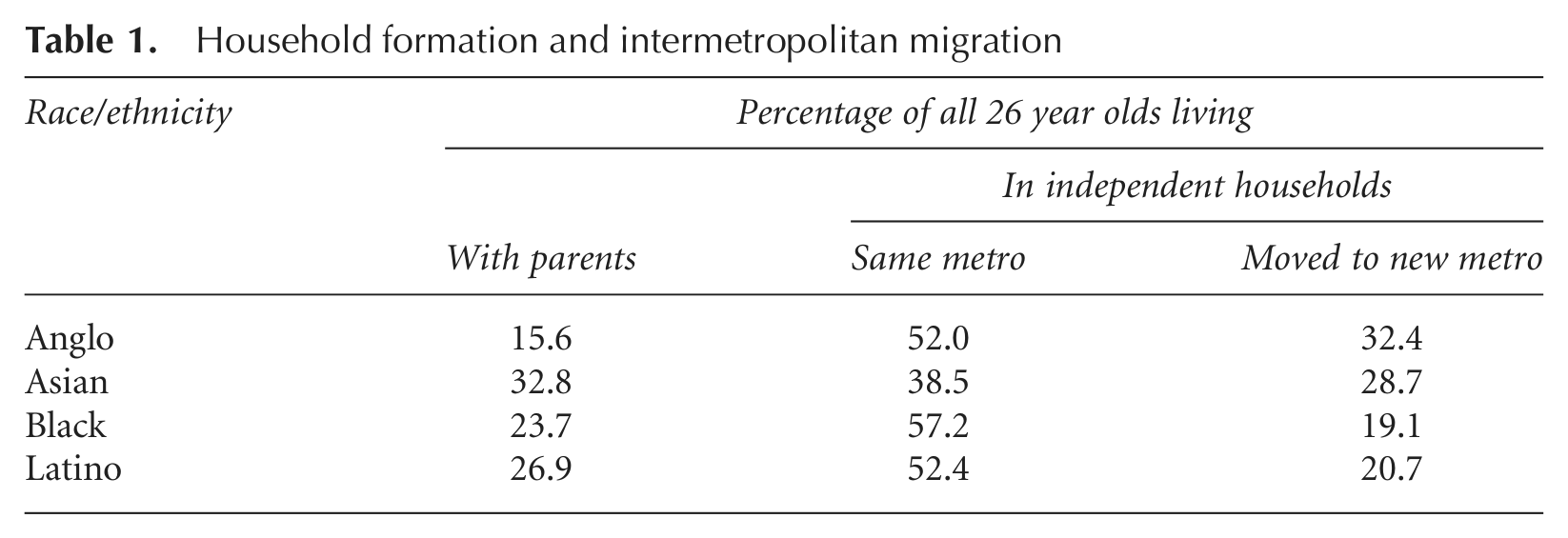
Table 1 shows the weighted distribution of young adults who: had not established an independent household; had established an independent household in the same metropolitan area where they lived as adolescents; and, had migrated to a new metropolitan area. Anglos are more likely to move to a new metro area (32.4 per cent) than Asians (28.7), Blacks (19.1) or Latinos (20.7).
Household formation and intermetropolitan migration
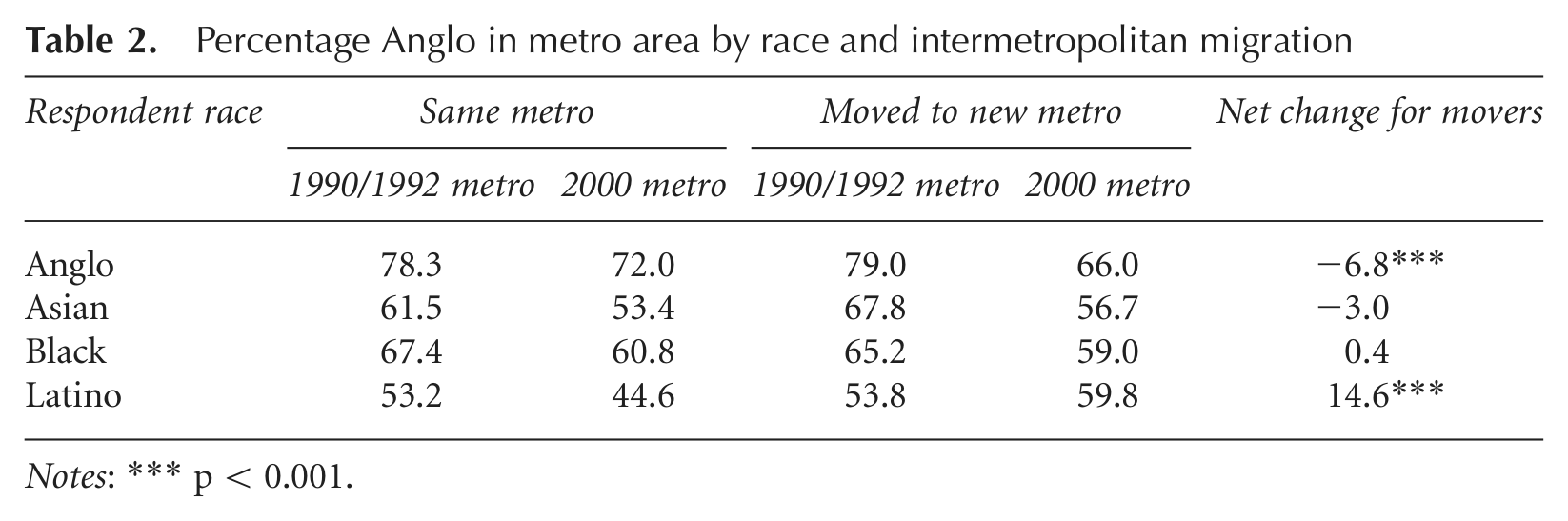
In Table 2, we examine Anglo, Asian, Black and Latino respondents’ exposure to Anglos in their metropolitan areas separately for those who did and did not migrate to a new metropolitan area. Metropolitan areas have smaller proportions of Anglos in 2000 on average than they did in 1990 because the proportions of Asians and Latinos in the US as a whole increased (Bean and Stevens, 2003). Further, young-adult migrants in the US typically move to larger metropolitan areas (Plane et al., 2005), many of which have lower proportions of Anglos than those they migrate from. Thus, as our sample ages, their metropolitan areas should have relatively fewer Anglo residents.
Percentage Anglo in metro area by race and intermetropolitan migration
Notes: *** p < 0.001.
Consistent with these general observations, Table 2 shows that the percentage Anglo in the sample’s metropolitan areas decreases between 1992 and 2000 among respondents in all racial/ethnic groups who remained in the same metropolitan area. Among intermetropolitan migrants, however, the percentage Anglo is lower in the destination metropolitan areas of Anglo, Asian and Black respondents but not Latino respondents. For Latinos, it is higher. Additional analyses (not shown) revealed that this result reflected Latino out-migration from metropolitan areas on or near the US–Mexico border in predominantly Latino south-west Texas, including Brownsville, El Paso, McAllen and San Antonio. Latino migrants from these places typically relocated to major population and employment centres with relatively large Anglo populations, primarily in eastern and central Texas (i.e. Austin, Dallas and Houston). For all other Latino migrants, the percentage Anglo in their destination metros was slightly lower on average than the percentage Anglo in the metros where they lived as adolescents (60.9 in the destination metros vs 61.9 in the adolescent metros).
The last column of Table 2 examines whether the changes in metropolitan areas’ percentage Anglo are significantly different for migrants and non-migrants. Migration was not associated with substantial net changes in the percentage Anglo in the metropolitan areas experienced by either Black or Asian young adults. Yet as expected, Anglo migrants moved to metropolitan areas with relatively fewer Anglos than those where non-migrant Anglos lived. Supplemental analyses (not shown) indicated that this pattern was largely the result of many migrating Anglos moving from the Northeast and Midwest to destinations in the South and West. Conversely, Latino migrants moved to areas with relatively more Anglos than those where non-migrant Latinos lived. Again, this latter result primarily reflected the relatively high percentage Anglo in destination metros among Latinos who migrated from metros in south-west Texas on or near the US–Mexico border.
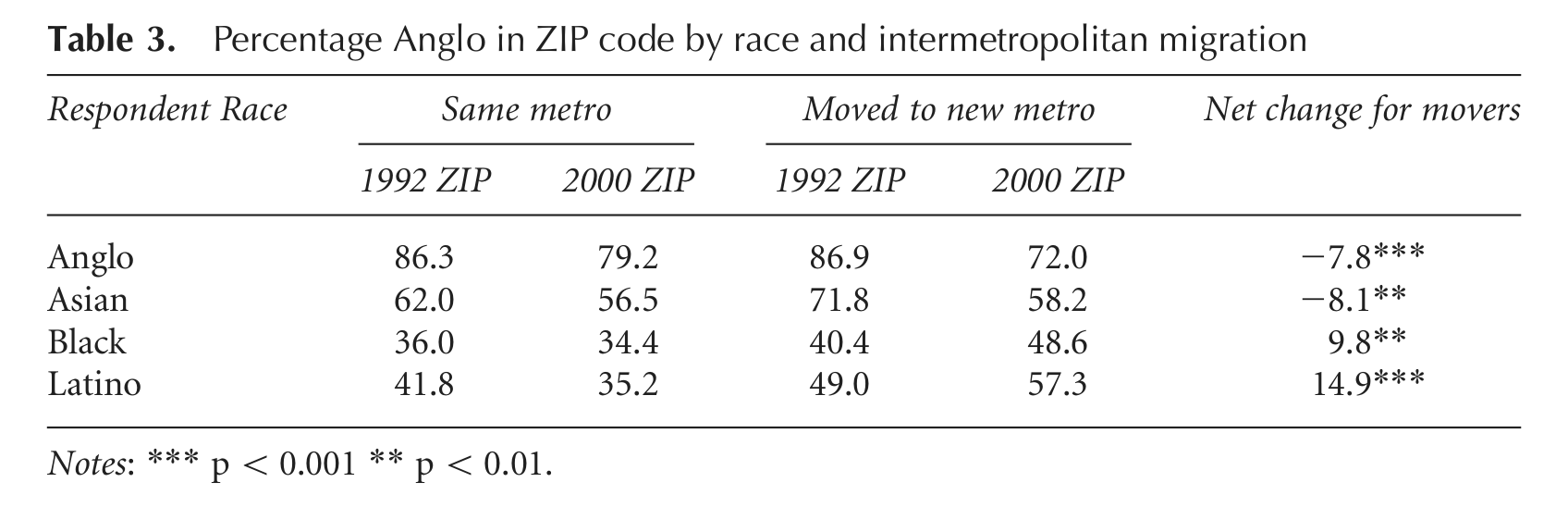
Table 3 is analogous to Table 2, but it examines percentage Anglo in respondents’ ZCTAs instead of their metropolitan areas. As shown, Anglo, Asian and Latino non-migrants live in ZCTAs with relatively fewer Anglos in young adulthood than those they lived in as teenagers. For Blacks, this change is very small. Intermetropolitan migrants who are Anglo or Asian also move to ZCTAs with relatively fewer Anglos on average. Intermetropolitan migrants who are Black or Latino, in contrast, move to ZCTAs that have relatively more Anglos than those of their origin.
Percentage Anglo in ZIP code by race and intermetropolitan migration
Notes: *** p < 0.001 ** p < 0.01.
As seen in the last column of Table 3, the change in migrants’ exposure to Anglos in their ZCTAs is statistically greater than that of their non-migrating counterparts. However, the direction of change varies by race/ethnicity. For Anglos and Asians, migration is associated with less exposure to Anglos; for Blacks and Latinos, migration is associated with increased exposure. For Anglos and Latinos, the changes in their ZCTAs mirror the change in their metropolitan areas (as seen in Table 2). However, Black migrants substantially increase their ZIP-code-level exposure to Anglos (by nearly 10 percentage points relative to non-migrants), even though there is no significant change in the percentage Anglo in their metropolitan areas. Similarly, Asian migrants significantly decrease their ZIP-code-level exposure relative to non-migrants, but not their metropolitan-level exposure to Anglos.
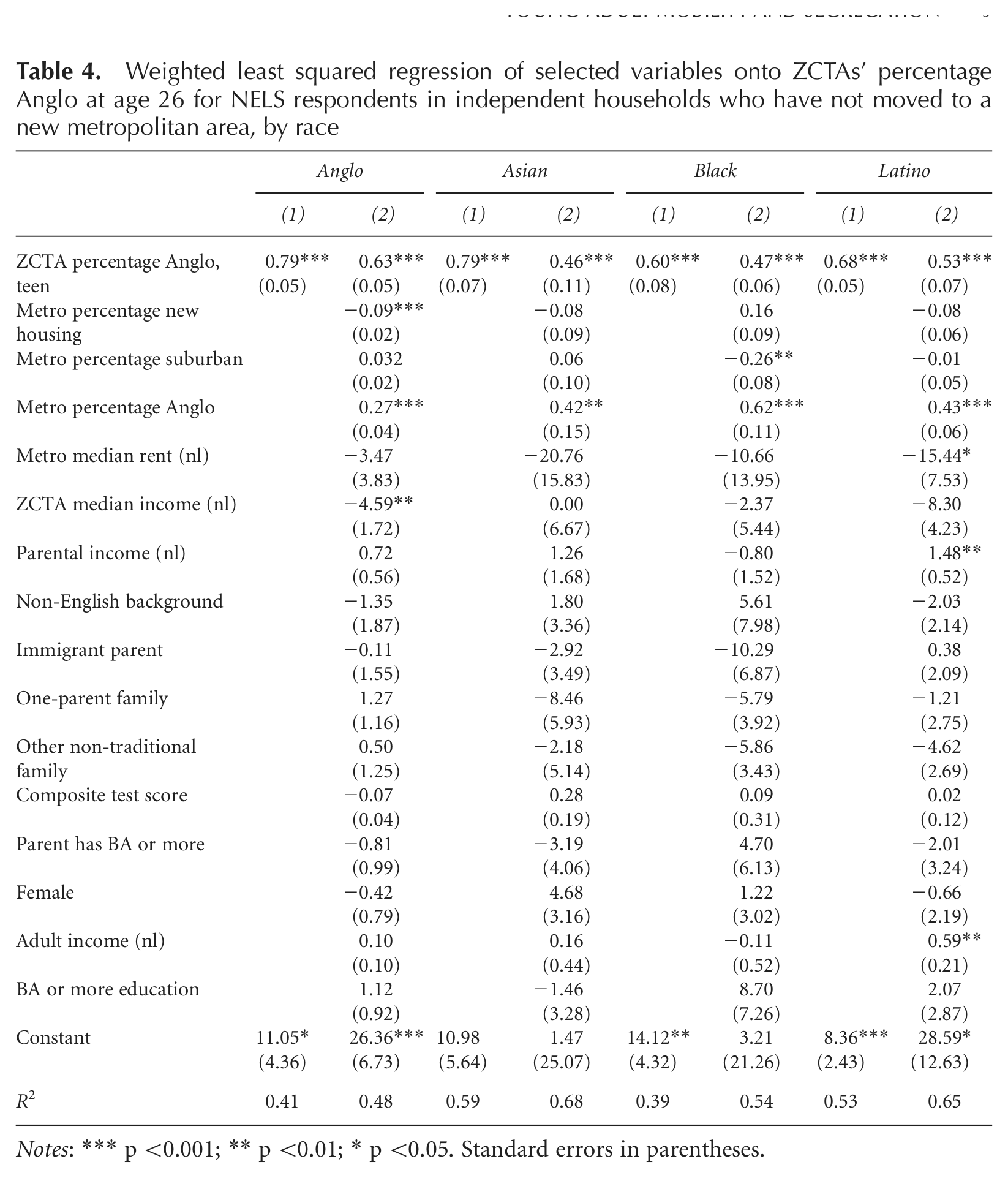
Next, we examine the correlates of residential exposure to Anglos in young adulthood with regression models, shown in Tables 4 and 5. Before examining the influence of percentage Anglo in the adolescent residential areas (our main interest), we briefly discuss the effects of the other independent variables. The coefficient for metropolitan areas’ percentage Anglo is consistently positive and significant for Anglos, Asians, Blacks and Latinos in all models in both tables. The percentage of housing built after passage of the Fair Housing Act in 1968 has integrative effects for Anglos and especially for geographically mobile Blacks, but no effect for Asians or Hispanics. In metropolitan areas with more new housing, Anglo non-migrants and migrants live in ZCTAs with slightly fewer Anglos. In contrast, Black migrants to metros with more new housing have substantially greater exposure to Anglos in their residential areas. 4 In metropolitan areas with higher median rents, young adults tend to live in ZCTAs with relatively fewer Anglos. This variable is significant and negative for Latinos who do not move to a new metropolitan area and for Asians and Anglos who do move to a new metropolitan area. For other groups, the variable is not significant, indicating that their exposure to Anglos is similar in metropolitan areas with high and with low rents.
Weighted least squared regression of selected variables onto ZCTAs’ percentage Anglo at age 26 for NELS respondents in independent households who have not moved to a new metropolitan area, by race
Notes: *** p <0.001; ** p <0.01; * p <0.05. Standard errors in parentheses.
Weighted least squared regression of selected variables onto ZCTAs’ percentage Anglo at age 26 for NELS respondents in independent households who have moved to a new metropolitan area, by race

Notes: *** p <0.001; ** p <0.01; * p <0.05. Standard errors in parentheses.
There is also evidence that human capital is associated with mobility into ZCTAs with relatively more Anglos, but only among migrants. Test scores have positive effects on migrating Latinos; adult education has a positive effect on migrating Blacks; and parental education has a positive effect on migrating Anglos. Otherwise, none of the education variables is significant. Income appears to have little effect on young-adult exposure to Anglos. Only among non-migrating Latinos is adult income significant and parental income is not significant in any model. The coefficients for other variables are usually not significant.
Next, we examine the strength of the association between adolescent and young-adult residential exposure to Anglos by race/ethnicity. As shown in Table 4, there is strong support for hypothesis 1: there is a strong positive association between residential exposure to Anglos during adolescence and young adulthood among those who remained in the same metropolitan area where they lived as adolescents, regardless of race/ethnicity. Among Anglos, a 10-percentage point difference in percentage Anglo in the teenage ZCTAs is associated with a 6 percentage point difference in the young adult ZCTA even with the controls included in the model. For Asians, Blacks and Latinos, the corresponding differences are about 5 percentage points.
Table 5 presents the regression results for young adults who moved to a different metropolitan area. Consistent with Hypothesis 2, the strength of the bivariate association between teen and young-adult residential exposure to Anglos is markedly lower among migrants who have moved to a new metropolitan area, regardless of race/ethnicity. Indeed, adding the control variables effectively reduces the coefficient for Anglos to zero. The coefficients for Asian, Black and Latino young adults decrease with the addition of the control variables, but they remain positive and statistically significant. These results are consistent with Hypothesis 4, which predicted a positive relationship between adolescent and young-adult residential exposure among non-Anglo young-adult migrants. However, contrary to Hypothesis 3, less residential isolation during adolescence is not associated with lower levels of isolation during young adulthood among migrant Anglos, net of controls.
Figure 1 shows the slopes, by race, migration status and model. The steeper the slope, the more strongly young-adult residential exposure to Anglos is predicted by adolescent exposure. (The slopes for Anglos are truncated because so few Anglos grew up in residential areas with small percentages of Anglos.) As seen in the figure, the steepness of the slopes is more strongly related to migration status than to race or the presence of controls. All four groups show much steeper slopes for non-migrants than for migrants and the inclusion of control variables does not dramatically affect the slopes. Thus, the control variables play a minor role in accounting for the similar levels of exposure observed during youth and young adulthood even though they do help to explain variation in young-adult exposure to Anglos. In addition, the models suggest a considerable amount of mobility into neighbourhoods with relatively more Anglos for migrants who had very few Anglos in their teenage residential areas. In the figure, this is evident from the higher intercepts for migrants than non-migrants (which are calculated using the means for each racial/ethnic/migration group).

Relationship between ZCTAs’ percentage White in the teen years and in young adulthood for people who live in the same metro area (non-migrants), with and without other factors controlled.
As shown in Table 3, Black and Latino adolescents typically live in neighbourhoods with few Anglos. As Figure 1 suggests, they tend to move to residential areas with substantially more Anglos when they migrate to a different metropolitan area as young adults. The few Black and Latino migrants who live in areas with relatively high percentages of Anglos as teens tend to move to similar residential areas as young adults. Hence, Black and Latino migrants typically become relatively integrated with Anglos. For Anglos and Asians, migration has more of an averaging effect. Migration is associated with modest increases in percentage Anglo for Anglo and Asian migrants who had few Anglo neighbours during adolescence. Conversely, migration is more often associated with modest decreases in the percentage Anglo for Anglo and Asian migrants, who typically grew up in predominantly Anglo residential areas (see Table 3). Hence, the initial differences between Asian non-migrants and migrants in their origin residential areas tend to decrease. And because so many Anglos spend their adolescence in neighbourhoods that are predominantly Anglo, most Anglo migrants experience somewhat less residential isolation than comparable non-migrants as young adults.
Discussion and Conclusion
This paper examines how strongly residential exposure to Anglos is transmitted from adolescence to young adulthood across racial/ethnic groups and what role the geographical mobility of young adults might play in attenuating the persistence of residential segregation. Our findings reveal that, regardless of race/ethnicity, young adults typically live in residential areas that provide levels of exposure to Anglos that strongly resemble those they experienced during adolescence. This similarity is much more pronounced among people who remain in the same metropolitan than it is among those who move to a different metropolitan area, especially among Anglos.
Our findings highlight two potentially important contributors to the persistence of high levels of residential segregation between Anglos and racial/ethnic minorities. First, relatively few young adults have migrated to new metropolitan areas in the wake of the stage of the life course when residential mobility reaches its peak (i.e. the early 20s). This is particularly true among Blacks and Latinos, the racial/ethnic groups that are most segregated from Anglos. Although nearly a third of Anglo young adults have migrated to a different metropolitan area by their mid 20s, only about one-fifth of Blacks and Latinos have done so. Because teenage and young-adult exposure to Anglos is so similar for non-migrants, low migration rates help to ensure that integration with Anglos remains a very slow process.
Young-adult Anglo migrants move to residential areas with slightly more non-Anglo residents than those of non-migrant Anglos, although they still typically live in predominantly Anglo neighbourhoods. Moreover, our findings do suggest that increases in intermetropolitan migration among Black and Latino young adults could conceivably hasten desegregation. Black and Latino migrants who spent their teen years in neighbourhoods that provided little exposure to Anglos typically had more Anglo neighbours in young-adult residential areas. Increased exposure to Anglos was particularly pronounced among Black young adults who had migrated to metropolitan areas with newer housing stock, probably because it allowed them to escape institutionalised discrimination against Blacks in metropolitan areas with older housing stock in the so-called ghetto belt in the Northeast and Midwest (Logan and Stults, 2011). (Perhaps because Asians and Hispanics have only been present in substantial numbers in many of these same metros in recent years, there were no such differences in residential exposure to Anglos across metros with more or less new housing among young adults in these groups.)
Yet our findings do not suggest that migration is a panacea. The second factor that inhibits rapid desegregation is that, among all racial/ethnic minorities, even migrants tend to move into residential areas that provide levels of exposure to Anglos that are fairly similar to those in the neighbourhoods where they spent their adolescence. 5 Because few Latinos and especially Blacks grew up in majority Anglo neighbourhoods, this similarity of neighbourhood contexts helps to ensure their persistent residential segregation from Anglos, even when they do migrate to another metropolitan area. Black and Latino migrants do typically move to residential areas with more Anglo neighbours than those where non-migrants live, but they still typically have far fewer Anglo neighbours than Anglo young adults do. Among Latinos, low levels of residential exposure to Anglos during adolescence partially reflect the predominance of Latinos in the Southwest, particularly in small and medium-sized Texas metropolitan areas on or near the US–Mexico border. Among Blacks, it reflects more pervasive segregation from Anglos throughout metropolitan America, but especially in large metros in the Northeast and Midwest (Logan and Stults, 2011).
One limitation of the present study is that we were not able to distinguish empirically between the effects of adolescent exposure to Anglos in residential settings and exposure in other settings. Although we examined the association between attending an integrated high school and the percentage Anglo in young adults’ residential areas (not shown), school and neighbourhood exposure were too highly correlated to yield reliable estimates of the independent effects of each. Therefore, future research should explore how exposure to Anglos in settings such schools, workplaces and recreational facilities may mediate the associations we observe between adolescent and adult exposure in residential areas. Similarly, we were unable to compare our results based on ZIP-code-level measures of neighbourhood racial context with measures based on smaller geographical units (for example, census tracts or block groups). Measured for these smaller units, racial residential contexts might well be either more or less similar across distinct stages of the life course.
A second limitation is that we were only able to track residential context through young adulthood (i.e. until respondents reached the age of approximately 26). Point-in-time measures of racial residential context are generally relatively good proxies for the residential environments experienced throughout childhood (Kunz et al., 2003) and adulthood (Crowder and South, 2008; Crowder et al., 2006). Yet this may be less true for young adults who have moved to a new metropolitan area. Hence, our results do not permit us to draw strong conclusions about the intergenerational similarity of neighbourhood racial contexts over the entire life course.
Nonetheless, these results do show that the transition to adulthood, a stage of the life course when relatively high levels of residential mobility could potentially attenuate persistent racial segregation, typically does not. Whether or not the relatively high levels of exposure to Anglos experienced by Black and Latino young-adult migrants relative to non-migrants persist into later stages of adulthood, relatively low migration rates among these groups limit the extent to which the transition to adulthood can even potentially attenuate segregation via this mechanism. Moreover, even among those who do migrate, their past experience of residential segregation often continues to shape the racial context in which they reside as young adults. And strikingly, low migration rates and limited experience with integrated residential settings during adolescence also generally proved at least as important—and often more so—in predicting residential exposure to Anglos than young adults’ socioeconomic attainment. Young-adult income significantly predicted young adults’ exposure to Anglos only among non-migrant Latinos and educational attainment was only related to such exposure among migrant Blacks. Thus, our findings provide limited support for the notion that increasing entry of Blacks and Latinos into the middle class will ensure rapidly rising levels of residential integration.
Similarly, high levels of educational attainment among Asian young adults as a group were not sufficient to prevent their increasing residential isolation from Anglos, particularly among Asian migrants. The latter lost their adolescent advantage in exposure to Anglos relative to non-migrants during the transition to adulthood. This finding may reflect the emergence of what Logan et al. (2002) have dubbed Asian ethnic communities. These ethnically homogeneous residential areas emerge out of preferences for residence among co-ethnics rather than as a result of economic constraints or dependence on neighbourhood ethnic resources that facilitate immigrant adaptation (Logan et al., 2002). Alternatively, this finding might reflect the emergence of so-called global neighbourhoods, which integrate Blacks into predominantly Anglo communities with substantial Asian and Hispanic minorities, thus transforming them from predominantly Anglo to racially diverse (Logan and Zhang, 2010). If either or both of these types of neighbourhoods are particularly attractive to geographically mobile Asian young adults, this could account for the relatively marked decline in residential exposure to Anglos that we observed among this group. Differentiating between these alternative explanations would require moving beyond our focus on residential exposure to Anglos to examine the overall racial diversity of specific neighbourhoods and how they change over time.
Yet in one limited sense, our results do offer some moderately encouraging signs. Non-Anglo young adults who experienced residential integration with Anglos as adolescents typically live in residential areas that provide higher levels of exposure to Anglos than is otherwise typical, even when they have migrated to places distant from their childhood residences. Thus, our results offer some hope that, for non-Anglo families, experiences with neighbourhood integration will be replicated across generations. Although such experiences appear unlikely to precipitate a rapid decline in levels of segregation between Anglos and minorities on their own, they may at the very least serve as an important long-term bulwark against resegregation.
Footnotes
Appendix
Descriptive statistics
| Variable | All |
Anglo |
Asian |
Black |
Latino |
|||||
|---|---|---|---|---|---|---|---|---|---|---|
| Mean/proportion | S.D. | Mean/proportion | S.D. | Mean/proportion | S.D. | Mean/proportion | S.D. | Mean/proportion | S.D. | |
| ZCTA percentage Anglo, teen | 65.54 | 27.11 | 76.83 | 19.35 | 56.95 | 26.62 | 37.14 | 29.45 | 39.78 | 27.71 |
| Moved to a new metro | 0.29 | 0.32 | 0.29 | 0.19 | 0.21 | |||||
| ZCTA percentage Anglo, teen years | 72.88 | 27.45 | 86.46 | 15.27 | 64.78 | 27.90 | 36.84 | 31.17 | 43.24 | 29.76 |
| Metro percentage new housing | 50.18 | 16.68 | 49.90 | 16.21 | 45.80 | 16.72 | 50.49 | 16.42 | 52.96 | 18.10 |
| Metro percentage suburban | 60.51 | 20.01 | 61.51 | 19.54 | 56.86 | 19.45 | 62.49 | 21.11 | 53.98 | 20.26 |
| Metro percentage Anglo | 65.17 | 18.93 | 70.04 | 16.01 | 54.37 | 19.36 | 60.46 | 15.22 | 47.78 | 20.48 |
| Metro median rent (nl) | 0.55 | 0.14 | 0.54 | 0.14 | 0.65 | 0.15 | 0.55 | 0.12 | 0.58 | 0.15 |
| ZCTA median income (nl) | 3.58 | 0.41 | 3.67 | 0.36 | 3.72 | 0.37 | 3.30 | 0.53 | 3.36 | 0.38 |
| Parental income (nl) | 3.38 | 1.08 | 3.61 | 0.84 | 3.51 | 1.27 | 2.83 | 1.25 | 2.73 | 1.35 |
| Non-English background | 0.13 | 0.03 | 0.59 | 0.04 | 0.66 | |||||
| Immigrant parent | 0.16 | 0.07 | 0.78 | 0.08 | 0.54 | |||||
| One-parent family | 0.18 | 0.15 | 0.08 | 0.34 | 0.18 | |||||
| Other non-traditional family | 0.16 | 0.15 | 0.08 | 0.22 | 0.15 | |||||
| Composite test score | 51.33 | 10.29 | 53.29 | 10.02 | 53.18 | 10.34 | 45.81 | 46.31 | 8.84 | |
| Parent has BA or more | 0.32 | 0.37 | 0.46 | 0.18 | 0.14 | |||||
| Female | 0.50 | 0.50 | 0.47 | 0.50 | 0.55 | |||||
| Adult income (nl) | 9.01 | 3.64 | 9.20 | 3.45 | 8.75 | 4.33 | 8.55 | 3.67 | 8.63 | 3.95 |
| BA or more education | 0.33 | 0.49 | 0.38 | 0.50 | 0.45 | 0.50 | 0.20 | 0.44 | 0.16 | 0.39 |

Funding
This research received no specific grant from any funding agency in the public, commercial or not-for-profit sectors.