




Abstract
People reside in homes; however, they live in neighbourhoods comprised of parks, sidewalks, restaurants, shops and other everyday places. Whether current or potential neighbourhood residents feel at home in these places remains an undertheorised aspect of neighbourhood change. Rather than housing policy or real estate development, this essay explores public space as a mechanism of neighbourhood change. Drawing from ethnographic research in the Latino barrios of North Denver, It deconstructs the history of one small yet vital public space—la Raza Park. During the 1970s, this park, its pool and the many events it grounded, built community cohesion and fostered cultural identity. In 1981, city authorities went so far as to deploy a SWAT team to la Raza Park to enforce a permit violation. The following summer, they demolished its pool. North Denver is now gentrifying rapidly. This essay stitches these disparate-seeming events into a story of neighbourhood change.
Introduction
Unlike with yuppies, in our community to see large groups hanging out in parks is totally normal (Northside Denver community activist Cisco Gallardo).
North Denver community activist and City of Denver employee Michael Miera agreed to speak to me about the gentrification of Highland. He suggested we meet at Chubby’s—an iconic North Denver taquería—to pick up a couple of green-chili-smothered burritos and stroll across the street to la Raza Park. 1 After our meal, as I was preparing to interview him about Highland, gentrification and public space, he preempted my first question with one of his own. “Dónde está Highland?”, he quipped and then quickly retorted, “this is the Northside”. For him, North Denver—a collection of the official neighbourhoods ofHighland, Sunnyside, West Highland, Sloan’s Lake, Berkeley and Jefferson Park—was more than officially designated and managed city neighbourhoods and cross-cutting voting districts. These neighbourhoods comprised the Northside; it was, he continued “a piece of Aztlán, 2 home to Mexicanos, to Chicanos. Now all you see are hipsters with money to spend”. Today in Highland, expensive trendy restaurants outnumber taquerías.
In the course of my fieldwork, I had the opportunity to speak with many long-time Latino residents of Denver’s Northside. All of them recalled how important the ‘take-over’ of la Raza Park was to their community. Nearly everyone shared a personal story of the la Raza Park riot, how the City of Denver closed the park’s popular pool and how the Northside began physically and socially to decay during the gang wars of the early 1990s. Many still share a common resentment towards the City of Denver. After the 1981 riot and the 1982 pool demolition, it became difficult and dangerous to be in public in Northside neighbourhoods. Informants shared stories of dodging bullets when gangs faced off, of drive-by shootings and of incessant racial profiling to which Latinos are still subjected by the Denver Police Department’s effort to pre-empt gang violence. Taking a long view of gentrification, this study grapples with how the redesign and policing of la Raza Park in the early 1980s facilitated the gentrification of North Denver in the early 21st century.
The primary questions I address are: how do street gangs come to appropriate public space and how does this appropriation and the consequent response by cities impact trajectories of neighbourhood change? In exploring these questions, however, I assume a somewhat oblique perspective. Rather than concentrating on the emergence of street gangs and their impacts on everyday neighbourhood life, I explore the emergence of the social milieu that engenders gang membership in the first place. We know that youth gangs establish and maintain their territory through overtly public methods such as dress, demeanour and threats of violence (Bourgois, 1995; Venkatesh, 2008). We know that street gangs, by methods both symbolic and violent, exploit public parks to assert dominance and claim territory in multi-ethnic neighbourhoods (Suttles, 1968). It has been further established that non-gang urban Latino (Valle and Torres, 2000) and African American (Anderson, 1990) youth often incite fear in White residents of urban neighbourhoods by articulating gang tropes of dress, vernacular and swagger. And gentrification scholars show us that ‘urban pioneers’ moving into inner-city Latino and African American neighbourhoods utilise many means, including calling police to enforce existing municipal codes and lobbying city council to enact municipal codes that disproportionately affect these ‘threatening’ practices of such minority youths in public space (Brown-Saracino and Rumpf, 2011; Freeman, 2006; Lees et al., 2008; Smith, 1996).
Focusing on the recent history of a gentrifying neighbourhood, this essay fills a gap in our understanding of how the management and policing of public space impacts long-term trajectories of neighbourhood change. Individuals rich in political, economic and social capital maintain an upper hand in battles over appropriate public practice in gentrifying neighbourhoods (Atkinson, 2003; Zukin, 1987, 1991, 2011). neighbourhood old-timers feel the appropriation of public spaces acutely as parks and plazas are redesigned and managed to attract gentrifiers instead of meeting long-standing needs of established locals (Brown-Saracino, 2009b). However, concentrating on housing policy, on displacement and on changes to public space during and as a result of neighbourhood change generates a gap in theorising complex gentrification processes. In the pages that follow, I expose how inadvertent outcomes of park and recreation policy reverberate and significantly contribute to the gentrification of inner-city neighbourhoods. After reviewing and drawing connections between the literatures of gentrification, public parks and Latino public practice, I report the findings of an ethnography I conducted in North Denver in 2011. Then, I develop a Lefebvrean frame, which I use to explore the production of public space in terms of both formal and informal regulation. Finally, I use this model to highlight how changing a public park accelerated the gentrification of the Northside.
Gentrification
We know a good deal about how public spaces change as neighbourhoods change, but very little about the role of public space in gentrification. This constitutes an enormous oversight. After all, real estate brochures featuring homes and apartments in gentrifying neighbourhoods often make many positive references to the neighbourhood’s character. They sell a neighbourhood’s livability: its safe and quiet streets, its farmers’ markets and street festivals, the architectural character of its building facades, the liveliness of its restaurant and cafe scene, and its verdant parks and parkways. Importantly, these brochure-promulgated selling points are all encountered outside the house or apartment for sale or rent. Newcomers not only purchase or rent houses and apartments, they also move into neighbourhoods. The social crux of this study lies exactly here, in ‘livable neighbourhoods’. The notion of the livability of public space is not constant across cultures. For example, Latinos tend towards lively and capricious public practices (Diaz, 2005; Pérez, 2004; Rios, 2010; Rojas, 2010; Valle and Torres, 2000), whereas members of the mainstream, White middle class tend towards sedate public spaces and predictable encounters (Lofland, 1998; Sennett, 1970, 1976, 1990; Watson, 2006). This essay explores whether changes to the publicness of public space is a significant factor in, not merely as an expected outcome of, gentrification. I put forth that since it is often working-class Latinos who are displaced by in-moving members of the middle class, changing the character, tenor and quality of Latino public space is a powerful yet underexplored mechanism in the gentrification of inner-city barrios.
Methodology
This study draws on 60 narrative interviews with those in critical positions relative to the gentrification of the North Denver neighbourhoods of Berkeley, West Highland, Highland and Sunnyside. Interviewees 3 include developers, city officials, middle-class newcomers and Latino long-timers. Since the focus of my inquiry was public space, observation proved a central research method. A long-time resident of North Denver myself, I drew from years of casual observation. Thus embedded in the context, I was able to construct a nuanced and multifaceted research project. My ethnographic research lasted for just over one year, beginning in February 2011 and ending in May the following year. Throughout the seasons, in weather both mild and severe, from early in the day until late at night, using both unobtrusive and participant observation techniques, I was able to unpack the various components of the practices constituting the publicness of North Denver’s public spaces, including neighbourhood parks, sidewalks and side-streets. Moreover, by means of narrative and casual interviews, I gained insight into how different cultures with divergent world-views shape and regulate ‘normal’ public practices. I worked to uncover a thematic consistency between interviewee insights, observed behaviour and empirical evidence uncovered in various archives. Finally, throughout my research, selected residents and experts read drafts and verified and/or clarified my preliminary findings and conclusions.
From my key informants, I learned of the dramatic cultural changes occurring in North Denver neighbourhoods. Pursuing tax assessor files, I learned that, in the course of less than 10 years, real estate prices had skyrocketed and hundreds of small, single-family homes had been razed and replaced with large expensive dwellings. Using the Brown University S4 Longitudinal Track Database, which accounts for shifting census tracts and neighbourhood boundaries, I found that between 1970 and 2000 the percentage of Latinos in Highland remained remarkably constant at 65 per cent of the neighbourhood population. This quickly changed. In the decade spanning 2000 to 2010, the Latino population sharply dropped to 38 per cent of the neighbourhood. White people now make up the majority of Highland. I argue throughout this essay that, though experienced in the short term, gentrification derives from complex historical processes at local, regional and global scales. Such an attenuated historical process presented me with significant methodological challenges. How, using ethnographic methods, was I to disentangle over 40 years of neighbourhood history? Along with neighbourhood information archived at the City of Denver and in the Denver Public Library, my key informants proved vital. Cisco Gallardo grew up in North Denver, swam in the la Raza pool as a child, was recruited into a street gang as a teenager and is currently the leader of GRASP (Gang Rescue And Support Project). Father José Lara, now retired in North Denver, served as the pastor of Our Lady of Guadalupe Church from 1967 to 1979 during the rise of Denver’s civil rights group Crusade for Justice and their ‘take-over’ and management of la Raza Park. As pastor of Our Lady of Guadalupe during the 1980s, Father Marshal Gourley offered insight into how changing a longstanding zócalo, especially its simple yet vital recreation space, undergirded the rise and increasing violence of North Denver’s youth gangs. Long-time North Denver community activist Martha ‘Marty’ Roberts showed how Denver public policies and policing protocols increasingly angered Latino youth. And Joaquin Gonzales, a native of North Denver, former Denver city planner turned North Denver restaurant owner, insisted that rational city planning often has irrational long-term consequences.
Public space is more than a social production process; it is a social process occurring within and in relation to a web of municipal regulations. Often irrespective of the cultural impetus of the production of public space, its publicness is always framed and delimited by many layers of codes and laws, by ‘tissues of regulation’ (Staeheli and Mitchell, 2008). Hence, archival research proved vital. In addition to researching municipal codes, permitting procedures and records of legal proceedings, I also spent considerable time perusing newspaper and magazine articles published during the upswing in Chicano activism in Denver in the 1970s.
Public Parks, Public Practices
When maintained as part of a public realm network (Garvin, 2011), large popular parks coalesce cities, providing a public space for ethnically and socially divergent publics. On the other hand, underused parks often serve as boundaries between diverse publics (Bowman and Pagano, 2004). Perhaps the classic example of a city park being used to demarcate socioeconomic and ethno-racial boundaries is Schaffer and Smith’s (1986) analysis of Morningside Park as the boundary, a literal no-go zone, between the disenfranchised Black neighbourhood of West Harlem and the gentrifying Morningside neighbourhood. Parks, it seems, can stitch cities together or splinter them into socially, politically and economically disconnected fragments.
Not only do some parks splinter cities into non-communicating fragments, some also splinter internally. Different ethnic groups are drawn to different park facilities and may engage in activities particular to their culture. For example, a USDA Forest Service survey conducted in New Haven, Connecticut, found that in general Black park users are drawn to social facilities, while White park users tend towards individual and pair activities (Taylor, 1993). Whereas Black residents of New Haven frequent the city’s parks to use ball fields and picnic areas, Whites tend to use tennis courts and jogging trails. These divergent uses may have as much to do with class as they do with race. For example, Mary Pattillo (2007) and Lance Freeman (2006) both show that Black gentrifiers see inner-city parks as spaces of peaceful respite rather vibrant gathering places. Urban parks frequently fragment along lines of class and culture. To illustrate, while working-class visitors to Brooklyn’s Prospect Park utilise this space to commune with one another, middle-class visitors commune with nature there and
express values that reflect the Western romantic tradition of idealizing nature and wilderness, as well as progressive notions of environmentalism and civic-mindedness (Low et al., 2005, p. 59).
Our concern is the eventual gentrification of a Latino barrio. Therefore not only must we consider race and class, we must also acknowledge significant differences between public practices normalised and legitimised within these groups. While Latino informants Cisco Gallardo, Michael Miera and Ana Chavez fondly recall the vibrant plaza-like zócalo that la Raza Park was in the 1970s, White newcomers I spoke to thought neighbourhood parks should be places one could go “to be alone”, “to escape the noise of the city” or simply “to appreciate while strolling or jogging by”. Contrary to viewing a park as a place of quiet respite, or as a visual amenity, Latino public practice indelibly impacts city parks. To illustrate, Valle and Torres (2000) write of the ‘latinisation’ of city parks in Los Angeles. Parks in East Los Angeles tend to be populated by activities antithetical to the White middle-class predisposition towards solitary enjoyment of picturesque landscapes. These parks tend to be animated by diverse activities such as: people fishing for dinner; children swinging at piñatas; people performing and dancing to various cumbias, bandas and meregues; and the bouncing and tilting of tricked-out lowrider cars. The air of these latinised parks is often filled with the aromas of warm corn tortillas with carne asada, and noises of impromptu soccer matches. Using the model developed later in this paper, such latinisation of space can be construed as informal regulation of Latino public behaviour seamlessly manifesting in public practice. Such Latino public practice reflects the Mexican spatial conception of the plaza, a space that concentrates the sacred and the profane, the public and the private, alongside the theatrical and the introspective (Valle and Torres, 2000).
Just as public culture impacts park publicness, so too does city governance affect who visits parks and what they feel comfortable doing while there. Park design obviously affects what people do in parks. A city’s allocation of funds impacts parks too. Tridib Baderjee (2001) argues that cities frequently increase financial resources to police departments, while dramatically cutting park and recreation funding and laying off park maintenance employees. Consequently, as shade trees die and grass browns, parks become vulnerable to the abuses and crimes that justify swollen police budgets. Events in Denver align with Banjeree’s findings. According to Cisco Gallardo of GRASP, soon after the la Raza pool was closed, the City of Denver began funding its new Gang-Unit. This shift in funding was endorsed and enabled by staunch conservative groups like the Coors family, who actually gifted the city a helicopter (Bellant, 1991). Interestingly, according to every source I perused in the archives and every informant I asked, Denver’s gang problem did not start until the late 1980s with the arrival of the Los Angeles gangs, the Crips and Bloods. In the words of community activist Veronica Montoya, during the 1970s la Raza Park’s pool diffused youthful energy; after the pool was closed, “neighborhood youth were drawn into gangs out of boredom and due to anger with the White system of Chicano and Mexicano repression”.
A century of scholarship highlights the connection between recreation programming and public safety. Parks replete with group and individual activity are by definition more public than deserted parks. More eyes translates to less crime (see Jacobs, 1993). What is more, recreation programming diverts the lures of vandalism, petty crime and gang membership. At the turn of the 20th century, Jane Addams advocated for the introduction of parks, playgrounds and recreation centres to impoverished neighbourhoods to stem social problems. She writes
to fail to provide for the recreation of youth, is to not only deprive them of their natural form of expression, but is certain to subject them to the overwhelming temptation of illicit and soul-destroying pleasures (Addams, 1909, p. 103).
David Diaz (2005) argues that parks and recreation are theoretically potent responses to the gang and drug epidemics coursing through US society. Mirroring Addams, he insists that absent parks, inner-city youth remain vulnerable to negative social forces. Even in Brazil’s favelas, community leaders understand the importance of providing organised recreation for neighbourhood youth (Neuwirth, 2006). Nevertheless, rational city governance endorses a ‘logic of policing’ to control the very alienation it frequently engenders.
People, especially youth, sense when they are ignored, or when their public presence is marginalised by dominant society. Thus relegated to the margins, youth often lash out violently by vandalising public property, defying formal regulations or openly deviating from dominant social mores. In inner cities, such acts can be read as intentional violence directed at the invisible structural and institutional racism that deprives youth of the public recreational facilities and programmes they require. They can also be considered as forms of protest against culturally insensitive yet codified formal regulations of public behaviour. Although focused on a riot, this paper is about more than violence and protest; it is about dislocating a public culture from an important neighbourhood park. Public spaces generally, and public parks in particular, have capacity for more than domination and marginalisation. As spaces with great potential to foster an appreciation for diversity and a tolerance for difference, they possess much capacity to sustain the many public practices that produce them.
Public Practice: The Latinisation of a North Denver Park
The take-over of Columbus Park and its ‘renaming’ as la Raza Park serve as an archetypal example of assertive practice (see Rios, 2010). Since the Crusade for Justice and its outspoken leader Corky Gonzales impacted and continue to impact the North Denver Latino community, a few words laying a socio-historical foundation are necessary. This history is intended to move towards amending a tremendous lacuna in urban scholarship. In fact, ignoring the history of the barrio-oriented social movements of the 1970s and 1980s destabilises current planning practice and urban policy (see Diaz, 2005).
Not ignorant of their own history, many key informants made sure I understood that the Chicano Movement is rooted in two ideas. First, the Latino communities of the American south-west and north-western Mexico—a homeland members refer to as Aztlán—are in fact a colonised people, over whom a border moved. In fact, the ancestors of contemporary Mexican Americans—the Anasazi, the Aztecs and the Mayans—continuously inhabited Aztlán for at least 4000 years (Otero, 2010). The 1848 treaty of Guadalupe Hidalgo between Mexico and the US not only ended the Mexican–American War and drew national boundaries as they exist today, but also stripped all indigenous persons living north of Mexico of any rights to the property their ancestors had occupied for thousands of years. Native Americans living in the American south-west were immediately transformed into indigent American citizens. Chicanos thus see their movement as an effort to regain rights to a territory that belonged to their ancestors. Importantly, North Denver Chicanos draw direct comparisons between the territory of Aztlán and that of the Northside.
Secondly, the impetus of the Chicano Movement was the Civil Rights movement of the 1960s as articulated by its more radical leader Malcolm X, who insisted that the dominant White classes had been the sole benefactors of the labour of people of colour for far too long and that this injustice would take a revolution to rectify. In the end, Chicanos sought both environmental justice in terms of the reacquisition of land and social justice in terms of a fair distribution of wealth among people of all races.
It is important to understand the take-over of la Raza Park as a symbolic reacquisition of a small piece of Aztlán. Throughout the south-west Chicano community, activists confronted city governments over the programming of public parks and public facilities (Diaz, 2005). Today, San Diego’s Chicano Park is one rare example of this confrontation having a long-term impact on park design. Chicano Park started as a protest on a highway construction site. In North Denver, la Raza Park was commandeered by means of co-ordinated ‘splash-ins’. During the early summer weeks of 1971, large groups of Chicano kids would jump in the park’s pool while taunting and teasing the lifeguards. Most of the White suburban teenagers employed by Denver Parks and Recreation as lifeguards were unable to control or even comprehend these splash-ins and simply quit (Vigil, 1999). Getting the suburban White kids to quit was part of the Crusade for Justice’s strategy. In the months leading up to the take-over, Northside youth had been training to be lifeguards. As the frustrated suburban lifeguards and pool managers began to leave, North Denver residents simply applied for and quickly filled these positions.
The take-over of la Raza Park ignited a political transformation of North Denver, culminating in 1972 with the election of Latino and former Chicano activist Sal Carpio to city council, representing North Denver. La Raza Park became not only a symbolic piece of Aztlán, but also it served as the centre of Chicano political activism and politicking. As a latinised space, la Raza Park became animated by recreation and by political and social events. It also grounded the cultural side of the Chicano Movement. For example, the first performances of Su Teatro, a nationally recognised theatre group whose productions speak to the history and experience of Chicanos, were held in la Raza Park.
Formal Regulation
Most contemporary local knowledge of the regulation of la Raza Park centres on the police actions that sparked the la Raza Park riot on Sunday, 28 June 1981. However, tensions between police and the Chicanos had often flared up during the 1970s. Frequent non-violent defiance of a city-wide 11:00pm public park curfew regularly resulted in cruisers swooping in, sirens blaring. The curfew was not the only regulation flouted by the community, then enforced by the police. For example, the pool often closed at 6:00pm on hot summer evenings, even though in Denver during the height of summer it does not get dark until after 9:00pm. Observing how the pool’s water literally cooled tensions, lifeguards would ‘unofficially’ reopen it. Cruising the neighbourhood, police would notice this violation of formal regulations and dutifully cite those in the pool for trespassing on public property and for using a closed public facility.
The la Raza Park riot began at the cultural festival dubbed the Eleventh Annual Grand Opening, a yearly celebration of the 1971 ‘take-over’ of the park. This particular year, however, the event was dramatically different from the preceding 10. By 11:30am, police began gathering throughout the Sunnyside and Highland neighbourhoods. Once the Grand Opening festivities were well underway, at about 3:00pm, police surrounded the park shouting into bullhorns and declaring the gathering unlawful. The throng of revellers was given five minutes to vacate the park before police used tear gas. According to Corky Gonzales
There was—you have to visualize this park, [it’s small, one city block]—maybe a couple of thousand, maybe 1500 people in this park, and suddenly these 1500 people are standing around the park, or a portion of them, you know, on the sidewalks in front of houses. 4
Obviously, there was no way to clear so many people from such a small area in five minutes and people began to panic. While parents tried to find their children, many of whom were still in the pool, 5 the police began to fire tear gas canisters into the park. In angry response, a riot began, with stones being indignantly hurled at police officers at first, and then indiscriminately through windows of commercial properties along West 38th Avenue. Well into the evening, police roamed sidewalks, backstreets and alleys with dogs and assault rifles, attempting to restore the peace that their actions disturbed.
The police justified their initial action because the annual event was indeed unlawful. In order for groups in excess of 24 persons to gather legally in any pre-planned manner in a City of Denver park, the people or organisation planning the gathering must pull a permit with the Department of Parks and Recreation. Its codified reality notwithstanding, Corky Gonzales, who had organised that the previous 10 Grand Openings as well as many other large events in la Raza Park, insisted this regulation had never previously been enforced let alone brought to his attention. Many Denver citizens and public officials were appalled with the level of police violence directed at a peaceful event. Nonetheless, the Denver Parks and Recreation Department used the la Raza riot and the property damage it caused to legitimise the demolition of the park’s pool the following year.
This process of legitimising as well as the eventual redesign and reprogramming of la Raza Park requires close attention. A concerted public relations campaign followed the arguably incommensurate response of the Denver Police Department to a minor permit violation. After the riot, Police Captain Gebhart quickly organised a public meeting. Gebhart framed the meeting (see Dreier and Martin, 2010) purely in terms of the restoration of public order. He set the agenda, he decided what would be and would not be discussed, and he determined the vocabulary to be used. In so doing, he exercised an invisible form of power; he compelled people to think in a certain way by ‘eliminating the option of thinking in other ways’ (Searle, 2001, 2007, 2010). Opening the meeting, Gebhart pointed out the history of the ‘curfew problems’ in the park from the police’s perspective. Yet, according to news reporting of the time, many neighbours had no problems with the curfew, only with the disturbance caused by the arrival of the police enforcing the curfew. Furthermore, geographically delineating morality (see Modan, 2007), Gebhart stated that “many activists came from ‘outside’ the community”. His argument weakens when we consider the cross-cutting physical geographies of social communities and physical neighbourhoods and the fact that few Northsiders thought of themselves as inhabiting the micro geography of an official city neighbourhood, but rather the Northside. Finally, by indexing la Raza Park as a “militant stronghold” and using phrases such as “splinter groups roaming the neighbourhood”, Gebhart set the police and their actions on a plane of moral authority, thereby putting the celebrants-turned-rioters on the shaky ground of antisocial deviance. To this day, many of my informants who remember the riot remain unsurprised that the police actions and Gebhart’s subsequent efforts to justify them were effective. After all, many people suffered financial loss during the riot. In a word, Gebhart’s framework effectively fuelled a moral panic (Cohen, 2002) in some neighbourhood homeowners and business owners and thereby legitimated the incommensurate response of sending SWAT teams to enforce a park permit violation.
Using the riot and the pool’s dire need of repair as justification, in 1982 the Denver Parks and Recreation Department drained the pool and filled it with concrete. This unsubtle move essentially destroyed the park’s publicness. Without the pool the park simply depopulated. The Northside swim teams and dive teams evaporated. Use of the park was further curtailed by innocuous implementation of restrictive parking regulations. For many years after the riot, evening and weekend street parking was not allowed on the perimeter of la Raza Park. A quote from the then-pastor of Our Lady of Guadalupe Church, Father Marshall Gourley, illustrates how invisible spatial regulations can be articulated to change public practice
Shortly after the riot, the police went around to all the neighbors and had them sign a petition to call for a no-parking zone around the park. Imagine a park without parking! I have great sympathy for neighbors who had to deal with noise and trash, but this no-parking zone rendered a public space no longer public.
In 1988, Denver Councilwoman Debbie Ortega proposed the official renaming of Columbus Park to la Raza Park. A highly contentious debate ensued. In the end, City Council voted seven to six against changing the park’s name from Columbus to la Raza. Despite the unsuccessful name change, and in large degree due to the growing Latino presence on City Council, funds were finally directed towards the park. Seven years after the pool was demolished it was replaced with an Aztec-inspired ‘La Raza’ gazebo-like structure (see Figure 1). A piece of architecture that honours the cultural legacy and architectural mastery of the Aztecs and Mayans, it now dominates this small park. However, its design remains uncomfortable for daily or impromptu use because its basic design is a raised rectangular platform shaded from the elements. All who stand upon it are quite literally on stage. Community organisers use it for Aztec dancing events, concerts and political events; otherwise, it remains largely unused. As one North Denver long-timer remarked, “The stage is great for events like the Aztec Summer Solstice or el dia de los muertos [the day of the dead], but who wants to hang out on stage, you know what I mean?”.
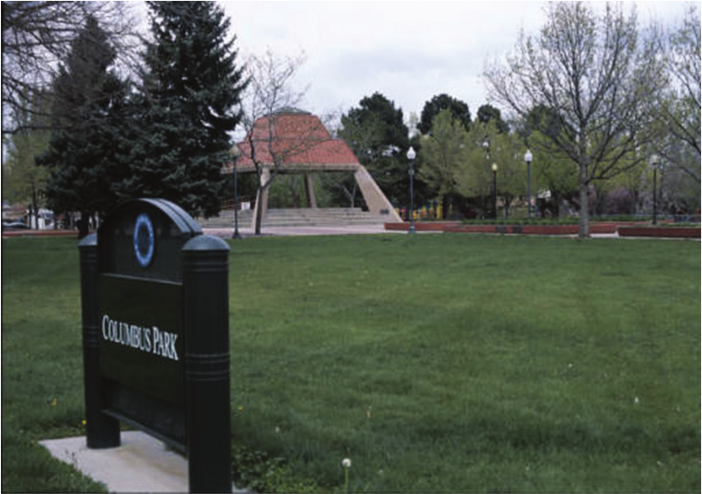
La Raza Park (officially known as Columbus Park). Note the ‘la Raza’ structure in the background.
Informal Regulation
Prior to the 1981 riot, la Raza Park played significant roles for the North Denver Latino community. It provided public space for countless formal and informal events such as cultural fairs, concerts and family gatherings. Area youth could escape the dry heat of Denver’s long summers and burn off excess energy diving and swimming in the Olympic-sized swimming pool. This small park essentially grounded an insurgent pride in Latino and Chicano heritage. Corky Gonzalez and the Crusade for Justice changed how North Denver youth perceived themselves by utilising la Raza Park as a nexus of cultural pride. “Who are we?”, asks Father José Lara, “We are Mexican! We are Chicano! The Crusade made this possible”. In national and metropolitan environments marked by structural and institutional racism, the latinisation of la Raza Park reflected a deeply felt communal sense of cultural pride. A long-time resident speaks of the wonderful things that happened by “finding pride in our history, in our culture. Where did we find it? In the Crusade, in la Raza Park”. Instead of seeing themselves as minority outsiders in American culture, many North Denver youth, by simply hanging out in la Raza Park or becoming involved with the Crusade for Justice, learned to appreciate their history and their culture. As explained by Ana Chavez, a Chicana activist
Back then especially, kids were looking for something to identify with. We grew up with lot of racism and prejudice. It was everywhere. We were always told, “Go back to your country, to where you came from, where you belong!”. After being involved with the Crusade for Justice, we learned about Aztlán, that this country is part of who I am. My ancestors journeyed here many years ago. Hundreds of years ago they might have settled in Mexico. They might have settled in Colorado. But I am where I belong. When you discover that, you found something to connect to. In many ways, la Raza Park made this transformation to being proud of who you are and where you live possible.
La Raza Park significantly contributed not only to a manifest cultural pride, but also to the collective courage necessary to publicise culture through cultural events and to defy dominant regulatory regimes. Ana Chavez draws a direct connection between the closing of the pool and the rise of gangs, saying “kids got angry because their parents were angry at the city for taking away the park from the people. Some of these kids joined gangs”. Again, according to all of my sources, violent street gangs did not become a problem in North Denver until the late 1980s. There may have been altercations with the police before, but they had always been politically motivated. Throughout the 1970s, Crusade for Justice activists often instigated conflicts with the Denver Police Department by openly defying the citywide 11:00pm curfew enforced in city parks. According to José Lara, former pastor at Our Lady of Guadalupe Church, which is located two blocks south of la Raza Park, Crusade for Justice activists claiming territorial right to Aztlán would protest against the treaty of Guadalupe Hidalgo by openly defying the city’s curfew. The police in turn would establish their territorial right by “just zooming in, sirens blaring, tyres screeching, and citing the many activists there who were in fact violating a legal curfew”.
Discussion
People produce public space. This production process presupposes access to public property. Public space may be a social construct, however, physicality and legality matter too. Euclidean dimensions and type of materiality along with rules regulating behaviour on public property strongly influence the production of public space. By reconfiguring the physical environment, urban designers can either facilitate or frustrate a wide continuum of public practices. The presence, absence and type of seating serve as examples of the power that urban designers wield (see Whyte, 1980). Regulations and how they are enforced determine who is permitted in and who feels comfortable spending time in publicly accessible space (see Staeheli and Mitchell, 2008). In the remainder of this essay, I construct a theoretical model to reach a better understanding of how changes to la Raza Park destabilised Latino public culture and thereby facilitated changes to the Northside that eventually contributed to its gentrification.
Social space is not a passive container; rather, it is the production of social relations in physical space (Lefebvre, 1991). Lefebvre (1991) theorises these relations as a triumvirate comprising spatial practice, conceived space and lived space. I draw deeply from Lefebvre’s work. Lefebvre insisted that spatial production processes should be conceived as a triad of interpenetrating processes. For him, ‘spatial practice’ is empirical human action and inaction in Euclidian space. It is directly sensible and observable, the medium and outcome of social action. Bridging the contributions of Calhoun and Sennett (2007) and Bourdieu (1977) to Lefebvre’s notion of practice while considering the complexities of public space, I think in terms of ‘public practice’. Furthermore, I parse public practice into three categories. These are: diverse practice, the co-presence of diversity; co-operative practice, the instrumental coming together of difference; and, assertive practice. In this essay, I have disentangled assertive practice. Assertive practice can be either the contestation or subversion of dominant tropes, through acts of civil disobedience and deviance; or, it can be the public celebration or validation these same tropes through public celebration and by means of various forms of policing. Interestingly, the same physical place can ground both types of assertion. La Raza Park was such a place. The take-over of la Raza Park by the Crusade for Justice subverted the City’s territoriality (Sack, 1986). On the other hand, deploying a SWAT team to enforce a permit violation, then organising a public relations campaign to legitimate its actions, the City of Denver validated this same territoriality.
For Lefebvre, ‘conceived space’ is a totalising abstract view of space assumed by planners and architects. Hence, it is the space of domination, surveillance and the exercise of formal mechanisms of power. It is important to consider that physical space is not only designed, it is regulated as property to which various stakeholders have rights (Blomley, 1998) and that these rights are deeply implicated in and curtailed by legal codes, municipal policies and levels and intensity of code enforcement (Staeheli, 2010; Staeheli and Mitchell, 2008; Valverde, 2003, 2005, 2009). Focusing on these tissues of regulation, I consider the formal regulation of public space. The pool curfew and the eventual replacement of the pool with the Aztec-inspired stage serve as examples of how la Raza Park was reconceived in terms of both design and regulation. I argue that trajectories of neighbourhood change stemmed from these changes to formal regulation. For example, police policies and protocols that authorised and legitimated a riot response to a permit violation along with modifying parking regulations proved significant factors in destabilising Latino public presence in la Raza Park.
Although powerful because they are codified into law and enforceable with police violence, formal regulations are not the only manner by which publicly accessible space is regulated and policed. More than public practice and more than formal regulation, public space is existential; it is experiential; it is lived. Lefebvre considered ‘lived space’ as a certain poetic moment of human spatial experience. It is what people imagine social space to be, from both aesthetic and ethical standpoints, as they engage with it. Enlivening lived space by focusing on unofficial rules, I am able to build on Lefebvre’s notion and consider how public space is regulated and sanctioned by those who produce it. In so doing, I include: cultural norms, the generally agreed upon beliefs, shared attitudes, maps of meaning and symbols that ground collective action (Bourdieu, 1977; Geertz, 1995; Low and Lawrence-Zuniga, 2003); social trust, the leap of faith we all take when engaging with others (James, 1960; Sennett, 2012; Simmel, 2004); and social sanctions, rewards for conformity and punishments for non-conformity to cultural norms (Mead, 1934; Searle, 2010; Weber, 2002) in a broader conceptualisation of lived space. I call this thicker notion of imagination and poetic moments ‘informal regulation’. Concisely stated, my theoretical lens focuses our attention on how formal and informal regimes of regulation frame and impact public practice.
In Figure 2, the light grey arrows (and boxes outlined in light grey) represent how public space, its design, its formal and informal regulation, and the public practices it fosters, has great potential to foster public practice. Travelling along the light grey lines, we see informal regulation and formal regulation reinforcing each other and manifesting in culturally appropriate public practice. Put another way, public space can potentially engender a public culture that is collectively imagined. During the 1970s, la Raza Park buttressed Latino public practice in North Denver; it was a vital cultural centre for the Northside. As this study has revealed, the unravelling of latinised public space was both complex and subtle. I use the dark arrows 6 and boxes to represent three ways in which the production of public space in la Raza Park was interrupted. Social groups often circumvent official rules in deliberate defiance of codified rules and what they perceive as culturally insensitive regulations. On 28 June 1981, the infuriated revellers-turned-rioters and the many cases of disgruntled youth, who later lashed out at the ‘system’ by joining gangs, both serve as examples of deviance. I use the term ‘discipline’ to indicate how city managers design, regulate and police public space with complete disregard of the lived experience of these spaces’ potential users. Using riot police to enforce a permit violation and the closure of the la Raza pool, irrespective of its symbolic meaning and its recreational benefit to the community, are examples of such discipline. Thirdly, and perhaps most damaging, is the rights-rift, which represents a disconnect between rights attached to persons and the official regulation of depersonified behaviours. Answering progressive calls to reconsider the ‘right to the city’ (Lefebvre, 1996) through the valorisation of ‘everyday urbanism’ (Crawford, 2008; Hood, 2008) and the ‘practice of everyday life’ (de Certeau, 1984), this essay has unpacked acts of everyday injustice that separate behaviours from people, and consequently separated the right to the city from Northside Latinos. Curtailing Latino rights to express cultural norms in public practice through racial profiling is one example of the rights-rift. Irrevocably changing a place where Latinos could openly practise their culture serves as another. Finally, restrictive parking regulations created a regulatory rift between Latinos and an important public park where they could practise their culture.
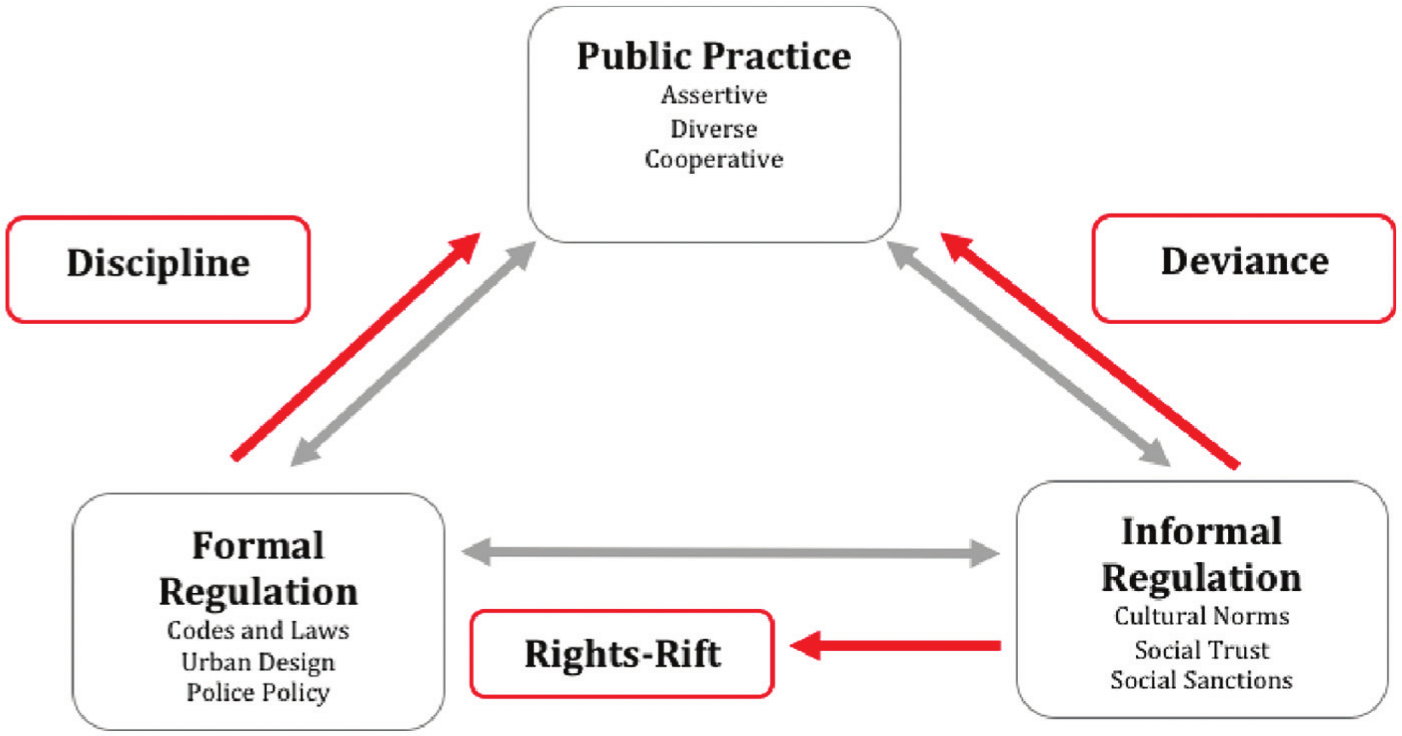
A Lefebvrean modelling of the potential production of public space.
Over 30 years have passed since the la Raza riot. Nonetheless, Northsiders who lived through it still lament losing an important place where they could be spontaneously Latino, a place where they could connect with their culture. They lost a place that contributed to their comprehension of their ancestry. The removal of the pool and the consequent decrease in the usability of the entire park irrevocably changed how Latinos, specifically those who identified as Chicanos, felt while in public in their neighbourhood. Using the phrase I heard quite often from my informants, after the pool closed they felt “less and less at home in the Northside”. This is astounding, considering that demographically measurable ethno-racial change in North Denver did not begin for another 20 years.
According to Cisco Gallardo, during the 1980s and 1990s, racial profiling became standard police protocol. In fact, every single Latino with whom I spoke mentioned the profiling they continue to endure. One Latina told me of recently being pulled over by a Denver police officer concerned that there were a group of young Latino men in her car. She was driving her children to school. Another Latino in his mid 30s said that he was pulled over recently because, the officer said, his brake light ‘looked’ broken; it wasn’t. Father Marshal Gourley helps us to understand how racial profiling contributed to a general animosity of Northside Latino youth towards authority, especially police authority. In Gourley’s words
Early in the ’90s, I was sitting in la Raza Park with a group of Northside kids, talking about politics and sports. All of a sudden a police cruiser pulled up along the southern side of the park, along 38th. We were sitting in the centre, by the stage. One of the kids says, “Just watch, they’re going to come and harass us!”. The kid nailed it! You know, especially during the 1990s stuff like this happened all the time. The cops drove around the block. And then, they drove up the lawn. They drove across the lawn, came right up to us! We were just sitting on a bench. The cops wanted to know what they were doing. “What’s up?” they asked, demanded actually. These kids were not doing anything that should cause such concern or merit such an extreme show of force, except for being a group of four brown kids talking to a White priest.
Police actions such as these delegitimised Latino territorial claims to la Raza Park as part of Aztlán. However, how did racial profiling impact trajectories of neighbourhood change in North Denver? It had a profound but perhaps not immediately measurable effect. Racial profiling made going outside the home akin to, as one long-timer Latino put it
putting on an itchy wool sweater when it’s cold. You know you have to do it, to get to work, to meet friends, to go shopping; it’s uncomfortable all the same.
As a consequence, Latinos simply stopped hanging out in public; they stopped claiming the Northside as their own through their public presence on its streets and in its parks. Ironically, racial profiling fuels the very problem its perpetrators intend to solve. How? In Denver and nation-wide, the late 20th century rise in gang culture is drawn from a complement of urban problems including a lack of recreation and open space, inadequate housing, poor education and constant police harassment (Diaz, 2005). Following Diaz, youth internalise the insensitivity and brutality of public officials and externalise feelings of disenfranchisement by openly defying laws, vandalising property and engaging in myriad antisocial behaviours. Completing the vicious circle, these deviant practices legitimate the very profiling and harassment they cause (Geis, 2002; Howell, 1998). Tying this circle back to our discussion of gentrification, street gangs and gang violence deter business investment (Greenbaum and Tita, 2004), which in turn accelerates physical blight and widens the rent gap, which in concert encourage speculative investment in inner-city neighbourhoods in the first place (see Wyly and Hammel, 1999).
Racial profiling worked to depopulate North Denver public spaces, including la Raza Park, of Latinos. It also worked to undergird gentrification pressures. Depopulated of ‘threatening’ Latinos, la Raza Park could more easily be appreciated by middle-class newcomers as a visual amenity and a space of restive solitude. In discussing the park with me, Denver Parks and Recreation employees always emphasised how the grass is green and how it is now maintained as a visual asset along the commercial corridor of West 38th Avenue. When I asked middle-class newcomers about North Denver Parks, most of them, first admitting that their preferred outdoor experiences were hiking and skiing in the nearby mountains, mentioned how well kept they seemed. This is how formal regulation facilitated la Raza Park’s transformation from a vibrant Latino zócalo for Northside Latinos into a quiet visual amenity for middle-class newcomers.
Like the rise of street gangs, gentrification too is a suite of processes (see Brown-Saracino, 2009a). This study has deconstructed one of these: the dislocation of Latinos from an important public space in their neighbourhood. Considering the history of a public park in a rapidly gentrifying neighbourhood, I drew subtle connections between the production of public space and neighbourhood change. As we have seen, heavy-handed policing along with profound changes to the design and programming of la Raza Park effectively dislodged the Crusade for Justice from North Denver. Additionally, the everyday injustices of racial profiling and culturally insensitive park regulations effectively prohibited Northside Latinos from practising their culture in public, thus robbing them of a public opportunity to connect with their collective history. Consequently, their cultural practices became less and less visible.
Essentially invisible, they acquiesced public space. In conversations with Latino long-timers, I learned that some of their friends and family decided to move from North Denver because its neighbourhoods became as one former resident put it “too quiet, too lifeless”. Others confided that many families moved from the neighbourhood fearing that members of their family might become victims of gang violence or gang membership (see Ander et al., 2009). These insights expose two crucial and underexplored mechanisms of neighbourhood change. First, although some residents—namely, the poor and others relying on assisted housing—were displaced irrespective of their desire to stay, many Northside homeowners decided to sell their homes, creating a housing supply in their wake (see Freeman, 2005). Secondly, since gentrification of the inner city presupposes that members of the middle class move to working-class/ethnic neighbourhoods, the dislocation of long-timer culture from public space aids and abets inflow of the mainstream middle class by effectively purging public spaces like la Raza Park of signs of cultural practices antithetical to their own. In advertisements and brochures, and while showing property to prospective buyers, real estate agents then appeal to middle-class tropes of liveable, safe and quaint neighbourhoods to fuel housing demand. Carefully considering the regulatory and cultural history of one neighbourhood park, this essay contributes to broader theoretical discourses, primarily to the connections between public space, public practice and neighbourhood change. Further research is needed to determine the strengths of the relationships I have revealed. To do this, rather than looking for them in places from which they have been displaced (see Slater et al., 2004), researchers must follow displaced people to their new neighbourhoods.
Footnotes
Funding
This research received no specific grant from any funding agency in the public, commercial or not-for-profit sectors.