



Abstract
Most Dutch cities have adopted urban restructuring policies aimed at creating a socially mixed population in deprived neighbourhoods. This entails the demolition of low-cost, social rented housing units, which leads to the displacement of their residents. While researchers have investigated the social effects of displacement on adults, this study is the first to provide insight into the effects on youths. The findings indicate that, although the first months after displacement youths lose some social contacts and stop participating in certain leisure activities, they show high levels of flexibility and soon make new friends and take up leisure activities in their new neighbourhood. No differences were found in friendships and leisure activities between displaced youths and those in a control group of non-displaced youths as reported at the time of the study. This confirms that in the long term the effects of displacement are limited.
Introduction
As a reaction to growing concerns about the undesired consequences of concentrations of poverty, many Dutch cities have adopted policies aimed at changing the physical and social composition of deprived neighbourhoods. These urban restructuring policies generally entail the demolition of inexpensive social housing units and the construction of more expensive alternatives in order to achieve a ‘better’ social mix, particularly in terms of income (Uitermark, 2003; Bolt et al., 2008; Galster et al., 2010). One of the consequences of urban restructuring is that it leads to the displacement of large groups of often low-income households. Studies following displaced households have generally concluded that most movers were satisfied with their new homes and their new neighbourhoods (Varady et al., 2001; Brooks et al., 2005; Joseph and Chaskin, 2010; Posthumus et al., 2010; Doff and Kleinhans, 2011). However, displacement is accompanied by the disruption of social networks in the old neighbourhood and difficulties integrating into the social structure in the new neighbourhood (Clampet-Lundquist, 2004; Popkin et al., 2004).
While there is a growing understanding of the effects of displacement on adults, we know very little about the consequences of being forced to move for youths’ social networks. 1 This is an important shortcoming, as youths’ friendships are considered to be of central importance for their development. These ties can function as a source of companionship, stimulation, physical support, ego support, social comparison, intimacy and affection (Gottman and Parker, 1986). The orientation towards peers peaks in mid adolescence, when the influence of friends on a youth’s behaviour surpasses that of his or her parents (Thornberry et al., 1994; Crosnoe, 2000).
The importance of friendships has also been confirmed by the large number of studies that have related youths’ friendships to variations in their wellbeing (see Hartup and Abecassis, 2002; Brown, 2004). Young people derive their wellbeing from identifying with a group and experiencing group solidarity. For most groups, this is achieved by regular meetings around foci of activity (Feld, 1981; Feld and Carter, 1998), such as the micro neighbourhood of adjacent dwellings, a community centre, the street or the basketball or football court (Van-Eijk, 2010). Organised leisure activities may also function as important foci of activity around which friendship networks are formed and maintained. Moreover, leisure activities in themselves may be an opportunity for the development of capacities and a sense of self-efficacy (Du Bois-Reymond et al., 1998; Chaskin and Baker, 2006).
While there is abundant psychological and sociological literature on youths’ friendships, little attention has been paid to how these friendships are related to the neighbourhood context and how displacement affects them. This paper partly fills these gaps. Our research question was: to what extent and how does displacement affect youths’ friendships and leisure activities?
The Formation and Maintenance of Friendships: The Role of the Neighbourhood
It is generally assumed that the formation of social networks is influenced by two structural factors—namely, propinquity and similarity. Propinquity—or closeness in physical space—influences the formation of social networks because people are more likely to become friends with those whom they meet regularly, for example in neighbourhood-based settings (Feld, 1981; Huckfeldt, 1983; Feld and Carter, 1998; Crosnoe, 2000). The importance of propinquity, and hence of neighbourhood settings, for the formation and maintenance of social contacts might, however, differ between different groups of people, and specifically between adults and youths. In this context, we therefore need to pay more attention to the ways in which young people differ from adults in their use and interpretation of urban space.
First, youths and adults differ in their freedom of movement. Youths’ possibilities to use urban space are, first of all, often constrained by the modes of transport available. In the Dutch context, most youths travel by bike, as driving a car is only allowed for people older than 18 years. Moreover, car ownership by young people is quite low due to the associated costs (Statistics Netherlands, 2012). The alternative would be to use public transport, but its use is limited by a lack of money and the fact that it takes a lot of time to get from one place to another (compared with adults who generally have access to a car). Moreover, the spatial behaviour of youths might also be restricted by regulations imposed by adults, most notably their parents. This means that they might be more restricted to their neighbourhood for the formation of friendships than adults (Valentine, 1997; Karsten, 1998; MacDonald and Schildrick, 2007; van Kempen, 2010). 2 Secondly, some places, such as parks or squares, might form important foci of activity for young people, whereas for adults they may merely be spaces to pass through (Matthews and Limb, 1999). Being forced to leave a specific neighbourhood might therefore be experienced differently by youths and adults. In addition, youths’ relationships with their environment, and their use of this environment, might differ between groups of youths, depending on their gender, age, ethnicity, social class or neighbourhood of residence (Huttenmoser, 1995; Valentine, 1997; Wyn and White, 1997; Karsten, 2003).
An increasing number of scholars have argued that, with the emergence of new forms of ICT and transport, the importance of the neighbourhood for the formation and maintenance of social networks is decreasing (Guest and Wierzbicki, 1999; Ansell, 2009). Nevertheless, empirical studies have shown that young people still make significant use of their neighbourhood. Social contacts often take place within the neighbourhood and local foci of activity are considered important for young people (Brooks-Gunn et al., 1997; Rankin and Quane, 2002; Preciado et al., 2012). Moreover, MacDonald and Schildrick (2007) showed in their research on youths’ leisure careers in deprived neighbourhoods that the large majority of the young people in their sample spent much of their time in the company of peers in the public spaces of their neighbourhoods.
The second structural factor that influences the probability of youth friendships is similarity: young people are homophilous—that is, they are attracted to those who share the same characteristics, behaviours, norms and values, even more so than adults (Baron and Byrne, 1994; Crosnoe, 2000; van Mastrigt and Carrington, 2013). Youth friendships are generally structured by gender, family background, income and ethnicity. The processes of propinquity and similarity intersect at the neighbourhood level because residence is often related to socioeconomic status and ethnicity (Zhou, 1997; Crosnoe, 2000). Because of the limited activity spaces of youths, and thus a more limited ‘pool’ of potential friends, the networks of youths are likely to show high levels of homogeneity.
Displacement: The Loss of Foci of Activity
Since the neighbourhood context might play a role in the formation and maintenance of youth friendships, a change in residential context is assumed to have a disruptive effect on these friendships, as it results in the loss of important neighbourhood-based foci of activity. It can be argued that all relocations of young people are by definition ‘forced’, as it is their parents who make the decision to move and young people generally have little say in this. Research by Bushin (2009) in the UK has shown that in most families youths were simply notified about the decision to move. In some cases, youths were asked their opinion, but this usually had little influence on the ultimate decision to move. In the case of displacement as a result of the demolition of the dwelling, however, the situation is somewhat different. First, displacement is accompanied by a sometimes long period of insecurity about whether the family will actually have to move. Secondly, under the policy of urban restructuring usually whole blocks of multifamily units are demolished, which means that families in these blocks are dispersed over several neighbourhoods. Displacement might therefore be more disruptive than a move for another reason.
The few studies that have specifically focused on the effects of displacement on the friendships of children and adolescents were conducted in the context of the American HOPE VI programme (a programme similar to the Dutch policy of urban restructuring) and the Moving to Opportunity experiment. Research by Clampet-Lundquist (2007) on the effects of the HOPE VI programme on 12- to 18-year-olds showed that after moving it was difficult for the youths to build a new life in their new neighbourhood. They had to get used to new norms and values, new friends were difficult to make and organised activities were still unknown, which resulted in a lower feeling of being at home in the new neighbourhood. Moreover, Gallagher and Bajaj (2007) found that, after displacement, children and youths showed greater levels of social isolation than in the previous neighbourhood. The study by Pettit (2004) on the effect of the Moving to Opportunity experiment on 6- to 17-year-olds revealed a more positive picture: displacement led to a short-term disruption of the young people’s social networks, but the children and youths were generally able to reconstruct social connections in the new neighbourhood. Thus, time is an important variable. In addition, de Souza Briggs (1998) showed in his research among youths aged between 12 and 17 years old that displaced youths were no more cut off from social support than a control group of youths who had stayed put. On the other hand, the movers were no more likely to report access to good sources of job information or educational advice.
Dealing with Displacement
While the formation of youths’ social networks is affected by structural neighbourhood factors, youths can react and respond to these structural influences in different ways: they can make their own decisions with regard to which activities to undertake and which people to engage with (Rudd and Evans, 1998; Miles, 2000; Evans, 2010). In the context of our research, it was therefore important not to see youths as passive ‘victims’ of displacement: they can actively choose to participate in different settings and form social networks, and thus create their own biographies. This can be in the old neighbourhood, the new neighbourhood or in other non-neighbourhood settings. These choices are often mediated by knowledge and understanding of what is possible, which in turn is mediated by the neighbourhood context, gender, socioeconomic status and ethnicity.
Research Design
Research Site
The research was carried out among a group of youths who had been forced to move out of seven neighbourhoods to make way for demolition activities in Utrecht, the fourth-largest city in the Netherlands. Utrecht has a number of characteristics typical of large Dutch cities: compared with other Dutch municipalities, Utrecht has a relatively large number of children living in families on welfare (12 per cent) and living in deprived neighbourhoods (35 per cent), and a significant group of non-Western immigrants (21 per cent) who are concentrated to a considerable degree in deprived neighbourhoods (ethnic segregation index: 37.4) (Verwey Jonker Instituut, 2008; Municipality of Utrecht, 2010a).
In 2000, the municipality of Utrecht and a number of the city’s housing associations decided to restructure early post-Second-World War neighbourhoods by demolishing 9500 socially rented units and building 9000 new units, including 6000 in the owner-occupied sector (Municipality of Utrecht, 2010b). These demolition activities took place in a limited number of neighbourhoods, most of which are characterised by relatively low rents and, consequently, by a large percentage of low-income households.
Research Sample
Our research focused on how displacement affects youths between the ages of 12 and 21. We chose the lower limit of 12 years because at this age youths make the change from primary to secondary education, which is generally accompanied by a change in their action space as well as by changes in the restrictive regulations imposed by their parents. This transition can have an important effect on youths’ social contacts and leisure activities. We set the upper limit at 21 years because until this age most young people are still in education. At the age of 21, a large share of youths finishes their senior secondary vocational education and are likely to enter both the housing and the labour market. Again, such an important change may influence their action space, social networks and leisure activities.
The research sample of displaced youths allowed us to investigate the immediate effects of displacement: we asked these youths how they had experienced their move and whether they had lost friends or stopped participating in leisure activities after the move. However, as we were also interested in the extent to which the effect of displacement prevailed in the long term, we included a control group of youths from the same neighbourhoods who had not been forced to move. This group consisted of two sub-groups: ‘other’ movers—namely youths who had moved, but not because their homes were to be demolished—and non-movers. Including this control group allowed us to compare the new situation in terms of the friendships and leisure activities of youths who had been displaced and those who had not.
Data and Measurements
We used the database of the municipality of Utrecht and data from the housing association Mitros to find households that had been forced to move because of demolition activities in the period 1998–2009 3 and that included youths who had been between 12 and 21 years old at the time of the move. We also used the municipal database to find youths from the same neighbourhoods who had not been forced to move to serve as our control group. The group of displaced youths comprised 433 potential respondents, while the control group (other movers and non-movers) comprised 859 potential respondents.
We carried out the actual survey between June and December 2009. The total response rate of 26 per cent left us with 336 completed questionnaires. For the purpose of this paper, we focused on youths who lived and had moved with their parents, because we expected displacement to have the largest effect on this group, as they were generally younger and therefore more likely to be neighbourhood-based for their activities and social networks. Youths who already lived on their own prior to the move were often students, for whom we expected the move to be less disruptive. We also excluded youths who moved from the parental home to a dwelling of their own, because among youths in this group there might already have been plans to leave the parental home—for example, because of a change from secondary education to higher education, or from education to employment. The forced move might thus have been an opportunity rather than a disruptive factor. This selection left us with a research group that shows less internal differentiation than our initial research group. This reduced our sample to 236 respondents.
Table 1 shows the descriptives of the displaced and the non-displaced youths. It can be seen that most respondents were still attending school at the time of their move and a large share of them were still in education at the time of the interview. The share of youths who were still in education at the time of the interview was slightly higher in the group of displaced youths than in the control group, this difference can be explained by the fact that the respondents in the control group were slightly older. Moreover, quite a large share of the respondents had a non-Western background. The share of respondents from non-Western backgrounds was slightly larger in the group of displaced youths than in the control group. We controlled in the logistic regression analyses for these variables (and for a number of other variables).
Descriptives

Applies only to respondents who moved, n = 43.
For the non-movers the old neighbourhood is the same as the neighbourhood at the time of the study.
It has to be noted that even a move within the same neighbourhood was regarded by many of the respondents as a large change in their residential environment. A move to a dwelling—even just a couple of blocks from the previous one—might disrupt the casual meeting opportunities on the street and lead to the loss of friendships. Moreover, as generally whole blocks of multifamily units were demolished, only a few of the old friends remained in the old neighbourhood.
Source: own fieldwork (2009).
When we look at the moves, two interesting issues emerge. First, as most of the respondents had moved only a short distance, not many of them had had to change schools: only 11 respondents had changed schools in the same year as the residential move. However, for all these respondents, the change of schools was related to the transition from primary to secondary education. Secondly, a large share of the respondents had moved to similarly deprived neighbourhoods (for more background information and maps, see: Visser et al., 2013). This means that, in terms of institutional resources, the differences between the old and the new neighbourhood were limited. However, it has to be noticed that, in the context of Utrecht, living in a deprived neighbourhood does not necessarily result in limited access to leisure facilities. On the contrary, in the field of leisure provision the municipality pays specific attention to disadvantaged neighbourhoods, including those our respondents came from and moved to (Municipality of Utrecht, 2009).
We also asked the displaced youths whether they would participate in a follow-up interview; 66.4 per cent indicated that they would. From July until December 2009, we conducted 29 in-depth interviews. We aimed at achieving an equal distribution of respondents over different categories of displaced youths (moved within/out of the neighbourhood, moved to another deprived neighbourhood or to a better neighbourhood) and over different ages, genders and ethnicities. Each respondent was assigned a pseudonym, which is used throughout this paper. An important strength of combining quantitative with qualitative data (i.e. adopting a mixed methods approach) is that it allowed us to examine how the changes in friendships and leisure activities as a result of displacement operate within the realities and constraints of the individual lives of youths as well as in the neighbourhood context (see DeLuca et al., 2012).
In the quantitative part of our research, we used a number of regression analyses to gain insight into the effects of displacement on friendships and leisure activities. Since the dependent variables were measured on a binary scale, we used logistic regression analyses to predict whether (1) or not (0) changes had taken place in friendships and activities and to find out which individual, household and neighbourhood characteristics played a role in predicting these outcomes.
Results
The Localness of Networks before the Move
Social networks differ in the extent to which they include neighbourhood-based ties. One can question whether youths’ friendships are indeed locally based, as youths increasingly make use of mobile phones and social networking sites to maintain their friendships. Knowledge about this network localness is crucial when researching the effect of displacement on friendships, as moving may have a larger effect on youths who have relatively many local friends. Our survey confirmed our hypothesis that youths are to a considerable degree locally oriented for their friendships: 74 per cent of the displaced youths indicated that most of their friends had lived in the same neighbourhood. Thus, for most of our respondents the neighbourhood can be regarded as an important place for friendship formation.
We conducted a logistic regression analysis to establish which factors influenced network localness (Table 2). This analysis showed, first of all, that having more friends in the neighbourhood is positively related to length of residence. Youths who had lived in the neighbourhood longer were more likely to have lived in the same neighbourhood as most of their friends, than those who had lived in the neighbourhood for only a relatively short period. We also found that youths with lower levels of education or a non-Western background were considerably more neighbourhood-oriented. This might mean that the negative effect of displacement on friendships is greater for these youths.
Logistic regression analyses on the likelihood of having at least half of all friends in the neighbourhood before the move
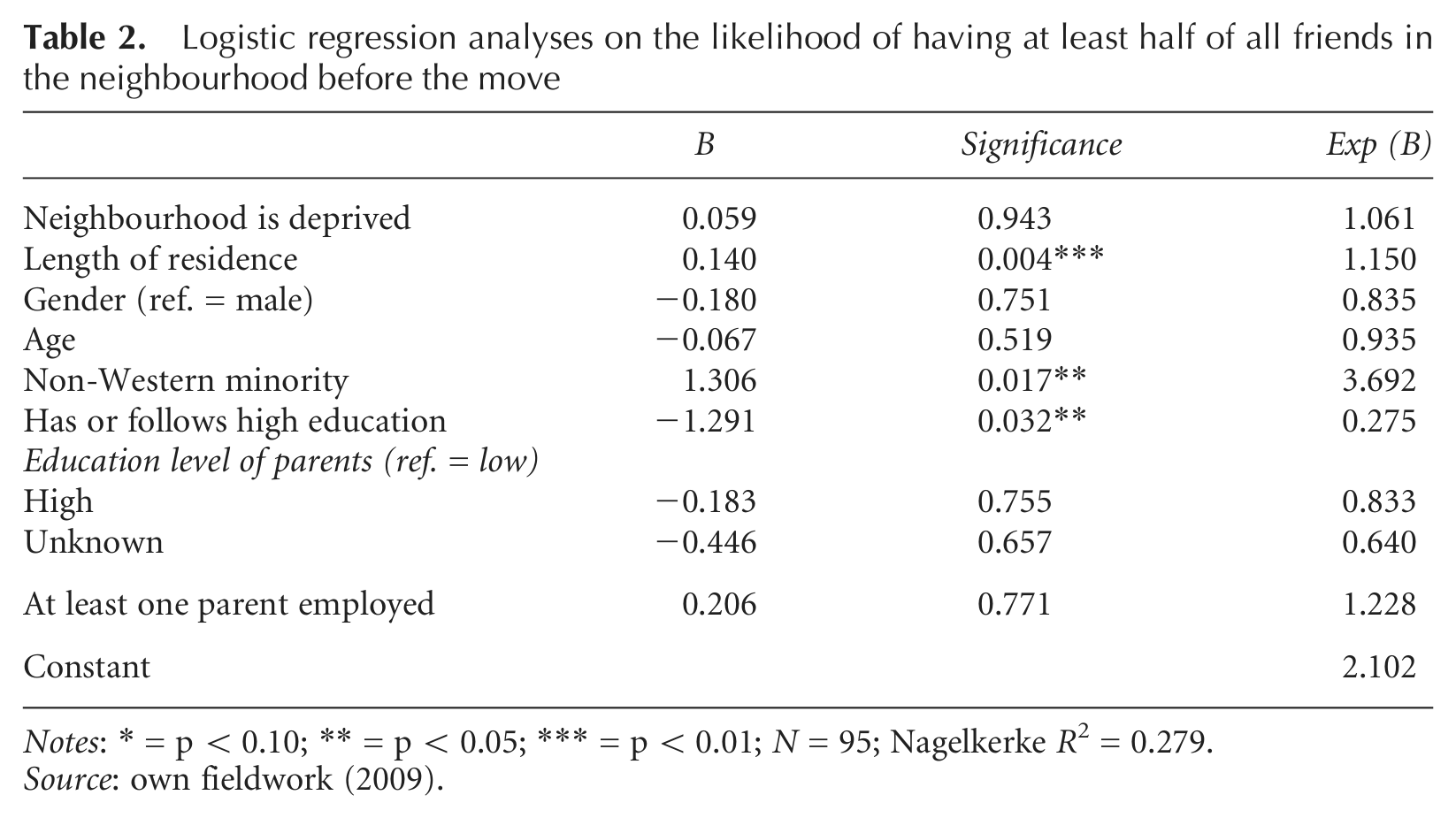
Notes: * = p < 0.10; ** = p < 0.05; *** = p < 0.01; N = 95; Nagelkerke R2 = 0.279.
Source: own fieldwork (2009).
The Effect of Displacement on Friendships and Leisure Activities
Before discussing the loss of friends and the giving up or participating less in leisure activities, it is important to take a closer look at the participation in activities before the move and how this differed between groups of youths (see Wyn and White, 1997). We found that leisure activities were influenced by ethnicity: youths from a non-Western background spent significantly more time than native Dutch youths at the community centre or in meeting friends on the street (see Table 3). Thus, displacement might have a larger influence on youths who belong to a non-Western minority group than on native Dutch youths. Interestingly, we found no significant differences in leisure activities between age-groups, main activities or level of education of parents (which can be seen as a proxy for socioeconomic status). The only additional difference we found was between males and females in being a member of a sports club: boys were more often a member.
Leisure activities of displaced youths before the move (%)

Notes: * = p < 0.10; ** = p < 0.05; *** = p < 0.01; N = 96. Some categories were left blank because of too small cell counts.
Source: own fieldwork (2009).
Overall, we found that displacement had caused a large share of the youths to stop participating or to participate less in leisure activities. Youths particularly stopped visiting the community centre (68.3 per cent) and participating in other organised leisure activities (44.2 per cent), most probably because these activities were to a large extent neighbourhood-based. Being a member of a sports club decreased by only 10.9 per cent, most likely because most sports facilities are usually not located in the neighbourhood of residence. Logistic regression analyses (not shown) indicated no significant effect of being from a non-Western background on the likelihood of ceasing leisure activities. However, as this group participated to a much larger extent in neighbourhood-based activities, in absolute terms the negative effect for non-Western minorities was more profound.
Our survey also showed that 30.2 per cent of the displaced youths had lost one or more friends as a result of moving. Of the factors that influence the likelihood of losing friends (Table 4), the distance between the old and the new home is the most important predictor. This is not very surprising: when youths move further away, it becomes more difficult to meet friends in a casual way and thus maintain friendships. The localness of the social network before the move also emerged as an important predictor: youths who had lived in the same neighbourhood as most of their friends, were more likely to have lost these friends after the move. Being younger also led to a slightly higher likelihood of losing friends. This is probably because it is more difficult for younger youths to maintain friendships after the move because their action space is more restricted. Again, the logistic regression analysis did not show a significant effect of ethnicity on the likelihood of losing friends. However, as youths from a non-Western background more often had networks that were neighbourhood-based, in absolute terms the negative effect for these youths was more profound.
Logistic regression analyses on the likelihood of losing one or more friends after moving
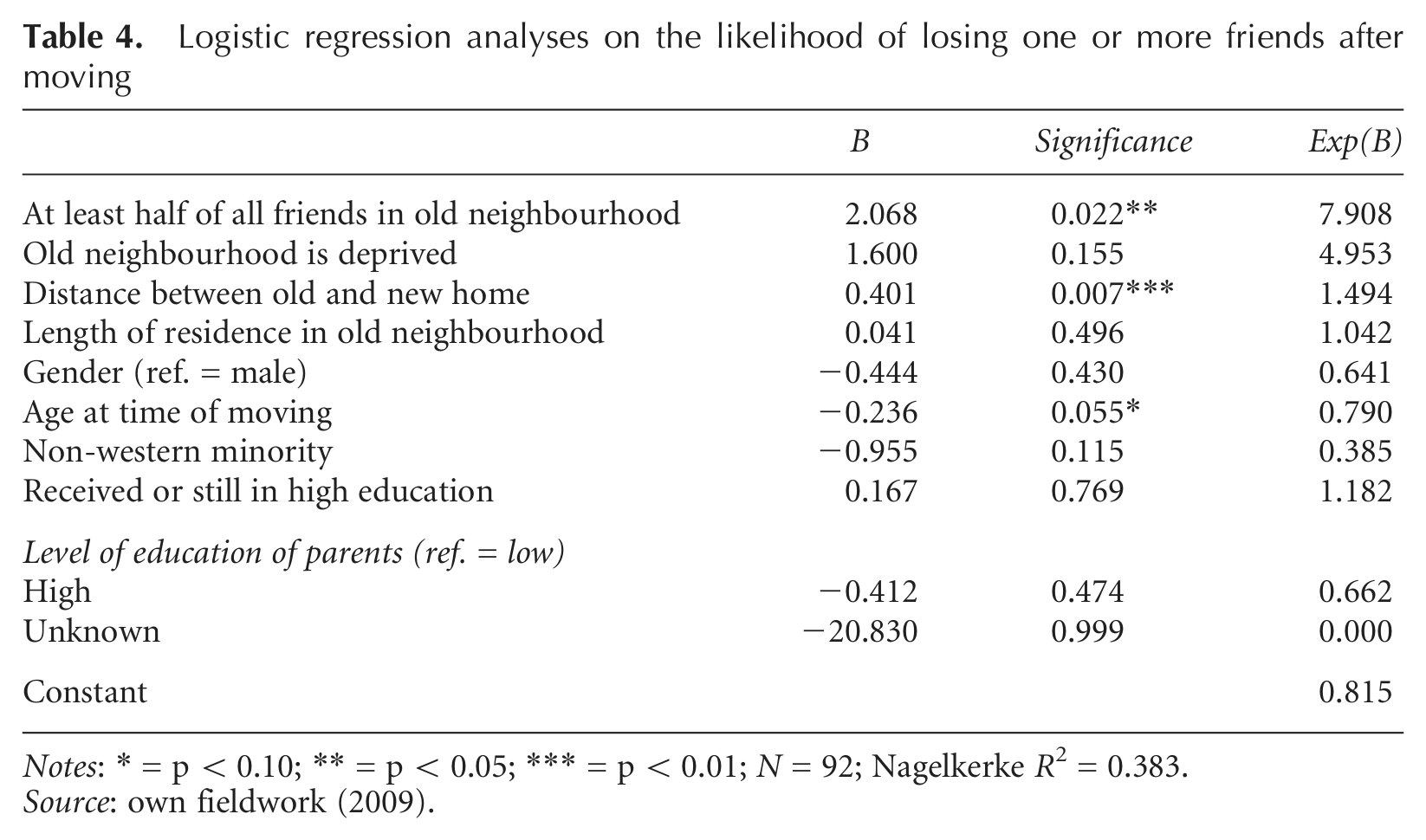
Notes: * = p < 0.10; ** = p < 0.05; *** = p < 0.01; N = 92; Nagelkerke R2 = 0.383.
Source: own fieldwork (2009).
The interviews revealed that losing friends was primarily related to the loss of common foci of activity: youths no longer met on a casual basis, but had to make appointments to meet each other. Zoran (22 years, male, Bosnian, moved in 2007) illustrated this as follows We practically grew up together and spent almost every day together. We played football and things like that … After the move, it all fell apart. One person moved to [neighbourhood A], the other moved to [neighbourhood B]. They of course also have to work and have to go to school. This makes it very difficult to get everyone together, like before … Now you need to have some sort of diary to make an appointment.
One focus of activity that emerged as being particularly relevant to displaced youths is the street: 77.1 per cent indicated that, before the move, they used to meet their friends in the street. Six months after the move, 60.8 per cent of the displaced youths had stopped meeting friends, or met them less often, in the street in the old neighbourhood. Our interviews revealed that the willingness to travel to other neighbourhoods for visiting friends decreased over time: shortly after the move, most youths had tried to continue meeting their friends in the old neighbourhood, but after some months this had become harder. Most youths indicated that it took too much effort to go there—also because they were dependent on the bike. Older youth in particular seemed often too busy with school and work to visit their friends in the old neighbourhood. Issues like lack of money and parental regulations seemed to be less important. Nando (18 years, male, Angolan, moved in 2007) illustrates the change in meeting his friends in the old neighbourhood as follows In the first months after the move, I spent most of my time hanging around with friends from the old neighbourhood. After the first year, I started to visit the old neighbourhood less and less. I had much less time to always cycle there. The longer I lived in the new neighbourhood, the less often I went to the old neighbourhood.
The loss of friendships turned out to be one of the main reasons why displaced youths were negative about being displaced. Displacement was perceived as negative by 43.2 per cent of the respondents. Our interviews revealed that particularly those who had many friends in the old neighbourhood were more negative about the move, whereas those who lacked emotional and social bonds with the old neighbourhood were often more positive and emphasised the opportunity to move to a better home and neighbourhood. On the positive side, although some of the respondents had lost friends after moving, 50.5 per cent had made new friends. A logistic regression analysis (not shown) indicated that younger youths had a higher chance than older ones of making new friends in the new neighbourhood. This might be because it is easier for younger youths to make new friends by just playing in the street.
The Flexibility of Youths
The effect of displacement cannot be explained by structural characteristics at the individual and the neighbourhood levels alone: it is also dependent on differences in the ways youths deal with the opportunities to maintain their old friendships, make new friends and take up new activities, and with the barriers to doing so. Although we found differences in how youths dealt with displacement and their new neighbourhood, the overall picture shows that they felt in control of the situation, took up new activities and formed new friendships. When asked if it was hard to make friends, Cahil (15 years, male, Turkish, moved in 2006) said No. When I came to live here, I started to study the neighbourhood. I often went outside to play in the street and in this way I made a lot of new friends.
Like Cahil, most youths were able to form new friendships easily. They met their new friends on their block, the local basketball court or the street corner. Younger youths in particular tended to be more outgoing and more open to new experiences, whereas older youths generally had other obligations in terms of homework, jobs or chores, which reduced the time they had to engage in neighbourhood settings.
Most youths thus felt in control of the situation after displacement, but there were a number of barriers that restricted the options they could exercise. Because many leisure facilities were available in the neighbourhoods the respondents moved to, the youths had a large variety of activities they could participate in after their displacement. However, this opportunity was constrained by a lack of knowledge about these activities. It took time to learn about the neighbourhood’s facilities and activities. Some of the youths simply did not know about the facilities available in the new neighbourhood. Elif (15 years, female, Turkish, moved in 2009) I had heard about it at school and we could go there every week [in the old neighbourhood] … You could practise sports and participate in other activities, and you could even organise activities yourself … Now I don’t even know where the community centre is … I haven’t heard about or seen anything that’s organised in the neighbourhood.
The youths’ opportunities were also restricted by a lack of feeling of social belonging. For most youths, existing networks and familiarity with the neighbourhood and the people living there played a role. Not only did neighbourhood settings influence the formation of social networks, but having networks generally led to easier participation in other settings because the youths felt more comfort and familiarity. Youths sometimes felt ill at ease entering unknown situations where they did not know anybody (see Goffman, 1959). This can be illustrated by the following story from Tisba (23 years, female, Moroccan, moved in 1999) about visiting the community centre Here I know nobody, and there [in the old neighbourhood] you went to a familiar environment. You knew the group leader, the children, which isn’t the case in the new neighbourhood. So then I have the feeling: no, I don’t have to [participate in these activities].
Moreover, when the new neighbourhood was primarily populated by people who were very dissimilar in their behaviour and norms and values, the youths were less likely to form new friendships. This is illustrated by the following quote from Nando (18 years, male, Angolan, moved in 2007): I don’t have any friends in my new neighbourhood. There are few boys my age here … The boys my age who are here have different interests than I have. I don’t like to hang around with them. When I see those boys, I don’t want to belong to that group. They smoke, drink and just damage things, so I don’t want to be associated with them.
From our interviews, it appeared that for many youths the presence of similar people in terms of gender, ethnicity and socioeconomic status turned out to be an important structural factor influencing feelings of social belonging and hence the leisure pursuits of youths after displacement. This is illustrated by the following quote of Nassima (25 years, female, Moroccan, moved in 2006) It [the old neighbourhood] was a very lonely place … My god, I was actually never happy to live there, but I thought I had to stay there; I couldn’t go anywhere … In the neighbourhood after the move I had Turkish neighbours, I had very good contact with them, and with Dutch neighbours. We talked a lot with the neighbours. Moroccan women came to visit me every now and then and I visited them.
Thus, the effects of displacement are not homogeneous across youths, but are dependent on the interaction between individual characteristics (most notably personality traits, such as openness and outgoingness); the ethnic group a young person belongs to; and the conditions in the new neighbourhood (for example, the availability of facilities and the population composition).
Long-term Effects
Our findings indicate that, although the youths faced some barriers to integrating into their new neighbourhood, after a while they had been able to ‘catch up’ and adopt new activities and form new friendships, which means that in the long run the effects of displacement were limited. The absence of long-term effects is confirmed by the extent to which youths met friends in the street and participated in leisure activities at the time of the survey (2009): there was no significant difference between the displaced youths and the non-displaced youths (see Table 5). This was confirmed by a number of logistic regression analyses (not shown) that indicated that, after controlling for a number of individual, household and neighbourhood characteristics, there was no effect of displacement on the likelihood of meeting friends in the street, visiting the community centre or participating in organised leisure activities (member of a sports club; music, dance, theatre, etc.) at the time of the survey. Thus, although moving had led to the loss of foci of activity for a large share of the youths, in the long run moving had not had a significant impact on their activities and social networks.
Leisure activities (2009) (%)
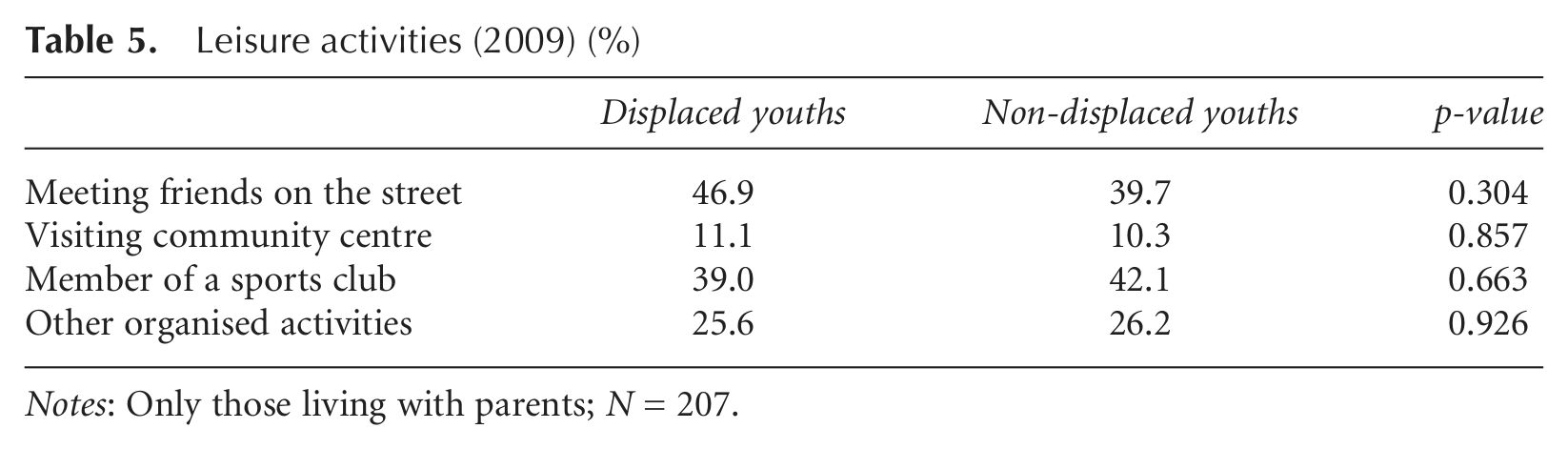
Notes: Only those living with parents; N = 207.
Conclusion
Urban restructuring is seen by many policy-makers as beneficial for the housing career of the households involved. The present study looked at whether the benefits of moving to a new home and neighbourhood come at a cost for youths—namely, the loss of friendships and having to give up leisure activities. Our results showed that for some of the respondents, moving had indeed led to the loss of friendships and the giving up of leisure activities. This was primarily because the youths no longer met each other on a casual basis—for example, at the street corner or the basketball or football court. In the first months after moving, most youths had tried to maintain their social contacts and activities in their old neighbourhood, but after a while this had become increasingly difficult.
On the positive side, we found that youths were to a large extent able to take up new leisure activities and to make new friends in the new neighbourhood, which is confirmed by the fact that displacement did not have a significant effect on the leisure activities and the extent to which the youths meet friends in the street a couple of years after the displacement. Thus, although moving has quite a few short-term negative effects, in the longer run these effects turn out to be limited, as most youths show high levels of flexibility.
Most studies on displacement assumed that a move has homogeneous effects across the population. However, we found that the effect of a displacement on the friendships and leisure activities of youths depends on conditions both at the individual level and in the new neighbourhood (see also Small and Feldman, 2012). The greatest loss of friends was among the youths who had had a very local network in the old neighbourhood, who had been younger and who had moved a greater distance. Further analyses showed that primarily youths from a non-Western background had a local social network and participated significantly more in neighbourhood-based activities than native Dutch youths. The effect of displacement was therefore more profound for this group. Moreover, conditions in the new neighbourhood—such as the population composition and the availability of leisure facilities and places to hang out—influenced the extent to which displacement had a negative effect.
We should rethink the assumption that displacement has a negative effect on the wellbeing of youths because of the disruption of social networks and the loss of activities. Most of the displaced youths felt in control of their situation and had been able to ‘catch up’ again. In this context, however, it is still necessary to recognise that the extent to which youths can take up new activities and make new friends is bounded by neighbourhood structures, such as the accessibility of activities and facilities, and the social climate in the neighbourhood. It is therefore important to assist young people and their parents when they move. Institutional actors need to be more proactive in helping families connect to their new neighbourhoods by, for example, supplying information about community centres and other places that provide leisure activities, and ensuring that the activities on offer meet the demands of diverse groups of youths.
Finally, although changes in friendship networks and activities are important in their own right, it is also important to research further the extent to and ways in which they mediate the effects of displacement on social outcomes. Although the effect of displacement on social contacts and leisure activities is only short-lived, it might still have a positive or negative effect on the future wellbeing of youths. Future research in this area might also profit from including other factors that moderate or mediate the effect of displacement on the social outcomes of youths, most notably the role that parents and schools play in this context.
Footnotes
Funding
The authors should like to thank the Mitros Housing Association, the Municipality of Utrecht, the Nicis Institute and the Krajicek Foundation for their financial support for this research.