




Abstract
Compensation paid to property owners for land expropriation is always a controversial topic, partly due to the difficulty in revealing households’ true valuation of their housing. This paper estimates and discusses the widely observed ‘willingness to accept–willingness to pay’ (WTA–WTP) gap for surveyed residents of their own houses during land expropriation. By testing several hypotheses interpreting the WTA–WTP disparity from previous studies, the paper tries to establish the incentive for households’ decision-making. The paper employs a contingent valuation method with data from 315 household interviews in central Beijing, China. The paper reports an average WTA/WTP ratio of 3.74 and reaches the conclusion that in our case the high compensation required by property owners largely derives from opportunistic pricing behaviour rather than sentimental attachment to the dwellings that is unobservable in the market price, and that the WTA of the residents is intentionally overpriced.
1. Introduction
According to the constitution of China, 1 land in urban areas is state-owned, while land in rural areas is owned by the farmers. 2 Land is allowed for transactions based on a hierarchical market. The government can procure land from farmers, changing it from rural land to urban land, or acquire urban land directly from the current property owners; this is called the primary land market, a market monopolised by the government. Only urban land is eligible for development: developers can obtain land from the government, develop it and then sell the built property; this is a secondary market, which is an open and competitive one. Individuals can also trade their properties through a tertiary market. China has long been termed a socialist country, characterised by its public ownership of properties. The secondary and tertiary real estate markets did not exist for a long time, until the country launched its market-oriented economy reform in the late 1970s. During recent years, the secondary and tertiary markets have been developing very quickly and the real estate industry has become one of the driving forces of the country’s economy, which inevitably generated fast-increasing demand for land expropriation in the primary market. In the past decade, the amount of land transfer in the primary market in China has achieved average annual growth of 16.8 per cent and reached 428,000 hectares in the year 2010 (Hu and Wu, 2011). However, the state-owned land property right together with the governmental monopoly of the primary land market in China make the land expropriation situation an especially tough scenario. The government used to wield its power to take the land—for example, according to Shin (2009), in Beijing’s Dongcheng, one of its central districts, from the year 2000 to 2005, more than 25 per cent of the residents have experienced certain kinds of displacement; thus illegal land expropriation and forced relocation have become among the most severe social conflicts in modern China (Feng, 2007) and unfair compensation is the most criticised issue relating to it (Zhang, 2006). Realising the urgency to solve the problem, China’s state council released a new act regarding the compensation for the assembly of urban land in 2011, to replace the old one, which was announced in 2001. In the new version of the act, compensation is regulated as “no lower than the market price of the similar property in the vicinity”. 3 It indicates a lower limit for the compensation schedule but seems not to be able to end the argument about the issue.
Land expropriation is actually a universal problem in urban development, as Nelson and Lang (2007) say “land assembly is perhaps the single biggest obstacle to central city redevelopment”, largely due to the dispute about compensation between developers and landowners. In many countries, the government is empowered to exert the compulsory taking of land for the public good provided a justifiable compensation is offered. For example, in the US, the Uniform Relocation Act established a uniform schedule of cash benefits to be paid to households displaced by federally funded public works projects (Cordes, 1979). And in practice, “courts have shown a preference for using market value as the appropriate level of compensation” (Nosal, 2001). However, both the fairness and compensation schedule of compulsory land expropriation are doubted: Cordes (1979) believes that it is an “excellent example of public projects that may produce aggregate net social benefits while simultaneously hurting certain individuals”; Lehavi and Licht (2007) argue that the incremental value of assembled land generated by the project will be enjoyed by a small third-party group instead of the whole society. Meanwhile, some scholars suggest that landowners will ask compensation higher than the market price during land expropriation due to “peculiar values not reflected in the market value, such as the landowner’s sentimental attachment to the land” (Heller and Hills, 2008) and therefore propose a higher-than-market-price compensation scheme (Merrill, 1986). On the other hand, there is a possibility that the property owners may ask disproportionate prices for their properties due to rent seeking, known as the ‘holdout problem’ (Strange, 1995). In fact, it is quite controversial whether the compensation should be paid based on the market value or with reference to the amount required by the property owners. Doubtlessly, the answer largely depends on how the house owners value their houses and what motive the valuation is based on, in the context of land expropriation, which is still open to question.
Existing literature regarding compensation for land expropriation concerns either how to maximise the social welfare (Blume et al., 1984; Fischel and Shapiro, 1988; Nosal, 2001), or the strategic decision-making outcome from a game theory perspective (Asami, 1988; Miceli and Sirmans, 2007; Eckart, 1985), but few studies deal with the motivation issue. This paper aims to elicit, through an empirical study in Beijing, China, first, how much property owners would ask for in compensation for land expropriation, in comparison with the market value of their properties; and, secondly, what is the dominant factor influencing their valuation—specifically, is it the personal attachment to the property or intentional overprice to make a profit? To this end, the research conducted an experiment using the concepts of willingness to accept (WTA) and willingness to pay (WTP), both of which provide some inferences regarding the valuation mechanism, but from different perspectives. A comparison of these two values will inform property owners’ incentive during the valuation process.
To simplify the reasoning, two prerequisites are set: the paper only considers the assembly of urban land for redevelopment and where the original land use and land use after redevelopment are both residential. The rest of the paper is organised as follows: section 2 conducts a literature review, mainly summarising the factors influencing the disparity between WTA and WTP, and proposes the main hypothesis; section 3 introduces the method employed in quantifying WTA and WTP and the derivation of data; section 4 reports the estimation results and tests the hypotheses about the disparity between WTP and WTA; section 5 discusses the implication of the findings in this paper.
2. WTA, WTP and the WTA–WTP Disparity
2.1 Existing Theory to Explain the WTA–WTP Gap
Generally, WTP refers to the sums of the maximum amounts people would be willing to pay to gain outcomes that they view as desirable (Boardman et al., 2006); WTA refers to the minimum amounts people would be willing to accept for giving up the desirable outcomes. In this paper, WTA is defined as the cash compensation a household requires for relocation (namely, giving up the current residence) and WTP means the money a household would like to offer to buy a house similar to the one in which it is currently residing. The estimation of WTA and WTP is widely considered by economics studies. Although numerous goods have been selected as the target for the comparison of WTA and WTP, they mainly focus on inexpensive goods or public goods, and studies relating to land expropriation could barely be found. Theoretically, these two values should be similar in magnitude for most goods; however, repeated experimentation has shown that the values of WTA and WTP for the same good can be vastly different (Adamowicz et al., 1993). Horowitz and McConnell (2002) find that the less the good is like an ‘ordinary market good’, the larger is the WTA and WTP disparity. Sayman and Onculer (2005) examined the WTA/WTP ratio with 169 data points from 39 previous studies and reached the conclusion that the mean of the ratio is 7.1 and the median is 2.9. Several theories have been applied to explain this difference.
Endowment effect
One predominant explanation from economic psychology is the ‘endowment effect’. It arises from Kahneman and Tversky’s (1979) prospect theory, which asserts that the value function for losses is generally steeper than that for gains. Later, Thaler (1980) proposed that selling creates a loss while buying creates a gain, and that is why the value increases for giving up. Some similar expressions of endowment effects are “ownership experience to increase the WTA–WTP disparity” (Sayman and Onculer, 2005) and “goods are considered to be more valuable when they are part of a person’s endowment than when not in the endowment, all else equal” (Brown, 2005).
Strategic motives
The sellers may overstate the price they want and the buyers may state a low price intentionally in order to ‘seek a good deal’. Through a ‘thinking aloud’ procedure, Brown (2005) suggested that strategic pricing is the main interpretation of the disparity. It is generally believed that an iterative bidding method could reduce the influence of these strategic motives and Sayman and Onculer’s (2005) meta analysis showed that iterative bidding is statistically significant in reducing the disparity.
Income effect and substitute effect
Neoclassical economic theory explains the disparity by the income effect. Willig (1976) demonstrated that the difference depends on the income elasticity of demand for the commodity whose price changes. Simply speaking, the WTP is lower for some goods because the payment capacity is reached before satisfaction with compensation is perceived. Hanemann (1991) supplemented this theory by adding the substitute effect, which says that for the goods tested, the fewer substitutes there are, the bigger the disparity will be.
Other explanations
Some other researchers reported a lower disparity between WTA and WTP through approaches such as the provision of explicit price information (Zhao and Kling, 2001), a within-subjects design, which asks the same group of respondents both the WTP and the WPA (Camerer, 1995) or allowing the respondents to gain experience of the valuation tasks to gain a better understanding of their real preferences (Plott, 1996). Brown (2005) mentioned the possible influence of the transaction effect—namely, “a selling price may include the cost of searching and travelling to the good for purchasing”.
2.2 Hypotheses and Experiment Design
The main concern of this paper is to test the existence of the endowment effect and strategic motives: if the WTA/WTP gap is generated due to the endowment effect, it means the house owners do have some personalised emotion towards the house that is not observable in the market; if the gap is generated due to strategic motives, it shows that the compensation requirement is exaggerated intentionally and improperly. To do this, the experiment design must try to clear up all the other factors influencing the WTA–WTP gap: housing is a necessary commodity for everyone; therefore, the true preference towards housing is supposed to be clearly understood. The average market prices of second-hand housing in the whole city and the study area are provided to the respondents before asking for the valuation to provide the explicit information, and a within-subject question is employed. The respondents are told that the cost of moving and related expenses will be covered separately to minimise the transaction cost. Although housing is generally abundant in substitutes in the market, residences exactly the same as the respondents’ current one should be scarce, which may increase the disparity through substitute effect; in addition, housing is a very expensive good, which makes the income effect influence the valuation significantly; therefore, to eliminate the effect of income and substitute effects, the WTP question is stated as Suppose you have got enough cash compensation to buy another house, and you find a house exactly the same as you are living in now in the same neighbourhood, are you going to buy it if the price is A yuan/square metre?
In this paper, the target good—housing—provides both true endowment (house owners) and non-endowment (house tenants) respondents at the same time. Therefore, it allows the testing of the endowment effect directly by the difference in the property right. If the endowment effect could be interpreted as ‘for a specific good, its owners would value it more than non-owners’, then house owners should be willing to pay more for their current houses than residents who rent the houses. Correspondingly, house owners would also require higher compensation than tenants when their houses are taken. The question to ask regarding WTA for house tenants is Suppose you are the owner of the house and the house will be torn down for some redevelopment. Based on your valuation of the house, if the compensation you could get is A yuan/square metre, are you going to accept it?
If the endowment effect exists, we can obtain Hypothesis 1 House tenants would have both lower WTA and lower WTP than house owners.
To test the strategic motive, a two-step bidding design is employed to simulate the bargain process between sellers and buyers. Depending on the response of the first bidding, the followed bidding increases or decreases (in relation to WTA, if the answer for the first price asked is ‘no’, the second price will be increased, and in relation to WTP the other way round) the price offered and the respondents are asked again. If the respondents provide their true valuation rather than seeking to benefit from the transaction, the possibility of acceptance should bear no relation to the sequence in which the questions are asked.
If a strategic motive exists, we can obtain Hypothesis 2 For the same price offered, the possibility of acceptance will differ depending on whether it appears in the first bidding, in the increased second bidding or in the decreased second bidding.
3. Empirical Study
3.1 Data Collection
The city of Beijing was chosen as the target for the case study. Fieldwork was carried out from December 2010 to January 2011. The spatial structure of Beijing is characterised by ring roads of concentric circles from the city centre to the periphery. The second ring road was built on the site of the destroyed city wall in ancient times; the majority of the dwellings in this area are the traditional courtyard houses (siheyuan). The third ring road was built for the Asian Games held in Beijing in 1990; inside, are concentrated many collective apartments built in the 1980s or earlier. As the study areas, 14 communities built before the year 1990 within the third ring road are selected (the distribution is shown in Figure 1); six of them belong to courtyard house type and eight are collective apartment type. These areas are potential target neighbourhoods for redevelopment and the residents are highly concerned about the compensation issue. From each community, 20–25 respondents are chosen randomly. If the visited family agrees to complete the survey, an indoor face-to-face interview is conducted. The respondent should be the household head 4 and should have been living in the community for at least half a year. The survey time is limited to between 5 p.m. and 8 p.m. on weekdays and the whole day at weekends to make sure that working people (probably the household head) are at home. As the topic of the survey is fairly sensitive and the face-to-face interview is time-consuming, the rejection ratio during the survey is quite high—on average, one out of four families agrees to take the interview. In all, we receive 315 responses, 108 of which are from courtyard house communities and the rest are from the collective apartment area.

Location of sampled communities within Bejing.
The survey consists of three parts. The first part covers the households’ basic information, such as family size, household income, age, occupation and education of family members. The second part records the current housing information of the respondents, including address, housing size, property right, transport activities and so on. These two parts aim to provide supplementary information regarding the answers for WTP and WTA. In the third part, the respondents are told that the survey is being carried out by an academic institute and that the purpose is to understand residents’ thoughts on the compensation criteria for policy-making before asking the WTA and WTP to obtain a more frank valuation. Besides, to guide the respondents to answer the WTA rationally, a choice question regarding the definition of ‘fair compensation’ is asked in advance.
3.2 Methodology for WTA and WTP Estimation
Following previous research for WTA and WTP estimation (Ryan, Scott and Donaldson, 2004; Lee and Mjelde, 2007), a contingent valuation method is employed in the study. Specifically, several methods are applicable, including the open-ended method, closed-ended iterative bidding method, contingent ranking method and dichotomous choice method (Boardman et al., 2006). The paper chooses the last one. In this method, respondents are asked whether they would be willing to accept (pay) a particular price to give up (obtain) a good or service. The price is randomly drawn, and only a ‘yes’ or ‘no’ answer is needed. This method was first used by Bishop and Heberlein (1979); it is regarded as being capable of providing more accurate information than the open-ended method (Arrow et al., 1993). Then a further bidding will be asked subsequently as an iterative bidding.
The estimation of the WTP and WTA follows the logit model, in which the probability of an individual accepting an offer is expressed as

where, A refers to the bidding price for WTA or WTP, X is the respondents’ characteristics related to the choice making and α, β and γ are regression coefficients to be estimated. The dependent variable Prob is a binary variable with a value of either 0 or 1. Further, when X is set to the average value of the sample, the expectation of WTP can be calculated as (2); similarly, the expectation of WTA is derived from function (3)


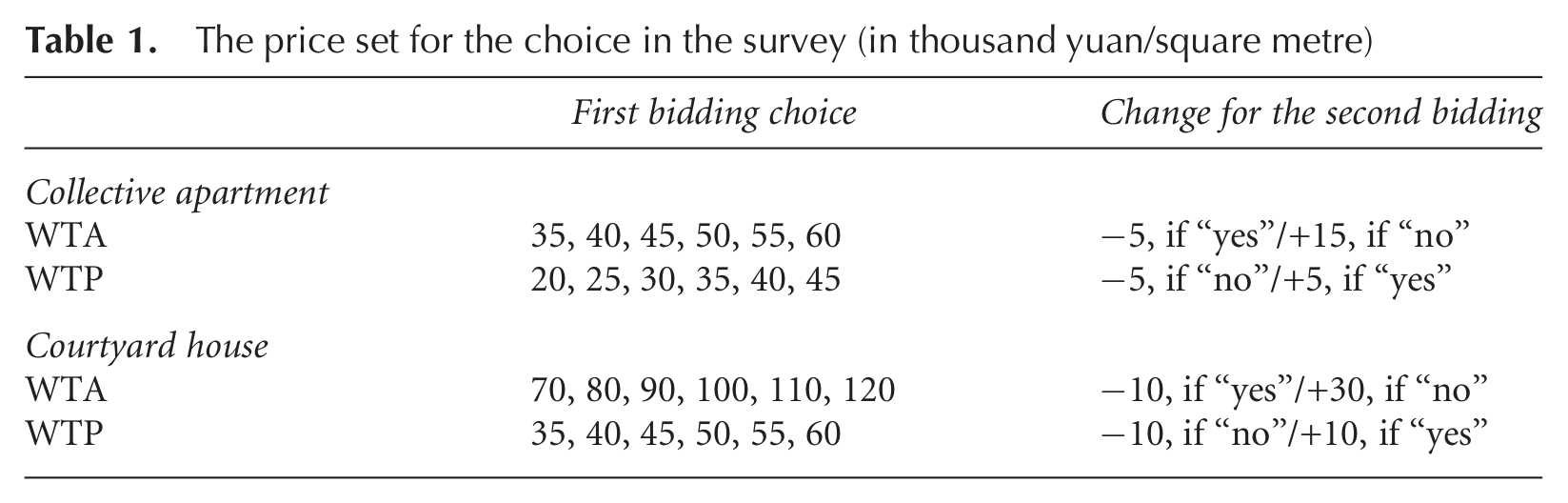
In this paper, the price set used for bidding (namely, A in equations (1) to (3)) is derived from a pre-survey with a sample size of about 20 (10 in the collective apartment area and 10 in the courtyard house area) through an open-ended question. The result shows that the WTP and WTA for the two areas differ so much that it might be more efficient to avoid using the same price set. In the end, four price sets are adopted, as shown in Table 1. Consequently, the estimation values for the two areas are also separated. The price a specific respondent is asked is randomly chosen before the interview (see Table 2). A following bid is offered depending on the first answer. As a result, we obtained 414(207*2) answers for the collective apartment area and 216(108*2) answers for courtyard house area.
The price set for the choice in the survey (in thousand yuan/square metre)
One sample question for WTA on the questionnaire: Suppose you have to relocate due to the construction of new apartments in your neighbourhood and the compensation provided is A yuan/square metre (as the triangle indicates), will you agree? (Moving and its related cost are excluded)
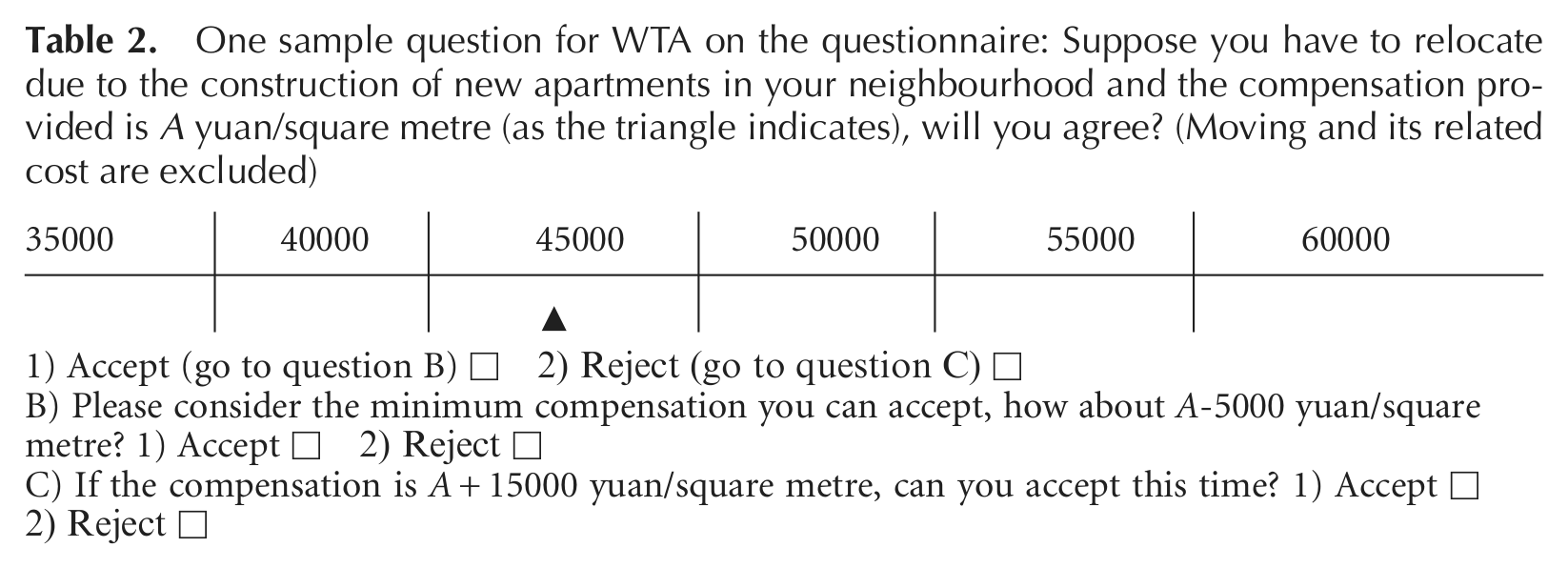
1) Accept (go to question B) □ 2) Reject (go to question C) □
B) Please consider the minimum compensation you can accept, how about A-5000 yuan/square metre? 1) Accept □ 2) Reject □
C) If the compensation is A+15000 yuan/square metre, can you accept this time? 1) Accept □ 2) Reject □
4. Estimation Result
4.1 Sample Profile
Table 3 shows some basic characteristics of the surveyed households. Compared with the city’s average level, the sample has a moderate monthly income, showing that people living in these old neighbourhoods in the central city belong to the low–middle income group. The housing condition is fairly poor; the average house size is only about half of the city mean. On the other hand, the family size of the sample is bigger. As for the property rights, privately owned housing accounts for 61.0 per cent of all the households, while the proportions of public rental and private rental housing are 28.1 per cent and 10.9 per cent respectively. Before the valuation of WTA and WTP, the respondents are asked to choose what they believe to be a reasonable method for the land expropriation compensation from five choices (see Table 4). About half of the respondents think the compensation should guarantee a better housing condition than their current one. Only less than 2 per cent of the respondents think the compensation is fair if it is based on the current market price of their houses. The survey also shows generally, for WTA, that the probability rises as the money increases, while for WTP, the probability declines as the money increases.
Household characteristics of the surveyed families
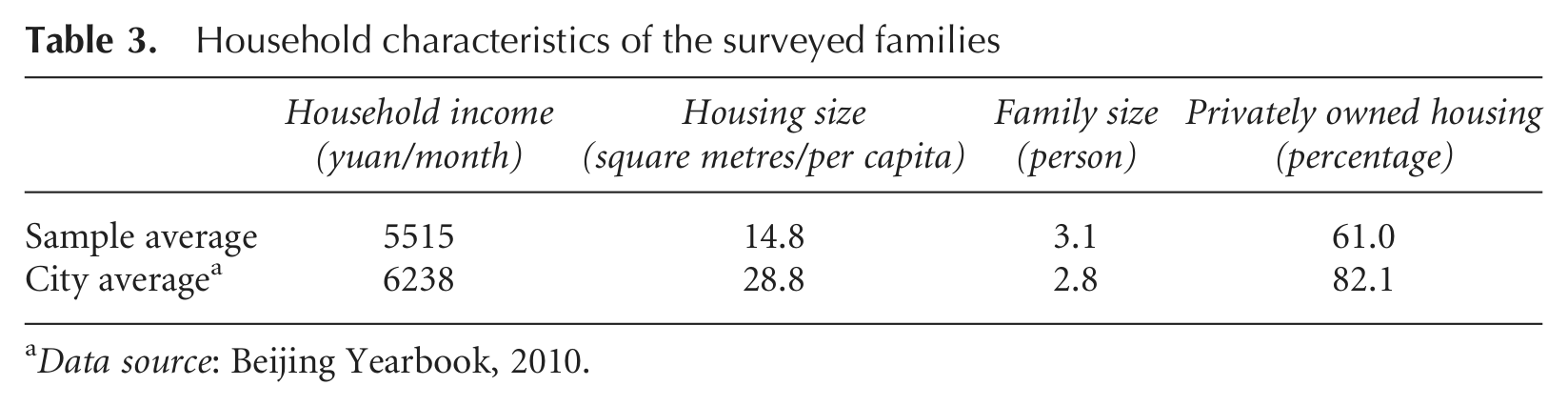
Data source: Beijing Yearbook, 2010.
Respondents’ opinion regarding a reasonable compensation scheme for land expropriation

4.2 Estimation of WTA and WTP
Besides the bidding amount A, five more variables are chosen in the vector X in function (1), as shown in Table 5. PROP indicates whether the surveyed households rent or own their current residences, and it is to test the existence of the endowment effect. INC stands for the households’ monthly income in 1000 yuan; as income is generally believed to be the indicator of payment ability which will in turn impose an effect on willingness to pay or accept, it is included in our model as most existing literature about WTA or WTP estimation does (Breffle et al., 1998; Ryan et al., 2004; Lee and Mjelde, 2007). The propensity to consume housing (for given income) is likely to vary with household characters (Hui, 1999) and many studies on urban housing suggest that family size, life cycle and occupation should delineate basic differences in such preferences (Muth, 1969; Rossi, 1955); therefore in this paper, family size (FS) is included in the model. Housing valuation is closely related with housing attributes (Wheaton, 1977; Daniere, 1993), which can be broadly divided into location attribute, structure attribute and amenity attribute (Fujita, 1989). Since location (with regard to the distance to city centre) and amenity conditions are quite similar within each group, we choose housing size (HS) and built time (HY) to reflect the housing structure attributes.
Independent variables in the model
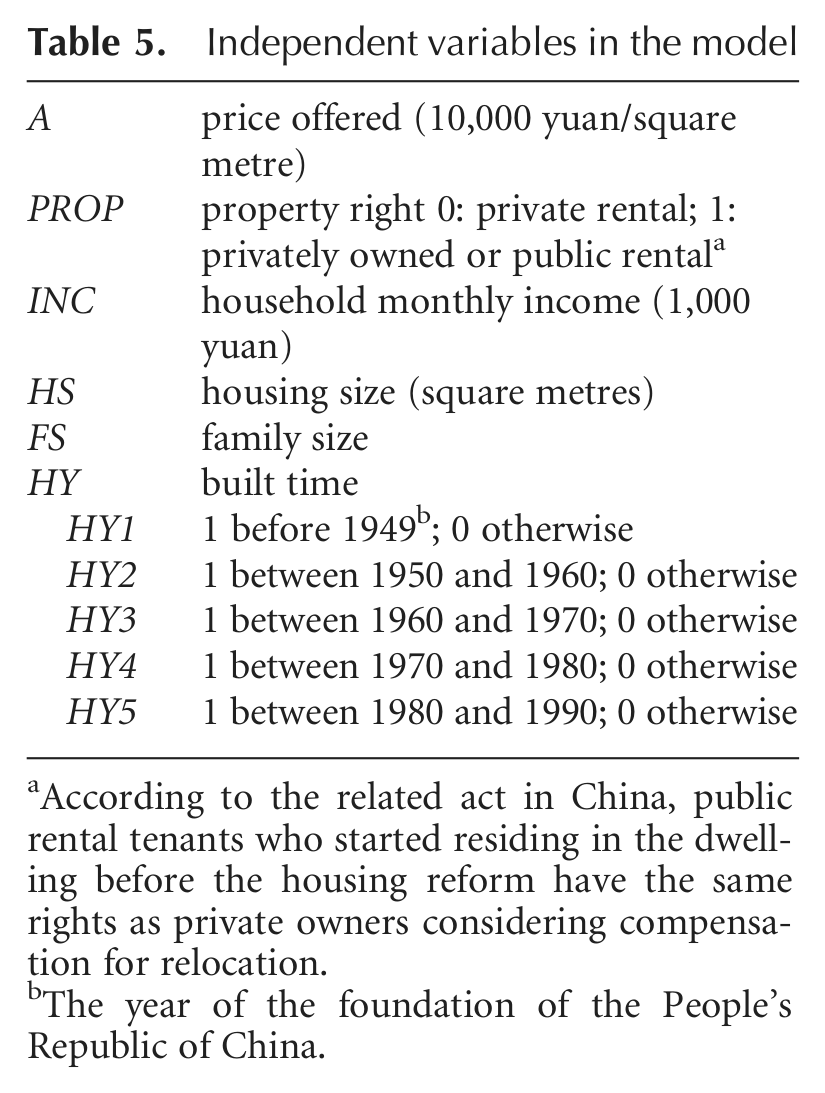
According to the related act in China, public rental tenants who started residing in the dwelling before the housing reform have the same rights as private owners considering compensation for relocation.
The year of the foundation of the People’s Republic of China.
The estimation result (Table 6) shows that for WTA, there are two highly significant variables: the compensation amount A and the property rights; for WTP, only selling price A is significant. The demographic features like households’ income and family size do not affect the decision-making; variables depicting housing conditions, like housing size and housing age, do not have an obvious influence either, although these factors have been proved to have influences on housing prices. After refining the model by excluding highly non-significant variables (p-value >0.3), WTA and WTP can be calculated based on the regression coefficients. Functions (2) and (3) are visualised in Figure 2. For the collective apartment area, the mean willingness to accept the relocation compensation is about 62,000 yuan/square metre and the mean willingness to pay for buying the same house is about 24,000 yuan/square metre; the WTA/WTP ratio is 2.58. For the courtyard house area, the mean WTA is about 157,000 yuan/square metre and the mean WTP is about 28,000 yuan/square metre; the WTA/WTP ratio is 5.61. The overall WTA/WTP ratio is 3.74.
Estimation results of the logit model

Notes: * significant at the 0.01 level. The values in the parentheses stand for the standard error.
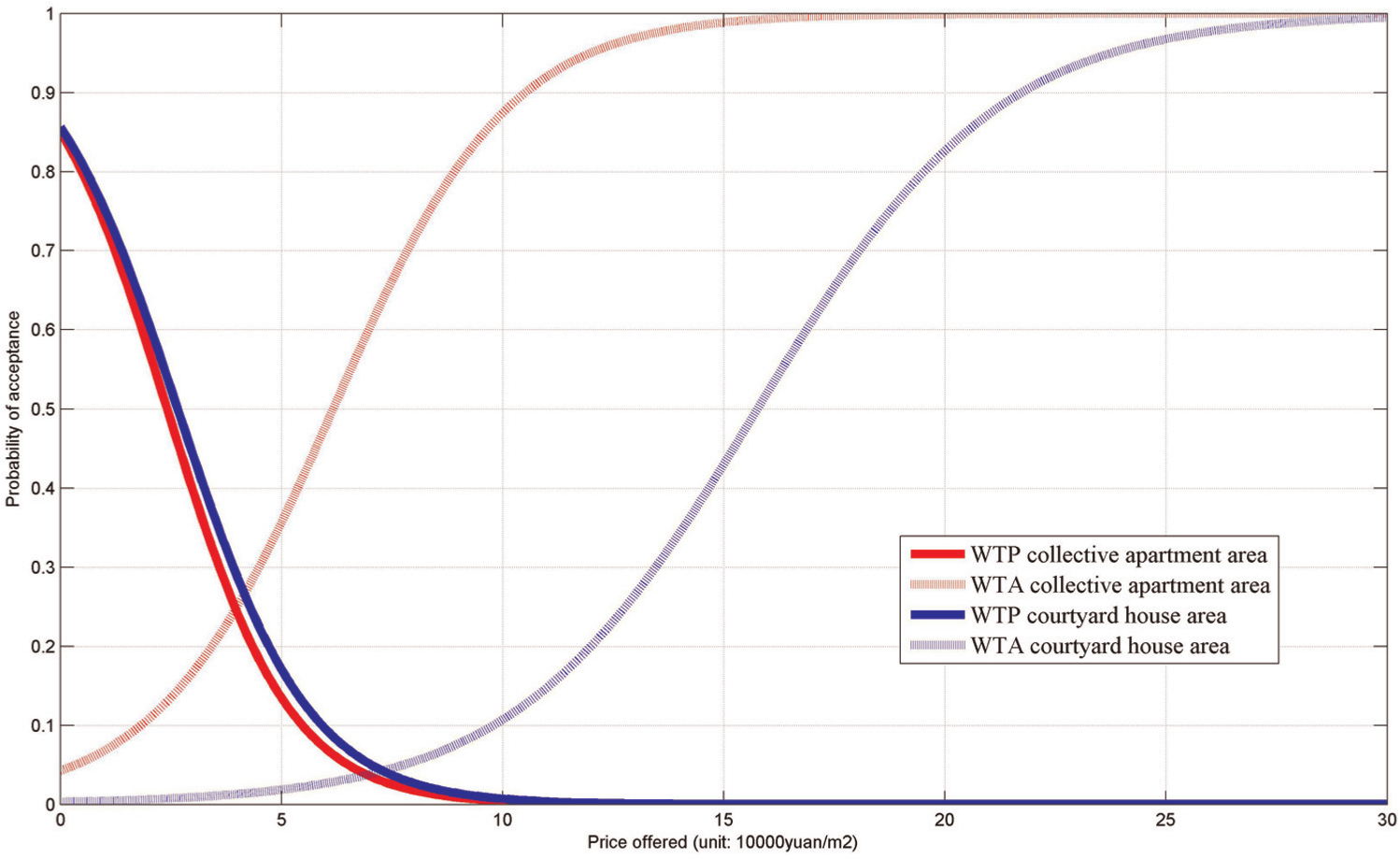
Probability distribution functions of WTP and WTA.
4.3 Effect of Iterative Bidding
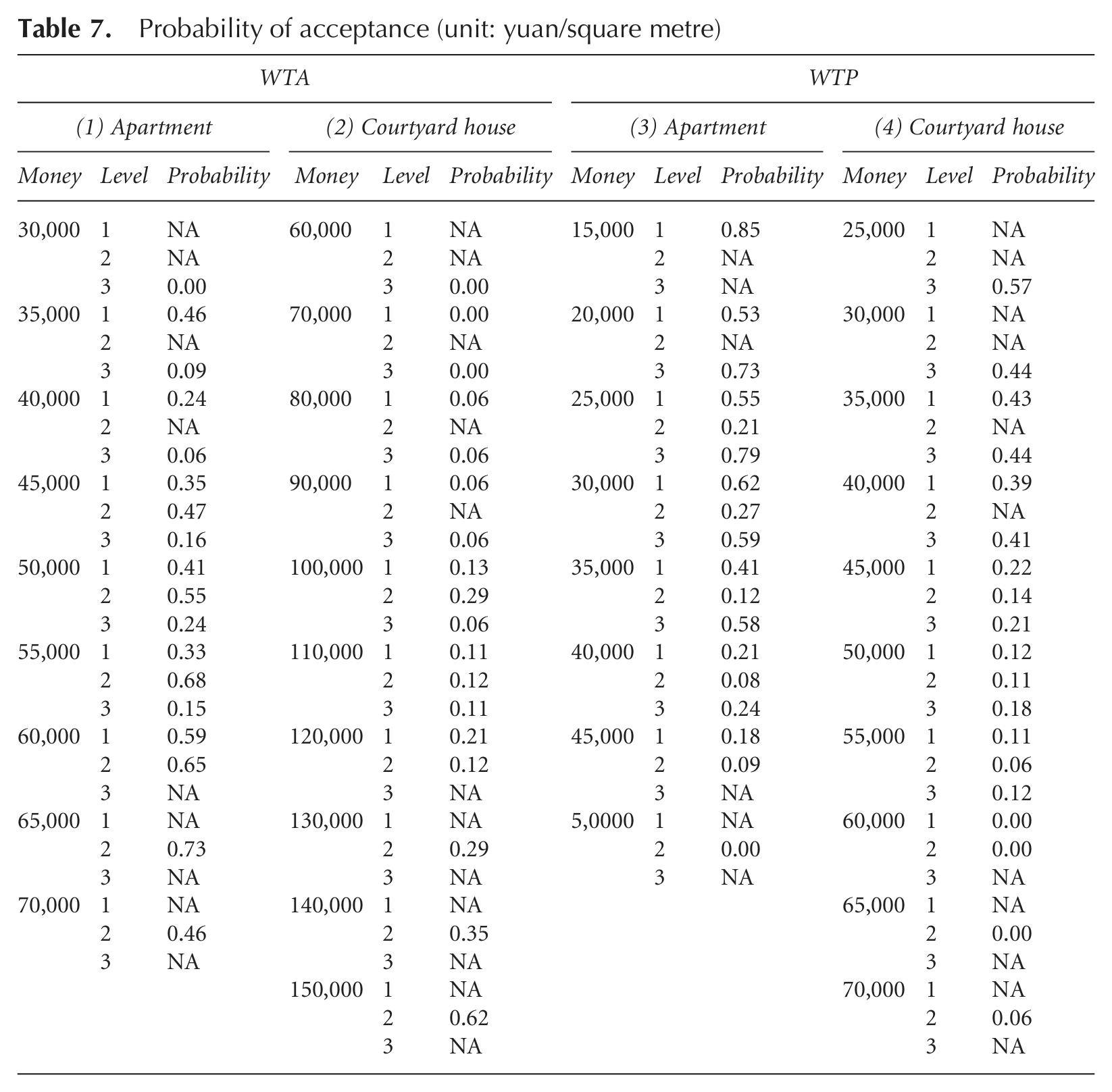
To examine whether the probability of acceptance is related to the bidding sequence, an ANOVA test is carried out. The original bidding, the second bidding (increase money) and the second bidding (decrease money) are labelled as levels 1, 2 and 3 respectively. The probability of a ‘yes’ answer with regard to the different money offered and the levels is shown in Table 7. The ANOVA results are shown in Table 8; the first part is the overall difference and the second part shows Dunnett multiple comparisons by setting the original bidding as the control category. For all the four groups, the overall differences are statistically significant with very low p-values. To interpret the difference between the groups, take group (1) (WTA of apartment) as an example; for a certain amount of compensation A, if it is offered after the respondent rejected a lower amount of money than A, there will be a 19.3 per cent higher possibility of being accepted than if A is offered in the first place, and if it is offered after the respondent accepted higher compensation, it will lower the acceptance possibility by 28.0 per cent compared with the situation in which A is offered as the original bidding. The p-value shows that the apartment area has a better significance level than the courtyard area; we believe this is due to the sample size limitation as the sample size of the courtyard area is only about half that of the apartment area. It is further divided into sub-groups according to money and level, which reduces the size of the sub-groups even more and may make some outliers significantly influence the result and increase the errors. If the sample size could be enlarged, the significance level should be improved greatly.
Probability of acceptance (unit: yuan/square metre)
ANOVA result
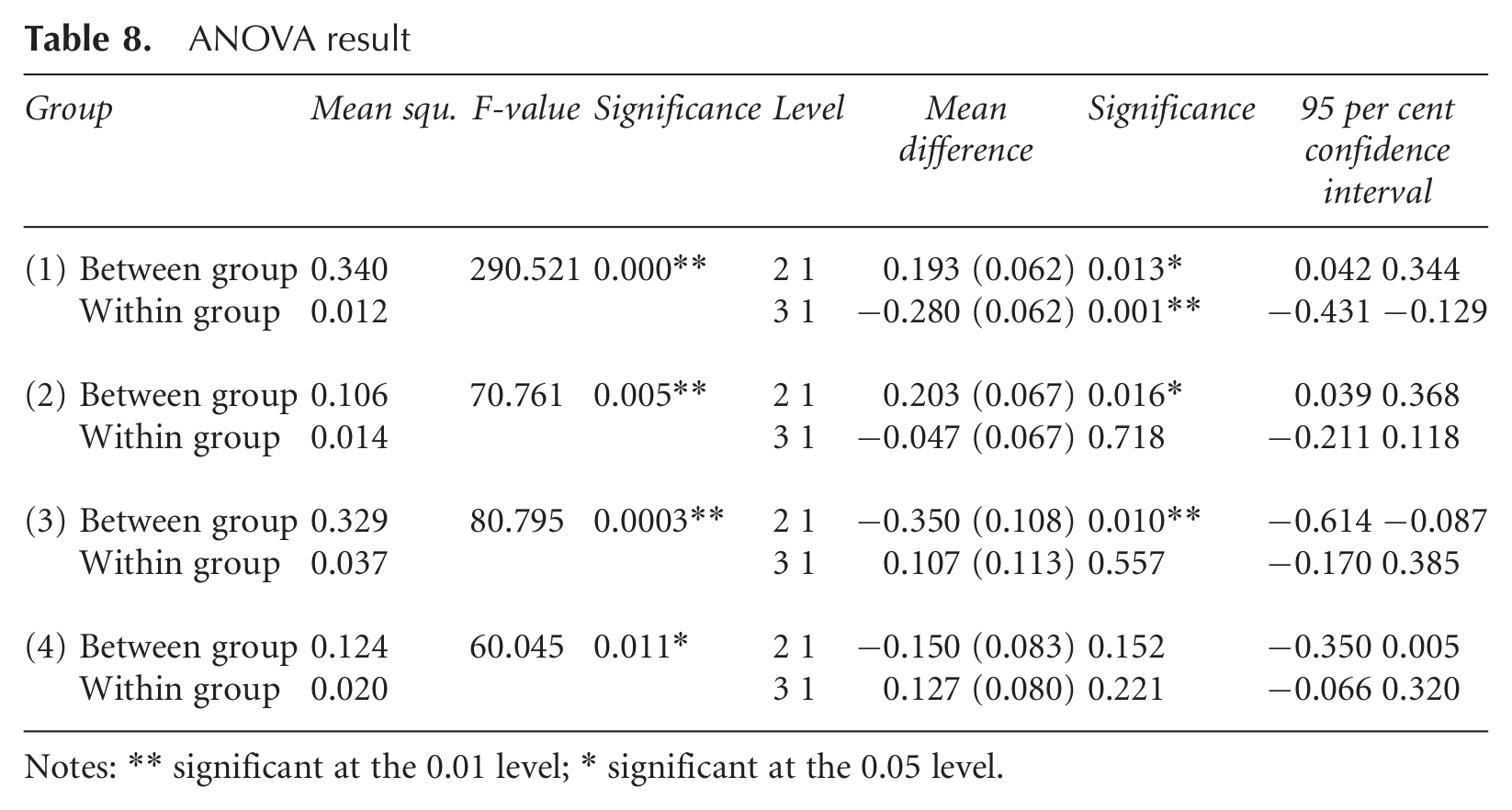
Notes: ** significant at the 0.01 level; * significant at the 0.05 level.
4.4 Interpretation of the Disparity
Consistent with previous studies, large disparities between WTA and WTP are detected. As explained in the earlier section, since other factors influencing the disparity have been cleared up, it is reasonable to attribute the WTA–WTP gap to the endowment effect and/or strategic motives. As we can see from the regression results, the sign of PROP is negative for WTA and positive for WTP in both areas. This means that ownership of the house tends to decrease the possibility of accepting a specific amount of compensation while it increases the possibility of accepting a specific selling price; namely, compared with renters, house owners ask for more compensation for relocation and also would like to offer more for keeping their current house, which tells the same story as Hypothesis 1. However, p-values of both regressions for WTP show no statistical significance for this variable; therefore, Hypothesis 1 cannot be fully validated: there is not enough evidence to support that the WTA/WTP disparity is due to the endowment effect. On the other hand, ANOVA tests indicate that, for a specific amount of compensation or selling price, the possibility of acceptance is strongly related to the sequence of the bidding. This is exactly what Hypothesis 2 indicates. Therefore, it is reasonable to accept this hypothesis—namely, the WTA/WTP disparity could be interpreted by strategic motives. In summary, from our empirical study, the gap between WTA and WTP for housing in land expropriation is more likely to derive from the households’ strategic motives for seeking profit in relocation rather than their personal attachment by ownership.
Further, we see that the WTA/WTP ratio has a noticeable difference between the two areas (2.58 and 5.61 respectively). One explanation for this is the housing market price difference; the average market price of the eight collective apartment sample areas is about 29,000 yuan/square metre, and the corresponding price for the courtyard house sample areas is about 55,000 yuan/square metre, which is almost twice the previous one. 5 As the market price increases, the WTA rises dramatically, while the WTP only increases slightly. Courtyard houses in the city are very scarce compared with apartments, and their bigger WTA–WTP disparity supports the substitute effect mentioned earlier. Besides, inconsistent with most existing literature, we find that WTA and WTP in our case bear no relation with income, and this might be because the price of housing goes far beyond the payment ability of the respondents.
5 Conclusion
This paper examines residents’ valuations of their current dwellings during land expropriation. The discussion of the WTA–WTP deviation helps us to understand the motive of households in pricing their houses provided they have to relocate. By employing the contingent valuation method and using data from face-to-face interviews conducted in 14 old neighbourhoods in central Beijing, the paper finds a WTA/WTP ratio of 3.74 (2.58 and 5.61 for the two regions respectively), which falls into the general interval of the disparity (between 2 and 5) found by previous studies (Sayman and Onculer, 2005; Brown, 2005; Adamowicz et al., 1993) but lower than the ratio of 7 reported by Horowitz and McConnell (2002) in the case of preserving land from development.
Two hypotheses interpreting the disparity are checked and they provide little support for the ‘endowment effect’ theory but indicate that the WTA–WTP gap is largely due to opportunistic pricing behaviour. The average WTA for the collective apartment area is 62,000 yuan/square metre, and it reaches 157,000 for the courtyard house area located within the second ring road of the city; both WTAs are more than twice the corresponding housing market prices in the region. This equals total compensation of 3.2 to 3.3 million yuan; considering the average second-hand house price in the six urban districts of Beijing, which was about 25,000 yuan/square metre during the survey period, the household could buy an apartment of nearly 130 square metres with the required compensation. This is in contradiction to most respondents’ statements that they only hoped to have a better housing condition after relocation, and the WTA they asked is obviously overpriced.
Nevertheless, the result of the paper does not necessarily mean that taking the market price as compensation is the optimal method: this might not even permit the household to buy a decent residence after relocation, considering the soaring house prices in the city and the relatively poor condition of the current housing. In fact, we can see from this paper that the severe conflicts between residents and government during land expropriation are due to the unsatisfying reality in relation to the expectation. Since the WTA is far higher than the market price and it is intentionally overpriced, there should be a compromise lying between the two values that is acceptable to both residents and policy-makers. To elucidate this, the housing utility of households in the context of a specific city should be considered, which could be a topic for future study. Alternative compensation schemes like in-kind compensation may also be more effective than cash compensation to diminish opportunistic pricing during negotiations with house owners.
Footnotes
Acknowledgements
The authors thank the anonymous referees for their valuable comments.
Funding
This research was partly supported by Grant-in-Aid for Scientific Research from the JSPS (Japan Society for the Promotion of Science).