



Abstract
Ethnic residential segregation can arise from voluntary or imposed clustering of some ethnicities in specific urban areas. However, up to now it has been difficult to untangle the real causes underlying the segregation phenomena. In particular, voluntary segregation preferences could not be revealed from the observed location choices given the existence of constraints in the real housing market. This study aims at analysing the voluntary segregation drivers through a stated preferences experiment of neighbourhood choice. This method obviates the choice-constraint issue by allowing a hypothetically free choice of alternative urban locations. The results suggest that ethnic preferences exist, positive for co-national neighbours and negative for other foreign groups. However, such preferences do not constitute a major location choice driver given relatively modest willingness-to-pay for ethnic neighbourhood characteristics. Certain heterogeneity in preferences for higher concentration of own co-nationals is captured for households of different origins and educational attainment.
1. Introduction
When choosing the most suitable area of residence, individuals often consider various location characteristics such as the average dwelling prices, travel time to work, quality of schools and public services or accessibility. Among these determinants, in Switzerland like elsewhere in Europe, the role of ethnic neighbourhood composition is gradually gaining in importance. Given the recent rise in immigration trends, the relevance of such a thematic is becoming essential for the management of an increasingly multi-ethnic social fabric. In fact, individual preferences for ethnic neighbourhood composition translate into housing location decisions, which might generate concentrations of different ethnic groups in certain urban areas. Even if the ethnic grouping can be beneficial for recent immigrants, helping them to settle into the new social context (Bolt and van Kempen, 2008), it is often a matter of concern for the consequences of its potential negative developments. There is, in fact, a general fear that such trends might evolve into the ethnic segregation phenomenon similar to that of the United States, often linked to a series of social problems such as racial inequality and marginalisation, ghettoisation and poverty concentration (Massey and Denton, 1993; Charles, 2003).
Residential segregation is often thought to arise from a combination of preferences of different ethnic groups and constraints in their choice decisions, first leading to voluntary and secondly to involuntary ethnic clustering patterns. However, the dominance of preferences as determinants of residential grouping is often debated. While policy-makers, often failing to consider the scientific contribution, expose divergent views on voluntary and involuntary triggering factors, research still struggles to untangle the real segregation causes. To this end, several theories, from spatial assimilation to place stratification, have been developed. Yet, such theories still lack the support of strong empirical evidence. The difficulty at the empirical level lies in the so-called choice-constraint issue (van der Laan Bouma-Doff, 2007) affecting immigrants’ residential location decisions. In the context of real housing markets, residential location choices can be constrained by households’ less favourable socioeconomic position or discriminative practices. The models using the observed location choices—generally employed for studying the segregation drivers—would, in this case, confound the effects of voluntary (preferences) and involuntary (constraints) components. In other words, the use of revealed preferences data on residential location decisions makes it infeasible to explain whether the present residential location was voluntarily chosen by immigrants or whether it was dictated by constraints they face in accessing other urban locations. Given that such constraints most frequently apply to disadvantaged ethnic minorities, which are also those who often show the highest segregation levels, the question of choice limitations in the analysis of voluntary segregation preferences becomes fundamental.
In this paper, we aim at analysing the preferences for ethnic neighbourhood composition—which we refer to as ethnic preferences—and measure their impact on residential location choice. To this end, we introduce the ethnic description of urban locations within the residential location choice models and design a stated preferences (SP) experiment of neighbourhood choice. This method obviates the choice-constraint issue by allowing interviewed households to face with a free choice of alternative neighbourhoods described by different ethnic and non-ethnic factors. Households’ preferences are thus revealed from hypothetically unconstrained residential location choices. Our specific focus is on the existence of self-segregation preferences and those for living with other foreign communities. For the empirical analysis, we conduct the stated choice survey, considering at the geographical level choices among the different neighbourhoods within the city of Lugano in Switzerland.
In addition to the general analysis of preferences for ethnic neighbourhood make-up, we investigate the heterogeneity across different ethnic groups. Using observed and random components, we assess the impact of socioeconomic characteristics potentially affecting segregation behaviour. Finally, we quantify the relative importance of non-monetary attributes of housing location choice (namely, ethnic neighbourhood composition and travel time to work) in terms of willingness-to-pay (WTP) measures. The intent is to examine whether the ethnic preferences are the strongest determinants of the location choice decisions, or if their impact is weak against other residential choice factors.
The paper is organised as follows. Section 2 provides a literature review of previous studies analysing ethnic segregation drivers and presents the stated preferences experiment of neighbourhood choice, along with the main study hypotheses. The stated choice experiment is applied to a case study in a Swiss urban setting for which the spatial context and data are described in section 3. Section 4 presents the methodological framework and model specification, while section 5 illustrates and discusses the model results. Finally, section 6 provides the conclusions.
2. Exploring the Voluntary Ethnic Segregation Drivers
2.1 Previous Research
In analysing the ethnic segregation drivers, several studies examine the impact of households’ and neighbourhood characteristics on the probabilities of moving to or residing in more vs less segregated neighbourhood types (see for example, Zorlu and Mulder, 2008; Doff and Kleinhans, 2011). Such studies commonly use data on households’ observed residential locations, estimating OLS regression or logit models. Even though their findings show that probabilities of residing in segregated neighbourhoods differ across ethnic groups, they could not fully explain whether such outcomes result from voluntary or involuntary segregation causes. Zorlu and Latten (2009) focus on this point in an attempt to identify preferences for ethnic neighbourhood make-up. Using the Oaxaca–Blinder decomposition technique, they explore the native–immigrant differentials in the choice of destination-neighbourhood types. They thus separate the contribution of observed and unobserved factors, attributing the latter (estimated as 35 per cent of the total differential) to preferences and discrimination effects.
Another methodology, extensively used in modelling the residential location choice decisions but applied to segregation issues to a lesser extent, are the residential location choice (RLC) models (McFadden, 1977). Such models reveal the preferences for different alternatives and their attributes from households’ choices among a pre-defined set of alternative residential locations. Applied to segregation analysis, they allow exploring the relative impact of ethnic neighbourhood attributes on the location choices compared with other residential choice drivers such as amenities, schools or environmental quality. Up to now, only a few studies focusing on segregation issues have estimated RLC models using revealed preference (RP) data. In his study, Åslund (2005) finds that the population composition significantly affects immigrants’ location decisions, where a particular importance is given to the presence of co-nationals and other immigrant communities. Both of these factors are found to act as attractors for new immigrants, as well as for those who relocate within the hosting country. However, as discussed previously, these model results cannot be interpreted as pure ‘preferences’, since they are likely to confound the effects of preferences and constraints embedded in observed households’ residential location choices.
A third stream of studies directly examines the preferences for segregation through stated preference experiments, employing the so-called Farley–Schuman showcard methodology. First proposed by Farley et al. (1978) the method was later implemented and further developed by various other researchers (see for example, Clark, 1992; Charles, 2000, 2003). This literature shows that preferences for residential proximity to co-ethnics exist and vary in intensity for different ethnic groups (Clark, 1992; Charles, 2000). Nevertheless, the approach presents two major shortcomings. First, it only captures the ethnic aspect of residential location choice and is therefore unable to explain if ethnic preferences dominate among other residential choice drivers. Secondly, the method relies on purely hypothetical bases, so that—as suggested by Clark (1992)—additional tests to examine the relationship between declared preferences and real behaviour are needed.
2.2 The Stated Preference Experiment of Neighbourhood Choice
In analysing ethnic preferences and their impact on segregation dynamics we employ a stated preference (SP) experiment of neighbourhood choice (for a detailed description of the SP experiment please refer to section 3.2). Contrary to the revealed preferences (RP) data (i.e. information on the observed residential location), the SP choice experiment permits a hypothetically free choice of alternative neighbourhoods, assuming no constraints as in the real housing market. The validity of the SP choice method is widely documented for situations where RP data are not available or adequate to identify preferences (for more details, see Louviere et al., 2000). Such a case applies to the markets subject to choice constraints.
The experiment designed for this study embeds neighbourhood ethnic description among other residential location choice drivers. Underlying preferences are thus revealed from households’ choice decisions, where respondents make different trade-offs between ethnic and non-ethnic location attributes according to their heterogeneous preferences. The resulting choices are analysed in the context of residential location choice models (McFadden, 1977), allowing us to compute preference indicators as well as willingness-to-pay (WTP) measures for each of the ethnic and non-ethnic location characteristics.
Pivoting or referencing the experiment around the experienced alternative—in our case, the actual neighbourhood characteristics of the chosen location—is a widely tested method developed for the construction of behavioural reality in SP choice experiments (Hensher, 2008). We implement such a method in order to adapt the hypothetical alternatives to the urban context under study, as well as to respondents’ current housing situation. Putting households in front of a hypothetical, yet credible and customised, choice setting adds to the realism of the experiment, permitting us to match more effectively their stated choices with the true behaviour in the domain of housing location decisions.
Four other major advantages stem from such approach. First, the SP experiment in which the dwelling characteristics are kept constant allows us to explore the residential location choices based uniquely on selected neighbourhood characteristics. Conversely, location choice models using RP data would involve a multilevel choice of dwelling and neighbourhood with the resulting difficulties in choice set definition and model estimation. Secondly, a priori definition of ‘neighbourhood types’ widely used in the current practice for analysis of neighbourhood-type selection, can be obviated and instead the marginal (dis)utilities for neighbourhood characteristics directly identified. Thirdly, the orthogonal experimental design strategy overcomes the issue of confounding effects as in the RP data setting. Finally, the heterogeneity in marginal (dis)utilities across different ethnic and socioeconomic groups can be tested and WTPs for different population segments compared.
Ethnic factors influencing the residential location choices
Findings of previous research on immigrants’ location decisions show that households tend to live in areas with a higher presence of co-ethnics (Åslund, 2005; Zorlu and Mulder, 2008) and a higher share of other foreign groups (Zavodny, 1999; Zorlu and Latten, 2009). Yet, the literature suggests that different driving forces could be behind the residential choice behaviour relative to these two ethnic factors.
Development of ethnic networks is believed to facilitate new immigrants in gaining information and accessing labour and housing markets, particularly at the initial stage (van der Laan Bouma-Doff, 2007). Likewise, aspects such as the preservation of native language and culture or the supply of specific ethnic goods are also deemed to reinforce preferences for residential proximity to one’s community of origin in the long run (Zhou and Logan, 1991). Besides these positive externalities, the ‘voluntary choice for segregation’ might also result from negative factors, such as experienced discrimination from other ethnic groups (van der Laan Bouma-Doff, 2007). 1 It is thus assumed that the observed concentration patterns among co-ethnics arise following immigrants’ preferences for residing next to their own compatriots, regardless of whether such choices are based on positive or negative arguments. 2
Conversely, high immigrant concentrations in specific neighbourhoods are frequently related to factors driving the involuntary segregation. In fact, it is often argued that the residential location choices of immigrants are dictated by their weak socioeconomic position, limited accessibility and discrimination in the housing market (Darden, 1986; van der Laan Bouma-Doff, 2007). Similarly, the voluntary preferences of other (dominant) ethnic groups are thought to influence the involuntary segregation trends of disadvantaged ethnic minorities (Zorlu and Latten, 2009). Thus, even though immigrants are found to have major probabilities of residing or relocating to neighbourhoods with high immigrant levels, this could be a result of constraints rather than preferences.
In our choice experiment, we test such a hypothesis. First, we aim to verify if the concentration of co-nationals has a positive impact on the probability of choosing a certain residential location, indicating preferences for ethnic clustering among own community of origin. Secondly, we examine the preferences for the share of foreigners, expecting to find a marginal disutility associated with such an attribute, denoting a negative perception of neighbourhoods inhabited by a large immigrant population.
Differences in preferences across ethnic and socioeconomic groups
It has been widely observed that ethnic preferences, as well as their impact on location choice, differ across different population segments. Following such evidence, we pay particular attention to two socio-demographic characteristics: the origins and the education level. These factors are found to affect significantly the observed segregation patterns, as well as to influence the ethnic preferences and thus the residential location choice behaviour (Åslund, 2005; Zorlu and Mulder, 2008). A third element potentially affecting the preferences for co-ethnic neighbours is the households’ income (Clark, 2009). This factor was tested in preliminary analysis but found to have a statistically insignificant effect in this particular study context. On this basis, we propose another set of hypotheses relating to heterogeneity in ethnic preferences in order to test some theoretical postulates identified by the segregation literature as being of particular interest for policy guidance.
The first hypothesis concerns the origins of ethnic communities and investigates the differences in preferences for self-concentration across the following population segments: the disadvantaged immigrant groups from underdeveloped and developing countries, the advantaged foreign communities of Western descent 3 and the native population. The aim here is to gain insight into the underlying causes of existing segregation patterns where the disadvantaged groups are predominantly concentrated in large and highly mixed residential neighbourhoods, while the advantaged communities tend to establish in more attractive areas mainly dominated by the native population.
Another subject directly linked to the social status of immigrant groups is the education level. Education is in fact one of the key variables, together with occupation and income, that according to the spatial assimilation theory could influence the segregation patterns into a major residential integration of ethnic minorities (Charles, 2003). Several studies demonstrate that the degree of spatial dispersion and residential integration is directly linked to the level of education of immigrant households. In their studies Åslund (2005) and Zorlu and Mulder (2008) find an increasing residential mobility, especially to quality urban areas, of highly educated immigrant households. The underlying assumption is that higher education levels support social mobility and enhance the chances of economic success of immigrants (Hartog and Zorlu, 2009). Households with higher education levels are thus able to choose more freely their residential location as well as to access some more attractive neighbourhoods. We thus test the hypothesis that a higher education level not only helps to eliminate constraints on residential choice, but also weakens the ethnic self-segregation preferences, stimulating a major residential integration within the mainstream society.
3. Data and Spatial Context
3.1 Spatial Context and Observed Segregation Patterns
The analysis considers the mid-sized Swiss city of Lugano and its seven surrounding communes inhabited by a population of 78,025 residents in the year 2008. With almost 40 per cent of foreign residents coming from over 100 different countries, Lugano is among the most ethnically diverse cities in Switzerland. Foreigners residing in the city, like those in the rest of the country, can be classified into two categories which exhibit different residential behaviour (Arend, 1991). These groups often occupy the extremes of the job market (Afonso, 2004), leading to strong differences in their socioeconomic status. The highly skilled and wealthier foreign communities are represented mainly by citizens from neighbouring and other Western countries (the EU, the US and Australia). Among the non-Western nationals, accounting for 31 per cent of total foreign population, citizens from the Balkans and Turkey are the most represented groups, whereas other minorities are mostly recent immigrants from less-developed non-Western countries. Other than showing a poorer socioeconomic position, the latter immigrant communities also exhibit a major social distance from the native population in terms of linguistic, cultural and religious background.
The spatial distribution of foreigners in Lugano more closely resembles the European context of ethnic mixing rather than homogeneously segregated neighbourhoods as found in the US. Moreover, the segregation levels are relatively low compared with the US and some big European cities, due to a small and compact urban territory as well as a good degree of spatial and social integration among the major ethnic groups.
The existing distribution of different nationality groups across the city neighbourhoods indicates a distinct pattern of concentration between the advantaged and disadvantaged ethnic communities. While advantaged foreigners situate themselves mainly in more attractive neighbourhoods inhabited by a larger share of natives, the disadvantaged immigrant communities concentrate within the large urban residential areas with a cheaper housing stock. Still, apart from the socioeconomic situation, foreigners’ distribution patterns also show some residential grouping among single ethnic groups. In this regard, each community exhibits a certain degree of concentration in specific areas. The highest concentrations are observed for Turkish, South American, some western European and North American communities, while Italians are, as expected, more dispersed over the territory given their cultural and linguistic similarity to the natives.
3.2 Data
The empirical analysis of this study refers to a dataset obtained through the main stated preferences (SP) experiment 4 and a secondary revealed preferences (RP) survey of location choice. The choice experiment was conducted as a computer-assisted face-to-face interview and completed for 133 households from 10 different nationality groups. 5 Overall city population (over 18 years old) was first stratified according to the origins and neighbourhood of residence and subsequently randomly sampled. Thus the male or female household head was interviewed. This sampling strategy allowed us to include all nationality groups in the experiment as well as to represent the spatial distribution of the population. Given a particular focus on the immigrants’ residential location choice behaviour, some less represented foreign groups were oversampled. However, the model results are unaffected by this sampling procedure, since the sampling criteria did not consider the choice variable, but exogenous individual-specific characteristics (for more details on exogenous stratified sampling in discrete choice models, see Manski and Lerman, 1977; Manski and McFadden, 1981).
In the experiment, respondents were presented with a future hypothetical situation in which their neighbourhood of residence changed its ethnic composition in terms of concentration of co-nationals and share of foreigners. They were thus asked to choose between the present neighbourhood of residence (reference alternative) and two alternative neighbourhoods (unlabelled hypothetical alternatives) defined by characteristics and respective attribute levels resulting from the experimental design (for more details on experimental design strategies, see Louviere et al., 2000). 6 Because the characteristics of the dwelling itself did not change, but only the neighbourhood variables, this was equivalent to moving the existing residence to a new neighbourhood. In particular, the three alternative residential locations were described in terms of two ethnic attributes (namely, concentration of co-nationals and share of foreigners) and two other housing choice drivers (namely, prices of dwellings and travel time to work). The latter two attributes are used for trade-off analysis and impact testing in the experiment and choice models.
The experiment was designed in a pivoted stated preference setting—i.e. the hypothetical alternatives among which each respondent had to choose were generated on the basis of his/her currently chosen alternative. Each of the four attributes describing the alternative neighbourhoods contained five levels: the reference value and four positive and negative percentage deviations from the reference value (see Table 1). While the reference value reflected the real value of the relative attribute of respondents' present residential location, percentage deviations for the hypothetical alternatives were set on the basis of the spatial context and characteristics of the city of Lugano.
Stated preferences (SP) experiment of neighbourhood choice: Description

Attribute levels are defined as positive and negative percentage deviations from the reference value.
Reference value is the value of the relative attribute of respondents’ present residential location.
Respondents’ present neighbourhood of residence represents the reference alternative in the experiment.
According to an orthogonal main-effects experimental design, 25 choice situations reflecting different combinations of attribute levels, were identified and divided into two blocks. The blocking procedure has been applied for reducing the number of choice situations presented to each respondent (for details, see Louviere et al., 2000). Each of the 133 respondents was thus assigned to one of the two blocks and accordingly presented with 12 or 13 choice situations of the format shown in Figure 1. The reference alternative attribute values were held constant for each respondent, reflecting the values of his/her present residential location; whereas those describing the two hypothetical alternatives varied across each choice situation defining different trade-offs between the neighbourhood attributes. The resulting database used for residential choice models estimation comprised a total of 1566 valid choice observations.
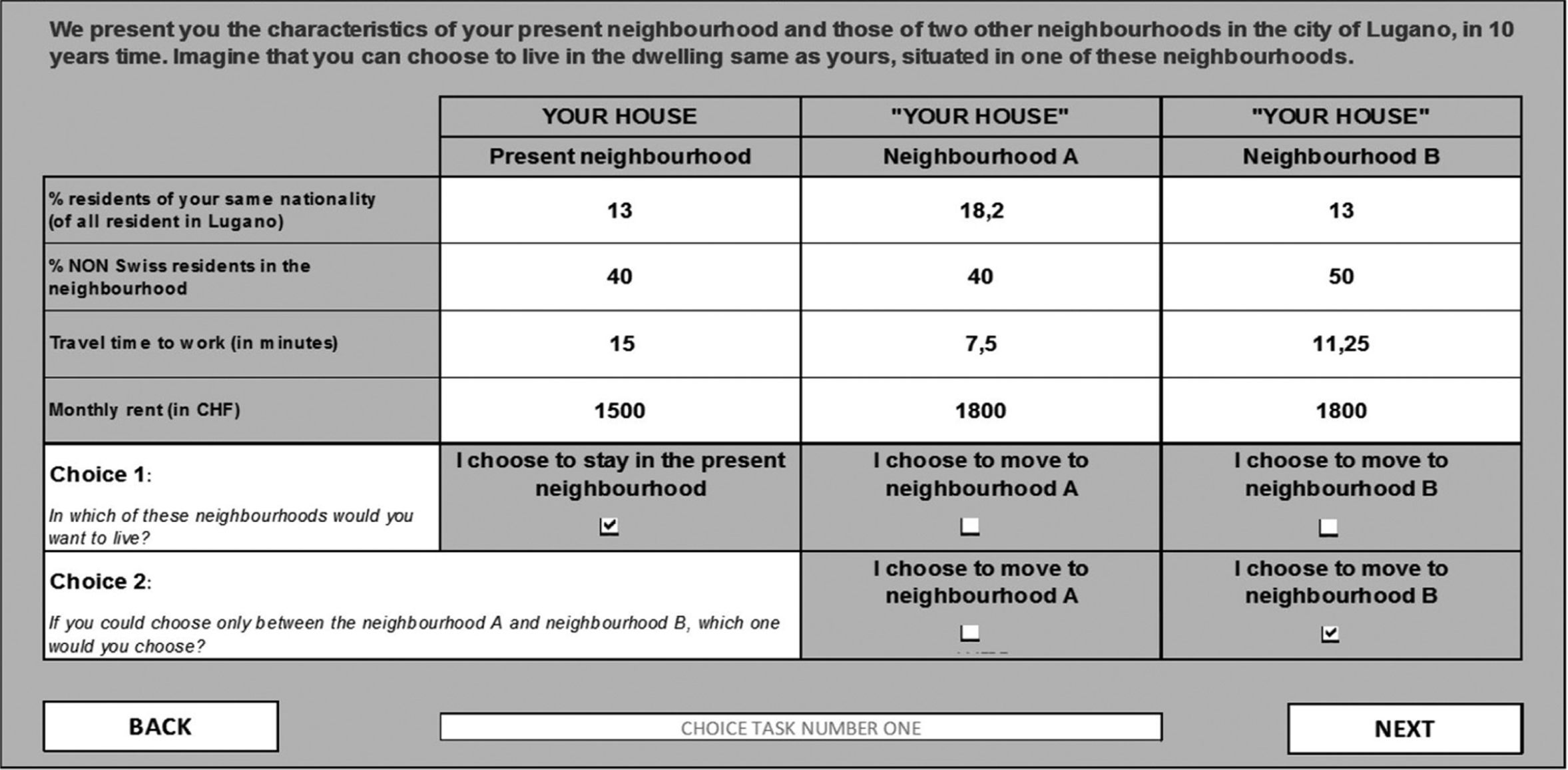
Stated preferences choice situation example.
4. Methodological Framework
Ethnic preferences are specified in the context of residential location choice models derived from a random utility model (RUM) framework (McFadden, 1974). In particular, the utility function associated with the individual n, for alternative j, in a choice task s, is defined as follows

where,

where

where,
Recalling the choice experiment under study which comprises two unlabelled alternatives and the reference alternative, the system of utility functions for the first model to be estimated (referred as M1 in the model results section) is expressed as follows

where,
The alternative specific constants (ASCs) are estimated for the two unlabelled hypothetical alternatives—namely, neighbourhoods A and B, and hence normalised with respect to the reference alternative. Furthermore, the degree of neighbourhood attachment is represented by two additional variables introduced in the utility function for the reference alternative. The first variable refers to the years lived in the present neighbourhood (YearsN), while the second variable denotes the Sense of Community Index (SCI)—the attitudinal index proposed by psychologists McMillan and Chavis (1986), focusing on the experience of community and measuring the degree of satisfaction with the own neighbourhood. These two variables are associated with coefficients
The model stated in equation (4) allows us to test the two main study hypotheses regarding the ethnic preferences H1: The concentration of co-nationals has a significant positive effect on the households’ neighbourhood choice. H2: The share of foreigners has a significant negative effect on the households’ neighbourhood choice.
Such hypotheses are in line with the current literature indicating the concentration of co-ethnics and that of other minority ethnic groups among the main drivers of immigrants’ location decisions (Zorlu and Mulder, 2008; Åslund, 2005). Furthermore, for H1 we expect a positive sign indicating a preference for residential proximity to ones’ co-ethnics, whereas for H2 we expect a negative sign expressing a decrease in marginal utility with the increase in the foreigners’ share in the neighbourhood.
Introducing the second model (M2) we aim to account for preference heterogeneity around the mean, to explain part of the existing heterogeneity through individual socioeconomic characteristics. We thus interact the observed individual characteristics with the mean estimate of the random parameter (Hensher and Greene, 2003). In this context the random parameters are defined as follows

where,
In particular, the second model (M2) considers two interactions that potentially link to the segregation patterns and opens to a second set of hypotheses addressed in this analysis, that is H3: The preferences for self-segregation are affected by the origin of immigrants distinguishing between advantaged and disadvantaged countries. H4: The preferences for self-segregation decrease with the increase of the education level of immigrants.
Formally, the focus is on the interaction between the concentration of co-nationals and the origin of households and between the concentration of co-nationals and the level of education with the following specification

where, DIS is a dummy variable taking the value of 1 for households from disadvantaged countries and Edu is a six-point categorical variable expressing the respondents’ level of education (ranging from 1 = none to 6 = academic degree).
According to the model specifications expressed in equations (4) and (6), the probability for household n to choose neighbourhood j is as follows

where, s = 1, …, S indicates the panel structure of the data. Given that the integral in equation (7) has not a closed form, the coefficients are estimated by maximising the following simulated log-likelihood function
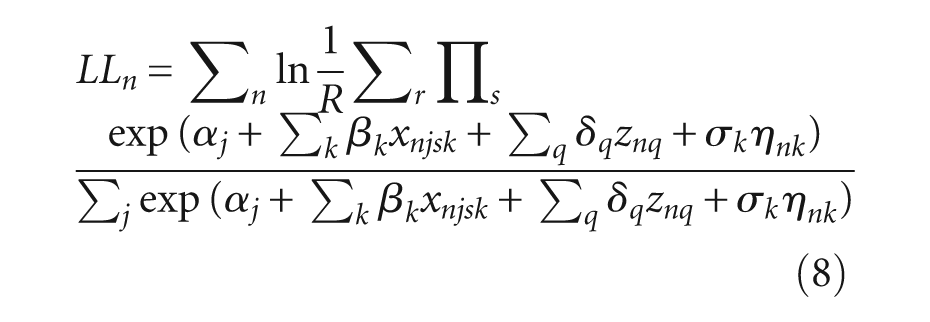
where, r = 1, …, R indicates the random draws 9 used for the simulation.
Finally, willingness-to-pay (WTP) measures representing the monetary value assigned by respondents to increase/decrease in a desirable/undesirable attribute can be computed from the relative coefficient estimates. In particular, for the first model (M1), the mean monetary values are obtained as follows

Furthermore, for the second model (M2) which includes interaction terms for origins and education level, the mean monetary measures for different population segments are computed as follows
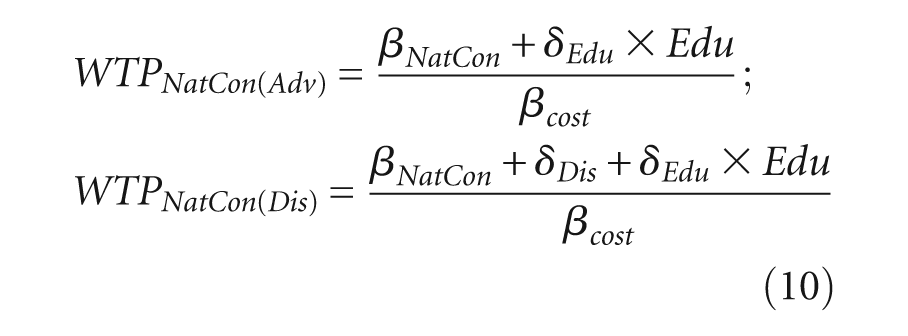
where, Edu = 1,…, 6 is the variable that distinguishes for the education level, while Adv and Dis stand for advantaged and disadvantaged ethnic groups.
5. Model Results
Two random parameter logit (RPL) models with a panel specification 10 were estimated: a base model (M1) and a model including heterogeneity in the mean (M2). The evaluation of each model is based on log-likelihood at convergence, McFadden pseudo ρ2 and the Akaike information criterion (AIC). The comparison between the two models relies on the log-likelihood ratio test. Table 2 reports the estimation results.
Random parameters logit (RPL) model results (N = 1566)

Note: aEducation level is a six-point categorical variable expressing the respondents’ level of education (ranging from 1 = none to 6 = academic degree).
As introduced in the methodology section, the dependent variable is represented by the utility associated with the choice alternatives and is expressed through the choice among three alternative neighbourhoods—namely, present neighbourhood of residence, hypothetical neighbourhood A and hypothetical neighbourhood B. Accordingly, the estimated coefficients are to be interpreted as marginal (dis)utilities associated with the attributes describing the choice alternatives. Thus, a positive (negative) estimate associated with an attribute denotes a marginal utility (disutility) which increases (decreases) the choice probability of a specific alternative.
Parameter estimates associated with the travel time to work and the monthly dwelling rent are statistically significant at the 99 per cent confidence level and have the expected negative sign for both the M1 and M2 models. This result denotes a marginal disutility associated with these attributes, albeit showing a significant random heterogeneity in appraisals for travel time savings among respondents. Being the alternative specific constant (ASC) for the reference alternative normalised to zero, the negative and statistically significant ASCs for the two hypothetical alternatives, A and B, indicate the preference for staying in the present neighbourhood of residence. The present neighbourhood is also preferred with the increase in the number of years lived in the neighbourhood and the level of satisfaction with the social dimension of the neighbourhood (Sense of Community Index) for the decision-maker.
5.1 Ethnic Preferences for Residential Proximity to Own Co-nationals and Other Foreign Communities
Turning to the main aim of the study, the estimation results presented in Table 2 allow us to test the four hypotheses formulated in the method section. Through such hypotheses, we seek to explore if preferences for ethnic neighbourhood composition affect the households’ residential location decisions, and in which ways. In accordance with our first set of hypotheses, the results show that the ethnic description of neighbourhood matters. In fact, households consider both the concentration of co-nationals and the share of foreigners when choosing their preferred housing location. As expected, a positive coefficient estimate associated with the concentration of co-nationals indicates that the presence of co-national neighbours increases the probability of choosing a specific residential location. Such findings may indicate the existence of positive externalities due to the presence of ethnic networks. Conversely, neighbourhoods with a large share of foreigners tend to be avoided not only by natives but also by foreigners.
As argued by prior studies, a high presence of foreigners may be related to a general negative perception and stereotyping of mixed ethnic neighbourhoods as melting pots of social problems, poor infrastructure and lower education quality (Charles, 2000; van der Laan Bouma-Doff, 2007). However, considerable levels of random taste heterogeneity, denoted by a significant standard deviation for the share of foreigners parameter, suggest that not all households have the same response to foreigners’ presence. In fact, some households are more keen and others more averse to the mixed neighbourhood environment. Further analysis could not identify the causes of such preference variations, since the preferences for multiculturalism seem to be independent from the observed socioeconomic and demographic characteristics of households.
5.2 Heterogeneity in Ethnic Preferences across Households of Different Origin and Education Level
Continuing the analysis, we introduce heterogeneity in mean across different household segments and test the second group of hypotheses set out in model M2. A model comparison shows that model M2 outperforms model M1 exhibiting a higher log-likelihood and pseudo ρ2 values. This result is supported by the log-likelihood ratio test (χ2 7.04; p<0.05). Hence, the two interaction terms representing the origin and education level of households do impact the preferences for co-national neighbours explaining the differences within the resulting household clusters.
In particular, hypothesis H3 explores preference variations among households belonging to the advantaged 11 and disadvantaged ethnic communities. A significant coefficient estimate for the first interaction term, indicating households’ belonging to a disadvantaged ethnic community (DIS), confirms the hypothesis of different preferences across these two population segments. Moreover, its negative sign suggests that households belonging to disadvantaged immigrant communities exhibit lower self-segregation preferences compared with the advantaged foreigners and natives. Such results are in line with international evidence which shows that Whites in the US context and advantaged foreign communities in the EU context tend to hold the strongest preferences for co-ethnic neighbours (Charles, 2000; van der Laan Bouma-Doff, 2007).
Secondly, the impact of education level on self-segregation preferences (hypothesis H4) is tested through the inclusion of the second interaction term—namely, the educational attainment (Edu). As expected, the negative and statistically significant coefficient estimate suggests that self-segregation preferences tend to decrease with the increase of education level. Many studies have, in fact, found that highly educated immigrants are much more dispersed, less dependent on ethnic ties and less likely to live in segregated areas (Bartel, 1989; Borjas, 1998; Bolt and van Kempen, 2003; Zorlu and Mulder, 2008). Households with a lower education level, on the other hand, give more importance to the presence of immigrants from their national background (Åslund, 2005).
5.3 Importance of Ethnic Preferences in Residential Location Choice Decisions
Even though the parameters reported in Table 2 indicate the direction of the effects, the absolute magnitude of coefficients is not directly interpretable. In order to compare the importance of different neighbourhood characteristics on choice behaviour, we thus derive the monetary values—i.e. households’ willingness-to-pay (WTP) for living in a neighbourhood with certain ethnic characteristics (as specified in equation (9)). In discrete choice models, the WTPs are defined as the ratio between the estimated attribute coefficients and the cost coefficient—in our study, the monthly dwelling rent. 12 Table 3 reports WTP measures for M1 and M2 models.
Willingness-to-pay in Swiss Francs (CHF), in terms of monthly dwelling rent

Notes: The Cost attribute in this study represents the monthly dwelling rent and thus the monetary values are expressed as the increase or decrease of the monthly rent price. Taking into account possible nonlinearities in the education level variable could give slightly different values, especially for households at the extremes of the distribution, nevertheless these were not modelled in the current model settings. Approximate exchange rate CHF/USD = 1.6.
Monetary measures indicate that the respondents are willing to pay a higher monthly rent in order to live in a neighbourhood with higher concentration of own co-nationals, but a lower share of other groups of foreigners. In particular, the M1 model results indicate that respondents are willing to pay additional 29.10 CHF of monthly dwelling rent for a 10 per cent increase in the concentration of co-nationals in the neighbourhood, while they require a compensation of 19.60 CHF for the same percentage increase in the share of other foreigners. This suggests that even though existent, ethnic preferences translate into very modest WTPs (relative to the average sample monthly dwelling rent of 1485 CHF), thus exercising a minor impact on households’ location decisions. This impact is also modest when compared with the value of travel time savings—i.e. the value associated with a 10-minute decrease in travel time to work, which corresponds to 123.30 CHF of the monthly dwelling rent.
Nonetheless, as shown by the WTP measures derived from the model M2, there are significant differences in the value given to the residential proximity to own co-nationals across different household clusters. The focus is, in particular, on the comparison of WTPs for the concentration of co-nationals among the disadvantaged and advantaged communities in relation to education level. Because the educational attainment is a six-level categorical variable, while the origin is a dummy variable, 12 different WTP values expressed in equation (10), are obtained, one for each population segment. These measures suggest that both groups, advantaged and disadvantaged, place a positive value on the presence of co-nationals, which nevertheless decreases with the increase of their education level. This impact is even stronger for the highly skilled individuals belonging to disadvantaged immigrant communities. It is, in fact, interesting to note that households from the disadvantaged cluster having a high education level (i.e. an academic degree) show very low or even negative WTPs (i.e. requiring compensation) for increases in concentration of co-national neighbours. These results seem to confirm the findings of Borjas who suggests that highly skilled persons who belong to disadvantaged ethnic groups have lower probabilities of ethnic residential segregation—relative to the choices made by the most skilled persons in the most skilled groups (Borjas, 1998, p. 228).
Significant differences in WTPs for self-grouping across the advantaged and disadvantaged ethnic groups also confirm such findings. In fact, the monetary valuation for the advantaged group of respondents is higher than that of the disadvantaged group. For example, considering the median sample value of the education level (i.e. degree from a higher professional school), a 10 per cent increase in the concentration of co-nationals is valued respectively at 3.60 CHF and 69.70 CHF (in terms of monthly dwelling rent) for disadvantaged and advantaged groups. This suggests that the proximity to co-nationals has a greater value and thus plays a greater role in the housing location decisions for the advantaged foreigners and natives than for disadvantaged ethnic minorities; and for lower education households than for those of higher education.
6. Conclusion
This paper contributes to the research on voluntary determinants of ethnic segregation. Using a stated preferences experiment of neighbourhood choice three key questions were empirically addressed. Do preferences for ethnic composition of the neighbourhood exist? How and to what extent do such preferences affect residential location choice decisions? Do ethnic preferences differ across households from different origins and education level?
Results from the residential location choice models suggest that the ethnic description of neighbourhood matters. Respondents, in fact, tend to choose neighbourhoods with a higher concentration of their co-nationals, but a lower share of other foreign groups. However, the monetary values, measuring households’ willingness-to-pay (WTP) for a neighbourhood with certain ethnic characteristics, are relatively modest. This indicates that even if existent, ethnic preferences play only a marginal role in explaining the households’ neighbourhood choice in the urban context under exam. Furthermore, the analysis of heterogeneity shows that preferences for co-national neighbours differ in strength and sometimes even in sign depending on the origins and education level of respondents. Such preferences are stronger for Swiss citizens and privileged foreign groups with respect to the disadvantaged immigrant communities, but they tend to weaken with the increase of the respondents’ educational level. In fact, households of lower education are willing to pay a considerably higher dwelling rent for living with greater shares of co-nationals compared with households of higher education. This could indicate that lower education households might derive more benefits from ethnic networks, in social and/or economic terms.
Some interesting considerations about the implications of heterogeneous ethnic preferences on the segregation dynamics stem from such results. On the one hand, a combination of two effects, the stronger preferences for co-nationals and the negative attitudes towards neighbourhoods with a large concentration of foreigners could induce the advantaged foreign groups and natives to leave or avoid ethnically mixed neighbourhoods, thus provoking higher segregation levels of disadvantaged communities in such neighbourhoods. On the other hand, the important role of education, not only in promoting socioeconomic mobility, but also in changing the preferences towards a greater residential integration particularly for the disadvantaged immigrant communities, could lead to their greater spatial dispersion. Hence, policies focusing on voluntary drivers for natives and advantaged foreign communities and on constraints for disadvantaged ethnic groups could promote the residential integration of these population segments. Integration policies, adequate housing mix and increasing the attractiveness of neighbourhoods with large foreign population could be a way of stimulating the influx of natives into such urban areas. These policies along with the support to disadvantaged ethnic communities in accessing the education system and the job market would lead to their choice empowerment, guiding their behaviour towards a major residential integration (Ibraimovic, 2013).
In conclusion, this study provides empirical evidence of the existence of ethnic preferences which, however, seem not to be determining factors of housing location decisions in urban context under analysis. A possible explanation of such findings could be the relatively low segregation levels across single ethnic communities in the neighbourhoods of Lugano. This links to another important question for the research agenda regarding the intensity of ethnic preferences in urban contexts with differing levels of ethnic segregation. In fact, the impact of ethnic preferences on residential location choice behaviour could be stronger in contexts with higher segregation levels. This could result in non-linearities in ethnic preference structure and the existence of possible tipping points (Schelling, 1971). However, in the geographical context under analysis, where the observed levels of ethnic concentrations are fairly small, it is reasonable to assume that even the major deviations (considered in this study) from these reference values do not reach levels at which the tipping points might exist. In this line, an interesting future research direction would be to consider (or hypothesise) urban contexts with much larger concentrations of ethnic minorities. Such analysis would permit exploration of the existence of non-linearities in preferences through the stated choice methodology used in this study. 13
Finally, ruling out the voluntary segregation causes, there might be other involuntary factors at the basis of the observed ethnic concentration patterns. Further research into accessibility constraints in terms of rent prices, existence of discrimination in the housing market and mobility of the native population could provide a better understanding of the existing segregation dynamics, suggesting directions to adequately address its potential negative effects.
Footnotes
Acknowledgements
The authors are grateful to Rico Maggi, Stefano Scagnolari, the local urban authorities of the City of Lugano and two anonymous referees for their valuable discussions and suggestions which helped to improve the paper. The majority of the work reported in this paper was carried out while the authors were working in the Institute of Economic Research at the University of Lugano, Switzerland.
Funding
The authors acknowledge the financial support of the Swiss National Science Foundation.