




Abstract
Despite an emerging literature on guerrilla gardening as a political practice in public spaces, with few exceptions, these accounts theorise it as working against many corporate and bureaucratic forms of power. Using the example of ‘F Troop’—a group of gardeners operating on a site in an English midland city—this paper focuses on the practices of urban guerrilla gardening in order to illustrate that these are perhaps not as ‘resistant’ or ‘celebratory’ as previous accounts have suggested. Rather, this paper draws on ethnographic data to focus attention on the micro politics of garden activism, arguing that the social backgrounds and motivations of those involved in guerrilla gardening and their relationship with other users of the space surrounding the dig site are also important—but largely underacknowledged—aspects of guerrilla gardening.
Introduction
The act of ‘guerrilla gardening’ has received growing attention in recent years (see, for example, Crane et al., 2012; Hardman, 2011; McKay, 2011; Reynolds, 2008). Despite this interest, this paper argues that many existing accounts present a somewhat distanced and celebratory representation of guerrilla gardening groups, positioning their activities as being largely resistant to ‘mainstream’ culture and somewhat disconnected from the context in which their actions are performed (Brace, 2011; Crane et al., 2012; Douglas, 2011; Hou, 2010; Lewis, 2012; Merker, 2010; Pudup, 2008; Reynolds, 2008; Ring, 2009; Tracey, 2007). Guerrilla gardeners are volunteers who, without permission, operate either individually or collectively to target public and private spaces of neglect and unlawfully transform the environment through the planting of flora without the landowner’s consent (Flores, 2006).
Using the example of ‘F Troop’—a guerrilla gardening group that humorously named itself after a US Western sitcom of the same title which featured a band of cowboys gallivanting into action—this paper follows the group’s illegal beautification of a seemingly neglected urban space in the centre of an English midland city that is currently being regenerated. Utilising ethnographic data collected over a two-year period, this paper argues that acts of guerrilla gardening could be considered as being less transgressive or ‘out-of-place’ (Cresswell, 1996) than perhaps first considered and are largely harmonious with some of the existing (and proposed) uses of this particular location. Following Spinney’s work which seeks to modify a prevailing perspective of how the practices of urban cyclists have been portrayed as challenging pre-existing design codes for London’s regenerated South Bank, suggesting that instead they “ultimately perform the values of sociality and display” (Spinney, 2010, p. 2916) associated with the redevelopment plans for the area, this paper acknowledges the resistant potential of guerrilla gardening but encourages carefulness against positioning all guerrilla gardeners as being resistant.
After Spinney (2010), therefore, the first half of the paper is split into two parts: the first section briefly sketches out the details of the site chosen by F Troop and key tenets of realised (and proposed) regeneration that impacts on the area within which the site sits. The second section critically explores the way in which guerrilla gardening in public spaces has been largely represented in the existing literature as being resistant to a mainstream culture. The second half of the paper is sub-divided into three empirical sections. The first section looks at how gardeners’ use the site as a way to display planted flora so that members of the public can enjoy it, the second as a social practice, and the final section charts the behaviour of the gardeners in relation to authority and other ‘guardians’ of the area.
‘F Troop’ and the Dig Site
Using a five-stage approach to their ‘digs’, referred to as ‘phases’ by the gardeners, F Troop has deliberately chosen to operate on—and beautify—a slender strip of ‘underused’ local-authority-owned land (c. 0.8 hectares). It is important to note several locational factors: the site is situated alongside the edge of a busy inner ring road with student accommodation and a public house in close proximity (Figure 1). Although the location lies on the edge of the city core, there have been several recent high-profile attempts to regenerate similar small sites within the city centre, and the broader forces of regeneration and gentrification are very much present in the city—areas of ‘low-quality’ housing and decaying urban fabric with a declining manufacturing base (‘Bloomsbury’ City Council, 2011a).1,2

The location of F Troop’s ‘phases’.
A recent phase of development completed in 2008 has produced an area within the heart of the city centre made over with major mixed-use development (with over 100,000 square metres of retail floorspace) introducing walkways, shops, restaurants and active frontages (‘Bloomsbury’ City Council, 2008) 3 similar in purpose to that of other post-industrial city centre redevelopments taking place in the urbanised global North (for example, Kearns and Philo, 1993). Whilst several contemporary proposals have sought to revitalise the area specifically within the line of the inner ring road, the City Council’s 2010 Adopted core strategy (the principal/statutory planning document intended to shape development) purportedly seeks to “improve pedestrian, cycle and vehicle access to reduce the severance effect of the Central Ring Road”. 3
The underlying logic here is to encourage the process of regeneration to expand into the wider area—and the relatively small site occupied by F Troop lies directly within an area specifically identified for strategic regeneration—to increase ‘liveability’ and to create “opportunities for [increased] leisure and cultural activity” (Adopted core strategy, p. 42). Such examples of proposed (and implemented) redevelopment are indicative of a broader trend in urban planning narratives of the past 30 (or more) years to reclaim underused areas and reimagine and market them as vibrant locally distinctive social spaces designed to play a catalytic role in spurring urban regeneration, chiefly by attracting youthful consumers (Hubbard, 2006). As Spinney (2010) notes, of particular importance is the focus on particular spatial practices within such urban ‘imagineering’ which, according to Dovey and Stevens (2005), serve to arrange forms of city life for a pervasive consumption culture which ‘choreographs’ spontaneity into ‘contrived’ forms of display.
Public Space, Guerrilla Gardening and Resistance
Enlarging and spatialising many of Habermas’s (1962) critiques of the deleterious effects of mass consumerism and the hyper-mediatisation of contemporary society, Sorkin (1992) argued that, for all the rhetoric of local individuality, the regeneration of urban public spaces is underpinned by the invidiousness of corporate capital (see Harvey, 1989) associated with all-pervading post-modern global ‘neoliberal urbanism’ (Brenner and Theodore, 2002; Zukin, 1995). Much has been written regarding the ways in which public and quasi-public spaces such as shopping malls and seemingly abandoned downtowns have become revalorised as places that provide a sense of being part of ‘a public’, while in fact cities have become highly contrived ‘machines’ for generating capitalist profit (see, for example, Brenner et al., 2011; Harvey, 2012). Mitchell (2003) and Smith (1996) have charted the emergence of a so-called ‘urban revanchism’ whereby ‘disorderly’ deprived neighbourhoods such as New York’s Lower East Side have been ‘cleansed’—sometimes by force or the threat of force by unscrupulous property developers operating within compliant governance arrangements—to make way for gentrified redevelopment (Brenner and Theodore, 2002).
Richard Reynolds, one of the foremost proponents of the recent ‘guerrilla gardening’ movement in the UK, draws direct inspiration from the ‘visionary’ and ‘eco trend-setting’ (Reynolds, 2006, p. 20) group of ‘green guerillas’ (sic: guerrilla with one ‘r’), and their attempts to resist the ‘cleansing’ of plots of land around Lower East Side earmarked for redevelopment during the early 1970s, either by clipping barbed wire fences or throwing ‘seed grenades’ over them (von Hassell, 2002) (see Figure 2). Following early confrontations, the city authority ultimately succumbed to the protest and legitimised many of the Green Guerillas’ plots into one of the country’s first community gardens, staking a claim for public green space before the onset of gentrification raised the value of the abandoned land and thus transformed the space into a landscape of power and profit (Schmelzkopf, 1995).

Liz Christy Gardens (of the Green Guerillas), Bowery and Houston Streets, New York.
Guerrilla gardening in the new millennium is a variant on this theme, revolving less around the claiming of particular spaces for parks, gardens or ecological habitat on a permanent basis (Hardman, 2011). Instead, it focuses more on anonymous insurgent activities that involve night-time or covert planting by individuals or groups on public or private land perceived to be neglected, underutilised (Reynolds, 2006) or yet to be brought forward in the development process (Kitchin, 2012). The principal ‘rule’ of guerrilla gardening is that permission to plant should not be sought beforehand. If plantings survive long enough to be noticed then the legitimisation or (occasionally violent) clashes with authority may ensue (Flores, 2006; Hardman, 2011). Several existing accounts (including Reynolds, 2008) suggest that the act of guerrilla gardening represents a ‘right to the city’ claim (see Lefebvre, 1968), loaded with the potential to disrupt the design and land use intentions of a “highly prescribed and controlled urban environment” (Douglas, 2011, p. 12) and the ubiquitous force of rampant neoliberalism (Brace, 2011; Crane et al., 2012; Hou, 2010; Merker, 2010; Pudup, 2008; Ring, 2009; Tracey, 2007). According to Brace (2011), for example, a consistent theme running through much of this literature emerges from a sense of disillusionment on the part of the guerrillas which is underpinned by a political motivation that directly challenges the control and ordering of public space by authority. Hence, the tactics employed by guerrilla gardeners—or ‘lessons from war’ as Reynolds (2008) suggests—are often conceived as being ‘out of place’ (Cresswell, 1996) as a sometimes egregious form of opposition in ways that can “effect change in… hegemonic landscapes” (Hou, 2010, p. 15). Or, as Ring suggests, guerrilla gardening represents a way for the disenfranchised to collectively come together—and derive enjoyment from—illegally claiming “undefined residual spaces” from the “organisations that control [and own] space” (Ring, 2009, p. 58).
Whilst Reynolds’s ‘Pimp Your Pavement’ campaign encourages people to re-appropriate a piece of pavement for gardening purposes and is supportive of more local authority involvement in guerrilla activity, 4 ‘anti-authoritarian’, ‘alternative’, ‘youthful’ and ‘thrill-seeking’ themes tend to dominate several unofficial documentaries, available on YouTube, made by guerrilla gardeners: Guerrilla Gardener (2007), Charged Life: LA Guerrilla Gardening (2011a), Vigilante Gardener (2011b). Guerrilla Gardener, for example, draws unequivocally on the street credentials and edgy sub-cultural feel of this ‘cool’ underground movement. Here, the (largely young) protagonists are described by Reynolds in the film as “having to think like drug smugglers”, who are tasked with undertaking “covert night-time operations” that transform underused land into oases of “greenery and recreation for local communities” (see also Lewis, 2012; McKay, 2011). 5 These representations sit alongside, and should be compared with, how other contemporary urban movements have been characterised. Cirugeda (1997), for example, provides a set of ‘hacking’ instructions for ‘troops’ of artists to transform ‘dumpsters’ into urban art installations for playful social interactions in an attempt to raise critical awareness of how ‘official’ forms of power constrain everyday life for city dwellers. Similarly, Gilchrist and Ravenscroft (2012) describe the tactics employed by ‘Space Hijackers’, a sub-group which defiantly operates in the margins of increasingly privatised public spaces (see also Garrett, 2011). It is argued, therefore, that the act of guerrilla gardening has been represented as producing alternative spatial meanings and that this is underpinned by a notion of a subcultural sense of resistance which downplays the social/or even ‘ordinary’ elements of urban gardening.
Such an interpretation neglects the potential for guerrilla gardening to represent an example of how certain public spaces can be re-animated as sites of communal gathering and everyday mainstream social activity (Amin and Thrift, 2002). Both Edensor (2005) and Qviström (2007) also suggest that more attention needs to focus on why varied social activities (for example, raves, gigs, social centres and illegal allotment gardens) seemingly flourish in ‘loose’ space—sites that are either abandoned/uncared for or ‘suspended’ in the planning process (Franck and Stevens, 2007) and why the demands of such groups are ‘constrained’ by planning practices that have been less than responsive to their needs (Tornaghi, 2012). In his exploration of how local residents came together to create the ‘Community Greenway’ garden space on a seemingly indeterminate stretch of land in inner-city Vancouver, Blomley (2004, p. 621) also acknowledges that, whilst gardening as an activity is historically freighted with symbolic notions of individual propriety (see also Hitchings, 2007), consideration should also be given to the collectivised and socialised ways in which people can claim ownership and transform privately owned spaces. Although there are recent notable examples of where guerrilla gardening groups/organisations operating in these loose spaces have engaged with more systematic dialogue with local institutions over the possibility of securing more long-term sustainable outcomes (see, for example, Adams et al., forthcoming; Hampwaye et al., 2007; Milbourne, 2012; Nel et al., 2009; Tornaghi, 2012), prevailing accounts have done much to create the figure of a subversive guerrilla gardener in their theorising of practice, power and resistance.
Method
Hardman (2011) has argued that dominant representations of guerrilla gardening are strongly inclined to overplay or romanticise the celebratory aspects associated with illegal cultivation from a somewhat ‘abstracted’ position. The first criticism we raise, therefore, is in relation to how guerrilla gardening has been represented. Differences such as geographical location (and sensitivity to different public spaces), the inspiration for being involved in such an activity, and social background/occupation have, for the most part, been underexplored (for example, McKay, 2011). While Crane et al.’s (2012) recent ‘participatory action’ study of guerrilla gardeners provides a more ‘grounded’ voice for the guerrilla gardeners, her focus on the activists’ disruption of accepted uses of space largely converges with previous narratives which posit that guerrilla gardening has the potential for marginalised urban dwellers to articulate their ‘right to the city’ (see Douglas, 2011).
The empirical data upon which this paper is based were collected between 2010 and 2012 when over 16 hours of field observations were carried out, thematically coded and analysed (see Silverman, 2010), and detailed structured and semi-structured interviews building on this analysis were conducted with group members of F Troop and with a small selection of local residents during five guerrilla gardening digs. F Troop has been operating in the city since the group’s inception in 2010 and contact with the troop members was made via Reynolds’s guerrilla gardening web forum. 6 Although group numbers tended to fluctuate, with earlier digs attracting eight or more attendees with friends and associates also making contributions, later digs featured around four guerrillas: digs involved a mixture of white males and females, aged from 35 to mid/late-40s; participants had local knowledge of the site and were predominantly university-educated local government officers and shop-workers employed within the city centre.
Unlike Crane et al.’s (2012) research which draws explicitly on the experiences of gardeners from working very closely with members of a particular guerrilla troop, a more ‘passive observer’ role (see Silverman, 2010) was adopted during the five F Troop digs, allowing data to be collected ‘from the ground’ whilst maintaining a certain critical distance. Following the analysis of field observations and interview material, strong themes emerged particularly around the motivations of the guerrilla gardeners and their relationships with other users of the space: ultimately, such an approach allowed for a more ‘mundane’ picture of gardening in urban spaces and how these actions relate to the social construction of space to emerge (Milbourne, 2012). 7 As Cahill et al. (2007) perceptively point out, researchers engaging with ‘sub-groups’ need to be critical of several epistemological concerns when collecting, interpreting and reporting ‘on-the-ground’ observations. Certainly, F Troop’s “illicit cultivation” (Reynolds, 2008, p. 16) of a piece of underutilised and seemingly abandoned strip of council-owned land presented an ethical dilemma in this regard: the group’s actions do not sit comfortably with a public–private binary perspective of landownership (in an Anglo-American context) that exists in a “legal world of bright lines and determinacy” (Blomley, 2004, p. 621). Members of F Troop were informed that any issues of public, or the guerrillas’ safety, or considerable infringements of UK law that might occur during a dig would have to be reported to the appropriate authorities. Accepting this position, however, the group suggested that one of the central motivations behind unlawfully planting flora on the site, alongside the sense of the personal/collective thrill of the act, involved doing something for the ‘greater public good’ which tended to outweigh any sense of illegality.
It could also be argued that existing literature on guerrilla gardening veers towards an essentialised construction of guerrilla identity; as something that is both ontologically separate from ‘mainstream culture’ and, as Reynolds (2008) points out, internally cohesive and unified around a common purpose of beautifying underused urban space. Whilst this interpretation has much in common with Gramsci’s (1971) earlier reading of sub-cultural resistance or the political agenda of the Centre for Contemporary Cultural Studies (CCCS) (Muggleton and Weinzierl, 2003), it is argued that such an interpretation creates the perception that all guerrilla gardeners are ‘alternative’ and thus inherently ‘resistant’ or ‘transgressive’. As Hardman (2011) suggests, emphasising what is most different about such ‘alternative’ practices ensures that it is easy to position the group against a ‘monolithic mainstream’, thus ignoring the multiplicity of the guerrilla practices.
There is also a final and associated problem in the way that some previous studies of guerrilla gardening define resistance in opposition to a dominant regime of power. Reynolds (2008), for example, tends to represent guerrilla gardeners as largely homogeneous groups whose unlawful occupation of space is resistant to the actions of a recognisable list of urban ‘anti-heroes’ comprising unresponsive local authorities (failing to maintain urban sites within their ownership), or self-interested property elites, who are looking for abandoned land to acquire and develop. It is suggested here that resistance in these interpretations of guerrilla gardening places rather too much emphasis on resistance to corporate and bureaucratic forms of power, and that the uses of space do not reside solely in the planning/design intentions that seek to define appropriate use: rather, meanings of space are seen to be remade continually through performative enactments (Rose, 2002). Following Spinney’s (2010) recent work on urban cyclists, we suggest that a more rounded interpretation perhaps requires a move away from a focus on the activities and practices of one group; instead, there is a need to also focus on the relational interactions with other actors in order to understand how power is negotiated through these encounters.
Using the ‘Looseness’ of Space for Display
The small strip of land selected by the F Troop gardeners has seemingly been left untouched by recent regeneration initiatives and it displays some of the characteristic of ‘space left over after planning’ (Ginsberg, 1973) following the construction of the inner ring road during the 1960s. Nevertheless, in the Local Authority’s recently adopted core strategy, several sites, including the area of public space used by F Troop, fall centrally within a ‘strategic area for future regeneration’ recognised as being crucial to delivering the authority’s ambition of seeking to secure ‘high quality urban environments’. 8 The site occupied by F Troop also sits squarely between land that has been recently acquired (and cleared) by a local developer to make way for “a fashionable up-market area with hotel, restaurants and cafes … a gateway to the city centre”. 9
Whilst neglected by recent regeneration activity, the small F Troop site itself is clearly not intended for use for guerrilla gardening; the site is adjacent to a rather ‘tired-looking’ 1960s-(re)built public house (although recently refurbished) and contains a small poorly maintained grassed area and borders, thus giving the area an overall appearance of being an ‘underused’ space. As Franck and Stevens (2007) argue, that ‘looseness’ of space is often materialised in forms as ill-defined boundaries, ledges, walls and borders, and gardeners have, over the course of the past two years, arranged digs in this location specifically to make use of, and derive satisfaction from, the immediate environment that surrounds them (see Figure 3). On the one hand, the group’s collective decision to re-appropriate land adjacent to the inner ring road as a site for gardening—juxtaposing the ludic enjoyment of group urban cultivation with the stream of traffic along the inner ring road—could be read as a conscious tactical expression of ‘insurgent citizenship’ (see Douglas, 2011). On the other hand, however, Sue, the self-appointed group leader, although seemingly opposed to the City Council’s wider regeneration ambitions for the city centre, also suggested that the decision to beautify this particular site was underpinned by more mundane reasons
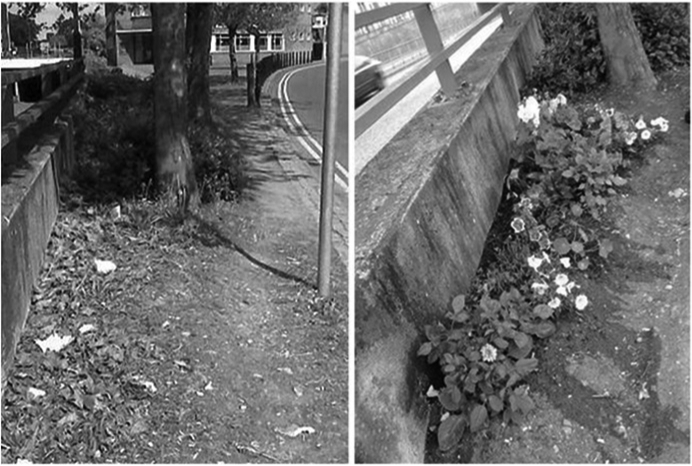
Guerrilla gardening in action at the F Troop site. Before (left) and after (right) photographs of the phase one dig.
We didn’t want them [City Council] taking all the glory—you know, for what we were trying to do… I chose [the site] because it was quite central, and there was the [public house] that virtually anybody in [the city], of a certain age, would know where it was. It just seemed a good space to brighten things up for people, because it was central, it was near the University, not necessary accessible by car, but accessible by foot … It was about making that bit nice and because it’s right next to the traffic lights. So when people are stopped at the traffic lights… they’d actually have to stop and look and see the flowers (Sue, September 2011).
Another important, although perhaps underacknowledged, feature associated with guerrilla gardening is that of working together towards something visual which members of the public can enjoy. The Troop made the decision to conduct its activities during daylight hours and occasionally wearing high-visibility jackets which, in some way, runs against some earlier representations that present urban guerrilla gardening groups that eschew opportunities for extensive social interaction and use the cover of darkness as a way of remaining ‘invisible’ from the mainstream (Flores, 2006; Reynolds, 2008; Tracey, 2007). Sue suggested that the opportunity to wear such brightly coloured jackets that “looked official” gave the group a certain feeling of belonging in the space, whilst providing them with a heightened sense of doing something “slightly rebellious”
[It was] Mark [another gardener] … [who] insisted we should wear fluorescent jackets; so that we’d look official and sort of fit in. We were [originally] like ‘get lost Mark’! [But] that’s the fun of it; we might get told off. … And [we noticed that] there’s a camera up above, so we’d be digging and looking up thinking ‘oops there’s a camera’! I think subconsciously we probably realise we’re not supposed to do it, but that’s half the fun of it! (Sue, September 2011).
The location of the F Troop dig also provides a key avenue through which local residents, students and visitors to the city access the area and thus there is, at certain times of day, a steady stream of daytime passers-by able to view the gardening activity and the visual display of mainly “brightly-coloured”, “relatively easy to grow” and “eye-catching nasturtiums” (Sue, September 2011). This resonates with Dickens’s account of how London street artists exploited the ‘looseness’ of urban space by “consciously moving” between the (more celebrated) White Cube Gallery space and the “authoritarian gaze of the street” (Dickens, 2008, p. 25), and how they invite members of the public to admire their visual displays of found, stolen and borrowed detritus. 10 Both Sue and Mark point out that the group members derive a certain level of satisfaction from seeing the reactions of passers-by and residents to the planted flora
Hopefully people will smile [at what we’ve done] and that’s what I’ve enjoyed; people stopping at the lights and seeing us there and they’d be having a chat or having a smile about, or waving or pointing. I like that because it gets a reaction from other people, and that’s nice (Sue, September 2011).
When you’re doing it you kind of imagine that if someone was passing they’d say ‘Oh those plants weren’t there before, that looks quite nice’. That’s some impact, not a massive impact … So the impact I would imagine would be ‘oh that looks nice’ and people might have noticed us—that’s a nice feeling, that, you know, to have that recognition (Mark, September 2011).
Dovey and Stevens (2007) and Spinney (2010) have made similar observations of urban cyclists operating in the regenerated spaces of Melbourne’s South Bank and London’s South Bank respectively, suggesting that the reactions of others are vital in interpreting the actions of BMX riders as ‘appropriate’. Further, whilst guerrilla gardening is clearly not purposely included in the list of recreational and cultural pursuits that the City Council seeks to explicitly acknowledge or even openly encourage for this particular area, the gardeners’ attempts to beautify the space arguably coalesces with the authority’s broad ideas that any future regeneration “must appeal [to people] … as a visually attractive place” by improving the “environment, housing, jobs and cultural, leisure and retail offer” (Adopted core strategy, p.39). 11 The sense of congruence is further underlined in the City Council’s recently adopted Biodiversity supplementary planning document (2011) which acknowledges (p. 27) the importance of the city centre’s stock of “vacant and abandoned land” and the possibility of “publicly owned land [and] privately owned facilities” being reworked to create a visually appealing green network. 12
Growing Sociality?
Whilst one of the guerrilla gardeners commented that “it’s all about the planting”, thus succinctly summing up the general motivations of most of those engaged in the act of guerrilla gardening at the F Troop dig, it would be all too convenient to overlook the social aspects associated with such a group activity. As the following encounter with the gardeners illustrates, one of the central motivations of the troop is a perhaps ill-defined belief in coming together to ‘do’ something for the greater public good
[It’s] more like a kind-of public spirited thing to do. Sort of like, well it’s not quite like picking litter up off the floor but … I think the illegality is outweighed by the good that it could potentially do … you know a troop coming together [under a common goal]. It was a bit haphazard. I think to start with, we were just bringing anything [to the dig]; anybody brings anything you want and we’ll just stick it in! (Mark, September 2011).
Whilst the focus of social interaction is very much directed towards the act of gardening, the practice of planting is interlaced with telling moments of sociality—pauses where group members have the opportunity to catch up with friends, discuss the overall strategy of the ‘next digs’ and talk about which flowers and vegetables to plant in the future (see Figure 4). Additionally, the genesis of F Troop was born out of a strong existing social relationship: for example, Sue, together with a close friend and work colleague, communicated extensively via email with other troop members to discuss possible sites to cultivate and because it allowed them the possibility of maintaining the land during their lunchtime break. Thus, the site is, at certain moments, recast as an animated social space when filled with the chatter of gardeners, the “clash of shovels, a pavement littered with garden rakes, and boxes of vegetation” (field diary, March 2011).
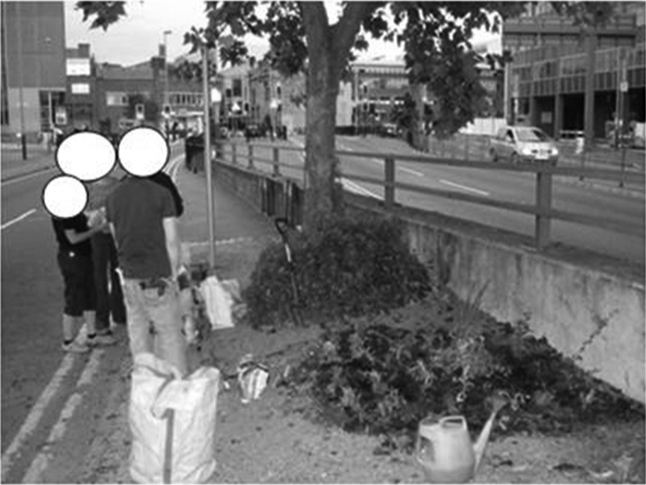
Social action at the F Troop site.
It would be tempting, perhaps, to suggest that F Troop represents a sort of ‘coming together’ of a tribe mentality where social and cultural differences (temporally at least) evaporate (Malbon, 1999). This reminds us of Maffesoli’s (1996, p. 98) notion that (neo)tribes involve collective (albeit) fluid associations, where individuals connect to a group ethos on a transitory and temporally variable plane. Of course, as Malbon (1999) has noted, there is an obvious danger of romanticising this suppression of social and cultural difference and the forming of collective bonds. Thus, the F Troop dig site should not be taken as a utopian space and fissures in group identity did emerge around levels of commitment to the project. Sue, for example, felt a sense of frustration at the non-attendance of some group members as the digs progressed, which, according to some troop members, resulted in her developing a more dictatorial ‘management’ style to the operation
Several non-attendees had promised to arrive at the fifth dig, but then pulled out attendance at the last minute. Sue felt most of them ‘blab about being part of the troop cos it’s trendy’ and the other troop members, felt they ‘talk the talk, but don’t walk the walk’. This appeared to anger the [remaining] troop [members], since they claimed they were putting all the effort in and being constantly ‘let down’ by those who failed to attend. There was also some ill-feeling from other members towards the controlling influence of the group leader—and her approach to managing the other members (An extract from Phase Five field diary entry).
Participants also agreed that guerrilla gardeners were not easy to classify because in several ways they were markedly heterogeneous. Although membership of F Troop fluctuated, the core group largely consisted of mainly females, involving a mix of ages, which, to some extent, runs contrary to the prevailing representation of guerrillas as (largely cohesive) groups of disenfranchised youngsters (Lewis, 2012; Reynolds, 2008). When asked what he thought constituted a guerrilla gardener, Mark suggested that he did not necessarily classify himself in such terms
I wasn’t actually involved in the gardening but I was involved in the watering which was the aftercare. Otherwise I maybe wouldn’t have thought myself as a guerrilla gardener. In fact, I think that the watering [just about] qualifies me as being involved in the gardening aspect of it (Mark, September 2011).
Rather than a single guerrilla gardener ‘identity’, there is no essential ‘core’ to the character of a guerrilla gardener and identity is continuously being remade through fluid performative enactments (Gregson and Rose, 2000). Instead of being categorised as a guerrilla gardener, Mark’s narrative describes how he and his partner first became involved in guerrilla gardening activity suggesting that guerrilla gardening was just “something fun” to do whilst conducting their everyday activities
We were walking in the centre of town, and somebody must have pulled out some council planting and thrown it just for fun. [My partner] replanted it! She couldn’t stop herself! … It was one of the arrangements; it was on a central roundabout flower display. After that we carried on doing what we were doing, you know, walking into town, shopping and stuff … Other than that I’ve never been involved with it [guerrilla gardening] (Mark, September 2011).
Much like those engaging in urban bike trials riding (see Spinney, 2010), the social conduct of the gardeners (and economic capital required to engage in the act of gardening) reflects the desire on behalf of the gardeners to be part of the mainstream. For example, it was observed that F Troop members would often wear designer outdoor clothing (under the high-visibility jackets) during digs; the group would regularly buy plants from publicly popular garden centres and nearby shops (albeit at a usually discounted price); and use expensive gardening equipment. Furthermore, the occupations of group members ranged from respectable local government officials to shop-workers, thus largely reinforcing rather than contesting the notion that guerrilla gardening is a more ‘ordinary’ activity; this also accords with Montgomery’s (2012) point that the wider guerrilla gardening movement is rather less subversive than previous accounts suggest; with various websites, YouTube clips and several publications enhancing its fashionable appeal. We would also argue that it is in no small part the proximity of the pub, as a space where sociality occurs—where people can mix, chat and spill out onto a small grassed area adjoining the site—that provides the gardeners with an increasing confidence to continue to operate. In a similar way to the display of guerrilla gardening, therefore, the social side of gardening performs some of the existing uses of this space, actively (re)producing it as a social space.
The Relationship with Authority
It could also be argued that the logic of whether guerrilla gardening is inherently ‘out of place’ (Cresswell, 1996) is perhaps more fluid than some previous accounts suggest. Commentating on the seemingly all-pervading privatisation of the public sphere, Hou’s (2010) description of guerrilla urbanism makes some useful moves towards differentiating between levels of control operating in public spaces, but ultimately positions most public spaces as exclusionary towards subversive acts such as guerrilla gardening. Similarly, Reynolds (2008, p. 73) is inclined to homogenise public sites used for guerrilla gardening, arguing that the guerrillas purposefully occupy abandoned (urban) space left by unscrupulous “[businesses and local authorities who] owe nothing to the community”.
As documented by Rosa Rose’s on-going battle with ‘private landowners’ to secure legitimisation for a community garden in Berlin-Friedrichshain, 13 Brace’s (2011) case study of Hawaiian street guerrillas who saw their (illegally planted) plants destroyed in 2003 by an act of authoritarian aggression (p. 3) and Reynolds’s (2008) (intermittent) clashes with police during a dig at London’s Elephant and Castle, it could be argued that guerrilla gardening in certain public spaces has met with occasionally hostile reactions from ‘authoritarian force’. Likewise, the spatial practices that F Troop displays on this piece of Council-owned land could be interpreted as being wholly inappropriate, unlawful and reason enough to move them on. The point to note, however, is that the enforcement of rules in some public spaces is imposed more strongly than in others. If anything, the F Troop gardeners were not necessarily transgressive as people largely seemed unconcerned by their presence, yet they may become transgressive if a police officer, local authority staff or a member of the public makes them so, by asking them to move on
[After a while working at the site] we soon found out that nobody was really going to bother us. I mean a couple of people came by and asked what we were doing and seemed to be supportive. … Yeah, but quite quickly got over the self-conscious aspect. Other places, I mean, you know, in the city centre itself, it might be different (Sue, September 2011).
At one of the first digs, members would often hide at the sight or sound of an emergency vehicle, fearing they would be caught and punished. … By the final phase, the troop was extremely relaxed and they took little notice of passing emergency vehicles. One troop member commented on his relaxed state: ‘yeah I was a bit panicky at first, but now, I think cos we’ve done it so much, and we haven’t had any trouble, it’s my space, so I feel like I’m doing nothing wrong and we’re just maintaining our space’ (An extract from Phase Five field diary entry).
Due to the apparent ‘absence’ of any visible police presence, feelings of illegality tended to dissipate amongst some of the group members, whereas feelings of ownership, pride and commitment to the project appeared to increase (amongst the remaining members) as the digs progressed. Even on this apparently unclassified stretch of land, the unlawful use of this space can attract the interest of other ‘guardians’ of the area. On occasions, certain local people actively engaged with the group, including the landlady of the nearby public house
The group ran out of water halfway through a dig, which resulted in the group leader venturing to the adjacent pub to ask for more supplies. On arrival at the pub, Sue explains the situation and supply needs of the troop. ‘No problem, [I’d] quite like to help, you wouldn’t mind working all the way up here [towards the pub]’ [pub landlady]. Encouraged by this conversation, Sue explained that the group plan to cultivate the space along the length of the carriageway towards the pub (An extract from Phase Three field diary entry).
Members of group were subjected to sporadic profane outbursts and sarcastic criticism of their actions from the occasional passer-by travelling along the inner ring road or from patrons of the pub during early stages of the project. What is intriguing to note, however, is that the attitude of the gardeners was different depending on the source of the comments: as Mark suggests, positive remarks coming from members of the public, especially from those who showed what the gardeners perceived to be a genuine interest in their activities, were also important factors in ‘checking’ the gardeners’ activities. In this sense, ‘authority’ in relation to the F Troop dig site came in different forms, as the following observation illustrates
I think when we were gardening, a couple of times, people asked what we were doing and they were incredibly positive about it. An older gentleman, a local resident, I think, said something nice about the site … Mainly older people mentioned things about the types of flowers they grew and would like to see. That made us really think about stuff to plant. They’re more likely to talk to strangers anyway, [more] than the local student population; heads down, thinking about booze… [Some people in the pub] thought it’s a nice idea too … [and] we’d have to really work to involve them [patrons of the pub], to ensure that the site keeps going, you know, make it more permanent after we move on (Mark, September 2011)
In the absence of any obvious police enforcement or local authority response, the reactions of the gardeners demonstrated in this account suggest that patrons and residents are deemed to have some authority in shaping how the area is being transformed. Moreover, ‘ownership’ of this loose space is overlain by collective understandings, existing somewhere between individual private property on the one hand, and the ‘commons’—space sitting outside private ownership—on the other (Blomley, 2004). Also, as Mark hinted, if sufficient interest amongst local ‘guardians’ could be generated, it may serve as a mechanism through which the long-term maintenance (and the appropriateness of the types of species to plant) and perhaps legal status of the site is secured. Such claims, however, sound precarious, especially given the supposed increasing privatisation of public space, lamented by many. Whilst the often-cited literature tends to discuss the more celebratory aspects of guerrilla gardening, Adams et al. (forthcoming) draw attention to the way in which local food production involved with the ‘Incredible Edible Todmorden’ guerrilla gardening movement which managed to engender sufficient levels of support to negotiate with the local authority and transition their activities from something transgressive to something embedded in local governance structures (see also Tornaghi, 2012). 14 As Hampwaye et al. (2007) acknowledge, however, in their review of how ‘alternative’ and illegal urban agricultural practices have achieved institutional acceptance in the global South, such a proposition should not be straightforwardly accepted. Furthermore, Nel et al. (2009, p. 16) writing in the context of South Africa and Zambia, argue that “concrete action” is also required on the part of local institutions if illegal gardening is to “move beyond its current status as a marginal survival strategy”.
Conclusions
Through ethnographic engagement with the everyday practices of F Troop, in this paper we have highlighted the importance of display, social interaction and the relationship with the different ‘guardians’ of the area in defining the meanings and acceptance of these forms of activity in a seemingly ‘loose’ public space. Previous academic accounts have served to position unsanctioned practices of guerrilla gardeners as being largely covert, resistant and ontologically separate from ‘mainstream’ culture (for example, Reynolds, 2008), and which sit outside the context in which they take place (for example, McKay, 2011) or approaches in which a researcher has created a troop (Crane et al., 2012). Here, however, through the observation of the ‘on-the-ground performances’ of the guerrilla gardeners, we argue that, whilst at first the activities of F Troop may seem resistant (and illegal) and not specifically encouraged in this space, there are congruencies with several of the ideals enshrined in the City Council’s regeneration plans for the area—especially regarding the desire to encourage development that will bring a certain visual vibrancy to the city centre; developing an otherwise neglected space into an area of flourishing vegetation. This sense of congruence with the mainstream is further underscored given the backgrounds and occupations of some of the guerrillas, the financial resources at the group’s disposal to buy plants, the type/style of clothing and general comportment of group members whilst on site, and the type of gardening equipment used for planting. The gardeners’ willingness to interact socially with other users of the space, and from having the ‘fruits of their labour’ seen and appreciated by passers-by, patrons of the pub and other local ‘guardians’, also highlights how this space is continually being re-made through performance.
Consequently, therefore, we agree with Spinney (2010) in his exploration of how the actions of urban cyclists—as a ‘typical’ sub-cultural group—have been traditionally represented and recognise that the practices and activities of F Troop may stand for a different and ‘unsanctioned’ use of the built and natural forms within this particular space; but we also suggest that future studies should move beyond privileging the transgressive elements of these practices, which ignores how such groups operate, how they are maintained and how they are received by others in public spaces. By focusing on the micro politics of guerrilla gardening, we also argue that identity is more fluid and less homogeneous than perhaps previously acknowledged. The narratives collected for this paper begin to highlight the internal tensions between group members and the decreasing levels of commitment from participants as the project unfurled: in some way, this helps to deromanticise the cohesive collective identity of guerrilla gardening groups. This is important, as understanding why participants’ involvement diminishes in certain urban gardening contexts has been identified as being a fundamental stumbling-block—alongside a lack of funding and institutional/policy support—that thwart promising urban agriculture and food security initiatives that seek to make a contribution to the wider ambitions of environmental sustainability (Adams et al., forthcoming; Hampwaye et al., 2007; Nel et al., 2009).
Footnotes
Acknowledgements
The authors would like to thank Professor Peter Larkham, Professor Phil Hubbard, Dr. Justin Spinney, Dr. Jennie Middleton and the three anonymous referees for their insightful comments on earlier drafts. We would also like to thank all the guerrilla gardeners who took the time to be observed and interviewed as part of this project.