



Abstract
Limited attention has been paid to neighbourhood conditions as a driver of firm relocation choices. Using a panel dataset (1999–2006) of actual firm relocations in the Netherlands, the effect of different neighbourhood conditions on firms’ propensity to relocate was estimated. Results show that, besides firm and regional characteristics, neighbourhood conditions also affect firms’ relocation choices, but which conditions matter depends on the firm’s industrial activity and size. The relocation decision of consumer services in particular is affected by neighbourhood conditions, while the choice of manufacturing, wholesale and business services firms is affected more by increases in population density. Nevertheless, a higher number of shops, cafes and restaurants and a more attractive physical environment do lower the probability that business services leave the neighbourhood, while manufacturing and wholesale firms are more inclined to leave neighbourhoods when a higher share of consumer services is not in use.
1. Introduction
Firm relocation has important implications for both individual firms and spatial policy because it affects firm performance (Knoben and Oerlemans, 2008) and leads to a redistribution of firms and related employment (van Dijk and Pellenbarg, 2000). Given these implications, there has been much interest in why firms decide to relocate, resulting in many studies examining the drivers of firm relocation (see Arauzo-Carod et al., 2010; Pellenbarg et al., 2002). These studies showed that, although firm growth is the most important trigger for firm relocation, firms also move with the intention of improving their locational environment.
Nevertheless, limited attention has been paid to neighbourhood conditions as a trigger for firm relocation. Neighbourhood conditions may matter as entrepreneurs are likely to be concerned about the socioeconomic status and general social climate of the neighbourhood as they prefer safe, well-maintained locations for their customers and employees (Iceland and Harris, 1998; Rosenthal and Ross, 2010). Consequently, differences in neighbourhood conditions may affect the sorting of firms into different parts of the city and, in this way, also affect patterns of urban development.
The current lack of insights in the effect of neighbourhood conditions on relocation decisions of firms may impede the ability to design policies that can effectively change the liveability and safety of urban neighbourhoods. Most contemporary spatial policies consider a mixture of housing and commercial activities within a neighbourhood to be beneficial for liveability within an urban environment (Burton, 2000). Consequently, policy-makers focus on stimulating and retaining economic activities within urban neighbourhoods. However, if firms are more likely to leave neighbourhoods with a lower liveability and safety, improving the situation in such a neighbourhood by stimulating entrepreneurship will be hard to accomplish.
Therefore, this paper aims to provide further insights in the relevance of neighbourhood conditions as a driver of firm relocation. The contribution of this paper is threefold. First, it provides new evidence on what triggers the relocation decision of firms by examining the effect of neighbourhood conditions on this choice. Secondly, the effect of various types of neighbourhood conditions are measured simultaneously, making it possible to observe differences in the relevance of those characteristics. Prior studies either examined the effect of one specific neighbourhood condition (Rosenthal and Ross, 2010) or used a generic indicator of neighbourhood conditions (van Dijk and Pellenbarg, 2000). Thirdly, building on the insights of the study by Rosenthal and Ross (2010), it is assumed that firms differ in their sensitivity to neighbourhood conditions. To examine this, the effect of neighbourhood conditions is tested by distinguishing between three types of activities (consumer services, business services and wholesale and manufacturing firms) and two size categories (one-man businesses and other firms).
This paper is structured as follows. Section 2 gives a brief overview of the literature on firm relocation and formulates several hypotheses on the effect of neighbourhood conditions on firm relocation. The data, method and measurement of the different variables are described in section 3. Section 4 describes the results and these are discussed in section 5.
2. Theory and Hypotheses
The basic idea underlying models on firm mobility is that the decision to change location is a function of dissatisfaction with the current location. It is assumed that a firm has chosen its present location as the most optimal or satisfying location given the information available at that time (Cooke, 1983; van Dijk and Pellenbarg, 2000). When the locational preferences of the firm change or when the locational environment changes, a mismatch between the locational preferences of the firm and the characteristics of the current location may develop, leading to locational stress. If that mismatch becomes too large and the entrepreneur has the necessary resources available and is willing to make the change, the firm moves to another location.
Such a mismatch is even likely to occur without any changes to the firm or its locational environment. Entrepreneurs are unlikely to choose the most optimal location as they have imperfect information about alternative locations and limited cognitive abilities to process all information available (Pred, 1967). Furthermore, especially the initial location of a firm is often chosen for non-economic reasons such as familiarity with the location, proximity to family, friends and the former workplace (Dahl and Sorenson, 2009). Consequently, many entrepreneurs may realise after some length of time that their current location does not fully match the firm’s locational preferences, even without any changes.
Following the insights of the few studies that examined the relevance of neighbourhood conditions for firm location (Gottlieb, 1995; Sivitanidou, 1995; Rosenthal and Ross, 2010), three dimensions of neighbourhood conditions may affect the sorting of firms within cities: the neighbourhood’s vibrancy, the attractiveness of the physical environment and the neighbourhood’s safety for customers and employees visiting the worksite. The sensitivity of firms to each of these dimensions is likely to depend on their economic activity (Erickson and Wasylenko, 1980; Rosenthal and Ross, 2010). Therefore, the relevance of each condition is subsequently discussed for three economic activities: consumer services, business services and manufacturing and wholesale.
Although each dimension of neighbourhood conditions is likely to affect the relocation choice of both consumer and business services, consumer services are assumed to be more sensitive because neighbourhood conditions can directly affect their performance, while for business services these are more ‘would-like’ location factors. In business services, neighbourhood conditions are only a relevant factor when other more essential factors are similar across two or more locations (Salvesen and Renski, 2003).
Consumer services perform better when they are situated in more vibrant neighbourhoods where many other shops, cafes and restaurants are concentrated. The buyers of their products and services prefer to discover and evaluate a variety of options available from multiple firms. Consequently, demand is often higher in neighbourhoods where consumer services are concentrated (McCann and Folta, 2008).
The vibrancy of the neighbourhood may also increase the performance of business services, but only indirectly. The success of business services largely depends on the creativity and talent of their personnel. A location in an amenity-rich area may help these firms to attract better qualified employees. Gottlieb (1995) argued that for attracting employees only the presence of amenities at the metropolitan level matters, because for most amenities it is not necessary to live or work next to them as long as the amenities are within commuting distance. But employees may also appreciate the presence of certain amenities near their worksite. They may prefer to work at a location with many shops, cafes and restaurants within walking distance, enabling them to visit those during lunch time or after work.
The attractiveness of the physical environment in the neighbourhood may matter because it can affect the image of a firm among potential customers. Since consumer services rely more on customers visiting the firm than business services, consumer services are assumed to be more sensitive to the maintenance of the physical environment. Nevertheless, previous research showed that the attractiveness of the direct surroundings of office buildings positively affects the rent (Weterings and Dammers, 2010), suggesting that business services do consider the attractiveness of the physical environment to be so important that they are willing to pay a higher rent for it.
Finally, both Gottlieb (1995) and Rosenthal and Ross (2010) found that violent crime is an important factor influencing firms’ sorting within cities. While both consumer and business services are likely to prefer a location in a safe environment, Rosenthal and Ross (2010) empirically showed that especially retail firms are sensitive to violent crime. They gave three possible reasons for this. Shops, cafes and restaurants have a direct access to the street making them more vulnerable to violence. Furthermore, contrary to other economic activities, the customers of consumer services often visit by walking to the door and, therefore, a shopper’s sense of security when visiting the firm matters. Finally, certain types of consumer services are also open at night when crime rates tend to be higher.
This leads to the following hypothesis
Hypothesis 1: All three dimensions of neighbourhood conditions affect the relocation decisions of consumer services more than the relocation decisions of business services.
The relocation decision of manufacturing and wholesale firms is less likely to be affected by neighbourhood conditions. Wholesale and manufacturing firms often sell their products throughout the larger metropolitan area, regardless of where the firm is located, and bring their products themselves to their customers. Consequently, customers do not visit the firm at its location. Furthermore, these firms do not depend on highly educated employees and most activities take place in firm buildings that are not directly accessible from the street. Therefore, the second hypothesis that will be tested is
Hypothesis 2: The relocation decisions of consumer and business services are more affected by neighbourhood conditions than the relocation decisions of manufacturing and wholesale firms.
In the case of one-man businesses, the locational preferences of the firm are likely to be highly intertwined with the residential preferences of the entrepreneur, because most one-man businesses operate from the entrepreneur’s home. Therefore, the relocation of a one-man business often follows from, or is accompanied by, a change in the entrepreneur’s residential location. Previous studies have shown that neighbourhood conditions affect residential mobility (for example, van Ham and Feijten, 2008; Feijten and van Ham, 2009) and, therefore, these conditions are likely also to affect the relocation decision of one-man businesses. However, this raises the question of whether such relocation choices are driven by the entrepreneur’s dissatisfaction with the neighbourhood as a living environment or as a firm location. To examine this, the final hypothesis that will be tested is
Hypothesis 3: The relocation decision of firms with more than one employee is less affected by the neighbourhood quality than the relocation decision of one-man businesses.
3. Methods
3.1 Data
For the analysis, the LISA database was combined with data on neighbourhood characteristics assembled from different sources. For all business establishments in the Netherlands, the LISA database contains information regarding the location, number of jobs and industrial activity (NACE-codes) on a yearly basis. Using the unique identification number of each firm, a longitudinal version of the LISA database was constructed for the period 1999–2006. Firm relocation is observed based on changes in the four-digit postal code of the firm from one year to another. 1 As the LISA database provides information at the establishment level, firm relocation consists of the relocation of both single-site firms and establishments of multisite firms and, consequently, relocations of chain restaurants and retailers are also included in the model. 2
At the neighbourhood level, the population was limited to all firm establishments located in urban neighbourhoods where at least 500 houses were present in 1999. Only urban neighbourhoods were selected because in urban areas, four-digit postal codes come close to what people may perceive as their neighbourhood, as urban postal codes are about 1 square kilometre or less in size. Outside urban areas, four-digit postal codes are too large. Therefore, firms located in more sparsely populated areas were excluded by limiting the population to firms located in municipalities with at least 17,000 inhabitants and in four-digit postal codes with more than 1000 addresses per square kilometre.
With respect to firm activities, the population was limited to firms involved in activities that are allowed to take place within residential areas and of which most daily activities take place at the address of the establishment. Activities generating too much pollution or noise, such as chemical industries or logistics, were excluded because the larger distance between their locations and the nearest residential areas, which is required by law, makes it unlikely that the location choice of such firms is affected by neighbourhood conditions. The same goes for firms of which most daily activities do not take place at the address of the firm. The Appendix shows which firms were selected.
Due to the longitudinal structure of the LISA database, new firms may enter the database between 1999 and 2006. These firms were included in the year after the start, because only after one year is it possible to determine whether the four-digit postal code of these firms has changed. Firms who exit the LISA dataset were excluded from the panel dataset from the year of disappearance onwards.
3.2 Empirical Model
The empirical analysis examines the effects of neighbourhood conditions on the firm’s propensity to relocate using a discrete time duration model. Such models are used to model time-to-event data when the event may take place at any point in time but no information is available on the exact moment of the event (Jenkins, 2005). As the LISA database reports establishment characteristics on a yearly basis, it is only possible to observe changes in the location from one year to another while the actual event could have taken place at any moment during that year.
The dependent variable, the time spell from the first time that the establishment is observed in the database (1999 or the year of entry) to the time it moves to another four-digit postal code, is right-censored at the end of 2006, the last year for which data from the LISA database are available. Many of the firm establishments included in the analysis did not relocate in the observed time-period (87.7 per cent). The dependent variable is also partly left-censored, because firms which were already established in the first year of observation may have relocated before entering the dataset. For data with such a structure, duration analysis is the most appropriate methodology (Guo, 1993).
The methodology that was adopted to model the event of relocation is the complementary log-logistic (cloglog) function which is the most commonly used discrete time representation of a continuous time proportional hazards model (Jenkins, 2005). The general form of this type of model is

where h(j,X) is the hazard rate of a firm establishment in interval j given the scores of that establishment on all covariates in interval j;
This essentially tells you how likely an establishment is to relocate in interval tj, given that it has not experienced relocation so far. By specifying dummy variables to represent each year, the baseline hazard rate γj has been modelled as a step function that describes the evolution of the baseline hazard between censored intervals. Furthermore, time-varying covariates have been included in the assumption that the independent variables may vary throughout the observed time-period. For further technical details regarding discrete time duration models and, more specifically, the complementary log-logistic function, see Jenkins (2005).
All establishments that are located in the same neighbourhood have the same score for the neighbourhood characteristics. To avoid a bias from estimating the effects of those aggregated explanatory variables on firm-specific response variables, models were estimated with cluster-robust standard errors at the neighbourhood level (Steenbergen and Jones, 2002). 3
Do note that the method adopted may underestimate the effect of neighbourhood conditions on the probability that firms leave a neighbourhood. Firm’s sorting into neighbourhoods is not based on a random process as firms select themselves into neighbourhoods based on the presence of certain neighbourhood conditions. The firms that are most likely to be affected by certain conditions were not located in such a neighbourhood in the first place. Although this selection process is unlikely to be perfect, as start-ups in particular may not make a very rational location choice, for well-established firms the process of self-selection is likely to lead to an underestimation of the effects of neighbourhood conditions as most of these firms may be already located in the neighbourhood of their preference (see Manjón-Antolín and Arauzo-Carod, 2011).
3.3 Independent Variables
Neighbourhood conditions
In total, six variables are included in each model as an indicator of the three neighbourhood conditions discussed in section 2. The vibrancy of the neighbourhood is measured using the Locatus retail database that contains information on the address and activity of all retail outlets in the Netherlands. 4 This database provided information on the number of cafes, restaurants and shops per 1000 inhabitants within each neighbourhood. When a large share of the cafes, shops and restaurants in the neighbourhood are not in use, this is likely to have the opposite effect, therefore, using additional information from Locatus, this share was also calculated and added to the model.
The Police Population Monitor (PPM)—a biannual nation-wide survey—provided information on the residents’ perception of neighbourhood disorder. 5 Residents are asked to indicate whether certain disorder events occurred often, sometimes or almost never in their neighbourhood and their answers were recoded in such a manner that a higher score reflected a higher prevalence of disorder (almost never = 0, sometimes = 1 and often = 2). Using the answers to nine questions, two types of disorder were measured: physical and social disorder. Physical disorder provides an indication of the attractiveness of the physical environment in the neighbourhood and social disorder of the safety and attractiveness of the social environment.
Physical disorder was measured using the answers to the occurrence of the following items: litter on the street, dog faeces on the streets and sidewalks, vandalism of phone booths, bus or tram stops, and graffiti on walls or buildings. Social disorder consists of the resident’s perception of the occurrence of the following events: drunken people on the street, women or men being bothered or hassled on the street, threatening behaviour, acts of violence and drug problems. The answers to each of these items were summed into a score for each type of disorder (with a maximum of 8 for physical disorder and 10 for social disorder) and, next, a neighbourhood average was calculated by taking the mean of the disorder score across all individuals within each neighbourhood. As individual characteristics were found to affect the likelihood that a respondent reports more or less disorder in the same neighbourhood (see Steenbeek et al., 2012), the answers on all included items were first corrected for differences between respondents in age and gender before aggregating the scores to the neighbourhood level. 6
Prior studies that examined the effect of neighbourhood conditions on residential mobility showed that subjective measures of the neighbourhood situation may differ from objective measures (Lee et al., 1994). Therefore, besides social and physical disorder which provide an indication of residents’ perception of the attractiveness of the physical environment and safety of the neighbourhood, the actual number of reported violence incidents per inhabitant within the neighbourhood was also added to the analysis.
Finally, the number of burglaries divided by the total number of firm establishments was added as an indicator of property crime. Contrary to social and physical disorder and violent crime, firms’ sensitivity to property crime is unlikely to be related to its economic activity as this is unrelated to the access of a firm to the street. Nevertheless, high property crime is still included in the model as it may trigger firms in general to leave a neighbourhood. The number of reported violent incidents and burglaries have been measured by the Atlas voor Gemeenten based on data provided by Statistics Netherlands (KLPD-HKS and KLPD-GIDS registrations, 1999–2005).
Control variables
To avoid any disturbance of the effect of the neighbourhood characteristics on firm relocation by differences in firm internal characteristics, four firm-level indicators were included in all models: size, growth rate, age and economic activity. All variables were measured using information from the longitudinal LISA database. The size of the firm was measured as the number of employees of an establishment and the growth rate based on relative changes in number of employees from one year to another. Since the LISA database does not provide information on the age of the firm, only the age of firms that were established between 2000 and 2005 could be measured. In the analysis, five dummy-coded variables for the age (in years) of the firm were included. The reference category is all establishments that were already in existence at the start of the database in 1999. To control for differences in economic activity, six dummy variables were composed that measure whether a firm is active in business services, manufacturing, wholesale, retail, catering or other consumer services (see the Appendix).
Besides firm internal characteristics, accessibility can also affect a firm’s propensity to relocate (Holl, 2004). Employees, clients and suppliers are better able to reach firms at highly accessible locations. The accessibility of the site was measured using information from the National Road Database 2002. For each six-digit postal code, the distance as the crow flies between the centroid of that postal code and the location of the nearest train station or entry/exit of the highway was calculated.
Lack of space for expansion is an important driver of firm relocation and neighbourhoods tend to differ in the possibilities for firms to expand at their current location. Due to a lack of data that directly measures these differences, the population density of each neighbourhood was included in all analyses to control for this effect (comparable to Rosenthal and Ross, 2010). The average household income in the neighbourhood was included to control for differences in the socioeconomic status of the neighbourhood and, specifically for consumer services which often serve local markets, as an indicator of the customer base of the neighbourhood. The total number of residents is included to account for differences in neighbourhood size. All three variables are provided by Statistics Netherlands.
Finally, in all models, dummy-coded variables for each NUTS III region were included to control for regional fixed effects. As the central topic of this paper is the effect of neighbourhood characteristics on firm mobility, those regional characteristics are not further specified.
Table 1 presents the summary statistics. The variance inflation factors show that multicollinearity did not pose a problem.
Summary statistics (average over 1999–2006 and the three industries)
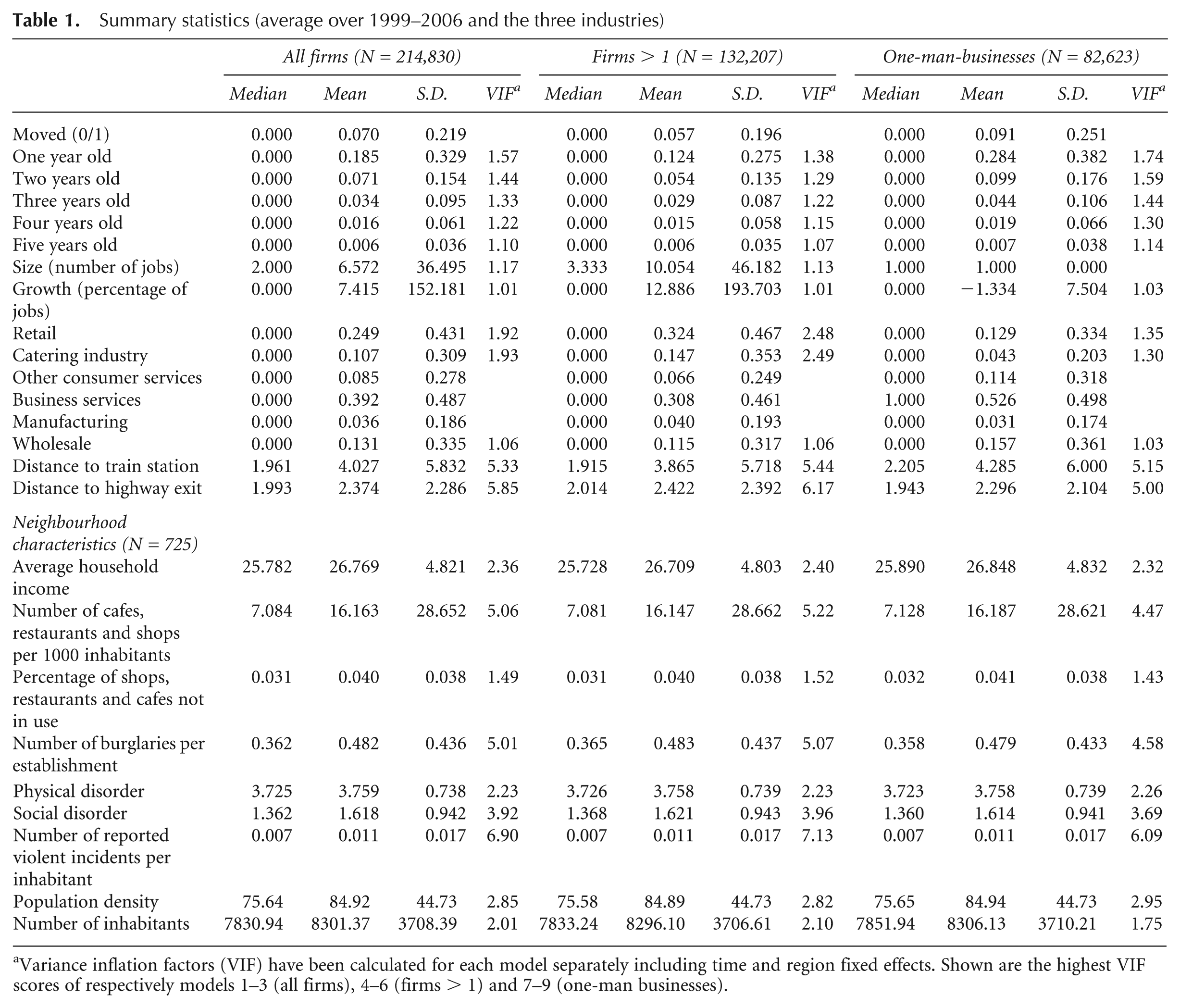
Variance inflation factors (VIF) have been calculated for each model separately including time and region fixed effects. Shown are the highest VIF scores of respectively models 1–3 (all firms), 4–6 (firms > 1) and 7–9 (one-man businesses).
4. Results
Table 2 shows the results of the discrete time duration model with complementary log-logistic function used to estimate the effect of neighbourhood characteristics on the firm’s propensity to leave the neighbourhood. To test the hypotheses formulated in section 2, the dataset is split into three groups: firms active in consumer services, business services, and manufacturing and wholesale firms. In each of these industries, the model is estimated three times to test hypothesis 3. The first model includes all firms, the second model all firms with more than one employee and the third model is limited to one-man businesses.
Results of complementary log–log model for all firms in urban neighbourhoods (robust standard errors in parentheses—clustered on postcode level)

Notes: *** significant at the 1 per cent level (p <0.01); ** significant at the 5 per cent level (p <0.05); * significant at the 10 per cent level (p <0.10).
As shown by the base hazard rates in Table 2, the likelihood of relocation differs between industrial activities: the average percentage of consumer services that relocated to another neighbourhood is much lower than that of manufacturing and wholesale firms (respectively 1.39 per cent and 4.60 per cent), while business services are most likely to move (5.65 per cent). Firms with more employees are less likely to move, shown by the lower percentage of movers in models 4, 5 and 6.
4.1 Neighbourhood Conditions
The model results show that neighbourhood conditions affect the relocation decision of firms and that the effect of those conditions differs between industries and firms of different sizes (see Table 2).
Model 1 shows the results for consumer services. Five of the six indicators of neighbourhood conditions have a statistically significant effect on consumer services firms’ propensity to leave the neighbourhood. These firms are indeed sensitive to the vibrancy of the neighbourhood shown by the statistically significant effect of both the number of shops, cafes and restaurants and the share of these services not in use. Both indicators have the expected sign: consumer services are less likely to leave neighbourhoods with a higher number of shops, cafes and restaurants, but more likely to leave neighbourhoods when a higher share of those services are unoccupied.
Consumer services are also more likely to leave neighbourhoods with a less attractive physical environment, shown by the positive effect of physical disorder. Both indicators of safety issues—social disorder and the number of violence incidents—have a positive effect on the consumer services firms’ propensity to relocate; however, only the effect of the number of violence incidents is statistically significant. This suggests that these firms are more likely to leave the neighbourhood when the actual number of violence incidents is higher, while a higher perception of social disorder is not enough.
Contrary to what was expected, the number of burglaries in the neighbourhood has a negative effect—that is, consumer services are less likely to leave neighbourhoods with a higher property crime rate. A possible explanation for this effect may be that the likelihood of property crime also increases with a higher concentration of consumer services. The presence of multiple potential targets may attract more offenders to such neighbourhoods. In this way, the co-location of consumer services creates economic benefits to these firms through attracting more customers, but may also lead to diseconomies such as a higher number of burglaries.
To compare the effect of the different neighbourhood conditions, Figure 1 shows, for those neighbourhood conditions that have a statistically significant effect, by which percentage the base hazard rate will increase or decrease moving from the 25th per centile to the 75th per centile of a certain neighbourhood condition. The effects of firm size and population density are also included to enable a comparison of the strength of the effect of neighbourhood conditions with that of a firm internal factor and a more generic neighbourhood characteristic.
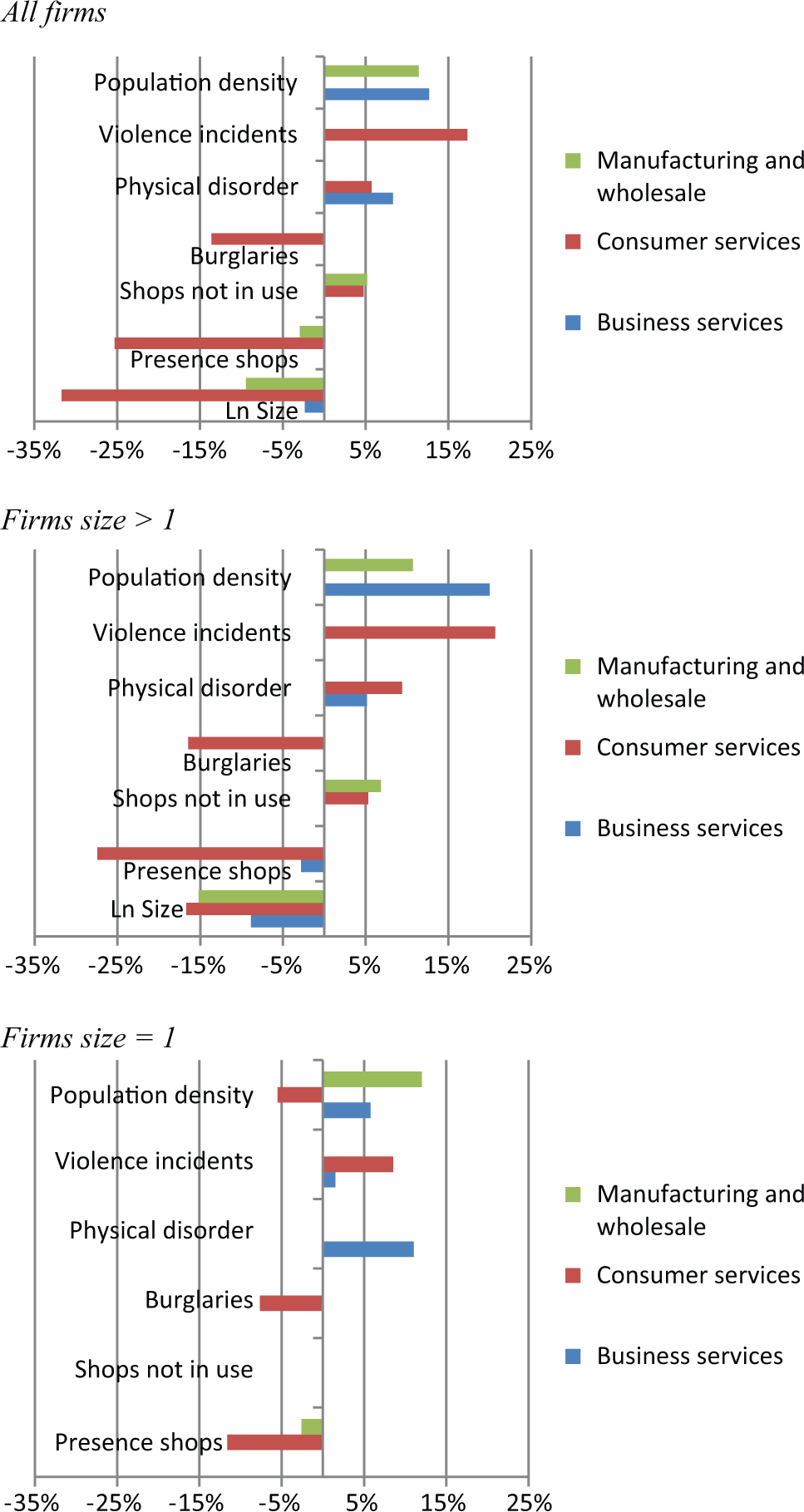
Differences in hazard rates (= propensity to leave the neighbourhood) moving from the 25th to the 75th percentile.
The concentration of consumer services has the strongest effect on these firms’ propensity to leave the neighbourhood (see Figure 1). An increase in the number of shops, cafes and restaurants in the neighbourhood lowers the base rate of consumer services’ relocation by more than 25 per cent. Yet social safety is also highly relevant in consumer services. An increase in the number of violent incidents from the 25th to the 75th per centile increases the probability that consumer services leave the neighbourhood by 17 per cent. The negative effect of the number of burglaries per establishment on consumer services firms’ propensity to relocate is also substantial (13.6 per cent), while the effect of an increase in physical disorder and the share of cafes, restaurants and cafes not in use is about three times lower (both about 5 per cent).
These results show that the vibrancy and safety of the neighbourhood have substantial effects on the relocation behaviour of consumer services and therefore on the sorting of these firms within cities. Nevertheless, the effect of firm size is even stronger (–31.7 per cent). An increase in the number of employees considerably reduces the probability that consumer services move.
Model 2 shows the results for business services. Only physical disorder has a statistically significant effect on these firms’ propensity to relocate. The positive effect indicates that business services are more likely to leave neighbourhoods with a less attractive physical environment.
The effect of physical disorder is the same for business services and consumer services. However, contrary to what was expected in section 2, the effect sizes shown in Figure 1 illustrate that this effect is somewhat stronger for business services than for consumer services. Moving from the 25th per centile to the 75th per centile in the level of physical disorder within the neighbourhood increases the base relocation likelihood of consumer services by 5.7 per cent compared with an increase of 8.3 per cent for business services.
In business services, the effect of physical disorder is stronger than that of firm size (–2.3 per cent), but considerably lower than that of population density (12.7 per cent). An increase in population density is more likely to make business services leave the neighbourhood than a decreasing attractiveness of the physical environment.
The results from models 1 and 2 show that Hypothesis 1 can be largely confirmed. Consumer services are more sensitive to neighbourhood conditions such as the vibrancy and safety of the neighbourhood than are business services. However, this is not the case for the attractiveness of the physical environment. Although physical disorder affects the relocation decision of both types of services, the effect is stronger for business services. Business services seem to be more sensitive to the attractiveness of the physical environment.
The relocation decision of manufacturing and wholesale firms is less affected by neighbourhood conditions than the relocation decision of consumer services, but not much less than in business services. Similar to business services, one neighbourhood dimension has a statistically significant effect on manufacturing and wholesale firms’ propensity to leave the neighbourhood (see model 3). The effects of the two indicators of the vibrancy of the neighbourhood—the number of shops, cafes and restaurants and the share of these activities not in use—show that manufacturing and wholesale firms are less inclined to leave neighbourhoods where more shops, cafes and restaurants are concentrated, but more likely to leave if a higher share of these activities is unoccupied. The effect sizes shown in Figure 1 indicate that manufacturing and wholesale firms are more sensitive to the presence of unoccupied consumer services. An increase in the number of cafes, shops and restaurants in the neighbourhood only slightly lowers the manufacturing and wholesale firms’ propensity to leave the neighbourhood.
Figure 1 also shows that the effect of the vibrancy of the neighbourhood on the relocation decision of manufacturing and wholesale firms is less strong than the effect of physical disorder on the relocation decision of business services. Therefore, the results confirm Hypothesis 2: neighbourhood conditions affect the relocation decision of manufacturing and wholesale firms less than that of consumer and business services.
As with business services, population density has a stronger effect on the likelihood that a manufacturing or wholesale firm leaves the neighbourhood than other neighbourhood conditions (see Figure 1). In both economic activities, room for expansion or parking areas is likely to be more important as a location factor than the vibrancy and attractiveness of the neighbourhood, even though neighbourhood conditions do matter.
The final hypothesis formulated in section 2 is that neighbourhood conditions affect the relocation behaviour of firms with more than one employee less than that of one-man businesses. To examine whether this assumption is correct, all models have been estimated again distinguishing between firms with more than one employee (models 4–6 in Table 2) and one-man businesses (models 7–9).
The results for consumer services largely stay the same. Nevertheless, the positive effect of the share of shops, cafes and restaurants not in use and physical disorder are no longer statistically significant in the model for one-man businesses (model 7). This suggests that, contrary to what is assumed by Hypothesis 3, larger consumer services are more sensitive to the vibrancy of the neighbourhood and the attractiveness of the physical environment than one-man businesses in this sector. The effect sizes in Figure 1 show that this is also the case for other neighbourhood conditions: the effect of an increase in the number of shops, cafes and restaurants, the number of burglaries and the number of violent incidents is stronger for firms with more than one employee.
The opposite goes for business services. Although the effect of physical disorder is statistically significant and positive for both larger companies and one-man businesses (see models 5 and 8), Figure 1 shows that this effect is twice as strong for one-man businesses. Furthermore, the positive effect of violence incidents is statistically significant in the model for one-man businesses, although the effect is very small. As especially in business services, one-man businesses often operate from the entrepreneur’s home, it seems that the preference for a safe and well-maintained physical environment in the neighbourhood mainly reflects the residential preferences of the entrepreneur instead of preferences towards the firm location.
The effect of the number of shops, cafes and restaurants, on the contrary, is only significant in business services when one-man businesses are excluded (see model 5). The fact that this condition affects the relocation decisions of firms with more than one employee is in line with the assumption formulated in section 2 that the vibrancy of the neighbourhood mainly matters for attracting employees.
In manufacturing and wholesale, the positive effect of the presence of shops, cafes and restaurants is limited to one-man businesses (see model 9), while the firms with more than one employee are more sensitive to the share of shops, cafes and restaurants not in use (model 6).
In sum, Hypothesis 3 is rejected for all three industries: one-man businesses are not more sensitive to neighbourhood conditions than firms with more than one employee. These results indicate that the effect of neighbourhood conditions on firms’ location choices is not limited to an indirect effect through the residential preferences of entrepreneurs. Neighbourhood conditions directly affect the sorting of firms within cities.
4.2 Control Variables
The effects of the firm internal characteristics—size, growth and age—on the likelihood of firm relocation are in line with those of earlier research (for example, Brouwer et al., 2004; van Dijk and Pellenbarg, 2000; Knoben and Oerlemans, 2008). The negative coefficient of size shows that smaller firms are more likely to relocate than larger firms, while the positive sign of relative growth shows that faster-growing firms are more likely to move. All three industries show the same effects. Only the models for one-man businesses show a negative effect for relative growth, but in these cases, relative growth only indicates changes in the number of hours that the entrepreneur dedicates to their own firm. With respect to age, results show that younger firms are more likely to relocate than older firms. In consumer services and manufacturing and wholesale, this effect is limited to firms of four years old as the effect of the dummy for five years is insignificant.
Accessibility of the firm site hardly affects a firm’s propensity to move to another neighbourhood. The only significant effect (models 2 and 8) shows that, in particular, one-man businesses in business services are less likely to move with an increasing distance to the nearest station. This effect may actually represent the effect of the distance to the city centre on residential preferences. Often people move to neighbourhoods further away from the city centre once they start a family because there they can afford a larger house with a garden. The lack of an effect of the indicators of accessibility may be due to the limited differences in accessibility between urban neighbourhoods within Dutch cities. Previous studies on firm relocation behaviour did find significant effects of accessibility, but those studies measured differences in accessibility at the regional scale (Holl, 2004).
As mentioned in the previous section, business services and manufacturing and wholesale firms are more likely to leave the neighbourhood when the population density increases. This implies fewer options for expansion and increasing congestion which may trigger firms to leave. One-man businesses in consumer services, on the contrary, are less likely to leave more densely populated neighbourhoods (see model 7). A higher population density may imply more potential customers and this beneficial effect may exceed the negative effect of less room for expansion and more congestion. This is further confirmed by the negative effect of the number of inhabitants in the neighbourhood on consumer services’ propensity to leave the neighbourhood. Business services are also less likely to move from neighbourhoods with a higher number of inhabitants.
A higher average income in the neighbourhood increases the propensity to leave of consumer services with more than one employee, while the effect is negative for one-man businesses in business services. Despite the fact that a higher average income suggests a stronger local consumer base, other factors related to income seem to push consumer services from high-income neighbourhoods. Real estate prices are likely to be considerably higher in those neighbourhoods and consumer services may not be able to compete with other activities that can afford the higher prices of such areas—for example, housing or business services attracted by the image of such a location, such as specialised lawyer firms. One-man businesses in business services are less likely to leave high-income neighbourhoods. Besides the relevance of the image of the location, such neighbourhoods are also likely to be more attractive residential areas.
5. Discussion and Conclusions
This paper has investigated the effects of neighbourhood conditions on firms’ propensity to relocate for all Dutch firms located in urban neighbourhoods between 1999 and 2006. In general, the results show that, besides the traditional drivers of firm relocation such as firm growth and the related need for expansion space, neighbourhood conditions should also be taken into account as potential drivers of firm relocation. This study confirms the previous findings of Gottlieb (1995) and Rosenthal and Ross (2010) that violent crime affects the sorting of firms and, in particular, consumer services, within cities. Yet other neighbourhood conditions also matter. Both the vibrancy of the neighbourhood, indicated by the presence of shops, cafes and restaurants, and the attractiveness of the physical environment are found to be relevant factors. While a few previous studies had already shown that such amenities affect the location choice of firms (Gottlieb, 1995; Love and Crompton, 1999), these studies stated that such factors mainly matter at the metropolitan level. However, these studies only considered amenities as a relevant factor for attracting employees and argued that employees can choose to live nearly anywhere within commuting distance from the worksite to satisfy their lifestyle preferences. Therefore, firms would only focus on the quality of life attributes of the larger region (Salvesen and Renski, 2003). This study shows that, besides amenities at the regional level, differences in the presence of amenities within cities also matter for firms’ relocation choices.
The results of this paper have also shown that the relocation decisions of most firms are affected by neighbourhood conditions—but to what extent and which conditions matter largely depends on the industrial activity of the firm and, to a lesser extent, on the size of the firm. The relocation choice of consumer services especially is affected by neighbourhood conditions. These firms are more likely to leave neighbourhoods where less similar types of activities are present, more shops and cafes are not in use, the physical environment is less attractive and the number of violence incidents per inhabitant is higher.
While the relocation decisions of business services and manufacturing and wholesale firms are also affected by neighbourhood conditions, increasing population density has a stronger effect on these firms’ decision to leave the neighbourhood. Factors such as congestion, room for expansion or parking areas seem to be more important for the relocation decision of these firms than the vibrancy, safety and attractiveness of the neighbourhood. Nevertheless, even when one-man businesses are excluded from to analysis to control for the fact that neighbourhood conditions may mainly affect the residential preferences of the entrepreneur, neighbourhood conditions were found to affect the relocation decision of business services, manufacturing and wholesale firms. Both types of activities are more likely to leave less vibrant neighbourhoods, while business services are also sensitive to the attractiveness of the physical environment in the neighbourhood. From a policy perspective, it is important to be aware of these differences between industries as they show that which neighbourhood conditions should be improved to keep firms from moving out of distressed neighbourhoods largely depends on which firms one wants to keep.
Due to processes of self-selection, it can be expected that the results in this paper underestimate the effect of neighbourhood conditions on firms’ propensity to leave a neighbourhood. The firms whose location decisions depend most on certain neighbourhood conditions may be already located in the neighbourhood of their preference and therefore less likely to move (see Manjón-Antolín and Arauzo-Carod, 2011). Furthermore, the results also show that the likelihood that firms leave the neighbourhood depends on firm characteristics such as industry, size and growth which implies that firms selectively move out of the neighbourhood. In particular in consumer services, this may lead to further changes in neighbourhood conditions over the longer term. The more consumer services leave the neighbourhood, the lower the number of active consumer services in the neighbourhood will become, increasing the share of shops, cafes and restaurants not in use. Such a negative spiral may make that neighbourhood increasingly less attractive as a location for consumer services.
This study has shown that neighbourhood conditions can trigger firms to leave the neighbourhood, but there are several interesting options for future research. This study focused on the role of neighbourhood conditions as factors increasing or lowering the probability of firms leaving. Consequently, insights are limited as to whether these conditions function as push or keep factors. To obtain further insights in the relevance of neighbourhood conditions for firms’ sorting within cities, future research could examine to what extent these conditions also function as pull factors attracting firms to certain neighbourhoods. Furthermore, an important underlying assumption of this study is that if neighbourhood conditions can trigger firms to leave a neighbourhood this is an indication that entrepreneurs consider these factors to be relevant. However, it is not known to what extent neighbourhood conditions also affect the performance of firms. Another question that deserves further attention is to what extent entrepreneurs would be willing to contribute to improving neighbourhood conditions. If so, policy-makers could involve both households and entrepreneurs in distressed neighbourhoods in programmes aimed at improving the situation in such a way that this stops residents and entrepreneurs from leaving.
Footnotes
Appendix
Six industries based on two- and three-digit NACE Rev 1.1 codes
| Manufacturing and Wholesale | All firms | Size > 1 | Size = 1 | |
|---|---|---|---|---|
| Manufacturing | 3.78 | 3.97 | 3.44 | |
| 15 | Food products and beverages | |||
| 16 | Tobacco products | |||
| 17 | Textile | |||
| 18 | Clothes | |||
| 19 | Leather products | |||
| 20 | Wood, products of wood and cork | |||
| 21 | Pulp, paper and paperboard | |||
| 26 | Glass and ceramics | |||
| 28 | Metal products | |||
| 29 | Machinery | |||
| 30 | Office machinery and computers | |||
| 31 | Electrical equipment | |||
| Wholesale | 11.66 | 10.27 | 14.07 | |
| 51 | Wholesale | |||
| Business services | ||||
| Business services | 35.20 | 26.89 | 49.59 | |
| 22 | Publishing and printing | |||
| 65 | Monetary and financial intermediation | |||
| 66 | Insurance and pension funding, except compulsory social security | |||
| 67 | Activities auxiliary to financial intermediation, insurance and pension funding | |||
| 72 | Computing services | |||
| 73 | Research and experimental development | |||
| 74.1 | Legal, accounting, book-keeping and auditing activities; market research; business and management consultancy; holdings | |||
| 74.2 | Architectural and engineering activities and related technical consultancy | |||
| 74.3 | Technical testing and analysis | |||
| 74.4 | Advertising | |||
| Consumer services | ||||
| Retail | 28.28 | 35.70 | 15.44 | |
| 52 | Retail | |||
| Catering | 12.32 | 16.29 | 5.43 | |
| 55 | Hotels, camping sites, restaurants, bars, catering | |||
| Other consumer services | 8.76 | 6.87 | 12.03 | |
| 63.3 | Travel agencies and tour operators; tourist assistance activities n.e.c. | |||
| 93 | Other service activities (for example, dry-cleaning, beauty treatment, funeral and related activities) | |||
| Total percentage | 100.00 | 100.00 | 100.00 | |
| Total N | 214,830 | 132,207 | 82,623 | |

Funding
This research received no specific grant from any funding agency in the public, commercial or not-for-profit sectors.