




Abstract
Metropolitan authorities and local business elites are often seen as major players in the energy transition in the city. Such energy transitions are mostly conceived of as low carbon technologies, which permit the retrofitting of urban infrastructure and the rebundling of metabolic circuits. This article contests these views by highlighting the major role of non-urban energy sector institutions and actors. By examining the connections between technology, space and energy politics, and by using a relational understanding of the urban, this article explores the case of Amman’s energy transition. The growth of consumption coupled with new energy practices face a problematic supply because of shifts in regional geopolitics. This situation has prompted energy transition policies, among which are a green growth programme and the building of a nuclear power plant at the edge of the city. The article analyses the socio-political assemblages that shape those policies and unravels the competing interests at stake. It demonstrates the political and highly unruly nature of energy transitions.
Introduction
Mainstream discourses about urban energy transitions mainly originate from international institutions or networks of cities and presume a central role for urban authorities in the governance of energy transitions. The purpose of the article is to critically examine this claim, which can be termed ‘city-centrism’. It overstates the capabilities of the urban actors and institutions in elaborating a vision related to energy. I also maintain that it is necessary to investigate how actors in the energy sector (public institutions, utilities, consultants, international firms) conceptualise the urban in its materiality as well as in the complex and shifting set of social and political interests that constitute it in the process of energy transitions with respect to other places and scales and in relation to various technologies. Given the diversity of interests at stake, an energy transition is a highly contested path. The restructuring of the energy circuits through transition touches the spaces of life and the social interests of many citizens, prompting their involvement and fuelling a debate on democracy in the city.
Taking Amman as a case study to address that issue, answers many critiques that energy transition scholarship has remained, until now, too focused on a specific set of cities: either world cities or Western cities (Droege, 2008; Hodson and Marvin, 2010a). It is necessary to expand analysis towards cities from the Global South and ordinary cities. Two main features shared with many cities characterise Amman in relation to energy issues. First, the city is experiencing strong demographic and economic growth, particularly fuelled by regional migrations. New consumption practices strongly sustain the very high pace of growth in energy demand. A second ordinary feature is in the energy insecurity. Amman’s energy supply almost entirely relies upon hydrocarbons, in a country dependent upon imports from its neighbours for 98 per cent of its needs (Mason et al., 2009). Thinking about the energy transition in Amman (like in most of the world) implies thinking about the geopolitics of oil, gas and nuclear energy. Alternative eco-friendly energy resources represent only a small part of the potential solution. Amman prompts the researcher to understand climate changes and global threats from a local point of view and from within the framework of local constraints which challenge the narratives of energy transition that focus mainly on low carbon transitions.
The article begins by critically articulating technology choices, the ‘urban’ and issues in governance and politics in urban energy transitions. It then moves on to the analysis of Amman’s thirst for electricity resulting from huge demographic and economic growth and the rise of a new urban way of life. Urban energy supply is threatened today not only by the pace of growth, requiring strong investments, but also by various geopolitical issues underlining the dependence of the country upon external imports and leading to the adoption of a new energy transition strategy. Then, rather than focusing on institutions, I will focus on two distinct energy transition policies and assess how they articulate with the urban. The first is led by the Greater Amman municipality and it is called the Amman Green Growth Programme, entailing several energy projects. The second is the project for developing Jordan’s nuclear programme, which is directly related to Amman’s energy demand. In the final section, I will discuss these strategies in light of three topics: the governance of energy transitions; the technological orientation of urban energy transitions and the potential for low carbon policies; and, thirdly, energy transitions as an issue for urban politics. 1
Technology, Space and Politics in Urban Energy Transitions
The recent acknowledgment, by both international and metropolitan institutions as well as by scholars, that cities have a central role to play in coping with climate change and energy challenges (OECD, 2010; Sassen, 2009; World Energy Council, 2010), has led to a blossoming of scholarly works scrutinising urban strategies. According to Hodson and Marvin (2010b), such strategies fall into three categories: securing the strategic protection of world cities, building more self-reliant urbanism and developing new networks of global agglomerations, like the C40. However, many of those studies have investigated pioneer programmes or world cities which have shown a particular awareness vis-a-vis such issues and which have expressed a strong will to act in that field (for instance: Bulkeley, Castan-Broto, Hodson and Marvin, 2010). Therefore, there is a need to focus on more ordinary cities, specifically from the Global South.
In so doing, the purpose is not to compare the programmes in such cities with alleged pioneer strategies and to highlight the path more modest cities should follow. One of the main purposes of this article is to see if cities, understood as “particular coalitions of social interests (urban political, policy and business elites and decisions makers and, to a lesser extent, including NGO’s and environmental justice groups)” (Hodson and Marvin, 2010b), really lead the move toward an energy transition. In contrast to world cities featured in international reports on city and energy best practices, it is interesting to consider if, in most parts of the world, the institutional framework of the energy sector makes any room for ‘cities’ at all. Rather than oppose urban and extra-urban actors, and in adherence to a more relational conception of the urban, I would like to make the case for a broader definition of the ‘urban’ which takes into account energy-sector actors from the national level but whose actions take place in, or have an influence on the ‘urban’ level. The need to make room for the visions, interests and priorities of energy utilities and firms has already been recognised (Hodson and Marvin, 2010b) but this element must be stressed in order to properly orient the research. The idea is to analyse the energy (transition) strategies of such actors and institutions, and how they conceptualise the urban, both as a material, localised entity in relation to other places, and as a social and political assemblage, where the relations of political elites, firms and inhabitants interplay.
The framework is derived from the existing literature dealing with energy transition and it distinguishes between two levels. The first level relates to technology and space. Urban energy transition policies involve a reconceptualisation of energy production and consumption in relation to urban spaces. Several studies have attempted to delineate typologies of energy transition policies with reference to certain technologies. Coutard and Rutherford (2010) distinguish between autarky-oriented (off-grid) and autonomy-oriented strategies (feed-in to grid or loop closing) intended to restructure energy circuits. As for Hodson and Marvin (2010a), they identify several strategies oriented toward the construction of ‘new urban networked technologies’. Their approach more directly emphasises the relocalisation or downscaling of energy circuits. This involves the (partial) retreat of large energy networks (oil-based) and the building of new, closer infrastructures which help cities to gain independence from resources which the peak oil, military threat or climate change may make more expensive or vulnerable, etc. This is also a way of cutting transport costs. In short, urban energy transition strategies downsize energy circuits and recentre them on the city itself. They limit, as much as possible, dependence upon remote places.
In using such a characterisation of energy technologies in their relation to the urban, one must add one question. To what extent are urban energy transitions low-carbon transitions? Most of the literature mentioned so far indeed seems to adhere to such a postulate. Here, I will examine the role of classical hydrocarbon energy solutions (in electricity generation; the issue of urban transport will remain out of the scope of this study) and of nuclear energy in urban energy transitions.
The second level of analysis is about governance and politics in energy transitions. Diverse policy networks interplay in the making of energy policies. Some of them are city-based interests. The inclusion of energy issues in their strategies is quite new, which explains why they are the focus of scholars like Hodson and Marvin, who have stressed that such coalitions try to articulate original responses to ‘new pressures’ related to climate change and energy challenges. The question here is: to what extent do such networks also operate in ‘ordinary cities’ (Robinson, 2006)? However, it is also necessary to understand how networks typically involved in energy policies adjust to such pressures. By ‘typical’ networks of energy governance, the state apparatus is meant (Ministry of Energy and other government institutions in the sector), as well as the energy utilities and firms, some of them being national and sometimes public, some of them being multinational and exploiting certain resources or technologies in certain countries or cities. Since the urban (and particularly the biggest cities) accounts for a strong share in energy consumption, securing its supply and managing its demand becomes a major issue for such actors. Urban energy transitions, therefore, are not solely the problem of metropolitan institutions but more likely a multilevel and public/private issue. Rather than being bound to administrative levels and specific places, the governance of energy issues relies on coalitions and connections of interests cutting through scales and public/private borders.
The depiction of such policy networks in terms of neoliberal assemblages is particularly useful. According to Parker, neoliberal assemblages point to the efforts to bring private agencies and market-oriented solutions to bear on traditional problems of government (e.g., economic and social development, distribution of public goods and services, maintenance of the commons, security, etc) (Parker, 2009, p. 110).
Indeed, in many countries, energy and electricity sectors have experienced in recent years neoliberal reforms and have been opened for investments channelled through global networks, like multinational energy firms. Such transformations shape new power relations and social hierarchies which can be observed in the cityscape—for instance, in new highlighted buildings or air-conditioned malls. It can also be observed in remote places, where power plants or electricity circuits are implanted, or energy-driven mega projects are planned. Socio-political assemblages are not reducible to one place or one level and involve a relational conception of the urban.
The notion of urban metabolism is helpful here in linking the two levels of analysis. Analysing the city through the material flows of natural resources means acknowledging the connections between various places, in and beyond the city (Swyngedouw, 2006). It is another way of recognising the relational nature of the urban. However, Swyngedouw also tells us that the flows of nature involved in urban metabolism are shaped by networks of power which in turn are reconfigured when urban metabolism experiences changes. Energy transition in the city implies de/reconnections of several local and remote places, and involves the mobilisation of actor networks potentially transcending the urban level, but whose decisions transform the city. The political conflicts related to the building, management and transformation of urban energy circuits are inherent elements in the analysis of urban energy transitions.
The interest in the notion of assemblage is, as Parker shows, that such connections of interests are dynamic and experience frequent and contentious transformations which can reveal ‘cracks’ in political order and threats to it, given the contradictions of interests between various stakeholders in the energy sector or due to unexpected political changes. Paying attention to street politics in relation to energy concerns points to the fundamentally non-technical character of energy transitions and even to their disruptive potential for the political order.
The Thirst for Electricity and the Rise of Energy Insecurity
This section presents the growing demand for electricity in the city of Amman and analyses how it has been sustained. The focus is put on physical and social connections which enable the urban experience of Amman, as well as on daily consumption practices which take place and which shape social hierarchies in the cityscape. It also highlights the recent emergence of a concern for energy security in the wake of geopolitical changes.
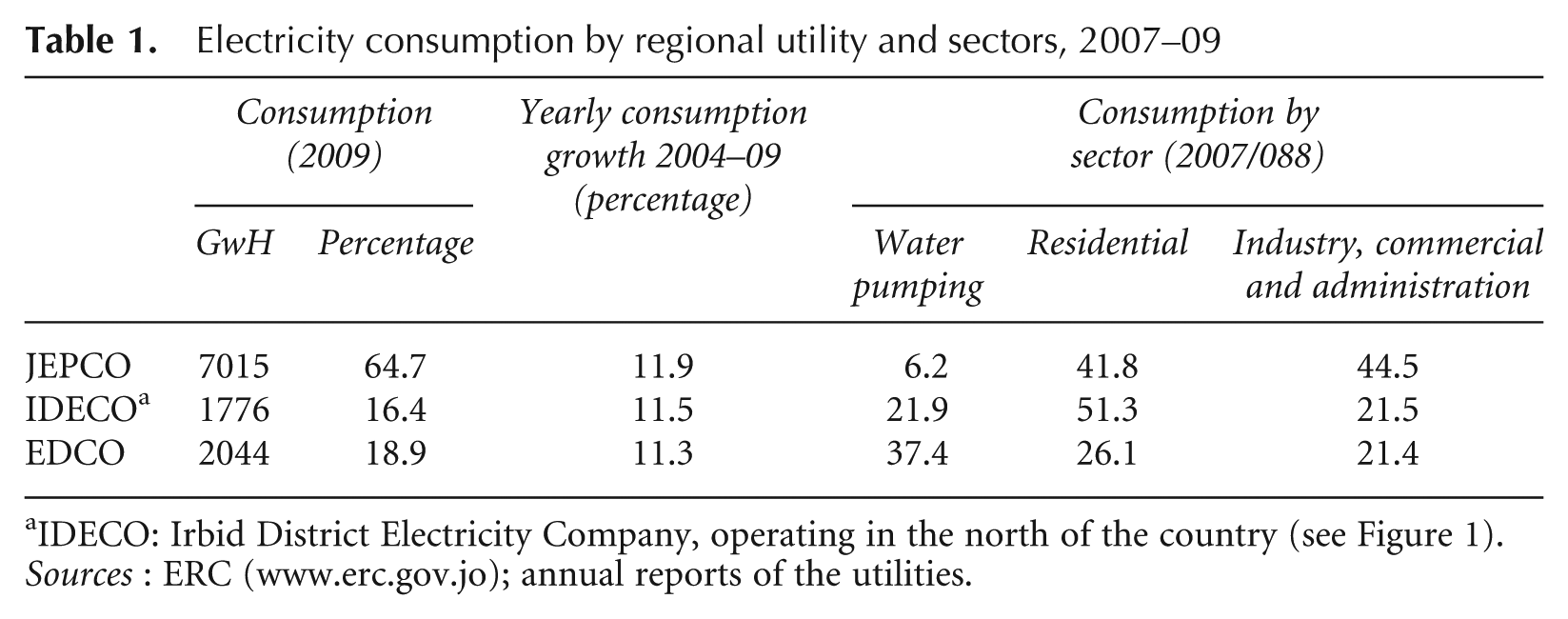
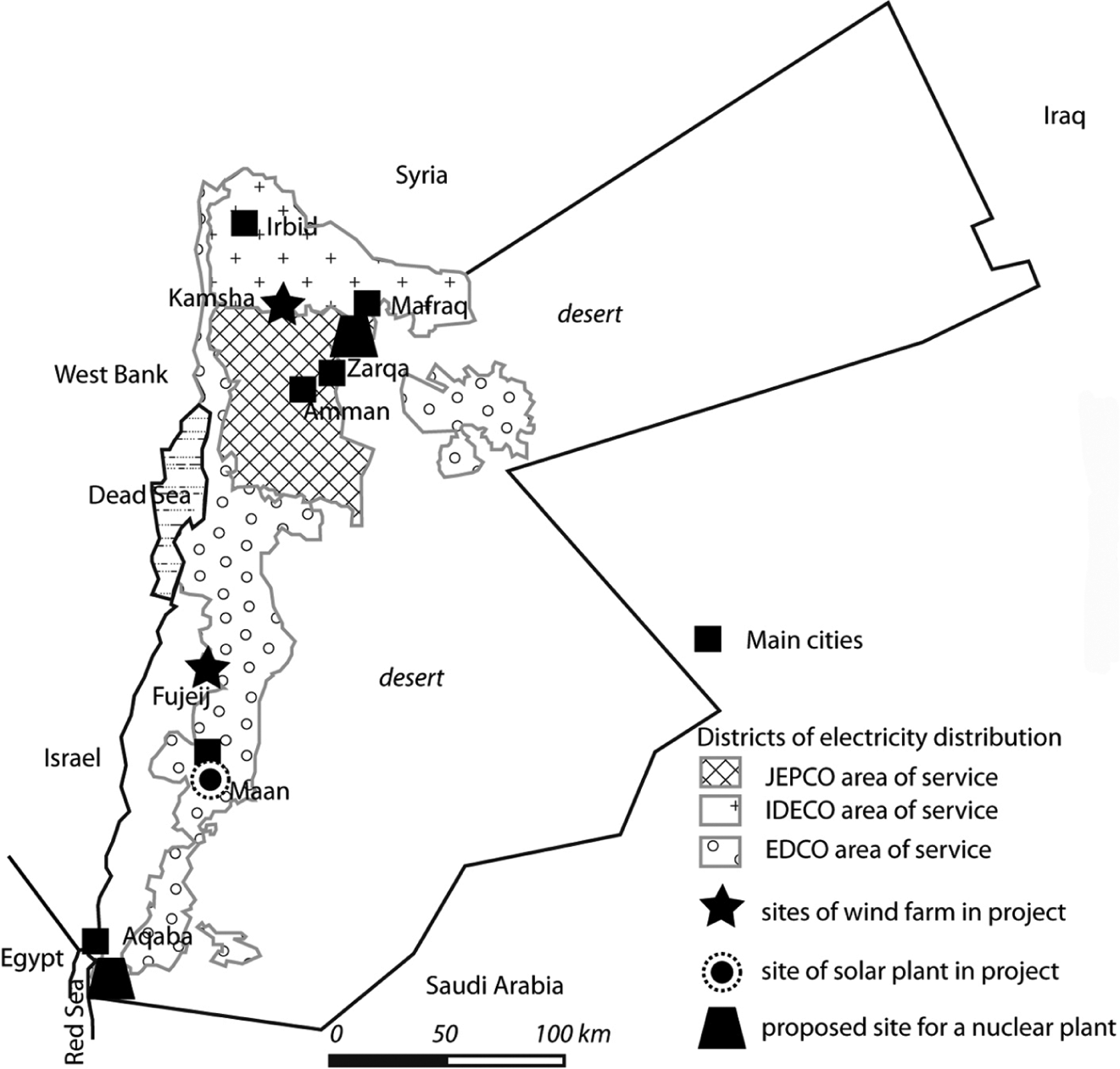
Amman, the capital city of Jordan, has about 2 million inhabitants. With the adjacent and surrounding cities of Zarqa, Salt and several other places, it forms a metropolitan area of about 3.5 million people (about 60 per cent of Jordan’s population). The very high population growth results from regional migrations (Palestinians in 1948 and 1967, refugees from Kuwait in 1991, Iraqis in the 2000s) which give the city a cosmopolitan profile. JEPCO (Jordan Electric Power Company), the regional company supplying Amman and its satellites, supplies about 65 per cent of the electricity in Jordan (see Table 1 and Figure 1). The figures of electricity consumption should be even higher, since a significant part of the electricity consumed in areas served by EDCO (Electricity Distribution Company), an electricity utility outside Amman, is used by water pumps that carry water up from the Jordan Valley (from -400 metres up to 1200 metres) and from other sources far from the city. In JEPCO’s perimeter, the growth of electricity consumption has been faster than in other areas during the last years, at about 12 per cent for 2004–09.
Electricity consumption by regional utility and sectors, 2007–09
IDECO: Irbid District Electricity Company, operating in the north of the country (see Figure 1).
Sources : ERC (www.erc.gov.jo); annual reports of the utilities.
Electricity supply in Jordan.
This is the result of population growth, of the increase in standards of living, 2 and of the adoption of new social practices. In recent decades, Jordan has experienced a major increase in the use of electricity in daily life. The proportion of the urban population with access to the public electricity network has increased from 78 per cent in 1979 to 100 per cent in 2009. 3 In the meantime, the urban population has increased from 1.5 million to 4.9 million, mostly concentrated in the central region. It is not surprising that the national policy of universal access to electricity has also led to the widespread use of electrical domestic appliances. For instance, between 2000 and 2007, the use of refrigerators and washing machines in homes increased from 89 per cent to 97 per cent.
This growing use is mainly related to the urban way of life, in its social and economic dimensions. At the national level, residential and commercial sectors have been the major contributors to growth. Between 1997 and 2007, their respective consumption increased from 31 per cent and 11 per cent respectively to 36 per cent and 16 per cent of total electricity consumption, while that of industry decreased from 34 per cent to 29 per cent. 4 In JEPCO’s area, one can notice that economic activities represent a bigger share of the demand than in other areas, reflecting the concentration of economic activity in the capital (Table 1). Some practices are particularly involved in growth. First, and as is true in most Middle Eastern and emerging countries, air conditioning is spreading at a very high pace: 7 per cent of households had A/C in 2006, compared with 4.9 per cent in 2000. Another very strong indicator of the demand for A/C is the summer peak in demand for electricity (the peak demand is increasing at a rate of more than 12 per cent yearly, which is a new phenomenon the managers of the electric system have to face). In winter, electric heating is also on the rise, affecting 13.3 per cent of households, and as high as 16 per cent in cities. 5 The development of these new electrical devices is clearly linked to social differentiation inside the city of Amman. The high reliance on electricity also enables new practices associated with social distinction, like air-conditioned malls which are emerging as new landmarks in the cityscape of West Amman as leisure facilities (Daher, 2008; Parker, 2009; Schwedler, 2010).
As a result of the growing demand for electricity, in 2010 and 2011 Jordan experienced several summer outages, whereas such problems had never occurred since the beginning of the 1980s. Such disruptions point to the fact that securing Amman’s supply is more and more difficult. Although the country has almost no proper energy resources and imports up to 98 per cent of its energy needs, Jordan—and first of all Amman—has long quenched its thirst thanks to privileged and cheap access to oil and more recently natural gas from neighbouring Arab countries. Until 2003, trade agreements with Iraq guaranteed the supply of cheap oil, which enabled the Jordanian national utility to sell electricity cheaply. The end of privileged access to oil began after the regime change in Iraq and exposed Jordan to world market oil prices (World Bank, 2005). The country has now entered into a new era, which the government has acknowledged as an ‘energy insecurity scenario’ (Mason et al., 2009). As a result, Jordan revised its energy strategy and switched most of its power plants from oil to natural gas (80 per cent of electricity generation is now based on gas). 6 Jordan signed an agreement with Egypt for the supply of natural gas at a fixed price until 2022, at a cost estimated at one-third of the market price. Nevertheless, Jordan’s energy bill rose from 1153 to 2280 million Jordanian dinars (JD) 7 between 2004 and 2008. Fearing popular unrest, the government did not fully pass on the price increase in electricity and raised subsidies to maintain prices at a time when the global economic slump had already badly impacted public debt.
In 2011, in the wake of the Egyptian revolution, the delivery of natural gas experienced major difficulties, increasing insecurity for supply and leading to what is now described as a profound energy crisis and an “issue of national security of Jordan” (The Jordan Times, 20 January 2012). More than 10 ‘terrorist attacks’ blasted the pipeline pumping gas from Egypt to Israel and Jordan between February and December 2011, forcing Jordanian power plants to rely on heavy oil fuel with overspending at 1 billion JD for the year. In the meantime, the Egyptian government also imposed a new agreement on gas supply, ending the favourable price structure and limiting the amount of gas delivered.
The energy insecurity issue led national authorities to design a strategy for energy transition as early as 2005. To this end, the government has embarked on an ambitious policy to develop renewable energy power plants and oil shale mining, and plans for a nuclear plant are also under discussion. The purpose of the Royal Energy Strategy—made public in 2005 and updated in 2007—is to meet the growing demand for electricity while facing budgetary and geo-strategic constraints. Climate change, global environment and peak oil arguments are not absent from the document, but they are clearly secondary concerns. The Jordanian transition strategy includes a move towards renewable energy sources (wind and solar energy) as well energy efficiency gains that must save funds in energy generation. Renewable energy resources should represent 10 per cent of the supply in 2020, while energy efficiency gains should represent 20 per cent of the current demand. However, the main resources targeted are natural gas, oil shale (with the goal of meeting 14 per cent of total energy needs in 2020), which is locally abundant and considered very promising, and nuclear power (to meet 6 per cent of total energy needs in 2020) (Mason et al., 2009). An essential concern is also in securing new suppliers for natural gas in order not to be held hostage by the troubled relationship between Egypt and Israel. The Jordanian energy transition strategy is far from being a low-carbon transition and its main objective is to secure its supply in complex regional geopolitics.
In the following section, some of the policies aimed at implementing these technological projects are reviewed, highlighting competing coalitions of interests that promote the policies and their links to the urban. Most of the projects featured in the Royal Energy Strategy are intended to supply a major part of their energy to Amman. Some of them are, or will be, built very near to the capital city (Figure 1). Nevertheless, they are largely conceptualised as national projects, being thought of at national scale, and their relation to the city as a material entity or as a network of social and political interests has neither been disclosed nor contested. In contrast to that, in the following cases, direct connections to the urban can be made. In the first case, the use of low-carbon technologies makes it possible to exploit diffuse energy in the city or to help customers to save energy; in the other case, the project for a nuclear power plant finds its justification in its proximity to the city, which is an original and paradoxical form of downscaling circuits. Both projects offer very interesting elements to analyse what is at stake in the urban energy transition.
The Amman Green Growth Strategy
The Royal Energy Strategy has mainly focused on the future energy mix but has almost failed to mention the role cities and citizens can play, apart from a few lines dealing with energy savings and energy efficiency—for instance, linked to incentives for solar panel heaters. In contrast to that, the Greater Amman Municipality (GAM) has designed an ambitious and original ‘Green Growth’ strategy. It reveals the awareness of the municipal leadership (the mayor and experts surrounding him) regarding threats to the city electricity supply. The initiative is also consistent with the neoliberal agenda pushed by various local, national and international interests aiming at the transformation of Amman into a new real estate and finance hub.
In 2010, the GAM launched the Amman Green Growth Programme (AGGP) which encompasses some ongoing projects already approved in the framework of the 2008 Metropolitan Strategy (compact growth, public transport) and new components related to sustainable development (solid waste management, an energy-saving lighting programme, recycling of used water). This move bore the imprint of the new Mayor Omar Maani and highlighted its will to smooth out the image of Amman to a city open for international (and specifically Iraqi and Gulf countries) real estate speculation by emphasising sustainable development goals.
Two components of the master plan illustrate the emergence of local energy policies. The first is a large project to replace existing incandescent lamps by low-consumption bulbs. The target is to replace 50 per cent of street light bulbs within three years and to replace them in homes (approximately 200,000 households) within five years. This project accompanies another energy-saving project, whose aim is to equip 40 per cent of households with solar water heaters (SWH).
The second component concerning energy policy is the building and management of a waste treatment site in Al-Ghabawi, where a methanisation unit is coupled to a 20 MW power station. The government has presented the project as part of a clean development mechanism (CDM). Additional funding is to be provided by the World Bank and GAM. This project is in line with a previous achievement which was launched in 1997, that entailed the building and operating of a 1 MW biogas unit in Al Ruseifah. The unit was operated by Jordan Biogaz Company, a subsidiary of GAM and of CEGCO, the public power generating company. The funding for the project was provided by the UNDP and the Global Energy Fund. Although there were a number of technical and administrative problems, including the lack of (or delay in) legislative measures devoted to the replication of such biogas projects, the evaluators judged that the benefit of this pilot operation lay in the experience and expertise acquired by GAM (Rijs et al., 2007).
Both projects are clearly intended to increase the Jordanian capital’s energy autonomy and self-reliance by retrofitting urban infrastructure (introduction of solar water heating and lighting) and rebundling urban metabolism (electricity generation from waste). The coalition of interests supporting that policy reveals a clear continuity with previous reforms and plans aiming at turning Amman into a showcase of urban renewal and at fostering its role as a regional business centre. As such, it very well fits the idea of a neoliberal assemblage, connecting various interests through different administrative scales and beyond public–private limits (Parker, 2009).
During the 2000s and specifically after 2006, several reforms have reinforced the Greater Amman Municipality and its Mayor (Malkawi, 2002; Potter et al., 2009). AGGP and the Metropolitan Strategy have been contracted to a Canadian consulting firm (planningAlliance), which later helped to set up a permanent local consulting body, the Amman Institute for urban development. This institute is a not-for-profit and independent institution led, until recently, by a Canadian planner but it is located in the town hall and its Board of Directors is directed by the Mayor. The Amman Institute provides consultations and training for the GAM as well as for other Jordanian (and now foreign) public institutions (Beauregard and Marpillero-Colomina, 2011). The Amman Institute has been a key element in a strategy that can be seen as the result of an active politics of scale (Bulkeley, 2005), linking interests cutting through metropolitan, governmental and international levels and through the public/private limit. Indeed, several government agencies are connected to that network, like the Renewable Energy and Energy Efficiency in the Ministry of Energy and the National Energy Research Centre. But the AGGP was also partly inspired by the World Bank (WB) as part of a global strategy called the City Wide Strategy. It aims at promoting Amman as a pilot city in the Middle East and North African Region. 8 At the time of the fieldwork, all the details of the AGGP funding were not confirmed but several international institutions, in addition to the WB, were keen to help, for instance AFD, the French aid agency for public lighting, and the UNDP for a waste power plant. In addition to the help provided by these institutions, the GAM has actively built connections with international networks of cities in order to gain experience from others’ projects and to attract investment and new expertise to the city (Parker, 2009).
The way the projects are currently devised also links them very clearly to the commercial approach to sustainable development understood as ecological modernisation (Hajer, 1996; Myllylä and Kuvaja, 2005). Several private firms (Energy service companies (ESCOs) or other small energy contractors) and consultants are expecting profits from the new projects. Indeed, the GAM is currently exploring the idea of associating itself to the private sector in the implementation of lighting and SWH projects. These devices would be financed through monthly subscriptions to a commercial service and private firms would provide investment and maintenance.
However, several key legal decisions intended to promote renewable energy and energy saving are currently on hold, like the GEREEF, 9 due to the repeated suspension of the Parliament. This could reflect the hesitations of several interests inside the government as well as in the energy sector vis-a-vis the renewable energy strategy, in contrast to the nuclear project that seems to enjoy stronger support.
The City and the Nuclear Plant
The second case study in the Jordanian energy transition is a project to build a nuclear power plant. Although still in the complex process of designing and bidding, it has recently gone through major changes which have underlined its very strong connections with the urban and have fuelled unexpected public debates calling into question the energy future of Jordan, which gain importance given the context of the Arab uprising.
The King of Jordan and the Jordanian government have made it clear since 2007 that they want to develop a nuclear programme with a capacity of 1000 MW in 2020, accounting for 6 per cent of the country’s energy, and to be increased to 20 per cent in 2030. The aim is to secure Jordan’s electrical independence and even to turn the country into an electricity exporter. The project has been directly managed by the King, who has created a special body for the nuclear programme, the Jordanian Nuclear Atomic Commission. Its head since its creation has been Khaled Toukan, a nuclear scientist who has occupied several ministerial positions since 2005, including the Ministry of Energy (in 2011). The interesting point is how such institutions with very technological concerns have integrated the urban into their discourse regarding the implementation of the energy transition. With the support of international consultants, they first selected Aqaba as the site for building the nuclear power plant. Several technological reasons were cited in justifying that choice: the need to pump cooling water from the nearby sea and the closeness of two big infrastructural projects—a water desalination plant and the projected Red Sea–Dead Sea channel currently under study. The first infrastructural project aims at responding to a growing fresh water demand in a country suffering from aridity and water scarcity—beginning with Amman (Darmame and Potter, 2011). The Red Sea–Dead Sea project aims at compensating for the loss of water in the Dead Sea, which lowers by 1 metre per year and threatens the very existence of the salted sea and the economic activities linked to it. Both projects would require great quantities of electricity.
However, at the end of 2010, the government announced that a new site was now under study, Balaama, near Mafraq, 35 km north-east of Amman (Figure 1), at the desert’s limits. Several reasons were alleged to justify that move. One was the seismicity of the Gulf of Aqaba, which could threaten the nuclear plant. Such an argument resonated even more strongly in the aftermath of the Fukushima collapse. Yet the move also seems to be related to geopolitical friction between Jordan and its neighbours. In the summer and the autumn of 2010, the US ambassador conveyed concern regarding the security of the programme and the risk of nuclear proliferation. His step was also regarded as motivated by the Israeli fears of a terrorist attack against the nuclear site that could touch Israeli areas adjacent to the border. The press also mentioned that such fears could be shared by Saudi Arabia and Egypt, also next to the site. These elements point to the fact that (urban) energy transitions cannot be separated from geopolitical contexts and that they are shaped by relations of power.
Other arguments were also put forward to justify the move to Baalama. They highlight that the nuclear project is, in the eyes of the authorities, entirely part of Amman’s metabolism. A first argument is that building a nuclear site near Amman would spare the building of a 400 km high voltage line from Aqaba to Amman. This shows that the capital would be the main place of consumption for the electricity generated by nuclear power plant. This argument echoes the concern for relocalising energy production and downscaling the energy circuits (Hodson and Marvin, 2010a). The second argument is that Amman’s waste waters would be recycled in order to ensure cooling the nuclear plant to be built near Mafraq. Such technological means already exist in Palo Verde, Arizona, the authorities say. It is striking that this rationale reconceptualises the flows of energy and water involved in the nuclear power plant in the manner which is close to the way rebundled networks play in the sustainable city agenda (Coutard and Rutherford, 2010). Far from being a project thought out for, and connected to the national grid, the nuclear project appears as being rebundled to the city’s energy and hydraulic infrastructural networks; therefore it is part of the urban metabolism. This example clearly shows that the urban energy transition is not only about developing energy efficiency solutions at the city scale or engaging in low-carbon electricity generation to quench Amman’s energy thirst, but is centrally related to the nuclear option.
What is the particular coalition of interests that promote the nuclear programme and to what extent can one identify intersections or conflicts with urban interests (including the groups that push for the Green Growth Programme)? As can be expected, investigating the political and economic interests revolving around the nuclear issue is not easy. Yet the Fukushima catastrophe has spurred hesitations within the Jordanian government about the nuclear programme and has opened up a space for public debate during which much information has been leaked to the press. 10
Such a programme has been strongly promoted and defended by the King himself as an issue of national independence and a sovereign right. However, the programme has also received the support of several institutions and interests outside Jordan. The programme is closely monitored by international institutions like the International Nuclear Agency, which have on many occasions given positive reports. 11 Several foreign governments have praised the Jordanian project, specifically those from which firms were originally involved in the nuclear development project. Three international vendors have been chosen (French–Japanese, 12 Canadian and Russian) and their financial, technological and spatial offers are still under study. Such a coalition is very different from the one led by the Greater Amman Municipality and apparently has no connection to it. Yet it can also be understood as a neoliberal assemblage since private international interests intersect those of several Jordanian institutions and political actors. That example highlights that the geopolitical dimension is key to most urban energy transition projects.
Taking to the Streets against the Energy Transition
These two examples of policies aiming at tackling Amman’s energy transition have shown the intertwining of technological issues with a concern for the city as a space, with its materiality, its metabolism and its connections with various and remote spaces. These entail geopolitical conflicts which in turn weigh on the definition of urban energy transition policies. The political processes which have been unravelled here pertain to urban governance or to geopolitics. However the urban energy transition also prompts other types of conflicts, involving urban citizens, which is the aim of this section.
The first contentious issue is the price of electricity, which is theoretically the responsibility of the Electricity Regulatory Committee, an independent body created in the wake of the liberalisation of the electricity sector in 2001, and taking effect in 2005. One of the axes of that policy has been the removal of the tariff subsidies which were very high, given the low cost of hydrocarbon supply until early 2000. Given the rise of the international oil and gas prices, raising the price became a central issue after 2008 and both NEPCO (National Electric Power Company), the national utility acting as the single buyer in the electricity sector, 13 and the Electricity Regulatory Committee have claimed it necessary to adopt a mechanism to link the fuel cost to the electricity tariff. Yet the ERC and the Ministry of Energy also argue that the renewable project would also justify a price increase. Indeed, the selling prices proposed by bidders for renewable power plants (wind and solar) are much higher than current prices, and a major reason for the delayed implementation is the discrepancies in prices.
Several price increases have been decided, in 2008 and recently in 2012. Yet it is a contentious and very unpopular issue, in a context of rising commodity prices and diminishing incomes for many citizens in the country. In September 2009, a long-announced increase had been suspended after a personal and public intervention by the King. When implemented, the increases have been calibrated in order to weigh more on big consumers, assumed to be the wealthiest people, and to leave ordinary citizens unaffected. Nevertheless, the demonstrations that have taken place in recent months show that the issue of pricing, itself directly a consequence of the energy transition policy, remains very sensitive for the government.
The protests against the nuclear project are amplifying the issue of pricing. In the wake of Fukushima and in conjunction with the uprisings in the Arab world, 14 several opponent groups have gained momentum and staged various public demonstrations. The most visible have been environmentalist NGOs like Greenpeace Jordan, which spectacularly demonstrated in front of the Ministry of Energy, but also local NGOs like the Jordan Renewable Energy Society (JRES). On the one hand, these NGOs claim that the nuclear projects are dangerous, specifically in Jordan because of the seismic environment (even in the Balaama site) and because of water scarcity. They also attack the lack of local expertise and the opacity of the negotiations and the decisions in a country generally lacking in transparency. Finally, the cost of the nuclear programme is an issue for them. On the other hand, they promote the development of wind and solar energy, because according to them Jordan has a huge potential for it. These NGOs intersect with the coalition of interests involved in the low-carbon energy transition in Amman. For instance, the head of JRES is also a consultant and firm-owner selling solar panels and promoting alternative technologies. 15 Some high-ranking civil servants in the Ministry of Environment and the Ministry of Energy also publicly criticised the nuclear programme and were recently joined by a Princess from the Royal Family, Basma Bint Ali, and even a former head of the Nuclear Energy Commission. These critics and counter-proposals were aired during a public conference in Amman. A debate on the issue later took place in Parliament and the Muslim Brotherhood, a strong opposition movement, took a stance against the programme (Luck, 2011b).
In addition to the mobilisation of these expert or political groups reaching into the heart of the administration, one has to note a popular movement in the Balaama area. Inhabitants, militants and local tribal leaders created a movement called Irhamuna (“Mercy for us”) that seems to gather together hundreds if not thousands of people. They reject the project in the name of security concerns, deeming the nuclear plant too close to their homes and taking land belonging to their tribes. They also criticise the lack of public participation (Luck, 2011a). Several connections are to be found between this local mobilisation and the more middle-class group of ecologists who have been active in the media and on the Web.
The emergence of popular mobilisation against some of the crucial options for the energy transition, and against their financial consequences, underlines that politics is a central dimension of energy transitions, often overlooked in many accounts and in theorisation. While (urban) energy transitions are conceptualised as a techno-policy-driven process, recent popular protests show that, even in the absence of a democratic and open process of information and decision, the technocratic issue of energy transition may become a political issue, as it concerns the interests of the citizens—the cleanliness and security of their built environment and their standard of living. Two factors contribute to that transformation.
The first is linked to the conjuncture that the unexpected burst of protests in Arab countries has also spurred a wave of protests against the regime, the lack of democracy and transparency, which in turn has touched energy projects. The Fukushima catastrophe is the second factor and it is interesting to note how opponents to nuclear projects have domesticated the image of apocalypse, comparing an eventual future nuclear power plant collapse to the Nakba, the expelling of Palestinians from their land by the Israelis in 1948—a foundational episode in the creation of modern Jordan (Luck, 2011b). In doing so, they subvert and properly reverse the rhetoric of doom usually associated with environmental politics as ‘post-political’, i.e. consensual techno-managerial solutions designed to escape a threat, for instance the future lack of energy (Swyngedouw, 2009). The street encounters of these diverse groups of interests (environmentalists and Balaama citizens) have not resulted in a revolution and probably will not, but they have derailed the ‘post-political’ management style of energy policies and transformed them into political issues. What is at stake now is not only a national energy crisis, but a debate to decide who will pay, which citizens will have to live near a nuclear plant and how can such issues be decided democratically. The energy transition issue in Amman has become an open political problem, consistent with recent scholarship (Bulkeley et al., 2010).
Conclusion
There are several conclusions which have been revealed by this case study on energy transition policies in Amman or as related to that city. These conclusions help us to understand anew the relationship between the urban and the issue of energy transitions. In this article, it has been clearly shown that changing social practices in the city represent a major push for energy transitions. However, the framework through which energy threats are understood is always a particular geographical construction, involving context-based relationships between the city, its country and its regional environment. Energy transitions are deeply inscribed in, and dependent upon, a given geography of energy circuits and the geopolitical relationships that shape and reshape them. This is a strong factor constraining strategies for urban energy transitions.
The role of metropolitan and local governments in the design and implementation of energy transitions at the urban scale is a problematic issue. Most of the literature posits a central role for coalitions of metropolitan interests, where local political and business elites partner up with experts and various stakeholders in order to design and implement a strategy for an urban energy transition. Yet the case of Amman shows that the urban government has very few levers to influence change in the energy sector. The case of Amman is instructive in showing that connections with global circuits of knowledge and finance are important factors to gaining such leverage. However, in the end, they play only a marginal role and urban energy transitions remain to a large extent issues which have to be tackled inside the energy sector. Yet this sector is split among diverse interests, and the issue of the urban as a place for specific practices which weigh upon energy demand is barely tackled. In countries such as Jordan, private energy firms specialising in new technologies (energy efficiency, renewable energy) are too small to influence strategy and they have to rely on foreign partners for large projects (like the wind power or solar power plants planned in Jordan; Verdeil, 2011).
The case of the ongoing nuclear programme illustrates that energy transitions are best understood according to a relational understanding of the urban. This is primarily the case regarding the geography of the circuits involved in such a project. In the first stage, the urban was not directly taken into account. Issues of national independence were the main drivers of such a programme. The development of mega infrastructures, needing a great amount of energy, was also a major factor justifying nuclear generation. The correlation between such infrastructures and the city has long remained indirect. The examination of a new site option, motivated by geopolitical pressures and concerns for security in the post-Fukushima context, has revealed that the urban is at the core of such a national project. National energy authorities are plainly urban too. Yet the example of the Jordanian nuclear programme is that of an urban energy transition imposed by a coalition of political and business interests excluding most metropolitan institutions and groups from the decision-making process. Such an energy transition is probably more common than is assumed in the literature.
The article also helps to challenge the view that urban energy transitions necessarily rely on low-carbon technologies. The case of Amman shows the potential for rebundled networks and for exploiting renewable energies, specifically solar. Yet such technologies represent only a very limited part of Amman’s energy future. The energy transition mainly consists of securing new hydrocarbon supplies—including developing a very ‘dirty’ energy like oil shale. The nuclear is also an option in the urban energy transition. The possible use of the urban waste waters to cool the nuclear power plant would be a paradoxical and uncommon case of rebundled urban metabolism. This shows that analyses of the urban energy transitions must not overlook these classical sources of energy.
The case study has also brought conclusions about the social and political dimensions of urban energy transitions, which can otherwise be understood as a technological and market-driven issue. In contrast to that view, the views of several critical urban scientists were followed, who insist on the politics of socio-technical changes and call for an assessment of the social interests involved in such processes, and the identification of winners and losers. In this respect, I have attempted to unravel coalitions of social interests pushing for diverse and, in some ways, contradictory paths towards an energy transition. Although one can depict them as neoliberal assemblages cutting through various administrative levels and blurring the public–private border, the research process reveals internal conflicts of business interests behind the ideological stances against or for the nuclear option. The environmentalist movement is highly connected with the emerging alternative energy private sector.
Yet the politics of the energy transitions is not only about business interests, it also touches the living conditions of citizens and might be the driver of dynamic street mobilisations where specific claims like energy tariffs gain wider political meaning. In Amman, this has been the result of the connection between the protests against the new urban location of the nuclear programme with the more global political claim against the regime in the context of the Arab revolts. Particular claims have been expressed in more general political terms of transparency and democracy. This is an ongoing process, and at this stage it is still too early to draw conclusions about the disruptive political impact of energy transitions. Whatever the future may hold these facts highlight that energy transition processes are fundamentally political and highly unruly. They cannot be led from the top–down in accommodating elite social interests, but must also take into account the interests of citizens.
Footnotes
Acknowledgements
For their helpful comments on an earlier version of this article, the author would like to thank Romain Garcier and Jonathan Rutherford, as well as two anonymous referees.
Funding
This research has been funded by IFPO, thanks to an Agence Nationale de la Recherche project: Tanmia: Le ‘Développement’—fabrique de l’action publique dans le monde arabe? (2008–2012).