




Abstract
This paper looks at the geographical dimension of firm networking in Norway, by examining the impact of manager-level, firm-level and regional-level variables on the decisions of firms to collaborate with partners at different levels of geographical distance. Using data stemming from a survey of 1604 businesses in five Norwegian city-regions, we model firms’ use of partners located within the region, elsewhere in the country and abroad, respectively. The results indicate that collaboration is affected in different ways by variables related to all three levels. At the level of the manager, trust is an important predictor of regional and national collaboration, but has no significant effect on the formation of international partnerships, which are fundamentally associated with factors such as education and the open-mindedness of managers. At the regional level, R&D expenditure tends to increase collaboration between regional actors, but reduces the likelihood of engagement with international partners. Education, by contrast, has the opposite effect: it encourages international collaboration at the expense of local links. The results highlight the need to balance policies for boosting regional social capital and R&D with investments in education and fostering open-mindedness as a means to prevent lock-in and develop innovation-enhancing global pipelines.
Introduction
Innovation collaboration is considered essential for innovation. The engagement of a firm with other firms – regardless of whether they are suppliers, clients, competitors or consultancy firms – universities and research centres, and government determines, to a large extent, its capacity to introduce new product and process innovations. Firms, universities and governments form ‘triple helix’ complex and evolving networks of interaction which significantly affect the innovative capacity of firms (Leydesdorff, 2000). Firms at the centre of these networks tend to be more innovative and dynamic than those that engage in less interaction with other actors and, therefore, remain relatively isolated.
While it is clear that the ability of firms to introduce new products or processes is crucially affected by their choice of innovation partners, the geographical dimension of these partnerships has until fairly recently attracted relatively little attention. Most ‘triple helix’ approaches to innovation have generally not been concerned with space at all (Etzkowitz, 2003). The dominant assumption has been that the majority of interaction takes place in close geographical proximity (Leydesdorff and Fritsch, 2006; Leydesdorff et al., 2006) and that, hence, the geographical location of partners may not really make a difference for innovation. However, starting with the work of Bathelt et al. (2004), recent research on the sources of innovation has tended to show that the geographical location of partners significantly affects the probability of a firm innovating and that interaction in close geographical proximity may not always result in innovation (e.g. Gertler and Levitte, 2005; Moodysson, 2008), but may instead lead to lock-in. In the specific case of Norway it has been found that firms that collaborate with a wide range of international partners are significantly more prone to innovate than firms that primarily collaborate with regional or national partners, or that do not collaborate with external partners at all (Fitjar and Rodríguez-Pose, 2011).
Yet, the factors that drive firms to collaborate with far-away agents or, by contrast, to predominantly network locally are still poorly understood. Hence questions such as which factors affect the use by firms of partners at different geographical distances, or whether the use of partners in different geographical locations depends only or mainly on factors internal to the firm or on the regional environment, remain unanswered.
In this paper we examine which factors are behind the geographical dimension of innovation collaboration. We assess to what extent the propensity of firms to network at different geographical distances depends on three types of factors. These factors include manager-level, firm-level and regional-level variables. Using data from a tailor-made survey of 1604 businesses located in five Norwegian city-regions, we conduct three different regression analyses that model firms’ use of partners located within the region, elsewhere in the country, and abroad, respectively.
The results indicate that collaboration and networking are affected by variables related to all three levels, but that these mechanisms have radically different effects on local compared with international collaboration. At the level of the manager, greater trust by managers leads to more regional and national collaboration, while open-mindedness is an important predictor of international cooperation. Firm-level indicators, such as the size of a firm, the internationalisation of its ownership and the sector it belongs to, also make a difference for the type of partners with whom firms engage. Finally, some regional factors, such as R&D expenditure, facilitate networking between regional actors, at the expense of reducing the propensity of regional firms to engage with international partners. Education, by contrast, has the exact opposite effect. In regions with an educated population, firms tend to be less inclined towards regional collaboration and to make more frequent use of international partners.
In order to reach these results the paper is structured into five additional sections. The following section looks at the link between interactions and innovation from a theoretical perspective, as highlighted in the relevant literature. This section is followed by a presentation of the potential factors which may determine the geographical dimension of firm interaction and their introduction in the econometric model. We then present the dependent and independent variables, while the penultimate section discusses the results of the empirical analysis. The conclusion draws up the main implications of the analysis.
Interactions and innovation
Interactions have been at the heart of most recent studies on innovation. From the literature on industrial districts (Becattini, 1987; Bellandi, 1996), learning regions (Morgan, 1997) or regional innovation systems (Cooke, 2002; Cooke and Morgan, 1998) to ‘triple helix’ approaches (e.g. Leydesdorff, 2000), learning and innovation are seen as the result of multiple formal and informal relationships between firms or between firms and other innovative agents – fundamentally universities, research centres and government. Frequent and repeated formal and informal interaction with a multitude of different actors allows knowledge to diffuse and spill over, contributing to the creation of virtuous circles of innovation and economic dynamism (Lundvall, 1992; Lundvall and Johnson, 1994). The innovative capacity of any given region is, therefore, perceived to be ‘strongly influenced by the level and quality of interaction and exchange between different actors and their respective knowledge flows (spillovers)’ (Fritsch and Slavtchev, 2011: 909).
The large majority of the studies looking at how different types of interactions affect innovation have either been theoretical, conducted in some sort of ethereal space – as is the case with many ‘triple helix’ studies (e.g. Etzkowitz, 2003) – or in relatively self-constrained and restricted geographical locations. Although it is frequently assumed that governments and other innovative actors ‘can act at national, regional, or increasingly also at international levels’ (Etzkowitz and Leydesdorff, 2000: 118), the reality has been that interactions within clusters, the city or the region have remained the stars in these analyses (e.g. Storper and Venables, 2004). The rationale for focusing on limited geographical scales is that ‘for a number of reasons, such as the costs and effort involved in having face-to-face contact, a considerable part of these exchange relations is constrained geographically’ (Leydesdorff and Fritsch, 2006: 1539). Indeed, significant parts of the recent literature on innovation have tended to highlight that innovation-related partnerships have become increasingly localised in recent decades (e.g. Rosenthal and Strange, 2008; Sonn and Storper, 2008).
The agglomeration of a large number of socioeconomic innovative agents in reduced geographical locations – high density – has many advantages. It allows for frequent exchanges of knowledge and information and for the creation of tightly knit environments conducive to the circulation of knowledge and innovation, making the innovation potential of any firm crucially dependent on the co-presence and ability of potential partners in the region (Fritsch and Slavtchev, 2011; Glaeser, 1999; Glaeser and Gottlieb, 2006). This is particularly the case for smaller firms, which can compensate for limited internal economies of scale through drawing on larger external economies in industrial districts or regional innovation systems. Agglomeration and geographical proximity encourage and facilitate frequent face-to-face exchanges deemed to be essential for the circulation of knowledge and innovation (Storper and Venables, 2004), and, although some innovative activities (mainly knowledge-intensive services) are increasingly decoupled from their geographical location, the majority of innovation, especially in manufacturing, remains very much geographically embedded (Leydesdorff and Fritsch, 2006; Leydesdorff et al., 2006). Even in those cases where interaction crosses regional or national borders, empirical research has tended to retain an element of geographical proximity. Many of the analyses of cross-border innovation systems imply a degree of geographical contiguity, with cross-border interaction taking place in the space of a few kilometres (e.g. Trippl, 2010). The assumption thus remains that the actors involved in innovation need to be physically close to one another in order to maximise the benefits linked to the circulation of codified and tacit knowledge through frequent face-to-face interactions (Lundvall and Borrás, 1999; Rallet and Torre, 2000). Furthermore, the actors need to be socially close to one another in order to engage in mutually beneficial cooperative behaviour, making high levels of social capital in a region crucial for firms’ ability to turn local collaboration into learning and innovation (Lorenzen, 2007). Consequently, interaction, networking, cooperation, social capital and spatial proximity are the key constituting elements of collective learning processes and of the innovativeness of firms, regions and nations (Asheim et al., 2007: 657).
The role of collaborations beyond reduced geographical spaces for innovation has, by contrast and despite some exceptions (e.g. Amin and Cohendet, 2004; Bunnell and Coe, 2001), traditionally attracted less attention. The interest in exchanges that overcome geographical distance has, however, grown significantly as a result of the emergence of research examining different types of distances (Boschma, 2005; Torre and Rallet, 2005). In order to become and/or remain successful, firms increasingly resort to more complex systems of collaboration that more and more frequently stride over national borders (Godin and Gingras, 2000). Several studies stress the importance of collaborating with partners at multiple scales (Arndt and Sternberg, 2000; Asheim and Isaksen, 2002; Sternberg and Arndt, 2001). In particular, in the case of the diffusion of innovation, the literature on ‘global pipelines’ (Bathelt, 2007; Bathelt et al., 2004; Gertler and Levitte, 2005) has represented a major step forward in overcoming the tyranny of geographical distance in innovation research. Global pipelines represent purpose-built connections between firms and the outside world, channelling knowledge and innovation at what are often huge geographical distances. Face-to-face contact in global pipelines is often achieved through temporary geographic proximity at professional gatherings or during short-term visits (Bathelt and Schuldt, 2010; Maskell et al., 2006; Schuldt and Bathelt, 2011; Torre, 2008). Because of their purpose-built nature and of the geographical distance involved in pipeline-type exchanges, global pipelines tend to be more rare, more costly and lead to different types of innovations than face-to-face interactions conducted at close geographical quarters. Hence, pipelines tend to be used more frequently by larger firms with sufficient scale to invest in their development. In particular, multinational enterprises often sustain such global networks within the same organisation, while also linking to external firms in the different regions where they are located (Ebersberger and Herstad, 2012). The business literature has traditionally modelled internationalisation as a gradual process in which successful firms expand from domestic to foreign markets, making size an important variable (e.g. Johanson and Vahlne, 1977). However, the literature on ‘born global’ firms (Knight and Cavusgil, 2004; Oviatt and McDougall, 1994) has qualified established assertions about size and internationalisation, noting that some firms are oriented towards global markets from their inception and that small size can also offer flexibility when operating in foreign markets.
The topic of interaction at different geographical scales has received less attention in the literature on innovation management, where the roles and strategies of managers in promoting innovation have been put to the fore. Several studies have focused on firm culture, entrepreneurial orientation or the personality of the firm as important factors in determining its potential for innovation and long-term success (e.g. Barney, 1986; Hofstede, 1985; Lumpkin and Dess, 1996), noting that the personality of small firms often reflect the personality of their founder or manager. While studies of how firm personalities and manager attitudes affect innovation are commonplace, these factors have less frequently been linked to the firm’s strategies for interacting with external agents. Glasmeier et al. (1998: 118) note that ‘the firm-learning literature overemphasises structure and underemphasises the effect of personality and family dynamics on firms’ goals, learning strategies and outcomes’. However, Malecki and Poehling (1999) classify firms as extroverts or introverts based on their use of external information sources, whereas Kickul and Gundry (2002) find support for a three-step model in which a proactive personality in the entrepreneur leads to the use of prospector strategies by the firm, which is in turn conducive to innovation.
The fact that frequent face-to-face and pipeline-type interactions are generally regarded as complementary (Bathelt et al., 2004), does not prevent researchers from showing that pipeline-type interactions are likely to generate more radical product and process innovations than local exchanges (Bathelt et al., 2004; Trippl et al., 2009). By contrast, face-to-face exchanges in close geographical proximity are thought to be at the root of more incremental innovations. Hence, Shearmur (2010) finds that radical innovation in high-tech industries tends to increase with distance from urban areas, whereas process innovations and innovations in medium- and low-tech industries are more prevalent in firms located closer to urban areas. However, in the specific case of Norway, Fitjar and Rodríguez-Pose (2011: 1257) find that, once firm-specific, sector-specific and region-specific factors are controlled for, international pipeline-type interactions are more conducive to both radical and incremental innovation, whereas the impact of local, regional or national exchanges on innovation is rather limited. Similar results are achieved, using very different methods, by Moodysson (2008), who finds, in a study of the Medicon Valley in Sweden, that local interaction has a negligible impact on innovation and that other sources of knowledge tend to be embedded in globally configured knowledge communities.
What determines different types of interactions?
Despite its importance for innovation, we still know relatively little about what determines the geographical dimension of the interaction between innovative agents. Which factors push firms to collaborate with different partners at different geographical scales? Are the drivers behind exchanges in close geographical proximity radically different from those that lead to partnerships at considerable geographical distance? In this paper we hypothesize that the geographical dimension of firms’ interaction with other firms and other innovative agents is determined by three types of factors.
First, given the link between the personality of the firm and its manager and its association with network relations (Glasmeier et al., 1998; Kickul and Gundry, 2002), we expect that the propensity to collaborate with partners at different geographical scales will be affected by manager-level characteristics. We expect the attitudes of managers to have an important influence on the choice of partners and, consequently, on their geographical location. Specifically, we focus on two dimensions of managers’ attitudes: attitudes of trust and attitudes of open-mindedness. Studies of how trust affects economic outcomes occupy a prominent position in the social capital literature, regardless of whether trust is considered an individual asset, as in the works of Coleman (1988), or as a community resource, as in the works of Putnam (1993). However, trust pertains mainly to relations to others within the local community (Lorenzen, 2007) and its impact on the ability to cooperate successfully with outsiders is unclear. In these relationships, open-mindedness and tolerance towards different ideas and outlooks may be a more important cultural attribute in promoting network formation and learning. Open-mindedness and tolerance has been shown to affect regional and national economic growth in several studies (e.g. Florida et al., 2008; Inglehart and Norris, 2003), presumably in part because of the increased potential for learning and innovation arising from access to a diversity of ideas and approaches to problem-solving (Berliant and Fujita, 2012; Ottaviano and Peri, 2005). Thus, we posit that attitudes of trust and open-mindedness in the manager will not only affect the number of partnerships a firm enters into, but also whether these partnerships are primarily local or non-local. Furthermore, we also control for the level of education, age, gender and networks of the manager.
Similarly, firm-specific characteristics related to the size of the firm, the participation of non-locals in the ownership structure and the industrial sector a firm belongs to will influence the number and location of partners (Döring and Schnellenbach, 2006; Fritsch and Lukas, 2001; Malecki, 2010). The literature on ‘born globals’ notwithstanding (Knight and Cavusgil, 2004; Oviatt and McDougall, 1994), we expect larger firms to have more international partners because of the higher cost of establishing global pipelines. The differences are expected to be smaller at the regional level, where smaller firms are more dependent on external collaboration. Nonetheless, larger firms will have more capacity to handle a wider range of partners and will in all likelihood have more partners at all scales. Furthermore, firms owned by locals and servicing the national market are bound to have fewer international partners than firms with a more international ownership structure in global sectors.
Finally, the impact of characteristics of the regional environment is of particular interest to policy-makers and scholars of cities and regions. We hypothesize that the regional environment in which a firm operates will also affect the levels of connectivity, especially at the local level (Leydesdorff and Fritsch, 2006: 1539). Although the importance of cities as sites for connectivity, innovation and creativity may have been exaggerated (Asheim et al., 2007), much of the recent literature in urban economics (e.g. Duranton and Puga, 2000; Glaeser, 1999) highlights the important role that agglomeration and density plays in affecting the level of interaction of innovative agents. Firms in large and densely populated agglomerations are therefore bound to have more interaction with other local innovative agents than firms in isolated, rural locations (Fritsch and Slavtchev, 2011: 912; Malecki, 2010). Firms in regions with innovation-prone socioeconomic environments – or with adequate social filters (Rodríguez-Pose, 1999) – will also find it easier to establish partnerships with other firms, with clients, suppliers, customers, research centres and universities, and with government agencies. Factors such as a good endowment of human resources (Chaminade and Vang, 2008), the presence of advanced research institutions (proxied by R&D expenditure) and a high number of researchers will also encourage partnerships, especially if these conditions signal the existence of a strong regional innovation system. Finally, strong clusters, with a large number of firms in the same or in related sectors, also facilitate the emergence of favourable environments for knowledge interchanges (Duranton and Puga, 2000).
However, most of this literature has remained in the theoretical realm – where there are multiple claims highlighting the importance of interaction, but relatively little empirical evidence – or focused on specific case studies. Most of the empirical analyses in this field have also focused mainly on the local dimension. In this respect, de Jong and Freel (2010) find that firms in urban areas collaborate with partners located significantly closer to them, leading to the conclusion that firms collaborate locally if relevant partners are available. Others focus exclusively on one dimension of collaboration. University–industry relationships have been particularly popular. Bishop et al. (2011) and D’Este et al. (2013) underline the importance of this type of collaboration for innovation, highlighting – especially in the case of D’Este et al. (2013) – the importance of geographical proximity for the development of these relationships. Conversely, Laursen et al. (2011) find that university research quality is more important than geographical proximity, especially for technology-intensive firms. Still others examine collaboration with a range of partners, but using fixed effects for different regions, rather than probing specific characteristics of the regions (Fritsch, 2003; Fritsch and Lukas, 2001; Herstad et al., 2011). These studies find that larger or more urban regions do not necessarily promote local collaboration. A similar result is found by Teirlinck and Spithoven (2008) using fixed effects for various degrees of urbanity.
Consequently, while some earlier research has highlighted the regional conditions for encouraging local interaction, we know less about under which circumstances regional conditions will encourage the formation of pipeline-type interactions. However, factors such as a high regional level of education (indicating that the region has sufficient absorptive capacity to learn effectively from exchanges with global knowledge hubs), in interaction with a young (and therefore often more mobile) demographic structure, may favour the promotion of collaborations that go beyond the boundaries of the region.
Hence, putting all these factors together, the level and geographical origin of the innovation-related collaborations entered into by a firm can be assessed using the following model:

where P depicts the number of partners used by firm i in region r. Three separate types of partners are considered according to the geographical origin of the firm and its partners: regional partners, national partners, and international partners, respectively. M represents a vector of the specific characteristics of the manager of each firm, F those relative to the firm itself, and R those of the region where the firm is located. ε is the error term.
By developing equation (1), we obtain the following expression:

where all the variables are as in model (1) and
Research design and descriptive data
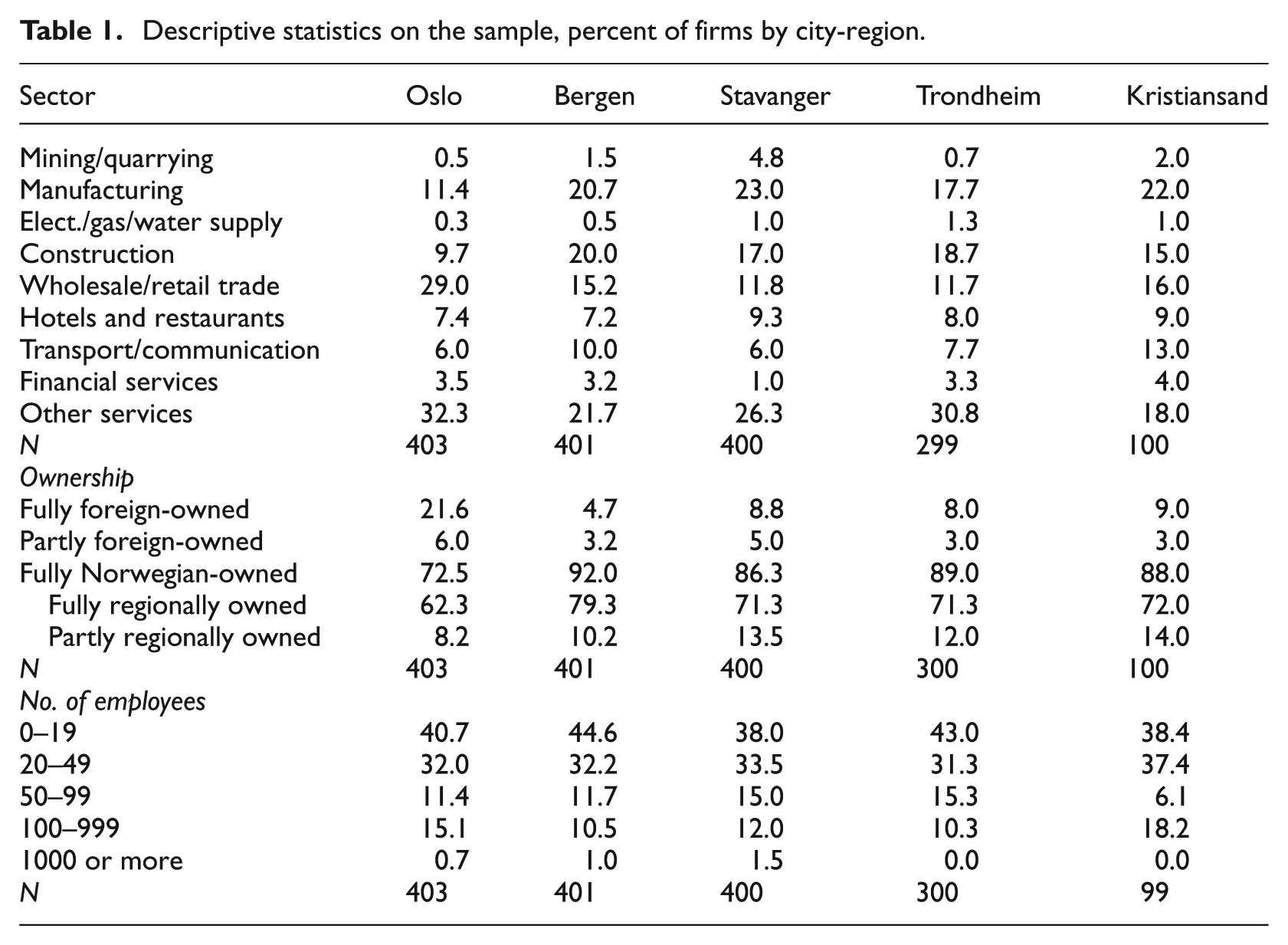
As described in the previous section, the paper draws on a model in which collaboration, measured by the number of partners of an individual firm, is the result of a combination of manager, firm and regional characteristics. The regional data have been collected from various official sources, outlined below. The data on managers and firms were collected through a survey of 1604 managers, conducted in the spring of 2010. Companies were sampled from a population of all the companies with ten or more employees located in the five largest city-regions of Norway, 1 with a quota of 400 firms in Oslo, Bergen and Stavanger, 300 in Trondheim and 100 in Kristiansand. The sample was drawn from the Norwegian Register of Business Enterprises, which by law registers all businesses in Norway. In total, 5887 companies were approached, and the response rate was 27.2%. The survey was administered by the market research firm Synovate through telephone interviews based on a questionnaire developed by the authors. It included questions from the Community Innovation Survey, the World Values Survey, and some original questions specifically tailored to the present analysis. The managers answered questions pertaining both to themselves and to their businesses. Table 1 shows key descriptive statistics on the firms included by city-region. There are substantial differences between the regions in terms of both sector distribution and foreign ownership levels, reflecting underlying differences in the industry structures of the respective regional economies. Oslo stands out in particular, having a much higher share of foreign-owned firms and of firms in the wholesale and retail trade and the services sectors, and a lower share of manufacturing and construction firms. This reflects its position as capital and associated role as a hub for foreign imports and national distribution. These differences are considered in the regression model, which controls for both sector and foreign ownership. As a consequence, these differences should not have any impact on the results of the analysis.
Descriptive statistics on the sample, percent of firms by city-region.
The main dependent variables in the analysis are three indices measuring the use of partners in innovation processes according to their geographical location relative to the firm of interest. The three geographical locations considered include regional, national and international partners. Managers were asked whether, over the last three years, their firms had cooperated with any of seven types of partners (other businesses in the conglomerate, suppliers, customers, competitors, consultancies, universities and research institutes) in innovation processes. 2 For each type used, they were also asked whether their partners were located within the region, elsewhere in Norway, and/or abroad. By adding the number of different types of partners used at each level of geographical distance, we constructed an index with values from 0 to 7 of the importance of regional, national and international cooperation for the surveyed companies. While these variables do not capture the number of partners consulted within each category, let alone the quality and depth of relations to individual partners, they do provide an indication of the scope of the firm’s network at each geographical scale and of a firm’s capacity to branch out beyond the more generalised interactions focused mainly on producers, users, suppliers and subcontractors. Mapping out the full range of partner types represents a good proxy for the capacity of any given firm to develop different types of collaboration.
Figure 1 shows the average number of regional, national and international partner types used by firms within each of the city-regions. In all the locations considered, regional partners are most frequently used, while international partners are the least used. However and somewhat counter-intuitively, given the theories that stress the role of agglomeration and density for interaction, companies in Oslo use fewer regional partner types than the other four city-regions, with an average of 1.8 regional partner types compared with a combined average of 2.5 partner types in the other city-regions. Conversely, Oslo-based companies use more international partner types than any other region − 1.3 on average, compared with 0.8 in the other city-regions combined. This is also the pattern found by Herstad et al. (2011). There are minor differences in the number of national partner types used, with the companies in the western city-regions of Bergen and Stavanger using the fewest (1.3) and those in Kristiansand using the most (1.7).
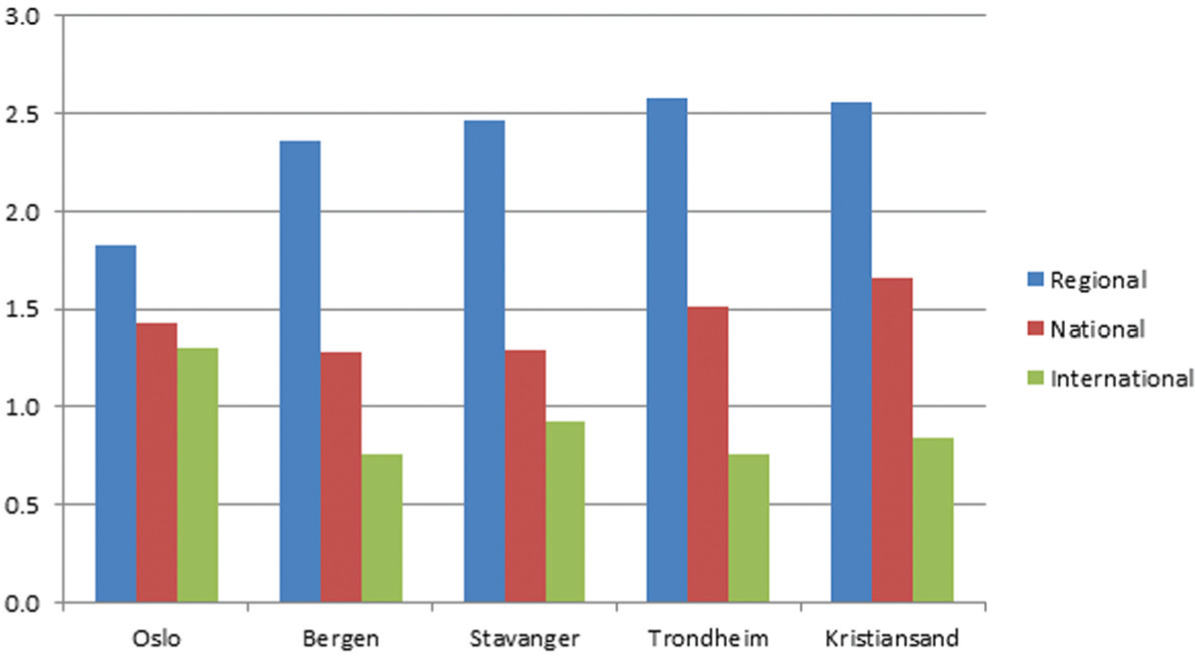
Average number of partner types used by city-region.
Independent variables
As indicated in model (1), collaborations leading to innovation are the results of three types of factors: manager-related, firm-related and region-related factors. The independent variables within each of these categories are described in greater detail below.
Manager characteristics
Data on managers’ perceptions and views of the world are derived from a set of 12 survey questions concerning their values and attitudes towards other actors within the region and towards interaction with outsiders. The purpose is to examine whether the presence of attitudes of trust and open-mindedness in managers affects their firms’ collaboration patterns. The 12 questions were reduced to four underlying components through principal components analysis in which all 12 indicators were entered, and components with eigenvalues above 1 were extracted, following the latent root criterion. 3 Table 2 shows the results of the analysis. Based on an assessment of the factor loadings associated with each of the components, we note that the first and last components reflect mostly variation in attitudes of trust by managers, although they refer to levels of trust in two different types of actors. The first component, labelled ‘regional trust’, captures trust in regional business managers, politicians and public officials, as well as general trust in other people. The fourth component, labelled ‘work-related trust’, refers to trust in employees and inclusion of staff in decision-making processes. Conversely, the second and third components are more closely related to attitudes of open-mindedness. Component 2, labelled ‘open-mindedness’, refers to openness towards foreign cultures, change and new ideas. Component 3, labelled ‘regional-mindedness’, is inversely related to open-mindedness and reflects above all a form of pro-regional sentiment that is potentially to the detriment of interaction with outsiders. This entails a preference for maintaining regional employment even at the expense of company profits and finding it easier to cooperate with local and regional actors. This dimension also encompasses conservatism towards new ideas, indicating that the regional-mindedness may stem from a preference for what is well-known and secure (Fitjar and Rodríguez-Pose, 2011). In total, these four components explain 51% of the variance in the original indicators.
Principal components analysis.
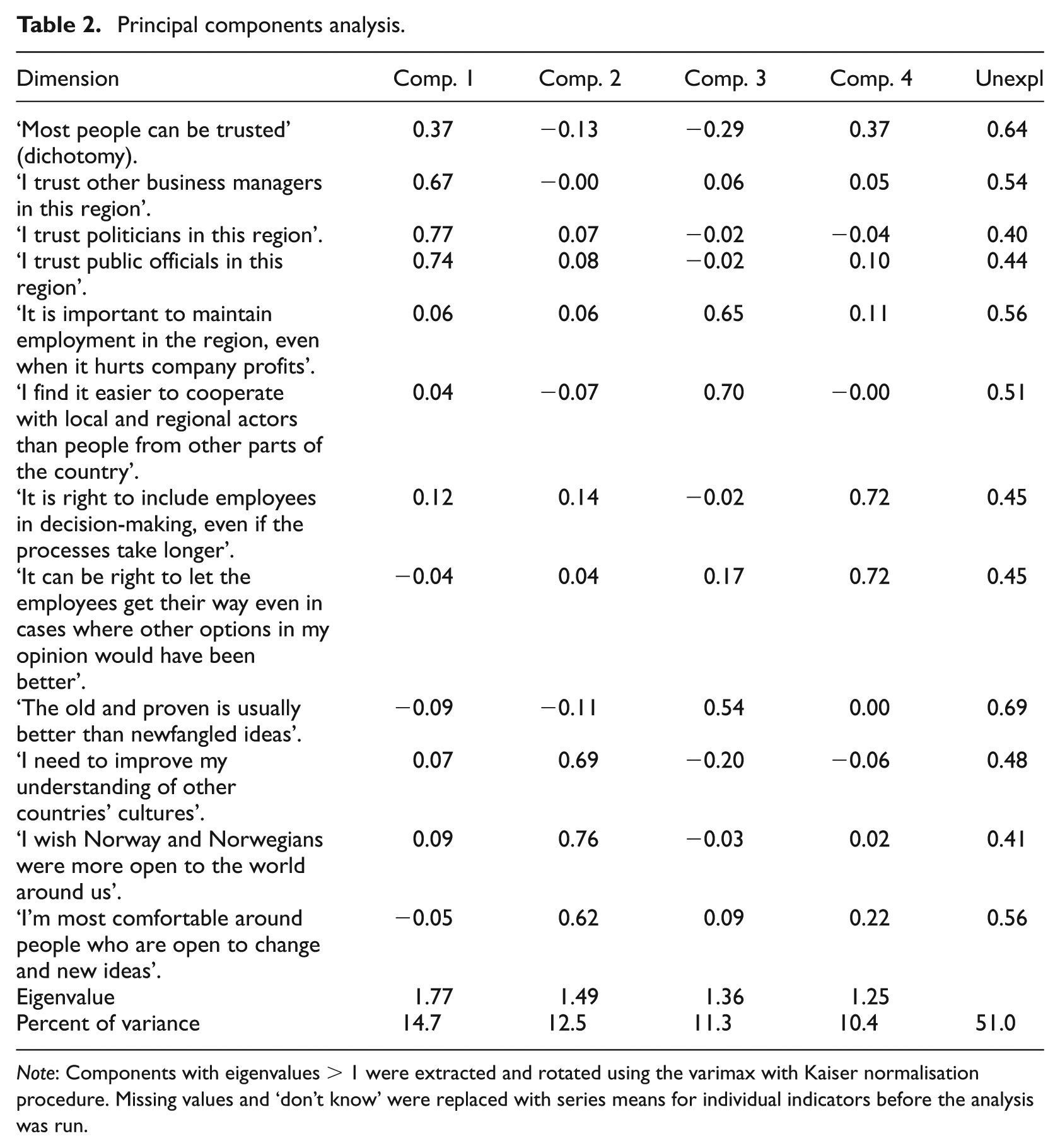
Note: Components with eigenvalues > 1 were extracted and rotated using the varimax with Kaiser normalisation procedure. Missing values and ‘don’t know’ were replaced with series means for individual indicators before the analysis was run.
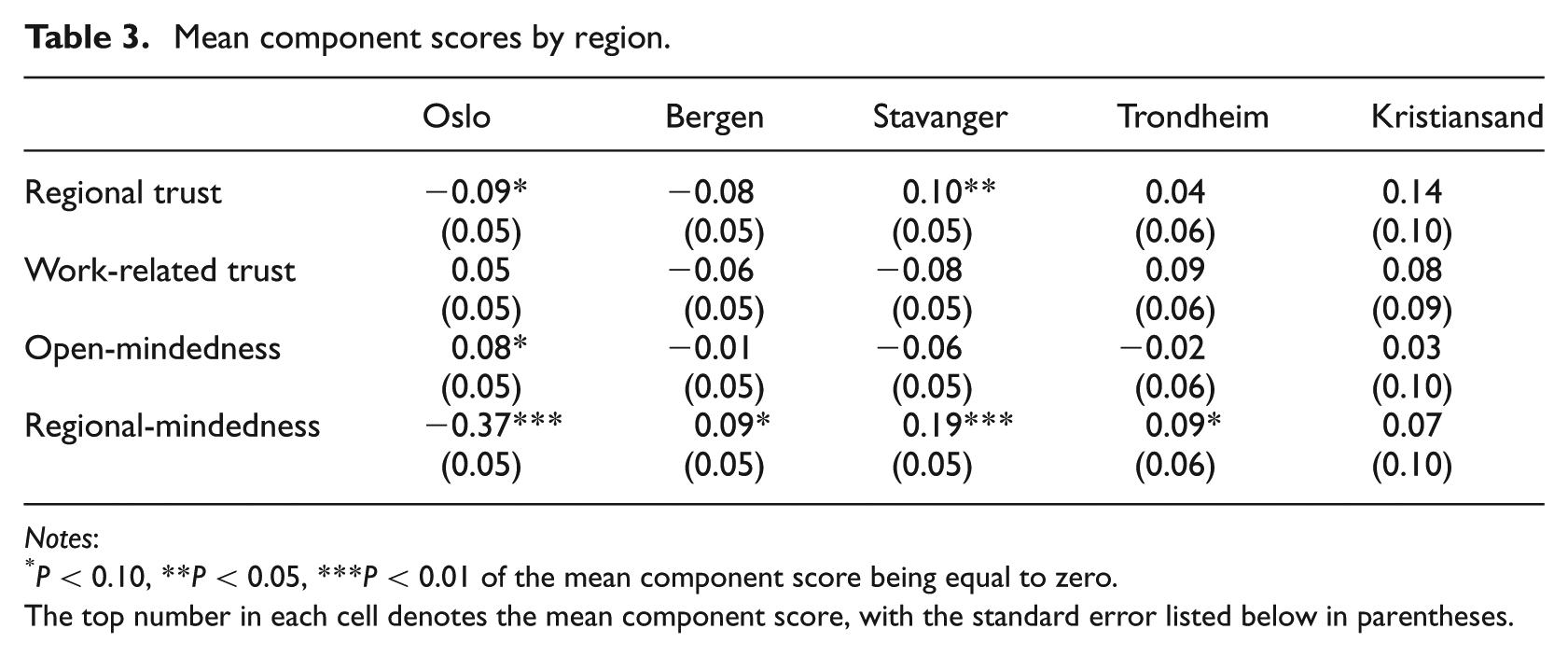
Table 3 shows the mean scores by region for each of the components. There are notable differences between Oslo and the four other city-regions in the attitudes of managers. Managers in Oslo are significantly less trusting of other regional actors and less regionally minded than managers in the other cities, and also significantly more open-minded. There are no statistically significant differences between the other four city-regions.
Mean component scores by region.
Notes:
P < 0.10, **P < 0.05, ***P < 0.01 of the mean component score being equal to zero.
The top number in each cell denotes the mean component score, with the standard error listed below in parentheses.
Firm characteristics
Following model (1), three firm-level variables are expected to have a particular bearing on a firm’s capacity to interact with partners and its geographical pattern of collaboration. First, company size, measured in terms of the log number of employees in the firm, 4 is related to the capacity of the firm to engage in a variety of partnerships. Second, foreign ownership is a continuous variable that measures the proportion of shares held by foreign owners, which is expected to affect the firm’s choice of international over domestic partners. Finally, the sector in which the firm operates affects the potential for learning from other partners and the relevance of local knowledge versus global pipelines in transmitting the knowledge that is required to succeed in the market. Hence, we include dummy variables for nine different sectors: (1) mining and quarrying, (2) manufacturing, (3) electricity, gas and water supply, (4) construction, (5) wholesale and retail trade, (6) accommodation and food services, (7) transportation, storage, information and communication, (8) financial and insurance services, and (9) other services.
Regional characteristics
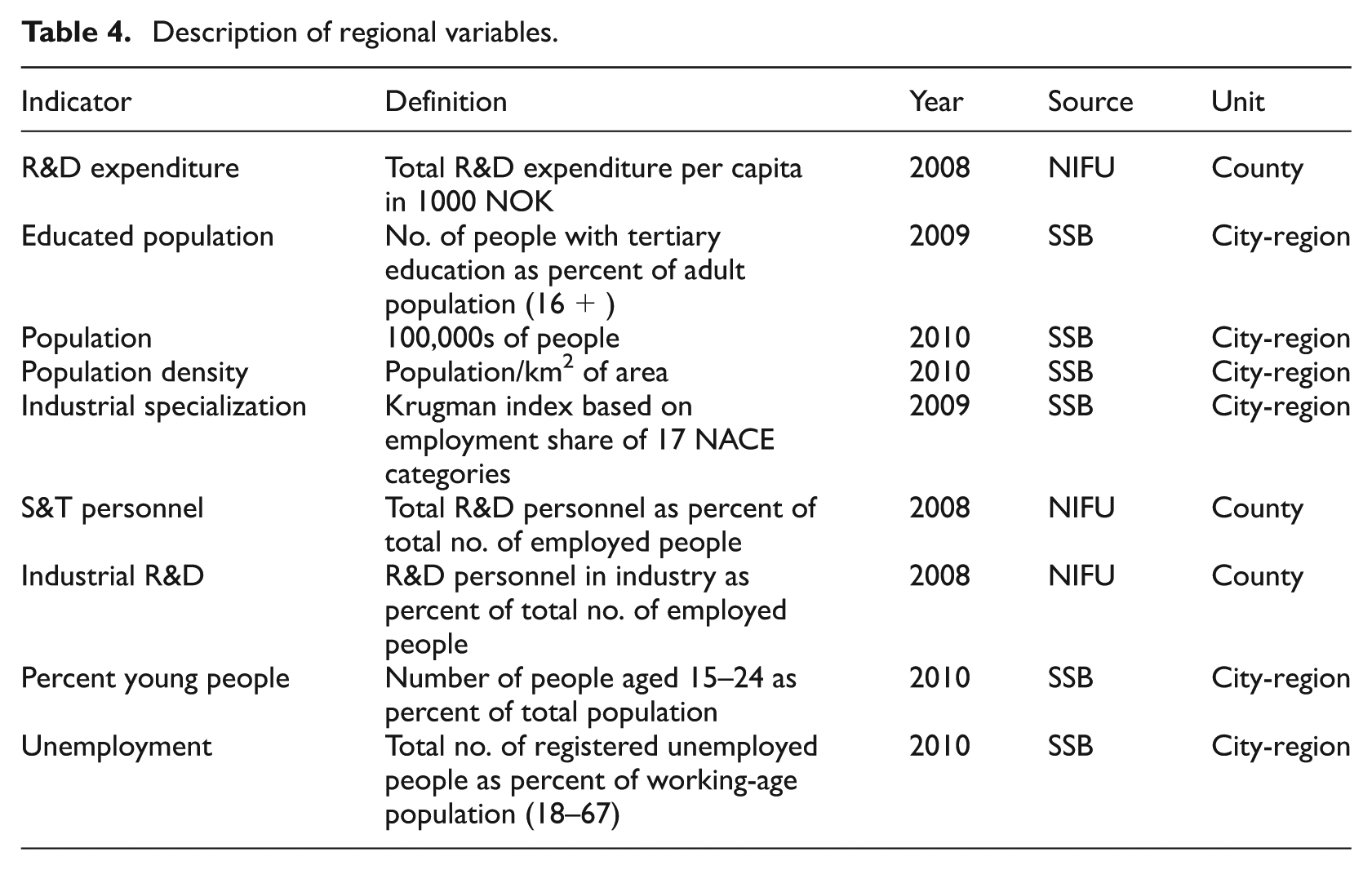
Data on the city-regions are drawn from two different sources. We first include data on the composition of the population and on employment in each city-region from Statistics Norway (SSB). We include four variables relating to the composition of the population: size, density, age and education levels. Furthermore, we include two variables concerning employment: unemployment levels and industrial specialization, as measured by the distribution of employment across different sectors within the city-regions compared with the rest of the Norwegian economy. The data were collected from the online data bases of Statistics Norway, using the most recent year available. Statistics Norway produces some of the data for city-regions as statistical regions, 5 in other cases data from the municipalities which make up each city-region have been aggregated by the authors to a measure for the city-region as a whole.
The above data are complemented with data on R&D intensity from the indicator reports produced by the Nordic Institute for Studies in Innovation, Research and Education (NIFU) for the Research Council of Norway, available from their online data base. We include three variables covering R&D intensity: total per capita R&D expenditure, and R&D personnel as a share of total employment, both overall and for R&D personnel employed in industry. Unfortunately, these data are only produced at the county level, forcing us to resort to data for the counties where the city-regions are located. 6 The most recent year for which data were available was 2008. Table 4 provides an overview of all the regional-level variables. All firms in a region have the same value on each of the variables.
Description of regional variables.
Empirical analysis and discussion
The relationship between firms’ geographical patterns of collaboration and the various independent variables relating to manager-level, firm-level and regional-level characteristics is examined – according to what was stated in the theoretical section – through negative binomial regression analysis, following model (2).
In order to avoid multicollinearity problems, we vary the regional characteristics included in the regressions. R&D expenditure and educated population are kept in the regression as much as possible, while the other regional characteristics are included one at a time. For four of the regional variables (population size and density, S&T personnel, and percent young people), multicollinearity is too severe to include both R&D expenditure and educated population in the same regression, and we therefore run two regressions for each of these variables, the first controlling for R&D expenditure and the second for educated population. However, as could be expected, S&T personnel and R&D expenditure are too closely correlated to permit inclusion in the same regression at all. This results in a total of 11 regressions being run for each of the dependent variables. The manager- and firm-level variables included are the same across all the regressions.
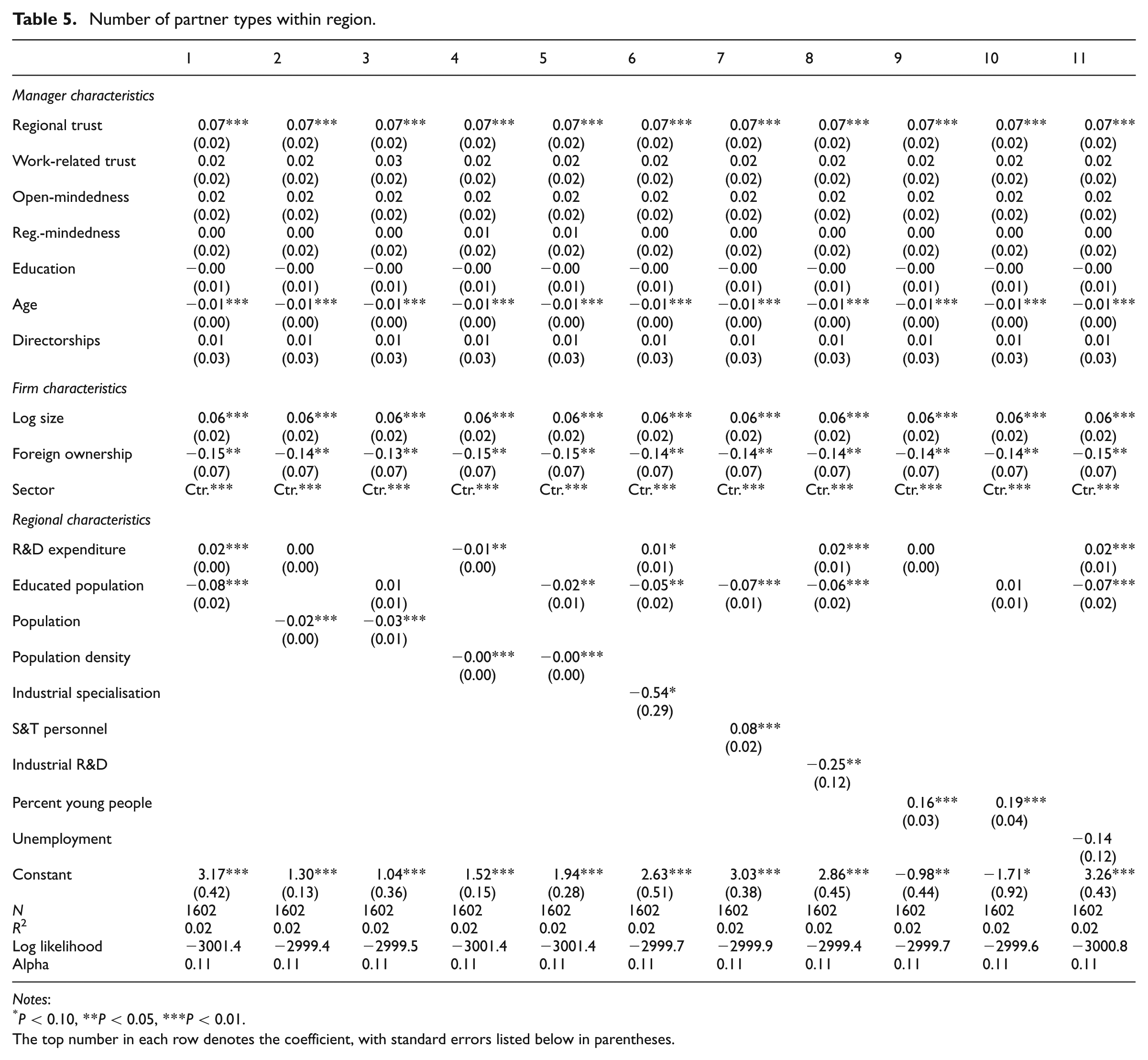
Table 5 shows the results for the regressions using regional partners as the dependent variable. Overall, the models explain around 2% of the variance in the number of regional partners used, which is not unusual for large data samples that include – as is our case – a high variation in firm behaviour. However, and more importantly, several of the independent variables in the empirical model are significantly associated with a firms’ use of regional partners. The effects of the manager-related characteristics are consistent in all regressions: regional cooperation is significantly and positively related with trusting attitudes by the manager towards other regional actors. It is not significantly affected by any of the other value dimensions. The manager’s age consistently has a significant negative effect on regional cooperation, whereas the manager’s education and formal positions in other firms do not significantly affect cooperation with regional partners.
Number of partner types within region.
Notes:
P < 0.10, **P < 0.05, ***P < 0.01.
The top number in each row denotes the coefficient, with standard errors listed below in parentheses.
All of the firm characteristics are significantly related to levels of regional cooperation. Larger firms tend to make use of a greater variety of regional partner types. Foreign-owned firms cooperate significantly less than Norwegian-owned firms with regional partners. On average, a fully foreign-owned firm collaborates with around e−0.14 = 15% fewer regional partner types than a fully Norwegian-owned firm. There is also significant variation in the use of regional partners across sectors.
Examining the effects of regional characteristics, two things stand out. First, when controlling for the education levels of the population, higher levels of R&D expenditure in a region tend to be associated with more frequent regional collaboration. Second, when controlling for R&D expenditure, higher levels of education tend to be associated with less frequent regional collaboration. R&D expenditure and education thus seem to be pulling in opposite directions when it comes to regional collaboration. It is worth noting that, as R&D expenditure and education levels in a region are closely related, these effects occur only when controlling for the other variable, and thus do not appear when we include only one of the variables in the regression.
Among the other regional variables, population size and density both have a significant negative effect on regional collaboration, contrary to the findings of de Jong and Freel (2010), although similar to those of Fritsch (2003), Teirlinck and Spithoven (2008) and Herstad et al. (2011). The same is true for industrial specialization, again contrary to the literature underlining the importance of Marshall-Arrow-Romer (MAR) externalities (Glaeser et al., 1992; Henderson, 1999). The proportion of S&T personnel employed in the region in general has a significant positive effect on regional collaboration, but higher numbers of R&D personnel in industry have a significant negative effect when controlling for overall R&D expenditure, suggesting that the combination of an R&D-intensive regional industry and little investment in regional universities may be detrimental for university–firm linkages within the region. Regions with a younger population tend to rely more on regional collaboration, echoing the findings for firms with younger managers. Finally, unemployment is the only regional characteristic tested for that does not significantly affect regional collaboration.
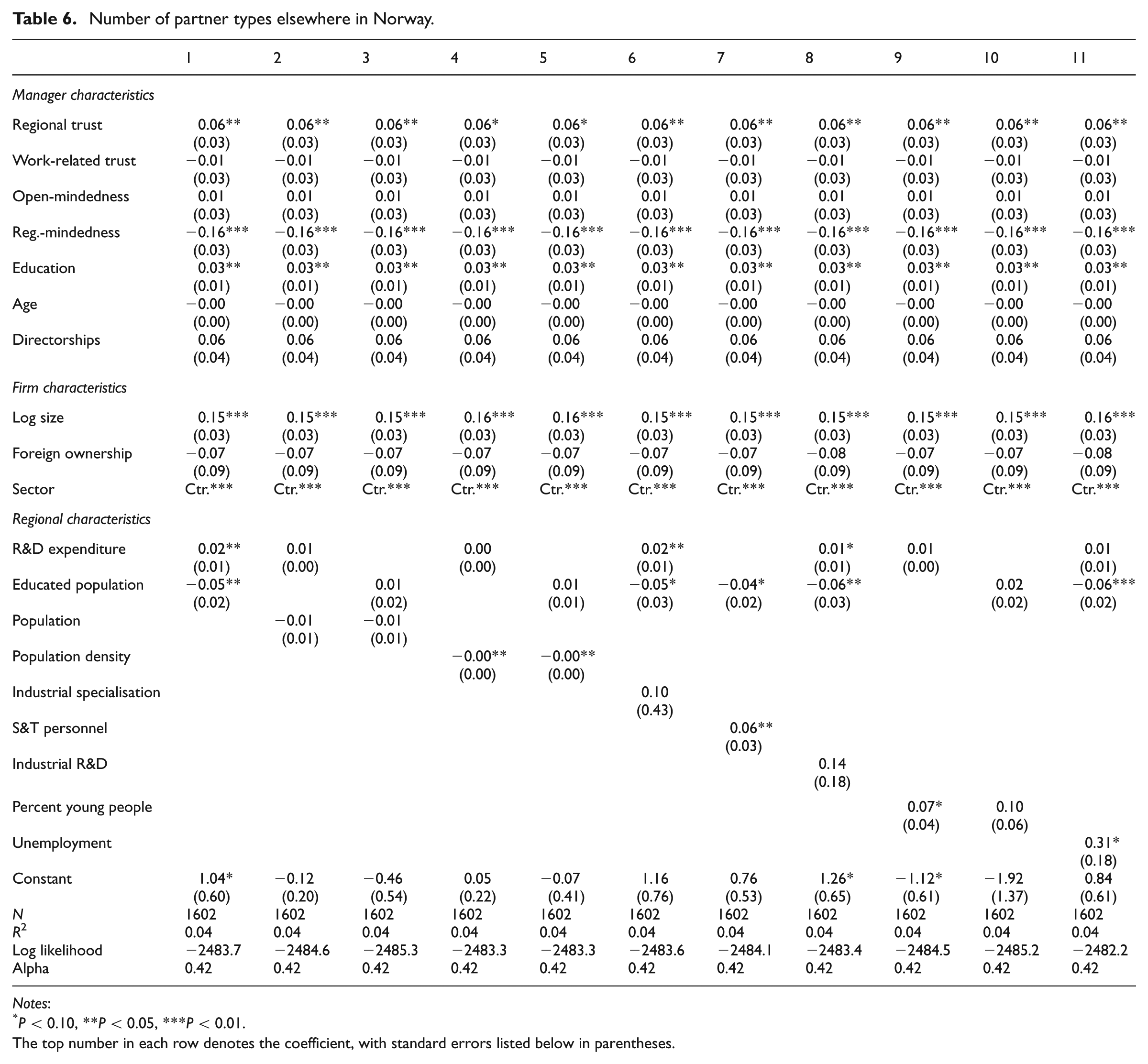
Table 6 shows the results for the regressions using national partners as the dependent variable, indicating that a number of the independent variables significantly contribute to a firm’s use of partners. The effects of manager-related characteristics are consistent in all regressions. Regional trust has a significant positive effect on collaboration with domestic partners, even outside the region. However, regional-mindedness has a significant negative effect on collaboration with partners from other parts of Norway. The remaining two value dimensions do not significantly affect national collaboration. For national collaboration, the manager’s level of education also matters, with the number of national partners used by the firm increasing by e0.03 = 3% for every additional year of education undertaken by the manager. However, the managers’ age and number of directorships in other firms do not significantly affect national collaboration outside the region.
Number of partner types elsewhere in Norway.
Notes:
P < 0.10, **P < 0.05, ***P < 0.01.
The top number in each row denotes the coefficient, with standard errors listed below in parentheses.
The firm’s size and industrial sector also significantly affect its level of collaboration with national partners outside the region. The effect of firm size is stronger for national collaboration, with a coefficient of 0.15, than for regional collaboration, where the coefficient is 0.06. On the other hand, foreign ownership does not have a significant effect on collaboration when it comes to partners from elsewhere in Norway.
As expected, regional characteristics are less important in explaining collaboration with partners elsewhere in the country than with regional partners. However, the key variables R&D expenditure and education levels reproduce the same pattern detected for regional collaboration: when we control for the education of the population, firms located in regions with higher levels of R&D expenditure tend to cooperate with a higher number of partners from elsewhere in Norway. Conversely, when we control for R&D expenditure, firms located in regions with a more educated population tend to cooperate with fewer partners from elsewhere in Norway. Again, this effect appears only when we include both variables in the regression, as they are closely related, but tend to pull in opposite directions.
Among the other regional variables, population size does not significantly influence collaboration, but population density has a significant negative effect on national collaboration. Regional unemployment has a significant positive effect on the use of partners from elsewhere in Norway, as do high levels of employment in science and technology. R&D employment in industry, by contrast, has no significant effect. The proportion of young people in the region positively affects national partnerships when controlling for R&D expenditure, and becomes non-significant, but still positive, when controlling for education levels. Industrial specialization seems not to affect national collaboration.
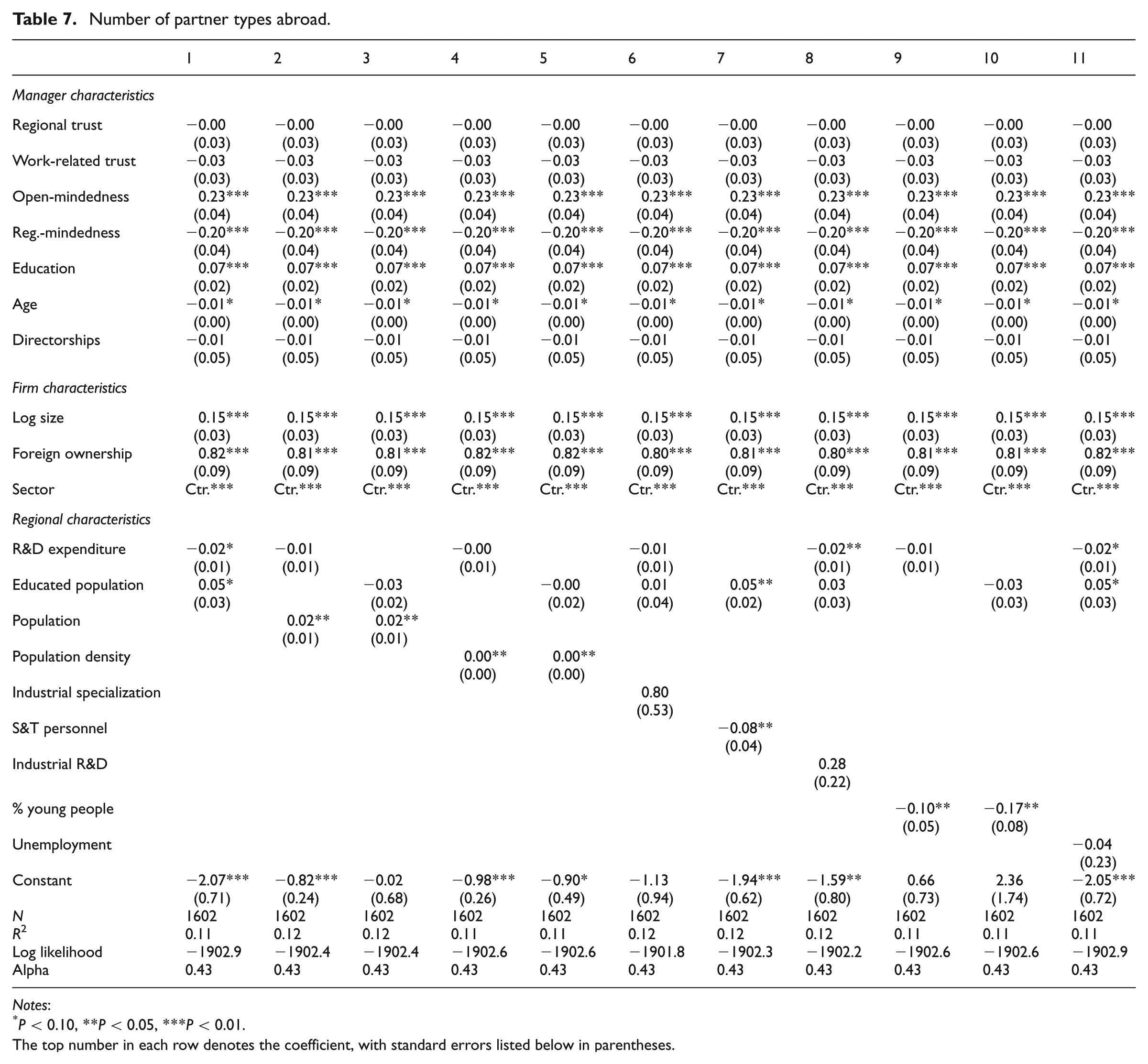
Table 7 shows the results for the regressions using international partners as the dependent variable. The model explains 11–12% of the variance in the dependent variable, underlining, once again, the high variation in firm behaviour. The effects of manager characteristics are consistent also for these regressions. Once more, the manager’s perceptions and views of the world matter a great deal for the geographical nature of the partnerships a firms enters into. Firms with more open-minded and less regionally minded managers use a significantly higher number of foreign partners than other firms. However, trust, whether in its regional or its work-related form, does not influence international collaboration. The manager’s education level and age also significantly affect a firm’s propensity to engage in international collaboration. For every additional year of education by the manager, the firm cooperates with e0.07 = 7% more partner types abroad. On the other hand, age has a negative effect on international collaboration, reducing the number of foreign partners by e−0.01 = 1% for every year of the manager’s age. The manager’s number of directorships in other firms does not significantly affect the firm’s collaboration with international partners.
Number of partner types abroad.
Notes:
P < 0.10, **P < 0.05, ***P < 0.01.
The top number in each row denotes the coefficient, with standard errors listed below in parentheses.
All the firm-level variables have a significant association with foreign collaboration. Foreign ownership is particularly important, with fully foreign-owned firms collaborating with around e0.81 = 125% more international partner types than fully Norwegian-owned firms, all other things equal. Furthermore, firm size has a significant positive effect of a similar magnitude as for national collaboration. There are also different levels of international collaboration in different sectors.
Regional characteristics also play a role in determining firms’ propensity to collaborate with foreign partners. However, the effects of the key variables R&D expenditure and education are completely reversed with respect to the results of the regressions for regional and national collaboration. The coefficient for regional R&D expenditure is always negative, and has a significant effect on international collaboration in regressions 1, 8 and 11 (controlling not only for regional education levels, but also for industrial R&D employment and unemployment, respectively). Conversely, education levels in the region have a positive effect in most of the regressions (and always when controlling for R&D expenditure), significantly affecting international collaboration in regressions 1, 7 and 11 (controlling for R&D expenditure, for S&T personnel, and for R&D expenditure and unemployment, respectively).
For the other regional-level variables, the effect also tends to be the opposite of their effects on regional and national collaboration: population size and density both have a significant positive effect on international collaboration, while S&T personnel and a young population tend to reduce levels of collaboration with foreign partners. Finally, industrial specialisation, R&D employment in industry, and unemployment do not significantly affect the use of international partners by regional firms.
Conclusion
This paper has looked into the little-known field of the geographical dimension of the partnerships that promote firm innovation in urban locations. Using a survey of 1604 firms in Norway’s top five city-regions, we have assessed what determines not only the number of innovation-related partnerships Norwegian firms enter into, but, more specifically, what factors affect the geographical choice of partners and collaborators.
The results of the analysis indicate that engaging with partners for innovation is influenced by a combination of manager-related, firm-related and region-related factors. In general, firms with younger and more educated managers engage more in innovation-driven collaboration than firms with older and less educated managers. Larger firms also tend to interact more with other innovative agents. And regional factors such as education, R&D and age structure influence the formation of partnerships. However, many of the factors that affect the number of partnerships of firms in Norway work in different directions, leading to diverse types of geographical collaboration. At the level of the manager, greater trust in regional actors is a key element determining the number of local partnerships and of partnerships elsewhere in Norway, but plays no role in the number of international collaborations by any given firm. International collaboration is mainly driven by factors such as the open-mindedness of managers, whereas an excessive pro-regional sentiment, or regional-mindedness, is detrimental for this type of engagement. Firm size and industrial sector always affect the propensity of Norwegian firms to enter into partnerships, regardless of distance, while foreign ownership leads to more international engagements, but is detrimental for the number of collaborations by firms within their region of origin. Finally, greater investment in R&D drives local collaboration, whereas education encourages pipeline-type relationships and these factors seem to interact with one another. Factors linked to agglomeration, such as the size or density in a specific city-region – contrary to theoretical expectations – have little influence on collaboration with nearby partners, making a difference only for international partnerships.
Our analysis goes beyond existing scholarly literature in adding empirical evidence on the geographical dimension of innovation-driven collaborations. Most of the literature in this field has remained in the theoretical realm – where there are multiple claims highlighting the importance of interaction, but relatively little empirical evidence – or focused on specific case studies. And the geographical dimensions of collaboration have tended to be overlooked even by the most incisive analyses (e.g. Bishop et al., 2011; de Jong and Freel, 2010; D’Este et al., 2013). The novelty of our research lies precisely in this interest in collaboration (focusing on seven different types of firm networking) and in the importance awarded to the geographical dimension of this collaboration. Furthermore, rather than using fixed effects for different regions (Fritsch, 2003; Herstad et al., 2011), we probe specific regional characteristics that can account for the patterns observed.
The results also stress, on the one hand, the need to seriously rethink the policies that aim to promote innovation-generating forms of networking, but, on the other, they raise a number of questions about how the combination of numerous interactions and collaborations on different geographical scales may affect the overall innovative capacity of firms in Norway. Further research is therefore needed in order to address the complexity of these interactions, encompassing not only the scope, but also the quality and depth of relations to partners at different geographical scales, and to highlight whether local, national and international collaborations are truly complementary and may, together, contribute to delivering greater innovation.
Footnotes
Acknowledgements
We are grateful to the editor and to the three anonymous reviewers for their constructive suggestions to earlier versions of the manuscript. The article has also benefited from comments by participants at the AAG 2012 and ERSA 2013 meetings held in New York and Palermo respectively.
Funding
Funding was received from the Research Council for Norway, Demosreg programme and the European Research Council under the European Union’s Seventh Framework Programme (FP7/2007- 2013)/ERC grant agreement no. 269868.