



Abstract
In China, economic reforms over the last three decades, have transformed its urban governments so that economic growth takes priority over other policy goals. The purpose of this paper is to explore how talented worker housing policies have emerged within one of China’s first-class cities, namely Shenzhen, to address its affordability problems but also to enhance local economic competitiveness. Whilst Shenzhen is heading in the direction of an international, entrepreneurial city focusing, in particular, on high value-added industry, it needs to attract and retain professional, skilled workers to sustain this growth trajectory. Drawing on the concept of urban entrepreneurialism, the paper examines how talented worker housing policies and procedures have been initiated and implemented in Shenzhen in relation to its economic development strategy and affordable housing programme. The paper suggests that not only is policy delivery proving problematic, but affordability problems remain insurmountable, thus potentially limiting the effectiveness of this particular urban entrepreneurial strategy in supporting place competitiveness.
Introduction
House price inflation, affordability problems and their impact on labour markets in economically growing cities have been well documented internationally (Economist Intelligence Unit (EIU), 2012; Kupke, 2009; Morrison and Monk, 2006). In China, at the time when most world property markets experienced sharp rises in prices, the value in Yuan of new build properties grew by a factor of 27 between 1997 and 2009 (Chen, 2012). Even with the impact of the credit crisis and subsequent slowdown in house price rises worldwide, China’s house price increases continued, albeit at a slower rate (Chen, 2012; Naughton, 2010). Inflationary pressures in Chinese urban housing markets, in particular, have been a consequence of both economic growth and rapid urbanisation (Li and Yi, 2011). Whilst China’s urban population is expected to double between 2000 and 2030, the rapid population influx has not been matched by a commensurate growth in housing supply (Stephens, 2010).
Given excess demand and relatively inelastic supply, the resultant property price rises have effectively prevented access to the market for a significant proportion of potential first-time buyers, particularly those on low-to-moderate incomes. Increasing the supply of subsidised, affordable housing for the growing numbers of low-to-moderate income households has therefore become a major policy concern in China, with central government making a commitment in 2011 to provide 36 million affordable housing units between 2011 and 2015 (Huang, 2012; National Peoples Congress (NPC), 2011). At the same time, providing affordable housing for workers considered essential to place competitiveness has become a policy initiative at the local municipal level (Chen, 2011; Shenzen Municipal Government (SMG), 2010a, 2011; Wang, 2011).
The purpose of this paper is to examine how talented worker housing policies have emerged in Shenzhen, one of China’s first-class cities, to address affordability issues facing specific workers but also as a means to support local economic competitiveness. Shenzhen epitomises an entrepreneurial city undergoing reform and modernisation that the Chinese central government is keen to advocate. Located in Guangdong Province on the Chinese border, immediately north of Hong Kong, Shenzhen is among the most developed Chinese cities, having the fourth highest GDP (EIU, 2012).
Whilst SMG’s economic development strategy focuses on high value-added industry, it needs to attract and retain professional, skilled workers to sustain this growth trajectory (The International New Town Institute (INTI), 2012; SMG, 2010a). The emergence of talented worker housing policies in SMG’s latest development plan, in effect, reflects the local government’s wider policy ambitions to enhance the city’s international competitiveness (SMG, 2010a, 2011).
Drawing upon the concept of urban entrepreneurialism and the US and English experience, the first part of the paper outlines how these Western governments have developed policies that target housing assistance at low-to-moderate income, public sector workers considered key to delivering public services and supporting commercial businesses upon which local economic growth depends. Yet whilst SMG’s policy direction echoes this trend in the West, the paper considers the way in which China’s unique institutional context grants local municipalities considerable autonomy to pursue its own innovative strategies (Tang et al., 2011; Wu and Zhang, 2010). The significant discretion afforded to SMG, in effect, accounts for how it has been able to re-shape its housing policies to assist targeted workers in the private sector as well as state-owned enterprises in order to support Shenzhen’s economic development strategy.
The second part of the paper then examines how talented worker housing policies have been initiated and implemented in relation to both Shenzhen’s economic growth strategy and affordable housing programme overall. The paper suggests that not only is policy implementation proving problematic, affordability problems are likely to remain an insurmountable obstacle, thus potentially limiting the effectiveness of Shenzhen’s talented worker housing policies to support place competitiveness.
Urban entrepreneurialism and Western experience in developing targeted worker housing policies
The concept of urban entrepreneurialism has a basis in early US literature that both theorises and documents the transformation of urban governance in advanced capitalist economies over time. David Harvey’s (1989) influential work focuses in particular on the reorientation of urban governance towards entrepreneurialism. Given the heightened mobility of capital and the reduction of spatial barriers to the movement of goods, people, money and information, Harvey (1989) claims that local governments have had to maximise the attractiveness of their specific locality as ‘a lure for capitalist development’ (p. 5). In the face of growing inter-urban competition, traditional ‘civic boosterism’ has effectively become integrated with the use of local government powers to try and attract new inward investment in order to sustain local economic growth.
In adopting entrepreneurialism, Harvey (1989) suggests that local governments’ central strategy is to focus upon exploiting the particular locality’s comparative advantages for the production of goods and services within the international division of labour. Another secondary but complementary strategy entails improving the position of the city within the spatial division of consumption. This involves a host of measures, including enhancing the living environment of the urban workforce. As Wood (1998) notes in his review of Harvey’s (1989) work, introducing new types of urban space for consuming and living is a necessary prerequisite for attracting and retaining highly skilled workers essential to place competitiveness, as it heightens the city’s comparative advantages vis-à-vis other places that have not prioritised their workforce’s housing needs.
Despite economic and state restructuring over the last few decades, the principles of urban entrepreneurialism, with local governments developing strategies to boost growth, remain a prominent feature of urban governance in the USA (Mossberger, 2009). The trend towards entrepreneurial governance and sustaining place competitiveness has equally become a major imperative for urban policy makers in England, with strategic plans guiding and promoting economic development since the 1990s (Vigar et al., 2000). Whilst local government institutions in England work within a more centralised and formal system than in the USA, there is considerable scope for local discretion and professional autonomy to support local economic growth, particularly through the adaptation of urban space (Haughton et al., 2009).
The term ‘urban entrepreneurialism’ is now common in Western literature on contemporary urban policy (Buck et al., 2005). Moreover, there has been substantial interest in evaluating local economic development strategies; particularly the way formal rules and institutional structures interact with informal public-private growth coalitions to enhance urban comparative advantages (Lowndes, 2009; Mossberger, 2009). There has been less academic research, however, using the concept to analyse how housing policies have been used to support place competitiveness, in particular, evaluating strategies that target subsets of the urban workforce with housing assistance. Yet this strategy not only grew in relative importance in policy discourse during the 2000s, particularly within the USA and England, but also new sets of rules and principles of housing allocations have, in turn, been established (Morrison, 2012; Scanlon, 2010). The opportunity to evaluate the effectiveness as well as implications of this type of urban entrepreneurial strategy that focuses on consumption space therefore exists.
Government support for targeted worker housing programmes arose in the USA and England in response to growing concerns over the impact of housing affordability on labour shortages and its effect on place competitiveness. The lack of available housing and pressures on public services, in particular, were seen to be undermining the competitiveness of employers and the long-term socio-economic sustainability of different city-regions (Raco, 2008). Policies have been developed by both governments that target low-to-moderate income households working in the public sector in areas such as health, education and community safety, where recruitment and retention problems were evident.
The emergence of targeted worker housing programmes in the USA and England, in effect, complemented and reinforced mainstream local economic development strategies pursued by urban entrepreneurial governments. This policy direction not only justified government intervention in the housing market, it also focused investment priorities on new urban consumption spaces for subsets of the workforce, as Harvey (1989) hypothesised. The USA has the largest number of programmes designed to provide housing assistance targeted at public sector workers, such as teachers, nurse and police officers on low-to-moderate incomes. Moreover, these programmes operate at federal, state and local level (see Scanlon, 2010). In other Western countries, affordability problems facing public sector workers have not been considered severe enough to warrant government attention, so policies motivated by such concerns are not as pronounced in planning the competitive, entrepreneurial city (Kupke, 2009).
In England, the difficulties that low-to-moderate income, public sector workers experience affording housing, particularly in high-cost locations, provoked a government policy response, coined the ‘key worker’ problem (Department of Environment, Transport and the Regions (DETR), 2001; Office of Deputy Prime Minister (ODPM), 2004). Central government introduced a series of programmes, including the Key Worker Living (KWL) programme in 2004, which established the categories of public sector workers eligible for key worker housing assistance (ODPM, 2004). The land use planning system also became used as the principle means to secure affordable key worker housing on development sites coming forward for planning permission, through the use of section 106 agreements (Department of Communities and Local Government (DCLG), 2006; DETR, 2000). 1
Both policy makers and academics alike have criticised the KWL programme for being divisive, privileging certain public sector workers with housing assistance at the expense of others (GHK Consulting Ltd and CURS, 2006; Morrison, 2010, 2012, 2013; Raco, 2008). At the same time, despite subsidised housing being targeted at eligible key workers, the gap between the housing price and income remained too wide for a large proportion of key workers to afford (see Morrison, 2012). As in the USA, these difficulties have been exacerbated following the credit crisis, when the availability of mortgages was severely reduced. The scope for targeted worker housing programmes to be an effective urban entrepreneurial strategy to support place competitiveness in these Western countries has been effectively undermined.
China’s institutional context
Central government promotes entrepreneurial governance
In China, urban entrepreneurialism has equally grown in prominence, echoing the general trend towards supporting place competitiveness as in the West (Chen, 2009; Shen, 2010; Wu and Zhang, 2010). China’s institutional context, however, is relatively unique, consisting of a top-down political system and a decentralised urban governance system. Since the 1980s, the central government has relaxed its control over investment decisions and growth management, while municipal governments have assumed primary responsibility for economic development (Li and Yi, 2011).
Economic reforms over the past three decades have, in effect, transformed China’s urban governments, with the promotion of economic growth becoming a major function of local government. The fiscal system also changed from 1994 onwards, allowing local governments to own the revenues derived from land lease transactions to meet ongoing public expenditure. The state-owned land is administered through municipal officials and rented to land users on long-term leases, with all revenues from land transactions going to local government. The sale of land use rights accounts for a substantial share of municipal governments’ revenues. A strong incentive therefore exists for local officials to support economic growth and encourage increased land prices (Stephens, 2010; Tang et al., 2011; Wu, 2007).
Local governments have also been granted greater economic autonomy, no longer having to have their local municipal plans and strategies approved by central government (Wu and Zhang, 2010). Yet, the behaviour of municipal officials in urban China is still affected by their superior governments, especially central government, which plays a dominant role in determining municipal officials’ career advancement. Since promoting economic growth has become a key priority on the agenda of government officials at different levels, including municipalities, greater economic performance of a city-region equates to greater chances of local leaders’ promotion. The incentive for local government officials to expand their economic base and support place competitiveness is therefore considerable (Tang et al., 2011; Wang et al., 2001; Wu, 2007).
Moreover, confronted with intense inter-city competition, each Chinese local municipality is under pressure to enhance its city’s economic base and reduce potential skills shortages of their major private sector employers and state-owned enterprises (INTI, 2012; Jessop and Sum, 2007). As McKinsey and Company (2005) note, if not addressed, the lack of skilled talented workers, in effect, would inhibit China’s first-class cities becoming global cities. Shen (2010) therefore argues that cities across China aspire to become ‘talent’ hubs, with both central and local municipal governments ‘working hard to attract skilled labour, including both domestic and foreign talents’ (p. 1), in order to sustain economic growth. 2
The acute affordability crisis that workers face particularly in China’s first-class cities has provided an added rationale for local municipalities to intervene in its urban housing markets and seek ways to provide housing assistance to talented workers that are considered key to sustaining local economic competitiveness (Litao and Jinjing, 2009; Wang, 2011).
As in the USA and England, providing particular subsets of workers with housing assistance, however, necessitates debates about whose presence is essential for place competitiveness and how such assistance is to be delivered in practice (Raco, 2008). Not only has the concept of talented workers to be defined and boundaries of entitlement drawn up, but affordable housing programmes need to be realigned if newly constructed housing is to be allocated to this target group.
Central government redirects its affordable housing programmes
Since 1994, the Chinese central government has established several affordable housing programmes to be implemented by local governments to assist low-to-moderate income households who cannot afford housing in the market. Cheap rental housing (CRH) addresses the problems of households qualifying for minimum living standard assistance (MLSA), including those with disabilities, on low incomes and seniors through providing housing at nominal rents (see Huang, 2012). In comparison, the public rental housing (PRH) programme is targeted more at lower-to-moderate income households, which traditionally, talented workers have been entitled to apply for, alongside other households whose incomes fall below the threshold set (Shenzhen Residential Leasing Management and Service Centre (SRLMSC), 2013).
Besides applying for PRH, low-to-moderate income talented workers also qualify for government controlled-priced (or capped-priced) housing, under the Economic and Comfortable Housing (ECH) programme, established by the central government in 1994. In the same year, central government also launched a Housing Provident Fund (HPF), which is a compulsory savings scheme. Employees and employers in both public and private companies are required to contribute a certain percentage of their incomes to the HPF account on a monthly basis. As a way to promote home-ownership, employees can take out a certain percentage of the fund for housing-related expenses (see Yeung and Howes, 2006).
ECH is provided by developers on free or low-priced land allocated by the local municipalities; with the latter also regulating the profit margins of developers to 3% and selling the housing to qualifying households at restricted prices and with only partial property rights. Although priced lower than market rates, ECH has been criticised for remaining out of reach of most households and often bought by wealthier households, thus missing its target group (see Huang, 2012; Logan et al., 2009).
In 2010, the Chinese central government announced that policy attention should focus on increasing the amount of PRH provided at subsidised rents for low-to-moderate income households; with local municipalities having to comply with this policy direction as they revised their latest five-year development plans (Huang, 2012; Naughton, 2010; PRC, 2010). However, as a way to support place competitiveness, a more localised policy has also been implemented in a number of first-class cities, including Beijing, Shanghai and Shenzhen, whereby talented workers have been assigned a proportion of this newly constructed PRH (Chen, 2011; Wang, 2011). 3
The next section examines the rationale for this policy direction within Shenzhen, drawing on the concept of urban entrepreneurialism as a way to explain how the policy decisions arose within a particular set of contextual conditions (Yin, 2012).
Shenzhen and its urban entrepreneurialism strategies
SMG’s central strategy: A focus on production space
Shenzhen has undergone tremendous economic transformation, with the municipality covering an area of 2050 km2 in China’s Guangdong Province, and accommodating a total population of roughly 10 million in 2010, of which 6 million are migrant workers (SMG, 2012). Shenzhen is the largest migrant city in China, with in-migration dramatically increasing since May 1980 when Shenzhen was formally nominated as a ‘Special Economic Zone’ (SEZ). This designation represented the first one of its kind in China because of Shenzhen’s close proximity to Hong Kong (Deng, 1984; Wang et al., 2001).
The SEZ was created to be an experimental ground for the practice of market capitalism guided by the ideals of ‘socialism with Chinese characteristics’ (Deng, 1984). Coupled with China’s reform and opening-up policy, masterminded by the late Chinese leader Deng Xiaoping, privileged terms were offered to foreign companies seeking to invest in China. Acting as a gateway city for China, Shenzhen was, in effect, granted the ability to take the lead in China with regard to developing urban entrepreneurialism strategies (Wang et al., 2001). The SEZ, in particular, enhanced the city’s locational advantages and was used as a way to attract highly mobile foreign investment.
Three decades on, both Chinese and foreign investment has gone into Shenzhen’s SEZ, initially in manufacturing, however, more recently in high-technology industries, logistics and financial service industries as well. Shenzhen is now reputed to be one of the largest manufacturing bases as well as fastest-growing cities in the world (EIU, 2012).
Moreover, low-cost manufacturing is now no longer the backbone of Guangdong province’s economy, where Shenzhen is located. SMG is, instead, aiming to change its mode of growth to emphasise quality of growth. In 2009, SMG mapped out plans to promote the development of three new industries, biotechnology, new energy and the internet, which are considered to be the fundamental industries for Shenzhen’s economic growth. In addition, the municipality promised tax breaks and land concessions to high-tech firms (Daverman, 2013; INTI, 2012).
In July 2010, Shenzhen’s SEZ was expanded to include ten districts under its jurisdiction, representing a five-fold increase over the SEZ’s pre-expansion size. Until then, Shenzhen’s SEZ comprised only four districts, located in the city core: Luohu, the financial and trading centre; Futian, at the heart of the SEZ and the seat of the municipal government; Nanshan, the centre for high-tech industries; and Yantian, the location of the port which is the third busiest container port in China and the fourth busiest in the world. Suburban districts, Bao’an and Longgang, as well as four new management districts have also been included within the SEZ to encourage further expansion of Shenzhen’s resource base beyond the city core (see Figure 1) (Daverman, 2013; Sampan Newspaper, 2011; SMG, 2012).
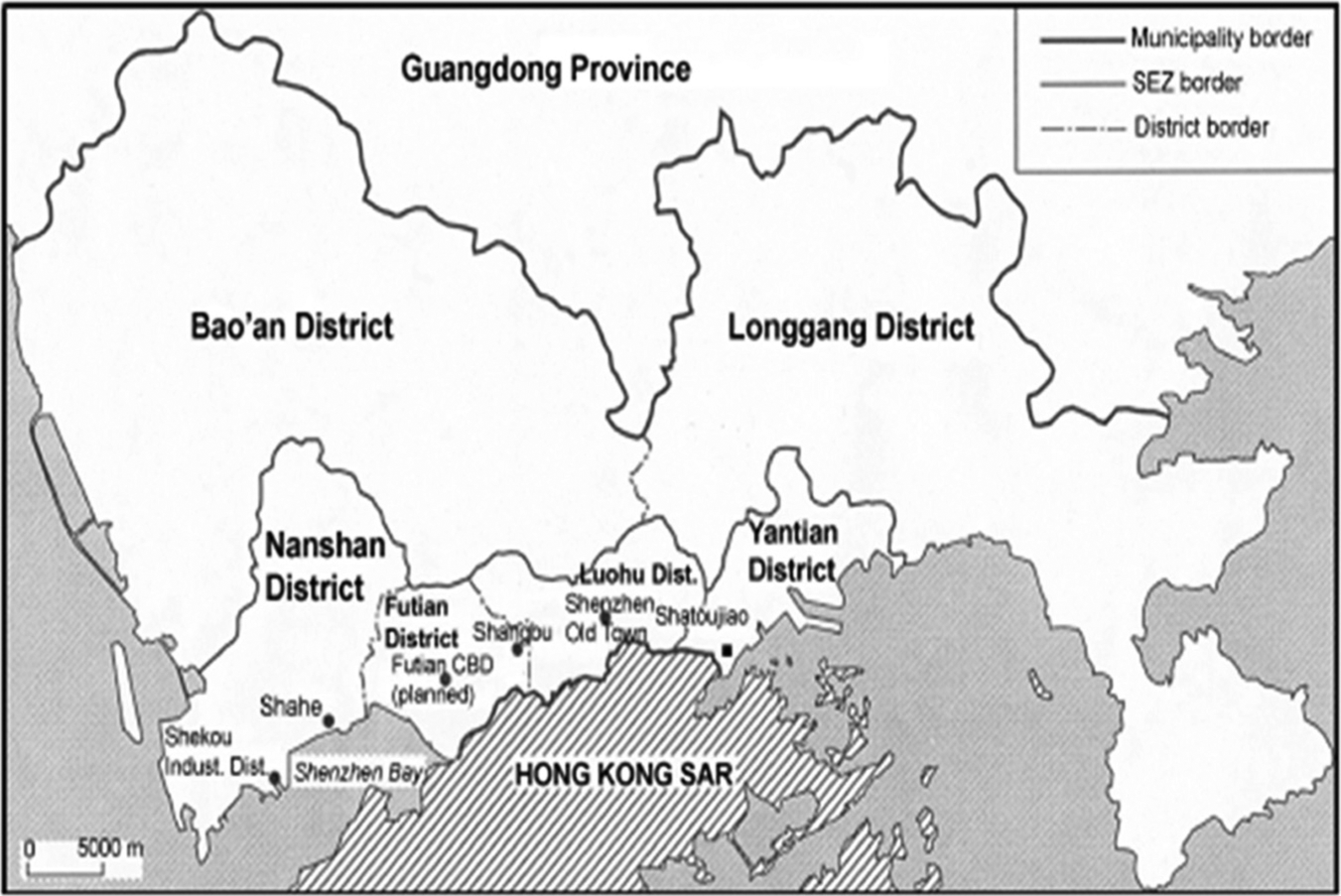
Shenzhen and its urban disticts.
As Wu and Zhang (2010) note, economic restructuring, coupled with the development of the SEZ and expansion of a city’s administrative regions through annexation and boundary adjustment, are key economic growth strategies of local governments within China. Introducing ‘cost competition’ through fiscal measures, tax incentives and expansionist approaches have also become critical measures for SMG to increase the rate growth and overall size of Shenzhen’s local economy.
Yet confronted with intense inter-city competition within China as well external global competition, enhancing place competitiveness also requires further strategic decisions to be taken (INTI, 2012). In line with Harvey’s (1989) predictions, the creation of new urban spaces for consumption, including construction of new housing projects for its expanding, professional workforce, has therefore become a complementary strategy alongside SMG’s central economic development strategy that focuses on production space.
Complementary strategy: A focus on consumption space for Shenzhen’s workforce
Whilst Shenzhen is becoming an internationally recognised, entrepreneurial city that focuses, in particular, on high-valued industry, it needs highly skilled, professional workers to support this growth trajectory. Investing in the city’s living environment is, in effect, a necessary prerequisite to attract and retain such a workforce from local and overseas labour markets (INTI, 2012). Moreover, the growing affordability crisis and income disparity witnessed within the city has made the rationale for this policy direction stronger.
In 2010, Shenzhen GDP per capita was 95,000 Yuan, making it one of the richest of all Chinese cities (EIU, 2012; SMG, 2012). Whilst incomes have risen quickly, so too have differentials in income levels. The rise in property prices has made existing homeowners wealthier, but it also prevents access to the market for a significant proportion of potential first-time buyers, many of whom are essential to sustaining the long-term growth of Shenzhen’s economy. In 2012, the median monthly disposable salary (after tax) was 2781 Yuan – among the highest in China. Yet, the average prices per square meter in the city were 28,010 Yuan, and outside the city centre 14,770 Yuan (see Figure 1). The average house price-to-income ratio is approximately 15.6, which therefore excludes most of the low-to-moderate income households from home-ownership (Chen, 2012; SMG, 2012).
Against this backdrop, the talented worker housing policies were incorporated into SMG’s latest five-year development plan (2011–2015) (SMG, 2010a, 2011), with the Shenzhen government office issuing a bulletin stating that: We are facing new situations and challenges; in particular the high cost of living for talents and the adverse effects on economic and social development has become increasingly prominent … All levels of department should have a high sense of political responsibility and mission to fully understand the importance of the implementation of talent housing projects. (SMG, 2010a: Bulletin 2010, no. 23, para. 2)
Although new policies and procedures have been subsequently instigated by SMG, they need to be workable and translated into practice (SMG, 2011).
Research methods
To examine the initiation and implementation of Shenzhen’s talented worker housing policies and procedures, this paper draws upon three study visits to Shenzhen, organised by Shenzhen’s Urban Planning, Land and Resource Commission (UPLRC) between 2010 and 2012, followed by correspondence with government officials and research assistance within Shenzhen thereafter. The purpose of the visits was to provide guidance on how England’s key worker housing policies have worked in practice, as SMG devised its policies in its latest development plan. (2011–2015).
As Yin (2012) notes, ‘the essence of a single case study is to illuminate a decision or set of (policy) decisions, why they were taken, how they were implemented and with what results’ (p.13, emphasis added). Using this analytical framework provides a way to guide the case study research, thus contributing to our understanding of the particular policy domain.
The paper draws upon a number of sources of evidence to make sure the how and why facts and preliminary policy results of the case study are supported and verified (Yin, 2012). Details of Shenzhen’s policies and procedures were obtained from scrutinising documentary evidence and verified through in-depth interviews with senior government officials in SMG Housing and Construction Bureau and Shenzhen UPLRC (see SMG, 2006, 2010a, 2010b, 2011, 2012; SRLMSC, 2013; Shenzhen Statistics Bureau (SSB), 2013). 4 Interview questions centred first on the way this policy initiative had been trialled over the previous plan period (2006–2010), focusing in particular, on how constraints to housing delivery had arisen in this pilot phase. It then focused on how policies and procedures have been formally adopted in the Shenzhen’s latest development plan (2011–2015) and whether supply and demand-side problems to delivery could be overcome.
Adding to Yin’s (2012) analytical framework, a further dimension was explored, namely policy effectiveness. Since the policies and procedures have not been fully embedded in Shenzhen’s development plan (2011–2015), and difficulties were also encountered accessing confidential data, assessing the longer-term effects of this policy direction can only be speculated upon, to date. Table 1 summarises the key components the analytical framework used to guide the research process.
Analytical framework adopted to examine Shenzhen’s talented worker housing policies.
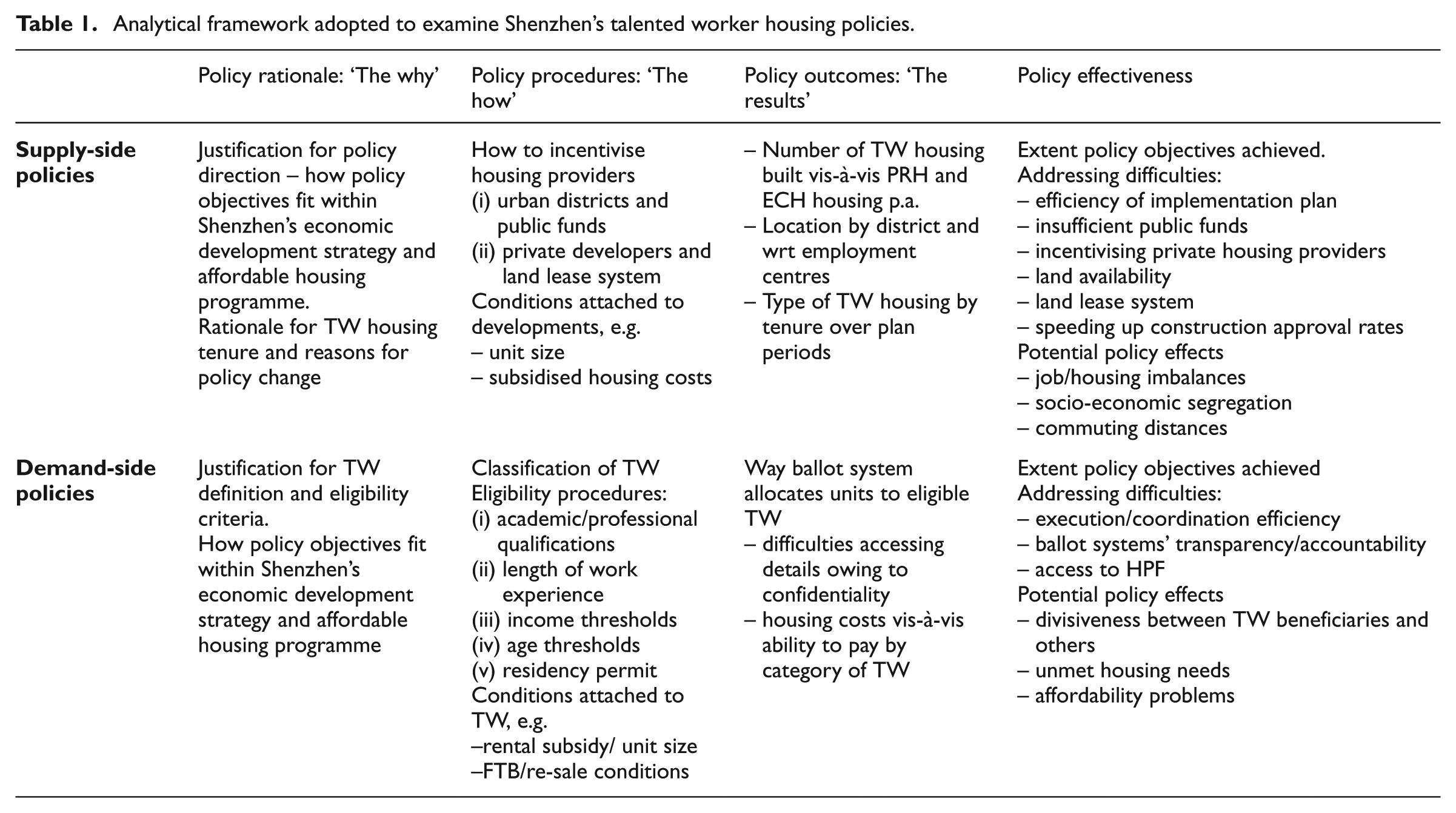
Shenzhen’s talented worker housing policies
Supply-side policies
The experimental policy phase (2006–2010)
Overall, fewer than 5000 homes have been built within Shenzhen specifically targeted at talented workers during Shenzhen plan period 2006–2010. In comparison, more than 30,000 ECH 5 and 77,000 PRH have been built over the same period (SMB, 2011, 2012; SMG Senior Official interview). By the end of 2010, compared to market housing, affordable housing represented only 6.6% of total housing supply overall (SMG, 2011). The provision of housing specifically for talented workers in turn is therefore considerably modest. Moreover, it occurred over a period when the initiative was still being piloted, with policies not being formally established until SMG latest development plan (2011–2015) (SMG, 2011). Yet despite this urban entrepreneurialism strategy being solely in its experimental phase, lessons learnt, particularly with regard to tackling housing delivery, were used to inform SMG’s formal policies and procedures.
At this policy initiative’s inception, SMG initially tasked two urban district authorities to construct a few relatively small-scale talented worker projects as a form of PRH ring-fenced for specific, eligible workers. Nanshan district council funded two talented worker schemes alongside PRH (of fewer than 400 and 800 units, respectively) in 2007. The district is a prime location, adjacent to Shenzhen’s financial district and southwest of the SEZ (see Figure 1). It also hosts eight of Shenzhen’s eleven universities within the district. Providing PRH for professional workers adjacent to Shenzhen’s financial centre and its main higher education institutions was one of SMG’s objectives.
Yantian district council also funded a talented worker project alongside PRH, entailing fewer than 400 units in 2007. The district is further out, adjacent to Shenzhen’s river in the South and has witnessed comparatively high housing price rises in recent years (see Figure 2). The district accommodates Shenzhen’s port as well as a relatively high proportion of the city’s manufacturing base. Public investment into new residential space for its workforce beside major employment sites in effect supported SMG’s broader urban entrepreneurialism strategy.
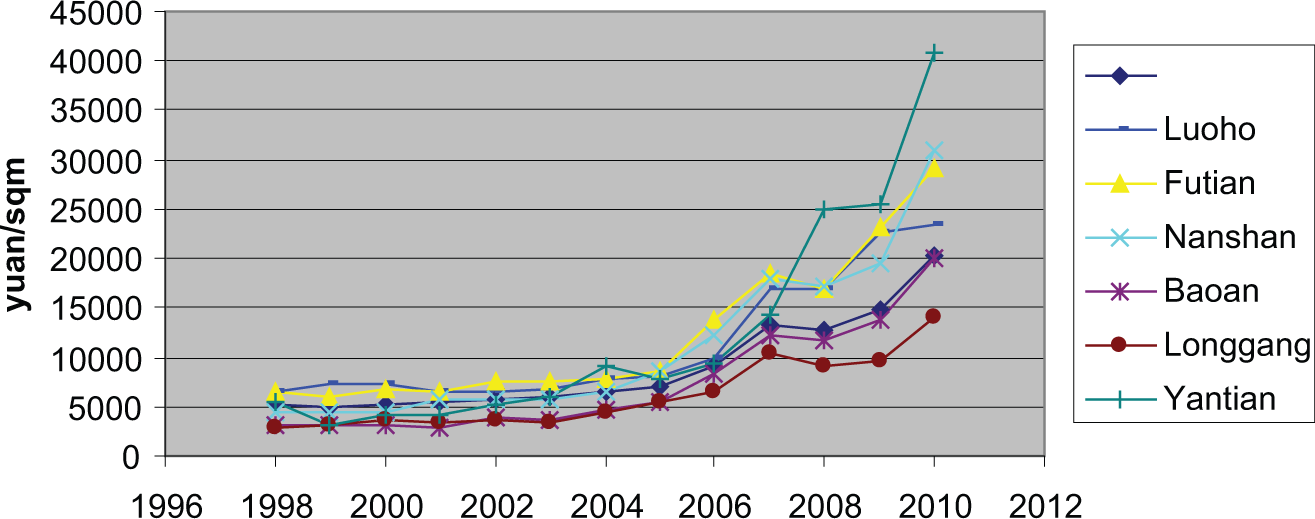
Shenzhen’s housing prices by urban district.
However, although the urban districts were originally given the responsibility to develop these talented worker housing projects in this trial period, corresponding public funding for such provision proved to be insufficient, alongside their commitment to build CRH, for lowest income households qualify for MLSA, as well as PRH, for low-to-moderate income households in general. The amount of talented worker housing subsequently built was therefore relatively limited. As a senior SMG official stated in interview: Public housing construction funds to urban districts come from the municipal government’s financial allocations. Given our financial capacity, we did not have enough public funds to tackle our growing housing pressures. We therefore also needed to seek private developer contributions to affordable housing provision.
Between 2007 and 2010, three further talented worker housing projects were undertaken by commercial developers. Similar to the principles established under the ECH programme, land was provided by the municipal government at discounted prices in exchange for the developers agreeing to sell homes at below market prices to eligible talented workers determined by SMG. To aid affordability within Shenzhen’s high-priced housing market, SMG stipulated that talented worker housing should be built as government-controlled (or capped-price) housing. The discount is the same as that set for ECH, i.e. no more than 70% of the market price for the same type and size of housing within a given district. SMG has also limited the floorspace of the talented worker housing units to below 90 m2, as it has done for provision of ECH. The rationale for making the housing tenure a form of home-ownership was, in part, the same as in Western countries: property ownership reflects the preferences of most households, and it appears to encourage integration, social stability and individual responsibility (Malpass and Rowlands, 2010).
It has been difficult, however, to incentivise commercial developers to build affordable housing projects compared to open-market-valued (OMV) housing that has continually risen in value. As SMG acknowledged in interview, lowering the land lease price does not appear to be enough of an incentive for private developers to build subsidised housing, especially as profit margins are restricted to 3% (see also Logan et al., 2009).
Moreover, the location of the affordable housing projects also changed over time, as land availability has become increasingly restricted within Shenzhen. The first two private-led talented worker projects built alongside ECH (entailing fewer than 300 units, respectively) were located in Nanshan district, where private developer competition has remained particularly strong. The competitive bidding process was formally organised by SMG, with interested parties agreeing in advance to build capped-priced housing on these allocated sites. Yet, whilst the formal auction rules were explicitly known by all eligible market investors as they came to the land auction, informal negotiations have also occurred around these land deals.
The commercial developers, for instance, have been able to negotiate building OMV housing alongside capped-priced housing, as a way to cross-subsidise the cost of development and sustain their profit margins. SMG has agreed to this business practice in order to incentivise market activity. These earlier affordable housing projects have therefore gone ahead, located next to Shenzhen’s key employment sites in its urban core.
The third privately constructed housing project was built in 2010, at the end of the trial period. It is larger than the previous two, consisting of approximately 2400 units of ECH and talented worker housing, and located on an inferior, lower-valued location in the outskirts of Shenzhen, within Longgang district, north of Shenzhen’s central core. As a senior official in SMG noted, this highlights the difficulties in incentivising the private sector to build affordable housing, particularly in prime locations. SMG (2010a) recognizes this problem, issuing a statement in its bulletin on talented worker housing projects: we need to attract companies with a strong sense of social responsibility to invest in the construction of housing for talents not exceeding 90 m2… we need competing construction companies to support this talents initiative. (SMG, 2010a: Bulletin 2010, no. 23)
Shenzhen development plan (2011–2015)
In accordance with central government’s announcement that local municipalities should focus attention on constructing PRH (PRC, 2010), SMG renewed its commitment in its latest development plan (2011–2015) to increase the city’s supply of PRH. As public funds are insufficient, SMG continues to rely upon revenues received from land transfer elsewhere in the city. The pressure to maximise land sale prices, particularly in more commercially sought-after central districts, therefore remains (see also Huang, 2012).
SMG states that 140,000 affordable housing units are to be built by the end of 2015, with the aim that they make-up 50% of total housing supply and totalling around 150 projects across the city (SMG, 2011). More than 35,000 affordable housing units are to be available by the end of 2013, including 20,700 PRH units and 7700 ECH units (ChinaScope Financial, 2012). Moreover, ‘the guiding ideology’ stated in the plan is to not only accelerate affordable housing construction but also to ‘shift the focus to talented worker housing projects’ (SMG, 2011: Article XI). 6
In addition, the new affordable housing projects are to be primarily located in the outer urban districts and new management districts (see Table 2). The commuting distances that talented workers undertake if they live in these newly constructed schemes is not a policy consideration, to date.
7
As a senior SMG official noted: The location of affordable housing projects in the new plan period will be dependent upon the availability of land supply which is so limited in Shenzhen.
New permitted land a supplied by SMG for affordable housing in Shenzhen plan period (2011–2015) (km2).
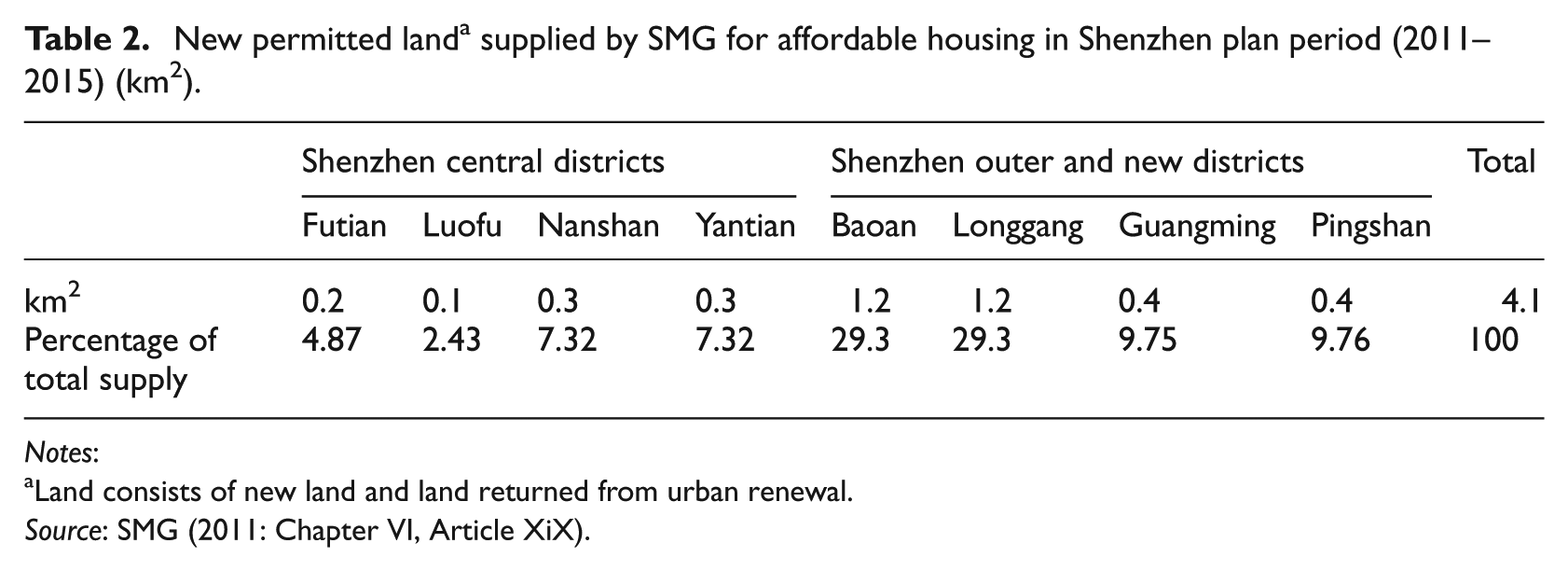
Notes:
Land consists of new land and land returned from urban renewal.
Source: SMG (2011: Chapter VI, Article XiX).
As other scholars have argued, the tendency for affordable housing (whether ECH or PRH) to be located on cheaper, less desirable land on the periphery of Chinese cities, will not only create new residential patterns but socio-economic segregation as well (Huang, 2012; Li and Yi, 2011; Stephens, 2010; Tang et al., 2011).
Demand-side policies
As SMG formalised its policy in its latest development plan (2011–2015), the lessons taken from the trial period centred primarily on the most effective form of housing delivery. Devising policy procedures and mechanisms to allocate the housing was seen as a secondary consideration. As a senior SMG government official noted: Talented worker housing policies can only be tackled step by step. First we expand the scale of construction. Our priority is finding available land supply. Second, we classify the talented workers and make sure the most in need are allocated a housing unit.
Although an equitable distribution of new housing may be a policy goal, as Stephens (2010) notes, the allocation of affordable housing (whether ECH or PRH) is one of the most controversial aspects of housing policy in China. Difficulties in establishing allocation principles are inevitable given that the group in housing need is much larger than the supply, and affordable housing construction lags far behind. Problems over the delineation of eligible households for targeted worker housing are particularly great, as it depends on establishing whose contribution to the local economy is most valued. As in the USA and England, beneficiaries considered to be the most deserving are effectively assisted with housing at the expense of others (Raco, 2008).
Table 3 summarises the way SMG has classified Shenzhen’s talented workers in relation to their academic and professional qualifications (SRLMSC, 2013). The municipality’s rationale for strategically targeting housing assistance at professional workers, with qualifications and achievements particularly in sciences and engineering subjects, is that these skills are considered to be essential in supporting growth in high-technology industries within the SEZ, particularly in biotechnology, new energy and the internet, which are SMG’s priority growth sectors (see section ‘Shenzhen Urban Entrepreneurial Strategies’) (SMG, 2010a). Unlike in the USA and England, the difficulties that lower-paid public sector employees, particularly in the health, education and community safety professions, have accessing affordable housing and whether these undermine local competitiveness, are not as high on Chinese central or local governments’ agenda (Litao and Jinjing, 2009).
SMG’s classification of Shenzhen’s talented workers by qualifications and occupations.
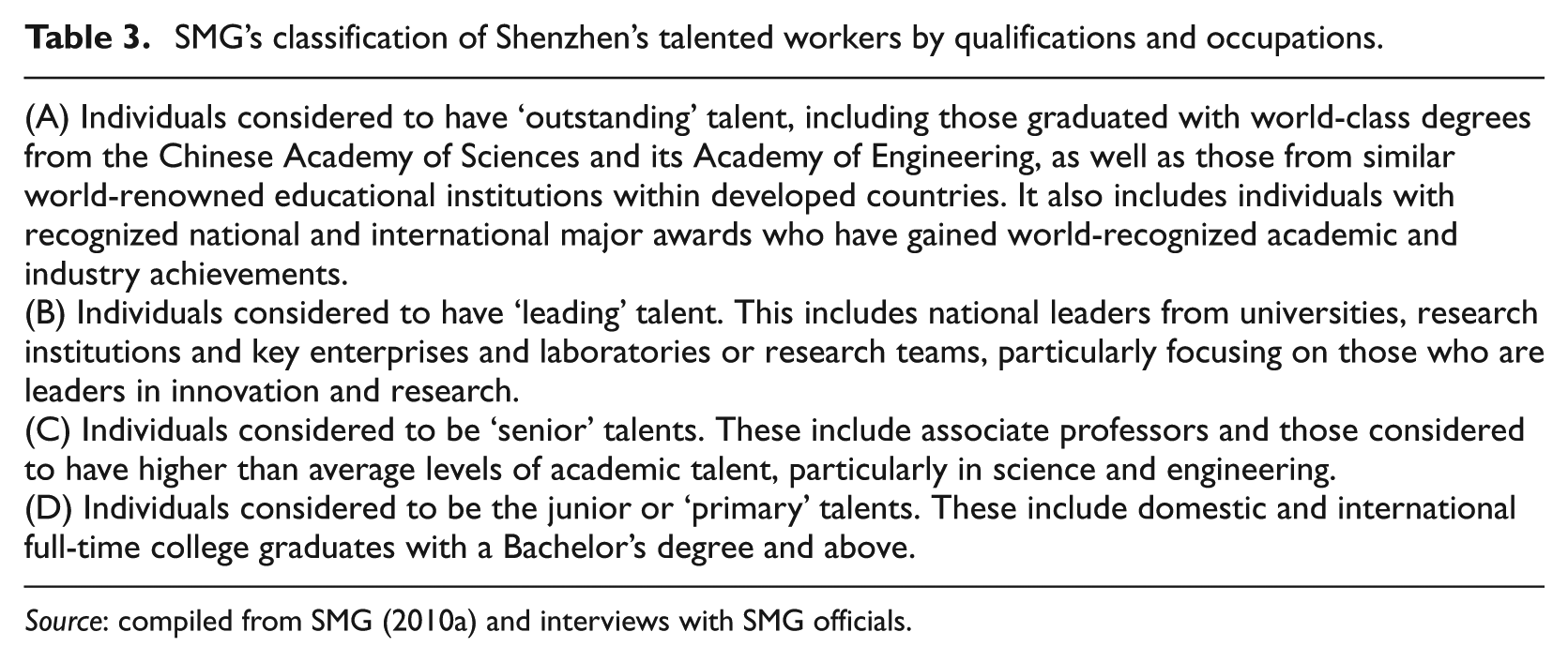
Source: compiled from SMG (2010a) and interviews with SMG officials.
Moreover, SMG Housing and Construction Bureau have established additional eligibility criteria. Applicants for talented worker housing should not only have a Bachelor’s degree, but also a minimum of five year’s work experience. An age-threshold criteria has also been set. Outstanding, leading and senior talented worker applicants have to be younger than 46 years; and primary talented workers holding a PhD have to be younger than 36 years; younger than 30 years if they hold a Master’s degree and younger than 25 years if they hold a Bachelor’s degree. Moreover, all applicants must have permanent resident status (hukuo) (SMG, 2012; SRLMSC, 2013). Migrant workers without permanent residency are therefore excluded at the outset.
Talented workers can purchase ECH; however, they need to be first-time buyers to be eligible. SMG has also placed restrictions on the buyers’ property rights, by putting conditions on the re-sale of the housing. The purchaser cannot sell their property for at least 10 years. If the property is subsequently sold, the owner must pay SMG back the 30% subsidy that they benefited from when they bought the property (SRLMSC, 2013). This clause does not appear to have affected the potential demand for capped-priced housing. A greater deterrent is whether ECH offered to Shenzhen’s talented workers is, in fact, affordable at the outset.
Eligible talented workers are able to benefit from the central government’s HPF. Yet, as Stephens (2010) notes, although the HPF is flexible it is also regressive, with only the higher income households using and thus benefiting from the fund. In Shenzhen, the older, ‘outstanding’, ‘leader’ and ‘senior’ talented workers are likely to access this fund, rather than the younger ‘primary’ talented workers, although SMG (2010b; 2011) does, however, acknowledge the need to expand eligible individuals’ use of HPF. Some companies also grant bonuses to their employees to facilitate access to home-ownership, although this represents a relatively small proportion of employers. To date, only a few companies have been prepared to give bonuses and many small private companies have not yet enrolled into Shenzhen’s HPF programme (SMG, 2010b).
SMG has also introduced a mortgage scheme attached to the HPF programme (SMG, 2010b). Talented workers, alongside other Shenzhen residents, are able to enrol into the HPF mortgage scheme, taking out mortgages on favourable terms, for instance, at lower interest rates. This initiative aims to improve a household’s ability to purchase property (SMG, 2010a, 2010b, 2011). As a senior SMG official noted: For an immigrant city like Shenzhen, professional, educated workers are a large and growing proportion of housing demand. We are pursuing a reform in housing tenure security which will encourage more participation in our owner-occupied housing market, particularly from our lower-to-moderate income workers.
In the absence of substantial personal contributions to provide a mortgage down-payment, affording housing, even at a discounted price, however, will remain problematic, particularly within Shenzhen’s central urban districts. Talented workers are instead more likely to apply for PRH allocated to them, especially as the rents are on average 60% of market prices. Certain categories of talented workers are also able to apply for rent-free housing over a set lease period (Zhao, 2013). 8
SMG’s Housing and Construction Bureau has been tasked by SMG to coordinate the allocation process. Given that talented worker housing needs exceed supply, the Bureau has to rely on a ballot system when allocating eligible applicants to the PRH. As Zhao (2013) notes, online applicants exceed properties available, to date. Once shortlisted, the finalists have to submit written application materials; however the acceptance rate falls considerably below those that are eligible. A senior official in SMG Bureau acknowledged that the allocation system in under constant review. SMG (2011) also notes the need to ‘improve execution efficiency’ (SMG, 2011: Article 27) so that policy implementation and allocation procedures are more efficient and sped up in order to meet raised expectations.
Within each district, different subsidised rents are offered to talented workers, using Shenzhen’s housing market prices to guide rental prices. The rental subsidy as well as size of property also varies by category of talented worker. 9 Primary talented workers, in particular, with lower rental subsidies may ultimately have to seek out the cheaper public rental properties being built in Shenzhen’s outer urban districts and its new management districts (Table 2) (SMG, 2011; SRLMSC, 2013). Not only are these outer locations a distance from the city’s central core, entailing lengthy commuting distances, they are not fully connected to SMG’s economic growth strategy, to date.
In the longer term, the municipal government’s aim, however, is to synchronise the planning of these talented worker housing projects alongside newly created industrial parks, particularly within Shenzhen’s new management districts through the creation of these ’hubs’ of new consumption space for talented workers with technical knowledge, research and development expertise co-located by SMG’s new high value-added production space, Shenzhen’s growth trajectory may therefore be sustained (see Daverman, 2013; INTI, 2012; SMG, 2010a). 10
Conclusions
The concept of urban entrepreneurialism offers a way to explore how urban governance has transformed within advanced capitalist economies (Harvey, 1989). Across the world, both central and local governments pursue strategies to enhance their different localities’ comparative advantages within an increasingly competitive, international market place. Investing in consumption space for the urban workforce has, in particular, become a critical strategy to attract and retain workers that are essential in supporting place competitiveness (Jessop and Sum, 2007; Wood, 1998).
To date, an evaluation of the rationale and policy implementation of targeted worker housing policies in China, particularly in relation to both central and local governments’ economic growth strategies and their affordable housing programmes overall, has not been explored.
Drawing together the conceptual ideas from urban entrepreneurialism and empirical observations from the Shenzhen case study, in effect, yields a more nuanced understanding of the way talented worker housing policies and procedures have been initiated and implemented within a specific institutional context. Not only is the Chinese institutional context relatively unique, opportunities exist for local governments to pursue urban entrepreneurialism and establish new rules with regard to allocating affordable housing (Huang, 2012; Wu and Zhang, 2010).
The significant discretion afforded to Chinese local municipalities accounts for the way SMG was able to re-shape its housing policies to assist targeted workers in private businesses as well as state-owned enterprises in order to strengthen the city’s comparative advantages. Launching Shenzhen on a path of high value-added industries, in effect, has involved adopting innovative strategies to recast the city’s competitiveness (INTI, 2012; SMG, 2011). In doing so, new types of consumption space, in the form of talented worker housing, have been built in this relatively new and entrepreneurial city.
Whilst Shenzhen’s talented worker housing policies have now been formulated and implemented in its latest development plan (2011–2015), it is too soon to undertake a full evaluation of policy effectiveness and its longer-term implications. Moreover, the amount of talented worker housing built, to date, is still too small to have a significant impact on the Shenzhen’s affordability problems. Yet as Yin (2012) notes, a case study of this nature is worth conducting, even at an early stage of policy processes, as the information is ‘revelatory’ and underlies issues of importance, particularly in relation to how policy makers in one municipality are tackling the mounting affordability crisis that its workforce faces – a problem that is prevalent across China and elsewhere.
Compared with England, Chinese central and local governments have been reluctant to use formal powers to require private developers to provide affordable housing. Local municipalities, instead, rely upon a system of incentivisation. Lowering the land lease price may not, however, provide enough of an incentive for market players to build affordable housing. Moreover, this policy approach also compromises municipal governments’ ability to maximise its land sale revenues. With sales of land use rights being a substantial share of the municipal government’s revenues, they will remain under pressure to maximise the land sale prices and sustain high land prices (Stephens, 2010).
As other scholars have observed, until the Chinese land system is reformed, and the monopoly local governments have over land supply and their dependency on land for revenue is changed, providing affordable housing through commercial developers may be limited (Deng et al., 2011; Huang, 2012; Li and Yi, 2011; Tang et al., 2011).
Meanwhile, the Chinese central government’s ambitious goal to increase the supply of PRH is, however, reliant upon scarce public funds and allocation decisions at the local municipal level. Local governments targeting newly constructed PRH at talented workers, however, need to be justified, particularly if this policy direction affects the original intention of PRH to help solve the housing difficulties faced by low-to-moderate income households in general (Chen, 2011). These concerns echo those raised by a number of Chinese scholars, who are wary of a return to a modified public housing system that allocates units to those with ‘connections’ at the expense of others (Gou, 2011; He, 2010; Monkkonen, 2011).
As Yin (2012) argues, a single case study provides a valuable way of analysing how institutions frame and resolve policy issues within a specific context. There are limitations, however, in generalising from one city, which invariably reflects a particular set of empirical realities. To further this line of inquiry, a comparison of targeted worker housing policies in relation to municipal governments’ economic development strategies and affordable housing programmes, if in existence in other Chinese cities, is encouraged.
As in Western countries, targeting housing assistance at workers whose housing needs are well articulated and reflected in a city’s broader policy ambition, rather than at the needs of others considered ‘less valuable’ to an urban entrepreneurialism strategy is likely to persist. The longer-term consequences of this policy direction therefore need to be considered (Morrison, 2013; Raco, 2008).
Footnotes
Acknowledgements
The author would like to thank Shenzhen’s Urban Planning, Land and Resource Commission for their hospitality in Shenzhen, Ming Luo for her research assistance and Professor Rebecca Chiu, Dr Tony Manzi and Sarah Monk as well as the anonymous referees for their comments on earlier drafts of this paper. The usual disclaimers apply.
Funding
This research received no specific grant from any funding agency in the public, commercial, or not-for-profit sectors.