




Abstract
The broad intent of smart growth is to reduce development in environmentally sensitive areas by limiting the outward expansion of development and redirecting private investment to urban areas. Local decisions that shape and constrain land uses can pit narrow economic interests against broader-based environmental organisations and impact decisions on smart growth. Based on the political market framework, this study specifically examines the influence of pro-growth and smart-growth interest groups on smart growth policies adopted by local governments in the state of Massachusetts, USA. The results suggest both real estate interests and environmental groups influence local policy decisions, and depending on the policy, the characteristics of local political institutions mediate these influences.
Introduction
The negative effects of sprawl, ranging from social, health and economic consequences for individuals (Ewing et al., 2003; Freeman, 2001) to regional environmental impacts (Burchell et al., 2002; Carruthers and Ulfarsson, 2002), has prompted local governments across the United States to implement a variety of land use policies. Many of these policies are oriented towards ‘smart growth’. However, because many smart growth policies can impact current and future land uses and decisions on public infrastructure investment, they can generate substantial conflict among local interests. Not surprisingly, researchers have sought to explain the conditions under which smart growth policies are adopted provided the myriad of actors that have a stake in local planning decisions.
Some of this literature has emphasised an agency-based explanation for local policy adoption. Among the questions asked is who are the local interest groups that have a stake in land use policy, and to what extent does their support or opposition to economic development and growth management influence local policy (Feiock, 2004; Feiock et al., 2008; Hawkins, 2010; Ramirez, 2009)? These questions have been asked in studies that seek to explain amendments to long range planning documents and the use of various smart growth and sustainable development policies by municipal government (Hawkins, 2011; Lubell et al., 2005; Lubell et al., 2009a, 2009b; Wang et al., 2012).
Smart growth is one policy area that is useful for exploring the effect local interests have on land use policy because smart growth may redistribute the benefits and costs of development among competing interests (Downs and Costa, 2005; Feiock, 2004). Protecting open space land and targeting reinvestment to urban areas already serviced by infrastructure (which are major tenants of smart growth) can be perceived to come at the expense of other community priorities, such as economic growth. This can generate conflict among local interests, spur political debate and lead to policy change. However, there are few studies that test the effect local interests have on the adoption of specific policies by city-level government that are linked to smart growth.
Recent studies by O’Connell (2009) and Ramirez (2009) begin to fill this void in the literature by providing empirical evidence of the effect local interest groups have on smart growth policy. In this study I seek to complement their research by specifying alternative empirical models and by including policies excluded from their analyses. Similar to their studies, I draw on previous research that utilises an interest-group model of land use policy and the political market framework (Lubell et al., 2005, 2009b). The former perspective forms the basis of growth machine theory, which emphasises land-based interests as the centre of the local growth coalition who wishes to maximise ‘rents’ from policies that encourage development (Feiock et al., 2008; Logan and Molotch, 1987; Molotch, 1976). Proposed policy that shapes and constrains land use can pit these narrow economic interests against broader-based environmental organisations and impact decisions on smart growth. The latter approach incorporates local political institutions as supplying policy to meet the demands of these interests.
In the next section I provide a brief review of the literature on smart growth. This is followed by a discussion of the interest groups and the political market framework. I then describe the influence local interest groups have on smart growth policy adoption, paying particular attention to the studies by Ramirez and O’Connell. I discuss the smart growth policies that are the focus of this study and then present my research methods and the findings from the analysis. I conclude with a discussion of the implications for urban policy and planning as well as avenues for future research.
Smart growth policy
What is ‘smart growth’? Most scholars consider smart growth as local efforts to limit sprawl by directing land development away from areas that are likely to experience accelerated growth and reinvesting resources to urban neighbourhoods (American Planning Association, 2002; Chapin, 2012; Lewis and Knaap, 2012). Ewing (1994) notes the characteristics of sprawl that smart growth is intended to address: (1) low-density, scattered, and/or dispersed development, (2) separation of where people live from where they work, and (3) a lack of functional open space. The results of some studies indicate that sprawl leads to fiscally and environmentally unsustainable land use patterns for communities and regions by threatening water resources and altering wetlands, fragmenting open spaces and requiring greater resources to maintain public facilities and infrastructure (Carruthers and Ulfarsson, 2002; Ladd, 1992).
Counter arguments to this line of reasoning are that there is little analysis or discussion of the costs, the implied trade-offs or even the consumer’s desire for an alternative urban form advocated by enthusiasts of smart growth (Gordon and Richardson, 2002). Critics of smart growth suggest the common held belief that ‘sprawl is bad’ is an oversimplification. Policy intervention in the name of smart growth constrains developers from providing people with what they want. Some suggest that smart growth in fact denies home-ownership opportunities by increasing housing costs (Cox, 2002). In addition, commercial development in outlying areas has allowed cities to expand their tax base and provide much needed economic development. The long-term consequences of sprawl, however, remain at the centre of research on land use policy.
In light of the perceived long-term consequences of sprawl, smart growth is often presented as a multifaceted policy approach to accommodate development while also addressing transportation, housing, urban redevelopment and environmental management issues. For example, some scholars have identified at least six key dimensions of smart growth: natural resource preservation, community development, housing, economic development, transportation choice and planning initiatives (Ye et al., 2005). Development that is ‘smart’ should be in the form of mixed land uses and higher densities, and should offer citizens a wide variety of amenities that are easily accessible; for example, parks, town centres and biking trails (Gray, 2007). Among the smart growth policies advocated by the American Planning Association (2002) are residential cluster development and density bonus ordinances and infill development incentives. What explains the adoption of smart growth policies by local government? In the following sections I discuss the interest group model of local policy and the political market framework that provide a theoretical lens to answer this question.
Local interest groups
An interest group model of policy adoption provides one explanation for the variation in local smart growth initiatives. Land use policy is particularly important because it may clearly result in the costs and benefits concentrated on one group over another, produce conflict, and spur the mobilisation of resources by various interests (Feiock, 2004; Wilson, 1980). Local policy aimed at shaping the location and characteristics of development can pit smart-growth interests that often push for a slow or more managed growth against real estate interests and developers that promote a pro-growth agenda that maximizes economic returns (Feiock et al., 2008; Hawkins, 2010, 2011; Lubell et al., 2005).
Smart growth constituencies consisting of environmental organisations and conservation advocacy groups tend to prefer policies that protect land from development, maintain community character and emphasise well-planned growth (Hawkins, 2010). Increasing open space land for passive recreation purposes, wildlife protection and general quality of life factors are consistently argued in favour by environmental organisations. Some scholars suggest that the presence of non-profit groups, including environmental organisations, influence cities to do more in promoting sustainability by articulating the demands of the local population and by producing ‘bridging social capital’ between residents and their local government leaders (Portney and Cutter, 2010). Land trusts, for example, often play a key role in education on environmental best practices, and watershed associations can undertake outreach by providing information on land development projects and navigating complicated policy proposals.
However, environmental groups are often presented in the urban politics literature as being relatively diffuse and lacking significant financial resources (Lubell et al., 2005). They can be hampered in their ability to sway public officials from pursuing smart growth because of the perceived negative effect policy can have on future development. With fewer resources at their disposal, environmental organisations have a difficult time competing with well-organised developers. This is exacerbated because development interests are perceived to be highly important to the local economy (Logan and Molotch, 1987).
In comparison with smart-growth interests, Hawkins (2010) defines pro-growth interests as organisations and groups that are concerned with advancing policies that favour land development, infrastructure provision and expansion, and a lax land development regulatory environment. Logan and Molotch (1987) characterise land-based interests as the centre of the local growth coalition who wishes to maximise ‘rents’ from policies that encourage development. Associated with the growth coalition are real estate interests and developers that profit from the intensification of land. Since local governments are highly dependent on local property taxes for revenue, elected officials often work cooperatively with these pro-growth interests on development issues. Moreover, the production of jobs is an argument made by pro-growth interests for the need to pursue policies that are orientated towards more land development (Molotch, 1976).
Pro-growth interests have a greater ability to translate preferences into policy because they tend to have large financial resources that can be used for lobbying and securing legal advice. Development interests are also portrayed in the literature as having less clear-cut connections to a specific geographic location and will generally look for economic opportunities across a community. Elected officials can generate political support from pro-growth interests by altering the distribution of property rights through land use regulations and zoning that optimise economic returns (Feiock, 2004). Lubell et al. (2005), however, argue that an interest group model provides an incomplete explanation for policy adoption. They advance a ‘political market framework’ that combines the activity of local interest groups with political institutions to explain policy decisions. I describe this framework in the following section.
Political market framework
Under the political market framework local officials are the suppliers of policy benefits and the demanders are private interests such as environmental organisations and real estate developers. The local governance structure mediates the demands of these interests and shapes the willingness of public officials to supply the preferred policies of these interest groups (Clingermayer and Feiock, 2001). In summary form, Feiock et al. (2008) argue: ‘The structure of local political institutions will amplify or mute the influence of different interest groups on land use decisions’.
Underlying this framework are the key differences in local political institutions. This is operationalised as the difference between a city with a strong mayoral form of government and a city managed by a professional administrator appointed by an elected city council (Feiock et al., 2008; Lubell et al., 2005). Under a mayoral form of government, policy outcomes are more likely to reflect the pressures of interest groups and mass political appeal in which political incentives emphasise short-term electoral gain. Mayors reduce the transaction costs for interests that lack financial and political capital and enable organisations to articulate their demands in shaping local decisions (Sharp, 2002). The empirical findings presented by Feiock and colleagues (2008), for example, shows the positive influence of socioeconomic status on land use change is much higher in cities that emphasize mayoral power.
In cities with a professional manager, ‘low-powered’ incentives constrain the role of administrators by creating a non-political and a more efficiency-centred governance model (Frant, 1996). A managerial form of government is intended to insulate centralized executive power from political influences and interest-group pressures (Sharp, 2002). Beyond shaping the incentives of the executive position of a city, this form of government can increase or decrease the transaction costs faced by interests as they attempt to shape local policy decisions (Feiock et al., 2008). Because there are fewer political access points provided under a manager governance model, the costs of participation for environmental groups are likely to be higher in a city with a professional city manager.
On the other hand, city managers are depicted as being more willing to provide favourable outcomes to better-organised interests comprised of real estate developers and construction interests. Managers may be more inclined to favour the policies of pro-growth interest groups because their performance in office is often evaluated based on the economic performance of the jurisdiction (McCabe et al., 2008). The findings presented by Feiock et al. (2008) suggest these pro-growth forces have a more powerful influence on land use policy when executive power favours appointed professional managers rather than an elected mayor. Thus, based on the political market framework, I expect smart-growth interests will have less of an influence on smart growth policy adoption in cities with a managerial form of government. In comparison, pro-growth interests will have a greater influence on smart growth policy adoption in cities with a professional manager.
Policy adoption
Previous research provides important insights on land use policy in general and local smart growth policy more specifically. Studies by O’Connell (2009) and Ramirez (2009) in particular demonstrate the influence of local interest groups on smart growth policy, and in the case of Ramirez, the mediating effect form of government has on these influences.
O’Connell (2009) identified eight types of smart growth policies, which he grouped under two categories: land preserving policies and inner-city redevelopment policies. These policies were collected for 202 cities with populations of at least 50,000 located in 26 US states. Survey respondents were asked to identify supporters and opponents of smart growth. Environmental protection groups were found to be supporters of smart growth policies in at least 53% of the responding cities. Smart growth groups (45%) and neighbourhood associations (43.6%) were also cited as supporters. Although respondents were less likely to identify non-supporters, actors including developers, real estate interests and property rights organisations were reported as active opponents. The results of a Poisson regression analysis suggest that when a city has a greater number of different types of supporters, the number of land preserving policies adopted by the city increases, as well as the number of overall smart growth policies.
Similar to O’Connell, Ramirez (2009) identified 22 smart growth policies used by a sample of 147 cities in the state of Florida, which he grouped into three categories: boundaries, density bonuses and smart growth zoning. Based on the local interest group model, he operationalised pro-growth interests as developers and slow-growth interests as environmental groups and homeowner associations. Respondents to his survey indicated on a five-point scale the extent to which each group is active in local policy making. He also employed a Poisson regression analysis to estimate the number of policies adopted in each category. His findings indicate that an increase in the activism of environmental groups in the support of economic development has a positive effect on the number of density bonus policies adopted by a city. For pro-growth interests, measured as the extent to which developers are active in supporting economic development in the city, the effect is negative. Based on the political market framework, his findings also suggest the activism of homeowners in a city with a mayor-council form of government results in a decrease in the count of density bonuses and an increase in the count of urban growth boundaries.
In this study I examine five smart growth policies: mixed-use zoning, zoning for multifamily (by-right), zoning for cluster development, zoning for transfer of development rights and zoning for directing new development to existing water/sewer network. Zoning is a core technique in implementing smart growth by regulating the uses of land and the location and intensity of development. According to Gray (2007), smart growth policies have three defining characteristics: (1) they generally encourage compact designs and high-density development, (2) they typically place limitations on building projects in sprawling communities, and (3) they usually involve comprehensive approaches to land use planning decisions. Each of the policies described below achieve, to varying degrees, these objectives. Since each policy may redistribute benefits and costs of development I provide hypotheses related to the effect smart-growth and pro-growth interests will have on their adoption.
Mixed-use zoning
Mixed-use zoning emphasises a combination of uses usually consisting of residential, commercial and office in one integrated development. This policy tool is intended to accommodate development but also to mitigate the effect of this development on the environment. Mixed-use zoning will presumably result in more land being conserved in outlying suburban or exurban areas and reduce the expansion of urban infrastructure. As environmental groups increase their support for local development policy, I expect mixed-use zoning will more likely be adopted. I also expect a greater likelihood that mixed-used zoning will be adopted as pro-growth interests increase their support for local development policy. Mixed-use zoning provides flexibility for developers to meet market demand and maximise economic returns. It may also allow developers to more easily secure financing when uncertainty and unfavourable economic conditions cast only residential or commercial development as non-profitable or too risky.
Zoning for multifamily (by-right)
Although increasing residential density is a cornerstone of smart growth, it is notoriously difficult to implement in practice. Increasing residential density is often viewed as a fiscal liability by local officials who are concerned about negative externalities and neighbourhood service delivery (Hawkins, 2010). Housing, more so than retail or commercial development, requires ancillary development such as schools, public facilities and government services. On the surface this policy is consistent with environmental objectives, but over the long term may redirect public resources away from environmental protection efforts in order to fund service delivery for a larger population. Because environmental organisations include politically active and wealthy suburban residents who oppose multifamily residential development, generating support for this policy can be quite difficult even if it results in the protection of open space land within neighbourhoods (Gray, 2007; Hawkins, 2010). Moreover, because multifamily zoning emphasises residential use rather than integrating commercial or retail into the development, it may not fully address concerns over sprawl. I expect that as support for development policy by smart-growth interests increases multifamily zoning is less likely to be adopted.
Pro-growth interests prefer an environment that is highly predictable. Policies that impose ‘unnecessary delays’ and that prolong development decisions can be costly for developers and the real estate industry (Eran, 2003). When multifamily is provided by right, it more clearly defines property rights and provides a degree of certainty for developers and minimises the transaction risk of planned development. Moreover, multifamily housing provides an alternative investment opportunity residential developers can take advantage of depending on market conditions. When pro-growth interests increase their support for local development policy, this is likely to translate into the adoption of multifamily smart growth zoning.
Zoning for cluster development
Cluster development aims to minimise the impacts of development while serving environmental objectives. A residential cluster concentrates infrastructure and housing on a portion of a development with the balance preserved as open space for recreation, conservation or agriculture (Arendt, 1994). For smart-growth interests, a cluster development aligns with their objectives of minimising sprawl and protecting more open space land. In return for providing these public goods, developers often receive density bonuses. In O’Connell’s (2009) study, smart growth supporters have their greatest impact on the adoption of measures to protect land from development. Ramirez (2009) controls for contextual factors that are likely to affect policy adoption, such as income and home-ownership rate, and finds environmental interests have a positive and significant effect on the number of regulations that promote density bonuses. I expect that as smart-growth interests increase their support for local development cluster zoning is more likely to be adopted.
Ramirez (2009) suggests that density bonuses present a dilemma for development interests. Developers are likely to accept some forms of smart growth zoning because it gives them more flexibility in project design. Cluster zoning may also significantly lower infrastructure costs for the developer (Arendt, 1994: 282). On the other hand, this policy may be viewed in a negative light by pro-growth interests because of the uncertainty of the preferred location of preserved land (Hawkins, 2010). This is exacerbated when local boards and commissions must approve the development. Developers would oppose the requirement of providing public goods in exchange for obtaining the right to build their project if development is stalled because of extensive negotiation over site design. It also reduces lot size that developers argue is counter to the preference of homeowners and which decrease monetary returns. Thus I predict that pro-growth interests will have a negative effect on the adoption of cluster zoning.
Zoning for transfer of development rights
Transfer of development rights (TDR) is a method for protecting land by transferring the ‘rights to develop’ from one area (e.g. the sending area) and giving them to another area (the receiving area). TDR can be relatively complex because it uses a ‘carrot and stick’ approach by combining free-market forces with local regulations. This requires local officials to walk a fine line between enabling creative development and imposing excessive limitations on growth. Smart growth interests are likely to have a positive effect on the adoption of this policy tool because it serves the purpose of addressing sprawl by redirecting private investment towards areas that are presumably more appropriate for development. In return, local environmental groups can receive land in a location that fits within local conservation goals or land preservation programmes. O’Connell (2009) categorises TDR as a land preservation policy rather than a redevelopment policy. His analysis indicates supporters of smart growth significantly influence land preservation policies but not redevelopment policies. Ramirez (2009), on the other hand, treats TDR as a density bonus tool, presumably because the development that occurs in a receiving area has higher density and a mixture of uses.
TDR can provide benefits to local real estate interests by shifting development to areas where there is less resistance to development by local environmental groups or neighbourhood associations. Land designated as ‘receiving’ development may also overlap with local financial incentives that increase return on investment. However, developers are suspicious of smart growth policies that may involve complex restrictions on construction and that alter property rights that restrict the opportunity for future development (Feitelson, 1993; Gray, 2007; Mayer and Somerville, 2000; Riddiough, 1997). Developers who buy development rights are acquiring the capacity to build at higher density on existing lots in a receiving area, but the process can require extensive negotiation with environmental groups that may be weary of the underlying motives for the transfer. Thus a TDR can be costly for developers because of the lengthy time it may take to reach an agreement. As such I predict pro-growth interests will have a negative effect on the adoption of TDR.
Zoning for directing new development to existing water/sewer network
Zoning that directs development to existing urban areas is intended to capitalise on existing infrastructure and reduce development in rural and urban fringe areas. Smart-growth and pro-growth interests are expected to have positive effects on the adoption of this zoning tool. By encouraging more concentrated development around existing downtowns or other locations where infrastructure is available, it can reduce development costs. For development interests, this provides a wider range of uses for land that is serviced by utilities and may generate higher economic returns. For smart-growth interests, land development that occurs in urban areas translates into less environmental damage in outlying and urban fringe or rural areas.
Research design
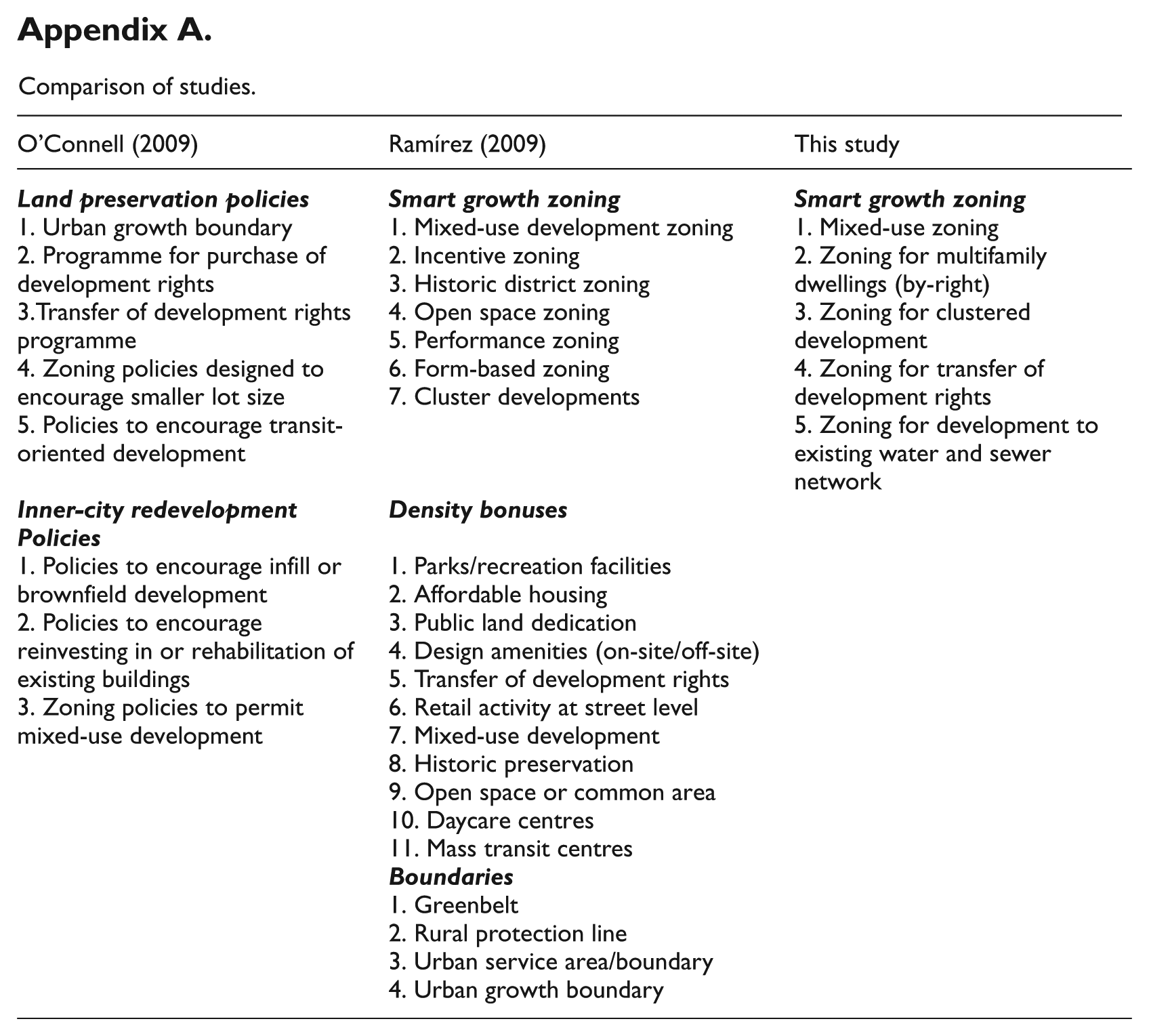
To what extent do local interest groups previously discussed influence the adoption of smart growth policy? In this study I complement the contributions made by O’Connell and Ramirez in four ways. First, I survey planning officials of cities and towns in the state of Massachusetts. Since survey respondents are located in only one state, I am able to control for the institutional context that O’Connell suggests is important in empirical tests, as well as provide evidence in a context that is different than Ramirez’s study of Florida municipalities. Second, whereas O’Connell measures interest group influence on smart growth policy as the number of supporters or opponents, I measure interest groups at the ordinal level based on survey data. I also extend the political contracting model employed by Ramirez, but utilise a method of analysis that provides evidence of the factors contributing to the adoption of specific policies. Whereas both O’Connell and Ramirez group smart growth policies based on what the policy is meant to achieve and then analyse the number of policies adopted under each category, I examine the use of each policy individually. Appendix A displays the differences across the three studies.
Data collection
The empirical analysis focuses on municipal governments in the state of Massachusetts. The entire state is incorporated with 351 jurisdictions, each with the authority to enact land use policies provided through state-enabling legislation. County government provides only minimal public services, and cities and towns are both considered municipal government. The key to whether a municipal government is a city or town is population size. For a municipal government to be a ‘city’ it must have a population of at least 12,000, irrespective of whether its home rule charter specifies a mayor-council or council-manager form of government. Communities with more than 12,000 population can continue to refer to the municipality as a town.
Since property taxes are the major source of revenue for municipal government in the state, maximising available land is a significant goal for many local government officials. However, as land development has intensified, in particular residential sprawl, environmental groups and urban planners have demanded that more action be taken to preserve environmental resources (Euchner, 2002; Evenson and Wheaton, 2003). The rise in popularity of environmental issues has prompted many local governments to implement smart growth initiatives, yet in other communities sprawl continues seemingly unabated and few, if any, smart growth policies have been adopted.
The first source of data is a survey of local public officials. In 2005 I distributed a questionnaire by mail to the planning director of each city and town (351) in the state. If the local government did not have a planning director, the questionnaire was mailed to the chairman of the planning board. Directors of planning have responsibility for coordinating stakeholder input and reviewing development activities in their city and are strategically positioned to craft and implement smart growth policy. Planning officials therefore are a reliable source to describe and evaluate the various interests that support local efforts. A total of 240 surveys were returned, representing a 68% response rate.
The second source of data used in the analysis is smart growth policies compiled in 2005 by the Massachusetts Executive Office of Energy and Environmental Affairs (EOEEA) as part of the Commonwealth Capital Scorecard program (CCS). The CCS is Massachusetts’ version of a ‘Smart Growth Scorecard’. According to the US Environmental Protection Agency, scorecards are basic assessment tools that encourage communities to view their current policies and regulations through the lens of smart growth. The purpose is to help communities determine how their current regulations influence patterns of development and potential growth (US Environmental Protection Agency, 2006). Through this programme local officials voluntarily identify from a list of policies provided on the scorecard those that are utilised by their community and then submit the data to the EOEEA. A total of 191 municipalities (54%) submitted CCS data to EOEEA in fiscal year 2005. 1 The 240 cities that responded to the survey were matched with the 191 cities that submitted CCS data. Of these, 138 are included in the analysis because of survey non-response. 2
Of the seven categories of policies and planning efforts listed on the scorecard, I focus on five zoning tools that are categorised as promoting compact development. 3 These policies were chosen because planners need to examine in a more robust way the linkages between plans and implementation. This entails an evaluation of the types of policies listed above. Second, zoning implements more compact and higher density development, which undergirds more affordable housing and water conservation efforts that are the focus of other CCS policies.
Variable descriptions and method of analysis
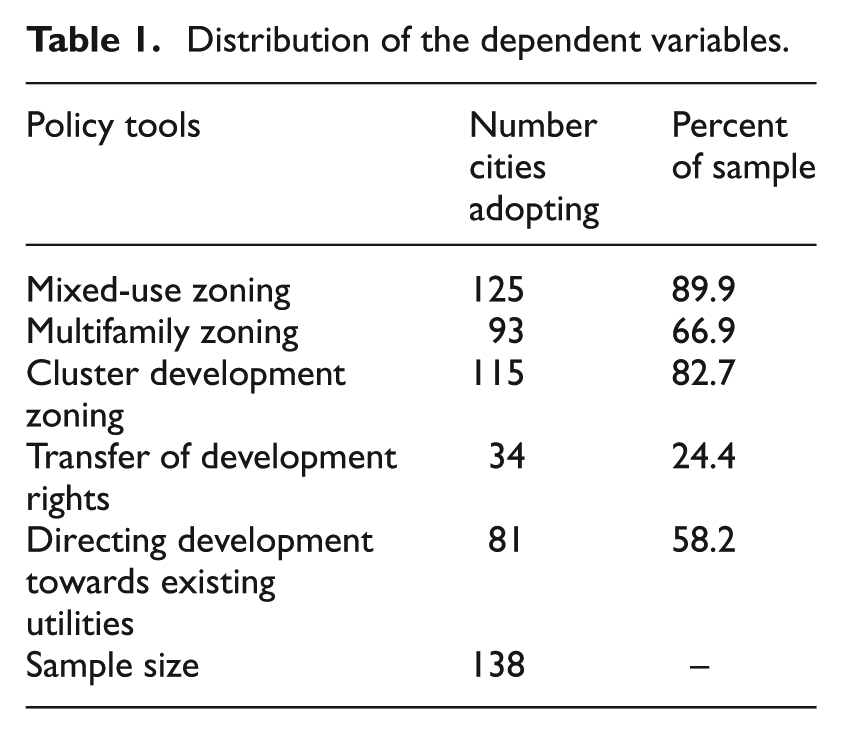
Five smart growth zoning policies collected from the CCS represent the dependent variables. Each policy is measured as a binary variable with ‘1’ indicating if they were adopted by a community and ‘0’ otherwise. Table 1 presents the distribution of each policy. Of the 139 cities in the sample, nearly 90% have adopted mixed-use zoning while only 24% have adopted transfer of development rights. Roughly half of the cities in the sample direct development towards areas with existing infrastructure to support growth. Probit regression models were specified for each policy to predict their use by local government with the independent variables discussed in this section. I first analyse five regression models that exclude two interaction terms described below. This allows me to isolate the effects of interest groups on smart growth policy, controlling for local contextual factors. I then analyse five unrestricted models that include the interaction terms.
Distribution of the dependent variables.
Smart-growth interests is measured with a survey question that asked respondents to indicate on a scale of 1 (low) to 3 (high) the extent to which environmental organisations are supportive of local efforts to promote development. To measure pro-growth interests, survey respondents indicated on the same scale the extent to which local real estate developers are supportive of local economic development efforts in the community. 4 Because very few respondents indicated low support by pro-growth interests, this variable was collapsed to form a binary variable where high support was coded ‘1’ and all else coded ‘0’. The distribution of smart-growth interests is 45 (32%) = 1, 66 (48%) = 2, and 28 (20%) = 3, whereas the distribution of pro-growth interests is 27 (20%) = 0 and 111 (80%) = 1. Cities in which pro-growth interests have low support for local economic development efforts have, on average, a population of 20,811, a population density of 1455 per square mile and a population change of 10.60%. In comparison, cities in which pro-growth interests highly support local development efforts have a similar population size (20,856), population density (1459 per square mile) and population change of 10.18%. The mean difference in ‘high support’ between pro-growth (0.80) and smart-growth interests (0.20) for economic development efforts is significantly different at the 0.01 level.
To test the mediating effect of local political institutions I created two interaction terms. The first is the product of the manager form of government and the smart-growth interest group variable. The second is the product of manager form of government and the pro-growth interest group variable. A binary variable indicates whether the city has a council-manager form of government. In this study, ‘manager’ refers to a professional administrative position of similar responsibility (e.g. town administrator, executive secretary, town executive).
Policies adopted by communities to promote economic development, as well as address the negative consequences of such development, are consistently found to be influenced by the context of growth in the community (Feiock et al., 2008; Lubell et al., 2005, 2009b). Although smart growth does not equate to a no-growth approach, competition for economic development may undermine some of its overall goals, particularly removing land from potential development. Survey respondents were asked to indicate if there is strong competition for economic development among communities in the immediate region. This is measured with a binary variable. In addition, I use a binary variable as a measure of a community having a professional planning staff. The professional expertise of a planner on issues related to growth may influence local actions that are intended to build ‘smarter’ and more sustainable communities through policy adoption (Jepson, 2004). Support for smart growth tends to arise as the availability of environmental public goods and undeveloped land is threatened. Thus I also include the percent of total acreage that is undeveloped as a measure of land scarcity.
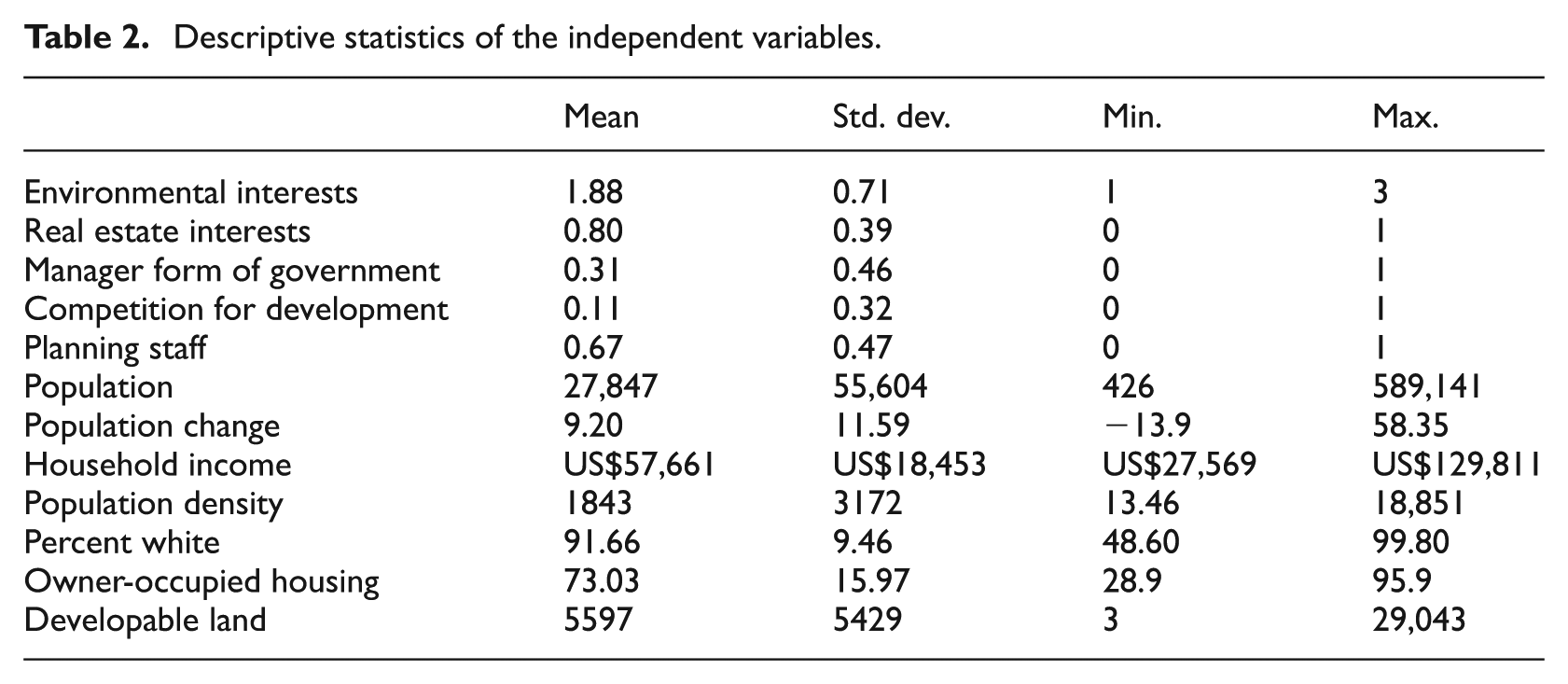
I control for the size of a community with local population (logged). Larger communities that have more resources at their disposal may also be more likely to engage in short- and long-term planning to address complex growth-related issues. Population change (1990–2000) is used to indicate growth pressure. Communities experiencing population growth are found to more favourably endorse growth management (Baldassare, 1990; Baldassare and Wilson, 1996; Donovan and Neiman, 1992). The socio-demographic characteristics of the local population are also likely to influence smart growth policy (Wassmer and Lascher, 2006). Mohamed (2008) finds, for example, that people who are concerned about sprawl are also willing to pay for the purchase of open space in rural areas and to redevelop abandoned property in inner cities. Homeowners in particular are key demanders in urban politics, with a clear interest in the efficient use of tax and policies that maintain home values (Fischel, 2004). As suggested by some studies, predominantly white communities with higher incomes tend to favourably endorse a slower and more managed approach towards growth (Donovan and Neiman, 1992). I control for these factors with percent white, household income, owner-occupied housing and population density. Descriptive statistics and measures for the independent variables are presented in Table 2.
Descriptive statistics of the independent variables.
Results
The results of the analyses with and without interaction terms presented in Table 3 indicate there is a moderate level of support for the interest group model in explaining smart growth policy. The findings suggest pro-growth forces affect policies that increase density whereas smart-growth supporters influence policies that are oriented towards land preservation but have no statistical impact on multifamily housing. These findings are generally consistent with Ramirez (2009) and O’Connell (2009), but also provide new insight into the traditional urban politics hypothesis about the effect environmental interests are expected to have on policy compared with real estate interests (Lubell et al., 2005). Of the five policies examined, I find statistical support for the political market framework for only the use of transfer of development rights.
(a) Probit regression results.
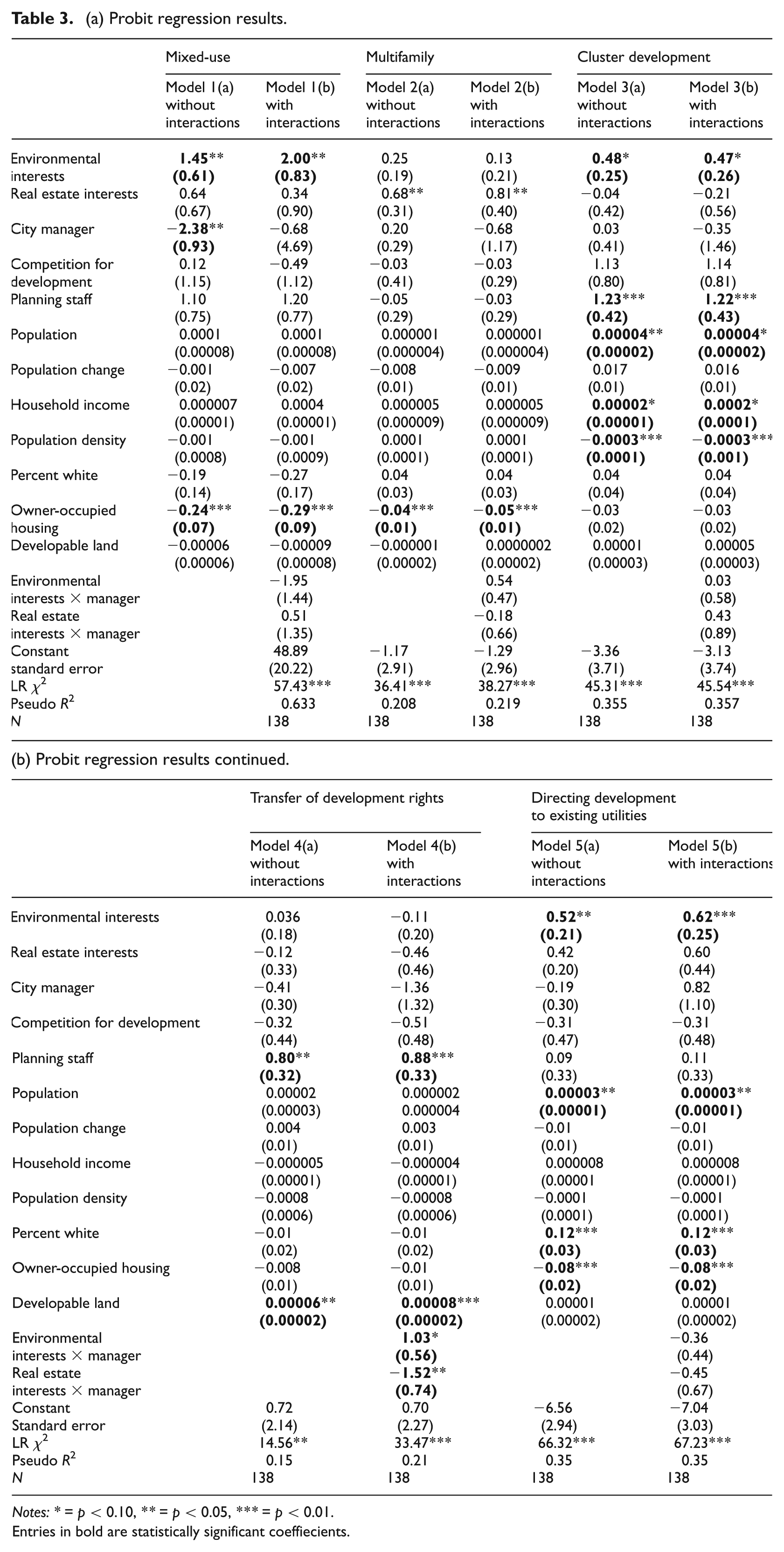
Notes: * = p < 0.10, ** = p < 0.05, *** = p < 0.01.
Entries in bold are statistically significant coeffiecients.
Beginning with model 1a, the smart-growth interest group variable has a positive and significant effect on mixed-use zoning while pro-growth interest group variable has no significant effect. Pro-growth interests, however, has a positive and significant effect on multifamily zoning (model 2a). In model 3a, the effect of smart-growth interests is positive and significant on cluster zoning. The smart-growth interest group variable has a positive effect on zoning that directs development towards an existing water/sewer network (model 5a). Among the control variables, only owner-occupied housing has a statistically significant, yet negative effect on multifamily zoning. This finding is consistent across three of the five regression models. Table 4 summarises the hypothesised effect smart-growth and pro-growth interests have on policy compared with the findings.
Summary of findings.
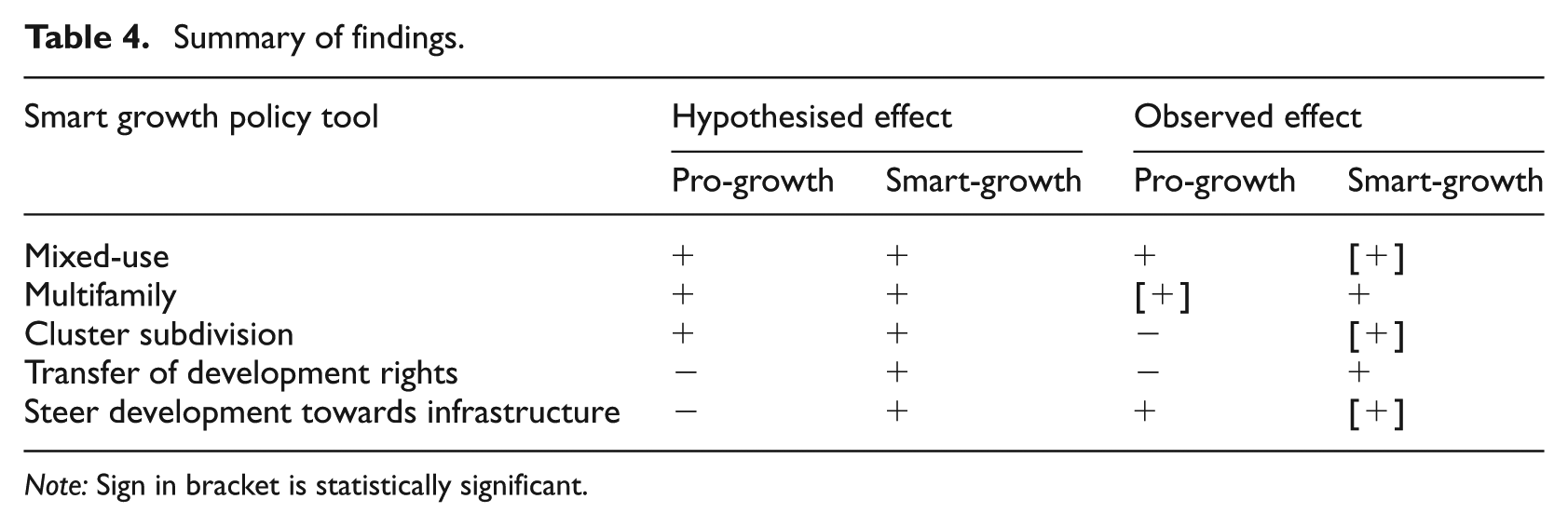
Note: Sign in bracket is statistically significant.
Discussion
As expected, the results generally suggest as smart-growth interests are more supportive of development policy, cities in this sample are on average more likely to adopt policies that mitigate development on the environment. For instance, although cluster zoning often results in more housing units being developed, it serves smart growth objectives by coupling residential density with environmental protection measures by ensuring a portion of a development remains as open space. Mixed-use zoning also seeks to accommodate development by allowing higher density residential and commercial uses. The intended effect is to minimise low-density development and encourage open space protection. These findings are consistent with results reported by Ramirez and O’Connell.
Consistent with the hypothesised relation, the results indicate that smart-growth interests have a positive and significant effect on smart growth zoning that directs development towards existing water and sewer networks. This policy is a cornerstone of smart growth. For environmental interests, this policy provides benefits that align with their preferences for reducing development in areas that are not serviced by infrastructure. Whereas the number of supporters of smart growth has a positive but non-significant effect on inner-city redevelopment policies in O’Connell’s study, the results presented here indicate environmental organisations support for economic development results in a city being more likely to adopt a policy that encourages urban redevelopment.
It is interesting to note that among the five models without interaction terms, pro-growth interests have a significant effect only on zoning for multifamily housing. Compared with development that is granted by special-use permit, multifamily zoning by-right provides less leeway for negotiation over the use of land and characteristics of development. This may explain in part the result; it provides a greater degree of certainty for investment decisions. Cities with a manager are less likely to adopt mixed-use zoning.
Among the control variables, owner-occupied housing is negative and significant in relation to mixed-use multifamily zoning. For many homeowners higher density is viewed as producing externalities and potentially affecting housing values (Fischel, 2004). Moreover, multifamily housing may also be considered ‘affordable housing’ that will have a negative fiscal impact on the community. Thus this result may point to exclusion that some suggest drives policy decisions related to this policy tool (Pendall, 2000). A community with a professional planning staff is found to increase the probability that cluster zoning and transfer of development rights is adopted. Planning staff can play a key role in generating greater understanding among local interests on how these policies achieve the goals of land conservation and accommodate development. This finding is consistent with previous research that suggests greater planning agency capacity positively influences local government decisions on smart growth initiatives (Brody et al., 2006).
Turning to the results that include the interaction terms, there is statistical support only for transfer of development rights policy (model 4b). Based on the political market framework, it was hypothesised that the effect of economic interests on this policy is greater when a city operates under a manager form of government. The interaction term is consistent with this argument – policy that can be perceived to delay development and require extensive and sometimes costly negotiation with competing interests is less likely to be adopted by cities that operate under a manager form of government.
On the other hand, it is expected that cities operating under this governance structure shape the ability of smart-growth interests to articulate their demands. This would translate into smart-growth interests having a weaker effect on TDR conditional on a manager form of government. The results, however, suggest the opposite. As environmental groups increase their support for development policy, the likelihood of TDR being adopted increases conditional on the city having a professional manager.
One explanation for this finding relates to how the variable is measured. Survey respondents were asked to indicate the support for economic development policy by environmental groups. TDR policy does not stop development, but rather encourages the relocation of development to more suitable areas. Thus the conditional effect of smart-growth interests on this policy is consistent with the literature that suggests managers are more likely to respond to private demands that emphasise greater economic development. In this case the ‘receiving’ areas are presumably more appropriate for development than the ‘sending’ areas, which smart-growth interests seek to protect. In addition, the results point to city managers accommodating the policy preferences of environmental interest groups because of their association with professional planning organisations that emphasise smart growth as a way to reconcile environmental and economic priorities. Moreover, because managers are less risk averse, they are likely to push for policy adoption earlier than elected officials such as mayors (Kwon et al., 2009). TDR remains a relatively new approach to land preservation for many communities.
Because TDR is relatively complex and requires extensive negotiation between interests, the results also suggest that cities with a manager form of government are more receptive to policies that require dispute resolution and other management skills. Coordinating a transfer of development rights between competing interests that distrust one another increases uncertainty in whether an agreement can be reached and whether the parties will uphold the agreement. A community must keep the costs of negotiating these exchanges low and generate outcomes in which both smart-growth and pro-growth interests receive some benefit. Cities with a professional manager can reduce the transaction risk faced by environmental interests by adopting TDR policy that structures the negotiation process with pro-growth interests. Since a city manager is expected to engage in setting policy that has a community-wide focus, this form of government provides a stronger credible commitment the policy will provide benefits to diffuse environmental organisations. Overall the results point to a more nuanced approach to land use policy that reflects the manager’s responsiveness to the policy preferences of pro-growth interests while also accommodating the demands of environmental groups.
Conclusion
This study focuses on local interest groups and smart growth policies adopted by local governments in the state of Massachusetts. Smart growth may emerge as a bundle of discrete policies to reach goals of greater environmental protection and more equitable and sustainable growth. In some communities, one or two policies are all that is necessary whereas in other communities a full range of policies are needed to address sprawl and other growth-related issues. I sought to build on the work of O’Connell and Ramirez by disentangling individual policies to determine whether interest groups and the local governing institution determine their adoption.
Depending on the type of policy that is analysed, the results of probit regression models indicate that smart-growth and pro-growth interests have a significant influence on policy adoption. The findings suggest that greater support for economic development by smart-growth interests increases the likelihood that mixed-use zoning, cluster development zoning and directing new development to existing water and sewer networks will be adopted. In comparison, pro-growth interests have a positive and significant effect on multifamily zoning. Local governing institutions also matter by shaping the dynamics of the political market. Statistical support for the mediating effect of a professional city manager on smart growth is provided only for TDR policy.
The results are largely consistent with the land use literature that argues pro-growth interests shape policy decisions that can affect the distribution of benefits that favour growth and development by allowing greater densities through multifamily housing. An increase in residential density, coupled with other environmental protection measures, can minimise the impacts of development on the environment by combating sprawl and achieving goals of sustainability. The results also suggest that support from environmental interests is an important factor in policy adoption, particularly those that mix land uses and cluster housing units. However, I find no significant effect of this variable on multifamily zoning and transfer of development rights, which can achieve smart growth objectives that environmental interests are likely to advocate. Cities with a manager form of government shape the effects of smart-growth and pro-growth interests on TDR policy; it strengthens the positive effect of smart-growth interests and the negative effect of pro-growth interests.
One limitation of this study is that there are likely incentives associated with each policy that are not reflected in the analysis. For example, taking advantage of sewer and water utilities may meet smart growth objectives in the eyes of the local government, and presumably reduce costs incurred by development interests because infrastructure is already present. However, urban development can be costly compared with rural and urban fringe development, and uncertainty over environmental conditions may undermine private investment in these areas. Financial incentives can induce greater development in these areas. A second limitation of this study is that it does not address whether a community is more or less stringent in the application of these policies. The extent to which planners and developers negotiate density, location of open spaces and other characteristics of a residential subdivision remains an important empirical question. Future work should also examine at a finer level of analysis on whether the areas zoned for these purposes have changed over time and whether this change has led to greater or lesser support for land use policy by local interest groups.
Overall the results of this analysis point to the argument that for cities to be successful in achieving goals of smart growth, both pro-growth and slow-growth interests should be considered in policy development and implementation. Framing the issue and the resultant benefits of a policy is essential with competing claims to what promoting smart growth entails and how best to achieve it. Thus one of the challenges for local officials is to highlight the benefits some groups may receive from local policy while negating threats posed by other interests. If an inclusive and collaborative process is undertaken, a greater share of the benefits can be distributed to more groups. This may also reduce conflict and build consensus on how best to achieve smart growth.
Footnotes
Appendix
Comparison of studies.
| O’Connell (2009) | Ramírez (2009) | This study |
|---|---|---|
|
Urban growth boundary Programme for purchase of development rights Transfer of development rights programme Zoning policies designed to encourage smaller lot size Policies to encourage transit-oriented development |
Mixed-use development zoning Incentive zoning Historic district zoning Open space zoning Performance zoning Form-based zoning Cluster developments |
Mixed-use zoning Zoning for multifamily dwellings (by-right) Zoning for clustered development Zoning for transfer of development rights Zoning for development to existing water and sewer network |
|
Policies to encourage infill or brownfield development Policies to encourage reinvesting in or rehabilitation of existing buildings Zoning policies to permit mixed-use development |
Parks/recreation facilities Affordable housing Public land dedication Design amenities (on-site/off-site) Transfer of development rights Retail activity at street level Mixed-use development Historic preservation Open space or common area Daycare centres Mass transit centres |
|
|
Greenbelt Rural protection line Urban service area/boundary Urban growth boundary |
Funding
This research received no specific grant from any funding agency in the public, commercial, or not-for-profit sectors.