



Abstract
The importance of strengthening local governments is widely recognised as local governments face new challenges against the backdrop of global decentralisation processes. Municipal International Cooperation (MIC) contributes strategically to such processes by peer-to-peer learning within existing local institutions, a development process that is both efficient and provides continuity. Empirically, the paper draws upon the findings of an evaluation of the Dutch support programme for MIC called LOGO South. The main conclusion is that partnerships between local authorities do strengthen local governments in the South; the unique approach of the LOGO South programme adds important spillover effects in mutual learning, resulting in both policy transfer and mobility. By creating multilevel governance networks, knowledge circulation was also strengthened. This paper contributes to the debate by showing that locally based, multilevel hybrid networks are strategic for governance processes.
Keywords
Introduction
The last decades witnessed a changing role of local governments in the South. Decentralisation policies have added new tasks and responsibilities to local government agendas. The aim is to move beyond the direct provision of local basic services, ideally towards a role as facilitator of development strategies, and a monitoring and sanctioning authority, working through participatory local decision-making processes. Many local governments are not equipped for this complex set of roles, and therefore institutional capacity building is considered a pressing challenge.
Municipal International Cooperation (MIC) is an approach officially aiming to strengthen local governments. 1 Through formal partnerships local governments decide to work together and stimulate knowledge exchange between their staff, often on previously identified topics to build capacity. Within MIC, knowledge transfer from one municipality to the other occurs through direct peer-to-peer exchange, contributing to knowledge circulation. Mutual learning – embodied in two-way exchanges of information, benefiting both partners and based on complementary professional backgrounds – is considered a critical dimension of successful municipal partnerships (Johnson and Wilson, 2009).
MIC, with its exchanges of different types of knowledge, can potentially transform urban policies of both partners. How such policy transformations take place is being hotly debated within recent academic debates on urban policy mobility (e.g. Clarke, 2012; McCann, 2011). Awareness has increased that policy development occurs at various levels, with spillover effects across institutional boundaries and scale levels (Cochrane and Ward, 2012). Globalisation leads to increasing connectivity, networks and exchanges between policy contexts, at both national and local level. In the words of Peck and Theodore, ‘policies are on the move’ (Peck and Theodore, 2010: 169). The study of urban policy mobility differs from earlier studies of urban policy transfer because of its focus on the political processes by which practice and policy communities on the ‘receiving location’ reconfigure policies in line with locally different and sometimes conflicting interests. This new view stresses the dynamics of policy mobility: it is not about fully fledged packages of policies being transferred in total, but their being adapted to specific local urban contexts (Clarke, 2012). As such, policies ‘evolve through mobility’ (Peck and Theodore, 2010). Within this debate, the process of knowledge mobility and learning across epistemic communities is crucial, as without it, policy will not ‘move’. Some authors prefer using the concept of knowledge circulation, as policy mobility is both about the transfer from A to B, as well as diffusion and adaptation among other actors and/or localities, resulting in multilevel or multiscalar phenomena.
The current debate on policy mobility remains rather abstract, as most of the literature is relatively anecdotal. Comparative analyses of the practice of urban policy mobility are rare. The aim of this paper is to add to the debate by examining the contribution of MIC to knowledge transfers, learning processes and policy mobility across localities and institutional boundaries – and the consequent utilisation and reconfiguration of such knowledge in strengthening local governments across a range of situations. For this purpose, we take the case of the LOGO South programme, implemented between 2005 and 2010 the explicit aim of which was to strengthen local governments in countries in the South. The programme was executed by the International Cooperation wing of the Association of Netherlands Municipalities (VNG International) financially supported by the Dutch Ministry of Foreign Affairs. 2 We analyse whether this programme was successful in policy transfer only, or whether its activities developed further into urban policy mobility, with knowledge circulation and mutual learning spillover effects and the forging of hybrid networks across scale levels.
MIC as approach for local capacity development
The importance of MIC programmes has increased as donors, national governments, academics 3 and practitioners increasingly recognise the importance of local government networks (Bontenbal, 2009). This growing recognition is explained by two important changes in development cooperation. First, in line with the growing role of local governments, development cooperation policy has increasingly focused on local and urban institutions, outsourcing and facilitating ‘public goods’ service delivery and effective management. Many local governments in the South continue to be challenged by a lack of financial resources for service provision and weak organisational capacity to respond to the expanding mandates expected of them (Baud, 2004; Crook and Sverrisson, 2001; McCarney, 1996). Building local government capacity is thus an important expressed component of donor-driven decentralisation programmes, decentralised cooperation and interventions aimed at public-sector reform (Grindle, 2006; Nibbering and Swart, 2008; Romeo, 2003). Consequently, MIC is seen as a model for local capacity building and municipal knowledge exchange to support the building of stronger local institutions (Knip, 2009; Van Reesch, 2007). 4
Second, working in ‘partnership’ or ‘networks’ has become a much-valued modality for development cooperation programmes. Traditional relationships between donor and recipient partners are replaced by a more balanced North–South power relationship in which partners cooperate on a professional peer basis (Baud and Post, 2002; Fowler, 1998). MIC – in which knowledge and experience is shared on similar issues between same-level partners – is thought to incorporate some of the values of peer networks, including mutuality, joint goals and planning, although the latter two are espoused more in theory than practice (Johnson and Wilson, 2006; UN-Habitat, 2003; Van Ewijk and Baud, 2009).
Through MIC, municipal partnerships may seek to contribute to a variety of short- and longer-term expressed policy transfer objectives, including local service provision, poverty alleviation, institutional strengthening, utilising knowledge exchange. MIC also aims more recently at broader political goals, such as strengthening democracy, enhancing local state responsiveness, enabling city diplomacy relations and achieving Millennium Development Goals (MDGs). In many cross-border municipal partnerships other actors are included in forming hybrid networks including the private sector and civic organisations. This fits into the broader discussions on policy mobility; i.e. focusing on how policy transfers take place, how policies change as they travel and how local actors transform them for local usage (McCann and Ward, 2011).
Knowledge exchange through peer networks is a major instrument within MIC programmes, more than donations or financial investments. Knowledge is transferred, exchanged and transformed between various actors, across different scale levels, using different methodologies 5 (Bontenbal, 2010). 6 Both how MIC supports knowledge circulation in practice and its effects on policy mobility are examined in this paper.
MIC in practice: The Dutch LOGO South programme
This paper deals with the support programme for MIC entitled ‘LOGO South’. The LOGO South programme ran between 2005 and 2010 and aimed at strengthening local governments in several developing countries. The programme was executed by the international cooperation agency of the Association of Netherlands Municipalities (VNG International) and financially supported by the Dutch Ministry of Foreign Affairs. The total budget of the programme in the period 2006–2009 was 25,260,000 Euros, while average annual costs per MIC project were around 96,000 Euro. This programme is interesting for two reasons: first, the Netherlands is among the few countries with a support programme for MIC, with a relatively high budget compared with those in other OECD countries. Second, the programme focused on specific countries and one or a few themes per country. This approach was thought to facilitate South–South knowledge exchange between the local governments both within countries and regionally.
The LOGO South programme was operational in 11 countries in Africa, Asia and Latin America, supporting 53 Dutch MIC projects. In each country several MIC partnerships were active, focusing on one or two themes: these included finances, water and waste management. Such focus differs strategically from other Organization for Economic Cooperation and Devleopment (OECD) MIC programmes; according to the OECD (2005), the large majority (over 70%) of decentralised cooperation focuses on social sectors (mainly education and health), with less attention paid to key municipal areas, such as water supply and sanitation, solid waste management, municipal infrastructure and municipal services. 7 The chosen themes in specific countries were an outcome of consultation processes in which both Southern and Dutch partners were involved. Once the themes were defined the Southern and Dutch partners submitted jointly developed project proposals to VNG International for funding.
In most involved countries a bilateral approach through city-to-city partnerships was used. The exception was the municipal partnerships between Nicaragua and the Netherlands which also used an integrated expert pool consisting of Dutch experts, coordinated and facilitated by a Dutch national platform organisation and their counterparts in Nicaragua, 8 which implied fewer municipal peer-to-peer contacts within the municipalities involved. How results differ will be explored below.
Methodology
This paper is based on the findings of two programme evaluations, the first being an evaluation of the LOGO South programme carried out by all authors between June 2009 and January 2010 (Baud et al., 2010). For this evaluation, three out of the 11 countries in Africa, Latin America and Asia in which the programme was implemented were selected for fieldwork visits. Selection criteria included the number of projects per country, inclusion of different types of actors (local governments and other NGOs), geographical distribution and coherence, and the history of the municipal partnerships. Based on these criteria, South Africa, Indonesia and Benin were selected as case studies.
The evaluation included a range of research methodologies:
a desk study, analysing relevant secondary sources (programme documents LOGO South, project documents of specific partnerships in the concerned countries);
field research in the Netherlands, consisting of interviews with VNG International staff, representatives of local governments, regional water authorities and water companies;
field research in South Africa, Indonesia and Benin, with field visits to nine projects in South Africa, five projects in Indonesia and three projects in Benin. During these field visits we interviewed representatives of the project partners, and collected and analysed secondary material, such as project documents.
A second evaluation provided evidence on the fourth country – Nicaragua – in the LOGO South programme, where three MIC partnerships between the Netherlands and Nicaragua were assessed. This evaluation was carried out between December 2009 and April 2010 by two authors (Van Ewijk and Van Lindert, 2010) and provides an interesting addition because of Nicaragua’s use of an integrated expert pool as well as bilateral contacts.
This evaluation also included a desk survey and field research in the Netherlands and Nicaragua. The research included in-depth field research in three cases in Nicaragua and the Netherlands. Of specific interest was the role of the Dutch national platform and their counterpart organisation in Nicaragua.
National policy contexts
The LOGO South country programmes shared the overall objective of strengthening local government, but differences in the wider national and policy contexts led to rather varied approaches between countries and the municipalities involved. Moreover, the different forms of cooperation in the LOGO South programme and the scope of the support activities can only be understood when taking history, consolidation and (organisational) modality of the twinnings into account. Generally, direct support in setting up local government departments and equipping them with necessary operational skills was high on the agenda of programme countries where local governments were weak or where local authorities were recent innovations, resulting from recent decentralisation processes. Benin is a clear case in point.
In countries with more mature local government structures, programme activities tended to aim more at strengthening specialised service delivery agencies, rather than municipal organisations as such, as was the case in Indonesia. Path dependencies also play a role; many municipal partnerships have a long history and were established during the 1980s and 1990s, such as the ties between Dutch and South African municipalities and Dutch and Nicaraguan municipalities, in which relations between the municipalities were gradually deepened and extended over the years (Van Lindert, 2009).
Municipal International Cooperation in the LOGO South programme
MIC entails the capacity development of local governments by building knowledge through peer-to-peer exchanges. This provides spaces for moving from knowledge transfer to policy mobility when practices, expertise and policy models from the Netherlands can be adapted to local contexts to better reflect the demands of partner municipalities. Knowledge circulation can also take place, transferring knowledge to actors outside the twinning arrangement. In this section we discuss the contribution of the Dutch LOGO South programme to local capacity development through knowledge circulation and policy mobility. We start by focusing on how the programme influences the strength of local staff capacities, and then proceed to three dimensions directly linked to this: improved service delivery, citizen–government interfaces and revenue-raising capacity.
Strengthening staff capacity
Strengthening local capabilities was the core of the LOGO South programme and involved training, linking and peer-to-peer knowledge exchange. In some cases putting basic equipment and facilities in place was necessary, but this was not the main thrust of the programme. In the peer-to-peer learning model experts in a particular field in one partner municipality shared their knowledge and skills with colleagues from the other. Training activities entailed both technical (i.e. job related) as well as more process-oriented activities. Technical training programmes ensured, for instance, that a local Registry Office was indeed capable of efficiently and reliably recording births, deaths and marriages (see Textbox 3). Process-oriented skills were more ‘developmental’ in aiming at strengthening the capability of people and organisations to reflect on their work and develop continual improvements. Although their impact was difficult to gauge in the short term, it is expected to yield returns over time.
Our findings confirmed previous research findings in which peer-to-peer learning in MIC partnerships proved to be an efficient and interactive way of building capacities (Bontenbal, 2009; Johnson and Wilson, 2009; Van Ewijk and Baud, 2009). The peer-to-peer learning approach generally focused on existing demands by partners, motivated partners within their working environment and yielded increased exposure to outside knowledge and experience for both partners. MIC partnerships were usually built on long-lasting relationships, fostering trust and friendship on both sides. Generally the exchange activities were much appreciated and worked well as training modality, despite their limitations. Experiences and approaches by the Dutch organisation were not necessarily the most suitable ones for the situation of partner municipalities in the South, and Dutch civil servants were not always knowledgeable about situations elsewhere or the requirements for this type of cooperation. However, peer exchanges broadened the views of all those involved, provided working models and produced personal and organisational networks that are a resource in their own right. It also made both Dutch and other-country partners reflect on their own contextualised work practices; knowledge travelled across South–North divides.
In contrast, in the Dutch and Nicaraguan municipal cooperation the partnership works with an expert pool in which direct peer-to-peer relations between two local governments are no longer the main focal point. These expert pools consisted of Dutch civil servants, experts in their field, who worked in several Nicaraguan municipalities. They spoke Spanish well and had sufficient knowledge of local governance and relevant cultural aspects in Nicaragua. Our research findings indicated most persons involved, both in the Netherlands and in Nicaragua supported this model, although it reduced personal commitment and limited ownership of the twinning within Dutch municipalities. The result was more limited support for the programmes among municipal staff in the Netherlands. 9 The expert-pool model has advantages where a number of municipal partnerships exist in one country and where language poses an important barrier in communication. It also allows knowledge to travel between local governments in one country and a wider range of policy models to be drawn on by Nicaraguan local governments. Through these networks coordinated by the national platforms, policy mobility clearly occurred as local governments adapted policies from other local governments.
The LOGO South programme significantly contributed to strengthening local staff capacity. Peer-to-peer learning effects were particularly strong in the South African twinnings (between people working in the same sector, and in similar positions within the municipal apparatus or regional water authority). Peer-to-peer contacts were also direct, as English is one of the official languages of South Africa and all Dutch officials involved speak sufficient English.
Learning effects were also strong in the programmes related to urban cadastres and strategic planning in Nicaragua facilitated by the expert pool described. The programmes were crucial for establishing more effective systems of local tax collection, while developing strategic planning processes was essential to enable acquisition of national and international funds. However, in Indonesia or Benin, direct communication between international peers was difficult as few Dutch staff speak French or Bahasa Indonesia. Language differences complicated joint writing of proposals and reports, which may have limited project ownership among Southern local authorities.
In Indonesia, water companies formed the main target group rather than local government. The programme did have an important contribution in improving availability and quality of drinking water by providing technical and organisational knowledge; however in all four participating Dutch water companies relations with respective local governments are symbolic at best (see Box 2).
Municipal partnerships with South Africa have a long history as Dutch local governments joined forces as the ‘Lower Authorities Against Apartheid’ (LOTA) movement to criticise the ‘Apartheid’ regime. When the Apartheid regime ended in 1990, many Dutch local governments felt committed to support the building of the new South Africa. Housing emerged as an important theme in the transformation period. Both municipalities and housing associations actively supported the establishment of Social Housing Institutes (SHIs) drawing on Dutch cooperative low-income housing models. This was complemented by the participation of the Dutch International Guarantees for Housing Foundation (DIGH) from which loans could be obtained. The ministries responsible for housing also confirmed their commitment in a memorandum of understanding. However, increasingly actors questioned whether the Dutch model of social housing is applicable in South Africa. None of the South African SHIs have become financially viable. When they function (i.e. providing low-cost housing) they do so drawing on municipal resources. Therefore some younger MICs are now experimenting with models based on public–private partnerships sourced elsewhere, suggesting some policy mobility. At the national level (both at the Ministry of Housing and at the Local Government Association SALGA) the original Dutch model is still very much embraced. The focus of LOGO South in Indonesia was the water sector. The Dutch water sector has always been very important in Indonesia, dating back to the colonial era. Living proof of this influence is the Dutch-style water towers, as well as the systems of canals and polders in flood-prone areas. While one regional water authority in the Netherlands focused on water management by establishing a water authority in the flood-prone environment of Semarang, other Dutch actors in LOGO South were water companies aiming at improved delivery of safe water to households in four cities. The twinnings with the Indonesian water companies took place in the context of recent decentralisation and greater autonomy for local governments, which meant a proliferation of newly created provinces, districts and municipalities all over the Indonesian archipelago. As local governments have a mandate and obligation to provide safe drinking water to their citizens, each has its own public water company. The Indonesian water companies are technical-operational units managed like autonomous businesses, although local government is still influential as the mayor appoints their directors or managers and the municipal council sets the water tariffs for households. The Dutch water companies who were involved in LOGO South are semi-public entities: that is, they function entirely as private enterprises but the shareholders are still fully public (municipal and/or provincial). In addition to improved management of the participating Indonesian water companies, other benefits from the LOGO South cooperation were: upgraded water treatment plants, implying an improved and more reliable provision of drinking water (both in terms of quality and quantity) to the consumers; improved quality and better maintenance of the water piping systems and, thus, less ‘technical’ leakages of water; and in some cases, less ‘commercial’ leakages of water, because of the introduction of improved water meters and registration methods for water use.South Africa: housing and multilevel governance networks through policy transfer
Indonesia: Improving the availability and quality of water
Learning activities within a MIC context are not immune to pitfalls of skills training programmes. Especially in less developed countries with smaller local governments, service delivery may hinge on just one or two trained and knowledgeable people, who as a result of training received may well be lured away to more promising positions elsewhere. Previous research on MICs has indicated that dissemination and institutionalising of new knowledge is indeed one of the main challenges (Johnson and Wilson, 2009). As expected we have encountered several examples of trained staff members moving out of their organisations. Particularly in Benin, the peer-to-peer learning was effective but vulnerable as it was limited to a few people involved. In terms of policy mobility, however, staff turnover is not a loss to society, as the knowledge travels with the persons concerned, even when it hampers the local beneficial impact of MIC.
Service delivery
Strengthening service delivery was mainly on the agenda in cooperation with South Africa (housing, water and waste management), and in Indonesia (water management). The programmes witnessed improved service delivery especially related to waste- and water management. 10 In Indonesia higher quality and extension of drinking water connections was achieved through cooperation with the water companies involved (see Box 2). In the tsunami-stricken town of Banda Aceh, great progress was made in terms of solid waste management, small-scale door-to-door waste collection and community-based waste management. With support from its Dutch counterpart, Banda Aceh became the first city in Indonesia to have a municipal waste management plan. Both waste and water management in South Africa were improved significantly. Various South African municipalities pioneered new waste collection models adapted to local circumstances, where micro-enterprises of community members collected waste at drop-off points instead of through door-to-door collection. This enabled waste collection and separation for recycling in hitherto unserviced areas.
Regarding water management, the support in South Africa to the newly created Catchment Management Agencies (CMA) with decentralised water management led to increased participation of various stakeholders. This in turn led to a more integrated water governance approach and better balance between water demands from various water users. Because the model of CMAs from the Netherlands was deliberately chosen by the national government, learning about high levels of participation in South Africa was a prime example of South–North policy mobility.
Local government–civil society interface
Although improving the interfaces between local governments and civil society was not the main thrust of the LG programme, MIC partnerships have triggered many local governments in involving other actors and establishing networks within their locality, bringing outside knowledge into the twinning. South African municipalities strategically cooperated with national NGOs and local CBOs, and involved nearby knowledge institutions in research and studies. As a spill-over from their twinning project, the municipality of Camdeboo partnered with a private housing association and the university of Port Elizabeth to develop a viable social housing approach for the city. In Indonesia, cooperation was restricted to the relation between local government and the water companies. In Nicaragua, local governments, NGOs and private sector formed ‘triangles of cooperation’, promoting mutual learning within these networks. These triangles were mirrored in the Netherlands with similar results 11 (see Box 4 and Model 2 in Figure 1).
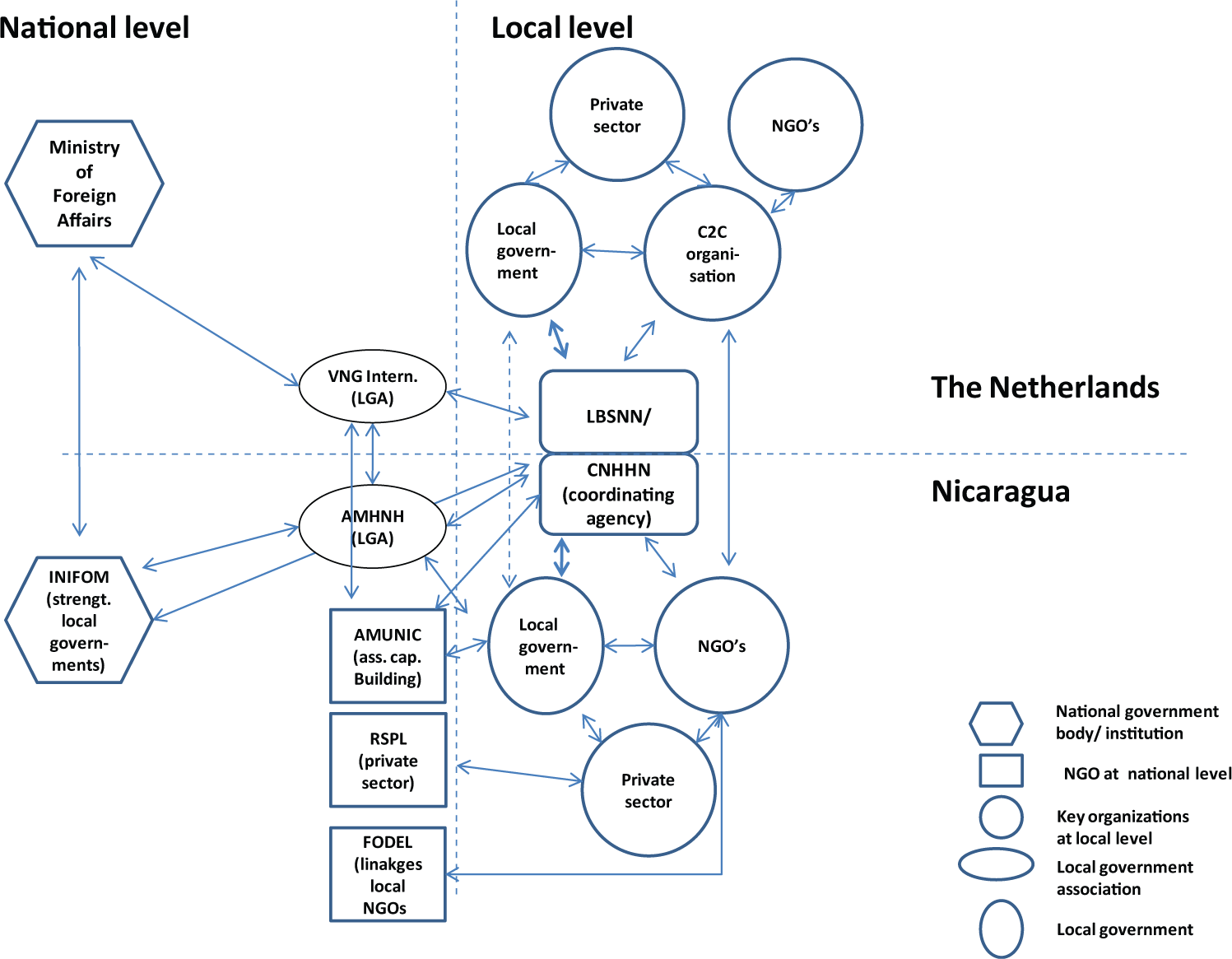
Policy mobility through multilevel governance networks in Nicaragua.
In Nicaragua and Benin, government–citizen interfaces also improved. In Benin increasing transparency and accountability about tax rates are the most notable results of improved revenue collection systems. An information campaign among Beninese citizens on tax collection was set up, which led to an increased understanding of the issue by citizens (Kleine-Vennekate, 2011).
Revenue-raising capacity
The topic of financial management and tax collection was on the agenda only in Benin and Nicaragua. With support of the LOGO South programme, municipalities in Benin have improved and applied a system of civil registration. Generally there has been a modest increase in local revenues linked to the implementation of the civil registration programme (see Box 3). In Nicaragua the emphasis of the cooperation was in the early stages on cadastral upgrading, and later on strategic planning and improving financial administration and local taxation. Urban cadastres have been made more up-to-date, and the improvements in local taxation are substantiated by the fact that over a five-year period (2004–2009) the partner cities in the LOGO South programme have increased their total tax incomes with around 10% higher scores than other municipalities in Nicaragua. Such figures show a clear increase of available resources at the local level. 12 The expert pool contributed to policy transfer as local governments visited other municipalities to draw lessons.
Benin: Setting up civil registry system
Decentralisation in Benin is a recent phenomenon. Decentralisation laws under the new constitution (1990) were approved in 1999, and the first local elections were held in 2002 and 2003. Shortly after, three small Dutch municipalities started providing support to three Beninese municipalities. The municipal cooperation concentrated on improving a core function of municipalities: their civil registry and property registration (local cadastre). MIC activities included the development of the registry, the cadastre, support in developing the initial survey to fill the data base, and training in data base maintenance. Adequate up-to-date civil registries are crucial for local governments both for management purposes and as a source of local revenue. Citizens need their birth certificates and other certificates to enter into contracts with third parties for service delivery, bank accounts, etc.
These MICs had strengths and weaknesses. For the Beninese municipalities the Dutch support considerably strengthened their staff and financial capacities. Policy mobility was increased by sharing lessons learned through the association of Beninese municipalities (ANCB) and ad hoc networks of municipalities. The number of municipal staff working at the municipality and involved in the programme was limited however, making the programme vulnerable to staff turnover. Another limitation was the lack of coordination with national government legislation. As national legislation on financial management was not yet in place, it is not known to what extent the system set up at the time of evaluation would meet future national government requirements. Thus policy mobility remained limited to local government, with no guarantee of up-scaling to other municipalities. 13
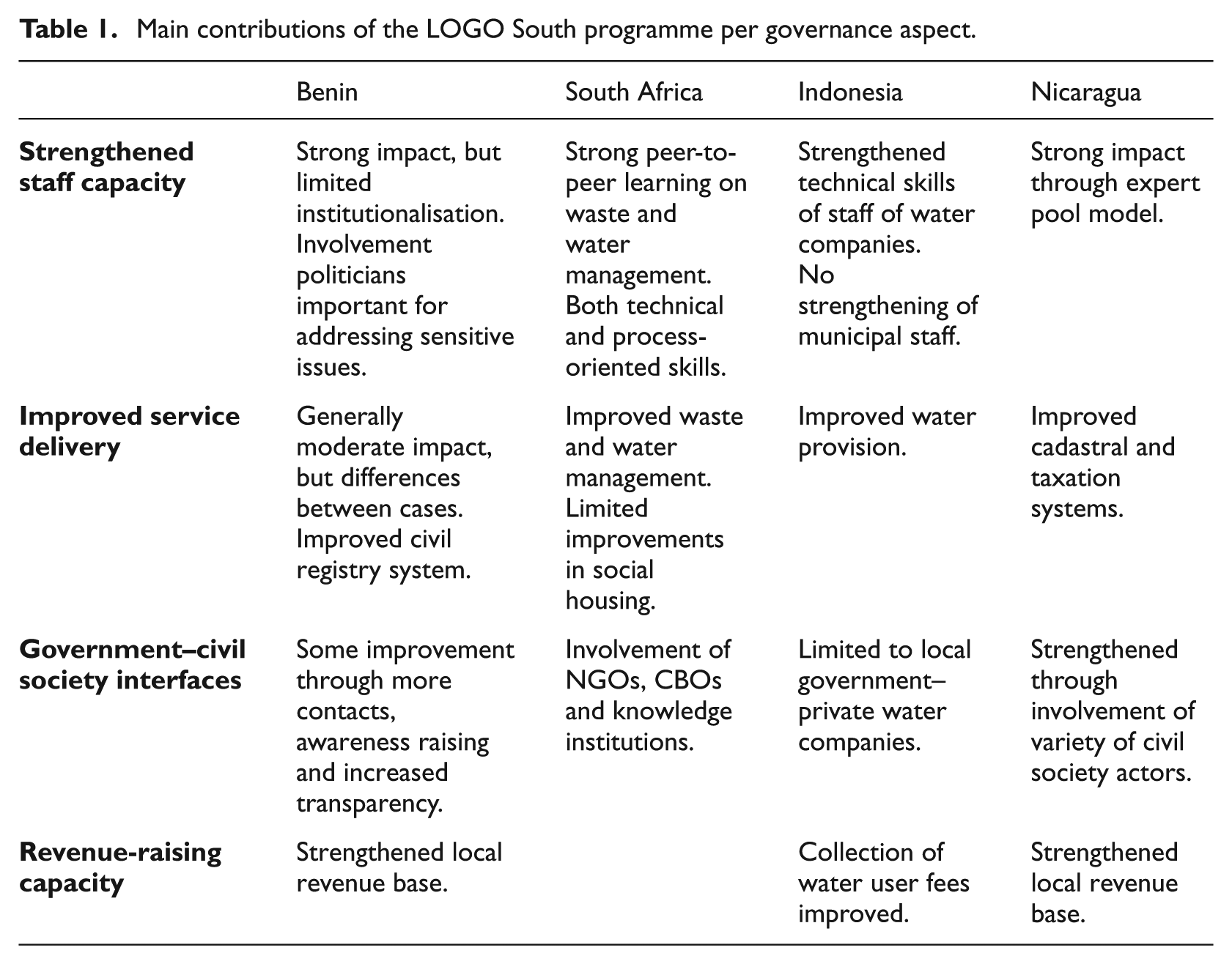
Summarising, in this section we analysed how MIC strengthened local staff capacities and resulted in improved service delivery, improved local government–civil society interfaces and increased revenue-raising capacities. The main factors supporting these changes are the transfer of knowledge through the peer-to-peer approach, knowledge added through linkages with national institutions and local CBOs, and in some cases policy transfers, such as the Dutch social housing models adapted to the South African context. Table 1 summarises the main contributions of the Dutch LOGO South programme per governance aspect.
Main contributions of the LOGO South programme per governance aspect.
Besides the targeted objectives, additional benefits of MIC derived from the LOGO South programme were found, such as cost efficiency and strategic leveraging of mutual learning for policy mobility. Most ‘regular’ international development cooperation programmes have to reserve large parts of their budget for (expatriate) staffing, project management units and other overhead costs. In contrast, MIC is based on existing local government bodies and long-lasting relationships. It does not require new organisational buildup, reducing costs in a major way, and providing an inbuilt continuity after projects are completed. Even more importantly, personnel costs are borne by the municipalities involved. Only additional project-specific costs require financing in this form of international cooperation. Commonly found project costs in MIC are training and equipment costs, as well as exchange visit costs. Such exchange is the thrust of twinnings and provides the second strategic advantage – the leverage in learning from practice through the activities carried out.
The trust built up in the (peer-to-peer) learning processes and the long-term engagement led to a high leveraging of additional inputs from the stakeholders involved. Many partners provided additional inputs in kind; not only through participating municipalities, but also through other stakeholders, such as housing associations, regional water authorities, private enterprises and knowledge institutions. Second, there was a substantial leveraging impact by Dutch municipalities. The majority of municipal staff involved in twinning projects were quite committed to work additional hours voluntarily to accomplish the tasks related to the twinning projects, as time provided formally for the projects was limited.
Discussion: Policy mobility through multilevel governance networks?
At the outset of our paper we introduced the debate on urban policy mobility, and raised the question whether MIC could be considered an example of urban policy mobility. To what extent does MIC, as embodied in the LOGO South programme, entail processes in which policies, on a variety of locally important topics, are adapted to the specific local urban context of twinning partners in South Africa, Benin, Indonesia or Nicaragua? To what extent does it involve other actors and localities, and extend knowledge circulation? We now examine our case studies in the light of these questions.
Overall, processes of knowledge transfer were the main explicit activity in the LOGO South programme, with knowledge exchanged at municipal level between colleagues from North and South. In some cases additional knowledge circulation took place in which South–South dissemination had a catalysing effect on other stakeholders in the municipalities concerned or led to policy mobility with other localities. The specific set up of the LOGO South programme – focusing on specific themes by country and fostering exchanges within and between countries in one region – broadened the involvement of other actors in all countries involved. It resulted not only in a transfer of knowledge, but also cross-boundary circulation and uptake of knowledge among other actors.
One example of policy mobility is the network of municipalities in Benin involved in expanding land registration systems. Although registration of land rights was only part of the LOGO South programme in one Beninese municipality, through this network experiences are now shared regularly with 17 other localities.
Other examples of policy mobility come from Indonesia. The city of Banda Aceh benefitted directly from the achievements of another Indonesian–Dutch MIC relationship, replicating Ambon’s system of community-based waste management by using local community members as promoting agents. Also the successful implementation of water projects in the districts of Bogor, Banten and Medan attracted the attention of other water companies in Indonesia. This resulted in these water companies being trained by staff trained within the LOGO South programme. In this way, a multiplier effect of increased staff capacity within water companies occurred, based on the network of water companies benefiting directly from the programme.
In South Africa such a multiplier effect was noted in the areas of social housing and water management, where knowledge was collected, written up, and shared with all members nationally in meetings organised by SALGA. 15 In some cases knowledge circulation led to involvement of other levels of government, suggesting policy mobility through multilevel governance networks. Some partnerships in the LOGO South programme involved Local Government Associations (LGAs), whilst some included participation of higher-level actors, such as national governments.
In several contexts this resulted in multilevel networks of cooperation, promoting mutual learning and policy mobility. An excellent example is the set of partnerships in Nicaragua, where different national government bodies as well as the LGA, coordinating bodies for the private sector and NGOs are involved. The case of Nicaraguan–Dutch city twinning is further supported through the strong leadership role of the coordinating body (LBSNN-AMNHH). The municipalities spoke highly of its role, because it takes many initiatives beyond ‘regular’ training, exchange and coaching activities, bringing new players into the field. In addition to VNG funding, substantial resources were also secured from other Dutch NGO organisations, making further learning activities possible. Another clear example of multilevel arrangements is the water sector in South Africa in which the Department of Water and Forestry and newly created Catchment Management Agencies (CMA) were actively involved. Local experiences were fed back into policy formulation; as such, processes of policy mobility could be observed, with local-level actors having access to processes of national-level policy formulation. Textbox 4 and Figure 1 16 give more insight into hybrid Nicaraguan networks while Textbox 5 and Figure 2 present multiscalar arrangements for the water sector in South Africa.
Nicaragua: MIC as a catalyst for development
The cooperation with Nicaraguan municipalities dates back to the 1980s when formal municipal agreements were established as a follow-up of civil society engagement supporting the Sandinista movement. The 17 partnerships between Dutch and Nicaraguan municipalities are coordinated by a special non-government agency with offices in Amsterdam (LBSNN) and Managua (AMHNH). 14 LBSNN was created in 1986 as an initiative of ten municipalities in the Netherlands and over the years has developed into the main coordinating and executing agency of various support programmes. Most programmes were subsidised directly or indirectly by the Dutch Ministry of Foreign Affairs.
The case of MIC between the Netherlands and Nicaragua is an excellent example of the catalysing impact of city twinnings for broad-based decentralised development cooperation. LBSNN focuses on the strengthening of three pillars – the local public sector, the civil sector and the private sector – and has been very successful in involving a great variety of partners, at different organisational levels, in MIC-based programmes. The VNG funding for institutional strengthening of local governments was a basic driver for scaling-up individual municipal partnership activities into joint, nationwide programmes of local government capacity development, promoting policy mobility.
The focus of such LOGO South activities in Nicaragua was on improving urban cadastres, collection of local taxes and strategic planning. Civil society networks play a vital role in each of the various twinnings; they organise fundraising activities for development projects and exchange activities and are streamlined and supported through nationwide programmes executed by Dutch NGOs. Programmes targeting the private sector are also subsidised by Dutch NGOs. For nearly all these programmes, LBSNN and its Managua-based office of AMHNH are the main drivers of the cooperation.
South Africa: Multiscalar arrangements
After carefully considering various models of decentralised water management, the South African national government opted for an adapted form of the Dutch model of decentralised, independent regional water authorities. At the request of the South African government, a twinning relation was established between the South African Department of Water Affairs and Forestry (DWAF) and the Dutch Association of Regional Water Authorities. This cooperation focused on capacity building around the development of the institutional and regulatory framework for setting up Catchment Management Agencies (CMAs). Simultaneously, twinnings were set up between Dutch regional water authorities and the newly formed CMAs in South Africa, where support for knowledge exchange focused on improving water management tasks assigned to these newly formed CMAs. South African members of DWAF and the CMAs visited the Netherlands for a peer-to-peer learning visit. The involvement of both national and local government officials in one programme fostered coherence between national policy and local implementation. Within South Africa knowledge exchange was fostered between the earlier established Inkomati CMA and the more recently formed Breede Overberg CMA. South African peer-to-peer learning was the cornerstone of this exchange. South–North ‘mutual’ learning also occurred; Dutch regional water authorities reported learning how to increase stakeholder participation, amongst others, from their South African counterparts.
The cooperation in Inkomati now includes transboundary water governance between Mozambique, Swaziland and South Africa, who share the Inkomati river watercourse. The involved Dutch regional water authorities built on their experience with transboundary river management between Germany and the Netherlands (river Vecht). The cooperation resulted in several partnerships between Dutch knowledge institutions and municipalities, the respective regional water authorities and the water authorities in the Inkomati area.
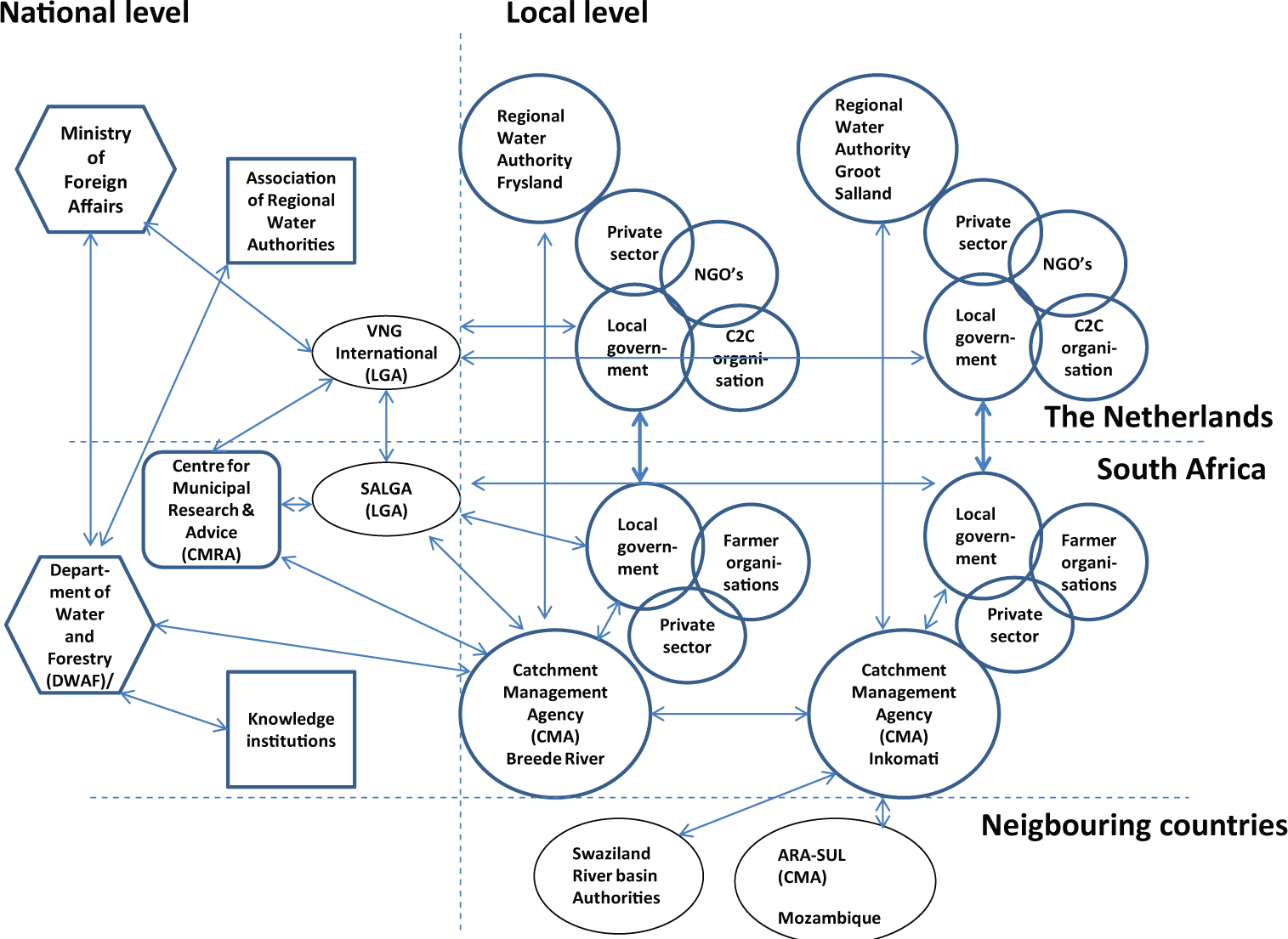
Policy mobility through multilevel governance networks in South Africa.
Both in Benin and Indonesia the exchange programmes were relevant to national government policies, although multilevel networks there were virtually absent. In these countries, a lack of urgency seemed to exist with regard to the realisation and consolidation of such networks across administrative echelons. In both countries various LGAs exist at national and regional level, making the LGA landscape highly fragmented.
Conclusion
We now come back to the question raised at the beginning of this paper: namely, to what extent this programme primarily promoted policy transfer, or whether its activities developed further into urban policy mobility, with knowledge circulation and mutual learning spillover effects and the forging of hybrid networks across scale levels? LOGO South did successfully (and efficiently) support knowledge transfers and some mutual learning. It had an important added value compared with other channels of international support, in the continuity and good international peer-to-peer knowledge exchange embedded within it, and the potential of mutuality between partners. The current debate centred on the further question concerning the extent to which such programmes contribute to policy transformations, moving from policy transfer to policy mobility.
The Dutch LOGO South programme built on the key characteristics of MIC, adding some unique features by providing programmatic support in strategic areas of municipal responsibilities. These unique features included: creating focus by selecting and supporting strategic areas of municipal responsibilities, promoting dissemination between municipalities providing spillover effects in learning processes, and linking a variety of actors, creating both horizontal and multilevel hybrid networks. Analysing core dimensions in supporting local governance, mixed results were obtained with respect to capacity development. Staff capacity and service delivery did improve in most cases. Revenues have been raised in those cases where the programme focused on that issue (Nicaragua and Benin). Citizen–government interfaces have been most convincingly strengthened in Nicaragua.
Linking our analysis to the debate on urban policy mobility, the tools developed by the LOGO South programme mainly focused on technical capacity building, contributing to ‘knowledge transfer’. However, several impacts on local policies were also found, in which Southern partners adopted policy aspects of the northern partner. Examples of such policy transfer are the water authority models introduced in South Africa and housing models in Nicaragua. Knowledge circulation also took place, where broader policy networks – or ‘multilevel governance networks’– in the South emerged; this was the case in Nicaragua, where MIC acted as a catalyst for development, bringing in multiple funds and partners, and hybrid networks emerged. Knowledge circulation occurred in the multilevel policy networks in South Africa, in which an entire sector (water) was strengthened. Finally, we observed multiplier effects towards other local governments and stakeholders outside the formal MIC programme.
Our conclusion is that policy transfer is still the dominant process within the LOGO South progamme. However, policy mobility does occur within the networks built up in LOGO South, but in a different manner than assumed in the literature (cf. McCann and Ward, 2011).
First, although the original sourcing of knowledge is mainly from the Netherlands, the dissemination and exchange activities leading to further policy mobility is South–South, at both national and regional level.
Second, policy mobility has usually been discussed in the context of city growth strategies that are spread internationally; in this programme knowledge transfer and exchanges within national networks concerned issues of classic public service provision and administrative strengthening (tax collection, registration).
Third, policy mobility in terms of local adaptation did take place. However, institutional and political barriers were found to limit the possibilities of policy mobility. This is an issue which the debate should take up more integrally in future work.
Finally, the multilevel networks that have been built up illustrate a more hybrid arrangement, creatively drawing knowledge from other sources as well as the main policy transfer embedded in the programme aims. Recognising the potential multilocality of knowledge sourcing can also contribute to the debate, balancing the globalisation of the Northern perspective (cf. Robinson, 2005).
Footnotes
Funding
This research received no specific grant from any funding agency in the public, commercial, or not-for-profit sectors.