



Abstract
As a main rural initiative, village land shareholding cooperatives spearhead non-agricultural development in the interest of rural communities, and thus participate in urbanisation. Nanhai, Guangdong, is a case in illustration. The institution of land shareholding cooperatives gives rise to unique compartmentalised industrialisation and fragmented urbanisation in the context of high population density and small-area autonomous villages. Village cooperatives are mutated from economic corporations to welfare organisations, prompted by the collapse of village enterprises. Being averse to investment for long-term productivity, village cooperatives indulge in extracting short-term land rents solely. Extracting land economic rents created by urbanisation, village cooperatives generate environmental and social equality problems. High-density low-income countries, especially in Asia, are facing a great challenge as fierce competition for limited urban land resources without effective governance often results in an unfavourable form of urbanisation. Sustainable compact urbanisation needs to strike a balance between local autonomy and urban integrity.
Keywords
Introduction
China’s urbanisation since the early 1980s has been a historical phenomenon in terms of its economic and social impacts on the populace of this enormous developing country. Land development for urbanisation takes place extensively to the suburbs of metropolises where competition for land between urban governments and rural communities is explicitly demonstrated. Upon the dismantling of People’s Communes, rural economic development has been more or less decentralised to individual village households, except for the phenomenal movement of rural collective industrial enterprises which prospered in the 1980s and withered in the 1990s in dynamic industrialising regions. Young villagers either move to nearby towns or migrate to faraway cities to find non-agricultural jobs, as farming alone cannot support household living. However, in the periurban areas of dynamically growing regions, the village cooperatives have become the primary mode of collective economies (Shi, 2000). Nanhai is one of the leading pioneers in this pursuit. In facing infiltration of urban-sponsored developments into the rural territories, rural villages initiate bottom-up institutional change in the best interest of rural communities. Village land shareholding cooperatives were set up consequently in the early 1990s and began the process of autonomous rural development. Nanhai has been physically, economically and socially urbanising while the villages are still governed by the traditional rural autonomy.
Village autonomous governance is a laudable institution that safeguards villagers’ interests. However, implicated by the general cooperative problems and acute land scarcity, will village-based land shareholding cooperatives be a boon or bane to the rural communities and urbanisation in general?
Rural autonomous cooperatives under land scarcity and economic competition: The impact of institutional change on sustainable urbanisation
Societies and economies are bound by institutions that are ‘the humanly devised constraints that structure political, economic, and social interactions’ (North, 1991: 97). Institutions are composed of both formal rules such as constitutions, regulations and laws, and informal constraints such as conventions, moral rules and social norms. Formal institutions are explicitly enforced by the state, while informal institutions are maintained by the communities. Organisations, whether they are political, economic or social, behave and perform as collective actors within a framework defined by institutions (Knight, 1992). Although institutions can provide a framework for social and economic transactions, informal institutions may face challenges in the context of rapid social and economic changes when social norms are undergoing change. Institutional uncertainty could induce disorderly short-term behaviours.
Institutions are evolving constantly, driven by socioeconomic and technological changes. In North’s (1990) view, institutional change is always made marginal, incremental and path-dependent by an immense stock of social capital in the form of an institutional matrix. Institutional change is thus related to social choices that are constrained by cultural norms. China’s economic and social transitions suggest profound institutional change. People’s Communes under the central planning were abandoned and replaced by the decentralised Household Production Responsibility System (HPRS) in the early 1980s (Kung, 1995). Driven by the dynamic rural industrialisation which was facilitated by the market-oriented investments, village economies in the dynamic urbanising regions were rapidly transformed from agricultural to non-agricultural. The HPRS soon became an institution impeding villages’ non-agricultural development.
Endorsed by the Nanhai Government that actively promoted village economies, Land Shareholding Cooperatives (LSCs) emerged in the early 1990s as an experiment of rural reforms (Fu and Davis, 1998). This initiative has then been followed by other urbanising regions and adopted as a main mode for rural collective development. Cooperatives are an institution. A cooperative is ‘an autonomous association of persons united voluntarily to meet their common economic, social, and cultural needs and aspirations through a jointly-owned and democratically-controlled enterprise’ (The International Cooperative Alliance, http://www.ica.coop, cited by Ortmann and King, 2007: 41). As an organisational arrangement, cooperatives are characterised as voluntary and open membership, autonomous management, and members’ active participation in the economic management (Hendrikse and Veerman, 2001).
A cooperative may be able to serve its members’ economic needs in a certain social context, but as an organisation it has intrinsic problems breeding members’ short-termism. Short-termism is caused by the problems of free-riders, horizon, and transaction costs in decision-making (Cook, 1995; Royer, 1995). When property rights are not transferable and not clearly delineated in the open membership cooperatives, free-rider problems occur. Having the same rights as the existing members, new members without prior contribution to the cooperative can obtain the rights to residual claims, which causes dilution of returns to the existing members. The horizon problem arises when the productive life of collective resources is longer than the time-span a shareholder can claim on the dividends generated, as the shareholder may leave or die (Porter and Scully, 1987; Vitaliano, 1983). The horizon problem is derived from the problem of restrictions on transferability of residual claimant rights. Therefore, there is a disincentive for members to contribute to the long-term investment and an incentive for members to maximise the short-term dividends.
Because of the democratic member-controlled system (one-member-one-vote), there could be high transaction costs in reaching management decisions, and the cost of group decision-making increases with the size and diversity of the cooperative (Staatz, 1987). Cooperative management may not be able to react to market opportunities in a timely manner, likely leading to management inaction. Ostrom (1990) advocates management of common pool resources with neither centralised government control nor privatisation. However, contextual variables such as the relative scarcity of the resource and the size of the collective involved are emphasised as critical for effective collective self-governance (Ostrom, 2000). High population density and land scarcity challenge collective governance over common land resources. Autonomous village-based cooperatives in high-density land-scarce Nanhai are made spatially small and fragmented. Preferring short-term gain to long-term investment, village land shareholding cooperatives without economies of scale will gradually become underproductive in the environment of intense market competition, and diminishing returns will make village cooperatives economically unsustainable in the long term.
It is well recognised that sustainable urbanisation is a formidable challenge to low-income developing countries, as pursuing economic growth and improving social welfare are still the top priorities for their government agendas and aspirations of their citizens. It is indisputable that sustainability for the developing countries hinges on their economic sustainability which, in turn, relies to a large extent on the efficiency of their economic development. Inefficient economic development wastes resources unnecessarily, and thus adds to tension in social relations and heightens pressure on the environment. Deficiency of wealth often leads to social injustice and environmental unsustainability.
LSCs: A rural autonomous organisation designed for village economic development
Rural industrialisation in China has had a long history. It started in the late 1950s when it was intended to support agricultural production by making use of local materials and labour (Byrd and Lin, 1990). Since the early 1980s, farm productivity has been improved by the HPRS significantly and soon the problem of surplus labour emerged (Putterman, 1995). The township and village enterprises (TVEs) thus flourished, providing industrial employment to those made redundant from farming. In 1976, there were 1.1 million TVEs employing 17.9 million workers and producing a total gross income of ¥27 billion (Chang and Kwok, 1990). In 1993, 24.5 million TVEs were in operation, and employing 123.5 million workers with a production of ¥3154 billion, which represented about 40% of the nation’s total industrial product, whereas it was only 9% in 1978 (Chang and Wang, 1994; Wong and Yang, 1995). Rural industries became one of the major forces transforming peasants’ lives and building up a local social service system.
Nanhai is located to the immediate west of Guangzhou, the capital city of Guangdong Province, and to the north of Foshan central city. Nanhai used to be a rural county, and it has become a district annexed to Foshan municipality since 2003 (see Figure 1). Located in the fringe of both central cities, it has been a dynamically growing locale in the Pearl River Delta since the 1980s. Dynamic industrialisation has attracted to Nanhai an influx of migrants who accounted for 53.6% of the total population in 2011, rising from 12.6% in 1988. The total population increased by 144.2% during the period 1988–2011 as a result, making Nanhai a high-density rural district (Nanhai Bureau of Development Planning and Statistics (NHBDPS), 1998, 2012).
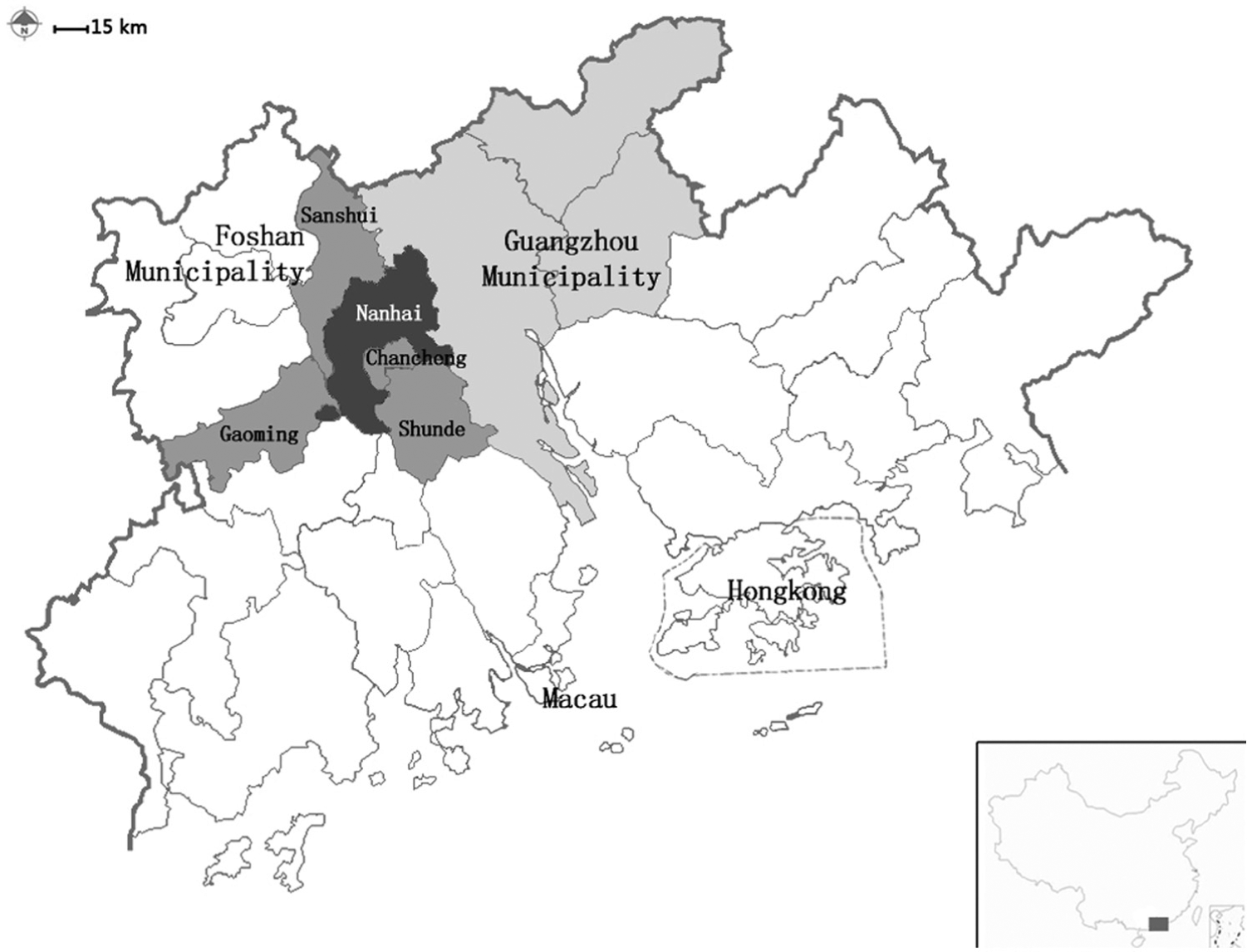
Location of Naihai in the Pearl River Delta.
Natural-village-based LSCs
Nanhai’s TVEs had been growing at a high speed until the collective ownership was at issue. The number of TVEs had reached the zenith of 3878 by 1996 (392 in 1978) (NHBDPS, 1998). The village industries contributed 31.2% to the Nanhai’s total industrial output in 1984, and the share rose to 47.2% in 1995 (NHBDPS, 1998). Correspondingly, the built-up land for non-agricultural uses as a percentage of the total rose from 10.7% (1990) to 27.9% (1996) (Nanhai Land and Resource Bureau, 2008), and agricultural labour as a percentage of the total rural workforce declined from 38.1% to 24.9% in the same period (NHBDPS, 1998).
Being the basic social unit in rural China, natural villages have been a very stable and steady institution in the long Chinese history (Gao, 1999). The 1949 revolution imposed the People’s Communes as the basic organisation on rural society, and this top-down collectivisation later gave rise to one of the drastic economic disasters in China’s history. The People’s Communes have thereafter been abandoned and replaced by the HPRS since the early 1980s. However, private land ownership has been abolished by the revolution, and rural land has become collectively owned by the agrarian community ever since. Since the establishment of HPRS, villages have been restored as the basic social unit, and agricultural production is decentralised to village households that till the land leased from their villages. Village land stock is equally distributed among all village households for a 30-year leasehold based on the egalitarian principle (Kung, 1995).
Nanhai was a county with very high population density and thus severe land scarcity. Farmland per capita was only 0.04 ha in the early 1990s, only one-third of the national average (Ministry of Agriculture, China, 1993). Further improvement in agricultural productivity was severely hampered by the extremely fragmented land subdivisions created by the HPRS. Meanwhile, off-farm employments have become abundant in Nanhai and elsewhere in the Pearl River Delta that has been rapidly industrialising since the 1980s. Instead of tilling the meagre landholding, young villagers went to the mills to seek better remuneration. Twenty percent of rural labour had already been engaged in non-agricultural employment by 1990 (Hou and Zeng, 1991). Farmland was left idle as a result. The nature of collective landownership forbade land transfer between village households, let alone land sublease to farmers outside the village (Fu and Davis, 1998; Yao, 2000). The dire situation called for institutional change.
Farmland lots need to be pooled to enable agricultural production with economies of scale. The beckoning rural collective industrialisation needs consolidated large land parcels as well. Village-based LSCs were a bottom-up local initiative that emerged in Nanhai, endorsed by the government authority in 1993 as it re-collectivised and pooled fragmented land holdings to facilitate farming on an increased scale (Nanhai District Government, 1993). All land parcels except family housing plots are re-collectivised and managed by the LSC committees elected. In return, village members are given LSC shares and become the shareholders. Only village members can hold the LSC shares, and those shares cannot be transferred and sold. If a member has to quit the village (for instance, death or migration), his or her shares should be surrendered to the cooperative. Shares are distributed to the cooperative members equally based on a formula which takes into consideration members’ prior contribution towards the collective resources. Incomes from the village economy are distributed among cooperative members according to their shares, albeit about 40% of the collective incomes are required to be held by the cooperative organisation for future collective development by the government. Since villagers are the natural members of LSCs, LSCs are reckoned as both social and economic autonomous organisations, not controlled by professional managers as are urban shareholding corporations.
Though the Organic Law of Village Committees (1988) has officially promulgated that administrative villages should be the basic autonomous social and economic units in the rural regions, most LSCs in Nanhai are conceived based on a natural village which usually consists of members of the same clan. 1 Social norms as informal institutions may still be effective in the management of a close-knit homogeneous community, as clan-specific informal institutions may not be sufficient for providing order to a diverse and heterogeneous aggregate. As a result, there were a total of 2063 LSCs in Nanhai at 2010, in which only 13 LSCs were set up at the level of administrative villages, consisting of several natural villages. The remaining 2050 LSCs were composed of 1839 natural-village-based and 211 administrative-village-committee-managed, 2 accounting for 99.4% of the total. On average, a natural-village-based LSC has a tiny area of 42.2 ha and 410 members. Thereafter, Nanhai’s rural development has been led by the village LSCs.
Leasing of non-agricultural land as informal institution
Rural industrialisation grew dynamically until the mid-1990s when manufacturing became increasingly globalised. Rudimentary village enterprises faced increasingly hard competition from inward foreign and private firms which had industrial expertise and understood modern business management. Privately owned enterprises and joint ventures gradually took over, while village industries had withered, either bankrupt or privatised from the late 1990s (Che and Qian, 1998; Li and Rozelle, 2003; Pei, 2002). Collectively owned enterprises’ share in the total industrial output declined drastically from 50.2% (1998) to 2.9% (2008), while the foreign and private enterprises’ industrial output as a percentage of the total jumped from 40.9 (1998) to 96.4 (2008) (NHBDPS, 1998, 2009). LSC economies were in peril in the face of market competition, which prompted an informal institutional change from the below.
With the closure of village enterprises, LSCs gradually took the role of ‘landlords’, leasing land to private enterprises and their migrant workers so as to live on land rents. According to China’s Constitution, rural land is collectively owned by the agrarian community. However, China’s collective land is a unique institution. The idiosyncrasy of the collective land ownership is that it is based on the Marxist doctrine that land should be treated as a means of production, not an economic asset. Land is owned by the rural communities on the condition that it is only used for economic production. Collective land ownership is thus defined as such that the collective has neither the right to derive income from land by letting it out, nor the right to change its form and substance by developing it for non-agricultural activities without approval from the government at the county level or above (Lin and Ho, 2005).
Thus, leasing of non-agricultural land without urban state’s approvals is an informal institution. 3 The fact that LSCs cannot place their land plots as collateral for bank loans is a clear testament that collective land is not an asset. Village land leasing to the outside industrial investments was allowed in the name of ‘economic reforms’ with tacit consent of the district government. This local practice was only formally recognised in 2005 by the Guangdong Provincial Government in the spirit of economic reform (Guangdong Provincial Government, 2005), but the central government remains cautious and reticent. According to the Nanhai’s statistics of four years (2006, 2008, 2009 and 2011), land rents to LSCs’ total income accounted for 81.7% on average over these years (Nanhai Department of Rural Work (NHDRW), 2007, 2009, 2010 and 2012).
Fragmented non-agricultural development led by LSCs
Nanhai was a rural county in 1988 when urban and town centres only accounted for 1.4% of the total built-up land, while rural built-up land (mainly village housing and industrial land uses) amounted to 94.6% of the total (irrigational infrastructure taking the remaining 4.0%). During the period 1988–2000, areas aggregated to a size of 328.3 km2, or 28.5% of the total territory, were converted from farmland to land for non-agricultural uses, among which 20.8 km2 were for rural housing, 153.6 km2 for industries, and 60.8 km2 for urban and town centres. In 1988, built-up areas only accounted for 10.8% of the total area (http://datamirror.csdb.cn/admin/introLandsat.jsp, accessed 12 April 2013). LSCs as basic units for collective farming may be an appropriate institutional arrangement, but LSCs as autonomous and independent units for industrial development are obviously too small for integrated clustering of manufacturing. Fragmented industrialisation appears in Nanhai as every LSC pursues industrial development.
An analysis of satellite remote sensing maps reveals that the built-up land has been developed in a spatially dispersed pattern. Consequently, agricultural and non-agricultural land uses are intensively mixed up. A Fragstats 4 patch analysis highlights that farmland has become increasingly fragmented over time, indicated by an increase of patch numbers from 77 (1990) to 448 (2000), and the gradual fall of the mean patch size from 1245.5 ha to 164.8 ha per patch. The continuous dropping off of the contagion index over time (from 62.7 in 1990 to 38.0 in 2000) shows that Naihai’s landscape is increasingly fragmented, with farmland and built-up land extensively piecemealed and spatially intermingled.
LSCs: Economic corporations sliding into welfare organisation
LSCs were intended as economic organisations, and expected to operate like normal shareholding corporations. The shareholding structure was fixed initially, i.e. a closed membership system, as collective revenues were expected to be used chiefly for village welfare and development, and only a very small percentage is for dividends. Because of the closure of most village industrial enterprises in the mid-1990s and consequent institutional change, LSCs have been transformed from an organisation of economic production to one for land-rent extraction.
Contest for the collective entitlement: Pushing for open membership
Because village land is ‘owned’ collectively, village members are legitimately entitled to the benefits derived from collective common land. Since LSCs were increasingly relying on land rents, the initial fixed cooperative membership system was challenged. There were no reasons why only existing members could claim the land benefits, as village population change was still dynamic. The closed membership structure gave rise to an equity problem, as new village members brought in by birth and marriage were not entitled to LSC shares, while those members having left villages because of death or migration could still claim village revenues. Equity in village members is a legitimate concern.
Villagers with rural hukou (certificate of registered household residence) are natural members of LSCs. Following a long-established rural tradition that ‘married daughters are like water splashed out’ (Wang, 2004), a married daughter should join her husband’s community and give up her entitlements in her parents’ village. It is a village social norm that married daughters should not be the shareholders of LSCs where they belong to before they are married out. However, some modern married women felt strongly about gender unfairness in this traditional social practice. As early as in 1994, 60 young women went to Nanhai District Government to appeal for renouncing the gender discriminative custom (http://www.womenwatch-china.org/newsdetail.aspx?id=7946, accessed 14 March 2013). 5 The so-called ‘married daughters’ grievance’ became one of the top social issues with widespread publicity, though they were the minority, representing only about 3% of the total rural population in Nanhai (http://fs.southcn.com/xwss/msxw/content/2009-04/23/content_5093983_2.htm, accessed 14 March 2013).
Only sons can inherit the land and houses of their parents, and this social norm has been well established in rural society. Urbanisation brings in social change. Urban society endorses gender equality. The clash between the minority married daughters and the majority villagers is the confrontation between the traditional rural informal institution and the modern formal institution. When married daughters appealed to urban governments to deal with gender discrimination, the urban authorities had to invoke the formal institution of gender equality which had been adopted since 1949 when the Communist Party founded the socialist China. Everyone has to be treated equally as long as she or he is a registered member of the village. The village majority resisted urban ruling for long, and married daughters kept protesting. Their appeals accounted for 42% of the total social protests occurred in Nanhai in 2004 (Nanhai Department of Policy Research (NHDPR), 2005). Eventually, married daughters prevailed, symbolising that the informal institution is subdued by the formal one when the former fails to manage the villages. They are given equal shares like their brothers.
The closed membership system has to be abandoned by most LSCs, and an open membership has been adopted since the early 2000s. New members, as long as they have their village hukou, can purchase LSC shares for a fee (buying instead of being given shares free of charge because they have not contributed to the village resource) according to a pre-determined formula. In the same spirit, another social norm is brought back in. As a Chinese social tradition, society needs to take care of those aged members. Many LSCs have adopted a policy allowing senior villagers to purchase additional shares at a discount rate as a village pension scheme. According to the field investigation the authors conducted, a shareholder of 60-year-old in Pingnan LSC can hold up to three shares, while a village member of 20-year-old has only one share. Additional shares could be purchased at ¥16,000 per share (a price in 2009), while the dividend in the same year was ¥1820 per share. The ‘investment’ could be recouped in 9 years. In Shuibu LSC, the share price in 2011 was only twice the yearly dividend. LSC shares are more about welfare than investment.
As a result, the number of shareholders has been increasing. In eight years, the number of village shareholders increased by 30%, from 583,100 to 756,700 (NHDRW, 2003–2011). Rural hukou becomes valuable, which is unprecedented in the post-1949 Chinese history, as urban hukou has always been a more coveted entitlement than the rural hukou (Unger and Chan, 1999). Fifty three percent of Nanhai’s region had been urbanised by 2008, but residents with rural hukou still accounted for 64% while urban residents represented the remaining 36% of the total (NHBDPS, 2011).
Village equity may have triumphed, but the free-rider problem looms large. The number of shares has been increasing every year, and it is beyond the control of existing members. The future returns per capita become uncertain. LSC shares cannot be transacted in the open market, and thus LSC shares do not have market value. Though shares could be bought back in the case of member’s departure, or shares could be sold to other members in the same LSC, the share prices, comparing with annual dividends, are relatively low. Therefore, LSC members do not have a long-term perspective, which constitutes the horizon problem (Cook, 1995). Shares are treated as a certificate of entitlement only, rather than an investment. LSCs have been gradually becoming welfare organisations since the late 1990s.
Management of LSCs: Case study of Lianxing administrative village
Village cadres used to enjoy great authority over the management of villages during the era of People’s Communes. Even when the autonomous HPRS was in place, land leasing to the village households and frequent land subdivision and redistribution were subject to village cadres’ peremptory decisions, as they often acted not in the interest of villagers (Cai, 2003; Dong, 1996; Guo, 2001; Li and Rozelle, 2003). LSCs have changed that cadre–villager relationship and enhanced the power of villagers as shareholders who elect their representatives to make up of the LSC management committees. Being elected every three years, a management committee administrates the village economy with major decisions decided in general meetings attended by at least two-thirds of total shareholders and approved by the two-thirds majority of those who are present (Po, 2008). LSCs are controlled by members effectively. The authors’ field investigation of 32 LSCs reveals that the performance of LSC management committees is basically assessed by their ability of giving out dividends with annual increments. Ensuring an increase in annual dividends continuously to the shareholders has become the top priority of the LSC management.
An in-depth investigation of Lianxing administrative village was carried out by the authors during March–May 2012. Lianxing consists of 11 natural-village LSCs and one administrative-village-committee LSC, with a total area of 201.5 ha. Because of dynamic economic and social changes, movements of village members are frequent. Besides natural births and deaths, marriages bring in spouses as new members, and some young village members leave for better employment opportunities elsewhere. Lianxing’s population statistics revealed that population change during the period 2000–2012 affected 38.4% of the total members, though net population increase was about 11.3%. 6 High volumes of LSC share transaction (selling and buying back) at discretionary rates without market prices make short-horizon problems prominent. The share price in 2011 was only twice the yearly dividend, which is clearly not in favour of those who sell but benefits tremendously those who buy. The horizon problem exists for both the aging and young members who do not have incentives to contribute to the long-term growth opportunity.
Shuibu LSC is one of the 11 LSCs in Lianxing. There were 535 villagers, 180 households and a total area of 18.8 ha as of 2012. A survey of village household incomes was conducted in Shuibu where 144 households (80% of the total) were interviewed. It unveils that, though the annual remuneration (¥27,841) from off-farm employment of a village labour is only 62.9% of what an urban worker can earn (¥44,237), an average village household has a total annual income of ¥150,035 which is only slightly less than an urban household annual income of ¥168,655 in 2012 (NHBDPS, 2013). It is the LSC dividends (¥52,962 per household or ¥11,600 per member) that close the gap between the rural and urban household incomes. Contributing 35.3% to the annual household income, LSC dividends are a very significant source to the village household welfare (see Table 1). It is achieved by the LSC where 61.7% of the total village land is for leasing. It is an unusually high percentage, as if 535 villagers are living in an industrial zone. The land leasing income amounts to 91.0% of the total LSC revenues, and 85.3% of the total LSC revenues are distributed to the village shareholders as dividends.
Structure and annual income of an average household in Shuibu LSC, 2012.
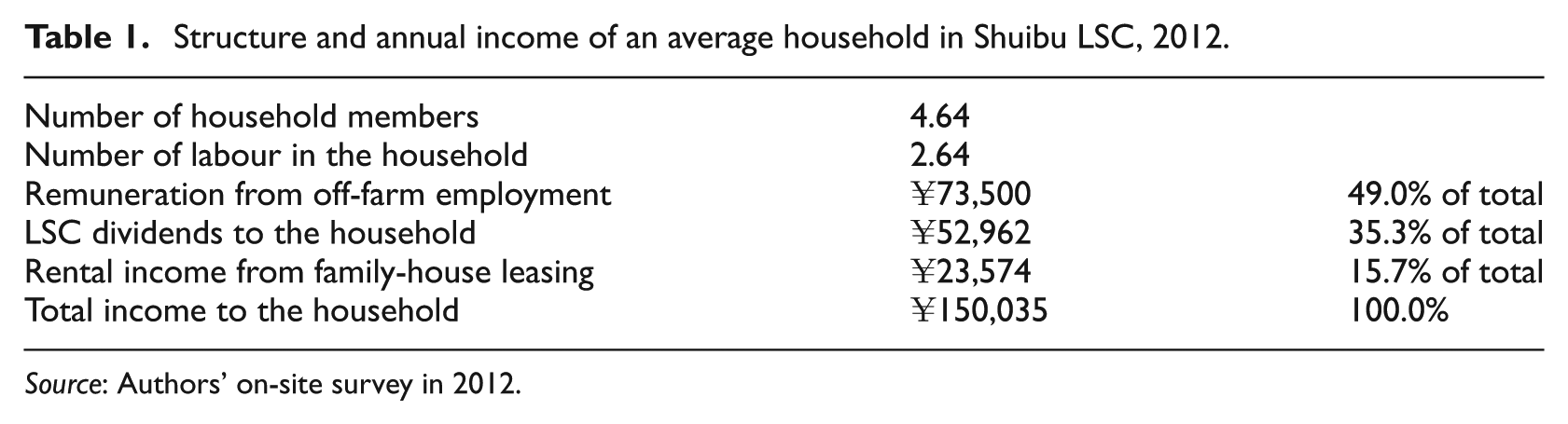
Source: Authors’ on-site survey in 2012.
Nevertheless, in spite of a great deal of dividends distributed, those who are very satisfied with the amount of LSC dividends received only account for 6.4%, according to the authors’ questionnaire survey to 92 villagers. Of these, 37.2% believe that annual dividends could be more. A total of 50.0% is unsatisfied and the remaining 6.4% very unsatisfied with the amount of dividends received. Although 54.3% are worried about the long-term sustainability of the land leasing village economy, only 15.5% of those interviewed are willing to cut down the dividends so that the LSC can retain more for improvement and investment. It seems that the majority of LSC members are only interested in the extraction of land rents. It also reveals the equality problem between the migrant and local workers, considering the facts that there were 25,000 migrants living in Lianxing and the local villagers only accounted for 17% of the total population in 2012. The total income to migrant workers in the village factories is only two-thirds of local workers’, as the latter are entitled to LSC dividends.
Cooperative problems: Short-termism
Because land leasing is the major pillar of the LSC economy and land resource per capita is meagre, LSC members do not have confidence in the long-term future of LSCs, coupled with general cooperative free-rider and horizon problems. Short-term returns and welfare are preferred over long-term economic productivity. The primary concern of the village managers is the maximisation of revenues for distribution, and no one seems to care about sustainability of the collective economy. The statistics show that natural-village LSCs’ revenues retained for investment were only 6.3% and 6.6% of the total on average in 2007 and 2008, respectively (NHDRW, 2008).
Under the pressure of maintaining ever-growing dividends, LSCs have to convert more farm land and lease it to industrial tenants in order to increase cooperative incomes. Agricultural land was converted to industrial land at a rate of 1280.3 ha per year during 1988–2000, and this rate increased to 1941.5 ha per year during 2000–2008 (Nanhai Land and Resource Bureau, 2008). The land-use statistics of Lianxing unveil that in 1994, 21.1% of the total village land was used for leasing to industries. The figure rose to 58.6% in 2008. Industrial lands were scattered to all of its LSCs, and the percentages of industrial land in the 12 LSCs vary from 44.1% to 72.3%. In 2012, Lianxing hosted 469 small industrial plants, only three plants having an output annual value more than ¥5 million (a quality yardstick used by local official statistics). An influx of migrant workers comes with a rapid increase of labour-intensive factories. In 22 years (1990–2012), population in the village increased by 4.4 times, and the resident density reached 16,300/km2 in 2012 (Archives of Lianxing Village Committee, unpublished). Serious environmental problems in the high-density villages are imaginable. Lianxing is not an isolated case. In the whole of Nanhai, 65.1% of the total collectively owned built-up area was used for manufacturing, while rural village residential land uses only accounted for 28.9% in 2008 (Nanhai Land and Resource Bureau, 2008). It is extraordinary and excessive that almost half of village land resources are used by and leased to manufacturing, and villages have virtually been occupied by the industrial plants.
Moreover, in order to raise annual dividends, many LSCs have adopted a policy of direct leasing of raw land without services and premises, so as not to spend on capital investment. Raw land leasing usually does not incur expenses on facilities and infrastructure, and allows tenants to build their own premises. In Guicheng town, there were a total of 1295.8 ha industrial land managed by 114 LSCs in 2007, of which 977.3 ha (75.4%) were leased directly to the industrial tenants without necessary infrastructure, and 318.5 ha (24.6%) were developed with factory premises and facilities built prior to the leasing. Despite the fact known to the cooperatives that land productivity of premises leasing (¥1.2 million/ha) could be as much as six times of that of raw land leasing (¥0.2 million/ha), three-quarters of the industrial land resources are still used unproductively (NHDRW, 2008). It seems that cooperative members are unwilling to sacrifice short-term dividends at all for a more productive long-term return. LSCs, initially intended as a collective economic corporation, have been sliding into a welfare organisation. The management and operation of LSCs centre on extracting short-term land rents instead of investing in long-term village economies.
Further institutional change stalled: Ossification of compartmentalised industrialisation and fragmented urbanisation
Compartmentalised industrialisation and fragmented urbanisation
Two phenomena stand out from the land-use statistics. The first is that bottom-up urbanisation is well pronounced as urban built-up land only accounts for one-third of the total, and the remaining two-thirds belong to rural built-up land which is overwhelmingly used by manufacturing. The second is that industrialisation has been significantly propelling urbanisation, evident by industrial land amounting to 57.0% of the total built-up land and the rural industries take three-quarters of it. As a result of LSC-led rural industrialisation, Nanhai has become substantially fragmented in terms of its spatial structure. LSC-led land development has produced 1868 industrial land patches spatially dispersed, and farmland has been disintegrated into 1862 patches. Self-contained development of small-area villages generates, in aggregate, compartmentalised industrialisation and fragmented urbanisation.
This bottom-up urbanisation may have reflected the interests of rural communities. However, very limited land resources are not productively utilised in the best interest of long-term sustainability. Self-contained mode of village-based industrialisation impedes the economic provision of industrial infrastructure (such as waste water treatment and other necessary services) which is essential for productive manufacturing. Poor quality industrialisation jeopardises the fragile ecological environment. Houses and factories are intensively mixed up in small villages. Polluting and hazardous plants are widely spatially dispersed, exacerbating the living condition of village communities. Environmental survey results show that Nanhai’s soil and irrigation water are contaminated by heavy metals to various extents, and thus the locally grown vegetables are affected with 46% of the samples certified as unsafe according to the public health standard (Chen et al., 2011). Air pollution and acid rain as environmental problems are equally serious (Li et al., 2007).
It is not exaggerating to claim that the whole of Nanhai is a huge industrial site. Land used by manufacturing amounts to 332.8 km2, representing 31.0% of Nanhai’s total territory. Excessive land development for manufacturing is caused by the informal institution of collective land leasing. The precious land assets are used extremely inefficiently, which could be otherwise used for social purposes, or retained as open space.
Underproductive utilisation of scarce land resources in LSCs
Two land-rights regimes (state-owned land and collective-owned land) have produced dual spatial clusters of manufacturing in Nanhai that are urban industrial zones and rural LSC industrial sites. Because of equipped infrastructure and facilities, urban industrial zones are more productive than rural LSC industrial sites. Numerous small industrial land parcels scattered in hundreds of LSCs and most factories in LSCs tend to be low value-added.
Located in Shishan township, Nanhai Economic Development Zone (NHEDZ) is the largest state-owned urban industrial zone (2312 ha) that amounts to 26.6% of the total industrial land owned by the state in Nanhai, according to 2008 statistics (Nanhai Land and Resource Bureau, 2008). Only industrial plants with annual output value more than ¥5 million are admitted, in order to make it a high quality industrial zone. Since the inauguration of NHEDZ which accounts for 25.6% of the total industrial land stock in Shishan, Shishan’s industrial land productivity has been enhanced significantly, which is shown by its comparison with Luocun township where 94.4% of industrial land is administrated by LSCs (see Table 2). Shishan’s industrial land productivity was only 60% of Luocun’s in 1996. With NHEDZ, Shishan’s was 65% more than Luocun’s in 2008. It demonstrates clearly that integrated urban industrial zones are more productive than rural fragmented industrial patches.
Productivity of industrial land in Shishan and Luocun, 1996–2008.
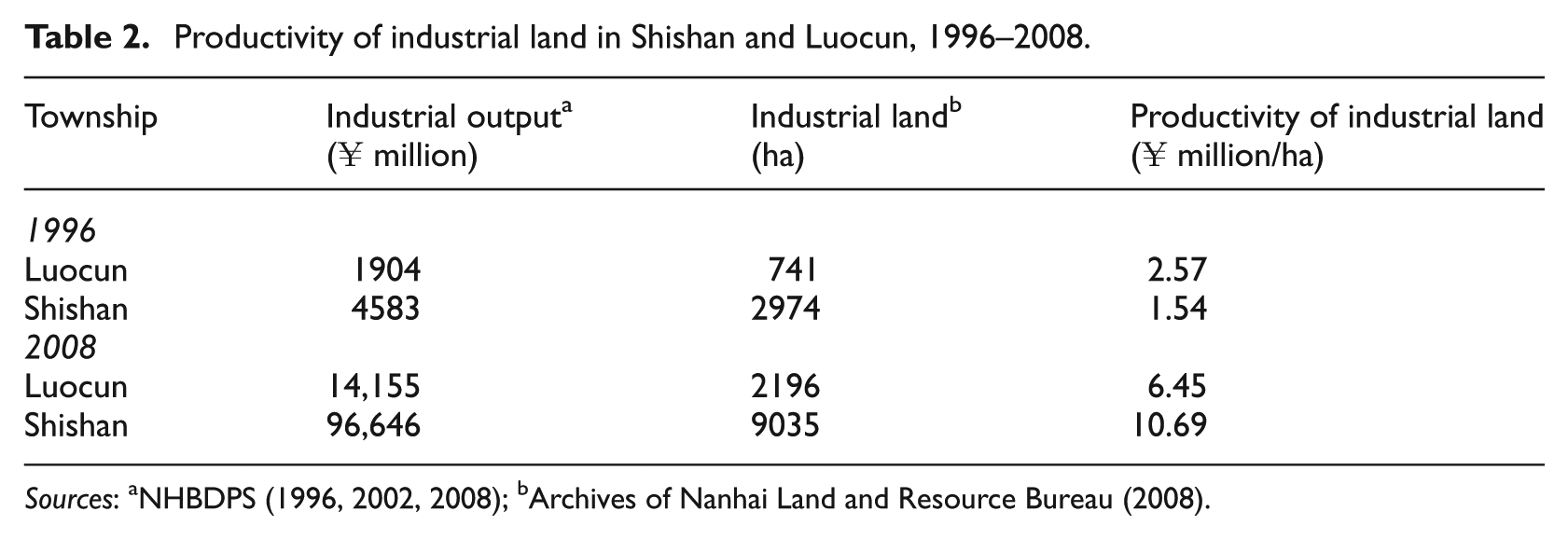
Sources: aNHBDPS (1996, 2002, 2008); bArchives of Nanhai Land and Resource Bureau (2008).
Since LSC industrial sites account for 74.5% of the total industrial land area in Nanhai, Nanhai’s economic productivity has been declining. Its GDP per capita used to be 109.6% of the Foshan’s average in 1998, but in 2010 it went down to 88.3%. Being the district with the lowest GDP per capita in Foshan municipality in 2010, Nanhai’s productivity was only 66.3% of the most productive district’s (Gaoming) (Foshan Bureau of Statistics (FSBS), 1999, 2011; see Figure 1). The most likely reason for rural workers’ remuneration being only 62.9% of urban workers’ is that manufacturing plants in rural LSCs are mostly low value-added and thus offer low wages (see section ‘Management of LSCs: Case study of Lianxin administrative village’). Low value-added industrialisation means that scarce land in Nanhai is used underproductively, which impinges on the sustainability of ecological environment and social equality between locals and migrants.
An attempt to coordinate integrated development between LSCs
Pingnan was composed of four village LSCs and one administrative-village-committee (AVC) LSC (see Figure 2 and Table 3). Natural villages’ land holdings are fragmentally distributed possibly because of historical reasons. Because of an unspecified quota of protected sown land was allocated to Xiangluo and Wudou LSCs, mediated by the township government and Pingnan AVC, these two LSCs are not able to convert protected sown land to industrial land for leasing. About 50–60% of the total village land was reserved for farming in these two LSCs, while only 14–25% of the total was for farming in Meiyuan and Shunlu, in 2002 (see Table 4). As a result, per capita dividend income for the shareholders of Xiangluo and Wudou was only 65.1% of that for the shareholders of Meiyuan and Shunlu (Archives of Pingnan Village Committee, unpublished). In order to solve the inequality problem between the LSCs caused by the national policy of sown land protection, four village LSCs and AVC-LSC were merged into one Pingnan LSC in 2003, led by the Pingnan AVC.
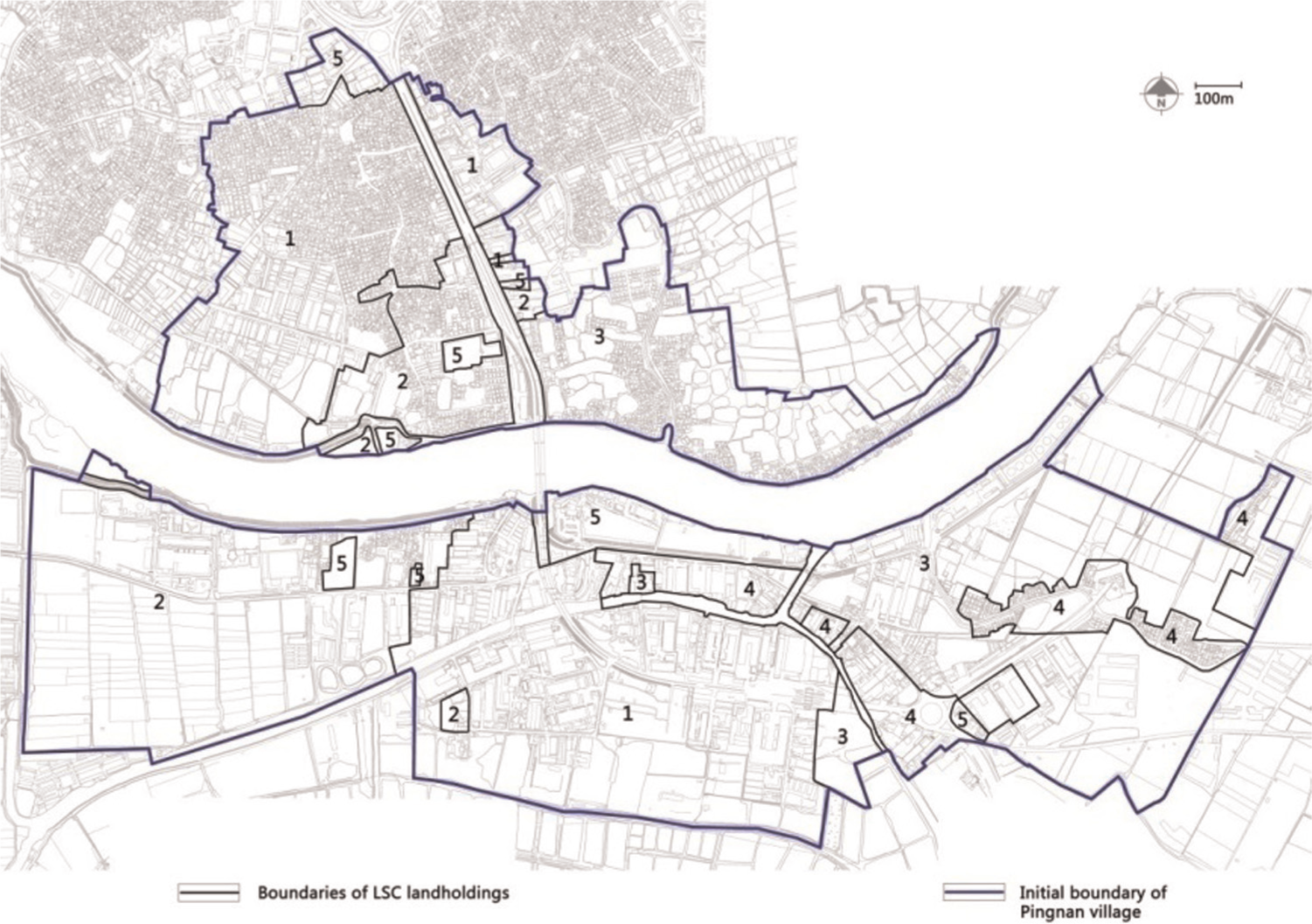
Location of LSC landholdings in Pingnan.
Land-use statistics in Pingnan Administrative Village, 1995–2008.
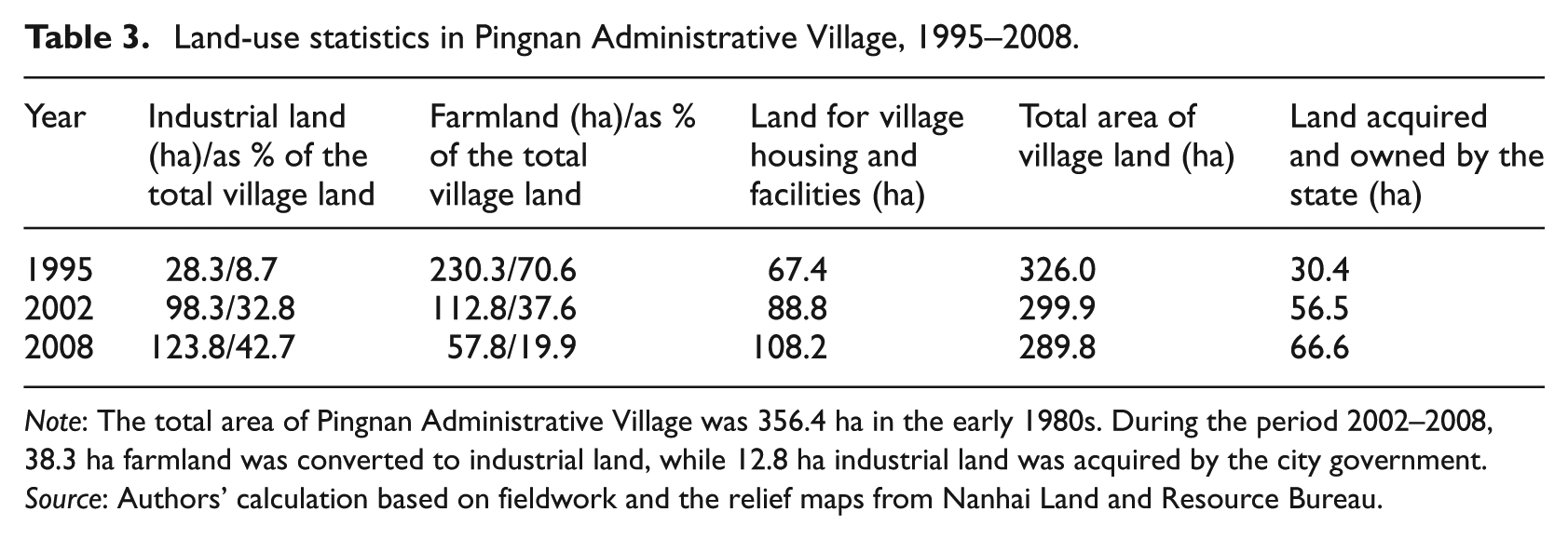
Note: The total area of Pingnan Administrative Village was 356.4 ha in the early 1980s. During the period 2002–2008, 38.3 ha farmland was converted to industrial land, while 12.8 ha industrial land was acquired by the city government.
Source: Authors’ calculation based on fieldwork and the relief maps from Nanhai Land and Resource Bureau.
Land-use statistics in natural-village LSCs and administrative-village-committee LSC, Pingnan, 1995 and 2002.
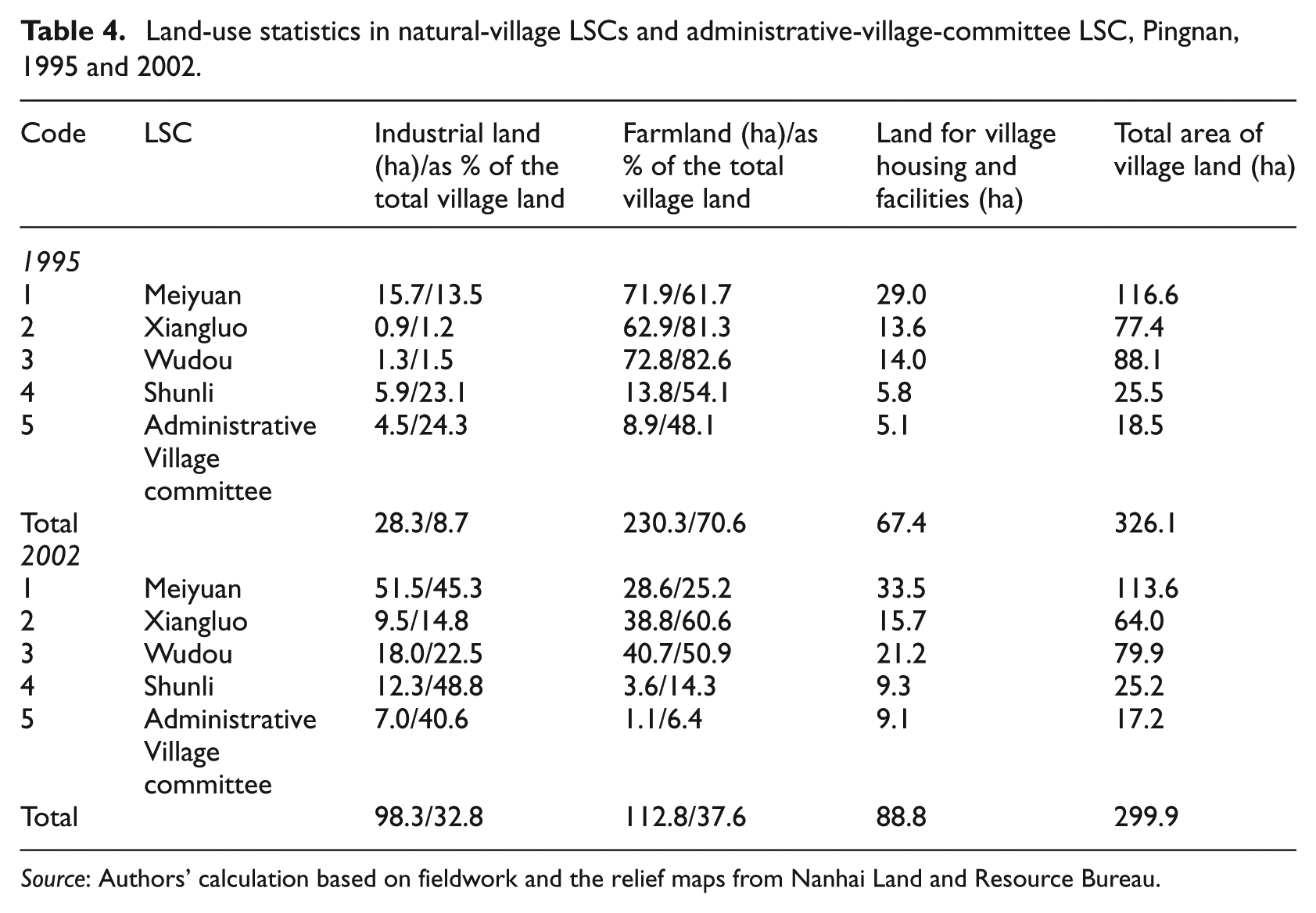
Source: Authors’ calculation based on fieldwork and the relief maps from Nanhai Land and Resource Bureau.
Income and welfare to villagers are equalised between villages in Pingnan, but agglomerated Pingnan has not seemingly improved productive use of industrial land with acquired economies of scale. As regulated by the initial institutional design, dividends to the villagers are not borne by the AVC-LSCs. Thus, AVC-LSCs can behave like economic corporations, focusing on the long-term quality development of the villages. In Nanhai on average, AVC-LSCs spent 23.0% of the total income on investment, while village-LSCs spent only 6.6% on investment and 93.4% on dividends and welfares to shareholders in 2008 (NHDRW, 2008). After the merger, dividends to villagers have become Pingnan LSC’s main responsibility. Initial Pingnan AVC-LSC as corporation is thus attenuated, and shareholders’ pressure for more dividends is fell on newly established Pingnan LSC. More revenues are distributed as dividends as a result. Between 2002 and 2008, new development of 38.3 ha industrial land was all farmland converted, and only 17.5% (6.7 ha) was serviced (see Figure 3). Existing low-quality industrial land stock remained underproductive.
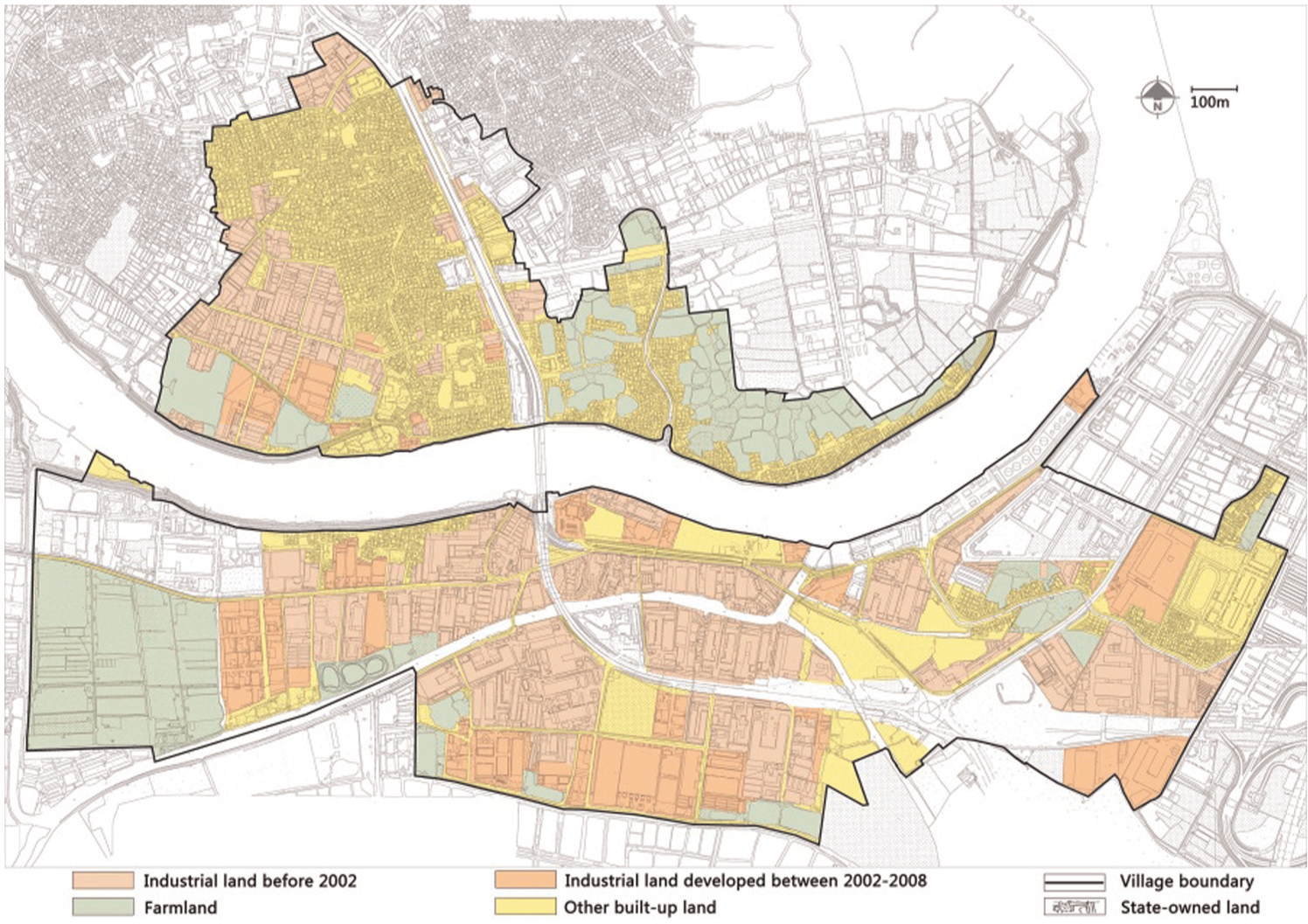
Land uses and new land development during 2002–2008, Pingnan.
Amalgamation of small village LSCs does not make the cooperative more productive, as the merged LSC remains a welfare organisation. A comparison between Nanhai’s average urban disposable income and Pingnan’s dividend to the villagers reveals that the latter’s increment (66.9%) is only two-thirds of the former’s (101.9%) over the period 2003–2011 (NHDRW, 2003–2011; NHBDPS, 2004–2012).
Locked in an underproductive mode of land development
Village LSC shareholders are averse to investment for long-term productivity, as it would reduce the amount of annual dividends received. Progressive extraction of land rents to the limit without adequate investment has LSCs locked in the state of gradual deterioration. Limited village land is used underproductively as industrial land and tenant plants are of low quality. Shareholders’ pressing for ever-increasing dividends drives LSCs to convert additional farmland to industrial land for leasing until there is no more vacant land left. LSC village economies are basically of quantitative expansion, instead of quality growth. Not able to sustain high-density villages, village land economies will then be stagnant and fixed in the vicious cycle of underproductivity. Unproductive industrialisation compromises the ecological environment and deepens the social inequality between the vast migrant workers and local villagers. Without external thrusts, the pattern of compartmentalisation and fragmentation is ossified by the village LSCs.
Conclusion
In rapidly developing Nanhai, village-based LSCs have improved villagers’ quality of life significantly, but this mode of non-agricultural development results in compartmentalised industrialisation and fragmented urbanisation. Environmental integrity is considerably compromised. Further institutional change to LSCs after the downfall of village industrial enterprises makes the rural collectives welfare organisations extracting land rents solely. Social inequality between migrant workers and local villagers are exacerbated by the stagnant factory salaries because of underproductive industries and rent-seeking behaviour of the locals. Cooperatives have problems of disincentives to invest in the future, but not necessarily problems of underinvestment. Under-investment in Nanhai’s land shareholding cooperatives is caused by the land-rent extraction from a meagre land stock on a per capita basis. When underproductive LSCs are ‘locked-in’, sustainable industrialisation and urbanisation become unattainable.
While villages are an appropriate autonomous unit for agricultural production, the level of autonomy may have to go beyond the village unit for non-agricultural development. Higher level coordination appears crucial for integrated industrialisation and urbanisation in regions of high density and land scarcity. Quality industrial and urban development as well as public and social goods will enhance ecological environment and improve social equality between the new migrants and existing local residents. The institution of land-use zoning for a township as a planning unit is needed to enforce industrial land amalgamation into a few industrial zones, while land parcels in the zones could still be owned by individual LSCs.
The Nanhai case study has raised two profound questions with broad implications: the extent and the level of autonomy in urbanisation in the context of high population density. Sustainable urban development for the Global South, especially for high-density low-income Asian countries, is a great challenge in the context of acute land scarcity. Cities in Asian developing countries are still expanding while a great magnitude of rural-to-urban migration is yet to come. Spontaneous or autonomous land development, prevalent in developing countries, often exacerbates shortages of scarce land resources. Fierce competition for limited urban land resources without effective governance often results in land-rent seeking and an unfavourable form of urbanisation. Expanding urban spatial capacity is critical for cities to accommodate rapidly growing urban economies with supporting infrastructure and physical premises.
Footnotes
Funding
This research is sponsored by the Global Asia Institute, National University of Singapore.
Grant No.: R-297-000-109-133