



Abstract
Previous studies have attributed the proliferation of rural migrant enclaves in China’s large cities primarily to the constraints limiting migrants’ residential options. Through an ethnographic exploration of Xiaohubei, a migrant enclave with a high concentration of Hubei rural migrants and small-scale garment producers in Guangzhou, this paper sheds new light on the dynamics and implications of the migrant enclaves. It argues that rural migrants are actually active agents who develop a vibrant garment manufacturing cluster by establishing a flexible garment production system, embedding their business within the enclave and maintaining a nationwide translocal network. It also contends that the enclave provides a feasible path through which migrants can achieve social mobility and adapt themselves to the urban environment. This paper concludes with a plea to take into account the agency and everyday practice of rural migrants when understanding the migrant enclaves and a reflection on the existing large-scale and indiscriminate demolition of the enclaves.
Introduction
China has experienced an unprecedented wave of rural–urban migration over the last three decades. By the end of 2012, there were a total of 260 million migrant workers in China, most of whom were rural migrants moving to the city for employment (National Bureau of Statistics (NBS), 2013). Rural migrants tend to congregate with their relatives, friends and fellows from the same hometown (referred to as laoxiang in Chinese) in particular urban areas, thus forming numerous migrant enclaves in China’s large cities (Gu and Shen, 2003; Ma and Xiang, 1998). Rural migrant enclaves are geographically bounded areas with a high concentration of rural migrants. While native-place-based enclaves (so-called Tongxiangcun in Chinese) such as Zhejiangcun in Beijing are mainly constituted by rural migrants from a particular province or county such as Wenzhou of Zhejiang Province (Ma and Xiang, 1998; Zhang, 2001a, 2001b), other enclaves such as urban villages in Guangzhou and Shenzhen accommodate migrants from different provinces (Wang et al., 2010; Zhang et al., 2003). The social implications of migrant enclaves become a subject of controversy in recent years. Policy-makers and the media commonly tend to depict the enclaves as the breeding grounds for social problems and the obstacles to modernisation, as presented by overcrowded housing construction, chaotic land use, severe infrastructure deficiencies and deteriorated built environment (Zhang et al., 2003). By contrast, some academics argued that the migrant enclaves play a positive role in the process of rapid urbanisation, as they not only provide low-rent accommodation to low-income migrants, but also enable indigenous landless peasants to earn their own livelihood by renting out their self-built houses (Li and Wu, 2013; Liu et al., 2010; Song et al., 2008; Wang et al., 2010; Zhang et al., 2003).
Although the above two sets of perspectives have focused on different ramifications of migrant enclaves and therefore have resulted in competing views on the implications of migrant enclaves, they both have portrayed rural migrants as passive and powerless sojourners who are exploited by global capitalist production, constrained by the household registration (hukou) system and trapped in the lowest tier of the urban labour and housing market (Chan and Zhang, 1999; Fan, 2004; Wu, 2008). However, both have failed to consider the agency and everyday practice of rural migrants, the resources that they hold, and the strategies that they use to negotiate various institutional, social and cultural constraints. In fact, rural migrants tend to adopt various strategies and mobilise their own resources to maximise their social and economic wellbeing, to transcend the rural–urban duality, and to circumvent institutional constraints (Fan, 2011; Fan and Wang, 2008; Liu et al., 2012; Solinger, 1999). Nevertheless, little research has so far been done to investigate the agency and everyday practice of rural migrants in relations to the formation and perpetuation of the migrant enclaves (notable exceptions include Ma and Xiang, 1998 and Zhang, 2001a, 2001b). Little academic effort has been made to systematically articulate rural migrants’ social networks embedded in the enclaves where they live and simultaneously linking their rural hometowns and other places.
This paper aims to fill the above knowledge gaps through an ethnographic exploration of Xiaohubei (literally, Little Hubei, hereafter referred to as LHB) in Guangzhou City, a migrant enclave with a significant concentration of rural migrants from the central region of Hubei Province and small-scale garment factories owned by these migrants. It particularly focuses on the effect of these migrants’ enclave-based or translocal practices and networks on the growth of the enclave and the role of LHB in facilitating rural migrants’ upwardly social mobility and adaptation to the host society. While not denying the existence of the constraints on and the discrimination against rural migrants in Chinese cities, we argue that rural migrants are active agents who develop a vibrant manufacturing cluster within LHB. We also contend that, at least in the case of LHB, migrant enclaves provide a viable path through which rural migrants can settle down and achieve upwardly social mobility. It functions as a place of initiation where they can adapt themselves to the urban environment yet without completely changing their cultural norms, values, customs and identities. This study contributes to the existing literature on the driving forces and social implications of China’s migrant enclaves from a humanistic perspective and through the lens of social mobility and adaption.
From global to local: Immigration, enclaves and translocality
Immigrant enclaves have long been the central concern of urban studies. Chicago School ecologists, for instance, took enclaves as the laboratory to decipher the myth of the rising urbanism in the USA (Burgess, [1925]1967). In their models, enclaves in inner cities (e.g. Little Sicily, Greektown and Chinatown) serve as ports of entry providing shelters and initial employment to newly arrived immigrants, who subsequently disperse in the city over time (Burgess, [1925]1967). This residential relocation process was also captured by the spatial assimilation model, which linked immigrants’ intra-city moves to wealthy suburbs to their advancement of life chances and their gradual assimilation to the host society (Alba and Logan, 1993; Massey et al., 1987). In this sense, living in the enclaves is more driven by constraints than by preferences or choices, and leaving the enclaves is often considered to be associated with climbing up the social ladder.
However, some scholars also suggested that the preferences of ethnic groups themselves play an important role in the formation and perpetration of ethnic enclaves, and thus that living in enclaves does not necessarily contradict the upwardly social mobility (Logan et al., 2002; Portes, 1987; Wilson and Portes, 1980). For example, many successful ethnic entrepreneurs continued to expand their businesses in long-established inner-city enclaves (Portes, 1987; Zhou, 1992). Moreover, such immigrants as Chinese or Koreans who moved to suburban areas still concentrated in ethnic neighbourhoods, even though they had already achieved social and economic success (Li, 2009; Logan et al., 2002). Logan et al. (2002) indicated that, for some ethnic groups, the ethnic enclave was a destination rather than merely a springboard, as many ethnic entrepreneurs and professionals still preferred to congregate with their co-ethnic groups. Li (1998, 2009) coined the term ‘ethnoburb’ to describe such suburban residential and business areas that see a notable cluster of middle-class minorities.
So far there is no consensus on the social implications of immigrant enclaves (van Kempen and Özüekren, 1998). On one hand, policy-makers in some countries such as the Netherlands tended to take migrant enclaves as a social problem and advocate housing mix of different ethnic groups (Bolt et al., 2008). On the other hand, some viewed migrant enclaves in a positive light, as successful and prosperous enclave economies have been found in such enclaves as Little Havana in Miami or China town in New York (Portes, 1987; Zhou, 1992, 2009). Compared with their counterparts in the general economy, ethnic entrepreneurs and employees involved in the enclave economy are more capable of mobilising market resources and therefore achieve greater economic success (Zhou, 1992). In this sense, the enclave is not merely a shelter for the disadvantaged who are forced to be self-employed or work in small businesses, but provides an effective alternative path to social mobility (Zhou, 1992, 2004). In the same vein, in his influential book Arrival City, Saunders (2012) also asserted that ‘successful’ informal settlements across the world acted as important social spaces conducive to the integration of immigrants into the host society.
The notion of transnationalism is of central interest in recent research on migration (Portes et al., 1999; Smith, 1998; Zhou and Tseng, 2001). Transnationalism, defined as ‘the processes by which immigrants build social fields that link together their country of origin and their country of settlement’ (Schiller et al., 1992: 1), provides a new perspective on the international migration. Specifically, it recognises ‘transmigrants’ as active agents who forge global interactions and transgress national boundaries (Guarnizo and Smith, 1998). Earlier studies on transnationalism placed the emphasis on the hyper-mobility and nomadism of transmigrants and their penetration to the national political and cultural systems (Appadurai, 1996; Ong and Nonini, 1997). More recent studies have tended to explore the reciprocal relationship between external connections and local embeddedness (Guarnizo and Smith, 1998; Ley, 2004; Lin, 2002; Zhou and Tseng, 2001). For instance, Zhou and Tseng (2001) argued that transnational networks and activities necessitated deeper localisation rather than de-territorisation. Ley (2004) argued that ‘cosmopolitanism is always situated, always imbued with partiality and vulnerability’ (Ley, 2004: 162). The term of ‘translocality’ was coined accordingly to highlight the importance of localities in migrants’ transnational connections and practice (Smith, 1998).
However, some scholars offered a plea for grounding translocality within different scales and locales and thus examining translocality beyond the notion of ‘grounded’ transnationalism (Brickell and Datta, 2011; Smith, 2011). As the movements cross different localities within the same country have long fallen under the rubric of rural–urban or inter-regional migration, they called for further examination of internal migration with multi-sited and multi-scalar perspectives (Brickell and Datta, 2011; Smith, 2011). We follow prior studies on the translocality and intend to articulate the ways in which rural migrants create their social spaces through enclave-based or translocal networks and practices.
Dynamics and implications of rural migrant enclaves in China
In the last three decades, a growing body of literature has examined the patterns and dynamics of rural–urban migration in China (Fan, 2008). The prevailing discourse has taken rural migrants as passive and powerless sojourners driven by regional development gaps and constrained by the hukou system. However, it devoted insufficient attention to the agency and subjectivity during the process of migration (Chan and Zhang, 1999; Fan, 2004; Wu, 2008). In fact, rural migrants adopt various strategies to negotiate economic and institutional constraints and enhance their social and economic wellbeing (Fan and Wang, 2008; Ma and Xiang, 1998; Solinger, 1999). For instance, they keep circulating and moving back and forth between rural and urban areas and split their households into different places for maximising economic returns and minimising risks (Fan, 2009; Fan and Wang, 2008; Fan et al., 2011; Zhu and Chen, 2010). They remit most of their earnings back to family members left in rural areas so as to build their own houses and set up a small business in their hometowns (Fan and Wang, 2008; Ma, 2002). They normally look for jobs and accommodation in destination cities with the aids of kinship and native-place ties (Liu et al., 2012; Ma and Xiang, 1998; Zhang and Xie, 2013).
Previous studies have ascribed the growth of migrant enclaves mainly to social, institutional and financial constraints limiting residential options of rural migrants (Wang et al., 2010; Zhang, 2011; Zheng et al., 2009). According to these studies, rural migrants have no choice but to enter the informal housing market because of their restricted access to the formal housing distribution system, their inability to afford urban housing at market prices and their temporary residency in the city (Li and Wu, 2008; Shen, 2002; Wu, 2002). Under such circumstances, urban villages become attractive to rural migrants as they provide a large stock of accessible and affordable rental housing with ideal location. Some depicted housing rural migrants in urbanised villages as a self-help process or a survival strategy (Chan et al., 2003; Lin et al., 2011; Zhang, 2011; Zhang et al., 2003). In their interpretations, however, it is indigenous villagers who actively mobilise their own resources (e.g. land and financial capital) to create a low-rent housing market and to accommodate migrant tenants; rural migrants are still considered passive and powerless in this process. Few studies have explored the importance of kinship and native-place ties in migrants’ housing choices (Gu and Shen, 2003; Ma and Xiang, 1998). Nonetheless, personal migrant networks are not the only resource that rural migrants can make use of during the process of migration. More attention should be paid to how migrants make their own choices and mobilise their own financial, social and human resources to develop the migrant enclaves.
Only a handful of studies have attempted to link the growth of migrant enclaves to the agency and everyday practice of migrants (Ma and Xiang, 1998; Zhang, 2001a, 2001b). Ma and Xiang (1998) firstly indicated that migrants are by no means passive actors during the formation of Zhejiangcun, a rural migrant enclave in Beijing. Zhang (2001a, 2001b) further explored the ways in which migrant entrepreneurs built up their power and authority through the construction of a migrant community. Specifically, migrant leaders of Zhejiangcun privatised space informally by constructing walled compounds and marketplaces and mobilising their various social networks, therefore reinforcing the power of their leadership. Zhang (2001a, 2001b) provided a new insight into migrant enclaves in China, as her research was centred on the assumptions that space is constituted through practices and power relations and that social relationships are spatially constituted and transformed. We follow this idea and focus on the dialectical relationship between the formation of LHB and rural migrants’ social practices and networks.
Recent massive demolition on urbanised villages in China’s large cities has triggered a heated debate about the effect of urbanised villages and migrant enclaves on urbanisation (Li and Wu, 2013; Song et al., 2008; Wang et al., 2009, 2010; Wu et al., 2013). Studies have indicated that urbanised villages play a positive role in promoting urbanisation by providing affordable accommodation to rural migrants and enabling indigenous land-deprived peasants to earn their livelihood (Song et al., 2008; Wang et al., 2009; Zhang et al., 2003). Wu et al. (2013) argued that the village redevelopment policy would not eliminate informality but lead to the replication of informality in other areas. Tian (2008) indicated that housing rural migrants in urbanised villages were socially and economically costly, as such migrant enclaves emerged with dilapidated environment, security risks, government revenue loss and other social problems. Although there has been a sizable body of literature on the causes and implications of migrant enclaves in China’s cities, little research has been done to investigate how rural migrants shape the formation and development of migrant enclaves through their agency and everyday practice, and no effort has been made to unravel the social implications of migrant enclaves through the lens of social mobility and adaption.
Research area and data collection 1
Migrants from Hubei Province play an important role in Guangzhou’s medium- and low-priced garment industry. In this study we only focus on one of their enclaves located in Dongfeng Village of Haizhu District within the inner city of Guangzhou (Figure 1). Dongfeng Village is a typical urbanised village that has been transformed from a suburban village surrounded by farmlands to a ‘village in the city’ encircled by expanding urban built-up areas. The village was officially transferred to be an urban neighbourhood in 2002, but the village committee (cun wei hui) and the collective shareholding company still exist and manage most neighbourhood affairs, including community security, sanitation and infrastructure maintenance.
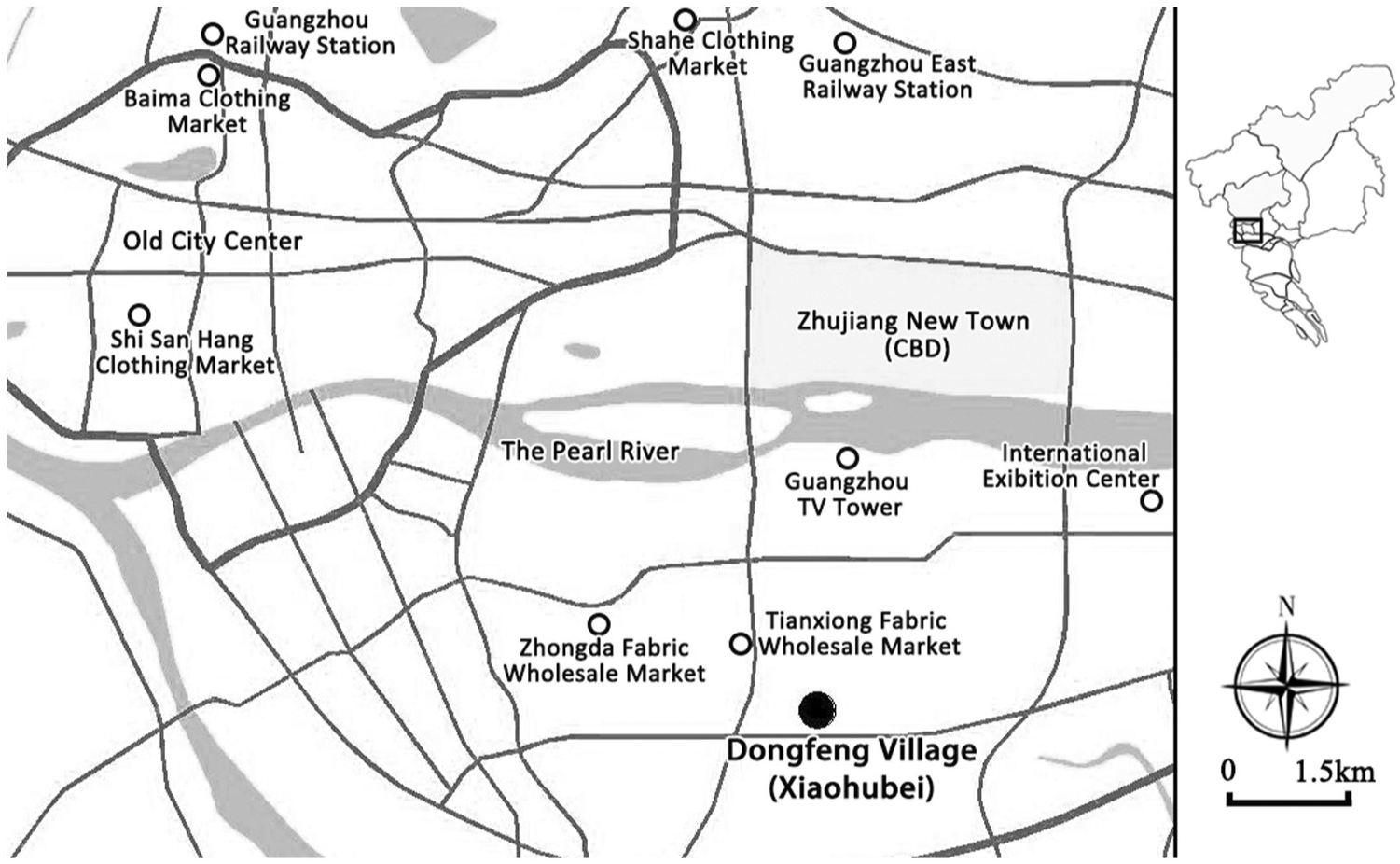
The location of Xiaohubei (LHB) in the city of Guangzhou.
Dongfeng Village is a distinctive rural migrant enclave, as rural migrants represent the majority of its inhabitants. By 2010 there were about 5000 local residents with Guangzhou hukou (including 4200 indigenous villagers), and the number of migrants was around 120,000. Most migrants are low-educated and rural-originated, and most of them engage in the garment manufacturing industry. By 2010 there were more than 2000 garment factories, nearly 95% of which were small-scale producers with about ten people. Why do local residents call this place LHB? First, as the largest subethnic group, around 50,000 Hubeinese have lived and worked in this place. About 95% of these Hubei migrants come from three county-level cities located in central Hubei, including Tianmen (nearly 60%), Xiantao (nearly 25%) and Qianjiang (nearly 10%), which are historically linked, geographically adjacent and culturally similar to each other (Figure 2). Second, migrants from Hubei Province have played a dominant role in garment production and distribution within LHB. By 2010 nearly 70–80% of garment factories within LHB were owned by Hubeinese. Third, LHB provides an environment familiar to Hubei migrants. For instance, Hubei dialects are commonly used in LHB, and Hubei-flavour food can be easily attained in local food market, restaurants and hawker food stalls.

The location of Guangzhou and Tianmen-Xiantao-Qianjiang region in China.
Our data mainly came from in-depth interviews and field observations conducted in Guangzhou between February and May of 2010, supplemented by secondary sources including government documents, village archives and newspapers. Our interviewees include local officials, garment business owners, garment workers and other residents in LHB. Specifically, we interviewed cadres of Dongfeng Village Committee, Share-holding Company and Resident Committees for demographic, social and economic profiles of LHB. In order to acquire the information of garment production and distribution within LHB, the operation of Hubei garment factories and Hubei migrants’ experiences, 15 Hubei garment business owners and 30 Hubei garment workers were interviewed. We approached business owners through a snowball technique and interviewed workers randomly on the street and in the working places.
Formation and development of LHB 2
A rural migrant enclave emerged in the Dongfeng Village in the late 1990s as a result of the expansion of urban areas as well as the transformation of the village economy. The municipal government acquired nearly all farmland belonging to the Dongfeng Village in 2000. According to ‘Regulation on Land Management in Guangzhou’, promulgated in 1995, the village committee received about 10% of the acquired farmland (referred to as Economic Development Land, EDL) for developing the collective economy. The lease of EDL became the primary source of revenue for the collective economy. In the Dongfeng Village, nearly all EDL was leased to Hong Kong or domestic private investors. Driven by a booming garment market in Guangzhou, most of these investors were engaged in the clothing production industry. Dongfeng Village and its nearby areas are ideal sites for garment production because of their proximity to fabric wholesale markets, as well as a large amount of low-rent land. The proliferation of private-owned clothing factories led to an influx of rural migrant workers.
The garment industry has experienced an unprecedented growth within the Dongfeng Village since the early 2000s. Its development was fuelled by a fast-growing apparel market in Guangzhou. On the one hand, augmented exports of apparel to overseas markets provided a large volume of production contracts to local producers. As a result of the increasing purchasing power of Chinese people, the demand for trendy clothes expanded dramatically. Many international trade intermediaries and large-scale wholesale markets such as Baima Garment Wholesale Market were established in Guangzhou. These garment traders assigned production orders to garment producers in Guangzhou and Pearl River Delta. As buyers’ orders are normally seasonal and fluctuated, sustaining a large and stable workforce all year around leads to a large amount of overhead cost. Therefore, many large-scale garment factories, including those in or near the Dongfeng Village, began to outsource part of their work to smaller factories.
Migrants from Hubei Province became the dominant social group in the Dongfeng Village with the rise of small-scale and informal garment producers. The first generation of these garment production units were set up by experienced workers who had previously worked in large-scale clothing factories. Different from other small-scale producers surviving by receiving periodical orders from local large-scale factories, Hubei producers within LHB received production orders not only from their large-scale counterparts but also directly from garment traders. They merely focused on the production of medium- and low-priced clothes with fashionable design. They are superior to both large-scale and non-Hubei producers in terms of productivity, efficiency and profitability. Nowadays, it is only these Hubeinese-owned small-scale factories that flourish within LHB and prevail in the intensified competition.
As owners of the above-mentioned small-scale factories normally give priority to their laoxiang when recruiting new employees, the share of Hubei migrants in the total workforce increased from less than 10% in the beginning of 2000s to nearly 40% in 2010. LHB has become a port of entry in Guangzhou for rural migrants from Tianmen and its nearby counties, as newly arrived migrants can easily find a job and earn a living within the enclave. Unlike Zhejiangcun where migrant leaders built informal housing for their laoxiang, migrants within LHB could only rent indigenous villagers’ self-built houses (Figure 3a). In response to the growing rental market, indigenous villagers of the Dongfeng Village renovated their own buildings and built more floors to maximise rental income. Most of these self-built houses are mixed use: the ground floor accommodates either commercial activities (e.g. restaurants and grocery stores) or producer service activities (e.g. machine repairing and wholesaling); the rest of the building is either garment workshop or worker dormitory (Figures 3b and 3c). The dormitory is often quite small: about five to ten workers live in a room of about 10–20 m2. It is very common for garment manufacturers to provide free food and accommodation to their employees. Migrants working for the same employer generally eat, work and sleep in the same place. Consequently, LHB is not only a place of working but also a place of living.
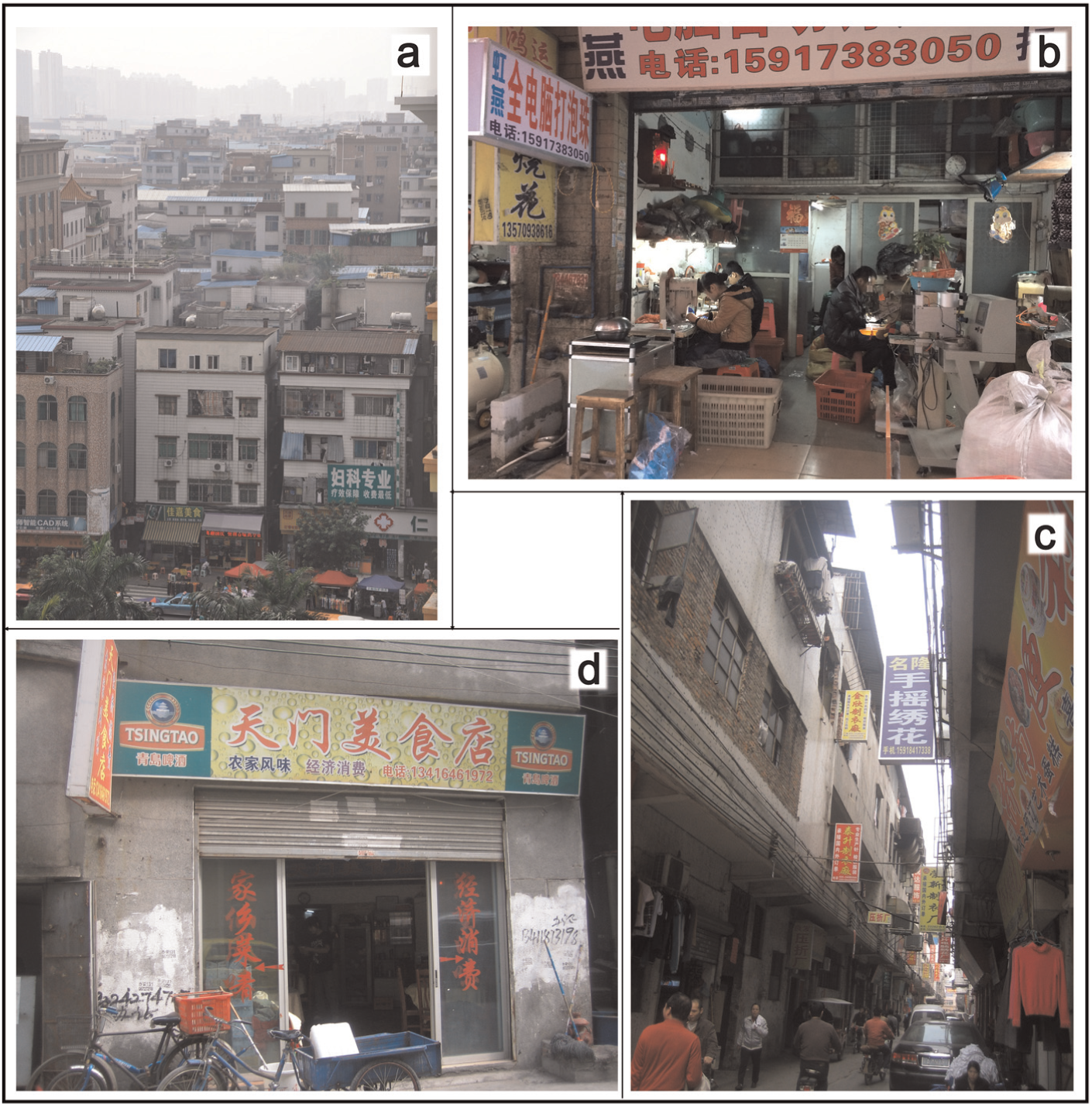
(a) Indigenous villagers’ self-built houses in LHB; (b) a typical small-scale Hubei garment factory; (c) mixed-use buildings accommodating garment factories and worker dormitories; (d) a typical restaurant offering Hubei-flavour food.
The congregation of garment workers in LHB has generated expanding demands for food and daily services. Many Hubei migrants come and run various service businesses such as Hubei-flavour restaurants, snack bars, grocery stores, clinics, barber shops and bus services to and from several cities of Hubei Province (Figure 3d). As these migrants not only share the same dialect, customs and cultural roots but also work and live in a given locality, they constitute a geographically bounded and culturally identifiable community within which close interpersonal ties and group solidarity persist (Ma and Xiang, 1998; Zhang, 2001a, 2001b). This is exemplified by an unrest when, on 13 May 2013, more than 4000 Hubeinese congregated and confronted the local police after the arrest of a garment factory owner and his family who fought against the confiscation of their machines by government agents.
How did Hubeinese-owned small-scale factories survive and flourish in the Dongfeng Village, thus facilitating the rise of LHB? The economic success of these factories hinges primarily on the agency and everyday practices of rural migrants, especially those who intend to or already run a garment business. The following three sections show how Hubei migrants develop a vibrant garment manufacturing cluster and produce their social spaces by establishing a flexible production system, embedding their business within the enclave and maintaining translocal networks.
The emergence of a flexible production regime
Hubei garment factories within LHB are flexible in their management and payment. In order to boost labour productivity, workers in Hubei factories are normally paid on a piecework basis, and unlike the large and formal factories operating more in compliance with labour laws, there are no maximum working hours in these informal factories. Thus, it is very common for their employees to work 14 hours a day and seven days a week. In this sense, these factories can be considered sweat factories, and their employees can earn more than their counterparts working in large factories. For example, the monthly wage of a skilled worker in small-size Hubei garment factories is RMB3000–4000 (or US$487–650), much higher than that in large-scale factories (RMB2000–3000, or US$325–487).
Adopting apprenticeship is another approach to increase labour productivity and reduce labour costs. Many Hubei factories recruit teenagers aged 15–16 years who recently graduated from junior high schools. Apprentices are trained to make clothes under the supervision of their experienced colleagues working in the same factory. Their wages are very low (RMB6000–15000, or US$975–2436 per year), but their workload is not less than regular employees. These apprentices work very hard and finish their training normally within one year. As such, workers’ strong willingness to make more money and improve their skills is closely interwoven with the expansion of employers’ business.
Hubei garment factories are also flexible in work schedules and products, which enables them to promptly respond to the market. Different from those working on production lines and performing specialised tasks repetitively in large factories, workers in small-scale Hubei factories must be proficient in the entire process of making a garment. These workers are multi-skilled and self-motivated, and they are able to emulate the most popular and fashionable design in the market. In most cases, the producers are required by buyers to produce a new style of clothes and complete the order in a very short timescale. The small but flexible Hubei factories are superior to large factories in this regard.
Hubei garment factories are also competitive in terms of the cohesion within the organisation. In most if not all Hubei factories, both employers and employees come from the same place of origin and share the same spoken language, habits, manners and social identity. Such geographical and cultural bonds ease the tensions between social classes and cement mutual trust. In fact, most Hubei employers play the role of mentors to their co-ethnic employees. They treat their employees as their peers (zi ji ren) and are concerned about their employees’ wellbeing and personal development. For example, many employers in our interviews felt obligated to help their newly arrived employees to settle down in Guangzhou and equip their employees with necessary business knowledge. In return, employees work hard and they never act against the employers. In sum, employers and employees in such flexible production regimes are mutually reciprocal and interdependent.
The embeddedness of garment business within the enclave
The proliferation of Hubei garment factories is deeply embedded in a locale where production network is tightly knit, entrepreneurship spirit is fostered, and state regulation is absent. As mentioned above, the burgeoning apparel wholesale market in Guangzhou and the seasonable and fluctuated market demand prompted garment producers in LHB to build close relationships with each other. Most garment producers have several long-term and stable subcontractors in the enclave. Once their productive capacity cannot fulfil the demand from their customers within the required time, they will outsource some work to their subcontractors. Nowadays some manufacturers even play the role of middlemen and subcontract most of their production tasks to other manufacturers. The outsourcing relationships normally occur between factories owned by relatives, laoxiang or former employers/employees, because distributors who cooperate with their relatives, laoxiang or former employees do not need to spend additional time and money on searching for subcontractors, bargaining the price and monitoring the cooperation. In this way a tight-knit production network within LHB can minimise transaction costs and increase collective efficiency.
Hubeinese-owned garment factories within LHB could not have flourished without an entrepreneurial milieu. Compared with migrant workers from other places, workers from Tianmen and its nearby counties are more desperate to become a boss (lao ban). This is linked not only to the adventurous characteristics of Hubei migrants themselves but also inspiration from success stories of surrounding co-ethnic business owners. For people in Tianmen and its nearby counties being a business owner will bring about various benefits such as wealth and fame. Thus, they work diligently in the hope of raising financial capital and business knowledge for their own business. Some of our Hubeinese interviewees launched their own business when they were under the age of 30. Despite their young age, they generally had more than 10 years’ experience of working as a garment worker. The narrative of a 24-year-old worker illustrates how his strong desire to own a business was shaped by the cultural setting of LHB: [In LHB,] if you leave [your hometown] for many years and finally go home as a wage-earner (da gong zai), you will lose face (mei mian zi) in front of your relatives and friends. Business owners are honourable to our people. If you go home for Spring Festival as a business owner, you will be welcome everywhere, and the seniors in the village will ask their children to learn from you.
The garment business owners in LHB also take advantage of an unregulated space to establish and develop their informal business. Within such unregulated space, the enforcement of state regulations over rental housing and factory production is rather weak and inefficient. For example, the change of use of buildings from residential to industrial is rampant within the enclave. Many small garment producers rent villagers’ self-built residential buildings for production. Such practice is prohibited by municipal government because of the risk of fire hazard and poor sanitation, but the government does not have enough resources, prestige and power to regularly and periodically carry out inspection and enforce regulations. Such vacuum of state regulation enables informal economy to survive and thrive.
Not different from the case of Zhejiangcun, the garment business owners have close ties with landlords and village cadres in LHB. Local villagers who benefit from the increasing rental market welcome the development of local informal economy. As a relatively independent and self-organised unit representing the interest of indigenous villagers, the village committee not only acquiesce in the existence of an informal economy, but also act as a protective umbrella for the informal sectors during the inspection for tax, sanitation and fire safety carried out by the government agents. In this sense, state control is subverted by the private interests of landlords and the functional and financial independence of the village committee. A narrative of a garment business owner illustrates this point: Our landlords and village cadres have close relationships. If we are driven away, who will rent their houses? Once the authority is about to inspect garment factories [in Dongfeng Village], the village cadres will let our landlords know immediately. [And then] the landlords will tell us to prepare [for the inspection] in advance … We will neaten the factory or even simply suspend the production [for a few days]. Even if we get caught [violating the regulations], we could ask the landlords to mobilize their social networks [to address the problems] … Normally we just need to offer a bribe and pay a small amount of fine [to avoid heavier punishment].
The maintenance of translocal recruitment, fundraising and business networks
The notion of translocality draws attention to local–local connections through migrants’ agency and everyday practices, highlighting the importance of localities during the process of migration (Brickell and Dotta, 2011; Smith, 2011). The formation and development of the migrant enclave is not merely a local process; rather, it should be analysed under a multi-sited (migrant enclaves, home communities and wholesale markets in Guangzhou and other cities) and multi-scalar (neighbourhood, urban, regional and national) framework. Specifically, garment business owners draw on native-place-based resources such as labour and financial capital through strong connections to their rural hometowns, and they form alliances with Hubei garment traders to access the nationwide merchant network whereby they can acquire business intelligence and exploit business opportunities. Such translocal networks feed the local garment industry within exhaustible labour, financial capital and business opportunities, therefore facilitating the formation and perpetuation of the migrant enclave.
Chain migration is an important component of Hubei migrants’ translocal practices. After settling down at LHB, most of these migrants still keep very strong connections with their relatives, friends and laoxiang living in Hubei Province and normally go back home on a yearly basis. Such translocal networks transmit information about employment opportunities of LHB back to Hubei Province and subsequently channel a vast number of rural labourers to LHB. A Tianmen factory owner introduced his translocal practices through which he could solve the labour shortage problem: I go back to Tianmen during every Spring Festival. [During the festival] I visit my relatives and friends at hometown. If they know some neighbours who have grown-up children at home, I will talk to the [children’s] parents and persuade them to let their children to work in my factory after the holiday. [These children] have nothing to do at home anyway. They can at least learn some useful skills from me.
The translocal recruitment networks are nowadays formalised. Dozens of vocational schools have emerged in Tianmen, Xiantao and Qianjiang, providing paid clothing manufacturing training to rural youths. Most of these schools send their graduates directly to garment manufacturers in Pearl River Delta, including those in LHB. Local employment agencies, whether formal or informal, also play an active role in channelling labourers to garment producers within LHB. Therefore, the Tianmen-Xiantao-Qianjiang region as a whole serves as a labour reservoir for garment manufacturing cluster in LHB, as ‘left-behind’ families, vocational schools and employment agencies in the hometown are actively involved in the creation of the translocal recruitment networks.
Another example of translocal practice is related to raising private funds for setting up and expanding business. In LHB, migrants’ families and close friends from the same geographic origin are the major sources of start-up business capital. Most business owners in our interviews used to receive financial support from their relatives when they tried to start a business. Some of them even raised funds in the rudimentary form of shareholding. All interviewees considered such a fundraising approach as the fastest, easiest and safest way. As the Tianmen-Xiantao-Qianjiang region has a long tradition of leaving the hometown for adventure, business owners can normally get full support from their family and relatives. In return, business owners pay off the debt with high interest and remit money routinely back to their home communities once they earn a large amount of money. The success stories of earlier migrant entrepreneurs inspire more and more families in rural hometowns to devote money to a clothing business in LHB.
Garment business owners forge and sustain translocal connections with their suppliers, buyers and business partners at different localities. Most garment business owners in LHB have long-term cooperative relationships with one or several Hubei traders who run a booth in Guangzhou’s specialised wholesale markets, and their cooperative relationships are strengthened by mutual trust among relatives and friends from the same geographic origin. These Hubei traders act as intermediaries by collecting market intelligence, sending production orders to manufacturers and selling products in large quantities to buyers from all over the country and abroad.
Hubei traders tend to emplace their business activities primarily in Guangzhou’s wholesale market, because Guangzhou is one of the most important clothing distribution centres in China. The garment wholesale markets in Guangzhou are world-renowned and attract buyers from all over the country and abroad. As mentioned by a Hubei trader, the locality where he does business enables him to be easily embedded in the nationwide trade network: I put all the sample clothes in my booth. And then potential customers will come to my booth. They pick the goods and bargain the price with me. [After we make a deal,] they bring the products to other cities like Wuhan, Beijing and Shanghai and sell the products to local retailers.
Rather than passively waiting for business opportunities, traders actively gather business intelligence and explore business opportunities. For instance, in order to keep abreast of the fashion trends, traders and their partners often sniff around other apparel markets of Guangzhou, or even apparel markets of other large cities. Once they find a fashionable design which has potential to make huge profits, they will ask their cooperative garment producers within LHB to emulate the design immediately and promote the products to their potential buyers. In some cases the alliance between traders in the wholesale markets and garment producers in LHB even evolves to a new form: while the traders are directly in charge of the production and distribution activities, including buying materials, organising production, delivering products and dealing with buyers, their partners, the factory owners, are merely responsible for minor administrative affairs such as paying the rent, recruiting and training workers and supervising the production. This production mode can quickly adjust to the market and substantially reduce the transaction costs.
Social mobility and social adaptation of enclave dwellers
LHB provides its migrant enclave dwellers not only with a viable path for upward social mobility but also with a milieu in which they can familiarise themselves with a new environment more easily and peacefully. Migrant workers living in LHB have more opportunities to climb up the social ladder than their counterparts outside the enclave. First, as mentioned before, compared with those working on assembly lines in large-scale garment factories, workers of small-scale Hubei factories in LHB can get more money and improve their skills in garment production more quickly. It takes a shorter time to become a skilled worker in small Hubei factories than in large-scale factories. Once a migrant becomes a skilled worker, he/she can hop to any other clothing factory in Guangzhou. Second, many migrant workers encounter the glass ceiling in large factories because of their low educational attainments and temporary migrant status. Thus, it is nearly impossible for rural migrants to obtain an administrative position in large-scale factories. By contrast, workers in small factories owned by their laoxiang are more likely to get promotion. Thus, it turns out to be easier for migrants to accumulate business and management skills by working for their laoxiang.
Third, those who start their own business in LHB can mobilise abundant native-place-based resources and social networks embedded within the enclave. They can recruit experienced workers and look for potential customers and suppliers through personal social networks based on kinship and common place of origin. They can make profit by receiving production orders from garment distributors and other producers owned by their relatives or laoxiang. Fourth, for business owners from Hubei Province running a business within LHB is more lucrative and less risky than in elsewhere. The most successful business owners in LHB make a substantial profit, own a larger business, buy commercial housing property in Guangzhou and eventually obtain a Guangzhou hukou as investors or entrepreneurs. In this sense, LHB provides a viable path through which rural migrants can accumulate human, social and financial capital quickly, thereby transcending the institutional, social and cultural barriers in the destination cities.
LHB also functions as a place of initiation where rural migrants can familiarise themselves with a new environment. It provides migrants a ‘second hometown’ to which they are functionally and emotionally attached and in which their cultural and social needs can be satisfied. Rural migrants in large cities suffer from not only homesickness and loneliness but also many forms of discrimination and stigmatisation. They may feel frustrated and isolated if they are not accepted by the surrounding communities. In LHB, it is easy to find Hubei-style food and services, and home dialects can be heard everywhere. Thus, it provides migrants a familiar social and cultural environment to ease homesickness and loneliness.
Moreover, LHB provides a haven where rural migrants can avoid the discrimination and hostility from urbanites in their everyday life. Such deep-rooted discrimination and hostility in Chinese cities sets up a barrier for rural migrants to improve their economic situation and social status. This is less the case for migrants in LHB. In addition, the existence of LHB enables newcomers from rural areas to learn social norms, habits and customs of urbanites through interacting with earlier migrants, especially successful migrant entrepreneurs. In this way, rural migrants in LHB can adapt to their new life in Guangzhou more smoothly and easily.
Conclusions and discussion
This study has examined how rural migrants’ enclave-based or translocal practices and networks shape the growth of their migrant enclaves and what role the migrant enclaves play in the social mobility and adaptation of migrant dwellers. Through an ethnographic exploration of LHB, a native-place-based and employment-specialised migrant enclave in Guangzhou, we have found that rural migrants, especially those who intend to or already own a business, are better seen as active agents and resource carriers who develop a vibrant garment manufacturing cluster by establishing a flexible garment production system, embedding their business within the enclave and maintaining translocal recruitment, fundraising and business networks. In this sense, migrants from Hubei Province play an active and leading role during the growth of the enclave. The case of LHB has also illustrated that such native-place-based and employment-specialised enclaves are neither hopeless ‘slums’ nor temporary ‘footholds’ for rural migrants moving to large Chinese cities. Compared with those living outside the enclaves, rural migrants living within the enclaves can settle down and climb up the social ladder more easily and smoothly. Enclave dwellers can better mobilise abundant native-place-based resources and tight-knit social networks embedded within the enclaves and familiarise themselves with an urban environment gradually and smoothly. Hence, these migrant enclaves not only provide a low-rent accommodation and a low-cost living space to rural migrants, but also function as a place of initiation, an establishment platform and a social mobility path for enclave dwellers.
Previous studies have attributed the proliferation of migrant enclaves in Chinese large cities mainly to the overarching and insuperable constraints imposed on rural migrants’ housing choices (Wang et al., 2010; Zhang, 2011; Zheng et al., 2009). Nevertheless, such a structuralism perspective may lead to an underestimate of the human agency and everyday practices of rural migrants themselves. While not denying that rural migrants take an inferior position and suffer from institutional and social constraints in the large cities, this study has added a new dimension to the study of migrant enclaves in China’s large cities by particularly focusing on the agency and everyday practice of rural migrants. Our empirical results have shown that the rural migrants are able to carry out various enclave-based or translocal practices and to mobilise their financial, social and human resources to enhance their social and economic wellbeing and negotiate various institutional, social and economic constraints. In this light, our findings have challenged the conventional wisdom that rural migrants are no more than a homogeneous social group passively responding to economic opportunities and obediently succumbing to the institutional and social constraints within the large cities.
This paper has echoed Zhang’s (2001a, 2001b) discussion on the dialectical relationship between space and power with regard to the development of Zhejiangcun. In the case of LHB, thousands of Hubei migrant entrepreneurs set up small-scale garment business and turn indigenous villagers’ self-built houses into garment factories, tertiary establishments and worker dormitories. They play the roles of not only employers but also mentors and sponsors to their employees. They mobilise abundant native-place-based resources through strong connections with their home communities. They build a reciprocal business partnership with other garment producers and traders and form a patron–client relationship with their landlords and village cadres. In doing so, the migrant entrepreneurs create their social spaces through practices and power relations, and their wealth, power and prestige are accumulated through the production of their social spaces. However, it should be pointed out that, unlike migrant leaders of Zhejiangcun who build housing compounds and marketplaces on their own, migrant entrepreneurs of LHB do not solely control their own social spaces. On the contrary, they share the power with indigenous villagers and their representative, the village authority. For example, the mixed-use buildings on housing land (zhai ji di) are constructed and owned by indigenous villagers, and public utilities and community services are provided and maintained by the village authority, which are acceptable and legitimate in the eyes of the government (Tian, 2008; Wu et al., 2013; Zhang et al., 2003). Therefore, while Zhejiangcun was demolished in the 1990s because Wenzhou migrants’ privatisation of space and power was considered to pose a threat to the state control (Zhang, 2001a, 2001b), LHB continues to survive and thrive under the tolerance of the government.
A burgeoning body of literature has discussed the positive role played by migrant enclaves in the Chinese urbanisation process, such as housing migrant workers and enabling land-deprived local villagers to integrate into the mainstream society (Chan et al., 2003; Lin et al., 2011; Song et al., 2008; Wang et al., 2009, 2010; Zhang et al., 2003). This paper has gone further to link living and working within the migrant enclaves to the upward social mobility and social adaption of rural migrants. Studies on ethnic enclaves in Western countries have shown that the ethnic concentration may also have some negative impacts on enclave dwellers (Marcuse, 1997; van Kempen and Özüekren, 1998). For instance, ethnic congregation may lead to the absence of daily contacts between the enclave dwellers and mainstream society, which may reduce their opportunities of finding jobs outside the enclaves. However, in the case of LHB, such a detrimental effect can be substantially mitigated by ample enclave-based work opportunities, the accessibility to job information outside the enclave and a considerable demand for skilled and experienced workers in Guangzhou’s garment manufacturing industry. Another disadvantage of the ethnic concentration pointed out by the literature is that enclave dwellers’ extant ideas, beliefs and behavioural habits may be reinforced by their social environment. This is more likely to be the case for old and middle-aged rural migrants, who heavily rely on concrete kinship and laoxiang networks to acquire information. With regard to young rural migrants who constitute the majority of the inhabitants of LHB, nonetheless, as they have attained a certain level of education and are able to learn new things via the Internet and other media channels, they are able to change their original ideas, beliefs and behavioural habits rapidly after their arrival in Guangzhou.
It is noteworthy that not all migrant enclaves are necessarily conducive to the formation of migrant-owned business and migrant entrepreneurs; some migrant enclaves are merely places of living for their dwellers. However, according to a review of literature and our empirical findings (Ma and Xiang, 1998; Zhang and Xie, 2013), those enclaves endowed with abundant native-place-based resources, tight-knit kinship and laoxiang networks and vibrant externally oriented economic sectors (e.g. garment production) are more likely to provide a path of economic advancement and social mobility. This suggests that migrant enclaves may vary in terms of their social implications to enclave dwellers, and that the existing large-scale and indiscriminate demolition projects are likely to reduce rural migrants’ chance of climbing up the social ladder and adapting to the urban environment and thus have a negative impact on the integration of rural migrants. Therefore, it is important for policy-makers to take into account the wellbeing of enclave dwellers and adopt tailor-made approaches to redevelop the migrant enclaves.
Footnotes
Acknowledgements
The authors thank the anonymous reviewers for their constructive comments.
Funding
This research is supported by a Chinese National Natural Science Foundation project entitled The Incorporation of New Immigrants in the Large Cities in China (41271163) and a major project of the Chinese National Science Foundation (41130747). It is also supported by the Fundamental Research Funds for the Central Universities (3161396), the Ministry of Education Research in the Humanities and Social Sciences Planning Fund (12YJAGJW007), and a Key Project of Philosophy and Social Sciences Research of Ministry of Education (11JZD028).