



Abstract
This article empirically examines the formation of municipalities in the USA. It traces change in unincorporated areas over decades to determine how basic dimensions of population heterogeneity affect the probability of municipal incorporation. The article also examines how state legislation on local government autonomy affect the probability of municipal incorporation. To guide the research, this article follows theory on local government boundary change and the Tiebout hypothesis – literatures interested in the role of municipal fragmentation in tax-and-service differentials within metropolitan areas. Main findings are that income heterogeneity raises the probability of municipal incorporation and state restrictions on local government autonomy lower that probability. I present a boundaries-normalised data set that can be useful for research extensions.
Introduction
What factors explain the formation of municipalities in America? This article presents results from a longitudinal study addressing this question since 1970. This research problem has important implications for theory and design of metropolitan governance institutions. Two strands of literature guide the study. First, it builds on theory of local government boundary change. This literature explains how boundary changes result from an interplay of service demands in unincorporated areas, entrepreneurs, 1 and constraints imposed by state legislation on localities. Second, the study draws on the literature on Tiebout (1956) and resident sorting. This literature documents how diverse populations in metropolitan areas correlate with segregation and tax-and-service differentials across municipalities. Focusing on the related literatures, key explanatory factors are empirically assessed for municipal incorporation in the USA.
Guided by the boundary change and Tiebout literatures, the article makes the following contributions. First, it presents a boundaries-consistent data set that enables analysis of change in unincorporated areas through time-series cross-sectional methodology. Research using over-time data is important to move the literature forward. This study takes advantage of over-time change in unincorporated places by applying panel data methodology. 2 Second, the article distills distinct explanatory factors of boundary change and the political economy of tax-and-service policies into an integrated study. Whereas boundary change and the Tiebout hypothesis are often separate literatures, this study emphasises the interplay of heterogeneous populations, state legislation and change of municipal boundaries.
The study concentrates on municipal incorporation as a central form of boundary change. This study focus is important for two reasons. First, despite significant theoretical enquiry on boundary change, there is limited empirical research for municipal incorporation in the USA. 3 Second, municipal incorporation is a form of boundary change of critical consequence. While other forms of boundary change are important, 4 municipal incorporation deserves focused attention for theory and policy implications. Municipal incorporation has been historically at the root of the fragmentation of metropolitan areas (Teaford, 1979). After incorporation, fragmented municipal jurisdictions can hardly be reorganised through consolidation processes (Brierly, 2004).
This article is related to the literature reviewed in the following paragraphs. 5 Focusing on post-Second World War Los Angeles County, Miller (1981) examines municipal incorporations under the ‘Lakewood Plan’. He documents how the Lakewood Plan eased municipal incorporation by allowing for city–county contracting of service provision. Miller draws additionally on the Tiebout model and concludes that municipal incorporations reinforced socioeconomic stratification across jurisdictions. Relatedly, Musso (2001) frames her study of municipal incorporation in California as a test of the Tiebout model. She empirically examines incorporation referenda in unincorporated places and reports a significant association between higher-income level and the probability of success of an incorporation proceeding. More recently, Hogen-Esch (2011) examines the influence of state–local relations on municipal incorporation in California. He concludes that legal reforms, by constraining municipal home rule, have reduced incentives for incorporation. 6
The literature necessarily includes Burns (1994), who looks at special-district and municipal incorporations by emphasising the role of entrepreneurial actors in incorporation initiatives. Burns argues that entrepreneurs, such as business groups, can solve the collective action problem pervading incorporation initiatives. She also analyses the role of race and class divisions as well as relevant state laws on local government. Subsequently, Carr and Feiock build on Burns by analysing a broader set of individual and collective actors involved in proceedings of boundary change (Carr, 2004; Carr and Feiock, 2004; Feiock and Carr, 2001). They also analyse other forms of boundary change, including annexation and city–county consolidation. Carr (2004) particularly pays attention to how state laws affect incentives for collective action in processes of boundary change.
Recent literature on municipal incorporation has been contributed by Smith and colleagues. Smith and Debbage (2006) explore municipal incorporations in the South, and they conclude that those incorporations appear to represent a large proportion of all incorporations in the USA. Smith (2011) looks at the influence of annexation on municipal incorporations in North Carolina, and he concludes that large annexations and population growth are related to municipal incorporations. Continuing their previous work, Smith and Debbage (2011) analyse the geographic distribution of new municipalities and find that a large number of incorporations appear to concentrate into specific states. They conclude that different state legislations on boundary change could in part account for the geographic concentration of incorporations. Waldner et al. (2013) report a decrease in the frequency of municipal incorporations since 1950. They conclude that such decrease is related to restrictive state legislations, slowing suburbanisation, and less unincorporated territory available for incorporation. Finally, Rice et al. (2014) present a literature review on municipal incorporation and supplement it with a review of media articles. They conclude their review by outlining a typology of explanatory factors for municipal incorporation. 7
Theoretical framework
The role of urban heterogeneity
Residents incorporate municipalities for a variety of benefits derived from incorporation (Burns, 1994; Feiock and Carr, 2001; Rice et al., 2014). Those benefits can include better services, community homogeneity, and policies that influence property values (Fischel, 2001). History suggests that urban heterogeneity has been a central factor in initiatives for municipal incorporation in America (Alesina et al., 2004; Burns, 1994). If this hypothesis remains valid – as the historical record suggests, theory for boundary change needs to explain why an unincorporated area would opt for incorporation despite the substantial (ex-ante) costs of incorporation proceedings and (ex-post) costs of financing an ongoing municipal jurisdiction. 8
Why would unincorporated areas opt for incorporating homogeneous yet small-scale municipal jurisdictions? A first answer could be to circumvent redistribution since municipalities can redistribute resident income through tax-and-service policies (Miller, 1981). Since income stratification has been correlated to ethnic diversity in metropolitan areas, municipal incorporations might also reflect a collective choice to circumvent both ethnic and income heterogeneity. The literature on urban segregation suggests that ethnic and racial segregation has persisted – even among ethnically diverse populations of otherwise similar incomes (Boustan, 2011). This pattern suggests that residents are often willing to avoid ethnic or income heterogeneity by sorting themselves into homogeneous jurisdictions and then enforcing homogeneity through municipal policies such as zoning (Fischel, 2001; Miller, 1981; Ross and Yinger, 1999). Relatedly, incorporation may be conceived as ‘defensive incorporation’, particularly when annexation of unincorporated areas becomes a credible threat (Rigos and Spindler, 1991).
I analyse three basic factors of urban heterogeneity – income, race and Hispanic ethnicity. The first two of them have a long history in America, while the third one has a more recent history related to immigration (Waldinger, 1989). Racial and income heterogeneity were significant motivators of municipal incorporation during post-Second World War suburbanisation (Alesina et al., 2004; Burns, 1994; Smith and Debbage, 2011). In particular, racial turnover in cities could have encouraged ‘white flight’ to unincorporated areas and, subsequently, municipal incorporations. Certainly, racial turnover was not the only growth force in the unincorporated fringe – suburbanisation has been a general trend in industrialised societies (Mieszkowski and Mills, 1993). However, suburbanisation has been an important antecedent of municipal incorporations in post-Second World War decades.
There are two basic explanations for how urban heterogeneity plays a role in choice of municipal boundaries. The first hypothesis is concerned with differential incomes in metropolitan areas. According to this hypothesis, incorporation aims at circumventing heterogeneity of incomes and redistributive tax-and-service policies through municipal jurisdictions (Alesina et al., 2004; Miller, 1981; Rice et al., 2014). The alternative hypothesis focuses on ethnic and racial heterogeneity in metropolitan areas. According to this hypothesis, incorporation aims at avoiding ethnic or racial interaction (Alesina et al., 2004; Burns, 1994). 9 The aforementioned hypotheses need not be mutually exclusive and, in the urban history of the USA, income and ethnic heterogeneity have been indeed correlated. Nonetheless, those hypotheses highlight distinct dimensions of urban heterogeneity deserving separate attention.
The first hypothesis for the role of heterogeneity in initiatives for municipal incorporation is therefore socioeconomic. It draws on the related literature on income stratification in metropolitan areas (Boustan, 2013; Fischel, 2004; Smith and Debbage, 2011). This hypothesis is also derived from the Tiebout model. It suggests that municipalities are formed to draw boundaries along the lines of socioeconomic strata. According to this hypothesis, stratification shapes the lines of income-differentiated municipalities. It emphasises heterogeneous preferences for tax-and-service policies through municipalities. Thus residents support municipal incorporation to gain control of zoning policy and shield property values (Fischel, 2001, 2004).
The second hypothesis for the role of heterogeneity in municipal incorporation is ethnic and racial. It is related to the literature of urban segregation in America (Boustan, 2011; Van Kempen and Özüekren, 1998). This hypothesis is less developed in the Tiebout literature and more central in the early literature on boundary change. 10 It is also an extension of the segregation literature to choice of municipal boundaries. This hypothesis has received previous attention from the literature, for historical reasons. In theory, US civil rights legislation should have precluded ethnically delineated jurisdictions. Nonetheless, whereas federal legislation has focused on preventing gerrymandering in congressional districts, choice of municipal boundaries is regulated by state legislation (Burns, 1994; Carr, 2004). This legislation, however, is silent on ethnic or racial implications of municipal boundaries. That silence could allow for ethnically driven boundary choices in proceedings of municipal incorporation.
The effect of ethnic and income heterogeneity on municipal incorporation thus extends the Tiebout model (1956). Tiebout’s insight was that residents shop around the metropolitan area for housing and neighbourhood amenities. The early literature put residents-as-consumers at centre stage and relied on mobility as the causal mechanism of neighbourhood sorting (Dowding et al., 1994). More recent literature adds voting as a collective choice mechanism for tax-and-service policies in municipalities (Ross and Yinger, 1999). While the Tiebout literature primarily emphasises income sorting, the role of ethnicity and race has also been recognised (Alesina et al., 2004; Musso, 2001). For instance, a racial threat to an unincorporated community could arise from neighbouring jurisdictions of different racial composition (Burns, 1994; Miller, 1981). 11 The study will thus pay attention to the different sources of population heterogeneity for choice of municipal boundaries.
Previous studies give mixed findings for the aforementioned hypotheses. Burns reports some evidence for the role of race in the formation of local governments (1994). Alesina et al. (2004) find similar evidence and argue that race mattered in boundary changes during post-war suburbanisation. Interestingly, those studies suggest that municipalities may have been porous to populations of diverse incomes, yet municipalities delineated along the lines of ethnicity persisted. A complicating factor when attempting to disentangle socioeconomic and ethnic factors is the historical association between ethnic and income stratification in America. For example, ethnic and racial minorities have been historically overrepresented in low-income cities (Boustan, 2011).
Municipal boundaries play the central role of delineating the jurisdiction of municipal policy powers (Barron, 2003; Briffault, 1996). Also, boundaries have a socioeconomic effect by defining the territorial scope of service provision. This exclusionary implication could be the basis for municipal incorporation, as some populations are incorporated and others are excluded from municipal jurisdictions (Burns, 1994; Miller, 1981). Municipal incorporation may be driven by heterogeneous preferences for local policies (Alesina et al., 2004) and thus be framed as a choice for self-government underpinned by ethnic and income stratification. However, unincorporated areas face hurdles, fiscal and procedural, to successful incorporation (Carr, 2004; Hogen-Esch, 2011; Rice et al., 2014). Fiscally, municipal incorporation is costly because it brings about costs of organisational structure. Procedurally, municipal incorporation requires resident approval by referendum and other requirements imposed by state legislation.
The role of state legislation
In addition to urban heterogeneity, state legislation for local autonomy has shaped the organisation of unincorporated and municipal jurisdictions in the USA. 12 Generally, state legislatures have plenary authority over municipalities. In his treatise, Dillon (1873) laid out the theory that municipalities derive their powers from explicit state’s delegation. ‘Dillon’s rule’ remains an influential theory, yet several states have introduced legislation for ‘home rule’ since the early twentieth century (Barron, 2003). Dillon’s rule and home rule remain competing theories of state–local governance and, across the states, the extent of local autonomy varies widely (Hogen-Esch, 2011; Krane et al., 2001). Although extent of local autonomy influences multiple policy areas, it is central for boundary change – the institutional process determining the role of municipalities in American federalism (Carr, 2004; Feiock and Carr, 2001; Sonenshein and Hogen-Esch, 2006). The possibilities of boundary change are thus mediated by the configuration of state laws.
Since the progressive movement, general legislation has been introduced for local government reorganisation. Some states have eased procedures for municipal incorporation, whereas other states appear to be restricting them (Hogen-Esch, 2011; Krane et al., 2001). 13 Similarly, most states have hardened procedures for annexation (Krane et al., 2001; Rice et al., 2014). Thus municipal incorporation could have also become an alternative to annexation of unincorporated areas. In some states, particularly in the Northeast, legislatures retain plenary authority over local government organisation, and special legislation is necessary for change of municipal boundaries. Different legislations mean that it is harder or easier to change municipal boundaries in different states. Specifically, legal requirements for municipal incorporation may include minimum population, area, density, distance from an existing municipality and property tax base (ACIR, 1993). 14
Although the organisation of unincorporated and municipal jurisdictions has been directly determined by laws on boundary change, legislation for local policy authority seems to also create incentives for municipal incorporation (Barron, 2003; Fischel, 2001; Krane et al., 2001). Home rule has been a normative theory for delegation of authority to localities on various policy areas. Particularly, state legislation defines rights to and regulation of land use. Thus one of the core debates on local government autonomy deals with what the scope of municipal zoning should be. Effectively, state governments and courts mediate municipal zoning authority. State governments often directly intervene in land-use regulation. State courts can also restrain municipal zoning authority, e.g. by adjudicating zoning cases (Barron, 2003; Briffault, 1996; Fischel, 1987; Gyourko et al., 2008). 15
Since land-use regulation is a core policy power of municipalities, control of that policy may well be a significant motivator of municipal incorporation. Because it can impact property values, control of land-use regulation has been recurrently a campaign issue used to mobilise resident support for municipal incorporation (Burns, 1994; Fischel, 2001). Consequently, the activism of state governments and courts in zoning, traditionally the role of municipalities, seems to influence incentives for municipal incorporation. In sum, restrictions on municipal zoning, by court or state legislation, could affect incentives for municipal incorporation (Fischel, 2004).
Home rule has also influenced state legislation for alternative institutions of service provision. The theory of home rule, though originated from central cities, was later embraced by suburbs (Barron, 2003). As unincorporated suburbs grow in some metropolitan areas, they increasingly rely on counties and special districts for service provision (Fischel, 2001; Foster, 1997). Local autonomy by state legislation has consequently resulted in alternative forms of service provision for unincorporated areas. For scale economies, unincorporated areas can rely on those alternative institutions of service provision (Brierly, 2004; Fischel, 2001; Foster, 1997). Thus a greater role of counties and special districts could allow for scale economies in otherwise fragmented unincorporated and municipal jurisdictions (Carr and Feiock, 2004; McGinnis, 1999; Ostrom et al., 1961; Parks and Oakerson, 1989).
Metropolitan districts and counties can gain scale economies by pooling regionwide resources and thus spreading out fixed costs of service provision (Alesina et al., 2004; Brierly, 2004; Foster, 1997). Metropolitan districts, for instance, can take advantage of scale when providing regionwide services. For similar reasons, urban policy reformers typically emphasise the potential economies that could be achieved through consolidation of municipalities (Briffault, 1996). Inconclusively, some research points out that scale economies are not always attained after consolidation (Carr and Feiock, 2004; McGinnis, 1999). However, scale economies in service provision remains an important theory in debate on institutions for metropolitan governance (Brierly, 2004). 16
Counties have been traditional institutions for service provision in states outside the Northeast (Krane et al., 2001). While their functional autonomy varies across the states, counties provide services that often substitute for those of municipalities. In theory, then, counties can provide services to unincorporated areas and thus reduce one incentive underlying initiatives for municipal incorporation. As noted previously, counties may be employed for service provision needing scale economies such as metropolitan infrastructure (Brierly, 2004). On the other hand, the county may be perceived as a distant governmental authority when its policies affect residents in unincorporated areas. In particular, pro-development county policies appear to create incentives for municipal incorporation (Fischel, 2001). Overall, counties often provide urban services to unincorporated areas, but counties may also impose policies that motivate resident support for reorganisation of local jurisdictions (Parks and Oakerson, 1989; Sonenshein and Hogen-Esch, 2006).
Special districts can be alternative forms of service provision when municipalities face functional constraints. For example, limitations on municipal fiscal capacity seem to be circumvented by incorporating special districts (Burns, 1994; Feiock and Carr, 2001; Foster, 1997). Certainly, special districts play roles limited to specific services and cannot substitute for general-purpose governments. In theory, however, special districts can provide services to unincorporated areas and thus reduce one incentive underlying initiatives for municipal incorporation. For example, special districts seem to be increasingly employed for urban infrastructure (Briffault, 1996; Foster, 1997). On the other hand, special districts are less useful when residents seek access to the zoning authority of municipalities (Burns, 1994; Fischel, 2001).
In sum, unincorporated and municipal jurisdictions could rely on metropolitan districts and counties to coordinate regional policies and thus mitigate municipal fragmentation (Carr and Feiock, 2004). Whereas metropolitan districts and counties can economise on fixed costs of service provision, they cannot always accommodate heterogeneous demands for core municipal policies, such as zoning. Those heterogeneous demands could engender resident support for municipal incorporation – a hypothesis that is related to the Tiebout model (Alesina et al., 2004; Miller, 1981; Musso, 2001; Tiebout, 1956). Scale economies could also motivate alternative forms of service provision; in particular, metropolitan districts and counties appear to be motivated by those economic factors (Brierly, 2004; Ostrom et al., 1961). At the same time, ethnic and income heterogeneity appear to influence neighbourhood sorting and change of municipal jurisdictions in metropolitan areas.
Empirical framework
Data
The study examines the effect of heterogeneity and state legislation on municipal incorporation in the USA. It assesses how population change over decades and key state legislation have influenced processes of municipal incorporation. The unit of analysis is the place as delineated for unincorporated and incorporated jurisdictions by the US Census. 17 Observing the census place can refine empirical research on municipal incorporations in several ways. In particular, the place is a more precise unit of analysis for isolating incorporation events.
Relatedly, the study presents a boundaries-normalised data set that enables analysis of change in the place through times-series cross-sectional methodology. A hurdle when using places as units of analysis is that they are redrawn by the US Census every decade. 18 To get around that hurdle, I compile data from the US Census of 1980, 1990 and 2000 normalised onto the boundaries of 2000. Specifically, I use the boundaries-consistent data constructed by GeoLytics, Inc. – a US corporate developer of historical census data bases. To allow for longitudinal analysis of places through decades, data from each decennial census are traced back on the boundaries of 2000. In this section I summarise the data; see Table 1 for complete definitions.
Data.

Note: The table presents definition and source for the variables analysed in subsequent sections. The US Boundary and Annexation Survey is for the annual surveys from 1970 to 2000. The US Census of Population and Housing is for 1980, 1990 and 2000 tracked on the boundaries of 2000 (GeoLytics, 2002, 2004; US Census Bureau, 2003). The US Census of Governments is for 1977, 1987 and 1997. Unless noted otherwise, the unit of observation is the place as delineated by the US Census for unincorporated and municipal jurisdictions. Except for state legislation, all variables are time-variant.
The dependent variable is the probability of incorporation, which classifies places on whether they have been unincorporated or incorporated in 1980, 1990 and 2000. A dummy variable classifies unincorporated places (0) and municipalities incorporated (1) in the preceding decade. For example, the 1980 data identifies municipalities incorporated from 1970 to 1980 and unincorporated places with population greater than the minimum required for incorporation. 19 Thus the data set classifies newly incorporated municipalities and unincorporated places ‘at risk’ of incorporation.
The central independent variables are measures for (i) heterogeneous populations and (ii) state legislation on local government. First, I construct heterogeneity measures for income, race and Hispanic ethnicity. For race and Hispanic ethnicity, segregation measures for nominal variables are constructed following Reardon and Firebaugh (2002). As proposed by Reardon and Firebaugh, I construct an information theory index (H) that provides several advantages over alternative measures. 20 This section summarises how the heterogeneity measure is constructed; see Reardon and Firebaugh (2002) for an extensive discussion.
Measures of segregation use the metropolitan area as the composite area and tracts as components. Applying one of various methods, those measures estimate segregation across metropolitan tracts. For example, traditional indices of segregation measure the unevenness with which racial groups are distributed across tracts making up a metropolitan area (Boustan, 2011). The study measures of heterogeneity for race and Hispanic ethnicity follow a similar logic. To be consistent with the study focus, I use the county as the composite area and places as components. Then I calculate the information theory index through the following steps.
First, a heterogeneity score (

In equation (1),

In equation (2),

In equation (3), P denotes the population in the county, Pi denotes the population in the place, and H denotes the information theory index. H will be the independent variable used for heterogeneous populations, racial or Hispanic ethnic. Even though the H index (equation 3) uses place and county data, a unique H index is calculated for every place in the data set. This is possible since, when calculating an H for each place, I use data specific for that place and then data for the rest of the county (excluding the place). Therefore, H varies by place to the extent that there is always a unique place and a unique ‘rest of the county’ area. 21
Finally I construct a measure of income heterogeneity by calculating the ratio of mean income in the place to median income in the county. This measure is an application of the median voter model (Meltzer and Scott, 1981). It uses place and county data to capture the income differential between the place and its county. 22 Like the heterogeneity measure for race and Hispanic ethnicity, this measure of income heterogeneity is unique for every place in the data set. This is possible since, when calculating the ratio of mean to median income, I use place data in the numerator and county data in the denominator.
As described in Table 1, the second set of independent variables are for state legislation on local government. 23 First, I construct an index of legal constraints on incorporation and an index of legal constraints on annexation based on US ACIR (1993). Second, I use an index of court restraints on municipal zoning and an index of state government activism in zoning from Gyourko et al. (2008). Third, I construct an index of county autonomy and an index of municipal autonomy using ACIR (1993) and Krane et al. (2001). Finally, I calculate the number of special districts per 1000 population in the county based on the Census of Governments of 1977, 1987 and 1997.
The selection of other control variables is based on existing theory. I control for socioeconomic determinants of demand for urban services. 24 First, controls include population, population squared and population density in the place, as well as population in the county. Second, controls include the fraction of the population aged under 18 years, the fraction of the population aged 65 and over, and the fraction of manufacturing workers to the employed population in the place. Last, I control for place or state-fixed effects in alternative tests. For all control variables, I compile data from the US Census of Population of 2000 and the boundaries-normalised Census of 1980 and 1990 by GeoLytics, Inc.
Model
The above data allow for the testing of hypotheses through panel data methodology. For purposes to be explained below, I examine the data through two alternative methods. First I assume a linear probability model inclusive of fixed effects by place. Even though the dependent variable is binary, fixed effects OLS provides benefits not afforded by nonlinear models such as probit or logit (Angrist and Pischke, 2008). Effectively, fixed effects OLS takes advantage of the longitudinal structure of the data set by controlling for place-unobserved effects. Thus the following linear model, inclusive of fixed effects, is first estimated:

In equation (4), the subscripts denote a place i and time t, respectively. The variable y denotes the dependent variable, X encapsulates the variables for heterogeneous populations, and Z encapsulates control variables. The coefficients
Naturally, pooled probit, which can explicitly account for the binary dependent variable, is also estimated:

The key substantive change in the second model is my substituting W, denoting indices for legislation variables, for fixed effects by place. Whereas the fixed effects model (equation 4) and the pooled probit model (equation 5) do not need to be exactly equivalent, they are both useful and serve alternative purposes. Particularly pooled probit will be helpful, without place-fixed effects, to estimate coefficients for time-invariant legislation variables. Furthermore, each model is a helpful robustness check against the other. For estimation of significance p-values, I compute robust standard errors clustered by place (Wooldridge, 2010).
Table 2 presents summary statistics for the data analysed in subsequent sections.
Summary statistics.
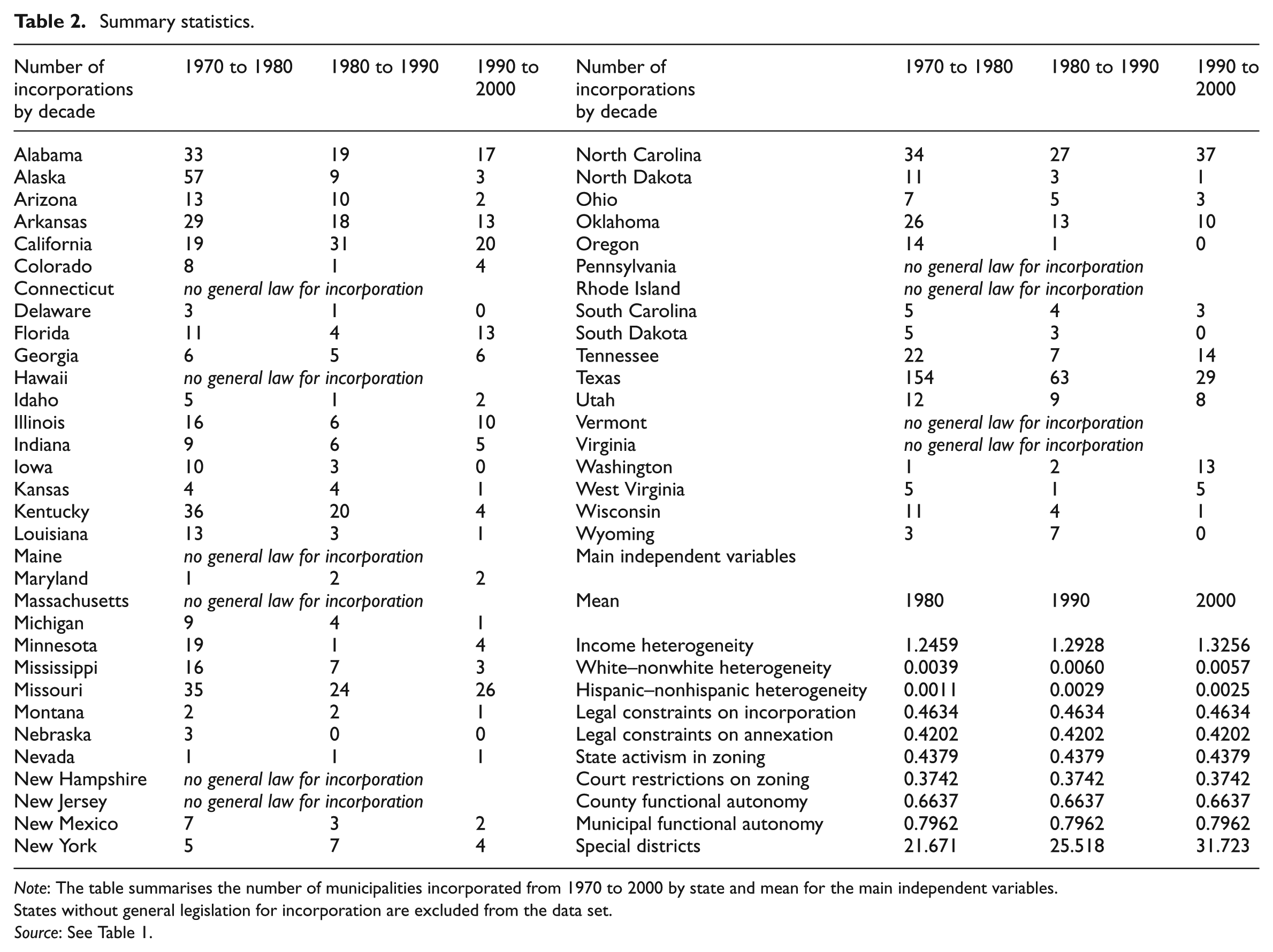
Note: The table summarises the number of municipalities incorporated from 1970 to 2000 by state and mean for the main independent variables.
States without general legislation for incorporation are excluded from the data set.
Source: See Table 1.
Findings
This section presents the study results based on the model specifications outlined in the previous section. The analysis focuses primarily on significant findings from Tables 3 and 4. The analysis is organised into three subsections: (i) urban heterogeneity, (ii) state legislation and (iii) robustness tests. 26
What factors affect the probability of incorporation?

Note: The table presents average partial effects and their p-value, estimated on robust standard errors. If indicated in the table, fixed effects and controls are included but not displayed for space. The number of observations (N) is equal to the number of places times the number of decades.
p < 0.10 and p-value within parentheses.
Source: See Table 1.
Robustness tests.
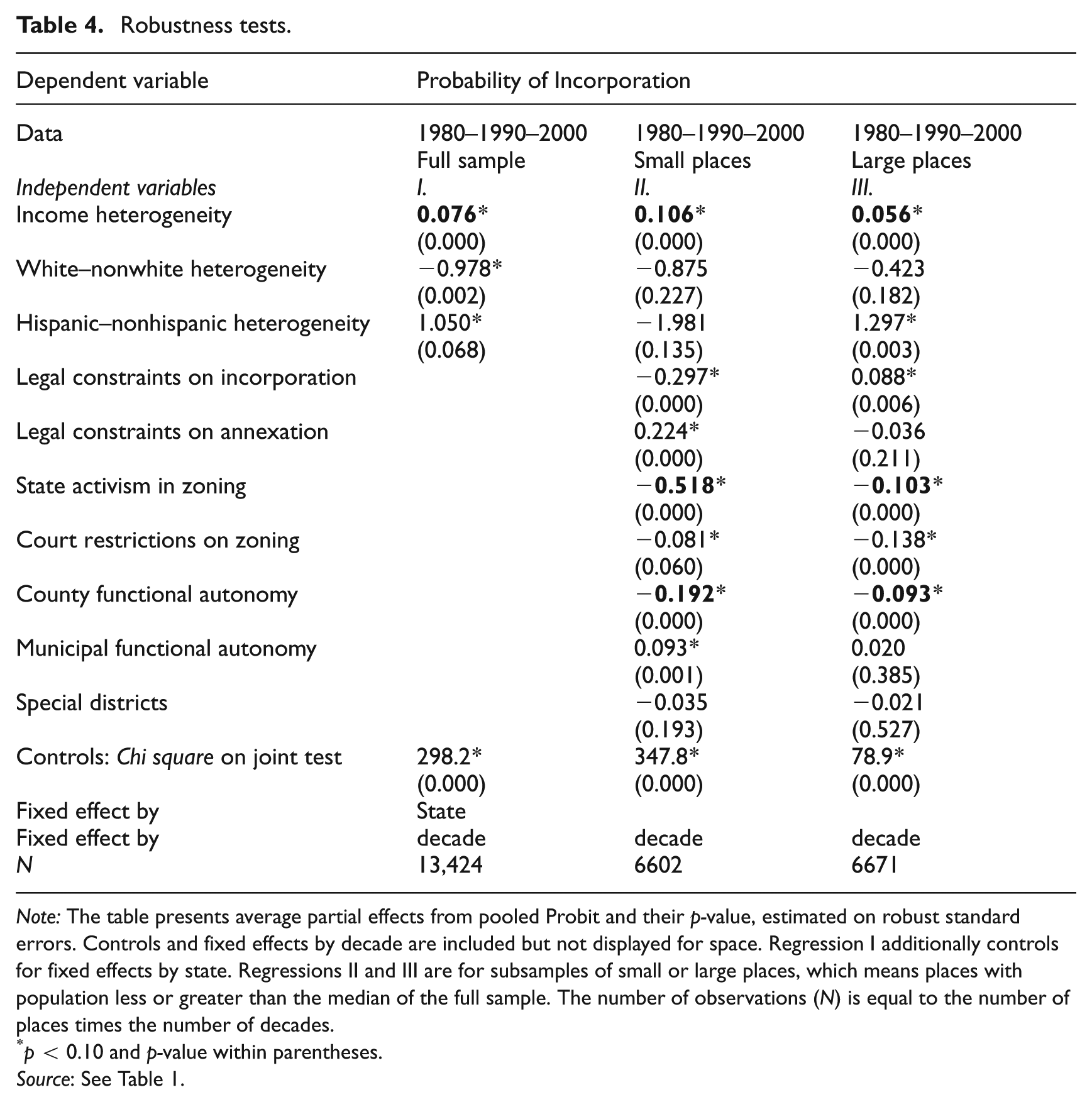
Note: The table presents average partial effects from pooled Probit and their p-value, estimated on robust standard errors. Controls and fixed effects by decade are included but not displayed for space. Regression I additionally controls for fixed effects by state. Regressions II and III are for subsamples of small or large places, which means places with population less or greater than the median of the full sample. The number of observations (N) is equal to the number of places times the number of decades.
p < 0.10 and p-value within parentheses.
Source: See Table 1.
Urban heterogeneity
The first set of results are for the effect of heterogeneous populations on the probability of incorporation. This section focuses primarily on the results from the fixed effects model. By fully controlling for place-unobserved effects, these results may be more consistent than results from pooled probit (Angrist and Pischke, 2008). Nonetheless, I will additionally use probit to show that the study findings are not merely driven by the choice of a linear model. Table 3 presents the main results from fixed effects OLS. First, the effect of heterogeneous populations is tested by two-decade panels. Finally, that effect is tested by the full panel in the last column.
The first set of results support the hypothesis that income heterogeneity raises the probability of municipal incorporation. When significant, the measure of income heterogeneity raises the probability of incorporation between 0.037 and 0.059. Interestingly, the effect of income heterogeneity is greater for the 1980–1990 panel. This result may be consistent with two factors. Since the 1970s, income segregation has widened in metropolitan areas (Boustan, 2013). Also, the 1980 decade was still influenced by post-war suburbanisation (Mieszkowski and Mills, 1993). Together, widening income heterogeneity and suburbanisation could have influenced initiatives for municipal incorporation among unincorporated areas.
In turn, the income effect for 1990–2000 loses statistical significance. A tentative interpretation is that, while income heterogeneity was still widening, the pace of suburbanisation was slowing down in the 1990 decade (Mieszkowski and Mills, 1993). Some central cities were regaining population (Glaeser et al., 2001). Also, income heterogeneity could have affected cities themselves, in addition to income differentials across the metropolitan area. Finally, an average effect is estimated for the full 1980–1990–2000 panel. When pooling all decades, income heterogeneity again raises the probability of incorporation. The previous analysis, however, suggests that effect was greater in the 1980 decade.
I first employ fixed effects OLS for the robustness reasons explained above. However, a nonlinear method such as pooled probit gives similar results for the effect of income heterogeneity on municipal incorporation. In Table 3, the effect of income heterogeneity ranges between 0.089 and 0.116. Therefore, pooled probit similarly supports the hypothesis that income heterogeneity raises the probability of incorporation. Actually, the average effect is greater when using pooled probit. It is also noteworthy that income heterogeneity becomes significant, for the 1990–2000 panel, when using probit rather than fixed effects OLS.
Finally, the results for racial and Hispanic heterogeneity are mixed across alternative models and suggest that ethnicity fails to predict new incorporations, as it was hypothesised for early post-war incorporations. 27 Rather, it is income heterogeneity that generally raises the probability of incorporation. This finding may also be consistent with recent literature on income segregation and differential tax-and-service policies in municipalities. Boustan (2013) and the literature referenced in her article suggest that high-income residents are willing to pay for housing in municipalities of high property values. That literature suggests that much of that willingness is related to low property tax rates and exclusive services in fringe jurisdictions. Although less explicit about the role of boundary change, the significant effect of income heterogeneity is relevant to that literature because incorporation is the institutional process allowing for the configuration of exclusive tax-and-service packages in new municipal jurisdictions (c.f. Miller, 1981).
State legislation
The second set of results are for the effect of state legislation on the probability of incorporation. Table 3 presents results from pooled probit, after fixed effects OLS. Fixed effects cannot be added when using pooled probit, but this method is needed to estimate effects for legislation variables. These time-invariant variables are now of interest. First the effect of legislation is tested by pooling two decades. Finally, that effect is tested by pooling all decades in the last column of the table.
This second set of results support various hypotheses concerning the effect of state legislation on the probability of incorporation. The first relevant variable is for legal constraints on incorporation. Clearly, those laws affect incorporation initiatives by imposing requirements. The findings support that hypothesis since the effect is generally negative. Another relevant variable is for legal constraints on annexation. Those laws appear to raise the probability of incorporation. This finding supports the hypothesis that constraints on annexation increase incentives for incorporation. Where it is hard to annex unincorporated areas, incorporation may become an alternative for areas in need of municipal services, for example.
Always significant, the measures of state and court legislation on zoning have a negative effect on the probability of incorporation. These findings support the hypothesis that restrictions on municipal zoning reduce one key incentive for incorporation. Indeed, zoning may be a key policy role sought from municipal incorporation (Burns, 1994; Carr, 2004; Fischel, 2001). Where zoning is broadly delegated to municipalities, incentives for incorporation appear to increase. Where zoning is restricted, incentives for incorporation seem to decrease. Although both state government activism and court restrictions are significant, the effect appears to be particularly strong for state government activism.
There are also interesting results for the measures of county and municipal functional autonomy. Significant across alternative tests, county functional autonomy has a negative effect on the probability of incorporation. Intuitively, greater county autonomy reduces incentives for incorporation, since municipal services can be provided by the county. Conversely, municipal functional autonomy generally raises the probability of incorporation. This finding also may be intuitive as greater municipal autonomy increases incentives for incorporation and the ability of a new municipality to provide services to its population.
Finally, a greater number of special districts per 1000 population in the county raises the probability of incorporation. This finding supports the hypothesis that special districts may substitute for municipal provision of urban services. Taken together, these findings suggest that municipalities, counties and special districts may be alternative institutions for service provision (Carr, 2004; Carr and Feiock, 2004).
Robustness tests
To check for whether the study findings are robust, some alternative tests are presented in addition to those of Table 3. 28 Table 4 reports those additional tests. In the first column, a pooled probit regression controls for state fixed effects; in other words, dummy variables classify places by state. This can be a rigorous test because it isolates and removes cross-state variation. A disadvantage of this test is that state legislation variables drop out and cannot be assessed. Therefore, this is primarily a test for the robustness of heterogeneity measures. Again, income heterogeneity remains robust and in line with previous findings.
In columns II and III, tests for subsamples of small and large places are implemented, separately. In column II, pooled probit is estimated for the subsample of places with population less than the median. In column III, pooled probit is estimated for the subsample of places with population greater than the median. These subsample tests are helpful for two reasons. First, they are a straightforward check for influential observations on either the lower or upper tail of the population distribution. Second and relatedly, this test may reassure us that the findings are not merely driven by the selection of observations by minimum population in the states.
The subsample tests show that income heterogeneity remains robust across subsamples. Nevertheless, the positive effect of income heterogeneity decreases somewhat when using large places only. My interpretation of this finding is that resident sorting by income might play a greater role in incorporation initiatives among small unincorporated areas, whereas additional factors could influence incorporation initiatives among large unincorporated areas. Results concerning state legislation are likewise consistent with previous findings. For example, a greater state and court role in zoning reduces the probability of incorporation. Similarly, county functional autonomy reduces the probability of incorporation. Other results are robust or mixed depending on the independent variable of interest.
Discussion
In this article, I present findings from a longitudinal study of municipal incorporations in the USA. To assess their role in municipal incorporation, measures of urban heterogeneity are constructed on place data for income, race and Hispanic ethnicity. The study findings indicate that income heterogeneity raises the probability of municipal incorporation, while the findings for race and ethnicity are mixed. The income findings support the Tiebout hypothesis and class-based explanations from the literature of boundary change. They also show that income stratification in metropolitan areas is likely becoming more relevant than ethnicity in initiatives for municipal incorporation, and the income findings appear to be robust to alternative tests. These findings also suggest that civil rights legislation, e.g. by preventing housing discrimination, could have allowed for racial integration in municipal jurisdictions – yet income stratification is now differentiating newly incorporated from older jurisdictions.
The role of state legislation on local government autonomy is also examined in specific areas. Those areas include legislation on boundary change, zoning and functional autonomy of local governments. Important results affecting the probability of incorporation include a negative effect of state government activism in zoning and a negative effect of court restraints on municipal zoning. Additionally important results include a negative effect of county functional autonomy and a positive effect of municipal functional autonomy. Several of those findings also seem to be robust to alternative tests. The study findings give a new range of tests of hypotheses previously suggested by, but inconclusively tested in, the literature.
The study builds on theory from the literature of boundary change and the Tiebout model to assess municipal incorporations in the states. The Tiebout literature points out the role of resident sorting in tax-and-service policies by municipalities, and this study extends that insight into the question of municipal incorporation. The literature on local government boundaries points out the role of state legislation in altering incentives for boundary change. I emphasise the role of, not only constraints on incorporation itself, but also legislation on zoning and functional autonomy of local governments. In terms of policy implications, the study findings are consistent with the idea that state legislations, inclusive of zoning, can affect incentives for municipal incorporation and resulting patterns of metropolitan fragmentation.
I also take advantage of this opportunity to present a boundaries-normalised data set that allows for analysis of boundary change through panel data methodology. This could be an important addition because it moves the empirical literature a step forward into sub-county level analysis. The data and empirical methodology proposed in the study may thus be useful for further lines of research. 29 Suggestive of possibilities for future work, limitations of this study include the following: First, the study did not look into municipal incorporations that subsequently dis-incorporate. While dis-incorporations are relatively infrequent, future research could explore the causes of dis-incorporation. Second, the study has been national in scope and had to abstract, to some extent, from topics specific to any individual state. Although the study findings point out the importance of state legislations, future research could dig into what additional factors influence the uneven frequency of incorporations over time and across states (Rice et al., 2014). Third and relatedly, case studies by state could continue to add depth to this literature (e.g. Miller, 1981).
Footnotes
Acknowledgements
I am grateful to Chelsey L Thorpe and Ujjwal Dhungana for outstanding assistance, to Richard C Feiock, Jered B Carr, and two anonymous referees for very helpful comments, and to the University of New Mexico, the Florida State University, and the Florida Public Affairs Center for financial support
Funding
The author gratefully acknowledges research grants by the University of New Mexico (UNM), the Florida State University (FSU), and the FSU Center for Disaster Risk Policy.