




Abstract
This study investigates immigrant suburbanisation trends over the past decade in the metropolitan USA, focusing on how suburbanisation affects the residential segregation of foreign-born populations. Using 2000–2012 data from the decennial census and American Community Survey, it tracks the suburban settlement patterns of 17 country-of-origin groups. It uses a methodological approach that decomposes metropolitan segregation into within and between city/suburb components. The findings indicate that most immigrant groups rapidly suburbanised during the 2000s, though there remain large differences in suburbanisation rates among country-of-origin groups. Immigrant suburbanites tend to be less segregated from US-born whites than are their coethnic counterparts in large cities. Suburbanisation continues to blur the city/suburb divide, which now accounts for a small share of the segregation experienced by most groups. At the metro level, suburbanisation is associated with lower levels of immigrant segregation even after controlling for relevant metropolitan characteristics. These findings are consistent with spatial assimilation, though trends over time suggest a more complicated picture. While immigrants are gaining access to the suburbs, most groups experienced increasing segregation at the same time they were rapidly suburbanising. This is due to increasing segregation within the suburbs, which often offset segregation declines occurring within large cities. These findings underscore the importance of understanding the underlying and often countervailing city/suburb contributions to metropolitan segregation.
Introduction
Over the past 50 years, two demographic forces have profoundly changed the structure and composition of metropolitan America: suburbanisation and immigration (Alba and Nee, 2003; Iceland, 2009; Jackson, 1987; Singer et al., 2008). As immigrants have become more geographically dispersed throughout the USA, there has been increasing scholarly interest in immigrant settlement patterns in new destinations outside of traditional gateways (Hall, 2013; Lichter et al., 2010; Singer, 2005). Some of these new destinations include smaller cities and rural counties, but most of them are found in suburbia. Reversing a pattern of urban concentration in previous eras, immigrants often bypass large cities altogether for settlement in the suburbs. In 1980, about four out of ten immigrants were suburbanites. By 2010, over half of the foreign-born population was suburbanised and this figure rises to 61% in large metropolitan areas (Wilson and Singer, 2010).
Immigrant suburbanisation has contributed to the increasing ethnoracial diversity of the suburban ring. During the 2000s, Hispanics alone accounted for nearly half of suburban population growth in the largest 100 metropolitan areas and the majority of ‘melting pot suburbs’ are concentrated in immigrant-rich metropolitan areas in California, Texas and Florida (Frey, 2011). How are these newcomers incorporated into the residential mix of suburbia? This is a crucial question given that residential segregation continues to have implications for racial and ethnic disparities in education, employment and health (Iceland, 2009; Massey and Denton, 1993; White and Glick, 2009). Thus, it is important to identify whether our diversifying suburban rings are indeed integrating or instead fragmenting into a mix of homogeneous neighbourhoods like we see in many of our largest cities.
Existing research on suburbanisation and residential inequality often relies on panethnic ethnoracial groupings, thereby treating Latino or Asian populations as monoliths (Clark, 2006; Farrell, 2008; Lichter et al., 2010; Massey and Denton, 1988). This is problematic given the cultural, linguistic and geographic diversity within their ranks, and this is doubly so for the foreign-born segments of these populations (Kim and White, 2010). This study falls in line with other recent work (Hall, 2013; Iceland, 2009; Lobo et al., 2007) that forgoes the panethnic approach by looking at settlement patterns of immigrants from 17 different countries-of-origin. In addition to considering a wide array of groups, it uses a novel methodological approach that decomposes metropolitan segregation into within and between city/suburb components. It is structured around four guiding questions: (1) Are immigrant suburbanites less segregated than their urban counterparts? (2) To what degree does suburbanisation affect immigrant segregation in metropolitan areas? (3) Does the impact of suburbanisation hold after taking other relevant metropolitan characteristics into account? (4) Are these findings consistent across country-of-origin groups?
The residential incorporation of immigrant groups
Assimilation or stratification?
Residential attainment is a crucial bellwether for immigrant incorporation into a host society. This is the fundamental assumption of the spatial assimilation perspective, which focuses on the residential patterns of immigrants and their offspring (Massey, 1985; Rosenbaum and Friedman, 2007). The logic of the perspective is straightforward. Upon entry into the USA, immigrant groups will tend to settle in segregated residential areas within large cities. The reason for this clustering is both cultural and economic. Newcomers seek support and a sense of belonging and they can find it in the social networks and institutions that an ethnic enclave provides. There are also economic benefits to residing in an enclave, including access to ethnic labour markets and entry into occupational niches. Over time, the perspective predicts, group members that become more acculturated and socioeconomically mobile will become more residentially dispersed as their social networks and housing options expand (Charles, 2007; Johnston et al., 2002; Massey and Denton, 1988; South et al., 2008). A major component of this spatial dispersion involves suburbanisation and greater residential contact with the US-born population. Seen in this light, suburbanisation is integral to spatial assimilation (Clark, 2007). If true, immigrant suburbanites should be less segregated than their urban counterparts and higher rates of suburbanisation at the metropolitan level should be associated with lower levels of immigrant segregation.
One issue with the spatial assimilation perspective as it was originally formulated is the implicit assumption that the process of assimilation works in the same fashion across immigrant groups. Portes and Zhou (1993) introduced a segmented assimilation approach to address this limitation. It recognises that immigrant groups face different opportunities and obstacles in a host country depending on their race, national origin, refugee status and access to ethnic networks and resources. This helps account for the fact that detailed ancestry groups often exhibit disparate segregation patterns and trajectories (Fong and Hou, 2009), even within the same metropolitan area (Lee et al., 2014). Owing to in-group preferences (Clark, 2002; Fong and Chan, 2010) or reliance on ethnic housing markets (Zhou, 1992), certain groups may be more likely to seek out clustered ethnic neighbourhoods. Other more suburbanised groups may rely on ‘heterolocal’ ethnic networks that need not be tethered to a segregated enclave (Zelinsky and Lee, 1998). As such, the segmented assimilation model predicts that country-of-origin groups will have divergent rates of suburban settlement and that group segregation patterns will vary within the suburban ring as well.
Another underlying assumption of the spatial assimilation perspective is much less applicable in the current era because of changing immigrant settlement patterns. Rather than opting for residence in the dense urban core, many immigrants have responded to the decentralisation of jobs by settling directly in the suburbs (Liu and Painter, 2011). How are they received? The place stratification perspective points to several barriers to spatial assimilation, some of which include white racial attitudes, preferences and behaviours. White discomfort with racially diverse neighbourhoods is well-documented, though there is some debate about whether this is ultimately based on racial (or nativist) animus or class-based concerns (Charles, 2006; Ellen, 2000; Harris, 1999; Krysan et al., 2009). Either way, neighbourhood demographic dynamics are consistent with white flight and avoidance of burgeoning immigrant populations (Crowder et al., 2011). Perhaps this helps account for rapid white population growth in homogeneous exurban areas distant from diversifying inner suburban rings (Frey, 2011).
The place stratification perspective also identifies institutional barriers to residential integration (Massey and Denton, 1993). Housing audits and analyses of mortgage data indicate that minority households continue to face discrimination in housing and lending (Pager and Shepherd, 2008). A recent housing audit carried out by the US Department of Housing and Urban Development found that black, Hispanic and Asian testers seeking information about rental units were told about and shown fewer units than white testers (Turner et al., 2013). Asian home seekers experienced the highest levels of discrimination; they were told about and shown 15.5% and 18.8% fewer properties, respectively, than their white counterparts (Turner et al., 2013). In addition to subtle forms of housing discrimination, purportedly race-neutral zoning regulations could also serve to segregate immigrants. Rothwell and Massey (2009) find that anti-density zoning leads to increased racial segregation by essentially pricing out many minority residents. These regulations are particularly prevalent in highly suburbanised metropolitan areas with fragmented local governments. The place stratification perspective predicts that institutional practices, legal and illegal, limit the housing choices of foreign-born racial minorities and will increase segregation as a result. This segregation could be manifested in a widening residential city/suburb divide between immigrants and native whites or to increased segregation within the suburban ring itself.
Immigrant segregation and suburbanisation
While there is a great deal of research on immigrant suburbanisation (Frey, 2011; Singer et al., 2008; Wilson and Singer, 2010) and immigrant segregation (Hall 2013; Iceland, 2009; Iceland and Scopilliti, 2008; Lieberson, 1980), there are relatively few studies that systematically analyse the interplay between the two. Using methods similar to those used in the present study, Fischer et al. (2004) decompose neighbourhood segregation by race, class, and lifecycle into its geographic components for the entire USA. They find that neighbourhood segregation between the foreign-born and US-born population increased by two-thirds between 1960 and 2000. Much of this increase was due to increasing immigrant concentrations in certain metropolitan areas and to increasing segregation within city and suburban communities. Their decomposition does not separate out the relative contributions of segregation shifts within cities compared with that occurring within suburbs, but it clearly shows that the differences between cities and suburbs is playing a small and decreasing role. By 2000, the city/suburb divide between the foreign-born and US-born population accounted for just 4% of total immigrant segregation in the US.
Rather than focusing on immigrants in the aggregate, Cutler et al. (2008) measure immigrant segregation trends for specific nativity groups between 1910 and 2000. They identify segregation declines in the early part of the century but, consistent with Fischer et al. (2004), these declines had reversed by 1970. As the spatial assimilation perspective would predict, they find that segregation increases in recent decades are due largely to an influx of new immigrants that are of lower socioeconomic status and less proficient with the English language than previous waves. Additionally, they contend that suburbanisation plays a role in this increasing segregation. Because immigrants rely on public transit more than the native population, they are forced to residentially cluster around public transit hubs in heavily automobile-dependent (i.e. suburbanised) metropolitan areas. Thus, the increasingly sprawled nature of metropolitan areas has driven immigrants to segregate, though the authors do not address whether or to what degree this is occurring in the suburbs.
Alba et al. (1999) find disparate segregation patterns across groups residing in the cities and suburbs of New York and Los Angeles. Mexicans in both metropolitan areas are less segregated in the city than they are in the suburban ring while Cubans exhibit the opposite pattern. High levels of suburban segregation are particularly high in Los Angeles, with Chinese, Indians and Vietnamese all registering lower segregation levels in the city than in its outskirts. Logan et al. (2002) also set their sights on Los Angeles and New York. The thrust of their study is not toward immigrant segregation per se but instead the related issue of ethnic neighbourhoods. They present evidence that many Cubans, Mexicans, Chinese and Vietnamese opt for suburban neighbourhoods with large concentrations of coethnics.
Clark and Blue (2004) also do not look directly at immigrant segregation but do assess black, Asian and Hispanic segregation from whites in a small sample of immigrant gateway cities. They find all groups tend to be less segregated in the suburbs, though the suburban advantage tends to be smaller (and occasionally reversed) for Latinos and Asians than it is for Blacks. In a subsequent study of 16 large metropolitan areas, Clark (2007) finds further evidence of Asian and Latino integration in the suburbs relative to cities. Lichter et al. (2010) analyse Hispanic settlement patterns in a much larger sample of places. Consistent with the previous two studies, they find that in 2000 Hispanics were generally less segregated in suburban places than they were in central cities. However, Hispanic suburbanites tend to be highly segregated in a subset of new destinations where the growing Hispanic population is disproportionately foreign-born. In fact, some of the most segregated communities in America are found in the suburban ring of these emerging Hispanic immigrant destinations.
Previous research on immigrant settlement patterns suffers from a number of limitations. These include focusing on overly broad panethnic groups, relying on limited metropolitan sample sizes, and leaving the impact of immigrant suburbanisation unexamined. The present study seeks to contribute to the literature on immigrant suburbanisation and segregation in a number of ways. First, it will provide data on the most recent immigrant segregation trends occurring in the USA for a large sample of metropolitan areas. Second, it will look at the settlement patterns of 17 country-of-origin groups, thereby producing a more refined picture of immigrant segregation than many studies provide. Third, it will decompose immigrant segregation into its constituent geographic components and assess the relative city/suburb contributions to shifting settlement patterns across metropolitan neighbourhoods.
Data and methods
Data
This study incorporates decennial census data from 2000 Summary File 3 and data from the 2008–2012 American Community Survey (ACS) 5-year estimates. I have selected the 17 largest country-of-origin groups from the foreign-born population, all of which had estimated national populations of 500,000 or more in the 2008–2012 ACS. These country-of-origin groups include immigrants hailing from five Asian countries (China, India, Korea, Philippines, Vietnam), five Latin American countries (Colombia, El Salvador, Guatemala, Honduras, Mexico), four Caribbean countries (Cuba, Dominican Republic, Haiti, Jamaica), two European countries (Germany, United Kingdom) and Canada. The US-born segment of the non-Hispanic white population will serve as the reference group. This follows the convention in most segregation research and reflects the reality that native whites are the largest and most suburbanised ethnoracial group in the USA. Furthermore, they are the group least likely to embrace residential integration (Charles, 2006) and most likely to move in the face of a proximate and growing immigrant population (Crowder et al., 2011). This makes native whites a particularly pertinent reference group to consider when investigating immigrant incorporation in the suburbs.
Metropolitan areas are defined according to the 2009 Office of Management and Budget specifications. The analyses include a sample of 263 metropolitan areas with at least 1000 foreign-born residents in both 2000 and 2008–2012 and at least one principal city of 50,000 or more in 2010. Group-specific analyses result in varying metro sample sizes because they are limited to metropolitan areas in which the group population size is 1000 or more. Census tracts serve as the proxies for metropolitan neighbourhoods in this study, and all tract data were extracted using the Social Explorer online research tool (Social Explorer, 2014). 1 Census tracts are excluded if their group quarters populations make up more than one-quarter of total population. This results in a total of 57,752 tracts making up 263 metropolitan areas. Tracts located outside of principal cities of 50,000 or more are coded as suburban. Thus, suburban tracts will be found in both suburban municipalities and in unincorporated areas. In cases where a tract crosses principal city boundaries it is assigned city/suburb status based on where the majority of the tract population is located.
Measuring and decomposing segregation
While many studies of immigrant segregation use the dissimilarity index (Hall, 2013; Iceland, 2009; Iceland and Scopilliti, 2008), I opt for Theil’s (1972) information theory index (H) because it is decomposable into geographic components. This will allow me to assess the degree to which overall metropolitan segregation is a function of neighbourhood differences within cities, within suburbs, or between cities and suburbs. In order to estimate H it is first necessary to calculate an entropy index (E), which reflects the degree to which US-born white and foreign-born populations co-reside in a given geographic unit:

where Qr refers to a nativity group’s proportion of a particular geographic area. In the two-group framework used here the denominator for Qr includes the immigrant group in question combined with the native white population; it excludes other nativity groups and US-born nonwhites. This two-group E reaches its maximum of 0.693 (natural log of 2) when both groups are of equal size. It reaches its minimum value of zero when only one group is present. Entropy indices are calculated for each metropolitan area and all of its census tracts.
H is interpreted as the difference between the entropy of a metropolitan area and the weighted average entropy of its constituent census tracts. High levels of segregation occur when tracts have much lower entropy scores than their metropolitan contexts, as would be the case in a metropolitan area featured by immigrant enclaves that are spatially separated from white residential areas. Lower segregation occurs when the level of overall entropy in a metropolitan area is reflected in most of its neighbourhoods, a situation in which immigrant groups are residentially intermingled with US-born white population. H is calculated using the formula:

where ti is the total two-group population of tract i and T is the total two-group metropolitan population. At its extremes, H can indicate maximum residential integration (H = 0) or maximum residential segregation (H = 1).
H is decomposable into three geographic components, reflecting the degree to which metropolitan segregation is due to the unequal distribution of immigrants and native whites (1) within principal cities, (2) between cities and suburbs, and (3) within the suburban ring. The geographic decomposition of H can be expressed as:

where TC, EC, and HC and TS, ES, and HS are the total two-group metropolitan population, entropy and segregation of principal cities and the suburban ring, respectively. The first geographic component, HC×S, refers to segregation between city and suburb, and the remaining two components refer to segregation occurring within principal cities and within the surrounding suburbs. This sort of geographic decomposition has been used to analyse the city/suburb contributions to segregation among panethnic ethnoracial groups (Farrell, 2008; Fischer, 2008; Fischer et al., 2004; Reardon et al., 2000), but it has not yet disentangled the geographic components of segregation for specific immigrant groups. 2
Multivariate models
The multivariate analyses will incorporate a technique developed by Massey and Denton (1989) to combine segregation scores for all groups and time points across metropolitan areas (see also Hall, 2013; Iceland and Scopilliti, 2008). I use generalised linear models with robust standard errors to account for the clustering of observations within metro areas. The full model includes group-specific suburbanisation rate and population size, dummy variables for year and country-of-origin, and a series of metropolitan controls that have been shown to correlate with segregation (Farley and Frey, 1994; Lee et al., 2008; Logan et al., 2004). These include region, population size and the overall suburbanisation of the metropolitan area. Additionally, I control for metro demographic composition by including percentage of the population that is black, foreign-born, recent immigrants (arrived in the past decade) and of retirement age. The availability of housing is captured by calculating the vacancy rate and the percentage of housing units built in the most recent decade. Functional specialisation as a military, university or manufacturing centre is represented in the models with variables measuring the percentage of the labour force in the Armed Forces, percentage of the population enrolled in college, and the percentage of the employed labour force engaged in manufacturing. Finally, reliance on public transit is operationalised as the percentage of employed workers that use public transportation.
Results
Patterns of immigrant suburbanisation and segregation, 2008–2012
Table 1 documents the rapid suburbanisation of the foreign-born population in the sample of 263 metropolitan areas. According to the 2008–2012 ACS estimates, about half (50.9%) of the foreign-born population resides in the suburbs, compared to 70% of the US-born white population. Since 2000, the rate of suburban growth among immigrants was nearly four times that of the US-born population and more than 12 times that of native whites. All of the immigrant groups originating from outside Europe and Canada suburbanised at a higher rate than the US-born population, with Indians, Salvadorans, Guatemalans and Hondurans experiencing the largest relative gains. Despite this suburban growth, all the groups except Cubans are less suburbanised than the native white population. Apart from Cubans, Colombians exhibit high rates of suburbanisation and Canadians, Germans and British have suburbanisation levels that mirror the total US-born population. On the other end of the spectrum, Chinese, Dominican, Guatemalan and Mexican immigrants have the lowest rates of suburbanisation.
Suburbanisation of metropolitan immigrants by country-of-origin, 2000 and 2008–2012.

Are immigrant suburbanites less segregated than their urban counterparts? Figure 1 provides segregation indices for the city and suburban segments of each group’s population for metropolitan areas meeting group-specific size criteria. The H indices are weighted by group size so they reflect the segregation levels experienced by the average group member. Overall, immigrants are slightly more segregated from whites in cities than they are in suburbs. However, different patterns emerge when breaking up the analysis by country-of-origin. Among most Asian immigrants, city segregation levels tend to be higher than those in the suburbs, consistent with the spatial assimilation perspective. However, Vietnamese suburbanites are more segregated than their city counterparts and in fact are more segregated than all other Asian groups regardless of city or suburban location.
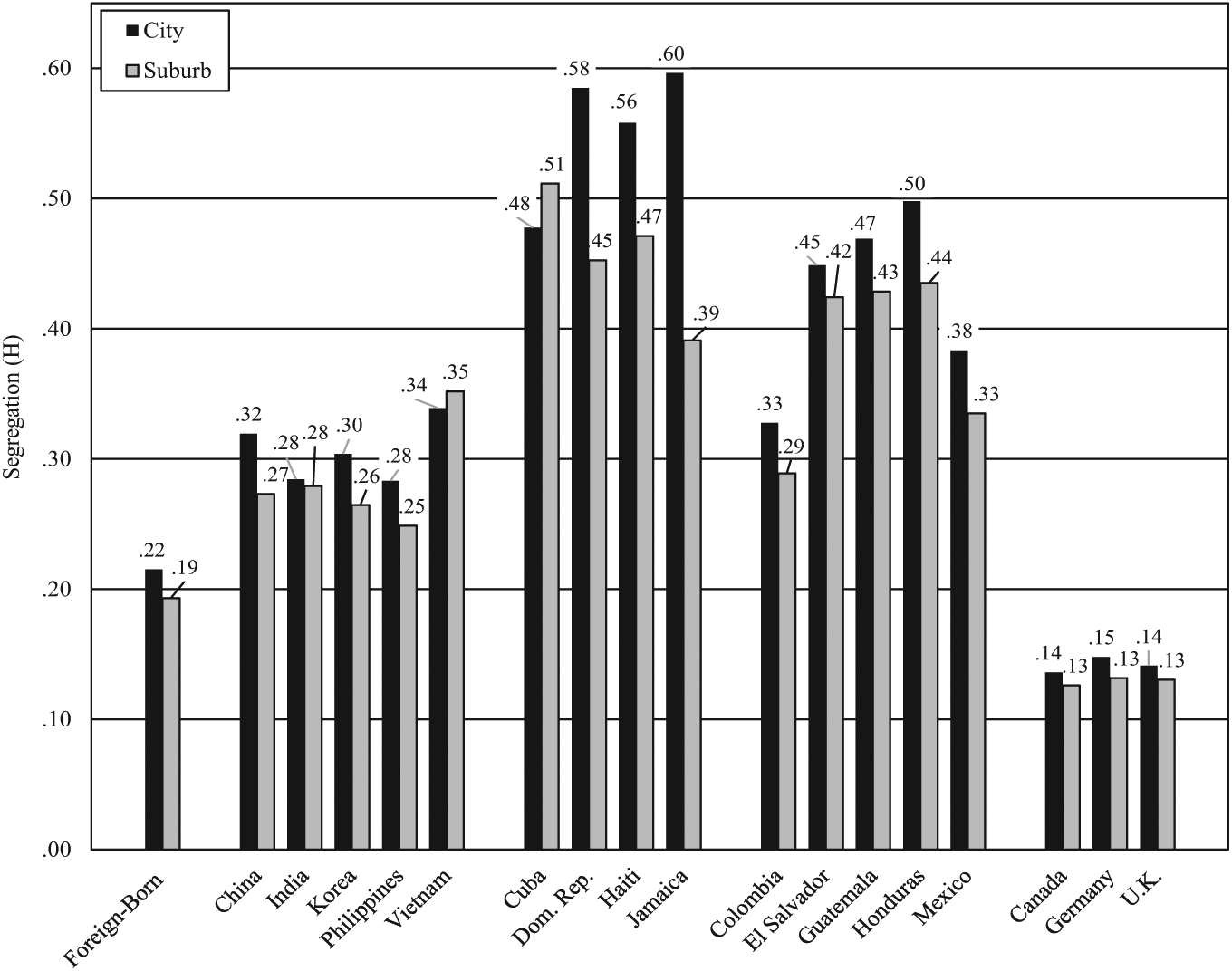
Immigrant segregation by country-of-origin in cities and suburbs, 2008–2012.
Among those with Caribbean origins, Cubans demonstrate a pattern similar to the Vietnamese. Not only are Cuban suburbanites more segregated from whites than Cuban city-dwellers, but they are more segregated than any of the immigrant groups originating outside the Caribbean. Despite their high levels of segregation, the other Caribbean groups conform to the spatial assimilation predictions of lower suburban than city segregation. Jamaicans in particular evince a large city/suburb gap in segregation levels consistent with spatial assimilation. The average Jamaican resident of a principal city is more segregated than any other immigrant group member while the average Jamaican suburbanite experiences lower segregation levels than any of the other Caribbean group members and most immigrants of Latin American origins. Latin American immigrants generally exhibit segregation levels somewhere between that occurring for Asian and Caribbean immigrants. Colombians are the least segregated and Hondurans are the most segregated among Latin Americans, but all groups are more segregated in the cities than they are in the suburbs. Canadians, Germans, and British are by far the least segregated country-of-origin groups. They display city/suburb differences consistent with spatial assimilation, though the city/suburb gap is very small compared with the other groups.
Decomposing metropolitan immigrant segregation
While the results in Figure 1 are useful, they do not give a sense of how suburbanisation, city segregation and suburban segregation combine to create broader patterns of metropolitan segregation for these groups. For example, consider Colombians. Despite relatively high levels of city segregation, the bulk of Colombian segregation at the metro level might be coming from settlement patterns outside the city given that they are one of the most suburbanised immigrant groups. A geographic decomposition of H can help to identify the city/suburb contributions to overall metropolitan segregation.
Figure 2 accomplishes this by displaying 2008–2012 decomposed metropolitan segregation levels for immigrant groups by country-of-origin. As is the case in cities and suburbs (see Figure 1) Canadian-born residents have the lowest overall levels of metropolitan segregation from the US-born whites, followed closely by those from Germany and the UK. Caribbean origins are represented on the right side of the figure, with Dominicans, Haitians, Cubans and Jamaicans occupying the four most segregated spots. 3 Though less segregated than the Caribbean groups, Hondurans, Guatemalans and Salvadorans are still twice as segregated from the native white population as the average foreign-born resident. The segregation level for Mexicans is notably lower than the other Latin American groups. Filipinos are the least segregated group originating from Asia, with Chinese and Vietnamese immigrants experiencing the highest segregation levels among Asian groups.

Immigrant segregation and suburbanisation by country of origin, 2008–2012.
Suburbanisation levels for the various nativity groups are also found in Figure 2. There is some evidence for a desegregating effect of suburbanisation, as there is a modest but statistically significant negative correlation between group-specific suburbanisation rates and H indices across groups and eligible metros (r = −0.252; p<0.001; N = 1428). However, it is clear that suburbanisation does not necessarily lead to greater residential integration. For example, Columbians are more than twice as segregated as the Canadian/European contingent despite being more suburbanised. Furthermore, metropolitan Chinese immigrants are only slightly more segregated than Colombians despite very low suburbanisation levels. While Dominicans fit the spatial assimilation logic of high segregation and low suburbanisation, the Cuban and Haitian experience shows that suburbanisation and segregation can go hand-in-hand. The shading in the bars gives some sense of the geographic contributions to segregation. Consistent with their high levels of suburbanisation, Cuban and Haitian segregation in metropolitan areas is largely a function of segregation occurring within the suburbs. Residential differences between the urban core and suburban periphery appear relatively small for most groups, though a discernible city/suburb divide is present for Chinese, Jamaicans and Dominicans.
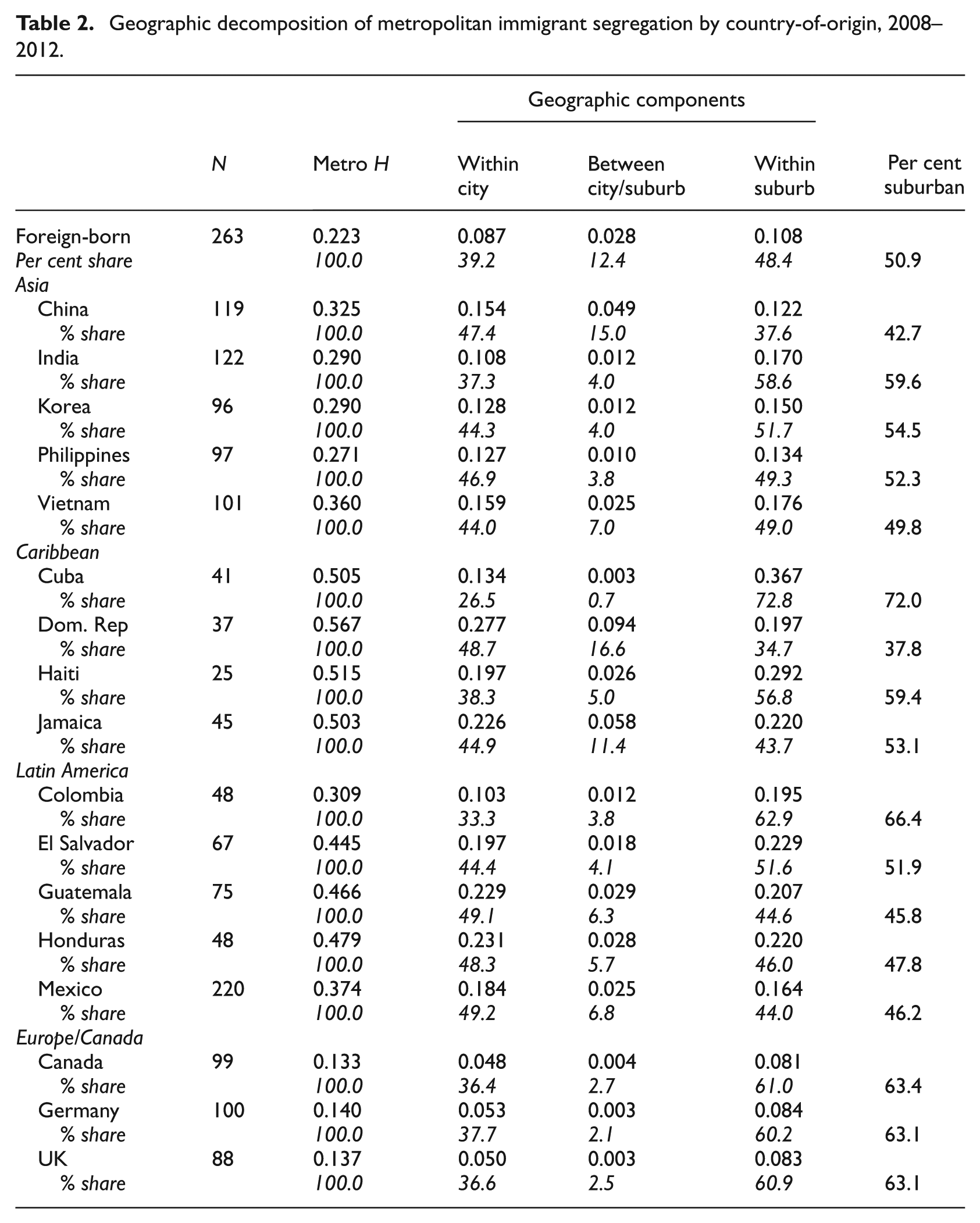
Table 2 provides a more precise decomposition of the H indices for country-of-origin groups. This table includes the within-city, between city/suburb and within-suburb components that combine to make up overall metropolitan segregation as measured by the H index. It also includes each component’s percent share of H to give a sense of its relative contribution to metropolitan segregation. A comparison of the Dominican and Cuban components of segregation provides a useful illustration of the utility of such a geographic decomposition. These two groups experience high levels of segregation but the geographic structure of that segregation varies markedly. Within-suburb residential differences account for the largest share of Cuban segregation (72.8%), followed by within-city differences (26.5%) and a small city/suburb component (0.7%). By contrast, nearly half (48.7%) of Dominican segregation is due to within-city differences, just one-third (34.7%) is due to within-suburb differences, and the remaining 16.6% is due to the city/suburb divide. To put it a different way, eliminating residential segregation from native whites in the suburban ring would make Cubans as residentially integrated as immigrants from the UK. Doing the same for Dominican suburbanites would have less of an overall impact, reducing Dominican segregation by one-third or so but still leaving them as segregated as Mexican immigrants.
Geographic decomposition of metropolitan immigrant segregation by country-of-origin, 2008–2012.
The shifting geographic structure of immigrant segregation in the 2000s
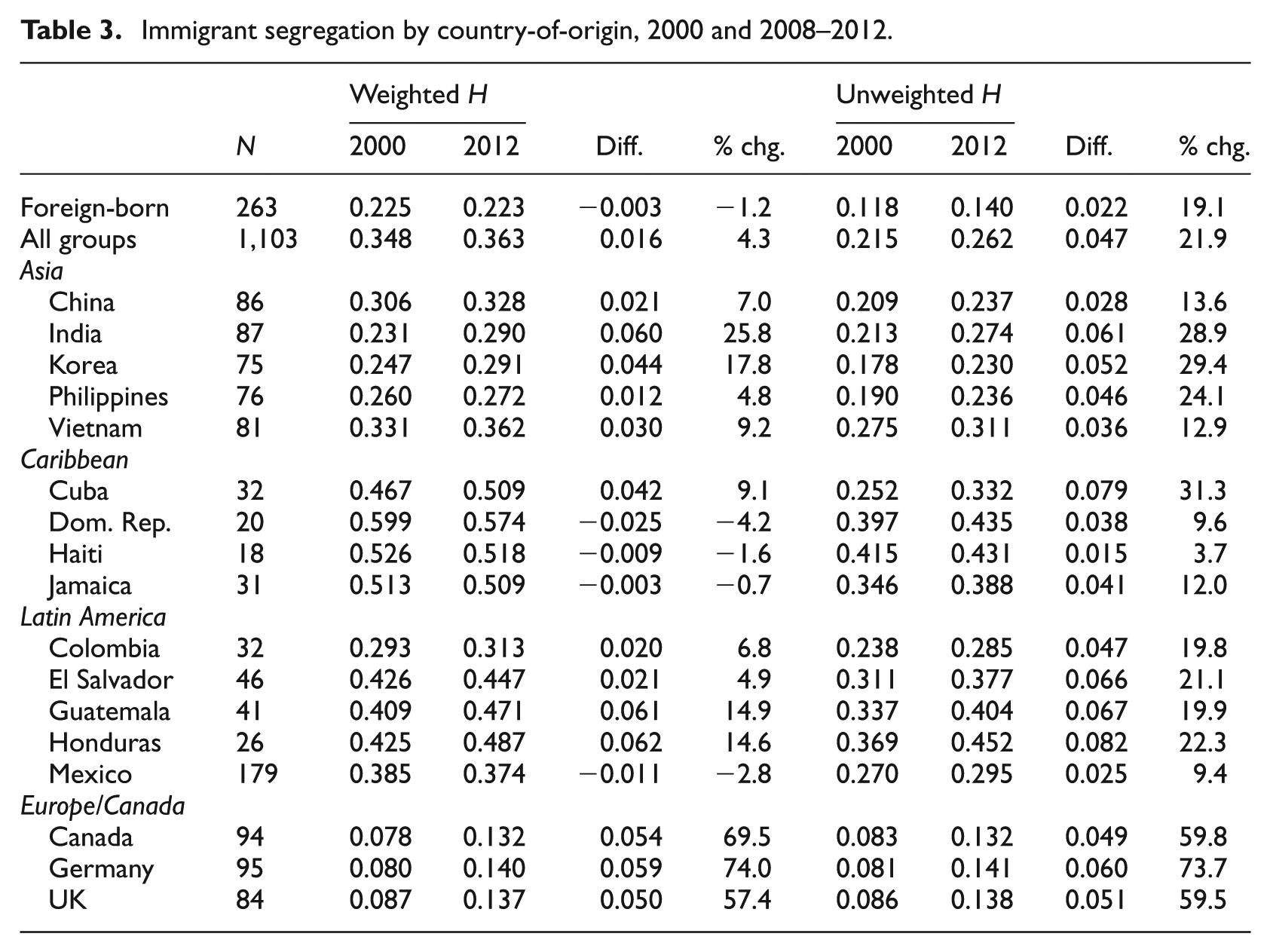
How has immigrant segregation changed during the last decade? Table 3 documents shifts in the segregation index H in metropolitan areas meeting the group-specific population thresholds for 2000 and 2008–2012. I will focus on the weighted results but the unweighted indices are also provided in the table. As a whole, the foreign-born population became slightly less segregated from US-born whites during the 2000s, though it is quickly apparent that country-of-origin plays an important role in the trends. Among Asian origin groups, segregation increased across the board, with Indians and Koreans experiencing the largest absolute and relative gains. Slight declines in already high levels of segregation were most common among Caribbean groups. Cubans are the outlier in in this group, with an absolute increase in H nearly equal to that of Koreans. Latin American groups varied markedly in their segregation trajectories. Colombians and Salvadorans experienced gradual gains, Guatemalans and Hondurans experienced very large absolute and relative increases, and Mexicans became less segregated from native whites. Canadians, Germans and British all became more segregated during the 2000s, though their very low 2000 segregation indices should be taken into account when considering the percent changes.
Immigrant segregation by country-of-origin, 2000 and 2008–2012.
What underlying changes in the distribution of immigrant groups have contributed to these overarching segregation trends? Figure 3 presents changes in the three geographic components of segregation during this period. It is clear that there is much going on under the surface of the overall shifts in metropolitan segregation depicted in Table 3. Among Asian origin groups, increasing segregation within the suburbs accounted for the lion’s share of the segregation increases. While Chinese, Indian and Korean immigrants did experience increasing segregation within principal cities, increases in the within-suburb components easily outpaced them. A more varied picture emerges for the Caribbean origin groups. While Cuban trends mirror that of the Asian groups (i.e. within-suburb increases), the appearance of steady segregation declines for Dominicans, Haitians and Jamaicans masks two countervailing trends. Namely, the city/suburb divide accounts for a declining share of segregation as these two groups suburbanise and diversify the suburban ring. However, the suburban neighbourhoods in which Dominicans and Haitians are settling are becoming more segregated even as their city neighbourhoods become more residentially integrated with the US-born white population.
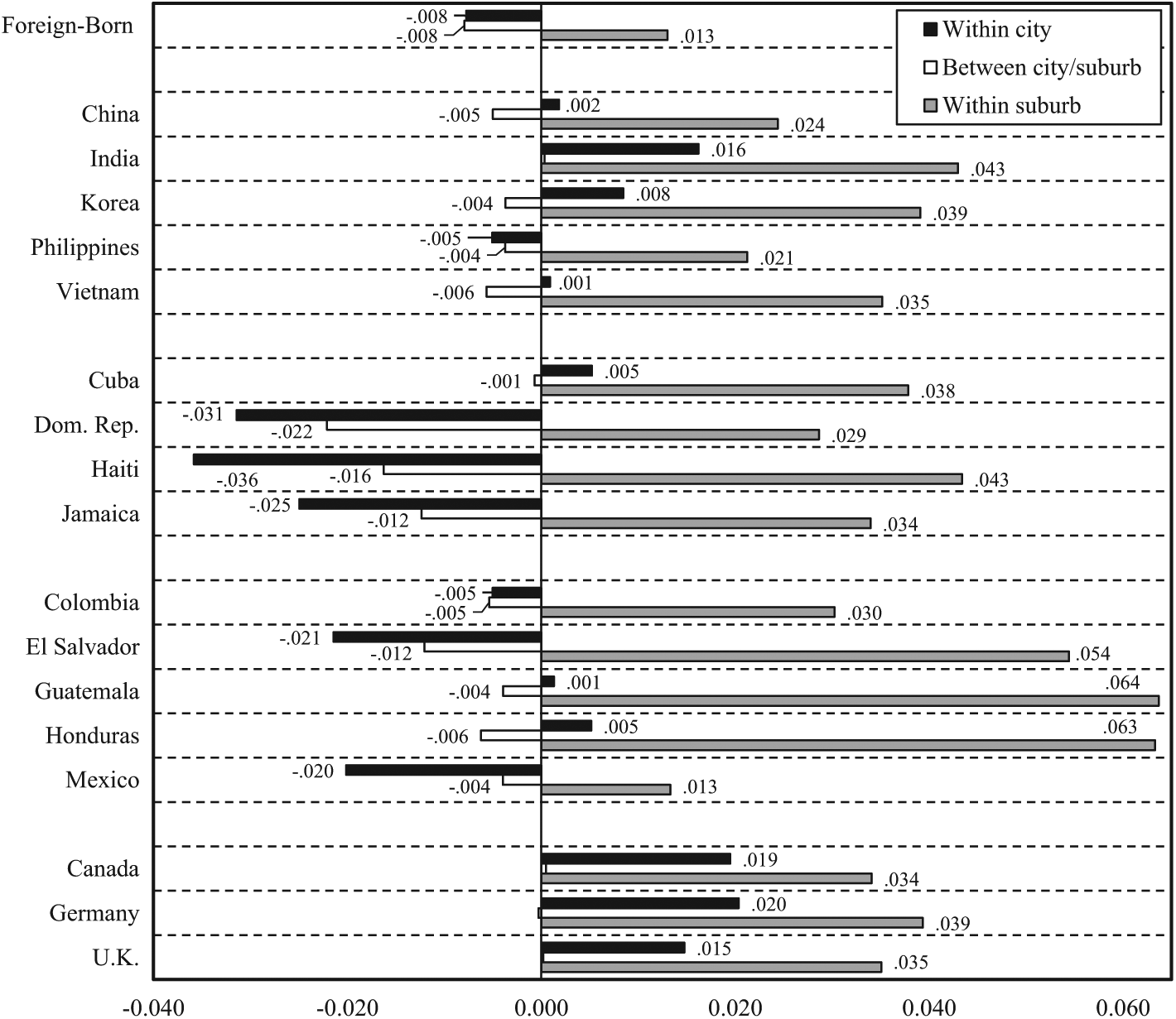
Changes in the geographic components of immigrant segregation, 2000 and 2008–2012.
Among Latin American groups, the suburban-centric shift of segregation observed among Asian groups continues in a more dramatic fashion. Guatemalans and Hondurans in particular experienced large increases in the within-suburb components, larger than any of the other groups. Mexicans, by far the largest immigrant group in the analysis, experienced more moderate increases in the within-suburb components. The desegregation trend for Mexicans within cities more than compensated for the uptick in the suburbs. Finally, Canadians, Germans and British experienced increasing segregation within cities and suburbs, but the suburban increases were roughly twice the size of the increases occurring within cities.
Multivariate analyses of immigrant segregation
What is the impact of immigrant suburbanisation after taking into account other relevant metropolitan characteristics? Table 4 presents the results of regression analyses assessing the association between group- and metro-specific variables with immigrant segregation. 4 To review, the units of analysis are pooled group- and year-specific metropolitan areas. The first model in the table includes a dummy variable for the year, indicating a segregation increase of 0.047 units between 2000 and 2008–2012 (see unweighted results in Table 3). The second model introduces group-specific population sizes and suburbanisation rates. The suburbanisation variable is negative and statistically significant, indicating that immigrant segregation is associated with lower levels of segregation. This model also includes a series of dummy variables identifying each immigrant group in question. Canadians, the least segregated group, serve as the reference group. After controlling for group size and suburbanisation, all groups except the British remain significantly more segregated than Canadians.
Generalised linear regressions of immigrant segregation on group and metro characteristics, 2000 and 2008–2012.
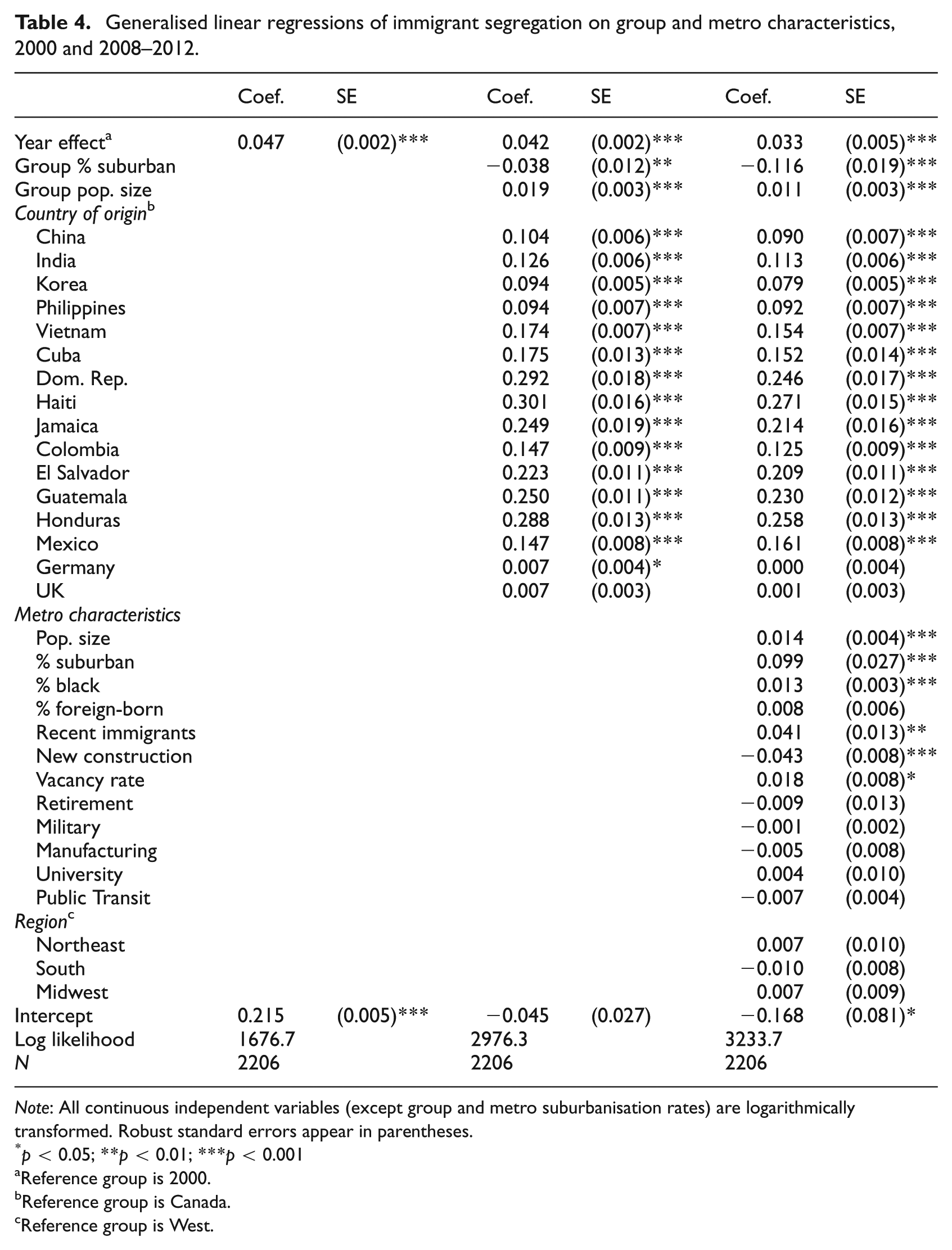
Note: All continuous independent variables (except group and metro suburbanisation rates) are logarithmically transformed. Robust standard errors appear in parentheses.
p < 0.05; **p < 0.01; ***p < 0.001
Reference group is 2000.
Reference group is Canada.
Reference group is West.
The third model in Table 4 introduces a host of metropolitan controls. The findings indicate higher levels of immigrant segregation are likely to be found in larger, suburbanised metropolitan areas with high vacancy rates, large black populations and many recent immigrants. The negative coefficient for immigrant group suburbanisation decreases threefold after controlling for the metropolitan characteristics. A stepwise analysis (not shown) reveals that the metropolitan suburbanisation rate accounts for more than one-third of this change. However, a model excluding metro suburbanisation still results in a decrease in the group suburbanisation coefficient (B = −0.088; se = 0.011; p < 0.001). Thus, accounting for metropolitan characteristics only strengthens the apparent integrating effect of immigrant suburbanisation. The coefficient for the year effect remains statistically significant in the full model, indicating that the increases in immigrant segregation between 2000 and 2008–2012 remain largely intact.
Group-specific models
To test whether suburbanisation has a consistent effect across groups, I stratified the sample and carried out separate regression analyses for each immigrant group (not shown). Not all groups had sample sizes large enough to carry out such an analysis, so I pooled together Haitians and Dominicans and excluded the four remaining groups (Cubans, Jamaicans, Colombians, Hondurans) that had less than 75 cases. In addition to H, I also conducted regressions that treat the geographic components of H as dependent variables. The suburbanisation coefficients for the metro H models were negative for all but one of the groups (Salvadorans) and statistically significantly for five of them: Koreans, Vietnamese, Guatemalans, Mexicans and Germans. In the component models, suburbanisation has a significantly negative effect on the within-city components for all groups and on the between city/suburb components for all groups except Filipinos. In the within-suburb models the effect of suburbanisation flipped, registering strong positive effects for all groups.
Discussion
Many of the findings outlined above are consistent with the logic of spatial assimilation. Most immigrant groups are less segregated from native whites in the suburbs than they are in large cities. Furthermore, suburbanisation is associated with lower immigrant segregation even after controlling for relevant metropolitan characteristics. Immigrant suburbanisation continues to blur the city/suburb divide, which now accounts for only a sliver of the segregation experienced by most groups. However, though immigrants are certainly gaining access to the suburbs, this is not to say that suburbanisation marks the end of segregation. To the contrary, most groups experienced increasing segregation from native whites in the 2000s at the same time they were rapidly suburbanising. This is due primarily to increasing segregation within the suburbs, which often offset segregation declines within cities. As a result, within-suburb segregation is accounting for a larger share of metropolitan segregation. So, immigrant groups tend to be less segregated in metros where they are highly suburbanised but immigrant suburbanisation is having an increasingly segregative effect over time within the suburban ring.
Consistent with the segmented assimilation perspective, some of the findings vary markedly across immigrant groups. Though all immigrant groups are suburbanising, there are large group differences in suburbanisation rates, often among groups coming from the same region. When comparing city with suburban segregation, Asian origin groups like Indians and Vietnamese (along with Cubans) register suburban segregation levels comparable with or higher than that occurring among their coethnics in the city. These findings are consistent with previous studies of immigrant settlement patterns New York and Los Angeles (Alba et al., 1999; Logan et al., 2002). Additionally, high levels of suburbanisation are not associated with residential integration for all groups. Colombians and Cubans are more highly suburbanised than Canadians, Germans or British, but they are also much more segregated. It is worth noting that the four Caribbean groups are the most highly segregated despite large differences in their respective suburbanisation levels. This fact lends credence to the place stratification perspective, underscoring a persistent and pernicious colour line in the USA that transcends one’s country-of-origin.
One limitation of this study is that the ACS data do not provide characteristics such as income, English language proficiency or year of entry by country-of-origin. Thus, it is impossible to test to what degree segregation within the suburbs is a function of the socioeconomic or acculturation characteristics of immigrants, as predicted by the spatial assimilation perspective. A broader issue to consider is whether suburbanisation actually results in upward residential mobility for all immigrant groups. As suburban poverty rates rise in the USA (Kneebone and Berube, 2013), certain groups may find themselves segregated into declining neighbourhoods in the inner suburban ring. Those with the financial resources to attain suburban residence outside these struggling areas may not integrate with the native white population to the degree implied by spatial assimilation. They may instead opt for bustling suburban enclaves distinct from predominantly white environs in the metropolitan periphery (Li, 1998). Future research should endeavour to disentangle these two suburban scenarios.
Footnotes
Acknowledgements
I wish to thank Carolyn Forner and anonymous Urban Studies reviewers for their valuable feedback on previous drafts of this paper.
Funding
This research received no specific grant from any funding agency in the public, commercial, or not-for-profit sectors