



Abstract
This paper examines the relationship between neighbourhood context and social interactions in Southernwood, an inner-city residential suburb in East London, South Africa. Based on interviews with selected residents and community leaders, the paper identifies six contextual variables which influenced neighbourhood social cohesion in the suburb. Contrary to expectations, interview data showed benign effects of racial diversity while social disorganisation accounted for much of the reported low levels of social cohesion in the neighbourhoods. The paper observes that while neighbourhood context has a bearing on the nature of neighbourhood social cohesion, multiple contexts within proximate spaces of neighbourhoods create variegated forms of intra- and inter-neighbourhood social cohesion.
Introduction
Social interaction in urban residential areas has attracted considerable interest among urban scholars. From Ferdinand Tönnies, the 19th century German Sociologist who characterised urban social ties in terms of gemeinschaft and gesellschaft, scholars have observed, on the balance of evidence, a progressive disappearance of interpersonal ties in urban residential areas (Gregory et al., 2009; Guest and Wierzbicki 1999; Völker et al., 2007). Several variables account for this propinquity without community (Guest et al., 2006) and include racial/ethnic diversity (Brown and Brooks, 2006; Crowder, 2000; Donnelly and Majka, 2008; Guest et al., 2008; Letki, 2008; Putnam, 1993; Savage et al., 2005; Wickes et al., 2013; Wilson-Doenges, 2000), socioeconomic class of neighbourhoods (Cheung and Leung, 2011; Filipović, 2008), crime (Letki, 2008), age, nature and design of housing units (Dawkins, 2006; Filipović, 2008; Guest et al., 2006, 2008; Letki, 2008; Völker and Flap, 2007), length of residence in a neighbourhood, household composition and age of residents (Filipović, 2008; Guest et al., 2006), housing tenure, residential stability and social disorganisation of the area (Guest et al., 2006). Popularised by scholars of the Chicago School, investigating the effect of neighbourhood context on localised behaviour has had a long tradition (Guest et al., 2006). Although Wirth ([1938] 2009) ominously observed that the apparent decline in social ties was simply the way of life in urban areas, scholars (Aneshensel and Sucoff, 1996; Filipović, 2008; Guest et al., 2006; Letki, 2008; Völker et al., 2007) have collapsed factors that lower interpersonal linkages in urban neighbourhoods into two categories: individual and contextual variables.
In the South African urban context, social interactions were historically ensconced in the apartheid era’s socially constructed but fiercely contested racial classifications of people into black, coloured, Indian and white (Christopher, 2002; Lemanski, 2006; Oldfield, 2004). These classifications produced ‘mercilessly divided’ cities (Seekings, 2000: 832). Against this backdrop, it has been suggested that in contemporary South Africa, urban residential areas will provide a fertile ground for assessing the extent of social integration (Maharaj, 1996; Williams, 2000). However, although racial relations have, understandably, taken considerable space in South African urban studies, Chipkin and Ngqulunga (2008) argued that race no longer occupied a privileged position to explain social aversion. Therefore, this paper examines the broader neighbourhood context to explain social cohesion in a racially diverse urban residential suburb.
Perspectives on social cohesion and the neighbourhood
Several concepts have been used to investigate social interactions within residential areas: social capital (Putnam, 1993, 1995, 2007), neighbouring (Filipović, 2008; Guest and Wierzbicki, 1999; Guest et al., 2006; Holdsworth and Hartman, 2009) and sense of community (Lupi and Musterd, 2006). Although there is no single universally accepted definition of social cohesion (Demireva, 2011; Friedkin, 2004; Kanazawa and Savage, 2009; Spoonley et al., 2005), many definitions embody aspects of bonding among people. For instance, Chipkin and Ngqulunga (2008: 61) underlined the ‘affective bonds between citizens’; Van Bergeijk et al. (2008: 1) referred to ‘the glue that keeps a social system together’ and for Dekker and Bolt (2005: 2448), it is ‘the glue that keeps the members of a social system together’. However, Kunene (2009) provided a broader perspective of social cohesion as ‘those factors that have an impact on the ability of a society to be united for the attainment of a common goal’. The paper adopts De Hart’s (2002, as cited in Van Bergeijk et al., 2008: 2) definition of neighbourhood social cohesion as ‘the degree in which residents share values and norms … in the form of friendships and neighbourhood activities … the existence of trust between residents and the willingness to collectively find solutions to collective problems’.
The study location: Southernwood, East London
The first mansions in Southernwood were built in 1882 and grew steadily as the city of East London expanded from West Bank. In the aftermath of the South African War (1899–1902), the population increase in East London accompanied white prosperity and led to the development of other suburbs such as Berea, Selborne and Vincent (Tankard, 1990). The continued outward expansion of the city further attracted residents out of Southernwood to newer suburbs (Figure 1). As a result, a relatively poorer population of whites moved into Southernwood.
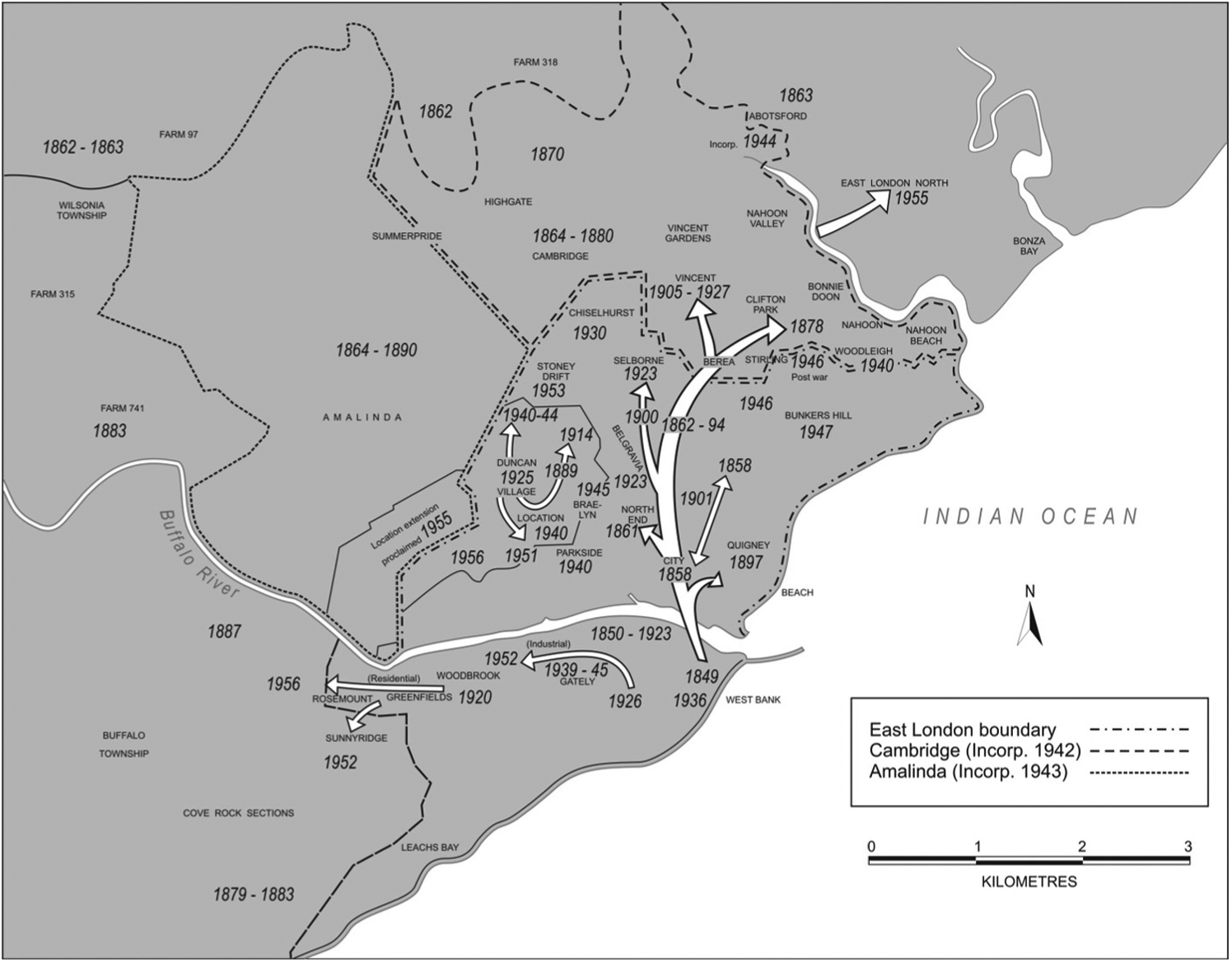
East London urban expansion: 1849–1956.
Although residential segregation in East London pre-dated the apartheid policy (Nel, 1991), the enactment of the Group Areas Act of 1950 entrenched racially defined residential areas. With the exception of domestic workers, permitted under the apartheid laws to stay with their employers, Southernwood became a white residential suburb. However, as in many urban areas of South Africa, rigid racial barriers in residential areas began to wane in the 1980s as blacks filtered into white residential spaces, thereby creating ‘grey areas’ (Christopher, 1994, 1997; Cloete, 1991; Elder, 1990; Hart, 1989; Maharaj and Mpungose, 1994; Pirie, 1987; Rule, 1988, 1989; Saff, 1990; Ulrich, 1993). In East London, greying was particularly evident in the eastern part of Southernwood, in often poorly maintained and overpriced houses and apartment flats (Daily Dispatch, 29 June 1990).
Research design and methods
For its relevance to investigating contemporary issues within their contexts, the study adopted a holistic case study design (Baxter and Jack, 2008; Meyer, 2001; Noor, 2008; Yin, 2009). Two methods were used to collect primary data: direct observation and in-depth interviews. The Daily Dispatch newspaper reports, and other historical documents from the East London Museum, provided footing for more informed direct observation on the physical characteristics of neighbourhoods in Southernwood.
Considering that neighbourhood social cohesion is ‘context-related’ (Filipović, 2008; Lelieveldt, 2004; Pacione, 2009), and in line with the view that age of housing was a contextual variable considered to have bearing on neighbourhood social ties (Guest et al., 2006), direct observation focused on assessing the general state of the neighbourhoods in terms of the physical condition of houses and socioeconomic activities within these neighbourhoods. Based on the literature on the relationship between social disorganisation and neighbourhood social ties (Guest et al., 2006; Letki, 2008), observed socioeconomic activities provided footing for evaluating the contextual basis of interview data on social cohesion at neighbourhood level. The observations were conducted over several visits to the suburb – in March, June and October 2009, and June 2010. During these visits, the principal author spent full days in Southernwood, taking note of neighbourhood characteristics in terms of state of houses and cleanliness of neighbourhoods. In June 2010, a former member of the Southernwood Ward Committee facilitated a guided walk through the suburb and helped to explain the social context of the neighbourhoods; with social context referring to the social activities which had a bearing on social cohesion in different neighbourhoods. Overall, the observation method sought to disaggregate the physical and social contexts within Southernwood with the view to understand their bearing on neighbourhood social cohesion. These direct observations informed the formulation of interview questions on respondents’ perceived neighbourhood social cohesion.
The interview method, noted for its ability to yield rich data on respondents’ life-worlds (Flick et al., 2004; Kvale, 2007; Miller and Glassner, 2004; Nieuwenhuis, 2007; Sayer, 1992), was used to probe residents on their perceived neighbourhood-based social cohesion. Interviews were conducted in April, May and June 2010, and June and August 2011. The principal author conducted in-depth face-to-face interviews on a purposively drawn sample comprising 34 residents of Southernwood, the Ward Councillor and an estate agent who had been working in Southernwood for 20 years. Five of the interviewed residents had previously served as members of the Ward Committee – an elected group of residents responsible for coordinating interests of their Ward in consultation with their Ward Councillor. The five were identified through the snowball technique during an interview with the Ward Councillor who, at the time of interview, was a member of the Democratic Alliance (DA) – South Africa’s major opposition political party – and had been in office since the municipal elections of 2005. At the time of the interviews, a Ward Committee had not yet been elected. The Ward Councillor and the five former Residents’ Committee members – three females and two males – provided a broad overview of context for the perceived levels of social cohesion in Southernwood. Further, the estate agent also provided insights on neighbourhood quality and complemented data on social cohesion from the Ward Councillor and the five former Ward Committee members.
Criterion sampling (Onwuegbuzie and Leech, 2007) was used to select the rest of the 29 interviewees who included four male students. Residence in Southernwood along selected streets constituted the criterion for inclusion. Scholars (Chaskin, 1997; Galster, 2001; Kearnes and Parkinson, 2001; Martin, 2003; Melvin, 1985; Pacione, 2009; Völker and Flap, 2007; Webster, 2003) have debated on the extent of neighbourhoods. However, Marschall and Stolle (2004) suggest that regarding contextual effects of neighbourhood on social interactions, it is critical ‘to measure neighbourhood variables at the level that captures the most immediate experiences in one’s living area’ (p. 134). Kleinhans et al. (2007) recommended that streets and building blocks were far more important levels at which to examine social interaction than wider areas of the neighbourhood. In this study, therefore, streets were used to delimit the neighbourhoods. Following these criteria, interviewees were drawn from residential areas along four streets: St Georges, Gately, De Villiers, and Nahoon View (Figure 2). Based on the direct observation method used prior to interviews, these streets provided a varied cross-section in neighbourhood quality in terms of physical conditions of housing and socioeconomic characteristics in the neighbourhoods. Interviews with the Ward Councillor and estate agent were conducted in their respective offices, two former Ward Committee members were interviewed at a public restaurant while the rest of the participants were interviewed in their homes.
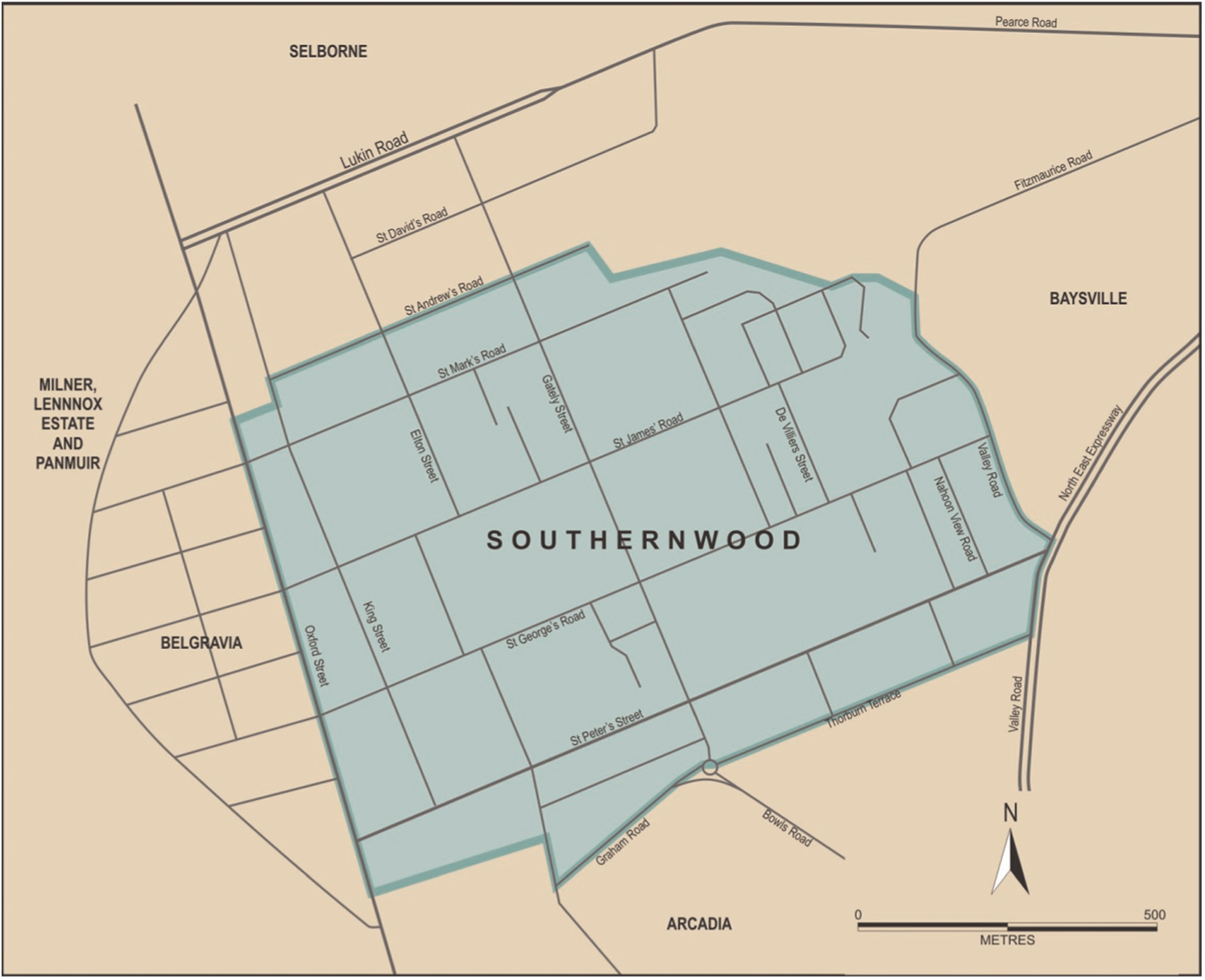
Southernwood residential suburb in East London, South Africa (2010).
All interviews, which were audio recorded, focused on three major issues that assessed the nature of neighbourhood-based social cohesion in Southernwood: safety and trust, social interaction and norms of reciprocity. The three items encapsulated the indicators of neighbourhood-based social cohesion highlighted in the literature (Coffé and Geys, 2006; Demireva, 2011; Filipović, 2008; Forrest and Kearns, 2001; Holdsworth and Hartman, 2009; Kleinhans, 2007; Kleinhans et al., 2007; Lelieveldt, 2004; Letki, 2008). With regard to safety and trust, interviewees were asked to state their overall assessment of safety in Southernwood, whether they considered it safe to walk at night, whether they trusted people in their neighbourhoods and whether they would recover a personal item if it were lost within their neighbourhood. Social interaction contained five sub-items which asked interviewees whether they knew, greeted, chatted, visited and got along with their neighbours. Lastly, norms of reciprocity explored interviewees’ willingness to either ask for, or offer help to their neighbours.
Although issues of positionality, such as class, race, nationality and gender, are known to influence the quality of interview data (Baxter and Eyles, 1997; England, 1994; Valentine, 2005), nothing overtly observed affected the study. However, considering that this study investigated social interactions in a multi-racial residential suburb, positionality based on race could not be discounted. Scholars on social relations in South Africa have acknowledged that although apartheid is no longer statutory, race still matters and the social divide may linger for many years (Bremner, 2000; Christopher, 2001a, 2001b, 2005; Crankshaw, 2008; Dewar, 2004; Lemanski, 2006; Smith, 2004). Consequently, covert nuances of race may have characterised the interview encounters. However, issues of positionality cannot be entirely eliminated from qualitative research. Instead, scholars emphasise ‘sensitivity to subjective aspects’ of qualitative interviewing (Meyer, 2001: 344), or being ‘mindful of … disciplined subjectivity’ (Baxter and Eyles, 1997: 514).
Based on interview data and the Daily Dispatch newspaper reports on Southernwood (Daily Dispatch, 2009a, 2009b, 2009c; Ntsaluba, 2009a, 2009b), qualitative content analysis was used to identify contextual variables which influenced social cohesion in the suburb. The data were inductively and deductively coded. The manual coding process followed two main stages: first, inductive coding (Thomas, 2006) of interview transcripts and newspaper reports identified thematic units (Saldana, 2009) highlighting variables which influenced neighbourhood social ties in Southernwood. This was consistent with Morgan’s (1993) view that in qualitative content analysis, the data are the source of codes.
The analysis yielded six contextual themes: change in racial composition, increase in student population, proliferation of slumlordism and boarding, crime, shebeens and truculent behaviour. A single coding approach (Burla et al., 2008) for theme identification was adopted. Mindful of Barbour’s (2001: 1115) caution of ‘the tail (technical fixes) wagging the dog (qualitative research)’ on intercoder reliability (Hruschka et al., 2004), an overall intercoder reliability of 0.72 (after Miles and Huberman, 1984, as cited in Campbell et al., 2013) was obtained on a sample of four interview transcripts. This was used to further refine the process of theme identification. As Fereday and Muir-Cochrane (2006: 4) observed, ‘emerging themes become the categories of analysis’. Therefore, in the second stage of analysis, the six themes were in turn deductively compared with five a priori codes established from the literature (Aneshensel and Sucoff, 1996; Cheung and Leung, 2011; Guest et al., 2006; Letki, 2008; Marschall and Stolle, 2004; Völker et al., 2007) as contextual variables known to influence social cohesion in residential neighbourhoods: racial heterogeneity, age and physical state of housing units, social disorganisation, socioeconomic status and residential stability. Although content analysis conjures quantification, Basit (2003: 151) advised that ‘social phenomena … need not be explained numerically. It is the quality and richness of the responses to social situations which we should focus on’. Quotations from interviews are included in the analysis to ‘integrate the voice’ of respondents (Delport and Fouché, 2011: 425). The quotes were selected for inclusion in the analysis on account of their typicality in reflecting context.
Findings and discussion
Out of 34 interviewees, most knew (22), greeted (23), chatted (20) and got along with their neighbours (24) while only five (14.7%) visited their neighbours. Norms of reciprocity were much lower: eight (23.5%) could either ask for help from – or offer help to – their neighbours. At face value, the results on social interaction appeared contradictory to the overall view of low social cohesion in Southernwood – high on social interactions, except for visiting neighbours – but low on norms of reciprocity. However, considering that norms require stronger affective bonds than knowing, greeting, chatting and getting along with neighbours, the results confirmed Kearns and Parkinson’s (2001: 2105) view of ‘many people’s preference for no more than casual acquaintance with their neighbours’, thereby holding true the maxim of ‘good fences make good neighbours’. The results were also consistent with the Ward Councillor’s general observation that ‘On a scale of one to ten, I would say social cohesion in Southernwood is about four or five’ (WC, personal communication, 22 April 2010). The remainder of this paper discusses the six variables emerging from the data, which constituted the local neighbourhood contexts in Southernwood: change in racial composition, increase in student population, proliferation of slumlordism and boarding, crime, shebeens and truculent behaviour.
Racial diversity and social cohesion in Southernwood
Based on the 2001 population census, Southernwood had experienced considerable change in its racial composition. The suburb comprised 59.6% (4318) black, 33.6% (2436) white, 4.7% (342) coloured and 2.1% (155) Indian population. This racial transformation in residential areas was a general trend occurring in South African cities (Cokayne, 2013).
Among the interviewees was a 72-year-old white male. He moved into Southernwood at the age of 12 when his father bought the house, which he inherited. When interviewed, with his wife, about the racial changes in his neighbourhood, he reminiscently stated:
I have lived here for 60 years now. This whole area used to be Europeans living here but that has changed now. It’s not being a racist, you know, but this used to be a very quiet street. From that corner it was all Europeans here but now there are about five of us left; the rest are all black people staying here. It was like a knitted community but in the last 12 years or so, this street has changed a lot. (SW 01, personal communication, 11 May 2010)
Although the reasons for leaving were not available for evaluation in this study, some respondents made reference to the issue of flight. For instance, one interviewee, a white elderly male who had lived in Southernwood for 26 years stated:
Most white people sold their houses and moved to Vincent, Cambridge, Beacon Bay and Gonubie. When the owner of the house where I previously stayed sold his house, he said to me, ‘Chris, you must get out; the blacks are going to come and crowd you here’. (SW 02, personal communication, 11 May 2010)
Interviews also revealed that the decline in the white population was also through natural attrition – deaths of the elderly residents. A white pensioner underscored this when she observed, ‘My husband and I have lived in this neighbourhood for 40 years. Most people who stayed here have died’ (SW 03, personal communication, 12 May 2010).
Although both black and white interviewees made reference to a perceived link between decline in social cohesion and change in Southernwood’s racial composition, the extent to which this change affected neighbourhood-based social cohesion varied. An elderly black woman who had lived in Southernwood for 51 years – having moved into the suburb in 1959 as a domestic worker, as the apartheid legislation permitted, made the following observation: ‘I got this flat in 1994 as a free gift from the “madam” [her employer]. There were only whites here. It was peaceful and quiet then, but the place is bad now’ (SW 04, personal communication, 18 May 2010).
While limited social interactions were confirmed through interviews, none of the interviewees expressly stated that these were racially defined. However, the interviewees’ observations confirmed the view that increased heterogeneity in neighbourhoods induced atomisation to the extent of reduced contact and cohesion (Cheung and Leung, 2011; Guest and Wierzbicki, 1999). A black lady in her 30s, who had lived for a year in a racially diverse block of apartment flats made the following observation:
I live in a multiracial block of flats. People just get into their apartments and lock their doors; we don’t even greet. It is not normal but that’s how it is; we all just mind our own business. White residents are not even friendly among themselves. (SW 05, personal communication, 31 May 2010)
To explain the general decline in social cohesion in Southernwood neighbourhoods, interviewees attributed this to interlinked themes of truculent social conduct rather than racial differences per se. These themes included influx of tertiary-level student population, proliferation of slumlordism, shebeens and crime.
Student influx and social cohesion in Southernwood
The actual number of tertiary-level students who resided in Southernwood was not established at the time of the study. However, through interviews and observation, the study noted the marked presence of students in the suburb with a considerable number in privately rented boarding houses and apartment flats. One of the students interviewed agreed, ‘Indeed, there are many students in Southernwood. It would be nice if the suburb was just declared a student village’ (SW 08, personal communication, 17 June 2011).
Based on interviewee estimates and newspaper reports, up to eight people, mostly students, occupied a two-bedroom house or apartment flat. Other secondary sources and interviews indicated that in some cases, as many as 20 people shared a house, with a single bathroom:
This boarding house situation has nothing to do with 1994 [the first democratic elections in South Africa]. It started many years ago and has therefore been happening for a long time. The only difference is that it is now widespread and there are more people renting rooms. These are three-bedroom houses but you can’t believe how many people live in them as a result of boarding – in some cases 20 people come out of one house. (SW 01, personal communication, 11 May 2010)
The presence of many tertiary-level students in Southernwood, their proclivity to undesirable conduct such as noise at late hours and general drunken behaviour were cited as constraints to social interactions and norms of reciprocity. One interviewee, a retired white lady who lived with her daughter and grandchild observed:
I don’t know if there is anything like social interaction in this neighbourhood anymore because people are behaving in such a negative manner, which makes it difficult to socialise. They can be actually very annoying. You are not going to interact with somebody who is making your life miserable; and we’ve got plenty of that here. (SW 09, personal communication, 11 May 2010)
This view was consonant with De Hart’s (2002, as cited in Van Bergeijk et al., 2008) assertion that dissatisfaction with the population of the neighbourhood decreases interaction. According to De Hart, the dissatisfaction arises when other people in the neighbourhood are considered unattractive. In the case of Southernwood, where the interviewees implied unattractiveness, it was behaviour-related and varied across neighbourhoods. Specifically, the presence of a large number of tertiary students in Southernwood presented a unique context for neighbourhood-based social cohesion. It was evident that youthful exuberance on the part of students created social conditions which did not foster neighbourhood interactions and norms of reciprocity with non-student residents. Further, interviewees noted that the short period that people stayed in their neighbourhood did not encourage the building of socially cohesive neighbourhoods. In general, owing to their transient stay, students did not invest energy in building social ties in the neighbourhoods. This finding in Southernwood parallels other studies (Bailey et al., 2012; Guest et al., 2006) which indicate an antithetical effect of length of stay on social cohesion. In general the studies show a positive relationship between area stability in terms of home ownership and length of residency and knowledge about neighbours.
Slumlordism, boarding and social cohesion in Southernwood
Slumlordism was one of the most cited characteristics of Southernwood’s neighbourhood context. Slumlords were residential property owners who maximised their returns from renting their residential property to as many people with little or no maintenance of their premises. Documented accounts suggested that some slumlords had multiple ownership of residential property in Southernwood, which they converted into unlawful boarding accommodation. In some sections of the suburb, backyard shacks provided additional residential accommodation. The occurrence of slumlordism and boarding indicated an acute shortage of residential accommodation in Southernwood, especially for students. In view of this shortage, the interviewed estate agent remarked, ‘It is rather unkind to refer to some of the property owners as slumlords because they alleviated the accommodation problem’ (EA, personal communication, 13 May 2010).
The impact of slumlordism and boarding on social cohesion was apparent in how the practices drove a wedge in the community. Interviewed property owners who resided in the suburb felt that the practice compromised the standards and property values in the suburb. One black lady moved from Mdantsane, a former black residential area. She bought her house in Southernwood in the late 1990s. Her despondency exemplified the general feeling of discontent stemming from slumlordism, ‘The area is really becoming low class; Southernwood is going down all the time’ (SW 11, personal communication, 11 May 2010). Both the interview data and secondary sources confirmed that most slumlords did not reside within Southernwood. Consequently, resident property owners were left to contend with the unsightly backyard shacks and an influx of people in boarding houses. Slumlordism and boarding eroded social cohesion in Southernwood because the practice engendered resentment, lowered trust and social interactions in the neighbourhoods. A sense of resignation and powerlessness prevailed among the interviewees, especially the property owners who attributed the decline in neighbourhood quality and attractiveness to the preponderance of slumlordism and boarding.
Shebeens, truculent behaviour and social cohesion in Southernwood
Interview and secondary data confirmed that for long, shebeens were a despised but integral part of Southernwood’s socioeconomic history. For instance, by 1952, shebeens and mailing – the illegal purchase and delivery of liquor to shebeens – were commonplace in Southernwood (Thomas, 2004). On this account, the social ills associated with alcohol abuse, such as prostitution and drug dealing, have long been an enduring character of Southernwood. Direct field observations revealed that shebeens were concentrated in the eastern part of Southernwood between De Villiers Street and Valley Road. A poorer state of housing characterised the eastern part of the suburb. Further, truculent behaviour was most commonly reported in the same area. As Guest et al. (2006) observed, a poor state of housing evinces low socioeconomic status of a neighbourhood, which in turn can trigger negative attitudes of residents and lower trust.
The spatial spread of these social ills further confirmed the existence of varying micro- and macro-contexts within the suburb, as one black male interviewee in his 40s observed:
There is more than one Southernwood here! The eastern part around Nahoon View is one Southernwood while the rest of the suburb is another. The eastern part is where you find all the shebeens, drugs, prostitution and all that. One has to be careful when you move there, especially at night, but I go there even at night when I need beer. (SW 10, personal communication, 24 June 2011)
In these neighbourhoods, interviewed residents expressed displeasure about the presence and negative effects of shebeens on the local social environment. The volatility of an environment given to the uncontrolled consumption of alcohol cowed residents into their homes – especially older residents – and further constricted the opportunities for meaningful neighbourhood interactions and norms of reciprocity.
Crime and social cohesion in Southernwood
All interviewees observed a progressive increase in incidences of crime in Southernwood and cited stabbings, theft, burglary, drug peddling and prostitution. In a typical response to a question about safety in Southernwood, one respondent remarked:
What I don’t like about Southernwood now is that some people would kill their own mother for Five Rand. There is a white lady who is a friend of mine. She was walking around five o’clock in the afternoon. Two young coloured boys came and grabbed her handbag. They stabbed her! She nearly lost her eye just for the handbag. (SW 06, personal communication, 12 May 2010)
Four of the interviewees (11.8%) considered their neighbourhoods to be safe, five (14.7%) could take a walk at night, nine (26%) trusted people in their neighbourhood while five (14.7%) felt that they could recover a personal item if it were lost in their neighbourhood. Overall, the majority of the interviewees considered their neighbourhood to be unsafe (88.2%) and did not trust people in their neighbourhoods (73.5%). In terms of the effect on social cohesion, these results confirmed that owing to the likelihood of inducing fear in residents, low neighbourhood safety and trust were inimical to social cohesion (Aneshensel and Sucoff, 1996; Letki, 2008).
While the prevalence of crime in neighbourhoods was indicative of low social cohesion (Letki, 2008), it was also likely to be a product of low social cohesion – revealing the social disconnect of residents from their neighbourhood. However, the presence of crime also presented an opportunity for a cohesive community response. From observations and interviews, it was evident that Southernwood neighbourhoods had multiple contexts – both physically and socially. Some sections of the suburb had houses in near derelict condition. These were also the neighbourhoods reported to have a preponderance of criminal activities. Despite the absence of a Ward Committee, the interview with one of the former members of the Ward Committee revealed that a Community Based Forum (CBF) was constituted in the month of May 2010. The Forum was an initiative of a few individuals in street-defined neighbourhoods in the eastern section of Southernwood where cases of petty crimes were reported to be high. According to the interview, the group resolved two things: first, to have two people on security patrols of their neighbourhood every night, and second, to meet every Sunday to review and plan their work. In this micro-level response, as opposed to suburb-wide response, the presence of localised crime in the neighbourhood presented an opportunity for residents to cohere around one issue. This arrangement was in line with what Forrest and Kearns (2001: 2134) listed as an ‘observable measure’ of cohesion at neighbourhood level. In this specific eastern section of Southernwood, reports of crime presented an opportunity for ‘getting together to promote or defend some common local interest’ (Forrest and Kearns, 2001: 2134), thereby producing an observable indicator of a cohesive neighbourhood. Harvey (2009) referred to such issues inducing coalescence as militant particularisms – where a group coheres around a value related to a very narrow local concern. In view of these seeming contradictions and differences in social cohesion in proximate spaces of neighbourhoods, Amin and Graham’s (1997) conception of the contemporary city as a variegated and multiplex entity also held true for social cohesion in Southernwood neighbourhoods.
While Southernwood was largely considered unsafe, there were pockets of neighbourhoods in which interviewees expressed a relatively higher sense of safety. These spatial differences, closely related to the socioeconomic character of neighbourhoods, further underscored the existence of multiple contexts across neighbourhoods and produced differences in regard to trust and safety. For instance, a black female respondent, who lived in a security wall-fenced and access-controlled block of apartment flats, stated in reference to her immediate residential area:
There is less crime now in my neighbourhood because we have security presence day and night. We have only one entry and exit gate so it is easy to monitor any suspicious activities. Even if you are moving out a television from your apartment, the security personnel must be informed. We can leave our laundry on the line overnight without any risk of theft. (SW 07, personal communication, 12 May 2010)
The relative higher sense of safety in some of the neighbourhoods did not, however, necessarily translate into increased social cohesion within these areas. This finding seemed to agree with Wilson-Doenges’ (2000) conclusion that although higher-income gated neighbourhoods report a higher sense of safety, they exhibit a lower sense of community. While perceptions of low safety and trust in Southernwood were widely shared, other variables were more localised in their nature and bearing on social cohesion.
Conclusion
This paper concludes that indeed, when explaining the nature of neighbourhood social cohesion, context matters. The general treatment of context assumes some levels of spatial homogeneity across a given residential area. However, this paper notes that contexts vary in proximate spaces of residential neighbourhoods. The use of the street to delimit a neighbourhood reinforced the view of spatial fluidity in social cohesion. Further, the paper demonstrates that spatial variations embody the old and emergent layers of context which ultimately contribute to the production of spatially fluid neighbourhood social cohesion.
In the case of Southernwood, multiple contexts included changes in racial character, a noticeably high presence of young tertiary-level students – with their perceived recalcitrant behaviour, slumlordism, petty crimes and the presence of shebeens. While some of these contexts affected the entire suburb (macro), others were confined to smaller sections of the suburb (micro). The net effect of these multiple contexts was the formation of intra- and inter-neighbourhood differences in social cohesion. Hence, understanding the multiple contexts in a given urban residential suburb forms a meaningful entry point for investigating social cohesion within its neighbourhoods. Invariably, the existence of these constantly changing multiple socioeconomic and physical contexts also challenges the extent to which enduring socially cohesive communities can be built to embrace an entire urban residential suburb. The answer to this dilemma may lie at micro-level neighbourhoods because at this level, more meaningful interactions and affective bonds stand a greater chance of being realised than at the macro-neighbourhood level.
Although racial change constituted a palpable part of the neighbourhood context in Southernwood, its influence in diminishing levels of social cohesion was not expressly cited in any of the interviews. However, undertones of the role of racial heterogeneity were discernable, particularly amongst older interviewees who had lived long enough to witness the transformations in residential stability of their neighbourhoods.
Guest et al. (2006) listed teenagers hanging out on the streets, litter, rundown or abandoned buildings as indicators of social disorganisation. In this study, interviewees cited influx of students with their youthful exuberance, slumlordism, rundown houses and general truculent behaviour as factors which inhibited neighbourhood social ties. In essence, social disorganisation proved to be a barrier to social cohesion within neighbourhoods.
While crime generates feelings of powerlessness and diminishes trust (Letki, 2008), the general perception of interviewees in Southernwood revealed inter-neighbourhood differences; some neighbourhoods were considered to be more crime-prone than others. Similarly, the extent to which different binaries of population groups (e.g. male–female, young–old, black–white) responded to the varied micro- and macro-level neighbourhood contexts remains open for further inquiry. Further, the creation of a neighbourhood watch in a part of the Southernwood neighbourhood which experienced various forms of petty crime and truculent behaviour reinforced the notion that in the presence of militant particularisms, a neighbourhood can, against the odds, forge social bonds to address a common challenge. However, not all neighbourhoods, as this study evinces, respond to such opportunity for cohesion, further confirming that few neighbours could create micro-level social cohesion (Völker et al., 2007). We find resonance with Guest et al.’s (2006) suggestion that neighbourhood ties may have multiple dimensions such that given contexts might combine with people’s individual attributes to elicit stronger ties in some neighbourhoods than others.
Although studies show that racially based social polarisation in South African neighbourhoods may linger for some time to come, it is also important to acknowledge that these neighbourhoods are evolving. New and unanticipated trends in cohesion at neighbourhood level may continue to unfold. Recognising the multi-layered nature of neighbourhoods (Kearns and Parkinson, 2001) and the multi-dimensionality of neighbourhood ties (Guest et al., 2006), we agree with Oldfield’s (2004) conclusion that in post-apartheid South Africa, context and situation will determine the extent to which race may influence neighbourhood-based social interactions.
However, it remains patently clear, as Forrest and Kearns (2001: 2130) observed, that investigating social cohesion in urban residential neighbourhoods should acknowledge that ‘people may buy into neighbourhoods as physical environments rather than necessarily anticipate or practice a great degree of social interaction’. In short, because neighbourhoods and social interactions do not always converge (Guest and Wierzbicki, 1999), low levels of social cohesion may manifest within proximate neighbourhood spaces owing to lack of social interaction (Kleinhans, 2009). However, in light of militant particularisms, and contrary to expectations based on literature, some irrefutably negative neighbourhood contexts may offer opportunity for building some dimensions of social cohesion, as the Southernwood case demonstrates. In keeping with the site-specificity of context, this paper underscores the need to recognise the spatial and temporal fluidity of context when examining social cohesion in residential neighbourhoods.
Footnotes
Acknowledgements
The authors gratefully acknowledge invaluable comments from three anonymous reviewers.
Funding
Funding from the Govan Mbeki Research and Development Centre (GMRDC) is gratefully acknowledged.