




Abstract
This paper explains the importance of distinguishing de facto from de jure property rights, confused by some economists, in heritage conservation planning. A comparative study on three Hong Kong examples of British colonial military buildings is used to show how neither de jure private property rights nor de facto close access is a solution to the problem of open access to heritage buildings. Also, a government museum is only a partial solution to the problem of promoting an authentic historic sense of history in a post-colonial environment. The examples to be examined are the coastal gun batteries on Devil’s Peak, the coastal gun batteries on Cape D’Aguilar, and the Museum of Coastal Defence inside the old Lei Yue Mun Fort. With the help of site photos, the case studies demonstrate that heritage buildings can only be preserved when at least three conditions are satisfied: (a) there is an intention to conserve; (b) there is a viable scheme to conserve; and (c) there is effective regulation of access. Open access, however, can have some merits as a process of information discovery by members of the public.
Introduction
Post-colonial military heritage conservation is often driven by the curiosity of local researchers who rediscover the past in sealed-up or overgrown locations. Unlike the case of Portuguese Macau, where the departing colonial regime took great pains to systematically rehabilitate major European examples of built civilian and military heritage, the British administration did not have a great interest in doing the same in Singapore (Lai and Ho, 2003). The Battle Box on Fort Canning Hill 2 is a case in point. This major Allied command centre during the Battle of Singapore, sealed up under unknown circumstances during the 1960s, was not ‘rediscovered’ and opened up for conservation tourism until 1988 – and only due to the research of National University of Singapore scholars (Bose, 2012). It would be unreasonable to say that from the fall of the city in 1942 to 1988, the Battle Box was ‘well-conserved’ by virtue of the fact that it was sealed up and forgotten. Which structure should be designated and conserved as a ‘heritage building’ and how is a controversial subject fought between the majority who accept only a subjectivist and relativist ‘social construct’ view and those who agree that there are intrinsic and universalist values inherent in heritage (Agency for Cultural Affairs (Government of Japan), 1993). However, no expert in conservation would agree that merely closing up a place to the public or erasing its existence from collective memory is a correct way to conserve a piece of heritage, which requires a dimension of public knowledge and access. However, careless abstract economic thinking can generate propositions that point towards enclosure.
This paper clarifies the distinction between de facto and de jure rights to correct two major errors found in the economic literature, which testifies to the importance of having a good understanding of the ‘real world’, especially through the eyes of a development theorist when undertaking economic theorisation. Dealing with practical urban issues, development theorists are often more sensitive than economists to the specific dimensions of property rights.
The first mistake is to divorce de facto property rights from de jure property rights by treating the latter as if they are merely an epiphenomenon or a kind of parameter. Both de facto and de jure property rights are imperative because a widening gap between them (i.e. ambiguity in property rights) may entail major political changes (Lai and Lorne, 2014a).
The second error is confusing de jure and de facto property rights. Although common property is, in most instances, open access, open access property is not necessarily common property. This paper deals with the second type of error and explains the importance of distinguishing de facto from de jure property rights in heritage conservation planning. Three post-colonial Hong Kong examples are used to demonstrate this distinction.
Using basic property rights concepts and with the help of site photos, this paper uses a comparative study on three Hong Kong examples of British colonial military buildings to show how neither de jure private property rights nor de facto close access is a solution to the problem of open access to heritage buildings. Also, a government museum is only a partial solution to the problem of promoting an authentic historic sense of history in a post-colonial environment.
The following section explains the theoretical landscape of the property rights in relation to heritage research.
Theoretical context
The application of the property rights concepts of ‘the tragedy of the commons’ and ‘open access’ to heritage research has been growing (see for instance Howell, 1994; Russo, 2002; Webster and Lai, 2003). This paper attempts to make a contribution to heritage research by clarifying the basic difference between ‘open access’ and ‘common property’ and illustrates, by way of three case studies, the application of these concepts to a discussion of military heritage.
Economists Anthony Scott Gordon (1954), Armen Alchian and Harod Demsetz (1973), and Steven Cheung (1970, 1987) have, over the last 60 years, identified and elaborated on the nature of three distinct types of property rights: common, communal, and private. Common law recognises these three types of rights, but only enforces the latter two.
There exist two different classifications of property rights regimes due to differences in the theoretical thinking of two economic schools of thought. One school, best represented by Nobel laureate Elinor Ostrom (2000) and in agreement with the ideas of Ciriacy-Wantrup and Bishop (1975), accepts a simple dichotomy between common and private property. The other, which may be called the UCLA School, represented by Alchian and Demsetz (1973) and Cheung (1987), differentiates communal from common and arrives at a threefold and finer distinction between common, communal, and private property. In this paper, the authors prefer the Alchian–Demsetz–Cheung distinction between common and communal property not only on the grounds that their distinction articulates well with the much older resource economic research on ocean fisheries by Gordon (1954), who described ocean fish as common property almost 60 years ago, a concept adopted for instance by Feeny et al. (1996) because the finer threefold distinction between common, communal, and private property helps make a theoretical distinction more precise. Cheung (1970) adopted Gordon’s (1954) terminology of common property and defined ‘common property’ as a state of affairs subject to unrestrained competition. In other words, it is ‘non-exclusive’ property (Cheung, 1970). It was in Cheung’s, rather than Ostrom’s (2000), sense that Stroup (2005) merged the two concepts of open access and common property into the composite concept of ‘open access common property’.
Common property is often equated with open access property informed by Hardin’s (1968) now famous concept of open access to resources. The two concepts, though related, are distinct. Uphoff and Langholz (1998: 252) correctly saw the need for such a distinction (equating common property with communal property) by saying that:
we need to distinguish ‘open access’ resources, which are what Hardin (1968) was describing, from ‘common property’ resources, which are less likely to become degraded in that they are governed by social norms and conventions.
In effect, Uphoff and Langholz (1998) held that ‘open access’ resources are, in the terminology of Alchian and Demsetz (1973), distinct from resources under ‘communal property’. Elinor Ostrom also pointed out that the debate over property rights regimes ‘has been clouded by a troika of confusions that relate to the difference between: (a) common property and open-access regimes; (b) common-pool resources and common property regimes; and (c) a resource system and the flow of resource units’ (Ostrom 2000: 332). As regards the first confusion, Ostrom’s approach was to follow the distinction made by Ciriacy-Wantrup and Bishop (1975). Ostrom’s distinction is the same as that of Uphoff and Langholz (1998) in that it described what Alchian and Demsetz (1973) would take pains to describe as ‘communal property’ and ‘common property’.
Hardin’s ‘tragedy of the commons’ describes a physical state of affairs concerning resources, namely open access ones, which may or may not be ‘common’ property rights. Unfortunately, many wrongly assume that resources under open access are always common property and that assigning or recognising private property rights to a resource solves the problem of open access.
This misconception is due to a failure to distinguish between de facto and de jure realities. More often than not, many supposed ‘common properties’ are either officially private or at least under communal ownership. Hardin should not be blamed for this. In his frequently cited work, he gave the example of overgrazing to describe open access to communal pastures that were treated as ‘common’ in an earlier paper by Bottomley (1963). These ‘common pastures’ are not truly common property in the sense that access to them is not unlimited and open, but communal (according to Alchian), because they are defended by the community of a polity. In fact, the only true examples of common property on Earth are the high seas and Antarctica. There is little land elsewhere that has not been claimed by any nation-state as its sovereign territory. Whether or not such a claim is effective in the face of contesting claimants or squatters is another matter.
Table 1 is a 4 × 3 matrix with four types of de jure property rights (private property rights further differentiated into those held by individuals and those by the state 3 ) by column and three de facto modes of access restriction.
A matrix of property rights and physical access to resources.
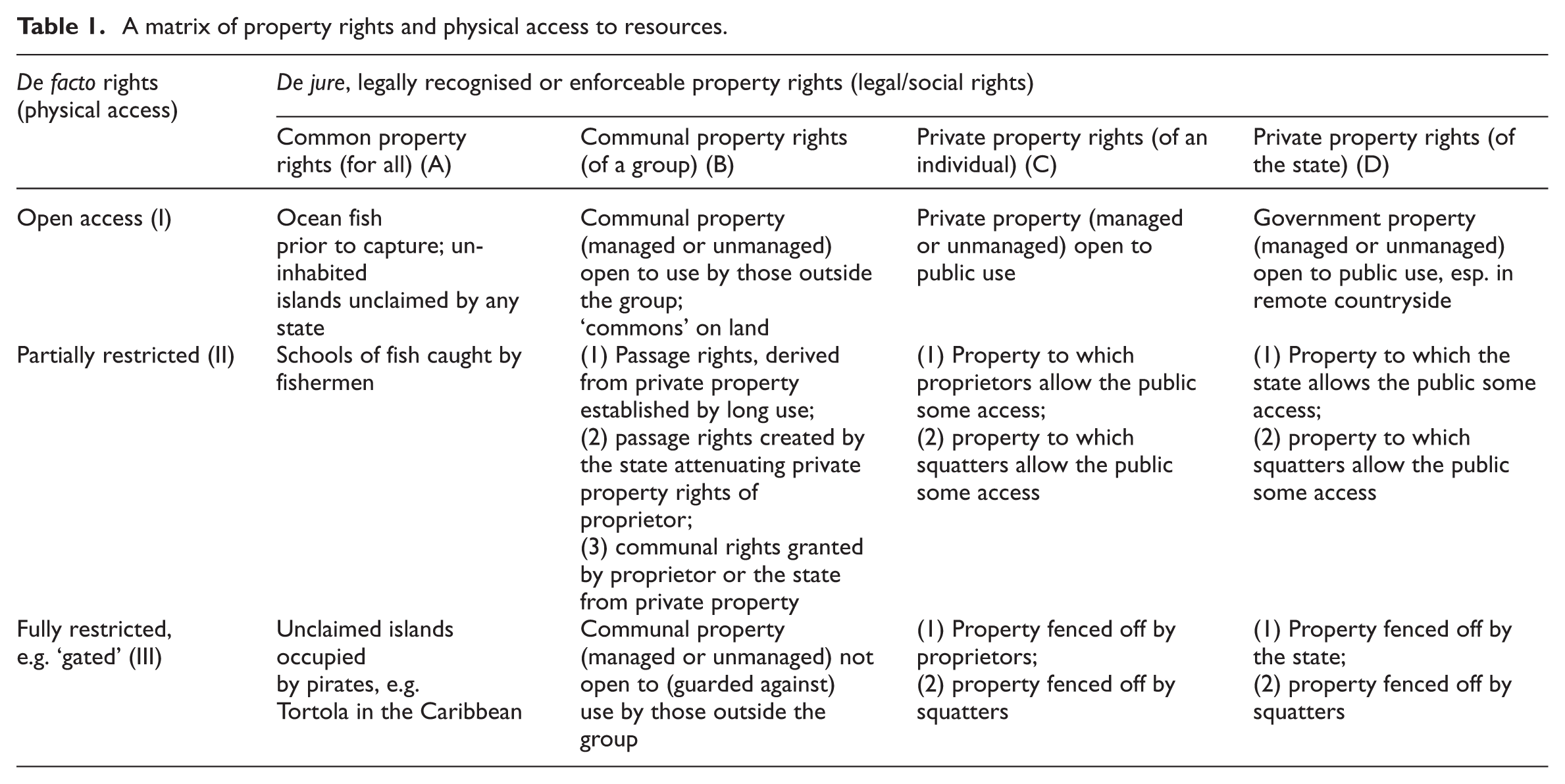
Table 1 was developed according to the received views of classifying regimes that govern competition for resources rather than a typology of economic organisations. In the table, the cells along the de jure row under columns A, B, and C are those that have hitherto been focused on by neo-institutional economists. We completed the picture by adding the dimension of de facto access to each de jure entry, which includes state ownership as a form of private property.
When a resource is open access, the ‘dissipation of rent’ due to competition by entrants would occur. For heritage buildings, some quarrying of building materials will happen. Rent dissipation occurred when the scramble for building materials produced human and material losses. What has happened to the Coliseum in Rome due to scavenging for metallic fixers and stones is a case in point (Downs and Medina, 2000). Heritage buildings, upon identification, can only be preserved when the following minimal conditions are satisfied: (a) there is an intention to conserve; (b) there is a viable scheme to conserve; and (c) there is effective regulation of access for the purpose of conservation. While private ownership by individual citizens may be regarded as antithetical to these conditions due to purely economic considerations, there is no guarantee that private ownership by the state would automatically satisfy the three conditions. The first condition is the most critical, but is subject to political considerations (Yung and Chan, 2011).
When condition (a) does not hold, (b) would not exist at all, and thus, heritage buildings that sit on the private property of the state are subject to the problems of open access. Even when there is an effective closure of a property, its heritage may not necessarily be protected, as the purpose of closure is for purposes other than conserving heritage buildings. That is why closed access per se is grossly inadequate for conserving, not to say nurturing, a resource or building. A farm is not a zoo. The first two case studies shed light on these points.
That does not mean access control is insignificant or that open access has no merit, as the last example demonstrated. Even when a conscious effort is made to deny access, the closure can be ineffective, especially if the site is so large that the transaction costs of enforcement against trespassing are high. The problem of less than 100% de facto closure by a management authority could also result in some unintended advantages, as revealed in the last case study.
Theoretical support for this point is present in the history of maritime aquaculture. In Hong Kong, as in Norway, marine culture by nets/cages originally emerged as a form of squatting (Hersoug, 2005). Had the state’s control of its territorial waters been effective and watertight, the industry might not have had the chance to develop. A violation of certain existing rights can be a prelude to the emergence of new industries. In heritage conservation, squatters sometimes may help identify, if not also create, items of heritage value.
The typology of Table 1 articulates with the Coasian transaction cost view (Barzel 1989) that resources, such as the military heritage sites discussed, can be seen as bundles of attributes. Each attribute is associated with distinct configurations of exclusion and transaction costs, which influence the overlap between the de jure and de facto combinations of exclusion, use, income, and transfer rights associated with each attribute, subject to physical (spatial) constraints (Webster and Lai, 2003) such as distance. For example, there may be strong de facto access control over entry into a lighthouse (entry being an attribute), but much weaker de facto rights associated with the long-distance aesthetic effect of the lighthouse (where an ability to see the lighthouse is another valuable resource attribute). Such distinctions, illuminated by Schumpeterian innovations (Lai and Lorne, 2014b) would be revealed in the three case studies.
The military and property rights interests of the sites
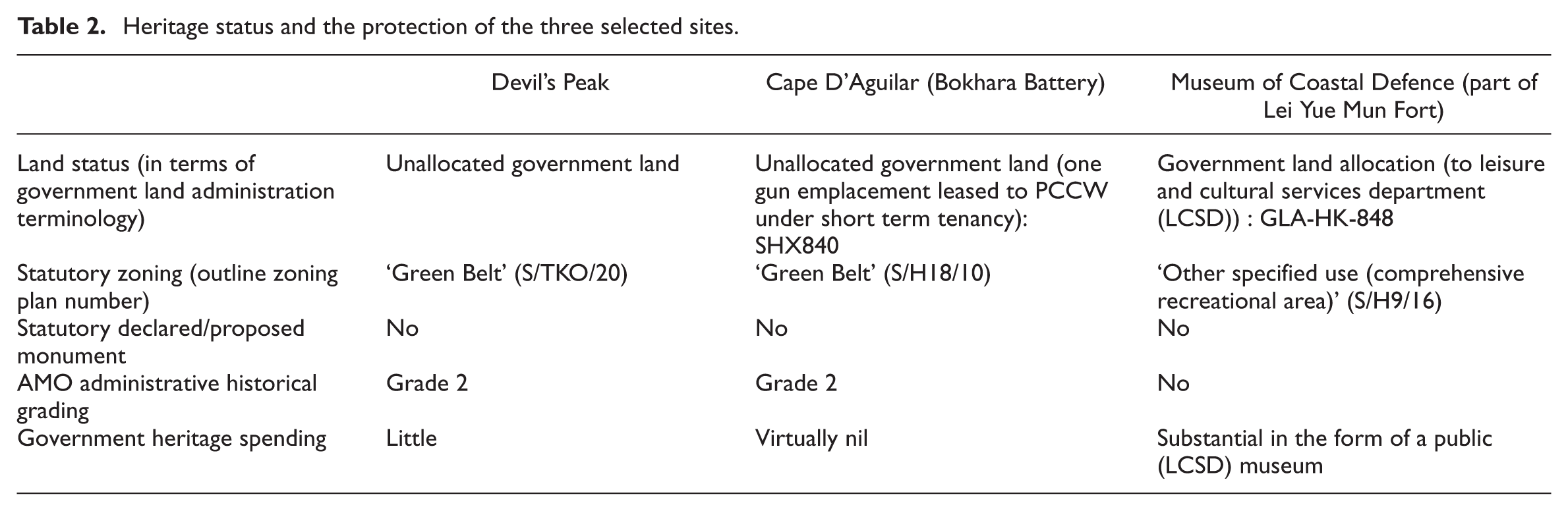
The three sites selected were all well-connected in military geography and history. All have a degree of recognised heritage value, as the buildings at the first two places were classified by the Antiquities Advisory Board as ‘proposed Grade 2’ heritage sites and a public museum has been built at the third place, although none has been declared a monument under the Antiquities and Monuments Ordinance, which would protect it against demolition. They are also all government property. Their statuses and land tenures help avoid many tricky issues of conservation on private property and political issues concerning military heritage conservation identified by experts (Strange and Walley, 2007). Furthermore, they are three ‘ideal types’ of property rights regimes regarding access and human intervention. The observations made are based on a 12-year period of ongoing inquiry, which involved archival research, aerial photo studies, land surveying, engagement with stakeholders, documentary production, and university curriculum development sponsored by a Lord Wilson Heritage Trust and other public sources of funding. The Devil’s Peak site and the Lei Yue Mun Fort were, respectively, on the northern and southern sides of Lei Yue Mun Pass, the only eastern water approach to Victoria Harbour. The latter site is much older, dating back to 1844. All the artillery installed at the two batteries on Devil’s Peak was relocated to the southern part of Hong Kong Island, with two pieces going to form Bokhara Battery in Cape D’Aguilar. All three sites saw action during the Battle of Hong Kong. Devil’s Peak was where a heavy rearguard action took place, borne mainly by the 5/7 Rajputs and the First Mountain Battery of the Hong Kong Singapore Artillery (HKSRA), before the last defenders evacuated the mainland side of Hong Kong by dawn on 13 December 1941.
Then, the guns in Cape D’Aguilar, manned by the 30 Coastal Battery, fired at a Japanese destroyer twice ‘at extreme range’ on 8 and 16 December before the Japanese made the first attempted landing on Hong Kong Island.
Lei Yue Mun Fort was one of the positions where the Japanese successfully landed and fighting at close range took place. This happened before day break on 18/19 December 1941. Hong Kong surrendered on Christmas Day 1941, but fighting continued in Stanley until the next day.
Besides being places of military interest, the three sites are useful for discussing the conservation of buildings not owned by private individuals. During the colonial period, the three sites were, amongst others, allocated to the War Department. After the defeat of Japan, Devil’s Peak was relinquished by the military. We can deduce that the Royal Air Force set up a base at Cape D’Aguilar 4 till and at the same time the state-owned company, Cable and Wireless (now PCCW), became the twin controllers of the site until the University of Hong Kong was allocated some land to build a marine research station and ancillary quarters there. Devil’s Peak became an open access site after the military relinquished the site, while Cape D’Aguilar has remained a closed area even though it has been demilitarised. Lei Yue Mun Fort was retained by the military for active use until the late 1980s, when it was returned to the government as part of the military withdrawal programme in the years leading up to 30 June 1997. The eastern portion of the fort, then severed from the remaining portion by the newly-built Island East Corridor (IEC), which links Chai Wan to Causeway Bay, thereby bypassing congested King’s Road, was allocated to the Urban Services Department (the Leisure and Cultural Services Department after 1997) to be converted into the Museum of Coastal Defence. The museum’s land parcel (GLA-HK-848) consists of Lei Yue Mun Redoubt and Pak Sha Wan Battery. The museum opened to the public on 25 July 2000 – some seven years after the decision was made to build it.
Table 2 summarises the heritage status and protection of the three sites. The fact that these sites were legally the state’s private property, as the site-by-site discussion below will reveal, does not mean that this kind of property is immune to the problems of open access even if it has been well-built and managed. Likewise, closed access is no guarantee of the proper conservation of built heritage.
Heritage status and the protection of the three selected sites.
Devil’s Peak
On the summit of the Peak, at about 222 metres, was built a stronghold called the Devil’s Peak Redoubt in 1910. This structure had a contiguous firing wall with 120 firing loopholes, some of which were inside two machine gun bastions. At one point, the Redoubt served as the Fire Command East for the artillery and was connected to an observation post at 196 metres by a trench lined with stones and provided coordinates for Gough Battery at 160 metres, which had emplacements for a 9.2-inch and a six-inch quick firing gun, and Pottinger Battery at 80 metres and its two 9.2-inch guns (Figure 1). The military buildings, which are in different states of ruin, were identified and surveyed by a research team led by the authors under the sponsorship of two Lord Wilson Heritage grants. They include:
four coastal gun emplacements;
two underground magazines (ammunition vaults);
two coastal searchlight shelters;
several shelters (including one that provided power generation for an AA gun position and one that served as a communications centre);
observation posts;
a machine gun stronghold (the Devil’s Peak Redoubt); and
military paths.
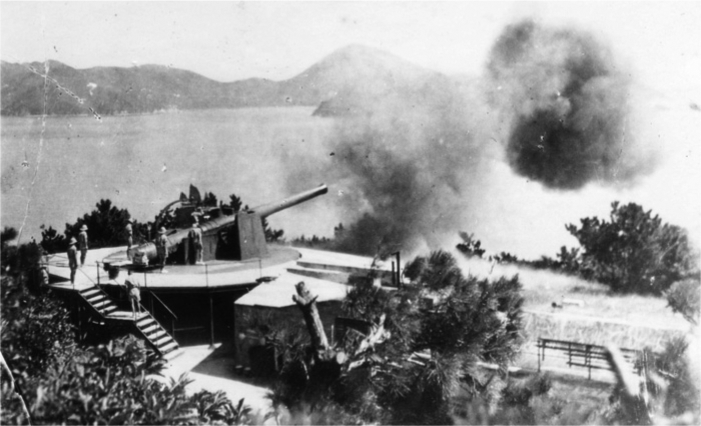
Pottinger Battery firing practice.
These building works were mostly constructed of reinforced concrete and/or bricks. All structures were apparently designed and built purely from a military function point of view. This functionalist concept can be appreciated in terms of location (chosen to meet strategic objectives), size (big enough to perform its intended military function, but small enough to not be easily identified or located), shape (circular for gun emplacements and rectangular for storage and accommodations), architecture and structure (strongly-built with very thick walls and underground vaults to withstand combat gunfire), appearance (virtually no aesthetic considerations and without any attractive finish or colour, except camouflage), and so on.
Due to its close proximity to rural squatter settlements that were developed after the war and the recent development of high density high-rise public housing and a Chinese cemetery in the vicinity, Devil’s Peak is an easily accessible area. However, although the site (the land and buildings there) is entirely owned by the government, there is no active public or private management of it on a day-to-day basis (i.e. no form of regular access restriction or public investment). While the Green Belt zoning in the town plan has a long history, individual buildings (the Redoubt and the two batteries) were not graded until December 2009. ‘Fortifications at Devil’s Peak, Sai Kung, N.T.’ is classified a Grade 2 site on the government list (Item 463) of heritage sites. Grade 2 buildings are buildings of ‘special merit’ and the policy for them is that ‘efforts should be made to preserve [them] selectively’.
There is no direct government spending on the conservation of the military ruins on Devil’s Peak. The government’s public works projects, notably the extension of the Kai Tak Airport runway in the 1970s, actually ended up burying the right gun emplacement and magazine of Pottinger Battery, which were excavated by a Hong Kong University research team in 2005 led by the authors.
Small projects launched by a local District Council from January to May 2002 actually destroyed a military path by carelessly repaving it and ruining a substantial portion of the trench connected to the Redoubt with a newly-constructed flight of cement steps, replaced the original steel peepholes with PVC materials, and deposited concrete on the natural rock outcrop near the trig station to create an unnatural and arguably ugly viewing platform.
Morning hikers have contributed to the untidy appearance of the ruins by hoisting the national flag on the Redoubt and, more recently, at Gough Battery on pennants made of steel, building a rope handrail along a dirt track up to the Redoubt from the north, planting flowers and fruit trees in the cavities of ruins, and depositing their improvised gardening tools all over the place (Figure 2). Sometimes their building works resembled government structures. A good example is the erection of a standard minibus shelter at Gough Battery. War gamers have left a lot of plastic bullets at the site. More troublesome is that a high degree of competition among ‘common’ users has occurred – planting by one group appears to have been replaced by another after a while and political propaganda using abusive and sometimes foul language can be seen on the walls of the structures. The illegal gardeners perform their daily chores oblivious to the Lands Department’s signs prohibiting private agriculture and have colonised three major areas: the northeastern part of the Redoubt’s interior; the firing trench and the observation posts; and near a two-storey communications centre between Gough and Pottinger Batteries. However, the first phase of ‘rent dissipation’ was undertaken during the war by the Japanese occupiers, who removed all steel materials (notably the doors of the shell expense chambers in the gun emplacements and the doors and shutters of the bunkers). A post-war building boom led to the systematic removal of bricks that lined the roofs of the arched underground magazine vaults below the gun emplacements. An aerial photo taken in 1964 showed lines of bricks being placed out in the sun in the open area of the battery. This was likely for drying purposes.
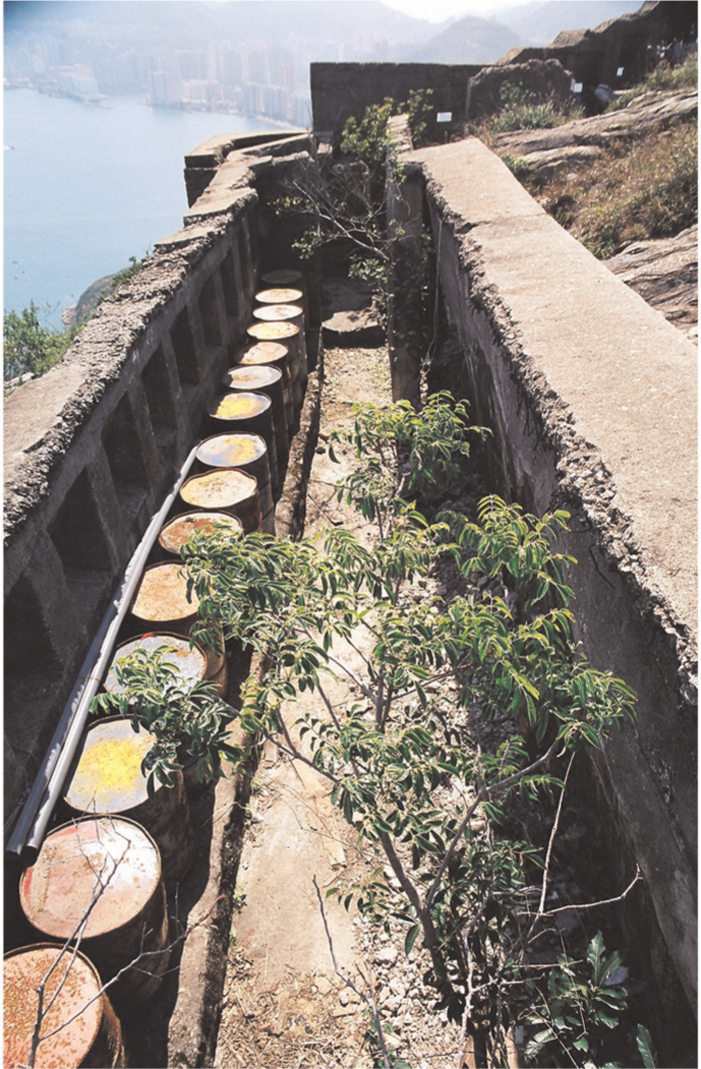
Gardening tools deposited by hikers.
The present state of affairs of the military buildings on Devil’s Peak that survived the war is due to the absence of all three conditions typical of open access government land. In terms of conventional transaction costs reasoning, the state of affairs on Devil’s Peak can be explained in terms of its relatively good accessibility and social visibility in a low bid rent urban area. If it was located in a higher rent area, as in the case of the disused Pinewood Battery above the University of Hong Kong, it would have been actively managed.
Cape D’Aguilar
Located on the southeastern tip of Shek O Peninsula is Cape D’Aguilar. This wavy area has a good view of the South China Sea and Bokhara Battery was built there in a hurry before World War II to provide better coastal gunfire cover of Hong Kong’s southern territorial waters. Installed on a cliff of a higher promontory on each side of a three-storey battery observation and command post was a 9.2-inch gun emplacement. The two guns were originally deployed at Pottinger. To the east of the Battery, on a lower promontory, through which a sea arch can be found, stands the Cape D’Aguilar Lighthouse, which was built during the nineteenth century, which is a statutorily declared monument, and the more recent Hong Kong University marine research student quarters. On the eastern side of this promontory is the Hong Kong University marine research centre, which faces a small sea arch that gave the place its Chinese name ‘Hok Tsui’, literally ‘Crane Beak’. The coast and sea along this promontory is a statutory marine reserve. The lighthouse, student quarters, and marine research centre are all within an area closed to visitors and access is restricted to it by PCCW, which uses the area for its own telecommunications business. PCCW also has a private ‘Rural Building Lot’ for a submarine cable house.
The disused military buildings, each in a different state of ruin, that were identified and surveyed by the authors under the sponsorship of a Lord Wilson Heritage grant include:
two coastal gun emplacements;
two coastal searchlight shelters;
a number of shelters; and
a fire command post.
Like those on Devil’s Peak, the military buildings were mostly constructed of reinforced concrete. There are some differences in the quality of the workmanship and style between the building works here and at Devil’s Peak. Other than the fact that the workmanship for the gun aprons was poorer here, this battery differs from its Devil’s Peak counterparts in that it had no underground magazine. The civilian buildings and facilities presently at the site include:
university research buildings and staff/student quarters;
an old lighthouse (Cape D’Aguilar Lighthouse);
telecommunications installations; and
government signboards.
All civilian building works and facilities were well-maintained.
Due to its remote location, its narrow and winding access road (Hok Tsui Road, which was part of the old Occupation Road, now called Shek O Road, during the colonial era), entry restrictions due to PCCW’s status as the leaseholder, and the preservation nature of the marine reserve, Cape D’Aguilar is a highly exclusive area to which only a few individuals can enter. No signs of adventurous and industrious morning hikers or war gamers are present here. However, the military structures here look poorer than those on Devil’s Peak, even though the latter are at least 35 years older. The UHF installations (including a monocone antenna) at the right gun emplacement that were still tidy in October 2002 were in a wasted state during a visit in November 2012 due to the abandonment of this outmoded form of emergency communication with ships. The front of the roof of the second floor of the OP was intact in 2002 (Figure 3), but had completely collapsed during the November 2012 visit. The roof of the left searchlight shelter position has suffered a similar fate. Besides, the well-mown lawn outside the row of shelters to the west of the gun emplacements had become an unkempt bush by the last visit). As in the case of Devil’s Peak, the root actions of plants and erosion, especially in an area that receives the ion-rich spray of the sea waves, will eventually corrode all structures to a state beyond repair unless immediate rescue action is taken.
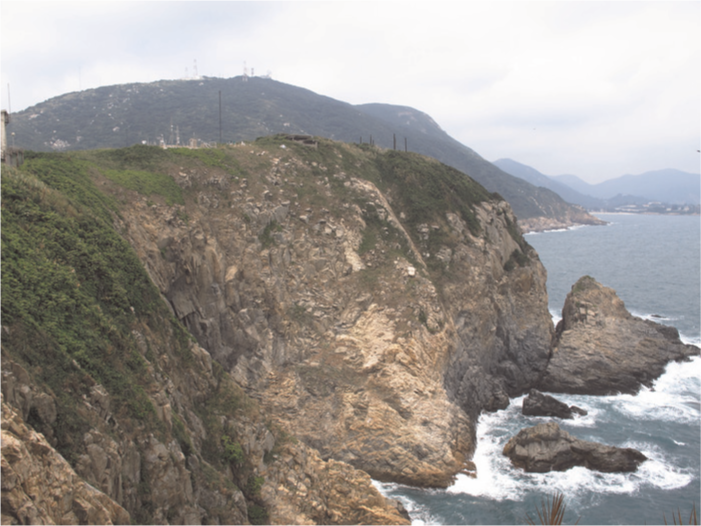
Observation post of Bokhara Battery in 2002 (before further collapsing).
‘Bokhara Battery, D’Aguilar Peninsula, H.K.’ was, in December 2009, at the same time as Devil’s Peak, classified as a Grade 2 building on the government list (Item 391) of heritage sites. The lighthouse is a declared monument.
The state of affairs of the military buildings that survived the war at Bokhara Battery is due to the absence of conditions (a) and, hence, (b), although (c) is also present. Mere exclusion is not sufficient for even the preservation, not to mention the conservation, of the buildings.
In terms of received transaction costs consideration, the state of affairs at Bokhara Battery are its remoteness and, hence, low social visibility of the site in a countryside setting and public utility function of the promontory. In a more visible countryside location, as in the case of the disused Chung Hom Kok Battery, it would have been better managed.
Coastal Defence Museum, Lei Yue Mun Fort
The Coastal Defence Museum in Shaukeiwan comprises only the southern half of a Government Land Allocation that consists principally of the Lei Yue Mun Redoubt with two six-inch quick firing gun positions, over which a huge canopy has been erected to create an air-conditioned museum, and the Lei Yue Mun Passage Battery for two small caliber guns. There is no plan to rehabilitate the nearby Pak Sha Wan Battery, which is now under dense vegetation cover and has become a haven for wild animals (snakes and wild boars) to the northeast of Lei Yue Mun Redoubt. The museum can be criticised for not having any information on the Royal Navy or the Japanese Imperial Navy, which played a part in the history of Hong Kong, or any display on coastal defence works on military sites elsewhere during the colonial period. The adjoining Pak Sha Wan Battery is a case in point. The building works there include batteries, pillboxes, searchlight shelters, naval dockyards, and so on. Nevertheless, one should sympathise with the precursor of the museum, which ran on a very tight schedule before the 1997 handover. In any case, the treatment of this part of the Fort has been far better than government efforts to preserve built heritage anywhere else in Hong Kong other than the Lei Yue Mun holiday village, which is the former Lei Yue Mun Fort to the east of the IEC. Compared to Devil’s Peak and Bokhara Battery, this site is exemplary in terms of the government’s efforts at preservation. Its existence provides hope for an expansion to incorporate the Pak Sha Wan Battery site or a duplication of the same approach elsewhere.
The museum is opened to the public every day except Thursday and a nominal entry fee of HK$20 is charged. Senior citizens and students enjoy a 50% discount. Access control is near perfection, as there are many security guards patrolling all key positions and ingresses/egresses. CCTV monitoring is also comprehensive. The site has no sign of graffiti and conditions are neat and tidy. The vintage military structures here were much older than those on the two other sites we visited, but there are more visible traces of battle damage. Since all the military structures have been restored and opened to the public as displays, they are in excellent condition. This state of affairs owes thanks to the presence of the three conditions present here. The museum was designed to blend in with the surrounding topography and all new structures have done that with the existing military facilities in terms of use, scale, colour, and materials.
Key lessons on access and management learnt
The observations on the three sites were those obtained by the authors, whose team has researched them for 12 years. The sequence of the case studies is not random, but carefully decided. A Hong Kong person who has never gone up to Devil’s Peak would find the site scenic on arrival, but will usually be annoyed after seeing the results of careless human disturbance – especially when they are advised that some of the alterations were done using taxpayers’ money. Anyone who visits Devil’s Peak after having heard of the concept of ‘the tragedy of the commons’ may imagine that closed access, like for Cape D’Aguilar, is a solution to heritage conservation. But when one visits Bokhara Battery to have a closer look at the conditions of its buildings, one would likely be shocked by their degrees of deterioration, which stand in sharp contrast to the neat and scenic environment and well-maintained lighthouse, a declared monument, and student quarters, managed by the University of Hong Kong, in the vicinity. One’s gut reaction after visiting the Lei Yue Mun Redoubt area would be that the museum is the best solution. That, to a great extent, is true. However, the museum in Lei Yue Mun is not as fully gated as Cape D’Aguilar or the bank gold vault that stands next to it. Some fishers and adventurers do trespass into Pak Sha Wan Battery and test the coastal margins of the museum. Chinese fishermen who dared not build anything when the British were stationed at the fort have since built a bright yellow temple on a concrete platform (which probably housed a gun previously) along the rocky shore outside the gated area of the museum to worship their gods (Figure 4). In other words, only part of the land allocated to the museum has access restrictions. Due to the thickness of the vegetation there, the difficult topography, and probably the recent military past of the site, the degree of abuse by intruders has been minimal compared to that which has occurred at Devil’s Peak.
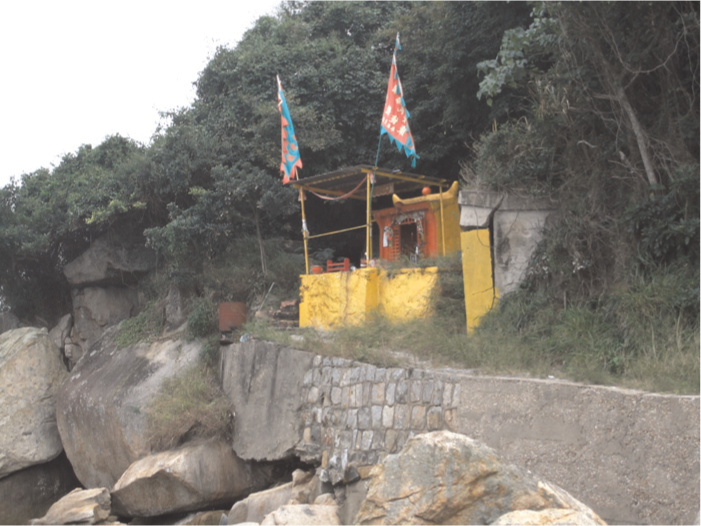
Temple erected by squatters within land of the government Coastal Defence Museum.
The intrusion of visitors just outside the confines of the museum actually helps advance heritage conservation planning. The erection of the bright yellow temple, which mirrors a red Tin Hau (Mother of Heaven) Temple across Lei Yue Mun Pass in the coastal squatter village below Devil’s Peak, led the authors to discover Searchlight Emplacements Numbers 3 and 4, which were built in around 1902, while they searched for a supposed pillbox or quick-firing emplacement with the permission of the museum on 13 December 2012. These emplacements could be found in the drawings of the ‘Fortification Design Branch’, which were deposited in the UK without the museum’s knowledge or are available in the extant literature. Only No. 3 emplacement could be easily spotted in the old aerial photos of 1949 and 1963.
The case of the Museum of Coastal Defence is interesting, as it resembles both Devil’s Peak and Bokhara Battery in terms of accessibility and social visibility. However, ideas and efforts have transformed the site and enhanced its value. Although it can be criticised in terms of the various criteria of authenticity, the investment in the museum has gone well beyond the degree of conserving Pinewood or Chung Hum Kok Battery. This shows the effect of Schumpeterian innovation.
Visitors to Devil’s Peak sometimes cause hill fires. While these are disastrous from a botanist’s point of view, they are most welcomed by archaeologists and surveyors, as they clear the vegetation and expose military structures. In October 2012, the authors’ team could no longer reach Pottinger Battery (which they dug out in 2006 from the earth filling deposited there by the Kai Tak runway project team) due to the overgrowth that recolonised the area. Access is now naturally blocked and nobody can easily gain entry to get a closer look at the battery.
An interesting thought about the morning hikers who ‘privatised’ parts of Devil’s Peak as their own or for their political platforms is that non-governmental energy could have been channeled by NGOs to create new social heritage spots without further harming the built heritage so as to empower the local community. That the Fisher’s Association in Norway emerged as an important NGO when the state granted licences to culturists to stop open access to the coastal ocean proves the viability of this approach. This should not demand too much public funding, but will have to involve community action facilitated by the local District Council.
The temple erected within the museum’s premises by intruders poses a challenge, but also an opportunity, to the present landowner by realigning the management strategy of the museum. When suitably modified, following the example of the statue in Repulse Bay that used to attract a lot of Japanese tourists during the 1970s, this illegal structure can become a scenic spot for the public after being transformed from an eyesore into an art piece.
From the above comparative study informed by the discussion on property rights regimes, the following property rights lessons on conserving military heritage buildings, which add to the basic tenets of the ‘tragedy of the commons’ and often do not apply to land property, can be learnt.
First, in terms of property rights classification, as shown in Table 1, the type of property rights for Devil’s Peak is principally DI with a degree of DII. Both Bokhara Battery and Lee Yue Mun Redoubt are DIII.
Second, effective access restrictions (condition (c)) do not guarantee heritage conservation without intention (condition (a)), even when the land is under state ownership and control. Enclosure alone is not adequate for conserving built heritage.
Third, even land under active facility and property management (when all conditions are present) often leaves gaps of unauthorised entry when the site is large.
Fourth, entrants to private government land with or without access restrictions sometimes, albeit unintentionally, provide lessons to heritage researchers and even generate new heritage values. The rope rail erected up the Devil’s Peak Redoubt by hikers and the temple outside the Museum of Coastal Defence are cases in point.
Fifth, a degree of communal property rights should emerge to restrict access to certain places for the enjoyment by some (in the case of Devil’s Peak), and this rational attempt to limit rent dissipation must be regarded as a problem by the landowner because when competition escalates, there can be conflicts and harm to the built heritage in question. When an innovative solution is feasible, the problem can be transformed into a positive externality (Lai and Lorne, 2006, 2014b).
Discussion and conclusion
This paper uses a Coasian methodology informed by Schumpeterian innovation to show the subtle difference between open access and common property, which has not been well recognised in the economic literature. The interesting finding was that open access can be a source of information that opens up new parameters for consideration, which the existing property rights literature has not addressed. Note also that the distinction between de jure and de facto property rights is theoretically significant in discussing the so-called ‘ambiguous property rights’ (Lai and Lorne, 2014a).
This Hong Kong case study of three sites with colonial military buildings of recognised heritage values adds, in light of transaction costs and innovations, to our understanding of access restrictions for conservation research and planning. The idea that open access can be a source of information, on the basis of which innovative management may be adopted, is something that the authors hope environmental economists will take up in theory.
Our submission is in theoretical agreement with the views of Feeny et al. (1996) and Ostrom (2000), who argued that communal (which they called common) property can play a positive role in conservation. This paper, however, does not promote any ideological public or market solution. The former was criticised by Nobel laureate, Austrian economist Hayek, in The Constitution of Liberty (Hayek, 1960), while a market solution was considered viable by some theorists (Hojman and Hiscock, 2010).
For the state to put matters into practice is not easy due to the post-colonial politics of public consultations (Lu, 2009; Yung and Chan, 2011), even if they have the government’s blessings and funding is ample due to various regulatory requirements (Davies, 2012). It is beyond the scope of this paper to offer immediate solutions to the problems of deterioration in built military heritage in the first two cases or ways to conserve Pak Sha Wan Battery in Lei Yue Mun.
In any case, a simplistic enclosure approach to heritage sites is surely not the way for conservation. Furthermore, the public can be a source of heritage values and there can be an inhibition of innovations if there is too much exclusion. After all, conservation is supposed to be for public enjoyment.
Zoos are not animal farms. Although a zoo keeps animals and prevents them from human disturbance, it does not nurture them. An animal farm is not a zoo either because active human intervention in the form of animal husbandry takes place there. This account of two distinct forms of resource management, both predicated on restricted access, informs us that merely enclosing a resource is, in itself, insufficient for its transformation. Likewise, heritage building conservation calls for active human intervention beyond mere enclosures.
In closing, we say that a more sensational metaphor than ‘farm vs. zoo’ for the military heritage facilities in question is probably ‘dead or alive’ in the sense that if these non-civilian facilities were simply enclosed or sealed up, they would truly be dead! If, on the other hand, military buildings can be transformed, this can bring to life a development path that was not intended for their original function of inflicting death.
Footnotes
Acknowledgements
We are grateful for the useful comments of three anonymous referees, especially those regarding the choice of site and transaction cost and the useful advice by Dr Stephen N. G. Davies, the former teacher in Western political thought of the first author at the University of Hong Kong and Editor of the Journal of the Royal Asiatic Society Hong Kong Branch.
Funding
This research received no specific grant from any funding agency in the public, commercial, or not-for-profit sectors.