



Abstract
With increased inequity and polarisation in society, access to leisure has become even more crucial for ensuring the humanity and health of people living in urban poverty. Homeless people constitute the hard edge of urban poverty, and literally embody broader inequities in society given that they face increased risk of illness and an early death. Scholars have explored the material and psychosocial hardships experienced by homeless people, but focus less on leisure. This article explores the role of leisure in the everyday lives of 99 homeless people in New Zealand and England. We document various leisure activities across different urban spaces and consider the complexities of leisure in how homeless people make meaning of, cope with and survive street life in the city.
Introduction
In unison with increased inequality and social polarisation in countries affiliated to the OECD, urban poverty and homelessness have re-intensified (Hodgetts et al., 2013a; Theodorikakou et al., 2013). Homeless people constitute the hard edge of urban poverty and literally embody broader inequities in society, where they face increased risk of illness and early death (Stolte and Hodgetts, 2014). In response, scholars have considered pathways into and out of homelessness, and demonstrated the influence of various interlinked structural (growing inequalities, unemployment, housing unaffordability) and personal (familial traumas, psychological illness, substance misuse) risk factors (Hodgetts et al., 2014; Perreault et al., 2013). Considerable effort has gone into defining homelessness to ascertain prevalence, allocate resources and develop services (Illsley, 2013; Lancione, 2013). Underlying many definitions is a continuum of housing situations, ranging from insecure housing to the absence of a dwelling.
Although arising from an appropriate concern for addressing homelessness, such definitions have been criticised for pigeonholing people into reified categorises that can gloss the lived nuances of homelessness (Hodgetts et al., 2014; Illsley, 2013; Lancione, 2013). The preoccupation with developing definitions largely reflects the agendas of domiciled society for managing the urban ‘problem’ of homelessness. Homelessness constitutes much more than the presence or absence of particular forms of shelter. Research with indigenous people, for example, documents how homelessness involves disruptions to ancestral affiliations to geo-cultural landscapes, traditions and kinship networks (Groot et al., 2011). Our research agenda focuses on the everyday lives, social practices and relational experiences of homeless people (Borchard, 2010; Hodgetts et al., 2008, 2012; Lancione, 2013).
In order to understand the emplaced, material and relational aspects of homelessness, this article explores how street homeless people periodically engage in both fleeting and extended periods of leisure. We document how homeless people find agentive ways to enrich their lives, seek respite and reflect on their harrowing situations through leisure. Our analysis demonstrates how leisure is vital for homeless people’s humanity, wellbeing, and constitutes a fundamental human right (Sager, 2013). Scholarship on this topic is limited (Borchard, 2010; Hodgetts, 2008, 2010; Klitzing, 2004; Perreault et al., 2013). Consequently, we must first consider why homeless people’s leisure practices are routinely overlooked.
It is important to consider how the leisure pursuits engaged in by homeless people are often contested (Borchard, 2010), since street homeless people lack private spaces in which to exist and conduct their leisure. Homeless people are routinely moved on by authorities. Associated with the removal of such ‘disruptive bodies’ lie taken-for-granted challenges to homeless people’s rights to the city and leisure (Mitchell and Heynen, 2009; O’Sullivan, 2012). For example, whenever we mooted writing this article on homeless people going on holiday to domiciled people our words were met with puzzled glances, laughter and unsettling questions. ‘But, aren’t they already on holiday?’ ‘Don’t they have more pressing needs?’ ‘They choose to be homeless and not work so why should they have fun?’ Such discriminatory challenges to homeless people engaging in leisure are anchored in a persistent public narrative that proposes that people ‘choose’ to be homeless. In addition, homeless people are often not perceived to have earned a break because they are not working. Such narratives obscure the fact that homelessness is rarely a personal choice and surviving homelessness is hard and stressful work (Borchard, 2010). These challenges also reflect the commodification of leisure (Higgins-Desbiolles, 2006; Lefebvre, 1971) and the reproduction of problematic dichotomies between work and leisure (Cook, 2006; Dart, 2013; Rojek, 2005).
The Aristotlean ethical notion of human flourishing underpins the obligation of society to provide the resources and conditions to enable all people to grow and develop meaningful lives (Sager, 2013). Relatedly, Higgins-Desbiolles (2006) point out, Article 24 of the Universal Declaration of Human Rights states that: ‘… everyone has the right to rest and leisure, including reasonable limitations of working hours and periodic holidays with pay’. We argue that the sentiment of Article 24 stands equally for homeless people. If we accept that being homeless is hard work (Stolte and Hodgetts, 2014), then homeless people also have a right to leisure and opportunities for reflecting on, and developing, their humanity. Yet, the rights of homeless people to leisure and human flourishing are undermined by the reproduction of the work–leisure dichotomy that is central to the commodification of leisure, associated exclusionary practices and inequalities in access to leisure resources (Cook, 2006; Dart, 2013; Rojek, 2005). For example, Higgins-Desbiolles (2006) recounts how non-commercial understandings of leisure as a social good for all have been disrupted by the subjugation of human existence to market forces. Holidays, for example, are often promoted as enabling people to recharge their batteries before returning to paid work in the formal economy.
The dualism between paid employment and leisure has long been problematised because it can reproduce patriarchal assumptions regarding what counts as work, and this obscures the leisure pursuits of people who are not in paid employment. Further, leisure and work constitute overlapping domains where ‘good jobs’ often allow for dimensions associated with leisure, such as freedom, creativity and fun (Dart, 2013; Rojek and Blackshaw, 2013; Sager, 2013). For the growing precariat classes, however, the divisions between work and leisure may be hardening given that their jobs are increasingly experienced as oppressively rigid, regulated and lacking creativity. As Dart (2013: 398–399) notes ‘… the work–leisure couplet should not be made redundant but, rather, is in need of regular modification and re-grounding in order to understand the specificities of lived experience’. Such a dynamic approach is important because leisure is a situated, complex, pluralistic and contested phenomenon, which invokes issues of freedom, respite, play and personal growth (Dart, 2013; Sager, 2013).
Social practice theory offers insights into the dynamic aspects of leisure. ‘The most basic theoretical assumption is that activities of social life continuously have to be carried out and carried through, and that this mundane performativity is organised through a multiplicity of collectively shared practices’ (Halkier and Jensen, 2011: 104). A dynamic nexus of social practices make up lifeworlds. These practices comprise activity structures, understood here as routine forms of human action that involve bodies and physical acts, imagination, the use of material objects and the conduct of relationships. We will document how, for street homeless people, leisure is comprised of an evolving set of such situated practices (Crouch, 2006) through which they explore themselves and their place in the world. Following Sager (2013), we propose that leisure emerges when homeless people engage in practices that they find valuable for their own sake, but which can also offer respite, meaning and escapes from the grind of everyday life. Our research is in keeping with the assertion that leisure research should adopt a pluralistic orientation in documenting how societal structures and power relations shape leisure spaces, and inform efforts to support social inclusion and distributive justice (Crouch, 2006; Rojek, 2005; Sager, 2013). Central here is an engagement with emplaced experiences of leisure that move out from participant accounts and the local setting to the broader social forces that provide much of the situated context for these experiences (Simmell, 1903[1997]). We are interested in the meaning of leisure practices for those engaged in them and the broader significance of their social practices.
The present research
A small and disparate body of research has made mention of homeless people’s leisure activities. This research demonstrates the importance of recreational activities for reducing stress, building social ties, regaining a sense of self and place, buffering against adversity, finding hope and meaning, and experiencing inclusion and control (Borchard, 2010; Hodgetts et al., 2010; Klitzing, 2004). Leisure pursuits may not resolve homelessness, but appear to stabilise people for a time, encourage agentive reflection and improve people’s quality of life in a manner that aids survival. Such research identifies various intermittent urban spaces within homeless people’s everyday landscapes – including cafés (Borchard, 2010) and libraries (Hodgetts et al., 2008) – as providing leisure opportunities for respite, for retaining one’s humanity and for promoting interactions with diverse groups of people (Higgins-Desbiolles, 2006). Borchard (2010), for example, explored the activities of two street homeless men in Las Vegas sitting in a Starbucks café with a laptop playing online poker in a virtual casino. These practices reflect the overlapping of representational and material spaces in homeless lifeworlds (Hodgetts et al., 2008), and how various everyday locales are combined by inhabitants to form what we call urban socio-scapes of homeless leisureliness, respite and survival (Hodgetts et al., 2010).
In exploring such leisure practices within street homeless lifeworlds, we draw from an ongoing programme of urban research into the everyday material, spatial and relational aspects of street homelessness, which began in the UK in 2003 and continues in New Zealand (Hodgetts et al., 2007, 2008, 2014). The research involves ethnographic, participatory and ongoing action-orientated work to foster collaboration between service providers, social workers and academic researchers to advance understandings of, and supports for, homeless people. In embracing an ethnographic impulse within critical scholarship on homelessness (for detailed methodological discussion see Groot et al., 2011; Hodgetts et al., 2007, 2010, 2012), we involved ourselves in service settings in central London, Auckland and Hamilton. Street homeless people were recruited through these agencies, where staff facilitated our access to participants. Moving out from these locales we engaged with street homeless people through casual conversations, direct observations of daily activities, biographical interviews, go-along interviews and photo-elicitation projects/interviews. Although we did not set out to research leisure specifically, the importance of leisure emerged over time.
Of the 99 participants, 44 completed one or two in-depth biographical interviews, with 48 also taking photographs of their everyday lives and completing photo-elicitation interviews. We also conducted weekly interactions over a six-month period with a group of seven homeless men who developed a community garden that supplies a local foodbank. Casual conversations informed our fieldnotes, helped us refine formal interview themes and were crucial for building rapport with participants and encouraging open dialogue. Biographical semi-structured interviews focused on participant backgrounds, pathways to homelessness, interests, everyday practices, health, identities and future aspirations. Photo-elicitation exercises served as ethno-methodological breaching tasks that enabled participants to gain reflective distance from their everyday lives. Participants were afforded opportunities to show us how particular issues, relationships and practices manifest within their lifeworlds, and to raise issues of importance to them, which we had not set out to investigate, such as leisure.
Embracing notions of reciprocity and gift exchange in community research (Hodgetts et al., 2013b), we engaged dialectically with stakeholders and decision-makers in order to help address the evolving needs of our street homeless participants. Specific activities included using empirical materials, such as participant biographical accounts and photographs, to lobby central and local government decision-makers to refrain from extending punitive responses to homelessness. We also engaged staff and clients of services in reading groups and light-hearted activities, such as public debates, in order to promote broader deliberations regarding homelessness. Research insights were used to inform the development of outreach, rehousing and healthcare initiatives, and to reconsider aspects of social work practice so as to embrace a more client-centred perspective that is responsive to the diverse needs of street homeless people. With the consent of three participants, their photographs were used by health practitioners to extend existing therapeutic dialogues. Our work has recently extended to annual professional development seminars with the New Zealand judiciary.
The analysis for the present article drew from Lévi-Strauss’ (1962) concept of researchers as bricoleurs who bring together insights generated in interactions with participants, researcher fieldwork experiences and insights from theory and previous research to create new interpretations. This analytic strategy required abductive reasoning (Hodgetts et al., 2011). For example, leisure was identified inductively as a key issue for participants from our reading of fieldnotes, interview transcripts and photographs. We then looked for relevant research to ascertain what was already known about leisure among homeless people. We re-read our entire research corpus to generate a list of leisure practices, the places in which leisure practices take place, and the relationships involved. Next, we engaged in deductive coding of the whole research corpus according to the forms of leisure we had identified. We then considered how these themes might be clustered in relation to different forms of leisure, the use of objects, relationships, identities and city spaces. In putting the analysis together through writing, the accounts of our participants were not considered in isolation, but alongside various scholarly sources in a manner that enacted Simmel’s (1903[1997]) approach to urban scholarship of focusing on specific moments in order to understand the broader patterning of urban life. Asserting that the specific resembles the general, but is not reducible to it, Simmel extracted general arguments out of detailed considerations of specific urban practices. This approach typifies attempts to bridge the gap between philosophical abstractions and detailed empirical engagements with actual everyday lives that are typically written out of history.
We found that for homeless people, leisure spans a raft of social practices that often generate experiences of respite, pleasure and reconnection; including daydreaming, reading, walking, drinking, gardening and holiday-making. We will demonstrate how leisure involves various imagined, material, embodied and emplaced practices that aid in coping, transcending street life, re-finding oneself and asserting one’s humanity and rights to the city. First, we explore issues of imagination and material leisure practices through which homeless people escape homelessness for a while and preserve their sense of self. Second, we consider tensions arising between homeless and domiciled worlds when our participants’ leisure practices are conducted within shared urban spaces. Third, our attention turns to more mobile forms of leisure where people transit different leisure retreats both within and beyond the city.
Leisure, imagination and the city
Homeless people engage in various leisure practices that transform aspects of an inhumane urban landscape of despair into momentary spaces for care (Stolte and Hodgetts, 2014). Here, leisure comprises more than escapes from the physical grind of homelessness and an aid to coping. Leisure encompasses specific acts of belonging and attempts to gain affiliation with other people, the city and former domiciled selves. As Snow and Anderson (1993) have observed, having a stigmatised homeless identity can erode the self. This drives a need for street homeless people to seek activities through which they can salvage a more positive domiciled self. Beyond a passive ‘acceptance of streetlife’ (Snow and Anderson, 1993), homeless people often cultivate agentive strategies for escape that aid them in responding to being ‘trapped on the streets’ (Cohen and Taylor, 1976). In exploring these processes we demonstrate how, ‘It is our imagination which gives us the necessary sustenance to create visions of alternative realities …’ (Andrews, 2014: 4) and identities (Rojek, 2005). In this way, imaginative practices reflect how leisure can take people out beyond present time and space (Crouch, 2006).
Our participants work to give the city meaning by imposing their imaginations on the landscape through leisure. In discussing a set of photographs of specific locales that he inhabits, Colin reveals the role of his imagination and appreciation of the aesthetics of urban space in buffering against adversity. In reflecting on photographs of a fountain (see Figure 1), Colin states: I took that photo because it’s a common hangout for streeties. I really like it as a water feature. It’s like a little piece of nature in the middle of the city so that appeals to me from an aesthetic point of view … The sound of it is really nice and there’s a bench beside the fountain … Cos, they’re places I can escape from my reality. It’s a peaceful place … I go there, listen to the water.
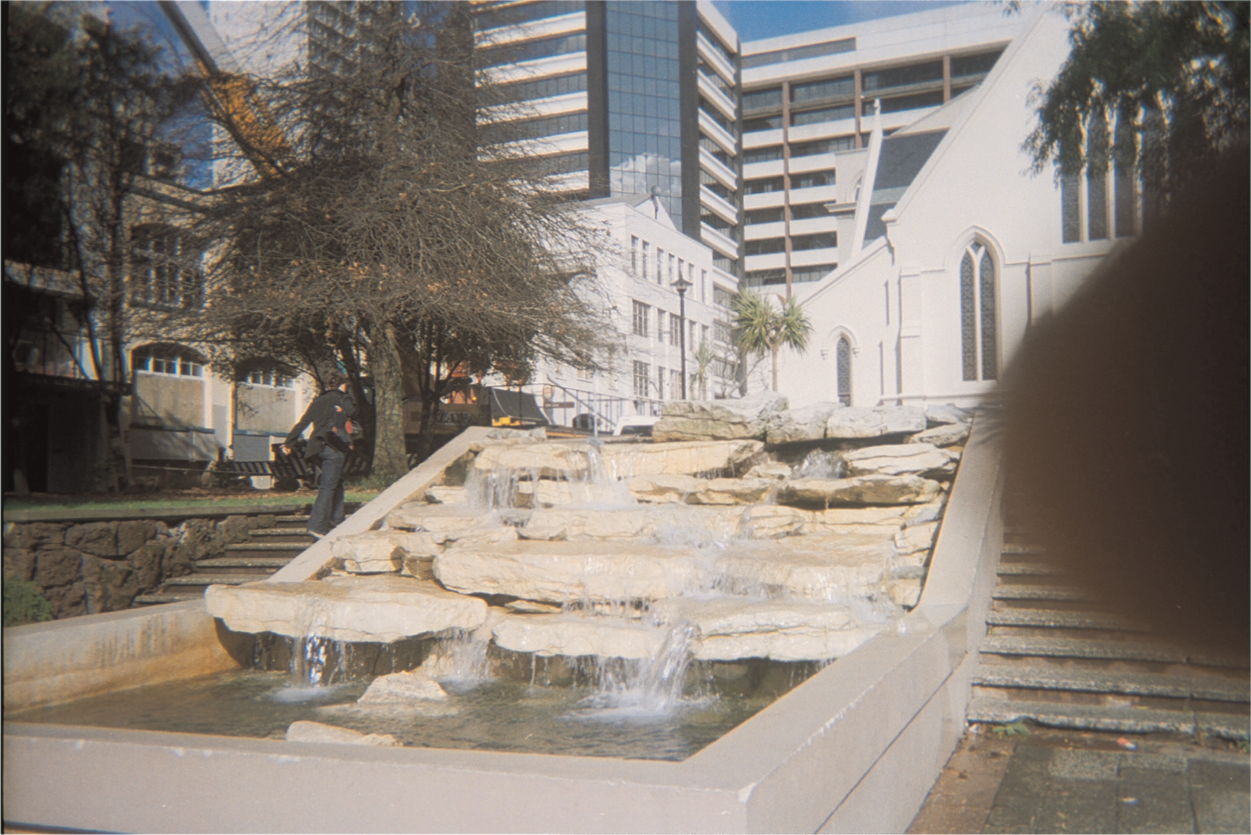
Fountain in central Auckland.
Through such accounts we gain insight into participants’ private cities, the urban landscapes that they texture and render meaningful in accord with their interests and imaginations. The physical features of the fountain and Colin’s imagination are intertwined. Imagination and fantasy can play a vital role in bolstering a homeless person’s day-to-day survival. As Raban (1974: 159) notes that in living on the streets and being exposed to the stimulation of the city, anyone might: ‘… find oneself unconsciously slipping into magical habits of mind’. Imagination is located in particular locales for our participants. In this exemplar, the sound of the cascading water helps Colin to appreciate the city, remember nature and escape his homelessness for a while. There is a visceral element to such accounts of imaginative reconnecting with the natural world through spending time by a water feature (and, as we will show later, gardening), which encompass basic sensations of oneself in nature (Bouwer and Van Leeuwen, 2013). This leisure practice gives form to Colin’s relationship with himself, the urban landscape and nature (Sager, 2013).
Leisurely escapes do not always take people anywhere different physically, but they can transport people imaginatively (Cohen and Taylor, 1976). Through imaginative play and daydreaming our participants appear to create cities for themselves in which they have worth. As Raban (1974: 1) notes: ‘Decide who you are, and the city will again assume a fixed form around you’. For example, Jean recalled traversing the cityscape pretending that she was a detective, looking for ‘little clues’ in the rubbish. She thought about who had owned items such as buttons and constructed narratives about these because such practices ‘keep you alive’. Jean elaborates: You go into a dream world. You go into a cartoon world. That you are a detective in a cartoon film. Everything becomes totally different. The street itself takes on a completely different atmosphere and life, and you are a different person altogether. You’re a different thing altogether. You even use second-hand clothes as your different thing … I would get a mac that looked like a detective’s mac. You know, to be used as a prop for my world, I would create if I wanted to get through a night or two of homelessness.
In this account, imagination and fantasy extend to play and adventure. Jean’s account resembles Simmel’s (1959) notion of the adventure as something like a fragment ‘torn from life’. Daydreaming and fantasy play offer possibilities for Jean to extend beyond her lot in life, providing with her additional meaning and purpose. Such practices refract aspects of Jean’s lifeworld to give it form and substance borrowed from other realms. Being a detective occupies Jean’s mind and takes her away from her homelessness with purpose. It allows her to find some detachment from the familiar, and to explore alternative purposes and selves (Andrews, 2014). By contemplating in a detailed way on the small discarded items around her, Jean was able to transform an urban landscape in order to re-occupy it as a more legitimate person. Leisure practices interconnect places, times and selves through the use of material objects as props for imagination and ‘escape attempts’ (Cohen and Taylor, 1976). Objects of leisure can aid homeless people in re-imagining themselves. Imagination in the use of objects enables participants to invoke the presence of other people and physically distant places in a manner that exceeds the materiality of their present situations. Imagination and ideas can become particularly important markers for people facing poverty, since: ‘Ideas are both the cheapest and the most intensely private objects with which a man [sic] may furnish an identity’ (Raban, 1974: 106). Our participants extend out into the world through their imagination and affective connections to everyday leisure objects (Heidegger, 1927[1962]). Through involvement with material objects in everyday life, our participants experience themselves as being more fully human, rather than simply ‘the homeless’, and locate themselves within the city.
Briefly, leisure enables street homeless people to transform a landscape of mere survival and despair in the city (Crouch, 2006; Stolte and Hodgetts, 2014) into a more meaningful and humanising socio-scape. Participants seek connection with the material world and meaningful roles through leisure and, in doing so, construct their cities in imaginative ways (Raban, 1974). Evident across the participants’ accounts was a sense in which homeless people did not want to be eclipsed by one material facet of their lives (homelessness), no matter how influential it is for their daily existence. Participants repeatedly present self-images of people who were not just homeless. Imagining the self, no matter how fantastically, as an appreciator of architecture, detective or bookworm enables our participants to give meaning to street life and to endure.
Leisure spaces and contested practices
Various leisure practices appear to open up new potentialities and provide spaces for our participants to be more of who one would like to be (Cohen and Taylor, 1976). These leisure practices do not just comprise solitary activities. They involve spending time interacting with other people in betting shops, libraries, cafés and parks. Several participants recounted structuring their days so that they could catch up with domiciled acquaintances to converse about a range of general issues or to socialise with homeless friends, belong together, and lay claim to public spaces.
In terms of attempts to reconnect with the domiciled world, Pat enjoyed spending time at a betting shop on Saturdays: ‘having a flutter, only 50p, but enough to enjoy the races …, having lunch and talking about the races’. As with other participants, gambling brings the chance of a windfall, the excitement of winning and fun into a demoralising lifeworld. Such gambling escapes: ‘… there’s always the possibility that something will happen’ (Cohen and Taylor, 1976: 104). In the process, Pat cultivates an alternative leisure identity for herself that takes her out beyond that prefigured and ‘expected’ from her status as a homeless women (Hodgetts et al., 2010). Crouch (2006) notes that leisure spaces, such as this betting shop, are material and imaginative, both reflecting and constitutive of identities and spaces. Further, judgement-free leisure spaces are essential as spaces where homeless people can be accepted and included instead of being marked as ‘other’ (Trussell and Mair, 2010). Such spaces afford opportunities for street homeless people to ‘be’ somewhere as members of the public doing what everyone else is doing (Hodgetts et al., 2008). To some extent, they are able to leave their homeless identities at the door and assume the identity of the patron and friend, in order to span homeless and domiciled lifeworlds.
Pat’s efforts to escape the everyday grind of homelessness by participating in a domiciled space is precarious and contingent. Leisure practices such as hers offer temporary respite, a sense of autonomy and resistance, but carry the risk of being pulled back into the lived grind of street homelessness (Rojek, 2005). On one occasion, Pat returned to visit the betting shop proprietor to share drawings she had made, only to find him busy talking with a colleague: When I knocked at the door he just turned round to his colleague and said ‘Don’t worry she’s just an old beggar lady’ and he threw some coins at me. And, that was dreadful … Well I don’t think that I am what they say I am. I don’t think I am a bag lady … You don’t see me with lots of bags very often, I’m not …
This incident disrupted Pat’s sense of belonging and leisure identity as a legitimate community member. It illustrates how a homeless person can be dragged discursively from a leisure space back into the dignity-stripping domain of homelessness. It also reflects what Raban (1974: 67) referred to as: ‘The dream smashed up, the daring impersonation turned into mere lie …’. The social identity of the bag lady is re-imposed on Pat at the expense of her felt identity as a friend. What was previously constituted as a judgement-free space for Pat (betting shop), is transformed by the proprietor back into a judgemental space with no room for Pat’s alternative leisure identity (Crouch, 2006).
Participants contrasted their use of different public leisure spaces with different leisure practices (Hodgetts et al., 2008). For example, Jason discusses how on most days he visits the library by himself to read, but on other days he drinks in the park with friends: I visit the library, go and read there. Mostly on pay day, well we’re drinking … We have cook-ups, with a gas stove burner, and a big pot, meat and veges and we all contribute. Then we have fried eggs and bacon. Some of them get the bacon and meat out of the supermarket dumpsters. They [Homeless] know how to do it. They [shop staff] come out from Countdown [supermarket] with a lot of primo meat. You get to know when the staff are coming out with it. ‘Oh yeah, we’ll take that, we’ll take the whole trolley’… We go down the park [Figure 2], get some beers going and escape reality for a while.
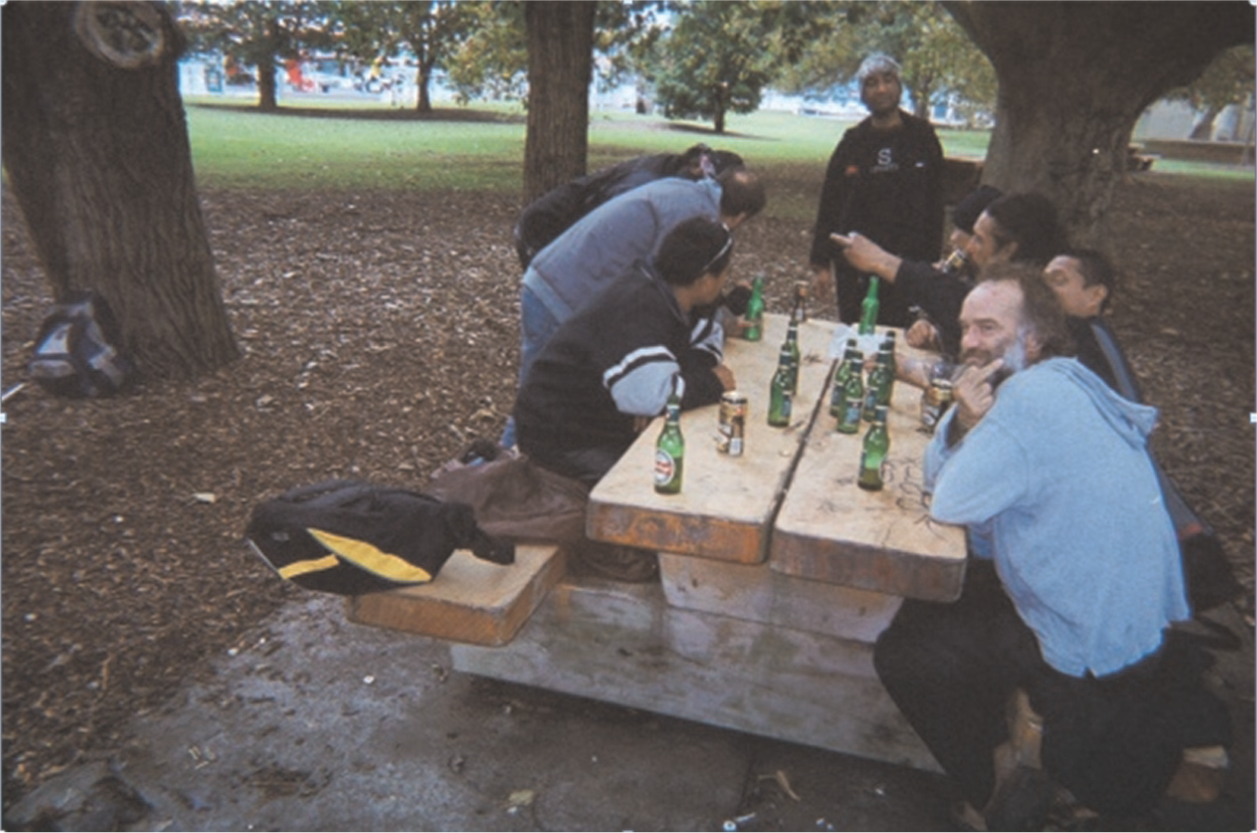
Friends enjoying a barbeque in the park.
Depicted in Figure 2 is an instance of an escape into the leisure space of a party in the park. The scene exemplifies the creation of a public leisure space by homeless people through which they can engage in subcultural practices engaged in by other groups in private (Rojek, 2013). ‘It’s great being able to make a place for us and do our own thing’ (Jason). We can also witness here traces of the companionship, emotional support and pleasure made possible through communal leisure events. Such accounts characterise homeless people as resourceful and cooperative friends who have fun together within the homeless institution of the ‘drinking school’ (Archard, 1979). In this context, dumpster-diving can be read as a communal resistive leisure practice (Rojek and Blackshaw, 2013).
The public leisure space of the park is temporarily converted through such practices into the private leisure space of the outdoor summer party (Demant and Landolt, 2014). Drinking is presented by participants as a communal activity through which group cohesion, respite and reciprocal relationships are cultivated. In the extract and image above we witness pleasure, sociability, abandonment, letting go and an opportunity to be someone else for a while. Almost all of our participants discussed such escapist drinking or drug-use as a response to the adversity of homelessness and a way of ‘getting away from it all for a while’ (Ben). These dimensions are often missed by domiciled passers-by and authorities who see such practices as criminal disruptions to urban life and public order (Rojek, 2013). We do not want to romanticise substance misuse or gambling as forms of leisure among homeless people. We acknowledge that public drunkenness, for instance, can be unpleasant for other people. There are leisure-related tensions around inclusion and exclusion, homeless people’s rights to leisure and the need to regulate and restrain behaviour in public spaces (Demant and Landolt, 2014). Nevertheless, drinking schools are part of many homeless people’s lifeworlds, and can have both detrimental and positive consequences for those concerned (Archard, 1979).
In considering negative domiciled reactions to such scenes, it is useful to note that the consumption of alcohol has been a key feature of leisure traditions in European countries for some time (Archard, 1979; Yeomans and Critcher, 2013). Drinking is associated with issues of moral regulation and who gets to drink, where, when and with whom. As such, what is deemed ‘troublesome drinking’ is deemed disruptive to social order and requires punishment (Yeomans and Critcher, 2013). Central here are processes of abjectification through which homeless people are constructed by authorities and domiciled passers-by as dirty, immoral and irresponsible beings who threaten public order (Hodgetts et al., 2011). This construction leads to the transgression of street homeless people’s rights to such leisure because they are positioned as being out of place and in need of control (Hodgetts et al., 2012). As forms of structural violence (Hodgetts et al., 2013a), punitive responses to such leisure practices extend to the use of bylaws to banish homeless people and the criminalising of their activities (O’Sullivan, 2012). Participant accounts of the party problematise dominant positionings within the city where homeless people are regularly displaced by the practices of domiciled citizens. As Tepini states: ‘When we do our thing in the park we get to hold a place for once. Other [domiciled] people get pushed out. Welcome to our world!’. Through the party, participants resist being positioned as ‘out of place’, exercise their rights to ‘be’ in the city (Mitchell and Heynen, 2009) and experience a temporary sense of resistance. The park becomes a site for the politics of inclusion, exclusion and the contestation of power (Crouch, 2006).
Leisure as journey and retreat
In exploring accounts of leisure and movement in this section, we go further into mobile leisure practices that take homeless people out beyond street life and associated selves. In the process, we consider how, through leisure, street homeless people are able to reposition themselves as agentive and deserving human beings. Accounts of travel, gardening and holidays, in particular, are as much about actual events and leisure spaces created through such practices as they are about imagined alternatives to homelessness and city life. Further, street life is rendered more manageable when one has a break to look forward to.
For some of our participants, leisure involves physical journeys to places, which offer some distance from a dehumanising aspects of street life. Their accounts of leisure emphasise journeys and mobility. For example, Roger and Ben (interviewed together), talked about taking time out and the pleasure they derive from riding the free bus, which operates on a circuit of the central business district. In discussing their photographs, Roger and Ben take us on a tour of the city pointing out key leisure spaces, including the casino and river. They use the photographic tour to project out, reflect on, and communicate how journeys on the bus provide an avenue for escape and adventure. Roger states: Oh that was us on the free bus … It just does a neat loop around town, yeah … Easy to get around and see what’s going on around town … It’s fun … Yeah being on a journey, around town, meeting friends in town, see the bros … Just jump on the bus and cruise around, jump off … Just takes me away from the grind bro … Just chill out and enjoy the ride … And, I get a chance to look at things differently and enjoy the ride. It feels like an adventure. Like a kid riding the bus. I don’t feel homeless on the bus cos I’m going somewhere.
This account reflects the significance of travelling for leisure across a cityscape and in stitching various locales into a personal socio-scape of leisure within which a sense of self can be anchored (Crouch, 2006). The bus provides a mobile leisure space and some distance from which Roger and Ben can gain a sense of perspective. They can connect with what is going on in the city as well as escape from homelessness into the pleasures of their youth. Roger and Ben go on to provide a commentary of the journey past the various leisure spaces they transit along the way. For example, Ben states: ‘We can jump off here and go down there to our favourite places down by the river, it’s nice down there just chilling out’. Looking through the photographs of their bus-trip on a particular day, Ben and Roger invite us to share their perspective, from the vantage point of the bus, on the centrality of various leisure spaces in their everyday lives. Although spending time on the move, these men present themselves as being embedded in the sociality of the city. Through their accounts of the bus journey emerges a tension in where the city ends and ‘nature’ begins. This tension is evident in Ben’s reference to his favourite retreat into green spaces by the river that flows through the city. The river and city parks bring participants out from the built-up environment and closer to nature. These spaces constitute a ‘vague terrain’ within the city, which is less contrived, more open and offers escapes from the streets (Kamvasinou, 2006).
Homeless people’s escapes into green spaces appear to transform these spaces into less vague terrain (Crouch, 2006). For example, gardening provides a means of instilling identities into the natural world, to be, reflect and develop social ties (Li et al., 2010). The community garden we consider below is located just outside of the Auckland CBD and on land that has been returned to the local indigenous Māori people. This garden offers a restorative leisure space that is textured by inclusive politics. It was created by a group of Māori homeless people and members of a Māori tribe (Ngāti Whātua) as a judgement-free space for homeless gardeners. At the garden, these homeless people are afforded a sense of place that contrasts with their lives in the broader landscape of despair (CBD) where they are characterised by being out of place (Stolte and Hodgetts, 2014). Going to the garden means these men can leave the settler (colonial) society they associate with street life in the CBD, and return to the Māori world of the garden. As Tepini states: ‘Out there in the city is their [settler society] rules. In here is our [Māori] rules’. As a leisure activity, gardening on tribal land within the city allows this group of homeless Māori men to reconnect with, and enact, their cultural heritage, and to resist losing themselves to the streets (Snow and Anderson, 1993). They feel able to cultivate a sense of belonging and stability, contemplate their present situations and consider possibilities for the future. Areta reflects on what it is like to be in the garden: That’s like being at home. It’s normal. There’s no tension. It is being open with each other … Good for understanding and be yourself … I get strength in knowing my te reo [Māori language] and in being here [Figure 3] … To me it’s very important in keeping and building my inner confidence. Being able to be Māori here is important to my confidence. Know the differences between who I really am or who I am supposed to be in this world of ours. Half the time [whilst on the streets] I am lost. Now, what is my purpose? And, I can find it here. Just taking the time here to work on it on a day-to-day basis.
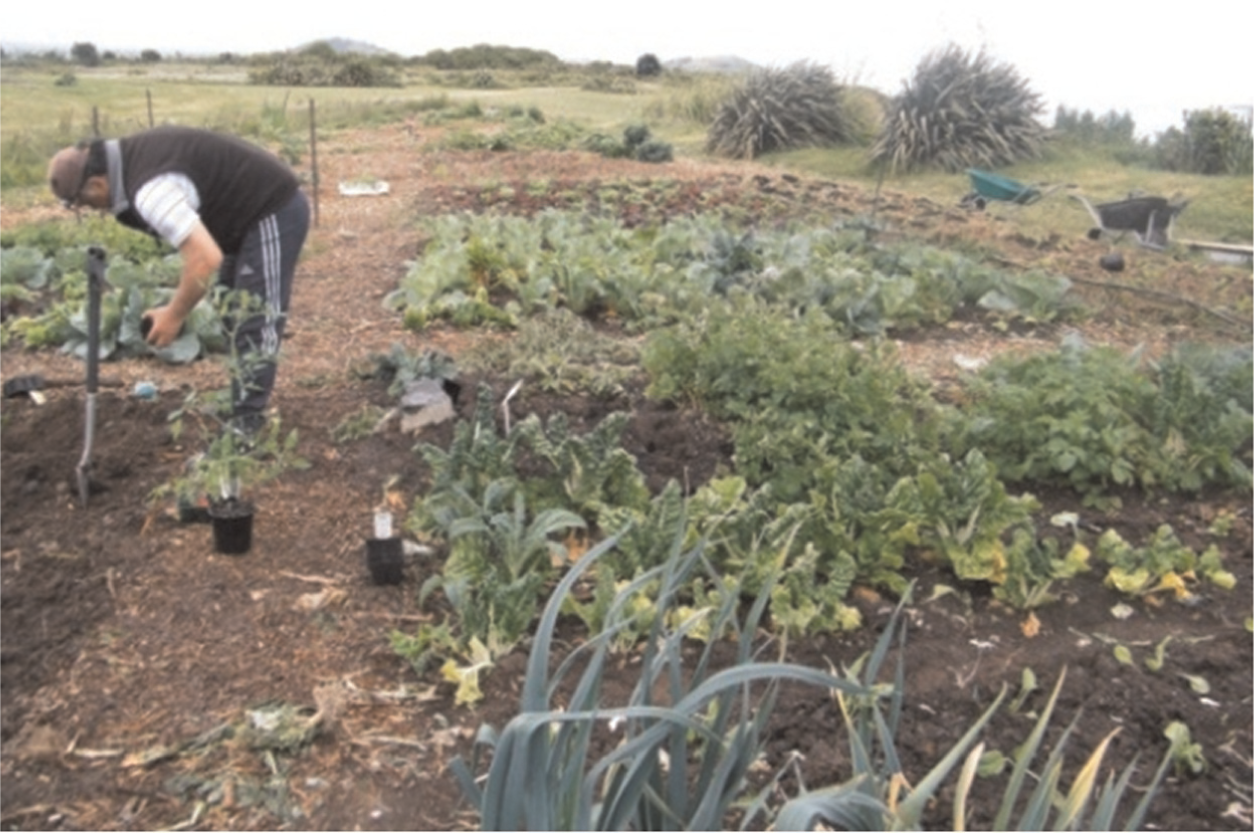
Areta in the garden.
Areta’s excursions to the garden create opportunities for him to punctuate his life on the streets where he feels lost with an escape to a place where he can re-member, engage in and reflect on Māori ways of being. Part of a street homeless person’s task when they escape to another location is to rebuild a sense of place and comfort somewhere new. Deaux (2000: 429) termed this process of identity re-situation as ‘remooring’ – that is, the ways in which ‘people connect identity to a system of supports in the new environment’. Here we see how what are typically ‘home’-based (Crouch, 2006), self-regulated leisure practices that involve labour for domiciled people, such as gardening, can bring street homeless people closer to nature where they can cultivate a more positive sense of self and belonging.
Other excursions into leisure are more time intensive than bus trips or regular excursions to a community garden. These include annual holidays outside the city and even a year camping out at a distant beach. For example, Hemi took a year out from street life in Auckland to have a ‘working’ holiday at the beach and ‘rediscover himself’. Hemi’s extended escape took him out beyond the city that excluded and marginalised him on a daily basis: I needed a getaway and spent one year in the bush … You know, at the beach … A kinda holiday. Just not being that guy who sleeps on the streets for a while. I ended up helping this old guy to do some garden work for him because he couldn’t do his gardens himself … He paid me for doing the gardens by cooking up a feed … I would do some cleaning up in the old fellow’s place. He used to send me out to do some fishing for him. Used to do that sort of thing … That was a good time … Getting back to a simple life and feeling like a person again.
Hemi foregrounds his resourcefulness and ability to survive off the land. He creates a place for himself where, in helping a local elderly man, Hemi can support his holiday at the beach. Such holiday breaks are not just one-off adventures and can also take the form of more regular annual vacations. Several participants recounted camping at mainland beaches or retreating to islands off the coast of Auckland with friends: They all take the ferry over to Waiheke Island, with their sleeping bag and sleep on beach, and then go and fish over there and get some seafood over there. Just for a couple of days or a month. Sometimes, if the nights are warm we stay over there for a couple of weeks. People ask, ‘where you been?’. (Jason) Interviewer: On holiday? Yeah things like that. They even take trips over to Great Barrier Island … Yeah we had, eight of us doing it. Wow, must have spent about two months over there. Yeah, fish off the rocks. (Jason)
Homeless holidays afford opportunities for people to live differently, to change routines and to experience other aspects of life (McGabe, 2009). Such holidays are special occasions where one takes a lengthier break from the everyday drudgery of the city. Stories of such holidays reflect how ‘Leisure is especially relevant in the shaping of our narrative identity because of the centrality of experience: many of the best stories that form our sense of self are connected to leisure activities’ (Bouwer and Van Leeuwen, 2013: 588). For homeless people, holidays provide re-situating activities through which they can escape street life and gain a refreshed perspective on life. Whilst holidaying, our participants do not consider themselves to be homeless, even when sleeping rough on a beach. These participants imagine themselves according to leisure-based identities as adventurers, caregivers, friends and holidaymakers. Holidays provide spaces for presenting themselves as agentive and deserving human beings and for convincing themselves that there are possibilities of genuine escapes into a better life.
Discussion
This article sheds light on the complexities surrounding leisure for street homeless people. Leisure has imaginative and material elements that are conflated when our participants impose themselves on urban ‘vague terrain’ to give the city new personal significance. Through leisure, our participants can work to mould the city for themselves (Lefebvre, 1971; Raban, 1974) and create meaning, inclusion, fun, purpose and self-understanding in lives characterised by deprivation and exclusion (Bouwer and van Leeuwen, 2013; Crouch, 2006). Through leisure practices, participants agentively enact ways to temporarily transcend urban landscapes of despair by (re)constructing a socio-scape, constituted from real or imagined spaces and practices that restore their humanity. Leisure is foundational to their explorations of identity, and offers opportunities for being something more and doing more with one’s life. It is through regular leisure activities that street homeless people can realise themselves as interconnected within the material and social world (Heidegger, 1929[1971]). References to leisure allow participants to project and imagine themselves as complex human beings actively engaged in the world, and as possessing memories, dreams and agency. As Andrews (2014: 114) notes: ‘It is through our imaginations that we link our past, present, and possible futures’. Imagination allows our participants to remember aspects of their domiciled existence. To engage in the present in ordinary activities from the past is central to surviving street life, and for ensuring a sense of continuity and ontological security.
What can be read as escapes from adversity through leisure can also be read as escapes into society and attempts to re-engage with domiciled life. Our participants’ leisure practices offer adaptive moments of respite that are woven into attempts to make it through the day (Cohen and Taylor, 1976). In this way, leisure enriches and saves lives. It holds the precarious potential for ‘genuine escapes’ from the harrows of street life (Borchard, 2010; Cohen and Taylor, 1976). Getting away from it all can provide a means of getting away from one’s homeless self and contemplating change (Crouch, 2006). After all, leisure involves the search for freedoms, choices, autonomy and fulfilments, which are problematised by the socio-economic restraints of homelessness (Simmel, 1959). Yet, our participants keep up the search.
While the leisure practices of our participants may not change the materiality of extreme poverty, it helps them cope and to reflect on their situations and aspirations. Here, we consider the political implications of our analysis in that we support leisure for homeless people, but also acknowledge the need for structural change and reduced inequities in order to address the urban poverty that drives homelessness (Hodgetts et al., 2013b; Theodorikakou et al., 2013). In the current epoch of austerity, reduced welfare support and victim-blaming in relation to people living in poverty, it is important to not lose sight of the potential of leisure for re-humanising people in need. By investigating leisure practices we are able to see the humanity of those often denied personhood; those reduced to an abjectified and defective class, ‘the homeless’ (Hodgetts et al., 2011, 2012). Similarly, Layard (2006) challenges current welfare reforms and austerity measures that punish ‘the poor’. Such reforms undermine the basic human need for leisure and respite. Leisure should be part of a welfare system that cares and fosters human flourishing (Sager, 2013).
As an agentive practice, leisure can be built upon to work with homeless people to address their needs and restore normality in extra-ordinary lives. Scholars have raised the importance of fostering relationships and experiences of belonging among homeless people, both on the streets and beyond (Borchard, 2010; Perreault et al., 2013). Such concerns are reflected in the efforts of service providers to create judgement-free environments through leisure in which people can safely re-engage with the domiciled world (Trussell and Mair, 2010). It is crucial for service providers to construct supportive spaces for homeless people to gain respite, reflect upon their lives, build new social supports and consider other options in life (Hughes, 1991; Klitzing, 2004; Perreault et al., 2013). Specific interventions take homeless families, in particular, away from their present situations and offer them time to reflect and consider alternatives in life (Gibson and Morphett, 2011; Perreault et al., 2013). The general aim of such programmes is to temporarily release homeless people from the spaces and pressures of urban poverty. The charitable organisations involved recognise the health and humanising potential of such initiatives for rebuilding social ties, creating a sense of normality, control, safety, dignity and acceptance (Hughes, 1991; McGabe, 2009; Trussell and Mair, 2010). Such initiatives reflect how, rather than simply ‘rehousing’, there is also a need for more holistic support systems that include social participation and the cultivation of social networks and leisure. In considering the range of leisure practices engaged in by homeless people themselves, scholars are better placed to respond to homelessness.
Footnotes
Funding
This research was funded by the Marsden Fund of the Royal Society of New Zealand, grant number 06-UOW-045.