




Abstract
The transition of the Chinese economy from plan to market has led to dramatic economic restructuring and urban transformation since the economic reforms and open door policy in 1978. The state and the market, which are the two basic regulating mechanisms, have significantly changed their role in economic and urban development in this transition in China. We attempt to examine the interplay of the state and the market in facilitating economic growth and producing ‘new’ urban space after replacing socialism with state capitalism. Four major waves of urbanisation and urban development have been identified, in terms of the interaction of the state and the market in producing different forms of urban development which also bring about economic transition in China. We further examine the new form of urban development in the fourth stage of urbanisation which is represented by the rapid growth of producer services and the resulting development of central business districts. Economic transition and urban transformation in China seem to converge with the development pattern of developed and other developing countries. However, embedded in a different state–market interplay, the experience of Chinese cities may be different and not be easily imitated by cities in other developing countries.
Introduction
China has long been an agrarian society before recent rapid urbanisation that transformed it to be a more urbanised country. In the past, most of the Chinese population resided in the countryside, and the agricultural sector dominated the Chinese economy. Chinese cities and towns have functioned either as political centres or as military hubs, or both, for thousands of years. The economic function of these cities was weak. In fact, cities have been viewed as the reservoir of alien corruption and vice from the First Opium War to the foundation of the People’s Republic of China (Kirkby, 1985). Cities and towns were unattractive because of their non-economic profile and negative image. The population census in China in 1953 recorded 77.26 million urban residents, accounting for only 13.26% of the total population (CSSB, 1954).
After ‘New China’ was established in 1949, the Chinese Communist Party (CCP) emulated the Soviet practice and launched the First Five-Year Plan (1953–1957) to facilitate industrial growth. The 156 key construction projects financed by the central government started to initiate urbanisation and urban development in China. These processes have gone through ‘a special trajectory of socialism with distinct Chinese characteristics’ which received considerable attention from scholars (McGee et al., 2007). Urbanisation and urban development of China have been divided into two stages, namely, distinctive urban growth under socialism and rapid urbanisation with unprecedented speed and scale after socialism. In their introduction in Restructuring the Chinese Cities: Changing Society, Economy and Space, Ma and Wu (2005: 5–10) identified the salient features of urbanism and spatiality for socialist and post-socialist cities, respectively. However, the post-reform economic and urban transformation is more complicated than pre-reform urbanisation despite the same time span of 30 years. Pre-reform urbanisation was shaped by central urban planning for socialist industrial development and highly influenced by political movements. Urbanisation was slow and fluctuated. In contrast, post-reform transition of the Chinese economy from plan to market led to ‘multiple and simultaneous economic, social, and spatial restructuring’ (Ma and Wu, 2005: 5) and unprecedented growth in the history of urbanisation and economic development. Its urbanisation level has grown from 17.9% in 1978 to 53.7% in 2013, resulting in an increase of 558.7 million urban population (CSSB, 2014). During the same period, the economy has also grown tremendously to become the second largest economy in the world. With unprecedented rapid urbanisation and economic development, Chinese cities have experienced rapid transformation in the last 30 years. Such growth and transformation can be better understood by examining state–market interaction and urban development in different stages of economic transition in the ‘post-reform era’ which cannot be easily emulated in other developing countries.
We attempt to use a four-wave (stage) urbanisation model, based on the urbanisation pattern and underlying mechanisms in interpreting and projecting urban development, to examine the interplay of state–market during the economic transition and urban transformation in China since 1949 (Yeh et al., 2006). The four waves of urbanisation are socialist industrialisation and anti-urbanisation, early economic reform and rural industrialisation, land-centred development, and tertiarisation and the rise of producer services. As highlighted in many studies, the political economy of China is a prerequisite to understanding urban and regional development of the country. As China has adopted a gradual mode of market transition, the Chinese state and the market have interacted in a way different from that of their Western counterparts which is embedded in a free market environment and that of the former socialist nations which used an aggressive and quick-paced model of transition. Because of such a unique state–market relation, China has successfully guided urban development to promote economic growth and prevent urban problems that commonly occurred in other developing countries. However, considering the expansion of the service sector and further relaxation of state control on land acquisition, population movement and foreign capital, the economic transition and change in the state–market interplay in the early 2000s has raised the following important question of whether urban problems commonly found in other developing countries that China attempted to avoid in the early stage of economic reforms and opening up will emerge in its cities. This paper examines how the state and the market have interacted in shaping economic transition and transforming cities in China. We attempt to present a discourse on the process and dynamics of contemporary Chinese urbanisation to enhance our understanding of urban change in an emerging and transitional economy, especially during the current stage of producer service development.
State–market interplay in the Chinese context
As Block (1994) notes, the operation of an economy constantly involves combinations of state actions and markets. The ‘positions’ of the state and the market in the political agenda determine their respective capacities in allocating resources and directing economic activities which result in different supply–demand relations. Thus, to understand urban growth and transformation in a nation, the way in which the state and the market interact, which is contingent over time and across space, needs to be taken into account seriously. According to McCormick and Unger (1996), the transition from state socialism to market economy since the late 1970s has placed China’s political economy and state–market relations in three theories of ‘convergence’: convergence with the West, with Eastern Europe, or with East Asia. Mainly developed on the basis of Western experiences, the neoliberal discourse argues that as a response to the post-1970 round of global economic restructuring, the state capacity has reconfigured territorially and functionally along local, regional, national and supranational levels (Brenner, 1997; Goodwin and Painter, 1996). According to this discourse, the accelerated pace of technological change and the increasing mobility of capital between nation states have entailed a more functionally integrated and interdependent global economy (Yeung, 1998). As capital expands territorially, market forces have replaced the state as a more effective and crucial mechanism in generating optimal allocation of investments and resources, which leads to the processes of ‘denationalisation’ of the state and ‘destatisation’ of the political system (Jessop, 1990, 2000). The former refers to the ‘hollowing-out’ of the state that power previously located at the national state level is restructured ‘upwards, downwards, or sideways’ upon various scales, and the latter a relative decline of the state’s direct management and control over economic development. Although the neoliberal state still plays an indispensable role in the ‘creation, governance and conduct of markets’, under the ‘imperatives of globalisation’, it has restructured in a ‘qualitative’ way to give the national economy the ‘flexibility’ needed to compete in the global market (O’Neill, 1997; Yeung, 1998).
The economic miracles of the Asian Newly Industrialising Countries (NICs), from which the developmental state model is derived, have shown a very different way of state–market interaction. In stark contrast with neoliberalism which ‘presents itself as completely non-political’, the developmental state model argues that late-developing economies can only succeed with the support of effective state intervention, and that the introduction of market mechanism on their own will only lead to chaos (Amsden, 1990). According to the model, the rapid rise of the East Asian NICs is based upon national capitalism in which the ‘repressive government’ utilises different versions of markets and organisations to achieve a ‘high-growth economy’ (Deyo, 1992; Xia, 2000). In Singapore, for instance, the intervention of the government has been concentrated in three strategic areas – the labour market, taxation and fiscal incentives, and state-owned enterprises, which ‘allows a substantial measure of government direction of the entire economy’ (Huff, 1995: 1427). In Korea, e.g. the automotive industry, the government has ‘selected’ firms to undertake particular activities, ‘designated’ certain parts and components for local production, ‘allowed’ specific new firms to enter the sector, and ‘allocated’ production volume according to the actual performance of the domestic content schedule (Kim and Lee, 1980). The developmental state, which plays a strategic role in ‘taming’ domestic and international market forces, is considered a ‘solution’, a highly centralised, coherent bureaucratic body with various policy instruments at their disposal (White and Wade, 1988; Xia, 2000).
Often labelled as a ‘transitional economy’, interpretations on the transformation of the Chinese economy also make reference to market transition theories. The theories of market transition accentuate the role of the ‘path-dependent’ process on post-socialist institutional formulation, but they remain debatable on the extent to which the power of the old system persists in reshaping the stratification order (Nee and Cao, 1999). In his early work on market transition, Nee (1989) highlights the significance of market forces as a causal mechanism in the transformation of the post-socialist state and social structure. He argues that with the shift from ‘hierarchies’ to ‘markets’, the most privileged stratum of state socialism or the redistributors lose some of their power and privilege, while those at the bottom of the state socialist hierarchy, the ‘direct producers’, benefit. As a result, inequality is reduced (Szelényi and Kostello, 1996). In contrast with the views in favour of the effect of an ‘emergent market economy’, the ‘state-centred’ or power persistence argument emphasises the persistence of power that offers continuing advantages in market transactions (Bian and Logan, 1996). To grab vested interests, the powerful individuals and groups are likely to reinforce the preexisting stratification in maintaining the status quo. Disagreement in the casual priority, i.e. the state or the market, has undermined the applicability of the market transition framework in state–market interactions.
Economic reforms since the late 1970s have led to China’s transition from socialist to socialist-market economy and have greatly transformed central and local government relations. As three most relevant theories, the neoliberal discourse, the developmental state model and the market transition theories, have yielded significant insights to theoretically understand the relationship between the state and the market in post-reform China. However, as many scholars have pointed out, these theories are inadequate in some ways, i.e. the liberal democracies of neoliberal discourse, the nation-state-level analysis of the developmental state model, and the disagreement in the debate of market transition theories, to be applied to the Chinese case (Chien and Wu, 2011; Nee and Cao, 1999; Xia, 2000). The state and the market are two basic regulating mechanisms in economic development. How they interact affects the distribution of economic resources and activities, from which the nature of urban growth is shaped. Although it is argued that the political economy of China presents a ‘hybrid’ of the three theories or models, a systematic framework to conceptualise the interplay of the state and the market in the Chinese context is lacking. Such an ambiguous interpretation of state–market interactions which determine the type of supply–demand relations in allocating resources and directing economic activities has resulted in a partial account of the path of urban development in China.
In response to this, we attempt to theorise the changing state–market relations in China from a developmental perspective, especially the policy development and the changes of state strategies and policies. The state and the market are two central concepts that require clarifications before an analytical framework is developed. The change in the power relations between the central and local governments, which gives rise to new forms of governance in post-reform China, has been discussed in many studies (Lin and Yi, 2011; Oi, 1992; Walder, 1995; Xu and Yeh, 2005). This study considers that the state should not be treated as ‘a singular and uniform political entity’ (Ma, 2002: 1549). In neoclassic economics, the market is the most effective mechanism in allocating resources through free supply–demand interactions. The market includes the commodity or product market and the resource market. In the light of production factors, the resource market can be further divided into capital, labour and land markets (McEachern, 1997). The Chinese state has ‘constrained’ and ‘regulated’ different types of market for decades, which has given rise to ‘country-specific’ state–market relations for economic and urban growth.
Pre-economic reform: State internalised market
From 1949 to 1978, the CCP adopted a centrally planned economy framework based on Marxist ideology. According to the Marxist viewpoint, market and private property inherently produce inequality and alienation which are products of capitalist economies. The ‘fundamental contradiction’ between ‘productive forces’ and ‘social relations’ is insolvable under capitalism (Harvey, 1973). The actions taken by the socialist state to eliminate unacceptable injustice and achieve the socialist ideological commitment were thus basically against the market. In the 1950s, the socialist state managed to own and control most economic units and ceased the existence of the free market, through which market mechanism was effectively controlled and essentially internalised into the command economy.
With such an ‘internalised’ market and public ownership, the socialist state monopolised the investment, production, circulation and distribution of economic activities. Unlike the free market that allocates economic resources indirectly and subject to the supply–demand relationship, the socialist state directly allocated inputs and products according to the economic plans. The approach of ‘material balances’ of the former Soviet Union was adopted. This approach involves a production plan, including input quotas and output targets, for each state enterprise. Production inputs were freely supplied to enterprises based on this production plan, including raw materials, equipment and workers. The products of state enterprises were distributed through a hierarchical system of state-owned wholesale corporations. Each wholesale corporation was responsible for one or several similar commodities and monopolised the trade in that line of products. The corporations placed orders for processing and manufacturing with industrial departments before purchasing their entire outputs or underwriting their sales; the prices were determined by the Price Commission (Solinger, 1983: 200). The distribution of commodities to individuals was also part of the plan. The central authority allocated various categories of ‘commodity coupons’ (e.g. grain, oil and meat) to urban residents to represent their monthly permitted purchase quotas of the commodities. Only residents with coupons could buy necessities from the ‘department stores’ (baihuo gongsi) and ‘retail stores’ (menshi bu) of the wholesale corporations.
The socialist state adopted a heavy-industry-oriented strategy to develop its economy. Urban growth and spatiality under socialism was directly and indirectly related to socialist industrial development because of the capability of the state to manipulate production, distribution and prices. State enterprises were the basic cells of the economy which performed two fundamental roles. They functioned economically as the basic productive entities to increase state revenues and socially as the ‘work units’ (danwei) responsible for the provision of the welfare for their workers (Hsu, 1985). A comprehensive plan for an average of five years or the five-year plan was adopted to allocate resource and consequently, determined the location of economic activities throughout the nation. Chinese cities were designated as cities of ‘production’, and numerous cities of ‘consumption’ were transformed. Urban space was arranged in a work-unit compound pattern within the cities. The internalised state–market relation and extensive state industrialisation strongly affected the economic and spatial structure of the ‘socialist cities’ in China prior to the economic reforms.
Post-economic reform: State externalised market
The rigid centrally planned economy soon developed its inherent problems, despite impressive achievement in industrialisation (Zhang, 2000). Chinese leaders had recognised that ‘state power became a problem’ (Stavis, 1983: 184). Thus, they changed their perception of the market and launched economic reforms in 1978. Socialism and market economy were no longer mutually exclusive. The state and the market were considered means of regulating economic activities (Fukasaku and Wall, 1994). Introducing market mechanism has brought a new institutional set-up, wherein the Chinese state articulates free market forces in a new fashion.
Market mechanism significantly increased its importance in developing the Chinese economy because of economic reforms. Different types of market, namely, product, capital, labour and land markets, have successively emerged. These markets have participated in the distribution of products and allocation of production inputs. In 1978, the commodities allocated by the state were under 256 categories. This number was dramatically reduced to 24 in 1987 and 17 in 1989. By the end of 1991, less than 30% of the prices of commodities and goods were decided by the state (Jia and Wang, 1994: 41). The prices of economic resources can fluctuate according to the changing relationship between supply and demand. The withdrawal of state intervention and the rise of non-state sectors have also broken the ‘iron rice bowl’ and ‘fraternal cooperation’ of the state enterprises. The state enterprises were granted great flexibility for their production, but they also lost the shelter provided by the state and were confronted with intense market competition.
By allowing the market economy to ‘grow out of the plan’, the Chinese state has essentially externalised the market mechanism. However, the market economy that has developed in China has ‘socialist characteristics’. Fan and Scott (2003) depict this market economy as a ‘mixed’ economy shaped by the socialist ideological legacies on the one hand and by the drive toward economic liberalisation on the other hand. Zhang (2000: 60) states that this market economy is ‘a syncretic doctrine including elements of orthodox Marxism; Mao’s early thinking; East Asian authoritarianism; Western market capitalism; and lessons from China’s reform’. The scope of the market has significantly expanded, but the market has virtually been a partially externalised one. The powerful and multiple roles of the party-state in the economy, namely, the ultimate decision-maker, regulator and participant, have remained over the past three decades (Ma, 2002). Economic reforms have occurred to solve the problems of the planned economic framework and strengthen the authority of the state. Access to different types of markets has been granted step by step. Restrictions have been removed in stages even for the same market. The state plays a more active and decisive role in determining where it meets with the market as the circumstance changes. Therefore, the interaction of the state and the market, which affects population movement, land acquisition and investment source in an intricate way, has significantly affected urban development in China during the post-reform period.
Contemporary Chinese urbanism and urban transformation over the past decades have been considered ‘unique’, ‘distinctive’ and ‘peculiar’ because they demonstrate some characteristics different from those of developed and other developing countries. The urbanisation pattern of China under state socialism was characterised by rapid industrialisation without a paralleled urbanisation, that is, the growth of industry was rapid, but the level of urbanisation remained very low (Xu, 1984). The post-reform urbanisation and urban development is featured by ‘unparalleled size and scale’ and ‘rapidity of change’ vis-à-vis its Western counterparts (Lin, 2011: 3). Compared with undeveloped countries, urban growth and transformation in China has successfully avoided ‘over-urbanisation’ (Sovani, 1975) or ‘pseudo-urbanisation’ (McGee, 1971) in which urbanisation is merely a growth of urban population as a result of rural–urban migration but there is no concomitant growth of the economy to provide jobs and housing for these migrants, leading to poverty, employment and housing problems in these cities. However, since the early 2000s, China has embarked on economic and urban transition similar to the developed and developing countries. This transition is represented by significant transformation from manufacturing to services, rapid growth of rural-to-urban migration, and dramatic expansion of large cities (Lin and Wei, 2002). As such, will ‘pseudo-urbanisation’ occur in Chinese cities? Using the conceptual framework that we established, we attempt to provide a better understanding of the divergence and convergence of China’s economic transition and urban transformation from the perspective of state–market interplay. A special emphasis is placed on the recent decade, based on which the future trajectory of China’s urban development is discussed.
State–market relations, economic transition and four waves (stages) of urban transformation in China
Figure 1 shows that the Chinese economy has transformed rapidly from agriculture to industry and then to service industry since economic reforms in 1978. Its urbanisation level and per capita income have also risen quickly in the last three decades. The speed of Chinese economic development and urbanisation is unprecedented in the history of mankind. If the rapid economic development of the four little dragons, namely, Korea, Taiwan, Hong Kong and Singapore, from the 1950s to the 1970s is considered a big miracle (Chen, 1979), the rapid economic development and transformation in China in the past three decades is an even bigger miracle.
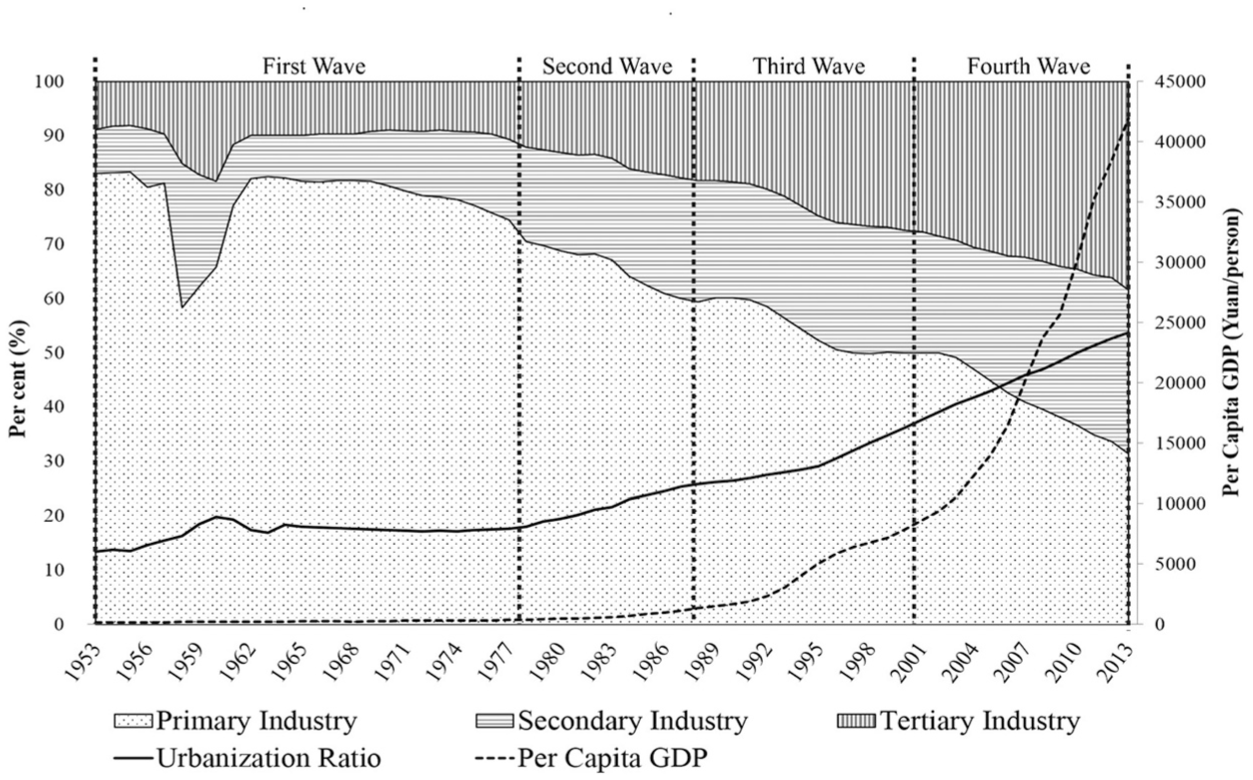
Economic transition, urbanisation, and per capita GDP of China from 1952 to 2013.
The economic reforms and open door policy in 1978 have been widely accepted as the watershed for Chinese economic development, as well as urban growth and transformation. However, treating urbanisation during the post-reform period as one process is inadequate because of its complexity. Some scholars have noticed this inadequacy. Lin (2007a) observes that urban growth of China since the 1990s has entered a stage of city-based and land-centred urban transformation. Gu et al. (2008) divide the post-reform urbanisation into recovery (1978 to 1985), rapid development, (1986 to 1998) and stable development (1998 to 2006). In our study from the perspective of state–market interaction, we divide urban growth and transformation since 1949 into four main waves or stages. These stages can be considered as waves. Like waves, they come very rapidly and create great impacts soon after they come. These waves are brought by major change of state policies which have great impacts on the market. As such, the dividing lines between the waves in the present study are years when crucial policies or strategies were promulgated and implemented, such as economic reforms and open door policy in 1978, reform on urban land in 1988, and the Tenth Five-Year Plan using urbanisation and the service sector to promote economic development in 2001. As there are time lags in the implementation of state policies, the effects of the policies may not be able to be realised at the beginning of each wave. Moreover, their impacts tend to extend to the next wave(s). However, it is the policy initiatives that have significantly changed the relationship between the state and the market, leading to new waves of urban growth and development. In China where the state plays a critical role in regulating and shaping development, such a division is more likely to better understand the nature and dynamics of China’s urban growth and transformation.
First wave: Socialist industrialisation and anti-urbanisation (1949 to 1977)
The pre-reform period is the first wave of urban growth and transformation of China. In this period which has been well documented (Kirkby, 1985; Ma, 1976), the socialist state internalised virtually all types of market to achieve a socialist industrial development. The commodity market was replaced by the hierarchical distribution system. Labour and capital goods were merely internal allocation between the departments of the state industrial entity (Gao, 1980). Urban land was administratively allocated to state enterprises and agencies without any charges (Yeh, 2005). The socialist state was also responsible for reproducing labour power by providing welfare to workers in state units. Ideologically, cities were considered consumptive and non-productive and should be controlled (Kirkby, 1985; Ma, 1976). The household registration system (hukou) was introduced in 1958. This system divided the population into agricultural or non-agricultural and required all citizens to register in one and only one place of permanent residence, which effectively prohibited rural-to-urban migration and controlled labour transfer in cities (Chan, 1994).
This state–market relation enabled the socialist state to command over most economic resources and organise economic activities in light of its development plans and political ideology. With economic and technological backwardness of China, the socialist state concentrated the investment in the industrial sector to maximise industrialisation and simultaneously constrained urban consumption to minimise urbanisation costs (Chan, 1992). Affected by the anti-urbanism ideology and political conflicts, small rural industries were promoted during the Great Leap Forward, and intellectuals were sent to the countryside during the Cultural Revolution (Xu, 1984). As a consequence, industrial output underwent rapid expansion without paralleled urban growth. The level of industrialisation as reflected by the percentage of industrial added value in total GDP increased dramatically from 17.6% in 1949 to 44.1% in 1978 (CSSB, 1999). However, the population in Chinese cities only increased from 57.7 million to 172.5 million and slightly increased its share in the total population from 10.6% to 17.9%. The average annual growth rate is only 0.2%. From 1965 to 1977, urbanisation was ‘stagnant’ and remained constant at the 17% to 18% level (Figure 1). For almost all countries in their early stages of economic development, the spatial concentration of population in cities and towns has been accompanied by a massive shift of labour and other inputs from agricultural to manufacturing activities. The internalised state–market relationship and the anti-urban approaches adopted by the socialist state had made the pre-reform urbanisation pattern of China very different from that of other countries.
Second wave: Early reform and rural industrialisation (1978 to 1987)
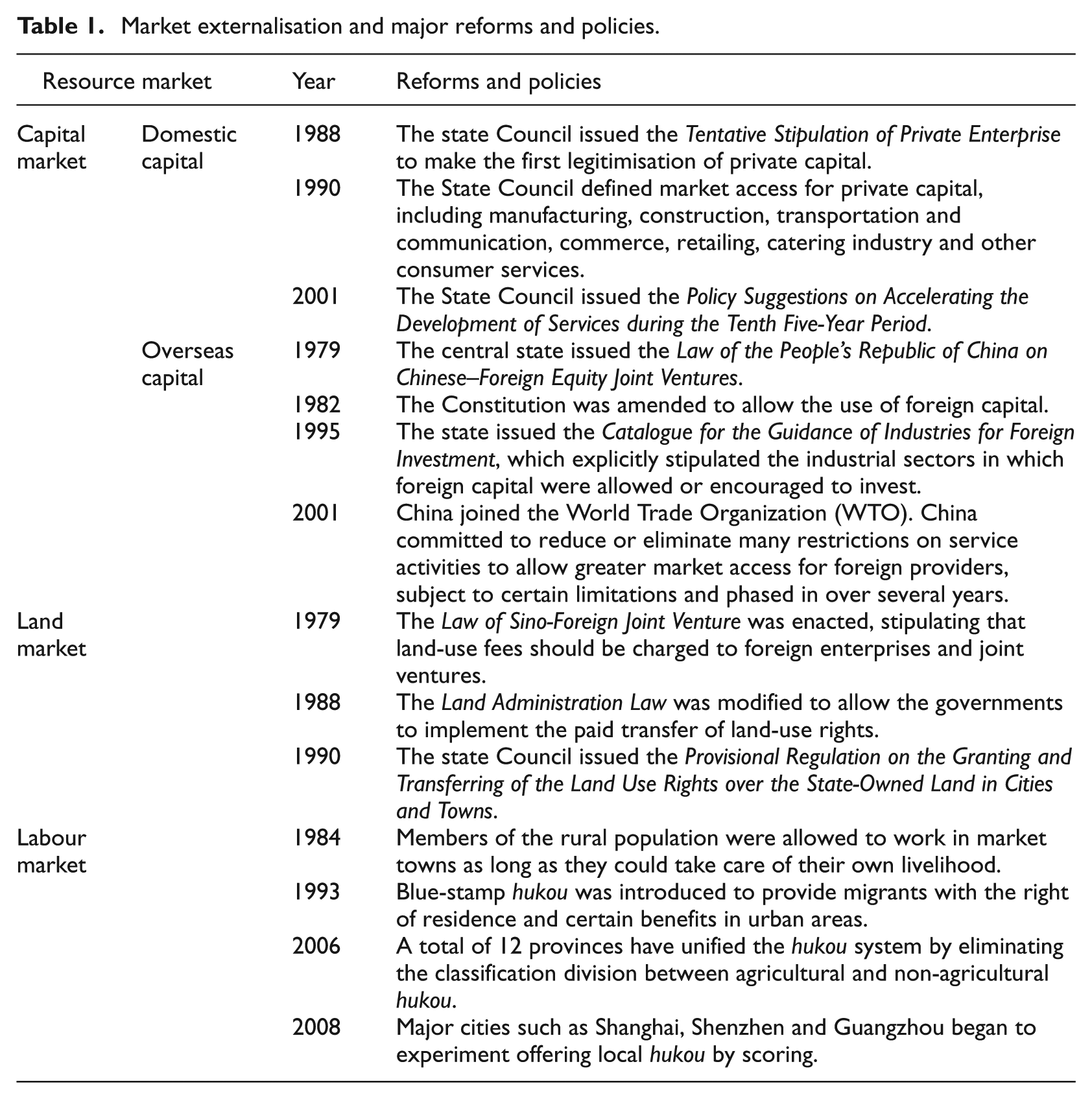
The ideological change and economic transition from plan to market since 1978 have significantly altered the relationship between the state and the market. The Chinese state has externalised the market for three decades by dramatically expanding its scope. Driven by market and global forces, the socialist cities, which are characterised by ‘under-urbanisation’, ‘less urbanism’ and ‘a relatively uniform urban space’ (Lin, 2007b: 8), have undergone profound transformation. However, market externalisation in China was ‘gradual’ and ‘partial’. As discussed in the previous section, the Chinese state has significantly externalised the product market after economic reforms, leaving commodities distributed and prices determined largely by the market, rather than the central planning organisation. But for the resource market, the post-reform state adopted a more cautious attitude, expanding different types of market in steps, as shown in Table 1. Amongst the policies, some most influential ones have led to dramatic change in state–market relations, giving rise to the growth and spatiality of urbanism at different stages.
Market externalisation and major reforms and policies.
The economic reforms and open door policy implemented in 1978, which allow the use of foreign and private capital, has initiated the second wave of development. During the early stage of economic reforms, the effects of policies concentrated in rural areas, where the reforms took place initially.
The introduction of the Household Responsibility System in the rural areas dramatically raised rural productivity and generated large surplus of rural labour. To make use of this large reserve of inexpensive rural surplus labour to take advantage of the global trend of offshore production, the Chinese state in the 1980s emulated the successful experiences of the Asian ‘dragon’ economies in the 1960s and 1970s to develop an export-oriented economy (Wu and Gaubatz, 2013). Opening up to the outside world since 1978 succeeded in attracting foreign investment to the nation’s ‘capital-starved’ economy. However, the development of the export industry, which is labour-intensive, was seriously impeded by the hukou system which strictly controlled population mobility from rural to urban for nearly two decades. To satisfy labour needs, reforms on the hukou system was initiated in 1984. Agricultural hukou population are allowed to move to nearby market towns and small-sized designated towns, as long as they can take care of their own livelihood (State Council, 1984). Rural labour thus started to enter the cities to supply the export industry’s demand and became the ‘backbone’ of the industry (Chan, 2010). It was estimated that the number of rural–town migrants more than doubled from 11.12 million in 1982 to 29.51 million in 1990 (Zuo et al., 2002).
Encouraging the growth of small cities and controlling the undue growth of large cities in avoiding the immense urban problems in the rapid urbanisation process in developing countries were the basic principles of urban development in China (Xu, 1984). These principles were reemphasised after the economic reforms. In 1980, the urban system policy to ‘strictly control the scale of large cities, rationally develop medium cities, and actively develop small cities and towns’ was issued, and in 1986, the State Council lowered the criteria for the designation of towns and small cities. The national strategy of ‘leaving the land but not the village’ (litu bulixiang) and ‘entering the factory but not the city’ (jinchang bujincheng) (Fei, 1994) played a crucial role in facilitating the development of rural industries, through which the national urban system policy was achieved by absorbing the rural surplus labour and preventing them from flooding into the large cities as experienced in other developing countries.
Private and foreign capital was concentrated in rural areas where they were allowed to invest with a large number of rural surplus labour. Township and village enterprises (TVEs), established by the township or village governments, household(s), or Chinese and foreign partnership through shareholding mechanisms or cooperative systems (Liang, 2006), became the most important outlet for labour transfer. The concentration of investment by source, namely, collective, private, and foreign direct investment, gave rise to different regional growth models, namely, ‘South Jiangsu Model’, ‘Wenzhou model’ and the ‘exo-urbanisation’ model in the Pearl River Delta (Liu, 1992; Ma and Fan, 1994; Sit and Yang, 1997). Apart from giving preferential treatment, an infrastructure-led development approach with levelling of land and provision of road, water, electricity and telecommunicaiton which started in the Special Economic Zones had been used to attract foreign investment (Yeh, 1985). Figure 2 shows the remarkable growth of TVEs in the rural areas and their rapidly increasing importance in job creation in the 1980s. The share of TVEs in total employment dramatically rose from 22.9% in 1978 to 45.0% in 1990, whereas that of the state sector, including state-owned enterprises (SOEs) and collectively owned units, dropped from 77.1% to 59.7% during the same period.

Employment in TVEs, SOEs and Collective Units, 1978 to 2012.
As a result of the national urban system and rural policies, from 1978 to 1984, the number of designated towns increased from 2850 to 9321 (Zuo et al., 2002). Urban population increased by approximately 130 million from 1979 to 1990, with more than half of the increase in small cities and towns (CSSB, 1999). At the early stage of economic reforms, the Chinese government started to externalise the market for industrial capital and labour, but imposed a filter through the preferential treatment of investment in rural areas and the control of population flow, spreading development to areas outside large cities. Also, because of the emphasis on the growth of rural areas, the market for urban land was still internalised. As a result, early industrialisation in China took place not so much in large cities, but rather, small cities and towns have experienced a dramatic increase. This is different from other developing countries where the effects of globalisation mainly concentrated in major cities, and particularly, the primate cities. Rural industrialisation, which absorbed numerous rural surplus labour, effectively prevented the over-urbanisation problems that plagued other developing countries in the post-Second World War period.
Third wave: Land-centred development (1988–2000)
The impacts of the Second Wave on cities were relatively small because of the lack of capital for them to invest in infrastructure for promoting economic development. Rapid urban transformation mainly occurred in the Third Wave with urban land reform which provided the much needed capital for them to develop infrastructure and use the market force to transform the cities.
Although capital remains an important factor of production in economic growth, the externalisation of the land market emerges as a new and powerful force to drive China’s urban growth and transformation into a new stage. The use of land in China was virtually free from 1954 to 1984 (Yeh and Wu, 1996). In 1988, the Land Administration Law was modified to allow the paid transfer of land-use rights. In 1990, the State Council issued the Provisional Regulation on the Granting and Transferring of the Land Use Rights over the State-Owned Land in Cities and Towns, which specified that the right to the use of land could be assigned, transferred, leased and mortgaged (Table 1). The transfer of land-use rights, including the sales of land-use rights and the collection of land-use taxes, has reintroduced land values, which has enabled city governments to effectively raise funds through land ‘sales’ and bank loans. Prior to the introduction of the land-leasing system, the revenue of local governments generated from urban land was only 35 million RMB in 1987. The amount increased phenomenally to 29,048 million RMB in 1996, accounting for about 25–50% of the revenue of the local governments on average (State Land Administration Bureau, 1997). Revenues from land are used to improve infrastructure and accessibility to increase land values on the one hand, and to attract investment on the other. This positive circle, called ‘using land to breed land development’ (yide yangde), has produced a very significant impact on China’s urban development.
First, the reintroduction of land values has created a property market and led to the development of the real estate industry. This process has been facilitated after Deng Xiaoping’s famous tour to southern China in 1992 which generated an urban sprawl that started in the Pearl River Delta, and then spread to other parts of the country. According to Yeh and Li’s (1999: 385) estimates from the satellite images, the total amount of construction sites in the once rural areas in the Pearl River Delta has increased by an astonishing rate of 968.9% between 1988 and 1993. In 1998, the housing reform was introduced, which replaced in-kind housing allocation with in-cash housing allocation. Housing is no longer allocated by the state without charges; it becomes a commodity to circulate in the market. The implementation of the policy, which has dramatically stimulated housing consumption, has pushed the growth of the real estate industry to a new height. This has led to rapid internal spatial restructuring of Chinese cities (Wu and Yeh, 1999). Second, apart from direct income through ‘selling’ land, the land assets under the firm control of local governments were also utilised as an effective incentive, offered at very low or even free price, to pursue local industrial development to increase revenue. In 1994, the central government introduced the tax-sharing system which drastically reduced the revenue of local governments. As a response, on the one hand, the conveyance of urban land, which was outside and beyond the taxable budgetary categories, was speeded up (Lin, 2009, Lin and Yi, 2011), and on the other, new sources of revenue were sought. Among the local taxable categories that the tax-sharing system listed, the ‘income taxes and profit remittances of local enterprises’ are one of the reliable sources of tax revenue collection (Li, 2000). Following the successful experiences of Special Economic Zones, there was a ‘zone fever’ in the 1990s with the increasing autonomy of local governments in land management. A large number of development zones and parks, such as ‘industrial parks’, ‘economic development zones’ and ‘high-tech parks’, were planned and developed by the governments to attract investors at different administrative levels (Cartier, 2001). By the end of 2005, a total of 6866 development zones and parks were planned, of which 4154 (60.5%) were approved and developed, including 222 zones and parks approved by the central state, 1346 by provincial governments, and 2586 at the city, county and township levels (Zhai and Xiang, 2007). The planned area was 38,600 km2, bigger than total urban built-up area (Jia et al., 2010). Third, urban land reform also provides funds for city governments to carry out projects for place marking. Large transportation and face-lifting projects have been initiated in many cities, such as Shanghai (Wu, 2000) and Guangzhou (Xu and Yeh, 2005), to enhance the cities’ competitiveness for promoting further growth.
In addition to land and housing reforms, following the success of rural reform which provided ‘the basis for the rapid growth of Chinese industry and foreign trade’ (Zhang, 2000: 13), the Chinese state continued to launch reforms in the urban areas, externalising the resource market at a larger scale and at a faster pace. Reforms on the urban sector were deepened and integration with the global market was accelerated to attract private and overseas investment. Private capital had been encouraged as an important supplement to public ownership since 1978, but was small-sized and concentrated mainly in rural economy and daily consumer sectors, such as the retail and catering industries in the 1980s. In 1990, the sectors that allowed the participation of private investment were explicitly defined, including manufacturing, construction, transportation and communication, commerce, retailing, catering industry and other consumer services. The list was later extended to include other industrial sectors, real estate and business services during the mid-1990s. At the same time, market access to foreign investment was also extended to involve more industrial sectors and wider spatial area. The utilisation of foreign capital was no longer limited to the eastern coastal region, but covered the middle and western regions as well. As a consequence of economic privatisation and liberalisation, the share of SOEs in total employment continued to drop rapidly since 1990, contributing to less than 20% after 2008 (Figure 2). According to Yao’s estimation in 2004, about 70% of the SOEs have been privatised by 2002 (Wu et al., 2007). Similar depression also occurred for collective units whose share in total employment deceased from 15.2% in 1990 to less than 5% in 2002 (Figure 2). On the contrary, the non-state sectors exceeded SOEs and collective units in the generation of jobs since 1993, replacing the state sectors as the key actors in the national economy.
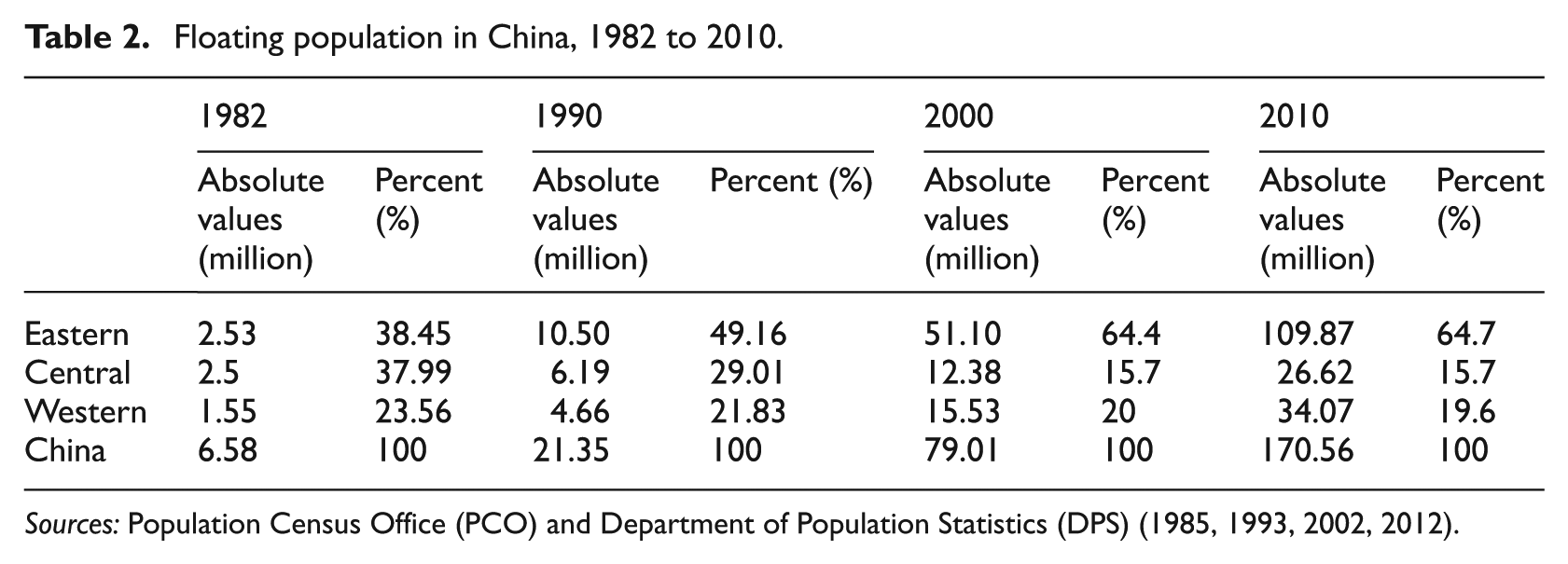
The rise of non-state sectors, larger-scale industrialisation, flourishing real estate sector and burgeoning demand for services boosted by increasing average per capita income have generated large numbers of industrial as well as service jobs in urban areas. To satisfy labour needs for a booming urban economy, some approaches were undertaken to allow rural labour to enter cities from the early 1990s. The food grain rationing system was eliminated in 1992, and the central government devolved more power to local governments on the control and management of the hukou system (Chan and Buckingham, 2008). To meet their labour demand for growth, many cities created permanent or semi-permanent local hukou during this period, e.g. the ‘Blue-stamp hukou’ introduced in 1993 to provide migrants with the right of residence and certain benefits in urban areas. These migrant workers, although they were allowed to move to a city, were still barred from access to urban social services. However, because of the urban–rural income difference, population continued to flow from rural areas to urban industries and services. As shown in Table 2, the floating population increased from 21.35 million in 1990 to 79.01 million in 2000, and displayed an increasing pattern of concentration in the eastern region.
Floating population in China, 1982 to 2010.
Characterised by a development pattern centred on urban land, the process of urbanisation achieved a higher growth rate in the third stage. The urban population increased from 301.9 million to 459.1 million between 1990 and 2000, and the urbanisation level increased from 26.4% to 36.2% (Figure 1). Instead of a rapid increase in city number as that in the previous stage, many cities experienced dramatic expansion. During the same period, urban built-up area increased from 12,856 km2 to 22,439 km2 (CSSB, 2001). The development of the real estate industry and the construction of industrial zones and parks have effectively stimulated economic growth, but also elicited much criticism for leading to urban sprawl and extensive loss of agricultural land (Cartier, 2001). On the other hand, the revenue collected from land also enables city governments to develop large projects for competitiveness building and place marking. Given the ‘soft budgeting system’, competitiveness building in Chinese cities is at a larger scale and much faster speed than their Western counterparts. Moreover, as land values have been introduced, urban renewal and new social areas began to change the internal spatial structure of Chinese cities (Yeh and Wu, 1995). New business districts, which did not exist in Chinese cities in the 1980s, started to emerge in some large cities such as Shanghai and Guangzhou with relatively small scale. At this stage, the effects of the market were more important, the process of industrialisation was accelerated, and average personal income was rising. The demand for service activities, producer as well as consumer services, has been driven up, providing the basis for the development of a service economy and a new wave of urban development.
Fourth wave: Tertiarisation and the rise of producer services (2001–present)
In the Tenth Five-Year Plan (2001–2005), the State Council promulgated the strategy of accelerating service development and the use of urbanisation to increase service industries. The growth of the service sector was suppressed during the Maoist period under the state internalised market framework and the development strategy in favour of heavy industries. After the Decisions on Accelerating the Development of the Tertiary Sector, the first important service document issued in 1992 basically focused on traditional or low-order services, it is not until the 2000s that the importance of developing ‘an effective service sector’ is recognised and incorporated into the national development agenda. In 2001, the Policy Suggestions on Accelerating the Development of Services during the Tenth Five-Year Period was issued, with attempts to facilitate the growth of traditional as well as ‘modern services’ or ‘producer services’ which include finance, insurance, real estate, logistics, information and telecommunication, accounting and legal services. Specific actions were introduced in this document to open up the market for service industries to domestic and foreign investors.
In the same year of 2001, China joined the World Trade Organization (WTO). The WTO classifies service activities into 12 general sectors and 154 subsectors. China made commitments to open nine general sectors and 88 subsectors. Five general sectors were related to producer services (for detailed sectors, please see United States General Accounting Office, 2002). China committed to reduce or eliminate several restrictions on these activities to allow greater market access to foreign service-providers over a period of three to six years. China’s accession to the WTO has substantially opened the Chinese service market to the outside world. Since 2011, actually utilised foreign investment in the service sector outperformed that in the industrial sector. Actually utilised foreign investment in producer services particularly reached US$38.9 billion in 2012, which accounted for 78% of that in total services (Trade and External Economic Statistics Division of National Bureau of Statistics, 2013).
The externalisation of the service market has led to dramatic expansion of the service sector. The contribution of the service sector to the national economy rose from 32.9% in 1995 to 46.1% in 2013 in GDP, and from 24.8% to 38.5% in employment (CSSB, 2014). The rapid growth of the service sector and further reforms on housing have triggered land demand for commercial and residential uses. Unlike industrial land which is offered at very low price to attract investment, price for commercial and residential land is high, which provides a fixed and crucial source of revenue for local governments. Table 3 shows that the amount of urban land leased to foreign investors and local developers and the government revenue from land conveyance achieved a leapfrog in 2001, which were double of those in 2000, and since then an even more remarkable increase. Owing to the huge economic benefits, local governments and the developers share the same desire to promote urban growth, their ‘coalition’ resulting in rapid property development in the 2000s. This can be reflected from the phenomenal expansion of the real estate sector. By 2013, employment in the real estate sector increased to 3.7 million, which is 50 times greater than that in 1988. The amount of investment surged up to 8601 billion RMB, which grew by more than ten times in the past decade (Figure 3). Property development contributed to a large share of urban fixed asset investment, specifically by about 21.1% in 2005 (CSSB, 2006).
State-owned land conveyance in China, 1993 to 2011.

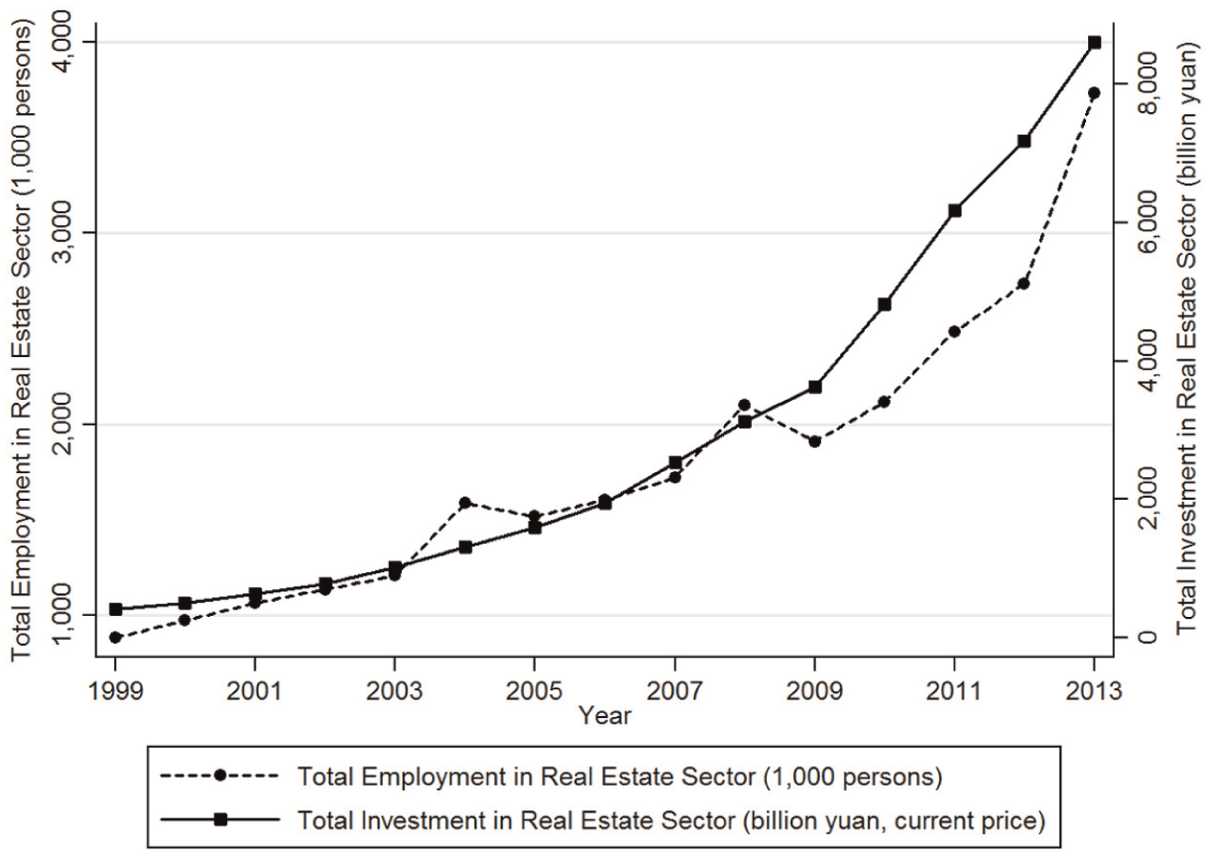
Employment and investment of the real estate sector.
As a consequence of the enlarging service market and rapid urban construction, the job market in urban areas, particularly in large cities, continues to expand, which has further enhanced the attractiveness of these places in the 2000s. During this period, efforts have been taken to simplify and localise the management of hukou system by abolishing the ‘agricultural’ and ‘non-agricultural’ distinction within individual jurisdictions (Chan and Buckingham, 2008). By 2006, a total of 12 provinces have eliminated the rural–urban division to ‘unify’ the hukou system. The improvement in hukou system has given rise to greater geographical mobility of the population. The number of floating population reached 170.56 million in 2010, more than double of that in 2000 (Table 2). In addition to absolute number, the structural change of the urban economy has raised new requirements for labour supply. Figure 4 indicates that within the service sector, producer services have rapidly increased their importance in terms of employment from 27.7% to 33.7% between 2003 and 2013. By 2013, these activities have employed about 99.8 million individuals. 1 Unlike consumer services, the production of producer services needs to involve labour inputs with professional knowledge and skills. Because of the crucial role they play in facilitating economic growth in the era of globalisation, producer services are identified as sectors of strategic importance to promote. To attract well-educated individuals, some major cities such as Shanghai, Shenzhen and Guangzhou began to experiment in offering local hukou by scoring in 2008. In recent years, reforms on the hukou system have continued and progress has been achieved regarding the rights and welfare of migrant workers. However, as Chan and Buckingham (2008: 604) point out, despite significant improvement, these efforts have had ‘only very marginal impact on weakening the foundation of the system’. It remains potent to affect the development of the labour market in current China.
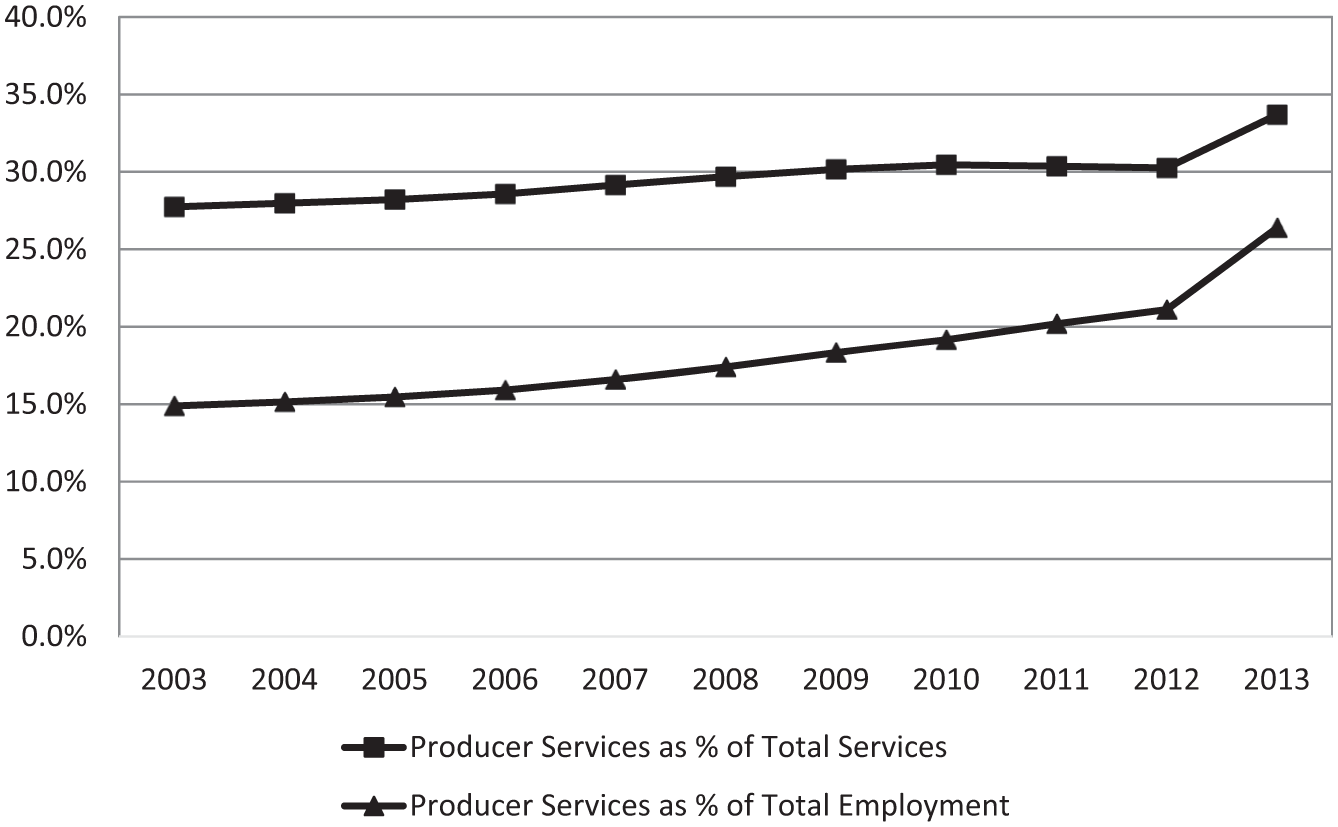
Shares of producer service employment in total services and total employment, 2003 to 2013.
The process of tertiarisation and the rise of producer services have emerged as new and powerful forces driving the economic and urban growth in China since the 2000s. By 2013, the level of urbanisation has reached 53.7% (Figure 1). Since 2011, Chinese cities have had more residents than in the countryside. As concentrations of service industries, large cities tend to perform better in the urban system. At the fourth stage of urban development, the interplay between the state and the market also leads to rapid property development which gives rise to new urban mosaic and spatiality. In addition to the widely spreading residential districts and shopping centres, the rapid development of central business districts (CBDs) driven by the booming demand for producer services has been the most visual new urban element that fundamentally transformed the landscape of Chinese cities. Instead of being developed in the old city proper, new CBDs have been built to direct new development and form new city centres in China, which shows some basic difference from their Western counterparts. On the other hand, although the restrictions on China’s internal migration remain, the enlarging income gap between rural and urban areas has lured huge number of rural population to migrate into cities at a fast pace (Figure 5). The urban problems that plagued the Third World cities, such as squatters and hawkers, have started to emerge in Chinese cities.

Per capita annual income of urban and rural households.
Conclusions
Six decades earlier, the population in Chinese cities was merely 10% of total population. In 2001, for the first time residents in Chinese cities exceeded those in the countryside. Rapid urbanisation mainly occurred after economic reforms in 1978. The same demographic transition took 150 years to occur in Europe and 100 years in the US (United Nations, 2013), but it only took 30 years for China to achieve. Since 1978, in addition to rapid urbanisation, the Chinese economy has transformed rapidly from agriculture to industry and then to the service industry with quick increase in per capita income. Owing to its astonishing speed, the rapid economic development and urban transformation in China over the past three decades is an even bigger miracle than the economic development of the four little dragons between the 1950s and the 1970s.
Rapid urbanisation also occurred in other developing countries since the 1950s, but with a lot of urban problems. However, despite a much faster pace of urban transformation after economic reforms in 1978, China succeeded in avoiding the intractable urban problems of the developing countries at the stage of early industrialisation. To understand the distinctive features of China’s urbanisation and urban development, we incorporate the framework of state–market interaction to examine the role of the state in facilitating economic growth and producing ‘new’ urban space after replacing socialism with state capitalism that helps China to transform its economy from industries to services and producer services.
The entire process of urban growth and transformation in China over the past 60 years indicates that China has transformed from a centrally planned economy to a socialist market one, and from early industrialisation to more advanced industrialisation and into service industries, especially producer services. Economic transition and urban transformation after economic reforms has fundamentally transformed the urban spatial fabric that originated from the socialist economy. Existing studies have identified several major changes, including accelerated urbanisation, simultaneous expansion of manufacturing and service activities, increasing regional disparity, the emergence of ‘new urban spaces’, and reformation of social classes (Lin, 2011; Logan, 2007; Ma and Wu, 2005; Wei and Fan, 2000; Wei et al., 2007; Yang and Yeh, 2013; Zhou and Ma, 2000). The restructuring of the economy and the new elements of urbanism in Chinese cities seem to demonstrate a trend converging with the Western pattern and that in other developing countries. However, from the perspective of state–market interplay, which is ‘country-specific’, we attempt to provide a better understanding of the complex trajectory of China’s urbanisation and urban development.
Different from the market transition process in the former Soviet Union that a revolutionary mode was adopted, China chose a gradual transition strategy. Therefore, rather than taking the post-reform transformation as a holistic process of institutional change, we further divide it into three waves based on the changes in state–market relation. Table 4 summarises the major features of state–market relation, economic transition and urban transformation in the four waves since 1949. During the Maoist period, the socialist state internalised the market, giving rise to the first wave of urbanisation characterised by socialist industrialisation and anti-urbanisation. Since 1978, the Chinese state withdrew its intervention in the product market soon after the economic reforms, but has retained its control on the resource market. As the capital, labour and land markets are externalised in a partial and gradual manner, the significant change and improvement in the markets has become the underlying dynamics leading to new waves of urban development. It should be noted that we attempt to provide an analytical framework from the theoretical perspective, rather than making a clear-cut division of China’s urban growth and transformation.
State–market interplay, economic transition and urban development.

During the second wave of early reform and rural industrialisation, the Chinese state relaxed its control over industrial development and the use of private and foreign capital in the rural areas. China made full use of its large reserve of cheap rural surplus labour to attract foreign capital and to develop export-oriented industries in the countryside, which gave rise to the rapid growth of small cities and towns. In 1988, reform on urban land was introduced, and as a consequence, a development pattern centred on land has emerged. Land is not only utilised as an important asset to attract investment for industrial development, but also becomes a major source of revenue for local governments, leading to rapid urban sprawl and urban restructuring at this stage. Rising personal income and relaxation of state control over service development have led to dramatic expansion of service activities, particularly producer services and rapid property development since the 2000s in the current fourth wave of development. One of the most salient characteristics of this wave is rapid development of CBDs and increase of high-rise office buildings and place making.
From the perspective of state–market interplay, the convergence and divergence of China’s urban growth and transformation with developed and other developing countries can be interpreted in a more systematic way. Because of the recent change in state–market relation, large cities where service activities are more likely to concentrate become the economic centres attracting considerable influx of rural population. The movement of population is an important dynamic of urban growth, but has posed new challenges to large cities as well. The common ills of urbanisation, such as slums and hawkers, that are seen in many developing countries, have emerged in some major Chinese cities. If the development trend continues, will the Chinese cities encounter the urban problems that have plagued the Third World cities? Recognising this possibility, the State Council issued the National Plan on New Urbanization (2014-2020) (the Plan hereafter) in March 2014, which proposed a ‘new-type’ urbanisation to rapidly develop small cities and towns to ‘reduce the migration pressure on large cities’. 2 First, to promote the reform on the hukou system and the equalisation of basic public services, with different eligibility requirements for cities of different size. The rural migrant workers and their families who are both willing and able to stay in cities and towns where they have had jobs or carried out business for a long time will be granted urban residency, but differentiation exists among cities of different size. Policies to convert rural population into urban residents adopt the strategy of ‘completely lifting restrictions on new residence registration in administrative townships and small cities, relaxing restrictions on new residence registration in medium-sized cities in an orderly manner, laying down appropriate conditions for new residence registration in large cities, and strictly controlling the population size of megacities’. 3 Second, to shift away some of the economic and other functions of megacities to accelerate the development of small and medium-sized cities and small towns. The development of small and medium-sized cities is highlighted as the focus in optimising the structure of the urban system. The distribution of key industries and public resources will be promoted in small and medium-sized cities to help them develop industries and attract population. Third, to promote reform on land management and institutions to improve land-use efficiency, equity and sustainability, which includes stronger property rights for farmers, higher compensation for land requisition, new mechanisms for converting rural construction land to urban uses, and market-driven pricing system for urban land allocation. Based on these proposed reforms and policies, the Plan addresses three specific tasks, each involving the urbanisation of 100 million people. The tasks are to allow 100 million rural residents to settle down in cities or towns with legal city residence status; to guide 100 million rural residents in the central and western regions to settle in nearby cities; and to improve the living standard of 100 million people who live in so-called ‘urban villages’ through a series of urban regeneration projects. In completing these tasks, it is stressed that the government should relieve excessive restrictions to let the market play a more important role. If the reforms and policies in the Plan take effect, they will lead to new changes in state–market interplay and may give rise to another wave of urban growth and transformation, such as, the emergence of new city clusters in the central and western regions, growing share of urban population in small and medium-sized cities and small towns, and significant redevelopment within large cities.
Given the specific state–market interaction in China, the Third World urban problems have not yet manifested in China. The experience or the urban development path of China may not be easily imitated by other developing countries unless their states have the power to control the flow of population into large cities, especially primate cities, and the ability to provide incentives to place industries in the rural areas. However, the growth pattern of Chinese cities has generated their ‘distinctive’ problems. Rapid industrial development in the urban areas was facilitated by ‘zoning’ land for industrial zones and parks. In the current stage of urban development, producer services are identified as strategic sectors to enhance the competitiveness of cities in the era of globalisation and thus their growth is pursued by many local governments. Relying upon their control over urban land, the local governments are using similar ‘zoning’ strategy by developing shopping centres and CBDs to attract producer service industries. However, producer services are more likely to concentrate in the CBDs of large cities (Yi et al., 2011). The intense involvement of the state has resulted in the over-construction of CBDs, which also leads to severe waste of land and investment. For the labour market, the stringent control over internal migration not only helped to avoid the pseudo-urbanisation and primate city problems, but also provided cheap labour advantages for the country to compete in the global market. However, it also created many problems that evoke mounting criticism (Chan and Buckingham 2008). In recent years, the rising income inequality between rural and urban areas has continued to attract a huge number of rural population into cities. Because of the persistence of the hukou system, the migrant workers are deprived of most of the rights and welfare enjoyed by urban residents. Treated as ‘inferior second-class citizens’, they cannot easily settle in cities, giving rise to serious social stratification. To solve these problems may require further reforms on the land market and the household registration system, which may in turn result in new patterns and features of urban growth and transformation.
Footnotes
Funding
The research was supported by the National Science Foundation of China (Grant no. 41301181), the General Research Fund of the Research Grants Council of Hong Kong (Grant no. 17209014), the Strategic Public Policy Research Funding Scheme of the Research Grants Council of Hong Kong (Grant no. 7001-SPPR-09), and Francis SK Lau Research Fund in Urban Studies and Urban Planning of the University of Hong Kong.