




Abstract
A large body of literature attests to the growing social divide between urban residents and rural–urban migrants in China’s cities. This study uses a randomised experiment to test the effect of intergroup contact on attitudes between a group of urban adolescents and a group of rural–urban migrant adolescents. Results showed that intergroup contact in the form of a fun and cooperative puzzle task significantly reduced negative attitudes toward the other group. Implications for desegregated schooling and their broader societal implications in China are discussed.
Introduction
A large body of literature now attests to the growing social divide between urban residents and rural–urban migrants in China’s cities (Cheng et al., 2014; Li and Shin, 2013; Nielsen and Smyth, 2011; Nielsen et al., 2006; Yue et al., 2013). The current study employs a randomised experiment to test the effect on intergroup attitudes of intergroup contact between urban and rural–urban migrant adolescents. Underpinned by Allport’s (1954) contact hypothesis, we test the effect of ‘pleasant and co-operative’ contact (see Hewstone and Brown, 1986) on intergroup attitudes and assess whether such contact generates more positive attitudes in general toward the other group. Our results have direct implications for China’s integrated schools policy as well as broader implications for breaking down entrenched barriers between rural–urban migrants and urban residents in China’s cities.
Background to the study
Prior to the economic reforms in China in the late 1970s, rural–urban migration was prohibited. The Chinese government subsequently relaxed restrictions on rural–urban migration, resulting in what has been described as the ‘biggest migration in human history’ (Miller, 2012). Now large numbers of rural–urban migrants, with a rural hukou (household registration), live and work alongside those with an urban hukou in China’s cities. According to the Sixth National Census (National Bureau of Statistics, 2010), the total number of migrants in Chinese cities in 2010 was 261 million; of whom, most were rural–urban migrants.
The hukou system separates rural–urban migrants (who have a rural hukou) from urban residents (who have an urban hukou). The latter hukou type is considered to be economically, and socially, superior to the former (Yue et al., 2013); thus creating a hierarchical socio-economic stratification that favours urban residents over rural–urban migrants (Yang et al., 2010). As a consequence of the hukou system, rural–urban migrants have traditionally had limited access to social insurance (Nielsen et al., 2005) and public services such as housing (Wu, 2004). Rural–urban migrants also typically work in so-called ‘three-D jobs’, which are considered to be dirty, dangerous and demeaning, and are generally shunned by those with an urban hukou (Roberts, 2002).
Rural–urban migrants have been largely marginalised in China’s cities. In addition to rural–urban migrants suffering institutional discrimination emanating from their hukou status, many urban residents have developed broad negative attitudes toward rural–urban migrants. Urban residents blame rural–urban migrants for a plethora of urban problems, including congestion, crime, environmental degradation and unemployment (Solinger, 1999). Urban residents typically attach negative stereotypes to rural–urban migrants, based on their accent, appearance and dress in public areas (Gan, 2014). Surveys have repeatedly found that urban residents construct negative images when describing rural–urban migrants. For example, it is common for urban residents to use terms such as ‘cheat’, ‘ignorant’, ‘misbehaved’, ‘stupid’, ‘thief’ and ‘violent’ when asked to describe rural–urban migrants (Gan, 2014; Li et al., 2006; Liu, 2008; Wong et al., 2007).
Rural–urban migrants perceive that urban residents look down on them and view them as inferior (Wong et al., 2007). Li (2006) conducted extensive interviews with rural–urban migrants in Tianjin and reported that rural–urban migrants believe urban residents ‘think highly of themselves [and that] they are superior to us’ and that ‘we get nasty abuse from the locals’. There are several reports of rural–urban migrants enduring unpleasant social encounters with urban residents, often involving verbal abuse (Gan, 2014). These encounters have widened the social gulf between rural–urban migrants and urban residents and reinforced the notion of a clear distinction between a socially superior in-group (urban residents) and a socially inferior out-group (rural–urban migrants) in Chinese urban areas.
Increasingly, children are migrating with their parents, or being born to rural–urban migrants in the cities. Children born to rural–urban migrants in the cities inherit the rural hukou of their mother, so they are still considered to be rural–urban migrants irrespective of their birth place. As a consequence, there are now large numbers of rural–urban migrant children in Chinese cities. According to the Sixth National Census (National Bureau of Statistics, 2010), the number of children aged 0–14 with a rural hukou in Chinese cities in 2010 was 42 million, representing about 16% of the migrant population. Similar to their parents, rural–urban migrant children have also been marginalised in China’s cities. Gan (2014) interviewed adults with an urban hukou about their views of rural–urban migrant children. Common views were that migrant children were wild children (Ye Hai Zi), reflecting a lack of parental discipline; migrant children were perceived as being responsible for the majority of juvenile crime in the cities and were generally viewed as being bad mannered and rude (Gan, 2014). Most of the participants interviewed in the Gan (2014) study had little direct contact with migrant children, demonstrating that these views were typically formed based on longstanding stereotypical beliefs about rural–urban migrants.
Rural–urban migrant children also incur strong discrimination from their urban peers. Rural–urban migrant children are often ostracised on the basis of their appearance and dialect (Chen, 2014; Lin, 2012). Compared with urban children, the clothes of rural–urban migrant children are often shabby and they have different health habits – for example, they may be less likely to wash their hands before eating (Chen, 2014). In a survey conducted in Guangzhou, one-third of migrant children reported being mocked or teased by their urban peers for their appearance and the manner in which they communicate (Lin, 2012). As a result, studies have found that the incidence of depression and loneliness among rural–urban migrant children is much higher than among urban children (Hou et al., 2011; Zhou, 2010).
The Chinese government has voiced the view that it wants rural–urban migrant and urban children to become more integrated through the school system, rather than attending traditionally segregated schools. In a much publicised gesture, when the former Premier of China, Wen Jiabao, visited a migrant school in Beijing, he wrote on the blackboard: ‘Under the same blue sky, grow up and progress together’ (Lin, 2012). The Chinese government has decreed that rural–urban migrant children can now attend public schools, which were previously off limits to migrant children. In public schools, migrant children thus live and study alongside their urban peers, fostering – at least in theory – social inclusion (Lin, 2012). The efficacy of this policy with respect to breaking down social barriers between urban and rural–urban migrant children is untested. Our study fills that gap by drawing on intergroup contact theory and, as such, has direct implications for assessing this policy.
Intergroup contact and social harmony
Group favouritism, whereby members of one group favour their own group members over members of other groups, is a well-established phenomenon (Schaller, 1992). Group favouritism has also been shown to exist in Chinese samples (Malloy et al., 2004). One consequence of group favouritism is that intergroup social contact between groups tends to be minimal; and the lack of intergroup contact can act to reinforce pre-existing between-group prejudices. A large body of literature, beginning with Allport (1954) has shown that such between-group prejudices can be ameliorated by intergroup contact. Allport’s (1954) contact hypothesis states that intergroup contact that entails cooperation to realise common goals can reduce prejudice between groups and consequently improve intergroup relations and foster social inclusion. Hewstone and Brown (1986) have suggested that the type of contact needed to translate a change in attitude about a single member of another group to a generalisation about all members of the other group can be conceptualised as ‘pleasant and cooperative’.
The contact hypothesis has far-reaching implications, because it suggests that positive intergroup contact between individual group members can generalise to effect positive attitude change about the whole other group. At least three theories have been proposed to account for the generalisability of individual contact to the group. Brewer and Miller’s (1984) decategorisation model proposed that intergroup prejudice is based on negative stereotypes that develop when individual behaviour and characteristics are evaluated solely based on group category membership. They argued that in order for contact with an individual to result in generalised attitude change toward that individual’s group, the contact should be structured to reduce the salience of category membership through a process of individuation. As Gonzalez and Brown (2003: 196) put it, contact should be structured ‘to get to know the outgroup members as individuals’, hence rendering category stereotypes meaningless. Gaertner et al.’s (1989) common in-group identity model argued that intergroup contact shifts the perceived boundaries of groups to create a superordinate group – in effect transforming ‘us’ and ‘them’ into a more inclusive ‘we’, by decreasing the salience of group members’ differences, hence creating a common identity. In a reformulation of the common in-group identity model, Gaertner and Dovidio (2000) proposed a dual identity model that argues contact will be generalisable if it is structured in such a way as to simultaneously invoke a common group identity while retaining the salient features of the constituent subgroups. Gonzalez and Brown noted that contact that results in a dual identity is less psychologically costly for members of socially inferior groups who may fear a loss of identity through assimilation with a more powerful status group. There is a sizeable empirical literature testing the contact hypothesis from the perspectives of both socially superior in-groups and socially inferior out-groups. Pettigrew and Tropp (2006) report the results of a meta-analysis of over 500 studies. Their main finding is that there is a robust, highly significant, effect of contact on changing attitudes and reducing prejudice.
There are several studies testing the contact hypothesis using child or adolescent samples as young as three years of age (see, for example, Cameron et al., 2006; Grutter and Meyer, 2014; Rutland et al., 2005; Turner et al., 2013). Many of the intergroup contact studies with children and adolescents have focused on testing the benefits of school desegregation on facilitating contact and reducing prejudice. The starting point for such studies is that when young people attend segregated schools, the lack of contact with members of other groups reinforces factual inaccuracies and stereotypes that form the basis of negative attitudes (Turner et al., 2013). Most of these studies use US or UK samples. For example, a series of studies in the USA have emanated from comprehensive desegregation of US schools in the mid 1950s (Schofield, 2009). Much of this research has shown that school desegregation has benefits, at least in the long run (Schofield and Eurich-Fulcer, 2001). Other research has examined sectarianism among adolescents in integrated and non-integrated schools in Northern Ireland. Turner et al. (2013) found that intergroup contact between Catholic and Protestant school adolescents in Northern Ireland resulted in more positive attitudes and lowered prejudice levels toward the other group, pointing to the benefits of integrated schools.
The existing literature on the contact hypothesis in urban China is limited to two studies that both sample the adult population. Nielsen et al. (2006) studied the effects of intergroup contact on adult urban residents’ attitudes to rural–urban migrants, on the basis of a survey administered to 885 adult urban residents in Jiangsu. The main finding in that study was that intergroup friendships were correlated with more positive attitudes towards rural–urban migrants for specific demographics. In a follow-up study, Nielsen and Smyth (2011) examined the effects of intergroup contract on adult rural–urban migrants’ attitudes toward urban residents on the basis of a survey administered to 600 adult rural–urban migrants in Fujian. That study found that intergroup friendships were correlated with more positive attitudes among adult rural–urban migrants toward adult urban residents.
The current research
The purpose of this study is to examine whether intergroup contact between urban and rural–urban migrant adolescents in urban China in the form of cooperation to realise common goals generates more positive attitudes in general toward the other group. To realise our objective, we conduct an experiment with a sample of urban and rural–urban migrant adolescents.
We extend the existing literature on the contact hypothesis in urban China in three directions. The first extension is that we use an experimental design with random treatment assignment. In doing so we explicitly address two of the major limitations of earlier studies of the contact hypothesis in urban China, which each use cross-sectional self-report data. These earlier studies have been limited in two main ways. The first is that they have only been able to establish correlation, and not causality, between intergroup contact and attitudes toward the other group. The second limitation of these earlier studies is that they have been subject to common method bias typical of cross-sectional survey research. The second extension of the current study is that we use an adolescent sample, thus pursuing the suggestion by Nielsen and Smyth that ‘designing an experimental study using a child cohort may be particularly useful’ (Nielsen and Smyth, 2011: 479). We focus specifically on an adolescent cohort because a number of empirical studies have demonstrated that individuals are highly susceptible to attitude change during the so-called ‘impressionable years’ of mid to late adolescence (see, for example, Krosnick and Alwin, 1989; Visser and Krosnick, 1998). The third extension of the current study is that the attitudes of adolescents from both a socially superior urban in-group and a socially inferior rural–urban migrant out-group are considered concurrently, thus we will be able to determine the relative efficacy of pleasant and cooperative contact on attitude change for in-groups and out-groups.
In addition to contributing to the literature on the contact hypothesis in urban China we contribute to the literature on integrated schools in urban China. The limited literature on integrated schooling in urban China suggests that there are benefits to be had of integrating urban and rural–urban migrants in public schools. In a study of rural–urban migrant children in Beijing, Yuan et al. (2010) found that rural–urban migrant children in public schools had higher levels of psychological and social adaptation than rural–urban migrant children in migrant schools. However, there is no research on the role of intergroup contact in changing attitudes in public schools.
Based on existing theory and research, we test the following hypothesis:
Hypothesis: Intergroup contact between urban and rural–urban migrant adolescents in urban China generates more positive attitudes in general toward the other group.
Method
Study location and subject sample
The study took place in March 2014 and January 2015 at the Xiamen-Haicang Experimental Middle School in Xiamen, China. Xiamen is one of the original four Special Economic Zones that opened for direct foreign investment and trade in mainland China. Haicang is a recently developed town across the Jiulongjian River from the urban centre of Xiamen Island. The rapid development of Haicang produces a high ratio of rural migrants among its residents, especially in the labour force (Chinanews, 2014).
Haicang Experimental Middle School was founded in 1994. It serves grade levels 7, 8, and 9 and has a total enrolment of about 1600. A favourable condition for our study is that students who belong to a class attend the same lectures together throughout the day. Thus, students who are in the same grade level but in different classes have minimal opportunity to interact with each other (i.e. unlike junior high school students in the USA, Chinese middle schools emphasise major curriculum subjects and discourage extracurricular activities). In other words, there is minimal pre-experiment contact between students from different classes, creating a good opportunity to test the contact hypothesis.
The management of the school gave us permission to randomly select four classes (referred to as A, B, C and D below) out of 12 in Grade 8 from which to sample. Using students’ registration information in the roster, we randomly selected 15 students with urban hukou and 15 with rural hukou from each class. We then randomly paired up the urban students from class A to the rural students from class B, and the rural students from class A to urban students from class B (the same pairing procedure was the used for students from classes C and D). Through this selection procedure we sampled 120 students, randomly assigned into urban–rural dyads who had limited contact before the study. One student was absent the day of the study and was replaced by a student for the other class, resulting in one dyad in which both members came from the same class. We exclude this dyad from our analysis. Thus, a total of 118 students (59 with urban hukou and 59 with rural hukou, 41.5% female, M age = 14.4, SD = 0.8) participated in the study.
The study employed an experimental design. The materials used in the experiment were in Chinese, translated from the English materials described below, by the first author of this paper. Back-translation was used to ensure that the validity of the materials was maintained after translation. Each participant was given a name card, with his or her name as well as his or her origin printed on it (e.g. ‘Ming Zhang, Urban’). The urban–rural dyads were randomly assigned into the contact group (30 dyads) and the no-contact group (29 dyads).
Each dyad was seated side by side at a desk. On the desk there were two tags that read ‘Urban’ or ‘Rural’, respectively. The participants were asked to sit by the tag that represents his or her hukou status. Once seated, participants in each dyad were instructed to exchange name cards so that each participant could see the name and origin of their counterpart. It was emphasised that participants should remember the name and origin of their counterpart.
Each dyad was then asked to solve 36 puzzles selected from Raven’s progressive matrices (Raven, 1936, 1981), an instrument commonly used to assess children’s general cognitive ability. Specifically, each puzzle presents the reader with a group of eight symbols/shapes in a three-by-three matrix; of which the ninth cell is blank, and asks the reader to select one from eight possible answers that best fits with the existing eight symbols/shapes to fill the ninth cell (see Appendix 1 for a puzzle example). Previous experience of one of the authors suggests that it takes around 10 minutes for adolescents who are of similar ages to our participants to complete all the 36 puzzles.
We used an established procedure in the literature on social contact research (Pettigrew and Tropp, 2006) to manipulate the amount of contact between the two participants in each dyad. Specifically, for the dyads in the contact group, all the 36 puzzles were provided in a single pamphlet. The two participants in each dyad were asked to discuss with each other and solve the puzzles together. They were encouraged to solve as many puzzles as possible together. In contrast, for the dyads in the no-contact group, the 36 puzzles were randomly split and printed in two separate pamphlets (18 puzzles on each pamphlet). Each participant in the dyad received one pamphlet and the dyad was asked to work on the puzzles independently without communicating with each other. They were encouraged to solve as many puzzles as possible individually. All the participants were given a maximum of 15 minutes to complete the puzzles.
After the puzzle task, the participants reported their general attitude toward students of different origins (i.e. the urban participants reported their attitudes toward students of rural origin, and the rural participants reported their attitudes toward students of urban origin). We used an item that has been shown to be valid and reliable in measuring such attitudes, specifically ‘in general, what’s your attitude toward students with an urban/rural origin’ on a five-point Likert scale (1 = very negative, 3 = neutral, 5 = very positive). The participants then completed the manipulation check questions described below. Finally students completed an eight-item questionnaire: the personal wellbeing index – school children instrument (Cummins and Lau, 2005) and reported their demographic information.
At the conclusion of the session participants were given surveys for each of their parents to complete. This survey included the questionnaire comprising the personal wellbeing index – adult (International Wellbeing Group, 2013), demographic questions, and questions to establish location of birth as well as duration of current residence. Completed surveys were returned to the school and passed on to the researchers.
Ten months after the experiment, we conducted a follow-up study to see if the effect of the experimentally manipulated contact on participants’ attitude toward the students of a different origin would be carried over a long period of time (Enos, 2014). Specifically, the participants completed 11 items (α = 0.90) that measure their attitude toward students of different origin (e.g. ‘how willing are you to play with them on the weekend’) and also 11 items (α = 0.90) that measure their actual behaviour in the past ten months (e.g. ‘how often have you played with them on the weekend since you completed our study last time’). Their responses were averaged to create a follow-up attitude score and a follow-up behaviour score. They also completed a manipulation check described below.
Results
Manipulation checks
In the initial study, the participants were asked to report the name and origin of their counterpart, and whether the puzzle task involved contact with their dyad counterpart or not. All participants correctly identified the name and the origin of their counterpart (i.e. all urban participants reported that their counterpart was from a rural origin and all rural participants reported that their counterpart was from an urban origin). All participants also correctly reported the manipulation that they received (i.e. those in the contact group reported that the puzzle task involved contact and those in the no-contact group reported that the puzzle task involved no contact).
We asked participants in the follow-up study to identify the gender and origin of their counterpart. In the contact treatment, 24 out of 29 urban students correctly identified both versus 19 out of 29 for rural students. In the control treatment, 19 out of 29 urban students correctly identified both versus 20 out of 29 rural students.
General attitude toward the other group
Consistent with our hypothesis, participants in the contact group reported a more positive attitude toward students of different origin compared with the participants in the no-contact group. We consider the correlation of these effects with other socio-economic variables, and find the only significant relationship is a positive one between attitude and personal wellbeing. However, in the follow-up 10 months later, there is limited evidence of persistent effects for students of urban origin and no significant effect for those of rural origin.
Panel A of Table 1 reports the average responses for the three questions regarding attitude towards the other group. Consistent with our hypothesis, urban participants in the contact group reported more positive attitudes toward rural–urban migrant students (average rating of 4.34), relative to the urban participants in the control group (average rating of 3.86). Likewise, the rural–urban migrant participants in the contact group reported more positive attitudes toward urban students (average rating of 4.28) compared with the rural–urban migrant participants in the control group (average rating of 3.79). In the follow-up, we can see these effects depreciated to nominal differences. For the both urban and rural control groups, the attitude and behaviour ratings are very consistent with the original attitude ratings. However, we see falling averages for the control group measures, reducing the gaps between contact and control by approximately 50%.
The immediate and longer term effects of contact on general attitude toward the other group.
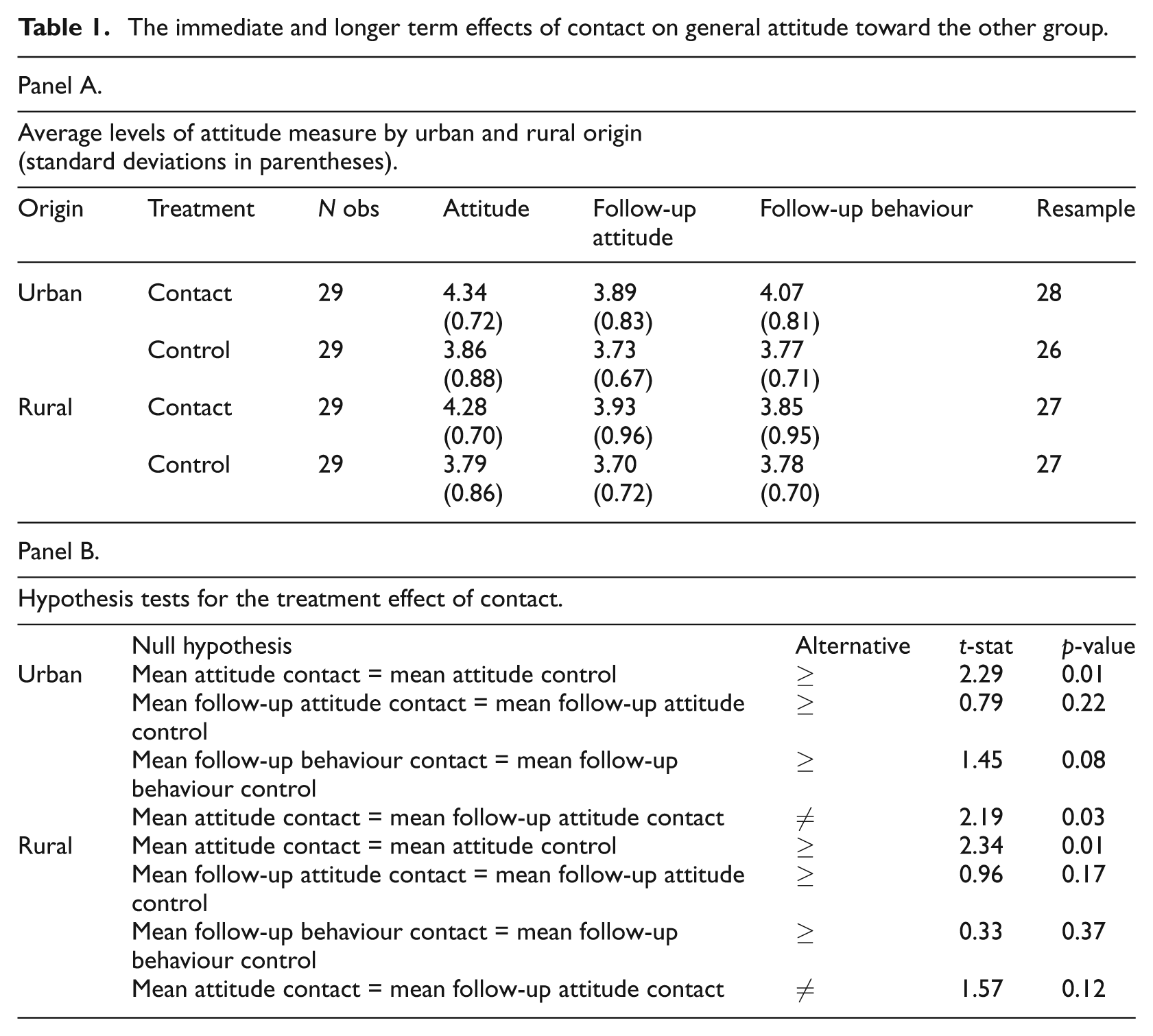
We verify the statistical significance of the effects with a series of hypothesis tests reported in Panel B of Table 1. The contact hypothesis suggests we should observe higher response rates for the contact versus control measures. Thus we conduct t-tests where the null is that the average response is the same for the contact and control groups versus the alternative (one-tailed) that the average response for the contact group is higher than the control group. We observe clear positive treatment effects in the initial attitude measures between contact and control groups for both urban, row 2, and rural, row 6, participants. There is scant positive evidence this effect persists for ten months after the exogenous contact. For the urban subjects there is no statistical difference between the follow-up attitude, row 3, and weak statistical difference (p-value = 0.08) between the follow-up behaviour of contact and control group responses. Slightly positive evidence (p-value = 0.03) is found when comparing the initial and follow-up attitude within the contact group. This two-tailed test is reported in row 5. For the rural subjects, there is no evidence that the contact effect persisted for the ten-month gap between the initial and follow-up studies; all of the hypothesis tests are insignificant.
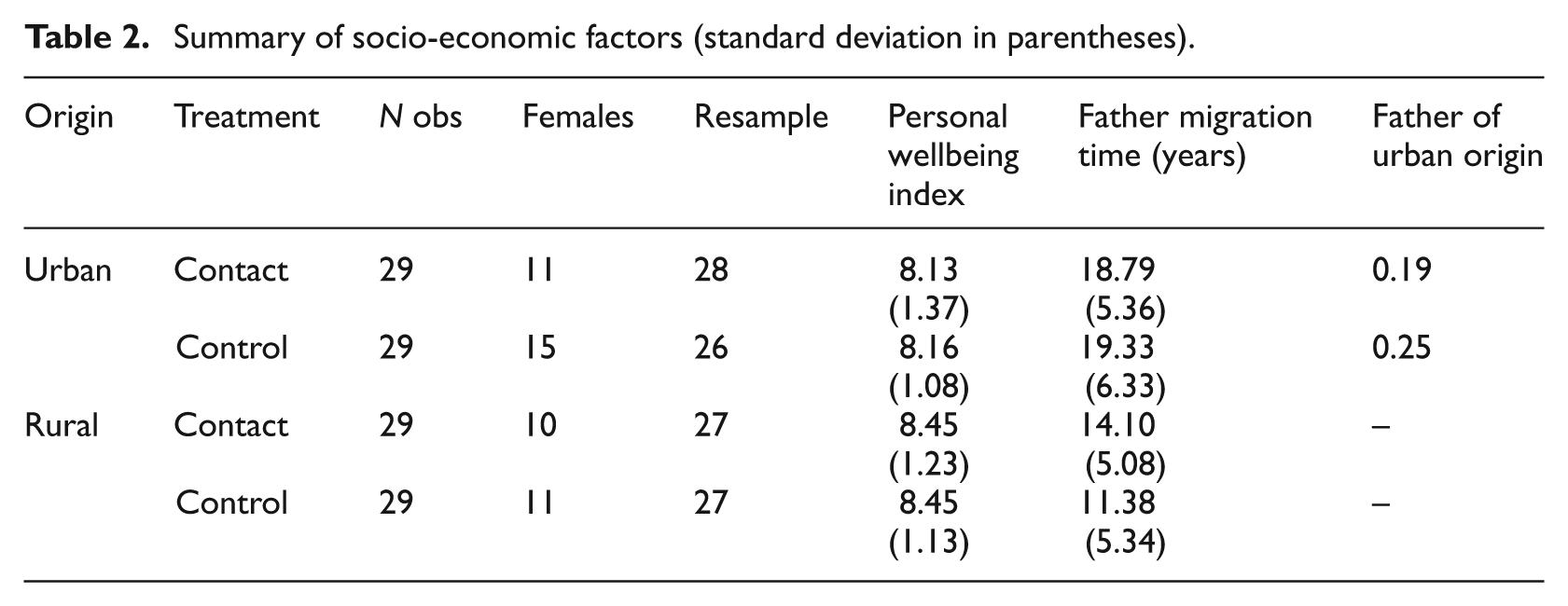
Next we consider whether the treatment affects are conditional upon socio-economic factors, and the distribution of such factors across treatment groups. We examine the distribution of factors such as gender, personal wellbeing, father migration time (a proxy for the duration of a participant’s family’s urban residence) and father’s urban origin (those possessing an urban hukou who were actually born in an urban area). The counts and averages of these variables are presented in Table 2, where clearly there is no bias in assignment.
Summary of socio-economic factors (standard deviation in parentheses).
Next we ask if participants’ attitudes toward each other vary with these factors. Table 3 reports ordinary least square regressions, with robust standard errors, for three different models. The first model shows that participating in the contact activity generates a significant effect on attitude, which does not vary with hukou status or gender. The second model includes a control for the participant’s personal wellbeing score. The coefficient is positive and significant, while the values of the other coefficients change little, and the adjusted R-square doubles. This indicates that PWI explains a surprising amount of the variation in the attitude response. Finally, in the third model, we include the variables father migration time and father origin recorded from the survey we asked parents to complete. Note, that incomplete and unreturned surveys reduce the number of observations to 88 for this regression. Neither of these coefficients is significant, lending support to the notion that hukou type defines the group membership rather than the length or urban tenancy length or the family’s hometown.
OLS regression results with attitude response as the dependent variable (robust standard errors reported in parentheses).
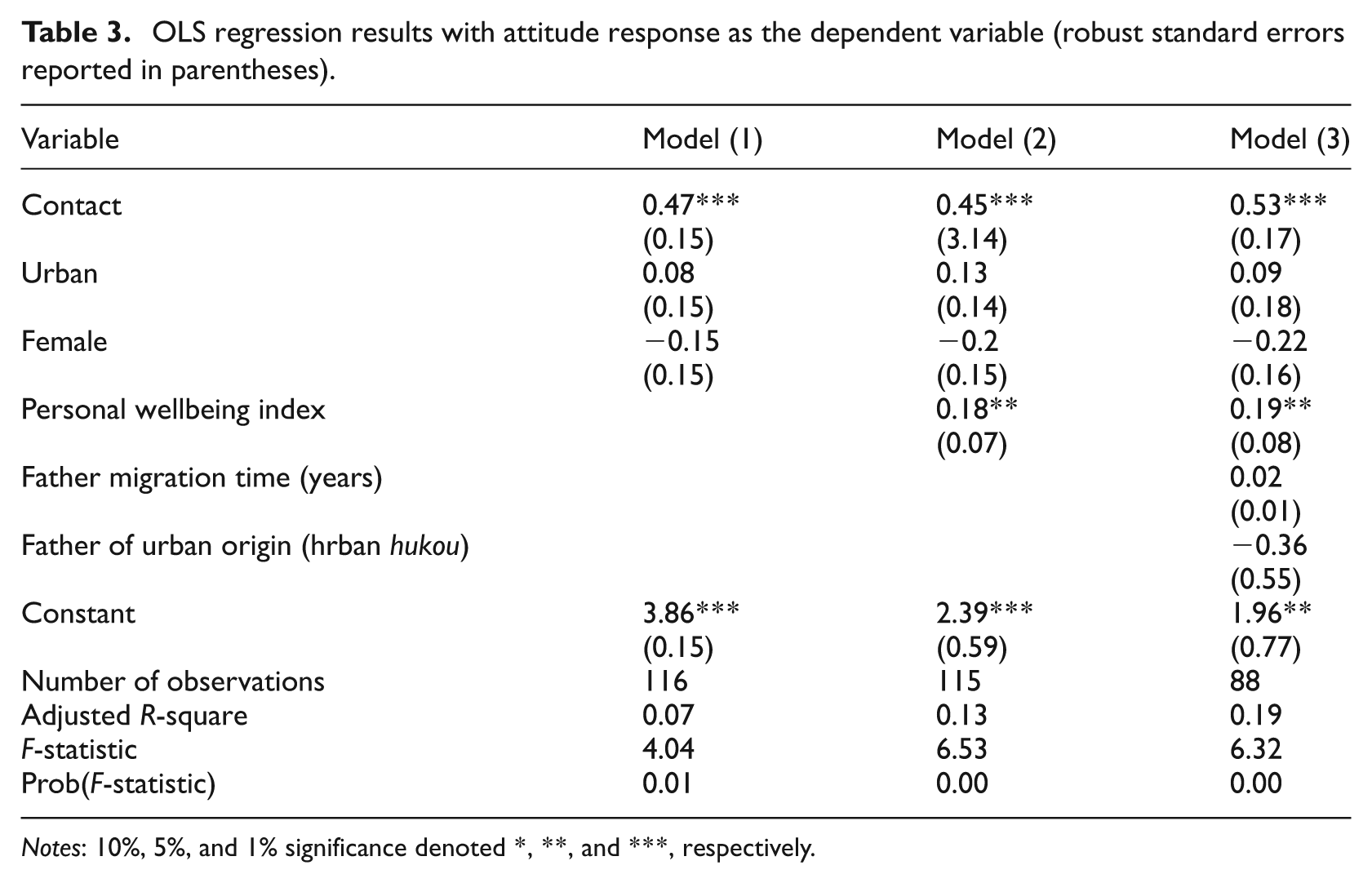
Notes: 10%, 5%, and 1% significance denoted *, **, and ***, respectively.
Discussion
This study used a two-group post-test only randomised design to test the effect of intergroup contact on intergroup attitudes among urban and rural–urban migrant adolescents in urban China. The results of our experiment using dyads of urban and rural–urban middle school students showed that manipulated contact in the form of joint puzzle-solving resulted in more favourable post-test intergroup attitudes compared with post-test attitudes among a no-contact condition group. The results of the experiment thus fully supported our hypothesis: intergroup contact between urban and rural–urban migrant adolescents in urban China does generate more positive attitudes toward the other group. These results are fully consistent with Allport’s (1954) original thesis that increased intergroup contact that entails cooperation to realise common goals can reduce negative prejudice between different social groups. Furthermore, by framing our contact condition around a fun and increasingly challenging activity, our results are also consistent with Hewstone and Brown’s (1986) conclusion that it is a ‘pleasant and cooperative’ type of contact that is needed to translate a change in attitude about a single member of a group to a generalisation about all members of that group. While Nielsen, Smyth and colleagues have reported earlier studies suggestive of the current results (Nielsen and Smyth, 2011; Nielsen et al., 2006), the present study, with its experimental design, is an important advance on those earlier cross-sectional survey results.
The persistence of attitude change has been shown to be a function of cognitive dissonance. That is, if one’s prevailing attitude about a person or group is at odds with the way one experiences that person’s or group’s behaviour, then the psychological discomfort that is produced effects an attitude change to bring the attitude and experience into alignment. Senemeaud and Somat (2009) showed that dissonance-provoked attitude change is durable over time to at least one month. Hence, in terms of the follow-up study, it is perhaps not surprising that after 10 months we did not find a strong significant effect.
Somewhat encouraging is that for urban hukou participants, follow-up behaviour reduced to the middle of the immediate treatment group response and the follow-up control group response. This lead to a no man’s land result: the original and follow-up treatment difference is not significant, but the follow-up treatment and control difference is significant.
It is also encouraging that the follow-up study provides additional evidence of the original contact effect. We found that the control group’s attitude and behaviour are very similar at both points in time. But for the treatment groups the original levels are elevated and return to similar levels of the control in the follow-up study. The inter-temporal measurements show that we were not simply lucky with our original random assignment of individuals to treatments, but rather that contact was successful in effecting change in attitude.
Our results are consistent with recent research in education that has indicated that social interactions in schools may assist rural–urban migrant children to adapt to their new urban environments (Liu et al., 2009). Our results also support the conjecture made by Nielsen et al. (2006) that programmes aimed at facilitating social and spatial integration of urban and rural–urban migrant children with the view to promoting intergroup friendships may provide a promising path forward in terms of reducing prejudice between the two groups. As discussed earlier, the integration of urban and rural migrant schools is high on the policy agenda in China (Lin, 2012). Our findings suggest that such a policy would be a positive step forward in terms of facilitating intergroup attitude change between adolescents in China.
Importantly, the design of our study suggests that our results are an important step forward in identifying an intervention strategy to combat the increasing social divide and disharmony that persists between urban residents and rural–urban migrants in urban China. Specifically, our results suggest that the classroom is an ideal natural laboratory that can play host to targeted strategies that ameliorate the negative attitudes that serve to perpetuate social distance between urban and migrant residents. By the introduction of a simple contact activity taking less than 30 minutes, our results showed a significant positive effect of contact on intergroup attitudes. This effect was present between the two groups in both directions: urban students in the contact condition reported more positive attitudes to rural–urban migrant students than did urban students in the no-contact condition; and rural–urban migrant students in the contact condition reported more positive attitudes to urban students than did rural–urban migrants in the no-contact condition. Our results hence suggest the efficacy of implementing simple, low cost, school-based intervention programmes that pair urban and rural–urban migrant children to undertake enjoyable contact activities. Such programmes could make use of existing standardised instruments such as Raven’s progressive matrices, or they might utilise more readily available activities such as find-a-word puzzles, crossword puzzles, jigsaw puzzles or Sudoku puzzles. While there is clear potential to design activities that comprise or complement curricula, contact activities need be neither technical, nor time-consuming and hence the notion of the contact activity is flexible enough to enable activities to be tailored to practically any student group or educational setting.
While there may be feasibility constraints for schools of systematically bringing together all urban and rural–urban migrant students for ongoing contact activities, a further body of recent studies have shown that positive attitude change can be effected through vicarious ‘extended contact’, or knowledge of in-group members being friends with out-group members (for example, see Cameron et al., 2006). This ‘extended contact effect’ would suggest that there may be wider benefits across the school community of bringing together even small groups of urban and rural–urban migrant students for fun and cooperative contact tasks, who collectively have networks that reach across the school community. Such a strategy might focus on bringing together student leaders or students who are active on student councils or in student clubs and who consequently have a relatively high degree of influence among their peer groups.
While our recommendations have focused on the potential benefits from more inclusive schooling in urban China, our findings have implications for other cultural settings as well. Our findings add to the literature suggesting that desegregation of schools and policies to promote pleasant and cooperative contact between students from different backgrounds can improve racial harmony (Schofield, 2009) and reduce sectarianism (Turner et al., 2013).
Limitations and directions for future research
One limitation of our study was that we only examine if the effects of our contact condition were persistent at a single point ten months after the experiment. Future research could examine if the effects of the contact condition were persistent after shorter periods, say initially a few days, then a week, then a month and so on. This would provide a basis to track the level of persistence in attitude change resulting from contact over time.
A second potential limitation of the study is the possibility that preconceived status inequality within the dyads may have led to perceived helping behaviour, rather than cooperative behaviour (see, for example, Dovidio et al., 2006). Although all students who took part in the experiment were from the same academic year, the in-group/out-group divide between urban residents and rural–urban migrants in China is quite pronounced with a clear hierarchy favouring urbanites. It is possible that within each dyad there may have been an implied hierarchy. It is important that future studies with groups that have a traditionally strong implied hierarchy make explicit that each member of the dyad is of equal status in the task assignment and there is no dyad leader.
A potential limitation of our study is that it is confined to a single city in China. Further studies could investigate explicitly the impact of environmental context on the capacity of contact to reduce intergroup prejudice by conducting experiments such as ours in multiple locations, where differing levels and types of urban environmental stressors might influence the outcomes of intergroup contact. The state of the environment is one of the leading causes of social unrest in China (Zhang, 2007), with overcrowding from rural–urban migration and escalating consumption of fossil fuels in key migrant receiving destinations exacerbating what are already increasing levels of environmental degradation (World Bank, 2007). A multi-site study could shed light on whether, and if so how, external environmental stressors impact on the efficacy of pleasant and cooperative contact to ameliorate negative intergroup attitudes.
Finally, a natural extension of this study would be to do a study based on imagined contact (Crisp and Turner, 2009). While many Chinese adolescents attend desegregated schools where such intervention programmes of the form suggested in this study might be feasible, there are still large numbers of Chinese urban adolescents who attend schools restricted to urban locals and large numbers of rural–urban migrants who attend migrant schools. In these cases, there is both social and spatial segregation. One potential strategy to overcome this spatial barrier might be to design strategies based on imagined contact.
The imagined contact hypothesis states that contact in the form of an imagined interaction with an out-group can produce more positive perceptions of an in-group. This, in turn, should lead to more positive evaluations of the out-group, similar to the effects of actual intergroup contact. The imagined contact hypotheses has been tested with school children in other contexts (see Crisp and Turner, 2012, 2013 for reviews). Such a study would build on this study and previous studies in Chinese contexts based on survey data and also be an important contribution to understanding intergroup relations in urban China.
Footnotes
Appendix 1
Funding
This research received no specific grant from any funding agency in the public, commercial, or not-for-profit sectors.