



Abstract
This paper examines the role of culture in shaping and contesting city branding strategies. Throughout the world, the private and public sectors are jointly engaged in branding cities by mobilising a cultural rhetoric with the aim of attracting business, boosting tourism and revitalising urban spaces. Adopting a critical sociological perspective, the paper examines whether or not culture-based city branding brings benefits to community cultural organisations and explores the reasons why this might be the case. Based on the experience of Buenos Aires and drawing on in-depth interviews with both policy-makers and community cultural centres, different notions of culture, underpinning contrasting imagined cities, are discussed. The paper argues that city branding, founded on a commodified notion of culture, driven by profit-making goals and oriented towards international tourism, can create an urban vision of consumption to which cultural organisations are opposed. The paper concludes by showing how a particular entanglement between politics, businesses and urban marketing in the Latin American city gives way to ongoing contestations over the city brand and configures the possibilities and distribution of potential benefits.
Introduction
In 2006 the Department of Tourism Promotion and Development organised a short film contest on alternative views of Buenos Aires to help imagine the new city’s tourist brand. The idea was to attract views of the city not typically included in conventional tourism promotion (GCBA, 2007), which have historically sold the Argentine capital through a mixture of traditional neighbourhoods, tango, French architecture, a thrilling nightlife and a bohemian cultural scene, earning the city a ‘sexy, alive and supremely confident’ status, as Lonely Planet recently put it. The contest first prize was given to ‘Bohemian + Modernity’, a film showing the historic district, the Chinese neighbourhood and the trendy Palermo district’s fashion shops. Aware of the exclusions in conventional urban promotional materials, the local tourist office, however, did not resist the logic of selling the city through stereotypical objects of consumption by selecting a film that portrays the city’s most tourist-friendly neighbourhoods, for ‘what is particular about Buenos Aires at present, a mixture of immigration and poverty, is, from the perspective of tourism, not to be displayed unless a social activist escorts the foreigner on a shanty town tour’ (Sarlo, 2009: 184, author’s translation).
The allure of creating an urban brand emerges in a context of increasing inter-urban competition where the private and public sectors are jointly engaged in ‘place wars’ (Haider, 1992) with the aim of branding cities for attracting business, boosting tourism and revitalising urban spaces. As an instrument of urban planning, place branding centres on brand identity, brand positioning and brand image, which altogether constitute the brand of the city (Kavaratzis and Ashworth, 2005). Studies of city branding abound and have been produced from geographical, sociological, cultural studies, political science and marketing approaches. Broadly, they have focused on three main perspectives: the production of brands, appropriation of brands and critique of brands (Lucarelli and Olof Berg, 2011). Within these, city branding has been discussed through the differences between product branding and place marketing (Holcomb, 1999; Kavaratzis and Ashworth, 2005), the new features of the tourist industry and tourist sites (Bickford-Smith, 2009; Judd and Fainstein, 1999; Urry, 1990), the use of city branding for urban renewal (Gibson, 2005; Paddison, 1993), and for producing meanings, imaginaries and discourses with political and practical implications (Braun, 2012; Eshuis and Edwards, 2013; Griffiths, 1998; Johansson, 2012), among many other perspectives.
This paper examines whether or not culture-based city branding brings benefits to local cultural organisations and explores the reasons why this might be the case. Drawing on the imaginaries of policy-makers and community cultural centres in Buenos Aires, different notions of culture, underpinning contrasting imagined cities, are discussed. Whilst there has already been detailed discussion of the ways in which tango-based city marketing and tourist-oriented cultural policies pave the way for neoliberal urban development and socio-spatial inequality (Kanai, 2014), the focus here is on how the process of creating a city brand can be contested by alternative interpretations of culture and urban visions mobilised by local cultural organisations. The paper argues that city branding, in the case analysed here, does not provide benefits to local cultural organisations because of its profit-making goal, its promotion of a consumer culture, its appropriation by the local government as a political marketing tool and its orientation towards international tourism. Culture-based city branding is approached as a point of conflict and competing interests, contributing to fill the theoretical gap between accounts of the city branding process and empirical cases that reflect them (Kavaratzis and Ashworth, 2005). In particular, the paper offers a contribution to a new understanding of city branding based upon a critical analysis of the entanglement between politics, urban planning and businesses, in light of both official and grassroots urban imaginaries.
This paper is divided into four sections. Whilst the first discusses city branding within the wider politics of entrepreneurial urbanism in Buenos Aires, the following two sections examine ways in which the city is imagined and branded through culture from a policy and a practice perspective. The final section brings together these urban imaginaries to examine ongoing contestations over cultural policies and city branding. The paper concludes that, while the creation of the city brand has been institutionalised and its formal features and use are regulated, in practice the brand escapes formal, legal regulations. In being appropriated for political usage, it becomes the target of popular contestation of local urban policies, which are based on commodified views of culture to which community cultural organisations are opposed. The city brand, then, becomes both a means of political advertising and an object of political resistance. Distancing itself from technical analysis of branding as a mere marketing tool, this paper embeds the study of city branding in local and national politics and, in doing so, it renders the city brand political.
Methodology
This paper adopts a qualitative research strategy to provide exploratory insights on the branding of the city of Buenos Aires 1 through culture as a case study. The analysis is based upon a policy examination of institutional documents and upon semi-structured, in-depth interviews conducted with civil servants in the urban cultural sector, a marketing consultancy, a cultural manager and directors of three community cultural organisations in Buenos Aires. The selection criteria were based on participants’ involvement in the process of branding the city: formally, in the urban policy-making domain (those involved in the contest to create a new tourist brand), or informally, in the sphere of not-for-profit culture at the neighbourhood level (three of the most well-established, highly respected and active organisations were selected). Although the interviews were conducted between July and August 2007, the paper provides an up-to-date account of the ongoing urban branding process by drawing on current secondary data sources.
At the moment of writing, April 2015, Buenos Aires has still not developed its official tourist brand 2 and uses the political administration brand for public communication. This seems to be due to the priority given to the administration brand, widely used over the tourist city brand, which suggests an entanglement of politics with tourist industry business. The findings of this research, rather than examining a practice that has been abandoned in contemporary urban politics, provide a timely interpretation of a process where marketing agencies continue to resort to culture to sell the city to the world.
Culture-based city branding: Tracing the porteño experience with urban entrepreneurialism
A historical snapshot on cultural policies
City branding needs to be understood as part of the broader policy context in which it is embedded. In recent years, Buenos Aires’ urban cultural policy has experienced a shift from a concern with widening access to cultural activities under a ‘taking culture everywhere’ motif, to a focus on cultural policies as a magnet for global tourism and economic development. Since 1983, the transition to democracy after seven years of military government had seen the explosion of cultural activities in public space, previously censored and violently controlled by the armed forces. This revival in public culture was accompanied at the neighbourhood level by a municipally organised network of cultural centres, offering citizens a variety of lessons and workshops for free, ranging from football, drama, music, clowning and traditional forms of dance to ceramics, knitting, cooking, crafts and painting, among many others. However, by the 1990s, the political content of culture began to evaporate with the implementation of neoliberal policies whose seed was sown under the military dictatorship.
The 1990s were marked by neoliberalism in Argentina and in many Latin American countries, with a deepening of social inequality, growing levels of unemployment, poverty and insecurity alongside widespread social unrest and public funding cuts. A combination of bureaucracy, the corrupt relationship between the state and economic power groups, indifference towards social issues and a loss of credibility in politics led to a process of increasing de-politicisation of society (Wortman, 2009: 12). The denigration of politics produced by Menem’s era, characterised by corruption, media spectacles and rampant consumerism, led to the erasure of the political component of cultural activities through an emphasis on the economic, commercial value of culture. Previously created community cultural centres were closed down in 1993 as part of Menem’s capitalist cultural policy oriented towards spectacular mass culture in the form of the cultural industries and the proliferation of the shopping mall (Wortman, 1997).
Argentina’s financial entanglement with the International Monetary Fund triggered the government’s appropriation of individual savings in banks, which in turn led to these policies’ most visible impact: the economic, social and institutional crises of 2001–2002. Although in the aftermath of these crises public funding was widely cut and cultural activities were particularly hit, the revival of political participation in the public sphere – exemplified by public assemblies and clubs del trueque (barter clubs) based on solidarity and mutual cooperation – was accompanied by the re-emergence of non-commercial, voluntary and self-managed cultural initiatives, following their previous relegation.
Soon after, the arrival of Mauricio Macri as City Mayor in December 2007 brought about a ‘professional’ enterprise logic to cultural policies to distinguish his party (Propuesta Republicana, aka ‘Pro’) from what was seen as a large public sector ruled by an inefficient state. Such logic was behind a number of initiatives, many of which were aimed at promoting the city through culture in order to attract tourists and investors. These included urban regeneration projects in the southern and central city areas, attempts at ordering the public transport system through the creation of unique lanes for buses and bikes in some areas, and a boost to creative industry programmes through tax incentives and the spatial organisation of ‘creativity’ into specialised clusters.
In contrast, the reduction of existing cultural programmes, such as the cultural centres network ‘Programa Cultural en Barrios’, in place since 1983, and the closure of independent, non-profit cultural centres in the name of health and safety irregularities have given clear signs about the stance the city government would take towards grassroots culture in Buenos Aires. The election of Hernán Lombardi, a man with a background in tourism, 3 as Culture Minister would later confirm the subordination of the city’s cultural policies to policies for tourism development.
Cultural policies for city branding
Culture has been at the heart of the branding of Buenos Aires. Since the 1990s the construction of the city brand has been structured around culture’s role for urban regeneration, the development of the cultural industries and the preservation of heritage, as part of a marketing plan of a ‘city-company’ targeted at a globalised market (Bayardo, 2013: 105). Far from being a purely rhetorical operation, the city has been the target of urban renewal projects, which have been oriented towards privatisation and resulted from an alliance between the state and urban land, for the benefit of private business (Rodríguez et al., 2011).
This rise of tourist-oriented cultural entrepreneurialism in Buenos Aires, based not only on the exporting of tango abroad but also a wide range of spectacular festivals locally, has enabled the continuation of a form of neoliberal urbanism oriented towards globalisation (Kanai, 2014) with socio-spatial inequality, social exclusion and urban fragmentation as its key features. Despite the anti-neoliberal, progressive rhetoric of Argentina’s national politics, market mechanisms have continued to shape policy agendas, planning goals and urban interventions at the municipal level (Lederman, 2015). Rather than moving away from state restructuring, culture marketisation and public service privatisation, the ‘pro’ municipal politics has been oriented towards deepening the legacy of the 1990s. In contrast, at the national level the revival of the idea of a ‘national culture’ centred around the values of democracy, social inclusion, diversity and federal participation has highlighted, since 2003, the need to question a hegemonic neoliberal logic by implementing a popular national model for Argentina.
The city government’s invocation of culture for urban marketing happens in the context of the city’s decentralisation into comunas and in an operation that, apart from subordinating cultural policies to creative industry clusters – which follow global models of development professed by international organisations and which are friendly to real estate development – paves the way for the constitution of a territory centrally defined around ‘investors and talents’, rather than in relation to neighbourhood and barrio identities (Bayardo, 2013). In times of strong urban entrepreneurialism, emerging concerns about urban environmentalism, tied with creative city policy imperatives, can become productive in legitimising exclusionary neoliberal urbanism (Lederman, 2015). As an example, in the midst of political electoral campaigns and a severe housing crisis in the city, on 3 April 2015 Macri inaugurated the new and costly sustainable City Hall building by star architect Foster + Partners in Parque Patricios as part of a wider, creative industry-led urban regeneration scheme. This mobilisation of sustainability and creativity policy narratives gives the city ‘a green, clean and cool’ character and becomes productive in opening up undercapitalised areas of the city for private investment (Lederman, 2015) and middle-class consumption, limiting the urban imagination to a city branding-friendly operation.
From a creative economy perspective, the municipal government has kept some of the policies developed by the previous political administration to organise urban creativity spatially. Such policies have been implemented through the activities of the Design Metropolitan Centre (CMD), a governmental body created in 2001 to support small and medium sized businesses in the field of design, which under the Macri’s administration passed from being under the Culture Secretary remit to depend on the Economic Development Ministry, making explicit a view of creativity as an economic resource (for a review of the CMD, see Kanai and Ortega-Alcázar, 2009). A landmark of this administration has been the organisation of creativity into urban clusters, the so-called polos or distritos creativos. The polos model – currently comprised of four disciplines, from technology and design to audiovisual production and the arts – rests upon two pillars: a tax reduction policy for companies in the cultural and the creative industries and the agglomeration of their products and services for regenerating decayed areas in the south of the city, as well as reinforcing the cultural branding of the wealthier north.
Top-down city branding: Buenos Aires, cultural capital of Latin America
In the 2000s, the branding strategies of the Aníbal Ibarra municipal administrations (2000–2006) and that of Jorge Telerman’s (2006–2007) focused on selling Buenos Aires as a cultural city to tourists. The majority (70%) of international tourists to Argentina between 1990 and 2001 came from four main countries – Brazil, Chile, Uruguay and Paraguay (Gardella et al., 2005). More recently, in 2014, Brazil continues to be the main market (26.4%) of international tourism in the city of Buenos Aires, followed by the rest of Latin America (21.4%), and then Europe, North America and the rest of the world (Observatorio Turístico de la Ciudad de Buenos Aires, 2014). The brand is seen by the local government as the city’s intangible capital that defines its image so as to ‘position in the minds of tourists’ what the city has to offer. Buenos Aires previously had three different brands: one institutional, one political (the Mayor’s brand), and one for tourism promotion.
The institutional brand (first left in Figure 1) was used by all governmental areas in their advertisements; the Mayor’s brand was based on the famous ‘I love NY’ message (centre in Figure 1) and was intended to show the ‘love and affection citizens feel for their city’. In particular, a +BA (meaning ‘You love BA’ but also the ‘BA attitude’) was aimed at expressing the sensations of ‘how residents love the city’ and ‘how they take care of it’. The tourist brand (right in Figure 1) was aimed at symbolising ‘the city’s modernity’ through a visual identity associated with the label put on suitcases and with ‘bue’, the air-traffic identification for the city. But, as this was seen as not fully expressing the ‘cultural diversity’ of the city (its culture-based entertainment activities), the need to create a new brand arose. Relying on ‘culture’, Buenos Aires was then depicted as the cultural capital of Latin America (‘a place where you breathe culture’), then the tango world capital (based on the dance’s patrimonialisation for the international cultural market (Gómez Schettini et al., 2011)), the city of design (as entitled by UNESCO), the meetings centre of Latin America, and the port of entry to Argentina.

City brands of the Ibarra/Telerman administration.
Adjectives such as ‘modern’, ‘diverse’, ‘sophisticated’ and ‘open’ seek to stress the international image of the city, giving it a world-city character – mainly through its hosting of national and international cultural and sports events. The depiction of Buenos Aires as ‘modern’ is related to its cultural assets but also its potential for business. A proposal to build, as a private–public initiative, the tallest international business centre in the city was aimed at ‘selling the Buenos Aires brand, to symbolise what it can offer and to attract high-scale investments in order to create a city of business …’ (La Nación, 26 April 2006). A combination of a cultural rhetoric, an idea of modernity and a varied entertainment offering conjures up a desirable image of Buenos Aires as a city of and for business.
Feelings and experiences were also evoked to present a particular lifestyle to sell the city through unique experiences. Culture provided the symbolic content that constituted the conceptual brand, ‘Buenos Aires emociona’ (Buenos Aires is exciting). Emotion-centred branding discourses shaped the broader Latin American urban marketing context too, where countries such as Brazil, Colombia, Paraguay and Peru, were advertised with the phrases ‘sensational’, ‘passion’, ‘you have to feel it’ and ‘a country of experiences and sensations’, respectively. Selling places by means of using ‘soft factors’, such as quality of life, image, culture and diversity (Sevcik, 2007), constitutes a key feature of contemporary cities’ entrepreneurial strategies, one which helped to put the problems of the city aside:
Even though we all talk about the city’s insecurity, it is a safe city, with a nightlife that is unusual in Latin America and in the world, in general. (Former Design Coordinator, Design Metropolitan Centre, personal interview) We have worked on the inauguration of the Evita Museum in 2002, pot-banging protests, crises … We were sponsored by TAM which gave us air tickets to offer to journalists to come to the museum opening. From Europe, nobody wanted to come, because they said that Argentina was at war and it was chaotic here. The only person who did come was French. Do you know why? Because he was a war correspondent. Worse than what he saw in the Lebanon it wouldn’t be. (Consulting Partner, marketing consultancy, personal interview)
The reference to Argentina’s economic and political crisis is made to reinforce the need to shape the city image from a cultural perspective. The marketing consultant explains how, by inviting international journalists to the inauguration of a new museum, the intention was to show the world that Buenos Aires was still a cultural destination worth visiting. Culture, then, appears to remedy a likely negative perception of the city based on its convoluted politics and unstable economy, seen as detrimental to tourism promotion.
Marketing, politics and the subordination of culture to tourism
Similarly, the city administrations that followed (Macri, 2007–2011, 2011–2015) have continued the branding strategy of Buenos Aires as the Cultural Capital of Latin America, developing an urban marketing programme based upon an alliance between culture and tourism as its central axis (Rodríguez et al., 2011). Currently, the city government uses a number of brands which are based upon the formal features of the political administration brand, mainly Macri’s signature colour; yellow (Figure 2).
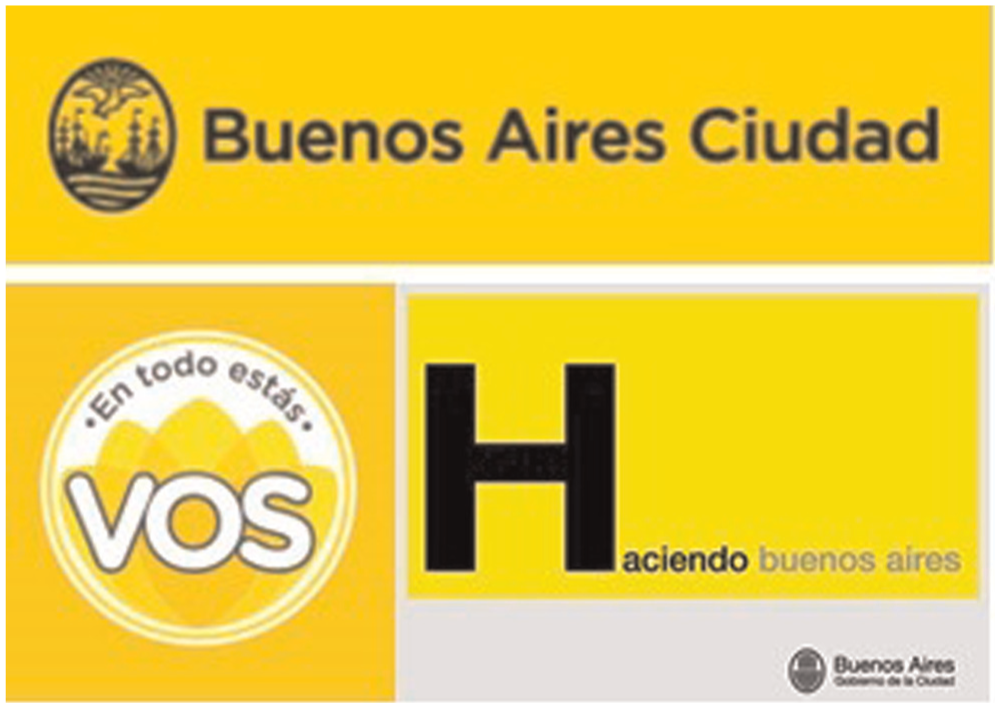
City brands of the Macri administration.
The ‘Buenos Aires, Cultural Capital of Latin America’ slogan ended up constituting a key element of the city’s tourism branding strategies for the foreign market. Yet this was a somewhat unlawful operation, since the brand was not produced by the Ministry of Culture’s Ente de Turismo – the only governmental body with the legal authority to create the city’s tourist brand (Law 2627/2007). For the national market, the brand ‘Buenos Aires, la Ciudad de Todos los Argentinos’ (BA, the city of all Argentineans) was aimed at rhetorically balancing the city’s centrality in the urban imaginary and its concentration of offerings, services and resources, in contrast to the poorer rest of the country – a historically tense relationship that dates back to the 19th century in view of the city’s economic and political pre-eminence.
In practice, the Haciendo Buenos Aires municipal government’s brand-slogan suggests the intertwining of urban development and political advertising. The current official city brand is based upon the Mayor’s party political marketing, failing to incorporate references to local resident’s cultural identities (Méndez and Tyrone, 2014). Here the political brand becomes the city brand, blurring the distinction between marketing and politics, with urban marketing becoming the only urban policy alternative under globalisation (Gorelik, 2002). This might explain why the Macri administration has not shown interest in creating the new urban brand legally – there is little motivation, since the city could be promoted through the publicising of (their) urban policies, subordinating the promotion of the city to the promotion of the local political administration.
Beyond the brand, Buenos Aires is promoted through a variety of attractions, ranging from theatre, tango and museums to steaks, Messi, nightlife and the Pope. 4 High impact international festivals, such as the Tango World Cup or the Book Fair, underscore the desired position of the city within a global cultural map, failing to address the neglected needs of local cultural venues and artists.
‘Branding’ the city from below: Culture as social transformation
Three case-studies
In Buenos Aires, the non-commercial cultural landscape is vast and ever-growing, particularly since the late 1990s. The 2001–2002 crises paved the way for the emergence of myriad community initiatives which, through collaboration and self-management, provide the city with a lively, diverse and democratic public culture. Although often implicitly and from a bottom-up perspective, these initiatives also brand the city through their activities, networks, festivals and promotional materials, particularly in their contacts with international groups, challenging the top-down nature of city branding as the only possible means of urban promotion. Three are amongst the most well-known organisations in the city, two of which have a long tradition in the popular cultural sector. First, the Grupo de Teatro Catalinas Sur. The theatre group started in 1983, staging community-based street theatre as a way of reclaiming public space (after the bloody military dictatorship of the 1970s) through social participation and solidarity networks among residents of all ages in the barrio de la Boca, one of the most deprived – and most tourist-friendly – city districts. The arts are perceived as being a right for all, as a space of political resistance, memory and identity, as a transforming tool whereby to communicate and learn about history from a popular perspective. Free community arts workshops on traditional artistic forms, such as theatre, circus, puppetry, murga and candombe, are on offer and participants often end up becoming part of the cast of the various theatre plays. The multiple award-winning Group has become the inspiration for the growth of many other community-based groups, both nationally and internationally.
Second, the Circuito Cultural Barracas. It came into being after the successful experience of the Catalinas Group which shared similar goals and features. Since 1996 it has been located in the barrio de Barracas, also in the southeast part of the city, in a district characterised by social polarisation and fragmentation. It stems from the idea that art is a tool for social transformation, whereby quality of life, citizenship, creativity and social inclusion are enhanced both at the levels of the family and the neighbourhood. Working in street theatre, clowning and murga, mainly targeted at working-class residents of all ages, to produce collective arts practices represents for the Circuit ‘alternative forms of expression to neoliberal individualism’, thus promoting collective encounters among neighbours.
Third, the Centro Cultural de la Cooperación Floreal Gorini. This cooperation cultural centre was created in 2002 by the cooperative movement as a space for the formation of a ‘critical, left-wing and anti-capitalist way of thinking’, fostering social mobilisation and advocating the values of ‘cooperation, fraternity, peace, dignity, democracy and solidarity’. The centre offers a wide range of low-priced cultural activities, such as theatre, music, dance, cinema and arts courses and conducts research on a variety of social sciences subjects. The ideological framework around which its participatory activities are structured turns the centre into an alternative space situated outside the commercial culture circuits, although it is physically located within one of the most visited – the Corrientes Avenue.
Non-commercial cultural forms
The content of the activities in which these three cultural organisations are engaged reflect the importance of conceiving culture beyond its commercial forms:
[Culture] A set of social practices that express the world and also create it, tending to transform it by means of developing new ideas against the dominant thinking of individualism; culture promoting senses of identity inherent to the people. (Cooperation Cultural Centre Assistant Director, personal interview) We understand culture not as fine arts but as all that means how a society lives, how it communicates, how it struggles, how it enjoys, all this is culture … the arts do not appear after solving economic problems, the arts come first and from there, from a collective dream we can transform the rest of society. (Barracas Cultural Circuit Director, personal interview) We speak of culture as art, as memory, identity, work and organisation; and within the scenic arts, music, dance, language, puppets, all that we use to communicate, reflect on and think. (Catalinas Group Director, personal interview)
These broader views of culture are clearly bound up with artistic forms and a strong political content in terms of enabling social change. They differ from purified, ideologically ‘neutral’ views of culture, as depicted in city branding made by the local government, based on stereotyped conceptions of culture which exclude mixed and hybrid forms. In part this explains why the community cultural organisations showed no particular interest in being part of those initiatives.
Linked to these groups’ lack of interest in official city branding is also their historical relationship with the local government, which provided the framework for the negotiations over the benefits to be received through city branding infused with a cultural aroma. If there was no governmental support previously given to the cultural organisations, rarely did any benefit result from city branding campaigns. Considering that it is mostly the commercial cultural venues organising tourism in the city who benefit from city branding, especially those linked to tango dinner-shows in iconic neighbourhoods such as San Telmo or La Boca, community cultural centres do not see particular benefits arising from the exploitation of the urban brand through ‘culture’.
Through self-management, these organisations function on limited funds gathered through performances a la gorra (pay-as-you-wish method), sale of tickets and food on site, donations, membership fees, revenue for workshops, external financial assistance and limited city government subsidies. Even though they receive some public funding, this is not without its problems. The fact that on some occasions the directors of the Catalinas and Barracas organisations were offered political positions which they rejected, was pointed out as one reason affecting the allocation of public resources. Conversely, in the case of the Cooperation Cultural Centre, this problem was related to the content of its activities which are not ‘ideologically aligned to the official discourses’, as its director explained. Nonetheless, these groups have received awards from the government throughout their trajectory and jointly implemented programmes in recognition of their outstanding work.
Under the Macri administration, however, Culture Minister Hernán Lombardi’s approach to culture has given priority to international events over supporting existing cultural initiatives locally. Since 2008, social protests by artists and community cultural workers have been opposing Macri’s reduction of community cultural centres, demanding better salaries and formal employment conditions and defending intangible heritage and access to culture, viewing the local cultural office’s policies as a threat to the survival of popular culture in the city (Raggio, 2013).
The activities developed by these cultural organisations are strongly embedded in the local area. Issues concerning neighbourhood problems, such as pollution, floods, insecurity, crime and lack of solidarity, informed the content of their activities as an attempt to enhance inter-neighbour relations and strengthen community development. While a place-bounded view of culture underpins the work of these organisations, an important factor in their development is the link with other national and international organisations. This provides them not only with more visibility at the regional and international levels, but also with a significant exchange of experiences that nurture their everyday cultural activities. The creation of shared projects that transcend national boundaries was seen as an effective way of exercising pressure on the public policy-making domain so as to secure further resources locally, as well as learning from each other. Some of the cultural organisations studied here are members of the Latin American Network for Social Transformation, the National Network of Community Theatre and the Community Live Culture – People Make Culture Collective; others have agreements with Latin American universities for the exchange of information and experiences. Being deeply rooted in the local while aiming to reinforce the regional dimension differentiates these organisations from other cultural centres in the city, which have a different cultural programme, seen by respondents as ‘part of the commercial circuit of individualist consumption’, and ‘not of the community but for the community by the state’.
But what culture, what city?
What emerges from these policy and practice accounts is that the meaning of culture itself and the type of future city imagined are at stake in the process of city branding. Different understandings of culture, in turn, underpin contrasting imagined cities, and who inhabits the dominant image of the city will depend on who has the power to represent it (Zukin, 1996). Different cities were imagined in these accounts in correspondence to the diverse notions of culture implicated. On the one hand, a modern cultural city whose sophistication and openness were rooted in the development of cultural festivals and events, a city of spectacles and business, leading Latin America by virtue of its creativity and diversity of spaces for cultural consumption. On the other hand, a city of artistic expressions, a place in which culture seems to be not entirely commodified, citizens’ identities not simply forged by consumption, and a place where collective and inclusive projects can come into being. Between these two views, in which cities are differently situated in the social imaginary, the possibility of selling places as commodities acts as the barrier that separates them, because selling places, indeed, might go against alternative understandings of local culture and history which are rooted in the city’s daily encounters (Kearns and Philo, 1993). However, in both portrayals, the city was promoted. Whilst in the first case this was achieved through official city branding operations, in the second, the exchange of urban experiences with other similar organisations took the form of ‘selling’ the city abroad. Using public space was also a contested matter. In the case of top-down city branding, eating in restaurants, going to the cinema and theatres, showing citizens’ ‘happiness’ in the streets was conceived as a key strategy for achieving a positive image. Unsurprisingly, performing street theatre with social content was characterised as being almost impossible, given the restrictions imposed by the previous and the current local government:
In the city, it is all regulated in a way that nobody can do anything in the street. If you see what we have to sign in order to do street theatre legally, you stop doing it, because you are responsible for all that may happen in the street at that moment. We have a license to use public space, but we are never completely legal, because we are requested to have an insurance that covers actors and audiences which no insurance company can provide. (Barracas Cultural Circuit Director, personal interview)
This comment unveils some of the contradictions that more often than not characterise official political discourses, such as those referring to the importance of being in the streets, and then not facilitating it; creating strategic plans without implementing the policies stated; or promoting the city’s lifestyle, but ignoring its daily problems. Far from assuming a pure form, these two contrasting cities represent utopian models, cities imagined, cities dreamed, that when combined, enable us to see how they function as complex sites where tensions between contested notions of culture arise.
Contesting the brands
In the street, these contradictions are reflected in the very space of the promotional signs and the marketing slogans. Here I present three examples that contest the city (political) brand, by appropriating the official local government language, colour and font to revert its meaning and construct oppositional content. Macri’s slogan ‘Making Buenos Aires’ (Figure 3, left), referring to the city’s material redevelopment initiatives and highlighting the construction of the new underground line H (Haciendo is Making in Spanish), has been turned into a ‘Turning Buenos Aires to Shit’ condemnation, playing with the Spanish verb ‘to make’, in the context of a social protest. By adding ‘Macri: the city is not your company’, the sign establishes an explicit link between businesses, politics and urban destruction. In this case, this is not an official sign but one made by protesters.
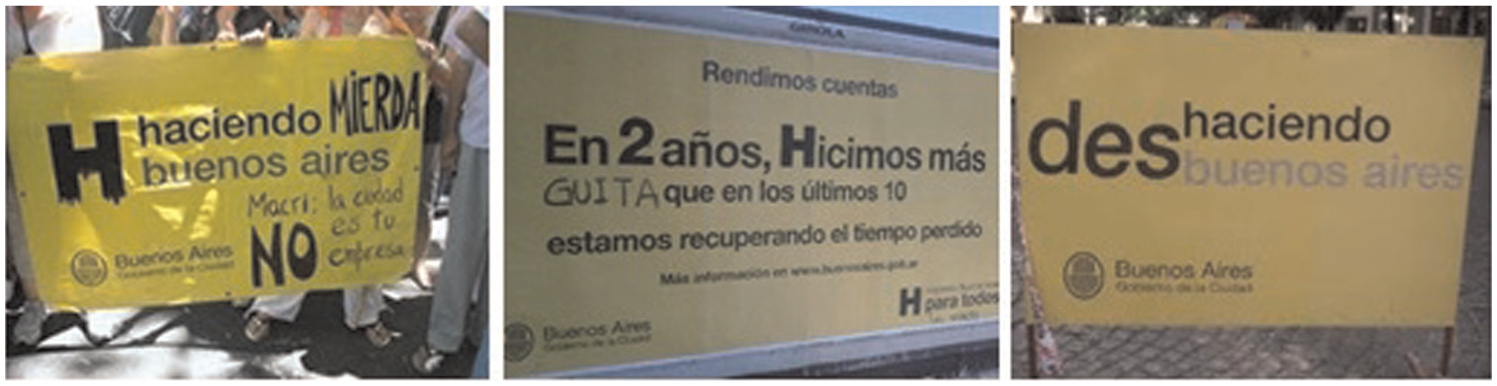
Contestation over the Mayor’s branding signs.
Another example is street sign (Figure 3 centre) ‘Reporting: In 2 years, we did more than in the last 10. We are making up the lost time’, which makes an implicit reference to a common claim that the local government has done more than the national authorities, in power for over 10 years. It became ‘Reporting: In 2 years, we made more MONEY than in the last 10 …’ suggesting a repeated and familiar metonym associating local government directly with private business. Similarly, official construction sign ‘Making Buenos Aires’ (Figure 3 right) became ‘Un-making Buenos Aires’, through a simple creative linguistic act of political contestation, which shows how the brand can become instrumental for political resistance.
The idea of cities for sale has never been more appropriate in relation to Buenos Aires than under Macri’s administration, in view of the business logic it has applied to urban cultural planning, giving priority to symbolic and artistic productions that are market-friendly and profitable (Kanai, 2014: 1114). This echoes Dávila’s (2004: 61) study of the branding of East Harlem in New York, where tourism strategies showed a business treatment of culture and were not based on ‘culture’; instead the cultural industries were the object of economic interest, with the main beneficiaries being not the local residents or their needs, but rather developers and visitors.
Then it is not surprising that the current city’s visual identity has neither wide acceptance among citizens nor cultural identification with the city brand (Méndez and Tyrone, 2014). Yet this is not peculiar to the current Macri administration. In the words of urban marketing expert Puig Picart:
The problem I notice in Argentina is that people don’t trust their political institutions or their Mayors. Citizens don’t feel they are included in public policies. Rather, they feel they are being used … Buenos Aires positions itself as a brand in the world, despite its political institutions. (Puig Picart, cited in Reinoso, 2008, author’s translation)
These views were expressed a few years ago, when the aftermath of the 2001–2002 crises still pervaded media discourses and public opinion. Elsewhere (Dinardi, 2015) I have examined how the policy invocation of culture for urban regeneration in Buenos Aires operated under a logic that clearly speaks to the aforementioned quote: seen as an ideologically neutral, a-political resource, culture was expected to function as a panacea whose universal, ‘positive’ nature was taken for granted and was deployed to help ‘clean’ politics of its dirty image in post-2001 Argentina. Puig’s words also signal an important point that is sometimes forgotten in city branding accounts: that the city will brand itself, regardless of how it is officially branded by the local authorities. Like it or not, the real city imposes itself on the ideal city, defying official urban narratives targeted at wealthy tourists.
Conclusion
The aim of this paper has been to analyse whether or not city branding as an urban policy strategy based on the mobilisation of culture brings benefits to those working in the community cultural sector and explore the reasons why this might be the case. A central argument has been that city branding did not provide benefits to local cultural organisations because of its profit-making goal, its promotion of a consumer culture, its appropriation by the local government as a political marketing tool, and its orientation towards international tourism. Clearly, a business treatment of culture that approaches it as a profit-making device while sidelining ethnic and racial tensions (Dávila, 2004) has little in common with a conception of culture as a social transformation tool aimed at strengthening community values and fostering citizenship. When the city brand becomes a resource for political marketing rather than an inclusive representation of the diversity of city life and its cultures, it fails to make visible the dimension of cultural production, subordinating the branding of the city to the branding of a political party.
Two different imagined cities were contrasted. On the one hand, a city of consumption where festivals and mega-events are organised to achieve more visibility and reputation at the local, regional and international levels was seen to be the city planned by the urban elite. The image of Buenos Aires portrayed in tourism promotion was seen to heavily rely on the city’s cultural facilities for consumption, suggesting a ciudad empresa or company-city model (Marín, 2013) based on mega-events, social displacement, urban fragmentation, competition, private interests and real-estate redevelopment projects catering for the rich. On the other hand, the city dreamed of by the cultural organisations was characterised as a city where culture also plays a pivotal role in encouraging people’s active participation in the public sphere, in developing critical thinking and in fostering senses of solidarity and belonging. These different interpretations of culture and competing urban visions impact on the ways social inclusion goals are mobilised and actually pursued. Taking into account these two rather contrasting cities, this paper argued that, while the former nurtures an individualist consumer society, the latter helps to promote active citizenship, creativity and respect for diversity. In this sense, Harvey’s argument (1989) that an inclusive urban image can also succeed, based on everyone’s participation through their production of social space, is central to support a city for the many and not the few (Amin et al., 2000). Therefore, further exploration is required into the most appropriate ways of engaging all sectors of society in the production of the city’s image with the aim of representing a fairer city and, consequently, achieving a more egalitarian distribution of benefits. This, however, represents:
a critical challenge to contemporary urban policies and politics that approach culture as a commodity, industry, and aesthetics which reflect dominant interests rather than the culture of neighborhoods and its residents. (Dávila, 2004: 62)
So how can we turn the focus from the macro level of top-down culture-infused city branding, concerned with international events and economic development, to the micro scale of everyday practices of community cultural workers? In this paper, by paying analytical attention, grounded in empirical research, to the dialogue between top-down and bottom-up forms of branding the city through culture, the aim has been to contribute towards filling the existing knowledge gap in urban cultural studies concerning the disconnect between how the city is imagined and how it is really experienced and lived (Yúdice, 2008). Enhancing the existing cultural resources and developing forms of participatory branding based on citizens’ cooperation (Precedo et al., 2010) and non-planned, decentralised initiatives between cultural institutions and cultural sector representatives (Ulldemolins, 2015) could contribute to this challenging task.
From the study of these policy and practice imaginaries regarding culture and the city we can draw three lessons for our understanding of city branding. First, while many of Buenos Aires’ marketing strategies resemble those of cities elsewhere in the global North, the analysis revealed a particular entanglement between politics, businesses and urban marketing, which needs to be understood as part of the broader urban cultural governance in Latin America that emerges in the context of unstable, contingent and contradictory processes involving both democratisation and neoliberalisation (Kanai and Ortega-Alcázar, 2009). Apart from unpacking what ‘culture’ might mean in the political economy of neoliberalism (Dávila, 2014), which makes it an instrument of marketisation, we need to render the city brand political, by focusing on its social uses, appropriation and contestation, if we are to understand how urban marketing works in the Latin American city.
Second, contextualising the creation of a particular city brand within the local and national historical and political configuration allows us to critically examine its emergence, multiple meanings and circulation. Milestones such as Argentina’s 2010 bicentenary commemoration, the local tensions between the different political parties in power at the municipal and national levels and the change in the local government administration have all impacted upon the ways the city brand was created for local and international markets.
Third, paying attention to both the creation and the contestation of the brand, by examining alternative ways of ‘branding’ the city from below as well as acts of resistance to official branding, can create a productive space from which to explore the intricate relationship between culture, representation, material transformation and urban planning. Instead of a passive reception of the official branding campaigns, citizens in Latin America are actively challenging, contesting and disrupting national branding campaigns and creating parodies by altering official logos and slogans textually and visually (Lossio Chávez, 2015).
There is still a long way to go in order to create a socially inclusive culture-based city brand in Buenos Aires. To do so, it would be necessary to reduce the increasing friction between the local government and community cultural organisations by supporting, rather than restricting, these organisations’ creative artistic production in the city, and going beyond a rhetoric of cultural participation and social inclusion. In the absence of governmental signs towards this direction, contesting the official city brand seems to provide cultural workers with a starting point whereby to express their alternative views on culture and the future of the city. This paper has been a contribution to this debate.
Footnotes
Acknowledgements
The author would like to thank the participants of this study and the anonymous reviewers for their valuable comments and suggestions that greatly contributed to improving this article. Thanks also to Professor Andy Pratt for his helpful feedback.
Funding
No direct funding was received to write this paper, however it was written while completing an MSc in Culture and Society at the London School of Economics and Political Science (LSE), for which I received funding from the LSE (Graduate Merit Award). The paper was revised for re-submission from City University London where I hold an Urban Studies Foundation Postdoctoral Research Fellowship.