



Abstract
Social conflict can be mobilised to achieve progressive and/or regressive change. Focusing on urban land conflicts that relate to property rights, I examine how commonly held understandings of this phenomenon may risk glossing over conflict that emerges because of the property rights themselves, as well as legitimating only certain types of conflict as worthy of activism and scholarly engagement. Using the example of Thokoza, a largely residential area outside of Johannesburg, I juxtapose an understanding of conflict as being related to ‘distributional’ inequalities with that of conflict emerging from the inherent nature of property rights. This illustrates the complementary value of thinking about conflict caused by property rights themselves in analysing urban land conflicts.
Introduction
This article adds to efforts to explain, and engage with, urban land conflicts. Activists, policy makers and researchers have long recognised that social conflict may achieve progressive and/or regressive social change. In many cities in the global South – and in my own experience of some of them – urban activists and scholars have grappled with how to engage with urban land conflicts in ways that resist regressive change and instead promote progressive change in favour of poor and marginalised groups.
In this article, I take a broad view of conflict as ranging from periodic violence (Comissão Pastoral da Terra, 1996, cited in Hui and Bao, 2013: 374) to the verbal confrontations that contribute to the ‘many forms of low-level instability and conflict … [which are] … difficult to categorise, but seem to be increasingly important in a general global context of rapid urbanisation’ (Beall et al., 2013: 3067–3068). What I am particularly interested in is how specific understandings of urban land conflict may have the effect of legitimating certain kinds of conflict as more worthy of engagement by activists and scholars. This leaves some conflicts unrecognised, or beyond the scope of engagement which seeks social change. The danger is that in such contexts, activists and scholars are hampered in their understanding of whether such conflict offers the potential for progressive change, or how it might be used to resist regressive change.
There are many understandings of urban land conflicts. Some are linked to urban processes that revalue or govern land (Kombe, 2010). Others may relate to expressions of ethnicity and experiences of corruption (Obala and Mattingly, 2013). These are important but what I have in mind here are conflicts common to many cities in the global South that relate to claims to, and competition for, property rights to urban land (see e.g. Cadstedt, 2010; Napier, 2013; Nkurunziza, 2007).
My argument is that when urban land conflict is primarily understood as a (re)distributional struggle over (already) defined property rights, the analysis tends to neglect conflict that occurs because of the inherent, contested nature of property rights themselves, and thus validates certain types of conflicts as more worthy of engagement than others. The idea that the nature of property rights (rather than their unequal distribution) can be a source of conflict is derived from a recognition that property rights are always based on social relations between people in relation to things, including land (Blomley, 2004; Macpherson, 1992; Singer, 2000). From this perspective, property rights are relational, constructed, contingent on social context and have to be continually ‘produced’.
There are, as a result, two ways in which conflict is inherent in property rights. First, because social relations are typically unequal, inequality comes to be reflected in the expression and definition of property rights in a given context (Blomley, 2004). Second, property rights are always a reflection of previous conflicts, as one of their main functions is to reduce the potential for conflict by clarifying the conditions and circumstances under which different parties can use and hold land (Platteau, 1996). Thus in addition to the tangible inequalities in the distribution of property rights, by their nature, they also therefore reflect existing and past conflicts of different kinds, which in turn can generate or shape the outcome of contemporary struggles.
I deliberately use the term ‘property rights’ to refer to both ‘property rights’ and ‘claims’ in order to work with a broader social understanding of the concept. A narrower legal distinction is often made between state-sanctioned ‘property rights’ and ‘claims’ which may or may not be recognised by state law; where claims are not recognised, they are seen as informal or extra-legal. Rejecting this distinction in conceptual terms, I therefore seek to destabilise the implicit hierarchy that exists between (superior) rights and (inferior) claims.
Consistent with the understanding of property rights as being based on social relations between people, I view a ‘property right’ as a particular type of claim that emerges out of specific networks of agents, institutions, processes and so on. To further complicate matters, the vast majority of claims are based on perceived ‘rights’ (i.e. rights recognised and enforced by and through different networks of institutions, agents, processes and places), so that even ‘informal’ claims may have elements that are recognised by the state, thus making the distinctions between rights and claims difficult to discern in practice.
This is different to thinking that the distinction between ‘property rights’ and ‘claims’ is not important. Clearly, ‘property rights’ (and associated state-law distinctions between personal and property rights) enable some to engage the state and its power to achieve certain ends. But seeing ‘property rights’ and ‘claims’ as both forms of claims analytically avoids automatically privileging one over the other in assessments of urban land conflict. This is important if we value being able to analyse conflict without a predetermined understanding of the direction of conflict (e.g. towards gaining freehold title) or the nature of property rights (e.g. which are considered more ‘conflict free’ than others).
In the second section, I outline three streams of literature that analyse urban land conflict to illustrate how conflictual struggles are primarily understood in terms of the distribution of property rights to land. I highlight two issues that need to be explored in more depth as a result of this type of analysis. Using the example of Thokoza, a precinct in a largely residential township east of Johannesburg, the third section considers urban land conflict as being over property rights and the fourth section juxtaposes this consideration with a view of urban land conflict arising from the nature of property rights themselves. I conclude by discussing the added value of complementary analyses of urban land conflict related to property rights, in terms of identifying and legitimating new forms of conflict with which activists and scholars can engage.
Urban land conflicts as distributional struggles over property rights
The aim of this section is to highlight a distinctive feature of analyses of urban land conflict as relating to property rights to land. This serves as a prelude to discussing the tendency to focus on urban land conflicts as distributional struggles over property rights. In proceeding, there are two points to note. First, analyses of ‘urban land conflict’ are fragmented across many areas of study and here I will look briefly at work on tenure in/security, land administration and land markets. Second, analyses of ‘urban land conflict’ emerge in both academic and ‘grey’ literature of international aid agencies, policy think-tanks, NGOs and professional bodies with enriching cross-fertilisation of debates across this (sometimes arbitrary) divide. With these points in mind, I use this brief overview to support the validity and currency of a specific definition that nevertheless speaks to broader concerns about urban land conflict.
I begin with a broad distinction between ‘land in conflict’ and ‘land and conflict’ in order to qualify my argument. ‘Land in conflict’ refers to specific struggles around the distribution of land but where the conflict has very little to do with the land itself. Instead, the conflicts are rooted in social expressions of ethnicity, religion or nationalities and the land acts as a proxy for these conflicts. Other cases where land might be considered more of a proxy for conflict is where disasters or wars have displaced people and their resettlement causes greater competition for land. While there are clearly distributional issues at stake here, I am more interested in the distributional struggles that emerge from analyses of ‘land and conflict’. That is, where there is something about the nature of the land that relates to the form of conflict. However, such broad categorisations are only of partial assistance in narrowing down the field which is fragmented across areas of study and types of literature.
The importance of property rights in analyses of urban land conflicts
In this section, I consider three areas of research on urban land conflicts – tenure in/security, land administration, and land markets – that highlight the centrality of property rights in the analyses. Tenure insecurity in urban areas, especially of poor and marginalised groups, has motivated analyses of urban land conflict. Tenure insecurity is considered both a cause of conflict and consequence of conflict. As a cause of conflict, people holding insecure property rights struggle to upgrade these rights to increase their immunity to arbitrary eviction (Cabannes et al., 2010). As a consequence of conflict, people can be displaced to land where their claims are less certain or lose their social connections that provide surety to the land they occupy (Myers, 1994; UN-Habitat, 2007). In both cases, property rights are central to the analyses and, in particular, the distribution of, or access to, secure property rights to reduce tenure insecurity.
Issues related to urban land administration make another significant contribution to analyses of land conflict and, similarly to research on tenure insecurity, property rights are a key concern. Land administration has a key role to play in minimising the potential for conflict, in creating mechanisms for dealing with conflict through dispute resolution procedures and in addressing conflict where there is little clarity over property rights (Deininger, 2003; Williamson et al., 2010). In many poor cities, institutional change creates disjunctures in, and between, plural institutions like courts and land administration agencies that are designed to keep excessive profiteering in check and provide stability (GLTN, 2012; McAuslan, 2003; von Benda-Beckman, 2002). Such disjunctures in the administration of property rights create possibilities for conflict and may also weaken the ability of the institutional apparatus to keep social forces in check (Wehrmann, 2008). As a result, this area of study has tended to privilege how people can gain access to property rights that are recognised by land administration agencies – often presented in the form of a continuum of land rights.
Often complementing, or at least forming a backdrop for, work on tenure in/security and land administration, is research on land markets. Competition, unfair competition, and/or increasing competition for property rights can cause conflict (Kombe, 2005, 2010; Rakodi and Leduka, 2004). In this view, property rights emerge as an extension of people’s financial and/or emotional interests. These interests can usually be traced back to a quest for profit maximisation through the operation of land markets. This motivation, in turn, is driven by deeper factors. First, the search for profit maximisation is ‘based on emotional and material needs, which … are a consequence of psychological fears and desires. Therefore, [in this view] psychological phenomena form the basis of land conflicts’ (Wehrmann, 2008: 24) that relate either to pecuniary or emotional factors. Consequently, (secure) access to property rights are considered to fulfil financial and emotional needs.
Relating to these three areas of work, Babette Wehrmann’s definition of urban land conflict usefully captures the defining features of urban land conflict as relating to (a) the distribution of, or differential access to, (b) property rights to land. Emerging from a report on land conflict that has gained some purchase in academic debates (Ali et al., 2013; Hui and Bao, 2013; Lombard, 2012), Wehrmann (2008: 9) argues that a distinctive feature of land conflict is that it is: a social fact in which at least two parties are involved, the roots of which are different interests over the property rights to land: the right to use the land, to manage land, to generate an income from the land, to exclude others from the land, to transfer it and the right to compensation for it.
It is the view encapsulated in this definition – that land conflict is a struggle over property rights – that I seek to complement with the argument of this article that we also need to pay attention to the nature of conflicts inherent in property rights themselves.
It would be overstating the point to claim that such diverse areas of study always tend to gloss over the inherent qualities of property rights. It is therefore important to acknowledge examples in which conflict inherent in property rights does already emerge. Clearly, considerations of boundaries to property rights are an example where the nature of property rights are themselves questioned – albeit in quantitative or topographical forms. Similarly, competition for, and conflict over, property rights can be about whether those rights match the investment horizons of the economic activities being pursued on the land (USAID, 2005) and thus, the nature of the property rights themselves. Nonetheless, even when the nature of property rights themselves are questioned, the tendency is to consider the issues in distributional terms – in terms of who has access to property rights that are legible to a formal land administration system and it is the consequences of this tendency that I turn to now.
One of the consequences is that it encourages activists and scholars to adopt the view that: preventing land conflicts means simultaneously avoiding institutional deficits, limiting extreme needs for land and reducing opportunities to make excessive economic profit from the land market. This [it is suggested] can be achieved by a combination of correcting institutional weaknesses and introducing good land governance. (Wehrmann, 2008: 91)
The assumption is that, while deeper issues will continue to trigger conflict, successful interventions can reduce the number and level of violence of land-related conflicts.
Notwithstanding the immense value of a ‘distributional’ view, it is worth pausing to consider where, and how, it encourages activists and scholars to work with conflict. There are two implications I want to highlight. First, this view tends to take property rights for granted, because it focuses on conflicts associated with struggles over the property rights in land that underpin accumulation and/or personal security. It follows that activists and scholars will seek to focus on the relative strengths of the competing parties in order to promote the desired social outcome of minimising conflict by improving disadvantaged groups’ access to property rights.
Second, identification of the deepest causes of conflict is based on an assumption of individual desires and fears that map onto individuals holding property rights. However, this view is unnecessarily restrictive, as in focusing on individuals it takes the focus away from the ways in which property rights are the motivator and result of a wide network of interdependent relations. Moreover, the focus on individuals can, perhaps unintentionally, reinforce the dominance of the ownership model of property. In this model, public or state and common property exist, but private property is clearly distinguished from these other forms and ownership is taken almost exclusively to be concerned with individual private property rights (Singer, 2000). One problem with this extremely pervasive view is that private property rights which are recognised by the state are taken to be settled and ordered, and thus are assumed to be highly unlikely to generate conflict in themselves (Blomley, 2004).
In the sections that follow, I illustrate the value of complementing these types of analyses with a perspective that uses property rights as a lens to think through the processes by which such rights are conflictually constituted, thereby influencing current struggles over them. I draw on research on a small precinct of land in a township in Ekurhuleni Metropolitan Council, immediately to the east of Johannesburg in South Africa.
The original research was commissioned by Urban LandMark and conducted in 2007 in three sites in greater Johannesburg (Marx and Rubin, 2008). The purpose was to generate a qualitative analysis of approaches to land management in order to understand how existing ‘informal’ practices could be supported by the state. The three sites (Thokoza, New Doornfontein, and Diepkloof) were selected in order to ensure a spread of different patterns of land uses, property rights and historical processes of development. In each, a precinct (smaller than a neighbourhood but larger than a block) was selected for the analysis of land management practices, based on the existence of ‘iconic’ features that assisted the identification and tracing of relevant information in the archival records that were consulted. In this article, findings relevant to urban land conflict are presented. Because of the need to track back and forth across time and to present in-depth analysis, in this article I focus only on Thokoza, a largely residential township to the east of Johannesburg (see Figure 1), which originated in the 1950s as part of an attempt by the authorities to reduce the increasingly unmanageable densities in existing, poorly serviced townships.
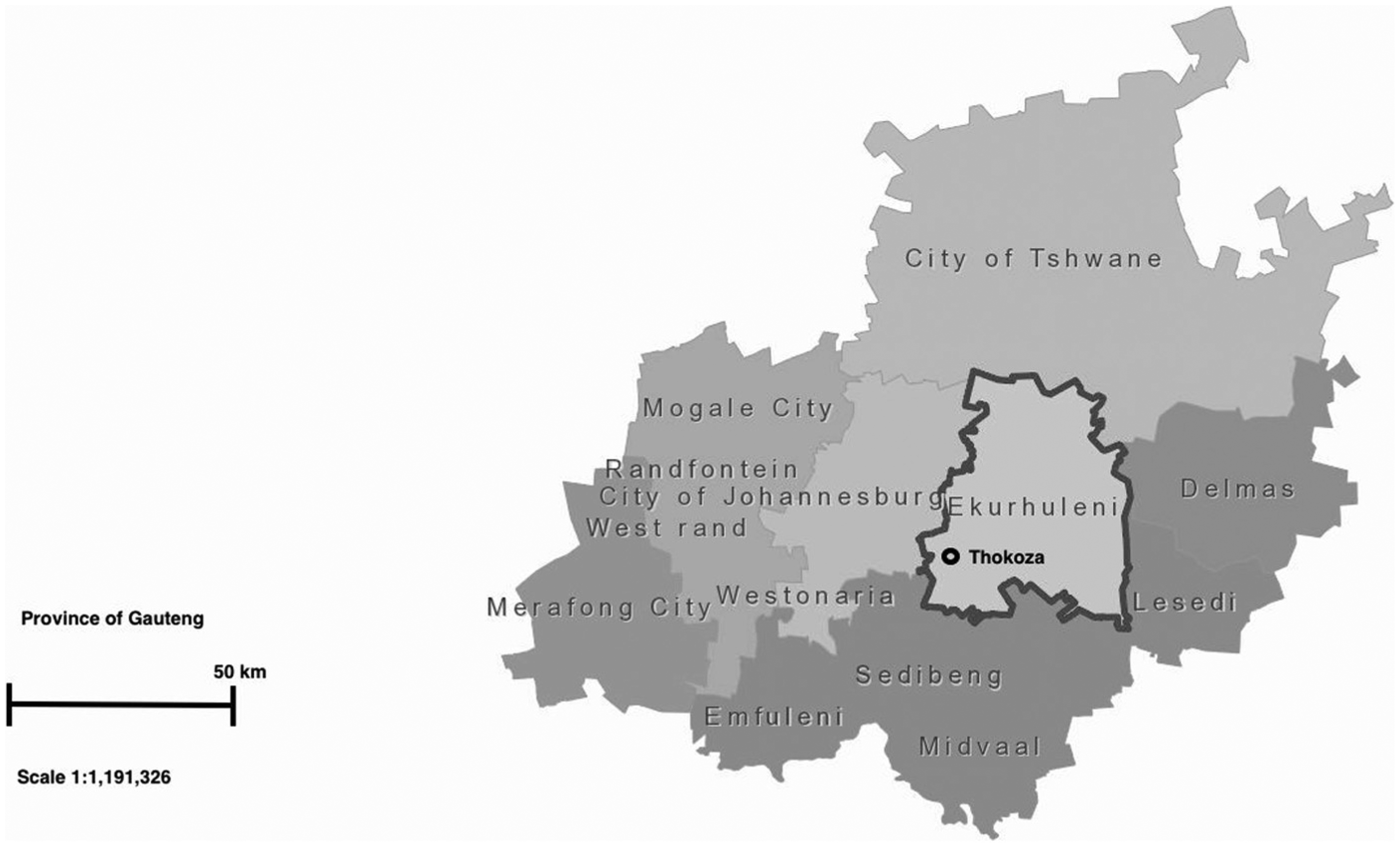
Location of Thokoza in Ekurhuleni Metropolitan Municipality.
The research generated accounts of how people had managed to negotiate access to, and retention of, property rights to land over the years. It was based on 15 in-depth interviews with longstanding land users in Thokoza, 12 interviews with municipal officials who reflected on trends across all three sites, and archival work. The data were analysed to identify patterns, including commonalities and differences, which emerged from the different accounts. The following section analyses urban land conflict, first in terms of differing interests over property rights to land, and then by identifying conflicts that have arisen because of the property rights themselves.
A precinct in Thokoza
In some very fundamental ways, conflict about property rights to land is the story of apartheid in South Africa. At the heart of the apartheid endeavour was the attempt to racially control who could use, manage, generate an income from, exclude others from, or transfer land, ostensibly to reduce inter-racial conflict but also for the benefit of those defined as ‘white’ (Beningfield, 2006; James, 2007). This created enduring inequalities in the extent of land ownership and ways in which property rights could be held by different groups. Thus, it is not surprising that the history of land in a precinct in a racially defined residential township tells a story of conflict over property rights. However, what is interesting about this case is what it tells us about the nature of property rights as a cause of conflict.
Conflict over property rights
A brief overview of the precinct’s history is useful to illustrate some of the conflicts that emerged from differences over property rights to land. Thokoza – ironically meaning ‘place of peace’– was proclaimed a township in 1958–1959 by the ‘White’ Alberton Local Authority, in a renewed attempt to reduce conflict by gaining control over migrants (mainly Black African men) drawn to the employment opportunities offered by the wider Johannesburg economy. 1 Black Africans were forcibly relocated to Thokoza from nearby ‘locations’, which themselves had been established by other ‘White’ Local Authorities during failed attempts to control Black African settlement in urban Johannesburg between 1907 and 1910 by forcibly relocating residents of informal settlements around the mines. Overcrowding in officially declared residential areas led to the construction of backyard shacks for rent and the emergence of informal settlements, in a cycle that continues to this day, because the amount of land officially provided for Black African use has been hopelessly inadequate at every stage of the city’s history.
Thokoza was purchased as farmland, re-zoned for residential use, and proclaimed under the Native (Urban Areas) Consolidation Act of 1945 by the ‘White’ Alberton local authority. A total of 17,500 plots were laid out in the township and ‘beneficiaries’ who were allocated a plot were issued with 30-year leases to a plot and a house constructed to minimal standards. In addition, between 1960 and 1980, the Madala, Buyafuthi and Umshayzafe hostels were constructed to house 2500 men attracted to the employment opportunities in the mines and nearby industrial areas. The Alberton Local Authority maintained control over the space in these hostels by requiring prospective residents to apply for a bed and pay for an initial permit. On acceptance, hostel residents paid a monthly rent to municipal workers, who maintained an office at the hostel entrance. Despite the high degree of municipal surveillance and control, by the 1980s the hostel population had risen to 13,000.
In defiance of apartheid regulations, the population living on residential plots in Thokoza doubled between 1970 and 1975 (from 27,673 to 47,900 people). However, almost no new land was made available and only 38 new plots were provided and houses built by the state during the 1970s. The consequence of the local authority’s failure to demarcate additional plots for the growing Black African population, which continued to increase in the 1980s, meant that people moved into shacks constructed in the backyards of existing houses, and also established informal settlements. By 1982 it was calculated that, on average, there were two backyard shacks on each of the 17,500 plots. About 10 years later, the number of backyard shacks was calculated to have risen to 65,000. Initially, the Alberton Local Authority forced the backyard shack dwellers to pay a levy, with the intention of dissuading further settlement and forcing tenants to leave. However, a combination of a growing economy and the dire lack of any other housing opportunities meant that very few tenants left (Sapire, 1992). The (undoubtedly unintended) consequence of the levy was to implicitly sanction the practice of backyard shack rental. In addition, in nearby townships ‘White’ Local Authorities began large-scale forced evictions of informal settlements of people struggling to gain a legitimate foothold in the urban economy. For example, in the first six months of 1983 over 68,000 informal dwellers lost their homes, a significant proportion of whom were ‘repatriated’ to the homelands. The Alberton Local Authority attempted to carry out similar large-scale evictions in Thokoza in 1984, but found it impossible to ignore the, by now growing, outcry that followed and the initiative failed.
Between 1981 and 1990, the population of Thokoza grew from 50,719 to 228,000, according to official figures (Bonner and Nieftagodien, 2001; Vermeulen, 1981). The space and minimal infrastructure planned for 17,500 households was clearly neither sufficient nor adequately maintained for the growing township. The lack of funding for development of extensions to the residential area was justified by the national government’s view that townships should be financially self-sufficient. In order to try and raise money for development and maintenance, local councils were encouraged to increase the rents paid by occupants of state-supplied dwellings, and tariffs for various services. However, this emphasis on increasing revenue from rents and tariffs coincided with a general economic slowdown, and in the ensuing hardship, many households could not afford the increases.
At the same time that the state was forcibly evicting Black Africans from informal settlements and backyard shacks, it was itself establishing the equivalent of informal settlements, leading Sapire (1992) to describe the state’s approach to land management as ‘schizophrenic’. For example, in 1987, the Thokoza Town Council 2 established a ‘temporary’ settlement of 500 households near the Thokoza water tanks, consisting of people forcibly removed from the nearby coal yards. The services provided were so rudimentary that there was little difference between this settlement and typical informal settlements constructed by ordinary people. The area became known as Phola Park, as immigrants and residents of backyard shacks started to settle informally. Although the Thokoza Town Council had sanctioned the settlement of the original 500 households, their legal entitlement to the land was unclear (Bremner, 1994). The legal status of subsequent residents who obtained land by invading and settling informally was even less clear, and thus new struggles over property rights were generated. By 1988 the population of Phola Park stood at 15,000 and by 1991, it was estimated that 24,000–30,000 people had settled on the land, with few toilets and virtually no access to formal water provision.
In the early 1990s, with major political change in the air, the politically conservative Inkatha Freedom Party (IFP) started to build a national identity based on its traditional provincial roots in Kwazulu-Natal, despite the variety of ethnicities in Johannesburg.
In the extremely volatile and violent conditions that ensued, many people were displaced. For example, Respondent 19a, a female long-term township dweller, described how she was dispossessed of her house and had to flee to a different informal settlement, before moving back to the Phola Park informal settlement. However, Phola Park offered little sanctuary. In 1991, at the height of the fighting, 150 people were killed and hundreds of shacks razed. The civil war in Thokoza (mirrored elsewhere in South Africa) continued throughout 1991 and 1992, aided by a complicit apartheid state, mercenaries from neighbouring countries who supplied arms and expertise to both sides in the conflict, and both the main political parties, which were intent on using Thokoza to make ideological points about their capacity to represent the urban population in a post-apartheid scenario.
In 1993, violence intensified around Khumalo Street (see Figure 2), because of the uncertainty engendered by the broader process of political transition. ‘Non-combatants’ were cleared from Khumalo Street and Zulu warlords took over most of the hostels and many of the houses. ANC supporters responded by ‘clearing’ the informal settlements of all those identified as ethnic Zulu. The evicted Zulus either relocated to the hostels (with their families) or returned to their rural homes. The latter were replaced by young Zulu men, intent on advancing the cause of the IFP and Zulu identity. During the ensuing violence, which gripped Thokoza while the remainder of South Africa celebrated the first free elections, hundreds of people lost their rights to property.
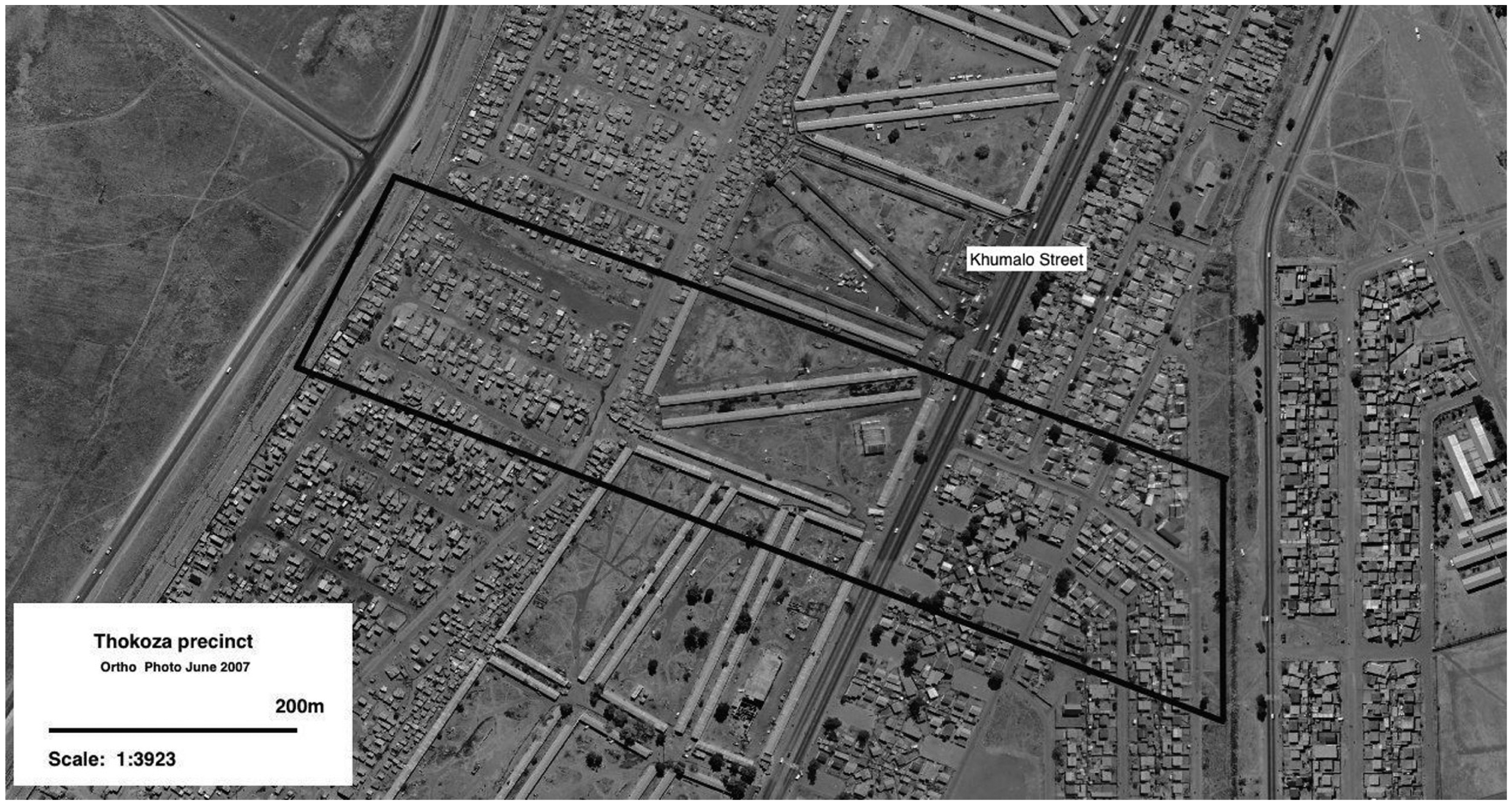
Thokoza study precinct.
Caught up in this violence was a sustained attempt by an NGO – Planact – to shift the focus away from party political-inspired conflict to developmental needs and provision of new land for the people living in Phola Park informal settlement. After stopping and starting due to the wider violence, a participatory project to secure land and housing for people that had settled there informally, re-commenced in 1992. The project had broad support but was ultimately scuppered by two groups of people with different views of, and relationships to, land. The first group was identified, by the NGO and Community Development Committee, as a loosely affiliated group of young men who lived either in the hostels or in Phola Park, but who considered their current residence to be informal and temporary, as they ultimately intended to return to their rural place of origin. These migrants were interested in saving as much money as possible as quickly as possible. While initially indifferent to the project, they came to object violently to any process that would increase the charges they would have to pay.
The second group was comprised of immigrants from Mozambique, a country itself gripped in a long-running civil war, many of whom played an active role in the violence. Their military experience and contacts, which proved invaluable in sustaining the violence in Thokoza, also provided a means of leveraging a plot on which they could settle informally. Mozambican immigrants had initially tended to settle on the periphery of Phola Park. However, housing policy regulations meant that formal property rights could only be granted to South African citizens. Ultimately, the Mozambican residents in the informal settlement would have been evicted, motivating them to oppose the project because they felt that if they could not hold onto their hard-won gains in Thokoza, they would have nowhere else to go (Baskin, 1993; Bremner, 1994). When members of the Community Development Committee, who were supposed to represent community interests during the upgrading project, were assassinated, the project came to halt.
With respect to conflict over rights to land, therefore, the story of Thokoza demonstrates that in the South African context, a significant element in conflicts may be about gaining what are considered to be the most secure property rights. In 2006, leaseholds in Thokoza were converted to freehold titles under a Regularisation and Transfer of Ownership scheme. Leaseholders who could prove that they had been paying rent were offered the chance to purchase their land and dwelling. The purchase prices were heavily discounted, and in some cases occupants were simply declared the owners. As part of this process, households that had lost their plots during the violence of the early 1990s were reinstated as the legitimate owners of the property rights.
I have sketched a very conflictual period in Thokoza’s history, in which people were deliberately only offered, if at all, partially legitimated or secured property rights, which led to a struggle over property rights. To return to the type of analysis that is inspired by a ‘distributional’ analysis of property rights, the struggle is conceived as being over converting an individual’s property rights to higher or more secure levels. This is, of course, an important struggle. Poor and marginalised groups can benefit from the security associated with state-backed property rights. Moreover, the ‘fears and desires’ that underlie individual psychological and physical forms of security are important and need to be taken seriously, even if they are difficult to pin down analytically. However, this type of analysis tends to only legitimate one specific form of conflict – struggles over the distribution of secure property rights – as worthy of engagement by activists and scholars, but does not help explain why urban land conflicts continue to rumble along, even where significant numbers of people have ‘higher’, more secure property rights.
Property rights as a lens through which to analyse conflict
In this section, I examine how the different property rights that people hold, use and acquire can themselves contribute to conflicts. I focus on how property rights in Thokoza are the outcome of conflict between different social groups; how nominally similar property rights in different parts of the city are not the same in practice; how property rights in Thokoza are less well-protected and enforced than in other parts of the city; and how property rights are associated with social networks that may contain elements that act as lightning rods to other conflicts and hence can never be neutral.
Property rights as the outcome of conflict
In the 1950s, the apartheid state allocated Black Africans township plots and houses with leasehold rights, initially for 30 years and later for 99 years. 3 These were seen as conveying rights inferior to those provided by the freehold property rights available to White Africans, but superior to any other property right permitted to Black Africans. That is, leasehold property rights were caught up in complex relationships with other rights. In a pattern that repeated itself time and time again, the apartheid state used divide-and-rule strategies relating to land to create conflicts, weaken opposition and maintain control. While a 30-year leasehold was not the same as freehold, it was a good deal better than renting, settling informally or, worst of all, relying on customary property rights that were under severe pressure in the overcrowded rural ‘homelands’. Thus, despite facing the same forms of general discrimination, different groups of urban Black Africans, all desperately trying to avoid being bundled out to the impoverished homelands, were pitted against each other as the state used property rights in contradictory ways to stoke and try to manage racial conflict.
Of course, property rights are also the outcome of many other processes and not just conflict, however embedded and pervasive it might be. It is therefore necessary to consider other aspects of property rights to land, such as how these may be nominally similar but different in practice and thus leading to expressions of conflict.
Property rights as expressions of conflict
Despite their relative superiority, the leasehold property rights people held in Thokoza were of a lower quality than leasehold rights held (by whites) in other parts of Johannesburg. Thokoza was hastily established to avoid conflict and maintain law and order by accommodating Black Africans and address the lack of space of the other nearby townships established between 1950 and 1954 (Katlehong and Vosloorus) to absorb the growing numbers of Black African residents.
The area of land provided for Black African housing in the 1950s was insufficient and, moreover, plots were not accompanied by budget allocations for the provision of infrastructure or the construction of good quality housing. This apartheid-inspired failure led to further conflicts, as the pressures arising from overcrowded living affected other housing areas and their residents. The authorities quickly realised that merely providing land would result in the emergence of environments that were as difficult to police and control as the shack settlements they had just demolished. It became evident that at least a basic level of servicing and housing provision would be necessary to achieve some degree of order.
The dilemma created by the need to provide more land to house Black African urban residents without incurring increased costs or antagonising ‘White’ local authorities by burdening them with additional costs was addressed by providing for the use of cheap Black African labour to construct dwellings in the townships, through the promulgation of the Bantu Building Workers’ Act of 1951. The provisions in this Act legalised the training of Black Africans as skilled labour in the construction industry but restricted the places in which skilled workers were permitted to work. As a result of these provisions, building costs were significantly reduced. In addition, in order to meet part of the cost of improvements to the land, the Bantu Services Levy Act of 1952 provided for a levy on Black African employees. In this sense then, even though leasehold rights were nominally the same across different racial groups, in effect, those held by Black Africans were impoverished in terms of local authorities’ access to finance to improve the quality of land and housing held under the rights.
Thokoza’s property rights as less protected and enforced
So far, I have illustrated how property rights were used to create conflict between different groups and how those issued to urban Black Africans by the state were of lower quality than those provided to other groups defined in racial terms. In addition, both leaseholds and rental permits in Black townships were more weakly protected and enforced than property rights held by whites. Black African local authorities lacked the resources and legitimacy to effectively enforce property rights. Thokoza was ‘governed’ successively by a number of different ‘Boards’, ‘Councils’, ‘Administration Boards’, ‘Community Councils’, and ‘Black Local Authorities’, entities which had two features in common. First, while provision was made for increased Black African control over local matters, the apartheid authorities ensured that the local bodies had limited power and autonomy and that control over them could be maintained. Second, the new bodies were increasingly expected to be self-financing. Typically, additional resources could only be generated by raising rents or service charges, which the impoverished residents could not afford to pay. As a result, the local authorities were consistently inadequately resourced and many ran into debt. By 1984, Thokoza Township had accumulated arrears of rent and service charges that amounted to R340,399 and that doubled over the course of the following year to R626,153, partly because a boycott of the Thokoza Black Local Authority was staged in 1985. 4 In response, the area came to be considered ungovernable and a State of Emergency was declared – student and trade union leaders were harassed, assaulted and arrested, reducing the level of political activism in the area until the 1990s.
Life continued to get more difficult for residents as schools were closed and criminal gangs emerged in the vacuum left by the arrest and detention of political and civic leaders. In the mid-1980s, the apartheid state embarked on a ‘Great Sale’ of township housing in order to moderate political demands, based on a principle of ‘buy your property or lose it’. In order to buy their plots, leaseholders pushed up the rents of tenants in backyard shacks or crammed in more shacks (Sapire, 1992). Conditions in the township worsened, until it was not uncommon for 11–15 people to share one toilet and 150 people to share a tap. By 1987, Thokoza was the most congested township on the East Rand because of the failure to provide additional land to accommodate the growing population and the financial demands placed on the original leaseholders. The congestion, deteriorating services and worsening living conditions resulted in constant conflict and tension caused by too few resources being shared by too many people.
In addition, the government failed to legitimate those formal property rights that it had allocated in Thokoza. While the township had been re-zoned in 1958 and the land subdivided (referred to as a process of proclamation), title deeds were only finally and completely registered in the Deeds Office (referred to as the establishment of the township) 26 years later in 1984 under the Black Communities Development Act, No 4 of 1984. This provided for certain Black Africans holding rights under the 1945 Native (Urban Areas) Consolidation Act to be granted freehold ownership. The BCDA was repealed by the Abolition of Racially Based Land Measures Act No 108 of 1991 except for Annexure F, because the latter was the only legislation governing land use in townships. Annexure F permits a wide range of activities and imposes no density or height restrictions on plots. Its continued use as the framework for managing land use and construction in townships appears to be a pragmatic acceptance by the post-1994 government and local authorities of the outcomes generated by years of neglect of conditions in townships such as Thokoza.
Property rights as part of networks that transmit conflict from elsewhere
The final illustration of why it is hazardous to take the nature of property rights for granted in considering urban land conflicts over such rights returns to the consideration of how rights are dependent on networks of agents, institutions, processes, documents and so on, for their validity and value. In this section, I present instances of how rental permits in hostels and backyard shacks, and informal ownership claims to land, circulate in very different networks that can themselves transmit conflict from elsewhere.
As noted earlier, from the 1960s onwards, permits were issued to entitle recipients to live in single-sex hostels in Thokoza. These were similar in concept to standard tenancies of public housing, but provided less security. Their use can be seen as another elaboration of the government’s divide-and-rule strategy. Not only were the permits issued only to men, they were granted tenure that was different from (and regarded as inferior to) leasehold. In addition, spaces in the hostels were allocated along ethnic and language lines, extending segregation practices to the micro-level. These allocation processes were endorsed by many migrants, who sought succour from the difficulties associated with migrant life and the brutalities of apartheid in their relationships with people with whom they had kinship and other links.
The hostels were thus distinctive spaces in which social networks were linked to the rural origins of the migrants. In addition to the state’s attempts to physically isolate migrant workers from township residents (in the name of conflict reduction), the research showed that migrants themselves drew heavily on their shared rural values, which they often perceived as superior to urban values, and which they considered their township neighbours to lack. For example, older hostel dwellers, referred to as ‘big brothers’, sought to ‘protect’ newer residents from the ‘corrupting’ influences of urban township life. Young migrants were often mentored by more experienced migrants, who advised and guided newcomers, and monitored their behaviour, spending patterns and leisure time – all within a strict hierarchy of respect based on age, similar to the characteristics of rural South African societies. For example, Respondent 2, a long-time hostel dweller, remarked that: he [the big brother] would give you some of [your salary], and save the rest, but if they found that you take some money from your salary before the big brother has it, oh … my god you will be in big trouble. Such things made people disciplined and work for their families.
Thus, the social networks associated with hostels were heavily invested in maintaining rural linkages and identities, making them very much islands of imagined rurality in the heart of urban Thokoza. While rural values were important in the lives of many township dwellers (James, 2007), the hostels reinforced the government’s preference for Black Africans to be only temporary urban residents, and their allocation practices reinforced ethnic and rural identities. Moreover, while the government owned and initially oversaw the running of the hostels and acted as if it was the only source of authority, it also made use of forms of authority based on a customary rural institution, resulting in the reproduction of conflicts associated with this institution.
The authority figures were the izindunas (customary headmen in Zulu society), who controlled access to accommodation and the management of and transactions within the hostels. Although this leadership institution was derived from rural society, its authority was based on municipal endorsement and its role as the government’s informal but extremely powerful management arm. One of the headmen in the Thokoza hostel described his role as being: to resolve conflict among people, for example if there was a conflict between someone from Enqhuthu and someone from Emsinga,
5
I’d contact the person in charge at Emsinga to resolve the issue, then the person that is found to be guilty must apologise in the traditional way with a sheep or cow and even money. If it happens they kill each other, that’s where I come in, I’d send a report to the king every year. I once sent cows to Emsinga from the Ntenga family … The problem must be resolved.
Thus, access to and the use of accommodation, the value and validity of the permit as a form of property right and mechanisms for resolving conflicts over land and other issues depended in part on social networks that worked over great distances, transmitting (although rarely without some distortions) social conflicts from rural to urban and urban to rural areas. In addition, they depended on complex interactions and interdependencies between formal (municipal) and informal or customary institutions (the izindunas), resulting in the emergence of a multi-nodal, multi-valent network of agents, processes and temporalities in which conflict could be transmitted through property rights.
Another example of this can be seen in the state’s tacit acceptance of tenants’ informal rights to backyard shacks, even though such tenants are embedded in social networks different to those of the leaseholders on whose plots they live. Informal systems based on social networks have emerged to manage the space within plots. For example, reflecting on the process of finding somewhere to live, a male backyard tenant observed: The best thing is to network with people, ordinary people. If you are working, talk to people at work, or if you go to church, tell people, or if you go to the library, tell people that you are looking for a place to rent – they can help. Because you can’t wake up in the morning and look for a place to stay by doing door-to-door. You won’t find it. (Respondent 19, 2)
Finally, property rights in the informal settlements are negotiated through complex networks that include elements of the state and political parties. That is, in the informal settlements ownership rights are not purely informal, since the local councillor’s endorsement of transactions in land is required. For example, describing how she had obtained a plot in the informal settlement behind the hostels in 2000, Respondent 22 recounted how she had been shown a piece of land by the ‘owner’ and advised that she could occupy it and build a shack if she could produce an ‘organisation card’ that would prove that she was a member of the IFP. Other respondents suggested that such a political affiliation was no longer required to access land, although they reported that it was still necessary to make their request to the local representative of the IFP. This representative, in conjunction with the formally elected municipal councillor, would reportedly make the decision on whether to grant an applicant access to a plot or to approve a land sale. There is thus an interaction of informal and formal allocation mechanisms. Satisfying these requirements might suggest that ‘owners’ in informal settlements have security, but at the time of the research, one resident reported that they had recently been told that they were to be evicted because the council wanted to build a stadium on the informally occupied area.
I have presented four examples of the ways in which different property rights were themselves the outcome of conflict, expressions of conflict, vulnerable to conflict or a channel for transmitting conflict from elsewhere. In the concluding section, I consider what value this additional mode of analysis adds to understanding urban land conflict.
Conclusion
The aim of my argument has been to complement existing understandings of, and engagements with, urban land conflicts relating to property rights. There is certainly great value in understanding urban land conflicts in terms of people’s struggles over property rights to particular parcels of land, as suggested by Wehrmann (2008). Such a framework guides activists and scholars to assess the relative power and strengths of different parties in conflict and to identify the interests that might underpin and shape the conflict. This type of analysis is fundamental for engaging with distributional conflicts.
However, I highlight the added value of also assessing how the nature of property rights are already constituted by conflict and the two differences this makes. First, such an analysis reveals additional sources of conflict, suggesting processes and social interactions that can be engaged with by activists and scholars. Adding to the view of conflict between different parties, the analysis has shown how different forms of property rights are themselves the outcome of wider political and social conflicts, histories that continue to be reflected in contemporary forms and understandings of property rights.
In the South African context and elsewhere, there is a tendency to take (particularly state-sanctioned) property rights as given, for analysis to focus on conflicts between those seeking land with such defined rights, and for policy and practice to focus on issuing or upgrading rights and claims where desirable or possible. However, based on an in-depth analysis of the history of a single precinct within a typical township in Johannesburg, I have argued that this focus is insufficient to understand and explain urban land conflicts that relate to property rights. Instead, analysis of urban land conflict should be extended beyond assessing the relative power of different parties struggling over property rights to land to consider the wider causes and effects of conflict, including those inherent in different categories of property rights themselves. Such an improved understanding could lead to the identification of a broader suite of interventions, which might be able to realise the progressive or ameliorate the regressive effects of conflict for the different parties involved.
Second, the conflict imbricated in property rights may suggest new forms of engagement in urban land conflict. This is because these forms of conflict are a reflection of underlying structural inequalities that continue to disadvantage particular groups. Some of these are rooted in historical inequalities and some originate elsewhere. In Thokoza, some of the struggles over property rights have supposedly been resolved, in that some residents have contested their inferior leaseholds and won the right to formal freehold property rights. However, conflicts over land rights continue: some between residents and the state remain unresolved, while others rumble along at a low level. For example, the quality of freehold property rights in Thokoza is less than elsewhere in Johannesburg, partly because these property rights incorporate the outcomes of prior conflict. Freehold owners in Thokoza and other similar areas are unable to use their titles as collateral for formal loans.
This understanding adds to the analysis gained from a ‘distributional’ analysis, where the underlying causes of conflict are traced to individual interests driven by fears and desires. While it is not as easy to map conflicts caused by the nature of property rights as those between individual interests it is important to do so to broaden our understanding of how conflicts relate to social change. A failure to engage with the nature of property rights means that, sometimes inadvertently, an exclusive focus on struggles over the distribution of property rights perpetuates the idea that the only property rights that count are private property rights held by individuals, and that the reason they are so highly valued is because they are perceived to be free of conflict.
Footnotes
Acknowledgements
The article draws on research conducted with Dr Margot Rubin and Progressus Research and was commissioned by Lauren Royston under the Urban LandMark programme led by Dr Mark Napier. I am grateful to all of them for the lively discussions during the research. I would also like to thank the anonymous reviewers and editors of Urban Studies for many helpful comments. Special thanks are also due to Melanie Lombard and Carole Rakodi for their advice, inspiration and insights. It goes without saying that I alone am responsible for any errors that have arisen as a result of preparing this article.
Funding
The Urban LandMark programme funded the original research on which this article is based.