



Abstract
This paper presents a critical analysis of the contemporary policy focus on promoting employability among young people in the UK. Drawing on analysis of UK policy approaches to tackling youth unemployment since the late 1970s, we suggest that existing critiques of employability as ‘supply-side orthodoxy’ fail to capture fully its evolving meaning and function. Under the UK Coalition Government, it became increasingly colonised as a targeted tool of urban governance to legitimise ever more punitive forms of conditional welfare. We argue that this colonisation undermines the value of the notion of employability as an academic tool for understanding the reasons why young people face difficulties in entering the labour market. The paper suggests that the notion of youth transitions offers more potential for understanding youth unemployment, and that more clearly linking this body of research to policy could provide a fruitful avenue for future research. Such a shift requires a longer term, spatially informed perspective as well as greater emphasis on the changing power relations that mediate young people’s experiences of wider social and economic transformations. The paper concludes that promoting employment among urban young people requires a marked shift to address the historically and geographically inadequate knowledge and assumptions on which policies are based.
Introduction
Recent UK policies on youth unemployment have been underpinned by a static and simplistic notion of employability rooted in supply-side orthodoxy, which presents worklessness as a behavioural and cultural shortcoming among individuals (e.g. DWP, 2008, 2010; HM Government, 2011a, 2011b). As a discourse it focuses on the relative employability of workless young people in explaining the difficulties they face in securing and maintaining a foothold in increasingly competitive urban labour markets. This narrow, individualised conceptualisation of employability has been critiqued by those arguing for a broader notion which recognises the importance of geography and demand-side factors, such as the relative buoyancy of local labour markets (Lindsay and Houston, 2011; McQuaid and Lindsay, 2005).
At the same time, from a youth studies tradition, the growing complexities of urban society have been increasingly cited by scholars researching urban youth unemployment as a central factor impacting negatively on the labour market opportunities of young people over time (Furlong and Cartmel, 2007; MacDonald and Marston, 2005; McDowell, 2002; Roberts, 2011; Thompson, 2011). They have drawn attention to the increasing complexity and non-linearity of youth transitions since the 1970s in accounting for the deterioration in labour market prospects, particularly among urban youth in the UK’s cities. Key processes here include deindustrialisation, labour market restructuring, the changing nature of post-compulsory education transitions and an increasing individualisation in the responses of young people which is deemed to have ‘obscured the role of social structures in shaping life chances’ (Thompson, 2011: 790). Taken together these academic endeavours have made important contributions to our understanding of urban youth unemployment in challenging the narrow supply-side focus of policymakers.
In this paper we further build upon and critique the notion of employability informing policy. In particular, we question its usefulness in understanding and diagnosing urban youth unemployment. We suggest that existing academic critiques of the conceptualisation of employability underpinning policy need to be cognisant of a distinct shift in the nature of labour market policy under the Coalition Government of 2010–2015. Analysis of policies on youth unemployment since the 1970s shows a gradual structural shift towards a more punitive regime characterised by increasing conditionality and benefit sanctions. Until recently, this has been accompanied by ‘relief cycles’ (Peck, 2001) where conditionality is largely intensified during periods of economic growth and eased during downturns. We show how this cyclical pattern came to an abrupt halt under the Coalition Government which increased both the intensity and coverage of conditional forms of welfare applied to young people during a period of high youth unemployment. While ‘creeping conditionality’ (Dwyer and Wright, 2014) has been a feature of employment policy since the 1980s, recent welfare reforms under the Coalition Government were distinguished by the extent to which young people have been the target of spending cuts, less generous benefits, tighter eligibility criteria and more punitive forms of welfare. This is beginning to manifest itself in the emergence of a cohort of young people increasingly at risk of worklessness and poverty relative to older groups (MacInnes et al., 2013).
What’s more, these processes and outcomes have occurred during a period in which young people are becoming ever more employable as indicated by levels of formal qualifications. We suggest, therefore, that the notion of employability is more than simply a form of supply-side orthodoxy. Rather it has been colonised as a form of discursive legitimisation for neoliberal policies which seek to reduce the costs of supporting young people while simultaneously compelling their engagement with ‘flexible’ and insecure labour markets. This is likely to accentuate the difficulties faced by marginalised youth and contribute to their continued stigmatisation. In this sense recent approaches to youth unemployment would seem to correspond to the notion of ‘neoliberal state-crafting’,‘whereby governments purport to curb, contain, or reduce the very poverty that they have paradoxically spawned through economic deregulation, welfare retraction and revamping, and urban retrenchment’ (Wacquant, 2013: 41).
For these reasons, we remain sceptical of academic attempts to ‘reclaim’ the notion of employability by emphasising the importance of demand-side factors. In seeking alternatives, we consider the concept of youth transitions. This literature seeks to widen the debate, from one dominated by behavioural economics and labour market studies, by acknowledging the importance of longer-term social change and its impact on the youth segment. While there is an important and growing evidence base on the outcomes of ‘the coincidence of a series of economic changes’ (McDowell, 2002: 39) that have significantly altered opportunities for young people – and particularly those towards the bottom of the class structure – few accounts have sought to explain the longer-term urban processes contributing to these differential outcomes across space: ‘despite much research interest in youth transitions, the interactions among a series of cultural, institutional, familial, economic, and political changes and their attendant impacts at this extended stage of the life-course have, to date, not been systematically described’ (Roberts, 2011: 25).
Though a systematic description of the kind advocated by Roberts is beyond the scope of this paper, an implicit and secondary contribution is to point towards the potential linkage between youth transitions research and policy through a broader political economy of welfare. We suggest that a revision of the concept represents a fruitful avenue for the youth studies research agenda. Such an approach, following Cote (2014), places greater emphasis on institutional and political change, the power relations in which young people are embedded and how these change over time alongside wider social and spatial processes in explaining the labour market marginalisation of some young people: the least powerful. Indeed, our primary focus here is on those at the bottom of the class structure who find themselves in a much weaker position relative to previous generations and also to their middle-class peers. These young people are invariably: the marginalised section of the youth cohort for whom middle-class notions of individualisation as an empowering force do not hold true given their relative lack of access to economic, political and cultural capital (Bright, 2011; Lawler, 2005; Skeggs, 2004; Willis, 2014); an increasingly stigmatised group facing widespread contempt (Skeggs, 2009) and ‘diminished levels of empathy from the middle-classes’ (Vertigans, 2015); and are therefore deemed to warrant a targeted approach by the techniques of welfare conditionality due to their perceived individual, cultural and moral inadequacies (Kennedy, 2014). That said, though the tropes of employability are focused on this group, the effects resonate across a wider youth cohort including unemployed graduates for instance.
The remainder of the paper is divided into three sections. Firstly, we explore the concept of employability as it specifically relates to youth unemployment and the notion of increasingly complex youth transitions. This critical, cross-disciplinary academic literature highlights a disjuncture between empirical evidence and the simplified and individualised concept of employability characteristic of policy assumptions. In the second section we examine labour market activation policies since the late 1970s and recent welfare reforms targeted at workless youth. This analysis highlights the way in which these have, in combination, become increasingly punitive and dis-embedded from ‘relief cycles’ which have historically exhibited a more expansive and ameliorative policy approach during periods of economic decline or stagnation (Peck, 2001; Piven and Cloward, 1971). We also present time series data at the city-region level on the employment status and educational levels of young people in England’s core cities. This illustrates how more punitive forms of workfare have been implemented precisely at the time young people are becoming more employable as measured by formal academic qualifications. Despite this, levels of employment have fallen, which undermines the link between employability and employment. Thirdly, drawing on this evidence, we problematise the simplistic notion of employability, in terms of both academic and policy discourses, and advocate a longer-term, dynamic and theoretically-informed approach in understanding youth labour market disadvantage. We conclude that approaches to tackling unemployment among urban young people require a marked shift to address the historically and geographically inadequate knowledge and assumptions on which policies are based.
Urban youth unemployment, employability and youth transitions
It is important to situate policies and narratives of youth unemployment within the wider context of the problematisation of urban youth more broadly. Urban youth have long occupied an ambivalent position within UK society (Cohen, 2002 [1972]; Pearson, 1983). This translates into the differential treatment and targeting of some young adults within public space and policy more broadly: ‘residual youth groupings, including the young unemployed, homeless, poor and often those from ethnic backgrounds, are excluded, segregated, incorporated, policed and in some cases literally “swept off the streets”’ (Chatterton and Hollands, 2003: 88). In recent years notions of a lack of self-restraint and consideration for others among young people, often linked to deficient parenting and readily located within inner city areas, have been central to the plethora of policies and interventions to emerge under anti-social behaviour legislation (Flint and Powell, 2012; Law and Mooney, 2013; Riots Communities and Victims Panel, 2012; Rodger, 2008). This conflation of the behavioural roots of urban disorder with the moral deficiencies seen to contribute to youth unemployment has the effect of spatialising the latter as a distinctly urban problem. Such tendencies are reinforced by the less controversial observation that youth unemployment remains concentrated in some of Britain’s less buoyant towns and cities (Crowley and Cominetti, 2014) and consistently higher in urban than rural areas – even if the gap is closing (Commission for Rural Communities, 2012). Evidently, most policies on youth unemployment are determined, and applied, nationally and youth unemployment cannot be conceived purely as an urban problem. However, both discursively and empirically, it tends to retain a distinctly urban emphasis in policy terms. These wider developments in urban governance are crucial to understanding the position of, and policy approaches to, workless young people as they give rise to the particular framing of youth unemployment and employability within urban policy along behavioural and cultural lines.
The policy realm of youth unemployment is particularly susceptible to heightened public fears and anxieties related to the perceived threat to the social order presented by a mass of unemployed among the youth ranks (Fergusson and Yeates, 2014). For example, the urban riots and disorder in English cities in 2011 were followed by proclamations about the loss of work ethic among a ‘lost generation’ of urban youth as part of a narrative of social malaise and moral decline in which ‘cultures of worklessness’ form a central component (DCLG, 2012; Flint and Powell, 2012; Slater, 2014). This narrative revolves around long-standing discourses of ‘dependency’ that individualise the problem of unemployment and wider worklessness (Crisp, 2009; Fraser and Gordon, 1994; MacDonald and Marston, 2005; Patrick, 2014; Peck and Theodore, 2000; Schram, 2000; Shildrick et al., 2012a).
In the 1980s, the rhetoric of the New Right in the UK ‘transmuted social issues like unemployment into moral problems’ and the focus shifted to an ‘intensification of the tendency to personalize unemployment’ (Cole, 2008: 32). This phenomenon is also evident across Western neoliberal societies (Fraser and Gordon, 1994; Peck, 2001; Wacquant, 2008) and is central to an emergent global youth unemployment discourse (Fergusson and Yeates, 2013, 2014). A key assumption underpinning labour market policy in the UK (and beyond) since the 1980s, then, is the notion that large sections of the workless population lack the values and behaviours deemed necessary to fulfil the societal obligation of work. Empirical research shows such characterisations apply particularly to young people not in employment, education or training (‘NEETs’) (Lawy et al., 2009). However, we suggest that employability discourses are increasingly targeted and classed, informed by the widespread and seemingly relentless negative representations of workless urban youth 1 (Pickard, 2014).
This discursive construction of the problem of unemployment as one of individual shortcomings has been accompanied by a shift from a focus on the individual’s right to a decent standard of living – characteristic of the post-war settlement – to the individual’s responsibility to society and a change in the notion of ‘entitlements’ (Dwyer, 1998; Flint, 2009; Peck, 2001; Peck and Theodore, 2000). Central to this is a switch in understanding from unemployment as a structural condition explained by a lack of employment to an individual problem caused by a lack of employability (McQuaid and Lindsay, 2005; Peck and Theodore, 2000). McQuaid and Lindsay (2005) show that the concept of employability has a long genealogy, with several changes in meaning discernible over time. In recent years, however, it has come to signify a ‘supply-side orthodoxy’ (McQuaid and Lindsay, 2005: 204) that unemployment is explained by the deterioration of skills, work habits and commitment among individuals over time (see also Theodore, 2007). In relation to youth, this narrow characterisation has generated a new policy orthodoxy among policymakers and some academics which posits that: ‘Unemployment, by and large, is a product of the low skills and aspirations of the young unemployed. Problems of young people becoming NEET or trapped in poor-quality jobs can be solved by “up-skilling”’ (MacDonald, 2011: 434). Our focus here is on a wider youth cohort, broadly defined as those young people in urban areas whose everyday lives defy their static characterisation as NEET, underemployed etc. Rather, we refer in particular to the urban youth population that finds it increasingly difficult to secure and maintain employment and who may move regularly between discursive categories; itself a factor in their representation as ‘chaotic’, or ‘lacking the habits of work’ (i.e. employability).
The policy logic of focussing on employability invites ‘supply-side interventions towards activating underemployed segments of the labour force through training, job-readiness programming and unemployment benefit reforms that encourage (and increasingly compel) rapid entry into work’ (Theodore, 2007: 929). Furthermore, it legitimises conditionality as a necessary tool to activate passive welfare recipients in order that they fulfil their responsibility to look for work (Dwyer, 1998; Peck, 2001; Patrick, 2014). Accordingly, labour market policies have increasingly focused on the ‘responsibilisation’ of welfare recipients, with urban youth a particular target for successive UK governments (Law and Mooney, 2013). Peck (2001) argues these changes can be understood as a shift in the regime of regulation from one of ‘welfare’ to ‘workfare’. For Peck, workfare can be understood as a distinct political response to the need to create a ready supply of workers for the low-paid and contingent work that has emerged in the wake of economic restructuring: ‘workfare is not about creating jobs for people that don’t have them; it is about creating workers for jobs that nobody wants’ (Peck, 2001: 6). Peck draws on Piven and Cloward (1971) to suggest that this systemic change in the institutional architecture and rationale of labour market policy has been paralleled by successive ‘relief cycles’ where punitive policies are eased during an economic downturn and then ratcheted up during an upswing. The logic is that expectations to find work can be reasonably increased as job opportunities become more plentiful, not least because jobseekers might otherwise become too discerning in whether to take up less attractive opportunities. Thus workfare has both structural and cyclical dimensions.
The more recent work of Loïc Wacquant (2012, 2015) has since sought to widen this lens to emphasise how workfare has emerged in tandem with ‘prisonfare’ in the United States and, to some extent, across Europe as a dual mechanism to contain poverty generated by economic restructuring and welfare retrenchment. This ‘double regulation’ (Wacquant, 2012) is distinctly urban in character as it is directed primarily at highly marginalised groups of the post-industrial working-class concentrated in the most disadvantaged areas of cities: what Wacquant refers to as ‘areas of relegation’. Workfare is also increasingly global in scope. Whilst the UK has long been highlighted as an example of policy transfer of American policy paradigms around workfare (Daguerre, 2004), there are signs of ‘emerging tendencies’ towards more disciplinary forms of US-style workfare across other Western Europe states too (Brodkin and Larsen, 2013: 43) and often targeting the most marginalised sections of urban societies (van Baar, 2012). Thus, on a higher level, alongside the emergence of a global youth unemployment discourse (Fergusson and Yeates, 2013, 2014) is an international shift in terms of the punitive management of ‘problematic’ populations.
The narrow conception of employability underpinning this shift to conditional, workfarist forms of ‘welfare’ has come under sustained criticism. McQuaid and Lindsay (2005: 207) argue for a broader conceptualisation that understands employability as ‘being derived from, and affected by, individual characteristics and circumstances and broader, external (social, institutional and economic) factors that influence a person’s ability to get a job’. External factors include: the attitudes of employers towards the unemployed; the supply and quality of training and education; the availability of other assistance for disadvantaged job-seekers; the extent to which the tax-benefits system successfully eliminates ‘benefit traps’; and (most importantly) the supply of appropriate jobs in the local economy. This introduces demand-side considerations into the notion of employability and suggests that it is the interrelationship between demand- and supply-side factors that explains employability. The adequacy of this broader conceptualisation for understanding the situation of young people in the labour market is, arguably, only partial however. Addressing demand-side factors as part of the concept of employability recognises the importance of geography in terms of local labour market conditions, as numerous commentators advocate (Beatty et al., 2010; Keep and Mayhew, 2010; McQuaid and Lindsay, 2005; Theodore, 2007). But it still neglects historical processes, the salience of class and power relations in contributing to uneven labour market opportunities. These shortcomings have been acknowledged, to some extent, in the youth transitions literature.
There is a growing consensus that changes in school to work transitions have become increasingly fractured and more complex since the 1970s with young people dependent on the family and state for longer periods (Furlong and Cartmel, 2007; MacDonald, 2011; McDowell, 2002; Roberts, 2011; Thompson, 2011; Yates et al., 2011). Reasons include the expansion of full-time places in higher and further education, the raising of the school-leaving age and the collapse of the traditional rapid entry into employment in manufacturing and heavy industry within post-industrial cities (Pollock, 1997; Yates et al., 2011). In the UK in the mid-1970s ‘two-thirds of teenagers went straight into employment at age 16, at the end of the 1990s less than one in ten 16 year olds looked for work as they completed compulsory schooling’ (McDowell, 2002: 42). Thompson (2011: 789) argues that policymakers reduce the growing complexity of school to work transitions to a problem to be addressed at the individual level: ‘Low attainment, restricted aspirations, and negative attitudes and behaviours are essentialised, regarded as properties of young people, families and communities, rather than as consequences of structural inequality’ (see also Bright, 2011). In other words, the fragmentation of youth transitions is reduced to the very same supply-side orthodoxies underpinning narrower conceptualisations of employability. Moreover, the notion of more complex transitions since the ‘golden age’ of the 1960s and early 1970s has also been challenged recently (Goodwin and O’Connor, 2005). We return to the issue of youth transitions in the discussion section below.
Youth unemployment, active labour market policies and welfare reform
This section presents an empirical examination of policies designed to tackle youth unemployment, as well as wider welfare reforms that affect the entitlement of young people to out-of-work benefits. Our primary concern here lies with exploring the norms and assumptions underpinning policy as well as how the timing and frequency of key reforms interacts with changing levels of youth unemployment. The analysis below underpins our assertion that policies on youth unemployment experienced a qualitative shift under the Coalition Government as levels of conditionality were increased and intensified at a time of high youth unemployment.
Table 1 below details a series of labour market initiatives to tackle youth unemployment since the late 1970s. It shows both dedicated active labour market programmes (ALMPs) specifically targeting young people, as well as broader welfare reforms that have increased levels of conditionality attached to receipt of some out-of-work benefits.
Youth labour market activation and welfare reform measures, 1978–2014.
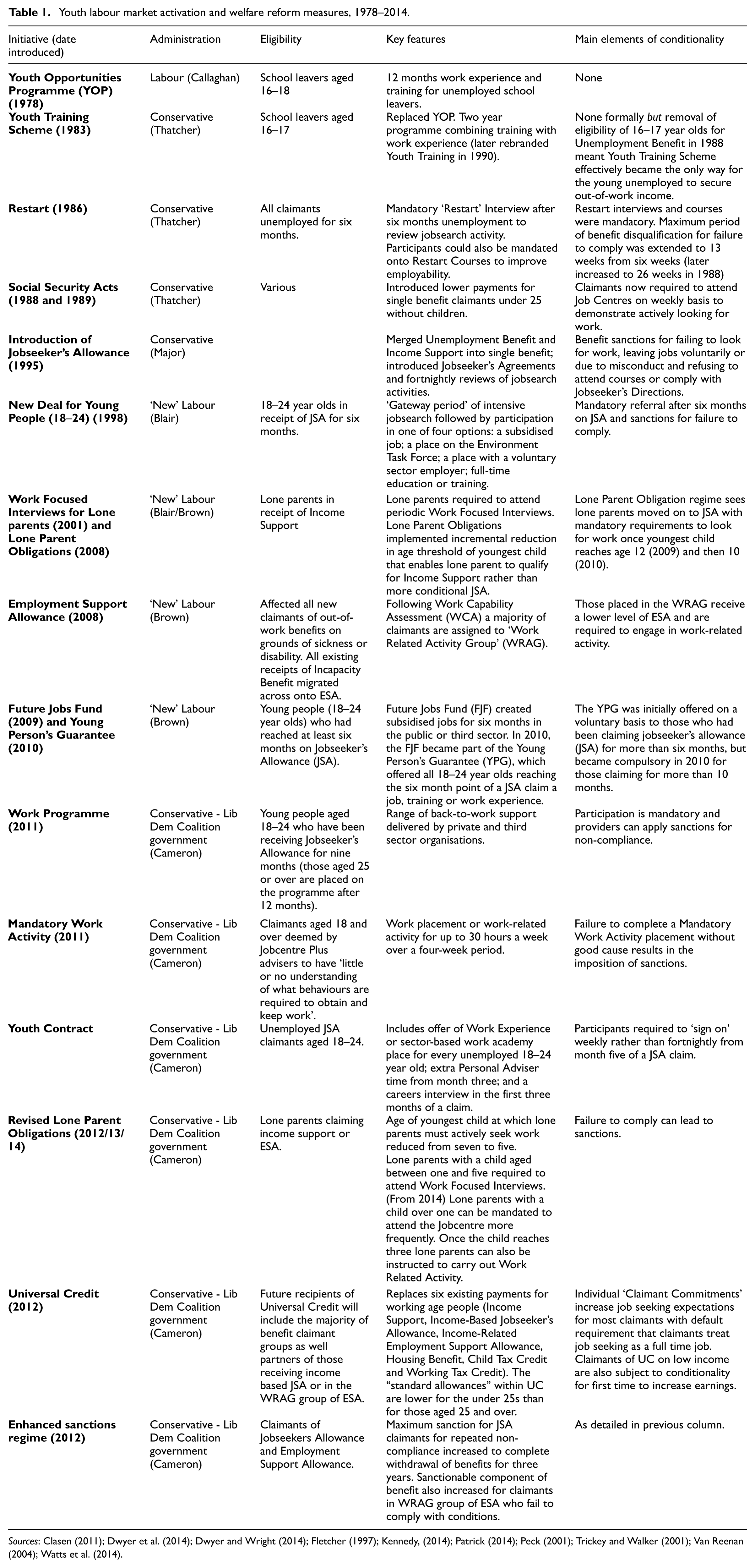
The analysis shows how the policy trajectory since the late 1970s displays three clear and interrelated trends: a near exclusive focus on addressing youth unemployment through supply-side interventions to improve employability; growing levels of conditionality to enforce attachment to the labour market; and differential treatment of young people relative to other age cohorts. Nearly every single major initiative is premised upon the ‘supply-side orthodoxy’ that interventions to tackle worklessness should largely focus on improving employability through individual behavioural change by raising the skills, aspirations and work-readiness of young people out of work. The single notable exception is the £680m Future Jobs Fund programme implemented by the Labour Government in 2009, which sought to create temporary jobs for young people by subsidising six month posts in public and third sector organisations.
These supply-side policies have been underpinned by growing levels of conditionality which can be observed through a number of policy shifts. Mandatory Restart interviews in 1986 marked a key departure from a more passive policy regime based on ‘absorption’ (Convery, 2009: 4) of surplus labour through largely voluntary training and work experience programmes (also Peck, 2001; Watts, 2014). However, Conservative administrations shied away from consolidating this into more systematic forms of workfare, partly in response to the rising unemployment in the 1990s which made it unpalatable to implement ‘US-imported workfare’ (Clasen, 2011: 29) that lacked wider support among the electorate. This changed with the implementation of the New Deal for Young People (NDYP) under New Labour which represented the first comprehensive national programme of mandatory work-related activities for young claimants of JSA (Clasen, 2011; Peck, 2000; Trickey and Walker, 2000).
Conditionality has continued to increase since then in terms of both coverage and intensity. Successive governments have extended conditionality to hitherto exempt groups including: lone parents with the introduction of Work Focussed Interviews (WFIs) in 2001; the sick and disabled with the implementation of Employment and Support Allowance (ESA) in 2008; and those on low incomes now expected to increase earnings to meet minimum income thresholds under Universal Credit (UC) from 2013 onwards. Dwyer and Wright (2014) argue these requirements imposed on those in work and their partners – to earn a minimum income under UC – signified a category shift from a regime of ‘creeping conditionality’ under New Labour to one of ‘ubiquitous conditionality’ under the Coalition Government (see also Watts et al., 2014). The intensity of conditionality has also increased for young people through the additional mandatory conditions imposed under UC, the enhanced sanctions regime and changes to the expectations placed on lone parents.
One recurrent feature of successive welfare reforms is the differential treatment of young people who have consistently faced less generous entitlements and been subject to more stringent forms of conditionality than other jobseekers (Kennedy, 2014). Individuals under 25 receive lower ‘standard’ allowances for JSA and UC and are also ineligible for Working Tax Credits unless they have a child or disability (although UC will see them entitled to in-work benefits for the first time). Moreover, 18–24 year olds are mandated onto the Work Programme three months earlier than those over 25. This differential treatment within benefit and welfare-to-work systems has been legitimised on the, largely un-evidenced, basis that younger people are often supported financially by parents; have lower living costs; and, tellingly, need the highest levels of incentivisation to find work (Kennedy, 2014).
These labour market reforms have also been combined with reforms in other policy areas that have tightened eligibility to benefits and other resources for young people. The Local Housing Allowance (LHA) changes introduced in 2008 (by the Labour administration) restricted entitlements to Housing Benefit for people under 25 to the lower shared accommodation rate; and subsequent reforms in 2011 reduced entitlements from the 50th to the 30th percentile of market rents in Broad Rental Market Areas (see Beatty et al., 2014 for full details). Moreover, the total withdrawal of Housing Benefit for those aged under 21 (and potentially extending to those under 24) was recently announced by David Cameron (House of Commons, 2015), was later shelved but has not gone away. These reforms have served to restrict access to the rental market for young people on Housing Benefit (Beatty et al., 2014), especially in high demand areas where labour markets tend to be stronger, thereby reducing their mobility. Young people are also increasingly channelled to sub-standard Housing of Multiple Occupation as a result, with increasing evidence of ‘hidden homelessness’ as many are reduced to ‘sofa surfing’ (Beatty et al., 2014). At the same time, rising housing prices and more limited access to mortgage finance in the wake of the financial crisis have further restricted access to home ownership for ‘Generation Rent’, leaving them more reliant on the private rented sector (Jessop and Humphrey, 2014) and facing greater stigma from landlords. In England, the increase in University tuition fees has also left young people leaving higher education facing significant sums to repay on student loans during their working lifetimes. Furthermore, Education Maintenance Allowance was abolished alongside cuts to the Area Based Grant, affecting Connexions, the Youth Opportunities Fund and the Youth Capital Fund (Jessop and Humphrey, 2014). Toynbee and Walker (2015) also note that it is the over 65s that have had their pensions and perks (e.g. winter fuel allowances, free TV licences and free bus travel) protected under austerity; while young people have experienced cuts in services, falling incomes, rising rents and diminishing prospects of owning their own homes. This combination of unprecedented retrenchment has prompted some commentators to decry the ‘pinch’ (Willetts, 2011) or ‘jilted generation’ (Howker and Malik, 2013) of young people who have borne the brunt of ‘austerity’ measures compared to older groups. For disadvantaged young people lacking financial and parental support the message from the state seems to be: ‘you’re on your own’.
What emerges, therefore, is a clear picture of young people out of work facing growing levels of conditionality through welfare-to-work programmes and the benefit system. It illustrates how policies on youth unemployment are underpinned by a narrow conception of employability focusing on improving the motivation, skills and work-related experience of young people. The result is that young people now face the most stringent requirements ever to look for work in the post-war period. The intensification of conditionality has occurred over several decades but there have been distinct cycles within this period. Until recently, this followed Peck’s (2001) observation that the UK has experienced a longer-term structural consolidation of workfare, but that key developments have tended to occur during more buoyant economic conditions: there is a long-established relationship between economic cycles and shifts in welfare policy (Piven and Cloward, 1971). Whilst there is strong evidence in the United Kingdom of a cumulative, and perhaps structural, transition toward benefit conditionality and work programming, as creeping compulsion has been accompanied by creeping workfarism (Jones, 1996), there are also indications of Piven-Cloward cycles. So, the more radical reform measures have tended to occur in the context of falling unemployment, first in the post-1986 downswing (e.g. Restart in 1986, the Social Security Act of 1988, and TECs in 1988) and subsequently in the post-1993 downswing (e.g. the JSA proposals of 1994, Project Work in 1995, and the New Deal in 1997).
However, this relationship between more radical welfare reform and economic context began to unravel under the Coalition Government. Two significant pieces of evidence support this. First, Figure 1 shows the timing of key welfare and labour market policy reforms against changes in levels of youth unemployment. Both the JSA claimant count and the wider Annual Population Survey (APS) count of youth unemployment are illustrated. Claimant count data is useful for showing long-term trends given the availability of time-series data back to 1986. It has become a less accurate indicator of youth unemployment, however, given the growing numbers of young people who are out of work and looking for work, but not claiming JSA. For this reason, unemployment counts from the APS are also presented as these include young people who choose not to claim (or have been temporarily mandated off JSA), but nonetheless are out of work and looking for employment. The figure shows key changes on the JSA claimant count line until it peaks in 2011, with remaining changes displayed on the APS count line which peaks later in 2012 (dotted lines indicate where the change would fall on the claimant count line).
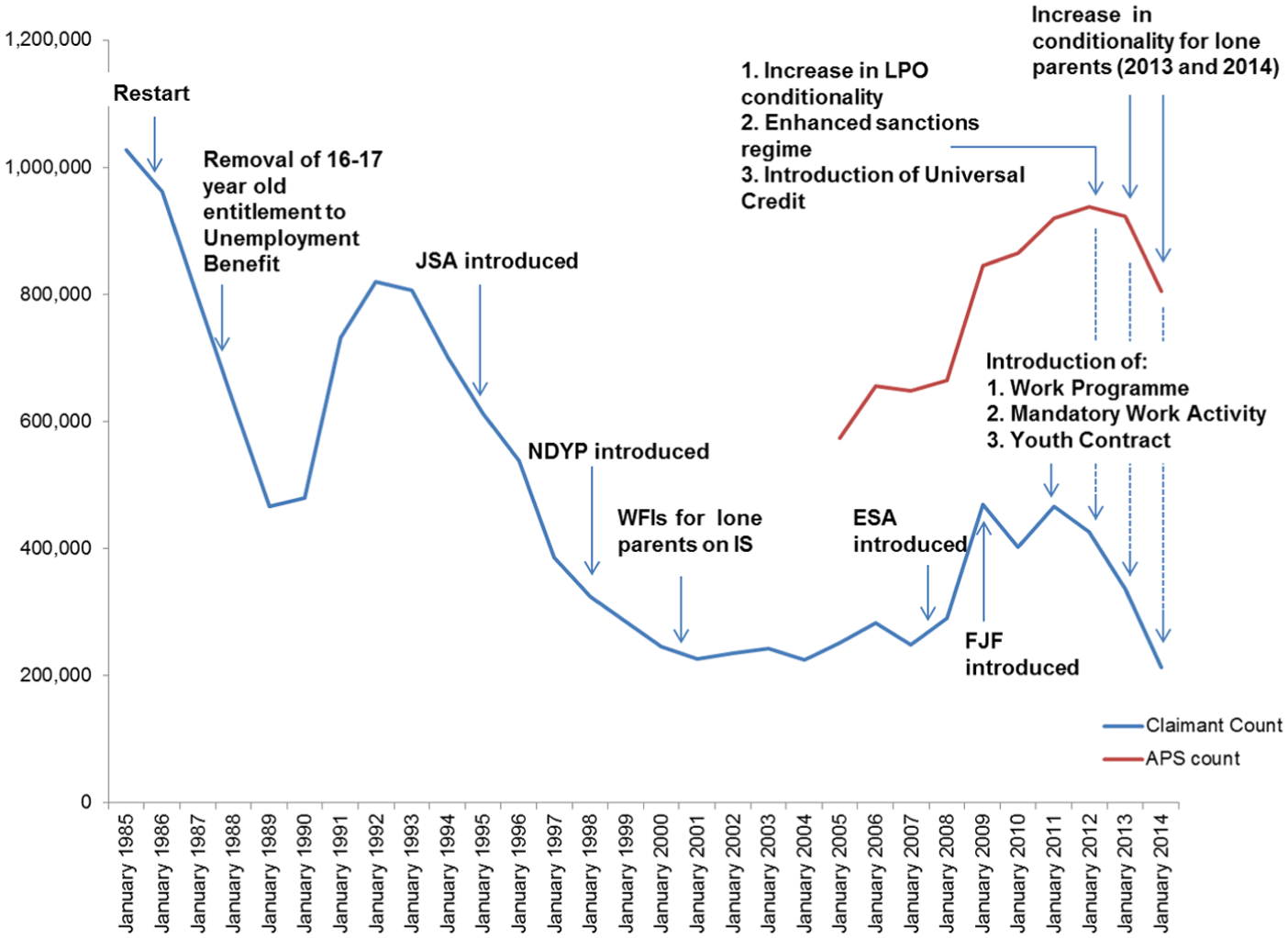
Labour market reforms and youth unemployment levels.
The figure illustrates that, under the Coalition Government, policy became dis-embedded from long-term ‘relief cycles’ whereby conditionality tends to increase during periods of economic growth. There is a noticeable bunching of seven different reforms between 2011 and 2013 at a time when the APS measure was peaking and then falling slightly. This contrasts noticeably with pre-Coalition Government reforms which were less frequent and far more likely to be introduced during extended periods of declining unemployment. Whilst the diagram should only be read as a figurative illustration of the relationship between reform and economic context, it remains striking how the Coalition Government, contra to all previous administrations, displayed palpable zeal for intensifying punitive reforms at precisely the time that youth unemployment peaks. This represents a fundamental departure from historical policy approaches.
A second observation relating to levels of sanctioning supports this notion of growing levels of conditionality during the economic downturn and nascent phase of recovery. Recent figures show that young people account for a disproportionate number of sanctions: 41 per cent of all sanctions issued under the new regime from October 2012 to December 2013 (Watts et al., 2014). Furthermore, recent research for the housing charity Crisis found that ‘the sanction rate for 18–24 year olds in 2013/14 was more than double the rate for 45–49 year olds and triple the rate for over 60s for both JSA and ESA claimants’ (Beatty et al., 2015: 21). Eighteen to 24 year olds account for just over a quarter of the claimant count but almost two-fifths of all sanctions. Sanctioning is now a significant risk for an under-25 JSA claimant, affecting eight per cent of claimants in this age group per month in 2010–2011 (averaged over the financial year), and rising to 8.4 per cent in 2013–2014 (part-year) (Beatty et al., 2015). Commentators suggest that these levels reflect Ministerial directive and policy change given that rises in sanctioning in 2010-2011 occurred whilst the economy remained weak and advisers might have been expected to ease up on levels of sanctions (Webster, 2014). In other words, there has been a deliberate and systematic political/ideological drive to increase punitive sanctions at a time when young people find it hardest to secure employment.
These findings regarding increases in conditionality and sanctioning are all the more striking when set against data on the employability of young people in urban areas as indicated by formal qualifications. Figure 2 shows: the proportion of young people with Level 4 qualifications and higher; 2 and those with no qualifications in seven Local Enterprise Partnership (LEP) areas 3 benchmarked against all young people in England. LEPs are a new form of sub-regional governance structure introduced in England in 2010 to replace Regional Development Agencies. They are private sector-led but also include public sector partners and their primary function is to drive sub-regional economic development. There are 39 LEPs covering the whole of England but the data in Figure 2 are shown for seven LEPs with a strong urban focus. They include seven LEPs containing England’s ‘core cities’ within their boundaries (Birmingham, Leeds, Liverpool, Manchester, Newcastle, Nottingham and Sheffield). The geography of LEPs is variable but is intended, at least in theory, to represent functional economic areas that take travel to work areas in to account. The data in Figures 2 and 3 captures the skills and employment status of young people living in areas that serve the core urban labour markets centred on these seven cities.
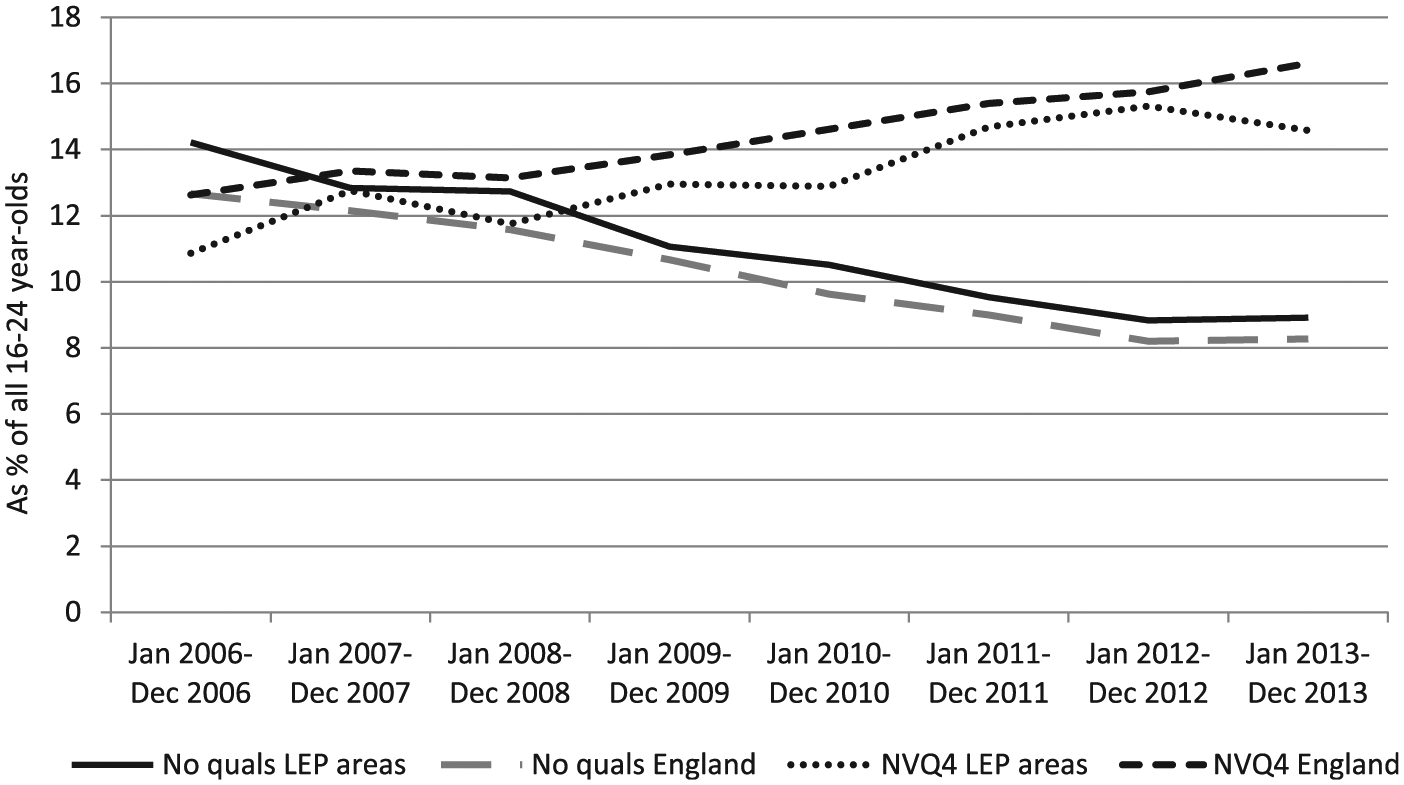
Qualifications among 16–24 year olds in seven LEP areas and England (2006–2013).
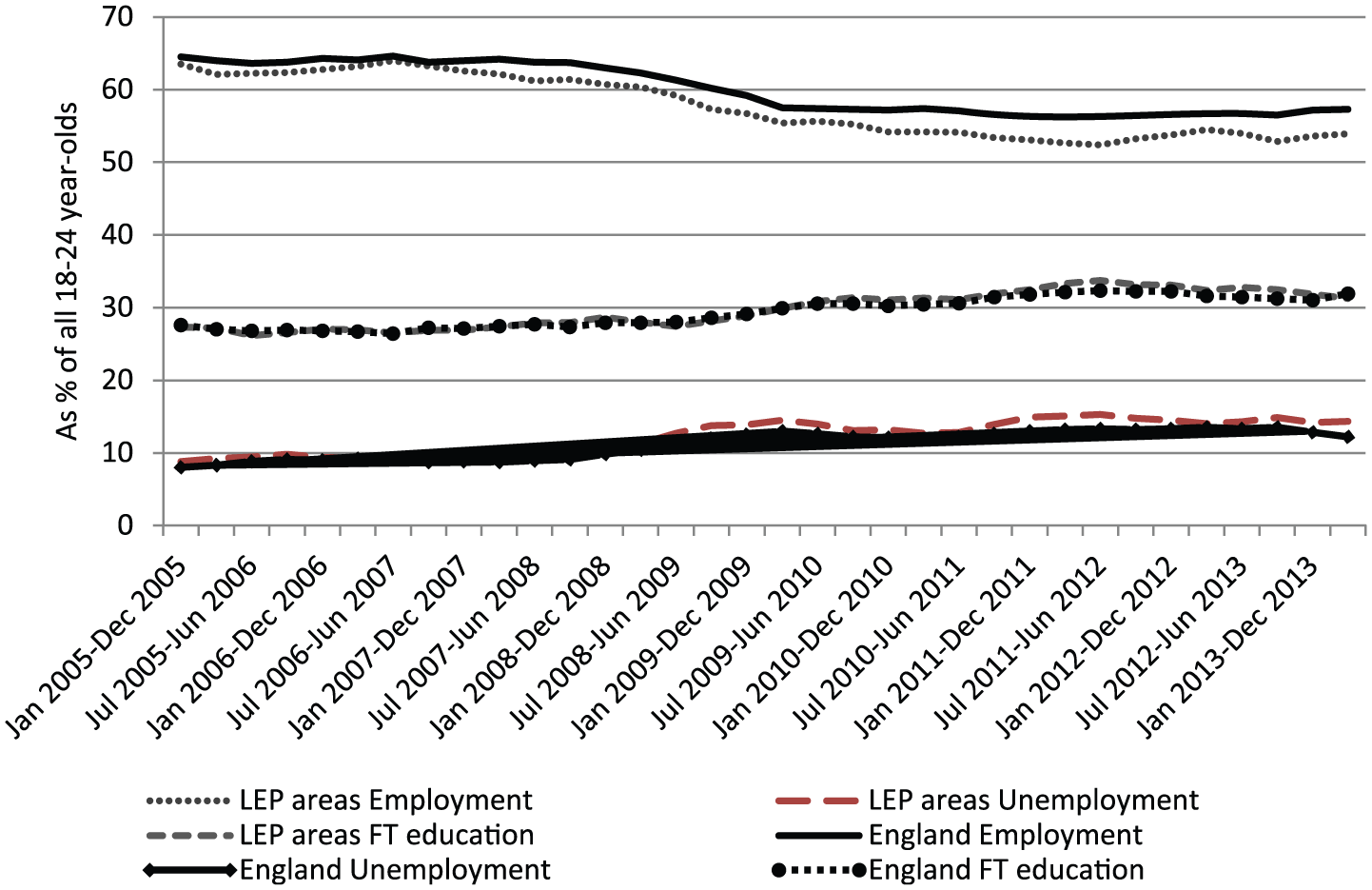
Employment status of young people aged 18–24 in seven LEP areas and England (2005–2013).
It shows two clear trends. First, there are increases in the proportion of young people with Level 4 or higher qualifications at both England and LEP level. Second, and perhaps most significantly, the proportion of young people with no qualifications has fallen across both scales with urban areas narrowing the gap with England to less than a percentage point by 2013. One implication is that policymakers have been applying ever more punitive forms of conditionality to young people at precisely the same time they are striving to make themselves more ‘employable’. This includes those who are most distanced from the labour market as measured by formal qualifications. The finding begins to undermine the discursive construction of youth unemployment as a problem of employability which, in turn, destabilises the legitimisation of growing conditionality in the welfare system. Rising levels of sanctions certainly seem less easy to defend in the face of clear evidence of an increasingly well-educated cohort of urban youth.
Policymakers could argue, of course, that growing levels of credentials are indicative of the success of more conditional forms of welfare that cajole younger people to participate more actively in training and education. In other words, mandation is paying off in terms of higher levels of employability than might otherwise be the case. However, this argument pays no heed to employment outcomes which display some worrying trends as Figure 3 shows. It indicates that the increase in employability as measured by formal qualifications has not arrested the declining employment levels of young people. The proportion of young people in employment fell and then plateaued in city-regions and England overall since the economic crisis in 2007. During the same period the proportion which is unemployed or in full-time education has risen. Rising levels of credentials, including shrinking numbers of young people with no qualifications in urban labour markets, have not therefore been enough to reverse falling rates of employment. Whilst growing participation in education may have many positive aspects, MacDonald (2011: 434) posits that expanded further and higher education may also be performing the same ‘warehousing’ function that disguised youth unemployment through youth training schemes in the 1980s. The data presented here appears to corroborate such a claim. This growing disjuncture between rising levels of formal qualifications and declining levels of participation in employment may ultimately reflect local labour conditions. As iterated earlier, policies on youth unemployment focused on employability have been largely impervious to differences in the geography of labour market demand. The consequence is likely to be growing bottlenecks of increasingly qualified young people who are not in employment because of the inability of local labour markets to absorb them. The implications of this are addressed in the discussion section below.
Discussion
The preceding section has drawn attention to the way in which an increasingly narrow conception of employability has underpinned governmental policies towards urban youth unemployment and has served to legitimate welfare reforms and increasing conditionality. This very same concept also serves as an explanation for high levels of youth unemployment giving rise to a supply-side consensus which is increasingly globalised and perpetuated by international governmental organisations (Fergusson and Yeates, 2013, 2014). In this section we firstly reflect on the changing policy and governance function of employability as applied to urban youth unemployment and, secondly, on the theoretical concept of youth transitions as a framework for understanding youth unemployment. We then make some tentative suggestions on the factors underpinning the differential treatment of young people in terms of welfare support.
The evidence presented above shows that policies on youth unemployment have become increasingly punitive at the very same time that young people are finding it more difficult to access sustainable employment. Moreover, this acceleration of conditionality has also taken place across a time period when levels of formal qualifications have been increasing among young people, including those with very low skills in urban labour markets. This has significant implications for our understanding of the notion of employability. The critique of the ‘supply-side orthodoxy’ embedded in conceptions of employability underpinning labour market policy is long-standing and well-evidenced. Urban scholars have convincingly demonstrated that youth unemployment must be understood not only in the context of individual characteristics, but also local labour market demand. This is an argument with which we fully concur.
However, we would also suggest this critique is inadequate for understanding the persistent appeal of the notion of employability in the current era of economic crisis. Until recently, the apparent ‘relief cycles’ that marked the relationship between policies on youth unemployment and economic change indicated that successive governments were sensitive to the need to ‘ease up’ in harsher economic conditions. The apparent rupture of this consensus under the Coalition Government cannot be accommodated in existing critiques. The charge of ‘supply-side orthodoxy’ is largely a static critique levelled in terms of competing economic explanations. As such, it is largely unable to explain recent political change and its dynamic relationship to economic context and wider public sentiment. We argue, therefore, for a critique of employability which is historically informed to fully appreciate its changing rationalities and policy manifestations.
We also contend that the evidence presented above points to the need for a fuller explanation of an apparent paradox: why has the notion of employability become further entrenched, and increasingly used to legitimise punitive reforms, at a time when it seems ever more ill-suited to explaining the economic marginalisation of young people in urban labour markets? Understanding this, we would argue, requires attention to the political economy of welfare in terms of ‘the root causes and consequences of the positioning over time of the youth segment in relation to those (adults) in a given society with political and economic power’ (Cote, 2014: 527). Our contention is that changes in contemporary policy on youth unemployment can be understood as a form ‘neoliberal state-crafting’ (Wacquant, 2013) driven by short-term, ideological knowledge. In other words, it is not a rational response to economic change as embodied by previous relief cycles. Rather, it is a more ambitious attempt to pursue a political project of austerity that uses the costs incurred by the state in containing the financial crisis as an opportunity to legitimise the pursuit of ideological goals, particularly in terms of reducing the costs of public spending on welfare (Blyth, 2013; Toynbee and Walker, 2015). The disproportionate impact of welfare reforms on young people shows that the effects of austerity have not been evenly experienced. Here Peck’s (2012) notion of ‘relational strategies’ has resonance in terms of explaining how neoliberal states have offloaded the costs of the crisis onto more vulnerable areas and groups in protecting the interests of more powerful political and economic actors (see also Slater, 2014). Urban youth, it would seem, are a comparatively easy target in deciding where cuts in expenditure should fall; suggesting continuity in terms of the historical construction, targeting and governance of the urban ‘youth problem’ (Pearson, 1983). Yet, there is also a significant departure in terms of outcomes. Increasing disparities in the generosity of welfare for different cohorts by age are contributing to growing intergenerational polarisation in levels of worklessness and poverty with younger cohorts faring worst (MacInnes et al., 2013; also Toynbee and Walker, 2015).
By closely studying the relationship between modes of governance and economic change in this way, we can begin to understand employability as more than just a tussle over the relative importance of supply- and demand-side explanations. Instead, it emerges as a flexible and mutating concept that can be used to legitimise a particular configuration of political responses at a range of governance levels. We suggest an on-going need to analyse these shifts in content and function over time, and in far more detail than has been possible within the confines of this article. This calls for ‘linking changing forms of urban marginality with emerging modalities of state-crafting’ (Wacquant, 2013: 41) in understanding what is particular about the current period, but also in highlighting historical continuities.
The preceding critique of employability also points, albeit tentatively, to the potential possibilities of linking youth transitions research to the policy domain in advancing the youth studies research agenda. In doing so, we would suggest that it is fruitful to situate changing youth transitions within an alternative, longer-term reading of individualisation (see Elias, 2001). The notion that the individualisation process among the youth cohort suddenly becomes all pervasive from the 1970s is clearly problematic (Goodwin and O’Connor, 2005). Rather, viewed in longer-term perspective, the shift to more complex youth transitions is but one symptom of the increasing distance between childhood and adulthood, a wider and longer-term process discernible across western societies over many centuries and supported by empiricism: ‘The more complex and differentiated adult society becomes, the more complex is the process of civilising transformation of the individual, and the longer it takes’ (Elias, 2008: 30, our emphasis). As urban society has become more and more differentiated, ‘the web of actions grows so complex and extensive, the effort to behave “correctly” within it’ becomes ever greater (Elias, 2000: 368) – a pressure applying to all members of society. As such, the distance between childhood and adulthood lengthens as ‘the requirements of societal membership become more demanding, so that childhood requires more time and effort in socialization and education prior to the achievement of adult status through entry into the workforce’ (van Krieken, 2005: 43).
This then raises the question of what is particular about the contemporary period. In today’s urban societies the pace of change and increasing complexity are arguably greater than ever with the web of social interdependencies in which young people are enmeshed ever longer and more dense. These trends are not even however, with the relative distance between childhood and adulthood (i.e. length of transition) dependent on the socialisation process undergone by young people and shaped by the urban context of their social/power relations (i.e. family, school, peer socialisation etc.). For example, the ‘one-step transitions’ from school to work in the 1960s and 1970s are more readily associated with working class youth, with different trajectories for the middle-classes with relatively more access to power resources (Furlong and Cartmel, 2007); and the work of Willis (2014 [1977]) and Bright (2011) informs of the neglected importance of peer and family socialisation in shaping the social worlds and choices of youth (i.e. different processes of individualisation). Situating youth transitions within this wider theoretical context enables acknowledgement of the role of historical processes, socialisation, class and interdependent power relations in contributing to different individualisation processes, and therefore transitions. That is, the structuring effects of these social interdependencies are not uniform, rather the negative impact of longer term social processes on labour market opportunities impacts disproportionately on those young people at the bottom of the class structure (i.e. the least powerful) and results in their labour market marginalisation. From this perspective, therefore, the task in hand in moving towards a more accurate diagnosis of youth unemployment is to historically and empirically explore the differentiated experiences of youth transitions with a much greater emphasis on shifting power relations and their relationship to social and economic transformations. The critique of employability above that suggests linking the youth transitions framework to policy analyses may provide a more fruitful avenue for advancing debates in both youth unemployment and the wider field of youth studies.
Finally, though a detailed explanation of the differential treatment of young people is beyond the scope of this paper, some tentative observations can be made. Firstly, the 18–24 cohort is a politically weak one lacking representation, with only 44 percent voting in the 2010 General Election. The unprecedented attack on youth could feasibly be viewed as a political strategy. Secondly, Stephen Vertigans’ historically informed analysis of recent responses to ‘looked after children’ points to a wider societal shift in attitudes and sentiments towards poverty and working class youth: ‘Middle-class engagement and support which was so noticeable during nineteenth-century attempts at child saving has diminished, while determining the poor to be tasteless, uneducated and immoral continues and is arguably more pervasive through extensive media intrusion and “poverty porn”’ (Vertigans, 2015: 12). We are perhaps too close to these developments, temporally speaking, to be able to discern how far the present trajectory represents a decline in empathy towards the poor. But ongoing support for welfare cuts among a majority of the UK population would certainly suggest a hardening of attitudes towards youth given the deleterious and disproportionate effects produced.
Conclusion
Despite the best efforts of urban scholars, the flawed and increasingly narrow policy concept of employability has been shown to be all pervasive in contemporary policy responses to youth unemployment in the UK. Analysis of UK policy since the late 1970s shows a marked shift under the Coalition Government of 2010–2015 towards a more punitive approach in an economic downturn, marking a distinct break from the ‘relief cycles’ of earlier periods. This colonisation of the concept of employability and its function as a tool of urban governance has, we argue, rendered it virtually useless as an analytical device for understanding youth unemployment – tainted as it is by short-term, ideological knowledge. Like other key watchwords of contemporary urban governance, such as ‘welfare dependency’, the ‘underclass’ and the ‘ghetto’ (Fraser and Gordon, 1994; Wacquant, 2008), it has little purchase in explaining contemporary urban marginalisation. However, it remains a legitimate object of academic analyses in terms of how it functions as a discursive formation to validate particular forms of neoliberal state-crafting.
The scale of the youth unemployment problem is such that policy-makers require quick responses giving rise to a ‘retreat into the present’ in terms of the diagnosis of the complex causes of youth unemployment. While the concept of youth transitions marks a progression from that of employability, there remains a need to reframe the debate so that it places power at the centre of our understanding. Of course, we need a more systematic understanding of the changes giving rise to increasingly complex transitions, but the central question is why some young people (invariably the least powerful) have found it more and more difficult to negotiate this complexity than others. Such a question can only be answered, we would argue, through a framework which can account for historical change and its impact on the power relations in which young people are enmeshed, while also being sensitive to spatial difference. In short, current understanding and policy requires a shift from a static, aspatial and individually-focused explanation of (and response to) youth unemployment, towards a longer-term perspective focused on the relationship between social and economic transformation and the shifting social interdependencies of young people across time and space.
Footnotes
Acknowledgements
We would like to thank Andrew Cumbers, Mike Danson and two anonymous referees for helpful comments on earlier drafts of this article. Thanks also to Duncan Adam who carried out the LEP analysis on which Figures 2 and 3 are based.
Funding
This research received no specific grant from any funding agency in the public, commercial, or not-for-profit sectors.