




Abstract
In cities worldwide, low-carbon urban initiatives (LCUIs) are realised by pioneers that prove that climate mitigation strategies can be integrated in urban development trajectories. Practitioners and scholars reflect on the need to scale-up such initiatives in order to accelerate the transition to low-carbon cities. Yet, limited conceptual clarity exists regarding the meaning of the concept of ‘scaling-up’ and the factors driving this process. This article aims to contribute to practice and theory on low-carbon urban development by presenting a taxonomy on the concept of scaling-up. Moreover, an explanatory framework is presented consisting of factors expected to contribute to the impact and scaling-up of LCUIs. Two case studies were conducted to illustrate the explanatory framework. The studies are illustrative but suggest that the explanatory framework allows for a systematic understanding of how the impact of former initiatives can be explained, and how their scaling-up can be promoted.
Introduction
As cities constitute centres of commerce, industry and development, and account for approximately 70% of overall primary energy use, the municipal level is increasingly recognised as an appropriate level for addressing climate change and promoting low-carbon urban development (Betsill and Bulkeley, 2006; Bulkeley et al., 2009; Collier, 1997; Mulugetta et al., 2010; Romero-Lankao, 2012, Schreurs, 2008; Williams, 2013). The term ‘low-carbon urban development’ (henceforth LCUD) refers to the reconciliation between urban development and the mitigation of anthropogenic climate change (see Urban and Nordensvard, 2013).
Climate mitigation in the building sector is considered a key priority for promoting LCUD. ‘Buildings’ constitute a key energy-consuming sector, contributing to approximately 30–40% of final energy consumption (Pérez-Lombard et al., 2008; UNEP, 2009). However, despite the potential of mitigating climate change in the built environment, efforts have been piecemeal (Bulkeley et al., 2009; UNEP, 2009). Nevertheless, worldwide innovative low-carbon urban initiatives (from this point forward: LCUIs or initiatives) prove that urban development can meet societal demands without any, or with limited, carbon dioxide emissions (Mulugetta et al., 2010). Examples include the large-scale energy retrofitting of housing blocks and the establishment of eco-districts. Unfortunately, successful initiatives are often not applied at a larger scale or in other cities while at the same time energy and resources are absorbed elsewhere in the process of ‘reinventing the wheel’. Moreover, the pressing question is how to go from such incremental interventions to systematic and large-scale change (Bulkeley and Broto, 2013). This research proposes that in order for these initiatives to play a significant role in climate stabilisation efforts, they need to be scaled-up beyond ‘islands of excellence’.
This article has two objectives. First, it provides a taxonomy on the concept ‘scaling-up’, inspired by different bodies of literature. While there appears consensus on the importance of scaling of initiatives to realise large-scale systemic change (Kemp et al., 1998; Mulugetta et al., 2010), limited conceptual clarity exists on the meaning of the concept in the context of LCUD. Second, an explanatory framework is presented consisting of factors expected to contribute to the impact and scaling-up of LCUIs. The explanatory framework presented can be applied to structurally assess and explain an initiative’s influence and to identify lessons for scaling-up. The systemic evaluation and sharing of lessons of former LCUIs is a need often underlined by scholars (Bai et al., 2010; Corfee-Morlot, 2009). As LCUIs render the low-carbon rhetoric both visible and practical, their evaluation could provide helpful lessons in terms of technological, organisational or contextual factors that can enable local policy makers and local community actors to better understand how scaling-up processes can be encouraged.
Method
As a point of departure, a thorough interdisciplinary literature analysis has been conducted to develop the taxonomy on the concept of scaling-up. Second, using desk research an explanatory framework was developed consisting of factors that are expected to contribute to the scaling-up of LCUIs. Empirical papers reporting on factors contributing to, or impeding, the realisation, success or impact of LCUIs have been studied to develop the explanatory framework. Two case studies of LCUIs have been conducted to illustrate the applicability of the explanatory framework. Six semi-structured interviews (1–1.5 h) were conducted with the main stakeholders who were involved throughout the entire planning phase and who had a comprehensive perspective upon the project (‘helicopter view’). Interviewees were asked questions pertaining to the success of the initiative in terms of LCUD, its scaling-up, and the relative importance of the factors from the framework for the success and scaling-up of the initiatives. In addition, a content analysis of various sources, including evaluation reports and media documents, was used in order to enhance the internal validity of the case study analysis. The cases are illustrative rather than representative as the main goal is to illustrate how the analytical framework can be used to explain the impact of former initiatives and to identify lessons for scaling-up.
Analytical framework
Low-carbon urban initiatives
Low-carbon urban initiatives (LCUIs or initiatives) are defined as initiatives in cities that integrate climate mitigation strategies in urban development projects. Important features of LCUIs are that they are initiated at community scale rather than at individual household level, which has benefits not only in terms of carbon reduction, but also in terms of reducing transaction and installment costs and strengthening community networks and ownership. This paper further operationalises LCUIs as interrelated systems of measures for LCUD and operational arrangements. Measures for LCUD relate to the physical objects (hardware measures such as PV, thermal insulation, heat pump, etc.) and/or instructions or skills (software measures such as instructions for sustainable behavioural change) that can contribute to climate mitigation. The successful implementation of measures for LCUD is dependent on operational arrangements at the organisational level of the initiative and influenced by the wider institutional environment outside the initiative.
Scaling-up low-carbon urban initiatives: A taxonomy
The term ‘scale’ concerns the spatial, temporal, quantitative or analytical dimension that is used to study processes and is often understood in terms of hierarchy (Gibson et al., 2000; Gillespie, 2004). A level is a unit of analysis located on a position on a scale (Gibson et al., 2000). ‘Scaling-up’ refers to progression in degrees or levels that are located at different positions on a scale. It involves a mechanism where information from one scale is transferred to another, thereby reaching a higher level of scale and a greater impact (Gibson et al., 2000; Schneider, 2001). The concept of scale is used in various scientific disciplines that attribute different meanings to it. In the ecological and natural sciences, scale is considered as an objective entity, such as space, time or quantity (Schneider, 2001). Political sciences can examine jurisdictional or administrative scales or levels of public choice (see Gibson et al., 2000). On the other hand, literature on politics of scale in human geography regard scale as a social construct that is not pre-given, but a way of framing conceptions of political-spatiality, which can embody and materialise in social reality (Smith, 1990; Swyngedouw, 1997). Since our study focuses on the scaling of initiatives, we will mainly make use of literature on the upscaling of grassroot organisations or programmes (see Douthwaite et al., 2003; Gillespie, 2004; Uvin, 1995; Uvin et al., 2000) and sustainable niches or experiments (Geels, 2011; Rotmans and Loorbach, 2006).
Definition and pathways to scaling-up
The term scaling-up can be used with reference to scaling-up means (initiatives or programmes), or scaling-up ends (social-economic and environmental impact) (World Bank, 2003). While the two are often interrelated, this research will primarily refer scaling-up means (i.e. successful LCUIs). Individual LCUIs can go to scale (means), thereby reaching a higher impact in terms of LCUD (ends). The definition of scaling-up adopted for this paper is as follows: to increase the impact of LCUIs in terms of promoting LCUD from a small to a larger scale of coverage. Inspired by the work of IIRR (2001) and World Bank (2003) and building on the different sources of literature discussed above, we present a taxonomy of scaling, where we distinguish two pathways to which individual LCUIs can go to scale, thereby reaching a higher impact in terms of LCUD: horizontal and vertical pathways to scaling-up.
Horizontal pathways to scaling-up
Horizontal scaling-up pertains to the spatial growth of an initiative or parts thereof. Related terms include ‘diffusion’ (Rogers, 1995), quantitative scaling-up (Uvin, 1995; Uvin et al., 2000), spatial scaling (Douthwaite et al., 2003), ‘organisational growth’ (World Bank, 2003), scaling-out (Douhwaite et al., 2003), ‘duplication’ (Bai et al., 2010) or ‘replication’ (Rotmans and Loorbach, 2006). Horizontal scaling-up implies a process where the initiative extends its coverage, reaches more people and a greater impact in terms of LCUD (see Uvin et al., 2000). First, horizontal pathways to scaling-up can result from the spatial growth and expansion of the scale of an initiative by increasing its constituency within one area or city. For instance, an initiative can expand from street to neighbourhood and from neighbourhood to city level. The growth or expansion of an initiative will likely require initiatives to increase their organisational strength (Uvin, 1995). Second, horizontal scaling-up can occur through the replication or transfer of initiatives to other cities or areas, within a country or abroad. In practice, both the internal growth and replication of LCUIs lead an increase in the spatial scale and coverage of LCUIs and thus a greater impact in terms of LCUD.
Vertical pathways to scaling-up
While horizontal pathways to scaling-up are important, scaling-up is not just about copying success, but should also be about structural learning and changing the institutional roots of carbon-intensive development. The second pathway to scaling-up is referred to as ‘vertical scaling-up’. Vertical scaling-up refers to the process where the information concerning ideas, values, knowledge or other lessons from individual LCUIs inform institutions at higher administrative and organisational levels with wider-reaching impact. It thus implies a process where individual LCUIs serve as the basis for wider policy and/or institutional change. Related terms include ‘political scaling’ (Gillespie, 2004; Uvin, 1995), ‘institutionalisation’ (North, 1990), ‘mainstreaming’ (Bai et al., 2010) and ‘translation’ (Smith, 2007). We propose that vertical scaling has occurred when an initiative has influenced formal institutions (policy goals or instruments) and/or informal institutions (values, ideas) of policy networks, thereby creating an enabling environment for change and changing the structural causes of fossil-fuel based urban development. A policy network consists of the interdependent governmental, private and civil society actors that participate in the policy area of LCUD (see Kickert et al., 1997). The institutions that can be influenced can be found at different spatial levels of political jurisdictions: local government, regional, national or international authorities. Individual LCUIs can apply indirect strategies, through the sharing of new practices and ideas, or direct strategies, through advocacy, to promote vertical scaling-up.
Synergising horizontal and vertical pathways to scaling-up
There is great potential for synergies between horizontal and vertical pathways to scaling-up (see Figure 1). The more horizontal scaling-up occurs, the greater are the chances that the initiative will inform institutions (vertical scaling-up). Vertical scaling-up in turn leads to a facilitative institutional context, thereby promoting horizontal scaling-up and the instigation of new initiatives. The processes of horizontal and vertical scaling are both required in pursuance of LCUD. Without vertical scaling-up, initiatives remain little more than ‘islands of excellence’ in an institutional environment that is not facilitative of LCUD (see Uvin et al., 2000). Likewise, a facilitative institutional context alone is not sufficient: political rhetoric and institutions at the macro level need to be put into practice.
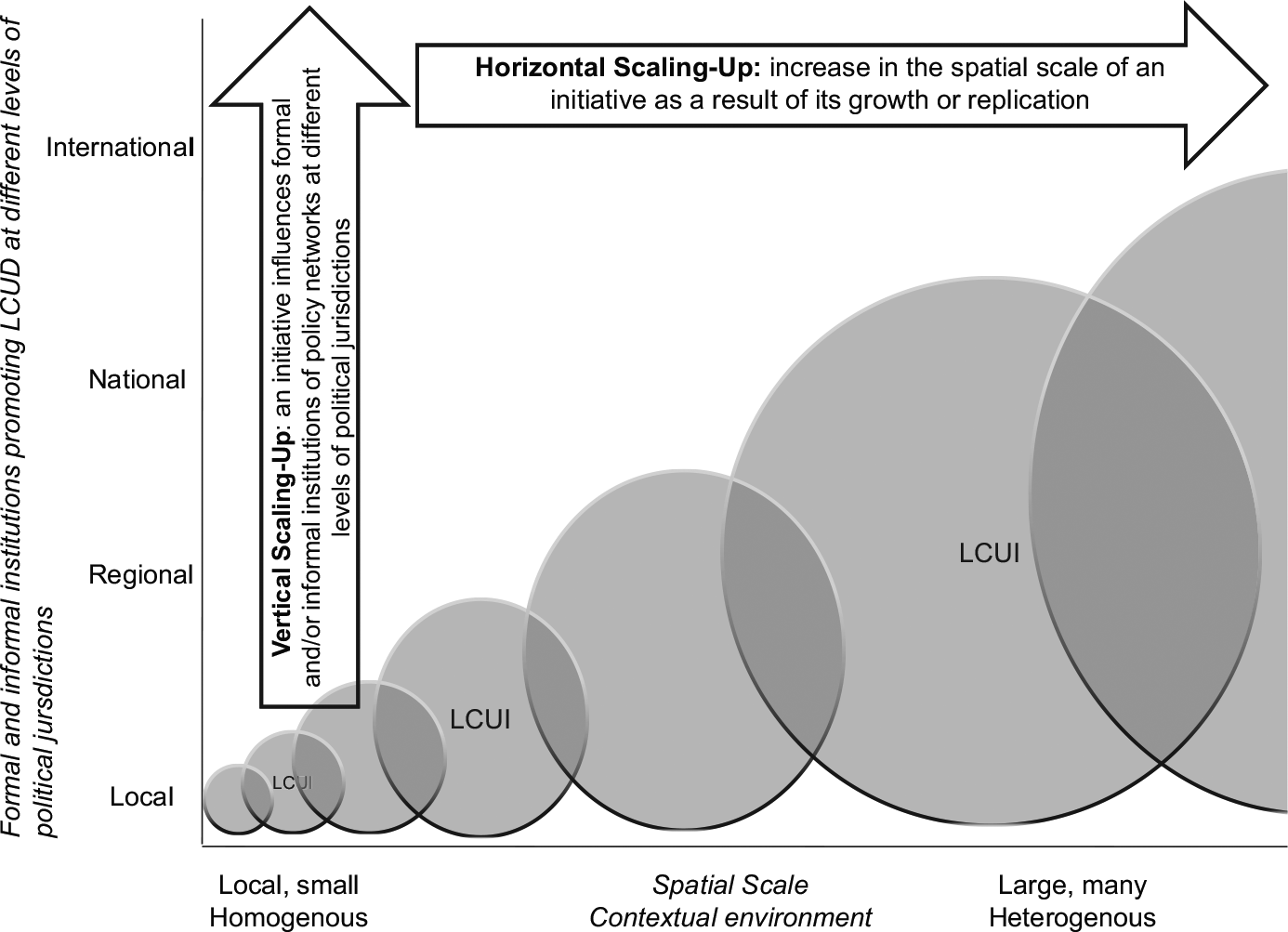
Horizontal and vertical pathways to scaling-up low-carbon urban initiatives.
Factors driving scaling-up: An explanatory framework
Mapping out the internal dynamics and external factors that contribute to, or impede, the success and impact of initiatives can be used to inform strategies for scaling-up. Based on the identification of drivers and barriers to the successful realisation of LCUIs, theoretical propositions can be developed on factors or conditions that need to be present for the horizontal scaling-up of LCUIs. To identify lessons for vertical scaling-up, one must study the processes that have enabled or hampered the initiative to influence its institutional environment. Of course, it can be debated to what extent specific, contextual knowledge can ‘scaled-up’ to universal and standardised guidelines (see Cash et al., 2006; Gibson et al., 2000). We propose that observations at the level of individual LCUIs can be useful to develop lessons for the scaling-up of LCUIs, but that one should treat lessons carefully for possible adaptation to new institutional contexts.
Table 1 provides an overview of factors that we expect to contribute to horizontal and vertical pathways to scaling-up LCUIs. The framework presents a summary of factors found in a sample of empirical, peer-reviewed papers reporting on factors contributing to the realisation of LCUIs and the accomplishment of LCUD in general. The framework consists of six sets of explanatory components that correspond to the different dimensions of an initiative and its contextual environment. Internal factors focus on the characteristics of the measures for LCUD applied by the LCUIs and the operational arrangement of the initiative. Context factors concern conditions outside the scope of the LCUI, and can relate to the policy, market, social-cultural, and geographical and built context. The framework provides an overview of the following information: the factor, its operational definition, the empirical studies that discuss its influence, and whether and how we expect that the factor can contribute to horizontal and/or vertical pathways to the scaling-up of LCUIs.
Factors that contribute to horizontal and vertical pathways to scaling-up LCUIs.

Illustration of the analytical framework
Introduction to the cases
A qualitative case study methodology has been applied to illustrate the applicability of the explanatory framework. The explanatory framework is used to identify which factors have contributed to or limited the success and impact of initiatives. These insights can be used to inform strategies for scaling-up. Two government-led LCUIs in the Netherlands are studied: City of the Sun (SoC) and the GWL-district (GWL). Both the GWL and CoS case are considered pioneer showcase projects in terms of LCUD (Femenias, 2004; van Hall, 2000; Verhoef et al., 2009). City of the Sun is a project realised by the Municipality of Heerhugowaard, during the period 1992–2008. The LCUI is in accordance with the Trias Energeticas principle, a three-step approach for realising an optimal sustainable energy solution through (1) reducing energy demand, (2) promoting renewable energy sources, and (3) maximising energy efficiency. In practice, the application of this principle led to 2900 new- build houses that make use of passive solar energy, are highly insulated (ISO++), and have heat pumps and PV panels integrated into their design. The 2900 new-build houses generate 3600 MW of solar power in total. Three wind turbines ensure that the district is CO2-neutral. The GWL-district is a sustainable city district in Amsterdam that was developed by the City Council Westerpark between 1995 and 1998 at a brown-field site of the former city waterworks. It comprises a sustainable, green and car-free district in the city of Amsterdam, with 600 sustainable dwellings, offices and shops. Various measures for LCUD were applied, including high insulation (cavity walls, roof, energy efficient windows), use of passive solar energy, sustainable building materials, a CHP plant, green roofs and sustainable water collection systems on roofs. While the initiative applied various measures for LCUD, the innovative aspect of the district was primarily the integrated character of sustainability and the car-free design (Femenias, 2004).
Lessons for horizontal pathways to scaling-up
At present, the SoC has already been replicated in the Chinese city Wuhan and in India, near New Delhi (ND, 2012). Moreover, the municipality of Heerhugowaard is also building a new residential suburb (‘de Draai’), where they repeat the approach taken by SoC, but apply different measures for LCUD (Verhoef et al., 2009). Many (foreign) local governments have expressed an interest in the SoC and might in the future develop similar initiatives (respondent local authority). The GWL-district has not been expanded or replicated. Respondents argue that the initiators were primarily focused on realising this initiative in order to improve the neighbourhood, rather than actively promoting the replication of the initiative elsewhere.
Measures for LCUD
The GWL-district was primarily realised out of ideological ideas on sustainability, and did not have much financial advantages compared with conventional projects. Yet, respondents note that for the large-scale expansion of similar initiatives, long-term financial advantage is a critical condition. The project team of the SoC case was also not financially driven, but did initiate the project because it expected that future residents’ reduced energy costs would enhance the financial attractiveness of the neighbourhood. Yet, interviewees note that for the majority of the buyers the high-level energy efficiency of the buildings was not the main attractant and reason for buying the houses. At that time, there was low market demand for PV panels owing to limited awareness and perceived uncertainty concerning their long-term financial advantage. Respondents noted that many consumers over-discount the future and require their returns on investments to be close to immediate. This meant that the prices of the houses with integrated PV panels could not be much higher compared with conventional new-build houses and that the initiators were highly dependent on subsidies and financial support to realise the initiative. Respondents from both cases noted that in order for horizontal pathways to scaling-up to occur, consumers should be more aware of the long-term financial advantage of measures for LCUD and pay accordingly, so that the project’s organisation is less dependent on subsidies and other forms of public support.
The measures for LCUD applied in SoC were reliable, not complex in use and did not require adaptation in user behaviour. ‘The residents live in a CO2-neutral district but don’t really have to think about it or adapt their behavior’ (respondent city council). On the other hand, in the GWL-district some sustainability measures were chosen that were rather experimental and unproven (e.g. water collection system and water-efficient toilets). Lack of experience and knowledge on the performance of some measures (at such a scale) made it difficult for the environmental advisor involved in the project to determine what the environmental and financial performance would be (reliability), leading to an increase in time and transaction costs (respondent city council). The measures are also perceived as complex as they required some adaptation of user behaviour (e.g. car-free design). The initiators ensured compatibility of the measures for LCUD and the values of the residents by actively recruiting future residents who advocated sustainable lifestyles and values and were willing to live accordingly (environmental awareness and values). The case reflects that residents with environmental values engage in LCUIs because they enjoy the process and goal, and might be less concerned with factors such as ‘reliability’ and ‘low complexity’ of the measures applied. However, respondents confirmed that to expand LCUIs beyond green-minded consumers who are not primarily driven by environmental concerns, but rather by benefits such as cost savings, reputation or comfort levels, measures for LCUD must be low in complexity, reliable and guarantee a long-term financial advantage.
Operational arrangements
Both cases are pioneering projects, of which the success had not yet been proven. Strong leadership was accordingly essential to the realisation of both projects. A respondent from the local authority involved in the SoC case notes:
Few people had believed that the project was realizable. The realization of the project can fundamentally be traced back to determination of a few people, who despite several setbacks continued to have faith in the project and ensured continuous stakeholder commitment throughout the 10 year development period.
Stakeholder involvement was great (planners, architects, developers, engineers, solar panel companies, provincial authorities) in order to access financial, technical and human resources (resource mobilisation). Continuity in the municipality’s project team, a flat organisation and short communication lines with other stakeholders promoted long-term commitment and support. The local government had set clear goals and had primarily a steering role throughout the process. ‘As a municipality, limit yourself to the ambition and the goal, leave the means to the implementing stakeholders wherever possible’ (respondent local authority). The case reflects the importance of stakeholder involvement in order to mobilise sufficient technical, informational, human and financial resources. Even when the project encountered various financial setbacks when the expected subsidy scheme of the national government was cancelled (see below), alternative forms of financial support were realised thanks to the project team’s strong vision, lobbying skills and broad stakeholder network.
Strong leadership and intensive stakeholder involvement were also highly important for the successful realisation of the GWL-district. The city council was highly motivated to profile itself as a pioneer in sustainable urban development, ‘a concept not well articulated at that time’ (respondent local government). The continued presence, cooperation and communication between key stakeholders, including housing associations, architects and environmental advisors, is considered an important success factor of the GWL case (see Femenias, 2004). The local government proactively mobilised technical, human and informational resources through hiring technical experts and involving local stakeholders (resource mobilisation). Financial resources were made available by a large urban renewal fund of the local government and by the housing associations (respondent building company). Given the environmental focus of the district and uncertainty on the performance, it was difficult to get private investors on board. Future green-oriented residents were actively involved throughout the planning process, during which they worked with interdisciplinary teams on the vision, design and management of the district. While this fostered ownership of the initiative among residents, it also required much time and effective coordination and communication (van Hall, 2000). Moreover, it led to lengthy discussions during the design stage because the specific goals and means of the project were not clearly articulated and the local residents’ ambitions were higher than the goals of the project organisation. While public participation is a valuable goal in itself, the case indicates that it can also lead to high costs and communication problems when the goals and means of the project are not clearly articulated by the initiator. In all, the case highlights the importance of clear and realistic goals for efficient internal and external communication, a sound time plan and an accurate calculation of the financial budget required for all design stages, taking into consideration the unreliability of subsidy schemes (see Femenias, 2004).
Policy context
Both cases demonstrate the value of a supportive political environment and political leadership. The case of the GWL-district shows that the presence of green parties in the local coalition can be an important driving force for the instigation of LCUIs. The local district council, run by a coalition of green and labour party members, opened up ground for sustainable urban development and initiated the project. In SoC, the political colour of the administration changed over the course of the project, but the political commitment and support by the local government, alderman, province and EU continued through effective leadership and stakeholder management.
The two cases also denote the importance of a facilitative and stable policy environment for the large-scale growth and replication of LCUIs. The lack of a stable and reliable subsidy scheme throughout the planning period (financial policy instruments) endangered the realisation of the SoC. At that time especially, the high upfront costs and the fact that PV had to compete with other forms of energy generation rendered subsidies and financial support essential. Yet, the national subsidy scheme (Energy Premium Scheme) was altered multiple times and even cancelled because of depletion of funds, which endangered the financial support offered by the European Union. As noted above, the changing policy framework required the project team to mobilise alternative financial solutions. The GWL-district did not benefit from extensive subsidies, but some ‘green loans’ were received by the national government. Yet, the project team of the GWL case also experienced problems resulting from the ending of the subsidy scheme for the building of social housing in 1994 – because of the privatisation of the housing associations – which resulted in a rush in the construction phase as 45% of the buildings would be social housing (GWL-terrein, 2010). These experiences indicate the uncertainty of public funding schemes and the importance of accurate planning in order to ensure that public funding is attained within the planning period of realising the LCUIs. In all a stable policy framework is deemed important as it enhances stakeholders’ trust in the policy framework and their willingness to engage in similar projects.
National regulatory policy instruments influenced both cases. For both the GWL-district and the SoC the energy performance coefficient (EPC) of the buildings was set significantly lower than the legal limit at the time. Yet, respondents note that they have learned that when planning for long-term projects, you need to take account of projected regulatory standards. While in both cases the targets were more ambitious than the national regulations at the time, environmental regulations continue to be tightened, rendering the EPC level of the districts soon outdated after completion (Femenias, 2004; van Hall, 2000).
Market context
The cases reflect that high upfront costs and market fluctuation can lead to financial challenges during a project’s realisation. In the SoC, the PV panels could not be financed without public support. Whereas the plan relied on a price drop of PV panels, they did not become cheaper but rather more expensive as a result of the dramatic rise in worldwide demand for PV, caused by numerous subsidy schemes (Verhoef et al., 2009). Through effective cooperation between stakeholders and the fact that the developers did, for moral reasons, not want to earn from the PV, it was possible to achieve a price breakthrough of 4.50 euro. This drop in price was a required condition so that the homeowners, who invested in the PV panels, could expect a payback time of seven years (Verhoef et al. 2009). Moreover, because of limited experience with the application of the measures for LCUD (at such scale), the installation and production costs were significant for both cases. Yet, increased expertise and experience of supply actors – partly as a result of pioneering cases such as SoC and GWL-district – will contribute to a reduction in installation costs, thereby likely improving the financial advantage of measures for LCUD and market demand for LCUIs. Also an increase in the energy price is expected to promote horizontal scaling-up processes as it will enhance the financial advantage of measures for LCUD. As a result of public funding in both cases, there was no need for external access to credit in both cases. Yet, access to credit, appropriate loan conditions for consumers and project developers and information availability on measures for LCUD and loan opportunities are perceived to be important conditions for the horizontal scaling-up of LCUIs.
Social-cultural context
Respondents from both cases indicate that societal values on environmental sustainability, resulting from amongst other informative policy instruments, will likely enhance market demand for projects such as the GWL and SoC. The GWL-district is an exemplar pilot project that attracted green-oriented citizens, who were willing to actively engage in the initiative and who were aware of the environmental and social benefits generated by the initiative. The residents living in the SoC district were not ‘energy fanatics’ when they moved to the neighbourhood, but did become enthusiastic about sustainability after they lived there for a while (Verhoef et al., 2009). ‘Residents enjoy the PV panels and there are competitions between neighbours on who generate the most energy’ (respondent city council). The observation that consumers can become enthusiastic about low-carbon behaviour and energy efficiency measures through experience and being exposed to it, can also be used as an argument that governments and key institutional players involved in development projects have to lead by example and actively pursue low-carbon developments, rather than waiting for a market pull.
Geographical and built context
Respondents from both cases confirmed that when replicating or growing an initiative, project designers and initiators should critically examine the technical compatibility of the measures for LCUD with the geographical conditions and existing infrastructure. During the scoping stage careful inspection of the site and building characteristics are required to assess what measures are most effective from an environmental and economic perspective, as this is context- and site-specific.
Lessons for vertical pathways to scaling-up
Respondents from both cases find it difficult to identify vertical scaling-up processes and establish direct links between the projects and changes in the formal and informal institutions within policy networks. Yet, respondents involved in the CoS case note that the initiative has provided the evidence base for the success of the model and the benefits it generates for residents and local businesses. Moreover, the CoS has influenced national guidelines on LCUIs, developed by The Netherlands Enterprise Agency (part of the Ministry of Economic Affairs) that are meant to assist entrepreneurs in successfully developing similar projects (Agentschap NL, 2010). Finally, the success and feasibility of the project has definitely supported the policy goals of the municipality of Heerhugowaard itself. The municipality aims to be carbon neutral in 2030, which requires that both new and existing buildings are low-carbon. The GWL-district has received considerable attention worldwide and is often referred to as a best practice case for sustainable urban design (Femenias, 2004; van Hall, 2000). While the initiative has attracted urban planners, policy makers and scientists from all over the world, respondents find it difficult to establish to what extent it influenced formal and informal institutions of policy networks. In both cases, the project organisations applied indirect strategies, rather than direct strategies such as lobbying, to promote vertical pathways to scaling-up through the sharing of results and information about the initiatives. Based on the results, we maintain that factors related to the operational arrangements and local political leadership are important for promoting vertical pathways to scaling-up.
Operational arrangements
While it is, for both cases, difficult to establish to what extent vertical scaling-up has occurred, the cases suggest that continued stakeholder involvement, leadership, resource mobilisation and external communication can raise awareness on the evidence base of the initiative and contribute to lesson sharing, thereby potentially influencing formal institutions (policy goals or instruments) and informal institutions (values, ideas) of policy networks. The cases reflect that after the completion of the initiative, it is important to organise various meetings with stakeholders in order to reflect on the lessons learned throughout the realisation of the initiative. For the CoS case, continued stakeholder involvement after the completion of the project and evaluation of the project, resulting from effective leadership, encouraged reflection on the project and identification of lessons learned. Unlike the SoC case, the organisation and stakeholder network of the GWL-district were soon dissolved after completion, leading to the fact that there was not a comprehensive evaluation of the project and limited dissemination of lessons learned to other actors (Femenias, 2004).
In both cases, external communication and knowledge dissemination was encouraged in order to enhance awareness on the benefits and impact of the LCUIs. In the GWL-district an information centre has been established that organises guided tours in the district to professionals and interested parties in order to promote awareness about the initiative. The project team of the SoC case proactively initiated and engaged in knowledge dissemination activities, such as symposiums for politicians, in order to enhance awareness of the project among public and private actors in the Netherlands and abroad (Verhoef et al., 2009). Moreover, the local alderman and project manager have regularly given guided tours and presentations about the initiative to (local) government officials from the Netherlands and abroad. During such occasions drivers and challenges encountered were shared. In addition to guided tours and presentations, an information centre has been set up and a book has been published (Verhoef et al., 2009) to promote lesson sharing. The cases imply that the availability of human, information and financial resources can support the dissemination of results.
Policy context
The CoS case reflects that political leadership at the local level can contribute to vertical pathways to scaling-up. As noted above, the success of the initiative has influenced the Municipality’s goals to be climate-neutral in 2030. Lessons and experienced from the SoC influence this policy target because the local political leaders were willing to learn from previous experiences and adapt their policy goals accordingly.
Reflection on the analytical framework
The taxonomy of scaling-up and the explanatory framework were helpful to identify the drivers and challenges encountered by the project team and the drivers required for the scaling-up of the LCUIs. Even though the case studies primarily have an illustrative function, some interesting observations can be made based on the first application of the framework. First, the cases indicate that different drivers contribute to the processes of horizontal and vertical pathways to scaling-up. On the one hand, in order to encourage the large-scale growth and replication of LCUIs (horizontal scaling-up), factors related to the measures for LCUD, operational arrangements and contextual factors are highly relevant. On the other hand, especially factors related to the operational arrangements are critical when promoting lesson learning and institutional change (vertical scaling-up). To encourage vertical pathways to scaling-up, it is important that lessons learned are captured in collaboration with stakeholders and that these are spread within policy networks.
A second observation concerns that the cases imply that there can sometimes be a difference in factors contributing to the success of (pilot) LCUIs and the conditions required to encourage horizontal pathways to scaling-up. To illustrate, limited financial advantage and high complexity of the measures for LCUD are not a key issue of concern for pilot projects, because the actors involved are eager to learn from the projects and are often intrinsically motivated to be engaged. In both cases, the project teams were not driven by financial motivations, but rather by a willingness to pioneer and to demonstrate ‘that it can be done’. The innovative character and uniqueness of both LCUIs enhanced the willingness of leading actors in the field to be involved in the project and led to the successful mobilisation of technical, informational, human and financial resources. Yet, the cases suggest that high financial advantage, high reliability, low complexity of the measures for LCUD is required to horizontally scale-up LCUIs beyond ‘sustainability-minded’ project developers and consumers. Moreover, it can be argued that for the large-scale growth and replication of pilot LCUIs it is important that there is a solid business case and that need for external public funding is limited. This requires a stable market, sufficient skills and expertise of supply actors, clear market rules and access to capital for project developers and consumers. Moreover, if public funding is required, a stable policy framework is deemed essential in order to enhance consumers and project developers’ trust in funding schemes and their willingness to use it. The above illustrates the difference between the factors contributing to the successful realisation of pilot projects and the conditions required for their horizontal scaling-up.
Finally, the application of the framework shows that the evaluation of vertical scaling-up is more challenging compared with horizontal scaling-up because it is difficult to establish causal relationships between the initiative and changes in formal institutions (policy goals or instruments) and informal institutions (values, ideas) within policy network at different levels of political jurisdictions. To promote vertical scaling-up, more empirical studies should be conducted on how an LCUI can actively challenge barriers deriving from the institutional environment in which the initiative is embedded. In addition, attention should be devoted to endogenous and exogenous factors to an initiative that can encourage discursive processes and learning so that LCUD becomes meaningful to local actors and decision-makers.
Conclusion
This article started with the proposition that in order to promote LCUD, successful LCUIs need to go to scale. New initiatives do not have to reinvent the wheel; valuable lessons can be distilled from former initiatives. This article has presented a taxonomy of scaling-up. A distinction is made between horizontal and vertical pathways to scaling-up, whereby the former concerns the replication and quantitative growth of initiatives and the latter the process where initiatives influence the formal institutions (policy goals or instruments) and informal institutions (values, ideas) of policy networks at different levels of political jurisdictions. The explanatory framework presented in this paper can be used to systemically identify factors that influenced the success and impact of initiatives and to develop lessons for scaling-up. Two case studies of LCUIs were described to illustrate the practical applicability of the explanatory framework. The studies are illustrative but suggest that the framework allows for a systematic, integrated and richer understanding on how the success of former initiatives can be explained, and how their scaling-up can be promoted. We propose that it is relevant to apply the explanatory framework to more cases, in different institutional contexts, so that it can be further verified and refined. In particular, it is deemed important to gain in-depth insights into the processes of horizontal and vertical scaling-up and policy arrangements that can be applied in order to accelerate these processes.
Footnotes
Funding
This paper is based on a PhD project by the first author, titled Scaling-up low-carbon urban development initiatives, funded by Climate-KIC.