



Abstract
Cities are increasingly seeking to learn from experiences elsewhere when planning programmes of sustainable transition management, and the contingencies of policy-learning arrangements in this field are beginning to receive greater attention. This paper applies insights from the field of policy mobilities to the burgeoning field of transition management to critically explore a proposed ‘learning relationship’ between Berlin (Germany) and Manchester (UK) around cycling policy. Drawing on qualitative data, the paper casts doubt over the existing consensus attributing recent growth in bicycle use in Berlin to concerted governmental interventions. A multi-actor analysis suggests that contextual factors caused the growth in cycling and that policy has been largely reactive. The emergence and circulation of the Berlin cycling renaissance as a policy model is then traced through policy documents and interviews with actors in Manchester, UK, to understand why and how it has become a model for action elsewhere. It is concluded that Berlin’s cycling renaissance has been simplified and mobilised to demonstrate the requisite ambition and proficiency to secure competitive funds for sustainable urban transport. The paper develops an original study of the role policy knowledge and learning play in sustainable urban transition management, and argues that attending to the dynamics of policy learning can enhance our understanding of its successes and failures.
Introduction
Cities are increasingly seeking to learn from experiences elsewhere when planning programmes of sustainable transition management, yet relatively little research exists considering the origins, developments or influences of policy knowledge in long-term sustainability planning and urban governance. This paper examines a proposed learning relationship between Berlin (Germany) and Manchester (UK) around cycling policy, developing an original study of the role policy knowledge and learning play in sustainable urban transition management. In doing so, the paper develops a conversation between transition studies and the emergent multi-disciplinary research field known as ‘policy mobilities’ (McCann, 2011).
Cycling is now firmly on the planning agenda in many European and North American cities. Increasing the proportion of journeys made by bike is increasingly being recognised as one way in which cities can decrease the environmental impact of urban transit, improve citizens’ health, and minimise socio-economic disruption in the pursuit of more resilient and sustainable futures (MacMillen et al., 2010; Parkin, 2012). As cycling policies are integrated into long-term plans and visions of sustainable urban mobility, policy-makers are seeking to learn from successful interventions elsewhere. Conventionally, the experiences of Copenhagen and cities in the Netherlands have been circulated as best-practice policy models for cycling promotion. Recently a number of other cities – such as Berlin – have emerged in this vein, notable for achieving relatively rapid increases in cycling despite more modest levels of investment (Pucher and Buehler, 2008).
Berlin has experienced an upsurge in the modal share (proportion of total journeys) of cycling in the last few decades, representing a significant reversal in the decline of bicycle use since cycling’s heyday in the city in the 1960s (Berlin Senate, 2013; Pucher and Buehler, 2007, 2008, 2012). This phenomenon has not escaped international media attention, where it has been dubbed a cycling ‘renaissance’ (Daily Mail, 2013; Guardian, 2010; Streetsblog, 2011). Increasingly Berlin is being seen as an exemplar by cities hoping to achieve a rapid cycling renaissance with relatively modest investment. In August 2013, Transport for Greater Manchester secured £20 million to spend on promoting cycling in the city through an inter-urban competition for the national government funded Cycle City Ambition Grant. Branded under the moniker ‘Vélocity 2025’, both the official grant application and accompanying promotional document emphasised establishing a ‘learning’ relationship with Berlin in order to help Manchester emulate their recent growth in cycling rates.
While excellent reviews of Berlin’s experience are available, in-depth explanations are, as yet, less well established in the academic, public or grey literatures. The first half of this paper addresses this gap by critically exploring the origins and development of Berlin’s cycling renaissance. Subsequently the paper uses a policy mobilities approach to trace the motivations and processes underpinning Manchester’s proposal to learn from the Berlin experience, and reveal their influence in mobilising and mutating the account of cycling in Berlin as a model for sustainable urban transitions. Through an exploration of proposals to establish a policy-learning partnership between Berlin and Manchester, the paper charts the emergence and mobilisation of the Berlin cycling renaissance as a policy model. The conclusion discusses the main implications for cycling policy-making and urban governance, and suggests key areas for future research at the interface between policy mobilities and sustainable urban transition management.
Sustainable urban transitions, policy learning and cycling
Transition management is the name given to long-term governmental attempts at steering aspects of society (such as transport regimes) towards more sustainable future forms (Kemp et al., 2011; Loorbach, 2007). Transition research has conventionally orientated analyses towards informing current or future transition management practice. Habitually citing past case studies and generic models to demonstrate insights, the transferability of transition knowledge is implicit. Increasingly, though, emerging work is considering the validity or suitability of policy knowledge or transfer and its influence more critically. This section develops an analysis of causality in policy knowledge, based upon the complex, multi-actor understandings of temporal change that are inherent in the transition framework.
Sensitivity to time is a central component in transition theory, where transitions in large socio-technical systems over time are popularly – and perhaps best – understood visually as an S-shaped curve (Figure 1). The diffusion of socio-technical innovations occur in society over time through the stages of pre-development, take-off, acceleration, stabilisation and breakthrough into widespread use (Rotmans et al., 2001).

The four stages of transitions.
Geels (2005) expands on this theme through their multi-level perspective (Figure 2), which traces the development of socio-technical transitions through different levels in society, highlighting the dynamic and effective interplay between three levels in facilitating a transition. The niche-level represents where innovations are initially invented and/or developed into a ‘socio-technical configuration’ (e.g. steamboats, hydrogen-fuel-cell-powered cars or the modern-day bicycle, etc.). Niche-level institutions could include research and development initiatives, urban laboratories or alternative informal communities. The socio-technical regime-level represents large complex systems in which different processes and activities combine in a ‘dynamically stable’ way – incremental changes do occur here but the prevailing dynamics maintain a steady system (see Holtz et al., 2008, for detail); examples include household energy supply, telecommunications or personal transport (Kemp et al., 2011). Finally, the landscape-level represents the influential social and environmental context of niches and regimes; including: physical features such as urban infrastructure and street structure; political systems and governance; economic forces; and social and cultural values (Kemp et al., 2011).

A dynamic multi-level perspective on system innovations.
Figure 2 illustrates how these three levels interact and feedback in the development of a transition over time. Through an evolutionary market-based process, technological niches coalesce into a socio-technical configuration that becomes increasingly adopted in society. This phenomenon gains momentum over time, eventually taking advantage of windows of opportunity that are opened by landscape-level pressures to break through and fundamentally alter a socio-technical regime – in this case a city’s personal transport system.
Transition management is the practice that aims to stimulate and guide this process through the three levels to steer a transition. Transition management can be conceptualised as top-down through altering the landscape and socio-technical regimes to open up windows of opportunity, and/or bottom-up in encouraging innovation and development from the niche level (Meadowcroft, 2005). The multi-level perspective suggests that alignment between pressures and opportunities at all three levels facilitate regime shifts (Geels, 2002; Schot and Geels, 2008).This paper focuses empirically on the production and mobilisation of cycling policy knowledge as an illustrative case study for the development of sustainable urban transport regimes.
Kenworthy (2006) cites encouraging cycling and walking in favour of motorised modes as a crucial policy in the push for a more sustainable urban form. High rates of cycling is deemed an essential factor in the fundamental restructuring of cities based on ‘… compact, mixed-use urban form, well-defined higher-density, human-oriented centres, priority to the development of superior public transport systems and conditions for non-motorized modes, with minimal road capacity increases, and protection of the city’s natural areas and food-producing capacity’ (Kenworthy, 2006: 67). More specifically, Teo and Odoni’s (2012) system perspective on cycling in urban mobility analyses how cycling can encourage a modal shift to public transport by providing efficient last mile connections for journeys. A sustainable urban transport system is essential if a city is to function properly, especially facing the ever-increasing trend of urbanisation and densification. Urban transport accounts for 40% of all CO2 emissions of road transport and up to 70% of other pollutants from transport (European Commission, 2015). Urban congestion is not only contributing to environmental pollution and energy consumption, but also the length of private and commercial journeys. Every year the European economy loses approximately 1% of Gross Domestic Product (GDP) through congestion (European Commission, 2011). Having been designed to optimise the flow of car traffic instead of optimising mobility, cities across Europe increasingly initiate car-free developments in which cycling and walking take an important role (Melia et al., 2011).
Despite sustainable transport being firmly on the research agenda (cf. Van Nunen et al., 2011), studies (or even mentions) of cycling have been relatively rare in transition research. Geels (2012) has set out a broad agenda for the study of transport transitions, while some work has started to conceptualise cycling transitions, noting that ‘measures to foster cycling are often implemented on an ad hoc basis, lacking strategic focus and a more profound understanding of bicycle cultures’ (Gössling, 2013). Kemp et al. (2011) note that cycling cannot be conceptualised as a regime in itself as it is not a socio-technical system; alternatively quoting Truffer et al’s (2008: 1361) exemplification of personal mobility as an archetypal regime. The governmental activity of promoting cycling can thus be understood as a ‘programme for system change’ (Meadowcroft, 2005: 484), representing one facet of transition management. Although cycling cannot be considered a new innovation as such, a transition perspective is relevant because cycling currently functions as a niche socio-technical configuration in low-cycling contexts. Evans takes this idea on in briefly exemplifying cycling in the Netherlands since the 1970s as a successfully managed top-down transition – conceptualising changes in landscape developments in the form of a ‘massive reversal in transport policy’ as opening up ‘… a window of opportunity …’ for cycling to impact the regime and landscape levels (Evans, 2012: 161). The potential importance of the Dutch experience to sustainability transitions is now being recognised, as evidenced by the funding of large research projects such as Smart Cycling Futures in the Netherlands.
Berlin’s cycling renaissance bares all the hallmarks of effective transition management, having supposedly been initiated and guided through local transport policies as part of a long-term vision of sustainable mobility (Berlin Senate, 2011). As part of the City Council’s long-term sustainability vision (see Cavan and Aylen, 2012; Manchester City Council, 2012) Manchester can be seen attempting to emulate this through the Vélocity programme (see above: Vélocity, 2013). As complex societal phenomena, though, these kinds of transitions necessarily involve multiple stakeholders and groups (Geels et al., 2008; Rotmans and Loorbach, 2009). Innovations are thus situated in very specific geographic contexts of localised norms and values, politics, physical environments, economies, attitudes and cultures, all of which influence transition pathways (Truffer and Coenen, 2012). The role of geographical context in framing sustainability transitions has been highlighted as an area requiring further research (Coenen et al., 2012), including the importance of geographical and/or social proximity between agents at different levels of the multi-level framework, the role of urban and regional policies and their interaction with national policy, and the social and political dimensions of place-based transitions (Hansen and Coenen, 2013; Lawhon and Murphy, 2012; Raven et al., 2012).
Policy mobilities and learning
Policy mobilities research is well placed to address these concerns. Rooted in work on policy transfer in political science, work on mobility in sociology and geographical theorisations of space and scale (Temenos and McCann, 2013), it offers well-developed analytical and nuanced methodological approaches to explore the mechanisms and influence of policy knowledge in urban governance. Theoretically, this paper draws on policy mobilities’ geographical conceptualisation of cities being at once territorially fixed and, in a mobile and globalising world, relationally constructed (McCann and Ward, 2010). This dialectic tension between fixity and flow is inherent in the phenomenon of policy learning, where policy knowledge is conceived in one territorial context, circulated relationally in time and space to be adopted in a different context (McCann, 2011). Policy mobilities work focuses on this tension in how places learn from one another, and its influence on policy knowledge and understanding (McCann and Ward, 2011).
It is useful to briefly clarify what is meant by ‘policy learning’. Policy mobilities inherits a basic semantic definition from policy transfer studies, summarised by Dolowitz and Marsh (2000: 5) as ‘… policies, administrative arrangements, institutions and ideas in one political setting (past or present) … (being) used in the development of policies, administrative arrangements, institutions and ideas in another political setting’. The empirical findings of this paper align with three previously distinct theoretical approaches used to explain international policy learning (Simmons et al., 2007). Namely, constructivism, which traces policy knowledge through networks of ‘experts’; coercion theory, which points to the influence of nation-states and powerful international institutions; and competition theory, which perceives authorities compete to attract investment or trade (Simmons et al., 2007). It is perhaps the theoretical flexibility of policy mobilities in this regard that sets it apart from previous approaches in capturing related processes in spheres of concern that are often treated discretely. Specifically, a theoretical innovation offered by policy mobilities observes a geographically and socio-politically relational understanding of trans-local policy learning in replacement of simple unidirectional policy transfer (Affolderbach and Schulz, 2015).
This theorisation necessitates an awareness of the reciprocal and dynamic character of the policy learning process in co-constructing the policies, actors, motivations and subjectivities that propel their dissemination (Temenos and McCann, 2013; Ward, 2007). Here a comparative approach is useful for the identification of regularities and anomalies between cities, forcing the researcher to consider different cities and contexts in their comparisons (Dear, 2005; Lees, 2012; McFarlane, 2010; Robinson, 2002). However, Ward (2008) advises that several aspects of comparative urbanism must be improved if it is to make a return in urban geography, including linking back to existing theories (rather than solely generating empirical knowledge) and perceiving cities as relational products of social networks and actions rather than discrete entities. With this in mind, the policy mobilities approach rejects the notion of objective best-practice knowledge, or its neutral transfer between contexts (Clarke, 2012). Rather, policy knowledge is ‘mobilised’ and circulated across time and space, by different actors, through networks and for particular purposes, mutating its content and understanding in the process (Peck, 2011; Peck and Theodore, 2010a). Like transition management, policy mobilities research has yet to examine cycling specifically; nor urban transport or sustainability policy in significant depth. However, a small amount of work on urban transport has featured in the policy transfer literature. Marsden and Stead’s (2011) literature review offers a handful of pertinent references as part of the (important, but somewhat predictable) holistic contention that institutional, cultural, economic and geographical conditions all influence policy search, interpretation and adoption processes. Following this, Marsden et al. (2012) provide a useful empirical research piece that additionally highlights the influence of organisational behaviour, ‘trusted peer networks’ (Wolman and Page, 2002), and individual limitations on the process of transport policy learning.
Dimensions and dynamics of transitions
Despite calls for a greater emphasis on understanding various geographical dimensions of policy knowledge production and dissemination in both the transition and policy mobilities literatures (Coenen et al., 2012; Temenos and McCann, 2013) – as well as their simultaneous emergence and now extensive contributions – explicit contact between the two fields has been limited. Following Affolderbach and Schulz (2015), this paper argues that policy mobilities can contribute to both transition management (as a governance practice) and transition research with critical analytical tools to challenge and help select, interpret, and apply best-practice policy models. Additionally, it is argued that transition theory can offer policy mobilities research conceptual apparatus to better consider complexity and temporality in policy learning.
Affolderbach and Schulz (2015) offer an original theoretical exploration of the potential epistemological advantages of such an integrated approach for sustainability research. Specifically, they identify the multi-level perspective’s particular ability to reconstruct transitions through a structured analytical framework, whilst critiquing its omission of the trans-local and socio-political nature of environmental policy-making (Affolderbach and Schulz, 2015). Affolderbach and Schulz (2015) posit that an integration of the policy mobilities approach in transitions research can help ‘… overcome the static character of the multi-level perspective … (and) depict the actual agency of individuals and organisations and thus … better understand the key factors and processes in sustainability transitions’ (Affolderbach and Schulz, 2015: 13). Although offering an important contribution, Affolderbach and Schulz (2015) limit their study to theoretical suggestions. This paper expands on this discussion by contributing an empirical exploration of these theoretical synergies.
Socio-technical transitions and policy learning dynamics are necessarily complex and multi-actor phenomena; so in order to sufficiently analyse causality and effect, a single in-depth case study is deemed preferable for this research. This approach and the data collection methods outlined below have also been chosen in order to allow for greater detail and depth of qualitative empirical analysis – an approach cited as both methodologically desirable (Cochrane and Ward, 2012; McCann and Ward, 2012, 2013; Peck and Theodore, 2012) and identified as problematically absent (Temenos and McCann, 2013) in recent discussions of policy mobilities research. More specifically, this research follows Peck and Theodore’s (2012) suggestion to use a ‘distended case approach’ – a flexible and exploratory mode of enquiry that allows research to ‘follow’ the movement and mutation of policy knowledge in its (often unpredictable) entirety; whilst remaining integrally focused on an identified in-depth single-case study (Cochrane and Ward, 2012; McCann and Ward, 2012, 2013).
In ‘following the policy’, this research starts with Manchester’s Vélocity 2025’s proposal for a policy-learning arrangement. The Vélocity 2025 case was chosen in part because it is in an early stage of development and formed the focus for the ESRC-funded Manchester Cycling Lab research project at the University of Manchester. Moreover, Manchester has been noted for its role in inter-urban policy learning networks (Cook and Ward, 2011), but its vision for a sustainable transport system has yet to be researched in this vein. Berlin is chosen as the other focus city because of its particular prominence in the Vélocity documents and the combination of being both unchallenged and under-researched as a cycling policy model whilst offering available statistics, policy information and interview participants. Existing information similarly informed the choice of time-frame from 1990 to 2013, which aligns with the length of Berlin’s cycling transition and Vélocity’s plans (2013).
The complex and multi-actor nature of sustainable urban transitions informs the adoption of an in-depth, qualitative and multi-stakeholder approach. Primary data collection was conducted during study visits to Manchester and Berlin in the spring and summer of 2014.
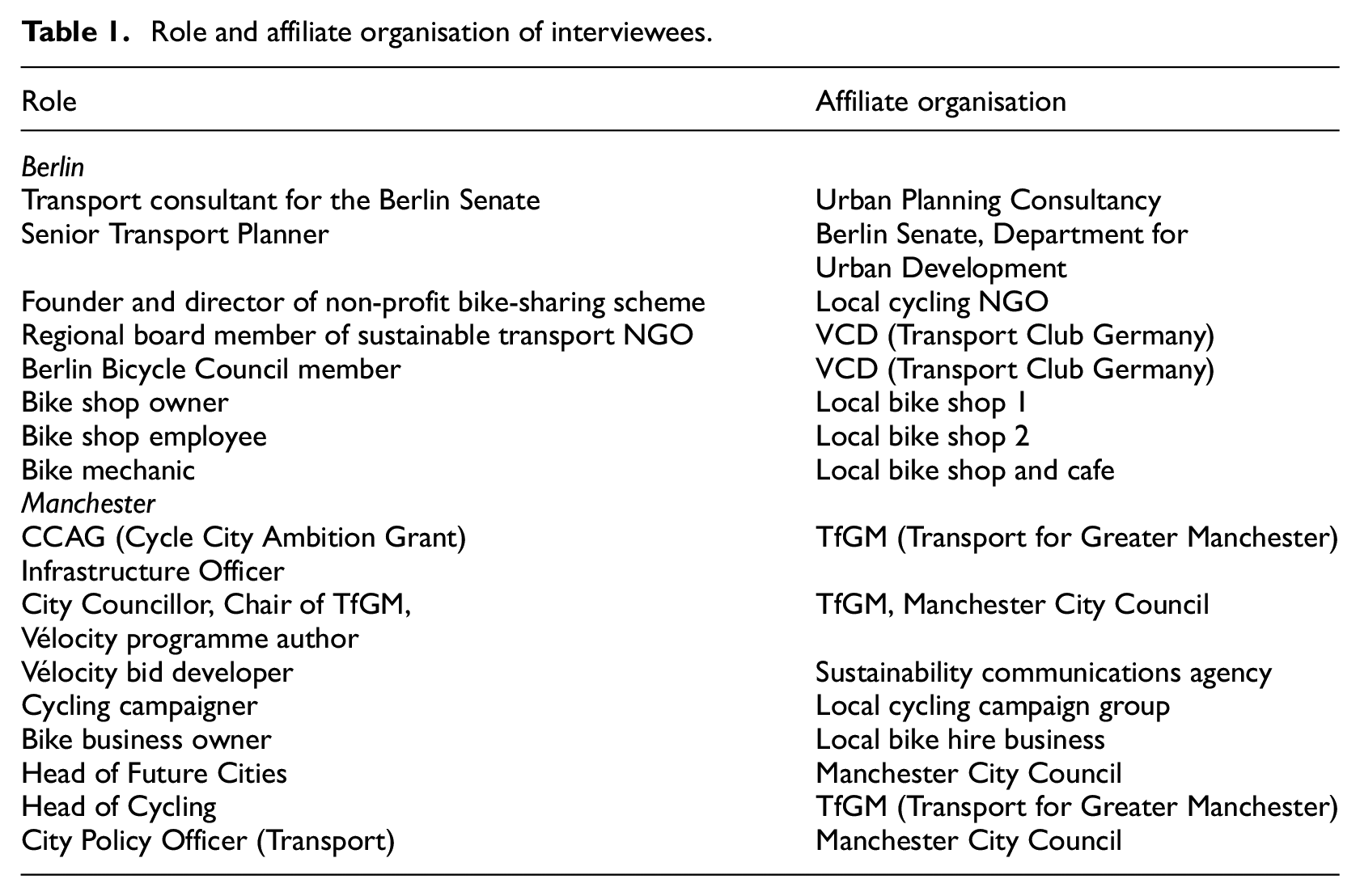
Primary data were collected through document examination and in-depth interviews with a variety of stakeholders and actors. Sixteen in-depth interviews were conducted (see Table 1), in addition to numerous short interviews and analysis of secondary data in the form of documentary and policy evidence to contextualise responses. The interviews themselves were semi-structured, with only open-ended questions asked. This allowed participants to provide impartial responses and raise additional factors in order to best glean emphasis of perceived possible causes and key processes for analysis. With the expressed permission of the interviewees, all interviews were recorded using a voice-recorder and transcribed at a later date. In the absence of existing qualitative research, the following analysis and empirical contributions stem directly from the resulting interview data. Table 1 profiles the interviewees involved.
Role and affiliate organisation of interviewees.
Informed by previous work in policy mobilities, the data collection process was designed as an exploratory and flexible process whereby contacts were snowballed from the initial participants. This reflexive and exploratory approach provides a rich qualitative data set and allowed the research to ‘study through’ unforeseen networks of influence and causality in both Berlin’s cycling renaissance and the circulation and mutation of this policy knowledge (McCann and Ward, 2012).
The choice of interviewees profiled in Table 1 was guided by the need to access representatives of key groups that steer transitions and previous cycling research (Parkin, 2012). In order to gain a more complete picture of the perceived influence of local transport policies, the perspectives of a variety of stakeholders involved in policy-making and implementation were considered, as well as local experts from cycling NGOs and businesses (see Table 1). In Berlin, this is reflected in the decision to interview a senior local Transport Planner for the Berlin Senate, a Transport Consultant employed by the Senate, three cycling and sustainable transport campaigners, and three employees of bike shops; allowing for an analysis of accounts from a range of stakeholder perspectives. In Manchester this involved interviewing the key bid writers and contributors at Transport for Greater Manchester, Manchester City Council and their sustainability communications consultants, as well as a range of other key stakeholder groups, including cycling and sustainable transport campaigners, employees of bike shops and planners involved in specific elements of the proposed upgrades.
The relatively small number of in-depth interviews reflects the focused nature of the case study and the limited number of people that were involved in preparing the bid in Manchester. It was possible to verify many of the key findings from Berlin with data from secondary sources. The nature of the study necessitated a constant shuttling back and forth between the documentary evidence and the interview data, which made it possible to critically analyse responses and validate arguments. This paper now turns to examine the causes of Berlin’s cycling renaissance, before tracing its mobilisation as a policy model for cycling transitions.
Re-examining Berlin’s cycling transition
Having experienced a rapid increase in bicycle use in recent decades, Berlin is increasingly discussed as a model for cycling promotion in academic, media and governmental discourse (Department for Transport, 2013; Guardian, 2010; Pucher and Buehler, 2008; Vélocity, 2013). Despite this, only a handful of academic studies – mostly featuring Berlin as part of multi-city analyses – have addressed this phenomenon (Brugman, 2012; Meng et al., 2014; Pucher and Buehler, 2007, 2008, 2012). These studies present Berlin as an exemplar for other cities to learn from when developing cycling policy; discussing expansion of cycle infrastructure, traffic-calming measures, the integration of cycling with public transport and educational schemes as exemplar policy measures. The message here is that the Berlin authorities have intentionally and successfully managed a significant increase in cycling as means of transport over the last two decades and thus offer useful lessons for cities looking to do the same. However, there is little critical analysis of causal mechanisms or insights into how or if policy measures can be successfully transferred and implemented in other cities.
Existing studies focus predominantly on quantitative data regarding changing cycling levels, infrastructure and transport design, rather than interrogating the causality of these changes. This paper contends that while policy efforts have coincided with higher levels of bicycle use in Berlin, there are a number of other causal factors at play. This analysis resonates with the work of Maddox (2001) on Germany’s national ‘bicycle boom’ of the 1970s–1990s, which suggests urban congestion, oil shocks, increased public environmental awareness and changes in urban form had more impact than public interventions.
Analysis of interviews alongside documentary evidence identified four prevailing causal factors for Berlin’s cycling renaissance: (a) the relative cost of cycling, (b) the relative convenience and speed of cycling, (c) Berlin’s cultural-cum-political demographics, and (d) the city’s pre-existing urban form. These four prevailing causal factors are now discussed critically in reference to statistics and secondary sources, and in relation to Berlin’s transport policies.
Interviewees stated the lower monetary cost of cycling relative to other transport modes as a significant reason for increased bicycle use. Responses emphasised this as the single most influential motivation for bicycle use whilst perceiving this as originating in high levels of economic deprivation in the city. This explanation given by a mechanic at a local bike shop and café was typical:
Because a lot of people around here don’t have much money (…) cycling is just like really cheap, it’s definitely the cheapest way of getting around (…) you can often find a bike pretty cheap, then you don’t have to pay for public transport.
Cost is recognised as important in transport choice (Frank et al., 2008) and Maddox (2001) cites economic shifts as influencing the growth in cycling in Germany since the 1970s. Berlin’s local economy has struggled following reunification in 1990 (European Commission, 2014; Krätke, 1999), its public finances are notoriously fraught (Färber, 2014) and poverty and unemployment rates have been comparatively high – reaching a peak of 19% in 2005 (Berlin Chamber of Commerce, 2011). Although this attribution of socio-economic factors is supported by a positive correlation between some of Berlin’s most deprived districts and bicycle use, these districts may also potentially be predisposed to higher cycle use because of their centrality and compact urban form (Berlin Senate, 2013). Furthermore, income-related travel survey data for Berlin from 2008 (Clearing House Transport, 2012) actually suggest little relationship between individual household income and cycling. Recent studies of other cities (including Manchester) have also suggested cycling to be more popular amongst individuals with higher incomes (McKenzie, 2014).
Regardless of a concrete statistical link between income and cycling, there does seem to be widespread awareness of the lower cost of cycling in transport choice in Berlin. Pertinently, both this awareness and any cycle-friendly socio-economic factors, such as income, social status and fuel prices, are totally detached from Berlin’s transport policies and investments.
Half of the respondents specified cycling’s speed compared with motorised modes for many journeys as a reason for high bicycle use in Berlin, emphasising traffic congestion as the driver of this perception. Perceived levels of comfort and convenience of bicycle use was also emphasised by respondents, contrasted against the relative hassle and cost of car parking. Although data on road behaviour or journey times by transport mode in Berlin are not readily available, traffic congestion and parking restrictions were noted as problematic by interviewees (see also Berlin Senate, 2014; Statista, 2014) and most journeys lie comfortably within the range conducive for cycling, lending credence to these claims. Regardless of objective backing, the interviews reveal the significant influence of a widespread perception of cycling’s effective speed, convenience and comfort (Tranter, 2012).
Although traffic-calming measures have been cited as a causal factor in Berlin, this was not mentioned by any of the interviewees. Nonetheless, it is impossible to ignore the potential importance that widespread traffic-calming measures have had on cycling rates. Area-wide traffic-calming measures actually began to be introduced in the 1980s in some areas of West Berlin (e.g. Moabit, Wrangelkiez, Graefekiez) and continued to be rolled out (albeit at a slower rate) after reunification until the policy came to be discontinued by 2000.
Despite traffic-calming measures’ prevalence, their success has been brought in to question, with residents of some areas expressing concern about a lack of enforcement and local authorities claiming not to have enough funding to conduct speed controls or implement further physical barriers (Berlin Senate, 2009; Berliner Zeitung, 1999; Kalender, 2012). Critically, as part of Berlin’s walking strategy, and considering local residents’ motivations to campaign for their expansion, such measures were implemented with the intention of reducing noise and air pollution and traffic accidents, rather than cycling promotion specifically (Berlin Senate, 2009; Environment Agency Austria, 2014; Kalender, 2012). Regardless of their success in encouraging cycling, there is very little mention of cycling promotion as an intended outcome of traffic-calming measures in either policy documents or subsequent policy studies. Increased cycling rates resulting from traffic-calming measures can then be seen as an unintended (albeit positive) outcome of the city’s transport policies at this time.
Responses cited prevalent cultural and political values as reasons for increased bicycle use, emphasising cultural and political inclinations particular to Berlin as major factors. Berliners’ awareness of the environmental and health benefits of cycling were also linked to the emergence of cycling and bicycles as popular fashion and status symbols since around 2006 as causal factors. As the owner of a local bike shop put it: ‘… in Berlin we are modern, we are not fat, you know?’.
Berlin has developed a global reputation as a creative hub and cultural capital since reunification and the city has had a reputation as a centre of support for progressive politics in Germany since the 1970s and 1980s (Colomb, 2012; Shaw, 2005). Significantly, Berlin’s particularly alternative and hipster image has become increasingly entwined with a form of fashionable bicycle culture (Daily Mail, 2013; Fick, 2013; The Bike In My Life, 2012).
Although attribution is difficult here (far from every Berliner is a hipster or environmental activist), identity is a key factor in determining propensity to cycle (Skinner and Rosen, 2007). The influence of Berlin’s particular cultural-cum-political milieu on bicycle use can certainly not be ignored, and it is argued that this has at least supported Berlin’s cycling renaissance.
Supporting recent studies of Berlin’s markedly ‘polycentric’ form (Horn, 2013; Meng et al., 2014), respondents also cited spatial structure as an important reason for high bicycle use. The average length of journey in the city is around 6 km (Berlin Senate, 2013) with 45% of journeys being particularly cycling-friendly at less than 3 km (Parkin et al., 2007; Pucher and Buehler, 2007).
A senior transport planner at the Berlin Senate Department for Urban Development highlighted how Berlin’s inherent journey patterns favour cycling as an optimal transport mode for a large proportion of journeys:
If you consider the mean trip length of people living in Berlin it’s (hardly) above 3 km (…) you end up with actually (…) quite a small number of longer trips, this is because you have the right structure in Berlin.
In this context, it is worth noting that Berlin’s division between 1945 and 1990 has meant that the tram network is better developed in the East, whilst the U-Bahn (underground railway) is more extensive in the West. Further research would be useful to identify whether the modal shift to cycling came from people switching from cars to bicycle or from public transport to bicycle. Considering the socio-cultural aspects mentioned above, it could be hypothesised that the latter is more likely to have contributed to increased cycling levels.
Although interviewees did not comment on the legacy of the city’s division, they did note Berlin’s particularly wide and spacious streets as enabling both ease of bicycle use and the development of cycle infrastructure. The city was actually built an extensive network of designated cycling road infrastructure long before the 1990s. Grandiose and expansive boulevards have historically been a significant spatial feature of Berlin. Nonetheless, through successive car-orientated planning agendas, the building of segregated bike lanes to allow more space for motor-vehicles had been standard practice from the mid-1930s until around near the end of the century (Allen, 1987; Bracher, 1987; Maddox, 2001). Ironically, Berlin owes its bicycle-friendly urban form to planning agendas either contrary to, or detached from, cycling promotion. Studies suggest that in the context of low bicycle use (as Berlin had until the 1990s), segregated cycle lanes can nurture increased levels of cycling participation to a significant extent (Tilahun et al., 2007; Wardman et al., 2007). Given an inherited urban form conducive to high cycling rates – wide spacious streets, extensive segregated cycle infrastructure and prevalent cycling-appropriate journey lengths – pre-existing urban form seems to have played a key role. Critically, this infrastructure was not built with the intention of increasing bicycle use and so any resulting benefits can be considered as exogenous to pro-cycling policies.
Understanding the role of cycling policy
Given the existing consensus around Berlin’s cycling renaissance, the four sets of causal factors discussed here highlight a notable omission – the influence of the city’s cycling policies. The transport consultant to the Berlin Senate highlighted the timing of policy interventions and levels of investment:
There was no money given to this programme until (…) about 2001, 2002, so the first seven years were kind of lost, was only on paper. So from 2002 onwards there was some money in this, I think (…) began with about a million euros per year and it’s about now up to two-and-a-half.
By 2001 cycling’s modal share in Berlin was already above 10%, up from around 5% for the city as a whole in 1990 and only 3% behind the 2008 level (Pucher and Buehler, 2007). Crucially, the Senate’s first cycling strategy was not adopted until November 2004 (Berlin Senate, 2011). By this time Berlin’s cycling renaissance was well underway.
Interviewees from the local government revealed the Senate’s surprise at the rate of increasing bicycle use and personal doubts about the influence of local governance. Far from initiating growth, the city’s long-term transport strategy actually had to be modified in order to cope with it. A representative from VCD (Transport Club Germany) and leading member of the Berlin Bicycle Council summed it up as follows:
The politics only follow the tendencies (…) the politics are only following (…) trying to cope with the trend.
This insight could perhaps be attributed to modesty (on the part of city officials) and partiality (on the part of VCD campaigners) if it were not for strong supporting evidence in the timing of investments and the inclusion of cycling policies in the city’s wider transport strategy plans. In short, Berlin’s initial and most rapid period of expansion in bicycle use cannot possibly be attributed to the city’s efforts to promote cycling because of the incongruent timing of such efforts with cycling uptake.
The comments of planners and consultants also point to low levels of investment throughout this period, both in comparison with similar cities (Brugman, 2012) and considering cycling’s already significant modal share in Berlin. The Head of the Senate’s transport division, Burkhard Horn, has also openly discussed the city’s enduring lack of investment in cycling since the 1990s (Horn, 2013; The Bike In My Life, 2012). In the aforementioned context of Berlin’s constrained economic situation, the city’s policies were attributed to a chronic lack of public funds by four of the interviewees. Interviewees also mentioned a lack of political willingness and persistently car-orientated political directives as a significant barrier to investment; a sentiment that resonates with the longstanding influence of the car lobby in German transport politics (Schwedes, 2011; Spiegel, 2011).
In contrast to the experiences of many other cities (see Batterbury, 2003), respondents (including VCD campaigners) also notably omitted the role of activism or bottom-up campaigning as a factor in Berlin’s cycling renaissance; a finding supported by the relatively late involvement of activist groups in local transport policy development in 2003 (Pucher and Buehler, 2012).
Berlin’s policy interventions in cycling since the 1990s can be characterised as a reactive management of an unexpected upsurge in cycling, rather than a proactive strategy to intentionally and methodically instigate increased use. Funding limitations hampered cycling-specific policies that were not even implemented until the upsurge was already well under way in the early 2000s, with the result that their impacts have been (admittedly) limited. Maddox’s (2001) doubts as to the purported influence of policy on increased bicycle use in Germany appear to align with Berlin’s experience, whilst the widely held notion of a policy-led programme of transition appears largely inaccurate.
Based on the evidence analysed above, it can be argued here that cycling as mode of transport had already passed through the pre-development and take-off stages by the time concerted pro-cycling interventions could have influenced bicycle use. According to Berlin’s transport department, Berlin has a natural limit of around 18–20% modal share for cycling. Arriving at this level could therefore be seen as something of an absolute end point in the diffusion of cycling as socio-technical innovation, or a completed transition programme. An estimation based on the trajectory of cycling’s diffusion in Berlin suggests that the modal share of cycling when the Senate’s first cycling strategy was implemented in 2004 was accelerating towards completing its diffusion in society. This temporal mismatch undermines previous attributions of concerted governmental intervention in causing Berlin’s cycling renaissance.
Berlin’s transport regime appears to be experiencing a transition towards a more sustainable configuration, driven in large part by increased cycling levels. Having accumulated momentum through the 1990s, the diffusion of cycling by 2004 can be observed as breaking through to alter the form and constituent processes of the city’s transport regime. Cycling can even be observed altering the wider landscape around this time, manifesting in local politics through the emergence of numerous local bicycle advisory councils since 2003, whilst also exerting its health and environmental credentials, and expanding cultural value through its emergence as a fashion and status symbol.
Contrary to existing consensus, increased cycling levels were not initiated or significantly guided through a managed transition that aimed to encourage more cycling. It is impossible, however, to rule out the unintentional impact of traffic-calming measures brought in to tackle pollution and car accident rates, nor the agency of local governmental efforts in encouraging further growth in bicycle use since 2004. What can be defined as reactive transition management may have encouraged the later acceleration and stabilisation of cycling as mode of transport and facilitated its wider sustainability impact. For instance, physical infrastructure has certainly been altered to better accommodate higher bicycle use, although lack of investment has likely limited impact here.
Mobilising Berlin’s cycling renaissance
An almost ubiquitous contention in policy mobilities research has been the importance of territorial context in determining the extent and suitability of learning arrangements (Benson and Jordan, 2011). Research here consistently observes strong positive correlations between fruitful learning and similarities in territorial context (Benson and Jordan, 2011; Temenos and McCann, 2013). This section considers how the potential for Manchester to learn from Berlin’s cycling policy model is limited by their fundamentally incongruent territorial and temporal contexts.
Manchester and Berlin have significantly differing urban forms. Critically, Manchester cannot be said to enjoy the abundance of wide streets and pre-existing network of cycle infrastructure, nor the dense inner-city residential districts inhabited by a particularly young, impoverished and environmentally aware population that underpinned Berlin’s cycling renaissance. Similarly, the Berlin phenomenon is causally linked to high and rising levels of deprivation and unemployment in the city, the likes of which are not even nearly evident in Manchester (Greater Manchester Chamber of Commerce, 2014). The difference in funding is even starker with Vélocity’s two-year £20 million grant endowing Transport for Greater Manchester with around four times the amount the Berlin Senate currently has available to invest in cycling, and more than ten times that which was invested initially in the early 2000s. In transition terms, Manchester does not exhibit the same spatial, cultural-cum-political or economic landscape-level pressures that opened up a window of opportunity for cycling in Berlin. The incompatibility observed here can then be understood as indicative of the dialectic tension between cities being territorially fixed – idiosyncratic in context and experience – on the one hand, and policy knowledge being constructed, circulated and understood relationally across space and time on the other (Bulkeley, 2006).
As argued above, Berlin’s pro-cycling policies have been reactive, intervening at a stage when cycling was already breaking through to alter the city’s transport system and wider political and cultural landscape. By contrast, Manchester is seeking to initiate growth from a significantly lower modal share, and intervening at this earlier stage of diffusion will likely require different strategies (Schot and Geels, 2008). This contextual misalignment can be observed in the differing planning strategies. Manchester is targeting more participation from inexperienced cyclists and so plans to build more physically segregated cycle lanes (Vélocity, 2013) with the aim of reducing ‘fear of cycling’ (Horton, 2007). By contrast Berlin has been removing segregated infrastructure in favour of on-road cycle lanes for a number of years now, perhaps indicative of the increased collective visibility and confidence in safety associated with higher bicycle use (Horton, 2007; Tilahun et al., 2007; Wardman et al., 2007). Berlin transport planners have little experience relating to Manchester’s position and so it is reasoned that learning here will be limited.
This incongruent coupling is based on a policy learning model that assumes that Berlin’s cycling renaissance was managed through targeted governmental intervention from its earliest stages. The next section outlines the factors that drove the mobilisation, circulation, and mutation of this policy model in Manchester and the UK more widely.
City branding, competitive funding and effective policy learning
Analysing interviews with Manchester Vélocity bid developers and relevant policy documents reveals the motivations, rationales and processes leading to the Berlin policy-learning proposal. Three influential factors led to the inclusion or ‘mobilisation’ (Peck and Theodore, 2010a) of the Berlin case in the Vélocity bid: professional networks and the marketing value of high-profile exemplar cities, the translation of Berlin’s trajectory into a quantitative target and coerced policy learning through the influence of funding bid guidance.
Professional networks and existing commercial relationships were emphasised as having strongly influenced both the specific account of, and the decision to include, the Berlin example in the bid. The lead bid writer noted that his ethical communications agency had secured the contract to produce the Vélocity bid and programme from Transport for Greater Manchester having worked with them on previously successful campaigns. Pivotal research into the experiences of the featured German cities had been provided by one of their German partner companies – Fairkehr – whom the Manchester company had developed a good relationship with through a European network of sustainability communications agencies (Creative Concern, 2014). Critically, Fairkehr had previously worked on cycling campaigns for a number of local governments in Germany (Fairkehr, 2014).
Given the aforementioned explanations attributing Berlin’s experience to policy, it is understandable that the research provided by Fairkehr corresponded with this consensus. However, the consultancy industry depends upon selling policy knowledge (Peck, 2003; cited in Clarke, 2012: 34), and it was also certainly not in their commercial interest to disseminate any doubts as to their own, nor their current or potential future clients’, purported successes. Within this context little motivation existed for the actors involved in the policy learning process to challenge received wisdom surrounding Berlin’s cycling success. This finding aligns with the aforementioned constructivist explanation of international policy learning which has traced the development of policy knowledge through networks of ‘experts’ in a social arrangement driven by rhetoric and theory rather than empirical rigour (Simmons et al., 2007).
The dissemination of the Berlin exemplar through this professional network also resonates with the competitive theory of policy learning (Simmons et al., 2007); with evidence that this policy model has been mutated through its inclusion in the competitive Vélocitybid document:
Manchester plans to establish a longer-term partnership with a number of German cities including Berlin (…) to learn from their extensive experience of infrastructure and behavioural change programmes that have taken cycling levels in key German cities on precisely the same growth curve that we’d like to create across our city region. (Vélocity, 2013)
It has been previously observed that policies have been translated into both English and scientific language in the policy learning process (Peck and Theodore, 2010b (cited in Temenos and McCann, 2013: 348)). Berlin’s experience has been similarly translated and simplified here into a marketable language of co-operation and growth, whilst being uncritically categorised as representative of other German cities. In the context of an inter-urban competition for funds, the Manchester bid framed the Berlin policy experience in a particularly (and successfully) marketable way and in doing so discursively framed cycling policy as a matter of infrastructure and behavioural change. The Berlin model mutated from previous descriptions (Pucher and Buehler, 2007, 2008, 2012) into an appealingly simple two-stage process.
The above quote alludes to the second factor influencing the mobilisation of the Berlin model – the known quantitative trajectory of cycling growth in Berlin. The impressive rate at which cycling’s modal share increased (Pucher and Buehler, 2012) is enshrined and repeatedly mentioned as a primary quantitative target in the Vélocity programme and bid (Vélocity, 2013). Interviewees from Transport for Greater Manchester, Manchester City Council and the bid writers explicitly recognised that the similarity between Berlin’s initially low base level of cycling and Manchester’s start point underpinned the rationale for the proposed learning partnership.
This supposed similarity is critical and distinguishes the relationship between Manchester and Berlin as one of learning rather than simply following best practice. Rather than positing the Berlin approach as a universally applicable model, the bid document attempts to construct similarities between the two cities in terms of the initial levels of cycling and the need to achieve big gains with minimal investment. Emphasising the quantitative aspects of Berlin’s experience offers a clear rationale for commensurability and thus the possibility of learning between the two cities. The statement of ambition and intention is effective but overlooks the qualitative facets of the Berlin model relating to the causal mechanisms and the development and evaluation of specific policy instruments. This feature of the Vélocity bid frames Berlin’s experience simply as a quantitative success, far removed from the complex, co-evolutionary, multi-stakeholder and multi-level process described in this paper, or even the previous explanations that it challenges (Pucher and Buehler, 2007, 2008, 2012). In this sense, the Berlin case is presented not so much as a best practice, but as a best target. Following McCann (2013), this can be seen as a form of reverse ‘policy boosterism’; with the promotion of locally developed policies not being performed actively by local policy-makers in Berlin (as previously observed by McCann, 2013) – but mobilised conversely by geographically distant peers in Manchester.
The Vélocity bid writers were not alone in identifying German cities as appropriate examples to follow. The final key motivation for adopting Berlin as a role model aligns with coercion theory explanations of policy learning (Simmons et al., 2007) in that it was strongly driven by the suggestion to learn from other cities in the Cycle City Ambition Grant guidance document, which specifically name-checked Berlin:
In addition to London many overseas cities starting from a low base in the amount of cycling and seeking transformational change examples include Edinburgh, Berlin, New York, Paris and across [sic] cities across Germany (over the past decade the percentage of trips by bike in Germany has increase from 9.5% in 2002 to 14.7% in 2011). The best international examples show how a successful approach can be taken to increase cycling numbers … . (Department for Transport, 2013: 11)
The desirability of a German comparator highlighted in the Department for Transport bid guidance, alongside the existing links between the Manchester bid writers and Fairkehr, underpinned the decision to include Berlin.
While the Department for Transport did not participate in this research an important further avenue of research would be to trace the reasons and information networks that underpinned the inclusion of these cities in the funding guidance. Nonetheless, the suggestion was taken on by Vélocity as well as other bids (e.g. West Yorkshire Metro, 2013). The Department for Transport guidance can thus be seen to have disseminated a particular version of cycling best practice, mobilising exemplars based on their simple quantitative relevance (base level and successful trajectory) and grouping these cities under the causal assumption of policy-led change.
The bid developer’s international connections and the competitive and coercive context of the bid represent omnipresent forces impelling the circulation of the Berlin policy model; reflecting Simmons et al.’s (2007) identification of overlapping insights from constructivist, competition and coercion theories of policy learning. Through the Cycle City Ambition Grant scheme, the Department for Transport explicitly utilised funding incentives to encourage competing cities to produce ‘ambitious’ policy programmes to be judged according to their ‘strategic, financial, economic, commercial and management cases’ (Department for Transport, 2013). Evidencing policy learning is a de facto requirement of political legitimisation and access to funding (Betsill and Bulkeley, 2004), and this competitive pressure led Transport for Greater Manchester to hire a professional agency to produce the bid in the first place, who subsequently utilised a peer network to obtain research into the Berlin case study with the aim of demonstrating the necessary ‘ambition’. These competitive and coercive incentives can then be observed as motivating the inclusion of the proposal to learn from Berlin in the Vélocity bid.
Underpinning this process in its entirety was the explicit association of learning from elsewhere with ‘ambition’. As both the source of funding and information in the Cycle City Ambition Grant process, the Department for Transport has played a powerful role in establishing a particular version of cycling policy knowledge learning that has subsequently mutated through multiple scales of governance and networks of communication.
Conclusion
The transition literature is replete with cases presented as offering insights for transition management practice in other contexts. However, there is a need for greater understanding of the contexts within which policy learning occurs, which underpin the transferability and epistemological validity of such insights. This paper suggests that it may be in the best interests of researchers and practitioners to do just that if the potential benefits from policy-learning arrangements are to be realised. Transition theory provides a conceptual framework that is well suited to the critical interrogation and evaluation of the specific role played by policy in driving complex, co-evolutionary, and multi-stakeholder change. This paper has produced a nuanced explanation of Berlin’s cycling renaissance that challenges the solitary attribution of policy in what is an emerging best-practice policy model. In conceiving Berlin’s cycling renaissance as a complex socio-technical phenomenon, the transition approach has framed a methodological and analytical consideration that highlights multiple factors of causation.
In Berlin, encouraging cycling was not a motivation for policy during the main growth in modal share and so this growth cannot be attributed to intentional transition management. This is not to say that no local transport policies had a positive impact on cycling, but that this impact was not planned or envisioned and that the growth in cycling can only be seen as a positive externality resulting from a range of causal factors and policies. Endowed with a ‘polycentric’ structure, abundant cycling-friendly journey lengths, spacious streets and an established network of dedicated cycle ways, 1990s Berlin inherited a longstanding urban form favourable for cycling. Figuratively speaking, this ‘window of opportunity’ was open long before Berlin’s renaissance. It can therefore be reasoned that other, shorter-term, landscape-level developments prompted a reduction in barriers to cycling (Horton and Parkin, 2012; Parkin et al., 2007) and increased growth in bicycle use. The combination of economic, infrastructural and cultural landscape-level pressures opened up a window of opportunity for cycling to make its mark on the city. This paper has also emphasised the significance of the timing of interventions in a transition in determining causality. Although pro-cycling policy can be recognised alongside growth in cycling, previous explanations bear no consideration to what point in time interventions were actually implemented. Just as Robinson (2011: 13) contends that ‘a spatial understanding of the processes at work in cities can draw us to alternative maps of causality’, this paper argues that a temporal understanding can do the same and that a transition approach can enable this.
Drawing on insights from the policy mobilities literature, the processes compelling the circulation of the Berlin cycling policy model in the UK were motivated by competitive and coercive mechanisms originating in a national government initiative. The development of this policy knowledge through different networks and scales of information exchange left questions of causality unchallenged for the ultimate purpose of promoting cycling planning credentials. Such unexamined assumptions are problematic for policy-making elsewhere as they have the potential to reduce the suitability and effectiveness of policy measures.
This paper has presented an in-depth empirical study that has fleshed out the suggested theoretical synergies between policy mobilities and transition approaches. It has confirmed Affolderbach and Schulz’s (2015) theoretical expectation that an integrated approach can help determine causality and thus key factors underpinning transitions. But further, the paper has demonstrated how the dynamic transition approach can reveal causality through its particular sensitivity to time in socio-technical developments.
This study suggests that both policy mobilities and transitions research can benefit significantly from a concerted conversation. Effective sustainable transition management must consider in greater depth how governments acquire policy knowledge and the influence that actors and networks of information exchange have on this process. By focusing on policy models as territorially constrained and relationally circulated and understood social products, policy mobilities strengthens the geographical understanding of transition studies. Deploying insights and approaches from policy mobilities has the potential to inform more suitable policy-learning arrangements and thus effective urban transition management.
As cities attempt to drastically re-orientate development towards more sustainable and resilient future forms, it is vital that planners and policy-makers have sufficient and appropriate knowledge at their disposal. This paper has examined Berlin’s cycling renaissance to challenge the attribution of causality in cycling policy, while simultaneously demonstrating the set of contextual factors that have led to this exemplar being uncritically mobilised as a basis for policy-making elsewhere. It is vital for both research and practice to critically consider aspects of causality and complexity in accounts of policy success. This paper has shown that an awareness of complexity and temporality in transitions has the potential to aid this, but that further research is required to understand how urban sustainability policy knowledge is made, mobilised and adopted.
Footnotes
Funding
This research was part-funded by The University of Manchester ESRC Impact Acceleration Account R116735.