



Abstract
This article questions the strict parallelism of demographic and economic development in characterising urban shrinkage in Germany. As the cases of several Ruhr cities and East German cities prove, urban economic growth can be achieved thanks to the substantial presence of modern industries and business services, and despite declines in population size. Serious shrinkages of Halle, Cottbus and Schwerin are primarily due to failures in the post-industrial transformation process. Recent policy measures strongly oriented towards slowing the downsizing process of population (via e.g. urban regeneration strategies) do not appear to be sufficient for achieving urban resurgence in these cities. More active industrial policy measures are required there to create a competitive high-tech manufacturing sector, to stimulate innovation activities and to boost its growth interdependence with modern local services and R&D infrastructure.
Introduction
The world is experiencing a continuous trend towards urbanisation. According to the UN (2014), 54% of the world population is presently living in cities, and this share is expected to grow to 66% by 2050. In Europe, the figure totalled 73% in 2014. Despite this trend, many cities have been suffering from economic declines and population losses and, at the same time, they have undergone economic transformation with symptoms of structural crises (Haase et al., 2014; Oswalt, 2006). According to Hollander et al. (2009), one in six cities worldwide was shrinking even before the US subprime mortgage crisis in 2007, while 40% of all European cities with more than 200,000 inhabitants experienced a population decline between 1960 and 2005 (Turok and Mykhnenko, 2007, 2008). The failure to achieve a timely and smooth post-industrial shift from traditional manufacturing to innovation-driven high-tech industries and modern business-oriented services, which was also triggered by relocation and polarisation of economic activities in a global context, has caused serious unemployment and outmigration problems in many urban areas, and also contributed to the gradual, worldwide rise in the number of shrinking cites (Friedrichs, 1994; Galster, 2012; Großmann et al., 2013).
Other determinants leading to urban shrinkage include counter-urbanisation caused by overcrowded city cores and suburbanisation, 1 war, natural or human-made disasters, an ageing or low-fertility rate population, etc. (Beauregard, 2006; Ehrenfeucht and Nelson, 2011; Großmann et al., 2013; Haase et al., 2014; Kabisch et al., 2008; Lang, 2012; Lin, 2014; van den Berg et al., 1982). All these have weakened the economic power of cities and also created financial bottlenecks in maintaining their local infrastructure and quality of life. Consequently, the challenges related to vacant housing, uncompetitive local business firms, as well as poor infrastructure including communication and transportation system, schools and waste disposal facilities have rapidly emerged (Haase et al., 2014; Hollander et al., 2009).
Population loss is widely acknowledged as ‘the indicator of urban shrinkage, the tip of the iceberg [resulting] from underlying complex sets of causes propelling specific problems for urban development, typically listed as economic decline, demographic stagnation, decay or abandonment’ (Großmann et al., 2013: 221). More precisely Martinez-Fernandez et al. (2012) and Morrill (2014) assess the urban shrinkage as:
a multidimensional complex of demographic (e.g. aging and population loss), socio-economic (e.g. economic downturn, employment decline, and poverty [and crime] concentration), […] and physical processes and effects (e.g. infrastructure, housing or industrial deterioration and abandonment) in constant interaction and as unmistakable symptoms of a structural crisis at work. (Audirac, 2014: 28)
Furthermore, it is often argued that there is presently no single theory of urban shrinkage that encompasses a large number of heterogeneous urban decline factors (Richardson and Nam, 2014) and, for this reason, that ‘there is still a lack of conceptualisation and integration of shrinkage into the wider theoretical debates in human geography, town and country planning, urban and regional studies, and social sciences at large’ (Haase et al., 2014: 1519).
The East German urban shrinkage caused by economic and structural transformation after the 1990 unification has been the most pronounced and serious in Europe. This downturn has also been clearly manifested in ‘a vast supply of housing stock resulting from combined effects of low fertility rates, outmigration and a building and renovation boom encouraged by tax incentives in the 1990s’ (Großmann et al., 2013: 222). Yet the recent economic and demographic development has differed from one East German city to another (Bartholomae and Nam, 2014a; Franz, 2004; Gatzweiler and Milbert, 2009; Mulder, 2009; Rink et al., 2010; Steinführer and Haase, 2007). For example, Dresden and Leipzig have been better able to cope with the difficulties, and some middle-sized cities like Jena and Rostock, offering attractive jobs, historical centres and high-quality education facilities, have also been quite successful (Hospers, 2014).
In fact, comparable post-industrial transformations had started in Germany in the 1970s, leading to the shrinkage of several urban cores in the old industrial regions of its western part. Ruhr cities with traditional coal mining and steel industry had to carry out massive and painful structural reforms to enhance their competitiveness (Gatzweiler et al., 2003), while Bremen’s decline was primarily led by the collapse of the shipbuilding sector (Bartholomae and Nam, 2014a). Even by the end of the 1980s, most large West German shrinking cities were found in the northern part of Germany, whereas Munich, Frankfurt and Stuttgart in the South were growing fast (Dormhardt and Troeger-Weiß, 2009). But, although their population size is diminishing, the Ruhr cities have recently demonstrated that urban economic revival and smart growth is possible if there is a gradual shift in the sectoral structure from old manufacturing to more sophisticated high-tech industries and modern services, since the latter are generally acknowledged to have a stronger urban orientation (Kermer, 2007). This has undoubtedly been a long, uneasy development process, and it should continue in the future. Furthermore, the number of single adult households and DINKs (‘double income, no kids’: couples in work without children) has also been increasing. Such demographic trends and new lifestyles favouring city locations, coupled with demand for attractive urban amenities, have further reduced suburbanisation (Cox, 2014).
This article aims to contribute to the scientific discussion surrounding the crucial question of whether urban shrinkage can be straightforwardly assessed as a consequence of demographic changes without a greater regard to the role of the economy (Haase et al., 2014). It primarily concentrates on examining the interplay of structural transformation and deindustrialisation, economic decline and demographic change (Großmann et al., 2013), and deals with the parallelism of demographic and economic development in characterising urban shrinkage in Germany. In this context, we argue that using population change as the only indicator of urban growth and decline could also lead to less effective policy recommendations to combat urban shrinkage (Florida, 2013; Gottlieb, 2002).
As seen in several Ruhr and East German large cities, urban economic growth can also be achieved despite population declines (so-called ‘smart’/‘lean’ growth), in cases where the large-scale presence of modern industries and business services guarantees a recovery. Urban shrinkage in East Germany is frequently caused by a post-industrial transformation failure and, therefore, today’s marked policy orientation towards slowing the downsizing process of population (primarily via urban regeneration measures aimed at hindering suburbanisation and low core urban density) addresses the symptoms without adequately tackling the root of the problem. In a close combination with these already existing policy schemes, more ‘proactive’ industrial (structural) policy measures are urgently required in East Germany’s shrinking cities to achieve a rapid and better-targeted economic restructuring, i.e. to create a competitive manufacturing sector (endowed with new high-tech firms) and to foster growth interdependence with modern local services.
Identification of urban shrinkage in Germany: Economic vs. demographic perspective
Among regional scientists, population change has conventionally been the most widely used indicator to identify urban growth and decline (Hospers, 2014; Rink et al., 2012), since:
[firstly,] population change is an important consequence of urban conditions. Migration [can also be seen as] a response to differences in employment or the quality of life between [cities, which, in turn, leads to fierce competition among them]. Secondly, population change also exerts an important influence over urban economic conditions [because] sheer population size and deep labour pools increase agglomeration economies and productivity in terms of better realising both economies of scale and scope. Population downturns have certainly caused wider economic, financial and environmental problems for cities and their authorities, while shifts in population size affect local jobs through demand for consumer goods and [public] services, housing, schools, etc. (Turok and Mykhnenko, 2007: 167)
However, population change alone does not fully capture urban economic development (Florida, 2013). Focusing on the East German case, Franz (2004) highlights the existence of a loose relationship between demographic and economic development: with high unemployment rates a reduction in the ‘natural’ labour supply caused by the extra population decline will hardly limit the city’s growth, as the idle working population continuously remains huge in this area. Furthermore, ‘jobless’ urban growth, which is rather independent of the labour supply development in the same area, can be achieved if the city sharply increases its productivity (Bartholomae and Nam, 2014a; Berlemann and Jahn, 2013).
Urban productivity can be enhanced in various ways: through massive investment in human capital and R&D infrastructure; a proactive location policy (also via establishing technology parks) to attract high-tech industries and modern services combined with a ‘brain gain’; or through support for the creation of local innovation networks with modern industrial and service clusters that are linked with their national and international counterparts. All of these factors contribute to a better realisation of agglomeration advantages (Florida, 2013; Glaeser et al., 1992). In particular, the discussion of a productivity gap among East German cities has recently gained prominence in the vivid concept of a ‘lean city’, and ‘smart urban economic growth’ debates (Fuhrich, 2003; Lang and Tenz, 2003), since Germany expects a continuous decline in population size in the long-run – which could worsen demographic problems in shrinking cities (Bartholomae and Nam, 2014a). 2
Table 1 depicts the differences in real gross value added (GVA) development and population change of selected large German cities in the period of 1995–2012. Without neglecting the idea of the parallelism of demographic development and economic change (‘growth-with-growth’), but also with adequate consideration given to its methodological disputes mentioned above (‘growth-without-growth’ according to Gottlieb, 2002), four varied categories of urban development can be identified via simple comparisons of these two indicators, 3 as shown in Table 2:
Category 1: Shrinking cities, suffering simultaneously from demographic and economic decline.
Category 2: Smartly growing cities, experiencing demographic decline or stagnation, but enjoying rather favourable economic growth.
Category 3: Population magnets, achieving expansion of population size combined with moderate economic development.
Category 4: Growing cities, experiencing both demographic and economic growth (Bartholomae and Nam, 2014a).
Real GVA and population changes in large German cities (1995–2012).

Source: Own calculations based on data from Statistisches Bundesamt.
Classification of selected large German cities according to changes in GVA and population size (1995–2012).
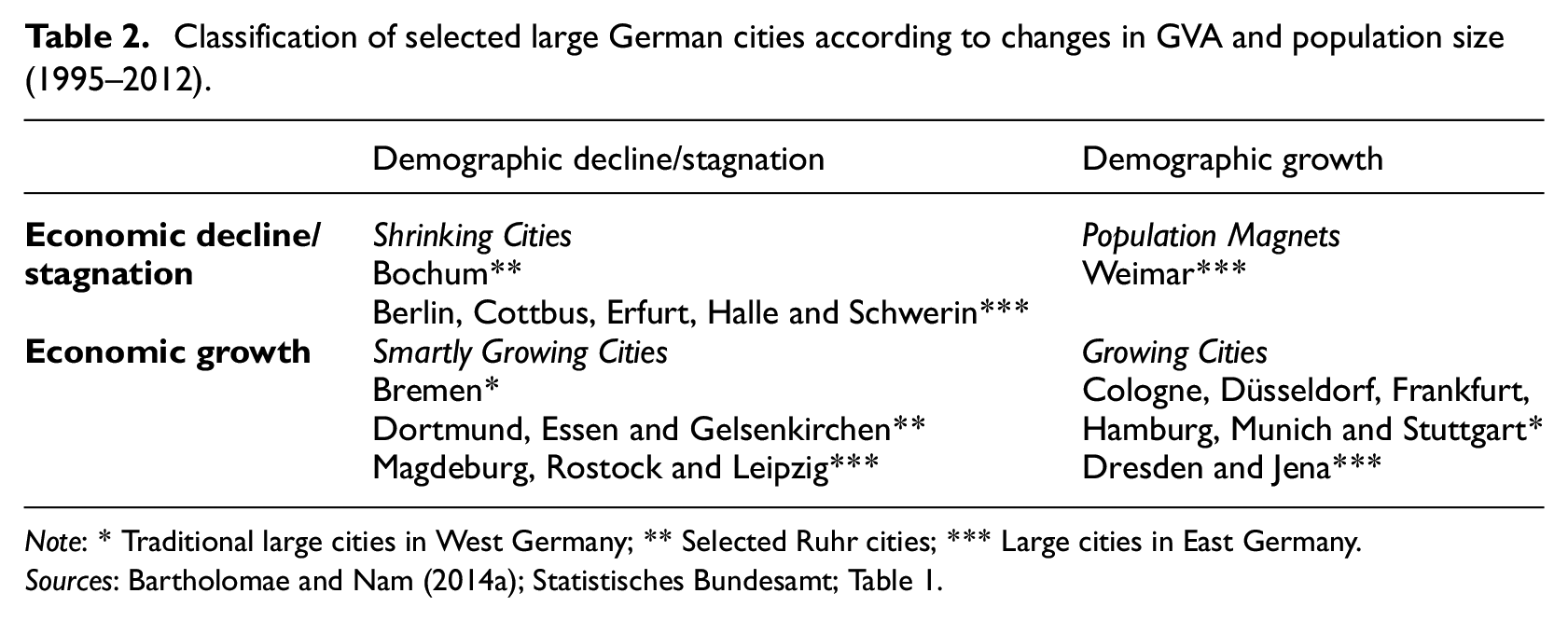
Note: * Traditional large cities in West Germany; ** Selected Ruhr cities; *** Large cities in East Germany.
Sources: Bartholomae and Nam (2014a); Statistisches Bundesamt; Table 1.
To verify whether cities are still suffering from the post-industrial transformation process that started in the 1970s, three groups of large cities were selected for the investigation: (1) the traditional, large West German cities such as Hamburg, Bremen, Düsseldorf, Cologne, Frankfurt, Stuttgart and Munich; (2) some Ruhr cities like Bochum, Dortmund, Essen and Gelsenkirchen; and (3) the East German cities that were strongly struck by the post-socialist shock after Germany’s reunification in 1990, namely Berlin, Cottbus, Dresden, Erfurt, Halle, Jena, Leipzig, Magdeburg, Rostock, Schwerin and Weimar.
During the period of 1995–2012, all the large West German cities investigated (except Bremen) experienced demographic expansion and economic growth at the same time, while Dresden and Jena are also considered growing cities. In spite of the temporal downturn caused by the 2009 crisis, the real GVA growth was most remarkable in Jena (∼60%), followed by in Dresden (∼15%; see Table 1). Dresden and Jena achieved also a significant population expansion (∼6%). Among the West German growing cities, Munich’s performance was most remarkable in the same period – the city achieved around 14% of real GVA growth and 13% of population growth (Table 1).
Bremen and most of the Ruhr cities investigated show a homogeneous development pattern: between 1995 and 2012 these ‘old’ post-industrial transformation cities experienced a demographic decline combined with economic growth. Dortmund and Gelsenkirchen in particular demonstrated a rapid real GVA increase of ∼11%, although the number of inhabitants declined by ∼12% in Gelsenkirchen and by ∼5% in Dortmund. Magdeburg and Rostock in East Germany also belong to this ‘smartly growing’ group that experienced a clear decrease in population of ∼11%, but achieved moderate real GVA growth of 2% to 5%, respectively (see Table 1).
Six of the large German cities analysed can be defined as the ‘shrinking cities’: namely Bochum in Ruhr area together with the post-socialist transformation cities of Berlin, 4 Cottbus, Erfurt, Halle and Schwerin. Unlike other aforementioned Ruhr cities, Bochum failed to create endogenous, real GVA growth (∼−5%), whereas the city’s population also decreased by around 10%. Berlin’s demographic change of −3% was accompanied by a real GVA loss of higher than 3% in the period 1995–2012. With its rate of −14%, Halle suffered most seriously from the economic loss that emerged in line with the population decrease of 18%. Schwerin’s marked economic decline of approximately 9% was combined with a large scale population reduction of around 20%, while Cottbus suffered not only from a severe population decline of around 21% but also from a serious economic decline of 11%. Weimar is the only city among the 22 large German cities considered in which the real GVA declined marginally, but the population growth rate amounted to around 2% in the years 1995–2012 (Table 1). 5
Comparison of Halle’s structural problems with those of other German cities
Halle’s economy and demography: Status quo
Traditionally, Halle was one of the leading East German industrial centres, specialised in salt, gas and energy, brown coal mining, mechanical engineering and chemical products (Wallosek, 2006). Unification created an immense post-socialist competitiveness shock and massive deindustrialisation, from which the old industries in the city suffered seriously: the dominant, big industrial companies were dismembered and privatised, leading to unemployment, 6 while expansion in the service sector was relatively weak (Haase et al., 2014; Rink et al., 2010). Halle currently is seeking to attract research activities for future technologies such as life sciences, new materials and solar energy (City of Halle, 2010). Yet this is an extremely challenging task, since fierce urban competition for R&D and modern industrial activities prevails among large German cities. Service firms account for around half of all companies located in Halle: including, however, less productive, traditional public administration bodies, as well as social and health services which are major local job-providers (Bartholomae and Nam, 2014b).
With approximately 233,000 inhabitants, Halle is presently the fifth most highly populated city in East Germany. The deindustrialisation process in Halle has also triggered the migration of young and skilled workforces to West Germany. Between 1990 and 1999, the city lost 56,000 inhabitants (∼18% of its 1990 total population). 7 However, such a ‘job-driven’ net outflow of people recently declined from around 12,000 in 1990 to an annual average amount of 2000–4000 (Rink et al., 2010).
Moreover, this demographic shrinkage has been exacerbated by suburbanisation (∼37,000 inhabitants between 1994 and 2001) and ongoing ageing problems in the city area (Raschke and Schultz, 2006). The Statistic Bureau Sachsen-Anhalt projects that Halle’s population will decline by 10% (∼23,000 people) between 2008 (with 233,013 inhabitants) and 2025 (with 209,726 inhabitants). As a result, high rates of housing and office vacancies and infrastructure oversupply have recently been seen in the centre of Halle (Haase et al., 2014). 8 Therefore, its urban development plan has been mainly oriented towards the model of building a ‘compact city’ with an attractive urban centre, as in other East German cities, that provides modern infrastructure and guarantees pleasant living and working conditions. 9 More specifically, the city has been making great efforts to control the provision process of the social infrastructure system (kindergartens, schools and elderly care facilities) via administrative and organisational changes, geographic concentration of such facilities, qualitative improvements in services, etc. (Stadt Halle, 2008). In spite of the experiences of some Ruhr cities (Essen, Gelsenkirchen and Dortmund) suggesting a possibility of smart growth followed by a successful economic restructuring, Halle’s main strategy to combat urban shrinkage no longer appears to be geared towards attracting modern industries and services, but significant policy efforts are being made to rehabilitate the city centre as a means of maintaining population size.
Comparison of Halle’s economic structure with that of other German cities
As mentioned, Halle’s economic and demographic shrinkage is a structural problem. In this regard the development and specialisation of various manufacturing sectors combined with the different degrees of dominance of individual services deliver crucial information on the key reasons why urban shrinkage continues in many East German cities. The cobweb diagrams in Figure 1 compare Halle’s employment structure (in terms of the share of employees subject to social insurance contribution) to that of other selected German cities in 2013. Beside the restructuring and transformation achievement of these cities in the last 20 years, they also reveal the cities’ current economic specialisation and competitiveness.

Comparison of employment structures in Halle and selected cities (2013).
Compared to the growing cities Dresden and Jena, Halle’s employment share for the ‘manufacturing’ sector (∼5%) was significantly low: the corresponding share reached c. 12% for Dresden and over 18% for Jena in 2013. 10 Moreover, Halle’s extremely high employment share for ‘education, health, social and other public and personal services’ of over 37% (compared to 29% in Dresden) seriously calls into question whether the city has recently been smoothly transitioning to a modern service society. Together with Halle, shrinking cities in East Germany include Cottbus and Schwerin: Cottbus and Schwerin boast higher employment shares for ‘public administration and defense, social insurance’, but their general employment structures were very similar to that of Halle in 2013, with a substantial share of employment lacking in manufacturing and modern market services.
An analogous comparison of Halle’s employment structure with that of the selected ‘smartly growing’ Ruhr cities reveals a clear difference: Essen, Gelsenkirchen and Dortmund demonstrate an employment structure similar to that of Dresden and Jena. In 2013 all these growing Ruhr cities and Dresden were equipped with a stronger manufacturing sector combined with a larger share of business and market services than Halle. 11 This implies that urban recovery is quite strongly affected by the performance of an individual city’s manufacturing sector, whereas an ideal combination of modern industries and services is a prerequisite for urban growth.
Some political responses to urban shrinkage in East Germany
Growth-oriented vs shrinkage-oriented policy
In recent years, cities have increasingly gained significance as major drivers of innovation, creativity and productivity growth in advanced industry and modern service-oriented economies (European Commission, 2006; Florida, 2013). In this context Turok and Mykhnenko (2008) argue that, firstly, the improved generation of agglomeration advantages (especially for firms) is required for the stoppage of urban shrinkage and to strengthen the economic role of cities. Such advantages are generated from the concentration of high-tech industries and modern business services and the establishment of more intact clusters and connectivity among them within the city area, which reduce production costs and make access to and exchange of business information and qualified labour easy. Secondly, the innovation activities carried out by local firms provide the basis for urban recovery and also guarantee the structural reform and long-term economic growth in cities (see also Wamser et al., 2013).
12
A third policy option for the resurgence of urban economies is a strengthening and better exploitation of the role of the ‘consumer city’, since:
the concentration of major entertainment venues, convention centres, museums, opera, art galleries or specialised centres of [higher] education, [sport] and health [in large cities traditionally] offer unique benefits to consumers [e.g. by providing varieties of shopping opportunities, restaurants, hotels, etc.), with spin-offs for growth through business and domestic tourism and talent attraction. (Turok and Mykhnenko, 2008: 56)
Furthermore, in response to the challenge of urban shrinkage, policymakers have options to adopt ‘active’ growth-oriented or ‘rather passive’ shrinkage-oriented approaches (Wiechmann and Pallagst, 2012). Most American cities have focussed on the former strategies, including smart economic growth (Lin, 2014), whereas more European cities have embraced the latter policy option. Hospers (2014) argues that the best strategy for shrinking cities in the EU is to accept the shrinkage and to improve the quality of life for the remaining residents. A large number of shrinking East German cities appear to be no exception: instead of reforming the urban economic structure more rapidly and stimulating productivity and economic growth, they search continuously for appropriate ways to stop the negative demographic trends and to maintain their population size. Hence, most public promotion schemes in the former GDR have focused on the creation of quality-of-life cities in terms of regeneration, redevelopment and revitalisation of city cores aimed at solving vacant housing problems, making historical centres more attractive and urban neighbourhoods greener, more compact and sustainable (Glock and Häußermann, 2004; Herfert, 2002; Lötscher, 2005).
Table 3 shows the aims and financial resources of typical federal projects that have recently been implemented to support Germany’s shrinking cities. Taking the case of Cottbus as an example, Table 4 shows how the urban rehabilitation programmes applied to the shrinking cities in East Germany are coordinated and financially promoted by the various tiers of government.
Federal subsidies for urban reconstruction and improvement of city centres in Germany.

Sources: Bartholomae and Nam (2014b); German Federal Ministry of Transportation, Construction and Urban Development: http://www.staedtebaufoerderung.info/cln_033/StBauF/DE/Home/home__node.html?__nnn=true; Mulder (2009).
Classification of urban reconstruction programmes for shrinking cities in Brandenburg (East Germany) according to different tiers of government: An example.

Achievement of urban resurgence via industrial policy
The widely implemented urban regeneration measures for creating a high-quality-life city equipped with educational, historical and cultural attractiveness alone do not appear to have fully solved the problems of the economic downturn in Halle, Cottbus and Schwerin, since their shrinkage is more strongly attributed to the lack of a competitive manufacturing sector and its weak growth interdependence with modern business services. The prevailing less-competitive industrial structure has also caused innovation activities to remain weak (Berlemann and Jahn, 2013). The success stories of Dresden and Jena, as well as the smart economic growth of several Ruhr cities, in spite of decreases in population size, demonstrate that the creation of a healthy economic structure and increases in productivity are essential prerequisites for a favourable long-term development. (In this context, Halle still wants to become a city specialised in modern industrial activities including life sciences, new materials and solar energy.) Furthermore, these cities with an industrial tradition have also been playing an important role as central places: Halle is not only the fifth largest city in the eastern part of Germany but also the largest city in Saxony-Anhalt, whereas Schwerin is the state capital of Mecklenburg-Western Pomerania. Therefore, it is not desirable that these large cities shrink further and lose all importance.
Taking these aspects into consideration, additional and more intensive efforts seem to be necessary in order to effectively reform the urban economic and industrial structure and to achieve the mid- to long-term economic resurgence in Halle, Cottbus and Schwerin, although this would be extremely challenging and costly. And this task can be most suitably carried out in terms of an active industrial policy which is designed not only based on the subsidiarity principle and own initiatives of these shrinking cities but also considers the strengths, weaknesses, opportunities and threats of specific urban economic structure and location quality, including ‘hard and soft’ infrastructure endowment. Such growth-oriented policy measures should primarily target the development of a healthy local manufacturing cluster, firstly by reducing the bounded vision of existing industrial firms and enhancing their absorption capacities of new ideas and technologies, and secondly via the creation of a substantial number of high-tech SMEs by fostering their innovation activities and better commercialisation of their products, which will attract other modern service firms into these cities. Such policy measures can include:
Creation of technology parks, to better utilise existing social capital and exploit local industrial know-how, and to attract innovative SMEs and entrepreneurs.
Promotion of urban innovation potentials and local firms’ R&D activities via (1) developing urban clusters among modern industries and business services; (2) establishing regional innovation networks with research infrastructure; and (3) integration of such local networks into national and international ones.
If urban path dependence creates lock-in effects, impedes absorption capacity of new business ideas and technologies and disturbs economic restructuring, a courageous political step needs to be taken to part with such an industrial tradition.
Exploring possibilities of attracting large firms via provision of subsidies (see Siemens in Dresden).
Closer inter-city cooperation (e.g. Halle and Leipzig) via common regional marketing and local land-use policy to attract business investment to realise economies of scale and scope.
Continuous efforts towards urban revival for slowing the demographic downturn of shrinking cities, and also, more effectively, for creating favourable working spaces and attracting qualified people in the city centre.
These recommendations correspond to the EU’s cohesion policy objectives, which should now be confluent with the knowledge-based initiatives and the goals of the Lisbon agenda of 2000–2010 as well as the current Europe 2020 strategy by promoting growth and employment in the less-favoured EU regions (Wamser et al., 2013). 13 In this policy context, intensive efforts have been made in order to better activate the endogenous innovation potentials for regional growth, via identifying the region-specific characteristics and assets, exploiting individual regions’ competitive advantages and rallying regional stakeholders and resources around their vision of future development.
To a certain extent, all these measures can be combined with the existing urban revival promotion schemes (as shown in Tables 3 and 4), with the traditional Joint Task for Improving Regional Economic Structure, which has been introduced also in eastern Germany in order to stimulate the endogenous growth in the structurally weak areas (Bade and Eickelpasch, 2011). 14 Yet, referring to the rather weak and troublesome economic development and structural change of Halle, Cottbus and Schwerin in recent years, better-targeted and more strongly innovation-oriented structural policy efforts, and some special financial support programmes designed under the particular consideration of urban shrinkage problems, seem to be additionally required to rescue these cities within a shorter period of time.
Conclusion
Shrinking cities are generally defined as cities facing population losses and additionally undergoing economic transformation with symptoms of a structural crisis. This study investigates the interplay of structural transformation and deindustrialisation, economic decline and demographic change. We question the widely applied parallelism of demographic and economic development to characterise urban shrinkage and suggest that the usage of population change as a single indicator tends not only to hinder the correct classification of shrinking cities but also to lead to less-adequate consideration of structural and industrial weakness when designing policy measures against urban shrinkage. This aspect is particularly important when characterising urban shrinkage in the East European transformation countries including East Germany. For the classification of German shrinking cities, the population data and the real GVA data on the city level for the period 1995–2012 are adopted, whereas their recent employment structures are compared to identify their industrial specialisation.
The experiences in some Ruhr cities and East German cities like Erfurt, Rostock and Magdeburg demonstrate that urban economic growth can be achieved via the substantial presence of modern industries and business services, although population size declines – see Florida (2013) for similar results from the US city classification. More precisely, the resurgence of these German cities is largely attributed to their success in structural transformation and achievement of ‘smart’ economic growth triggered by productivity growth. Shrinking cities like Berlin, Halle, Cottbus and Schwerin are now obviously suffering from a structural problem caused by the failure of post-industrial transformation. Beside the case of Weimar, which has become the ‘magnet’ of retirees exploiting its reputation as a historical and cultural centre, the current policy-based efforts to slow the population downsizing and suburbanisation via urban regeneration (including city-core revitalisation) measures (aimed at creating quality-of-life cities) are not sufficient for the resurgence of these shrinking cities in the long run.
To stop the shrinkage and achieve smart growth, a more proactive, growth-oriented industrial policy can be considered, which is designed based on the individual needs and initiatives of German shrinking cities and which also considers their specific economic structure and location quality, including infrastructure endowment. Turok and Mykhnenko (2008) suggest three ways to achieve urban recovery: (1) an improved generation of agglomeration advantages through concentration of modern industries and creating intact clusters; (2) rapid structural reform guaranteeing long-term growth via enhanced local firms’ innovation performances; and (3) the better exploitation of the role of consumer city (via concentration of e.g. entertainment and sport facilities). Also following this idea, Germany’s urban resurgence policy should be more strongly concentrated on the creation of endogenous growth potentials in the shrinking cities, which enables urgent developments of healthy local economic structure equipped with high-tech SMEs and modern business services, and stimulates firms’ R&D and innovation efforts within a better-established local innovation system.
In Germany, urban regeneration in less-favoured areas has been promoted by the Joint Task for Improving Regional Economic Structure in cooperation with the EU cohesion policy. Our recommendations for an ‘additional’, better-targeted industrial policy against urban shrinkage are also in accordance with the EU’s cohesion-policy objectives, emphasising the knowledge-based initiatives and the goals of the Lisbon agenda of 2000–2010, and the current Europe 2020 strategy, by promoting growth and employment in less-favoured EU regions.
Footnotes
Acknowledgements
The authors are grateful to three anonymous referees for helpful comments.
Funding
This research received no specific grant from any funding agency in the public, commercial, or not-for-profit sectors.