



Abstract
The arts have long played a role in debates around gentrification and displacement, yet their roles and impacts as change agents are not clear-cut. According to the standard account, artists facilitate gentrification and ultimately engender the displacement of lower income households, but more recent research complicates the accepted narrative. This article seeks to untangle the relationship between the arts, gentrification and displacement through a statistical study of neighbourhood-level arts industry activity within large US regions. The findings indicate that the standard arts-led gentrification narrative is too generalised or simply no longer applicable to contemporary arts-gentrification processes. Rather, the arts have multiple, even conflicting relationships with gentrification and displacement that depend on context and type of art. These results have important implications for how we study the role of the arts in neighbourhood change and for how governments approach the arts and creative industries in urban policy.
This article seeks to untangle the relationship between the arts, gentrification and displacement through a study of arts industries in large US regions. Most literature concentrates on gentrification in relation to individual artists and their residential choices. Much less is known about how artistic businesses and establishments relate to gentrification and displacement. It has long been understood that an arts presence helps to facilitate gentrification – the process by which neighbourhoods suffering from disinvestment experience an influx of capital and of middle and upper class residents (Ley, 1996; Smith, 1996; Zukin, 1982). The common narrative is that artists move to a neighbourhood perceived as blighted and set the stage for gentrification by renovating and upgrading aging industrial, residential and commercial buildings. Their efforts serve to change the look and feel of urban neighbourhoods, which attract higher income groups that often displace long-time residents and businesses as well as the artists themselves (Curran, 2010; Deutsche and Ryan, 1984; Ley, 2003; Lloyd, 2010; Mathews, 2010; Pratt, 2009; Zukin, 1982, 2010). The arts may catalyse gentrification through public policy as well. Increasingly, cities turn towards investment in arts institutions and cultural districts, and the attraction of creative industries, exploiting their cultural capital to generate development interest and consumer spending (Cameron and Coaffee, 2005; Catungal et al., 2009; Grodach, 2010, 2012; Hutton, 2009; Ley, 2003; Mathews, 2014; Ponzini and Rossi, 2010; Sasajima, 2013; Zukin and Braslow, 2011).
Each of these familiar types of arts-led gentrification remains embroiled in the wider debate surrounding gentrification and place change. Gentrification has the potential to bring benefits to residents in disadvantaged urban neighbourhoods if it occurs without widespread displacement. As gentrification deconcentrates poverty, it may enhance access to quality housing, education and employment (Freeman, 2005; Freeman and Braconi, 2004). In conjunction, the influx of higher income households is associated with new investments and amenities, higher real estate values and lower crime (Brown-Saracino, 2010; Papachristos et al., 2011). Yet, many argue that while gentrification deconcentrates poverty in specific places, it does not occur without significant social tensions and the displacement of lower income households and businesses (Bridge et al., 2011; Chaskin and Joseph, 2013). Gentrification may exacerbate economic inequality and destroy community ties while reducing the stock of affordable housing at large (Lees et al., 2008; Newman and Wyly, 2006; Slater, 2006).
For these reasons, gentrification has remained a central debate in urban studies. The arts have played a key part in that debate yet their roles and impacts as change agents are not clear-cut. The standard arts-led gentrification narrative is too generalised or simply no longer applicable to contemporary arts-gentrification processes. As recent research shows, in certain contexts, artistic activities may generate neighbourhood revitalisation without displacement and to the benefit of existing residents (Foster et al., 2016; Grodach, 2011; Markusen and Gadwa, 2010; Stern and Seifert, 2010). Other work demonstrates that the standard relationship may be reversed – artistic businesses and organisations may gravitate to areas with pre-existing creative industry clusters and affluent, professional populations (Murdoch et al., 2016; Schuetz, 2014; Schuetz and Green, 2014). In other words, artists and arts-related businesses may actually seek out gentrified areas where their patrons work and live. Moreover, different forms of artistic activity (i.e. artists, arts organisations, artistic businesses) may have different relationships to neighbourhood change so that while some forms of art may be associated with gentrification (and potentially displacement), others are not (Grodach et al., 2014). Indeed, most work has focused on how individual artists influence gentrification rather than the effect of artistic businesses and establishments, which are of increasing economic importance to many regions and a target of urban policy. Further, these relationships may vary by urban and regional context. Gentrification is not only more typical in some places than others, but has occurred at different periods of time in different cities. New York has experienced earlier, broader waves of gentrification than Dallas and, to a lesser extent, Chicago for example.
Given the potential for different and conflicting outcomes, and the dearth of research on art industries compared to that on artist residence, this article examines the relationship between an arts industry presence, gentrification and displacement. We ask the following questions: How is the presence of arts establishments associated with gentrification and displacement? Alternatively, do gentrifying or gentrified areas attract an arts industry? Do the arts avoid gentrified places altogether? To address these questions, the study statistically examines the relationship of arts industries to gentrification and displacement in different urban and regional contexts. Using data on arts establishments, we examine two types of art activity, the fine arts and commercial arts, in US metros with a population over 2,000,000 between 2000 and 2013. We also hone in on the patterns in four large regions with different arts industry characteristics: Chicago, Dallas, Los Angeles and New York. The findings indicate that the arts-gentrification narrative does not hold up as a generalised pattern across different types of arts activity. We find that arts industries generally do not play a significant role in gentrification and displacement. In fact, arts industry growth is weakest in gentrifying areas and it is gentrification that predicts arts growth in most contexts. The exception to this occurs only in those neighbourhoods with a concentration of arts activity that are located in regions where the arts are not widely concentrated and gentrification is not widespread. These results have important implications for how we study the role of the arts in neighbourhood change and for how governments approach the arts and creative industries in urban policy.
Unpacking the arts-gentrification relationship
Scholars recognise that gentrification has taken on different forms and proceeds at a differing pace and scale across time and place, often with successively higher levels of capital and corporate and state investment (Hackworth and Smith, 2001; Smith, 1996). At each stage in the ‘life cycle’ of gentrification, artists, arts organisations and artistic businesses are framed as playing a central role as agents and supporting actors in neighbourhood change (Cameron and Coafee, 2005; Deutsche and Ryan, 1984; Ley, 2003; Lloyd, 2010; Mathews, 2010; Yoon and Currid-Halkett, 2015; Zukin, 1982; Zukin and Braslow, 2011).
In the most common account, the gentrification process is initiated as educated individuals with modest incomes are attracted to the ‘gritty authenticity’ and low-cost functionality of aging industrial buildings and dilapidated central city neighbourhoods (Glass, 1964; Ley, 1996, 2003; Lloyd, 2010; Silver and Miller, 2013; Zukin 1982, 2010). In this context, artistic activity is considered to spark the first stage of gentrification by engendering the early transformation of a disinvested urban area. Since Zukin’s (1982) study of gentrification in SoHo, many have observed that artists are attracted to such places based on their affordability and adaptability and the aesthetics of declining historic and industrial buildings and neighbourhoods (Chang, 2016; Deutsche and Ryan, 1984; Ley, 1996, 2003; Mathews, 2010; Shaw, 2013). As artists and arts organisations make these neighbourhoods home, they establish a ‘bohemian’ atmosphere and create new economic value through small-scale artistic businesses and neighbourhood amenities including bars and cafes (Hutton, 2009; Lloyd, 2010; Zukin and Braslow, 2011).
The physical and symbolic appropriation of a disinvested neighbourhood by these ‘pioneer’ gentrifiers changes area character and sets the stage for future rounds of gentrification (Brown-Saracino, 2010; Cameron and Coafee, 2005; Ley, 1996, 2003; Smith, 1996; Zukin, 1982). Here, a new wave of migration occurs. Spurning the homogeneity of suburban living, professionals with higher incomes settle in the neighbourhood in search of ‘authentic’ urban places (Ley, 1996; Zukin 1982, 2010). Newcomers are more likely to purchase and renovate properties, which begins to price out former residents and first-wave gentrifiers, including artists and small arts businesses. These groups in turn are forced to seek out accommodations elsewhere in the city, often in adjacent neighbourhoods, where the gentrification process begins anew (Shaw, 2008).
Finally, this lays the foundation for broader and deeper levels of capital accumulation (Hackworth and Smith, 2001; Lees, 2003; Wyly and Hammel, 1999). The initial stages of gentrification pave the way to further upscale urban neighbourhoods and are accompanied by additional displacement. Developers, property investors and governments spearhead new redevelopment projects marketed to affluent buyers that incorporate luxury residential high-rises with corporate and boutique retail. These projects often include flagship museums, performing arts venues or smaller-scale arts activities to catalyse development and attract the interest of creative class consumers. Similarly, they may brand areas as arts districts and partner with arts organisations to promote development (Ashley, 2014; Catungal et al., 2009; Cameron and Coafee, 2005; Grodach, 2010, 2012, 2013; Mathews, 2014; Ponzini and Rossi, 2010; Sasajima, 2013; Zukin and Braslow, 2011).
In each of these scenarios, the arts – whether clusters of artists, artistic businesses, arts facilities or arts districts – are framed as changing the character of an area and, in this way, are assumed to play a causal role in the gentrification process. While this research provides important insights into how the arts can facilitate place change, it does not tell us if gentrification and displacement would have occurred without an arts presence or the extent to which the arts generated change in relation to other factors. While case studies document specific scenarios in particular places, they are not able to establish if artistic activity in fact causes gentrification and displacement or if the arts happen to locate in neighbourhoods that are already attractive to higher income groups and investors for other reasons. Without studies of neighbourhoods with and without an arts presence or those that control for other influential factors, we do not know if the arts actually cause gentrification and displacement or if they play other roles in neighbourhood change.
Another gap in the literature is that most case studies focus on gentrification in relation to artist residence rather commercial arts activity and arts facilities. Given the varying types of gentrification and arts activity (and the increase of arts-based economic development strategies), it is likely that different forms of arts activity play multiple, even conflicting roles in gentrification and displacement within and between places. As recent research highlights, different arts activities exhibit different relationships to neighbourhood change and some arts activity may be attracted to gentrifying or already affluent areas. As Grodach et al. (2014) show, while commercial arts industries are associated with rapid gentrification, the fine arts avoid such places and seek out slower growth neighbourhoods with few signs of gentrification. In New York City, Schuetz (2014) and Schuetz and Green (2014) find that galleries tend to locate in affluent areas with expensive housing and high levels of amenities while Murdoch et al. (2016) demonstrate similar results for nonprofit arts organisations. The evidence is also not clear as to if and how the arts are actually connected to displacement. Research by Stern and Seifert (2010) shows that arts clusters in neighbourhoods with high levels of both poverty and professionals exhibit lower poverty rates and increased housing values over time without displacement. Foster et al. (2016) similarly find that new arts organisations temper neighbourhood disadvantage. Using industry data on arts establishments, we test these possible arts-gentrification-displacement relationships in a large sample of neighbourhoods and in different regional contexts.
Modelling the relationship between the arts, gentrification and displacement 1
Data
To analyse the relationships between arts activity, arts growth, gentrification and neighbourhood displacement, we study zip codes in the 30 US Metropolitan Statistical Areas (2013 definitions) with a population over 2,000,000 between 2000 and 2013 (Appendix, Table A3). We study the largest metros because on average they contain larger pools of arts employment and possess more neighbourhoods that experience gentrification compared to the majority of smaller metros. We choose zip codes for our analysis because gentrification and displacement are both processes that occur at the neighbourhood-level and the zip code is the smallest unit of analysis for which data on arts establishments is available at the national scale. Second, while zip codes reflect postal routes rather than specific units of geography, the census has developed zip code tabulation areas (ZCTAs) to approximate the geographical areas each zip code route corresponds to. Thus, in addition to the arts data discussed below, we can easily link census data to our sample of zip codes. We use the 2000–2013 study period because it allows us to capture recent significant rounds of property development before and after the Great Recession. The limitation of this time period is that it does not allow us to account for earlier waves of gentrification or gentrification that occurs over a longer time period.
Variable creation
To measure gentrification and displacement, we use data from the 2000 census, normalised to 2013 ZCTA boundaries using GIS, and five-year estimates from the 2013 American Community Survey. As we note above, we define gentrification as the process by which neighbourhoods experiencing disinvestment experience an influx of capital and of middle and upper class residents. Although specific definitions of gentrification vary in the literature, particular variables – income, education, new housing construction and housing value – are applied fairly consistently in prior research to construct this definition of gentrification. To model gentrification, we follow Freeman’s (2005, 2009) established approach and statistically distinguish neighbourhoods with the potential to gentrify from others based on a set of features that are common across definitions of gentrification in the literature. Specifically, a zip code has potential to gentrify if it has:
a median income in 2000 that is less than the metro median in 2000; and
a percentage of new housing built in 1980 or later that is less than the metro area average in 2000.
Next, from this pool of zip codes, we classify those as gentrifying if they experience:
a growth (percent change) from 2000 to 2013 in the percent of the population over 25 with a bachelor’s degree or higher that is equal to or greater than the metro area growth; and
an increase in median housing value from 2000 to 2013.
We classify zip codes as gentrified if they experience the requirements for gentrifying and have either:
a median housing value in 2013 that is greater than the metro average; or
a median household income in 2013 that is greater than the metro average.
We thus define three neighbourhood categories, each of which corresponds to a different stage of gentrification. 2 Importantly, a zip code cannot reach the stage of gentrifying if it does not meet the requirements of potential to gentrify. Similarly, a zip code cannot be classified as gentrified if it does not also meet the requirements of gentrifying and potential to gentrify. Alongside these categories, in the descriptive analysis we also examine two types of neighbourhoods that do not have a potential to gentrify. Affluent neighbourhoods are those in the top 20% of the metro’s median household income distribution. All remaining neighbourhoods that are not affluent and do not have a potential to gentrify at the start of the study period we classify as no potential to gentrify. 3 Data on neighbourhood characteristics by each of the five neighbourhood categories are available in the technical appendix (Tables A4 and A5).
To define displacement, we identify zip codes that experienced a decrease in the number of poor persons from 2000 to 2013. This approach follows that of the University of California Berkeley’s Center for Community Innovation (CCI), which uses the loss of low income households in neighbourhoods with otherwise stable populations as a proxy for displacement. While CCI notes that these conditions could instead indicate that lower income households are moving into higher income categories, their analysis indicates a net increase in low income households over the study period due to the Great Recession. As a result, this approach may actually underestimate displacement (Zuk, 2015).
Finally, following Grodach et al. (2014), we create measures of two types of arts establishments in 2000 – fine arts and commercial arts – and two measures of arts growth from 2000 to 2013. The two categories of arts establishments are based on industry establishment counts from the North American Industrial Classification System (NAICS) in the 2000 and 2013 zip code business patterns (ZBP) dataset provided by the US Census Bureau. We define fine arts establishments in 2000 as the sum of NAICS establishment counts for theatre and performing arts companies, museums, art galleries, independent artists and fine arts schools. We define commercial arts establishments in 2000 as the sum of NAICS establishment counts for film, music and design-related industries. Lastly, in addition to the number of establishments in 2000, we also define growth in both arts categories using the formula:

where
Regression model
Each of the above variables – gentrification, displacement, fine arts and commercial arts in 2000 and fine arts and commercial arts growth – is included in a path analysis shown in Appendix Figure A1 and in Figure 8 in the regression results section. As the diagram illustrates, the levels of fine and commercial arts in 2000 are hypothesised to predict gentrification, displacement and future arts growth. Gentrification is hypothesised to predict displacement and arts growth, and displacement is hypothesised to predict arts growth. Each pathway in the model has an associated coefficient that indicates the relationship between the independent and dependent variables. We use maximum likelihood estimation to obtain the model parameters and specify standard errors that are robust to non-normal distributions and non-independence of observations. The appendix elaborates on the equations used in the study to estimate the model, and includes more detailed model results.
In our discussion of the results below we simplify the models’ interpretation by presenting the coefficients in terms of positives and negatives, with positives indicating a positive association between the independent variable and the dependent variable, and negatives indicating the reverse. Full results are available in the Appendix, Table A8.
Control variables
Our model captures the stage theory of gentrification, which suggests that the arts move to lower income neighbourhoods and in turn spur successive waves of gentrification, and the theory that gentrification and displacement may alternatively spur growth in the arts. Since both of these processes are estimated simultaneously, our approach allows a more nuanced study of the relationship between arts, gentrification and displacement than previously conducted. The model, however, does not account for all factors that may be associated with an arts presence, gentrification and displacement, which may confound significant results. To address this, we test the model with a set of control variables related to population, neighbourhood and built environment characteristics that prior work (e.g. Grodach et al., 2014; Woronkowicz, 2016) has found to be important in arts-related neighbourhood change (Appendix, pp. 2–4). 4
Region models
In addition to our primary research questions, we ask the following secondary question: Do the relationships between arts, gentrification and displacement, and arts growth differ depending on region? To address this question, we run the above model separately for four diverse regions: New York-Newark-Jersey City, NY-NJ-PA; Chicago-Naperville-Elgin, IL-IN-WI; Dallas-Fort Worth-Arlington, TX; and Los Angeles-Long Beach-Anaheim, CA.
These metropolitan areas are ideal study units because they possess different regional and arts industry characteristics that allow more contextualised results, as well as a sufficient number of observations (zip codes) for analysis. Los Angeles and New York are established hubs of arts industry activity in terms of employment size and concentration. Chicago ranks third in the US in terms of arts industry employment, but has only an average employment concentration (LQ), while Dallas contains a sizeable employment base but a very small concentration of employment (Grodach, 2016). New York and particularly Los Angeles contain very high numbers of arts establishments per neighbourhood while Chicago is roughly average and Dallas is well below the average in the study population. Moreover, whereas arts growth rates are very small or negative in the latter metros, Los Angeles and New York exceed average metro growth rates by 20% or more (see Appendix, Table A7). The model, however, does not account for all factors that may be associated with an arts presence, gentrification and displacement, which may confound significant results. In sum, Los Angeles and New York are established arts regions with large numbers, high concentrations and large growth of the arts during the study period. Dallas represents the other end of the spectrum and Chicago represents a more mixed arts industry context. Examining arts-gentrification patterns in these different contexts help us to understand nuances within the results based on the entire study population.
Descriptive statistics: Art, gentrification and displacement
The descriptive statistics provide a portrait of the relationship between the arts, gentrification and displacement that adds to the complexity of the standard arts-led gentrification narrative. Our analysis indicates that fine and commercial arts industries tend to locate in more upscale areas and, if they do trigger gentrification and displacement, it is less likely to occur in predominately low income areas than in those neighbourhoods where gentrification is highly accelerated and affluence is already present. The results also show that displacement is not limited to gentrifying areas, a phenomenon we explore in relation to the arts below.
30 metro statistics
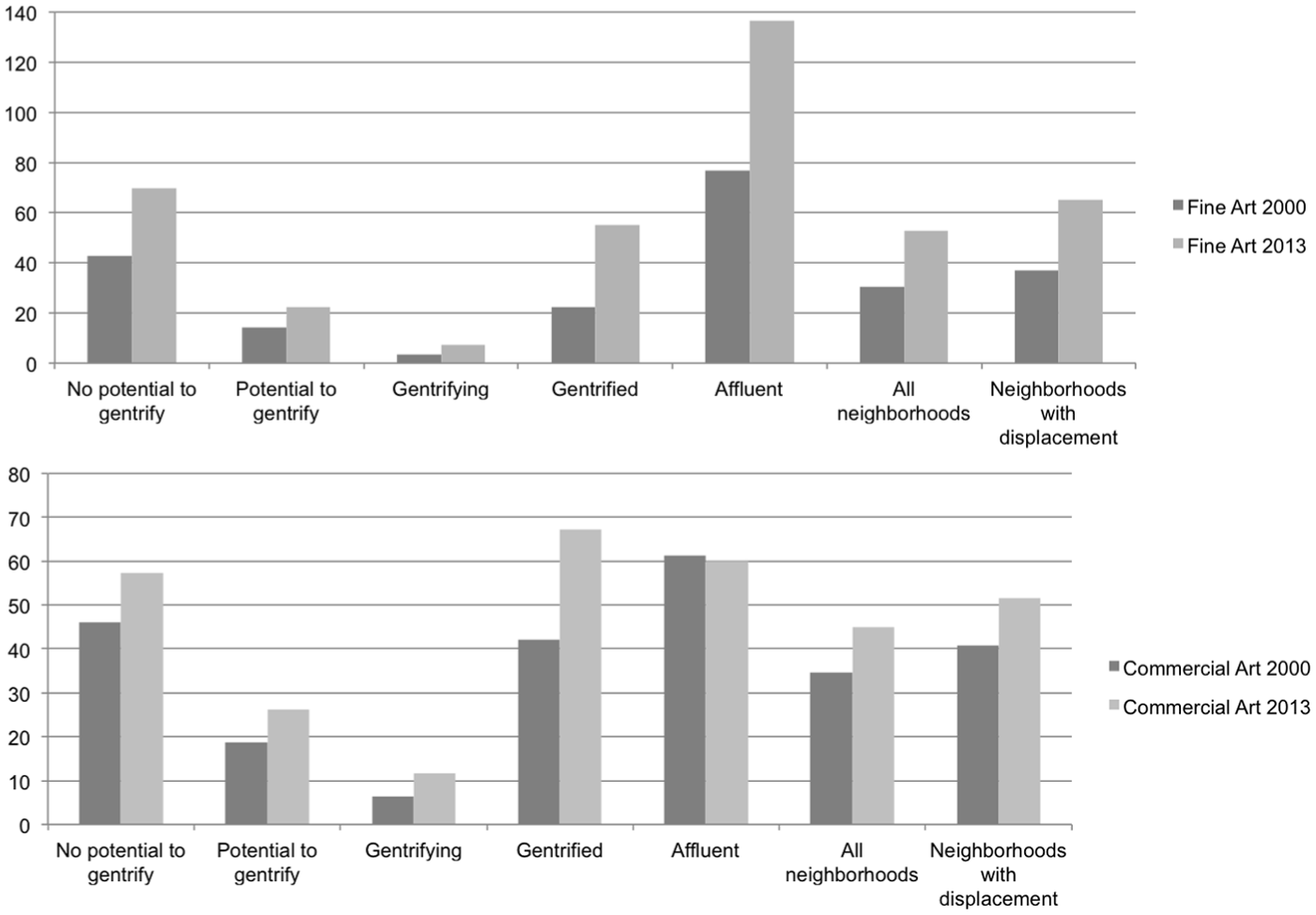
Contrary to the gentrification literature, fine and commercial arts establishments are least common in gentrifying neighbourhoods and those with the potential to gentrify (Figure 1). However, the commercial arts were sizably concentrated in areas that gentrified over the study period yet these areas account for just 12% of all study areas. This could indicate that a commercial arts presence helps to encourage a process of rapid upscaling. However, they also make a strong showing in affluent areas, indicating that they may be attracted to and can afford higher rent areas. This assumption is reinforced by the fine arts, which exhibit a similar preference, but are most common in affluent areas. Still, both the fine and commercial arts are also common in areas we classify as having no potential to gentrify – those that were well-off but not defined as affluent at the start of the study period.
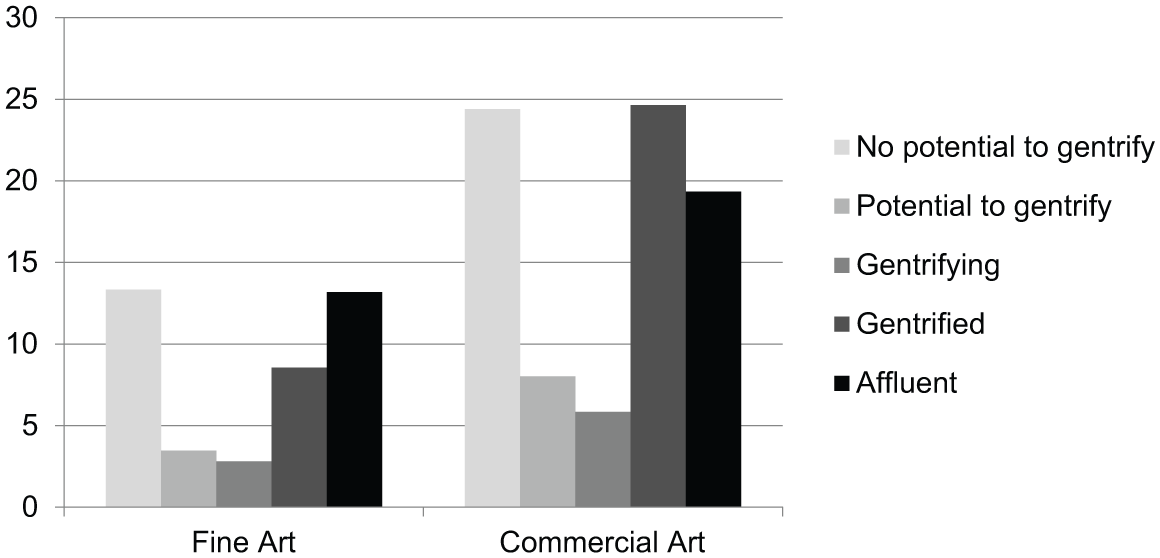
Average number of fine and commercial arts establishments by neighbourhood type, 2000.
About 24% of all areas in the study experienced potential displacement. As we would expect, signs of displacement are most common in gentrifying and gentrified areas, but those we label as affluent exhibit notable displacement as well (Appendix, Table A5). However, when we isolate the displacement neighbourhoods from the total sample, the arts remain weakest in areas suspected to be gentrifying (Figure 2). Also, an arts presence in higher income neighbourhoods with potential displacement stands out. In fact, the fine arts are nearly four times more concentrated in higher income places with signs of displacement than in those without. In other words, the highest concentrations of arts establishments are in places that are already wealthy and becoming increasingly segregated by wealth.
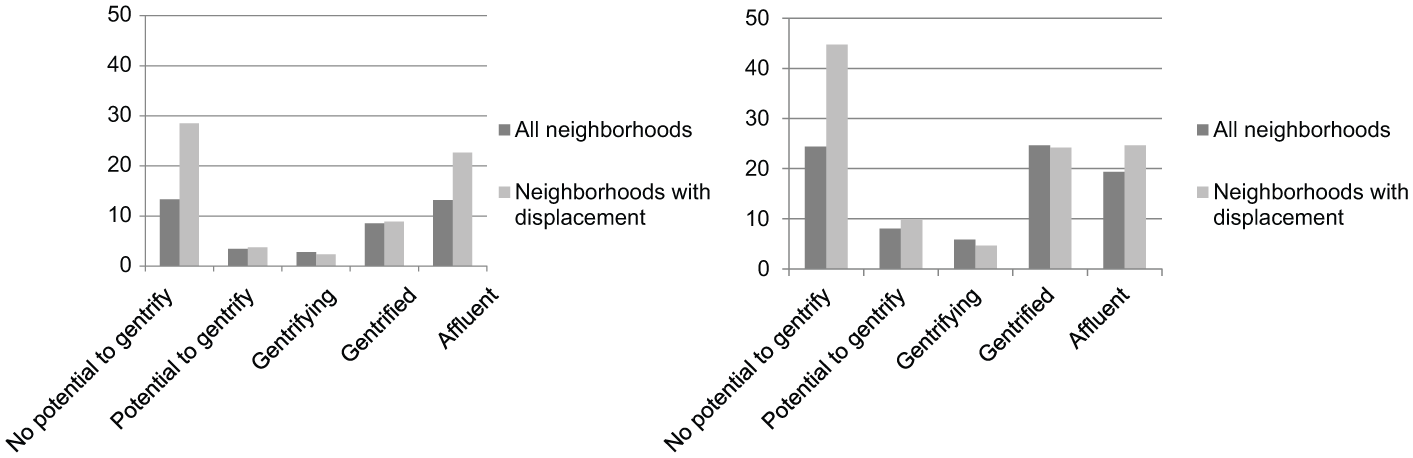
Average number of fine arts establishments (left) and commercial arts establishments (right) by neighbourhood type, 2000.
Examining the growth of arts establishments reinforces this finding. The fine arts exhibit stronger growth where signs of displacement are present in all neighbourhood types except those without gentrification potential (Figure 3). Growth is strongest in gentrified and affluent areas, and regardless of displacement status. This indicates that the fine arts are attracted to these higher rent markets or that initial arts establishments are replaced by more upscale arts activities at a faster rate over the study period. The commercial arts show basically the same pattern with one key difference – they are on the decline in affluent neighbourhoods (Figure 3). Alongside the trends above, this distinction is important because it potentially indicates that commercial arts establishments are leaving affluent areas and contributing to the rapid upscaling of gentrified places.
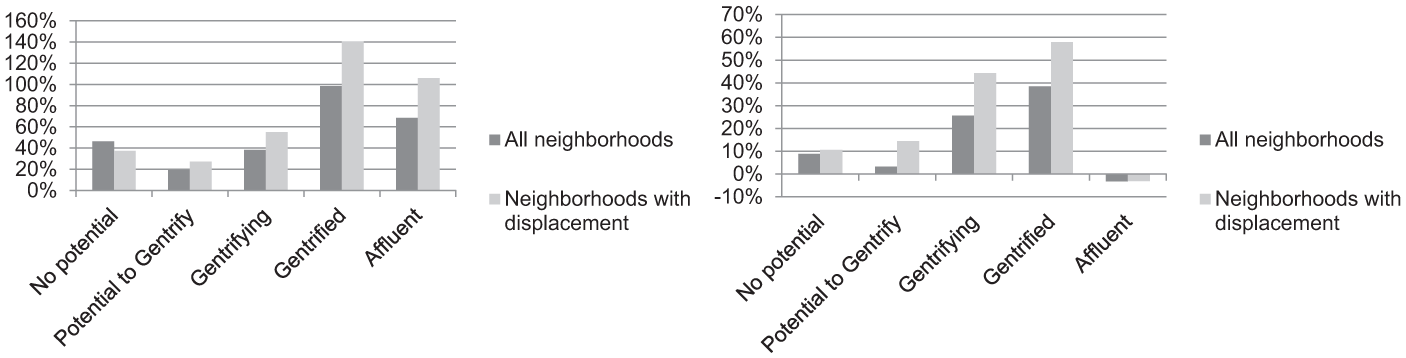
Average percent growth of fine arts establishments (left) and commercial arts establishments (right) by neighbourhood type, 2000–2013.
Metro-specific trends
Trends in the four metropolitan areas generally align with the overall patterns, in that arts establishments predominately locate and grow in wealthier areas. Mirroring overall results, the arts are generally weakest in the gentrifying areas and those with the potential to gentrify. There are some notable exceptions. These are perhaps a reflection of the high variation in the average number and growth of arts establishments between these metros.
As in the full study, in Chicago and Dallas, the arts are least common in areas that are gentrifying and that possess the potential to gentrify (Figures 4 and 5). Yet, we also find that areas which gentrified during the study period generally held and gained the largest numbers of arts establishments. This is especially notable in Dallas where just five areas gentrified. In contrast to the overall results, however, arts establishments are far less common in affluent areas. This may indicate that cost pressures in affluent areas are a barrier and push them towards those that gentrified since 2000. In turn, it could signal that the arts play a role in the rapid upscaling of such places or that they move to seek out other areas where incomes are growing.
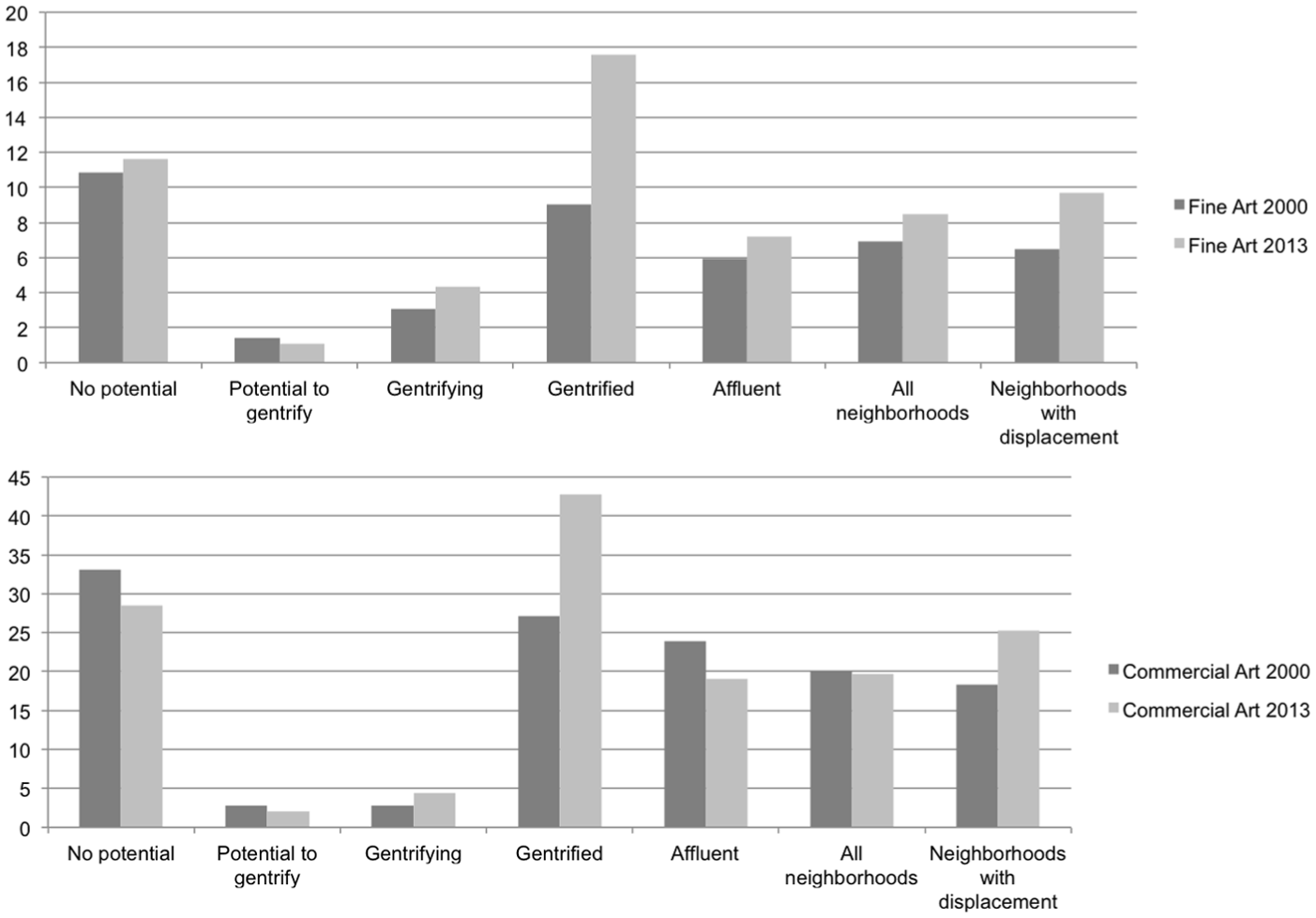
Average number of Chicago fine and commercial arts establishments by neighbourhood type.

Average number of Dallas fine and commercial arts establishments by neighbourhood type.
Los Angeles and New York (Figures 6 and 7) reveal contrasting dynamics compared to the other metros. In Los Angeles, the fine arts show by far the highest concentration and growth in the metro’s nine affluent areas. The commercial arts are strong but stagnant there and, by the end of the study period, gentrified areas contain the highest concentrations. New York stands out because the highest arts concentrations are in areas with no potential to gentrify (though there is noticeable growth in gentrified areas as well). In other words, arts industries are more dispersed within New York rather than concentrated predominately in gentrified or affluent areas.
Average number of Los Angeles fine and commercial arts establishments by neighbourhood type.

Average number of New York fine and commercial arts establishments by neighbourhood type.
Figures 4–7 also highlight that there is not a significant difference in the location or growth of arts industries based on neighbourhood displacement status. In Los Angeles and New York, arts industries are more numerous and growing slightly faster in areas with potential displacement. While Dallas’ commercial arts establishments favoured displacement areas, they are on the decline there. However, the region also experienced an overall decline in arts establishments during the study period.
In summary, the descriptive statistics show that arts industries are largely located and growing fastest in gentrified and higher income places. In most metros, they also tend to have higher numbers in places where displacement occurs. However, based on these results, we cannot say whether the arts drive gentrification and displacement or are attracted to more upscale areas where displacement might occur. In the next section, we control for neighbourhood conditions to determine how the arts may impact gentrification and displacement.
Regression results: Are arts industries linked with gentrification and displacement?
Overall, the regression models indicate that arts industries generally do not play a significant role in gentrification and displacement. The presence of commercial arts establishments does increase the likelihood of gentrification, but only weakly. A fine arts presence, on the other hand, has a negative yet insignificant relationship to gentrification. Neither fine arts nor commercial arts appear to have a direct relationship with displacement. Moreover, the regression analyses show that contextual differences and type of art matter in relation to these neighbourhood pressures.
Figure 8 shows the direct relationships between the arts, gentrification and displacement based on the path analysis. Table 1 shows the basic results for the models used to estimate the total effects (direct and indirect) of these relationships for neighbourhoods in each of the four regions compared to neighbourhoods in all 30 regions. The models indicate that a fine arts presence does not increase the likelihood of either gentrification or displacement in the 30 metros overall (Table 1, rows 1 and 3 respectively). In contrast, an increase in the presence of commercial arts establishments increases the likelihood of gentrification by 0.29. However, the relationship between the commercial arts and displacement is insignificant. These findings are in line with prior research (Grodach et al., 2014). However, the results suggest that although the commercial arts may catalyse gentrification, displacement is not inextricably linked to the presence of the arts. Rather, it is important to recognise that the arts are just one of many other complex factors that account for gentrification and that any subsequent displacement is likely due to other dimensions. In fact, given the very low R2 (0.08) for gentrification in the full model, we are likely only accounting for a small slice of factors that explain the gentrification process. The model does do a better job at predicting where displacement may occur (R2 = 0.15).
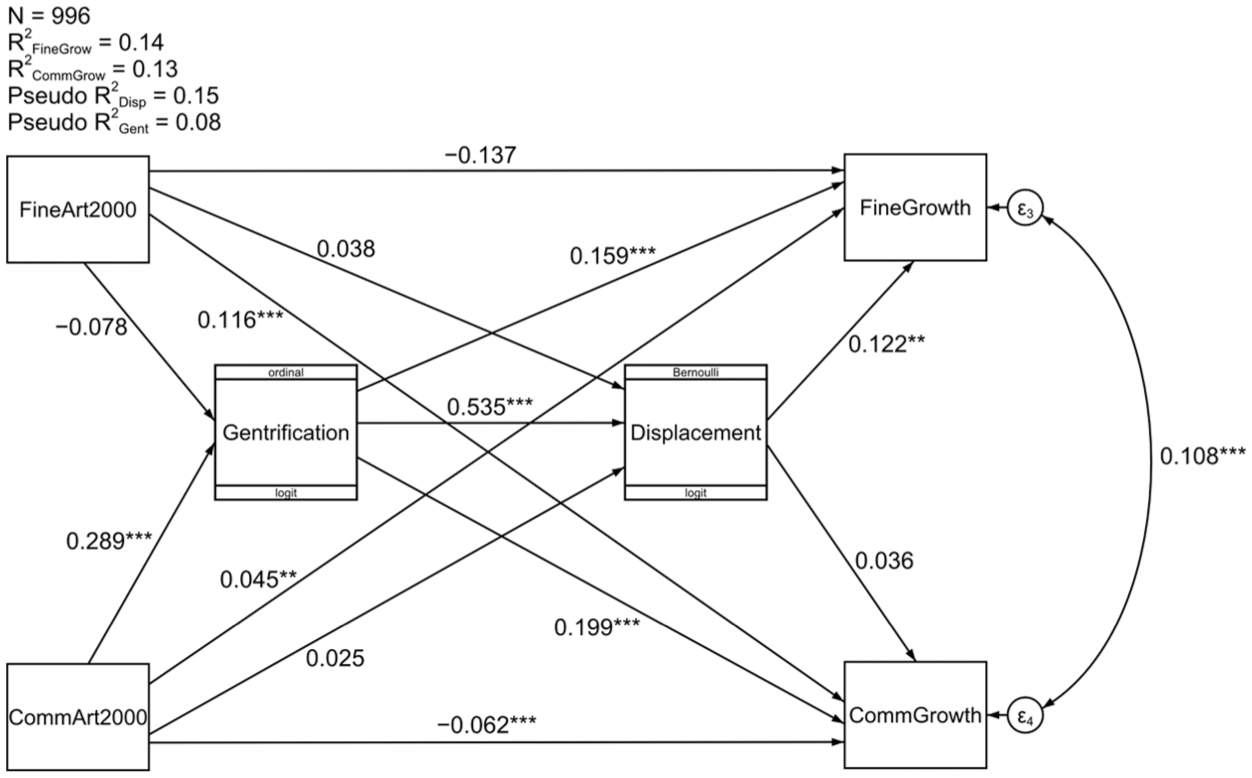
The relationship between arts, gentrification and displacement: Direct effects (full results in Appendix, Table A7).
The relationship between arts, gentrification and displacement: Significance and direction of total effects (full results in Appendix, Table A8).
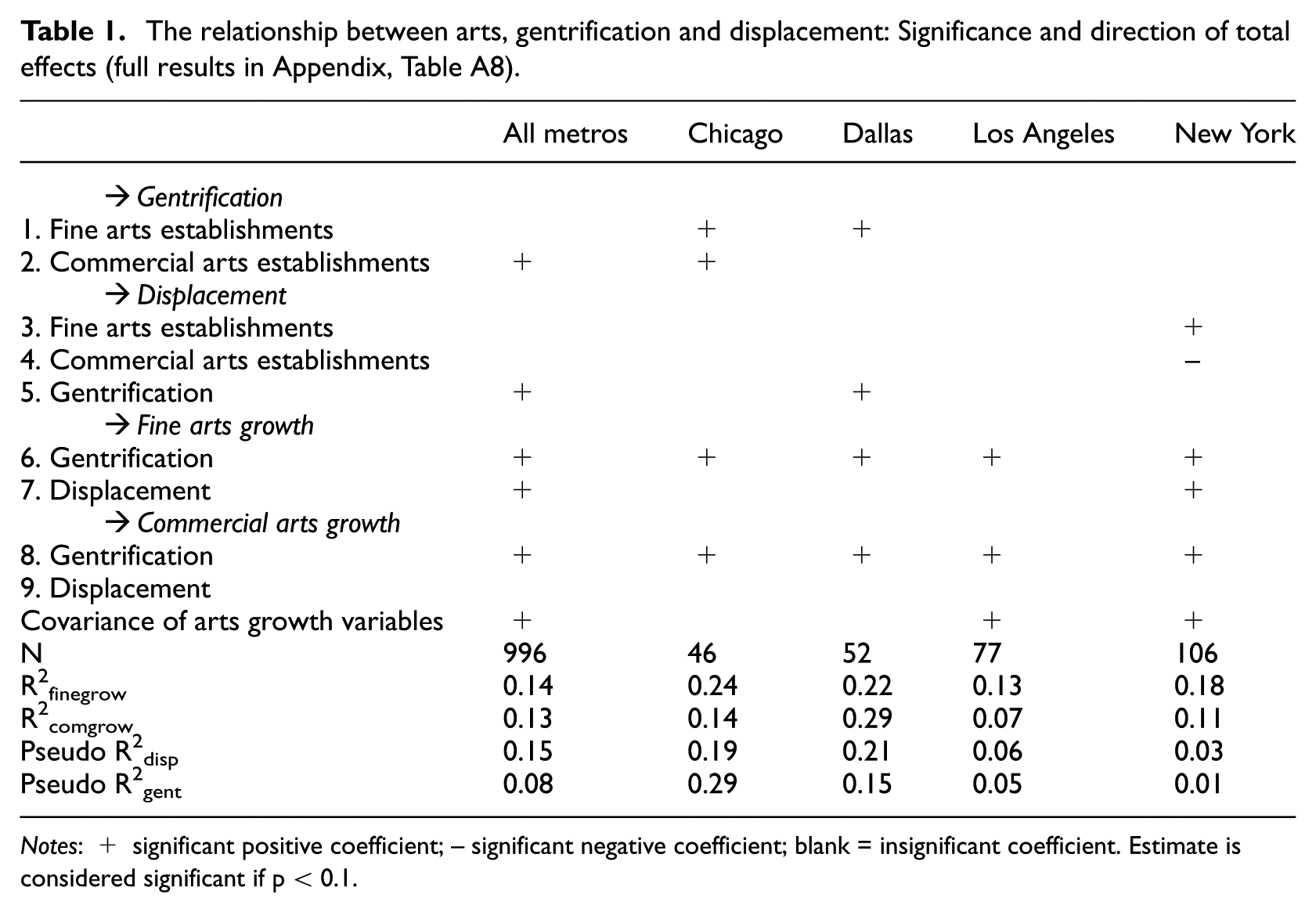
Notes: + significant positive coefficient; – significant negative coefficient; blank = insignificant coefficient. Estimate is considered significant if p < 0.1.
The individual metro results reveal important contextual differences in the relationship of the arts to gentrification and displacement. Interestingly, it is in the metros that have fewer arts establishments and a lower proportion of neighbourhoods experiencing gentrification where the link between gentrification and the arts is present. The fine arts have a significant effect on gentrification in Chicago and Dallas but not in Los Angeles and New York (Table 1, row 1). The commercial arts have a significant effect on gentrification only in Chicago. Moreover, the models explain considerably more of the variation in gentrification and displacement in these two metros than they do in the major art hubs (the R2 is 0.29 and 0.15 for gentrification and 0.19 and 0.21 for displacement for Chicago and Dallas respectively). While we would expect the process to be more widespread in Los Angeles and New York given their sizable arts concentrations and competitive real estate markets, we do not find a significant relationship. Instead, the arts-gentrification link is strongest, though by no means primary, when the arts are specifically concentrated in a handful of gentrified areas, as the descriptive statistics reveal for Chicago and especially Dallas. In contrast, in Los Angeles and New York where the arts are more dispersed throughout the different types of neighbourhoods, gentrification is driven predominately by other factors.
The individual metro results tell little in terms of displacement. All results are insignificant with the exception of those in New York. Here, in contrast to the overall results, the fine arts have a significant effect on displacement and the commercial arts have a negative association. The fact that these results exactly oppose that of the 30 metros overall may be due to New York’s highly concentrated and diverse arts sector that sets it apart from most places. Still, the low R2 for gentrification (0.01) and displacement (0.03) in New York suggests that the arts are very weak predictors of these forms of neighbourhood change. The contrast with the classic case studies of artist-induced gentrification and displacement, many of which were conducted in New York, is significant (c.f. Deutsche and Ryan, 1984; Zukin, 1982). Considering New York City’s continued investment in art facilities such as the construction of the new Whitney Museum and the Brooklyn Cultural District, it is possible that this relationship between the fine arts and displacement may be partly driven by explicit economic development strategies, as opposed to the presence of the arts themselves.
Examining the relationships from the other direction, the model indicates that in the 30 metros, gentrification predicts the growth of fine and commercial arts establishments (Table 1, rows 6 and 8). In other words, while arts growth does occur in the context of gentrification, an arts presence is not driving the relationship. Rather, gentrified environments lead to arts growth. This holds for results across the four metros, with the exception of New York fine arts where the relationship is insignificant.
Neighbourhoods with potential displacement similarly predict fine arts establishment growth in the 30-metro sample, yet in our four metros this phenomenon is only significant for the fine arts in New York. As growth in fine arts appears to have been concentrated in higher income areas, these findings suggest that arts establishments are locating in already upscale neighbourhoods that are only becoming wealthier. Further, this may be due to explicit arts-oriented development projects as discussed above. Yet, again, the R2 for displacement is quite low. As such, results indicate that although the arts are attracted to places that are upgrading, the association with displacement is not clear-cut.
Finally, the metro analysis reveals divergent relationships between gentrification and displacement that are worth considering compared to the full study. Namely, gentrification has a significant effect on displacement only in Dallas (Table 1, row 5). However, as noted above, of the four metros under study, Dallas has few areas where these neighbourhood change processes occur – five neighbourhoods gentrified and about 10 (out of 92 neighbourhoods) experienced potential displacement during the study period. In other words, although gentrification and displacement are linked in Dallas, the process is confined to a few areas. As we note above, an overarching arts-displacement relationship is insignificant in Dallas. However, because gentrification is confined to a few neighbourhoods, the arts may have more of an impact on bidding up real estate values and, in the near future, pricing out lower income residents and businesses in these individual places. In contrast, given that New York has more neighbourhoods undergoing gentrification and more arts establishments prefer gentrified spaces, the process is likely more widespread, as a large literature has demonstrated. But, in contrast to the standard narrative, given our results, it is more likely that arts establishments are attracted to rather than cause gentrification here.
Conclusion
This study contributes to a deeper understanding of the relationship between the arts, gentrification, and displacement. Chiefly, we provide evidence that the standard arts-gentrification narrative is not a generalised pattern, but rather one possible way that the arts are implicated in place change. By going beyond the focus on the role of artists in gentrification, this study adds a new dimension to understanding how the arts affect place change and provides an important corrective to the stage model of gentrification. The analysis demonstrates that fine and commercial arts establishments have varied, conflicting relationships with gentrification and displacement in different places. In particular, arts-led urban policy (the apotheosis of the stage model) breaks down because, as our results demonstrate, arts establishments by and large do not predict gentrification. Given that the arts have become considerably more diverse in their economic and social impacts and their participants, our findings provide a significant contribution to understanding these wider dynamics.
Overall, gentrifying areas actually have the weakest arts presence of all neighbourhood types in the study. While commercial arts establishments have a strong share in those areas that gentrified over the study period, they are equally represented in places that show no potential to gentrify. The fine arts are most numerous in affluent areas and those without potential to gentrify. Both the fine arts and commercial arts do exhibit the highest growth rates in gentrifying and gentrified places and these rates are highest where there are signs of displacement. Yet, our path analysis shows that it is more likely that certain arts establishments are attracted to these environments rather than creating them. In short, the arts likely do not play a causal role in gentrification and displacement.
Rather, the typical process is often turned on its head – instead of sparking gentrification, arts establishments are most numerous in places that are well-off and upscaling. One could argue that this is because they have already contributed to gentrifying their locations. However, if they play a role in the standard arts-gentrification narrative, then we should also see the movement of this arts activity to lower rent areas where gentrification and displacement continue anew. We largely do not. Arts growth is very small in places that are gentrifying or exhibit the potential to gentrify, particularly for the commercial arts. This indicates that many arts establishments want to be near their clients, whether it is the patron base of a gallery, or a design firm that serves a technology or advertising company, rather than simply seeking out cheap rent.
These patterns largely hold in the four metros we study individually, but with an interesting deviation. It is the concentration of arts activity in particular neighbourhoods in regions where the arts and gentrification are less widespread that explains arts-led gentrification. As we show, an arts industry presence predicts gentrification in Chicago and Dallas, but not in Los Angeles and New York as we would expect. We surmise this is because of the concentrated nature of gentrification outside all but the largest, most expensive metros, thus magnifying an arts-gentrification effect. As such, it is not the size or concentration of regional arts activity in combination with a competitive real estate market that explains arts-related gentrification.
These findings provide an important lesson to policymakers who seek to use the arts and creative industries in place-based revitalisation programs. Given that arts establishments cluster amongst linked industries and their customer base, it is folly to assume policy can seed arts establishments and produce place improvements. Nor, however, is it likely that arts-led strategies will engender gentrification and displacement. The caveat to this is that regions without highly concentrated arts activity are more likely to experience gentrification through the arts in those few places with highly concentrated arts industries. In such instances in particular, policy should attend to potential displacement pressures.
Footnotes
Declaration of conflicting interests
The author(s) declared no potential conflicts of interest with respect to the research, authorship, and/or publication of this article.
Funding
Funding for this research was generously provided by the National Endowment for the Arts (Grant 12-3800-7004).