




Abstract
Gay men have been implicated in neoliberal urban development strategies (e.g. the creative city) as a ‘canary’ population that forecasts growth. Paradoxically, both neoliberal re-development of North American inner-cities and the ways in which gay men become neoliberalised as individuals contribute to the dissolution of urban gay communities. In contrast to discourses of homonormativity, which suggest that gay men’s declining attachments to gay communities stem from new equalities and consequent desires to assimilate into the mainstream, this article argues that gay men in DC have internalised neoliberal discourses that call for career development, home ownership and social hypermobilities. The narratives of 24 gay-identified men living in DC indicate that the social and spatial dissolution of the gay community is linked with individual aspirations that are increasingly difficult to achieve. These aspirations include career advancement in a transient local economy, property ownership in an out-of-reach market, and the attainment of social status based on an ability to move through multiple neighbourhoods and venues with ease. As might be expected, African American and working class men are often left beyond the fray of these new neoliberal ideals.
Introduction
Sexuality and space researchers recently have examined changes in the form and function of urban gay spaces. So-called gay villages now have more heterosexual residents (Ghaziani 2014; Reynolds, 2009), significant gay venues have closed in many cities (Mattson, 2015), there is a growing gay presence in the suburbs (Tongson, 2011) and new ‘gay-friendly’ (though not necessarily gay-specific) neighbourhoods are emerging in urban peripheries (Kanai and Kentamaa-Squires, 2015; Nash and Gorman-Murray, 2014). Researchers often position gay men’s consumption preferences as causative links in changing urban landscapes of gay residential and commercial spaces. Some have suggested that same-sex couples are moving to new areas because they prefer rental properties and nightlife amenities that no longer exist in gay neighborhoods that have become increasingly heterosexualised. (Black et al., 2002; Collins, 2004; Cooke and Rapino, 2007; Ruting, 2008). Many have also suggested that new generations of gay men are now consuming in newly hip and edgy areas because they view older community spaces as tacky and passé (Hayslett and Kane, 2011; Nash, 2013; Ruting, 2008; Whittemore and Smart, 2015).
These shifting choices and aspirations are often described as homonormative (Brown, 2012). In what Duggan (2002) calls ‘the new homonormativity’ the state ushers in gay men and other sexually non-normative individuals into the fold of the capitalist mainstream by conferring equal rights and social acceptance. The homonormativity discourse assumes that middle-class gay men and lesbians – once given the opportunity – will aspire to assimilate and abandon efforts to work across difference in their communities (Duggan, 2002; Nast, 2002; Richardson, 2005). Many, however, have critiqued tacit assumptions that gay men are adopting conservative, assimilative identities (Noble, 2012) or purposely disavowing gay community life (Brown, 2012; DiFeliciantonio, 2015), noting that homonormativity is not easily applied to gay men who are not middle-class, white or situated in metropolitan areas (Brown, 2009, 2012).
In fact, gay men are grappling with the same increasing pressures of career, financial insecurity and uncertain social standing as other residents of the neoliberal city. Many aspects of their lives may even be rendered more difficult by ongoing homophobia. Although the homonormativity script also focuses on consumption aspects of the so-called ‘pink economy’ (Bell and Binnie, 2004), gay men are also part of a pink work force negotiates still-uneven landscapes of workplaces and property markets in order to acquire so-called pink goods (Lewis and Mills, 2016). As Gavin Brown notes, ‘queer critiques of homonormativity are frequently and problematically at odds with the lives and aspirations of many lesbians and gay men’ (2012: 1067). This article therefore argues that the changing patterns of consumption in gay men’s lives described by homonormativity are moreso products of neoliberalism and neoliberal urban development specifically. Generally understood as the variegated collection of policies and practices that promote austerity, competitiveness and capital accumulation, neoliberalism can be understood as the logic the guides the operationalisation of modern urban development (Brenner et al., 2010).
The ‘creativity city’ discourse that took hold in many North American cities in the early and mid 2000s is one trope that may illuminate the relationship between neoliberal imperatives for urban growth and the consumption choices of gay men. Popularised by Florida (2002, 2005), the creative city thesis offers a framework for attracting knowledge-sector workers to cities through amenities and qualities (e.g. diversity) that are appealing to ‘creative’ people. Critics, however, have claimed that creative city theory cannot predict urban growth trends or provide a meaningful, sustainable basis for urban policy interventions (Markusen, 2006; Peck, 2005). Others have claimed that attempts to operationalise the creative city theory through the development of high-end housing and amenities has exacerbated inequality in many cities (Catungal et al., 2009; Peck, 2012). This article is therefore less concerned with the creative city as a valid urban growth theory than as a ‘mobile political rationality’ (Ong, 2007) in which gay men are implicated as a pivotal population. Florida described the ‘canary’ metaphor accordingly in 2002 (Dreher, 2002): Gays are the canaries of the creative economy. Where gays are will be a community – a city or a region – that has the underlying preconditions that attract the creative class of people. Gays tend to gravitate toward the types of places that will be attractive to many members of the creative class. That said, a high score on the gay index, for example, New Orleans or Miami, does not translate into being a creative center, unless you couple that with technology assets. It’s not that gays predict high-tech growth, it’s that gays signal an environment that would attract creative-class people from a variety of backgrounds.
Many have debated the relevance of sexuality to the creative city concept. Since tolerance is measured by the presence of male same-sex coupled households and other ‘minority groups’ (e.g. immigrants) gay men act as ‘tracking molecules’ for growth potential (Storper and Scott, 2009) but do not signal actual development or inclusion (Wimark, 2014). In fact, just as canaries help to detect a powerful but invisible force that also ultimately kills them, the decline of visible urban gay communities may signal the advent of an advanced form of neoliberalism that destroys minority and identity-based communities.
The logic of neoliberalism affects gay communities directly through land development but also through the vectors of individual gay lives. For example, policies and practices that deny permissions for establishing gay festivals, promote ‘family-friendly’ events, and develop properties geared to young families with children are central to the goal of deriving maximum profitability from urban spaces (Doan and Higgins, 2011; Kanai and Kentamaa-Squires,2015; Mattson, 2015). Venues in gay neighbourhoods, including those purchased by heterosexual buyers, may seek to attract whatever group has the most spending power and interest in an area at any given point in time (Binnie and Skeggs, 2004; Kanai and Kentamaa-Squires, 2015; Mattson, 2015). In other locales, creative city strategies have spurred the development of ‘new’ gay spaces as a means of ‘catching up’ with cities where they have developed more organically. In Singapore, where same-sex marriage and male same-sex activity is still illegal, the government has sponsored a Pride festival and marketed workplaces as gay-friendly in order to attract educated foreign talent (Oswin, 2012; Yue, 2007). In Italy, where same-sex marriage is illegal and same-sex relationships were recognised legally only in 2016, similar ‘exceptions’ have been made. In Milan, the local government encouraged private entrepreneurs to create a ‘gay street’ in Milan prior to Expo 2015 in order to attract capital and cultivate a reputation as diverse and vibrant (DiFeliciantonio, 2015). These interventions create ephemeral and professionalised gay and lesbian spaces but not necessarily broadly inclusive gay community.
Like other urban residents, gay men are also affected individually by the internalisation of competitive enterprise as a behavioural model (Dardot and Laval, 2014; Foucault, 2008). The manic search for excellence and elimination of defects that characterises this model may be exacerbated in gay men because they are overcoming past traumas involving discrimination at home or in previous workplaces (Lewis and Mills, 2016). Gay men who are enjoying new work and social opportunities in cities that voice acceptance may therefore feel particularly ‘indebted’ to employers and colleagues, and constantly engage in ‘work on oneself’ to maintain this status (Di Feliciantonio, 2016). To do so, they may strive to accumulate capital by investing in properties with gaps between real and potential value rather than attaching themselves to a specific community or neighbourhood (Collins, 2004; Knopp, 1990). In addition, the pressures to maintain and advance careers among gay men may leave little time or energy for the social reproduction of their local communities (Lewis and Mills, 2016). The neoliberalisation of both urban development and individual gay lives are mutually reinforcing. As Kaika and Ruggerio (2015) show, declining loyalties to local communities and the social fractures within them are also preconditions for the advancement of further neoliberal development strategies in cities. In the following sections, I argue that the consequent dissolution of a centralised gay neighbourhood and visible gay community in Washington DC is due to both urban development strategies and the neoliberal subjectification of gay men themselves through three processes: the creation of neoliberal dispositions in the city’s gay work force, perceived pressures to own property and the emerging hypermobilities of gay social life.
Methodology
This article employs the life course narratives of 24 gay-identified men living in Washington, DC, USA, to better understand how gay men’s individual consumption choices relate to both neoliberal urban development and the shifting spatialities of the gay community. The approach of interviewing gay men addresses several gaps in the literature on urban development and gay communities. First, it differs from previous interventions that have used ‘interlocutors’ such as property developers (Knopp, 1990), real estate listings (Whittemore and Smart, 2015) and gay businesses (Kanai and Kentamaa-Squires, 2015) to describe shifts in gay consumption patterns. The narrative approach therefore offers a more emic perspective on what Knopp (1990) called the ‘social production of demand for land and housing’ in gay neighbourhoods and ‘the material and class interests involved in gay community development’. Second, this approach corrects what Mattson (2007) called a ‘saloon problem’ in urban ethnography, in which researchers examine the publicly visible aspects of social issues without examining the choices or thought processes of the individuals involved in those issues.
Participants were between 24 and 46 years old, had incomes between US$40,000 and US$100,000. They were recruited through respondent-driven sampling beginning with four men of different ethno-racial and professional subjectivities. Most worked in sectors such as education, politics and healthcare, though often for government employers. Of the 24 participants, 16 were white, three were African American, three were East or Southeast Asian, and two were Latino. Lasting 45–90 minutes, the interviews focused on linkages between migration, life course and wellbeing. While much of each interview focused on decisions to settle in Washington, DC, most of the participants also spoke extensively about their homes, their social lives and the changing characteristics of the neighbourhoods where these were situated. Interviews were coded using an open approach (Charmaz, 2006), emphasising the reasons behind (1) moves to DC, (2) residential locational decisions, and (3) changes in social lives. The analysis shows how individual migration, locational and consumption decisions among gay men operate within broader constellations of power, (in)security and inclusion that privilege certain behaviours, identities and dispositions. Put differently, their choices are not just described in discourses about urban development and gay livelihoods but actively shaped by these discourses and the material changes they precipitate.
Creating neoliberal dispositions in gay Washington, DC
During the past 10 years, Washington, DC has climbed to the top of the rankings of metropolitan concentrations of same-sex couples in the USA (Peters, 2013) and continues to hold status as one of the USA’s premier ‘creative cities’ (Florida, 2012). In 2003, the district government embarked up on a public–private marketing campaign for single professionals called ‘city living, dc style’. Set on increasing the city’s population by 100,000, the government chose the young professional-focused ’city living’ plan after opting out of an alternate plan focused on attracting families (Gibson, 2015). At this time, the government also authorised new, privately managed business improvement districts (BIDs) such as Capital Riverfront and NoMa (North of Massachusetts Avenue) to develop land, provide additional beautification and security services, and market new properties (Lewis, 2010; Schaller and Modan, 2005). By 2013, the city had grown by 45,000, most of the new residents were white and middle-class, and many were moving into houses or new condominium developments in transitional, rapidly gentrifying central and east-of-centre neighbourhoods such as Shaw, Columbia Heights and Navy Yard (O’Connell, 2012). In addition, the average price of a single-family home in Washington, DC increased from about US$250,000 to over US$400,000 during the same time period, and the number of low-cost rental units had halved (Gibson, 2015).
Since 2013, many of the last vestiges of the original Dupont Circle ‘gaybourhood’ have disappeared (Giambrone, 2016). Many of the historic gay-specific shops along Connecticut Avenue and 17th Street (e.g. Lambda Rising bookstore, Chaos nightclub) in Dupont closed because of rent increases in the decade following implementation of the ‘city living, dc style’ plan. In addition, a smaller commercial space in Southeast Washington, DC comprising more overtly sexualised gay spaces in the city (Ziegfeld’s and Wet strip clubs) dissolved when the properties were purchased by the developers of the new baseball stadium for the Washington Nationals (see Leap, 2009). Following these developments, shifts in residential and commercial gay space have been rapid-fire and often short-lived in nature, with Logan Circle, Columbia Heights, and even far-flung Takoma Park being named – sometimes simultaneously – as the next ‘up and coming’ gay neighbourhood in Washington, DC (Borderstan, 2013; Giambrone, 2016).
Although several dispersed gay venues remain, a new gay commercial cluster never truly cemented. Many participants expressed a sense of disappointment over not finding the vibrant, visibly marked community in Dupont that they thought they would.
I guess it wasn’t as gay as I thought it was … Dupont Circle just seemed like a normal part of town to me … there weren’t rainbow flags everywhere … it wasn’t like you see on television … San Francisco, guys walking down the street in leather chaps … when you walk through Dupont there are a couple of sex shops that are a … little flagrant about it – I put that in quotes – but I don’t think there’s that sense of ‘in your face’… I mean the only time you see things like that are at the Gay Pride Parade where people feel more free to express themselves and that’s one time where it’s encouraged and expected. (Marcus, 27, white) You’ve seen a lot of the old centres of gay culture here dissolve … Lambda Rising [bookstore] closed, the Blade [newspaper] closed … some of that is probably due to a generational shift as much as it is just shifts in DC … it insulated people from a lot of really bad things. (Max, 31, white)
As Nash and Gorman-Murray (2014) observe, these types of spatial shifts in gay and lesbian communities are not new, and the notion of gay community as a spatially concentrated ‘ethnic minority’ did not emerge until the 1980s and 1990s. Their work on Toronto and Sydney reveals that the 1950s and 1960s were also periods of significant mobilities between private homes and marginal neighbourhoods. Washington, DC is no different in this respect. The repression of homosexuality in the McArthur-era 1950s and 1960s meant that gay men working for the government often hid their identities and socialised in nondescript bars around P Street, west of Dupont Circle (Johnson, 2004).
Dupont Circle did not become the geographic centre of gay Washington, DC until thousands of gay men moved into the neighbourhood in the 1980s and 1990s (see Myslik, 1996). The goal in this article is therefore not to valorise the concentrated ‘gaybourhood’ as inherently better than more diffuse gay spaces. Instead, it seeks to show that social and spatial hypermobilities in which gay men in Washington, DC are currently embroiled are products of both neoliberal development in Washington, DC and the neoliberal selves that are cultivated there. Moreover, many of the participants indicate that the shifting spatialities and competitive nature of the community are as often sources of stress and fatigue as they are enjoyment.
Today, the most recognisable and enduring institutions of gay Washington, DC are political, most notably the Whitman Walker Clinic – a national leader in HIV/AIDS activism – and the national gay rights organisation Human Rights Campaign. Washington DC’s research universities (e.g. Georgetown, George Washington, American), in addition to drawing creative professionals of their own (e.g. professors, graduate students) have also spawned consulting groups, think tanks and non-governmental organisations (NGOs) that work in tandem with government agencies. Increasingly, DC is promoting its once overlooked advantages. Compared to the classic ‘creative city’ of San Francisco, DC has a higher locational quotient for both the arts (1.7 vs. 1.5) and computer and mathematical professions (2.5 vs. 2.0), though many of the jobs in these sectors are within the federal government. Despite the ascendancy to ‘creative city’ status that has spurred on mass gentrification and neoliberal urban development, Washington, DC does not have a particularly creative economy compared to ‘classic’ creative cities such as San Francisco. According to locational quotients from the Bureau of Labor Statistics (BLS, 2015), Washington, DC is predictably less specialised in architecture and engineering based on locational quotients (1.1 versuss 1.3), but more specialised in education (1.02 versus 0.88) and, surprisingly, both computer and mathematical professions (2.5 versus 2.0) and the arts (1.7 versus 1.5) (BLS, 2015). These statistics, however, cannot account the distinction between private and governmental work, the latter of which accounts for 38% of the Washington, DC workforce.
In this respect, many gay men in Washington, DC fit the ‘creative’ mold nominally but are also neoliberal subjects attempting to fit their own aspirations within the constraints of their publicly funded and party-affiliated employers to whom they feel indebted for their jobs (see also Lewis, 2012; Lewis and Mills, 2016). Adam (34, white) suggested that gay men, to some extent, have internalised the notion of the responsible ‘gay creative’: Gay men tend to be attracted more toward, um, jobs in politics … academic institutions … government, too, perhaps, but there’s no like industrial feel to the city at all, there’s no manufacturing at all … I think gay men tend to be attracted more toward like the … creative kinds of jobs, not creative in the sense of like art.
Washington, DC’s emergence as a destination of choice for gay men, then, might owe to the influx of men from regions (e.g. the South, the Midwest) where more accepting work environments were also those within lower-paying sectors such as food service, entertainment and aesthetics (Lewis and Mills, 2016; Murray, 1996). Many of the participants suggested that media and marketing materials frame DC as place to build a career rather than a sustained community, and that individual gay men have internalised this discourse.
[National gay publication] Out magazine just had this 25 all-star guys in Washington … like you have a white guy from Iowa who will come in and now he’s working at the white house and will say people are friendly because everyone’s a migrant, no one’s from here … it seems sort of insulting when people say all the gay guys are from somewhere else. (Marc, 35, white) A lot of people here are overachievers. I think that they’re personally kind of insecure and these are not free thinkers … basically someone’s serf on the hill or in an association, even if you have a lot of delegated power. (Carl, 43, African American) People come from America, generally supported by their parents, to go to law school or to become like a government tool. It’s kind of like being trapped in junior high forever. (Randy, 39, white)
In this sense, the discourse of Washington, DC as a creative city cultivates personal aspirations for career advancement among gay men, which are in turn spurred on by the insecurities of a contracting economy and uneven work opportunities.
Residential decisions
Economists have typically argued that gay men, and especially couples, make residential decisions based on preferences for certain neighbourhood amenities such as stylish housing and nightlife (Black et al., 2002). Sexuality researchers, in contrast, have typically suggested that these decisions are influenced by the gravitational pull of established gay neighbourhoods that incidentally include these amenities (Lewis, 2014). While both of these theories tend to position gay men as empowered agents, their residential choices are increasingly constrained by the contracting land and housing markets of a rapidly redeveloping inner-city Washington, DC. Since the early 2000s, the ‘city living, d.c. style’ plan and BID implementation have focused on what Rolnik (2013) calls ‘the creation of new opportunities for speculative investments in central-city real estate markets and the construction of megaprojects intended to attract corporations’ (Rolnik, 2013: 1063). In turn, home ownership in cities such as Washington, DC is seen as a necessary but increasingly out-of-reach means of achieving social mobility and surviving economic instability (Aalbers, 2008; Aalbers and Christophers, 2014). Among gay men, it has become another arena for competition, self-improvement and the pursuit of social mobility. The once-accessible rental market has become equally exploitative as younger gay men try to establish careers and livelihoods in the cities where they are most accepted (Aalbers and Christophers, 2014).
In the past 10 years concentrations of gay residents in Northwest Washington, DC neighbourhoods such as Logan Circle and Columbia Heights have diffused outward into newly gentrifying areas. In the American Community Survey, 2005–2009 5-year estimate data show the highest concentrations of same-sex couples in Logan Circle, Columbia Heights and other Dupont-adjacent neighbourhoods (see Figure 1). This first distribution mirrors the contact diffusion model of cities such as Dallas-Fort Worth (Whittemore and Smart, 2015), where proximity to other neighbourhoods with high concentrations of same-sex couples is one of the most important predictors of neighbourhood choice for same-sex couples. In the 2010–2014 estimate, however, same-sex couples seem to follow the scattered front lines of gentrification in Washington, DC more generally (see Figure 2). Moderately high concentrations in Logan Circle and Columbia Heights persist, but fewer tracts in Washington, DC fall into the highest quintile of concentration. More same-sex couples now appear in newly redeveloping neighbourhoods north of Capitol Hill such as Shaw, NoMa, and Mount Vernon Triangle, where business improvement districts have facilitated the influx of new condominium developments (see also Lewis, 2010; Schaller and Modan, 2005). Even more striking is the relative decline of same-sex couples in the wealthiest neighbourhoods of Northwest Washington, DC (e.g. Cathedral Heights, Palisades, Friendship Heights) and their increase in formerly low-income, high-crime neighbourhoods such as Fort Totten and Navy Yard. This noticeable shift over a short period time suggests that gay men are increasingly pursuing less expensive housing in areas with some amenities.
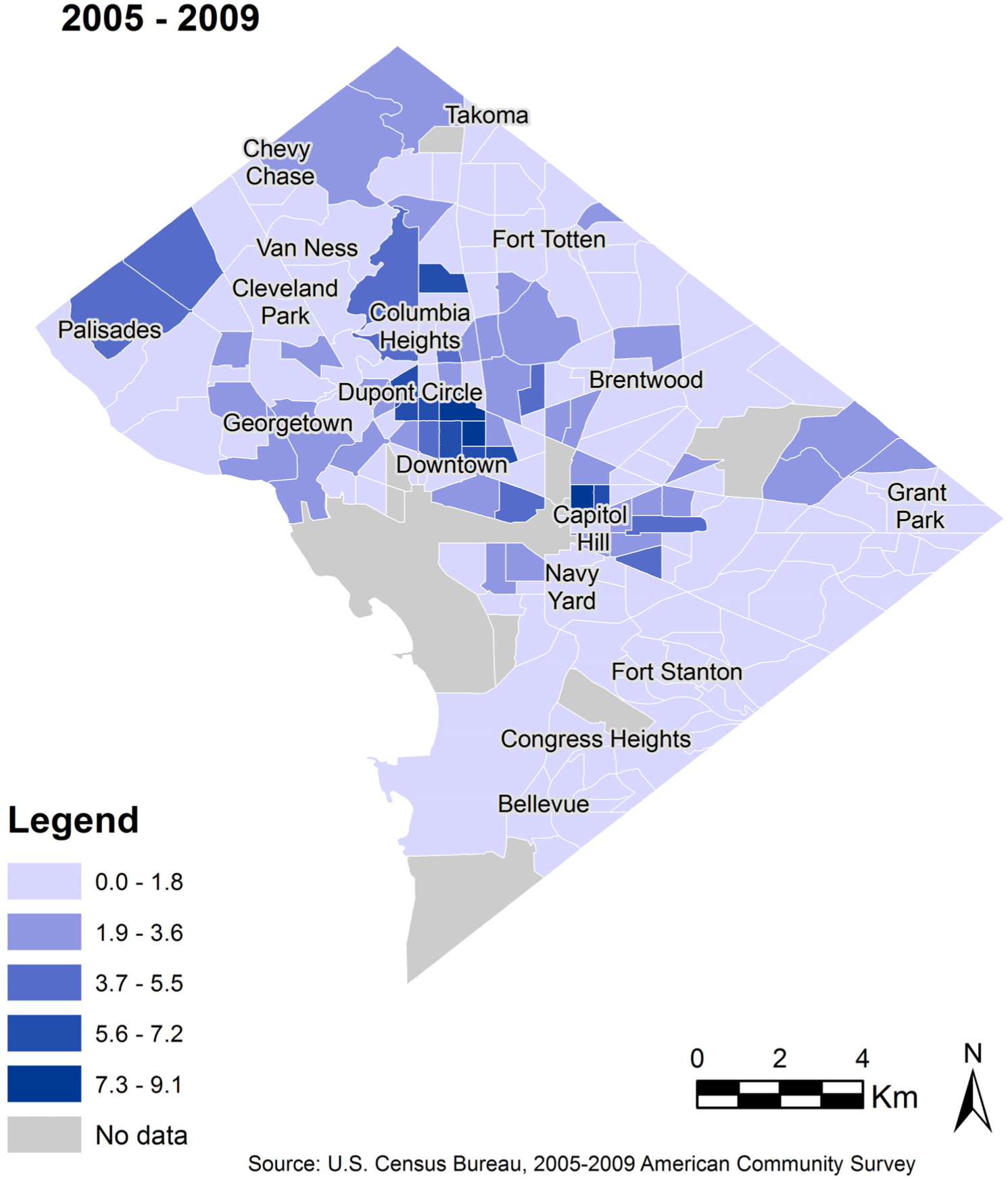
Percentage of unmarried partner households: Same sex. 2005–2009.
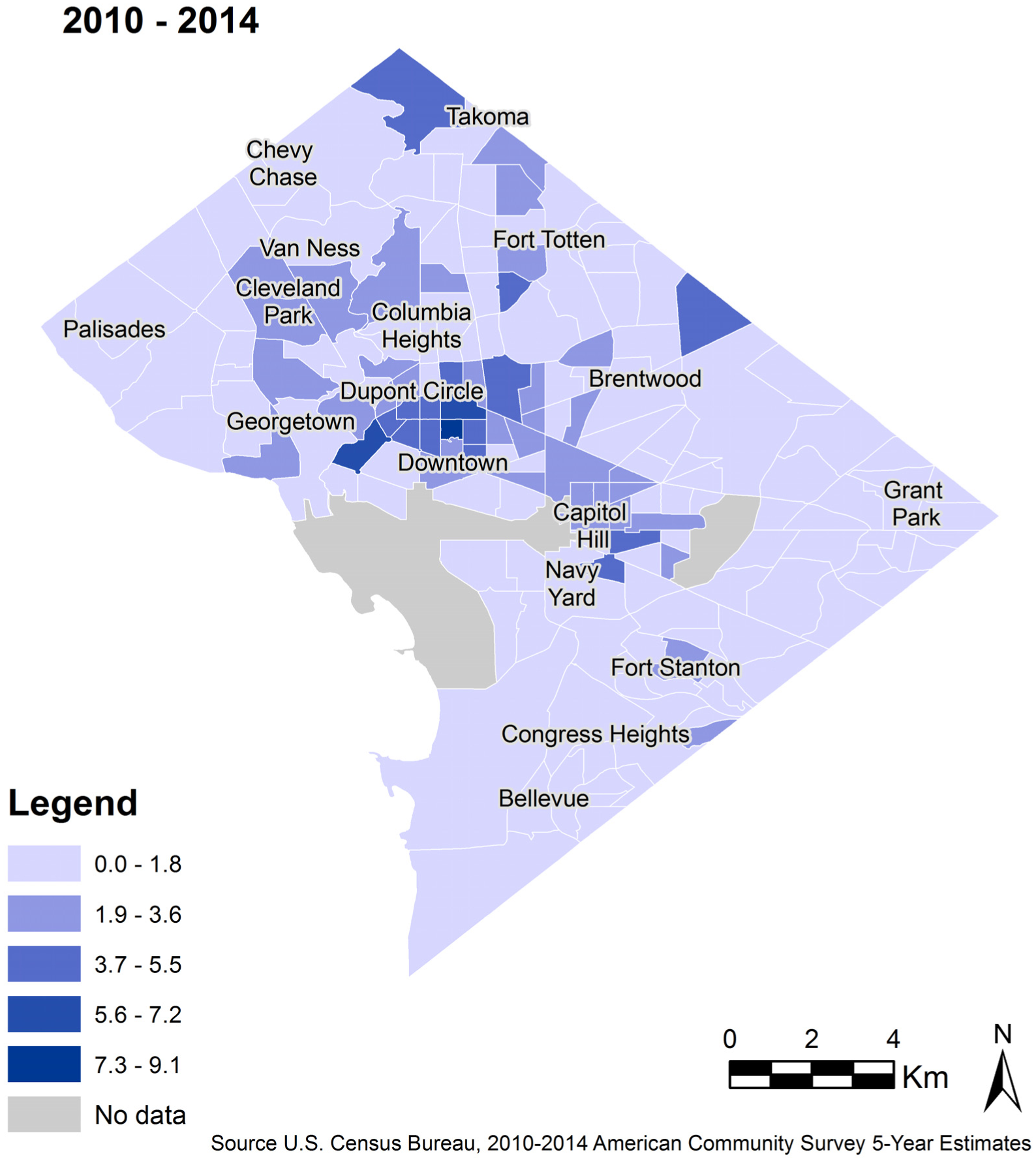
Percentage of unmarried partner households: Same sex. 2010–2014.
The outward shift in same-sex couple residences could still be read as evidence of freedom rather than constraint. With arguably fewer attachments to specific neighbourhoods (e.g. children in schools) compared with heteronormative families, gay men can pursue the most cost-effective housing opportunities.
There’s a whole dispersal that might have to do with the new sense of freedom. (Max, 31, white) Dupont transitioned and got gentrified … and then Logan gentrified and everybody wanted to go to Logan but then didn’t and now they’re in Columbia Heights but not quite … so I think there’s a whole dispersal, which in an interesting way might have to do with the new sense of freedom that like, does the gay community ultimately have to cloister or be in a ghetto once their rights are more protected? (Adam 34, white)
Others suggest, however, the need for a sense of belonging still limits gay men’s residential decisions.
Once people have families, they worry about the school system and there’s a lot more incentive to live outside the district, so I think a lot of gays stay central and don’t have that next step to move back to the burbs. (Mark, 27, white)
While Adam suggests that a growing sense of freedom and safety has allowed gay men to move into more peripheral neighbourhoods, Mark indicates that the Maryland and Virginia suburbs – which are cheaper than Washington, DC in many cases – still remain an unattractive option for men who are not part of heteronormative family forms. Gay men, then, in theory have greater freedom to move around in a Washington, DC landscape that is increasingly accepting, but are still constrained by both the financial realities of the Washington housing market and the more uncertain social and political landscape beyond the borders of the District.
Additional narratives reveal diverse aspirations and constraints among men of different age and ethno-racial subjectivities. Among older men, residential choices were influenced by perceived pressures to invest in property.
You’re not gonna make a lot of money in DC in a lot of other ways, so people want to make money on gentrification. (Jim, 34, white) Some of that has to do with property values, it’s just in [Dupont Circle, Logan Circle, and Columbia Heights] property’s so expensive that it’s easier if you want to buy a house and make an investment to go out further than those areas. (Dave, 33, white)
Both narratives suggest that the limited ability for gay men to buy property in the traditional gay neighbourhood has created a culture of expansion into cheaper areas inner-city areas but generally not the suburbs.
Black participants, however, perceived greater acceptance for both sexual and racial diversity in out-of-centre areas, preferring historically Black middle-class areas (e.g. Montgomery County, Maryland) to either new suburban hubs or gentrifying inner-city areas.
… I told [my partner] when we bought a house we were not buying it in the district … it just seemed to me like wasting money and there was such a huge difference moving to the suburbs … but if you were to live in Loudon County [Virginia], I think [being gay] would be an issue … I think if you lived outside of Prince George’s or Montgomery County in Maryland it’s also a problem. (Carl, 43, African American)
Carl’s narrative suggests that while gay white home buyers have joined the rapid gentrification of inner-city Washington, DC, African American men – including those who were raised in or near Washington, DC – may continue to see the city centre as homophobic.
Young renters, in contrast, still understood Dupont Circle to be Washington, DC’s gay destination neighbourhood indicated a desire to live in or near that neighbourhood (see also Whittemore and Smart, 2015).
When I first moved here I felt much more part of the gay community because of Dupont … my apartment was close to places I wanted to be … It’s definitely nice to live somewhere I can go and be with my people. (Jake, 30, white) I could kind of define myself as part of a group in DC … as a gay man living in Dupont Circle in the gaybourhood. (Jim, 27, Asian) Ideally, I think most people would want to live in Dupont, but it just isn’t affordable. (Jason, 26, white)
Interestingly, many younger participants also tended to claim detachment from the gay community despite wanting to live in or near the historic gay neighbourhood. Mark (27, white), for example, initially described the gay community more as a political entity than a place to live.
The [gay community’s] efforts to garner more rights for our community affects me every day and is great, but I don’t know that the gay community affects my daily goings-on. (Mark, 27, white)
Later in the interview, however, he explains why he chose to move to Dupont once he established his career despite first living in a cheaper neighbourhood.
I was really excited … I was going to be near the places I liked to go out, near the places where I knew other friends lived and other people that frequented those places lived … so there was no resistance on my part to move from Shaw to Dupont. (Mark, 27, white)
Mark echoes Modan’s (2008) observations that newer DC residents often fetishise diversity but tend not to actually engage with diverse communities. While he wants to live near amenities associated with the gay community he presents the gay community itself as immaterial to his day-to-day life.
In contrast, working-class newcomers and long-term African American residents often lack the education and professional status to rent in established gay neighbourhoods or aspire to home ownership in the rapidly gentrifying areas of the central city. David (42, Asian) described some acquaintances living in suburban Virginia who lacked the economic freedom to climb the Washington, DC property ladder and never gained access to a stable gay social circle.
… My friends tending bar fresh out of the army, like they couldn’t integrate so they left. On the socioeconomic level, these guys would be at the bottom here, and they were not native to Washington – so it was hard for them to get a foothold beyond the bar that they worked at, which had a sense of community but not enough to sustain them. There’s nothing, really nothing else for them here.
David’s narrative reinforces the point that rapidly developing neoliberal cities necessarily have winners and losers. As gay men are co-opted into the neoliberal project of competition and commodification, they also lose the cross-class sociability and interaction that characterised the early gay neighbourhoods of the 1970s and 1980s (Mattson, 2015). While younger men may live temporarily in known gay neighbourhoods and develop aspirations of buying elsewhere once professional and personal networks are cemented, others remain on the spatial and social periphery.
Social lives
Gay men’s social lives increasingly reveal a similar tension between desires for belonging and a disposition of detachment from the gay community (see Nash, 2013). In part, these tensions are related to the structural reconfiguration of urban gay scenes. Many participants suggested that business owners in Washington, DC had changed their business models to ‘neighbourhood-based’ bars rather than gay bars.
The bars have kind of moved out, they’re not just in one central area anymore, they’re kind of in different parts of the city and we’ve seen a lot more mixed bars now. It used to be that gay would go to gay bars and straights would go to straight bars … any night of the week 25, 50% of the people are straight … so I think the bars are more neighbourhood-based now than anything … One of the [mixed bars] I’ve gone to is called Wisdom, down in Southeast. It’s kind of an area that’s up and coming now. It’s kind of … it’s a martini bar, basically … any night of the week, if you go there, you’ll, you’ll get a whole mix of gay and straight people … one of the owners is gay and one of the owners is straight, so it’s … kind of a fun place to go. (Adam, 34, white)
While some enjoyed the social mobility provided by mixed and ‘gay-friendly’ bars or private fundraisers, others acknowledged that this mobility was only afforded to professional, middle-class patrons who are ‘in the know’.
Being a white male certainly helps and, you know, I’m not poor by any means … I’m able to hang out in the posh parts of town if I want to and I can be trendy if I want to. (Marcus, 27, white)
Although sexuality and race both historically have divided Washington, DC’s nightlife scene, Marcus’ narrative suggests that class is becoming increasingly prominent in gentrified, neoliberal Washington, DC (see also Mattson’s, 2015 study of gay bars San Francisco).
At the same time, the closure of gay bars in Washington, DC cannot be fully explained by new preferences for sexually mixed spaces. In fact, dissatisfaction with the gay scene was a far more frequent theme across the interviews. Some perceived the old Dupont neighbourhood as outmoded and stereotypical.
You walk around Dupont and everyone is so, I don’t want to say flamboyant … they try to play up the stereotype … not only the pride parade but if you walk down 17th Street or around Dupont circle, that’s not me. (Devon, 27)
Although Devon’s comment could be read as the disaffection of a younger generation, other narratives suggest that older men are also becoming disenchanted with the gay scene because of its increasingly professional, career-driven nature.
The mainstream gay bars serve a similar networking function to … bars that cater to specific industries … There’s so much push onto like what is your career portfolio in this city … that actual emotional value and moral value, all those things are pretty secondary … A city like Washington [is] turning over every four years … the pressure of that is hitting the gay community even more. (David, 42, Asian) People come here because they have this urge to be the student class president forever, and cause they’re so focused on work and figuring out who can help [them] become student class president forever, people are much more cliquish … there aren’t places where you can just kind of go and like hang out and do fun stuff. (Randy, 39, white)
Other participants saw private political and fundraising events as even more exclusive than the bar scene.
The biggest criticism of [Human Rights Campaign] was that it was all catered to upper middle class white men and I guess a lot of the DC crowd is that. They’re college educated, they have good jobs, and they rent or own a condo, and they have designer stuff, and they go out all the time. (Jake, 30, white)
All of the narratives indicate that the old neighbourhood bar scene and the newer fundraiser scenes have both become ways to develop networking opportunities and assert one’s elite status rather than to build community. Both scenes thus become transactional spaces where business deals are made or where pre-existing social groups choose to go after work or attend a private party. In particular, the trope of the ‘class president’ – which arose in five of 24 interviews – suggests an unwillingness to compartmentalise or downsize professional aspirations in favour of a more balanced lifestyle of greater community engagement.
Many may also avoid the gay scene altogether once they have the individual professional and financial freedom to pursue social alternatives.
[In the early 2000s] I was trying to adjust to the city, I didn’t feel very good about how I looked … my impression at the time was [that men at DC gay bars were] very wrapped up in themselves, very clannish … I basically went to bars to hook up and that was it … [Now my boyfriend and I] end up actually just doing a lot of stuff at home … it’s really kind of pointless to go to [local gay bar] if you’re in no way interested in most of the people. (Jason, 30, white)
Jason seems to react to the exclusion he perceived at gay bars earlier in life by foreclosing the possibility of making new friends or acquaintances within those settings later in life. In this sense, gay scene decline and home ownership aspirations work in tandem, though not necessarily in the way that the classic homonormativity script imagines. Jason suggests that creeping neoliberalism has rendered Washington, DC’s gay scene just a place to meet a partner or build a professional network, which in turn makes it a competitive and exclusive social space. The private home, in turn, becomes a refuge from these unpleasant social spaces once the transactions of the scene are completed. The ideal social scenario for gay men in Washington, DC, then, might be to have access to traditional gay bars as an emblem of acceptance or source of nostalgia but to not have to rely on them for socialising. Much like the Washington, DC labour market, its gay nightlife too is characterised by a fly-in, fly-out culture more concentrated on key venues than on a collective gay space.
In a third body of narratives, participants explained that the top-down re-development of certain areas (e.g. the creation of Nationals Park baseball stadium in Navy Yard) had systematically disadvantaged working class men and men of colour. While the now-defunct bars and strip clubs in Navy Yard were considered tawdry by some they were also a more racially mixed alternative to Dupont (see Leap, 2009). In some cases, the men of colour who patronised those bars have moved into the Dupont bars that are increasingly abandoned by middle-class white men.
Gay businesses have shut down because of the baseball stadium, that whole section closed down, Chaos on 17th Street closed down, which a lot of people of colour went to … I think because places shut down – [nearby gay bar] Cobalt to me is a perfect example – like I remember the first time I went, everyone was all white … there was one night we were joking, we think there are more people of colour here than there are white people. (Paul, 27, African American)
Many black men, however, have also gravitated to the single traditionally African American bar left in Washington, DC.
Bachelors’ Mills, I understand that it’s a lot busier than it ever has been – and that’s the black bar, which is right on Capitol Hill in Barracks’ Row. I’ve been there a couple of times. It is truly an African American bar, and it’s where African American men go to meet African American men and that’s who’s there … It’s busier than it has been, and that has to be – because depending on who you are and what your comfort level is – you might not want to walk into JR’s and you certainly might not want to walk into JR’s by yourself. (Carl, 43, African American)
Interestingly, these narratives suggest that the more diffuse commercial landscape of the new gay Washington, DC does not necessarily offer the tolerance and diversity espoused by the creative city thesis (Florida, 2002, 2005) or the more inclusive alternatives to the traditional gay village observed elsewhere (Nash, 2013; Nash and Gorman-Murray, 2014). Instead, men of colour have lost some of their key social spaces and segregation has become further retrenched as white, economically established men aspire to socialise in private and professional spaces. While mobilities across urban space may now be a more important form of sexual citizenship for gay men and lesbians than territorial belonging (Nash and Gorman-Murray, 2014), the narratives suggest that these new mobilities are not always inclusive or even always pleasurable.
Conclusions
The narratives here provide insights into the relationships between neoliberalism and urban gay communities. They suggest frustration with increasingly dominant norms of professional advancement, social networking in desirable locations (e.g. at fundraisers, on trips), and mobile consumption within the fragmented landscape of gentrifying Washington, DC. The culture of aspiration, however, is neither a simple matter of choice nor a wholesale onslaught of homonormativity brought about by changes in gay rights. Rather, it appears rooted in development strategies that drive the cost of living upward, exert financial pressure upon gay and other ‘minority’ communities, and encourages competition and fragmentation within those communities. Gay residential choices and social lives therefore become entwined with individual aspirations that are increasingly difficult to meet.
Queer geographers have often described gay men as allies of state institutions ‘complicit’ in capitalist projects (Nast, 2002), and it would be easy to suggest that gay men in Washington, DC are emblematic of this trend. At the same time, one must consider the individual life trajectories that bring gay men to cities like Washington, DC. Although gay men naturally seek out opportunities in a local economy where they are valued and accepted, they are also inculcated into a local culture that prioritises individual and competitive modes of consumption. While spatial concentration may have represented the best way for gay men to achieve social standing and political power in the 1980s and 1990s (Knopp, 1990), individual flexibility and widespread social connectedness are more important in the neoliberal city. In this milieu, a sense of gay community may be an important precondition for moving to the city, but is not seen as central to daily livelihoods (see also Modan, 2008). In fact, many participants seemed to worry that being seen as overly invested in or reliant upon the gay community would paint them as socially or professionally deficient.
The pressures of competition for jobs, housing, and social status in Washington, DC have affected both residential choices and social lives of gay men in the city. Similar to other moderately sized cities such as Columbus and Dallas (Hayslett and Kane, 2011; Whittemore and Smart, 2015), gay men in Washington, DC are increasingly moving to newly gentrifying neighbourhoods near the geographic centre of the city (e.g. Shaw, Fort Totten, Navy Yard) despite previously being concentrated in neighbourhoods immediately adjacent to Dupont (Adams Morgan, Mount Pleasant, Logan Circle, Columbia Heights) and out-of-centre middle-class areas such as Palisades and Chevy Chase. These residential choices may represent opportunistic investment strategies but also reduced opportunities for home ownership in a constrained housing market.
Socialising across different segments of the gay community in Washington, DC also appears decreasingly common. While many of the bars in Dupont Circle had once served a more mixed (though still segregated) clientele, they were dominated by gay white professionals in the 2000s and have subsequently been discarded by that population. While a new proliferation of ‘gay-friendly’ bars cater to middle-class professionals, socialising has also become more difficult for those who cannot afford transportation costs to more dispersed venues, tickets to get into events and fundraisers, or homes in which to entertain. In addition, venues that accrued status over time as comfortable places for African American, Latino and working class men have closed. In many cases, gay men of colour have taken over ‘traditional’ gay bars while white men have bunkered into increasingly privatised spaces.
While Florida’s‘canary’ metaphor originally referred to gay men as harbingers of urban economic development, gay men living in neoliberal cities such as Washington, DC may now be ‘canaries’ of late-stage neoliberalism that constrains and divides cities through unequal housing markets and increasingly competitive, precarious workplaces. Suffused with aspiration to advance their careers and livelihoods, gay men in Washington, DC are at least partially reacting to the discourses of urban development that surround them in newspapers, lecture halls and social media. In this sense, the fragmentation of once-concentrated gay communities (i.e. the death of the canaries) may signal that neoliberal development strategies are beginning to destroy the very subjects they once valorised. At the same time, neoliberalism is not all-encompassing, and it does not always produce homonormativity. Many gay men feel an allegiance to early gay activists, engage in gay community work, and express frustration over the lack of inclusivity in its current, fragmented iteration. Further work might seek to measure the relationships between gay community dispersal and other urban development processes, as well as investigate gay men’s methods of coping with community fragmentation. Doing so will require continuing to read for local difference in the broad landscape of shifting gay sexualities and spatialities.
Footnotes
Acknowledgements
Thanks to Phil Hubbard, Max Andrucki, and my anonymous reviewers for their comments on previous drafts of this manuscript, as well as Andy Sutton for his assistance with the maps.
Funding
Funding was received from the Government of Canada, Social Sciences and Humanities Research Council of Canada, 770-2009-0053.