



Abstract
This article investigates neighbourhood social dynamics with the help of two attitude dimensions discovered in earlier qualitative research: the threshold of intervention and adaptation. The data come from a nationally representative Finnish Neighbourhood Survey (N = 760) conducted in 2012. Our results show that adaptation and intervention characterise neighbourhood interaction in our survey data set as well. The threshold of intervention is higher among the residents of detached houses and those without strong ties in the neighbourhood. Adaptation is associated with low income and living in a detached house. However, different types of neighbours created on the basis of adaptation and intervention provide a richer picture of the phenomenon and more powerful explanations. The suggestions for future research and theoretical implications of the results are discussed.
Introduction
Many existing studies of neighbour relations essentially assert the fact that neighbours usually want to keep up a certain friendly distance between each other. According to the research by Crow et al. (2002), keeping a balance between not interfering and being friendly plays a crucial role in neighbour relations. Some commitment to neighbourliness is expected, ‘but it is equally important not to give the impression of interfering, since interference compromises the other’s privacy, which is … highly prized’ (Crow et al., 2002: 140). Neighbour problems should be approached with patience and flexibility. First, minor matters may unnecessarily turn to major disputes. Second, as neighbour disputes have a potential to escalate, people usually would like to avoid interference. As disputes arise, the opposite sides face the dilemma of interference as well as the expectation of flexibility for their part. 1
The aim of the article is to focus on these special social dynamics of the neighbourhood. The research on the topic is, however, rather limited. The findings of a previous qualitative research on disputes between neighbours pointed out two attitude dimensions that shape neighbourly interaction when residents find problems in their immediate living environment. The first dimension is the threshold of intervention to disturbances in the neighbourhood. The second is the degree of adaptation (flexibility) to everyday disturbances. On the basis of the dimensions of intervention and adaptation, four types of neighbours (Yard police, Fence builder, Park warden and Environmental caretaker) were discovered in qualitative interview study (see Haverinen and Heinonen, 2013.) A pilot internet survey showed similar results (Haverinen and Kouvo, 2011).
In this article we further develop the line of research outlined above. We discuss the dimensions specified in earlier research and illustrate them with quotations from qualitative interviews 2 gathered in Finland between the years 2010 and 2012. However, our analysis is primarily based on data from the nationally representative Finnish Neighbourhood Survey (conducted in 2012). First, we explore whether the dimensions intervention and adaptation are found also in the nationally representative survey data set. Our second aim is to map the types of neighbour interaction that are produced through the interplay between these two dimensions. Third, we study what kind of socioeconomic and neighbourhood characteristics these types are connected with.
Intervention and adaptation as the dimensions of neighbouring
The high threshold of intervention as the dimension of neighbouring may be approached with several concepts concerning the nature of neighbourly relation, including the notions of friendly distance and weak social ties (e.g. Crow et al., 2002; Henning and Lieberg, 1996; Schiefloe, 1990). In addition to this, neighbour disturbances and intervention can be approached on the basis of urban-sociological theories of the social organisation of everyday life and daily interaction of urbanites (e.g. Karp et al., 1991; Lofland, 1973, 1998). As Karp et al. (1991: 88–90) have pointed out, urbanites seek to minimise involvement and to maximise social order, and at the same time, they must protect their personal privacy. Resting on Goffman’s (1966, 1967) ideas about interaction in public social space and polite indifference, they note that persons have an investment in appearing ‘correct’ in front of others in order to preserve their self-images. Urbanites are required to strike a balance between involvement, indifference and cooperation with one another (Karp et al., 1991: 89). Sennett (1978: 264) approaches a similar phenomenon through the concept of civility, which is defined as an ‘activity which protects people from each other and yet allows them to enjoy each other’s company’.
Baumgartner (1988) showed in her ethnographic study of a suburb in New York City, how residents of a suburb reacted to grievances they experienced in their everyday lives. Residents of ‘Hampton’ generally felt that people did not want their neighbours to interfere in their affairs in the first place. Furthermore, the world of middle-class suburbanites proved to be one of weak ties (Granovetter, 1983). According to Baumgartner, people have diverse contacts rather than intimate relationships with many people, and a culture of weak ties seems to undermine confrontation and promote so called ‘moral minimalism’ as a form of social control. Baumgartner concluded that moral minimalism dominates the suburbs. Everyday life is filled with efforts to deny, minimise, contain and avoid conflicts when tensions arise between residents.
When urbanites become aware of a problem in their residential environment and attempt to do something about it, they face a pattern of behaviour where the norm is polite indifference (Goffman, 1966, 1967) and negative solidarity, an unwritten principle that characterises neighbour relations: ‘if you don’t interfere in my affairs, I will not interfere in yours’ (Kortteinen, 1987). Thus, intervention in conflicts is usually felt to be difficult; in order to avoid unnecessary conflicts with neighbours, intervention should be done incidentally and in a moderate manner. An abrupt intervention would signify meddling in other people’s business, thus defying the unwritten rules or conventions of the neighbourhood social life. However, a high threshold of intervention – complying with the above-mentioned rules and conventions – would only mean that the problems still continue.
Both the threshold of intervention and adaptation to disturbances (flexibility) are put to the test when neighbours find each other’s behaviour somehow disturbing. We assume that adaptation is high among the residents who adopt a flexible stance towards group boundaries and are ready to tolerate behaviour that they themselves would not engage in. Low adaptation, on the other hand, would mean inflexibility and strong boundaries between different social groups. Below, we shall divide four types of neighbours on the basis of these dimensions (see Figure 1).

Final cluster centres of the neighbourhood adaptation and intervention (the number of cases in each cluster after weighting).
The Yard police is a type of neighbour who is often annoyed with the actions of other neighbour(s). Therefore s/he complains directly and interferes in a straight and unfriendly manner. Neighbours usually find this offensive. Yard police tend to be inflexible, have strong group boundaries and a strong need for conformity. Though they are eager to complain directly, they are not willing to negotiate with other neighbours – a phenomenon illustrated in an interview quotation by an interviewee who applied for planning permission for an unusually high fence between the properties in order to avoid unwanted intervention from his neighbour’s side of the fence: The neighbour came to the fence shouting. He kept telling us what time of day we are allowed to cut grass or do other things in our yard. Children were playing basketball, he told them off. We have been passive but the neighbour has become more and more arrogant. He gives us nasty looks and wants to get rid of us. (Rb 5, male, aged 54)
The strategy of minimising involvement and maximising social order resembles the delicate balance of friendly distance, which can only be skillfully achieved in neighbour interaction (Crow et al., 2002). Along with the idea that privacy should be respected, neighbours are not allowed to be intrusive. Therefore, people typically build fences between their properties (‘good fences make good neighbours’). Additionally, they may use different kinds of symbolic means to establish social boundaries in order to create distance and to ‘manage inaccessibility’ (Gullestad, 1986). By creating social distance, boundaries or various kinds of fences, people might be able to avoid potential conflicts with their neighbours.
In the typology the fence builder represents a type of neighbour who finds his/her neighbours mostly obtrusive or disturbing. To manage access s/he builds concrete or symbolic fences. In general, a Fence builder prefers withdrawing from neighbourly interaction. As with Yard police, a fence builder is not willing to negotiate, but has, however, a high threshold of intervention at the same time. Various defense responses occur when territorial boundaries are violated (see Altman, 1975). The idea of territorial struggles between neighbours is illustrated in two quotations, one by an interviewee who had constantly made complaints about the horse stable construction of her new neighbour, and another by that neighbour.
Our neighbour’s road reaches our property. Their horse stable is too near our living environment. Everyone should stay in their own area. (Complainant, Rb 11, female, aged 70) So then this neighbour came and told us they would call the police if we cut any of the trees separating their property from ours. (The owner of the horse stable, Rb 10, male, aged 69)
Apart from the general expectation to be moderate in intervention, adaptation (flexibility) to disturbances that originate from differences in neighbours’ ways of life is also required. Life styles, working hours, timetables, habits, etc. differ among residents and thus tolerance is expected to a certain extent. In relation to this fact, we refer to Michelson’s (1976) theoretical framework and a conceptual understanding of how behaviours can be contingent on environments. The concept of ‘congruence’ is central here, signifying whether the people at hand can find it possible to realise their preferred or mandated behaviours in the specifically conceptualised setting or not (incongruence). With this concept, we can approach individuals and groups in terms of their behavioural demands on variations of environment – also pertinent to variations of neighbourhoods (Michelson and van Vliet, 2002). Incongruence may also result from notable dissimilarity between neighbours, as the next quotation by an interviewee who found the lifestyle of his neighbour arrogant, illustrates: The different lifestyle of the neighbour and (their) noisy gardening equipment such as a lawnmower, a petrol grass trimmer and a leaf blower are not acceptable in an old and peaceful residential area like this. The neighbour didn’t agree on building a similar fence like ours; he is applying for permission to build an atypically higher fence, which differs from [what is decreed in] the town plan. We are not even able to hang out in our own garden in peace. They think we spy on them. So we can’t go near the fence to pick up berries from our own bushes, because they may get annoyed. (Rb 3, male, aged 61)
Adaptation can also be linked with the evolution of urbanisation from a cultural point of view. According to a classical argument in urban sociology, tolerance towards different behaviour patterns and lifestyles may evolve among urbanites as an outgrowth of density, which generates tolerant and approving attitudes towards people from a different type or background (Fischer, 1982; Macionis and Parrillo, 1998: 124). Sennett (1978: 264–265) notes that ‘city’ and ‘civility’ have common etymological roots and civility could be understood as treating others as ‘strangers’, as well as creating social bonds whilst keeping appropriate social distance between each other. Thus, a flexible stance towards dissimilarities with neighbours could be understood as representing adaptation as an essential part of an urban way of life.
Some authors have highlighted the significance of unspoken cultural norms and sanctions – defining what is appropriate behaviour between neighbours. They must be friendly, but not too friendy, reminds Stokoe (2006) arguing that good neighbour relationships are functional and managed contacts. According to Stokoe, neighbouring functions quietly and goes unexplicated when the unstated normative social and moral order of the relationship is respected and maintained. Only when breaches occur do people start to articulate the otherwise unspoken norms of social life (Stokoe, 2006) As neighbours describe and account for their actions, they display a socio-moral order that, in turn, regulates everyday neighbouring practices (Stokoe and Wallwork, 2003). Thus, neighbour relations become an issue when the behaviour of neighbours is experienced as somehow disturbing or annoying.
A type of neighbour that usually feels disturbed only when someone roughly breaks norms, rules or regulations concerning neighbourly interaction we have named the Park warden. If needed, s/he will remind a neighbour in a considerate way. The Park warden adapts well to minor neighbourhood disturbances and has a high threshold of intervention, thus appreciating the unspoken norms that help to keep up social order in the neighbourhood, as the quotation below proves. Instead of contacting authorities right away, the interviewee took the matter up with his neighbour, who actually admitted that he did not know whether it is permitted to rework boats in the middle of a residential neighbourhood. The norms and sanctions that define the considerate way of neighbouring still seem to play a remarkable role in the mutual relationship even though the help of third parties has become the only possible way out.
That bloke [nearby in the neighbourhood] used to repair plastic boats in his garden. He had been doing that for several years – more or less expertly, even though he’s retired, I guess. I have nothing against the pursuit of fixing boats. But, you know, a thick layer of plastic dust in the air is not a very pleasant experience. Then, one day when I was giving the lawn a rake the air was filled with a strong smell of reinforced plastic particles once again. I talked to our next-door neighbour and I just asked what he thought about that. So he agreed that … is it even permissible to do that to that extent? (Rb 2, male, aged 50)
Another adaptive (flexible) type of neighbour is named as Environmental caretaker. S/he recognises that problems in the neighbourhood occur because some of the neighbours simply ignore the state of the residential environment by causing damage and annoyance. For instance, the Environmental caretaker may even pick up the litter of others and negotiate in a constructive manner in cases of disturbances. S/he looks after the surroundings and has a devotion to act as an Environmental caretaker in a flexible manner. S/he is motivated to act on behalf of others for the environment and to contribute to the common good in that way. An interview quotation below illustrates an Environmental caretaker type of neighbouring: We settled in this neighbourhood particularly because of the wonderful environment – and got used to gardening and nurturing plants. In the course of events we realised that one of our neighbours had begun to collect junk into his backyard. When we broached the subject with the other neighbours, we noticed that the place was a nuisance to the neighbourhood. I think that trying to reconcile with that neighbour has been our common interest. (Ra 11, female, aged 67)
Above, we have emphasised the importance of both intervention and adaptation in order to understand the social dynamics in the neighbourhood. The types of neighbours are understood here as individuals representing a particular combination of behaviours in the context of adaptation and intervention dimensions. It should be noted that the question here is about ideal types of neighbours and though, whilst belonging to a certain category, residents may differ in the degree in which they adopt the roles represented in the framework above. However, these patterns of behaviour are activated when neighbours become aware of a problem in their residential environment and try to solve it in interaction with others. In the following we aim to explore whether these dimensions and types of neighbour intervention and adaptation are found in the nationally representative survey data set and, if so, what kind of sociodemographic and residential characteristics they are associated with.
In the first research question we ask: can the dimensions of neighbour intervention and adaptation be found in the survey dataset or are they generalizable only to the specific contexts of qualitative urban sociology? Semi-structured interviews (see Haverinen and Heinonen, 2013), as well as a pilot study utilising the web survey data set (Haverinen and Kouvo, 2011) have lent support to the idea of the existence of these two latent dimensions that shape the interaction between neighbours. Therefore, we expect that these two general dimensions are also validated in the representative survey data set of Finns.
In addition to the dimensionality, we assume that there are four ideal types of neighbour interaction that are produced through the interplay between these two orthogonal dimensions, thus making up the types of neighbours in our study: Yard police, Environmental caretaker, Park warden and Fence builder. Thus, our second research question is: is it possible to find types of neighbour interaction that are produced through the interplay between these two orthogonal dimensions from the nationally representative survey data set?
Current knowledge on the topic mainly relies on these interviews, but there are, however, no studies on how socioeconomic or neighbourhood-based characteristics associate with these neighbour types – to the extent that they can de found in the data set. Because the models of intervention and adaptation are constructed in relation to a residential environment and individual intentions and interaction, we can presume that these underlying factors vary, at least to some extent, on the basis of these characteristics. Therefore, our third research question is: what kinds of socioeconomic and demographic characteristics associate with (a) the dimensions and (b) the types of neighbours?
Data and methods
In this paper, we apply a representative ‘Neighbourhood survey’ data set (N = 760) gathered in spring 2012. The survey is based on a random sample of over 18-year-old mainland Finns (response rate = 38%). The sample represents the target population fairly well on the basis of socioeconomic characteristics. Compared with the whole population, younger generations were slightly underrepresented in the sample. Therefore, when presenting descriptive statistics, we apply a weight variable to correct this bias. When presenting the results of the multivariate analyses, age is taken into account as a control variable to avoid possible biases in the parameter estimates that population weights might had caused (for more details, see Hirvonen, 2013).
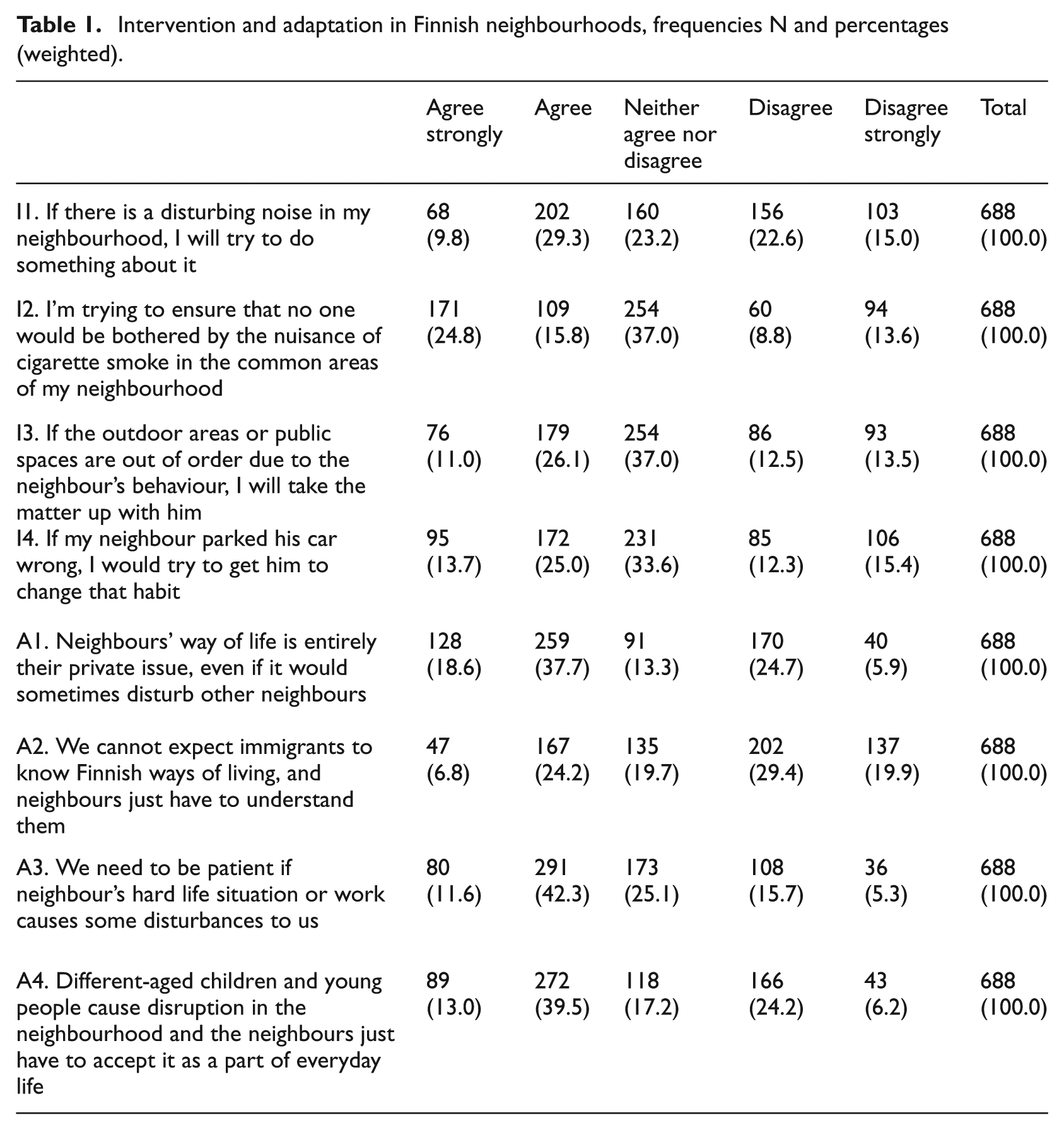
Intervention and adaptation in the neighbourhood was approached in the survey with eight items. Four of them measure the willingness to intervene in the neighbour disturbances (I) and four others measure neighbour adaptation (A) – in other words, willingness to accept possible disturbances as a part of everyday living in the neighbourhood (Table 1). The Likert-scaled items (1 = Agree Strongly to 5 = Disagree Strongly) were formulated so that they would always describe the very different concrete manifestations of intervention and adaptation from noise to ethnic relations. The variables measure relatively well, at least, their own latent dimensions of neighbour intervention (Cronbach α = 0.78) and adaptation (Cronbach α = 0.69).
Intervention and adaptation in Finnish neighbourhoods, frequencies N and percentages (weighted).
The correlates of neighbour intervention and adaptation include several micro-level determinants that have been found to be essential in previous studies on neighbour relations and housing. Age is primarily used as a demographic control, but there is, of course, evidence of the presence of life cycle or period effects on neighbouring (DiPasquale and Glaser, 1999; Möllenhorst et al., 2009). Gender is also a possible source of variation in neighbouring practices, as even in Finnish society, with a relatively equal participation of both sexes on labour market, women still, nonetheless, tend to spend more time at home, and therefore we may expect some differences based on that. Similarly, employment situation has a direct impact on neighbouring, as those who commute to the workplace on a daily basis have a different kind of relationship with their neighbourhood than, for example, housekeepers and the retired population.
Income and home ownership have an impact on the dimensions and types through various mechanisms. In the first instance, investment in real estate may heavily determine the willingness to interfere and adapt to the neighbourhood, because those that have spent a large amount of money on an apartment or a house may also be more willing to interfere if there are disturbances. Second, these are status variables that possibly determine the compatibility of the lifestyles between inhabitants of the neighbourhood (Völker et al., 2007).
The type of residence is one of the most important factors shaping adaptation to the neighbourhood. Apartment, row or semi-detached houses are associated with a high likelihood of interaction with neighbours in common spaces such as corridors and yards, as well as hearing noise and other sounds. In detached houses, this kind of interaction is limited to spaces outside the residence. Therefore, we may hypothesise that there is more neighbour intervention in apartments and row or semi-detached houses than in detached houses.
Friendship is a strong tie that is qualitatively different from typical weak ties (Granovetter, 1983) in the neighbourhood. Those that have formed friendship ties in the neighbourhood may be more eager to intervene if there is a reason for intervention (see also Nieuwenhuis et al., 2013). As well as home ownership, friendship ties can also be regarded as investments (Völker et al., 2007), though the question here is not about financial investments, but social ones that one might similarly want to look after. It is also plausible that once strong ties prevail, one is not as restricted to moral minimalism (Baumgartner, 1988) or negative solidarity (Kortteinen, 1987). Friendship ties may also have an impact on adaptation to the neighbourhood. Once there are neighbours that are more well known, one may tolerate more disturbances. Since friendship ties are often formed with people whose lifestyles are compatible, this may additionally increase adaptation.
In addition to the descriptive statistics, we apply principal component analysis (PCA), robust linear regression, K-means clustering and multinomial logistic regression (MLR). With the help of the PCA we can approach the question about the dimensions of the neighbour intervention and adaptation. If we were not to detect them, there would be no point in continuing the analysis on this track. However, as will be shown below, the dimensions can be clearly distinguished in the data. After that we apply robust linear regression to study which factors predict best these dimensions. The idea of K-means clustering is to detect neighbour types on the basis on the dimensions found in the PCA. The methods chosen also support each other in so far as the cluster analysis can be performed directly to the standardised z-scores (mean 0, std. 1) of the PCA which further improves the reliability of the analysis. Lastly, we apply multinomial logistic regression (MLR) to predict the ‘risk’ of belonging to a particular type of neighbour, by examining the impact of the relevant background variables.
Results of the analysis
In general, most of the respondents intervene rather easily with the disturbances listed in our four variables (Table 1). Noise in the neighbourhood, however, is more easily tolerated than other unpleasant effects of neighbours’ behaviour. Adaptation to possible neighbour disturbances is relatively common, although in the case of immigrants (A2) the opinions are more diverse.
The variables also seem to rather well represent the dimensions of neighbour intervention and the adaptation demonstrated in Table 2. On the basis of PCA, intervention and adaptation are loaded to distinctly different dimensions explaining more than half of the variation of individual variables together. The analysis with two principal components seems to produce the most optimal outcome. All the variables seem to have rather high loadings with either adaptation or intervention dimension, but loadings across the dimensions are still rather low. In other words, the quantitative analysis supports the observations that have been found thus far in a qualitative study, as well as in a statistical pilot study with a non-representative sample. As an answer to our first research question, we may conclude that the dimensions of the neighbour intervention and adaptation can be found in the nationally representative survey data set as well.
Principal component analysis.
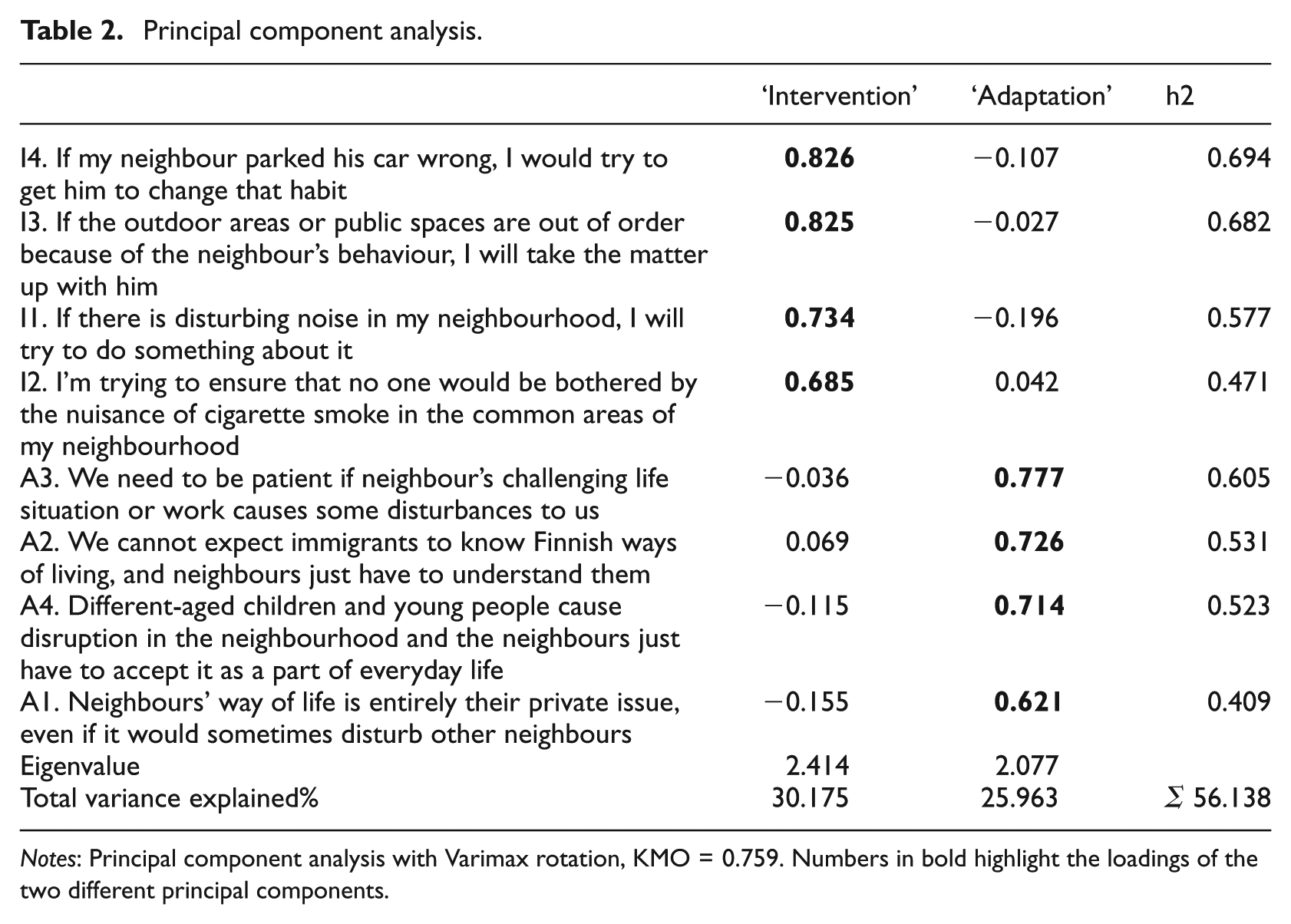
Notes: Principal component analysis with Varimax rotation, KMO = 0.759. Numbers in bold highlight the loadings of the two different principal components.
We apply robust linear regression to study what kinds of socioeconomic and demographic factors best associate with these dimensions (Table 3). As dependent variables we use the scores based on the PCA analysis described above. The scores of intervention and adaptation were formed using a regression method that produced two orthogonally related continuous scales that do not correlate with each other.
Linear regression analyses of intervention and adaptation dimensions (b-estimates, robust standard errors in parentheses).
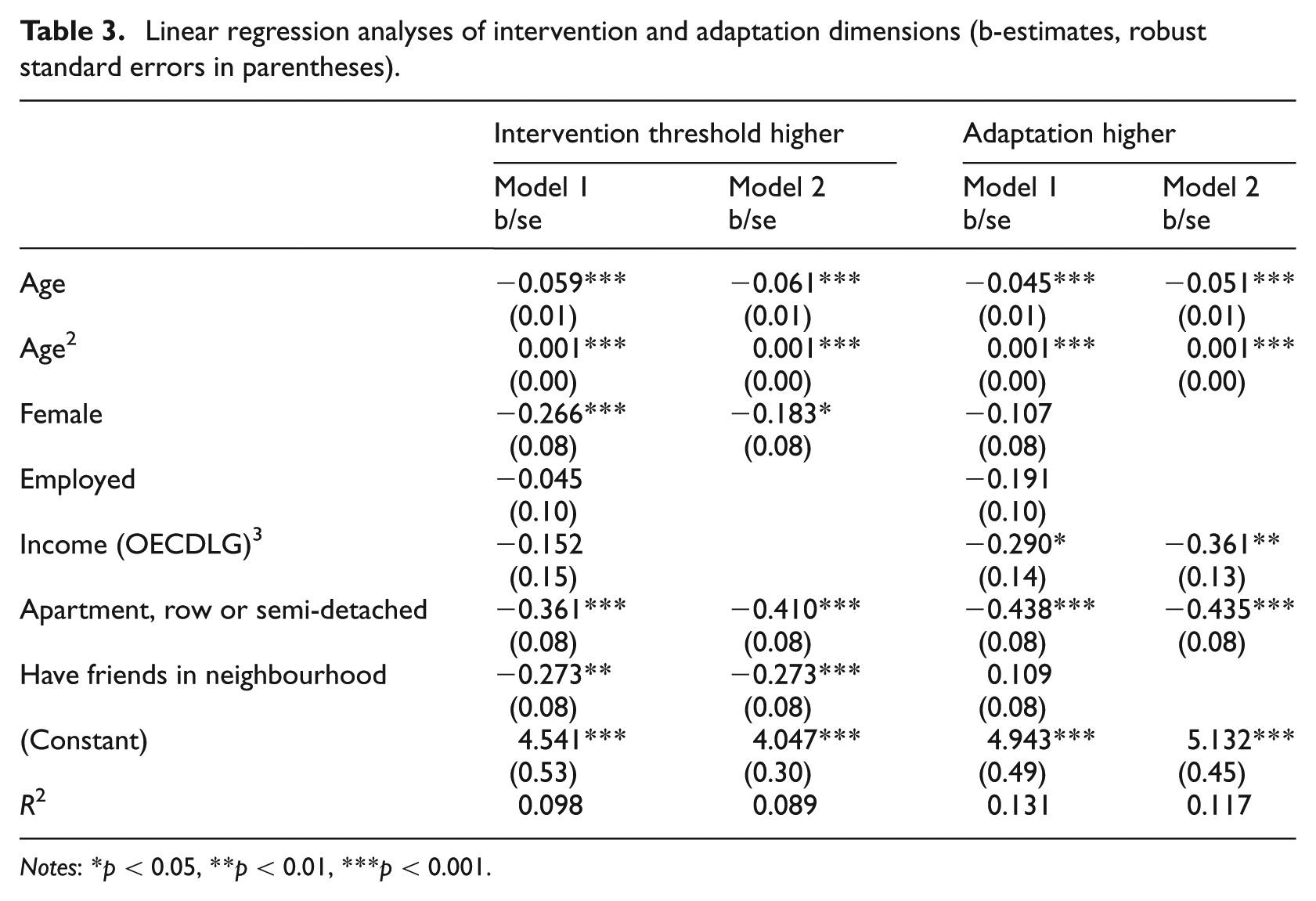
Notes: *p < 0.05, **p < 0.01, ***p < 0.001.
Regarding the dimension of intervention, it is possible to see that the type of residence, friends in the neighbourhood, age and gender have the strongest explanatory power. Living in an apartment, a row- or semi-detached house and reporting having friends in the neighbourhood lowers the threshold of intervention. Further, women seem to intervene more eagerly than men. In addition, age seems to have an impact on the intervention, but the effect is curvilinear, as can be seen from the estimates including both age and squared age (Age2).
Adaptation, on the other hand, is more usual among the residents of detached houses. Lower income, as well as age, have a significant association with adaptation. It seems to be that intervention is explained to some degree by the presence of the networks in the neighbourhood and gender-specific factors, whereas adaptation is more strongly associated with economic factors, such as income. However, the type of residence is the most important explanatory source when predicting both dimensions: living close to one’s neighbour brings about intervention and is a challenge to adaptation. Even though the observations from the regression analyses may be considered interesting, the explanatory power of the models could still be stronger (R 2 0.09–0.12).
The latent dimensions of neighbouring proposed through theory are empirically observable, but not sufficiently explained by socioeconomic and demographic characteristics alone. As previous research (Haverinen and Heinonen, 2013; Haverinen and Kouvo, 2011) has shown, the dimensions may have even more empirical relevance as underlying factors characterising the types of neighbours: Yard police, Fence builder, Park warden and Environmental caretaker. At least, these empirically found ‘real-life types’ may have stronger associations with relevant explanatory factors (socioeconomic, demographic, tenure type, house).
The search for the Yard police, Fence builders, Park wardens and Environmental caretakers was accomplished with the aid of K-means clustering (Figure 1). We grouped the different interviewees into four clusters on the basis of standardised (z, mean = 0 std. = 1) factor scores from the two dimensions of PCA described above (adaptation and intervention). The validity of the types formed by cluster analysis is tested later in the article. After having compared the size, interpretational possibilities and fit statistics of different possible solutions, we ended up with a solution of four clusters. As we can see, the solution of four clusters provided us with an outcome that is both theoretically and technically supported (Adaptation scale: F = 409.65, p = 0.000; Intervention scale: F = 417.33, p = 0.000).
The Environmental caretakers are placed in our scheme the top left corner and this group includes 157 respondents. The group has a low threshold for intervention, but nonetheless expresses simultaneously strong adaptation. The Park wardens (N = 216) do not intervene easily, but, however, adapt themselves relatively well. The fence builders (N = 102) do not intervene eagerly either but, like Yard police (N = 214), they will not adapt themselves easily for disruptions in the neighbourhood either. According to the cluster analysis, the most general types are Yard police and Park warden.
In the first two rows of Table 4, summed scales of adaptation and intervention are presented (range 0–16). K-means clustering seems to capture the types of neighbours suggested by theory. Yard police are eager to intervene, but their adaptation is at the lowest level. Environmental caretakers are likely to both intervene and adapt to the neighbourhood disturbances. Park wardens adapt very well, but they are not eager to intervene in neighbourhoods’ issues. Fence builders are the least likely to intervene and on average, their adaptation is at the lowest level.
Individual and neighbourhood characteristics by the types of neighbour intervention and adaptation. Means and percentages (%).

Notes: ANOVA (means) and χ 2 (percentages from crosstabulation). *** p < 0.001; ** = p < 0.01; * = p < 0.05.
The table also summarises some descriptive statistics associated with the neighbour types. Well-adapted Environmental caretakers and Park wardens are generally older than non-adapted groups, which usually have more neighbours as friends, are more usually retired and have lived longer in the neighbourhood. Even though the early ideas of urbanisation theory (Wirth, 1938) and even later studies (Fischer, 1982) emphasise the connection between neighbour relations and level of urbanisation, the degree of urbanity does not have a great importance for the types of neighbours in our data. As an exception to the rule, Park wardens are more likely to live in the countryside than the suburbs. However, this finding is probably associated with the fact that Park wardens (along with Environmental caretakers) prefer detached houses, which is the most prevalent house type in the Finnish countryside. Moreover, yard policing and fence building are associated with apartment housing. Row or semi-detached housing is more usual among Yard police than other types. To sum up these findings, the type of residence as well as particular demographic factors, seem to associate in a meaningful way with the types indicating different levels of adaptation and intervention.
Although the analyses above reveal a great deal of information on the sociodemographic and tenure related characteristics of the neighbour types, they do not allow us to weigh the relative importance of different explanatory sources when predicting the likelihood of belonging to a particular type of neighbours. To meet this challenge, we apply multinomial logistic regression (MLR) to predict the ‘risk’ of belonging to a particular type of neighbours (Table 5). The model is created in order to find both theoretically relevant and statistically suitable explanatory factors that may predict the risk of belonging to a particular type of neighbours. Therefore, we could not include all the interesting correlates presented in Table 4. However, the variables were chosen in order to ensure the inclusion of relevant socioeconomic, demographic and neighbourhood-level determinants with which it was possible to fit the model. In addition, one may contemplate the inclusion of both income and home ownership into the model. In Finland, however, home ownership is the most common type of tenure and even in the lowest income quintile, over 50% of the respondents belong to this group (Ruonavaara, 2006: 221).
The probability of belonging to a particular type of neighbours. Multinomial logistic regression. Average marginal effects (standard errors in parentheses).

Notes: *** p < 0.001; ** = p < 0.01; * = p < 0.05.
As we can see from Table 5, the model fits and determines the neighbour types quite well (Pseudo R 2 = 0.209) when Yard police is set as a reference category. Because the interpretation of the odds ratios is dependent on the reference category, we estimated average marginal effects for each independent variable and outcome on the basis of the MLR analysis. In addition, this choice made possible to report the estimates regarding the reference category (Yard police). Yard police are more likely to live in apartment and row or semi-detached houses and also tend to be younger than 65. Perhaps the most interesting finding is that both home ownership and higher incomes increase the probability of becoming a Yard police. Therefore, as in the case of neighbourhood community (Völker et al., 2007), financial investments seem to play a great role here as well. Strong ties with neighbours seem to be the most common among the Environmental caretakers. Having friends in the neighbourhood remarkably increases the probability of belonging to this type of neighbour. Age seems to increase the environmental caretaking as well. Park wardens are more likely to live in a detached house and more usually belong to the oldest and the youngest age group. As expected, Fence builders do not easily create friendships in the neighbourhood. The type of house seems to matter here as well. We will discuss the implications of these results in the conclusion.
Discussion and conclusion
The dimensions of neighbour intervention and adaptation discovered and grounded in qualitative research characterise neighbourhood interaction in our survey data set as well. Neighbour intervention seems to be best explained by close proximity to neighbours: the closer people live to each other, the more prone they are to intervene when breaches of the neighbourhoods’ norms happen. There is a strong association between neighbour intervention and age. Additionally, females and those who have friends in neighbourhood tend to intervene more readily.
Adaptation to the neighbourhood, on the other hand, is associated with low income and living in a detached house. Whereas the negative relationship between distant proximity to neighbour (detached house) and the high adaptation signals from the simple fact that the social dynamics of the neighbourhood do not challenge the adaptive attitudes, the interpretation of the association between low income and high adaptation is more tricky. It is possible that low income – together with age – is associated with time spent in the neighbourhood and thus signals from the degree of familiarisation to ones’ neighbours.
The analysis of the four types of neighbours provides a richer picture and more powerful explanations by independent variables that cannot be reduced to the dimensions as such. As in the case of earlier research based on focus interviews, the four types of neighbours can be constructed in a surprisingly meaningful manner from the quantitative data set as well. In our cluster analysis, Yard police and Park warden are the most prevalent types in Finland. In addition, when validated with original summated scales, the clusters seem to form the relevant cases from the fourfold of neighbour types.
Our results seem to complete the findings from the earlier research on the topic. An unexpected finding was that there is no association between the degree of urbanity and neighbour types, but, for example, detached housing is associated with less intervention and more adaptation. The minor role of the degree of urbanity is at odds with previous studies (Fischer, 1982; Wirth, 1938) emphasising the negative association between the intensity of neighbour relations and level of urbanisation. In general, as in the case of dimensions, house type is the strongest predictor of neighbour types as well. Moreover, investments in the neighbourhood (DiPasquale and Glaeser, 1999; Möllenhorst et al., 2009; Völker et al., 2007) are associated with the neighbour types, as well as different kinds of investments have different outcomes. Adaptive types are associated with the time spent in the neighbourhood (temporal investment) and friendship ties in the neighbourhood (social investment). However, yard policing is associated positively with economic resources. Financial investment in the neighbourhood (Völker et al., 2007) as well as a higher income, seem to promote likelihood of intervention, but at the same time reduce adaptation.
As is often the case with the cross-sectional data, it is naturally difficult to provide answers to the direction of causal arrow here as well. Perhaps living in a particular type of house contributes to adopting a behaviour pattern typical of a particular neighbour type, or it is the other way round?: people who have adopted a particular behaviour pattern are prone to select a particular house type or residential area. It is also possible that the types of neighbours that evolve through the interplay between the characteristics of the resident and residential environment may also have a reciprocal relationship. These are important issues to be addressed in any future research on the topic. Our main task here has been to test the viability of a typology of neighbour types, originally constructed in a small-N qualitative study, in nationally representative survey data; as well as to investigate the socioeconomic correlates of the different types. Our test attempted to yield positive results, and the further analyses gave new insights into the factors that are associated with belonging to particular neighbour types. However, it has not been possible to pay attention to the possible impact of the neighbour types on the various other neighbourhood phenomena in the scope of this article. For example, the association of neighbour types with a sense of community, satisfaction with living environment and neighbour disputes, as well as various neighbourhood-level demographic and socioeconomic characteristics, could be worth examining.
Though our ambitions have been mostly academic, research on neighbour types may also have policy implications. It is, of course, not always preferable to intervene in all kinds of neighbourhood interaction with administration. That being said, the knowledge about the social bases of neighbourhood social dynamics could be utilised when planning residential environments that meet the requirements of certain groups of people or when preventing or solving neighbour disputes. These questions, however, need more attention than it was possible to address in the space of one article.
Footnotes
Funding
The article is based on research funded by the Academy of Finland for the research project “Neighbouring and Neighbour Disputes in Contemporary Society” (decision number 127943).