




Abstract
Stereotypes are people or things categorised by general characteristics of the group based on a truth that is widely recognised and function to reduce ideas to a simpler form (Dyer, 1993). Not all stereotypes are pejorative but can be a form of othering of people (Bhabha, 1996) and come about through a friction with difference (Jameson, 1995). In Johannesburg, South Africa, there is a conflation of people and space that results in a form of spatial categorisation or stereotyping. Under the apartheid government the city’s spaces were divided by race and ethnicity and are currently shifting towards divisions of class and inequality deepening the fragmented post-apartheid conditions in the city. These spatial categories have been represented in films of Johannesburg and contribute to the construction of the city’s image but also construct images for particular neighbourhoods. In this paper I examine the use of space in film as a narrative device and explore the reception and understanding of Johannesburg’s spaces by its residents to illustrate the construction and reception of spatial stereotypes. The paper discusses three dominant spatial stereotypes of Johannesburg through key films and the reception of these films through quantitative and qualitative interviews conducted with residents in four locations (Chiawelo; CBD; Fordsburg and Melville) in Johannesburg. Stereotypes have negative consequences and these spatial stereotypes reflect the ‘city of extremes’ (Murray, 2011) but their use indicates a process of navigation and negotiation across differences in space and identity in the fragmented city of Johannesburg.
Introduction
Johannesburg’s rapid growth and development over the last 130 years has been moulded by diverse influences including colonial and apartheid ideologies. In the era of democracy the city has responded to increasing globalisation as a key centre on the African continent. However, the post-apartheid city remains fragmented. Experiences of the city are highly differentiated as a result of persistent inequalities that are manifest both spatially and economically. For Loren Kruger (2001) these divisions and inequalities have resulted in an ‘edgy city’ that both describes physical edges but also a pervasive state of mind, while Martin Murray (2011) has termed Johannesburg the ‘city of extremes’. These spatial fragmentations are mirrored and reinforced in the representation of Johannesburg in film. In this paper I review films produced since 1994 illustrating that Johannesburg has limited representation and is reduced from its complex whole to a series of spatial categories.
Three spatial categories in the films of Johannesburg reduce and simplify the spaces of the city and are frequently repeated across films and genres. Based on widely applicable but homogenising generalisations these depictions construct stereotypes of space. Scholars have commented on these spatial stereotypes in individual films (Fu and Murray, 2007; Oa Magogodi, 2003), usually to point out the establishment of binaries in the films. These stereotypes strongly reinforce the fragmented nature of the city, however the construction and use of these stereotypes in films reflects a friction between different areas of the city, much like different groups of people producing stereotypes (Jameson, 1995). Through this friction, films with spatial stereotypes are reassembling the fragmented neighbourhoods of Johannesburg.
The research examines the reception of these images of Johannesburg by the city’s residents and reveals how residents recognise and resist the stereotypes of their city. These films contribute to their knowledge of this divided city and enable residents to negotiate and navigate shifting relations in the post-apartheid city. Not limited to post-apartheid conditions, this othering of space has recently been explored in Amsterdam (van Gent and Jaffe, 2016) and thus the concept of spatial stereotypes is applicable to many unequal or divided cities globally.
The stereotype
Stereotypes are people or things categorised by general characteristics of the group based on a truth that is widely applicable or recognised and function to reduce ideas to a simpler form (Dyer, 1993). Stereotypes are categories that provide shorthand information (Dyer, 1993) and are ambivalent in that they are founded on truth but abused through abstraction or fantasy (Jameson, 1995). They need not be negative but stereotypes that project positive images are often overlooked (Bowman, 2010).
The stereotype is largely seen to be pejorative and part of the negative connotation is in the categorisation: mapping the ‘boundaries [of] acceptable and legitimate behaviour’, fixing categories where in reality boundaries are fluid (Dyer, 1993). Bhabha sees this rigidity in defining others as an important feature of the colonial discourse: ‘Likewise the stereotype, which is its major discursive strategy, is a form of knowledge and identification that vacillates between what is always “in place”, already known, and something that must be anxiously repeated’ (Bhabha, 1996: 87). It is the construction of difference that is reinforced through dissemination and repetition, which reinforces the idea that it is not the stereotype itself that is problematic but the power relations in their construction and use (Bowman, 2010). Therefore, stereotypes are related to prejudice and discrimination (Fiske, 1998).
For both Frederick Jameson (1995) and Rey Chow (Bowman, 2010) the stereotype is inevitable as a product of relations between groups and cultures, ‘namely, that it is a matter of the outer edge of one group brushing against that of another, that it is an encounter between surfaces rather than interiors’ (Bowman, 2010: 51). The stereotype is a product of the friction generated when groups of people interact with one another. In any large modern city, the stereotype is thus part of everyday activities and interactions between people. Anthropologist Arjun Appadurai has connected the stereotype, what he calls ‘strong tropes’, to the representation of place terming them topological stereotypes (Appadurai, 1992). These topological stereotypes are generated through repetition and negatively affect the way that these spaces are perceived and conceptualised (Wacquant, 1997). The power and politics embedded in stereotypes become indistinguishable from the everyday (Bowman, 2010).
In this paper I apply the term stereotype to urban space, defined as a spatial category that contains a foundation of truth about an area or neighbourhood that is simplified and used as shorthand information (in this case in films). Whilst the boundaries of a spatial category may be more readily mapped on the geography of the city, they are also more susceptible to change and fluidity. In the unequal and segregated city, spatial stereotypes reflect larger political power differentials and in this way, some spatial categories also project stereotypes of certain groups or cultures of people. Spatial stereotypes can be viewed as either positive or negative and their presence in cities and in the representations of films connects them to everyday practice in the city. The ability of a spatial stereotype to construct a positive image of space differentiates the term from Appadurai’s topological stereotype and from ideas of territorial stigmatisation, which focus on the negative connotations.
Media, and specifically film, are responsible for producing both positive and negative representations of place. The representation of urban landscapes and the city in film is well documented by planners, geographers and architects (Alsayyad, 2009; Bruno, 2007; Clarke, 1997; Clarke and Doel, 2005; Denzin, 1995; Hallam, 2010; Lamster, 2000; Lukinbeal, 2002; Mathews, 2010; Penz, 2003; Schwarzer, 2004, to name but a few). Film locations are determined as much by aesthetics and economic processes, controlled by a city’s film commission (Lukinbeal, 2002), as they are by narrative and meaning. Locations are used to add authenticity or realism to a film’s narrative, although in the case of a city’s residents occupying the same urban condition, this authenticity may be limited.
Philip Boland (2008) demonstrates the powerful role of the media in the construction of Liverpool’s image of place and people. Boland shows how mostly negative stereotypes of both people and place are generated by the media and how this contributes to the cultural knowledge of Liverpool (Boland, 2008). While Boland (2008) briefly mentions how these images affect the way Scousers see themselves, he emphasises that these stereotypes generate negative perceptions of the identity of the city. His study relates the media images to the broader challenge of place marketing.
In some cases representations can inform development in the city. The most detailed study of the representation of any one city in film is Thom Andersen’s three-part film Los Angeles Plays Itself (2003). As the most filmed city in the world, Andersen’s film analyses both the stereotype of the whole city of Los Angeles as well as various neighbourhoods and even buildings. Andersen and Davis have shown how the filmic representations of the Los Angeles neighbourhood, Bunker Hill, in the 1940s influenced its redevelopment in the 1950s (Andersen, 2003; Davis, 2006). The films of Bunker Hill depicted slum-like conditions combined with sinister plot lines encouraged the city to ‘clean up’ the area.
These negative depictions of neighbourhoods of the city have persisted into recent films and conflate identity and space in a process of othering. Scholars have highlighted the image of the marginalised ‘other’ in the banlieue of Paris (Higbee, 2001) or the depiction of African-Americans in the spaces of the ghetto or ‘hood (Massood, 1996, 2003). Even as some films or filmmakers attempt to dispel negative spatial stereotypes or disrupt hegemonic discourses about these neighbourhoods, the film images reinforce spatial stereotypes and the image of the ‘other’ (Higbee, 2001). These authors criticise the construction and reinforcement of these spatial stereotypes and the way that they are tied to particular identities but do not give context within the larger city to other stereotypes. These stereotypes closely resemble the ideas of territorial stigmatisation or the concept of the ghetto (Wacquant, 1997, 2007) but Massood (1996) shows that negative spatial stereotypes can prepare the ground for more nuanced stereotypes but these are limited to certain spaces and identities.
The research on the image of South African cities in early cinema connects the depiction of cities to contemporary trends in place marketing and tourism (Bickford-Smith, 2013). Bickford-Smith has shown that in the first half of the 20th century, the images of urban space in South African films, Johannesburg included, were strongly influenced by the need to promote cities as tourist destinations (Bickford-Smith, 2013). As a result these early films did not address the harsh realities present in the city and presented positive brands (Bickford-Smith, 2013). The aims of both city branding and tourism are to construct positive images of place to increase tourist and economic activities and, thus, in some cases, work to counteract negatives images produced in the media as Boland (2008) illustrates.
Little of the literature on spatial categories explores the way that stereotypes are perceived and understood by residents of these spaces. In this paper I show how the city of Johannesburg is simplified to a series of neighbourhood categories that reflect a process of othering within the city and the everyday negotiations of difference within the post-apartheid landscape. I discuss how these stereotypes contribute to knowledge of the city and how they are understood and resisted by residents of Johannesburg.
Method
It is understood that there is a process by which films feed back into the urban environment (Alsayyad, 2009; Bruno, 2007; Clarke, 1997; Clarke and Doel, 2005; Denzin, 1995; Hallam, 2010; Lukinbeal, 2002; Mathews, 2010; Schwarzer, 2004), although the influence of film on the city’s inhabitants and practitioners has not been given such great consideration. Scholars have admitted the difficulty in conclusively establishing this process (Gold, 1985). The research presented here is part of a larger project that examined the representation of Johannesburg in films produced since 1994 with particular focus on how these images of the city were received by residents of Johannesburg (Parker, 2016). At the outset, four locations were chosen in which a quantitative survey was conducted to explore the reception of Johannesburg films. The four locations were Chiawelo in Soweto, the central business district (CBD), Fordsburg and Melville. The locations were chosen because they provided a cross-section of different urban spaces and demographics in Johannesburg; they had all featured in at least one film or television show; and residents had reasonable geographical access to a local cinema.
The first phase of the research analysed the representation of Johannesburg in films produced since 1994. This phase revealed that three locations (CBD, Chiawelo, Melville) dominated representations of parts of Johannesburg and were far from being samples of diverse representations of spaces in the city. The second phase of the research was a quantitative survey conducted with 50 participants in each location. The participants were residents, workers or visitors to the area and the sampling method was random although the intention was to have representation of respondents across age, race and gender. The survey asked respondents to share aspects of their everyday experiences and practices in the city of Johannesburg and to discuss their viewing habits and films of the city they had seen. The survey also asked participants whether films influenced their feelings of and or activities in Johannesburg and briefly which feelings and activities might be influenced. The survey showed that residents of Johannesburg readily recognise the influence of Johannesburg films on their everyday practice in the city. Nearly 70% of all respondents recognised either a positive or negative influence of films on their feelings and three-quarters of respondents recognised an influence of films on their activities in the city. Although several studies comment on the gradual nature of changes in perception produced by film and that this is a difficult process to study (Keiller, 2003; Schwarzer, 2004), this research phase illustrates that respondents were aware of the influence of films. This finding was reflected across all four locations and socio-economic and demographic differences between the locations were not significant factors regarding the influence of film.
The survey established a connection between images of Johannesburg and the everyday practice of residents in the city. This prompted a third phase of study, conducted through qualitative interviews and a focus group, which set out to examine the factors impacting the influence of films on Johannesburg residents’ everyday practice. The focus of the interviews was primarily to understand the nature of the influence of films and referred to those factors that were raised in the survey as being significant. These factors were attending the cinema with friends and recognising Johannesburg on screen. Thus interviews were conducted with people who attend the cinema with friends and urban professionals familiar with Johannesburg’s environment (selected through snowball sampling). In addition, the qualitative interviews addressed an imbalance of male respondents interviewed in the quantitative survey with a sub-group of women. The predominance of male respondents was attributed to the greater numbers of men present on the streets in the four locations and a higher rate of decline from those women who were present on the street. This phase revealed how the representations of Johannesburg contribute to residents’ knowledge of the city. The interviews also showed how respondents were able to recognise and resist spatial stereotypes present in films of Johannesburg. It is important to examine the reception of films by audiences because films and television shows cannot be seen to be a reflection of perceptions and understandings in the real world (Thomas, 2003).
The fragmented city of Johannesburg
As a post-industrial city (Crankshaw, 2008), and one that has continuously attracted immigrants, Johannesburg has a multitude of cosmopolitan and diverse districts. In 2011, the population for the metropolitan municipality of Johannesburg was just under 4.5 million people but the greater urban area of Johannesburg has just less than 8 million people. The majority of residents (76.4%) are black African, 12.3% are white people, 5.6% are coloured people, and 4.9% are Indian/Asian (2011 Census, Statistics SA). From its earliest inception, these racial categories were the basis for dividing the city’s residential areas and this was continued through colonial and apartheid legislation and planning. The apartheid regime intended to create cities for whites only with black African labour bussed in from the outskirts of the city where required. Johannesburg’s spatial segregation was a physical manifestation of the many injustices blacks faced during apartheid. Despite these efforts segregation was never fully complete and many areas continued to house mixed race groups (Beavon, 2004).
The predominant narrative of Johannesburg is one of inequality, particularly racial inequalities established through colonial and apartheid governments (Beall et al., 2002; Beauregard and Body-Gendrot, 1999; Bremner, 2004; Murray, 2011; Nuttall and Mbembe, 2008). Despite efforts of development and redistribution in the democratic era, Johannesburg is being re-divided into fortified enclaves emerging as divisions between violent criminals and those who fear (Nuttall and Mbembe, 2008). Martin Murray calls it the ‘city of extremes’ (2011) where elements of power, values and symbolism are encoded in the city’s spaces (Murray, 2008).
The spatial stereotypes constructed in Johannesburg films
Films use different shots or viewpoints of the camera in order to tell their visual stories. Film is free to explore anything from aerial and long distance shots to medium and close shots but films traditionally use ‘establishing shots’, which are long distance or wide-angle shots, to depict the setting or location of the narrative and characters. Even films shot in studios will make use of this technique to establish the scene. Films draw on Lynch’s imageability of the city (1960) in making a film location legible, for example a long shot of the Eiffel Tower as a landmark quickly establishes the location of the film in Paris, France. Other urban elements such as streets and districts that are readily recognised contribute to locating the film in what Lukinbeal terms using landscape as place (Lukinbeal, 2005).
Many films set and filmed in Johannesburg make use of three key spatial stereotypes. The first is the central business district (CBD), which represents the area of the inner city as well as projecting the image for the city of Johannesburg as a whole. The second stereotype is that of middle-class suburbia and the third, township 1 areas. These areas conform to spatial stereotypes in a number of ways: urban conditions and elements are simplified and generalised; specificity of place is overlooked; the depiction of these spaces is used as a shorthand information in the narratives of the films; characters from these areas may also be generalised or stereotyped; the stereotypes are repeated in several films; and the film depictions generate markers or signifiers that are identifiable by audience members. With reference to Lynch (1960), the legibility of the CBD stereotype is conveyed through landmarks, middle-class suburbia through the depiction of a district, and the township through its aesthetic and urban form. In this section I describe the three spatial stereotypes projected in the films and compare them with real conditions in the city.
Johannesburg as a location for a film is typically conveyed through a shot of the skyline of the CBD. High-rise buildings that include a mixture of commercial, retail and residential uses dominate the CBD. Films use the iconic landmarks of the city, namely the Hillbrow Tower, Ponte Tower, and the Carlton Centre, to establish the location of the CBD. As a representation of the city it symbolises a city founded on gold mining, the economic heart of South Africa and even Africa, and therefore a site of aspiration and opportunity. Its rapid development since its inception in 1886 has also secured it as a modern centre, embodying the notions of industry and progress, and the very concept of urbanity.
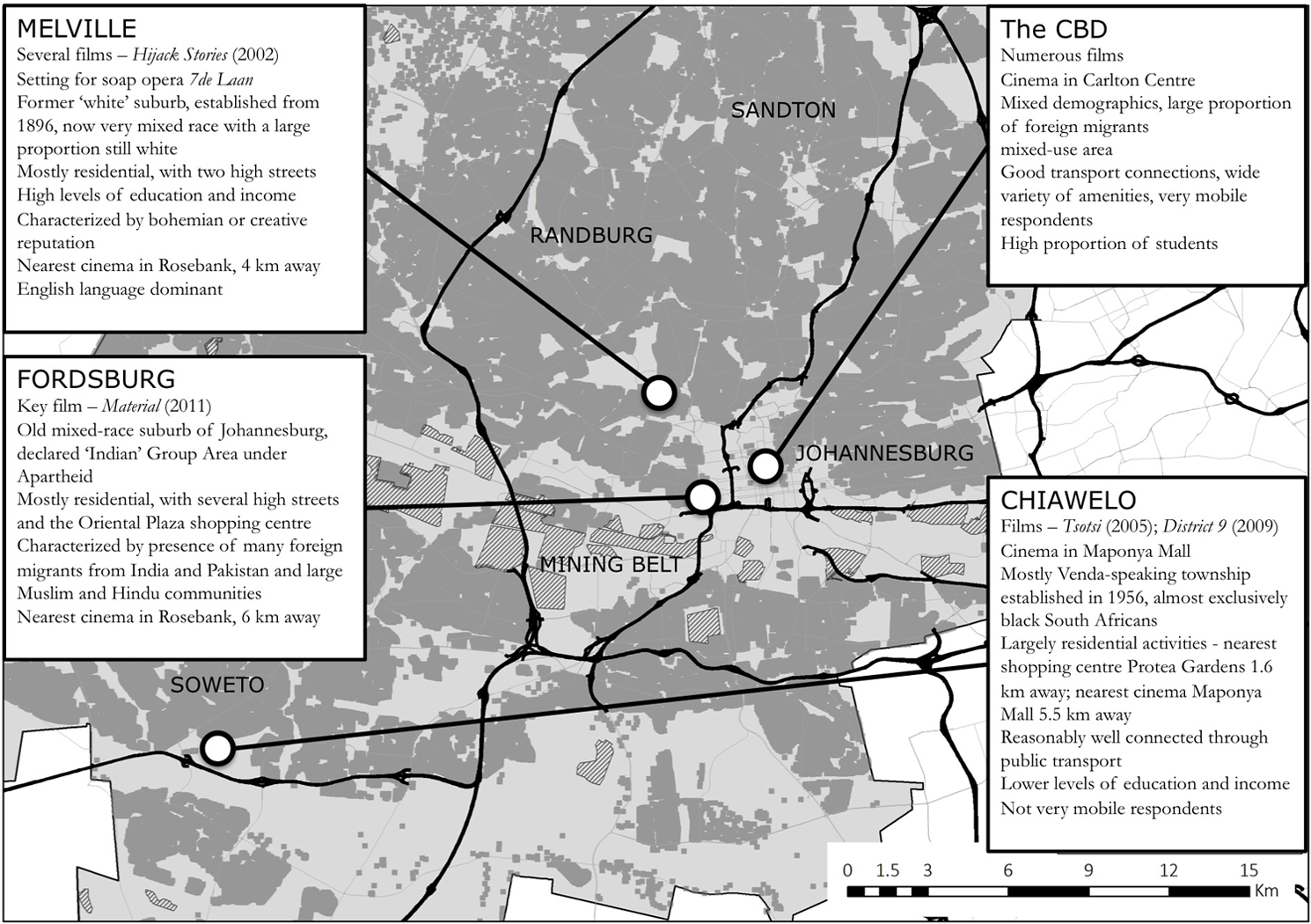
A map of the four study locations in Johannesburg.
One recent film of many 2 that depicts the CBD is Max and Mona (2004). Mona is a goat that travels with Max to Johannesburg and is the long-told story of the naive country boy coming to the big city, seeking a better life. The urban and modern context is emphasised with the arrival of Max and Mona in a minibus taxi, being delivered to the centre of the city where streets (and protagonists) are dwarfed by high-rise buildings, signalling their arrival. These images of arrival in the city and the domineering skyline are frequently depicted in films set in Johannesburg.
Max and his goat eventually settle in Soweto but he travels back to the city centre, to the Carlton Centre specifically, to do some shopping. This reinforces the city as a commercial centre and imbues it with the ability to connote a certain status level for its occupants and visitors. This symbolism has been repeated in other films, notably in Hijack Stories, where the gangsters show off their status by shopping in the Carlton Centre. The depiction of the CBD is therefore largely associated with these two aspects: as a centre of wealth and success at the same time as being a modern but overwhelming, and sometimes hostile, space. This duality is fully exploited in the film, Jerusalema (2008), where the inner city represents a space of decay and danger but is also the environment in which Lucky Kunene reinvents himself and creates a (criminal) empire. The CBD is Johannesburg’s predominant spatial stereotype. The high-rise buildings that form the skyline are the signifiers for Johannesburg and for the inner city, representing wealth, but also a site of danger. The emphasis of the inner city as a space of consumption ignores the reality that much retail therapy occurs in the large malls scattered across Johannesburg, including Soweto, and that the commercial centre of the city has been located in the Sandton CBD for at least the last 15 years. The image and meaning of the Johannesburg CBD is so strong that it persists in films despite the fact that these functions have shifted in reality.
Township spaces are important and frequent locations and sites in late apartheid and post-apartheid films. Johannesburg has several townships in the city and on the periphery, however, the largest one to the southwest of Johannesburg’s centre, Soweto, became the main place for forced removals when the 1950 Group Areas Act was enforced. Soweto has gained iconic status and today is the home of more than 1 million residents. Township spaces, mostly filmed in Soweto, have featured in many key films of Johannesburg: Mapantsula (1988), Sarafina! (1994), Taxi to Soweto (1991), Soweto Green (1995), Chikin Biznis (1998), Max and Mona, Hijack Stories, Tsotsi, Jerusalema, District 9, etc.
Commensurate with an area of such size and age, Soweto has diverse spaces (Harrison and Harrison, 2014). Even before the end of apartheid, middle-class neighbourhoods had emerged and, with democracy, investment has poured into the area creating a university campus, transportation networks, tourist destinations, theatres and shopping malls. However, poverty remains in some districts and there is also the presence of informal settlements. Chiawelo 3 is a suburb or township of Soweto established in 1956 for mostly Venda-speaking individuals. 4 Chiawelo is mostly a residential suburb (as are many townships as a result of imposed ‘dormitory’ conditions), characterised by small houses provided by the government, a few schools and some shops and businesses. Informal settlements in and on the edge of Chiawelo are nestled in the valley and these have formed the basis of film locations for both Tsotsi and District 9.
The depictions of Soweto in films have been rather two-dimensional. Lesley Marx (1996) states that in films such as Mapantsula, Soweto is Johannesburg’s metaphorical shadow. The films Hijack Stories and Max and Mona show ‘typical’ township spaces with small detached houses built by the government, wide dusty streets within a working class but also all too often a criminal class context. Economic hardships are alluded to but do not form part of the aesthetic of these films. More recent films such as Tsotsi and District 9, however, have begun to conflate township spaces with poverty and the slum.
[T]he ‘township space’ is represented as a space of ‘otherness’ and cinematic representations fail to recognise that the township is actually a heterogeneous or hybridised space, as representations of the township have become ‘fixed’ by representing it as one of ‘otherness’, informal squatter camps and decay. (Ellapen, 2007)
Both films were shot in Chiawelo, although the narratives are not necessarily located in Chiawelo, but rather the location serves as a more generic township or informal settlement space within Johannesburg.
Tsotsi 5 explores the gritty world of informal settlements and the periphery of the city in the story of a hijacker who accidently kidnaps a baby. The hijacker, Tsotsi, inhabits the spaces of the informal settlement (in Chiawelo) and travels into the city by train, to commit various crimes there including robbing and killing a man, and tormenting a disabled man. The settlement is shown to be a vast, almost impenetrable space dominated by criminal activities and gangsters and is shown to be a formidable space even for law enforcement. The informal settlement appears in a perpetual state of dawn or dusk, and is bathed in pink light and mist (or smog), filtering the poverty and hardship through a rose tint.
The informal settlement is shown to be on the periphery of the city, and the film emphasises the distance between the settlement and the CBD through train journeys, reflecting the reality for many Chiawelo residents. However, the film also neglects the greater context of the suburb and of its location in Soweto. The informal settlement is only a small part of Chiawelo and does not reflect the variety of housing conditions in Soweto at large. Instead the informal settlement is shown to be in isolation: from Johannesburg and from its immediate surroundings. Indeed, even the representation of the informal settlement overlooks the diversity of layouts, occupants and levels of formality that exist within informal settlements in Johannesburg (Huchzermeyer et al., 2014).
In the second key film, District 9, the theme of crime is set aside but instead, the settlement embodies the representation of squalor, temporality and the space of the alien (both ‘prawns’ and non-South Africans, specifically Nigerians). District 9 imagines a city of fear and terror, not just in the ‘edgy’ CBD, but also in the informal settlements. Although the narrative is science fiction, the film makes use of real images of informal settlements juxtaposed with aerial views of Johannesburg’s CBD in a mock documentary style. Again, the informal settlement is contrasted with the ‘modern’ CBD, and contributes to the drama of the narrative. The shanty town in which the aliens have confined residence bears such a strong resemblance to harsh reality that it can be seen to be an allegorical representation of apartheid or xenophobia a violent form of prejudice erupting in Johannesburg and South Africa.
In both films, despite the vast differences in genre and narrative, Chiawelo functions as shorthand information about spatial inequalities in the city. The informal settlement in the area is emphasised over more formal urban forms in the neighbourhood. The aesthetic of the informal settlement forms the foundation of the stereotype. The location is simplified and generalised to a space of poverty that ignores the other dimensions of the area. Whilst both films erase the specificity of Chiawelo as a place, the spatial stereotype is established in the context and contrast with the other spaces of the city; the CBD and the suburb.
The stereotype of the township is often contrasted with the stereotype of suburbia. The middle-class and formerly white suburbs of Johannesburg started with Doornfontein, followed by Parktown and Westcliff established to the near north of the city centre, and have continued sprawling in that direction for over 100 years. These suburbs are characterised by the proliferation of tree-lined avenues and spacious green gardens, influenced by the Garden City Movement and the return to ‘natural’ landscapes. This green landscape is the basis for the depictions in film as a recognisable district.
Developed by private property developers, the suburbs are largely disjointed through disconnected street grids and further differentiated by varying architectural styles (Czegledy, 2003), housing types and densities. Intended to be for whites only, this was never fully achieved as accommodation was provided for non-white domestic workers in backyards or on the rooftops of high-rises (Mabin, 2014). Despite this variety and hybridity the northern suburbs have been depicted in films as one undifferentiated sprawling mass:
In Mapantsula, Schmitz presents a Manichean split between a white and a black visual world. There is almost a sense of a ‘geography’ of whiteness, characterised by opulence, mansions, and beautiful gardens, juxtaposed with a geography of blackness, whose poverty is marked by filth and overpopulation. (Oa Magogodi, 2003)
Melville is a former ‘whites only’ suburb about 5 km northwest of the CBD. This residential neighbourhood dates back to 1896 and consists mostly of modest freestanding houses. There are two main roads or high streets lined with shops and restaurants, one of which serves as the real location for the fictional soap opera called 7de Laan (7th Avenue) (2000). The suburb was originally a working-class neighbourhood but with the development of the SABC (South African Broadcasting Corporation) and Rand Afrikaans University (now University of Johannesburg) the suburb became home to those in creative and media industries and academics (Corrigall, 2012). Today the suburb is middle-class and home to professionals, although the bohemian or creative reputation lingers.
Melville is a suburb popular as a film location used to represent these middle-class neighbourhoods. The depiction of Melville stands in stark contrast to the specificity of place that is the neighbourhood’s reality. In film Melville represents the vast stretches of middle-class suburbia that sprawl north (and south, east and west) of Johannesburg’s centre despite having a discernible historic working-class character and evidence of a creative class. The clearest example of its non-specific depiction is in the film Hijack Stories. Sox is a young black actor, who attempts to infiltrate the criminal underworld in Soweto in order to prepare for the role of a gangster on television. Critically, Sox lives in the former ‘white’ middle-class suburb of Rosebank, although the scenes depicting Rosebank were actually shot in Melville. This ambiguity or inauthenticity serves to emphasise Sox’s own conflicting identities within the city as he prepares to play the role of a gangster on television. At the end of the film, his loss of identity reiterates the perception of suburbs as non-places.
The locations in the film are restricted, for the most part to Soweto and ‘Rosebank’, which, according to Fu and Murray (2007: 284), become ‘integral to establishing the difference between an upwardly mobile urban identity for the emergent black middle class and excluded “gangsta” identity in the “Hood”’. Fu and Murray (2007: 284) argue that the ‘fictionalised-stereotyped’ portrayal of both landscapes sets up the binary that contributes to the mythology of Johannesburg as the ‘dangerous city’. By day, the middle-class suburb provides Sox with a familiar refuge but at night the spaces become a place of fear, where he attempts to steal his first car. This is emphasised in the scene of the suburban street lined with blank walls. This change in the feeling of spaces in the film reflects the theme of shifting identities. The suburban stereotype is established through these homogenised urban elements of tree-lined streets with walls and gates.
The use of locations in films adds meaning to the production as well as aesthetic value and aspects of the plot. Spatial categories convey this meaning very quickly for an audience and this is the function of the stereotypes in film. Therefore the meanings outlined above are key to the construction and reliance of the spatial category in the films. This function does not allow for nuanced depictions of space and identity but instead relies on assumptions of place and character. Not all films of Johannesburg rely on the use of spatial stereotypes. Some films such as Material (2011) or Triomf (2008) create a sense of place on screen through their rich and detailed depictions of neighbourhoods and characters. These films and narratives expend significant screen time establishing the place and location and may come at the cost of exploring the context of the location within the broader city of Johannesburg.
Spatial categories can have negative consequences for a city addressing segregation when these stereotypes of the CBD, the township and the suburb replicate the apartheid divisions of Johannesburg and reinforce relationships of space, race and class. However, their depiction may also be a result of their slow dissolution:
One of the structural conditions of the post apartheid city is that former categories (black/white, clean/dirty, good/bad, suburb/township, order/disorder, human/inhuman, safe/dangerous), and the geographies of boundary and space in which meaning and anxiety were contained throughout the colonial and apartheid periods have been, in the space of a mere decade, overturned. The Other, the stranger, the mob, the beast, that against which the entire edifice of apartheid had been erected, is within. Urban spaces have been rendered permeable, open to infiltration, intervention and contamination. (Bremner, 2004: 459)
As Jameson (1995) suggests, stereotypes arise out of the superficial contact between different groups and thus spatial stereotypes reflect the spatial contact and interaction between areas that were previously rigidly segregated. This idea is reinforced in the way that films usually depict two or more stereotypes juxtaposed in one story and in the plots where characters are depicted as shifting between these spatial stereotypes representing the interaction between the different spaces. After Rey Chow, these spatial stereotypes in films are a strategy for navigating the changing politics of the everyday in Johannesburg. The spatial stereotypes function as conventional stereotypes to simplify and present shorthand information, which provides the foundation for characters and plots to traverse a larger context of Johannesburg. In the following section I discuss how audiences and residents receive and interpret these images and how they are cognisant of these stereotypes.
Interpreting spatial stereotypes in reception and film production
In the qualitative interviews participants were cognisant of the spatial stereotypes used in Johannesburg films and the subject was raised frequently. When asked to identify from screen shots the places of Johannesburg, participants frequently repeated the visual symbols and signifiers of the spatial stereotypes of Johannesburg that were discussed above.
6 This is like Sandton. This is maybe Houghton or, this could be Houghton or Melrose or Hurlingham.
What makes you say that? Security sign?
The security signs, the garden, the high walls. Ja, I mean it looks opulent also.
Sarah recognised the image as the stereotype for the middle-class suburb, while also recognising that she would not be able to identify a more specific location in Johannesburg. The elements of the image that aided her identification were elements that nearly all participants identified. In some instances a single lush green tree was the only signifier needed to identify the middle-class suburb. This reinforces some of the key material elements of the city discussed in the representational study and also emphasises the symbolism embodied in the physical landscape. The Johannesburg suburb is far less of a definitive landmark than the CBD but is still legible in general, which does point to the strength of the spatial stereotype that films use. It is akin in image to the landmark.
Participants were conscious of the construction of spatial stereotypes, which were seen to be an inevitable element of film production:
I think it’s a lot of those, because sometimes you would think it’s a good thing that they are showing what really happens. But then at other times you think they could have handled it a bit more sensitively that it feeds into sort of stereotypical vision of the city. But then how else are you supposed to portray the city?
This participant highlights the conflict that is at the essence of the definition of stereotype. Participants recognise that spatial stereotypes are based on factual information that is not necessarily applicable to the space in its entirety.
Well I think then you don’t buy into the myths that you see on TV, so I mean if you’ve never really partied or worked, or lived or visited Soweto, you may think it’s some dark jungle, or the inner city even.
So do you think that films perpetuate those myths? Or do they help to break them?
No, they perpetuate them. Even the depiction of suburban areas as like cold, unfriendly and if you not from there then you’re going to struggle to be there. I don’t think that’s true.
Amma recognised the danger of these spatial stereotypes and felt that films perpetuate the stereotypes rather than breaking with accepted conventions. These participants are aware of the stereotypes because they are also aware that alternative depictions and narratives are possible. They recognise the large truths that the stereotypes are based upon but also point out the other truths that are not depicted. The spatial stereotypes in Johannesburg films provide simplified shorthand information for audience members but in so doing they also limit the diversity of depiction and therefore limit the transfer of knowledge through film. Another participant elaborates on the use of spatial stereotypes:
Well then equally what comes to mind is that I also have a problem with just these representations of Jo’burg just being if you can imagine a walk down Commissioner [street] from west to east or east to west. Because […] it’s a very particular kind of representation. So it’s not like the mine dumps along the mining belt, or it’s not leafy suburbia in some parts, it’s not the Sandton CBD and Alex[andra] and Wynberg. So it tends to either be like from afar of this pretty skyline or it tends to be this stereotypical shot of the inner city – vendor with fruit.
Yaminah laments the fact that, the spatial stereotype of Johannesburg’s CBD, eclipses representations of the city that demonstrate more diversity. Diversity, however, is not likely to be easily recognised, or even familiar to mass cinema audiences, subverting the purpose of including locational landmarks and spatial stereotypes in films.
Participants recognise spatial stereotypes through their material and physical markers, which is a critical aspect of their construction and function in films. Spatial stereotypes constructed and used in film impact the way that films are received in the city and contribute to the knowledge of the city’s spaces but participants also recognise the limitations of the stereotypes and are thus able to resist or critique them.
Even though locations may be selected on the basis of economics or a limited geography of the film shoot, urban audiences derive meaning from the images, gain knowledge of city spaces and are cognisant of the use of spatial stereotypes. Despite the potential for spatial stereotypes to reinforce the unequal and fragmented city, residents are able to reject the simplified imagery while also recognising their value as a film convention. Rejecting the stereotype reveals a process of negotiating and understanding the complex and divided city, which can also be seen to reflect the way that these films, in using spatial stereotypes, present different, if limited, depictions of neighbourhoods.
Conclusion
Three spatial categories have been constructed in the films of Johannesburg through the depiction of landmarks, districts, urban form and aesthetics. The spatial stereotypes use images of the urban landscape to reduce, simplify and repeat so that they are easily identified by audiences. They are stereotypes because they are a means of representing the city with shorthand information and present specificities of place in generic ways. These spatial stereotypes have occurred repeatedly in several films over the last 20 years and are often depicted together in the same film to establish contrasts or binaries. Spatial categories in the films of Johannesburg highlight the inequalities of the city and can contribute to normalising the ‘materiality of inequality’ (van Gent and Jaffe, 2016: 17). Despite Johannesburg’s segregated conditions arising chiefly from the apartheid government legacy, many cities globally are grappling with spatial divisions and inequality, as van Gent and Jaffe’s study in Amsterdam illustrates. Johannesburg, thus, serves as a case study for divided cities globally. Films that depict these urban conditions influence the everyday practices of residents (Parker, 2016) and are reinforcing the unequal city for its inhabitants.
In replicating the segregated city and in mirroring the processes of othering as discussed by Higbee (2001) and Massood (2003), spatial stereotypes are far from ideal but their function in films enables other more positive outcomes. Film characters can disrupt and transgress these established boundaries as Sox does in Hijack Stories. The juxtaposition of places or stereotypes within the context of the larger city in films is indicative of a process of the different neighbourhoods of Johannesburg coming together in one city and a process of assembling the fractured post-apartheid city. Both the construction and use of spatial stereotypes and their interpretation or rejection are a process of navigating the divided and unequal urban conditions. However, the limits of spatial stereotypes are also apparent – they represent the friction between surfaces rather than an engagement with the substance of a space or identity. Stereotypes limit the diversity of spaces and characters in films although audience members were able to gain information and understanding of their inhabited city. Stereotypes are related to prejudice and discrimination (Fiske, 1998), so although spatial stereotypes play a role in the restructuring of the unequal apartheid city, they should move towards greater nuance and diversity for an integrated post-apartheid imagining.
Footnotes
Acknowledgements
This paper is based on research conducted for a PhD thesis in town and regional planning at the SARCHI Spatial Analysis and City Planning at the University of the Witwatersrand.
Funding
This research was supported by the National Research Foundation.