




Abstract
Resettled rural communities are a product of China’s rapid urbanisation and associated top-down planning. For local governments, relocating farmers from natural villages into new, concentrated residential neighbourhoods serves the dual purpose of implementing national directives on farmland conservation and integrated urban–rural planning. For resettled residents, however, the transition process is fraught with livelihood, social and cultural contest. This paper explores how such residents in a Chinese city, Zhenjiang, exercise agency to reconstruct community and public space in their new neighbourhood. Keeping alive patterns and practice of thoughts acquired during their rural lives, habitus, resettled residents have deployed their new spatial situation in creative ways. Pre-existing social fabric and mutual benefit-sharing provide the foundation for spatial adaptation and transformation, allowing residents to achieve a sense of normalcy or even to recreate village life. Theoretically, our analysis highlights the importance of situating spatial agency within the context of shifting regime of property rights and its effect on the maintenance of habitus.
Introduction
Since the turn of the millennium, urban–rural integration has become a national directive in China, articulated in the New Socialist Rural Construction Program of the Eleventh Five-Year National Economic and Social Development Plan (2006–2010). In short, it is intended to break the institutional, social and economic separation of urban and rural areas, and bring urban and rural development into the same framework (Li, 2012; Qian and Wong, 2012). For local governments, relocating farmers from natural villages into new, concentrated neighbourhoods is seen as a win-win solution, consolidating small plots of rural residential land for agricultural use and implementing national directives on farmland conservation. Doing so also allows them to obtain more quotas to convert some rural land for urban use, which can generate fiscal revenues through the leasing of use rights (Liu et al., 2015a; Xu et al., 2011).
For resettled residents, however, the transition process is fraught with livelihood, social and cultural contest. The question thus is: how do residents cope after they relocate from the places they know as home, to the places for which they have no say in the decision to move? It should come as no surprise that residents in situations like this often feel more vulnerable and less secure as a result of involuntary resettlement, and have their social ties considerably disrupted (Clampet-Lundquist, 2010; Gans, 1982; Teaford, 2000). In light of this, how do residents, once relocated, attempt to recreate pieces of the life they lived previously? And how do they adapt to the new spatial situation? This paper explores the ways in which resettled rural residents in one Chinese city, Zhenjiang of Jiangsu Province, exercise agency to reconstruct community and residential space in their new neighbourhood, as well as ways in which such reconstruction affects their daily life.
Using the concept of habitus, in this case the pattern and practice of thoughts acquired during their rural lives, we show that even under top-down planning, residents are able to continue some forms of traditional lifestyle and refashion their use of space. While focusing on one city, our analysis provides new insight into the increasing awareness of and, more importantly, implementation of agency by ordinary residents. This case, in addition, shows the complexity of institutional context, particularly as regards property rights, in which rural–urban transition is taking place in China. Scholars have pointed to a visible degree of spatial agency by both local residents and migrants in the so-called ‘urban villages’ by engaging in housing and commercial development (Xiang, 2000; Zhang, 2001, 2002). That set of practice, nonetheless, takes place under collective ownership of rural land that has become ambiguous during rapid urbanisation. For our resettled residents, there is no such ambiguity in property rights. The new neighbourhood is built on state-owned urban land, and their relocation has dissolved the rural system of village collective governance. Their spatial practices, though maybe considered informal, becomes embedded within a formal system.
Jiangsu Province, in which our case city Zhenjiang is located, has a substantial record of policy experiment with rural development. Known for its ‘Sunan model’ of township and village enterprises, Jiangsu was among the first provinces to develop strategies for coordinating industry and agriculture in rural areas. Rural land zoning was introduced in the mid-1990s to create buffers between agriculture and industry, after a decision to adapt urban-style planning principles to the organisation of rural land use (Bray, 2013). Following the provincial lead, Zhenjiang initiated several projects of land readjustment, among which the most ambitious was the ‘Million Hectares of Fertile Farmland Project’ ( ) aimed at preserving and consolidating farmland, as well as concentrating rural residents from natural villages into large resettlement areas (Zhenjiang Municipal Government, 2012). In 2012, the Zhenjiang municipal government created an integrated urban and rural master plan with a 20-year horizon, incorporating all the land readjustment projects.
So far, the city has launched more than 100 resettlement projects. As the first undertaking responding to the ‘Million Hectares of Fertile Farmland Project’, Pingchang New City, our study area, was planned to accommodate about 22,000 farmers from 84 natural villages in three townships (Dinggang, Dalu and Yaoqiao), and another 22,000 resettled farmers affected by other development projects. Between 2008 and 2010, villagers were persuaded to relocate and the first group of residents resettled in May 2011. The speedy resettlement process was facilitated by village leaders mobilising door to door. Residents received cash compensation based on the size of their rural housing; while many expressed reluctance to move, township officials were effective in persuasion by promising additional compensation as well as using pressure tactics. Unlike in ‘urban villages’ or cases of farmland acquisition, the resettled villagers lost their homestead land, allotted by their village collectives and designated for individual use. Such loss may make them more vulnerable economically since they could no longer rent out extra living space or open home-based businesses. Throughout the process, the township governments took the lead in determining all fundamental aspects of resettlement, from site selection, planning, construction, to administration of the new neighbourhood. By April 2014, five community areas had been built, housing about 40,000 residents.
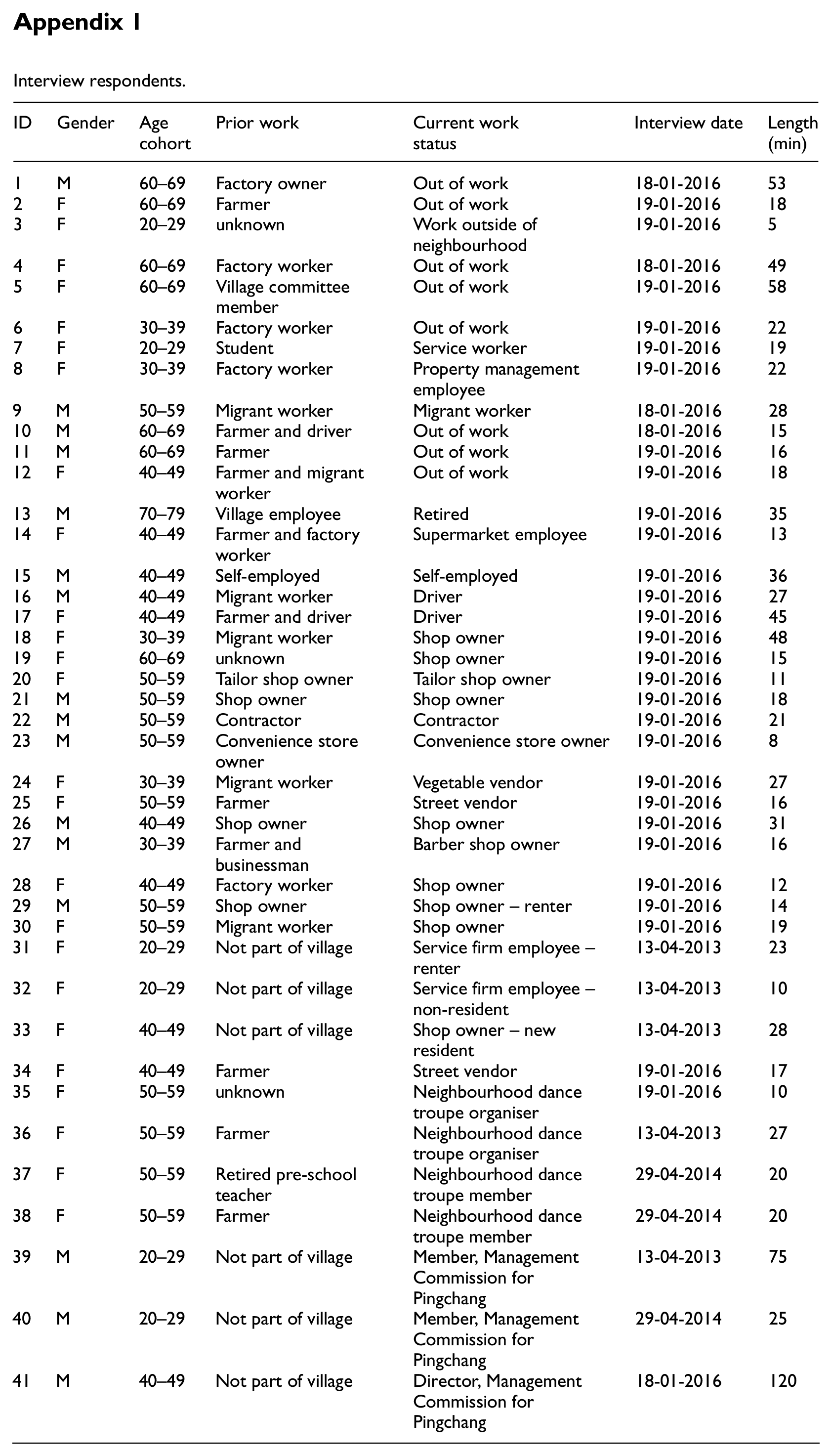
Our analysis is based on data drawn from surveys, in-depth interviews and field observations, conducted between July 2012 and January 2016. The first survey, with 100 valid respondents in July 2012, gathered information on resettled residents’ housing conditions, family structure, lifestyle before and after resettlement, and feelings about the new living environment. The second survey, in May 2014, allowed us to collect information on residents’ social interactions and associated spatial distribution, in addition to data on family, lifestyle and feelings of satisfaction, through 154 valid responses. Analysis on housing environment and lifestyle draws from both surveys. To better make sense of the survey data, we conducted a series of in-person interviews in April 2013, April 2014 and January 2016, focusing on the process of resettlement as well as residents’ spatial behaviour and their use of public spaces. Interviewed for 20 to 75 minutes each, the respondents included three neighbourhood committee officials, 36 resettled residents, and four other residents/tenants (for details, see Appendix 1). In January 2016, we convened a focus group of officials at the township and neighbourhood levels as well as neighbourhood representatives, for three hours, to discuss the resettlement process and management issues. In addition, non-participant observations took place in April 2013 and April 2014 as well as January 2016, at key neighbourhood venues including the central plaza, community centres and commercial areas, during afternoon and evening times when the use of such venues was at higher levels. Earlier observations pointed to a number of characteristic practices by residents, in both modification of existing space and creation of new space. Our understanding of such practices was then confirmed and substantiated through in-depth interviews with residents and focus-group meetings with neighbourhood officials. There were of course other behaviours drawing our attention (e.g. neighbourhood sanitation); because they did not reflect spatial agency, we chose not to include them in the analysis.
Agency in the social construction of space
To answer our questions about agency of resettled rural residents in China, we encounter a condition in which change in the spatial situation intersects with their habitus. Both directly impact multiple aspects of their daily routines: access to urban and public services, nature of community space, network of social interactions, and lifestyle preferences. The seminal work of Giddens and Bourdieu helps us understand the reflexive relationship between space and social action (Gotham, 2003). In particular, Bourdieu’s theoretical framework, using the concepts habitus and ‘field’, highlights and explains the spatial and temporal attributes of agency and structure. The creation of habitus – the ‘ensemble of dispositions’ that orient action and perception – occurs when people form specific codes of spatial performance through social situations (Bourdieu, 1977, 1989). Further still, the ‘habitus of the disposed’ is typified by ‘flexibility, pragmatism, negotiation, as well as constant struggle for survival and self-development’, according to research situated in informal settlements (Bayat, 2007: 579). This is relevant to the resettled villagers in our study, as their change in spatial situation also is accompanied by a loss of control over means of livelihood. As conceived by Spivak (1988) and echoed by Herndl and Licona (2007), agency is both a conscious formation of one’s identity and a positioning of oneself in the public sphere. It is dispersed and ever shifting in time and space, with constrained agency emerging at the intersection of agentive opportunities and regulatory power of authority (Herndl and Licona, 2007). Moreover, space is a fundamental component of one’s identity, with residents often feeling as if they belong to a particular place or piece of land (Fried, 2000). This is in part because physical space is also social space, where social activities, perceptions and constructions are created, contributing significantly to the sense of belonging (Nasongkhla and Sintusingha, 2013).
A fruitful point of inquiry to help conceptualise our study is investigating how disadvantaged citizens similar to China’s resettled residents, such as those living in particular neighbourhoods out of necessity (e.g. residents of public housing), find ways of exercising agency to some effect under circumstances in which their capacity and resources are constrained. For instance, in examining distressed neighbourhoods in Barcelona, Boston and Havana, Anguelovski (2013) shows activists in all three cities have developed parks, community gardens, playgrounds and urban farms to reconnect with land and space, as well as rebuild a broader sense of community where fear and sorrow emerged. All struggled to gain control of decision-making power in the face of abandonment or hostility on the part of various levels of government, ultimately succeeding in significantly changing how space-based development takes place.
Articulating strategies of agency by disadvantaged residents, Gotham and Brumley (2002) have found three strategies for using space in ways that provide agency and identity within public housing in the American South. The first strategy is the creation of ‘safe spaces’, areas such as courtyards, doorways and porches that are designated for interacting with other residents without straying too far from their own homes, often with certain individuals taking on the role of being monitors of activities in these places. The second is the demarcation of ‘hot spaces’ or ‘hot streets’ that are known to be havens of crime or drug use. These spaces are avoided and marginalised by residents. The third is the use of language as a means of affirming or rejecting the public housing project in which residents live. Some residents embrace the identity of their neighbourhood, or even seek to be someone representing the community, while others distance themselves from the places in which they live as they dissociate their life from the stereotype of public housing. These strategies have sprung up over time as residents find themselves in conflict with the local housing authority, given their perceptions of the authority failing to provide proper upkeep and maintenance of deteriorating spaces that attract drug dealing and other crime (Gotham and Brumley, 2002).
Even commonplace, routine acts can constitute agency to the effect that they allow residents to lay their own claim to spatial territory, as shown in Lelandais’ study (2014) of residents facing eviction from two neighbourhoods slated to be redeveloped in Istanbul, Turkey. Residents overcome the bad reputation of their neighbourhoods – largely a result of characterisation by the government – via the creation of a vision and living space that is rather different. This includes concerts, plays, feasts, festivals, courses of study and religious worship outside the government’s preferred religions and sects. These events and practices generate a continuous sense of identity among residents, and connect their identity with the place in which they live (Lelandais, 2014). Such routine acts, particularly as associated with where home used to be, also are common among immigrant populations. Often, they create what Wiles (2008) calls ‘nostalgic illusions’ of customs and relationships from home.
Under China’s rapid urbanisation, scholars have begun to uncover strategies by rural residents facing resettlement, to claim agency over their land and housing situation, aside from widely reported protests. These efforts have taken place before, during and after the resettlement process, through constructing informal housing as a means of driving up acquisition costs paid by local governments and securing rental income from migrants living in such housing. Moreover, some residents have banded together to request the right to develop a new housing development of their own, both for their future housing after displacement and as an investment. With this right granted, rural collective compensation funds have been used to pay for part of construction, enabling members to secure units at a reduced price (Song, 2014, 2015). In a study situated in a similar context to our research, Li et al. (2016) show a range of actions to transform new living spaces to enable the continuation of old customs and rituals, in a resettled community in Beijing. Moved from traditional, courtyard housing into modern residences significantly different from anything the farmers find familiar, they have converted new residential space based upon their living, communication and ceremonial requirements over the course of several years. Theoretically, however, such actions of demanding better housing or usable space represent a process of unpredictable bargaining rather than a claim to ‘the right to the city’ (Qian and He, 2012). They also can be characterised as interest-group politics, falling short of challenging the power relations and institutional practices at work (Shih, 2010).
While such studies on spatial agency of resettled rural residents in China are limited, the experience of other groups is illustrative. The first coming to mind is residents and migrants in the so-called ‘urban villages’ (chengzhongcun), transitional space that is part urban and part rural. Although located physically within the city, the local peasant residents of chengzhongcun have rural hukou status. By virtue of this status, they have rights to homestead land and often expand their homes or build additional structures to rent out to migrants. In some such villages, the best-known being Zhejiang Village in Beijing, migrants with more economic and social capital would then invest in the development of large, private housing compounds as well as commercial market places. Deemed undesirable by local governments, such developments have become cases of intense struggle over housing and the use of urban space by migrants (Xiang, 2000; Zhang, 2001, 2002). Similar practices prevailed in the so-called ‘Little Hubei’ in Guangzhou, where migrants deploy agency in their daily practice, including the massive development of small-scale and informal garment production (Liu et al., 2015b). Thus, ‘urban villages’ furnish a transitionary or entrance point to modern, urban life, with noteworthy spatial agency for existing residents and migrants alike. In the meantime, their identities in ‘urban villages’ are ‘at best only partially urbanized’, preserving customs of the rural spaces with which they are familiar (He, 2013).
It must be noted, however, that there is marked distinction in the property rights regime in ‘urban villages’, as opposed to the case of resettled residents in our research. For the latter, they have lost their homestead land previously allocated by village collectives, in turn foregoing the autonomy in constructing and monetising (e.g. by renting to migrants) their own housing and residential space. Relocating to the new neighbourhood has brought them into the urban system in which land is state owned and the property rights regime is formalised. Their spatial routines also are managed by both neighbourhood committee and property management personnel. By contrast, in ‘urban villages’, residents’ actions could be described as a ‘counterplot’ against the state and an exercise of ‘illegal’ rights, albeit with a degree of acceptance by local authorities as a means of pacifying unrest (Liu et al., 2012). These places often maintain governance with a significant degree of separation from the regulations and planning of the wider urban area in which they are situated (He, 2013). As such, the rental market, as well as the overdevelopment of public space therein, provides housing for migrants and income for residents, but engenders a deterioration of the living environment and a relative lack of public services. Nonetheless, local spatial freedom provides residents in ‘urban villages’ with ‘space to manoeuver’, helping them resist top-down pressure of urban expansion (Song, 2015).
The multiple strands of literature clearly point to the exercise of agency by disadvantaged groups, both within and outside of China. In organisation of such practice in residential environments, the privileged place of action is the neighbourhood, via the practices and customs of everyday life (e.g. rituals, habits and alternative lifestyles). This way, space and identity become deeply connected, and agency becomes a way for residents to reclaim the right to have a place in the city and to preserve their life space (Lelandais, 2014). Given the top-down nature of resettlement in China, planned elements dominate the new residential environment. These are in the form of both physical space (e.g. community centres) and social space (e.g. neighbourhood governance structure). In what ways do resettled rural residents exercise agency in attempting to maintain continuity and recreate pieces of the life they lived before? What are strategies employed by residents on a routine basis? Our analysis next will provide new insight on these questions, demonstrating both the role of institutional restraints the residents face and their reconstruction of space within a more formalised system of property rights. This serves as a microcosm of the process of negotiating ones’ spatial autonomy in an increasingly large number of planned resettlement communities under China’s integrated rural–urban development.
Reconfigured spatial situation in Pingchang New City
Both the physical layout and residential environment in Pingchang New City underwent substantial changes during the rural–urban transition. Density, of population and buildings, became higher. Formerly scattered natural village houses disappeared, and up to 50,000 resettled residents from around the city were then housed in multistorey apartment buildings (see Figure 1). There are five community areas in the neighbourhood, delineated by streets. A central plaza and an activity centre are located in the centre, with commercial establishments, exercise and recreational facilities, and schools. In addition, each community area has a recreational open space, a community centre, and some commercial space for leasing.

Illustration of change in residential patterns in Pingchang New City (authors’ own compilation).
On the governance side, a transition also took place, from rural to urban framework. The rural village structure before resettlement gave away to a duo of urban entities: neighbourhood committee and property management company. The former is a direct extension of the state apparatus, while the latter is non-state and in charge of maintenance of residential facilities. The governance system in place in Pingchang New City also builds on some traditional rural practices. Based on recommendations of the previous township governments, residents of every 100 households would select a representative and every 500 households a selectman. A key responsibility of these representatives (about 60 of them) is to facilitate two-way communications between residents and the neighbourhood committee and property management company. They also help organise neighbourhood-wide activities, such as recreational events.
Though governance at the neighbourhood level remains the purview of the state, it has become increasingly service oriented. Neighbourhood committee and property management personnel now provide a range of material support – a feature commonly associated with urban living environment, including collecting complaints about neighbourhood services, facilitating welfare programmes (e.g. for the elderly), organising recreational activities, mediating disputes among residents, and sometimes carrying out neighbourhood-watch programmes. However, some elements of social control remain; for example, the neighbourhood committee maintain household registration records, as well as facilitating the permitting process of rental housing.
A major change associated with resettlement has to do with how much control residents have over the configuration of space. Their previous rural living involved an organic pattern of settlement, in which farmers expanded their housing footprint over time. They also had control over the use of their homestead land (assigned by the rural collective), and often rented out extra space to migrant workers. But after resettlement, the physical environment is more policed, and spontaneous building is no longer tolerated given the state ownership of urban land. With the newly installed system of property management, residents have gradually become more cognisant of rules that regulate neighbourhood public space and sanitation.
On the surface, resettled residents were by and large happy with physical elements of the new residential environment, according to our survey results. More than half of them expressed satisfaction with housing conditions and transportation services (see Figure 2). Residents, however, were less than satisfied about a range of issues, most of which went beyond the physical elements. Rather, they had much to do with residents’ perception of the new environment, including sense of security, convenience to different facilities, and nostalgia for previous social connections. Despite better provision of services and facilities, the resettlement neighbourhood remained an isolated development amid vacant, farm land. With quite some distance from the city centre, residents continued to find it inconvenient to shop or secure satisfactory employment (see Figure 3). Close to half actually perceived their current employment opportunities the same as before, while those with low levels of education and work skills even observed reduced opportunities. More importantly, about one-fifth of surveyed residents missed their relatives or old neighbours.
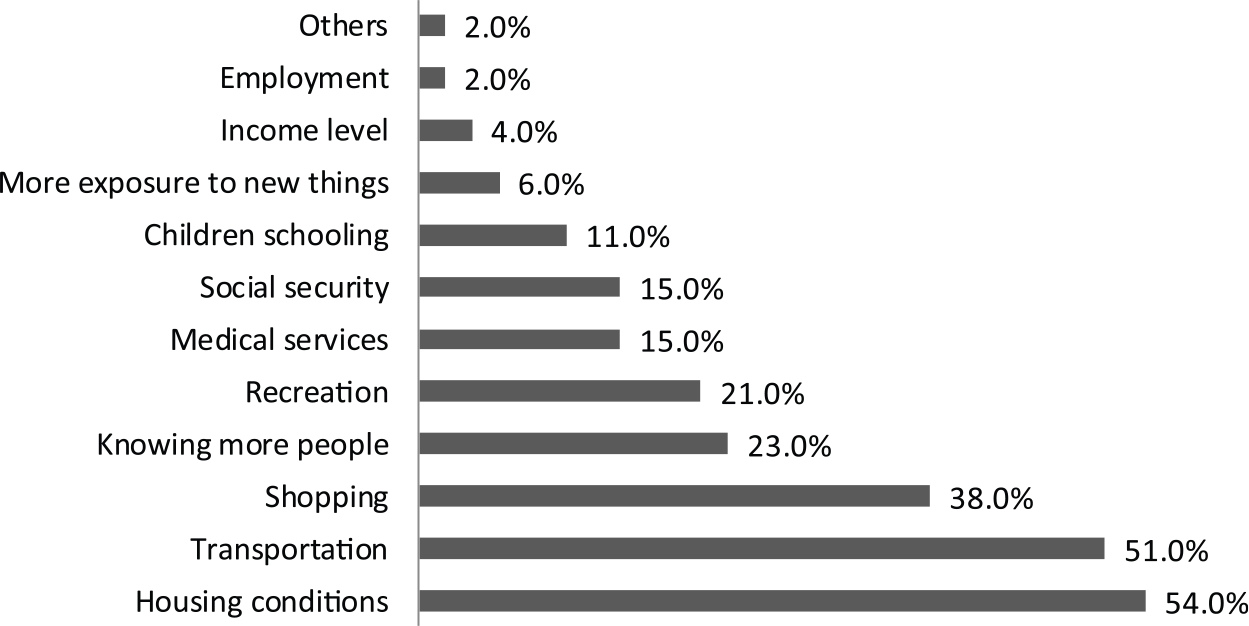
Major areas of improvement perceived by resettled residents.

Major areas of dissatisfaction perceived by resettled residents.
Moving to a residential environment with urban characteristics also brought with it changes in residents’ lifestyle. First, the consumption space of daily staples gradually moved from open-air food markets (about 60% used them before resettlement) to supermarkets (close to 70% reported so). More than half of the respondents also reported spending more time shopping. Second, residents were getting out of their homes more often (about 50% of respondents) for recreational purposes, taking advantage of open spaces in the new neighbourhood.
Acceptance, however, is only one part of this interactive process. While acquiescing to new norms, residents chose to deploy space in a number of creative ways. Some rural practices also remained, even when the new urban environment provided no explicit space to accommodate them. There was a cognitive distance between the physical and social space, because residents’ routine practices and perceptions had yet to match up with spatial configuration dictated by top-down planning. Their spatial agency was manifested primarily in two broad categories: adaptation of existing space and creation of new space.
Public and communal space became the intersection of top-down planning and bottom-up agency, as discussed in the next two sections. The authority to allocate land for non-residential uses naturally stayed with planners, with little public input. Five types of venue for public and commercial use were built in the neighbourhood (see Figure 4), with their general use patterns drawn from our survey in 2014 and observations:
Central plaza: for gathering (e.g. lighted ball courts and fountain). Moderate usage by residents, particularly during evenings and weekends. Elderly residents also brought their own stools to chat and play games in groups.
Neighborhood centre: four-storey building with banks, a food market, a supermarket, eateries, stores for consumer products, KTV, and a movie theatre. Except for the food market, most was scantly visited and only by younger residents.
Community centre: with activity rooms for games, table tennis, books, and children, open for fixed hours. Scantly used.
Commercial space: eateries and convenience stores. Used frequently, and operated mostly by resettled residents. Currently insufficient space with more planned.
Recreational open space: with rudimentary exercise equipment, frequently used and particularly in evenings.
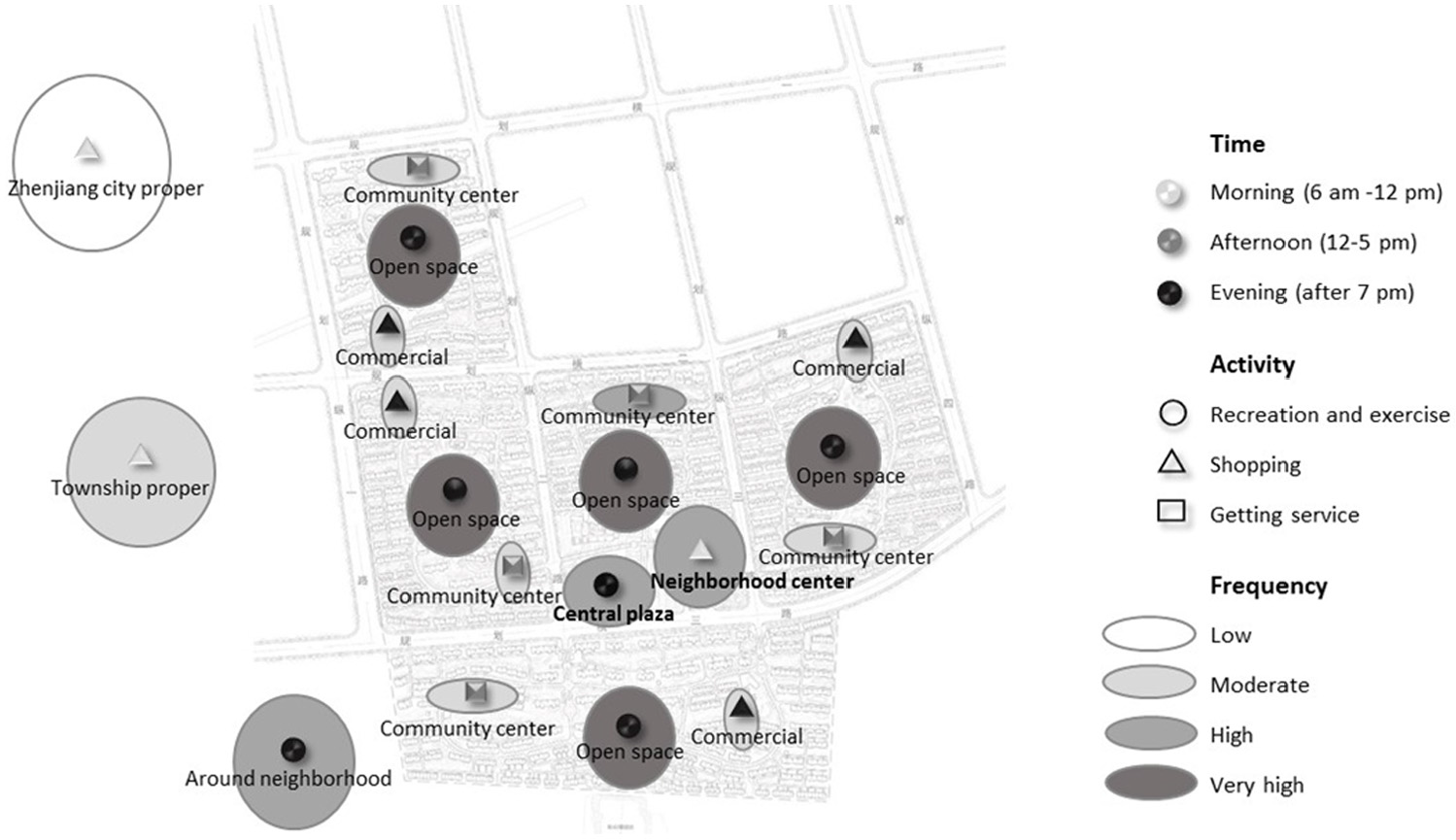
Timing and frequency of use of public and communal spaces.
Adaptation of existing space
Being uprooted suddenly from their traditional homes was unsettling, as one resident put it: ‘during the first few days in the new neighbourhood, we could not even sleep. Missing our old homes, not knowing what’s to come’ (interview with resident #8, 29 April 2014). Before long, bottom-up spatial reconfiguration began, gradually redefining how planners had planned the neighbourhood. A key form is agency through routine acts, mostly affected by habitus, as associated with how home used to be, to provide a continuous sense of identity among residents. When changed spatial situation interfered with routine activities, residents turned to adaptation. Three elements of such routine acts came to fore. These demonstrated how resettled villagers perceived the new spatial situations around them and reacted to it under their habitas, which had been shaped by their rural life experience and now allowed them to find ways to cope with new situations without calculated deliberation (Bourdieu, 1987).
First, hanging quilts to air out in the sun (see Figure 5). Common everywhere in China, this practice stems from the perception that UV rays in sunlight are a natural disinfectant. In their rural homes, residents simply did so in their own courtyards. In the absence of such private space in the new neighbourhood, they resorted to ‘invading’ public space. Even though doing so prevented the use of outdoor exercise equipment and benches from time to time, residents felt this was understandable and actually coordinated among themselves by taking turns. Neighbourhood officials also took a conciliatory stance:
In principle, this is not allowed, especially along key paths. But in reality, residents have real need for doing so. Therefore we have made compromises. As long as no trees or equipment is damaged, we do not intervene. (Focus group, January 2016)
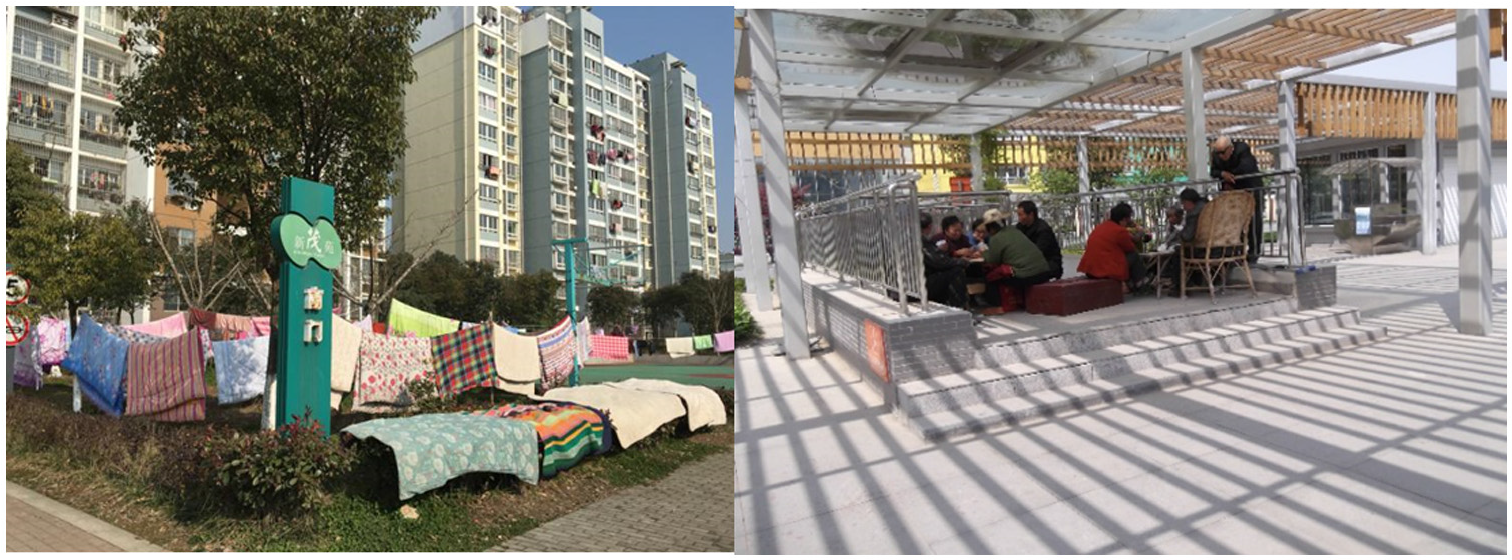
Adaptation of communal space.
Second, using communal space as residents’ own ‘living room’. Moving from a courtyard-style, rural home to apartment housing meant substantial reduction in living space. The former contained, at its centre, a gathering area for family and friends, often semi-open in warm places such as Zhenjiang. This was no longer present in the new living environment. What could be the substitute – a question that generated varied answers. Some residents used the area immediately outside of their apartment building entrance to gather with neighbours and friends. More gravitated towards communal space. They would bring their own stools, since the original design could not accommodate as many residents (see Figure 5). Chatting with friends, playing chess or poker, or engaging in other small group activities. The most active users were the elderly, particularly during daytime.
A third form of adaptation, holding funeral and wedding ceremonies, was more complex. A long tradition in rural China, events related to birth and death are important signs of a family’s social position. Most family ceremonies now take place in restaurants, such as wedding and birth celebrations. But regarded as taboo to be held in public, funeral ceremonies remain confined to home space. Before resettlements, residents in our study did so in their own courtyards by setting up funeral sheds for a wake and gathering. There would be a meal for people coming to pay condolences, as well as some singing. But the spatial situation changed in the new environment. At first, neighbourhood officials came up with an idea: renting out commercial space for this purpose where a use fee would be levied. This allowed for the continuation of traditional practice:
It was easier to host funeral and wedding events before, but now there is no designated space. Yet tradition cannot be changed, definitely not. We have to compromise: space can be altered, but not tradition. (Interview with official #1, 13 April 2013)
This arrangement, however, proved to be less fitting with the new living environment. A number of factors were at work. Residents resented using the same space for wedding celebrations after funerals had been held. Then, immediate neighbours disliked funeral ceremonies being held close by on a regular basis. In addition, even residents organising the events found it inconvenient to shuttle between the memorial hall in their own apartment and the ceremonial space. In the end, residents resorted to setting up sheds for funeral activities in nearby parking space or spare space. Although this might pose some disturbance, residents seemed to be comfortable with the practice. A mutual understanding also formed between residents and neighbourhood officials with very little intervention by the latter. For elderly residents, funeral ceremonies, especially the singing and paying condolence aspects, actually became a venue for socialising. According to a neighbourhood representative in the focus group conducted in January 2016, ‘back in the village, only 20–30 people showed up at a typical ceremony. Now, up to a hundred. For the elderly, it is a pastime and occasion to catch up with old acquaintances’.
Clearly, residents turned these neighbourhood places into their own space for everyday life. They adapted the space to their own needs and made their daily experience more pertinent. Such spatial practice was more or less absent in the original design of the neighbourhood. This form of agency, in our view, is quite benign as it does not present interference with the prescribed spatial configuration of the neighbourhood. In addition, it actually adds more rhythm and liveliness to the use of communal space. Mornings would be characterised by exercise activities, and neighbourhood dancing troupes practicing and performing in the evenings. As shown in Figure 4, recreational open space in each community area saw a high level of use, particularly in the evening.
Creation of new space
In addition to adaptation of existing space, residents resorted to a more assertive form of agency – the creation of new space and use – when more urgent needs arose. Accessory uses of housing units and residential space were a main example, such as operating barber shops, small convenience stores and other home-based businesses (see Figure 6 – signs indicating the sale of cooked food). The driving force was economic livelihood. Under habitus, residents instinctively resorted to spatial strategies to resolve livelihood challenges, including turning residential quarters into business space and taking over communal space for private commerce. Housing rental, home-based business, and street vending were commonplace when they were villagers (and for rural residents in general). A sizeable number of residents interviewed, however, were out of work after resettlement (see Appendix 1). For residents with relevant educational and business experience, proximity to the Zhenjiang city proper was advantageous in finding gainful employment (close to 32% of surveyed residents reporting so). But many older residents, having lost their land, found themselves short of income and income-generating opportunities (about 24%):
When we were peasants, we had some related side business. Now that we do not have land to farm, we lost our business too as well as storage space. All we can rely on is basic pension payments. (Interview with resident #10, 19 January 2016) We have seen reduced financial ability and social capital. We do not have employment. Life is more comfortable, but income is gone. (Interview with resident #12, 19 January2016) We are resettled residents and no longer have income sources. Where can we go to open up new businesses? The rent for commercial space here is very expensive. A lot of small stores have started, as long as they are not a nuisance to neighbours. (Interview with resident #27, 19 January2016)

Examples of accessary use on the ground floor.
Home-based, small businesses sprang up also because resettled residents had spare space and most of their old customers were still around. While the physical environment changed, the social network and lifestyle choice from the past remained. There is evidence elsewhere that the nature and types of social interaction differ between urban and rural settings: a rural social interaction model may require more inter-personal dependency because of geographical isolation, often resulting in exchanges for goods and personal services. As a consequence, rural residents are thought to have stronger inter-personal relationships (Hoffreth and Iceland, 2011; Stumpf, 2012). Older residents in Pingchang New City especially welcomed small businesses operated by neighbours because of the convenience they offered:
We don’t mind going to the shopping centre to buy large appliances. But for everyday items, such as salt and soy sauce, we would rather go to small convenience stores close by. (Interview with resident #2, 19 January 2016)
Community personnel, however, were less supportive, given nearly all of such small businesses were unlicensed. While operating in private space, they would generate spill-over effect onto neighbours (e.g. noise, foot traffic). In addition, there was the public perception of order. But there was no quick fix, as the accessary uses were spontaneous and widespread:
We cannot allow this to continue, definitely not. For one thing, they are paying residential price for water and electricity, but using them for commercial activities. Also, who is going to ensure health standards? Liabilities? Gradually we will ban all such accessary uses, and coordination with other government offices is needed. The timing is not right yet, but our principle will not change. (Interview with official #1, 13 April 2013)
Fundamentally, there was a cognitive distance between the planners and residents, which on a larger scale reflects the complex process of rural–urban transition. In genereal, rural and urban communities have important distinction (Amin and Thrift, 2002; Hazelzet and Wissink, 2012; Young, 2010). Livelihood for rural residents depends on land and whatever accessary income can be generated without leaving the land. By contrast, urban living relies on cash income, from either formal employment or other income-generating activities. In addition, while contemporary urban consumption tends to centre around shopping centres, rural residents rely more on small vendors and businesses with whom they have interacted over time. The cognitive distance, at the planning stage for Pingchang New City, resulted in a shortage of commercial space, particularly for small businesses and locations closer to residents. Such space was all slated in the neighbourhood centre, a design based on a more contemporary planning idea separating various uses in urban areas. There was limited ground-floor space planned for business activities along the main thoroughfares. It also was very expensive to lease space designated as store fronts.
Residents’ persistent agency thus started a process of conditional accommodation by authorities, especially around how to meet the demand for breakfast eateries. A dearth of such space was planned. Residents took the problem into their hands, setting up multiple vendors around the neighbourhood entrance area. (Some vendors came from outside.) Traffic congestion ensued. Neighbourhood and township authorities cleared away the vendors immediately. But the vendors kept coming back, posing a clear challenge to authorities. As a compromise, vendors would be allowed to operate before 8 am along the eastern edge of the neighbourhood. While temporary in nature, given that more commercial space was to be built later, the measure was in no small ways an affirmation of agency and its effect. A neighbourhood official ruminated:
In principle, we could have done more. But overreaction may lead to discontent en masse. We need to be more flexible; it cannot be everything is against the rule … It will take time to convince residents to adapt to the new, urban environment. If we can provide more convenient infrastructure and services, such adaptation will be more likely. (Interview with official #1, 13 April 2013)
The creation of accessary uses, to some extent, rested upon a kind of regulatory vacuum in local planning. Unlike in other planning cultures (e.g. the USA) where uses other than those granted as of right are regulated through municipal ordinances (e.g. zoning ordinance), the so-called ‘unlawful’ uses and construction in Chinese cities are largely left to administrative oversight. Thus the room for negotiation and compromise. The willingness of neighbourhood officials in Pingchang New City to accommodate is on the one hand a sign of pragmatism; on the other hand, it stems from the pervasiveness of residents’ actions and agency.
Aside from accessory uses, street vendors also sprung up along neighbourhood streets and near apartment building entrance areas (see Figure 7). Again, this stemmed from the need to generate more income for some residents. Because the streets were designed solely for travel use, the vendors created conflicts. Neighbourhood officials intervened, eventually settling on a narrow time frame when such activities would be allowed:
Earlier on we could put up stalls all day long. But now we could not, and officials would not allow it. On top of that, business was slow during the day time. So we now only sell between four and seven in the late afternoon. (Interview with resident #25, 19 January 2016)

Street vendors in the neighbourhood
Discussion and conclusion
Through an in-depth and nuanced analysis, our study has brought to light challenges, especially for planners and decision-makers, in China’s rural–urban transition. Wholesale style of resettlement to new urban neighbourhoods has long been the common practice. This overlooks residents’ cultural and social traditions, as well as livelihood hardship brought on by leaving the land. While acquiescing to new norms, residents in our study have deployed the space to continue some forms of traditional lifestyle. Such adaptation inevitably creates friction with neighbourhood officials. While residents value planned community spaces, they also show preferences to maintain some continuity from the rural tradition. Demonstrating a desire to begin taking charge of their own space, residents are essentially in the process of reproducing their living environment, initially shaped through a top-down planning process with little of their input.
Theoretically, our analysis builds upon the concept of habitus, which is the pattern and practice of thoughts resettled residents acquired during their rural lives. While continuous in nature, habitus requires a supportive environment. We have pointed to the importance of understanding how the shifting institution of property rights affects the maintenance of habitus. Having foregone the autonomy in managing and monetising their rural housing and residential space, resettled residents confront a land ownership and regulatory regime that is based on formalised state control. As such, what we have witnessed is an interactive process in which residents navigate their agency by both adapting existing space and creating new space, without seriously challenging the imbalance of power relation with authority.
While using the concept of habitus, we emphasise its role in regulating residents’ reactions to change, particularly in the context of shifting institutions and environment as a result of resettlement. According to Bourdieu (1987), habitus is both structured by an individual’s objective past position in social construction and structuring the individual’s future life path. Our study clearly points to such dynamics, moving beyond findings by similar research (e.g. Li et al., 2016) that shows either inadaptability to new spatial situation or spontaneous spatial transformation, a state of passivity. We show that agency has been in play, allowing residents to actively adapt and to some degree resist top-down directives. Moreover, the adaptation of existing space and creation of new space are not merely spatial strategies; they refashion residents’ lifestyles, and hence help reconstruct social relations (e.g. where and how to engage in social interactions).
A driving force in the exercise of agency to create social space may have to do with a sense of loss that occurred as residents transitioned from rural to urban lifestyle. Traditional rural housing was more conducive to spontaneous visits by neighbours and friends because of the open, courtyard design. Multi-unit apartment buildings with main entrances at the ground level fundamentally change the dynamics. Now, residents need to call ahead to arrange for visits; once inside the apartment, they need to change into indoor shoes to keep dust down. Becoming less and less willing to follow such rules, they begin gravitating towards recreational open space as substitute venues for social interactions. But such substitution is not ideal. Physical space also is social space: the more open the space, the less intimate the interaction.
The limit of such substitution also plays out in a different fashion for younger residents. Recreational open space, in their views, cater to middle-aged residents dancing, older residents playing card games, or children running around. It has little appeal to them. According to one youngster, they would rather ‘stay home watching TV than going to the neighbourhood or community centre’ (interview with resident #3, 19 January 2016). For them, social interactions have expanded beyond the neighbourhood. Our analysis elsewhere shows that younger residents appear to have the broadest social network that is also more expansive spatially and higher in frequency of interactions (Zhang et al., 2017). Most markedly, for those aged 20 to 39, they are more likely reaching out to workplace friends; such relations tend to take place outside of the neighbourhood. This inclination may stem from their weaker connection with farming and rural lifestyle – they identify more with jobs off the land, which gives them an entry into a work-based social network beyond traditional rural relations based on kinship.
Perhaps with the exception of the youngsters, what residents in Pingchang New City have done amounts to an attempt to create a ‘village in the city’ in their reconfigured spatial situation. Driving this is a multitude of factors: quest for economic wellbeing, desire to maintain pertinent traditions, and need for social interactions. Each of these carries an element of habitus, formed through their rural lives: attachment to their land for livelihood and to time-honoured familial traditions, and interpersonal relationships based on mutual benefit-sharing. Resettlement has taken the land from them, but it could not take the farmer out of them. Being relocated en masse has indeed helped preserve their social networks to some degree: during our second survey in May 2014 (almost four years after resettlement ), more than half of the residents reported connecting with old friends and neighbours with similar frequency as in the past, and almost on par with their interactions with new neighbours and friends.
We believe that this social fabric and mutual benefit-sharing have provided the foundation on which residents exercise agency in spatial adaptation and transformation, in order to create a sense of normalcy or even to recreate village life. There are multiple conflicts with the new living environment planned and built with top-down conceptions of what urban neighbourhoods should be like. Their agency has been centred around how public and semi-public spaces are used. In particular, the loss of control over means of livelihood for landless farmers proves to be a strong collective motivation to regain some autonomy. The more assertive forms of agency are the products of this: adding accessary uses to operate home-based businesses and invading street space to set up small vendors.
What has ensued is a process of compromise and accommodation between residents and neighbourhood officials, despite the imbalance of power between the two. While acquiescing to new rules imposed by authority that regulate the neighbourhood environment, such as sanitation and building standards, residents have adapted communal space to their own needs. On the other hand, much in contrast to the draconian style of social control that local officials practiced in the past, they have largely tolerated the creative ways in which residents consume the space even when such uses could have been deterred. So we see small shops dotting ground-floor apartments, make-shift vendors on neighbourhood streets, and traditional funeral ceremonies in parking lots. Such accommodation may be a sign of pragmatism on the part of authorities, but it also demonstrates the possibility of agency within a larger framework of top-down planning.
This, however, may be constrained in its long-term effect. Without a fundamental shift in their social status, resettled residents are limited in their positional properties. Most if not all of their claiming of agency over public space has been small in scale, dispersed in scope, and incremental in process. For them, it is an important coping mechanism in the face of involuntary change, instead of a quest for reshaping the balance of power with authority. The experience of resettled residents in Zhenjiang offers a microcosm of the increasing awareness and practice of agency by ordinary citizens. Their claim of lost livelihood, as landless farmers, seems to be the key to gaining sympathy of officials and, subsequently, compromise. This, although not unheard of, points to increased fluidity in relations between people and authority. Given that the fundamentals of neighbourhood governance remain unchanged – the prevalence of state control – such flexibility is needed so that consideration of residents’ need is integrated into the planning and management of resettled communities.
Footnotes
Appendix
Interview respondents.
| ID | Gender | Age cohort | Prior work | Current work status | Interview date | Length (min) |
|---|---|---|---|---|---|---|
| 1 | M | 60–69 | Factory owner | Out of work | 18-01-2016 | 53 |
| 2 | F | 60–69 | Farmer | Out of work | 19-01-2016 | 18 |
| 3 | F | 20–29 | unknown | Work outside of neighbourhood | 19-01-2016 | 5 |
| 4 | F | 60–69 | Factory worker | Out of work | 18-01-2016 | 49 |
| 5 | F | 60–69 | Village committee member | Out of work | 19-01-2016 | 58 |
| 6 | F | 30–39 | Factory worker | Out of work | 19-01-2016 | 22 |
| 7 | F | 20–29 | Student | Service worker | 19-01-2016 | 19 |
| 8 | F | 30–39 | Factory worker | Property management employee | 19-01-2016 | 22 |
| 9 | M | 50–59 | Migrant worker | Migrant worker | 18-01-2016 | 28 |
| 10 | M | 60–69 | Farmer and driver | Out of work | 18-01-2016 | 15 |
| 11 | M | 60–69 | Farmer | Out of work | 19-01-2016 | 16 |
| 12 | F | 40–49 | Farmer and migrant worker | Out of work | 19-01-2016 | 18 |
| 13 | M | 70–79 | Village employee | Retired | 19-01-2016 | 35 |
| 14 | F | 40–49 | Farmer and factory worker | Supermarket employee | 19-01-2016 | 13 |
| 15 | M | 40–49 | Self-employed | Self-employed | 19-01-2016 | 36 |
| 16 | M | 40–49 | Migrant worker | Driver | 19-01-2016 | 27 |
| 17 | F | 40–49 | Farmer and driver | Driver | 19-01-2016 | 45 |
| 18 | F | 30–39 | Migrant worker | Shop owner | 19-01-2016 | 48 |
| 19 | F | 60–69 | unknown | Shop owner | 19-01-2016 | 15 |
| 20 | F | 50–59 | Tailor shop owner | Tailor shop owner | 19-01-2016 | 11 |
| 21 | M | 50–59 | Shop owner | Shop owner | 19-01-2016 | 18 |
| 22 | M | 50–59 | Contractor | Contractor | 19-01-2016 | 21 |
| 23 | M | 50–59 | Convenience store owner | Convenience store owner | 19-01-2016 | 8 |
| 24 | F | 30–39 | Migrant worker | Vegetable vendor | 19-01-2016 | 27 |
| 25 | F | 50–59 | Farmer | Street vendor | 19-01-2016 | 16 |
| 26 | M | 40–49 | Shop owner | Shop owner | 19-01-2016 | 31 |
| 27 | M | 30–39 | Farmer and businessman | Barber shop owner | 19-01-2016 | 16 |
| 28 | F | 40–49 | Factory worker | Shop owner | 19-01-2016 | 12 |
| 29 | M | 50–59 | Shop owner | Shop owner – renter | 19-01-2016 | 14 |
| 30 | F | 50–59 | Migrant worker | Shop owner | 19-01-2016 | 19 |
| 31 | F | 20–29 | Not part of village | Service firm employee – renter | 13-04-2013 | 23 |
| 32 | F | 20–29 | Not part of village | Service firm employee – non-resident | 13-04-2013 | 10 |
| 33 | F | 40–49 | Not part of village | Shop owner – new resident | 13-04-2013 | 28 |
| 34 | F | 40–49 | Farmer | Street vendor | 19-01-2016 | 17 |
| 35 | F | 50–59 | unknown | Neighbourhood dance troupe organiser | 19-01-2016 | 10 |
| 36 | F | 50–59 | Farmer | Neighbourhood dance troupe organiser | 13-04-2013 | 27 |
| 37 | F | 50–59 | Retired pre-school teacher | Neighbourhood dance troupe member | 29-04-2014 | 20 |
| 38 | F | 50–59 | Farmer | Neighbourhood dance troupe member | 29-04-2014 | 20 |
| 39 | M | 20–29 | Not part of village | Member, Management Commission for Pingchang | 13-04-2013 | 75 |
| 40 | M | 20–29 | Not part of village | Member, Management Commission for Pingchang | 29-04-2014 | 25 |
| 41 | M | 40–49 | Not part of village | Director, Management Commission for Pingchang | 18-01-2016 | 120 |
Funding
Research conducted for this paper was partially funded by the National Natural Science Foundation of China (No. 41371150).