



Abstract
This paper investigates the urban redevelopment process under the ‘three old redevelopment’ policy in Guangzhou, China from 2009 to 2014. It highlights strongly shared interests between stakeholders’ institutions that match the core mechanism of the urban regime approach. The fragmented authoritarianism model is used to explain the origins of such regimes, using concepts such as institutional obstacles and small opportunities. In addition, comparisons are made between three types of places (the ‘three olds’ of towns, factories and village) that experience specific institutional difficulties. Through the ‘three old redevelopment’ policy, selective regimes are emerging in diverse ways to form new informal coalitions and realise potential land values, depending on the place and context in which it is applied. These selectivities can be explained by the analysis of a bias institutional ensemble which privileges some projects and some actors more than others in the ‘three old redevelopment’.
Introduction: The ‘three old redevelopment’ policy as a new mode in Guangzhou, China
Chinese cities are undergoing significant transformation in terms of land ownership, production and distribution models, industrial structure and decision-making system (Ma and Wu, 2005). Urban redevelopment, which has accelerated since the late 1980s, has played a key part in such urban changes because stricter regulation of land conversion in suburban space has brought urban development back to the inner cities (He et al., 2006). Research about the governance of urban redevelopment in China has addressed two main concerns: institutional background and governance mechanisms. As regards institutional background, ownership of land and housing are fragmented in the hands of various entities; land and properties have been commercialised during the process of marketilisation; such commercialising processes are controlled by the local authorities under a decentralising reform; and redevelopment is crucial to local authorities in terms of increasing land revenues and stimulating economic growth. Property rights of land in Chinese cities have been described as ambitious because they are economic rights (de facto rights) rather than legal rights. Potential values of land are open to competition between different agencies in urban redevelopment. The capacity to compete is relevant to the hierarchical position of agencies (He, 2007; Lai and Tang, 2016; Wu, 2002; Zhu, 2002). Based on this institutional background, local states and developers have formed a coalition to accelerate redevelopment by assembling fragmented property rights. The state has supported developers in terms of financial and administrative resources, beautification construction and infrastructure improvement to earn revenue through promoting the urban image and attracting investment. These improved images, and the increased amount of investment, may indicate excellent political performance for local leaders. This governance pattern with diverse styles, ranging from a cooperative mode to a self-governance mode, is a response to crisis and difficulties rather than a pre-designed blueprint (He and Wu, 2009; Lai et al, 2017; Lin et al., 2015; Wu, 2015; Zhang, 2002; Zhu, 1999).
These studies have built up a framework for understanding the urban redevelopment process over the last few decades. More recently, the ‘three old (old towns, old villages and old factories) redevelopment’ (TOR) policy emerging in Guangdong Province since 2009 represents a new phenomenon. A ‘shared-interest mechanism’ is emerging among different stakeholders. Compared with former urban redevelopment processes, Lin (2015) argues that the TOR aims to bring a fairer and more acceptable process by introducing institutional design. Schoon (2014) describes innovations in the TOR as an example of the Chinese experimental governance that is the core mechanism of China’s reform since 1978; this means doing an experiment in one place initially and spreading successful experience to other areas at a later stage. This paper will analyse the TOR in Guangzhou, the capital of Guangdong Province, from the perspective of an urban regime approach, which can reveal some new characteristics of the TOR policy. The regime approach will contribute to the analysis of some crucial elements of successful redevelopment, such as informal coalition, exchange resources and cross-boundary cooperation. These elements are initiated by the ‘shared-interests mechanism’ in the TOR. Actors from communities are empowered by this mechanism and included in coalitions of redevelopment; this is a new phenomenon. In contrast, this TOR case is not an ‘urban growth machine’ model because this model focuses more on inequality and conflict between pre-growth coalitions and involved residents, and between exchange value and use value (Logan and Molotch, 1987; Molotch, 1976). Without doubt, such inequalities and conflicts exist in Chinese cities. This paper is focusing more on cooperation rather than conflict between pro-growth coalitions and communities. It is more appropriate to employ the regime approach in analysing the recently established phenomenon of the TOR in Guangzhou. However, the urban regime approach presents some difficulties in analysing the Guangzhou case because of its problematic transferability (Painter, 1997). In order to resolve this issue, the fragmented authoritarianism model (Liberthal, 1992) and the strategic selectivity approach (Jessop, 2008), might be helpful. The fragmented authoritarianism model is a popular concept regarding Chinese politics. The authorities and resources are separated between different sectors in the government and between the state, market and communities. This model can help to explain origins of a regime according to local context; institutional resources for redevelopment are fragmented in various actors and an authoritarian style policy is the external force necessary to overcome such a fragmentation. The strategic selectivity approach is based on the understanding that the state is an ensemble of institutions; this ensemble may benefit some groups, some interests and some strategies more than others because of inherited institutions and the state’s accumulation strategies (Brenner, 2003; Jessop, 2008). This approach investigates the mechanism of selective regimes within the whole policy field. The urban regime approach has been applied to Chinese cases discussed later in this paper (Li and Li, 2011; Yang and Chang, 2007); this article aims to join this body of research and contribute to it in three ways:
This study emphasises the ‘shared-interest mechanism’, the ‘core element’ in the TOR, as the crucial condition to build regimes. Communities have more institutionalised bargaining power in this process to join the regime, an aspect that distinguishes the Guangzhou case from other Chinese cities.
Urban regime has emerged in some cases in the TOR to overcome institutional obstacles which are created by a fragmented authoritarian context in Guangzhou; this is the origin of regimes in Guangzhou. The external driving force to overcome fragmented institutional resources is initiated by the upper level state; this is an authoritarian manner of initiating institutional change. This origin of regimes is new.
This case of an emerging urban regime in Guangzhou can be characterised as selective regimes: the formation of regimes is strategically selected by the function of an institutional ensemble. This ensemble can affect the interaction inside the local state and among the state, the market and communities. This is a different way to analyse dynamics of regime.
This research is based on data collected from two instances of fieldwork. The first was conducted between October 2013 and January 2014 in Guangzhou, and the second was conducted in June 2015. In both instances, semi-structured interviews were utilised (35 people in diverse employment roles, such as urban planners, officers in government, developers and villagers in redeveloping projects), along with participant observation as an urban planner from 2010 to 2012. Secondary data were collected from governmental documents, the media, research reports and dissertations. Two additional online interviews were carried out in September 2016 to provide additional details.
The urban regime approach: Origin, application and transferability
The urban regime approach emerged in the 1980s and is rooted in the institutional context of US cities. This context implies that the success of local government is mainly evaluated by economic development, and this development depends heavily on local business in terms of economic growth and tax base. Governmental authority is greatly limited by the Constitution, national political ideology and the traditional autonomy of private business in terms of possessing and mobilising resources. Therefore, if the local authorities aim to pursue economic growth, coordination with private sectors are essential. Because formal connections between public and private sectors are weak, informal but stable ones become crucial. Furthermore, long-term trust, flexibility and accessibility to institutional resources in informal coordination have empowered the involved actors. Selective incentives, such as contracts, employment and infrastructure, are distributed among different actors in a regime; this is the core strategy for participants to benefit from each other and overcome the free rider problem. Through this strategy, a regime distributes resources and structures models of interaction, to realise ‘small opportunities’ which cannot be grasped without cross-boundary cooperation in a regime (Mossberger and Stoker, 2001; Painter, 1997; Stone, 1989, 1993, 2014).
An urban regime approach changes the research focus from ‘social control’ to ‘social production’ based on a turn in the understanding of power from ‘power over’ to ‘power to’. In other words, the achievement of common goals becomes more important than who can be dominant; this is based on changed essence of power from a hierarchical order to a cooperative order between interdependent actors (Stoker, 1995). These characteristics may reflect urban transformation at this stage to promote a market-oriented or a neoliberal society. The urban regime approach has been applied to different cities on a worldwide scale. However, many scholars have questioned its transferability because of its American origins (Kantor et al., 1997). For instance, Mossberger and Stoker (2001) summarise the conditions for the existence of a regime in the USA, which cannot be satisfied in European cities. Davies (2003) argues that British cities establish coalitions between public and private sectors because of a requirement from central government as opposed to their own demands; therefore, business departments in such coalitions are marginal. The core characteristics, such as cross-boundaries informal coalition and selective incentives, are the same in regime studies in a global perspective, but origins of regime and logic of its working might be various in different contexts.
Chinese cities have also been carrying out analysis through the regime approach. Zhu (1999) analyses coalitions between local authorities, SOEs (State Owned Enterprises) and developers to realise both economic growth and social stability. He finds that the local state created an attractive climate for industry to increase tax base and revenue. SOEs contributed to social stability in terms of offering jobs and welfare for workers and developers brought capital and experience into redevelopment. Zhang (2002) elaborates the socialist regime characteristics in Shanghai, citing ‘strong local government followed by cooperative nongovernmental sectors with excluded community organization’ (Zhang, 2002: 475). From a regime perspective, this socialist regime is different from its original model in the USA because the private sector is relatively less influential and civil society in China is still weak. Yang and Chang (2007) also focus on Shanghai to reveal a public–private partnership as a pro-growth regime to develop Zhang’s study from three perspectives: isolating the district government as a player with autonomy from the municipality; analysing rent-seeking opportunities in the redevelopment process; and pointing to the reduced impacts of the central government. Li and Li (2011) argue that an urban coalition has emerged between public and private actors in the redevelopment of urban villages in Shenzhen, through the biased distribution of resources and urban planning policy.
Such studies in Chinese cities are similar to the application of the regime approach in other countries; they have the challenge to discuss origins of the regime and the logic of its working in a Chinese context. This paper aims to address these challenges in a different way. To analyse the origin of the regime, the perspective of fragmented authoritarianism provides some insights into the local context. In addition, the strategic selectivity approach could be used to analyse the mechanism of regime in terms of understanding the logic of goal-building, partner choice, and cooperation (Jessop, 2008). In short, some key concepts, such as ‘small opportunities’, ‘selective incentives’ and ‘cross-boundaries informal coalition’ from the regime approach are still powerful analytical tools in my paper; furthermore, fragmented authoritarianism and strategic selectivity will contribute to understanding the local context in this research regarding the Guangzhou case. Besides, the TOR policy in Guangzhou is different from other Chinese cities in terms of the role of communities; communities are more involved in TOR, while other cases have more community-excluded coalitions.
Pre-conditions for a regime: Redevelopment in a fragmented authoritarian environment
The fragmented authoritarianism model provides some pre-conditions for involving the regime approach. Resources for successful redevelopment in the TOR are mainly separated among the Urban Planning Bureau (UPB), the Land Resources and Housing Management Bureau (LRHMB) inside the local state, and among the state, market and communities from a broader perspective. To grasp small opportunities in redevelopment, cross-boundary cooperation as a main feature of a regime might be essential mechanism. The TOR, a top-down institutional change initiated by the authoritarian state, seems to be the external force to stimulate the building of the cross-boundary cooperation. Therefore, a fragmented authoritarian environment is crucial not only to separate institutional resources among the public and non-public actors, but also to overcome this separation as a result of dominant authority.
The fragmented authoritarian urban redevelopment in Guangzhou
Liberthal (1992) claims that the authorities are divided into diverse clusters of bureaux within the regime below the peak of Chinese political hierarchy. No department has more authority over the others while resources and authorities to achieve consensus in administrative process are separated among different sectors. In addition, bargaining, exchange and negotiations are crucial to achieve agreement regarding decision-making in policy processes. This fragmentation is due to less coercion from the leaders, entrepreneurial behaviour of governmental agents, decreased influence of ideology and decentralised channel of personnel management after the 1980s. The structure of governmental organs includes both horizontal lines (kuai) and vertical lines (tiao). The horizontal agencies have different roles at the same level; the vertical ones have similar functions at different levels. Horizontal organisations are closely connected to local leaders while vertical ones are controlled by similar departments at higher levels (Liberthal, 2003; Wong, 2010). Mertha (2009) expands the scale of this model to include non-public players, such as journalists, professionals and activists. These actors (including bureaucratic actors) pursue policy goals in an entrepreneurial way, which means they are creative, take risks and coordinate with each other. Similar to Liberthal’s (1992) opinion, Mertha (2009) also claims that China is less authoritarian for the reason that the state can respond to requirements from non-public actors; outside expertise can enter the policy process and the scale of entrepreneurial behaviour has increased. Therefore, barriers to enter policy processes have become lower, and more actors can enter this field than ever before. However, policy process is still authoritarian while the barriers remain. From this perspective, literatures of fragmented authoritarianism have developed the fragmented side of Chinese politics, but have generally ignored the authoritarian side of the story. Some elements in the authoritarian regime are similar to features in Chinese politics, such as a limited entrance of policy processes, concentration of the decision power in the hands of top leaders; a responsive but not accountable government, and a less influential ideology (Linz, 2000). Yang (2013) describes the fragmented authoritarianism model as a paradox, where fragmentation and authoritarianism are controversial ideas. However, this paradox can help to understand China’s reform. Fragmentation leads to autonomous subordinates with space to reform, while the upper level authorities have enough power to grant reform. This paradoxical essence of the fragmented authoritarian model can help researchers to analyse two aspects of the pre-condition of a regime: the separation of institutional resources among different actors as the fragmented side, and the external force from the upper level to overcome this separation as the authoritarian side.
The urban redevelopment process in Guangzhou could be divided into six administrative stages: (a) confirmation of land ownership (only land for which legal status ownership has been confirmed can be transacted), (b) confirmation of property ownership (only legal property can be compensated), (c) approval under the land planning system (only planned construction land can be redeveloped), (d) approval under the urban planning system (the developmental status of land, such as its function, density and style), (e) agreement about compensation, operating compensation and (f) land transaction (changing ownership of land). After these stages, the construction process in redevelopment is similar to other urban construction. Institutional resources are separated. The steps (a), (b), (c) and (f) are controlled by the LRHMB while step (d) is the duty of the UPB. Step (e) involves broader stakeholders which included the local state, and community members and developers who were previously not included. Mayors have overall authority, but are less influential in the LRHMB which belongs to vertical orders (tiao). They take their cues from the Ministry of Land and Resources at the central level (He, 2007; Lin and Ho, 2005).
Institutional obstacles for the redevelopment of TOR
Contexts, processes and related difficulties are different between redevelopment in old towns, old villages and old factories.
Institutional elements in redeveloping old towns
Old towns are residential areas mixed with small social services and commercial functions, located in the centre of urban space. Ownership of land in old towns is very clear; they are state-owned. It is relatively less difficult to deal with land issues such as confirmation, transaction and planning. However, the ownership of housing is complex and ambiguous. Forms of ownership include public housing, work-unit housing and private houses. For instance, the second part of the Nanhuaxi Redevelopment Project has 134 public houses, 388 private houses and 12 work-unit houses (Wang et al., 2010). Public housing belongs to the land management department, and people living in such housing are tenants. They do not have ownership; they simply have use rights as a form of welfare from the state. However, they are also entitled to compensation because the socialist tradition respects use rights as de facto rights (Zhu, 2002). Work-unit housing is ostensibly sold to workers at a relatively low price. However, some of them are still occupied by former workers as tenants. The situation of private houses is more complex. Theoretically, there should be no private houses on urban state-owned lands, but the controls over construction on urban land have been relaxed in several periods. More interestingly, some properties built before the 1949 revolution still belong to owners who have already lived outside of mainland China for many decades. The developers and even the government cannot reach them in some cases. Such fragmented ownership among different residents requires land assembly capacity for redevelopment; the local state as the only actor has such a capacity. In terms of the urban planning system, some old towns are located in or close to historical areas. These old towns fall under regulation from the urban planning system because of historical preservation rules.
Institutional elements in redeveloping old villages
Old villages (urban villages or chengzhongcun) are described as a special category of collectively owned land; they are located in urban areas, but fall within the rural administrative system. Their residential land cannot legally be developed commercially because of strict regulations regarding the transformation of agricultural into non-agricultural land. However, such villages develop, perhaps illegally, commercial functions such as retail, entertainment, hotels, housing rentals and even manufacturing industries, in spite of land usage regulations. This development occurs because urban administrative and monitoring systems do not effectively cover urban villages in collectively owned lands. To maximise income, the height and density of these buildings are often extremely high. These high-density developments in a central location in the city centre bring about enormous cost to redevelop old villages (Tian, 2008). Because most of the villagers’ properties areillegal, it is a high-risk task for land management sectors to confirm their ownership through authoritative statements. These statements are crucial starting points for redevelopment. Conversion from agricultural to construction land is another key point of redevelopment that includes planned agricultural land. This conversion is controlled by the LRHMB according to land planning. The central government has increasingly developed more strict regulations over this conversion (Lin and Ho, 2005).
Institutional elements in redeveloping old factories
The sites of old factories are located in central or subcentral areas that used to belong to socialist work units. Most have been transferred into the hands of private capital during the reform of SOEs since 1992. Some work-units became bankrupt because they were less effective compared with market entities; bankruptcies led to redundancies with limited compensation. The land of old factory properties originates from a free allocation process as a planning activity rather than a market one; therefore, theoretically, these units, or their new owners, cannot develop the land for commercial purposes including real estate, unless they have paid enormous land leasing fees to the local state. After 31 August 2004, this freely allocated old factory land could not be redeveloped through negotiation between owners and developers because of strict regulation imposed by the land management sectors. An open auction with competition among developers (zhaopaigua) is the only choice. This auction is not beneficial to the owners of the old factory land because the local state will retain most of the interest in the open auctions. The ownership of old factories is clear but incomplete. It is less attractive for owners to redevelop or upgrade even though the local state often encourages old factories to upgrade their industries.
The necessity for a regime: Possible solutions to institutional obstacles
A summary of institutional obstacles is displayed in Table 1. Ownership of land and property might be fragmented and complex; it is difficult to assemble such a structure of ownership before launching a redevelopment agenda. Communities may refuse to agree with a redevelopment proposal by their organisational power. The crucial player, the LRHMB, is controlled by the central state, not the Guangzhou municipal level. At the same time, the UPB is sensitive about changing urban planning control issues, because increasing density will threaten urban infrastructure and the historical landscape. These threats may bring legal risks to urban planning officials. Because of problems in the LRHMB and the UPB, developers believe that uncertainty in redevelopment will decrease their incentives to invest; while their investment, experience and management ability are important to operate redevelopment, especially for compensation to former owners. Communities are eager to improve conditions of their properties, but they need capital, experience in development and in protecting their interests. Owing to these barriers, successful redevelopment becomes ‘small opportunities’. Stone (1989, 1993) defined ‘small opportunities’ as opportunities which cannot be grasped without the cross-boundary cooperation that occurs among interdependent actors, such as the local state, the market and communities. However, cooperation among the involved entities is difficult to realise without external forces because of reasonable considerations about the risks. In this paper, I argue that this external driving force, the TOR policy, could contribute to the formation of an alliance, and this alliance has some characteristics similar to the features of the urban regime. Such driving force is an authoritarian style because the upper level in the bureaucratic system has initiated the TOR agenda.
Institutional obstacles and possible solutions.
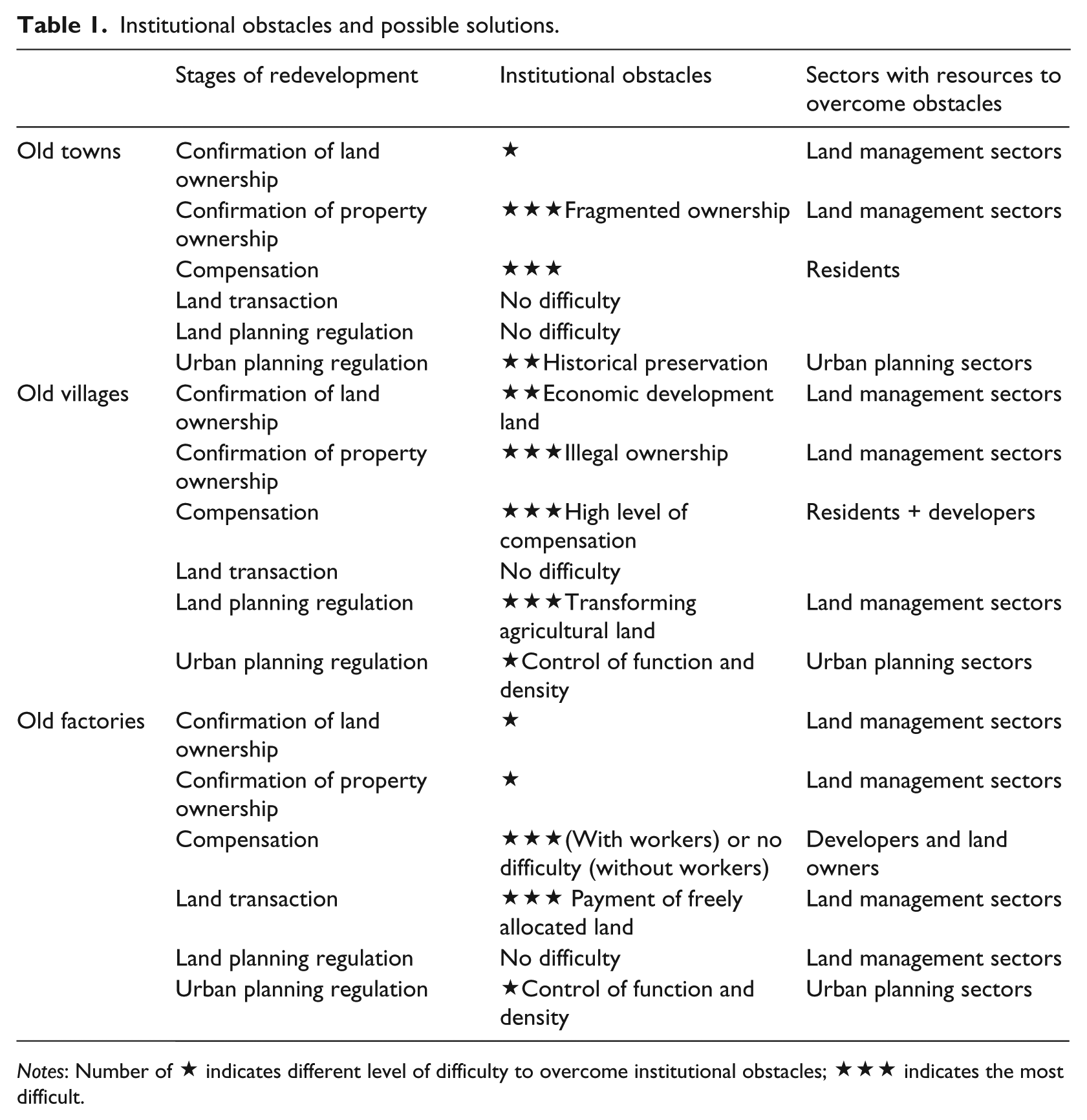
Notes: Number of ★ indicates different level of difficulty to overcome institutional obstacles; ★★★ indicates the most difficult.
Emerging process of regimes: The TOR in Guangzhou, China since 2009
Urban regime as a mechanism of cooperation is emerging in the TOR agenda. The TOR policy is organised by the National Ministry of Land and Resource Management and practices in Guangdong Province. The TOR policy aims to stimulate economic growth in terms of increasing land supply through its core feature, the ‘shared-interests mechanism’. This mechanism and other detailed arrangements bring about selective incentives to different interest groups. Such incentives connect various stakeholders in coalitions. Some of these alliances can be described as urban regimes. The urban regime approach can contribute to an understanding of the nature of cooperation between actors from the state, market and communities in urban redevelopment; in particular how can they overcome institutional obstacles by mobilising various resources.
Guangzhou and the TOR policy
The TOR policy has been in place since 2008, and it includes the redevelopment of old villages, old towns and old factories. Guangzhou is one of the first three experimental cities to implement this policy. This policy aims to reduce transaction costs by legalising former illegal land, negotiating land transactions, tax exemptions and fee relief, green channels of permission and approval, and releasing regulations from the planning system. Decreased transaction costs could stimulate more developmental land through redevelopment. Economic growth in Guangdong depends on increasing the amount of developmental land for new functions; however, land supply is always limited by national regulations. For example, Guangdong province requires about 40 square kilometres of developmental land per year, but the distributed amount according to national regulations is approximately 10 square kilometres per year. Stimulating land supply through redevelopment will contribute to resolving this problem (Interviewee 11, government officer, November 2013).
The TOR has produced selective incentives for different actors. This policy had a time limit; according to the first statement of the provincial government, it could only be applied between 2009 and 2012. Therefore, to maximise the efficiency of this policy, cooperation from the market and from communities was crucial in the redevelopment projects. These projects will benefit economic growth in terms of both direct investment and indirect taxes and fees, while growth is one of the most important targets of government. The government also needs capital because public funding is not enough. From the perspective of developers and communities, urban redevelopment brings good business because of the prosperity of the real estate market in Guangzhou over the last several years; the price of departments and flats has increased about three times over the last ten years (Xinlang Real Estate, 2012).
Core characteristics of the TOR
The core feature of the TOR policy is a ‘shared-interests mechanism’ among stakeholders, the local state, the market and communities. This mechanism offers a solution to fragmented institutional resources in different sectors. The local state partially gives up revenue from land transactions, which are a critical resource for fiscal income and are monopolised by the local state (He, 2007), while in the TOR, it is shared among the stakeholders. This shared revenue indicates that the authoritarian state is responsive to economic environment, while the lack of construction land has become the bottleneck of development.
The ‘three-old’ redevelopment policy in Guangzhou represents a new concept, which means every stakeholder can share the interests in the process of redevelopment. These interests solely belonged to the government before. This transformation gives an innovative answer to the question: for whose interests the policy is made? (Interviewee 11, government officer, December 2013)
The TOR policy offers various modes of redevelopment in all three categories in terms of different leading groups, origins of investment and processes of redevelopment. The entities of TOR could choose modes according to their preferences.
The ‘shared-interests mechanism’ could be described as a key condition to define coalitionsin the TOR as urban regimes established inthree ways. First, this mechanism provides more interest to non-public sectors, who have more selective incentive to redevelop. For example, returned land leasing fees from the local state for redevelopment in both old villages and old factories will encourage coordination between villages, factories and developers. Second, non-publicsectors, especially communities, have more power than before; such power includes setting a redevelopment agenda, choosing the mode of redevelopment and involved developer. The local state is still dominant in most cases; at the same time, this dominance has declined. Third, this interest-sharing mechanism reveals that it is a social production system rather than a social control system; this is because it seems that making things happen is more important than who makes things happen.
Redeveloping old towns in the TOR
Institutional innovation in redeveloping old towns
There are four modes of redevelopment, namely, reconstruction of a whole area, small-scale redevelopment, regeneration in historical areas and redevelopment of public service facilities. The district government takes charge of the first mode of redevelopment in old towns, according to the rules in the ‘No. 56 Document of Guangzhou Municipal Government’; this mode is the most feasible. Funding for this type of redevelopment comes from the land auction of redeveloped land in competition open to the market. The most significant innovation in redeveloping old towns is the ‘two rounds of agreement’ arrangement. The first round of agreement among involved residents is based on their attitude about the potential redevelopment agenda. Only projects that have more than 90% agreement can be undertaken. The second round of agreement concerns compensation to removed owners. This round requires two-thirds of residents to sign a compensation agreement (Guangzhou Municipal Government, 2009b). This two-round agreement empowers citizens through institutional resources; the interaction between the district government and residents is similar to negotiation and cooperation rather than command and compliance.
The practice of redeveloping old towns
Old towns are not a priority in the TOR in Guangzhou; rather, they are the most difficult to redevelop. Before 2009, the Enning Road Redevelopment had become an example of a policy failure because it was halted by residents’ resistance. The Nanhuaxi Redevelopment Project that followed has been more successful because the local state has improved the redevelopment process through lessons from the Enning Road Project. These lessons include communication between government and residents, negotiation about compensation and obedience to legal administrative procedure. These methods are similar to the TOR policy, such as the ‘two rounds of agreement’ arrangement. Therefore, the Nanhuaxi Project was described as a ‘three-old project’ before the real TOR policy had been announced. The Nanhuaxi Project is the first redeveloped old town participant with developers under the organising of the Land Development Centre, which is a subordinate sector of the Municipal Land Management Bureau established since 2000. This project has engaged 1.85 ha of land, with 445 householders in the Haizhu District from 2008 to 2011. Through a contract, the land development centre has deputised the district government to undertake the task of negotiation for compensation and demolition. Public forums, that include the government and residents, have been organised several times to exchange information and clarify requirements. Transparency about the process of planning and compensation represents another crucial element to satisfy the diverse requirements of residents. After two rounds of agreement have been signed, the Land Development Centre employed the Junhua Group as the developer in this project through a land leasing auction held on 18 August 2009, at a price of 215 million CNY. As of November 2011, the removed citizens had been moved into new flats and departments. According to governmental statistics, 96% of them are satisfied with this result (He et al., 2011; interviewee 20, NGO member, January 2014). It is a successful redevelopment, but is not a regime-building process because the connection between community and government is formal; this connection between community committees and government has some administrative features regarding related legislation.
Redeveloping old villages through the TOR
Institutional innovation in redeveloping old villages
The TOR develops methods to support two categories of redevelopment, the reconstruction of a village as a whole and comprehensive improvement. The first is the most popular mode, which is organised by the collective enterprise owned by village. They invite developers to contribute resources to work cooperatively, or they can redevelop the village using their own capital. Institutional innovation in this situation has four aspects. First, the income from land transactions will be partly distributed to villages. This income used to belong to the local state as an important resource of revenues before the TOR. Second, in total reconstruction, land transactions between the collective land of villagers and developers could be negotiated rather than going through an auction organised by the local state; in negotiation, villagers can control transactions and building partnership better than in auctions. Third, land management sectors have loosened the standards for confirmation of legal ownership of constructed land in villages. Fourth, redevelopment projects required agreement from at least 80% of villagers according to the policy in 2009; this number increased to 90% in 2012. After redevelopment, collectively owned lands in villages can be transferred into state-owned ones (state-owned land has more access to financial resources with less functional limitations), which are still controlled by collective enterprises of villages (Guangdong Provincial Government, 2009; Guangzhou Municipal Government, 2009; interviewee 7, government officer, January 2014).
The practice of redeveloping old villages
Thirty-one old villages have been approved under the terms of redevelopment plans prior to October 2014 (The TOR Office of Guangzhou, 2014). Pazhou village is one of the most successful cases from the perspective of the TOR office (interviewee 11, government officer, November 2013). People’s Daily, the official newspaper of the central committee of the Communist Party of China, has reported that the Redevelopment Project in Pazhou Village, Haizhu District is the largest project of old village redevelopment in Guangzhou, with approximately 20 billion CNY investment in 75.76 ha of land and 10,000 people. New departments were distributed to involved villagers at the end of 2014. This project creates the Pazhou Model, which means that a supportive government, voluntary villagers and an implementary enterprise have formed a win-win coalition (Li, 2015). Haizhu District has fewer resources for fiscal incomes because it is not an industrial district; therefore, external investment for Pazhou project is necessary (interviewee 13, developer, December 2013). In October 2009, Poly Real Estate (Poly) won the open auction of land in the Pazhou Village Project; in this auction Poly is the only participant. This is because the government announced five requirements for developers to attend such an auction; Poly is the only entity who can satisfy every requirement. Other developers suspect there is a coalition between Poly and the government, which excludes other real estate enterprises from the auction (Zheng and Lin, 2009). The redevelopment planning in Figure 1 displays the ‘shared-interest mechanism’ among developers, villagers and governmental actors. The 20 billion CNY investment is crucial for different levels of government in terms of supporting economic growth; villagers could possess more than 780,000 m2 of properties, such as departments, offices and retail after redevelopment; public parks, middle school and roads have been constructed by developers and returned to the government; other parcels of land are distributed to Poly for to build around 1 million m2 of departments, offices and retail (Wang et al., 2009). Besides, 3 billion CYN will be spent by Poly on the historical preservation of Huangpu Village, Haizhu District for public interest. To achieve consensus regarding distributing interests, more than ten meetings have been organised between stakeholders. Based on shared interests, these actors formed a coalition aimed at overcoming obstacles in redevelopment, such as planning regulations. In this coalition, villagers claimed that they had contributed to urban development by sacrificing their interests such as losing their collective land in the past; therefore, the planning sectors should relax their regulations to increase the density of redevelopment because of villagers’ sacrifice in the past. Street government has provided evidence to support villagers’ statements because the street level is familiar with the history of Pazhou Village. The municipal level employed their authority to ask LRHMB and UPB to respond to villagers’ requirements; they even have set a deadline to LRHMB and UPB, before that date these two departments must provide acceptable and helpful responses. Developers usually supported villagers’ requirements through informal negotiation with the public sector. The project manager of Poly has every villager’s mobile number; he claimed that he had never refused any requirement from villagers even if they were totally unreasonable. Instead, he has continued to make friends with villagers and negotiate in an amicable and trustworthy manner. At the same time, Poly has saved 1.1 billion CNY in a deposit account, which is controlled by the developer, villagers and government together to guarantee the progress of redevelopment (interviewee 13, developer, December 2013). In this case, selective incentives for various actors, cross-boundary cooperation, empowered villagers, long-term trust and informal coalition have appeared as important elements in a urban regime building process.
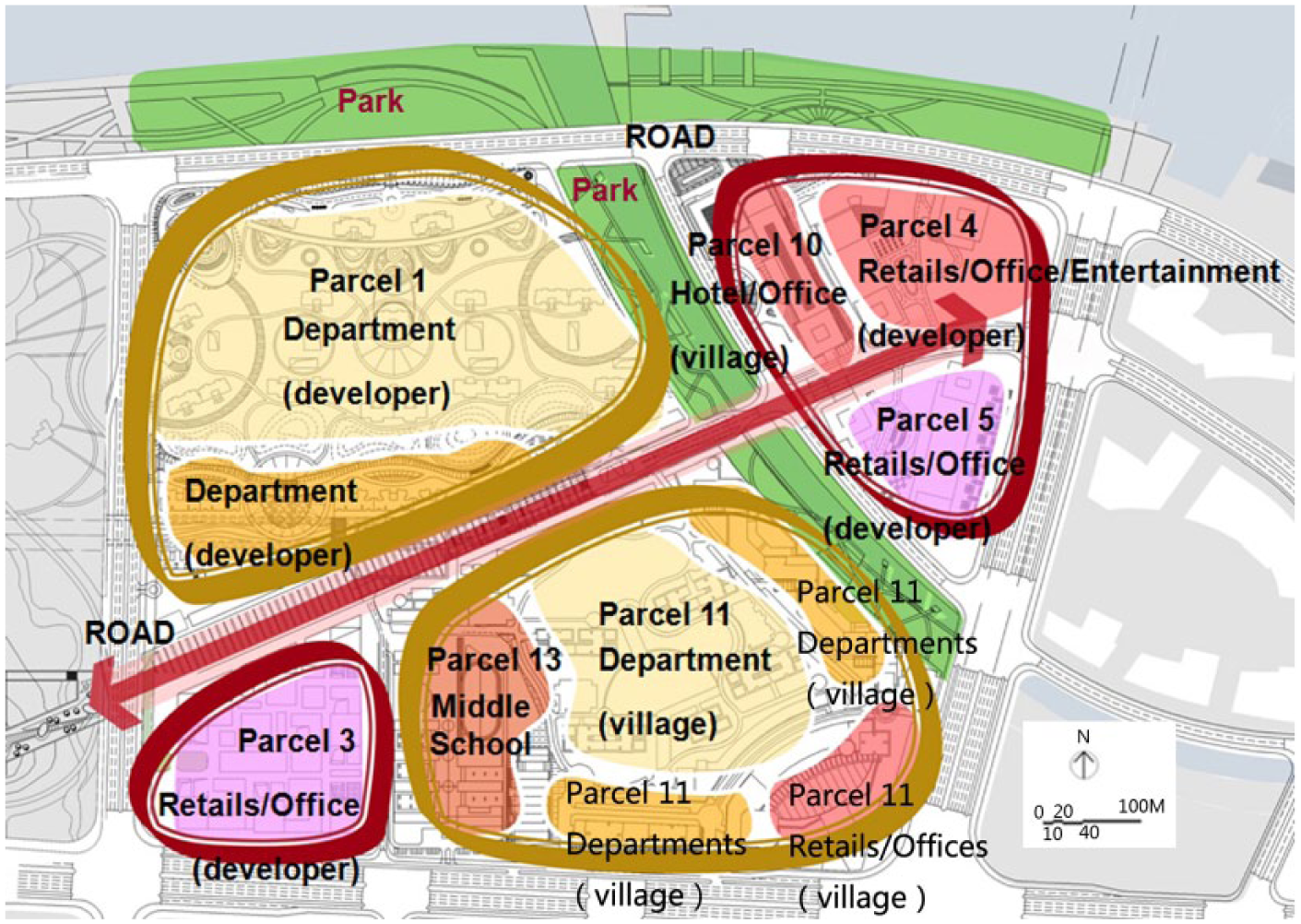
Pazhou planning of redevelopment – distribution between developer and village.
In other cases, coalitions have different characteristics. The Daping Village Redevelopment Project has invited Yanhai Groups to invest. This project has been temporarily inactivated in administrative process; it had not been approved at the municipal level by the middle of 2015. Yanhai Groups was introduced to the village by Shatou Street government and signed an agreement about redevelopment under the supervision from the street level. The developer did not directly negotiate with villagers; the leaders of the village persuaded villagers to agree with the project. Developers provided supports such as videos of future images after redevelopment, handbooks about policy and plans and calculations about benefits for every family in the redevelopment. In 2011 more than 90% of villagers have voted to support the projects. In its plan, villagers will get 330,000 m2 of properties while the developer can obtain approximately 600,000 m2 of shops, departments and offices. Staff from Yanhai Groups have successfully negotiated with the street and district levels with supports from the villagers in terms of providing documents and signing agreements. In 2013, Daping Village project became a priority in Panyu District; however, at the municipal level it met more difficulties, as its planning application was rejected. The municipal authority, the TOR office, has the final right to make the decision; the district level has fewer administrative powers and incentives to reject the application, negotiation at this level is relatively easier. The municipal level has more comprehensive consideration and different priorities in approving TOR projects. The developer has employed a private company to informally negotiate with the municipal level; unfortunately, this failed (interviewee 14, developer, January 2014, June 2015 and September 2016; interviewee 16, village leader, January 2014). Most of the elements in the regime approach have been established except the successful connection to the municipal level with long-term trust.
Redeveloping old factories in the TOR
Institutional innovation in redeveloping old factories
Two categories of old factories, factories on state-owned lands as SOEs and factories on collective lands as enterprises of the villagers, have completely different institutional arrangements. Factories in the first category have two modes to redevelop, the self-organising mode and the public auction mode; both of them are operated by current owners of factories. In self-organised projects, the owners of factories could invite outside capital to form partnerships to rebuild new functions (except commercial housing) with reduced land price paid to the local state. The public auction mode allows commercial real estate, the most profitable function, as the product of redevelopment through a land auction process. Land owners receive 60% of land leasing fees as a return from the government to support these projects. In some cases, the owners could choose the winner in such an auction as another privilege informally permitted by the local state. Old factories on collective land belong to villagers; these old factories are usually accompanied by the redevelopment of old villages. Policy about its redevelopment, such as sharing interests, relaxed standards to confirm land’s legal status, and more autonomy to villagers, is almost the same as the policy about old villages (Guangzhou Municipal Government, 2009b; the second interview with interviewee 7, government official, June 2015).
Institutional innovation in redeveloping old factories on state-owned lands is more significant than innovation in other categories because these lands are national property. If these owners changed the function of the lands before the TOR policy, they were required by national laws to pay the land leasing fees to the local state through open auction from 31 August 2004. Part of this income, which belonged to the local state, is shared between the state and land owners in the TOR; this is initiated by the state. It is an authoritarian style institutional change because the local state has made the decision to give up such income, rather than responding to the representative demands from the masses. This shared income is not just reduced revenue, but is also seen in the loss of state property (guoyouzichanliushi). The latter is serious as it is a potentially legal charge causing problems for officials.
Practice of redeveloping old factories
Redeveloping old factories is the focus of the TOR; 221 projects had been approved prior to October 2014 (The TOR Office of Guangzhou, 2014). The redevelopment in Guangzhou Iron and Steel Co., Ltd (GISCL) is an influential one because of its size. This enterprise is a SOE built in 1957. It has reformed after 1993 and has become a public limited enterprise in 1996 in the Shanghai Stock Exchange. Its product line was removed from Guangzhou. However, thousands of unemployed workers stayed. They needed compensation and welfare according to national policy. This created a serious burden on local revenue and a potential threat to social stability. Therefore, the local state organised several open auctions to sell land from GISCL to developers in 2013 and 2014. Of the income from the land auction 60% was distributed to GISCL to compensate workers, pay debts and upgrade production power. It is a special support for GISCL from the government (He et al., 2015). However, the GISCL case is not a typical one even though it is significant. Compensation to workers is too expensive for developers; therefore, most cases of redeveloping old factories occur on factory land without workers and their property present. For example, the Etanwan Project has been redeveloped by its owners on the former factory land without workers. They chose a developer, Guangzhou Investment Groups (GIG), a large SOE located in Guangzhou. This project constructed commercial real estate that requires open auction to attract potential investors in the land transaction process. However, the owner of the factory had announced special conditions for enterprises who could participate in this auction. These conditions were perfectly matched with the features of GIG. Through this informal operation, GIG won this ‘open’ auction to form a partnership with owners of the factory to redevelop (the second interview with interviewee 7, government official, June 2015). Similar to redeveloping old villages, most characteristics of the regime building process have emerged in this category except long-term trust.
Summary of cooperation in redevelopment: Emerging regimes
Pre-conditions of regimes: Institutional obstacles and their solutions
Institutional obstacles and their solutions are closely connected to a fragmented authoritarian environment. There are various institutional obstacles in the three categories of redevelopment because of fragmented institutional structure. These problems are resolved or partly resolved through four institutional innovations. First, the relaxing of land management regulations will help solve the issues around confirming land’s legal status and land management control. Second, the local state can share parts of its fiscal income in land transactions, and this shared income could engage more capital for the redevelopment movement in Guangzhou. Third, institutional resource distributed to communities, such as agreement among residents to approve a project and the autonomy to choose developers and the mode of redeveloping, brings about a more balanced distribution of bargaining power between the government, developers, residents and villagers. This in turn introduces more reasonable and acceptable compensation for former landowners in redevelopment. Fourth, the urban planning sector has also relaxed its control over land function and density, which means potential interests could be realised more easily after redevelopment. These four aspects of institutional change are initiated by the authoritarian state as the external force to overcome institutional obstacles.
Characteristics of coalitions in redevelopment
The core of these four institutional innovations is the ‘shared-interests mechanism’. The essence of such a mechanism is the transfer of resources from the public sector to non-public sector; market actors and communities have more interests in organising various coalitions. In old towns, the connection between residents and the government is not weak because official organisations at the street and community levels can mobilise citizens through governmental programmes. It is a semi-formal cross-boundary coalition among residents, different levels of government and developers through diverse contracts. In the other categories, the old village and the old factory, there is less formal connection among stakeholders. There are contracts between owners of land use rights and developers; however, informal operations between communities, developers and the government might be more important because urban redevelopment process is complex, dynamic and uncertain; therefore, strategies of coordinative actors are highly diverse and flexible. Such characteristics of coordination are matched with features of informal coalitions. All of these projects, except for some cases such as the Pazhou project (which is the result of long-term collaboration between Poly and the Guangzhou government), are cases of short-term, project-based cooperation.
Structural features of regimes
The local state still plays a dominant role in the TOR in Guangzhou; however, it has transferred authority, resources and interests into the hands of non-public sectors. The degree of dominance by the local state has decreased to increase opportunity of growth. This is more a social product model than a social control model.
Abstract features of regimes
The ‘shared-interests mechanism’ develops interdependence among stakeholders, and increases the capacity to achieve various goals through collective action. This is close to ‘power to’ rather than ‘power over’ in terms of power relationships in social interaction.
Emerging regimes in Guangzhou in the TOR
In terms of pre-conditions, characteristics of coalitions, and structural and abstract features of the regime approach, what occurred in the TOR processes in Guangzhou could be described as urban regime building processes. These regimes are in emerging processes after implementation of the TOR policy; it is still challenging to find long-term trust among stakeholders in the TOR. Cooperation in redeveloping old towns cannot be defined as an emerging regime because the connection between communities and the government is formal. Almost every element in regime building process, even the long-term trust among allies, have emerged in old village projects in important areas such as redevelopment in Pahzou Village; projects of villages in less crucial areas face challenges to develop a long-term trust with the state. Redeveloping old factories has similar characteristics to the projects in old villages. A summary of regimes in the TOR is displayed in Table 2.
Matching between definitions of regimes and reality in the TOR.
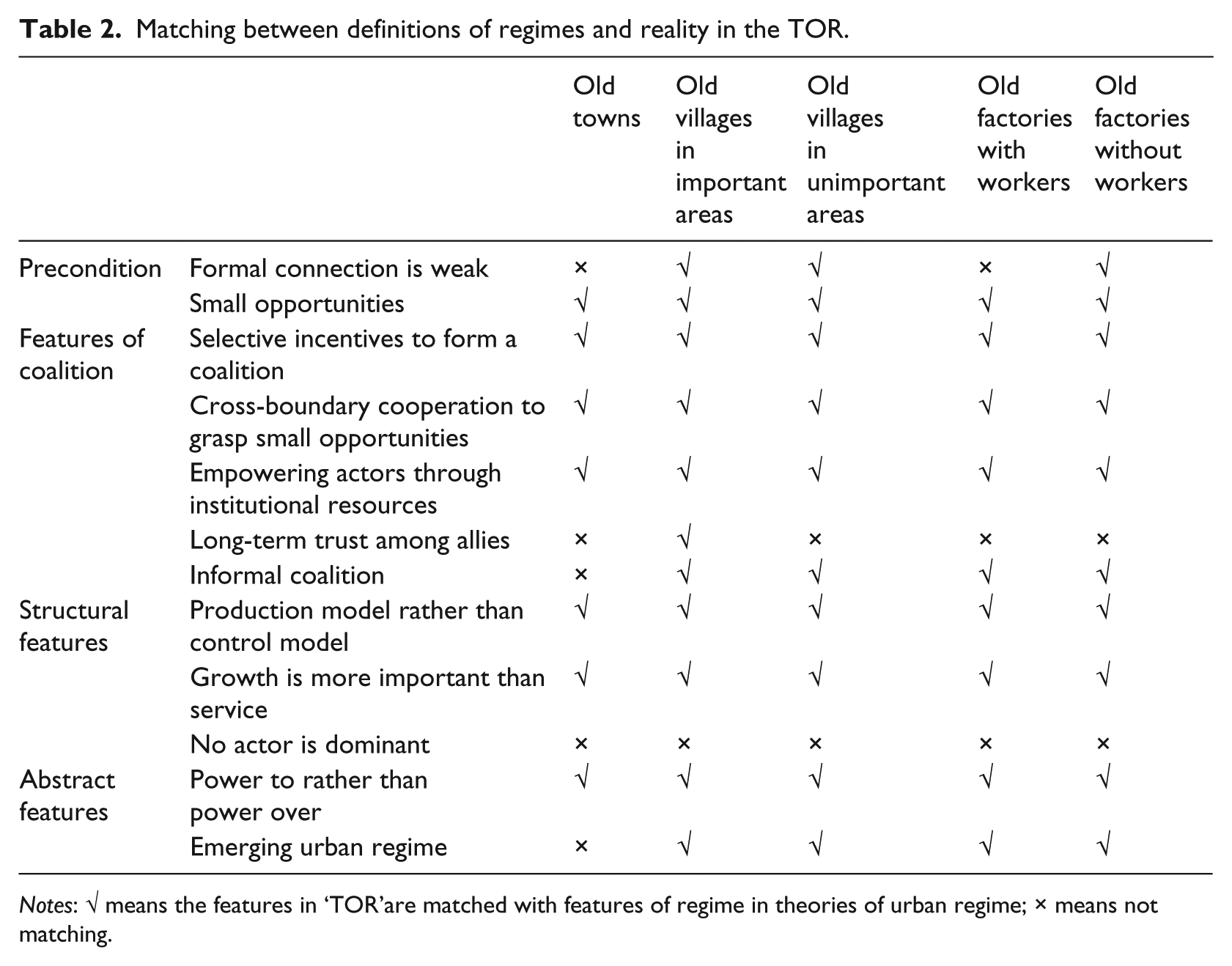
Notes: √ means the features in ‘TOR’are matched with features of regime in theories of urban regime; × means not matching.
Features of regimes: Selective regimes in the institutional ensemble
After analysing emerging regimes in the TOR in Guangzhou, the next question is what the features are of these emerging regimes? The answer from the field is that they are highly selective regimes; in some projects it is easier to organise a regime than others, some regimes are more successful than others, and some actors find it easier to join the regime than others. Such selectivity is produced by institutional contexts in which urban redevelopment happens. To bridge such institutional matrices and the selective building process of urban regimes, Jessop’s (2008) concept about strategic selectivity might be helpful. This idea has two sources. First, it was inspired by Offe’s (1974) concept of ‘sorting process’ in capitalist state to include some social groups and exclude others regarding the interests of ruling class and relevant history. Second, the idea about strategic selection has been constructed into Jessop’s (2001) strategic relational approach that has developed Giddens’ (1984) dualism structure-agency theory. Giddens’ theory has ignored the interaction between structure and agency; structure equally constrains and enables all actors. However, Jessop (2001) thought structure should be located in specific contexts that will strategically select some actors to benefit by the exclusion of others. In the words of Jessop: The state is the site of strategy, as a system of strategic selectivity. It is more accessible to some forces than others according to the strategies they adopt to gain state power; and it will be more suited to the pursuit of some type s of economic or political strategies than others because of the model of intervention and resources which characterize that system. (Jessop, 2008: 36)
Such selectivity, therefore, can be traced back to the essence of state power. The state is neither a rational subject nor neutral instrument; it is an ensemble of institutions. Every social group can exercise their power in this institutional ensemble; however, this ensemble is biased as, some groups, some interests and some strategies have higher priorities than others do. It is a strategic selectivity as the structural aspect of the state power (Jessop, 1999). The tendencies of the state to privilege certain social groups and projects have been affected by two categories of factors, the inherited state institutions and the current accumulation strategies in the whole economy (Brenner, 2003). Urban regimes are emerging in a biased institutional ensemble which comprises institutions such as SOEs’ reform, state-owned land leasing, urban planning system and governance of communities. Some of them are inherited from the last few decades. The exploration of current accumulation strategies has gone beyond the research focus of this paper; however, there might be some signs about these strategies emerging in the regime-building processes.
The TOR policy involves highly strategic selectivity among ‘three olds’. There are 253 redevelopment projects that have been approved prior to October 2014. Five projects involve old towns (two of them were approved before 2009; they are not projects under the three-old policy), 31 are within old villages and 221 concern old factories. In terms of the total area of land involved, the figures are 0.97 km2 for the old towns, 14.39 km2 for the old villages and 11.96 km2 for the old factories (The TOR office Guangzhou, 2014). Why did redeveloping old factories have the largest number of projects? This was due to the national reform of SOEs after 1992, since which old factories have had the least resistance to redevelopment as fewer residents (workers) required compensation. This institutional change was completed in most cases around 2000. Some state-owned factories have become private and former workers have already received their compensation. Such reform has reduced the costs for redeveloping old factories nowadays. Market forces have more incentive to enter redevelopment activities compared with projects in other categories. The small number of residents in old factories has decreased the cost of negotiation between stakeholders. There is another factor to reduce the cost of redevelopment, while the state has reduced its income in land transaction from land user to developer in the TOR. At the same time, there are fewer conflicts with the land planning system in old factories because most land in factories is already construction land. It is more possible to form a regime in redeveloping old factories because of less resistance from residents and planning systems and more potential income after redevelopment in the institutional ensemble of the state. These regimes are helpful to mobilise resources to achieve successful redevelopment. In contrast, in redeveloping old towns it is less opportune to organise a regime. There are more residents in old towns and some of them have strong connections to the government and mass media; this often means strong social capital to support their bargaining in negotiating with developers and the government. In addition, complex ownership in old towns has increased the cost of redevelopment. Consequently, it is more complicated to satisfy the requirement of compensation with residents in old towns. Because of uncertainty about the cost, future income of redevelopment is unclear. It is the obstacle to attract developers to organise a regime.
These strategic selectivities not only take place among different categories of redevelopment, they also occur within the same category. For example, progress in redeveloping Pazhou village is much smoother than in most other villages, such as the project in Daping village. This difference might be due to the strategic planning system. Pazhou village is more important for the strategic plan because its strategic position is located near the Pazhou Exhibition Centre and the China Import and Export Fair, which is the most significant international trade event in China. Redeveloping Pazhou village will support the operation of the Pazhou Exhibition Centre in the future. Therefore, the local state distributes more administrative resources to the Pazhou project. At the same time, the developer, Poly Real Estate, is one of the largest SOEs in China and has engaged in long-term cooperation with the local state. There are more resources to support the formation of regime among Pazhou Village, developer and the local state. Compared with Pazhou village, Daping village has less significance in the urban planning system. The developer, Yanhai Group, is a company from Hong Kong with few connections to the municipal government. Because of the various institutional positions of developers, and the relationship with trajectories of urban strategic planning, these two villages have experienced different levels of progress in redevelopment even they both have formed a regime (interviewee 14, developer, December 2013 and June 2015; interviewee 16, village leader, January 2014).
Such strategic selectivity does not just happen between different regimes; it also occurs among different actors in particular regimes. Namely, renters are excluded in regime-building coordination in the redevelopment of old villages. Such renters do not have ownership of property; but they are living in these villages with use right of houses. Such use right has been protected and compensated in the redevelopment of old towns; however, this is not compensated in old villages owing to differences between use rights of properties in collective-owned land and state-owned land. This difference might result from the fact that renters in public houses in state-owned land have lived in these properties for decades; it is still the inherited institutions matters.
The emerging regimes in the TOR in Guangzhou case represent highly strategic selectivities, inside and outside regimes. Strategic selectivities take place among three categories of redevelopment; among different projects in the field of redevelopment, and among different actors from the state, the market and communities. Strategic selectivities influence which projects can build regimes to achieve successful redevelopment; they affect what kind of regimes are more efficient; they decide who can join such regimes to share interests. Exercise of state power in a biased institutional ensemble as a heritage of the past, such as the land transactions, SOEs’ reform after 1992, relationship between SOEs and the local state, organisational form of communities and urban strategic planning, has influenced the result of strategic selectivities. In addition, some phenomena in these selectivities have displayed few signs about state’s accumulation strategies. The state-owned land has priorities to develop than village land in land regulations; therefore, redevelopment in old factories are more supported by the TOR policy. Villages are more encouraged to reorganise into urban communities in redevelopment. Use rights in state-owned land have more protection. Mega governmental projects, such as Pazhou Exhibition Centre, also have influenced the efficiencies of regimes in redeveloping old villages. These elements might indicate a governmental preference, urban preference and large-scale preference in the state accumulation strategies.
Conclusion
This paper investigates the TOR policy in Guangzhou, China after 2009, utilising the urban regime approach, along with fragmented authoritarianism and the strategic selection approach. This analysis covers three areas: the pre-conditions of the regimes, the emerging of the regime and the features of the regime. I offer three main conclusions. First, interaction and coalitions in the TOR exhibit some features that could be described as urban regimes in an authoritarian environment; such regimes are helpful for urban redevelopment. The TOR faces institutional obstacles, namely fragmented institutional resources in an authoritarian context, to grasp small opportunities. These difficulties require cross-boundary cooperation, such as urban regimes, to overcome those challenges. As a result, the authoritarian state has imported external resources, the TOR policy, into urban redevelopment to encourage cross-boundary co-operation to resolve institutional obstacles. Most elements of the regime have emerged in Guangzhou, especially in some cases in old villages and old factories. These regimes can mobilise different resources from various actors to support urban redevelopment. This explains origins of regimes within the local context of Chinese cities. Second, the ‘shared-interests mechanism’, the core aspect of the TOR policy, is crucial to stimulate the building of regimes; this also is why the urban regime approach is appropriate to analyse the policy. Actors in the market and in communities are empowered by access to institutional resources when the state shared its interests. This mechanism also helps explain the difference between the TOR in Guangzhou and similar cases in existing literature regarding other Chinese cities. Third, the urban regimes are emerging as selective regimes. These are very strategically selective among three categories of redevelopment, different regimes and various actors in these regimes. In this case, they are selective regimes with Chinese characteristics, which are deeply rooted in the political-economic context of Chinese cities. These institutions are biased towards different entities. In summary, this research aims to improve the application of the regime approach in non-North American contexts in terms of analysing origins and features of regimes.
Footnotes
Acknowledgements
This paper is based on the conference paper presented at the Urban China Research Network (UCRN) conference at Brown University on 8–9 May 2015. I would like to thank participants of this conference for their constructive comments. Special thanks are given to John R Logan for his insightful advice. Three anonymous referees also provide helpful ideas and challenging opinions to improve my paper from different perspective. Weiping Wu has also given me some useful suggestions.
Funding
This research is sponsored by Li Siguang Scholarship (2012-2015) conducted by China Scholarship Council and University of Birmingham, and the National Social Science Foundation of China, No.16CMZ018.