




Abstract
Public space is increasingly recognised to be central to spatial discourse of cities. A city’s urbanism is displayed in public spaces, representing a myriad of complex socio-cultural, economic and democratic practices of everyday life. In cities of the Global South, especially those with nascent democracies, different values attached to a space by various actors – both material and symbolic – frame the contestation, making the physical space a normative instrument for contestation. Tundikhel, once believed to be the largest open space in Asia, is an important part of Kathmandu’s urbanism, which has witnessed two civil wars popularly known as Jana Andolans, and the subsequent political upheavals, to emerge as the symbolic meeting point of the city, democracy, and its people. The paper argues that the confluence of the three modalities of power – institutionalisation, militarisation and informalisation – has underpinned its historical transformation, resulting in what I call ‘urban rupturing’: a process of (un)making of public space, through physical and symbolic fragmentation and spatial estrangement. The paper contends that unlike the common notion that public spaces such as Tundikhel are quintessentially public, hypocrisy is inherent to the ‘publicness’ agenda of the state and the institutional machinery in Kathmandu. It is an urban condition that not only maligns the public space agenda but also creeps into other spheres of urban development.
Introduction
Public space is increasingly recognised to be central to spatial discourse of cities. Particularly in the Global South, city’s urbanism, defined by the milieu of different urban components that provides order and contestation, is displayed in public spaces representing a myriad of complex socio-cultural, economic and democratic practices (or lack thereof) in everyday life. The material and symbolic values attached to space by various actors frame these practices, making the physical space an instrument for contestation and domination. Increasingly, contestations emerge from the conscious or subconscious desire to introduce a sense of order and control by the state (Benjamin, 2008; Mitchell, 1995; Mitchell and Staeheli, 2006), informal insurgent forces (Appadurai, 2001; Hackenbroch, 2013; Perera, 2009) and the military (Dovey, 2001; Padawangi, 2013; Samara, 2010), creating new forms of governance, network and dominance. These modalities of power establish a claim on the space as they see this as a way to connect to the city, its history and the space itself. Much less understood, however, is their impact, which determines the nature and the extent of a space being public (or not).
In nascent democracies such as Nepal, Tibet, Vietnam or Sri Lanka suffering from fledgling economy, weak governance or longstanding ethnic or political conflicts, authoritarian and political deliberation become the chosen mode of governance to establish hegemonic rights. Boundaries are blurred between civil and military, private and public, formal and informal simultaneously displaying both ‘order’ and ‘chaos’ built into everyday life and practices. The militancy psyche (and the ‘fear’ that results) is not always that of the ‘outsiders’, but very often stems from the war at home arising from authoritarian rule or religious, ethnic and political conflicts. The ‘ordered’ view is challenged by the invasion from a city’s urban poor and informal enterprises (Brown et al., 2010; Hackenbroch, 2013; Hackenbroch et al., 2009) consistent attempts to occupy the space defying the bourgeoisie’s control of the space through policies, regulations and coercion. Where unequal power relations prevail, informality helps to balance the concentration of power, introducing redistributive practices into the use, ownership, and concept of ‘public space’, giving it a new meaning. Both authoritarian deliberation and democratic practices are thus seen merging into a single frame to govern the public space, its configuration, and the extent of its publicness thereby making it important to examine them together.
Tundikhel in Kathmandu offers interesting insights into the complex interplay of powerful forces against the backdrop of longstanding conflict. Once believed to be the largest open space in Asia, this central public space is an important part of the city’s urbanism, which has witnessed two civil wars, popularly known as Jana Andolans, and the subsequent political upheavals 1 to emerge as the symbolic meeting point of the city, its democracy and people. It has been at the epicentre of the democratic movement of Nepal, which is rapidly emerging from 300 years of absolute monarchy and is trying to find its feet in search of democracy. Historically, Tundikhel played an important role as a space for religious, cultural, social, and political activism signifying Lefebvre’s (1991) spaces of ‘representation and representational space’. Since the abolition of the monarchy on 28 May 2008, Tundikhel has witnessed a greater constellation of forces – institutional, military and informal insurgency – competing to establish the sovereign rights to occupy and govern this space. The extent of their control, however, highlights the concurrent identity and political structure of the city, displaying a distinct characteristic of (dis)order. It also manifests the dominant spatial modalities, opening up fresh new insights into public space discourse not only in the Nepalese case but also in other cities emerging from similar contexts where public space as an instrument of contestation is transforming into an instrument of domination.
The purpose of the paper is twofold. First, the paper seeks to expand on scholarship from a relatively lesser-known city of the world by presenting an in-depth discussion of Tundikhel, the largest urban public space in Kathmandu. Second, the paper examines what I call the ‘estranged spatialities’ that resulted from three strands of contemporary discourses – institutionalisation, militarisation and informalisation – coming together not only to dismantle the very purpose of Tundikhel as a public space but also to rupture the ‘space’ as we know it. The paper argues that the current public space construct in Kathmandu must be seen as an entanglement of complex, multilayered and multifaceted conditions, where conflicts come naturally into play, leading to contradictions and estrangement of spaces. The incidence of spatial rupturing has intensified during the political transformation from absolute monarchy to republicanism, signifying new forms of inequality in the public sphere and an affront to the democratic aspirations of the ‘New Nepal’. 2
In the next section, the paper begins by piecing together some of the recent literature on the current debates on public space, particularly in terms of different modalities of power that the paper posits – institutionalisation, militarisation and informalisation. The third section examines each of these discourses in turn against the backdrop of Tundikhel. In the concluding section, the paper draws together strands from the discussion and argues that the contestation has led to ‘spatial estrangement’ – a process of (un)making of public spaces through ‘urban rupturing’. In this transition, oddly we are left without a conception of public space that is distinctly public. Information was collected using both structured and unstructured observations, 3 spatial-combing and archival research including a stakeholder workshop 4 held in Kathmandu in 2015.
Framing space and the city: Public space in contestations and spatial evocations
Historically public spaces are considered timeless, transformational and an elusive entity in a city’s urbanism. The scholarship on public spaces in recent decades has centred on the transformation of public spaces that underpins their celebrated and contested nature based on various processes of urban interventions. This section will focus on three strands of interventions in the public space – institutionalisation, militariation and informalisation – that typically underpin and help define the contestation, especially in cities experiencing longstanding conflict and political transformation per se, absolute monarchy to democracy or aristocratic dominance to more democratic ‘people-centric’ regimes. Each has a story. Each contributes to our understanding of the new spatial and spatiotemporal conditions. Now it should not be thought that the conflation of these three discourses is merely an empirical issue. On the contrary, it has practical political consequences that construct the new ‘urbanism’ in these cities. They might appear as fragmentary forces, but together they demonstrate multiple spatialities and temporalities within the dynamic city system. The uses of the space are continually shifting and expanding to accommodate constantly changing functions, agencies and meanings. For example, this happens when agitational campaigns and dharnas against an oppressive political regime are confounded with ‘disorder and crime’, or when struggle to install the vending barrows by the rural migrants is equated with ‘commodification’ of space. In both cases, the result is to occlude the question whether to subject public space to the logic of the insurgent urbanism or the state is to promote a freely admissible and a democratic public space. Despite this heterogeneity within the public space and disjunction between various agents and functions, it ultimately functions as a whole and we read it accordingly.
Institutionalisation of public space is rooted in the notion that public space is primarily a responsibility of state authority, which engages in its re-appropriation to create order and security (Benjamin, 2008; Mitchell, 1995; Mitchell and Staeheli, 2006) administered through regulations and rights. An institutional framework not only defines boundaries, controls access and grants publicness but also extends control over public spaces for sovereign rights. Marvin’s (2013) analysis of Chinese colonial rule over Tibet describes how sovereign rights are executed through the creation of ‘presumptive’ spaces, which are not just symbols of restrictions but also the centres of conflict between Chinese authorities and Tibetans who are deprived of any instruments of democracy. For indigenous Tibetans, the use of the public space is related to their ‘natural’ and ‘civil’ rights despite being fully aware their most important and holy public space in Barkhor is ringed with surveillance. Likewise, Chinese authorities are aware that they are vulnerable to international criticism if their confrontations with Tibetans catch the attention of international media, revealing the structure of force that represses Tibetan protests and religious activity. More importantly, it endangers the touristic romance that translates into revenues in Lhasa (Marvin, 2013: 1471). The enterprising Chinese state sees the space as a potential neoliberal object. This makes Barkhor a presumptive space with multiple meanings, imaginations, and agencies. Real spaces with ordinary qualities turn into celebratory spaces – a shift from an ‘ordinary’ to a ‘celebratory’ or ‘cherished’ space – where ‘non-ordinary’ behaviour becomes the norm. In such transition, however, space is usurped by the dominant groups and over time lost from the public domain altogether. Padawangi (2013) laments Jakarta’s subjection of public space provision under the authority of the ruling power to turn celebratory spaces of displaying power within the context of a fundamentally unequal society. Such institutional assertiveness is made more complex by the advent of neoliberalism that sees entrepreneurial states altering their modes of operation to become de facto landowners and formidable economic actors looking for ways to re-appropriate the public space for economic gain. The institutional influence on public space appears to hold grounds regardless of nature of the state it is connected to. Especially in countries riddled with conflict such as Nepal the boundary between democracy and autocracy is often blurred and even within the democratic envelope, splinter autocracies appear to exist as certain institutions and organisations can still choose to operate in autocratic ways and vice versa.
Not bound by geography, the expansion of neoliberalisation takes its own cultural forms.
Hackenbroch (2013: 416), in her study of access to public space and water supply in Dhaka, describes how poor voters support the formal system to gain political support to produce exclusionary and discriminatory outcomes leading to ‘organized encroachment of the powerful’, represented by the strong network of relations between institutions and individual actors of political society where they all have some neoliberal agenda. This manifests itself in all groups of the society. For the ordinary citizens, this ‘encroachment’ is about gaining access to urban amenities and services but, for institutions, it is about gaining power and political supremacy by controlling access to resources. Interestingly, however, such political inimitability can even produce quasi-state powers 5 to enforce moral and cultural code, as executed by Shiv Sena in Mumbai or the Maoist cadres in Kathmandu, suggesting informality to be inseparable from formality. The profound upheavals that ensue from political struggle quickly raise the prospect of de jure informal insurgency that seeks to counter-balance dominant spatial modalities. In apparent public takeover of space, the post-independence Jakarta witnessed public spaces evolve into ‘megaphones’ for grass-roots movements (Padawangi, 2013), while in Bangalore, public space engendered what Benjamin (2008) calls ‘occupancy urbanism’. Both underscore powers of informal insurgency in subverting the logic of military urbanism and institutionalised dominance – deemed formalisation of space that allows groups to make democratic claims, demands and protests, where spatialities, sovereignty and rights are constructed, negotiated and contested (Dovey, 2001; Marvin, 2013). Informality is thus useful because, considered as an active agent in social and physical production, it provides us with the liberating force to enable us to experience public space in alternative ways. People make cities. In such formulation, informality by virtue of being people-driven, is seen as a tool for non-spatial consciousness to the materiality reflecting our inherent humanistic relationship with space (public space) in universal ways.
Owing to the heterogeneity of actions of diverse groups and the difficulty of offering a uniform response, state institutions tend to rely on traditional methods of control and order through both soft and hard measures. Soft approaches often take the form of municipal by-laws that interestingly are routinely applied to what Samara (2010) calls a ‘surplus’ population – the poor and vulnerable – but relaxed for elites in the dominant position. According to him, ‘the creation or expansion of municipal by-laws targeting the urban poor and informal economy, aggressive enforcement of law and order, and the literal or de facto privatization of public space all contribute to spatial fragmentation and a massive fortification of the spaces between rich and poor’ (Samara, 2010: 199). As an intersection of people and power, public space naturally plays a prominent role in establishing order and paving the way for implanting hard measures that articulate policification and militarisation. State institutions enforce regulations and deliver welfare provisions often with support from the police and, in some cases, the military. The massively militarised elections in parts of the Global South only corroborate how democratic functions are supported by the military and how they are played out in the public sphere. On the other hand, the logic of state militarisation is often situational (effective in certain contexts) and relational (they only exist in opposition to other categories) (Castro, 2013). For instance, the military has played two important roles in the history of conflict in Nepal. Up until the 1990s, the military played a crucial role in protecting the Royals and royal institutions; however, post-1990s they helped the state in diffusing the Maoist opposition. Thus, the same agency is seen as having multiple identities and roles in the history. A central paradox, however, is the ‘military-encroachment of the public space’, as inevitably, the presence of the military in the city embodies transfer of sandbags, check posts and barracks from the borders into the streets and public spaces, creating new frontiers of barriers and divisions. These divisions are both visual and spatial, a common byproduct of persistent political instability. Over time these barriers start to achieve a sense of permanence, with high walls and barbed wires rupturing the space.
Literature is rife with allusions to public space shaped by complex structure and differentiated symbolic discourses. The heuristic intervention of state and military in public spaces is deemed both real (restriction of access, speech and action in everyday life) and metaphorical (emblematic of the death of the values of free society); the resurgence of grass-roots, be they informal traders or political activists, is beset with realism (livelihood) and idealism (counter-movement). Despite these contributions, the construction of public space in nascent democracies remains unexamined. More importantly, a coherent framework to explain how public space is connected with state spatialities warrants a deeper understanding of the confluence of the three discourses discussed above that position public space at the historic crossroads where the sum of parts is greater than the whole. They comprise, what Bridge and Watson (2010: 371) call, the confluence of the publics and cultures, deeply entwined offering up complex, sometimes conflictual, relationships that define the politics of the urban in general. The three discourses are not mutually exclusive. They are sometimes complementary and sometimes in conflict, and together they create an urban condition that fosters contestation and eventual rupturing. However, what remains unexamined is the eventual rupturing of the space as a result of the modalities of power it helps to sustain.
In order to demonstrate the spatial discourses of power, people, and sovereignty, I shall now focus on Tundikhel in the following section.
Tundikhel: A brief spatial history
The traceable history of Tundikhel goes back to medieval times, when Kathmandu was a mercantile and intellectual centre. Anecdotal evidence exists from that ancient period, of Kathmandu being on the trade route between India and Tibet (Shrestha, 1981) and Tundikhel providing a camping ground. Successive rulers such as the Licchavis (
The Early Shah Period also marks an important phase in spatial history, with the expansion of the old city of Kathmandu, which would eventually bring Tundikhel from its peripheral location to the centre of the city and reinforce its role as the central space through which political hegemony was established. The Rana Period, which spanned 105 years, further strengthened this spatial expansion. Seen by many as a feudal-fascist regime that thrived on instituting oppression against its citizens, Rana rulers learnt the imperial art of instrumentalising urban space and monumental architecture to lay claims on power and dominance over space. End of Rana rule in 1951 was marked by the advent of modernity and liberation and the power returned to Shah Kings that effectively reinstated the same fascist approach to governance. The military, staying very close to the Royals, was rewarded with spaces of premium in the city including parts of Tundikhel. The construction of the army Headquarters in 1989 formally established the permanent claim on the city’s only remaining urban open space. Since 1996, the country witnessed a seismic change in political landscape fuelled by a Maoist uprising, leading to the abolition of the monarchy and eventual accession to power as a political party. Although paradoxical, the Maoist dominance in the political sphere, the economic sphere has remained independent, attributed (mainly) to the pressures from donor agencies. In recent years the government has instituted liberal economy and opened up to new investments, firmly adopting neoliberal ideals.
Tundikhel thus symbolises different layers of planning and development achievements of different political periods to which the turn of the century added a new dimension. The struggle for democracy that continued for well over a decade saw Tundikhel playing an important role, from being a ‘royal ground’ it evolved into democracy’s ‘battleground’ where all forms of political power, including military and democratic forces, collide. The exclusionary process of class formation instituted by the ‘Royals’ and the respect they commanded for centuries was challenged by a defensive informal outbreak. With the ubiquitous media presence capturing the political struggle by transmitting images and actions, Tundikhel’s visual and metaphorical appeal as a space of emancipation has surpassed its appeal as a space of grandeur and beauty in the public imagination. Tundikhel became a public space in a true sense that showed great potential to renew the value of social life quite in line with the Lefebvrian (1991: 38) notion of ‘lived space as co-created common life’. The open field of about 30 ha of land sandwiched between the new and old quarters of the city (Figure 1) simultaneously became the site for liberation and royalty – a mediator between the power and the powerless. However, the spectre of control has never been absent from Tundikhel, reflecting the complex hierarchical socio-economy of the time, on which the fascist regime was run. As argued by Drummond (2000) in her study of public spaces in Vietnam, the country had a little history or concept of public space – it was a social vacuum that had been filled by the authority of the emperor/state with little place for Western-style public discussion or expression. This exclusionary operation was considered an essential mechanism to control the ‘public’, and exclusions were rooted in the process of class formation. 6 The resultant chaos was of our own imagining – the product of royal or at times the institutional addiction to mechanical order – here we see the order of life in development.
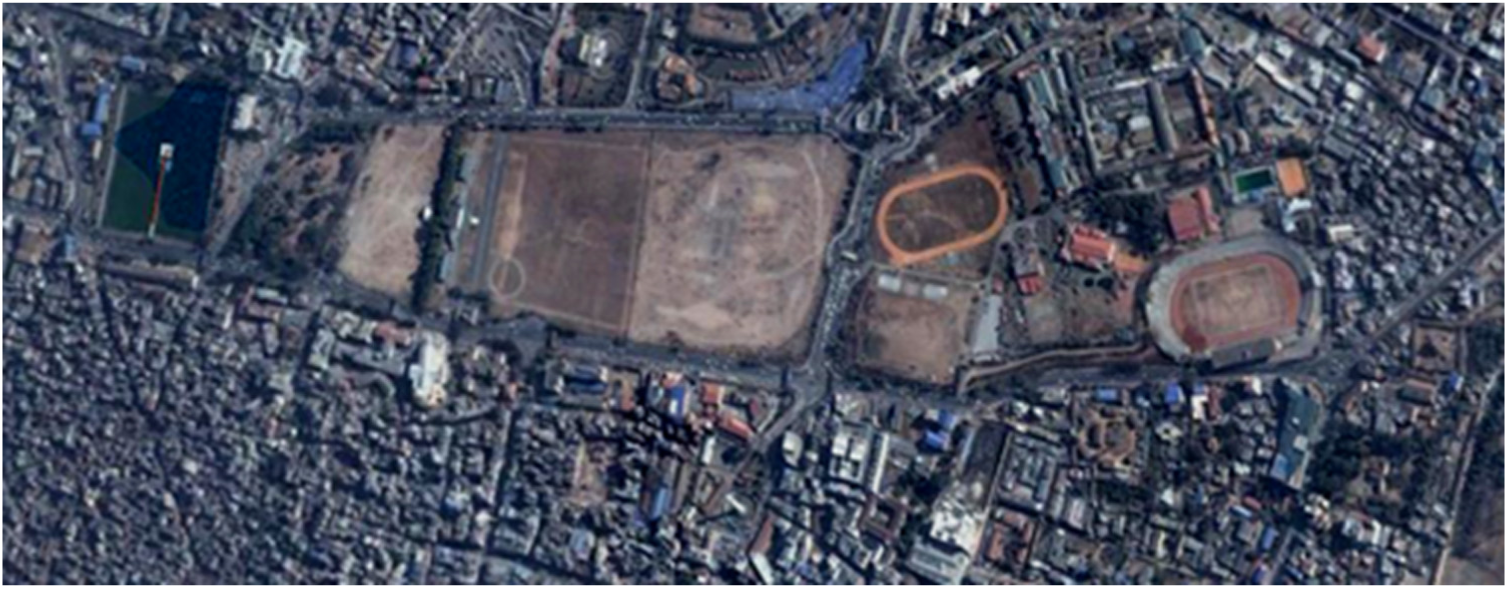
Tundikhel in the context of the city.
The unmaking of Tundikhel: Ruptured spaces and estranged spatialities
Tundikhel today is the largest civic precinct in Kathmandu, surrounded by some of the busiest routes and builtform that reflects the predominance of commercial and institutional uses interspersed by monuments and temples from the medieval period. Until about the middle of the 19th century, it existed as a single expansive open space, uninterrupted by either buildings or the road network. Currently, two major roads flank Tundikhel, built during the Rana Period as the first set of through roads linking Singha Durbar and Narayanhiti Palace, marking the advent of modernism in Kathmandu. A trunk road bisects Tundikhel in the north, marking a permanent severance in the historical association of Ratna Park with Rani Pokhari (Queen’s Pond). To the south, Tundikhel is separated by Shukra Path, a road built in commemoration of martyrs with the historic sculpture locally known as Shahid Gate built right in the middle of a four-lane carriageway (Figure 2). This symbolised an indelible disconnection with space to the south (occupied by the Nepal Army) from the greater mass of Tundikhel. Rai (2002) noted that the historic shrinkage of Tundikhel is striking, as space shrank from 60 ha to 30 ha over the span of 100 years. Segregation and fragmentation are two enduring trends of this transformation, created using both symbolic and physical barriers instituted by wider interventions resulting from institutionalisation, militarisation and informalisation. These interventions have come together to become a formidable force that breaks the linearity of the space into smaller pockets (see Figure 3), that are either controlled or out of bounds. They enclose discrete pockets of space, introduce relative solidity to the space itself affecting the impression of its orientational thrust.
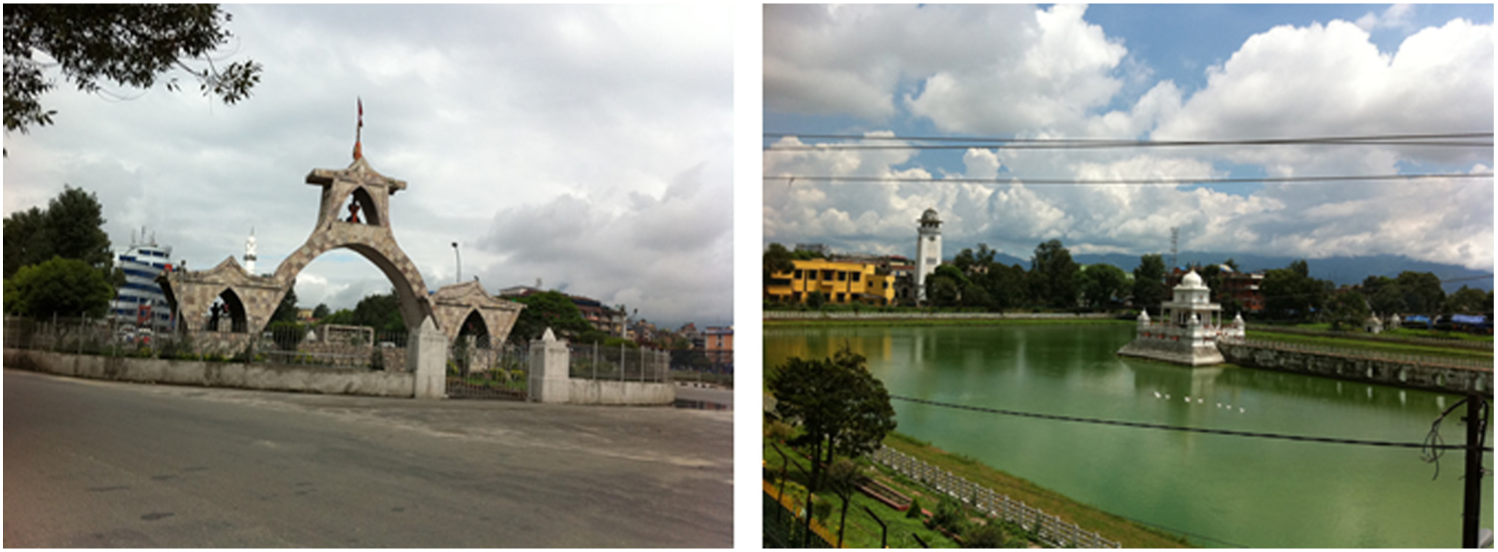
Shahid Gate (left) and Rani Pokhari (right).
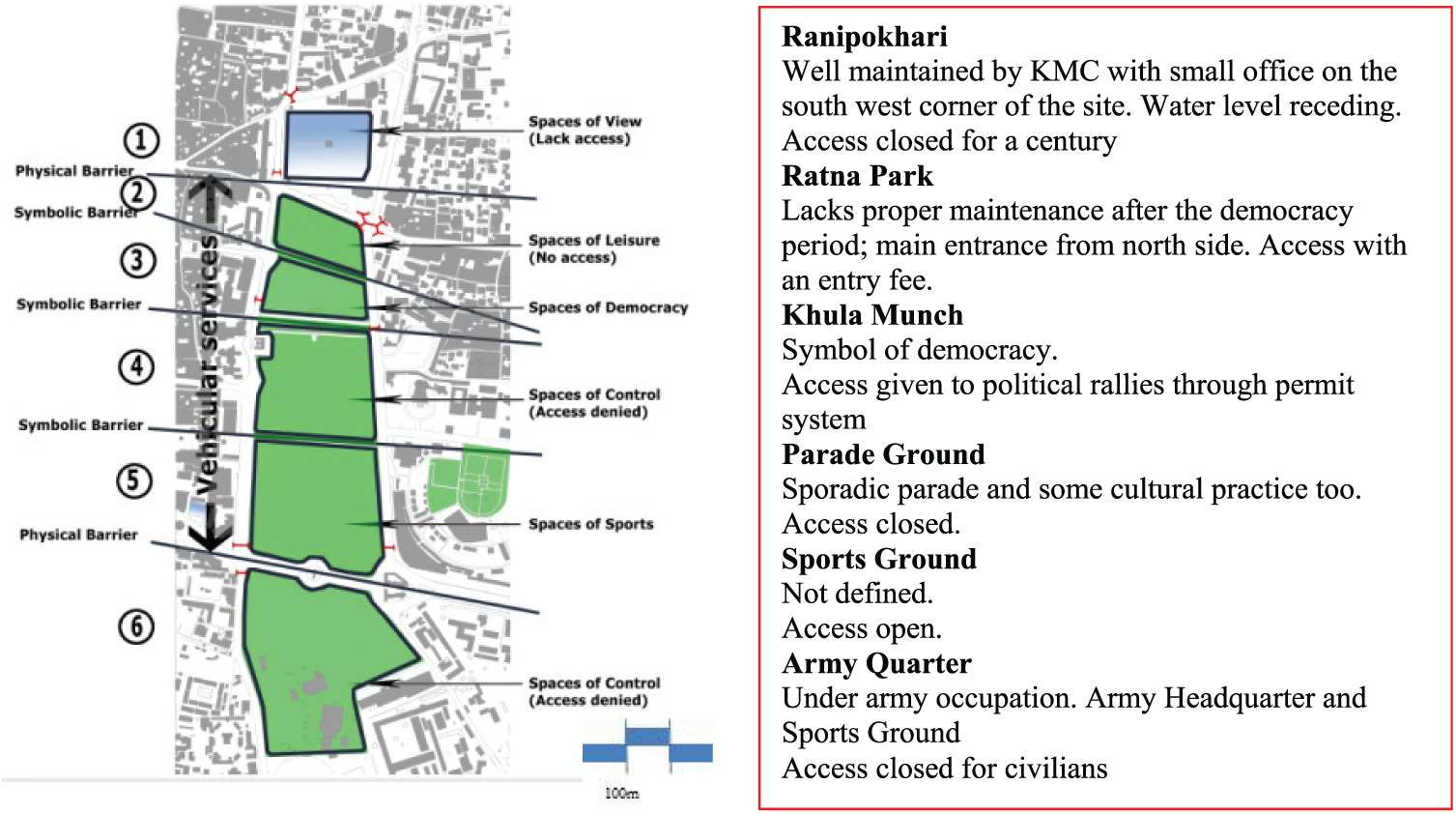
The compartmentalisation of Tundikhel, Kathmandu.
Institutionalisation
Institutionalisation provides a framework to bring resources into the public domain. In a regressive step, it can also introduce control, which reverses this process. In an ideal world, institutions provide basic provision in the interests of all citizens (Mitchell, 1995), closing the gap between the rich and the poor, the privileged and the powerless. In Nepal, historically the state/institution’s role has been minimal in welfare provisions such as healthcare, housing or access to resources and amenities including open spaces, because of budgetary constraints and lack of vision. It is one of the least developed countries in the world, with over 30% population living below the absolute poverty line, earning less than US$14 per person, per month, according to the national living standards survey conducted in 2010–2011. There are regional disparities in the poverty rate ranging from 25% in big cities such as Kathmandu to 50% in some parts of the country. Arguably, the ‘welfare deficit’ fuelled by growing disenchantment with the state and its policies manifested in a ‘democratic deficit’ that Maoists sought to address through the insurgency. While the government response to the insurgency was marked by failure to institutionalise democracy by promoting inclusion, representation and responsiveness (Thapa and Sharma, 2011), the Maoist insurgency had its own economic cost as the state was forced to redirect resources to fight it at the expense of dwindling resources in developmental areas and political organisations such as Kathmandu Municipality. In recent decades, democratic transition was accompanied by the concept of devolution and self-governance guided by the country’s commitment to economic neoliberalism. Donor agencies, which funded up to 30% of the country’s budget, insisted on embracing self-sustenance and wider partnership – a transition marked by the adoption of neoliberalist thinking in state institutions that put organisations such as Kathmandu Metropolitan City (KMC) in the spotlight as they increasingly look for ways to strengthen their institutional role and fiscal capacities. 7 The stage was set with the Local Self Governance Act 1999, which provides wider autonomy and a legal framework for the local governments to take various decisions independently in a more enterprising way that apes the market mechanism, particularly in areas of local taxation, parking permits and licensing. Buildings and open spaces within the Municipality are seen as bankable assets and an apparatus for maximising municipal revenue. Not bound by geography, the expansion of neoliberalisation has taken its own cultural forms, particularly in a context where there is relative fluidity of the urban condition, and ‘surplus’ people who are either poor or indifferent to the state. Going by Hindman’s (2014) account, Kathmandu’s neoliberalism is a ‘DIY capitalism’ that emerged in the post-conflict society and reflects not the return of the proverbial government intervention but a call to survive on your own. For grass-roots the problem is not conflict, but the effect of conflict on people’s lives and livelihood, and a rejection of the state apparatus. The notion of rejection is entrenched in the government machinery as well. The local election has remained suspended for the last 10 years, and as a result, the governing structure in municipal bodies lacks political mandate. For instance, Kathmandu city has not had an elected Mayor since 2006, and the powerful political parties at the centre remain the custodians of public policies and public funds.
Early efforts to institutionalise Tundikhel aimed at appropriating the Royals’ vision to modernise the city. The construction and expansion of perimeter roads resulted in Kathmandu’s first tree-lined boulevard, where social mores and elite values were enacted and embodied. They were the major routes frequently barricaded for visits from foreign dignitaries and sites for religious processions involving the Royals. Subsequently, new features were added in Tundikhel to strengthen the notion of the state as a provider and the people as receivers. The introduction of Ratna Park in 1962, Khula Manch (open assembly) in 1973 and rebuilding of the parade ground (1983) contrasted with the invisible social barrier that historically existed in Tundikhel. However, counter-intuitively this led to the fragmentation of this linear space, creating boundaries and helping to strengthen institutional controls. These efforts brought together two institutions – KMC and the Nepalese Army – with a diametrically opposite vision, purpose and reasons for their existence in instituting shared control and ownership over the space. While not explicitly highlighting the mechanisms underlying such a connection, it can be argued that the imposition of regulatory instruments across different parts of Tundikhel firmly established institutional control over it. For instance, Khula Manch, once a legitimating image for democracy, open to all its citizens, has been re-appropriated with frequent barricading and access restrictions. This space was founded in 1973 by the late King Birendra and conceived as an open-air stage for holding political rallies, public talks and to voice discontentment. The name, signifying symbol of freedom (Khula means open and Manch means platform) was given during one of the most draconian times in the country’s political history. This designation, designed to be viewed as the state’s repudiation of space for interactive, discursive political gathering was, however, a shrewd move that sought to contain the dissent by allocating a central space that is always under surveillance. In 1984, the perimeter roads were widened and Khula Manch was cordoned off, with high fences and police posts created at the entry and egress to make it easy for the police to swoop in at any sign of disorder. The presence of the army at the adjacent parade ground signalled the readiness of the authorities to clamp down on dissent. Khula Manch is, therefore, a quintessential space masterfully crafted by the Royals so that the demonstration or performance of dissent is naturally curbed. This firmly places Khula Manch into what Marvin (2013) calls a ‘presumptive space’, where the state withholds full rights of expression, but conceals this fact for political ends, and power is served by the illusion of public space.
The institutional transgression continued in Ratna Park, which was established some four decades ago, as the only park in the heart of the city. During the conflict period, the park was well used by new migrants and low-income people looking for a place to rest. However, in 2012, KMC abruptly closed the park, citing unauthorised encroachment from informal traders engendering crime and prostitution. What we observed is a new pattern of governance that uses policing and institutional control, not just for reinforcing the historical dimension of ‘control’ legitimised on the grounds of urban surveillance but also to achieve economic gain. Samara (2010) asserts that the use of policing under the new neoliberal governance, in which the understanding and practice of security are closely linked to the growth requirements of the market, raises important questions about the rights and citizenship of the people that call the city their home. The economic drive behind the closure of Ratna Park had been known to all. 8 Accordingly, the park was reopened in August 2015, and in the first month of its reopening KMC collected NRs700,000 (US$6560) (Ojha, 2015). This neoliberal interjection brings the park under the exclusive domain of elite residents, excluding the city’s poor and informal traders or the homeless creating its own lists of gentries who are worthy to be called ‘the public’. Excluded from Ratna Park, the legitimacy of the poor and vulnerable people as the public is held in doubt.The dominant culture thus institutionalises exclusion of particular groups under vastly different conditions and ideology, depriving citizenship of its emancipatory possibilities. The claim that the park has been a haven for drug use and anti-social behaviours, however, not only ignores the possibility of self-correction but also prevents other legitimate political, social and economic functions to take place (Drummond, 2000). In fact, the state-driven silent closure of public space was a feature of the urban landscape long before the culture of urban surveillance and control began. For instance, Rani Pokhari, built in the 16th century (Figure 2), has remained out of bounds for nearly 100 years, with vertical 10-feet-high iron bars obstructing both view and access. On the pond there is a Shiva temple, a Hindu god in the middle, which is accessed from a bridge many have not crossed in this generation. In a strange paradox, the pond, along with the temple and the deity, remain locked up in a society that is frequently energised through Hindu activism. 9 In a city that is famous for its public baths and Dhunge Dharas, 10 Rani Pokhari remains just a visual treat. However inexplicable the reasons might be, the century of restrictions in accessing Rani Pokhari has successfully erased a landmark public space from memory.
The institutionalisation of parts of Tundikhel offers an insight into power relations that create hierarchical spaces in the society, given that the latter is linked with notions of oppression and domination. Against the backdrop of centuries of autocratic rule, democracy in Kathmandu is in its infancy, and it still borrows from the legacy of the past and is rapidly gaining strength. Strangely enough, everything the state does (or not) is ‘Sarkari’ – ‘stately’ – in Nepal. A Sarkari kam is a purpose or action that still carries an impression of being above the law, and this has changed very little in post-conflict Kathmandu.
Militarisation
Tundikhel’s first spatial militarist was the legendary General Bhimsen Thapa. 11 It is said that he had French advisers come to Nepal to train Nepalese soldiers. Over the years, this legacy led the country to become one of the world’s largest troop contributors to UN peacekeeping operations. Barracks were constructed on the east and north sides of Tundikhel, where the Government Employee’s Provident Fund Office now stands, and a foundry was built to manufacture cannons on the southwestern side. The army’s presence first became apparent with the ritual of firing cannon at Tundikhel, every day at 12 noon; however, with the cannon came a military guard and with the guard came a guardhouse, and thus began the occupation by the military.
The militarisation of public space in Kathmandu is a hard reality, legitimised through the historical association of ruling monarchs with the city’s cultural practices and rituals, making military presence in the neighbourhood a common sight. The aspects of royalty and security featured rather strongly in residents’ psyche. The current debate on civilian supremacy over military is the result of the military’s controversial history in curbing democracy 12 (Pathak and Uprety, 2011). In the wake of the Maoist conflict, the ubiquitous presence of the military and the police became a necessary evil as a counterinsurgency to restore law and order, and justifiably so; therefore, it elicited far fewer adverse reactions than would have been expected had this not been the case from the people and the political parties. Both were bestowed with a lot of powers at the expense of civil liberty. 13 Since the ceasefire in 2006, the political events leading up to constitutional crises, instability in governance and frequent threats of ascendancy of paramilitary forces have continued to justify the military presence. Tundikhel today remains the most visible example of urban militarisation justified as a measure to protect the security in urban spaces.
The fact that militarisation embodies imposition of controls using physical features such as barbed wire and high fences sets itself distinctively apart from, let us say, the normative control administered by KMC, discussed in the previous section. The military’s heuristic control and expansion in Tundikhel suggest that hegemony and political subjugation remains alive in public spaces of nascent democracies. The magnitude of military controlled parts of Tundikhel has doubled in the span of the last two decades and now exceeds one-third of Tundikhel. It began with the establishment of army headquarters in the 1980s in the southernmost part of Tundikhel, and subsequently the city witnessed a gradual encroachment of Tundikhel by the army, using clever designations. The spaces went through a transition of being army sports and training grounds, and ultimately the location for new buildings effectively to a muted opposition. In an effort to permanently seize the space, the army has constructed new extensions to its headquarters in Tundikhel, exploiting the loopholes in the legal system. Under the Nepalese law, state agencies (Sarkari offices) are not required to obtain buildings permits from the Municipality prior to the construction of new buildings.
Accurately and precisely assessing the impacts of encroachment is a difficult task, but over time, a question that consistently features in intellectual and civilian forums is why should the military occupy central public space? And why does it not relocate to the periphery of the city, where more land could be available for its extending activities? In 1997, the Birendra International Convention Center in New Baneshwor (now the seat of the Constituent Assembly) was built, relocating the army cantonment. This question points towards the classic feature of military existence that is beset with contradictions. The important role the army has played in counterinsurgency and subsequently internal domestic conflict between those still hung up on the historical legacy (pro-monarchy) and everyone else (anti-monarchy) has led to the army seeing itself playing a prominent role in Nepalese society. On one hand, rebel infiltration continues to pose threats to Kathmandu, and on the other, frequent enforcement of emergency laws, restriction of freedom of movement, etc., have legitimised the army’s penetration into public spaces. In response to the Maoist insurgents using key urban spaces as a material location for hegemonic claims, the army saw the occupation of central areas as being equally important to retain its own symbolic supremacy. Routledge (2010: 1296), in his study of urban protest and democracies in Nepal, asserts that public space is a more hybrid version of the civil society that incorporates elements of both liberal and radical democracy – an integral part of the state and a sphere of hegemony, wherein consent is manufactured (albeit through extremely complex mediums, diverse institutions and constantly changing processes).
The severity of power split and its manifestation in public space in Kathmandu could not be fully comprehended if the historic power of the military was not taken into consideration in the public space discourse. The whole political history of Nepal since medieval times until the abolition of the monarchy in 2008 can be summed up in the powers of the military being elevated through harnessing the autocratic rule of the monarchs. This ‘elevation’ of power underwent spatial manifestation as the military was granted guardianship of some of the strategic monuments and central sites in Kathmandu. The powers of the army remained ‘above the law’, with just one figurehead above them – the King, popularly believed to be the incarnation of Lord Vishnu. Since 1744, the military institution in Nepal was known as The Royal Nepalese Army (RNA). The integration of the military with royalty that existed for centuries displays the characteristics of the triumvirate of nation/religion/king observed in Bangkok. In discussing the power hierarchy in Thailand, Dovey (2001: 268) argues that ‘all forms of political power, including military coups and democratic constitutions, need to honour the triumvirate to succeed’. The triumvirate, however, came to an abrupt end in 2008 with the abolition of the monarchy, and the term ‘Royal’ was subsequently dropped from its name, signifying its new purpose to be the protector of the newfound democracy. The name may have changed, but the army’s loyalty to the aristocrats has remained intact, and with that, their presence in the public space has remained unchanged. In fact, their growing tendency to keep civilians out of the central public space questions their real motives in the new context. Padawangi (2013), in discussing urban activism, states that Jakarta’s Thamrin–Sudirman corridor, which has been the site for public rallies or demonstrations, has been regularly subject to militarisation in order to prevent the ‘unwanted people’ from demonstrating there, particularly during the New Order. Thus, the subjection of public space provision under the authority of the ruling power makes those spaces more prone to becoming celebratory spaces of power and wealth in an unequal society.
In addition to being ‘politically led’, the army’s current role in the socio-political setting in Nepal and its resistance to any diffusion of power should also be seen as being ‘neoliberal-led’. In the recent decade, the military has seen its size grow three times amid widespread budgetary retrenchment. 14 This has meant that the army increasingly faces a compulsion to run its own welfare (its own hospitals and schools) and find different ways to generate revenue. The Nepalese Army already runs commercial ventures (such as petrol pumps, banquet halls and, more recently, garment factories) ( Kathmandu Post, 2016), and is known to harbour real-estate interests. Some see this as an emergence of a new public–private and military partnership as the new paradigm in the new democratic Nepal (Bhandari, 2014). This puts the army into the same existential dilemma as a poorly managed state enterprise searching for new ways to survive.
To sum up, the military acting as the key institution of guardianship, vigilantly preserving law and order, is common across many countries in the Global South. However, what is unique about Kathmandu is that, far from receding into the societal backdrop, while helping the government uphold its intentions, in the process the military uphold their own privileged socio-political status. This, coupled with their tricky organisational existence amid the ongoing political conflict in Nepal and neoliberal penetration, is the major influence in (re)shaping Tundikhel.
Informalisation
Informality in public space is a claim-making process and can be characterised as an eruption of informal activities that can range from informal trading and homeless people living on the streets or public spaces to cars and vehicles parked under the Municipality’s ‘No parking’ sign. They could also be impromptu sports activities or a range of other activities lacking any designated space. In most cities of the Global South, informality regularly intersects with formality. For instance, it is completely accepted that the ‘formal’ use of spaces is controlled to introduce a series of other (informal) activities (political rallies), functions (informal trading zones) or religious parades (such as Durga puja in Kolkata, Gai Jatra in Kathmandu and Ganapati Bappa in Mumbai) for which state institutions do not allocate formal space. Thus, the ‘laws of people’ take precedence over the ‘institutional laws’ as guardians of these public spaces. Ultimately, in the Global South, the publicness of its cities and spaces is measured from the extent, efficiency and effectiveness of these crossovers.
In Kathmandu, there are no designated public spaces, but any space that is not privately owned is called Sarvajanik. Such spaces are mostly state-owned and go beyond their legal definition. Sarva means ‘all’ and Janik means ‘people’ in English, so any space that is accessible to all people is actually Sarvajanik, or Sarvajanik sthala – a place that is ‘accessible to all’. Publicly owned land and spaces tend to be above the law in Nepal, and all, in their capacity as users, are ‘citizens’ and have the same rights over the space. The occupation of such space, by ordinary people, goes beyond the mere behavioural response to the context; it simultaneously shows what Perera (2009: 54) calls ‘a form of adaptation, questioning, resistance, and transformation’. Through observing discursive practices in both sides of the municipal laws, informal rules and norms develop both independently of and in combination with formal rules, making informality part of the institutionalisation process and a strong contender for space. Historically, right through the 1990s, the city saw the Panchayati 15 regime allowing an explosion of informal markets as a mechanism to curb political discontentment brewing under the covert operations of Maoist soldiers. Subsequently, a large swathe of Khula Manch turned into a thriving flea market that catered not just to the crowd gathered for political assemblies but also to the wider public. These markets were fostered under the controlled conditions of the Municipality and in tandem with the democratic movement that revolves around occupancy. The occupancy refers to not just physical space but, as Benjamin (2008: 724) argues, ‘is an appropriation of spaces through the “embedding” of municipal government into popular society. Such practices fuel an autonomous political process at the municipal level that reflects a new alliance and coalition politics’.
Following the political ceasefire in 2006, KMC moved to regularise the city’s public spaces as part of the city’s environmental improvements and beautification programme. 16 KMC’s subsequent move to ban informal markets from Tundikhel was fiercely contested by two principal groups – Nepal Street Vendors Association and Street Market Association. The conjoined organisations resulted in the development of a powerful informal force, often supported by the left-wing politicians who were promoting the rights of the informal traders. While such resistance recognises that the informal actors are here to stay and somehow need to be made part of the new democracy, their access to Tundikhel is dependent on the strength of their negotiation with KMC. Benjamin (2008) aptly calls it vote bank politics in his study of Indian cities such as Bangalore and Delhi. The power dynamics are not always visibly manifested, but as Appadurai (2001: 42) argues, informal actors also build deep democracies through their organisation and development of temporary infrastructure. Such democracies and infrastructure are regularly ruptured in Tundikhel as informal vendors are denied access to public spaces, relegating them to the footpaths of the perimeter roads. A string of informal vendors is visible on the periphery, waiting to lay their claim on Tundikhel. The testimonies from vendors located in Tundikhel reveal a concern with livelihood strategies dependent on the locational value of Tundikhel.
Paradoxically, the process of eviction and encroachment may have been cyclical, the process itself is random and the outcome unpredictable. Brown’s (2004) study of street traders in Kathmandu observed an uneasy relation with Municipal police who at times evict and at other times demand payment at cut price. Under such circumstances, power is associated with domination, and the Municipal police becomes yet another actor of such statutory instrument. Brown et al. (2010) argue about the role of the Municipal police in the enforcement of law, questioning to what extent such enforcement is apparent harassment and institutional policy as a livelihood strategy for the underpaid officials. Their act of taking money from the poor in the form of weekly or daily haftas 17 should be seen as quasi-legal exchanges where multiple rationalised self-interests go hand in hand in the form of bribery and harassment as a by-product of institutionalisation and the state’s interests in ‘control’ and ‘surveillance’.
Evicted traders keep returning to Tundikhel, each time better equipped and skilled, to defy Municipal regulations and operate illegally across major thoroughfares. Most recently on 14 April 2014, the Municipality issued a public notice urging all vendors to keep off Tundikhel, and active policing began. Kumar Sapkota, Chair of Self-employed Traders Association, laments the eviction of traders without a realistic alternative. He asserts, ‘Street vendors who are self-employed traders should not be evicted without a long-term alternative. There are 30,000 vendors in the capital of which 15,000 are women. They should not be evicted without a long-term alternative’ (Kathmandu Post, 2014). Thus, informality is increasingly a formidable contender for the public space within the contested dimension, operating in close entanglement with statutory institutions. Situated at the verge of legality, informality is constantly intertwined with the Municipal law and is at the discretion of the political, institutional or military power. In a strange paradox, KMC is yet to devise a policy on the use of, or what can be accommodated in, the public space and very often, operate in an ad hoc manner. 18 Arguably, in Kathmandu, informality is understood not just as a mode of the ‘ordinary’, but it has equally accommodated an elite informality carried out often in complicity with statutory institutions.
Urban rupturing: (Un)making of public space
Democracy or lack of it is manifested in the city’s public spaces. In the process of restoring democracy in Nepal, the city has moved from war to peace, from monarchy to republicanism, from being a Hindu state to secularism and from a unitary to potentially a federal state in the last two decades (Jha, 2016). This transformation is ongoing and far from complete. Episodically, political cadres along with their leaders besiege the city and its epicentre, Tundikhel. The military steps in with barbed wire and batons. The ensuing struggle ends with an announcement by the Chief Executive of KMC, who claims Khula Manch has been closed for an indefinite period. Such framing of contemporary spatial politics in everyday life displays the confluence of three historically unique and intersecting powers of modalities: institutionalisation, militarisation and informalisation as described in the previous section underpinned Tundikhel’s transformation. Institutionalisation of parts of Tundikhel offers us insights into power relations that create hierarchical spaces in the society. As an example of ‘exclusionary’ space, pockets of Tundikhel have embodied urban relegation from their role as being prime social spaces to spaces within which militarisation is being articulated and somewhat reinforced. On the other hand, situated at the verge of legality and at the margin, informality is constantly entangled with the Municipal law, well within the force field of Tundikhel. Drawing the three processes together to understand their transformative impact on Tundikhel seemingly presents many challenges. These challenges are conflicting because each process offers unique perspective on Tundikhel as observed in Marvin’s (2013) Tibetan ‘porous space’ or Benjamin’s (2008) ‘occupancy urbanism’ or Hackenbroch’s (2013) ‘organized encroachment of the powerful’. Since public space is never homogeneous, ‘the dimensions and extent of its publicness are highly differentiated from instance to instance’ (Smith and Low, 2006: 3) and require wider study. Our study shows that together these processes point to the complexity around Tundikhel’s transformation that is not easily explained by individual perspective. This complexity relates not only to the specific and limited form of democracy that prevails in Tundikhel but also to how a differentiated power structure is determining access and control, staking claims, disrupting activities and ultimately rupturing the space. The forces at play are both individual and institutional, formal and informal, civil and military. As a contemporary urban space that enables the contestation of power relations (Routledge, 1994, 2010), Tundikhel has become a physical space that itself is being contested.
The paper argues that the confluence of the three dominant modalities of power results in what I call ‘spatial estrangement’ – a process of (un)making of public spaces through ‘urban rupturing’. The evolution of ‘rupturing’ is evident first in the ‘fragmentation’ of public space, both physical and symbolic. Today, only one-sixth of Tundikhel is open to the public (see Figure 3), while other pockets of Tundikhel remain symbolic sterile spaces, under either institutional or military control. Barbed wire, high iron gates, army patrols and Municipal wardens create boundaries and prevent access. It is no longer a pure, autonomous repository of power, people or institutions but instead divided with boundaries and infested with significant apathy among the city’s informal groups that are forced to sit just outside the boundary. These spaces are adorned with hard boundaries that are quite defensive and lacking in civic engagement, showing the state’s approach to treating public space in the same way as buildings or objects – assigning territories and boundaries that ignore the culturally shaped organic relations that existed for centuries. Sennett’s (2006) explanation to define edges is pertinent here, which states that they are of two kinds – boundaries and borders. A boundary is an edge where things end; a border is an edge where different groups interact. At borders, organisms become more interactive, porous membranes because of the meeting of different species or physical conditions. A boundary is a guarded territory where no transgression takes place. Tundikhel witnessed borders morphing into boundaries to compartmentalise the space into six pockets of various degree of control that are both political and institutional. Ironically, these boundaries, once the hallmark of the conflict period, are being naturalised. The army’s constant presence generates fear, dominating both public space and the everyday life of civilians. Paradoxically, on one hand, the new government-translated democratic ideas are embodied in swatantra-sarbajanik (which translates as free-public) dialectic, and on the other, they reproduce the authoritarian state’s administrative habits and procedures (particularly from the time of the absolute monarchy) to realise law and order through the army. Current democratic deliberation pays a great deal of attention to controlling, dividing, and ruling but overlooks the balance between good governance and authority.
Beyond fragmentation, there are efforts to assign a sense of ‘permanence’ that takes the ‘rupturing process’ to the next level. By allocating specific use(s) and erecting structures, the ‘publicness’ is permanently taken away from Tundikhel, restricting social interaction, constraining individual liberties and excluding the public, or public activities. The apparent imperviousness and impermeability across different pockets create spaces with new spatial identities that set them apart from the historic Tundikhel, which was ‘one large space’. A large part of Tundikhel is already built up by the Nepalese Army, while in recent years new elitist outfits such as Hindu religious groups have built permanent structures. A creeping elitism in public space resonates Hackenbroch’s (2013) ‘organised encroachment’ for which state colludes with institutions that may not always have the public interest in mind. Further, the neoliberal ambition of the current government (from the state’s claims in ownership to introduction of entry fee in Ratna Park) reproduces that class hierarchy and governs who is allowed access and who is denied it. Thus, at the mezzanine level of the confluence of the triumvirate, we observe a tension between the formal regime and informality, a battle of access and privilege and luxury and livelihood. Ultimately, this urban rupturing points to the possible disconnection of Tundikhel from the city, its history and wider culture. This ongoing process has the power to erase the history and legacy of the space from the public memory such that the public space is not recognisable anymore. These phenomena are manifested by different multiple actions: eradication of structure/ buildings, adding fences and changing activities. The prolonged imposition of ‘control’ is, therefore, a condition which leads to an urban amnesia towards the city’s history. In Tundikhel, Rani Pokhari’s access restriction and muted opposition epitomises how spatial rupturing leads to the material deletion of public space from the public mind. The amnesia is all the more troubling since its mutilations are ignored and its role in the city’s urbanism rapidly loses relevance. Tundikhel was originally three miles in length and 300 yards in width, spreading from Rani Pokhari to Dasharath Stadium. Major parts of Tundikhel are now permanently lost through various developments and ever widening perimeter roads, barriers and iron gates restricting access and rupturing the space. Ironically, space has shrunk by more than half in just 40 years, a fact that is deleted from the minds of the generation that is old enough to remember the past.
To conclude, the paper informs the current debates on whether the public space in the Global South is quintessentially public. It argues that Tundikhel remains tightly controlled by the interplay of the three dominant modalities of power, and this in part reflects the traditional social values and notions that uphold denial, restriction and oppression in the use of public space. The paper advocates that judging by the ambition, depth and extent of impact, the confluence of dominant modalities of power assumes a hegemonic character powerful enough to trigger fundamental shifts in the processes and relationships through which public space is fragmented, modified and eventually deleted from the memory – a phenomenon of urban rupturing. The paper contends that hypocrisy is inherent in the public space agenda in Kathmandu witnessed through a gradual decline in the publicness of Tundikhel amid organised claims and interventions borne out of an urban condition that not only maligns the public space agenda but also creeps into other spheres of urban development. Finally, this empirical study exposes the limits to the specific form of democracy that people enjoy (or suffer) in contemporary Kathmandu. Perhaps it also inspires us to push those limits, sending warning signals to other cities in the Global South with similar contexts. What is needed is an understanding of the distinctive nature and range of possibilities in public spaces in cities of the Global South. The true benefits of public space thus lie in its becoming not just public but a place.
Footnotes
Acknowledgements
The author is grateful to Professor Bharat Sharma and Professor Bijaya Shrestha for offering their insights and comments at various stages of the project. A special thanks to Architect Shyam Sunder Kawan for providing the field support. The author would also like to thank the anonymous reviewers for their comments on the earlier drafts of the paper. The views expressed here are those of the author.
Funding
The research was funded by the British Academy/The Leverhulme Trust and Sir Ernest Cassel Educational Trust Fund (Grant No.: SG133061).