




Abstract
Urban redevelopment in Korea has worked effectively as new-build, high-rise gentrification, since it is directly connected with social upgrading as a result of the improvement of the physical environment. This research attempts to explain the role of place entrepreneurs, especially property owners, in urban redevelopment and unravel key factors and their relationship to such redevelopment. The formation and nature of pro-gentrification coalitions is explored through a case study conducted in Yongsan, Seoul. Urban redevelopment processes have been primarily governed by the exchange value interests of property owners. Absentee landlords comprise the majority of property owners who have played the role of speculative investors. Even though owner-occupiers know they cannot afford to return after urban redevelopment, they do not strongly oppose urban redevelopment as long as they can share in urban redevelopment profit. To sum up, property owners play an important role as developers in the Korean urban redevelopment system and they accelerate gentrification.
Introduction
Continuous urban redevelopment policies in East Asia have reinvested capital in under-invested areas, and high-rise luxury condominium blocks have replaced existing buildings following wholesale demolition (Jou et al., 2016; Wang and Lau, 2009) . This has caused the movement of middle- or higher-income groups into the area and the displacement of the existing low-income residents. In terms of space, form and actors, urban redevelopment in East Asia and gentrification in the West appear to be distinct phenomena (Waley, 2016). However, it is becoming harder to separate traditional gentrification, which involves the rehabilitation of existing housing, from redevelopment facilitated by new construction (Davidson and Lees, 2005). In addition, gentrification has many mutations and the meaning of the term has been expanded. Having considered Clark’s (2005: 258) definition of gentrification – ‘a process involving a change in the population of land-users such that the new users are of a higher socio-economic status than the previous users, together with an associated change in the built environment through a reinvestment in fixed capital’ – urban redevelopment has worked perfectly as a form of new-build gentrification in East Asia. This is very clearly seen in terms of the extensive growth of high-rise flat redevelopment in East Asia, which can be closely linked to gentrification (Shin et al., 2016). East Asian gentrification is much closer to new-build gentrification than the classic type of gentrification observed in the West.
The state in East Asia has facilitated urban redevelopment for the purposes of capital accumulation. The state has been in favour of this urban redevelopment process to promote gentrification for economic and urban growth. The strong role of the state in gentrification is overt in East Asian cities such as Shanghai (He, 2007), Hong Kong (La Grange and Pretorius, 2016), Tokyo (Cybriwsky, 2011) and of course Seoul (Shin and Kim, 2016). The existing research has provided conceptual explanations of gentrification by urban redevelopment and more recent research has enriched theoretical discussion on gentrification in the Global East (Shin et al., 2016). However, there are few recent and in-depth empirical studies addressing how urban redevelopments have been run in practice as gentrification. Also, research into the relationship between gentrification and property owners has been insufficient. Although the state has played a critical role in East Asian gentrification, it is important to pay attention to the role of property owners, since gentrification in East Asia is based on a mechanism that Ley and Teo (2014: 1289) termed ‘aspiration for improved housing’.
In reflecting on the effects of property-based interest groups in gentrification, this paper sheds light on place entrepreneurs’ attempts to initiate urban redevelopment. The intention is to contribute to further research into the characteristics of gentrification in Korea, with the focus being on the role of property owners and their subjective experiences with regard to the process of gentrification. One urban redevelopment area in Yongsan is used to investigate how a number of different property-based interests have been brought together and made to work. Interviews and observational data are used to examine how each interest has helped to reshape urban redevelopment politics. In order to achieve this, the next section examines how urban politics has dealt with spatial development and housing policies in Korea. The third section explains the data collection methods and the background of the case study area. The fourth section explores the formation and mobilisation of pro-gentrification coalitions in Seoul. This also gives voices to people who have been overlooked in existing literature: silent and passive owner-occupiers. Understanding these passive and silent parties gives additional insights into how the Korean profit-driven urban redevelopment systems have facilitated gentrification. The final section concludes the paper and outlines its contribution to wider research.
Urban restructuring and housing in the Korean developmental state
As the developmental state in East Asia has dominated the process of industrialisation and economic growth, it has played a critical role in urban restructuring. This developmental path has created the East Asian urban development model and housing culture. Under the auspices of the developmental state, urban and housing policies in East Asia have been used as vehicles for the promotion of state-led industrialisation (Doling, 1999; Lee, 2003; Shin, 2011). The developmental states have promoted the urban built environment and created infrastructure to drive compressed economic growth in the form of East Asian growth machines. As a result, the real estate sector has become crucial to economic growth in East Asia.
The growth-orientated states in East Asia have intervened in various social welfare policies, including housing. Holliday (2000: 709) distinguishes the East Asian welfare system from the Esping-Andersen approach adopted in Western countries, and dubs the East Asian welfare model ‘productivist welfare capitalism’. Holliday’s argument is that social investment is a means of achieving elements of economic growth, and he also suggests that states have a responsibility to ensure social welfare in a residual way. By contrast, in the East Asian welfare model, the market and family have played a vital role in welfare provision. The social welfare system in East Asia is not fully developed, and therefore housing has been important because a house can be considered a substitute for a pension (Ronald and Doling, 2010). This distinct East Asian housing culture has been shaped by economic growth-orientated housing policies (Park, 1998). The state has facilitated homeownership and adopted pro-market policies in order to promote the property sector for the purposes of economic growth. Under the commodified housing market system, homeowners have seen huge returns from their homeownership, and non-homeowners have developed strong aspirations for homeownership after witnessing homeowners’ capital gains. Lee et al. (2003: 41) argued that, in this environment: The development of the sector [homeownership] has been intimately connected with broader strategies of economic growth and development and in all cases home buying has formed a major element of the growth machine.
This helps to explain why many existing owners in Korea are keen to see their area redeveloped. The Korean developmental state, aiming for rapid modernisation and economic growth, regarded the city as a growth machine and has conducted urban redevelopment projects to foster economic growth. The close affinity between economic growth and housing policies has important consequences, and leads to socio-political stability, economic outcomes and the creation of a social welfare structure (Ronald and Kyung, 2013). In particular, the emerging middle class and their desire for having decent living standards and displaying their wealth through condominium ownership led to large-scale high-rise flat redevelopment in Korea in the 1980s (Lim, 2005). This saw the mass construction of high-rise flats and extensive speculation around homeownership and capital accumulation.
Although the Korean urban planning system has been totally dominated by the state, the state has not used its planning authority to distribute urban resources equally. Instead, it has created urban redevelopment policies that meet political interests and relieve it of its responsibility to provide housing and a universal social welfare system. The state has used its planning powers against the actual needs of the majority of residents in urban redevelopment areas, since urban redevelopment was designed to decrease the number of existing housing units and increase the number of high-quality, large and more expensive housing units (Ha, 2010). Without the designation of urban redevelopment districts and zoning changes by the state, property owners are not able to transform their shabby houses into high-rise flats and increase the exchange value of their properties. They can only refurbish or rebuild their own house for its use value, and would not earn a large exchange value.
These urban planning policies have led to the creation of pro-redevelopment coalitions consisting of the state, property owners and potential buyers (Chang, 1989). In contrast, the majority of residents and users of redeveloped areas are displaced from their homes and neighbourhoods and excluded from redevelopment profits. Instead of the state directly running and funding urban redevelopment, property owners in urban redevelopment areas drive urban redevelopment plans according to the wishes of the state. The pro-redevelopment coalitions have considerable power to acquire land and clear old housing for the construction of new flats, and to actively displace existing low-income residents in favour of high-income newcomers (Lee, 2016). Urban redevelopment transforms neighbourhoods from areas with affordable housing into expensive high-rise flat complexes for middle- or upper-middle-income households who can afford to pay for the flats (Lee, 2016). As a result, urban redevelopment has caused wealth to be concentrated in a few people and a few places, and socio-spatial polarisation has become more marked since exchange value has been promoted by pro-redevelopment coalitions over use value. This Korean urban redevelopment can be considered ‘endogenous gentrification’ (Ha, 2015). In conclusion, this transformation can be viewed as state-led or state-facilitated gentrification.
Research design
Methodology
In facilitating a case study with a mixed-method approach, data collection was conducted during six months of fieldwork in Seoul between June and December 2012. During the data collection period, the property owners association for redevelopment (hereafter POAR) 1 within the case study area held its first inaugural assembly on 22 September 2012. It was a very important meeting for property owners, since they made decisions on their board members, architects, annual budget and so on. This observation was very valuable in terms of understanding how the association functions and how property owners and their contractors work together. This observation and the interviews with 13 residents (including property owners and tenants in this area) offered pro-gentrification coalitions’ views. I mainly selected materials from interviews with property owners, since they are the key players. Two property owners hold positions of power within the POAR, which is one of the key institutions within this research. The leaders and board members in the POAR are directly involved in running urban redevelopment processes in practice. They are indeed ‘elites’ who exercise power in matters of urban redevelopment, in the same way as entrepreneurs run their businesses. Along with residents, five experts (such as urban planners and real estate agents) whom I interviewed offered in-depth knowledge based on their experience, so the interviews with them provided general and comparable insights. It was relatively easy to arrange interviews with such experts, since many of them are clearly identifiable. Interviewees were found through the snowballing method, developing relationships and taking opportunities. By contrast, it was not easy to find residents from the case study area to interview. In order to recruit interviewees from the existing residents in the case study area, I had no alternative but to knock on doors.
The most important documents covering how each urban redevelopment project is run in practice are produced and kept by POARs. The POAR records all information relating to the process of redevelopment from beginning to end, such as how much compensation it gives to tenants and how much profit it will make from the redevelopment project. These documents from the POAR are a potentially rich source of information when investigating the roles of the key actors and their relationships to one another. I succeeded in obtaining these documents and utilised this information to analyse how urban redevelopment has evolved and who has been involved.
Yongsan: A gentrifying neighbourhood
Since the early 2000s, new high-rise flats have been erected in Yongsan. Although Yongsan is an area close to the central business district of Seoul, the area deteriorated because of the huge rail yards and the US army base located in the middle of the district. However, after the relocation of these two facilities out of Yongsan was decided in the 1990s, many urban redevelopment projects have been planned and progressed. Yongsan has become attractive to high-income households and has received attention because of its new-build residential developments. In the meantime, Yongsan has been on the front line of the anti-urban redevelopment movement. On 20 January 2009 in Yongsan, 30 people protested against urban redevelopment-led eviction. They were suppressed by police and six people, including one policeman, lost their lives. This incident, referred to as the Yongsan disaster or tragedy, is regarded as the definitive national turning point for urban redevelopment. Yongsan has become the key symbol of urban redevelopment interests, property policies and the wider, long-lasting problems with regard to the Korean urban redevelopment system (Lee, forthcoming). After this incident, many residents in proposed urban redevelopment areas all around Seoul established their own organisations and have initiated collective strategies to prevent more gentrification in their neighbourhood. Despite this, no significant movements in the Yongsan urban redevelopment area have taken place since the Yongsan incident, and people in this area have been moving away from their neighbourhood. I therefore considered the Hangangro urban redevelopment area (hereafter Hangangro), which is facing gentrification (Figure 1) and is located near the place of the Yongsan incident. Researching this area gives insight into who plays a pivotal role in redevelopment and its facilitation, and helps us to understand how the key actors affect the characteristics of gentrification in Korea.

The case study area.
About 90% of housing (235 of 267 units) in Hangangro are deemed to be in bad condition (as shown in Figure 2), with most of the buildings there having been built before 1970. Many of the buildings are old, and property owners have not refurbished their properties properly since they have assumed that their area will be designated for urban redevelopment. In addition, the initial urban redevelopment plan for this area was decided in 2004, 2 so property owners have not been looking after their properties since then. Since the current housing is old and in poor condition, it is relatively cheap to rent considering its prime location. For example, the monthly rent of a 42.9 m2 housing unit in this area was US$250, 3 with a US$4166 deposit, in December 2012. New high-rise flats of a similar size located opposite Hangangro were rented out for US$583, with a US$8333 deposit. The land on which the buildings are located has a high potential value, since it can be transformed for the ‘highest and best use’ (Smith, 1979: 543). In fact, after the urban redevelopment plan to build super-high-rise flats in this area was released in 2011, the land price per square metre doubled from US$3625 to US$7825 4 in one year (Onnara, 2012). In order to exploit this rent gap, property owners in Hangangro established a POAR in 2012 and have driven the urban redevelopment plan.
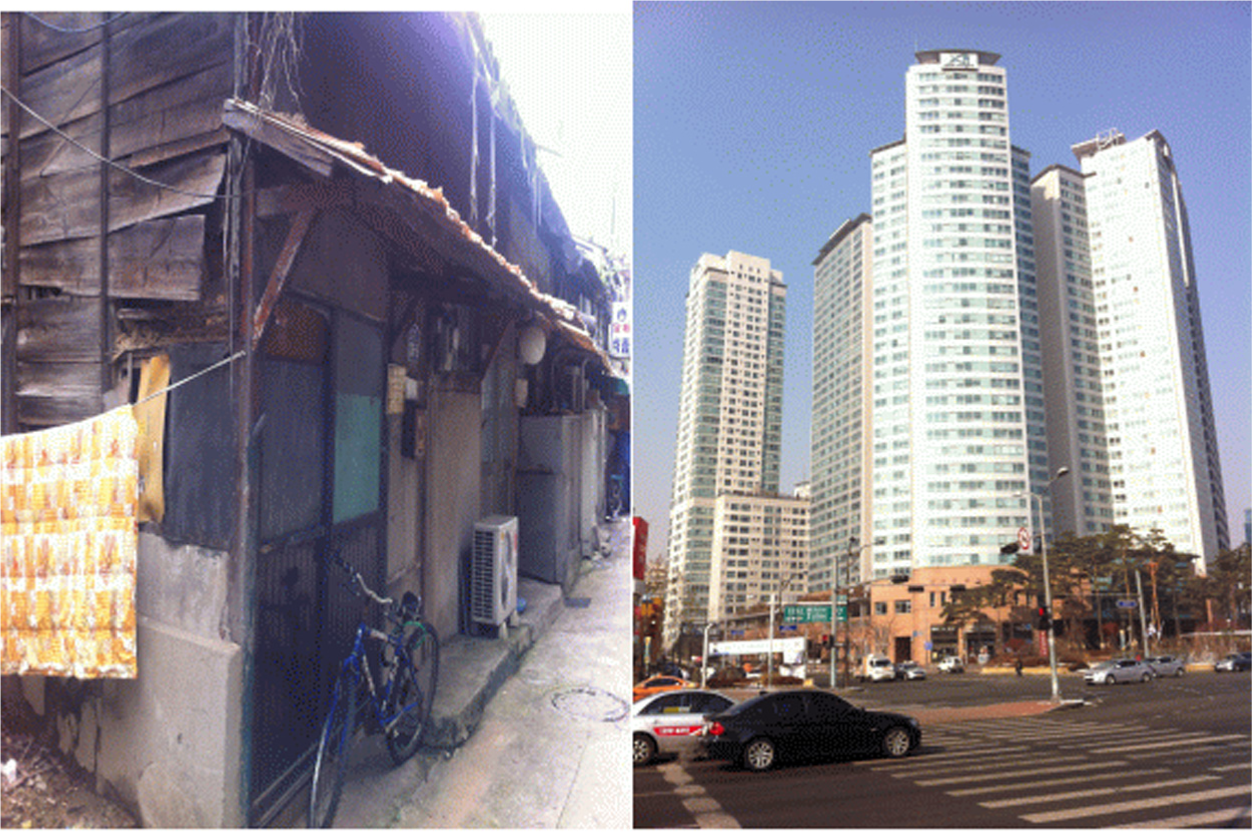
Present housing in Hangangro and new high-rise flats opposite Hangangro (author’s copyright).
Under the current plan by the Yongsan Gu 5 Government, 406 new housing units are going to be built, even though 468 households currently live in Hangangro (Table 1). This decrease in the housing stock shows that 90% of tenants in Hangangro have no chance of returning. Even if they are given a chance to return they cannot afford to, since most of the newly built housing is designed as large-scale units intended for sale (unlike the current housing). There are no plans to build smaller housing units besides the compulsory social housing stock (44 units) in the current urban redevelopment plan. About 80% of the new housing units are planned to be over 99 m2, which is generally considered the threshold size for middle-class housing (Kim, 2011a). The Hangangro POAR (hereafter HPOAR) proposed the estimated price of the new housing (Table 2) and the price is almost the same as that of the most expensive housing complexes in Seoul.
The current composition of ownership.
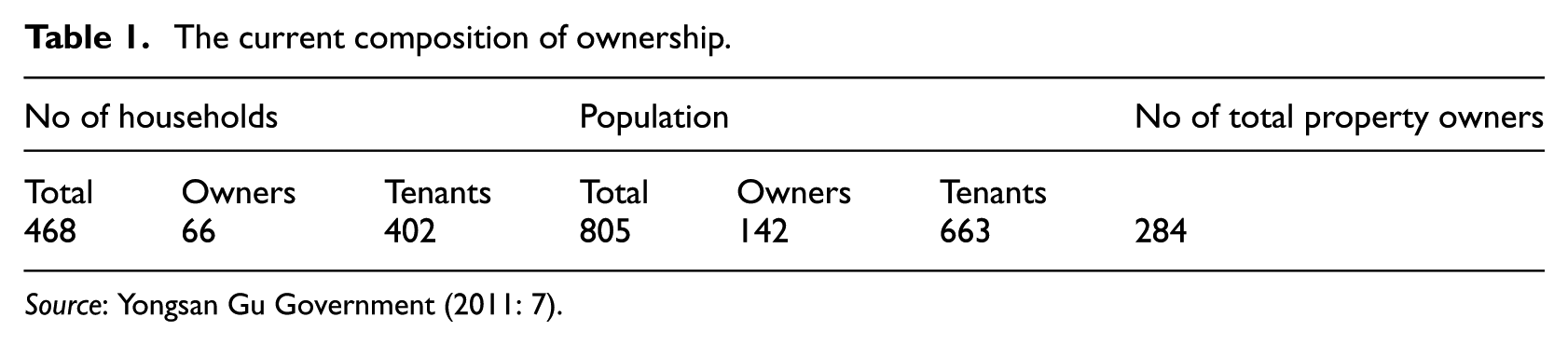
Source: Yongsan Gu Government (2011: 7).
The proposed price of new housing in Hangangro.

Note: The average housing price to household income ratio (PIR) was 7.6 in 2012 (10.1 in Seoul metropolitan areas). The PIR for the bottom 40 per cent of urban households in the income distribution was 11.3 in the same year, but 5.4 for the top 20 per cent of urban households (LHI 2012).
Most new properties are large and expensive. Low-income owner-occupiers and small-property owner-occupiers cannot therefore afford to own these properties, since they need to pay more than their current homes are worth. Urban redevelopment plans are designed to push low-income owner-occupiers into selling their properties and moving out. In fact, this particular urban redevelopment plan is skewed in favour of gentrification. After urban redevelopment, Hangangro will be totally different, with new housing and new residents.
The forming and mobilisation of pro-gentrification coalitions
The average duration of urban redevelopment in Seoul is reported to be 10.6 years from start to finish (
Dong-A Daily, 2012). The annual budget to run the HPOAR is about US$250,000 (HPOAR, 2012: 182). The HPOAR has calculated the costs and benefits of its urban redevelopment business. The total cost would be US$30.1 million, and the estimated net income would be US$4.6 million (HPOAR, 2012: 163–166). They would make huge profits from urban redevelopment, but only about US$1.43 million is allocated for tenants’ legal compensation. Under these circumstances, the HPOAR needs to do its best to shorten the time required for the redevelopment in order to minimise spending and maximise profits: Time is money, so I will do my best to finish this redevelopment business as soon as possible. I do not want to delay our business like the Yongsan incident. I will push forward this redevelopment business rapidly. (A leader of the HPOAR in his 70s, interviewed on 20 August 2012)
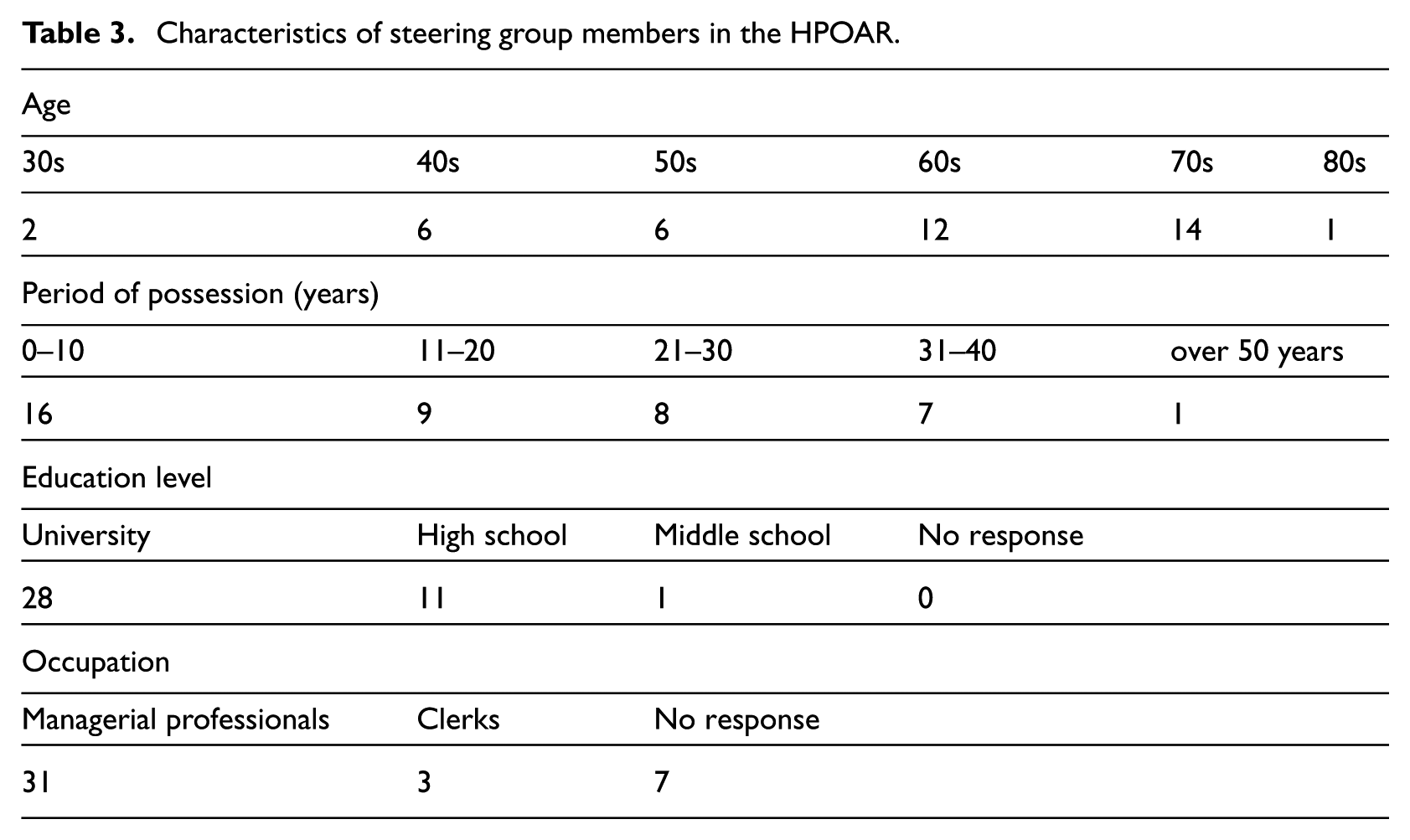
As this leader of the HPOAR noted, an urban redevelopment project is a property owner’s ‘business’ and is meant to earn them money. Property owners play an important role as developers in the Korean urban redevelopment system, just as professional developers and capital interest groups do in the West. The most important actors in urban redevelopment are the board and committee members of the steering group. Even though property owners decide the most important matters by voting, the steering group is responsible for managing the process (contracting with subcontractors and negotiating with the local state) on behalf of all the property owners. It is thus necessary to examine who they are, since they are more in favour of urban redevelopment than other property owners and also influence other property owners’ opinions.
In Hangangro, 41 of the 284 property owners were elected members of the steering group. As Table 3 shows, about seven in ten owners are over 60 years old. Of the 41 property owners, 28 have been through higher education and most of them have (or had) professional or managerial jobs. This figure is much higher than the national average for this demographic. Most of them have run their own companies or shops, and seven currently have jobs relevant to the construction and property sectors. The average property size in Hangangro is about 90 m2, but that of members of the steering group is much higher than the average size. This implies that pro-gentrification property owners are largely middle class.
Characteristics of steering group members in the HPOAR.
The high ratio of absentee landlords and their profiteering
Of the 29 absentee landlords, 14 bought their properties just after the redevelopment plan was decided. They are therefore unlikely to have any sense of community or psychological attachment to the place. They are more interested in exchange value than use value. Most of the absentee landlords are already living in flats in middle-class or upper-middle-class areas. This indicates that affluent absentee landlords bought their properties as an investment after the development proposal was put forward. For example, one absentee landlord lives at the most expensive address in Korea and bought 90 m2 of land and a 54-year-old house for US$137,500 in September 2008 – he has not rented it out. This strongly suggests that he invested this huge amount of money in land in Hangangro as he expected to profit from the redevelopment. Absentee landlords are likely to push for profit for speculative investors rather than end users. About 80% of property owners in Hangangro are absentee landlords. This high percentage of absentee landlords greatly influences the views of the POAR, as urban redevelopment becomes a profit-maximising business. The main interest of absentee landlords is in reaping high economic benefits, and this was observed at the first inaugural assembly. Absentee landlords expressed their opinions as follows.
According to the book provided by the POAR, our new flat complex will be on the market in early 2013. I suppose that economic depression will not have improved after six months. People are not willing to buy housing at the moment. If there is not enough improvement in the economy next year, we are likely to have difficulties selling our flats to new buyers. In that case, we cannot avoid carrying an extra financial burden. The success of this redevelopment project totally depends on how much we sell our new flats for. (A male absentee landlord in his 60s observed in the first inaugural assembly)
The questionnaire for all property owners conducted by the HPOAR shows that half of the property owners want their flats to be over 132 m2. This can be related to the high proportion of absentee landlords. Absentee landlords can afford – and indeed prefer – larger flats, but small-property owners and low-income property owners struggle to keep their properties when new housing is built in the form of large flats. The law states that the most important decisions regarding urban redevelopment have to obtain over 50% agreement from property owners, but this clause does not protect the minority. Even if all owner-occupiers in Hangangro oppose urban redevelopment, nothing would change since they make up only 20% of property owners. Structurally, there is no way to protect owner-occupiers who do not want urban redevelopment when absentee landlords and pro-redevelopment owner-occupiers are actively promoting it.
Property owners have the right to express their opinions regardless of whether they are in favour of or against urban redevelopment. Nevertheless, it is not easy to collect together hundreds of people for a meeting, so the first inaugural assembly of the HPOAR, at which I was present, represented a good opportunity for property owners standing against urban redevelopment to raise issues and put questions to the POAR in front of many other property owners. However, the POAR did not seem to be approachable or happy to hear any views that threatened to affect the speed of their business operations. When I was at the first inaugural assembly of the HPOAR, some property owners expressed different opinions from the POAR and wanted to discuss the issues they raised. However, their issues were not debated openly. The assembly was dominated by the steering group, which is firmly pro-urban redevelopment: 41 of the 62 attendees were from the steering group. There is no place for opposition in the current urban redevelopment system. Urban redevelopment is highly controlled by speculative interests. Much unfairness is woven into the urban redevelopment system in Korea, so owner-occupiers are likely to lose their social, political and economic rights because of urban redevelopment. Owner-occupiers against urban redevelopment have limited means with which they can change their future when the majority of property owners – often speculative absentee landlords – agree.
Owner-occupiers and redevelopment
Unlike absentee landlords, owner-occupiers tend to have lived in the area longer and are more likely to have community ties or some sort of sentimental attachment to the neighbourhood. However, many of them still tend to be profit seekers. They seem fine with leaving their property and community as long as they get a share of the urban redevelopment profits.
I have been living here and running a small restaurant for 30 years. Actually, many people sold their properties two to three years ago, when urban redevelopment plans were decided. One of my neighbours sold his property for US$33,333 per pyung
6
two years ago; it was a bit less than others got previously. Some people have said that now we could not get more than US$33,333 for one pyung due to the economic recession, but I think I can get more than that, as the urban redevelopment project is in progress. Someone paid that amount of money, which means they were sure that they would earn more money from their investment. Therefore, I agree with this urban redevelopment. (An owner-occupier in her 60s interviewed on 20 September 2012)
In these circumstances, urban redevelopment has turned into a speculative private business instead of a public business. Owner-occupiers and absentee landlords have been trying to maximise their profits after the establishment of the POAR, but not all property owners will be able to live in the new housing. One leader of the HPOAR is well aware of this: Probably about 10% of owner-occupiers can afford to return and live in this area after redevelopment. This area is going to be transformed into a super-high-rise luxury flat complex, so the standard of living is going to be totally different. At the moment, utility bills and maintenance costs are not expensive, but we would have to pay much more money for those when we live in a new flat. So, it is much better for them to sell their property in due course and move to somewhere else. When they sell their property, they can buy a bigger house with that money. Actually, about 50% of all property owners are already new. In contrast, it is highly likely that new absentee landlords can move into a new flat since they can afford to do it. (A leader of the HPOAR in his 70s interviewed on 10 October 2012)
In fact, property owners start selling their properties when urban redevelopment plans are still being discussed. When an urban redevelopment plan is in progress, more properties are sold to outsiders. According to Kim (2011b: 92), 60% of all property owners in one redevelopment area sold their properties during the urban redevelopment process. In particular, one in two property owners sold their property between the time the urban redevelopment plan was decided and the time their POAR was established. Choi et al. (2009: 414) analysed that the occupancy rate of absentee landlords is 1.53 times higher than that of owner-occupiers after urban redevelopment, and found the period of residence to be a negative determinant. The large size of the new housing units can displace even owner-occupiers that previously lived in small properties and owners on a low income. This is one reason why owner-occupiers’ return rate is lower than that of absentee landlords. Owner-occupiers whom I interviewed already knew that they would not be able to return: I do not think I can afford it, since the new housing is going to be too expensive. In addition, I do not want to work any more, so I will sell this building in due course and start my new life with that money. I think I can make new friends at a new place. (An owner-occupier in her 70s interviewed on 20 September 2012)
Owner-occupiers who have been living in the area for more than 30 years (sometimes more than 50 years) are aware of the difficulties they face if they wish to return, but they agree with urban redevelopment or at least do not vote against it. Urban redevelopment can be a chance to improve their old life, since they can trade up for a better property or accumulate wealth. Property owners from the POAR can buy a new flat after redevelopment at 80% of the non-members’ price, so they can sell their property and their rights to speculators and potential homebuyers at a high price before the urban redevelopment finishes. Potential homebuyers are willing to buy property owners’ rights, since it is cheaper than purchasing at a non-members’ price. Speculators are also willing to buy from them. If speculators sell their new flat at its market value, the difference between the property’s purchase price from the property owner and the property’s market value is pure profit.
Under Korea’s weak welfare system, housing is a very important substitute for an individual’s pension and acts as their life savings. Urban redevelopment can offer a good chance to improve property wealth, so owner-occupiers are broadly supportive of urban redevelopment although they cannot, in most cases, return. Accordingly, owner-occupiers who cannot afford to return are displaced along with any tenants. Even if owner-occupiers manage to keep their property, they are more likely to rent it out than move into it. In this scenario, it can still be said that they are displaced. Instead of owner-occupiers, more affluent renters move in. As a result, the social composition of the area totally changes. Owner-occupiers in Hangangro know this well, but they are still in favour of urban redevelopment and seem to accept their displacement. However, their agreement with gentrification is valid only when owner-occupiers obtain profit as they expect to. In other words, owner-occupiers are in favour of urban redevelopment as long as they get a share of the urban redevelopment profits. If owner-occupiers do not obtain any profit, they may form collective movements against urban redevelopment. However, owner-occupiers in this area do not expect to gain nothing because of the lack of information and their vague hopes. This is why there have been no opposition movements from owner-occupiers so far.
Conclusion
Gentrification, which was conceptualised within the Western world, has been debated in terms of a non-Western urban context. However, it is important to avoid generalisation in terms of Western-centric assumptions and Western notions of urban development. Hence, this research has been conducted in the context of the developmental state and its legacy in order to give a nuanced perspective on how the phenomenon applies to Korea. This research has explored the characteristics of gentrification in Seoul. The funding structure and operating system of urban redevelopment hold the key to the future of urban redevelopment. Urban redevelopment processes have primarily been governed by the exchange value interests of property owners. Given that the urban redevelopment system is profit-driven, absentee landlords comprise the majority of property owners who have played the role of speculative investors. Even though owner-occupiers know they cannot afford to return after urban redevelopment, they do not strongly oppose it as long as they can obtain enough money to be able to resettle in a new property in another area. Private investment in high-rise flat construction has been a product of the urban growth coalitions’ attempts to maximise profit. In fact, this urban redevelopment has been delivered successfully under the rapid economic expansion and property market boom, which has been the main source of legitimacy of the urban redevelopment system. Strong aspiration for homeownership and property speculation has helped to maintain this long-established urban redevelopment system.
However, the combination of state policy and private capital in Korean urban redevelopment is unique compared with the West, or even in comparison with other East Asian developmental states. The analysis of Korean gentrification reveals important contextual differences in the urban political economy compared with the West and the other parts of East Asia. Generally, the state in the West (Lees, 2014; Watt, 2009) and East Asia (Chua, 1997; Chui, 2001) uses compulsory purchase orders to acquire land and relocate residents, and sells the land to developers who try to maximise their profits by building luxury condominiums and focusing on commercial development. Public assets and land have been obtained by the private sector and handed over to new residents rather than the indigenous population. Therefore, previous research in this field has tended to characterise gentrification in terms of homogenous groups of winners and losers. Gentrifiers in the West generally come from outside the neighbourhood. It is often evident in academic papers that long-term local residents tend to be the losers, while the newcomers are the winners (Marcuse, 1985; Slater, 2006).
In contrast, gentrifiers in Korea are not always outsiders because of the nature of the urban redevelopment system. The role of owner-occupiers distinguishes Korean gentrification processes from those of other countries. This difference makes Korea’s gentrification a special case in an international context. Unlike other cases, owner-occupiers in Korea have shared a part of the urban redevelopment profits. Under the highly commodified housing market (with a limited welfare system), owner-occupiers have triggered gentrification in their pursuit of living in high-rise flats and improving their housing conditions. Owner-occupiers have the opportunity to increase the value of their properties and capitalise on them. They tend to consider gentrification positive, so they play a role as gentrifiers. This difference draws attention to owner-occupiers’ opinions on gentrification in the West and raises the question of whether owner-occupiers in gentrified areas are winners or not. It is rare to find research discussing owner-occupiers’ views on gentrification in their neighbourhood. Most gentrification literature pays attention to tenants’ issues, so owner-occupiers in gentrifying and gentrified areas seem to have been overlooked. This research has looked beyond the binary categories of winners and losers commonly examined in gentrification studies. The discussion of gentrification in Korea raises important theoretical issues and helps us to rethink the division between the East and the West. This research has contributed to the expansion of knowledge of gentrification in non-Western countries, since it has yielded insights into the gaps in existing research and examined gentrification literature related both to East Asia and the West. Revealing the multi-faceted nature and path of dependent development in Korea, this paper suggests that researching gentrification in different institutional settings provides a new perspective for the future comparative research agenda in this field across both East Asia and the West.
Footnotes
Funding
This research received no specific grant from any funding agency in the public, commercial, or not-for-profit sectors.