



Abstract
In this paper, we document the displacement and resettlement of over 11,000 villagers who were removed from their homes and relocated in modern apartment blocks to make way for the construction of a new business district in the western suburbs of Shanghai. We examine the expectations and concerns of displaced residents before and after their relocation. Our findings showed that while the former villagers recognised the improvement in their physical surroundings, they were deeply concerned about their loss of rental income resulting from the demolition of their former homes, in which they housed unregistered migrants. They felt unfairly treated by government throughout the relocation process and saw themselves as being decanted into a new village-in-the-city. These results paint a much more unequivocal picture of resident dissatisfaction than is found in some other recent research.
Introduction: Mega projects and displacement in Shanghai
Mass displacement and resettlement have for some time now been an all-pervasive feature of social transformation in China. In this paper, we examine the case of over 11,000 people who were in effect forced to move from their villages into purposely built apartment blocks in order to make way for a huge commercial project in Shanghai. We undertook an extensive survey of residents, asking them to compare their lives before and after resettlement and to comment on the compensation process. Our principal finding is that, despite a new living environment which a majority of the displaced villagers acknowledged to be better than the one they left, the removal of a reliable source of income in the form of rent and a scarcity of suitable jobs has made them more vulnerable. They lamented the irony of a situation in which they felt they were trapped in a new environment that was supposed to enfranchise them in the city. The overwhelming sentiment they expressed was that they felt like second-class citizens in a new ‘village-in-the-city’, stripped of their livelihood.
This paper feeds into debates on the outcomes of resettlement for displaced villagers in rapidly changing suburban Shanghai and more broadly therefore contributes to our understanding of the process and impact of feverish state-propelled urbanisation on local people. Our research looks specifically at the relationship between house and job, a relationship that has been under-reported elsewhere. It reveals the pivotal importance for displaced former villagers of the rental income they were once able to accrue by renting out extra-legally constructed accommodation space to unregistered migrants. In so doing, it points to some of the issues thrown up by the institutional arrangements that control ownership of land and movement of people in China. Indeed, we present here an uncompromising picture: resettled villagers were dissatisfied with their compensation and with their new situation even as they appreciated the modern environment in which they found themselves. Their source of income was removed, and there was no proper programme of jobs and training to replace it. Officials, on the other hand, felt it sufficient to enable them to purchase additional apartments at subsidised rates, but the former villagers themselves could not rent or sell their new apartments because incoming residents were able to find and afford better elsewhere. Their overall reaction was negative: without income there is no security. This places our research at odds with the results of a number of Shanghai-based surveys which, while differing in some elements of their approach, have painted a more mitigated picture or drawn attention to the reported benefits of displacement and resettlement programmes.
Hongqiao, the new commercial hub where our research is set, lies in the west of Shanghai and is one of the largest urban construction projects that China has yet seen. The project has two components. The first is a transport hub, including a new terminus station for high-speed trains linking to the existing airport, which itself has been expanded. This was completed in 2010 and has already become the city’s main point of connection to the surrounding Yangtze River Delta with passenger flows of 182 million in 2011, its first full year of operation. The second is a business district designed to counterbalance Pudong on which work began in 2009. The project is a huge national undertaking that has affected a large number of local residents, migrants and owners and employees of small and medium-sized factories and companies, all of whom have been forced to make way. The Hongqiao project involved the acquisition of 17.7 km2 and the demolition of 11 villages made up of 76 smaller communities, involving over 11,000 registered residents, 4000 households and over 1700 enterprises (in addition to an unknown number of unregistered migrants, likely to be half as much again). This represented a new demolition and relocation record for Shanghai. 1
As for the displaced villagers, their future lives hinged to a large extent on the amount of compensation they would receive. It is not surprising, therefore, that they harboured both deep fears and high expectations for the relocation. Meanwhile, local government tried to find ways to reduce the cost of relocation and resettlement of residents. Because funding for relocation was fixed and compensation was deducted from the budget for the whole project, the amount of compensation payments directly determined the funds available for the project thereby affecting its progress.
After a brief review of the underlying institutional factors that shape the social geography of urban China, this paper continues with a review of the issues raised and conclusions drawn by other surveys of urban displacement and resettlement projects in and around Shanghai. The empirical heart of the paper reports on the results of our investigations in three stages. First, we present villagers’ reflections on their former lives and livelihoods. Second, we provide a brief summary of some of the problems related to compensation and the relocation process. Finally, we appraise the effect of resettlement on the lives of the resettled residents, relating their feelings on the extent and nature of the impact of the Hongqiao project on their ability to make a living. The paper concludes by highlighting their dissatisfaction both with the compensation they received and with the lack of a steady source of income in their new surroundings.
Placing Hongqiao in a broader context of displacement and resettlement
The household registration (hukou) system in China registers people as either urban or rural, while land is defined as rural, in which case it is ‘owned’ by collective entities, or urban, where it is ‘owned’ by the state. These boundaries are riddled with anomalies that have led to manifold states of exception, as in the case we examine here, where villagers needed compensation for income from unregistered migrants living in extra-legal dwellings. Similarly, the government’s conventional calculation that converting rural land to urban while ‘rewarding’ rural hukou holders with urban status goes some way to appeasing displaced villagers no longer satisfies everyone as they lose the entitlement to land that comes with the rural hukou and gain little in its place (Andreas and Zhan, 2016; Chuang, 2015; Hsing, 2010; Smith, 2014).
The issues are particularly acute at the urban edge. Here in most cases the state expropriates the massive increase in the value of land realised through subsequent land and property transactions (Wu and Waley, 2018). After compensation and relocation, relocated villagers face a series of problems, often depending on the type of displacement. These can be related to a lack of job opportunities, to a lost sense of belonging, to poor social integration and to the onset of material poverty (Dong and Wang, 2014; He, 2013; Ye, 2008). Despite the uniformity of the fact of expropriation, its consequences in the form of displacement and resettlement are variable, depending both on the degree of urban-ness and on location within China. In some locations and in particular circumstances, residents are able to capture at least some of the rent gap through the creation of shareholding companies, sometimes known as cooperatives, by means of which residents reap dividends from profits made through the leasing of parcels on collective village land. This ‘distribution of rents’ (Hsing, 2010: 125 ) is a fairly widespread practice in the Pearl River Delta but is occasionally found elsewhere too (Po, 2011; Zhu and Yan, 2014), although even in these circumstances, the benefits are unlikely to be evenly distributed (He et al., 2009). It is important to recognise, however, that the situation in Shanghai differs significantly from the Pearl River Delta. Shanghai’s urban villages (or villages-in-the-city, as they are known in Chinese) have worse housing conditions than equivalent spaces in Guangzhou or indeed Beijing (Li and Wu, 2013; Wu, 2016a, 2016b).
An important consideration affecting the outcome of displacement and relocation for urban villagers is the nature of the project involved. Where this is a commercial development, as has been the case with projects on the urban fringes of Hangzhou and Zhengzhou, villagers often find it easier to bargain with private property developers and strike highly favourable deals as an outcome (Li et al., 2010; Wang and Feng, 2012). However, when it comes to state-led projects, displaced villagers have less chance to bargain with local government. Because Hongqiao transport hub was a national key transport project, this affected the whole Hongqiao development and meant that villagers had much less latitude for negotiation. 2
Hongqiao is no longer on Shanghai’s urban fringe, but the issues it throws up speak to a growing literature on the impact of displacement and resettlement both in Shanghai and throughout the Yangtze River Delta. Research on displacement and resettlement in this part of China presents a conflicting picture of how residents contrast their life before and after resettlement. The paragraphs that follow elaborate on this conflicting picture from a number of different standpoints: compensation, sources of income, social networks, life satisfaction and the balance sheet question of winners and losers. Given the ‘vast body of literature on residential mobility’ (Wu, 2004: 454) and even more so on displacement and resettlement more generally, the focus in the brief summary that follows will be on work that examines Shanghai, with occasional references further afield.
Compensation for forced relocation may take one or more of several different forms: compensation in money, in kind or in shares or other stakes in the project (Lian et al., 2016). Most scholars, however, report findings that convey widespread dissatisfaction among those displaced as a result of a lack of advance information (Siciliano, 2014). A second, related complaint is of an unfair compensation process lacking in transparency (Siciliano, 2014). At best, the results of the process tend to be seen as uneven, as those who insist on negotiating rather than accepting the authorities’ terms can wring for themselves better compensation deals (Wang et al., 2017). Most fundamentally, compensation is seen as insufficient, especially in view of the massive profits made by local governments from the leasing of developed land (Ong, 2014).
Other research presents a similar, indeed more clear-cut picture. For example, Chen Yingfang’s work (Chen et al., 2003) on displaced farmers on the urban edge of Shanghai reveals that the farmers believed they had been insufficiently compensated for lost land and home, that their rights were not being protected, that the expropriation process was unfairly implemented, and that they failed to receive social security benefits commensurate with those of urban workers (Chen et al., 2003). Similar findings issue from the work of Mao and Wang (2006). In their survey, land-lost farmers in the periphery of a city in Zhejiang province expressed fears over lost security as a result of the expropriation of their land and their lack of qualifications for the urban labour market. The consequent loss of self-confidence and self-esteem is highlighted in research by Zhang and Tong (2006).
A prominent complaint of relocated farmers concerns the loss of the fields that secured them an income (albeit often a small one) and some food for their kitchens (Ong, 2014). This leads to problems of food security faced after resettlement, especially for the elderly, confronted with the possibility of not being able to buy enough food to live off (Lian et al., 2016; Siciliano, 2014). Many so-called land-lost farmers continue some farming activities as best they can despite living in high-rise apartment blocks (Li et al., 2016). Others work to re-create the type of informal landscape they had known previously and which enabled them to earn money (Zhao and Zou, 2017).
A number of studies have examined the impact of resettlement on people’s social networks. Here too, the results are contradictory. Some findings point to negative consequences, especially for forced movers (Huang et al., 2016; Lin, 2015). Others argue that there is actually a differentiating effect whereby the better-off amongst the displaced are able to broaden their social networks in their new accommodation, while for poorer residents the contrary effect holds true (Zhang et al., 2017). Still others paint a recognisable picture – a diminution of family and kinship ties and an accentuation of broader, associational networks – but with an interesting context-specific twist, that one main point of social networking shifts from the home to the compound gate (Xu et al., 2016). The overall picture these scholars draw is a complex and mixed one that does not allow for easy generalisation.
It is certainly not the case that all studies report findings of dissatisfaction and unhappiness among those who have been displaced and resettled. Surprisingly perhaps, many studies present a more favourable picture. Zhang et al. (2017: 498) report that about half their respondents in a newly created Shanghai urban resettlement district consisting of apartment blocks are satisfied with ‘becoming urban’, but they have less to say on the changed capacity of residents to make a living without income from farming. Tian and colleagues’ (2017) findings indicate that residents were overwhelmingly well-disposed towards a move into apartments as their houses were old and they had not been allowed to upgrade them by Shanghai City Government, a view echoed in the work of Wu (2016a).
Two substantial surveys support these points and additionally suggest that there is not a significant difference between so-called voluntary or ‘choice’ movers and those who had no choice, with the latter group showing a somewhat reduced level of satisfaction. Wu’s research, published in 2004, of over 400 households in Shanghai paints a relatively favourable picture of resettlement outcomes with higher rates of satisfaction than of dissatisfaction for nearly all housing types and among both voluntary and involuntary movers. These findings are supported in an extensive survey of inner Shanghai by Li and Song (2009), who surmise that this unexpectedly favourable picture, both among voluntary and involuntary movers, might be occasioned by the crowded nature of old housing in Shanghai and higher compensation levels made possible by Shanghai’s greater wealth relative to other Chinese cities. Day’s research (2013), conducted at four separate locations in outer Shanghai, surveyed the views of 900 voluntary and involuntary movers from inner parts of the city. It is rather more inconclusive in its findings, and while Day finds more evidence of negative impacts, particularly among involuntarily relocated residents, on balance her findings indicate higher levels of satisfaction than of dissatisfaction.
Drawing conclusions from this literature based largely on Shanghai and the Yangtze River Delta is difficult. What we can safely say, however, is that lurking behind these studies and their findings is an unresolved conflict between livelihood and environment. Thus, some displaced and resettled residents appear to value their new immediate surroundings (Li and Song, 2009; Wu 2004) while others lament their lost economic security (Chen, 2003; Siciliano, 2014). At the same time, it is important to note that few of these studies interrogate the issue of lost rental income, and none of them are concerned explicitly with the contradiction between a new environment for everyday life and a loss of income and security. Our investigation is constructed specifically to capture the tension that exists for resettled residents between new environment and livelihood sustainability. It hinges on the ambivalence of the institutional dual land system, as a result of which villagers could raise their incomes substantially through renting out to migrants but are unable to replace this income after resettlement.
Conducting interviews and surveys in a zone in transition
The data for this research are based on three fieldwork stints in Shanghai in 2011, 2012 and 2013 and a number of subsequent visits, the last of them in November 2016. The fieldwork itself took place in two different stages. The first stage was between November 2011 and February 2012; the second took place between June 2012 and August 2012. During the second stage, an extensive questionnaire survey was administered in person at apartments numbered 202 and 402 in each apartment block (and 301 and 501 as alternatives where these were empty). The apartment blocks were strategically selected to capture people from each of the villages whose inhabitants were moved into the new purpose-built settlement. The survey was undertaken by students of East China Normal University. In the survey a total of 350 questionnaires were distributed. To maximise the response rate, questionnaires were hand delivered, filled in through face-to-face interviews, and subsequently cross-checked to ensure that each participant responded only once. This helped obtain a very high response rate, with 344 out of 350 questionnaires collected. There was a moderate bias towards men among our respondents (61%). This can be attributed primarily, we believe, to the prominent role played by male household heads in handling relocation and compensation issues as part of patriarchal family structures. Respondents were of all ages, but with a bias towards the older age groups (15% under 40, 42.5% under 60 and the same percentage over 60 years). The lower rate of respondents who were younger than 40 years reflects the loss of young people from the resettlement community.
The overall aim was to obtain enough data to have a thorough understanding of how the lives of the land-lost farmers had changed and what they thought of their current circumstances. To this end, in the questionnaire survey participants were asked a series of detailed questions about their life before relocation, about the compensation they received and the process of relocation, and their current situation post relocation. The focus was on the participants’ environment for daily life and their income. Where appropriate, survey questions allowed for multiple unweighted answers. As part of the first two stages of the research, 30 villagers were interviewed individually for periods of between one and two hours, during which time they were encouraged to talk more freely in response to structured questions on life before and after resettlement and on the compensation they received. A further ten were interviewed during a subsequent visit in 2015 in order to be able to ask questions about their more recent experiences in terms of income and employment.
Numerous and in-depth interviews were conducted between 2011 and 2016 with government officials, planners, scholars, administrators from state-owned companies, village leaders and real estate developers, in addition, that is, to interviews with villagers that formed the primary part of the fieldwork. Where these interviews are mentioned here, names are concealed to protect the identity of our interlocutors.
Life before displacement
We start our investigation into the forced move of villagers to make way for the Hongqiao project by examining their accounts of the ways they lived and earned a livelihood before their move. This, in other words, is an account of life before displacement. We look here primarily at the environment for the villagers’ everyday life, their living conditions and their income. All those registered residents who were displaced by the Hongqiao project came from Minhang District, and most of them from Huacao Township, a lower tier administrative territory within the district. They were all compensated and resettled in a purpose-built settlement, a move that was initiated in July 2009.
Before the development of the Hongqiao project, Minhang District in the west of Shanghai had been peripheral to the economic development of the city; it was an area with a low rate of urbanisation, classified as rural, meaning that the land was formally owned by village committees unlike the land in Shanghai’s central districts, which has always been classified as urban and owned by the state. Huacao, as one of 12 townships within the jurisdiction of Minhang District, was semi-rural and semi-urban, characterised by a mix of a large number of small-sized private and collectively owned factories, farmland and scattered settlements. The overwhelming majority (94%) of residents surveyed held rural hukou, but they were given urban hukou after relocation. The relative under-urbanisation of this area can be explained by the presence of Hongqiao Airport, which restricted the urbanisation of the surrounding area because of a height limit on buildings, noise pollution and poor transportation around the airport. As a result of these unfavourable circumstances, investment from public and private sectors and preferential government policies at various levels did not reach this relatively isolated area in the wave of construction and development in Shanghai in the years since 1980. 3
A number of big factories had originally been relocated to Hongqiao as a result of inner-city regeneration in Shanghai around the year 2000, when most manufacturing plants were moved from the city centre to the urban outskirts. In this way, Hongqiao gradually became a resettlement site for small and medium enterprises. Local rural land was rented out by village committees for the construction of factory buildings, while other plots were kept by local villagers for vegetable farming. Their land, whether used for farming or rented out via the village committee to factories, boosted the income of local villagers. With the increasing number of factories moving to Hongqiao, Huacao Township can be considered to have been a typical Shanghai village-in-the-city.
The surroundings that existed in Huacao Township are widely characterised as an unplanned environment with a high population density, poor education and healthcare facilities, narrow roads and scarce public space (Sargeson, 2013). 4 On the other hand, villagers had relatively generous living space. According to our survey, over 50% of respondents had houses with more than two storeys, and over 30% with more than three storeys. Their own quarters were large, some of them very large; 77% of interviewees had a total floor space of more than 200 m2, larger than the size of an average Shanghai family house.
The principal feature of these villages was their densification because of the building of extra-legal housing in the compounds of villagers’ residences for the accommodation of migrant workers attracted by the presence of factories (Chung, 2010; Wu, 2016a). The increasing number of factories in Huacao Township provoked an influx of migrant workers attracted by new job opportunities, and demand for rooms to rent increased dramatically. 5 The lack of planning or response from the local state in terms of housing provision created a vacuum that was gradually filled by local villagers, who started to build or expand housing on their own farmland without land-use planning and government permission. This was confirmed by our interviewees, with almost 90% of villagers relating that they had built extra housing for rent by the time of relocation. This additional living space became crucial in generating income to support the villagers’ living costs, but the fact that these were considered illegal structures by Minhang District Government (MDG) caused repeated difficulties in the process of relocation in terms of compensation. The ‘illegal’ nature of this housing was used as a tool by the district government to coerce villagers into moving. Finally, almost all the ‘illegal’ living space was compensated at half the price of legal buildings. 6
Villagers who lived in Huacao Township, by virtue of their location within Shanghai, not only enjoyed some of the benefits of urban residents, including pension and health insurance, but also benefited from their status as villagers through municipal subsidies for agricultural production as well as rent from migrant workers and dividends from factories. 7 All this led to a dramatic boost in income for many villagers. Our survey revealed that 21% of households had monthly incomes exceeding 50,000 RMB, while some villagers had monthly incomes from rental activity exceeding 100,000 RMB, a very substantial sum of money. 8
Based on the evidence we received from interviews and our survey, we can safely conclude that former villagers led a prosperous life but in overcrowded and even unhygienic living conditions. The former villagers’ living standards were heavily reliant on renting out housing to migrant workers, land dividends received from the village committee for rented factory land and job opportunities in the small factories located around the villages. This combination of income from renting properties to migrant workers while undertaking subsistence farming to provide their basic food requirements is common in other urbanising areas around China’s cities (Webber, 2008). It can be well imagined that former villagers were reluctant to move when they had become accustomed to this way of life, and they were in a vulnerable position when it came to facing compulsory relocation. In the following section we look at the complexities of the compensation arrangements and the dissatisfaction they occasioned.
The vexed issue of compensation
The villagers in theory could choose between 100% monetary compensation and compensation in kind, in the form of a compensation package including some additional financial compensation. But they were specifically discouraged from choosing monetary compensation by MDG, whose officials were concerned that the villagers might squander their compensation and become a burden on government. As a result, only about 12 out of 4000 households chose monetary compensation, which excluded the possibility of buying apartments at discounted rates. The others all received a compensation package the size of which depended on a calculation of lost land-use rights, crops and built assets (house and surrounding compound) together with the bonus for early acceptance. The level of compensation for land was separate from the compensation for lost housing and was determined by factors such as location and quality of the land. Since the area was classified as rural, the compensation standards relating to rural land were applied, lower than those for urban land. Villagers received 30,000 RMB per mu (one-fifteenth of a hectare), far less than the market value and far less, they noted, than inner city dwellers relocated to the suburbs.
Compensation in kind consisted of two components: monetary compensation totalling between 0.9 and 1.1 million RMB to cover interim relocation costs and a package that enabled them to buy up to 260 m2 of resettlement housing at a special subsidised rate, the precise size depending on the extent of their original dwelling and family size. All of this was to come out of a specially opened bank account which was to be exclusively used for resettlement purposes (Hsing, 2010: 109). About 90% of the villagers bought three apartments, paying at market price where these apartments exceeded the quota of floor area. In other words, the relocation system was heavily geared towards encouraging them to buy additional apartments, with the aim of helping them benefit from rising property values; our interviewees, on the other hand, told us they were disinclined to lose potential rent by selling up even if they could find buyers. 9
The relocation process had to be complete in time for the opening of Shanghai Expo on 1 May 2010. Local government used the fact that the transport hub was a national key project to persuade villagers to make a sacrifice for the sake of national goals – no mention was made of Hongqiao Business District. 10 Officials attempted to assuage villagers’ fears by emphasising that they would be moved to a nearby location. Nevertheless, compensation negotiations proceeded with difficulty. Villagers were confused by the evaluation forms, even after they had received explanations, and they were unsure how many apartments they would receive. They were particularly concerned by issues of transparency and fairness; they tried to compare the compensation payments they received with those of their neighbours (Chen, 2003; Lian et al., 2016). In particular, they criticised village leaders, who were also relocatees, for getting a greater number of apartments through resettlement. Even-tually, government officials won over all but a handful of villagers by promising relocation subsidies and rewards amounting to RMB 150,000. However, problems persisted: over 60% of the villagers we interviewed claimed that once they had paid for temporary accommodation, the relocation process and the decorating and furnishing of new housing, there was little money left over from their compensation package.
After resettlement: The new Aibo Community
After signing contracts for compensation and relocation, because resettlement housing in Aibo Community was at least three years off completion, all villagers were and told to find temporary accommodation in the open market or share with relatives. The elderly were given state accommodation provided by MDG.
11
Once the housing was complete, villagers and their families ‘returned’ to a place that was actually close to where they had been living previously, but without land and a source of income – and in a completely different environment (see Li et al., 2014, for a similar case in Guangzhou). They were, as we found in our interviews, well aware of the irony of their situation: We are surrounded by luxury properties and office towers. Our Aibo Community has become a new village-in-the-city. We have been transformed from an old village-in-the-city into a new village-in-the-city. It’s a joke. But we have lost our land, which was our security and our livelihood. It’s very unfair – local government expropriated the land from us with very little compensation but in no time is selling it at about 20 million yuan per mu. You see how much profit they are making? What do we get from land expropriation?
12
The relocatees were settled in five villages of the new Aibo Community numbered Aibo Village 1 to 5. Aibo Community is a newly built modern residential settlement located in the northwest corner of Hongqiao business district. There are more than 100 13-storey buildings in the five ‘villages’ of Aibo Community, with most relocatees housed close to others from the same village. Over 80% of relocated villagers admitted that their living environment had improved compared with what it had been, and they were satisfied with their new apartments.
The first stage of Aibo Community was built to house the relocatees. Many villagers started attempting to sell or rent their secondary dwellings on the open market. This was formalised when a second stage was started in 2013 to attract new urban residents with higher incomes and educational backgrounds to create a mixed community. 13 Companies such as China National Offshore Oil Corporation and Wanke Property had been moving into the Hongqiao Business District, and some of their younger employees rented apartments in Aibo Community. But as their number grew, employees of these large companies predominantly took to buying apartments in the numerous gated compounds built around the Aibo Community, meaning that many of the relocatees’ multiple apartments stood empty. 14 There was indeed a glut of up-market homes constructed in and around Hongqiao at the time Aibo was being built, and incoming middle-class company employees were not favourably disposed towards renting or buying an apartment in a settlement for relocated villagers. What is more, the formal nature of the Aibo apartments and the concomitantly high rent put them well beyond the means of migrant workers.
Aibo Community is equipped with various facilities which are normally only to be found in urban gated communities. Fitness facilities and green spaces have been provided by local government, and an activity centre was built for relocatees for weddings and other ceremonies. These and other facilities were also designed to attract other, non-relocatee residents to Aibo Community. A new good-quality public high school affiliated to Shanghai Foreign Language University was established in Aibo Community, greatly improving the quality of educational provision in the area. Owing to a relatively high proportion of elderly people, a nursing home was built to cater for senior citizens, as well as a market and some hotels. In terms of transportation, a bus service linking Aibo to Shanghai city centre and other townships of Minhang District was established, and the Hongqiao transport hub has two metro lines linking it to the city centre. All in all, we were left in no doubt by relocated villagers that they felt the living environment in Aibo Community was superior to that which had been left behind.
Despite all the new facilities in Aibo, an overwhelming majority of relocatees (94%) told us that they had lost out through the process of resettlement as they had been deprived of the good standard of living they derived from rents and land dividends. When asked what the biggest change was after their relocation, over half gave reduced income as an answer. Indeed, most interviewees told us their incomes had fallen to from 10,000 to 20,000 RMB after relocation, down from an annual average of 40,000 to 50,000 RMB beforehand. Interviewees tended to respond that they could live without advanced facilities but not without jobs and rental income. When comparing their lives before and after relocation, former villagers maintained that they were more concerned about their income and job opportunities as sources of livelihood rather than about improving the living environment. When asked what the biggest change brought about by resettlement was, 56% answered reduced income while the most common positive answer was convenient transportation, followed by improvement in living environment.
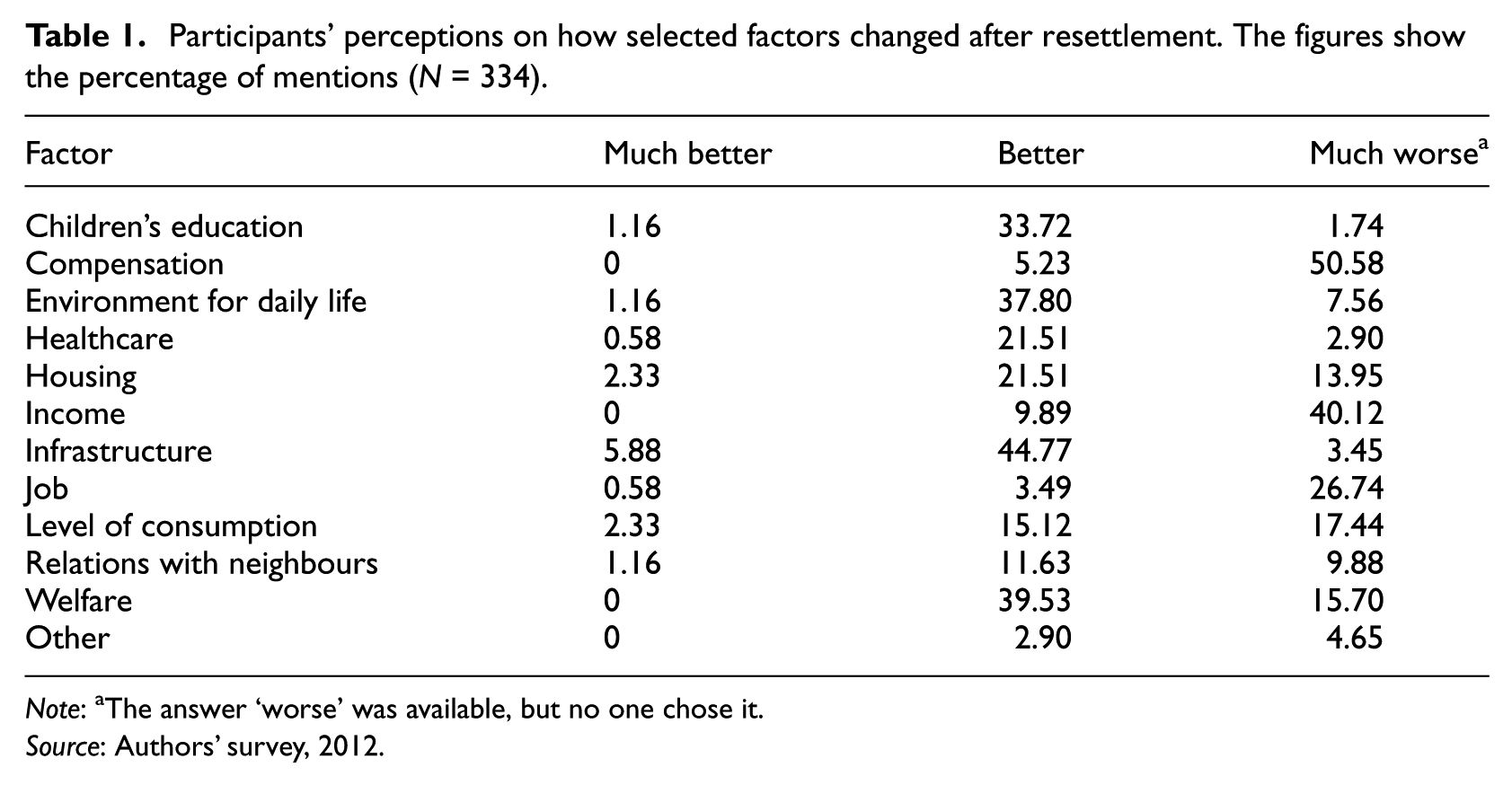
Relocated villagers were asked to select factors according to whether they were better or worse after resettlement. Infrastructure topped the list of improvements (c. 51%), followed closely by welfare, environment for daily life and education (Table 1). Even here, however, when subsequently interviewed, our survey participants raised some major issues. New transport links were of limited use to relocated residents as the metro stations are not within walking distance from Aibo Community. Improvements in welfare were limited; the category of urban hukou they obtained provided them with a lower level of healthcare and pension entitlements than a full urban hukou and represented little change from their previous rural hukou; many of them had had jobs in local factories enabling them to access pension and health insurance. This was brought home to us in the following comments from a resident whom we interviewed: The land and house we have lost were the source of our livelihood. After demolition, our life has no security. Our rural hukou has changed to an urban hukou, but we don’t enjoy the same health care and pensions as Shanghai city residents; we are now second-class citizens. We are still rural villagers although our hukou and housing has all changed. Even the government sees us as rural villagers.
15
Participants’ perceptions on how selected factors changed after resettlement. The figures show the percentage of mentions (N = 334).
Note: aThe answer ‘worse’ was available, but no one chose it.
Source: Authors’ survey, 2012.
The inadequacy of compensation was the major negative factor, mentioned by just over half the respondents, followed by income and job opportunities, findings that were confirmed in our interviews. In the words of one resettled resident: We are treated as problems to be dealt with rather than [residents] to be served. Particularly in terms of the compensation standard, for demolition in the city centre – a small apartment in the city centre – you can get a lot of money. People even count the number of bricks [in the demolished home] to raise the compensation. Our big houses just got us very little compensation. We are very angry.
16
Owing to low skill levels, lack of qualifications and lack of re-training programmes, resettled residents found there were not enough suitable job opportunities for them. By 2012, only 1000 job opportunities had been created in the whole of Xinhong Township, in which Aibo Community is located. In particular, younger relocatees had difficulty finding a job. Despite the inauguration of the Hongqiao transport hub, more and more young people moved towards the city centre to look for job opportunities. 17 Among the few jobs available were as security staff in the Hongqiao Business District. By October 2015, with the core area of Hongqiao Business District partially complete, some 300 vacancies for security guards and cleaners had been filled, primarily by resettled residents. The Hongqiao Business District authorities had encouraged companies to recruit the relocated villagers and promised to provide more of this kind of job, but for the companies themselves recruitment of migrants with rural hukou was certainly a cheaper option. The villagers themselves, however, were reluctant to accept jobs of this nature. 18 Officials, on the other hand, claimed in interviews that some resettled families had unrealistic expectations of the possible rewards from their compensation, believing they could use their compensation funding to buy a new car, and local officials blamed resettled villagers for being reluctant to take on manual labour, claiming that some of them had even become addicted to gambling. 19
The message that came across from our interviews and survey was a clear one, even if it was sometimes contradicted by comments from officials. When comparing their lives before and after resettlement, residents maintained that they were more concerned about their income and job opportunities as sources of livelihood rather than about the improved living environment. They could cope without advanced facilities, but not without jobs and rental income. There was a significant level of dissatisfaction with their compensation and an overwhelming feeling of having lost out.
Concluding thoughts: ‘Rent-lost’ farmers in new villages-in-the-city
The displacement and resettlement that we have examined here occurred in an area that had been on the periphery of Shanghai. Although Shanghai had spread well beyond Hongqiao, it remained a mixed agricultural-industrial area in which farming families retained enough fields to provide a small income and supplemented this by building non-registered additions to their housing to accommodate migrant workers. Unlike what often occurs in the Pearl River Delta, residents were dispossessed of their means of earning a living and resettled in new apartment blocks not far from their demolished villages. Only rather perfunctory provision was made for their future livelihoods. In this sense, our research has drawn attention to the inadequacy of the measures taken by the state to create appropriate circumstances that would allow relocatees to establish a new livelihood.
Our interview and survey results have highlighted the nature and extent of concern that local residents evinced. While they appreciated the convenience of their new surroundings, these sentiments paled in comparison with their dissatisfaction over compensation and concern about their future livelihoods. Our findings are reasonably clear-cut. They stand at odds with those of Tian et al. (2017), but this can perhaps be explained by different housing histories; the former villagers we researched had been able to extend their houses and supplement their incomes, unlike those surveyed by Tian and colleagues. They are less ambivalent than the findings from surveys undertaken by Wu (2004) and Li and Song (2009), even if the background circumstances and survey premises differ to some extent. They do, however, concur with the findings of Chen (2003) and Mao and Wang (2006) in so far as they too paint a negative picture of the consequences of the displacement and resettlement process for land-lost farmers. Finally, they support at least partially those of Wilmsen and Wang (2015), who, although writing in the different context of large-scale resettlement programmes, argue that success is predicated on long-term government commitment, which frequently is lacking.
The former villagers have become land-lost and ‘rent-lost’ farmers as a result of the expropriation of their means of securing a livelihood and of anomalies thrown up by the particular institutional arrangements that are the dual land and household registration systems (Li et al., 2016). This, crucially, is what allowed them to earn a living from renting out unregistered accommodation space, considered illegal by officialdom, to migrant workers whose presence in these village-in-the-city surroundings went unacknowledged by the authorities. It posed a serious problem, however, first for local government officials trying to calculate compensation standards (how do you compensate for something that officially does not exist?) and later for the resettled villagers, who lost a regular and lucrative source of income. For these former villagers whose primary skills are in farming there is no obvious way to make a living once they run out of compensation funds, and this has gradually become a serious social problem not only in Shanghai but throughout China (Chen, 2013; Zhang, 2010).
One of the ironies of the fate of those who lost their homes as a result of the construction of the Hongqiao hub is that, unlike with many other acts of expropriation, local residents were not displaced to distant new dwellings but were resettled nearby. Although they had not moved far, all around them had changed dramatically, and they had lost their means of economic support with little provided by the authorities to replace it. The accommodation that they rented out was supposed to have been replaced by rent from supplementary apartments in their new settlement, but Aibo rents were far beyond the means of migrants and well below the status of incoming white collar workers. Meanwhile, many younger residents left, even as their parents struggled without jobs, income and security. The irony of the situation meant they found themselves occupying approximately the same location but in a completely different place, surrounded by commercial developments and up-market residential communities that left them feeling, in their own words, like second-class citizens in a new village-in-the-city.
Footnotes
Funding
Funding was received from the China Scholarship Council and the China National Natural Science Foundation (41771174 ) and the Natural Science Foundation of Zhejiang Province (LY17D010002).