



Abstract
This paper makes an initial contribution towards building a polycentricity index to account for the governing of social–ecological systems. It develops three indices and an overall index, using an approach based on network science, to measure the extent to which actors develop ordered relationships to address scale mismatches in urban water governance. These indices are discussed with respect to the overarching system of rules governing actors’ decisions within the Middle Rio Grande (MRG) urban watershed. The analysis and discussions herein suggest that the governance of the MRG is a predominantly monocentric governing system with elements of polycentricity. They also suggest that polycentricity in governing the MRG urban water commons could primarily be about the politics of power and resource distribution as actors reconfigure their positionalities and align themselves and their interests strategically. The paper concludes with a succinct discussion about how quantitative measures of an overarching system of rules could be incorporated into future indices.
Introduction
Polycentric governance implies the existence of multiple decision-making centres that are formally autonomous of each other and operate under certain sets of rules (Aligica and Tarko, 2012; McGinnis and Ostrom, 2012; Ostrom, 1999 [1972]). Empirical testing of polycentrism has advanced at different paces within distinct bodies of literature. Between the 1970s and 1990s, scholars from the Bloomington School of Political Economy (Vincent and Elinor Ostrom, and their associates) provided rigorous empirical support for polycentric governance (e.g. McGinnis, 1999; Ostrom, 2008; Ostrom et al., 1978). Since the early 2000s, spatial planners and analysts have also increasingly studied the polycentric urban region – the interconnectedness of cities – using innovative and theoretically grounded analytical methods (Batty, 2001; Meijers, 2005; Parr, 2004). Particularly, the EU-funded POLYNET project (Hall and Pain, 2006) marked a significant juncture in the spatial analysis of polycentrism. From this project, Green’s (2007) seminal paper on ‘functional polycentricity’ used an approach based on network science to develop a theoretically grounded method in analysing networked European cities.
This paper explores a network science approach to measure polycentric governance by learning from some of these methodological advancements in the study of polycentricity and the social–ecological network approach (SENA) framework 1 (cf. Green, 2007; Sayles and Baggio, 2017). It takes an important first step towards building a quantitative index to study the polycentricity of urban water governance using the Middle Rio Grande (MRG) urban watershed in New Mexico, USA, as the case study.
The paper first discusses the conceptual foundations of polycentricity. These conceptual foundations are drawn upon to develop three indices and an overall index to measure the extent to which actors develop ordered relationships to address scale mismatches in urban water governance. These indices are then operationalised using the MRG as a case study. The analysis from the indices are discussed with reference to the overarching system of rules that govern actors’ decisions in the MRG. The paper also explores the relationships between the overall index and other network graph variables and discusses what these relationships mean to the study of polycentric water governance. It concludes by suggesting how future indices could incorporate quantitative measurement of the overarching system of rules within a governance system.
Mapping the theoretical landscape of polycentric governance
The ‘theory of polycentrism’ has been explicated extensively in the literature (e.g. Aligica and Tarko, 2012; McGinnis, 1999; Ostrom, 2010a). This section will not recapitulate the discussions and contestations in the literature. Rather, it will delineate what it means, theoretically and methodologically (empirically), to describe the governance of social–ecological systems as polycentric.
Polycentricity implies the collective functioning of multiple, linked centres. To avoid cooperation paralysis, as Polanyi (1951) argued, the Pareto optimum outcome is achieved through a trial-and-error evolutionary process as multiple autonomous decision-making centres (e.g. individuals and organisations) interact freely (cf. Ostrom, 2005). The discussion here points to two foundational premises about polycentricity, which serve to foreground the theoretical discussion herein: (1) there are multiple autonomous actors operating at multiple governing scales and within multiple sectors; and (2) functional connections (interactions) exist among these entities within an overarching system of rules.
McGinnis (2005: 8) asserts that ‘a polycentric system of governance is multi-level, multi-type and multi-sector in scope’. First, the multiplicity of different types of autonomous actors relates to the argument that polycentricity is shaped by multiple ‘pulsating polycentric domains’ (Aligica, 2014; Aligica and Tarko, 2012: 247). A polycentric domain/sector or ‘island of polycentric order’ is the policy or decision arena (e.g. economy, law and politics) within which multiple centres of decision making interact through competition and/or cooperation within an overarching system of rules (Aligica and Tarko, 2012: 247). The interactions within and between these multiple domains (re)generate and transform the entire system into a ‘polycentric order’– where many autonomous actors could make independent decisions to mutually adjust their ordered relationships with one another within a general system of rules (Ostrom, 1999 [1972]: 57). In other words, polycentricity involves multiple actors within different sectors of societal organisation whose activities under a given system of rules (re)create polycentric order within and between these polycentric domains – e.g. political and market polycentric orders. The order within these polycentric domains shapes and is also shaped by the polycentric order of the entire governance system (Aligica, 2014: 51; Nagendra and Ostrom, 2012).
Second, actors operate at multiple governing scales, which speaks to Ostrom’s (1990: 90) explication of ‘nested enterprises’. ‘Nested enterprises’ refers to governance activities that are organised in multiple layers involving local and higher organisational levels with clearly demarcated but often functionally overlapping jurisdictional boundaries (Lundqvist, 2004; Ostrom, 1990). In governing social–ecological systems, Ostrom (1990, 2000) argues against assuming that collective action dilemmas should be resolved through a panacea – one-size-fits-all institutional arrangement. In reality, the governance of social–ecological systems is often characterised by a complex nesting of enterprises –‘polycentric public economies’ (Ostrom, 2000: 33) – whereby large-, medium- and small-scale institutional arrangements are necessary components of an effective governing system (Ostrom, 2010b: 552).
Third, polycentricity emerges from actor interactions within a general system of rules. To borrow a key logical construct of relational/post-structural geographies, e.g. actor-network theory and assemblage theory (cf. Farías, 2011), polycentricity can be seen as an emerging relational space shaped constantly by the multiplicity of actors’ interactions within a system of rules. For instance, in spatial planning, interactions between autonomous territories (e.g. cities, regions or countries) could be in the form of commuting patterns or commodity flows between places. In governance terms, these interactions would involve interorganisational exchanges in service delivery or support. Consequently, Green (2007: 2101) proposed a ‘formal definition’ of polycentricity as a collection of ‘functionally connected and balanced’ cities, firms, or people.
These interactions would emerge from, and intend to shape, the shared overarching system of rules governing the decisions and actions of actors in addressing their social problems. Ostrom (1998) defines rules as when groups of individuals develop a common understanding of ‘who must, must not, or may take’ certain actions in particular situations; failure to conform is subject to sanctions (cf. Crawford and Ostrom, 1995; Ostrom et al., 1994). The overarching system of rules is the crux of why polycentricity was developed in the first place. At least conceptually, we know that markets work and have desirable welfare features because of price signals. The polycentric order is supposed to describe the conditions under which desirable emergent outcomes occur absent price signals (i.e. a system becomes self-organising). Ostrom (1994: 226–227) notes, Within a set of rules, autonomous decision-makers are free to pursue their own interests subject to the constraint inherent in those particular rules being enforced. […] The many autonomous elements or units seek to order their relationships with one another rather than by reference to some external authority […] self-governing systems [emerge] when those being governed have equal liberty and equal standing in the constitution of an order … I assume that the rules of such associations are open to public scrutiny, to constrain the organization of unlawful conspiracies’. (emphases are mine)
In polycentric orders, these rules emerge and evolve through the interactions of actors at nested arenas of choice – meta-constitutional, constitutional, collective and operational levels (see definitions in McGinnis, 2011) – but these rules are imposed by an ‘ultimate authority’ in monocentric governance (Pahl-Wostl and Knieper, 2014; Thiel, 2015). Thus, drawing on Ostrom et al.’s (1961: 831–832) view of a ‘polycentric system’, we could surmise that polycentric governance functions as a system because functional connections between actors are coordinated by an overarching shared system of rules that emerge and evolve from actors’ interactions (cf. Aligica and Tarko, 2012). Considering the overarching system of rules as actors interact helps to (1) determine the ‘conditions of entry and exit’ in a polycentric system (Ostrom, 1999 [1972]: 59), (2) identify which actors are ‘outsiders and insiders’ (Aligica and Tarko, 2012: 254), and (3) differentiate polycentricity from mere fragmentation and the conditions that could make the former break down into the latter and vice versa (Aligica and Tarko, 2012; Pahl-Wostl and Knieper, 2014).
(Re)Casting polycentric governance within the SENA framework: Synthesis and methodological approach
The SENA framework looks at the misalignment or mismatch between environmental and governance systems – i.e. social–ecological scale mismatch (Sayles and Baggio, 2017). Social–ecological scale mismatch considers the incongruities between governance and natural resource systems (Folke et al., 2007; Sayles, 2015; Young, 2002). Drawing from Thiel (2015) and Costanza et al. (2000), the scale of natural resource governance here refers to the resolution and extent (in space, time and degree of complications) of an area, its assigned institutional configuration and administrative levels for managing natural resources, and its relationships with other governance structures. The misalignment between the scale of ecological processes and the scale of institutions contributes to the mismanagement of natural resources (Bodin et al., 2014; Costanza et al., 2000).
The underlying causes for the scale mismatch problem are many and are discussed from multiple perspectives, which complicates the analysis of social–ecological scale mismatch. Cumming et al. (2006) delineates three forms of scale mismatches: spatial mismatch (misalignment between the spatial scales of management and ecosystem processes); temporal mismatch (misalignment between the temporal scales of management and ecosystem processes); and functional mismatch (misalignment between management and ecosystem functions). Costanza et al. (2000: 12) also consider scale mismatches to be when ‘decision making linkages between scales are ineffective’ and/or ‘decisions are based on information aggregated at the wrong scale, even though information may exist at the appropriate scale’. The scale mismatch problem also arises because of reasons such as (1) the scale of the formal organisation providing a public good does not consist of those affected by what is provided, and/or (2) those affected by the provision of a public good are different from those taken into account in deciding on whether and how to provide the public good (Ostrom et al., 1961: 836).
The logic of a polycentric system allows for a re-examination of the scale mismatch problem as a network problem (cf. Cumming et al., 2010). That is, considering how the absence or presence of functional connections between human institutions affects (1) spatial, temporal and functional alignments in decisions about the social and ecological systems (Cumming et al., 2006), (2) information about the social and ecological systems being aggregated at appropriate scales (Costanza et al., 2000), and (c) the appropriate scale to make decisions about social–ecological systems that accounts for those affected by the decisions (Ostrom et al., 1961).
SENA helps to construct and analyse different functional connections between human institutions assigned to different administrative levels in managing natural resources. 2 Specifically, scale mismatch bridging edges (SMBEs), an analytical tool within the SENA framework (cf. Bodin and Tengö, 2012; Sayles, 2015), provides an opportunity to analyse the scale mismatch aspect of polycentricity. Polycentricity considers both the cross-scale and cross-sector relations among actors. An actor’s SMBEs, which this paper later uses to measure the political network centralisation index (PNCI), market network centralisation index (MNCI), non-profit network centralisation index (NNCI), and an overall network centralisation index (NCI), capture the cross-scale and cross-sector linkages between an actor and other actors.
These indices represent an initial attempt to provide a means to quantitatively measure the level of polycentric order within islands of polycentricity (PNCI, MNCI and NNCI) and for the overall governance system (NCI). Here, we start from the basic unit of analysis, which is actors classified into their sectors of societal organisation. This starting point makes it possible to compute (1) how many cross-scale connections an actor builds specifically to political, market and non-profit actors, which ends up representing an actor’s PNCI, MNCI and NNCI, respectively. These indices are expressed in this paper as a ratio from 0 to 1 (or 0% to 100%). The indices help to capture monocentricity and polycentricity as a continuum; polycentricity increases in the network as the index approaches 1 (100%) and monocentricity increases as the index approaches zero. For instance, an actor with a PNCI of 10% (0.1) means that it is connected to only 10% of the entirety of political actors operating at different scales and within different socio-ecological jurisdictions. A network with 0.3 or 30% average PNCI for all actors implies a 30% polycentric order within the political island of polycentrism; that is, actors are connected to only 30% of the entirety of political actors operating at different governing scales and within different socio-ecological jurisdictions in the network. The 30% average makes the island of political polycentric order appear more monocentric than polycentric. This analysis and interpretation also apply to the MNCI, NNCI and even the overall NCI.
The overall polycentric order for the entire network, NCI, emerges from the interactions of actors across these three sectors or islands of polycentric order (cf. Aligica, 2014: 51; Nagendra and Ostrom, 2012). The NCI, also expressed as a ratio from 0 to 1 (or 0% to 100%), measures the overall polycentric order within the entire network – that is, the extent to which an actor connects across all three sectors (political, market and non-profit) and at different governing scales. For instance, an actor with an NCI of 10% shows that it is connected to only 10% of actors operating at different governing scales, across all three sectors, and within different social–ecological jurisdictions. A governance network appears increasingly polycentric when the average NCI of all actors in the network approaches 1 (100%) and it also appears increasingly monocentric when the NCI approaches zero.
As discussed above, it should be noted, however, that these indices are necessary but insufficient to capture polycentricity or polycentric order. Understanding the overarching system of rules within which these actors form cross-scale and cross-sector linkages is also key to the analysis of polycentric governance. For instance, it would be very contentious to characterise a governance system as polycentric if actors operate within a top-down, command-and-control rule system even though the average NCI of actors in a network is closer to 100%. Therefore, it is very important (if not imperative) that the use of this quantitative approach to capture polycentricity should always be accompanied by a qualitative analysis of the overarching system of rules within which actors operate.
Three steps will be utilised to operationalise the above-discussed conceptualisation of polycentricity specifically in water governance. These steps will then be used to develop three indices and an overall index using an approach based on network science to measure the extent to which actors’ form ordered relationships to bridge scale mismatches in water governance.
Drawing on all concepts, framing, and terminology of Sayles and Baggio (2017), an analysis of SMBEs, first, begins with two basic elements – social and social–ecological nodes (see Figure 1). ‘Social nodes’ refers to actors (individuals or institutions) involved in governing an environmental system (e.g. water resources). ‘Social–ecological nodes’ refers to both the spatial and aspatial (political–administrative) jurisdictional boundary of the environmental system; that is, in the case of water systems, it captures both the natural watershed and its administrative boundaries. In the US context, for example, the Soil and Water Conservation District (SWCD) is usually one such spatial and aspatial jurisdictional designation that attempts to capture both natural watershed and administrative boundaries. For the purposes of this paper’s analysis, these SWCDs will be designated as social–ecological nodes. 3
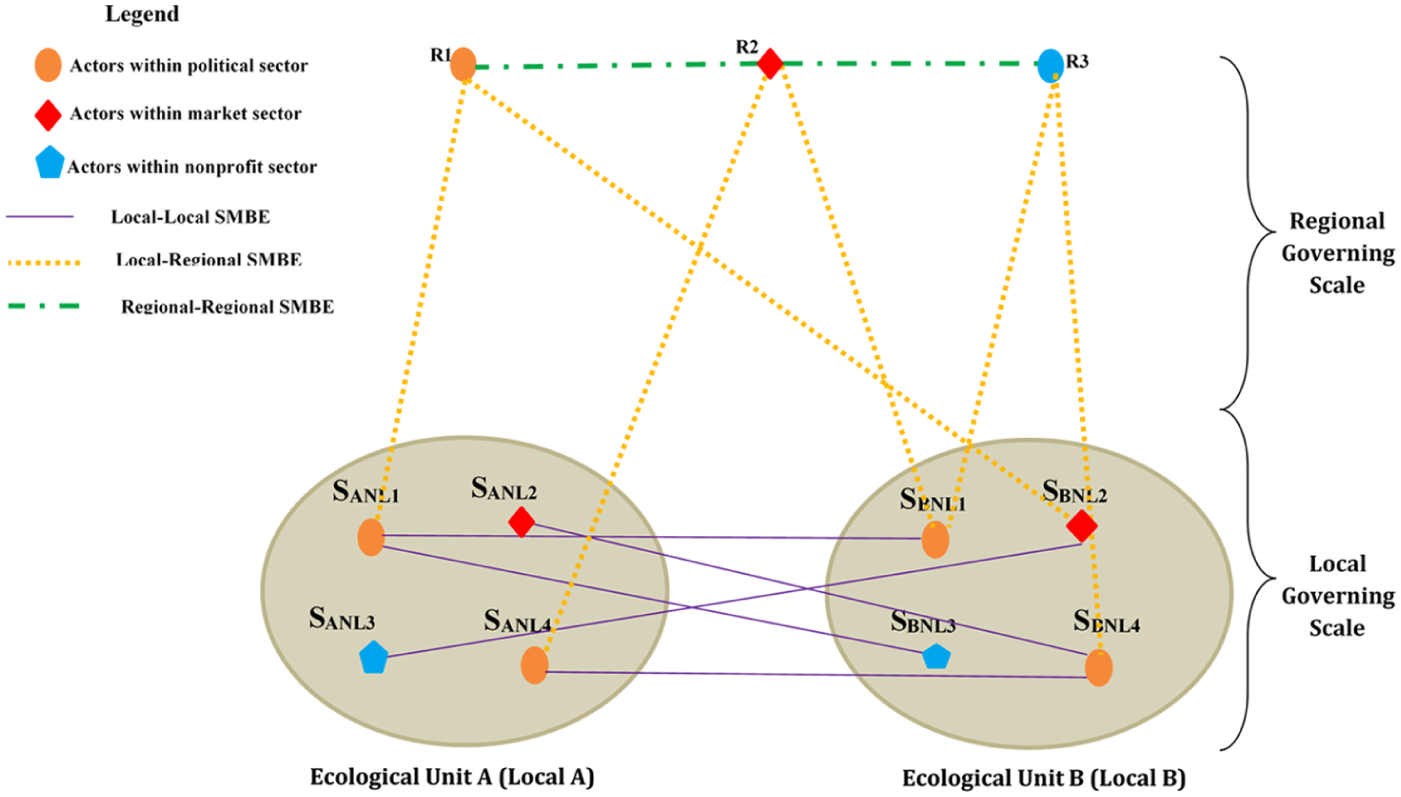
Conceptual map of the multi-scale and multi-sector dimensions of polycentric water governance.
Second, the social nodes are classified into local nodes and higher-scale nodes (regional nodes). These regional nodes operate at the regional, state and federal/national policy levels and are defined based on the spatial extent within which these organisations operate (Sayles, 2015). As shown in Figure 1, the local (SALN1, SANL2, etc.) and regional (R1, R2, etc.) social nodes are categorised according to their organisational types such as political, market and non-profit nodes. This paper is restricted to these three sectors for analytical purposes. The classified social nodes and their functional connections/linkages begin to address some of the above-discussed dimensions of polycentric governance: multiple actors with functional connections operating within different sectors and at different governing scales.
Third, the social and social–ecological nodes form three node-edge configurations – local–local, local–regional and regional–regional. These node-edge configurations, earlier referred to as the scale mismatch bridging edges or SMBEs, show the extent to which different social nodes connect to different actors within different social–ecological jurisdictions (i.e. SWCDs) and at different governing scales.
The SMBEs, as an analytical tool in the SENA framework, have three key analytical advantages when used to analyse the polycentricity of a governing system. The first of these advantages is that node-edge connection between two local social nodes within the same ecological unit is excluded from the analysis because it is not considered a SMBE (Sayles and Baggio, 2017). This means that the maximum edges needed by an actor to bridge scale mismatches within a network are fewer than would be expected in a regular network. That is, the analysis conducted herein acknowledges that polycentricity in governance may not necessarily require that all actors within a governance system are functionally connected to everyone to have a perfectly connected system. 4 This is because each actor decides to build functional connections –‘development of ordered relationships’– depending on factors such as the ‘conditions of entry and exit’ (e.g. incentives facing actors), and the enforcement, formulation and revision of basic rules of conduct (Ostrom, 1999 [1972]: 59–60).
The second advantage is that the SENA framework helps to determine an actor’s connectivity (aggregate SMBEs) within the islands of polycentric order (political, market and non-profit) and within the entire governance system. In other words, since polycentrism is a scalable concept, our basic unit of analysis is the individual actor (cf. Ostrom, 1991: 227); we can determine an actor’s degree of connectedness within each island of polycentric order using the indices developed: political network centralisation index (PNCI), market network centralisation index (MNCI), non-profit network centralisation index (NNCI), and an overall governance network centralisation index (NCI).
The third and last advantage is that we could use the local–local, local–regional, and regional–regional connections in the network to initially differentiate fragmentation from polycentricity (Aligica and Tarko, 2012; Pahl-Wostl and Knieper, 2014). Drawing from Sayles (2015), a network is more fragmented than polycentric when there are relatively more intra-scale than inter-scale connections. That is, there are more intra-scale connections when local actors build more connections to themselves (local–local SMBEs) or regional actors build more connections to themselves (regional–regional SMBEs). There are fewer inter-scale connections when local and regional actors build fewer or no connections to each other (fewer local–regional SMBEs). Even though a fully polycentric network should have a lot of these local–local and regional–regional SMBEs, the cross-sector aspect of polycentricity implies that the network must also have relatively more of the local–regional SMBEs to show that actors are building connections across multiple governing scales.
Constructing indices for the multi-scale and multi-sector dimensions of polycentric water governance
To construct the sub-indices (PNCI, MNCI and NNCI) and an overall index (NCI), the discussions in the previous section are summarised in the following representations:
LS: Local social node
RS: Regional social node
α: Social–ecological (local = l) nodes within which a social node operates (l1, l2, … ln)
β: Social node types (1 = political social nodes; 2 = market social nodes; 3 = non-profit social nodes)
Each actor’s (whether a local or regional node’s) overall NCI captures its SMBEs (i.e. cross-scale connections) across all three sectors (political, market and non-profit). To determine this overall index, we first compute its cross-scale connections to political actors (PNCI), market actors (MNCI) and non-profit actors (NNCI). For the purposes of demonstration, the equations presented hereafter present the formulae for computing only the PNCI for a local actor (equation 1) and the PNCI for a regional actor (equation 3). 5 Equation 1 is also used to compute the MNCI and NNCI for local actors and equation 2 is used to compute the MNCI and NNCI for regional actors. The NCI for a local actor (equation 2), for instance, could be computed as (a) a simple average of the actor’s PNCI, MNCI and NNCI or (b) an actor’s actual SMBEs across these sectors (sum of the numerator in equation 1 computed for all three sectors), which is weighted based on the expected SMBEs (i.e. sum of the denominator in equation 1 computed for all three sectors). The NCI or a regional actor could also be computed using either of these two approaches.
As earlier stated, the formulae for PNCI, MNCI, and NNCI for each local social node are the same, so we will state the PNCI formula for a hypothetical political, local social node called ‘i’. The formulae for the PNCI, MNCI, and NNCI are also the same for regional nodes, so we will state the PNCI formula for a hypothetical political, regional node called ‘z’. We will then state the equations for computing the overall NCI for these two social nodes.
For NNCI and NCI for ‘i’:
Let:
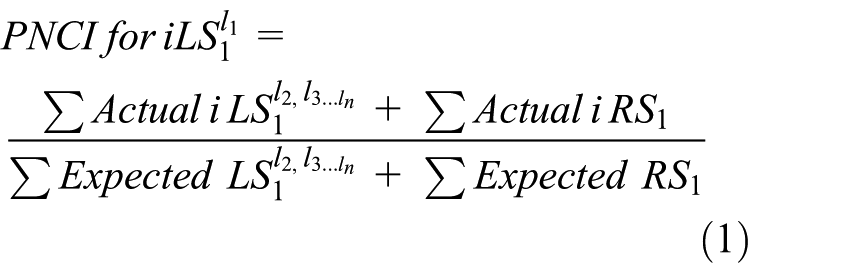
Where:

For PNCI and NCI for ‘z’:
Let:

Where:
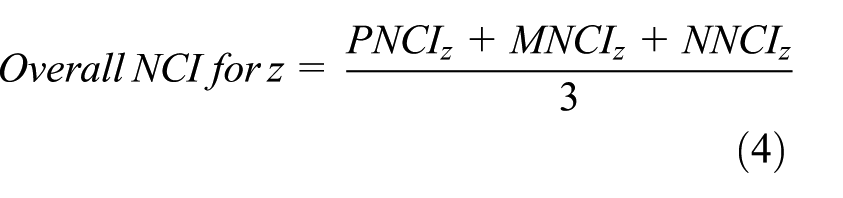
As earlier noted, the PNCI, MNCI, NNCI and NCI are a ratio from 0 to 1 (or 0% to 100%). An actor with a PNCI of 10% (0.1) means that it is connected to only 10% of the entirety of political actors operating at different scales and within different socio-ecological jurisdictions. A network with 0.3 or 30% average PNCI for all actors implies a 30% polycentric order within the political island of polycentrism; that is, actors are connected to only 30% of the entirety of political actors operating at different governing scales and within different socio-ecological jurisdictions in the network. The 30% average makes the island of political polycentric order appear more monocentric than polycentric. This interpretation also applies to the MNCI, NNCI and the overall NCI.
Using the methodological approach to study the governance of the MRG: Study area and data
The Middle Rio Grande (MRG) watershed or basin is located in central New Mexico (NM) and covers approximately 3060 square miles. The MRG watershed is part of the Rio Grande River, which is over 1900 miles long, and flows from the San Juan Mountains, near Creede, CO, into the Gulf of Mexico. The Rio Grande River forms the border between Mexico and Texas, which makes it a ‘successive and contiguous’ international and national watercourse (Benson et al., 2014: 201). The MRG extends from the Cochiti Dam to the Elephant Butte Reservoir in central New Mexico. It encompasses nine soil and watershed districts that span seven counties.
Benson et al. (2014) note that the multi-jurisdictional nature of this urban water commons and the extensive amount of public lands in this area have led to the presence of many actors, especially federal and state government agencies, within the Rio Grande and its associated watersheds such as the MRG. Hence, some scholars have characterised this watershed as experiencing a ‘rigidity trap’; that is, these actors ‘become highly connected, self-reinforcing, and inflexible’ (Benson et al., 2014: 223; Carpenter and Brock, 2008). This is partly due to the high presence of multiple federal and state actors, all having specific constitutional mandates. This suggests a monocentric governance of the MRG. However, as Ostrom (2000) notes, monocentric governance does not negate the presence of polycentricity within a governing system; a predominantly polycentric governance system may contain elements of monocentric government and vice versa (cf. Ostrom, 1999 [1972]).
Data were collected on the characteristics of actors (e.g. type of actor, and locations of operation, and who they are functionally connected to) in addressing water and environmental conservation activities in the MRG. Functional connection between two actors was measured as a non-directional relationship. Partly informed by Lubell’s (2004) coding parameters, the presence of a functional connection between two actors (e.g. A and B) was determined as a yes (1) or no (0) if: A is a project partner (or listed as a partner) of B or vice versa; A provides financial assistance (listed as a financial donor, corporate sponsor, and/or grantor) to B or vice versa; between them, A and B have a joint implementation agreement (JIA) and/or memorandum of understanding (MOU); A and B share logistics and personnel (including volunteering); and/or A and B have shared permitting or regulatory activities.
Using the archival snowball network sampling approach (Wasserman and Faust, 1994), more than 700 websites and archival documents (e.g. online newspaper articles, academic documents, government documents, annual reports, grant databases, budget documents, memoranda of understanding and action/strategic plans) were collected through Google search and LexisNexis. However, the data were limited to the past 10 years, which reduced the number of websites and archival documents analysed to 473. The data set was prepared, analysed and presented using multiple software programs including ArcGIS, sna and statnet suites in R, and Cytoscape.
Results and discussion
The network data collected include 82 local social nodes (LS) and 109 regional nodes (RS). There are nine socio-ecological units or SWCDs (α) and the social node types (β) include 65 political social nodes (28 are local political social nodes and 37 are regional political nodes), 23 market social nodes (10 are local market social nodes and 13 are regional market nodes), and 103 non-profit social nodes (44 are local non-profit social nodes and 59 are regional non-profit nodes). The presence of more regional nodes within the MRG is noted by Benson et al. (2014). There are also more non-profit actors (54%) operating within this urban watershed than political actors (34%) or market actors (12%). The multiplicity of social nodes alone does not make the governance of the MRG polycentric. We need to understand (1) the SMBEs of these actors across the multiple sectors and governing scales, (2) how the SMBEs help us to determine the polycentricity or monocentricity of the entire system (NCI) and within the islands of polycentric order (PNCI, MNCI, NNCI), and (3) the overarching system of rules shaping the governance decisions of actors in this watershed.
Determining the polycentricity of governing the MRG
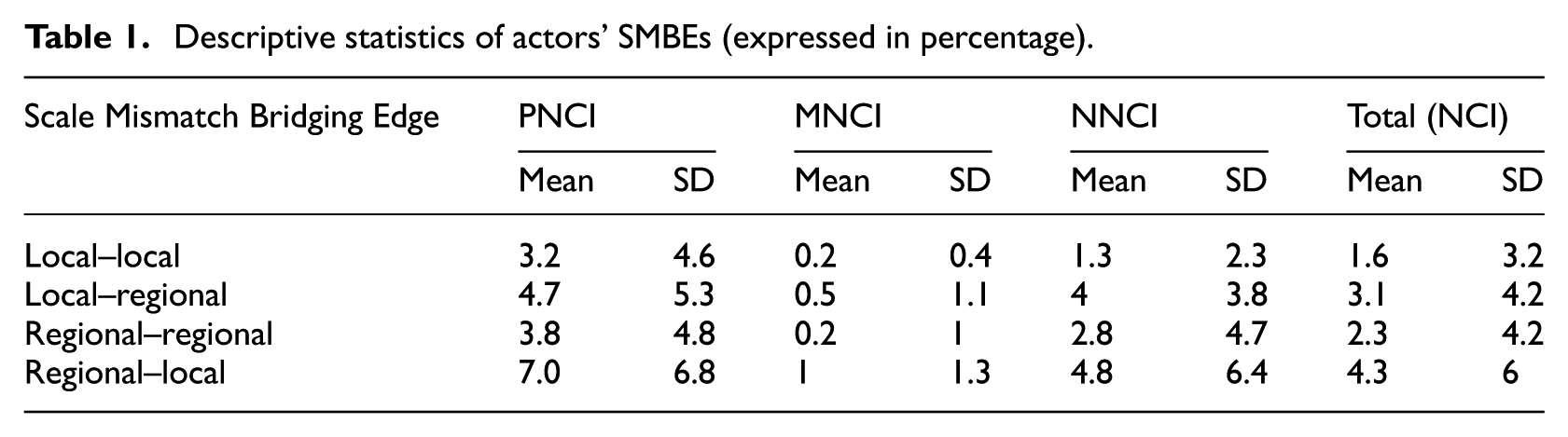
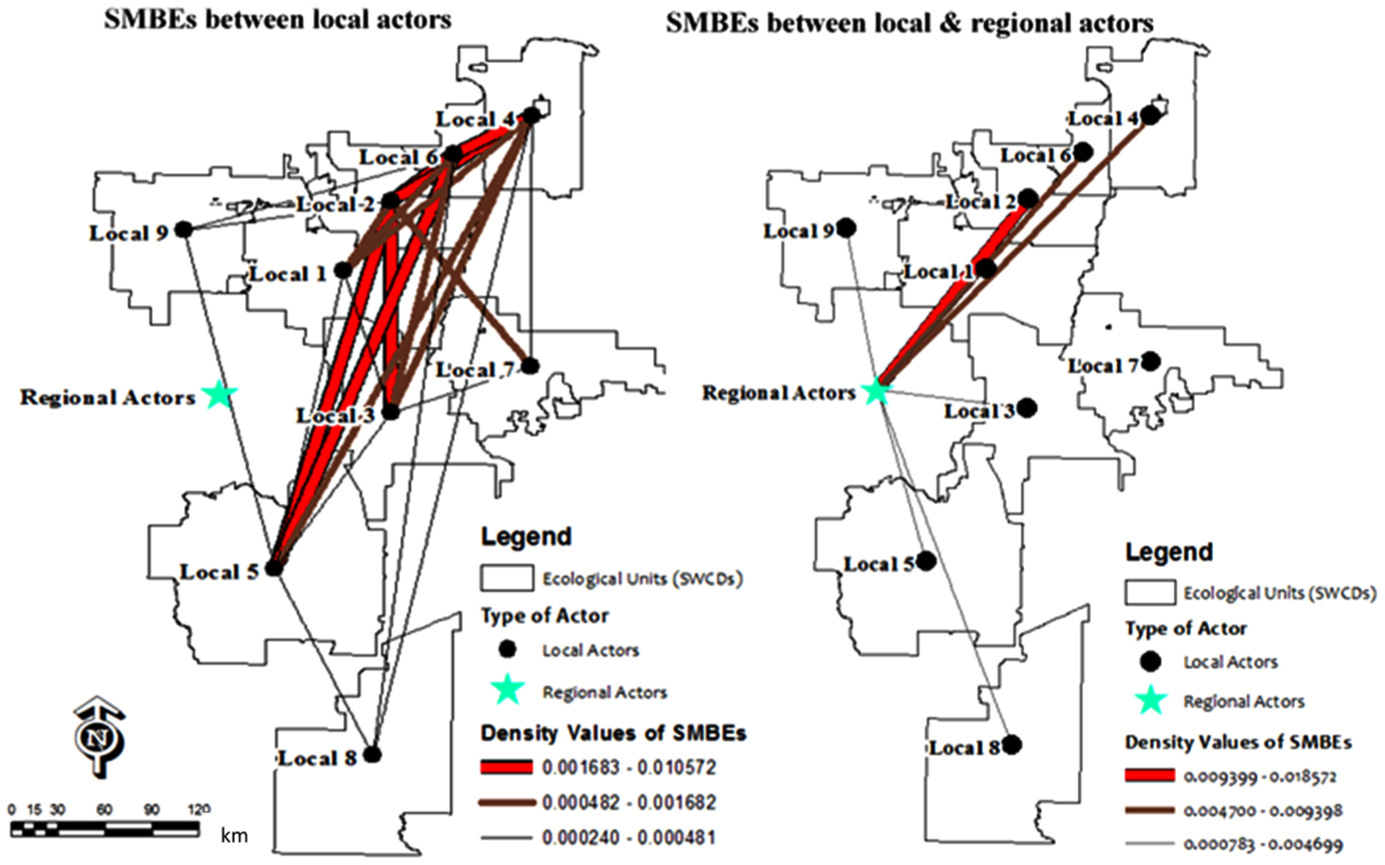
Table 1 presents the descriptive statistics of the SMBEs of actors within the different sectors (expressed in percentage). The statistics and Figures 2 and 3 are used to make three key points about the polycentricity (or otherwise) in governing the MRG urban watershed. First, polycentric governance has a multi-scale dimension. On average, actors within the MRG have more SMBEs between local and regional actors (total average of 7.4%) and between regional actors (average of 2.3%). This is visually represented in Figure 2. The map on the left shows that the density (intensity) of local–local SMBEs is high for actors within local 2, local 3, local 4, local 5 and local 6 SWCDs. Most of these SWCDs are within the densely populated urban centres in New Mexico (e.g. Albuquerque and Santa Fe). The Rio Grande River also flows directly through most of these social–ecological nodes. Local actors within these five SWCDs are reaching out more to each other (high density SMBEs) in governing the MRG.
Descriptive statistics of actors’ SMBEs (expressed in percentage).
Density of SMBEs based on the governing scales of actors.
Density of SMBEs based on the sectors and governing scales of actors.
The map on the right also shows that local 2 and regional actors are reaching out more to each other (high density SMBEs between actors within these two SWCDs). The local 2 SWCD is within Albuquerque, which is the most densely populated urban centre in NM. The relatively higher number of local–regional SMBEs within this network could be used to illustrate the point about how the SMBEs help to differentiate fragmentation from polycentricity (cf. Aligica and Tarko, 2012; Pahl-Wostl and Knieper, 2014; Sayles, 2015). This point is relevant here because, as noted above, there are more regional actors within the MRG. Thus, an analysis of the multi-scale dimension of polycentricity within the MRG will mean expecting more local–regional SMBEs to minimise the disconnection or fragmentation between local and regional actors. Hence, even though there are intra-scale (local–local and regional–regional) connections within the MRG, there is also some level of inter-scale (local–regional) connections.
However, the fact that the network does not seem fragmented also does not necessarily make it polycentric for two reasons. First, even though these actors are forming local–regional SMBEs, this amounts to only 7.4% (shown in Table 1). Second, the high-density, local–regional SMBEs raise concerns as to whether local actors within the MRG solve their larger collective problems (a) through local, self-governing arrangements with the use of regional policy actors as larger-scale conflict resolution arenas (further evidence of polycentrism) or (b) through a top-down centralised control situation (further evidence of monocentrism). The upcoming discussion on the overarching system of rules within the MRG will address this concern.
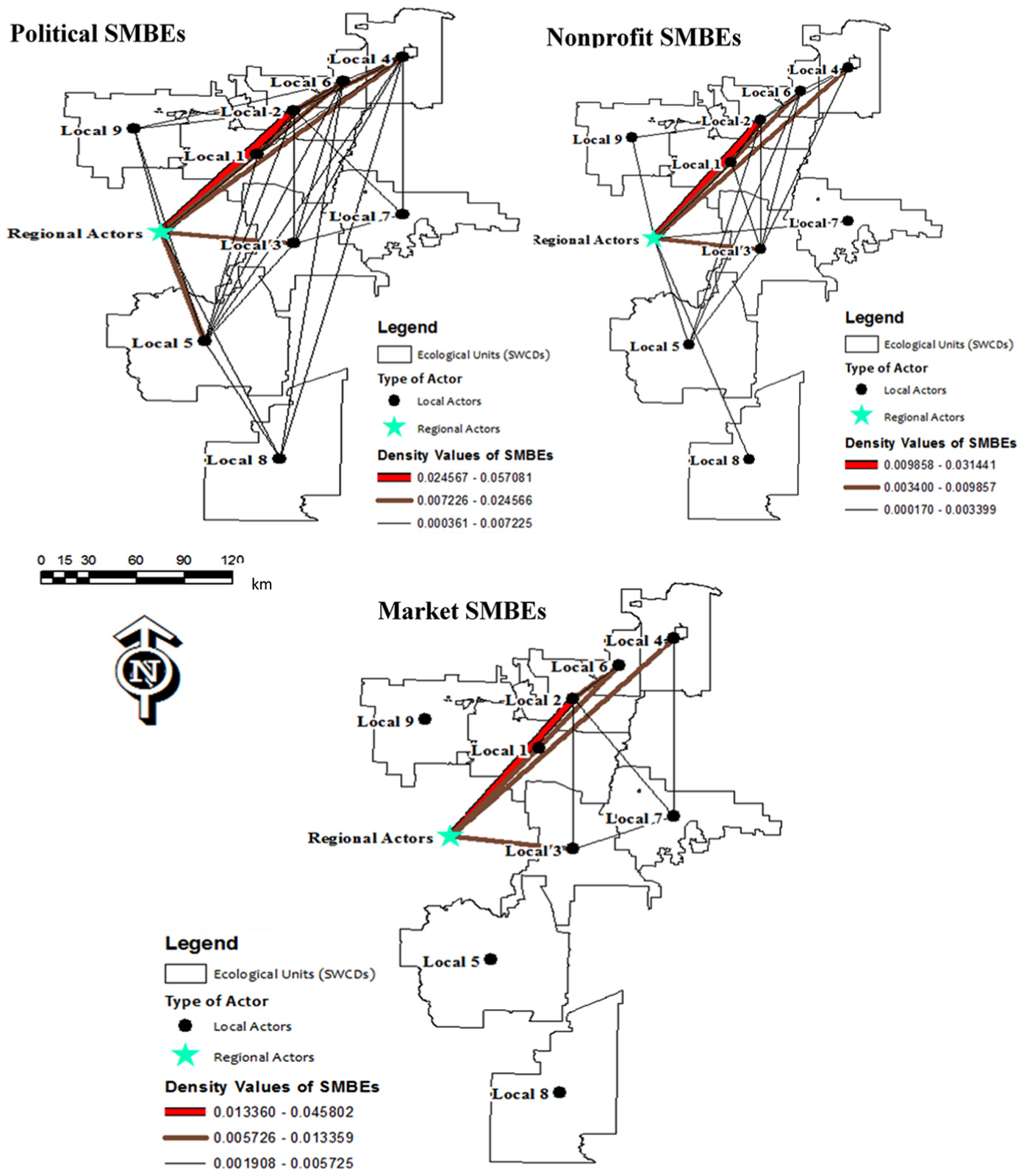
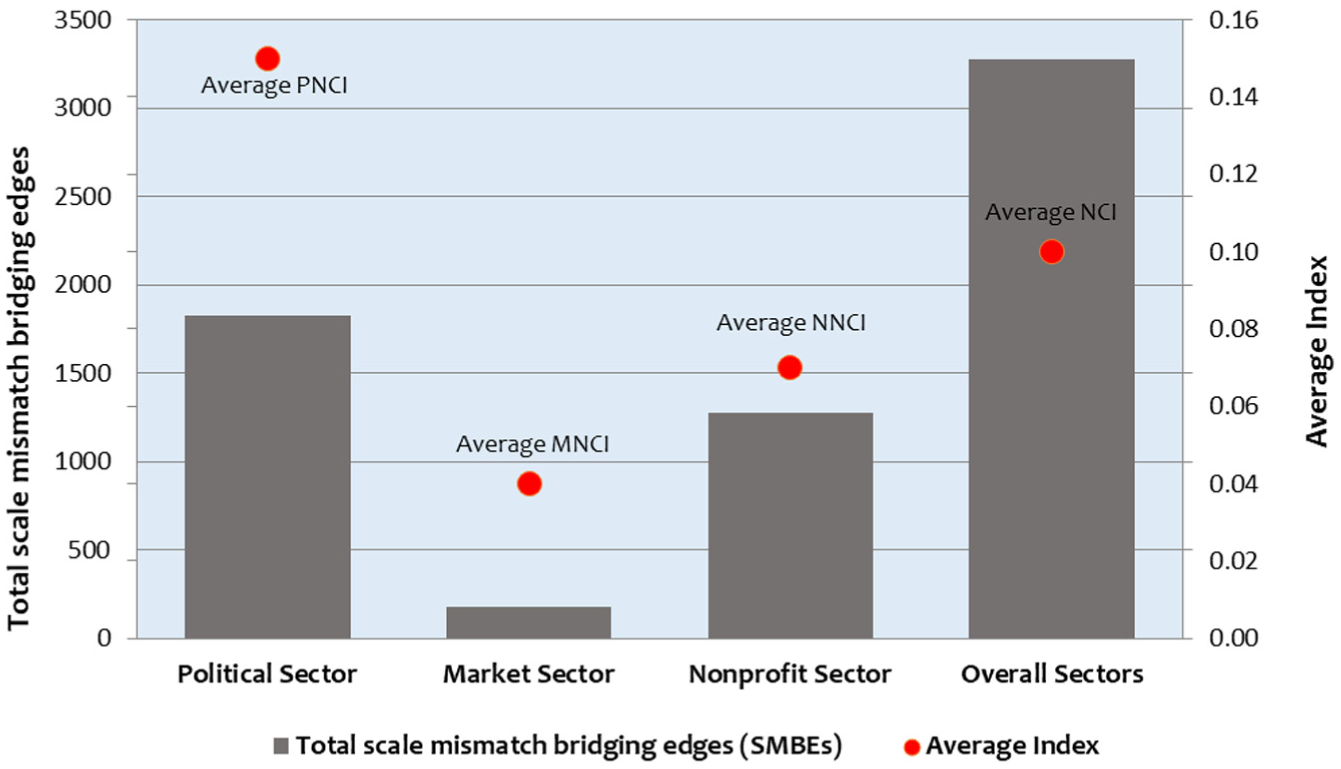
Second, polycentric governance also has a multi-sector dimension. Table 1 also indicates more local–regional SMBEs (total average of 11.7%) within the political sector compared with the other sectors. This is visually represented in Figure 3, which shows high-density (red) and moderate-density (brown) lines in all three maps but there are more of these lines in the first map (political SMBEs). Overall, we observe an average of about 15%, 4% and 7% for the PNCI, MNCI and NNCI, respectively, as shown in Figure 4. This also implies that there is a 15%, 4% and 7% polycentric order within the MRG’s political, market and non-profit islands of polycentrism. These numbers make these islands appear more monocentric than polycentric in governing the MRG. Similarly, the overall polycentric order for the MRG, NCI, which emerges from the interactions of actors across these three sectors is 10%. In other words, actors within the MRG have only 10% of the expected cross-scale and cross-sector connections needed to make the MRG appear polycentric. This makes the MRG appear more monocentric than polycentric. However, as noted above, using these indices to characterise the MRG as appearing more monocentric than polycentric is not enough. Characteristically, a monocentric governance system would also have a top-down, command-and-control overarching system of rules (Pahl-Wostl and Knieper, 2014). The third and next key point provides a qualitative analysis of the MRG’s overarching system of rules.
Total SMBEs and average PNCI, MNCI, NNCI, and NCI.
Third, polycentric governance is also concerned about the overarching system of rules that govern actors’ decisions in the development of ordered relations (e.g. SMBEs) within the system. The overall NCI and the sub-indices of the MRG make sense if it is situated within a qualitative analysis of the MRG’s overarching system of rules. The quantitative analysis so far suggests that the MRG urban watershed governance could be characterised as minimally polycentric within a largely monocentric government system. While necessary, these indices are insufficient evidence for determining the polycentric, fragmented or monocentric nature of the MRG. Hence, we also need to understand the overarching system of rules that govern actors’ decisions within this watershed.
In fact, the system might still be polycentric despite the lack of certain SMBEs. That is, if there are more local–regional SMBEs formed (compared with local–local ones) in governing the MRG, as the analysis shows, we must consider whether the overarching system of rules suggests that these local–regional SMBEs manifest (1) a top-down command-and-control governing process without local actors’ self-governing efforts in managing the MRG commons (monocentrism), or (2) a bottom-up, local self-governing process that utilises regional actors as a conflict resolution arena (polycentrism), or (3) both but there is more of 1 (top-down, largely monocentric) than 2 (bottom-up, minimally polycentric). Existing case studies and reports of institutional arrangements within the MRG point to a largely monocentric governance with minimal polycentric elements (e.g. Belin et al., 2002; Benson et al., 2014; Lawler, 2013). The parameters used by Pahl-Wostl and Knieper (2014) to discuss the overarching system of rules would be drawn upon to discuss the findings from these case studies and reports to support this assertion.
First, water management control, functions and responsibilities within the MRG are largely centralised at the federal, state and interstate levels. Water rights and appropriation decisions, notes Belin et al. (2002), are tied to federal, state and interstate legal systems (e.g. Endangered Species Act – ESA; Clean Water Act – CWA; and Rio Grande Compact) (cf. Benson et al., 2014). Enshrined in these constitutional-level rules are provisions that allocate water management responsibilities through a series of legislative processes by the United States Congress and the New Mexico State legislature with some level of consultation and participation by federal and state agencies (e.g. Army Corps of Engineers, and New Mexico Office of State Engineer). Lawler (2013: 94) describes this top-down, command-and-control rule system as the ‘legacy of state and federal interaction in control of water resources’. This describes the ‘rule-based and rule-bound regulatory model’ (Karkkainen, 2002: 557) that iteratively subordinates ‘state control to federal supremacy’ on natural resources regulation (Getches, 2001: 3). The relatively high density of local–regional SMBEs observed in the analysis could thus be explained by this centralised control at the federal (mostly) and state levels, which necessitates the need for local actors to form SMBEs with these federal- and state-level agencies responsible for executing constitutionally mandated water management functions and responsibilities in the MRG.
Second and finally, these top-down constitutional-level rules have significant impacts on the power dynamics as well as coordination and provision functions in governing the MRG. The case of Wild Earth Guardians v. Bureau of Reclamation and Corps of Engineers was one of the many instances of how these top-down distributed functions and responsibilities impact efforts by local collaborative groups to protect and conserve the silvery minnow and the willow flycatcher under the ESA. Again, local collective efforts and water rights arrangements (e.g. prior appropriation rights of the Pueblos and transfer of water rights) often have had to confront these rigid, top-down constitutional rules, which mostly results in long periods of litigations and diminished capacity for local self-organising (cf. Kelly and McKean, 2011; Mann, 2007; Matthews and Pease, 2006).
There are also coordination and cooperation challenges due to the asymmetry of power and resources often wielded disproportionately by federal and state agencies. This was evident in one of the collaborative programmes, the Middle Rio Grande Endangered Species Collaborative Program (MRGESP), established by the US Congress to coordinate actors’ efforts under the ESA. This programme was marked by (1) environmental groups’ decision not to join the programme, and (2) rifts and power influences by federal agencies and individuals – those who decide (a) ESA compliance criteria (Fish and Wildlife Service), (b) how and what to fund (Bureau of Reclamation), and (c) Congressional legislative actions (Former Senator Domenici) (Benson et al., 2014; Lawler, 2013). These issues question the ability of some of these collaborative efforts, enshrined in constitutional-level rules (e.g. MRGESP or the recently initiated Urban Waters Federal Partnership by the Environmental Protection Agency), to (1) foster, sustain and coordinate local cooperation efforts (i.e. local–local SMBEs), and/or (2) serve as an effective conflict resolution arena for local actors to solve their larger collective problems in the MRG (cf. DeCaro et al., 2017; Lubell, 2004).
(Re)Interpreting polycentric water governance in terms of social network analysis
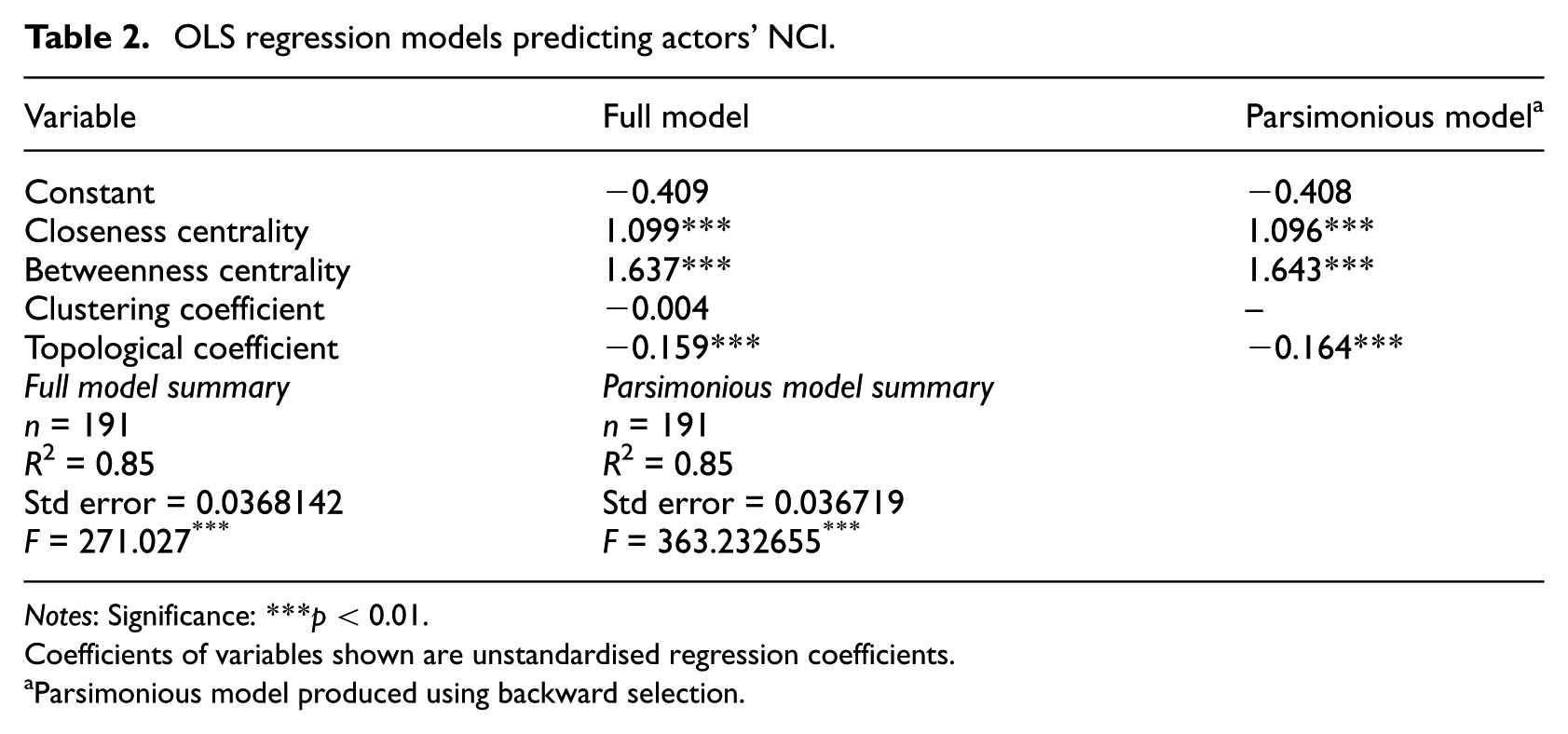
Finally, an ordinary least squares (OLS) model was developed (Table 2) to explore the relationships between the overall NCI and some network graph statistics to identify some implication(s) for polycentric governance. Two measures for actor centrality were included in the model – closeness centrality (how fast information spreads within the network) and betweenness centrality (an actor’s degree of control over others). Two measures for actor clustering were also included in the model – clustering coefficient (ratio of connections between an actor and its neighbours) and topological coefficient (extent to which an actor shares neighbours with other actors). All four are ratio measurements from zero to one.
OLS regression models predicting actors’ NCI.
Notes: Significance: ***p < 0.01.
Coefficients of variables shown are unstandardised regression coefficients.
Parsimonious model produced using backward selection.
The discussions here will focus on the parsimonious model. Three variables – closeness centrality, betweenness centrality and topological coefficient – have a significant relationship with the NCI; together, they explain 85% of the variance of the NCI (R2 = 0.85). The model reveals that an actor’s degree of centrality is positively related to its NCI; the opposite holds for an actor’s degree of clustering within the network. This has two interconnected implications for our understanding of polycentricity in governing the MRG.
First, an actor’s multiple connections (clustering) do not mean necessarily that it is connected polycentrically in a governance system. Within a given system of rules, polycentric governance is less about connecting to multiple actors and more about connecting to heterogeneous actors (across multiple sectors and governing scales). Hence, reiterating, despite the presence of multiple actors within the MRG, its governance framework is still rigid and inflexible (Benson et al., 2014: 223) because within such a top-down, constitutional-level rules system (strong central control and weak coordination), connections formed are less heterogeneous, thus making the governance of the MRG more monocentric than polycentric.
Second, and finally, the positive relationships between an actor’s NCI and its closeness centrality and betweenness centrality reiterate the point about political influence (closeness centrality) and ease of information dissemination (betweenness centrality). Polycentricity of the MRG may above all be about the politics of resources and power distribution and asymmetries therein; and the resultant constant reconfigurations of actors’ positionalities as they align themselves and their interests strategically. However, one could also assert that if strategic means self-serving decisions and actions, then strategic action, albeit at the individual or organisational level, lies at the very heart of the bottom-up construction of a polycentric system of governance. That is, whenever an actor comes to realise that his/her/its own strategic goals can best be accomplished by making cross-sector and cross-scale connections to other actors through contracts, partnerships, or other kinds of joint venture, then these strategic actors will engage in mutually beneficial connections that, over time, may end up constructing a polycentric system. Thus, depending on the overarching system of rules, strategic actors can cooperate too, when it suits their interests to do so, and by doing so they in turn may lock themselves into relationships which could construct a polycentric system.
Conclusion
This paper presented an initial step towards building an index to study the polycentricity of the MRG urban watershed. It used an approach based on network science methods to develop three indices and an overall index to measure the extent to which actors within this watershed build SMBEs to connect to others operating within different sectors and social–ecological jurisdictions and at different governing scales. These indices are discussed within the overarching system of rules that govern the decisions and actions of actors within the MRG. The analysis and discussions suggest that the governance of the MRG watershed could be characterised as largely monocentric with minimal elements of polycentricity. This finding is supported by empirical case studies conducted by scholars such as Benson et al. (2014) who have concluded that the MRG faces a rigidity trap as a result of the presence of federal and state agencies executing their top-down, constitutionally mandated functions and responsibilities.
This paper opens a path for future work to incorporate into the indices quantitative measure(s) of the overarching system of rules that (1) shape why and how actors develop ordered relations to address scale mismatches in governing this urban watershed, and (2) help distinguish between ‘insiders’ and ‘outsiders’ of the MRG polycentric system. For example, the work of Pahl-Wostl and Knieper (2014) could be instructive for future research on how to transform qualitative data of the overarching system of rules into quantitative measurements. These quantitative measurements could serve as nodal and/or edge covariates of the rules that shape an actor’s decisions or shape the relationships between two actors within a governance system.
Footnotes
Acknowledgements
I am grateful to Janet Kelly, Sumei Zhang, Daniel DeCaro, David Imbroscio, and Melissa Merry for their comments on an earlier draft of this manuscript. I am also thankful to the anonymous reviewers for their insightful and thought-provoking comments. All errors and omissions are mine.
Declaration of Conflicting Interests
The author(s) declared no potential conflicts of interest with respect to the research, authorship, and/or publication of this article.
Funding
The author(s) received no financial support for the research, authorship, and/or publication of this article.