



Abstract
Since the abolition in China of unequal regulations and controls related to the urban labour market and rural–urban migration in recent years, attention has been paid to migrants’ settlement intentions and their integration into host cities. Settlement channels have become more diverse and more accessible to migrants, because of relaxed institutional constraints and the advanced market mechanism, which are essential to the pace and process of urbanisation, and welfare and service provisions in host cities. Using data from a survey conducted by the Institute of Population and Labor Economic of the Chinese Academy of Social Sciences in Ningbo in 2014, this study examines migrants’ various settlement intention patterns, including traditional permanent settlement intention involving the transfer of one’s household registration (hukou) status; de facto permanent settlement intention through purchasing urban housing; and long-term temporary settlement intention and short-term temporary settlement intention not involving the transfer of one’s hukou. This paper finds that hukou status has a limited impact on permanent settlement intention, and rural migrants tend to achieve permanent settlement through more flexible channels, such as purchasing urban housing in their host cities, thereby avoiding the institutional hurdle of obtaining a local urban hukou. The paper contributes to the study of migration in China by introducing a new concept of settlement intention, de facto permanent settlement intention, which has not yet been investigated empirically in the existing literature.
Introduction
As a response to economic reform and the relatively relaxed migration policies that have been in place since the 1970s, China’s migrant population increased to 253 million in 2014 and is expected to reach 291 million in 2020 (Health and Family Planning Commission of China, 2015). This large growth is closely associated with the country’s urbanisation and social transformation. The Chinese central government has promoted ‘people oriented urbanisation’ reform, which encourages eligible rural residents to become urban residents (CPC Central Committee and State Council, 2014). Moreover, reforms in household registration (hukou) since 2003 have aimed to decrease inequalities associated with hukou status and promote public services, including housing and social security networks, to be available to all urban residents and rural migrants (Cai, 2011). Since then, increasing attention has been paid to understanding migrants’ settlement intentions in general, and how the temporary nature of settlement intentions affects their integration into host cities in particular (Fan, 2008; Zhu, 2007).
The conventional explanation for the temporary or ‘floating’ nature of migration is that migrants, especially rural migrants, are restricted from becoming permanent residents in host cities. In the decades since the 1950s, institutional mechanisms, mainly through the hukou system, limit migrants’ channels for changing their original hukou status and obtaining hukou status at their intended destination (Cheng and Selden, 1994). Those migrants without locally registered hukou are defined as ‘temporary migrants’ or ‘non-hukou migrants’ (Goldstein and Goldstein, 1991; Sun and Fan, 2011). Moreover, migrants suffered exclusions from the urban labour market and eligibility for social provisions because of hukou constraints. These hukou constraints result in fewer job opportunities, poor and temporary housing arrangements, ineligibility for education, and lack of social protection and medical services (Guo and Iredale, 2004; Shen, 2002; Wang and Zuo, 1999). Owing to employment instability and inferior social and economic status in cities, migrants without urban hukou tend to regard themselves as temporary settlers. Their migration pattern therefore tends to be temporary in nature. It is also sometimes circular if they move back and forth between their place of origin and their destination city.
However, settlement intention is more complicated than the ‘migration-to-settlement’ or the ‘migration-to-return’ pattern under institutional restrictions in China. Research in Fujian Province found that 34.8% of temporary migrants reported hukou transfer intention if the hukou status could be transferred freely (Zhu, 2007; Zhu and Chen, 2010). Through the temporary migration strategy of keeping their rural hukou at their place of origin, migrants could minimise the risks and maximise the economic benefits of migration, which explains migrants’ caution when obtaining urban hukou status (Fan, 2011; Zhu, 2007). In contrast with hukou transfer intention, Hu (2007) suggests that migrants report stronger permanent residence intentions at their destination.
Not enough attention has been paid to changes in migrants’ settlement strategy in response to recent institutional reforms and urban housing marketisation. The role of housing in shaping social classes and determining wellbeing of people has been heatedly debated recently in China. 1 Property owners in cities are regarded as emerging middle and upper classes as high property prices in Chinese cities have generated an increasing wealth gap between property owners and others. This property-generated wealth gap is much greater than the income gap that was generated by institutional differentiations, such as sectors of employment and the rural and urban divide. It is therefore safe to assume that the role of housing in affecting people’s migration and settlement behaviour would not be weaker than the institutional effects. Migrants have recently been encouraged to be homeowners in host cities because of the rise of the private urban housing market. In some cities where the housing market is more open and affordable, migrants without urban hukou registration have the option to purchase or rent urban housing. A few studies explain housing tenure choices based on migrants’ settlement plans in host cities. The inclination toward permanent settlement encourages migrants to seek formal housing access in host cities while circular or temporary settlement strategies foster flexible and affordable housing arrangements (Liu et al., 2017; Tao et al., 2015).
Nevertheless, there are limitations of traditional classifications of settlement intention, indicated by migrants’ hukou transfer intention. Instead of regarding migrants as passive players, it is reasonable to assume that migrants would actively deal with institutional constraints to achieve permanent settlement through the urban housing market. Drawing on results from a survey conducted in Ningbo City in 2014, this paper investigates the diverse settlement intentions of migrants in China. The present study goes beyond the conventional understanding of permanent settlement involving the transfer of one’s hukou registration to a host city. Instead of using one indicator of settlement intention, transferring one’s hukou registration, this paper uses three indicators to capture the complexity of settlement intention, namely, permanent residence intention, hukou transfer intention and housing ownership intention. This will provide a more comprehensive understanding of the different strategies adopted by migrant groups under institutional legacy and market forces. This paper has two major objectives. First, it challenges the assumption that migrants only have two possible settlement strategies: either settling permanently by transferring hukou to destinations or temporarily staying without local urban hukou status. The existing studies regard migrants without local urban hukou status as temporary migrants as they could move back and forth between their place of origin and their host city or they could return to their original rural home. It is possible, however, to assume that conventional classifications of the permanent settler, which are closely connected to urban hukou status, could be challenged. Qualified migrants are able to become permanent settlers without obtaining local urban hukou. This paper also aims to highlight migrants’ settlement strategy of utilising the market mechanism and achieving permanent settlement through urban housing ownership and overcoming institutional constraints.
Literature review
Prior studies on settlement intention of Chinese migrants
As in China, in other parts of the world there are also various patterns of international and internal migration. Most international migrants to Germany and South Korea, for example, tend to prefer permanent settlement even though most of them are engaged in low-skilled work (Lim, 2008). This is also the case in Mexico–US migration (Massey, 1986). However, the majority of internal migrants in Indonesia report a circular migration pattern between their original home villages and cities. They regard their home villages, where their spouse, children and possessions remain, as their permanent home (Hugo, 1977).
There are some similarities between international migration and internal migration in other countries, and settlement decision-making among Chinese rural–urban migrants. The endowment of human capital and social capital and the effects of social identity contribute to the settlement intention of migrants in China (Tang and Feng, 2015; Wang and Fan, 2012). For example, younger migrants with higher educational levels are more likely to be permanent settlers (Tang and Feng, 2015). Self-employed migrants have more opportunities to utilise economic and social paths to live longer and co-reside with family members than other migrants. Those migrants who are more engaged in local social networks have a higher possibility of integrating into host cities because their stable economic status and local self-identification increases the possibility of permanent settlement (Cao et al., 2015).
However, prior literature on China’s internal migration mainly focuses on the effects of institutional constraints on the temporary nature of migrants in host cities and considers institutional restrictions as the key to explaining settlement intention among migrants (Cai, 2001; Wang and Fan, 2006). Some scholars believe that institutional constraints prevent migrants, especially rural migrants, from obtaining local urban hukou (Chan and Buckingham, 2008). Temporary migrants without local urban hukou suffer discrimination associated with employment availability, job security and social services that prevent them from settling permanently in host cities (Sun and Fan, 2011; Wang and Fan, 2006). Even if temporary migrants who intend to be permanent settlers come with the endowment of human capital and social capital, the probability of success is not dependent on their efforts but is restricted to the institutional system (Cai, 2001).
There has been inadequate research examining individual efforts of temporary migrants to achieve permanent settlement within the context of economic and institutional reforms, although recent studies have begun to explain the settlement decision-making processes of Chinese migrants beyond the institutional framework. Some scholars claim that institutional constraints are overstated in terms of temporary settlement strategy among temporary migrants (Tang and Feng, 2015; Zhu, 2007; Zhu and Chen, 2010), as the temporary nature is determined by the economic fluctuations and low income level of temporary migrants in the market, which cannot be changed merely through obtaining urban hukou status (Shen, 2002; Zhu, 2007). The recent development in the literature still tends to emphasise the ‘temporary nature’ of migrants and their lack of motivation for hukou transfer. Migrants’ retaining their original hukou status and moving back and forth between places of destination and origin is to avoid risks and utilise resources (i.e. land tenure) during migration. This study takes a different approach. Unlike the previous studies that mainly focused on the ‘temporary nature’, we argue that conventional ‘temporary migrants’, who are without the local urban hukou, could now achieve ‘permanent settlement’ through their individual efforts and the market channel without considering their connections to urban hukou status, a condition that was often emphasised in the conventional approach.
Emerging trends of settlement intention: The role of the housing market
In addition to other factors, housing affects migrants’ settlement intentions. According to a new economics theory of migration, migrants tend to save to purchase a new house or invest in existing housing at their place of origin (Piore, 1979). Those migrants who intend to return to their place of origin tend to pay less attention to housing conditions in their place of destination and, thus, improving housing in their place of origin becomes a priority. This in turn has an impact on optimal migration duration (Djajić and Vinogradova, 2014). Conversely, when migrants plan to settle permanently, they prefer to improve the condition of their housing at their destination. They do this by searching for better rented accommodation or by investing in private housing (Turner, 1968). Therefore, housing conditions and the rate of housing ownership by migrants in host cities is dependent on whether they want to be permanent settlers.
Studies on migrant housing ownership in China have mainly focused on institutional constraints, which contribute to migrants’ lack of access to commercial housing markets (because of the affordability problem) and public-subsidised housing systems (because of policy restrictions in host cities). Housing was regarded as a welfare benefit instead of a ‘commodity’ until the reforms since 1999. It is impossible to regard access to housing ownership as a ‘commodity’ prior to 1999 for the entire population, as the government and work unit-based distribution system worked as the only channel of housing allocation. Under the government and work unit-based distribution system, the majority of migrants without urban hukou status were excluded from access to housing allocation, subsidised rental housing and housing provident funds in host cities (Huang and Clark, 2002; Lin and Zhu, 2010). After 1999 the traditional housing distribution system came to an end and the commodity housing sector was opened up to the entire population through market mechanisms. However, even if temporary migrants are permitted access to the commodity housing market, the high cost of commodity housing deters them from housing ownership (Wu, 2004). This housing ownership in host cities is even regarded as a ‘passport’ to local urban hukou 2 (Hu et al., 2011).
A few studies suggest that housing decisions among migrants go beyond institutional constraints and are closely related to different settlement intentions (Lin and Zhu, 2010; Tao et al., 2015). Driven by institutional reforms and the rise of the urban housing market, housing ownership eligibility is not associated with hukou status, especially in small, medium and medium-large sized cities. 3 Migrants have the option to purchase or rent private housing through urban housing markets. For example, in some medium-large sized cities (e.g. Ningbo) or even in some large cities (e.g. Suzhou), migrants without local urban hukou status are permitted to purchase properties if they can provide local social security or personal tax income certification. In some other large cities (e.g. Qingdao) where the housing market is more open and affordable, migrants are eligible to purchase or rent housing without local urban hukou status or any certification. 4 Instead of hukou status, household strategies, affordability, ties to place of origin and job opportunities have a greater effect on migrants’ settlement plans and housing tenure choices in host cities (Tao et al., 2015).
Although some studies suggest that granting urban hukou status to migrants has little effect on their decision to settle permanently or buy property in host cities (Liu et al., 2017; Tao et al., 2015), few directly use housing ownership intention in host cities as a major indicator explaining permanent settlement intention without obtaining local urban hukou status. Housing ownership, obtaining local urban hukou and permanent residence intention therefore warrant further investigation. Migrants without local hukou status have access to housing ownership in most regions depending on the size of the city and the policy on housing market access as discussed previously. It is thus possible to assume that there are diverse settlement intention patterns among migrants beyond institutional constraints. Empirical evidence will be obtained to verify whether the intention of transferring one’s hukou to places of destination is the key to achieving permanent settlement among migrants. This study will also examine, if migrants have diverse settlement choices under market forces, how human capital, social ties in places of origin and destination, and social identity affect migrants’ settlement intentions.
This study aims to answer three questions. (1) To what extent does the role of hukou affect migrants’ permanent settlement intentions in a host city? (2) To what extent do the factors associated with purchasing local urban housing contribute to migrants’ permanent settlement intentions? Moreover, (3) what are the settlement strategies adopted by migrants to overcome institutional restrictions?
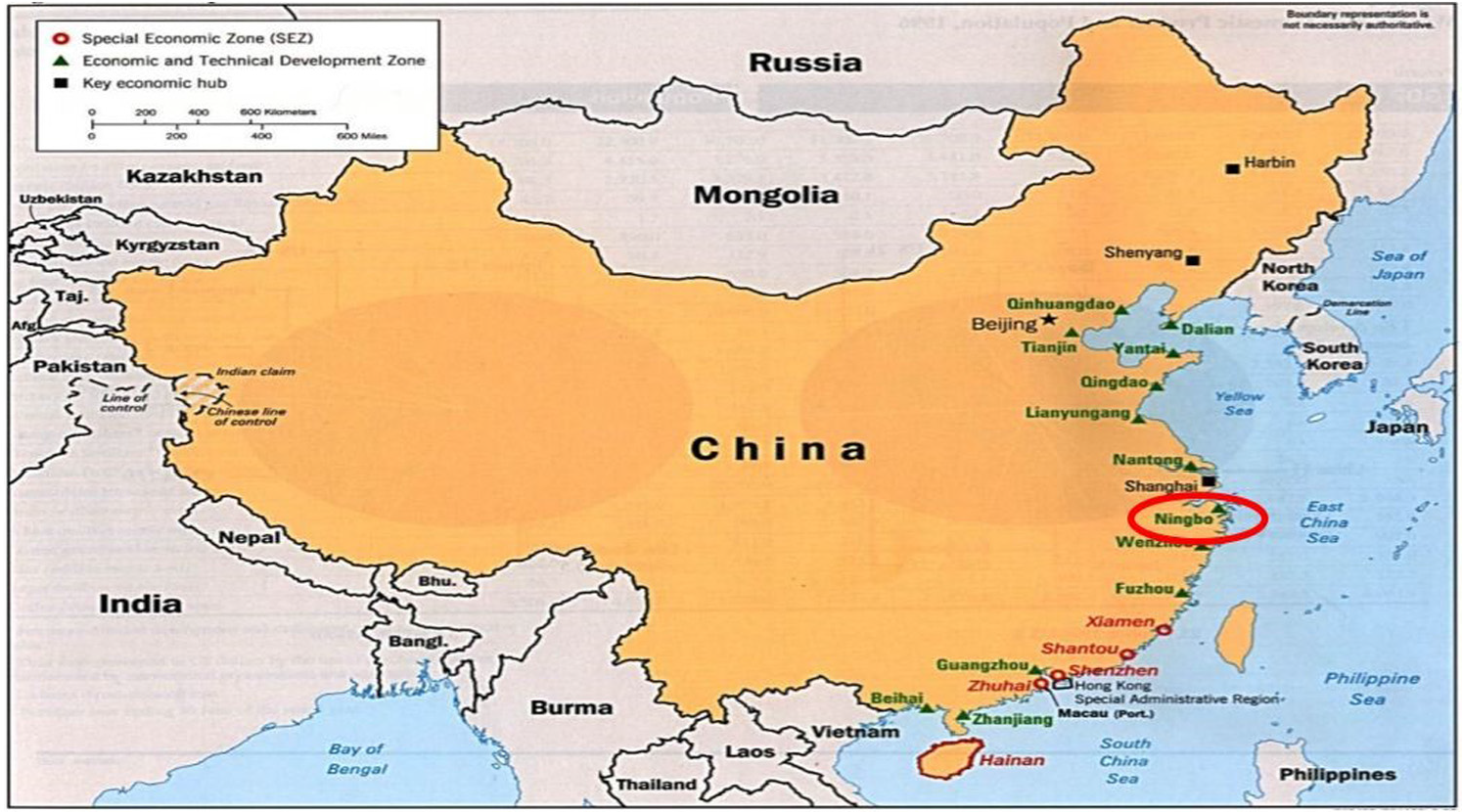
Ningbo City in the map of China.
Data and methods
Data sources
The data in this study come from a survey conducted in 2014 by the Institute of Population and Labor Economics of the Chinese Academy of Social Sciences in the city of Ningbo, Zhejiang Province. Ningbo was chosen for several reasons. Located in one corner of the Yangtze River Delta, Zhejiang Province has attracted a huge number of migrants since the pre-1970 period. Ningbo is renowned for its active manufacturing, commercial and trading activities, which makes the city appealing to migrants. In 2014, there were 4.2 million migrants living and working in Ningbo, approximately 42% of the total population of Ningbo. In 2013, 65% of migrants reported a length of residence of more than six months while 6% had been in Ningbo for more than five years (Statistic Bureau of Ningbo, 2014).
Comparing migration data from Ningbo and other medium- or large-sized Chinese cities (e.g. Fuoshan, Hangzhou and Suzhou) in 2014, a number of similarities are identified. The age structure of the migrant population in Ningbo is similar to that in the other cities. For example, the proportion of labour force participation age population in Ningbo was 81% in 2014 (94% in Suzhou and 91% in Hangzhou). The proportion of migrants without local urban hukou status accounted for 43% of the total population in Ningbo, 50% in Suzhou and 53% in Fuoshan (Statistic Bureau of Fuoshan, 2014; Statistic Bureau of Hangzhou, 2014; Statistic Bureau of Ningbo, 2014; Statistic Bureau of Suzhou, 2014). In addition, Ningbo has similar migration policies to those in Fuoshan, Hangzhou and Suzhou that encourage migrants to choose long-term residence and provide migrant children with full access to local compulsory education. Ningbo therefore could be used to represent medium- or large-sized cities in China, especially those in the coastal region.
Supported by a trained team from the Ningbo Public Security Bureau (PSB) and Statistics Bureau of Ningbo, face-to-face interviews were conducted to collect data in 2014. 5 Using official data from the PSB of Ningbo as a sampling frame, a multistage stratified sampling process was carried out. First, 100 neighbourhoods were selected randomly in a total of six districts, two counties and three county-level cities in Ningbo. Thereafter, in each selected neighbourhood, 20 migrants were randomly selected. We defined migrants as individuals aged 15 years or older 6 whose hukou was not registered in Ningbo at the time of the survey, and who had been absent from their places of hukou registration for more than six months.
The survey yielded a total of 1659 valid questionnaires. To test the data validity, we compared a number of demographic characteristics between the sample data and official data from the Health and Family Planning Commission (HFPC) of Ningbo in 2013. The sample data are very close to those of official data in HFPC. The average age of the sampled migrants was 35.2 years and 80.6% were aged 16–45 (82.7% in the HFPC data). Of these, 57.4% were male (53.9% in the HFPC data), 82.2% were married and 82.3% had received senior school or below education (70.4% in the HFPC data). This survey ensured that migrant-concentrated neighbourhoods were equally likely to be selected based on the PPS 7 sampling frame.
Variable specification
Three indicators were used to measure the settlement intentions. The first is the permanent residence intention, which was captured by asking migrants whether they planned to live permanently in Ningbo (yes, intending to live permanently in Ningbo; no, not intending to live permanently in Ningbo). The second is associated with hukou transfer intention (yes, intending to transfer original hukou to Ningbo; no, not intending to transfer original hukou to Ningbo). The last indicator involves housing decisions in Ningbo, which was captured by asking whether migrants were intending to own local property (yes, intending to own property in Ningbo; no, not intending to own property in Ningbo). To capture the complexity of settlement intention, we incorporated housing ownership intention into the classification of permanent settlement intention.
Four groups of independent variables may affect migrants’ settlement intentions. The first group concerns institutional constraints, specifically hukou registration (rural versus urban hukou). In previous literature a lack of urban hukou has been found to be an obstacle to migrants’ stable employment and access to social provisions in host cities (Sun and Fan, 2011; Wang and Fan, 2006).
The second group is associated with human capital and employment status, which captures migrants’ economic achievements that contribute to their settlement decision-making (Cao et al., 2015; Connelly et al., 2011). Migrants’ formal education, length of residence in the host city, income level, employment and labour contract capture their integration in the labour market of the host city.
The third group involves housing arrangements in places of origin. Housing ownership in places of origin would affect migrants’ housing decision and their settlement intention in places of destination.
The fourth group measures migrants’ social networks in both origins and destinations and their social identity in the host city (Cao et al., 2015; Liu et al., 2017). Three variables are used. First, interactions with locals or friends capture the local social networks. Second, experiences of receiving help from locals and a willingness to socialise with locals 8 capture migrants’ social attachments in the host city. Third, sending children to receive local compulsory education at their destination may promote migrants’ permanent settlement intention (Xu et al., 2011). In contrast, social networks and attachments in places of origin, including frequency of home visits and land tenure in places of origin, may reduce the possibility of permanent settlement at destinations. Moreover, migrants’ social integration in the host city is captured by social identity 9 and self-evaluation of the host city. 10 Finally, we control for the demographic variables including age, gender and marital status in the analysis.
Empirical findings
Descriptive analysis: Demographic characteristics of migrants
Table 1 shows that rural migrants were cautious about transferring hukou to their host city. Only 12.8% of migrants with rural hukou status reported their intention to transfer hukou to their destination while 31.8% of urban hukou holders expressed their intention to transfer hukou. Yet, 47.6% of rural migrants intended to stay permanently in their host city.
Permanent residence intention and transferring hukou intention by hukou type.
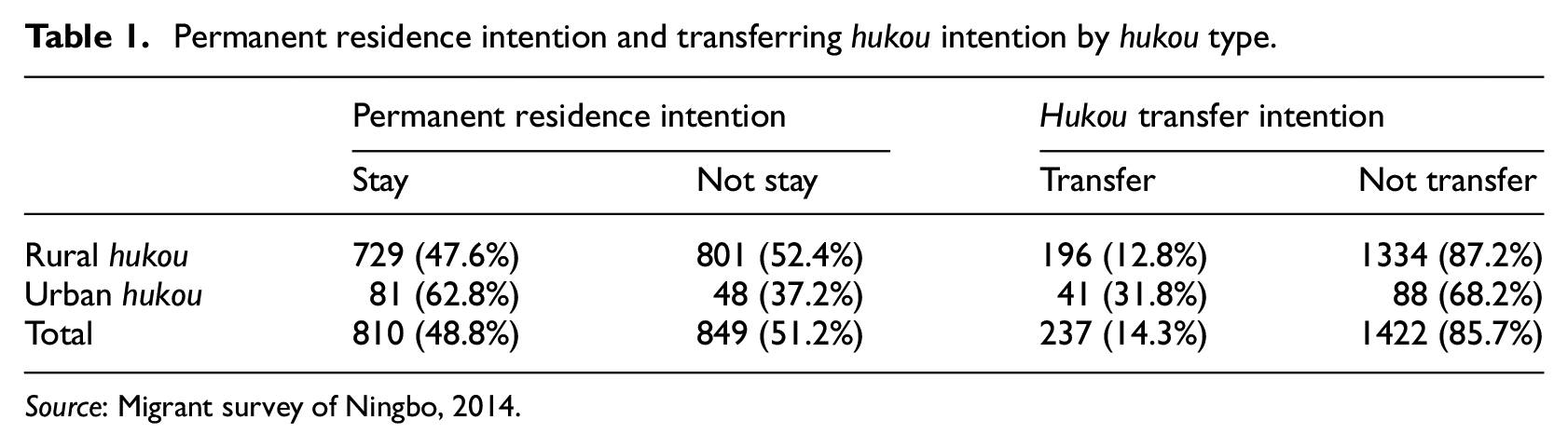
Source: Migrant survey of Ningbo, 2014.
Contrary to existing studies that found permanent settlement is closely related to the transfer of one’s hukou (Hu et al., 2011; Tang and Feng, 2015), in this study migrants reported diverse intentions of hukou transfer and permanent residence. Nearly half of the migrants reported their intention to per-manently settle while approximately 86% chose to retain their original hukou status rather than transferring hukou to their destination, regardless of whether they were urban hukou or rural hukou holders (Table 2). Furthermore, there were diverse settlement intentions among migrants with different housing arrangements. About 45% of migrants who lived in dormitories or rented private houses reported permanent residence intention while only 10% who lived in dormitories or rented housing tended to transfer hukou to their destination city. It is possible that migrants’ housing decisions at their destination could be connected with their permanent settlement decision-making.
Mean of variables used in regression analysis.
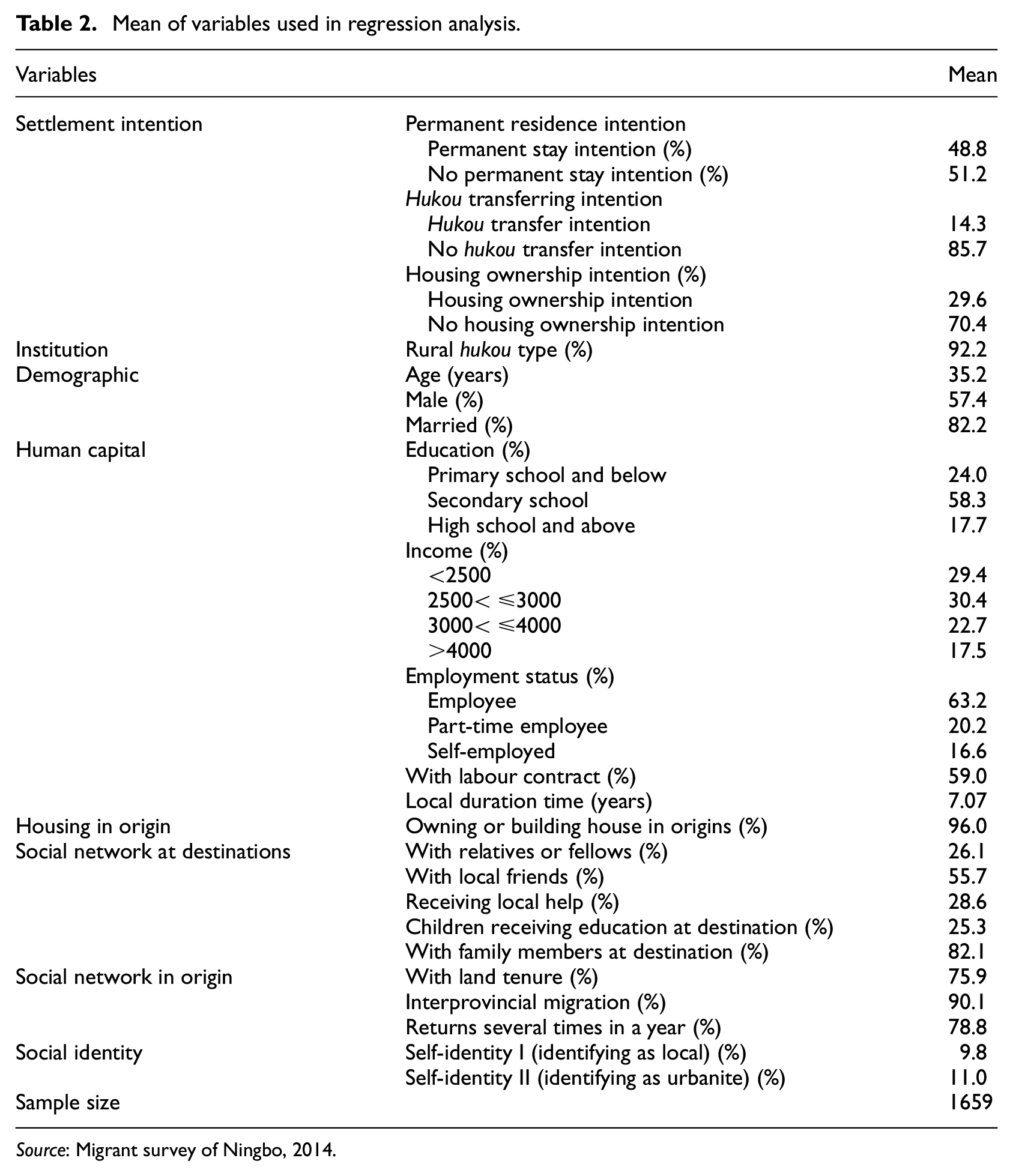
Source: Migrant survey of Ningbo, 2014.
New dimension of settlement intention: Urban housing ownership intention
As discussed previously, owning a property in host cities is not impossible for migrants because of the marketisation of urban housing. Those migrants who plan to permanently settle down tend to invest in property in host cities; otherwise, they prefer to improve their existing house or build a new house in their original home (Wu, 2004). A logistic regression is adopted to examine the relationship between housing ownership decision and settlement intentions (Table 3). 11 The results suggest that migrants’ housing decisions are important determinants of settlement intention. In contrast with those who live in dormitories, migrants who rent private housing are more likely to consider permanent residence in the destination city. Furthermore, migrants who own private property in the destination city are more inclined to be permanent settlers. The latter are more likely to choose permanent residence and transfer hukou to their destination city, although only a small sample reported housing ownership in the destination city. Through private renting, migrants take the first step toward permanent residence while housing ownership in the destination city contributes to their permanent residence and hukou transfer intention. Evidence so far indicates that housing ownership provides migrants with an additional option to achieve permanent settlement in addition to hukou transfer. Given the close connection between housing ownership decisions and settlement intention, housing ownership intention is considered as an additional category of settlement intention.
Logistic regressions of permanent residence intention and hukou transferring intention.
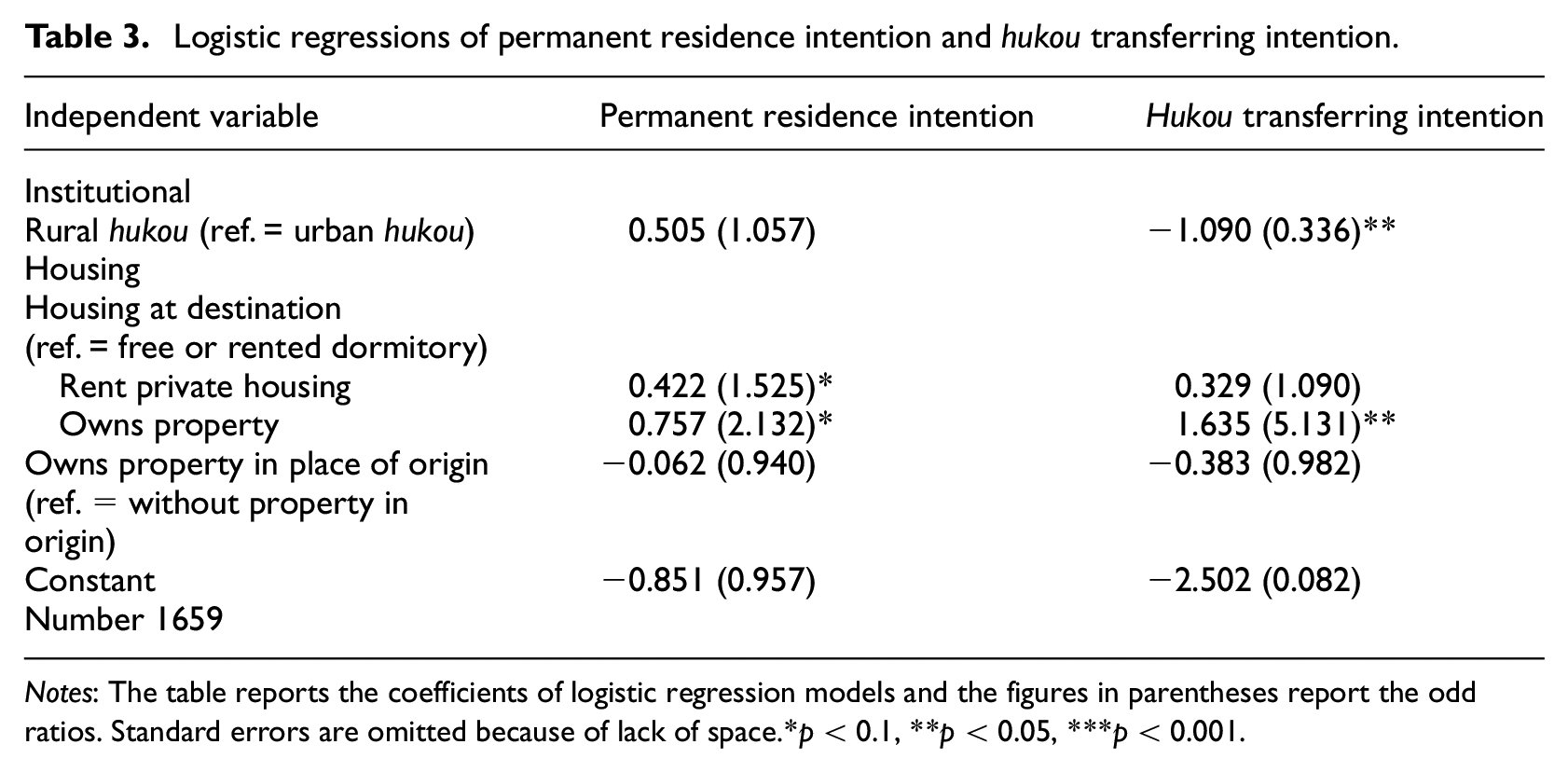
Notes: The table reports the coefficients of logistic regression models and the figures in parentheses report the odd ratios. Standard errors are omitted because of lack of space.*p < 0.1, **p < 0.05, ***p < 0.001.
By considering the three indicators – permanent residence, hukou transfer and housing ownership – four patterns of settlement intention can be identified. Migrants in each pattern satisfy the three conditions simultaneously: (1) if migrants reported their permanent stay intention and hukou transfer intention but not housing ownership consideration in the host city, their intention is classified as traditional permanent settlement intention (pattern1). In addition, some respondents (7.48%) reported their permanent residence intention, hukou transfer intention, as well as housing ownership consideration; this pattern is also classified as traditional permanent settlement intention (pattern1). (2) Migrants with de facto permanent settlement intention through housing ownership (pattern2) are migrants who reported their intention of residing permanently and owning housing in the host city, but are not considering hukou transfer. (3) Long-term temporary settlement intention (pattern3) indicates permanent residence intention but without considering either hukou transfer or housing ownership in the host city. (4) If migrants reported temporary residence intention without consideration of permanent residence, hukou transfer and housing ownership, this intention is classified as short-term temporary settlement intention (pattern4) (see Table 4). These four categories are mutually exclusive. Migrants shown in one settlement pattern would not be included in the other three patterns. For example, pattern1 only captures migrants who followed the traditional settlement pattern with both hukou transfer and permanent residence intentions, while pattern2 includes only those who reported both intentions of permanent residence and housing ownership but without intentions of hukou transfer. Migrants in pattern3 are only those with considerations of permanent residence but did not have hukou transfer and housing ownership intentions, while migrants in pattern4 only consider the short-term residence at destination without intentions of permanent residence, hukou transfer, or housing ownership. Table 4 indicates the diverse choices of migrants to achieve settlement based on the new classification scheme. Under this scheme, 11.9% of migrants reported traditional permanent settlement intention involving permanent residence and hukou transfer while 10.2% showed de facto permanent settlement intention in the host city without necessarily transferring their hukou registration (see Table 4). Considering migrants’ multiple choices of settlement intention, we used a multinomial regression model to further examine settlement intention patterns beyond the traditional hukou scheme.
Classification of settlement intention with permanent residence, hukou transfer and property ownership intention.
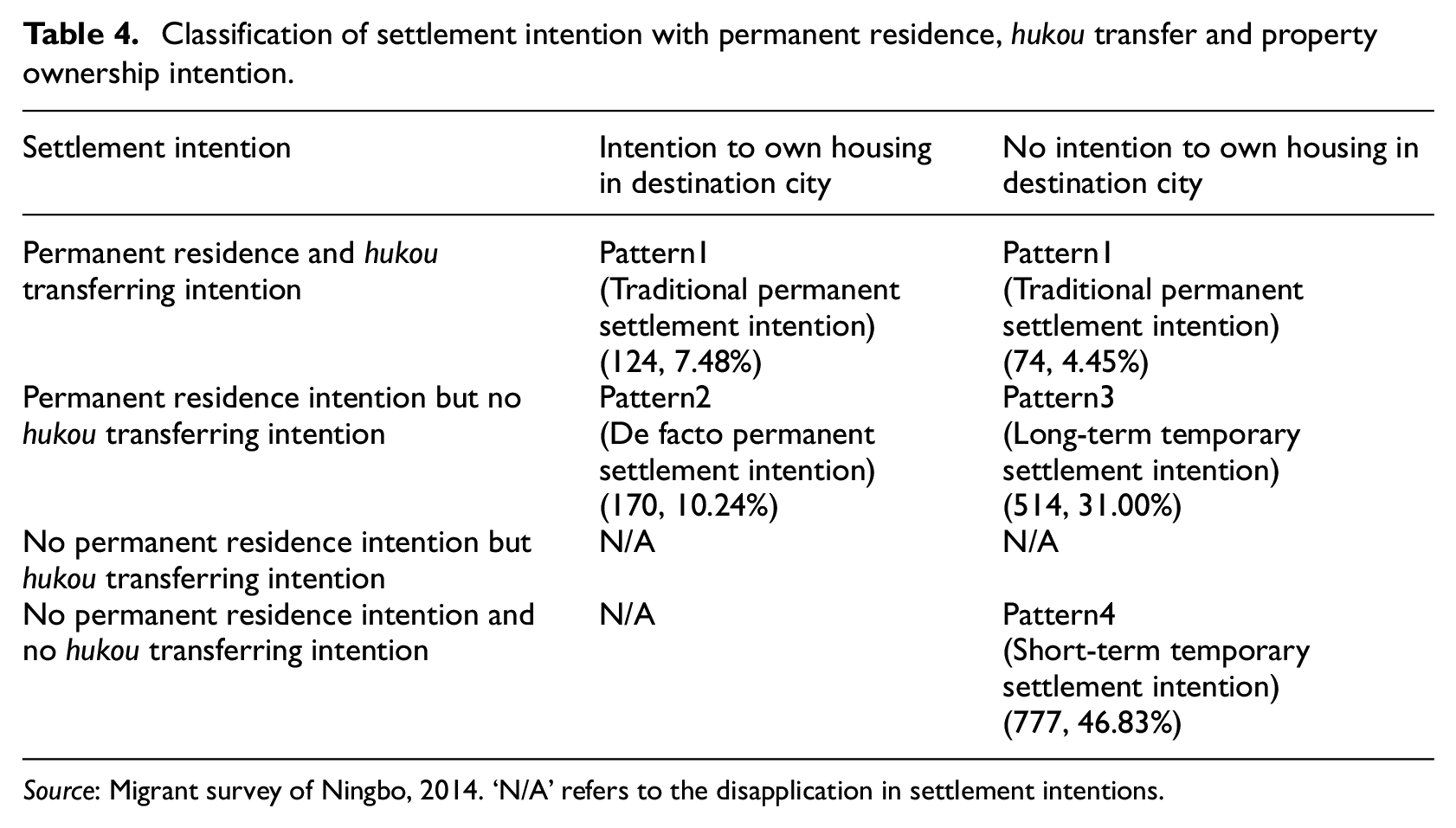
Source: Migrant survey of Ningbo, 2014. ‘N/A’ refers to the disapplication in settlement intentions.
Table 5 shows the multinomial regression results of the determinants of different settlement intentions. In stark contrast with previous settlement studies (e.g. Wang and Fan, 2006), the absence of urban hukou status is not the foremost barrier to migrants’ permanent settlement intentions. Migrants with rural hukou status, compared with urban migrants, preferred to achieve permanent settlement through diverse channels such as local house ownership, permanent residence and hukou transfer. Some rural migrants reported de facto permanent settlement intention (pattern2) because they intended to stay permanently and own local housing but have not necessarily transferred hukou. Some others with long-term temporary settlement intention (pattern3) preferred permanent residence but do not consider hukou transfer or local housing ownership. The results suggest that it is possible for ‘temporary migrants’ to be permanent settlers through urban house ownership instead of the connection to urban hukou status. Obtaining local urban hukou is not the only channel through which to achieve permanent settlement.
Estimates of multinomial logistic regression of settlement intentions in Ningbo (Ref = pattern4).
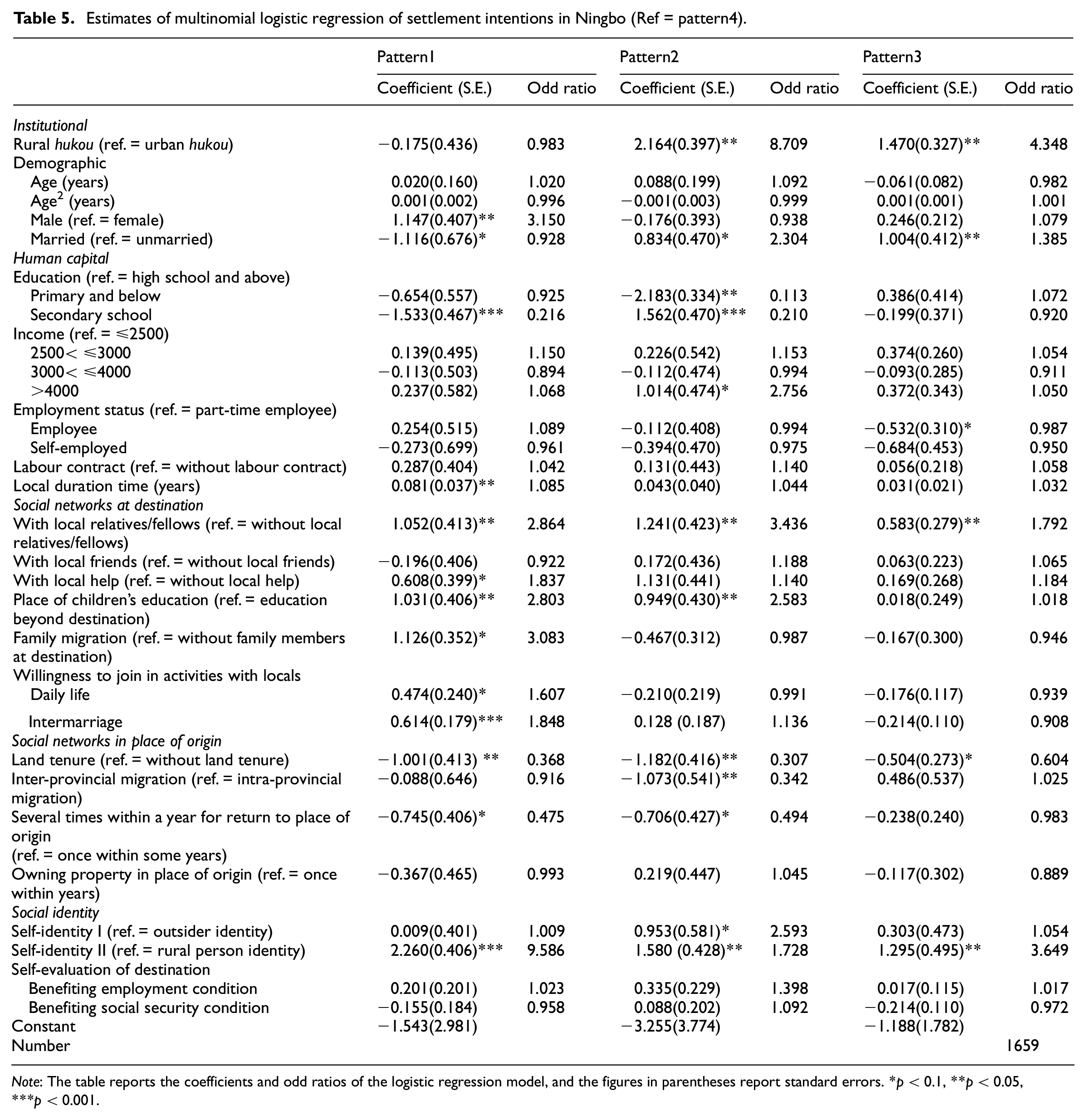
Note: The table reports the coefficients and odd ratios of the logistic regression model, and the figures in parentheses report standard errors. *p < 0.1, **p < 0.05, ***p < 0.001.
Human capital factors facilitate migrants to make varying settlement decisions. In addition to employment status and labour contract engagement, the educational level of migrants had a positive effect on permanent settlement. Migrants with a higher level of education intended to be permanent settlers with de facto permanent settlement intention (pattern2), owning housing in their host city but without the hukou transfer intention. Moreover, those migrants who had been living in the host city for a longer time were more likely to be permanent settlers involving permanent residence and hukou transfer intention (pattern1). These results are consistent with the general trend that the length of time spent at a destination increases migrants’ permanent settlement intention (Connelly et al., 2011).
Determinants beyond institutional constraints also lie in migrants’ social attachments in their host city. Social interactions at the destination strongly encouraged migrants to choose traditional permanent settlement intention (pattern1). Migrants who received help from local residents and reported a willingness to join social activities with locals and who in addition had the companionship of their family members were more attached to their destination. These social attachments therefore encourage permanent settlement. Compared with the short-term stay group (pattern4), migrants who identified themselves as urbanites showed a strong intention toward permanent settlement, either through hukou transfer, housing ownership or even merely permanent residence. With local self-identification, migrants were more likely to settle through owning a local house (pattern2). Not surprisingly, social provisions in the host city regarding children’s compulsory education raised the possibility of traditional permanent settlement intention or de facto permanent settlement intention. With regard to original attachment, consistent with our previous analysis, land tenure in the place of origin drove migrants to choose temporary settlement, suggesting that close attachment in the place of origin decreased the possibility of permanent settlement intention.
In sum, migrants in our sample hold diverse settlement intentions beyond hukou restrictions. Rural hukou holders are more likely to own local housing or stay permanently without necessarily transferring hukou. Through the urban housing mechanism, it is possible for migrants with rural hukou status, a higher level of education and higher income to achieve de facto permanent settlement intention. Human capital and social attachments in the host city encourage migrants to be traditional permanent settlers or ‘de facto’ permanent settlers while social attachments to the original home, such as land tenure, discourage their permanent settlement intention. We observe that urban self-identification plays an important role in increasing migrants’ willingness to be permanent settlers through diverse channels.
Conclusion
In recent decades, China has undergone rapid industrialisation and economic development, and the rise in rural–urban migration represents the country’s growing urbanisation and modernisation. Whether migrants, especially rural–urban migrants, plan to permanently settle or not affects the pace and process of urbanisation, and welfare and service provisions, in host cities. Temporary migrants, those without local urban hukou status, suffer economic instability and lack of social support in host cities; therefore their migration is classified as temporary in nature without the expectation of permanent settlement (Fan, 2008; Shen, 2002). However, few studies have addressed the diverse patterns of settlement intention under the interaction of institutional constraints and housing marketisation. The rise of housing marketisation has broadened housing choices for migrants, which also contributes to the complexity of the settlement process. Conventionally, hukou transfer was the only permanent settlement channel and all migrants who did not transfer hukou registration were considered as non-permanent settlers. The results from this study clearly suggest that the availability of the housing market in cities has provided migrants with an additional permanent settlement channel. Documents other than hukou registration, such as a personal income certificate, could qualify migrants in medium-large sized cities or even large sized cities to purchase properties. Renting has become available for migrants even without hukou or personal income tax certification in some large cities. This paper has examined the varying patterns of permanent settlement intention including permanent residence, hukou transfer and housing ownership in host cities.
This study finds that Chinese internal migrants exhibit diverse settlement patterns in host cities such as Ningbo. Nearly half of the migrants intend to stay permanently while the majority of them hesitate to transfer their hukou registration. The economic and social attachment (e.g. land tenure) to origin means that rural migrants tend to keep their original rural hukou instead of obtaining local urban hukou. However, hukou transfer intention does not comprehensively capture permanent settlement intention. Through private renting, migrants take the first step toward permanent residence while housing ownership in the destination city contributes to their permanent residence and hukou transfer intention. Owing to strong economic capability and social adaptation, they could achieve permanent settlement through market channels without necessarily transferring hukou. Housing ownership intention in the host city should therefore be incorporated into the traditional classification scheme of settlement intention.
Given the broad settlement choices including house ownership, permanent residence and hukou transfer, it is safe to say that rural migrants prefer to use flexible channels to achieve permanent settlement. Conventional wisdom states that hesitance in transferring hukou to the host city indicates a temporary settlement intention (Wang and Zuo, 1999). However, it is the urban housing market that facilitates de facto permanent settlement intention, which contributes to a balance between permanent settlement and maintaining rural hukou. Migrants could keep rural hukou and maintain socio-economic attachments, such as land tenure, in their original home to maximum benefits. The market mechanism broadens settlement patterns to encourage migrants to break institutional barriers to achieve permanent settlement intention. The strategy of de facto permanent settlement intention adopted by migrants could indicate the weakened hukou effects on migrants’ settlement decision-making, which could not have been possible in the previous era as suggested in the previous studies (Wang and Zuo, 1999).
Different determinants of human capital, social attachment and social identity on settlement intentions show varying strategies among migrants beyond the effects of hukou. High education level and strong economic ability significantly drive migrants to settle with de facto permanent settlement intention. Migrants with housing ownership intention or those who have already become homeowners in the host city are more capable of becoming permanent settlers who are economically and socially integrated. Through social support and social provisions in host cities, such as compulsory education for children, ‘de facto’ permanent settlers are able to break institutional barriers and settle down permanently.
There are several implications for the ‘people-oriented urbanisation’ process, which encourages eligible migrants to become permanent residents. First, as hukou transfer is not necessarily connected to permanent settlement, if housing ownership access is more available to migrants, it is possible for them to break institutional barriers through individual efforts to realise de facto permanent settlement. Since 2016, increasing numbers of medium-sized cities have permitted migrants without local hukou status to access the housing market while some cities require migrants to provide local social security or personal tax income certification to access the housing market. One could expect that if the urban housing policies are further relaxed, migrants would be strongly motivated to own local urban housing and settle permanently at their destination city.
Second, future institutional reforms and urbanisation should pay attention to the strategies of migrants to achieve permanent settlement. In the hukou reform process, instead of relying on granting hukou status to migrants at destination cities, the government should focus on granting the eligibility for equal employment and social provisions, such as education. A residence permit (ju zhu zheng) system has been implemented since early 2017 that aims to grant equal social welfare benefits and services to the permit holders. By granting migrants equal social welfare benefits, the residence permit system would challenge the role of the traditional hukou system in controlling people’s spatial movement and settlement. Research on the consequences of this new initiative will be needed in the future.
A few limitations are noted in this study. This single-city study may not be generalisable to all regions of China, especially megacities (e.g. Beijing), where migrants might experience more complicated settlement decision processes. It is noted that there might be possible reverse causality with the variables of social networks at destination, and of settlement intention. However, the reverse causality in this study is not a major concern. Previous studies suggest that the social network is an important factor in determining migration directions and destination choices, indicating that the social network was more likely to be a ‘cause’ of migration in the first place rather than a ‘result’ of migration or settlement (Cai, 2001). It is also noted that migrants who have already obtained permanent settlement through hukou transfer are not included in the data as the survey only captures conventional ‘temporary migrants’ without hukou. However, the omission of this type of migrant does not contribute to a biased result on preference toward hukou transfer by migrants. 12 A follow-up survey on the actual settlement behaviour of migrants would be ideal but was not available for this study. As suggested by previous studies (Fan, 2011), understanding settlement intention can lead to a better understanding of actual behaviour. Despite its limitations, this study provides a comprehensive analysis of migrants’ settlement decision-making from a new perspective that reflects the recent change in Chinese cities.
Footnotes
Declaration of Conflicting Interests
The author(s) declared no potential conflicts of interest with respect to the research, authorship, and/or publication of this article.
Funding
The author(s) received no financial support for the research, authorship, and/or publication of this article.