




Abstract
The 2017 Puerto Rican debt crisis is as instructive as it is sad, reflective of the familiar pressures of late modern capitalism (namely neoliberalisation, financialisation, crisis, and austerity) as well as its own unique dynamics percolating through four hundred years of colonialism and a century of legal subjugation to Washington, DC. Neither one-off explanations of fiscal crisis nor casual conflation with other cases suffice to adequately account for this, or any other, public sector debt crises. Puerto Rico is both foreign and domestic, it is neither state nor municipality but its bonds are treated as such, it reflects larger trends and is circumscribed by its own unique history, subtle economic explanations are matched by bald, large-P politics. Analytical conundrums such as these are confounding and lead to perennial, potentially circular and irresolvable, debate in the critical urban studies literature. This paper explores whether the possibility of using the philosophical notion of paradox – a situation where sound reasoning leads to incomplete, unsatisfying, or unexpected results or consequences – and Zeno’s famous paradoxes in particular, can serve as allegorical heuristics capable of provoking new theories, expectations, or assumptions in urban studies.
Introduction: Being like Detroit
17 May 2017 – ‘Puerto Rico in uncharted waters as historic bankruptcy process begins. U.S. federal judge to begin sorting out $123B debt in a San Juan court on Wednesday’ (D’Souza, 2017). Thus began the largest US government debt proceeding since Detroit. Not without warning, Puerto Rican insolvency today was clearly preceded by earlier troubles, news headlines summarising the saga: ‘Puerto Rico defaults on multimillion-dollar debt amid crisis’ (1 February 2017; AP, 2017), ‘Puerto Rico defaults on constitutionally guaranteed debt’ (1 July 2016; Gillers and Timiraos, 2016), ‘Puerto Rico’s biggest default yet’ (2 May 2016; White, 2016a). Puerto Rico is in fiscal crisis just as Detroit, Atlantic City and many other American governments have experienced as of late – cities, counties, states, large and small – but Puerto Rico also has its own unique historical, legal, political, economic and geographical features that defy common American characteristics. Looming largest is that the Caribbean island has been a colonial holding since the earliest days of transatlantic conquest. In his treatise on transatlantic urbanism, Jamie Peck (2016: 5) writes of cases and conjunctures, of ‘[t]he contradictory tangle of local and extralocal political calculations’. Puerto Ricans experience another tangle – legal subjugation – unlike most other American citizens. Since 1901, a US Supreme Court ruling has rendered Puerto Rico both foreign and domestic, neither state nor municipality – but with bonds treated as such.
Puerto Rico may not be legally ‘like Detroit’, but it faces similar circumstances: the pressures and contradictions of neoliberalisation, financialisation, fiscal crisis and austerity. Yet how to explain and interpret this conjuncture enjoys little academic agreement. Critical urban studies literature on related political economy trajectories and undercurrents is far from homogeneous, with much dispute over the nature, and even the ontological validity, of labels like ‘neoliberal’, ‘financialisation’, ‘crisis’ and ‘austerity’ (e.g. Bayırbağ et al., 2017; Christophers, 2015; Halbert and Attuyer, 2016; Storper, 2016). There is no shortage of (re)defining, (re)explaining and (re)naming, along with adding and subtracting, to familiar social science categories grappling with the political economy of late modern capitalism. It is surely a sign of disciplinary health that large debates churn in urban studies, but if chasm-like differences lead to enduringly circular arguments, then adjacent or more established literatures might help serve as way-finding signposts to understand such debate.
This article seeks to consider the analytical possibilities offered by applying the philosophical concept of ‘paradox’ to large debates in critical urban studies. It focuses on the dialectical tradition that began with the ancient Greeks, namely Zeno in the fifth century BCE, arguing that ‘paradoxes’ provide useful ways of appreciating tensions and contradictions as dichotomous, integrating antagonistic views into a whole, and using scepticism (particularly vis-a-vis conventional wisdom) to uncover new questions. To explore this argument, I draw on four of Zeno’s most famous paradoxes: i) The Grain of Millett (soundless sound), ii) The Arrow (motionless motion), iii) Achilles and the Tortoise (finite distance made of infinite steps) and iv) Against Place (singularity through infinite regress). Directly applying these paradoxes to moments in political economy is somewhat unwieldy; instead this article seeks to initiate discussion by suggesting that Zeno’s paradoxes offer heuristic allegories akin to how continuity exists amid conjunctural difference (neoliberalisation), systemic phenomena consist of idiosyncrasies (financialisation and fiscal crisis) and unique case dynamics develop from/into common circumstance (austerity). At a higher level of abstraction, ‘paradox’ also suggests that some conundrums may be unresolvable and some resolutions unsatisfying, and that debate itself represents a unity.
The debates invoked here are not unique; they intentionally reflect larger political economy changes and established academic writing, especially in areas germane to urban studies and economic geography regarding neoliberalism, crisis, financialisation, debt and austerity. To be clear, this article is not a contribution to the metaphysics of paradox, nor does it attempt to categorically resolve extant well-rounded debate in critical urban studies. Instead, it addresses several overarching (circular?) debates in critical urban studies literature and offers their (potential?) paradoxical syntheses, leaning on longstanding philosophical insights. The article’s structure focuses on how Zeno’s paradoxes might be applied to large concepts and debates in critical urban studies whilst weaving in empirical aspects of the Puerto Rican fiscal crisis to contextualise the discussion.
Large changes, lasting paradoxes
From the Greek ‘para’, against or distinct from, and ‘doxa’, common belief or opinion, a paradox is a statement with (apparently) sound reasoning that leads to a contradictory conclusion ( Oxford English Dictionary, n.d.). Even, or especially, if the conclusions are not satisfactory, the premises are logical and thus cannot be refuted unless the answer itself is pre-determined. In philosophy, the paradox presents a situation where sound reasoning leads to incomplete, unsatisfying or unexpected results or consequences. For urban studies debates, paradox might serve as a heuristic to provoke new theories, expectations or assumptions.
Useful paradoxes that we may draw on are those invoked by Zeno in the fifth century BCE. Zeno leads a mathematical tradition of ontological probing at the existential question ‘to be, or not to be’ (Toth, 1993: 200). Zeno’s paradoxes offer a series of logic puzzles leading to contradictory statements about time and space, sequence and counting. We have no direct works of this Greek philosopher; his paradoxes come to us first via Plato’s work (on Parmenides), which was also lost but recorded second-hand through Aristotle’s writing. For over a thousand years, these paradoxes engaged the likes of Aristotle, Diogenes, Aquinas and Archimedes. More recently, calculus, quantum physics and mathematical development on the concept of infinity (particularly important in addressing the logic underpinning the paradoxes’ reasoning) have added to the debate, but ultimately it is difficult to refute or resolve these paradoxes entirely; in some sense they remain unresolvable and dependent on scale, perspective and time. Mathematician and philosopher Alfred North Whitehead sums up Zeno’s endurance when he writes that, ‘every century thinks it worth while to refute him’ (Whitehead, quoted in Code, 1985: 49). The reason that they remain powerful as paradoxes, and that they can be usefully applied to urban studies inquiry, is that they combine confounding conclusions with stellar reasoning, and link thesis, antithesis and synthesis in academic debate.
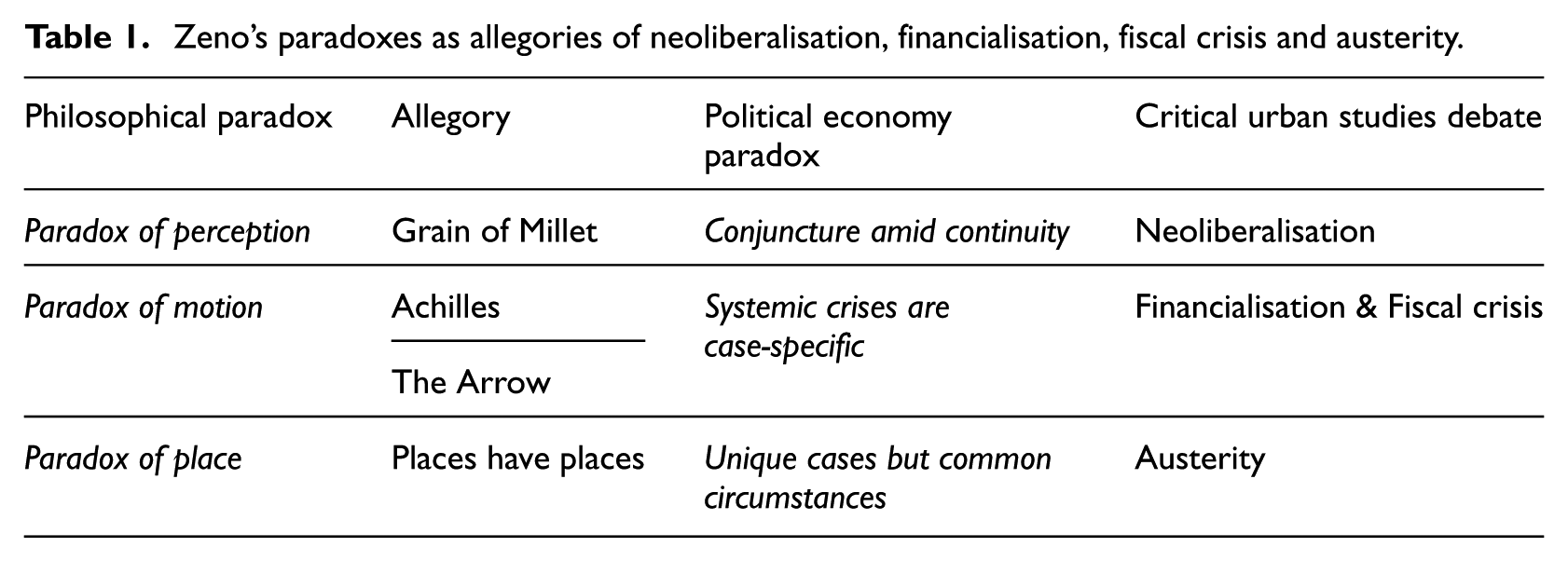
Aristotle considered Zeno to be the father of dialectics – a method of analysis based on questioning and defending propositions – and here we consider what his paradoxes offer critical urban studies with regard to an awareness of time, motion, events, sequencing and the difficulties of analytically resolving contradictions despite sound reasoning. As indicated in Table 1, Zeno helps to allegorically frame large debates on neoliberalisation, financialisation, fiscal crises and austerity by destabilising otherwise clear or obvious positions on change and continuity: i) the paradox of perception (The Grain of Millet), ii) paradoxes of motion (Achilles and The Arrow) and iii) the paradox of place (Against Place) (for more on the metaphysics of each, see Huggett, 2010).
Grain of Millet Paradox: ‘there is no part of the millet that does not make a sound’ (Huggett, 2010). One grain of millet falling to the ground makes no sound but a sack of millet does. One sack full of silent grain can make a sound.
The Grain of Millet paradox is allegorical to the compatibility of conjuncture and continuity in urban studies: liberal and illiberal moments make up the neoliberal era; neoliberalism is unique to today and equally an expression of larger historical trends in capitalism.
Zeno’s paradoxes as allegories of neoliberalisation, financialisation, fiscal crisis and austerity.
The proliferation of ‘neoliberalisms’ in the literature is striking. We now have the neoliberal state and neoliberal city (e.g. Hackworth, 2007; Peck and Tickell, 2002), actually existing neoliberalism (Brenner et al., 2010) and neoliberal localisation (Brenner and Theodore, 2002), complemented by the debt state (Streeck, 2017), the consolidation state (Streeck, 2017), the tax state (Gamble, 2015), post-democracy (Crouch, 2004) and the audit society (Power, 1997). Whether neoliberalism deserves such centrality is a matter of continual dispute. In a 2016 special issue of Territory, Politics, Governance dedicated to ‘The neoliberal city’, Storper (2016: 241) argues that ‘there is little evidence of the massive withdrawal of the state, de-regulation of city life, reduction in urban public goods’, and further suggests that much of the critical neoliberal literature misses the mark – either mislabelling or misunderstanding the underlying motivations and activities of urban governance. In a book devoted to neoliberalism, Eagleton-Pierce (2016: iii) writes that despite the popularity of this concept, its exact definition and implications remain ‘confusing, the product of contested histories, meanings, and practices’. Indeed. While for most jurisdictions it is certainly true that we can identify common trends over the past 40 years that fit within the neoliberal rubric identified by Harvey (2005) – e.g. public asset privatisation, fiscal austerity, market liberalisation – it is also true that policy over this same period has been inconsistent, contradictory and variegated (Brenner et al., 2010). There is evidence of, in some cases, not less state regulation but far more, not miserly public sector spending but new forms of redistribution (Braithwaite, 2008). Sometimes ‘neoliberalism is a macro level concept with influence on various urban worlds’ (Le Gales, 2016: 167), and in other instances ‘much urban policy change is indeed less motivated by macro-ideology than by a complex pragmatics of dealing with an urban environment shaped by changing technologies, migration patterns, lifestyles, economic specialization, and economic development’ (Storper, 2016: 254).
The liberal market order has no trouble co-existing with practices of economic nationalism, communitarianism or corporatism; in fact, Jessop (2002) argues that the social, economic and political problems created by neoliberalism require flanking by other non-neoliberal, non-marketised strategies. Likewise, for Tickell and Peck (2003: 165) neoliberal market politics have always been hybrid – never appearing in ‘pure’ form, local neoliberalisms are the result of the balance of class forces, institutional legacies and modifications in light of resistance, path dependency and crises. Halbert and Attuyer (2016), drawing on Ashton et al. (2016), describe contradictory tendencies of state retrenchment and extension – neoliberal policy projects making fuzzy any binary distinctions that may have once (if ever) existed (e.g. public vs. private, political vs. economic, productive vs. financial). Transformation is both structural and ideational whereby crisis narratives (re)frame subjects over time, incant rationalisations and shape-shift when rooted in place (Bayırbağ et al., 2017; Clarke and Newman, 2012; Fuller and West, 2017; Hinkley, 2017).
Puerto Rican economic governance reflects neoliberal trends just as it is circumscribed by its own unique illiberal political history. Austerity measures and financialised debt relations are being established as core governance mechanisms (more on these issues later), and privatisation has been used for years to address debt burdens. In 2009, the public service was cut by 20 per cent and in 2011 a major toll highway was leased to Goldman Sachs for 40 years. Despite the Puerto Rico Electric Power Authority being a long run revenue-generating asset, and with one million people still needing electricity four months after the devastation of Hurricane Maria, in 2018 San Juan announced it would be shedding its ownership ‘burden’ through privatisation (Bases, 2018).
Privatisation may be an archetypical example of neoliberal accumulation by dispossession but explanations of market-orientated restructuring alone cannot tell the whole story: colonial politics and regulatory practices of the US federal government (displaying both protectionist and liberal tendencies) make up much of the backstory of debt crisis and restructuring today. A paradox of perception is presented for urban studies analyses: neoliberal contextualisation reveals an economic history often detached from liberalism while joined to familiar patterns of winding and checkered capitalist transformation.
Near where Columbus first landed in the Americas, the island was claimed by Spain in 1493, and it remained under its yoke for over 400 years. On 17 July 1898, it gained its independence and a week later, on 25 July 1898, the US invaded the island. In April 1899, the Treaty of Paris was ratified and Puerto Rican sovereignty was transferred to Washington. With the Treaty of Paris, America was given Guam, the Philippines and Puerto Rico. In what is now known as the ‘insular cases’, 1 referring to a series of opinions by the US Supreme Court in 1901 on the status of US land acquired in the Spanish–American war, Puerto Rico became a territorial commonwealth – not a state – without the enfranchisement rights enjoyed by mainlanders, subject to Washington decree but without representation in Congress. From then forward, the commonwealth has been legally cast as ‘foreign in a domestic sense’ under US law (Duffy Burnett and Marshall, 2001; emphasis added).
Nineteenth century Puerto Rican political economy was agrarian-colonial, with plantation slavery and unfree labour constituting 70–90 per cent of the workforce in some regions (Scarano, 1984). Integration into the US initiated a series of economic transformations, first of its agrarian production structure in the early 20th century, then of state-led industrialisation in the early postwar period, and later of reliance on private foreign investment by the 1970s (Dietz, 1987). Well before neoliberal norms and liberalised financial markets, American federal law, particularly protections and incentives, were encouraging centre–periphery capitalist relations (Nina, 2016): special tax provisions for US companies doing business in US possession territories, including Puerto Rico, were offered beginning in 1921, and the Industrial Incentives Act of 1948 in particular exempted US subsidiaries operating in the commonwealth from paying Puerto Rican taxes and US federal income tax (GAO, 1993). Additional incentives included shielding subsidiaries from corporate tax if profits were distributed as dividends. Throughout the postwar era, Puerto Rico enjoyed the highest per capita income in Latin America, and experienced solid economic growth beginning in the 1960s (World Bank, 2017). Dietz (1987) argues that improvements in living conditions were mainly the result of fiscal transfers from Washington, and protectionist policies favouring industrialisation, public debt and public sector employment.
In 1996, the US Republican Congress began a 10-year phase out of Section 936, the tax exemption offered to US manufactures on the island. President Clinton supported it as a deficit reduction measure, promising it would save the federal Treasury US$10.5 billion over 10 years (Dayen, 2015). Without the tax credit, Puerto Rico has been in recession since 2006. The 2008 global economic crisis and US housing market collapse would only compound revenue problems. Hinterland-style fiscal federalism has mattered for the island in other ways too: it pays the same payroll taxes as other jurisdictions but receives much lower reimbursement rates for Medicare and Medicaid and its poorest citizens are ineligible for the Earned Income Tax Credit.
To return more broadly to our allegorical paradox of perception – the puzzle that one sack full of silent grain can make a sound – the current conjuncture is riven with confounding examples of intertwined liberal and illiberal moments co-existing within a framework of ever-evolving capitalism; and capitalism itself exists in different forms at multiple scales, reliant on non-marketised state and economic relations. Marx’s method in Capital Volume I suggests that the social dominance of private property and market mechanisms entails a privatisation of politics, contra the intellectual disconnect between political and economic spheres characteristic of liberal theory (Wood, 1981). And yet even if neoliberalism is enhancing the ecological dominance of capitalist market relations today (Jessop 2002), capitalism is still not the only way of producing, consuming and relating politically and economically. Between unpaid household labour, volunteer labour, unfree slave labour, intra-organisational state and corporate bureaucratic activity, not-for-profit production and myriad other ways of determining the ‘who gets what, when, how and why’ of political economy, much economic activity remains beyond the realm of the market prices, private property and profit-making ambitions central to capitalism. To give but one well-known example, Waring (1990) estimates that in capitalist countries, unpaid (non-market) work makes up as much as 40 per cent of the total time spent on producing goods and services.
Capitalism is, of course, not only relevant for its structural, material dimension; the outlook of economic participants, or ideational component of capitalist social relations, is equally important. Max Weber (2009 [1905]) famously considered the socio-cultural transformation ushered in with the rise of the Protestant work ethic to be an essential component of the ‘spirit’ of capitalism in its early days. Karl Polanyi’s (2001) Great Transformation targets the system of ideas constructed by classical political economists – which he calls the ‘liberal creed’ – as necessary for market society and the operation of self-regulating markets (less historical reality than ideal). The liberal state is also a core institution of the market system because it separates political and economic spheres based on ‘laissez-faire’ ideology (the doctrine of a minimal government), reducing social relations to the rule of private property (Polanyi, 2001). Similar veins of analysis are found through other epistemological lenses, such as Bourdieu’s (1990) sociological ‘habitus’ or Foucault’s (2010) micro-level subjectivities and ‘governmentality’.
The ongoing debate in urban studies about the validity and usefulness of ‘neoliberalism’ as a or the contemporary form of statecraft and construction of economic relations is itself therefore nestled in a much longer and more varied tradition of political economy theorising that addresses capitalism in its economic and political forms. Capitalism, just like neoliberalism, does not require entirely consistent or thorough domination of all aspects of social life; profits, prices, private property, liberalism and market mechanisms are rooted in (and/or reliant on) hybrid, often contradictory, social institutions. Puerto Rico offers a microcosm of this paradox: its history is replete with relations that are either/both colonial and capitalist, liberal and illiberal, bureaucratic and market-based.
Achilles and the Tortoise: ‘in every time in which what is pursuing will traverse the [interval] which what is fleeing, being slower, has already advanced, what is fleeing will also advance some amount’ (Huggett, 2010). More plainly: if Achilles, a capable athlete, was to chase Tortoise, a bulky animal, and Tortoise has a head start, Achilles must always catch up to the spot Tortoise was previously, thus Tortoise would win at a footrace if given a lead. Achilles should win because of his physical prowess but will be outpaced by the series of steps Tortoise has already made. Finite distance is made of infinite steps.
The Arrow: ‘the flying arrow is at rest’ (Huggett, 2010). A launched arrow in flight is stationary if examined at any one point in time. Motionless motion. The Achilles and Arrow paradoxes illuminate motionless motion, forward momentum occurring through a series of static steps, specific points being reached through an unspecifiable series, and are thus allegorical in urban studies to how systemic economic crises are case-specific. One city’s fiscal crisis is an endogenous phenomenon but serial urban fiscal crises indicate the systemic contradictions of financialised urban governance and capitalism.
There is now an extensive multi-disciplinary literature on the phenomenon of ‘financialisation’ in late modern capitalist society, with disagreement and parsing being ever-proliferate as well. Along with apt criticism of the financialisation bandwagon – its overuse as a term (diminishing its explanatory potential) and often-superficial treatment of finance itself (Christophers, 2015) – there are significant and growing distinctions within the literature that are rendering analyses increasingly incommensurable. Divisions often boil down to the unit of analysis and/or the assumed historical timeframe: financialisation as a distinct regime of accumulation, as changes in corporate control and governance (the rise of shareholder value), and/or as the influence of financial market actors, institutions and forms of decision-making in the economy on public policy and in everyday life (for a literature review, see Aalbers, 2017; Van der Zwan, 2014). In contrast, the Marxian and long wave (both liberal and radical) political economy tradition has long regarded the shift to financial sector profit making as a distinctive phenomenon, albeit with a range of analyses falling under this umbrella. In the early 20th century, for example, there was much enquiry into the power of the rentier class (e.g. Hilferding, 1981 [1910]; Hobson, 1971 [1902]; Lenin, 1988 [1916]), a trend continued through the works of those such as Dumenil and Levy (2002) and Epstein (2005); Arrighi’s (1994, 1997, 2003) work on financialisation describes its relationship to cycles of accumulation (cf. Braudel, 1981).
Running parallel to these long wave interpretations are accounts that focus instead on the unique features of financialisation today. Signature neoliberal policies such as Central Bank independence, monetarism and inflation fighting, and tight fiscal policy at the expense of employment and demand-driven growth are for Dumenil and Levy (2002) ‘an expression of the power of finance’, and thus the breakdown of Keynesianism is the key context in which the recent iteration of financialisation emerges. For Konings (2018: 111), the major distinction between Keynesian and neoliberal era financialisation is that whereas the former was ‘premised on the availability of steady paychecks and lifetime employment prospects, neoliberal financialization thrives precisely on the contingency of labour, its growing precarity’.
Writing in the early 1990s, Phillips (1993, 1994) is among the first to link financialisation as a prolonged split between real and financial economies to the then-nascent political influence of the financial sector on US politics (particularly public debt and changes in the tax burden) and the growing dominance of capital markets over bank-based finance arrangements. Krippner’s (2005, 2012) meticulous empirical research has also done much to further our understanding of the economic contours of late modern financialisation. Through her work, three significant attributes are revealed: the FIRE (finance, insurance and real estate) sector surpassed manufacturing as a share of total profits in the 1990s; non-financial firms have greatly increased their investments in financial assets relative to plant and equipment costs; and non-financial firms have become increasingly dependent upon financial market transactions for their overall revenue. Changes such as these indicate that financialisation is not merely finance trumping the ‘real’ economy – the process is reconfiguring both sectors.
Debt is characteristic of financialised capitalism (e.g. Foroohar, 2016; Fuller, 2016; Sokol, 2017) – debt secured through financial markets now funds household consumption, productive investment and government operations; wider and more varied forms of debt also mean enhanced debt relations and the influence of financial market techniques and mindsets across wider swaths of society. Public sector dependence on financial markets has been encouraged over the years by restraints on government revenue and spending. Within the context of balanced budget legislation in particular, drawing on the municipal bond market becomes an ‘essential element of the politics of circumvention’ (Sbragia 1996), with contradictory results – a larger public sector footprint rather than a smaller leaner state. Savage (1988) describes four techniques that governments have used to evade constitutional limits on borrowing, each of which deepen local financial market dependence: issuing state agency revenue bonds; borrowing through public corporations, commissions and authorities; delegating state operations to local governments and agencies; and lease-purchase agreements. For this reason, Sbragia (1996: 10–11) argues that despite finance capital gaining significant structural power over the state in the neoliberal era, it is equally true that financialisation has been encouraged by municipalities seeking to use private finance as a tool to advance their own economic and political interests.
The prominence of ‘financialisation’ in the literature makes for easy connections between neoliberalism and recent US urban fiscal crises. However, exploring the empirical history of American municipal finance presents a wrinkle for these analyses – far from a financialised, neoliberalised phenomenon, subnational government indebtedness and default punctuate nearly 200 years of US domestic economic development. Seen from a wider historical vantage point, the stability of the Keynesian era is the outlier; the Keynesian era is an interregnum between periods of local fiscal instability. Prior to the 2008 global financial crisis, there were four major episodes of default by state and municipal governments, each clearly linked to systemic economic woes: the 1840s, 1870s, 1930s and the 1990s. Each episode produced new regulations around public sector spending but, paradoxically, these reforms resolved one crisis only to serve as scaffolding encouraging greater bond market indebtedness as a means of financing public works and infrastructure. As the paradox of motion suggests, idiosyncratic case-specific dynamics are situated within broader systemic crises, and systemic crises themselves are connected to relatively unique economic conditions and public law/policy arrangements.
The first episode of debt and default followed an economic depression in 1839, the worst in American history up to that point. Arkansas, Florida, Michigan and Mississippi repudiated their debts and Pennsylvania, Maryland, Illinois, Indiana and Louisiana defaulted on their interest payments (Sbragia, 1996: 37). State debt limits were subsequently adopted for the first time. Capital funds and other special funds were not included in state debt limits, carving out a role for bond markets to finance public infrastructure (Briffault, 1996).
The next economic depression hit in 1873, and many cities were soon in near default position after decades of borrowing to finance public works and infrastructure projects during America’s initial period of urbanisation (e.g. providing hard surfaced roads and running water); and Pittsburgh and Memphis defaulted (Sbragia, 1996: 74). By the mid-1870s, 20 per cent of all municipal bonds were in some form of default (Sbragia, 1996: 82). Fearing for the marketability of these bonds, the US Supreme Court granted unlimited rights to bondholders: whereas private borrowers could limit their obligations by declaring bankruptcy and selling their assets, local government borrowers had unlimited obligations to their lenders. States also took action by subjecting local entities to balanced budget legislation and constitutional limitations on municipal debt, applicable principally to government operations financed through taxes and general obligation bonds that likewise pledge the full faith and credit of government (derived through taxes), with no such limits placed on capital expenses financed through the market as revenue bonds or other special purpose debt arrangements.
In the 1930s, in the wake of the 1929 stock market crash and within the context of the Great Depression, debt service payments had come to exceed 15 per cent of annual local spending in 14 states, and thus began a wave of municipal defaults on debt accumulated through investment in infrastructure related to suburbanisation (Inman, 2003: 58). In May 1934, Congress added three sections to the federal Bankruptcy Act, allowing municipalities and other political subdivisions of states to access the federal bankruptcy court. This act both frees municipalities to voluntarily seek reprieve from unsustainable debt (section 301) and reinforces the subordination of American cities to their respective state governments. Justice Cardozo, in Ashton v. Cameron (1936), provides a now definitive interpretation: ‘[i]n the public law of the United States a state is a sovereign or at least a quasi sovereign. Not so a local governmental unit, though the state may have invested it with governmental power’ (Justice Cardozo, quoted in McConnell, 2012: 231). McConnell (2012: 231) elaborates:
the basis for this difference [between states and municipalities] lies in the old common-law understanding that cities were municipal corporations formed by their residents for particular purposes that were neither wholly public nor wholly private. Cities were not understood to be sovereign governments in any formal sense of the term and so lacked some typical governmental prerogatives.
The 1934 ruling created a fundamental contradiction in American municipal finance: a local government is allowed to issue bonds and thus incur debt in the name of its jurisdiction, tax payers, service users and employees, but this level of government is not accorded sovereignty rights associated with fiscal policy making and protection from financial insolvency.
The disjuncture between rights and abilities in local fiscal-legal affairs was masked for nearly four decades by significant changes in US fiscal federalism in response to the Great Depression. With the enactment of the New Deal and postwar Keynesian welfare state, locally administered social programmes financed by federal tax dollars became commonplace, entailing a degree of revenue and cost sharing not witnessed in the past (Monkkonen, 1995: 21–33). State and city finances for services and capital expenditures became far more stable and predictable, with little fiscal distress emerging until the onset of neoliberal austerity and end of Keynesian redistribution. There were no municipal debt defaults in the early postwar period.
Stagflation in the 1970s, recession in the 1980s and 1990s, entrepreneurial urbanism and even mercantilist American fiscal relations all took a toll on the health of local balance sheets. From 1970 to 2009, 54 municipal bond issuers defaulted on various forms of debt, and from 1988 to 2009 nearly 170 jurisdictions declared bankruptcy (Kasparek, 2011: 16). The near bankruptcy of New York City in 1975 was narrowly avoided through grant payments provided by the state’s Municipal Assistance Corporation, but it foreshadowed events to come. By the 1990s a new round of fiscal distress hit: in 1990 Philadelphia required state assistance; in 1991 Bridgeport was in default and required loan guarantees from the state; Washington DC lost home rule over its finances in 1995 (taken over by the federal government to save the nation’s capital from default); both Miami and Orange County defaulted in 1996 and were given short-term borrowing assistance from the state; and Camden was bailed out by New Jersey in 2001 (Inman, 2003: 61; Janofsky, 1995).
After the 2008 global financial crisis and 2009 great recession, a new crop of local fiscal crises – particularly high profile, large debtors – emerged: Detroit (Peck and Whiteside, 2016), Atlantic City (Peck, 2016, 2017), Dallas, Philadelphia, San Jose (Hinkley, 2017), Stockton and Vallejo (Davidson and Kutz, 2015; Davidson and Ward, 2014) and others like Harrisburg, Central Falls and Jefferson County. Puerto Rico is the latest casualty (Table 2). Not all have defaulted on their debts or declared bankruptcy. Atlantic City, with roughly US$500 million in unsustainable bond debt and revenue/expenditure obligations, was subject to hostile takeover by an emergency management team implemented by the state governor. Michigan eventually allowed Detroit, under emergency management, access to a federal bankruptcy judge in order to settle its US$18 billion in unfunded pensions liabilities, bonds and other financial market instruments.
Largest US municipal debt default since 2008.

Source: Forbes (nd); Governing (nd).
Despite the gravity and depth of the 2008 crisis and its lengthy aftermath, municipal bankruptcies have not been statistically common – only one out of the roughly 3000 eligible municipalities have filed for Chapter 9 since 2008 (Governing, n.d.). Answering Knuth and Potts’ (2016: 458) request for analyses that ‘more thoroughly engag[e] law and the legal … to [develop] a precise, politically powerful understanding of the state and its role in producing financial geographies’, it is clear that state law is crucial for these statistics: low municipal bankruptcy numbers do not necessarily represent fiscal health. Federal law allows municipalities to access Chapter 9 bankruptcy protections only when permitted under state law. Less than half of all states have laws authorising municipal bankruptcy, and 50 per cent of those states only permit bankruptcy once/if the municipality meets state-dictated conditions (Table 3). Further, many local entities are not cities at all but special purpose agencies created to issue debt in furtherance of providing a public service. Oregon, for example, only permits irrigation and drainage districts to file for Chapter 9 bankruptcy.
Legal geography of American municipal bankruptcy.
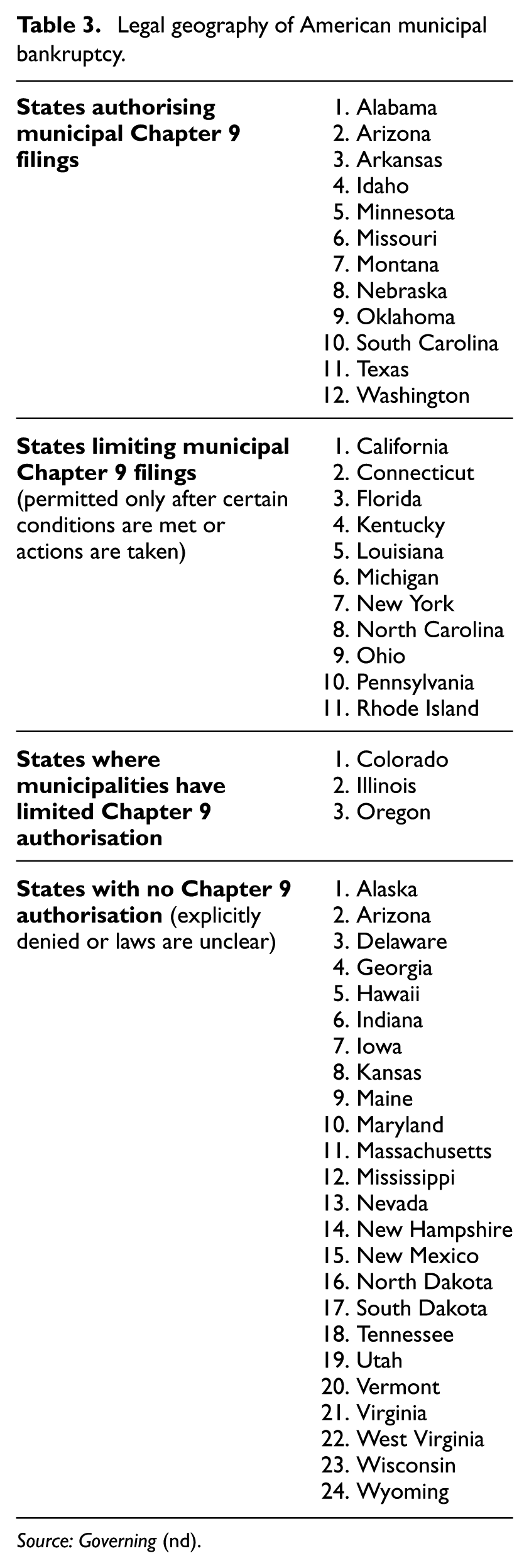
Source: Governing (nd).
The handful of municipal bankruptcies since 2008 says more about legal geography than it does about the condition of local fiscal-finances. According to the 2012 Census, there are 38,917 general-purpose local entities, and 21,683 are in states with laws permitting Chapter 9 filings. Thirteen localities brought Chapter 9 filings from 2008 to 2013: Gould, Arkansas (dismissed); Vallejo, California; Westfall Township, Pennsylvania; Village of Washington Park, Illinois (dismissed); Town of Moffett, Oklahoma; Prichard, Alabama; Boise County, Idaho (dismissed); Central Falls, Rhode Island; Harrisburg, Pennsylvania (dismissed); Jefferson County, Alabama; Stockton, California; Town of Mammoth Lakes, California (dismissed); and San Bernardino, California (Maciag, 2013).
Continuing with Zeno’s paradox of motion (systemic crises as case-specific), the supra-local frameworks imposed by state or federal governments are deeply implicated in determining the contours of urban financialisation and fiscal crisis, particularly in this era of high debt and financial instability. For many US governments, insolvency comes with de jure legal recourse to federal Chapter 9 debt relief. In practice, federal bailouts for local debt have always been scarce, de facto precedent instead favouring out-of-court debt settlement, renegotiation and refinancing (e.g. New York in 1975, Detroit in 2013 and Atlantic City in 2016/2017). 2 Puerto Rico, like local governments in half of all American states, lacks legal autonomy when it comes to bankruptcy.
Once considered the ‘jewel of the Caribbean’, shielded from other Latin American realities by US Congressional law, it now experiences high unemployment and chronic economic recession without these protections. With over 10 per cent of the island’s residents having emigrated over the course of the economic downturn, government brings in less tax revenue to address its mounting bills. No passive victim of market whims, government developed all sorts of special purpose agencies and investment vehicles to deal with its revenue shortfall: bonds to be repaid by sales tax, pension obligation bonds repaid by contributions to the retirement system, water and sewer agency bonds repaid by user fees, general obligation bonds repaid by all revenue sources, financing authority bonds repaid by rum taxes, highway bonds repaid by tolls. The island where 40 per cent of the population lives in poverty is also a self-selected domestic tax haven, home to the mega rich (or at least their numbered companies) – a few years prior to insolvency, Governor Luis Fortuño eliminated capital gains taxes and slashed income taxes.
Consistent with the paradox of motion, debt and fiscal crisis for this island are not only part of a serial pattern of financialised urban governance in the US (Peck and Whiteside, 2016), but are endogenous phenomena as well. Defying straightforward systemic analysis, uneasy idiosyncrasies exist, namely its unique relationship to American federal law. Congressional control over the terms of Puerto Rico’s legal status has produced significant debate over how best to proceed with bankruptcy litigation. Some hedge funds and conservative groups have been lobbying Washington both to recover Puerto Rican debt and to ensure that legal precedent does not allow other very large US debtors (e.g. Illinois) to escape their creditor obligations (Mahler and Confessore, 2015). Other groups highlight the need for equitable legal treatment of Puerto Rico’s debt: ‘it is unfair’, writes Detroit bankruptcy judge Steven Rhodes, ‘for Congress to deny Puerto Rico the protections that it affords to other Americans’ (Rhodes, 2016). In contrast to Atlantic City’s pride (or relief) that ‘at least we are not Detroit’ (quoted in Peck, 2016: 1), these lobbyists suggest that Puerto Ricans could benefit enormously from being legally treated ‘like Detroit’ given that their government is already fiscally ‘a Detroit’.
In 2016, the US Congress enacted the Puerto Rico Oversight, Management, and Economic Stability Act (PROMESA), suspending debt payments from 2016 to 2018, giving the island two-year protection from creditors’ lawsuits and creating the option of Title III where all creditors are granted equal treatment through court-imposed debt settlement. Title III was invoked in May 2017 to address the US$74 billion owed to bond markets and US$49 billion in unfunded pension liabilities. The Title III mechanism is an as yet unknown, untested form of debt settlement; it shares some features with the more familiar Chapter 9, the central exception being that local authorities lose aspects of voluntary control (section 301, for example, is not included in Title III). PROMESA sets up an oversight board managed by federal representatives; the board is not subject to popular input, can override Puerto Rican law, can impose any and all forms of austerity to repay bonds, can restructure the domestic economy, privatise infrastructure and issue municipal debt. Staffed by former corporate and banking CEOs, legal–financial experts and government officials from Washington, the board has no board member who unambiguously represents pensioners, unions, local businesses or voters. PROMESA continues to treat Puerto Rico and its debt as an anomaly – as neither state nor municipality. It remains an open question as to whether creditors will face markdowns and how future budgets and finances will be structured (White, 2016b). Facing familiar neoliberalised and financialised systemic contradictions common to Detroit, Atlantic City and a host of other cities, towns, districts and regions in the US, the Puerto Rican debt crisis is equally an endogenous phenomenon situated in a long history of legal subjugation and colonialism.
Paradox of Place: ‘for if everything that exists has a place, place too will have a place, and so on ad infinitum’ (Huggett, 2010). The Paradox of Place deals with the conundrum of infinite regress, and reminds us that unique cases may develop from or into common circumstance.
Related to the discussion of the previous two paradoxes, austerity has returned with a vengeance, at all scales, in the wake of the 2008 economic crisis. However, even now, decades after the eclipse of Keynesian demand management, social obligations on the part of public policy makers remain at all levels of government. Doern et al. (2013: 63–64) dub these legacy commitments ‘structural fundamentalism’ to reflect the widespread expectation that (neoliberal) state actors will address the fundamentals of unemployment and effective demand. Regressive changes to the tax system and enhanced debt financing are a common way of addressing these fundamentals. Austerity may be an ideal but it is not necessarily a consistent practice – it entails different types of state spending and different sources of state finance, not necessarily fewer funding commitments. How and why governments switch from funding operations to infrastructure, from tax to user fee collection or from muni bond financing to private activity bond financing is a matter of historical and case-specific investigation. The new liabilities and constituencies that these changes create deeply affect the terms of austerity, particularly visible in tough economic times.
Foregone tax revenue encourages debt financing, compounding state and municipal revenue loss. Municipal bonds often finance American public infrastructure and these bonds are exempt from federal tax in all instances and exempt from state tax when held by residents. Tax exemptions are appealing to creditors but constitute a significant, albeit hidden, tax expenditure for cash-strapped governments. Public revenue sources are thus redistributed to banks and wealthy households: banks now hold more muni bonds than they did in 2005 (now 15 per cent, up from five per cent a decade ago) and wealthy households, those in the 90th percentile, now claim a larger share of total household bondholding than they did in 2005 (Belz and Sheiner, 2017).
All told, the history of US municipal debt, fiscal crises and the growing exposure of public sector budgets to financial market volatility suggests a deep connection between the financialisation of the public sector and fiscal austerity: financial market reliance is both cause and consequence of austerity. The growth of financial market profit-making and capital mobility shapes government revenue through volatility, debt run up, competitive tax reductions and the intensification of pro-cyclical tax systems (e.g. those reliant upon sales or capital gains taxes). A paradox of place emerges in this area of urban studies, casting cities as victims and agents: debt run-up can be simultaneously the result of fiscal pressures imposed by markets and state legislation while municipalities remain active players in what this literature dubs the ‘consolidation state’, ‘debt state’, ‘financialised urban governance’ and ‘austerity urbanism’ processes (Bayırbağ et al., 2017; Peck, 2012; Peck and Whiteside, 2016).
Austerity has been a core feature of neoliberal governance for decades (Whiteside, 2016), part of its longstanding ‘culture of constraint’ (Clarke and Newman, 2012: 307), and it is within this shared experience that unique cases emerge. Another feature of the place paradox is that ‘austerity urbanism’ (e.g. Davidson and Ward, 2018; Schönig and Schipper, 2016) is composed of cases with often entirely unique local features. Some places may be adopting austerity today after serial engagements with this practice, whereas others may have by and large avoided the ravages of slash and burn economics of the past; austerity may involve shrinking the state or finding new (often debt- or contract-based) revenue sources, rejigging public sector activity and expertise; structural economic crises may be to blame for austerity-driven existential realignment, just as changes in government policy (whether sudden or gradual) may be a more important driver of fiscal collapse; austerity may be applied to one aspect of a public sector budget (operations) and not to another (infrastructure); austerity may be voluntary or imposed; unsustainable special purpose district debt is more likely to be dealt with through different expressions of austerity (e.g. privatisation) than are national scale sovereign debt crises involving wider policy domains (e.g. monetary and labour market reforms). There is no single version of austerity or condition of austerity – only varieties of austerity. The Paradox of Place folds an infinite regress of austerity case-specific analyses into a broader shared experience of austerity.
The Puerto Rican austerity saga has many unique elements that nonetheless fit within a common condition of ‘fiscal consolidation’. Fiscal collapse in 2017 comes but a few months after San Juan chose to implement tough austerity measures: reducing pension spending by 10 per cent, cutting Christmas bonuses, cutting health care spending by at least US$300 million, implementing employee furloughs, increasing revenues by overhauling the corporate tax code and cracking down on tax evasion, reducing the number of government agencies, creating employee redundancies and reducing the need for temporary workers (Brown, 2017; Spalding, 2017; Uhler, 2017). Cuts at the expense of growth may not seem like a prudent governance strategy but Puerto Rican constitutional provisions stipulate that debt must be repaid before nearly every other government obligation. Puerto Rico may not legally be a state or municipality, but its creditor obligations treat its debt as any other American muni bond. Federal aid will help the island recover from the ravages of Hurricane Maria, but it will not address deeper issues exacerbated by austerity – poverty, emigration, recession and reliance on illegal housing.
Much like how Peck (2016) has pointed out that we can follow the emergency manager, Orr, implicated in both Detroit and Atlantic City restructuring, we can also now follow the bankruptcy judge: Steven Rhodes, he who decided the fate of borrowers and debtors in the Detroit case, was hired to advise the Puerto Rican governor in 2015. And the revolving door exists in other ways too: Rhodes was hired by Puerto Rico on the advice of former New York Lieutenant Governor Richard Ravich; Ravich advised Rhodes when he was presiding over the Detroit bankruptcy settlement and he handled New York City’s 1975 debt restructuring. Puerto Rico has also hired bankers from CitiGroup as consultants; CitiGroup was involved in restructuring debt obligations related to Detroit’s Water and Sewerage Department bonds (Krist, 2015).
These shared experiences connect Puerto Rico to American austerity and restructuring, while Puerto Rico brings to the austerity story an aspect of legal wrangling not present elsewhere – its struggle for national self-determination. In June 2017, Puerto Ricans voted in favour of statehood, a legal status only Congress can confer. Statehood would grant additional rights and greater local control over economic development, but also come with additional burdens, like losing the current exemption from federal tax. Governor Ricardo Rosselló called it ‘a strong and clear message to the world claiming our equal rights as American citizens’, but bond expert Marc Joffe was more tempered: ‘[t]here’s not going to be a big appetite [in Washington] to bring in a bankrupt state’ (both cited in Long, 2017).
Concluding remarks: Foreign in a domestic sense
Philosophical debate on existential reality and common sense perceptions shares with the urban studies literature a sense that there is a need for contextualisation as well as generalisation, and reaffirms the possibility that some debates may never be resolved (nor would that be desirable), or perhaps the unity of debate is resolution itself. Casually importing intricate insights offered by other academic disciplines is seldom advisable. Yet this article has attempted to demonstrate that philosophical paradoxes can be useful as shorthand, or ways of grouping large political economy changes and urban studies debates. Paradoxes in mathematics, philosophy and physics offer ‘proof by contradiction’, but paradox is not being mobilised here in a 1:1 fashion. Paradoxes of perception, motion and place do not offer proof in urban studies; instead they tentatively point to how endemic, circular debate might not be resolvable: conjuncture and continuity are both at play, systemic crises are case-specific and unique cases may develop from or into common circumstance. For Puerto Rico, like urban studies debates more generally, developments may be seen as capitalist and colonial, liberal and illiberal, marketised and bureaucratic, current and historical, common and unique, foreign and domestic.
Analyses of complex change turn on one’s unit of analysis and timeframe of study. Longer historical vantage points display the arc of an arrow in flight, snapshots present an arrow at rest (The Paradox of Motion); contemporary studies of debt crises concerned with financialisation today must grapple with the precedent of serial instability in public sector finance. Recent American municipal fiscal crises are aspects of financialised urban governance since 2008 and part of a trend stretching back to proto-capitalist (antebellum) state–society relations, with each crisis episode emerging within unique policy and socio-institutional configurations.
Perception attuned to variety (the grain of millet) brings out nuance and exception; perception attuned to patterns (the sack of millet) lends itself to epochal thinking (The Paradox of Perception). The neoliberal creed is not only riddled with contradictions, it reflects contradictions: liberal and illiberal, austere and debt-ridden, regulated and de-regulated, guided by private market developments and guaranteed by public legal decree. Neoliberalism and its debates are a microcosm of capitalism and capitalist theorising: material–ideational systems where prices, profits and private property are helped and hindered by non-market and collectively orientated social forms.
With the austerity experience cobbled together through a near-infinite combination of real and rhetorical arrangements, common circumstance emerges from a clutch of unique and specific cases (The Paradox of Place). Urban austerity studies conceptualise place in terms that are both fixed and fluid, common and particular; if not patterned, infinite regress. Fiscal consolidation may be driven by efforts to shrink the state through cuts or to restructure the state through debt, spending on services may drop while obligations to infrastructure are extended, cities can be victims and agents, austerity is often voluntary (adopted for ideological reasons) and imposed through balanced budget legislation, colonial subjugation can converge with common American circumstance.
Puerto Rico’s debt story, foreign in a domestic sense, is steeped in history, a place where (neoliberal) market logics intersect with legal colonialism. For over 100 years, decisions made in Washington by the US Congress and US Supreme Court have deeply affected the island’s economic development: from the 1901 ‘insular cases’ court rulings limiting the constitutional rights of islanders and their government, to the 1948 tax exemptions Congress offered US subsidiaries operating in Puerto Rico and later their repeal in 1996; from a 1984 amendment to the Congressional bankruptcy code exempting Puerto Rican government debt from US federal Chapter 9 protection, to Washington’s PROMESA- and Title III-imposed fiscal consolidation today. Puerto Rican economic governance, fiscal crisis and austerity are signposts of paradox.
In light of the (in)distinct features of late modern capitalism, and the frequent incommensurability of actual policy with underpinning ideals, the political economy of most states is likely to reflect larger historical trends and express unique features. Supreme Court rulings, Congressional legislation and legal colonialism combine with the variegated and volatile neoliberal state, debt state, tax state, consolidation state, austerity urbanism and illiberalism, to create the topics of dispute that swirl in urban studies today (of which resolution appears unlikely and perhaps undesirable). These debates are in good company: for 25 centuries, Zeno’s paradoxes have alternately frustrated and inspired philosophy; for social science they serve as allegorical heuristics suggesting that tensions and contradictions exist in dialectical relation, antagonisms within a whole. By synthesising these urban studies debates through paradoxes of perception, motion and place, this article aims not to end debate – it hopes to provoke new questions and insights.
Footnotes
Acknowledgements
Thanks to Andrew Cumbers, Jamie Peck, J.J. McMurtry, and three anonymous reviewers for their helpful suggestions along the way.
Declaration of conflicting interests
The author(s) declared no potential conflicts of interest with respect to the research, authorship, and/or publication of this article.
Funding
The author(s) received no financial support for the research, authorship, and/or publication of this article.