



Abstract
One important aspect of sustainability involves the flows of materials and energy, extracted, consumed, transformed and disposed of in the functioning of urban societies, which makes it directly linked to the ‘nested’ character of infrastructure that this special issue of Urban Studies on ‘urban nexus’ is keen to address. In particular, the question of urban waste, a sector previously neglected in the field of urban policy, has slowly become a major issue in world urbanisation that can be tackled through its cross-sectorial interactions and its multidimensional effects. Through an analysis of the case of Delhi, this article aims to undertake an exploration of the waste and energy nexus in order to contribute to the current debates on the socio-technical transformations of waste infrastructure and its societal interlinkages. This article studies the effects of waste management policies in Delhi that essentially promote large centralised technical systems such as waste-to-energy plants, which are presented as a ‘modern nexus’ of waste and energy, at the expense of any ‘alternative nexus’ such as the existing traditional recycling sector. Hence, the main objective is not only to question the socio-spatial and political implications of the current reforms of the waste sector but also to discuss the development of other potential decentralised solutions that could complement the overall system in an adapted way.
Introduction
The theme of sustainable urban development at the Habitat III Conference reconfirms the key role cities play in the regulation of major global challenges. One important aspect of sustainability involves the flows of materials and energy, extracted, consumed, transformed and disposed of in the functioning of urban societies, which makes it directly linked to the ‘nested’ character of infrastructure that this special issue of Urban Studies on ‘urban nexus’ is keen to address (as posited by Jochen Monstadt and Olivier Coutard in their proposal for this special issue).
In particular, the question of urban waste, a sector previously neglected in the field of urban policy, has slowly become a major issue in world urbanisation that can be tackled through its cross-sectorial interactions and its multidimensional effects (UN-Habitat, 2010). The organised treatment of this waste has become a strategic tool in urban marketing that serves to consolidate the attractiveness of the most exemplary cities in this field, such as the ‘zero waste’ policies of Adelaide, San Francisco and Stockholm (Zaman and Lehmann, 2013), and obliges the others to align with this ideal of modernity. In India, while the rapid urbanisation of the last two decades has done much to improve living standards, it has also been accompanied by significant environmental deterioration, with at least 125,000 tons of solid waste generated daily by cities (CPCB, 2012). These phenomenal quantities were long neglected by the authorities, before becoming a key target of public action from the mid-1990s and the launch of environmental policies. This willingness has been strongly reaffirmed under the framework of the national ‘2014–2019 Swachh Bharat Abhiyan’ (Clean India Mission), which aims to improve the collection, treatment, disposal and reuse of waste flows.
Through an analysis of the case of Delhi, the country’s capital and showcase, this article aims to undertake an exploration of the waste and energy nexus in order to contribute to the current debates on the socio-technical transformations of waste infrastructure and its societal interlinkages. Home to 16 million people (in Delhi National Capital Territory) and part of an agglomeration of over 25 million inhabitants, the city generates around 9000 tons of domestic waste (according to municipality official records, January 2017) to be managed daily. Complementary to similar surveys in other contexts (see, for example, in Germany, Florentin, 2016), this article studies the effects of waste management policies in Delhi that essentially promote large centralised technical systems, such as waste-to-energy plants, 1 which are presented as a ‘modern nexus’ of waste and energy, at the expense of any ‘alternative nexus’ such as the existing traditional chain of the recycling sector (widely documented since the early 1980s; see, for example, the pioneering work of Furedy (1984) or Mukherjee and Singh (1981)). In Delhi, 150,000 to 200,000 informal waste workers (Gidwani and Chaturvedi, 2011b: 131) recover recyclable materials in parallel to the formal municipal waste system, and transfer it to informal recycling units. Most of them belong to marginalised groups, particularly Dalits 2 or deprived Muslim communities. This work constitutes an essential livelihood for them (Gill, 2012), while providing an environmental service to the city.
Thus, the main objective of this article is not to give a technological analysis of the system’s ongoing reforms, but rather to resituate this issue in cities characterised by severe social inequalities. More specifically, it aims more to resituate the issue at the level of the socio-technical implications related to the ambiguities of a process of infrastructure modernisation. In particular, a solution like incineration that is claimed to follow the principle of resource efficiency seems controversial as it is based on materials with high calorific potential, specifically plastics, paper and cardboard, all products traditionally recycled by informal retrievers (see photographic illustrations by De Bercegol and Gowda, 2016). Hence, the focus is not only to question the socio-spatial and political implications of the current reforms of the waste sector but also to discuss the development of other potential decentralised solutions that could complement the overall system.
The data presented here was collected during several visits to India between 2013 and 2017, in the context of the ‘Syracuse’ project, 3 followed by another French research project ‘Orva2d’ 4 financed by the French Development Agency, 5 dealing specifically with the issue of waste recovery. During this time, we conducted approximately 40 semi-directive interviews with actors involved in the formal sector: engineers, politicians and private agencies who showed us the treatment sites. A large part of the fieldwork also included more ethnographic observations of meetings and follow-up with so-called ‘informal’ actors who are part of the waste recycling chain, from collection to treatment plants: collectors, retrievers, resellers and recyclers. Finally, around 20 members of civil society were also interviewed, at the level of resident associations involved in non-governmental organisations and militant associations.
This article presents some of the results of these surveys, with a critical analysis of the waste management choices made in Delhi and a plea for a better articulation of the existing resources. To begin with, relying on existing scientific literature on the subject, in the following section we provide a brief background of the socio-spatial ambiguities of the waste modernisation policies in Delhi, which have dramatic social consequences for the precarious labour conditions of waste workers. This state of affairs brings us to our research question on how to rethink the waste-to-energy nexus in terms of situated resource efficiency linked to the informal recycling economy. Although allegedly qualified as ‘non-modern’ practices by the public authorities, waste sorting and the recycling sector appear to be a legitimate energy-efficient solution. Therefore, we provide a socio-technical analysis of the current reorganisation of the waste sector in Delhi, highlighting not only the deficiencies of the current centralised system but also the potentialities of integrating decentralised solutions for improved management. Finally, we conclude by giving some recommendations by conciliating the existing different nexus towards more sustainable waste management practices in developing cities like Delhi.
The urban politics of waste sector modernisation and the making of the city
Eviction of ‘non-modern’ practices
As in other developing cities around the world, the modernisation of waste management in Delhi can be seen as a reflection of a ‘sanitary ideal’ (Melosi, 2000) that seeks to replicate the technical solutions developed in the North, within which the informality of poor neighbourhoods, and their ‘non-modern’ waste recycling practices, have little or no place. With regard to the similar process in Cairo, Bénédicte Florin notes that it is the ‘ideology’ of modernisation (Florin and Cirelli, 2015) that makes public decision makers consider informal sector actors as ‘ineligible’ for integration into the new planned system. The urban elite and creditors (for whom ‘the collection systems in India are primitive’ (World Bank, 2008: 19)) see recycling workers as backward and incompatible with ‘modern’ waste management (Wilson et al., 2006), which necessarily has to be placed in the hands of private organised companies and to employ mechanised equipment on the pretext of sustainable development. For many slum dwellers whose survival depends on waste recovery,
6
the exclusion of their everyday experience is then reinforced by a ‘dispossession’ of their means of subsistence (Schindler et al., 2012). The privatisation of the sector, and the choice to incinerate waste on the pretext of solving the waste crisis and generating energy out of it, are thus not innocuous socio-technical choices. They reflect a social choice that embodies the primacy of capitalist accumulation over the power of work:
the process [of waste incineration] can be seen as an example of accumulation by dispossession, which means there is an inherent necessity of the owners of capital to separate, by force if necessary, labourers (waste workers) from the means of production (waste, transfer stations, etc). Once this process is complete, a small number of waste workers are offered the opportunity to sell their labour for a wage in waste-to-energy plants. (Schindler et al., 2012: 20)
When describing the informal recyclers of electronic waste in Bangalore, who are experiencing a similar situation of dispossession, Reddy proposes the concept of ‘abjection’, which describes not only the injustice of being excluded, but also the humiliation of being expelled from a sector to which they have always belonged (Reddy, 2015: 171). Reddy utilises the metaphor of waste to describe ‘the humiliating experience of informal recyclers becoming – to invoke Wright (2006) – figures of waste’ (Reddy, 2015: 171). Thus the promotion of a so-called ‘modern’ management system, based on Western models, reveals the desire to increase control over the economy by relegating the informal actors involved.
Relegation of the poor population
At a wider level, planning policies tend to deny the existence of populations confined to informality and produce ‘urban exclusion’ which pushes these populations away to the periphery (Kundu and Sarangi, 2005). The political economic works on the rise of Indian civil society and its gentrification (Ghertner, 2011) explain how the theme of environmental protection has made it possible to legitimise the relegation of poor populations, on the pretext of their adding to urban pollution. Since 1990–2000, reforms encouraging civil participation 7 have directly contributed to consolidating the growing influence of the powerful Resident Welfare Associations (RWAs) in planned neighbourhoods. Paradoxically, this has led to marginalisation of the poorest categories, by successfully imposing the interests of a sociologically dominant class in municipal councils to the detriment of a poor and less well organised population (Zérah, 2007). The poor population’s lack of representation is particularly evident in the judicial sphere, as legal mechanisms require financial and temporal means, which are not amongst these people’s prerogatives. Thus, mobilised by the middle classes, the judicial institutions (the Supreme Court of India, the High Court of Delhi and the Green Tribunal) have become important arbitrators whose decisions significantly impact urban governance, especially in conflicts concerning the environment, like those involving waste, promoting ecological considerations to the detriment of their social consequences. This results, for example, in the plastic recycling workshops in the north of the city being shut down regularly after a ruling by the Green Tribunal (30 units closed at Nangloi and Mundka in June 2015, where the emblematic PVC market, where waste plastic is bought, separated and resold in large volumes, has been relocated after being progressively relegated from the city centre to the periphery of Delhi; see Gill, 2012). Baviskar’s research on ‘bourgeois environmentalism’ allows us to understand how environmental discourses pronounced by the middle class in Delhi insidiously contribute to driving the poor out of the city: ‘for the bourgeois environmentalist, the ugliness of production must be removed from the city […] urban spaces should be reserved for white-collar production and commerce, and consumption activities’ (Baviskar, 2002: 41). Legal decisions are made for local environmental reasons, with no consideration for more global environmental considerations (a reduction in the use of raw materials, for example) or for those in insecure employment. The bourgeois vision of the environment, reinforced by legal decisions in its favour, takes precedence over social considerations and amplifies the insecure situation of poor urban populations (Mawdsley, 2004). We can hence understand that the modernisation of the waste sector is part of the ‘urban renewal’ policies implemented in Delhi which, in reality, are a euphemism for the demolition of insalubrious areas. Rehabilitation in the periphery, on less expensive land, is symbolic of an evacuation towards the outer fringes, which sometimes worsens the inhabitants’ living conditions (Dupont and Vaquier, 2014). The ‘modernisation’ of infrastructures thus clearly falls within a process of exclusion that relegates the poor to deteriorated peripheries, outside cities. Vinay Gidwani and Rajyashree N. Reddy thus put forward the concept of ‘eviscerating urbanism’ (Gidwani and Reddy, 2011: 1640), which is particularly relevant in light of the last Delhi Master Plan and its ‘vision’ of a ‘global city and a world-class metropolis’ that has got rid of its pollution and its slums (DDA, 2010: 2). Ghertner (2011) underscores the cultural importance of this policy of aestheticisation in the construction of the contemporary city where the environmental ideal is based on the ideal model of the ‘world class city’. The city is created by the middle class, to replicate Paris, New York or Singapore–reference cities, within which the poor have no place. This is actually a process of remodelling urban space to conform to the aesthetic models of the upper classes.
Rethinking the nexus between waste and energy
Following the recent academic work on waste transformations in Delhi, the infrastructural transformations taking place in the waste sector in Delhi can be read as a pretext of pollution used to evict the town’s proletarian categories (Demaria and Schindler, 2016; Gidwani and Reddy, 2011; Gill, 2012), through the introduction of hegemonic environmental polices of neoliberal inspiration which reveal the ‘violence of sustainable urbanity’ (Swyngedouw, 2014). But, this does not directly explain why the current reorganisation of the technical system appears to be unsuccessful at solving the waste crisis despite massive investment to modernise its infrastructure. Why do the chosen technical options to facilitate a nexus between waste and energy appear to be a ‘false good idea’ in the context of Delhi? By choosing to align with the ‘world class city’ reference, the mimicry of the urban planning authorities in Delhi tends to eliminate the option of the emergence of a site-specific model, freed from the commands of Western modernity, while improving its efficiency as well as local conditions. In this article, we assume that this replication might not be the best option to fit the particularities of the waste sector in Delhi, and our research enquires about the potentialities of situated alternative solutions that could be more resource efficient and socially inclusive. Therefore, while the critical debate on the subject is generally approached in terms of ‘deficiencies’, we would like to take into account the forms of creativity the actors demonstrate by identifying potential co-production regimes specific to Delhi. What are the local potentialities for an improved way of managing waste in an Indian city? We make the hypothesis that there is a nexus between waste and energy, where the ‘people [of the informal recycling sector act] as infrastructure’ (in Simone’s (2004) sense), which appears to be highly efficient despite its pitfalls, these latter partly due to its public relegation to informality. To underscore the relational effects between the current modernisation and this informal nexus, this article borrows particularly from urban political ecology as, by evacuating the waste flows generated by urban society, waste management directly contributes to the urban metabolism, to be understood here as all the processes by which agglomerations utilise, consume and transform resources. Since the end of the 20th century, the linear economy for the sanitary disposal of urban waste has been challenged by a circular economy paradigm valuing the recovery of waste resources. From the perspective of a circular metabolism, ‘informal’ channels for the retrieval of waste, which have been in existence for a long time, contribute to the reduction of environmental pressure and appear to be in that sense an efficient nexus between waste and energy. In the wake of the philosophy behind the ‘Syracuse’ research project, this article seeks to complete these metabolic analyses by enriching them with socio-spatial features interlinked to infrastructural technical systems that structure the discharge of these flows. Since the ‘traditional’ recovery practices have not been able to tackle all the increased volumes of waste associated with the current rapid urbanisation, we need to question their place and the role they could effectively play together with other systems. Relying on contemporaneous French academic debates, our research questions the scale of these infrastructural choices and considers their social and political effects. How does the modernisation of the waste sector affect the making of the city in Delhi? Following on from works inspired by science and technology studies (STS), and specifically by research undertaken at Laboratoire Techniques, Territoires et Sociétés 8 (Coutard and Rutherford, 2015; Dupuy, 1991), the analysis focuses on the transformation of infrastructure because ‘the choices made at this level end up structuring the daily existence [of urban populations]’ (Lorrain, 2011: 32, translated from French). Technical public services, in this case the waste management service, are thus highly structuring ‘instruments’ of public action, instilled with a political meaning that reflects the transformation of relationships between the State and society (Lascoumes and Le Galès, 2007). By looking at the transformation of the waste sector in Delhi, the aim is thus to interpret its political meaning in order to ultimately question the making of the city.
Socio-technical analysis of the ongoing transformations: Local constraints and specific opportunities of Delhi’s waste systems
Vast, ineffective, modern systems
For the administrators, the problem of solid waste management in Delhi is first and foremost a problem of land, given that the growing volumes (around 9000 tons daily according to municipal official records in 2017) demand ever more space in a city where it is in short supply and put the available treatment facilities under intense pressure (see Table 1).
The landfills of Delhi (on 4 January 2016).

Source: Official municipal data for 4 January 2016.
Since 1975, a succession of 23 landfill sites 9 has been created. Seventeen have been closed after reaching their maximum storage capacity, and two others for legal reasons. In 2014, therefore, four landfill sites were still running, three of which had already exceeded their maximum capacity and lifespan (10 to 20 years) but were still being used by the municipal authorities despite being officially declared illegal by the Delhi Pollution Control Committee. These are the Okhla site in South Delhi (1996, 16 hectares), Ghazipur in the East (1984, 29 hectares) and Bhalswa in the North (1994, 21 hectares). Although the opening of a new 40 ha site in Narela-Bawana in 2012 took some of the load off North-East Delhi, the Ministry of Urban Development estimates that 600 ha will actually be needed by 2021 to handle the waste properly and to be able to close the old landfill sites. However, available land is scarce in Delhi, and resident groups oppose any new project in the vicinity of their neighbourhoods. The Delhi Development Authority (DDA) is finding it hard to identify a new site: ‘there is simply no more land available to accommodate the need of proper sanitary landfills in Delhi’ (according to a retired DDA official, January 2016). In the meantime, the waste is piling up (the Okhla mountain is more than 180 feet high) with no real controls (no gas extraction or leachate recovery, except in the most recent facility), which creates legal conflicts between municipalities, government and citizens.
In these conditions of land scarcity, incineration technologies look like a life-saving solution for the authorities. In 1989, the Ministry of New and Renewable Energy, in cooperation with the government of Denmark, ran a first incinerator experiment with the target of incinerating 300 tons per day and generating 3.7 MW of electricity, but the site closed after just three weeks because the humidity levels of the incoming waste were too high and their calorific value too low (550–850 kcal per kg, whereas the minimum required for successful operation should be 1200–1400 kcal per kg). After this first failed attempt, the government recently commissioned three private operators to manage three new waste-to-energy plants. However, the opening of the Ghazipur incinerator (1300 tons per day, 10 MW), operated by ILFS, 10 and of Narela-Bawana (4000 tons per day, 24 MW), operated by Ramky, 11 has been postponed several times in the four years until March 2017 (see Table 2).
Waste-to-energy plants in Delhi.

Source: Official municipal data for 4 January 2016.
This delay was due to disputes over the rate for selling power to the major distribution companies (which was set at 2.49 rupees/kWh against a needed 6 rupees/kWh to ensure the financial viability of the process, according to a Jindal manager interviewed in January 2016), as well as technical reasons because of the low calorific value of the incoming waste. This low quality of waste explains why waste-to-energy plants operate below their capacity, at an average of 1000–1500 tons per day (according to the monthly data provided by the municipality between January 2016 and January 2017) instead of the 2500 tons initially planned in their design inception. According to data submitted by the operator of the Okhla incinerator (2000 tons per day, 16 MW), run by Jindal, 12 which has been operational since 2009, between 2011 and 2015 the incoming waste at the gate of the incinerator was composed on average of 69% biodegradable matter (food and garden waste), 30% high calorific value waste (wood, plastic, paper, rubber, textiles) and 1% inert waste (see Table 3).
Characterisation of incoming waste at the Jindal waste-to-energy plant.
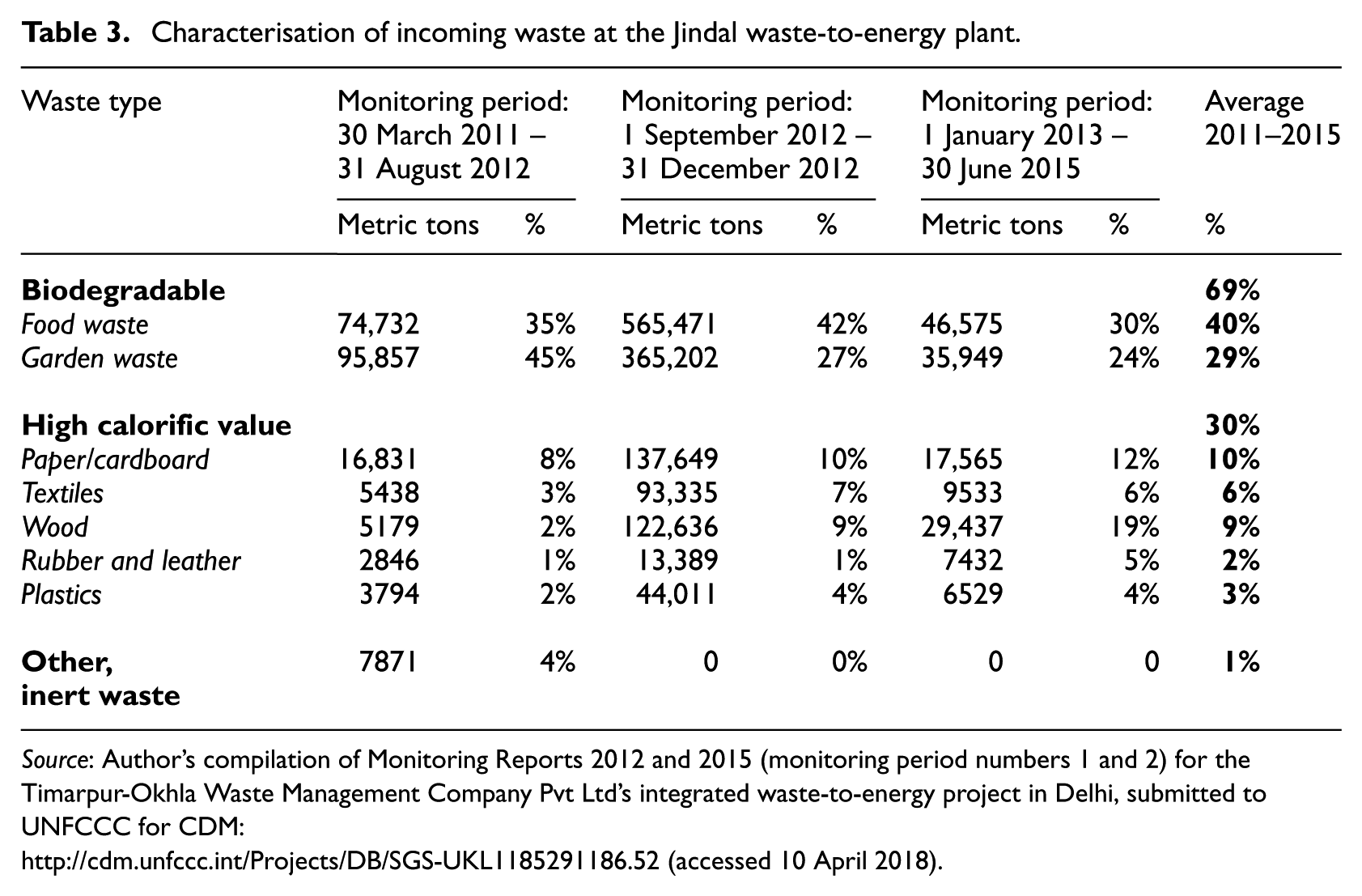
Source: Author’s compilation of Monitoring Reports 2012 and 2015 (monitoring period numbers 1 and 2) for the Timarpur-Okhla Waste Management Company Pvt Ltd’s integrated waste-to-energy project in Delhi, submitted to UNFCCC for CDM:
http://cdm.unfccc.int/Projects/DB/SGS-UKL1185291186.52 (accessed 10 April 2018).
In order to run properly, these incinerators need a continuous supply of waste with a high calorific value (such as paper and plastic), and this puts them in direct competition with the informal waste pickers, estimated to number 150,000 in Delhi (according to Chintan 13 official representatives interviewed in January 2016), who pick up the best paper and plastic at their sources, in order to resell in a recycling chain that is ignored by the authorities and the engineers. As less than a third of the incoming waste is of high calorific value, the operator is obliged to mechanically dry the remaining waste in order to be able to burn it (as is the case at the Jindal plant), or even to transform it to combustible fuel pellets (as at the ILFS plant at Ghazipur), which in both cases consumes energy and is a costly process. These technical problems are further exacerbated by legal opposition, with the emergence of coalitions of opponents demanding a halt to these incineration technologies, such as the ongoing court case against the Jindal plant (Sukhdev Vihar Residents’ Welfare Association & Others v. State of NCT of Delhi & Others). The coalitions are motivated by various philosophies, ranging from the ‘Not in My Backyard’ grievances of resident associations located next to the plants, to NGOs representing the ragpickers’ needs or environmental justice claims (on these unexpected coalitions, see Demaria and Schindler, 2016). They accuse the plants of being polluting and dangerous, although paradoxically the Jindal plant is recorded with the United Nations Framework Convention on Climate Change (UNFCCC) and is eligible to receive carbon credits for turning waste into electricity (see http://cdm.unfccc.int/Projects/DB/SGS-UKL1185291186.52). For their detractors, ‘this plant should not be granted any environmental benefit: it is unscientific, anti-environment and anti-public health’ (according to the head of the Toxics Watch Alliance, 14 January 2016). Waste incinerators seem likely to further exacerbate an already catastrophic atmospheric situation: concentrations of particulates (less than 2.5 microns) are almost 15 times higher than WHO norms, caused not only by monstrous traffic jams but also by power stations located in the city (which are mostly based on coal), and above all by the dust exuded from the innumerable construction sites typical of a fast-growing city.
Similarly, centralised composting appears to be quite inefficient. The first composting plant was established in the 1980s at Okhla with a planned capacity of 150 tons per day. It was halted between 1991 and 1995, before being forced to restart by a ruling of the Indian Supreme Court, and then closed again and replaced by the incinerator. Three other units were established, in Bhalswa (1998, 500 tons per day, closed in 2015) and in Tikri (2001, 125 tons per day, closed in 2013), but only the one in Okhla (1985, capacity 500 tons per day) is currently operating (see Table 4).
Compost plants in Delhi.

Source: Official municipal data for 4 January 2016.
The opportunities for selling compost (10–20 rupees/kg) are limited by the subsidised prices of chemical fertiliser (5.5 rupees/kg). Furthermore, built in the middle of the city, centralised compost plants in Delhi require transportation to link the production to the distant agricultural fields. Because the waste is coming in unsegregated, the non-biodegradable waste has to be separated at the plant itself by manual and mechanical means, increasing production costs, and the compost produced remains of low quality due to a lack of homogeneity, as it is difficult to remove all the plastic and glass. For example, although the Okhla unit, run by ILFS since 2007, can boast having received the equivalent of €40,000 in carbon credits in 2013 (without which it would have made a loss, according to the site manager interviewed in December 2014), it is only running at maximum half of its capacity of 500 tons per day and only produces some 30 tons of mediocre quality compost, which is difficult to sell, despite being bought by private fertiliser companies (for less than €20 per ton).
In both cases, centralised composting as well as incineration, capturing the waste at the source to allow appropriate segregation and thus control waste quality, is one of the most basic ways to limit the constraints of these technologies. Nevertheless, for the moment, the municipal collection system still begins officially at the dhalaos, intermediate neighbourhood-scale collection points with a capacity of 12 to 16 tons designed to cover residential groupings of 10,000 to 15,000 residents, from which waste is transferred to the centralised treatment centres (compost plan, incineration, landfill). Since 2005, virtually all collection from these transfer stations has been assigned to large, private, indigenous operators (Ramky, ILFS, as well as SPML). 15 These private operators are paid according to the quantity collected (‘more waste, more money’). In theory, since 2000, the legislation on waste (Municipal Solid Waste Rules 2000) requires municipalities to collect waste no longer from the dhalaos, but directly from households, with the aim of improving the operation of the processing treatment systems (whose efficiency depends on the quality of the incoming waste). However, in 2015, only 10–15% of the city centre was actually receiving this service, from the firm Ramky. In 2016, the updated legislation (Municipal Solid Waste Rules 2016) and awareness raising campaigns among the population restated the need for door-to-door collection, in order to provide better fuel for the centralised treatment of waste-to-energy. Nevertheless, door-to-door collection has yet to come into practice. Industrialised collection with trucks coming to pick up waste at the household level is technically difficult to achieve given the narrow streets in Indian cities (according to municipal officers) and because it has to compete with a complex system of waste pickers who informally collect the most valuable materials at source (according to a SPML manager interviewed in December 2014). Nevertheless, investors are betting that they will slowly succeed in privatising collection at the household level in order to control the entire chain, from the source to the centralised treatment plants.
A traditional waste sector in a state of radical upheaval
The reorganisation of the waste sector is politically sensitive in Delhi as its industrialisation is in direct competition with an already existing but informal collection of reusable waste recovery, the basis of the informal recycling economy. The public authorities are reluctant to recognise these unofficial but existing collection practices, as they raise appropriation conflicts with private formal firms (Cavé, 2014). These informal waste pickers cover the city, recovering useful waste that can be sold to wholesalers before being transferred to specialist markets where the materials – sorted, cleaned and processed in recycling workshops – are sold at the end of the chain for three to four times their initial value (on interlinked contracts, patronage and exploitation in the waste recovery market in India, see Gill, 2007). It has been estimated that the total social value added from waste selling activities in Delhi could be around 3587 million rupees (US$56 million) per year (Hayami et al., 2006: 63–64).
While calls for tenders for an organised door-to-door collection were issued in December 2014 to the large private organised sector in order to extend this collection to the city as a whole, advocacy groups working on behalf of the waste pickers, such as Chintan in Delhi, or unions like All India Kabari Mazdoor Mahasangh, Safai Sena, 16 are fighting for the informal sector to be recognised and fairly included: ‘Collection has to be formally given to those who have been doing it since forever and are already helping to reduce the waste crisis’ (according to a Chintan manager, January 2016). Chintan estimates that by informally collecting waste directly from residents, the informal collectors save the municipality 15 million rupees (US$307,000) per day, based on their being paid the (2003) minimum wage like the 60,000 municipal sweepers are.
Recognising the existence of local recycling initiatives would improve the efficiency of the waste management system and contribute to reducing the mass of waste. Despite competition with formal private operators, the sector continues to recover and to treat vast quantities of materials: paper, plastics, glass and metals (Cavé, 2014; Gidwani and Chaturvedi, 2011b; Gidwani and Reddy, 2011). Nevertheless, it remains extremely difficult to assess given its informal nature. Our empirical data provides a rough assessment based on a sample of 15 families or groups of workers in Hanuman Mandir, a slum in South Delhi that is mainly inhabited by ragpickers who collect waste from the neighbouring middle class areas. We followed these groups for two weeks in December 2016 in Safdarjung Enclave, an upper middle class area next to the slum. We found that an average of 40–50 kg of waste materials (excluding glass bottles) per family were sold daily to a local wholesaler. For a municipality of Delhi’s scale, this could mean that possibly approximately 2000–2500 tons of waste per day will be informally diverted in order to be recycled, based on a conservative estimate of 50,000 waste picking families working in Delhi (Chintan, January 2016). This would be equivalent to 20% of the waste generated daily in Delhi, which agrees with the figure commonly advanced by NGOs and ragpickers’ advocates.
Despite its informality, the sector is very well organised in India as it relies on dynamic cast networks from the collection of materials to their separation and transformation. For example, Gill has shown how the Khatik community (a lower cast from Rajasthan) has specialised in trading plastic scraps in Delhi by developing for themselves the skills to be able to differentiate all types of plastics (polypropylene, polyethylene, polyvinyl chloride, polyurethane, etc.). Waste pickers ultimately appear more skilled and efficient than the formal system in terms of gathering and segregating waste (Gidwani and Chaturvedi, 2011a: 59), which has also been shown by research in other developing countries (Gunsilius et al., 2011). For Chintan, it is therefore not the waste-to-energy plants which should be UNFCCC-registered but the groups of workers, as they contribute to reducing the amount of waste sent to landfill sites, avoiding greenhouse gas emissions of 900,000 tons per year (Chintan, 2012). These waste picker advocates would like to see the introduction of a management model inspired by the SWaCH (Solid Waste Collection and Handling) cooperative in Pune, 17 a big city in the State of Maharastra. Advocated as one of a kind in India, this model consists of a partnership between a union of 6000 workers, the Kagad Kach Patra Kashtakari Panchayat, and the municipality, which has led to the regularisation of 2300 workers in part of the city. To a certain extent, this formalisation has been reproduced in certain areas of Delhi by resident welfare associations. One example in place since 2003 is Defence Colony, one of the upmarket wards of South Delhi, where the resident welfare association for Block-A (around 1000 households), in cooperation with the NGO Toxics Link, 18 has set up a decentralised management system that has led to the regularisation of 17 workers. These workers were paid 100 rupees each per dwelling per month in 2016 for the in situ sorting of waste. Six pits were dug to receive part of the green waste and to produce good quality compost, which sells easily to local residents and provides a source of income to finance the maintenance of the system (protective clothing for the workers, purchase of carts, digging of new pits). Although it is still necessary to reject half of the waste supplied to to the dhalaos, this decentralisation of the system allows it ‘to reduce significantly the amount of waste to be evacuated to the centralised treatment facilities by 50%, [and has] notably improved the social conditions of the workers’ (Defence Colony Resident Welfare Association’s representative, January 2016).
Interestingly, the organised private sector is trying to take over this model, which remains for the moment organised by residents’ associations only and is not yet integrated into the municipal collection service. After the privatisation of the dhalaos, the organised private sector has now planned to contractualise workers, for example with the arrival of ILFS to undertake door-to-door private collection in the blocks of South Delhi under its new subsidiary Dakshin Dilli Swachh Initiatives Limited (DDSIL – South Delhi Clean Initiatives Limited), 19 in order to access waste with high calorific value before it gets evacuated towards informal recycling. One can see here the implicit recognition by the private sector of the positive dynamics of the informal traditional actors in segregating waste at its source. In particular, one small start-up company called Pompom, 20 created by an employee of Ramky, follows directly the same dynamics by innovating with a mobile phone application to facilitate the sale of waste by its users to the company, which comes directly to homes to collect it and eventually resells it to the informal chain of recycling industries: ‘don’t throw it, give it to me, waste is a valuable resource’ (according to a Pompom manager, December 2014). This modern replication of the traditional Kabadiwala waste collection system is in itself a proof of its legitimacy and efficiency, which clearly demonstrates the essential role that a collection at a decentralised scale has to play for the recovery of waste. Similarly, another neighbourhood that exemplifies the craze for ‘zero waste’ in Delhi is New Moti Bag, a neighbourhood of around 1100 households essentially inhabited by the families of senior civil servants, where a private company has taken over the waste management. The company Green Planet Waste Management, financed by the plastics sector within the framework of an eco-responsible approach, 21 has invested around €150,000 since 2014 in a decentralised treatment technology that would theoretically enable all waste to be reprocessed in situ: ‘Evacuating waste to a landfill is a complete heresy; we have the capacity to treat most of it at the source and reduce the burden to the environment’, said the director of the company in January 2016. The biodegradable waste is indeed treated on site, to create pellets and compost to be sold, along with plastic bottles, using the operator’s own technology. All the remaining dry waste is sorted on site and sold to the informal recovery sector (according to a Green Planet Waste Management manager, January 2016). Here also, this innovative solution is not a panacea in itself as the manager complained about the lack of financial outcomes of the system because he was expecting support via the allocation of advertising hoardings for rent, which was not finally given by the government.
Finally, in a city characterised by very high levels of inequality, waste retrieval is one of the main means of subsistence for a large number of poor households, and their sole employment: ‘we make a living of waste’ said a ragpicker (Hanuman Mandir, January 2016). If the sector was better integrated, the workers’ jobs would be guaranteed, from the lowest level collectors, to the industrialists at the top of the pyramid, along with the profusion of professions specialised in the collection, sorting, resale, cleaning, crushing and transformation of materials. This waste recovery economy provides a basic income for hundreds of families and ultimately, at the end of the chain, sustains formal industries that produce consumer goods. Regulation of the recycling sector and its inclusion in the waste management process would enable the progressive introduction of social and environmental norms in order to avoid the numerous socio-environmental pitfalls of the sector. There is hence a need to go beyond the sordid image of a sector that is doubtless imperfect in many respects but where it is in fact the condition of informality that tends to facilitate abuses, especially in terms of exploitation and child labour.
Without recognition of the legitimacy of the sector and proper public support, the precarious labour conditions of the workers will keep deteriorating. This can already be seen in the implementation of the Okhla waste-to-energy plant for the ragpickers living in its vicinity. Here, workers’ earnings have decreased by 21% according to a survey based on a sample of 109 persons working there (Chintan, 2012: 12). As stated by the Alliance of Indian Wastepickers:
informal workers are highly vulnerable, needing special and urgent attention. Strong measures like increased social security need to be undertaken to reduce the risk. In the coming years, we must commit ourselves to the campaign of social security for informal workers and pursue ‘Right to Social Security’ to become a justiciable right. In addition to that, questions of housing, education, skill-building, nutritious food, clean environment all need answers preferably sooner than later. (Arora, 2016)
All in all, the question of a ‘right to the city’ arises (Lefebvre, 1968), understood here in its reformist sense, as a series of rights in the city (Zérah et al., 2011), or in other words, the recognition of fundamental rights, including the right to a livelihood (theoretically guaranteed by the Indian Constitution). 22 The current reform of the waste sector ignores this right to the city for waste workers, and neglects an existing nexus, more inclusive and already energy efficient.
Conclusion: Ways towards an inclusive and efficient waste nexus
Rethinking the nexus between waste and energy is a fruitful method to analyse critically the ongoing reform agenda of the waste sector in Delhi and to understand better its effects on the making of this city. Waste recovery in Delhi seems to be central to the modernisation of the sector, but the authorities’ choice of a modern nexus technology seems to be incomplete, if not flawed, in terms of adapting to the social complexity of this huge metropolis. The Delhi case illustrates some of the factors hindering the introduction of decentralised solutions in the big cities of the South which could lead to more appropriate nested socio-technical systems of waste management.
The waste crisis in Delhi is seen above all as a technical problem to be tackled as such: by technicians, and through a technical infrastructure based on a centralised system. After the failure of over-exploited landfills, the limitations of this technical approach are visible in the recent incineration systems. Although the latter reduce real estate pressure in terms of the final storage space, their performance for the time being remains mediocre from an energy, environmental and economic viewpoint, particularly given the mismatch between the technology and the composition of the waste produced in Delhi. Nonetheless, the investments made by major operators are likely to slowly lead to an improvement in incineration techniques, but at a very high cost, while energy recovery from waste should ensure the economic viability of an increasingly expensive activity. However, as stated in the projections of the planning commission itself, there is so much waste in Delhi that even if it were possible to incinerate it and compost it at the maximum efficiency by 2021, there would still remain a minimum of 4000 to 5000 tons that would have to be put in landfills (DDA, 2010: Chap. 10). Furthermore, while it can certainly improve the efficiency of the industrialised treatment, particularly by capturing waste at source, in the short term, the ongoing liberalisation of the waste sector remains highly conflictual, politically sensitive and devoid of convincing techno-economical results.
The decentralised private or community-based alternatives favoured by the opposition for their part provide a potential for waste reduction that could possibly efficiently support the vast technical systems that they cannot realistically replace given the challenge of the colossal volumes of waste to be handled. In the current situation, it seems difficult to imagine the replication on a metropolitan scale of decentralised management experiments developed at the neighbourhood level. In a metropolis with a population of over 16 million inhabitants, there are numerous restrictions on their development: socio-spatial limitation (these experiments emerge in wealthy, middle class residential areas, while Delhi suffers greatly from urban poverty); land restrictions (they require the allocation of space that is difficult to obtain in regulatory and legal terms, particularly in densely populated zones) and technico-economic restrictions (they underpin the regulation in clusters of different industrial channels of recovery and the need to reorganise commercial outlets, particularly for compost, which must be sold for financial gain).
By taking into account the city’s social, land and institutional fragmentation, a solution could lie in the regulation of an appropriate coordination of the informal recycling sector and the vast, centralised, technical incineration systems, in order to create a more inclusive and efficient nexus. A collaboration between the formal and informal sectors (Chaturvedi et al., 2015), with a minimisation at the source of the waste generated (Narain and Singh Sambyal, 2016), appears to be the key to solving Delhi’s waste management crisis. To achieve this, one could imagine a progressive hybridisation of scales of intervention, with a semi-decentralised type of system:
- by encouraging household sorting to facilitate a reduction at source, particularly by promoting the production of compost at the neighbourhood level and its local reuse in gardens and streets;
- by formalising a door-to-door collection system by local workers who have the expertise to segregate the best recyclable materials, in order to improve the efficiency of recycling;
- by connecting the disposal of the residual waste, mainly biodegradable, with a municipal system better calibrated in terms of size and process, such as methanisation technology which is yet to be developed in India.
By locally reducing the quantity of waste, this reorganisation of the system could make it possible to reduce the size of the land surfaces required for landfills. A recognition of the importance of the informal recycling sector in any event seems to be fundamental to improving its efficiency. The improvement of capturing and sorting conditions could further increase the volumes of recycled materials, reduce the overall cost of waste treatment for everyone and support the urban economy by providing stable employment to a large number of workers.
A public campaign that associates the skills of the subaltern town, by recognising the economics of recycling, with those of the residents’ daily lives, by encouraging sorting at source, could be a first major step towards facilitating the sustainable management of Delhi’s waste and moving towards an inclusive urban nexus. The new 2016 waste management regulations that, albeit implicitly, recognise the existence of the informal sector seem to be opening the doors to a new collaborative phase. Their introduction could provide an opportunity to catalyse a more sustainable and inclusive waste management system. Nevertheless, formalising the traditional chain of recycling is not in itself a panacea to solve the waste crisis. One has to closely analyse the conditions in which this option can be articulated with a wider reform framework. Given this perspective, we suggest that further research should be conducted to understand the modalities of (non-)cooperation between the different stakeholders involved in order to facilitate more efficient and inclusive waste management in developing cities and to imagine the development of a new waste and energy nexus.
Footnotes
Acknowledgements
The authors are thankful to the guest editors and reviewers for their valuable comments, as well as to Aliya Tuzhilin for her editing work on this text.
Declaration of conflicting interests
The author(s) declared no potential conflicts of interest with respect to the research, authorship, and/or publication of this article.
Funding
The author(s) disclosed receipt of the following financial support for the research, authorship, and/or publication of this article: This research would have not been possible without the financial support of the French National Research Agency (http://www.agence-nationale-recherche.fr/en/about-anr/about-the-french-national-research-agency/), under the project ‘Syracuse’ (http://www.agence-nationale-recherche.fr/Project-ANR-11-VILD-0008), and the French Development Agency (https://www.afd.fr/en), under the project ‘Orva2d’ ( ).
).