




Abstract
The 2030 Agenda for Sustainable Development is marked by the consolidation of sustainability as a key guiding principle and an emphasis on cities as a potential solution to global development problems. However, in the absence of an agreement on how to implement sustainable development in cities, a set of urban policy solutions and ‘best practices’ became the vehicles through which the sustainable development agenda is spreading worldwide. This article shows that the rapid circulation of Bogotá as a model of sustainable transport since the 2000s reflects an increasing focus of the international development apparatus on urban policy solutions as an arena to achieve global development impacts, what I call the ‘leveraging cities’ logic in this article. This logic emerges at a particular historical conjuncture characterised by: (1) the rising power of global philanthropy to set development agendas; (2) the generalisation of solutionism as a strategy of action among development and philanthropic organisations; and (3) the increasing attention on cities as solutions for global development problems, particularly around sustainability and climate change. By connecting urban policy mobilities debates with development studies this article seeks to unpack the emergence, and the limits, of ‘leveraging cities’ as a proliferating global development practice. These urban policy solutions are far from being a clear framework of action. Rather, their circulation becomes a ‘quick fix’ to frame the problem of sustainable development given the unwillingness of development and philanthropic organisations to intervene in the structural factors and multiple scales that produce environmental degradation and climate change.
Introduction
We’ve been called a knowledge bank and I’ve been referring to the Bank that we need to take the next step and be the solutions bank.
The room was full. It was a cold January morning in Washington, DC and only those who arrived early enough to go through the World Bank security system half an hour before the event started were able to secure a seat. The rest of us were placed in an adjacent room, where a giant screen broadcast the event live. Spanish, Hindi, Portuguese, Chinese, and English with multiple accents mixed together in the background chatter. On the stage, Jim Yong Kim, president of the World Bank, and Michael Bloomberg, president of Bloomberg Philanthropies and mayor of the city of New York at the time, were about to start a discussion about the new hot topic in the world of development: sustainable urban transport. The occasion was Transforming Transportation 2013, a two-day event co-organised by the World Bank and EMBARQ, a sustainable transport think tank established in 2001 by the World Resources Institute thanks to a Shell Foundation grant.
Transforming Transportation is a snapshot of the new landscape of international development, and more specifically, of the increasing importance of global philanthropy and cities in development circles. Bicycle advocates in suits negotiating their identity as experts and consultants; World Bank portfolio managers and philanthropists interested in finding cost-effective and replicable urban transport solutions; mayors from Africa, Latin America, and Asia looking for development funding and transport projects that can be implemented during their short 3–4 year political terms; salesmen for Volvo buses and Siemens trams; university professors summarising the implications of their research for sustainable development; journalists looking for newsworthy stories of cities, transport, and climate change … These are some of the profiles that meet and collide at the World Bank during the coffee breaks of Transforming Transportation. But Transforming Transportation also illustrates the increasing emphasis on scaling up urban policy solutions and ‘best practices’ as a logic of intervention to attend to the most pressing global development challenges of our times. Indeed, when Rachel Kyte, vice president of the World Bank Sustainable Development Network, introduced the meeting, she highlighted this very logic:
We want to discuss today how to make urban transport systems more sustainable in every sense of that word, [this being] one of the most important development challenges for a rapidly urbanizing planet: which solutions in urban transport exist, which are the ones that can be scaled up, where do best practices exist, how they can be replicated.
Bogotá’s bicycle programmes and the Transmilenio Bus Rapid Transit (BRT) system are, in this context, a favourite and well-known case. For instance, when William Cobbet, director of the Cities Alliance, is asked what cities we should be learning from, he refers to Bogotá and Medellín as ‘great cases to look at’ in the field of sustainable transport. Discussing the Bogotá model in conferences around the world and sponsoring study tours to Bogotá have been important practices that international development organisations such as the World Bank and global think tanks such as EMBARQ or the Institute for Transportation and Development Policy (ITDP) have used to create and nurture a global epistemic community of sustainable transport experts, including the ones meeting in Transforming Transportation. For instance, when Adriana Lobo, head of EMBARQ Mexico at the time, introduced one of the panels, she said: ‘we have worked on this for many, many years, so we have a little history behind us, and we always talk about the story of Bogotá and Curitiba’. This ‘we’ is used to signal that those in the room are part of the global community of sustainable urban transport. For a long time, they were a minority in development circles. In a field traditionally dominated by US and European subway and highway engineers discussing large infrastructure projects and how to minimise transport times from point A to point B, buses, bicycles, and policies of cities of the Global South were often anecdotes. The fact that the president of the World Bank was sitting at Transforming Transportation in 2013 was an important achievement that confirmed the emerging paradigm change in transportation policy from modernisation to sustainability ideals (Banister, 2008) but also the empowerment of another type of transportation experts: ones that are less worried about speed maximisation and quantitative models, and are instead more knowledgeable about global greenhouse gas emissions, policy solutions, and ‘best practices’.
Although the circulation of policy models between cities is not a new phenomenon (Harris and Moore, 2013), certainly not in the world of development and philanthropy (Parmar, 2002) or in the discipline of urban planning (Home, 1997), the speed at which urban policies and planning ideas circulate has increased enormously in the last decade (Healey, 2013; McFarlane, 2011; Peck and Theodore, 2015). The transnational traffic of policy knowledge is particularly noticeable in the case of urban sustainability and climate change initiatives (Betsill and Bulkeley, 2004) as cities are increasingly seen not only as the cause of global environmental problems but also as potential solutions (Graute, 2016; Wachsmuth et al., 2016). Recent debates on urban studies have provided critical insights on how policy models and ‘best practices’ are produced, circulated and contested (Healey, 2013; McCann and Ward, 2011; Roy and Ong, 2011; Peck and Theodore, 2015). Yet, answers to the question of why urban policy circulation has increased in recent years have often been limited to either the spread of neoliberalism or technological advances and cheaper air travel fares (Peck and Theodore, 2010). Based on the analysis of the wide global circulations of Bogotá’s transport policies Ciclovía and Transmilenio BRT, I propose an alternative theoretical direction to answer this question by connecting debates about policy mobilities with development studies and, thus, unpacking how the emergence of the ‘leveraging cities’ logic as a proliferating global development practice can, at least in part, explain the increasing speed of urban policy circulation in recent decades.
In doing so, I follow Ananya Roy’s call to move policy mobilities debates beyond uncovering or identifying powerful actors and networks that move policies around. Drawing from Foucault, 2 she is interested, rather, in how studying the practices that make a policy mobile can lead us to understand the ‘apparatus’ that the movement of those policies suggests (Roy, 2012). For example, in Poverty Capital, Roy (2011) analyses the global travels of microfinance models as part of the emergence of what she calls ‘millennial development’, a kinder and gentler form of development that entails a democratisation of capital and development even if North-based institutions still dominate the circulation of development mechanisms and their associated capital circuits. In this article, I argue that to understand why Bogotá’s BRT and Ciclovía programmes have circulated so widely in the last decade, given that neither programme is new, it is necessary to understand the logic of ‘leveraging cities’ that increasingly dominates the apparatus of international development these days.
Key to this ‘leveraging cities’ logic is the construction and mobilisation of particular urban policies as world policy models or, in the language of consultants and policy-makers, international ‘best practices’. These are not necessarily the ‘best’ policies available in the world but rather those that have been constructed as ‘best’ by a transnational epistemic community of experts and practitioners that are often funded by international development organisations and, increasingly, by global philanthropy. These are often policy solutions that can be easily abstracted, measured, and packaged under a narrative of urban success so that they can seduce key decision-makers in city governments across the world. Through the circulation of these urban policy models, international development and philanthropic organisations comply with their increasingly stringent quantitative performance indicators. These policy solutions, however, are far from being illustrations of a clearly defined framework of action. Instead, the circulation of urban ‘best practices’ becomes a logic of intervention in itself: a ‘quick fix’ to frame the problem of sustainable development given the unwillingness of development and philanthropic organisations to intervene in the structural factors and multiple scales that produce environmental degradation and climate change in the first place.
To build my argument, I rely on a combination of multi-sited research methods and evidence gathered between 2011 and 2014 that include: (a) in-depth interviews with more than 90 policy actors involved in the construction and circulation of Bogotá’s policies in other cities, including Guadalajara, San Francisco, and Washington, DC; (b) participant observation at several international conferences and study tours in which Bogotá transportation policies were invoked and/or mobilised as a model; (c) interviews in Washington, DC and the San Francisco Bay Area with representatives of the main think tanks, development banks, and philanthropic organisations that have funded Bogotá study tours; and (d) data from Transmilenio SA archives, which includes a database of all city delegations that visited the system from 2001 until 2011. This combination of methods resonates with the methodological shift to study urban policy suggested by policy mobilities authors, who have called for multi-sited qualitative and ethnographic methods that stay close to the everyday practices of policy actors without losing sight of political economy analysis (Peck and Theodore, 2015; Roy, 2012). It also helps illuminate how cities and urban policy exchanges are becoming not only a preferred scale of neoliberal capitalism but also an increasingly important arena for international development banks, global philanthropy, and think tanks to intervene in global development problems. Against the high hopes of development and philanthropic organisations about the potential of cities and South–South urban policy exchanges to save the planet’s problems, the article concludes with a note of caution. By promoting the circulation of urban policy solutions and ‘best practices’, whether they originate in the South or the North, this ‘leveraging cities’ logic contributes to the diffusion of a rapidly spreadable yet limited approach to sustainability that this article describes as ‘urban solutionism’.
Beyond celebrations and contextual critiques of the ‘Bogotá model’: Connecting urban policy mobilities and development studies
A new urban imaginary of Bogotá, Colombia emerged in the last decade. Traditionally portrayed as an urban dystopia and a city of fear during the 1980s and early 1990s, Bogotá became a world policy model of sustainable urban transport in less than a decade. The transformation of Bogotá during the 1990s and early 2000s, based on the promotion of public space, non-car transportation alternatives and teaching citizens ‘cultura ciudadana’, 3 has been nationally and internationally celebrated and, more recently, replicated by many cities in the Global North and South. However, from all the policies experimented with in Bogotá, two programmes have been particularly replicated: (1) Transmilenio, Bogotá’s famous Bus Rapid Transit (BRT), a system of high-frequency rapid buses with dedicated lanes and stations that carries over one million passengers per day; and (2) Ciclovía, a 70-mile weekly street closure programme to promote urban biking and physical activity that brings together one million Bogotanos every Sunday in streets normally reserved for car traffic.
Since 2001, cities as diverse as Guangzhou, Johannesburg, and Guadalajara, among more than 100 others, have implemented a BRT system drawing inspiration from Bogotá’s Transmilenio. In the same time period, mayors and bicycle advocates in more than 400 cities, including Los Angeles, Santiago de Chile, Jakarta, and San Francisco, have referenced Ciclovía to pass similar street closure programmes. Interestingly, other successful programmes experimented with in Bogotá, including innovative ways of increasing urban tax collection or the promotion of urban citizenship, have not been so mobile and have hardly been replicated in other cities. In a recent article, Laura Lieto (2015) has argued that when policies travel from one city to another what travels is not the policy itself but a socially constructed ‘mythical narrative’ about the success of that policy in the city where it was implemented. In the case of Bogotá, Montero (2017b) has shown that this myth was a simplistic story of urban transformation success, the idea that Bogotá moved from a chaotic Third World city into a sustainable transportation model thanks to a limited set of public space and transportation planning interventions.
Another interesting fact about the circulation of Bogotá’s Transmilenio and Ciclovía is that neither of these two programmes are new ideas. For example, BRT has been already happening and working well in Curitiba since 1974, while Ciclovía has been happening in Bogotá since 1974. Yet, both programmes have experienced an exponential growth since the early 2000s (see Figure 1 for BRT). In the last 15 years they have travelled not only South–South to cities in Latin America, Africa and Asia, but also South–North to cities in the USA, Canada, and Europe. Although urbanism has been traditionally shaped by urban planning models drawn from European and North American cities, the rapid spread of Bogotá’s Transmilenio and Ciclovía in the last decade shows that the current transnational traffic of policy models and ideas of the ‘good city’ is more complex than a North–South transfer.

Number of cities with a BRT system (1974–2013).
In the last two decades, a prolific literature has emerged in architecture, geography and urban studies around Bogotá’s policy experiments with public space and non-car modes of transportation. While much has been written about Bogotá, both from celebratory (Berney, 2017; Cervero, 2005; Gilbert and Dávila, 2002; Montezuma, 2005) and critical (Duque Franco, 2008; Galvis, 2014; Gilbert, 2008) perspectives, less is known about how and why certain urban policies and interventions tried out in Bogotá became policy models and circulated around the world whereas other policies were silenced and ignored. One of the few attempts to critically analyse the making of Bogotá as a world model is Isabel Duque Franco’s (2011) piece Bogotá: Between Identity and Urban Marketing. Resorting to neo-Marxist theories of urban marketing (Arantes et al., 2000) and ‘city entrepreneurialism’ (Harvey, 1989), Duque Franco explains the international recognition of Bogotá during the 2000s as the outcome of two types of marketing campaigns orchestrated by Bogotá’s mayors and local government agencies based on image-making and competitiveness objectives rather than the comprehensive needs of urban populations. While ‘city entrepreneurialism’ frameworks have been useful to illuminate the increasing primacy of economic growth and competitiveness objectives in local governments (Hall and Hubbard, 1998; Jessop and Sum, 2000), this metanarrative also obscures the diverse constellation of actors, networks, and agendas that are behind the construction and mobilisation of certain cities and policies as world models. In fact, activists and social movements have traditionally relied on the construction and global circulation of policy models and best practice repertoires (Appadurai, 2002). By focusing on the agency of mayors and local government agencies as they react to neoliberalism, ‘city entrepreneurialism’ frameworks fail to account for the diversity of local and transnational actors and agendas that can put policies and city models in motion. For example, in the case of the ‘Bogotá model’, one cannot ignore the important role of bicycle activists and public health experts in spreading Ciclovía (Montero, 2017a).
Here, recent debates on urban policy mobilities (McCann and Ward, 2011; Peck and Theodore, 2015) can help us move beyond the celebrations versus critiques binary around the Bogotá model and focus rather on conceptualising the multi-scalar practices and power dynamics that facilitate policy travel and circulation between cities. Moving beyond typologies of actors, modalities of learning, and the rationalistic assumptions of policy diffusion/transfer debates, policy mobilities authors have analysed the mobilisation of urban policies as an open-ended, socially constructed, and power-laden process where power and politics come to the forefront (Peck and Theodore, 2010). In other words, models and ‘best practices’ travel not because they are best but rather because they have been constructed as ‘best’ at a particular moment of time. Although the rapid spread of BRTs has been the focus of much research in transportation policy studies (Hidalgo and Gutiérrez, 2013; Hidalgo and Hermann, 2004; Marsden et al., 2011), including the spread of Latin American BRT models in Asian cities (Matsumoto, 2007), this research has often privileged ‘policy diffusion’ and ‘policy transfer’ perspectives that emphasise who are the transfer agents, where these agents learn about new policies, and how the policy model adopted is similar or different from the original examples of Bogotá and Curitiba. Less is known about why BRT and car-free programmes such as Ciclovía became so prominent and replicated in the last decade given that both had already existed since the 1970s. Initially, policy mobilities authors argued that the increased speed at which policies travel was related to the spread of neoliberalism (Peck and Theodore, 2010). Yet, more recently, several authors have argued that resorting to neoliberalism as a universal reason to explain the increased speed of urban policy travel is a limited view, especially when conceptualising urban planning and policy processes in cities of the Global South, where neoliberal logics are often mixed with other logics (Bunnell, 2013; Jacobs, 2012; Parnell and Robinson, 2012).
In this article, I show that the rapid spread of Bogotá’s now world famous Transmilenio BRT system and Ciclovía car-free programme is part of a larger set of urban policy solutions promoted by international development banks and global philanthropy to intervene in global climate change through their replication in as many cities as possible. It is precisely this increasingly frequent logic of intervention within the international development apparatus based on scaling up particular urban policy solutions as a leverage to solve global development problems, what I call in this article the ‘leveraging cities’ logic, which I seek to explain and problematise in this article. In order to unpack this, in the following sections, I show that the circulation of Bogotá’s Transmilenio and Ciclovía since the early 2000s points at a historical conjuncture in the apparatus of international development characterised by: (1) the rising power of global philanthropy to set global development agendas; (2) the generalisation of solutionism as a favoured strategy of action among international development and philanthropic organisations; and (3) the increasing attention to cities as solutions for global development problems, particularly in the areas of sustainability and climate change. To do so, I rely both on empirical material on the construction and circulation of Bogotá as a sustainable transport policy model as well as on debates in development studies about the rise of philanthrocapitalism (McGoey, 2012; Rogers, 2011), the changing knowledge practices of the World Bank (Goldman, 2005), including its increasing interest in South–South knowledge exchanges (Abdenur and Da Fonseca, 2013; Roy, 2011), as well as critical reflections on the idea that cities can be a potential answer to development and sustainability problems (Graute, 2016; Wachsmuth et al., 2016). As Vanessa Watson (2009) has argued, putting urban studies in dialogue with development studies offers important opportunities to expand our understanding of cities as urban planning theory has often been focused on the experience of cities of the Global North while development studies has traditionally focused on the reality of the Global South.
The rising power of philanthropy
In the last two decades, the number of actors and funding sources in development has increased significantly (Kharas, 2007). While development assistance in 2000 was overwhelmingly provided by traditional bilateral and multilateral donors, the percentage of non-traditional actors such as philanthropists, climate finance funds, social impact investors, and global funds has risen from 22.8% in 2000 to 43.8% in 2009 (Greenhill et al., 2013). The increases in the availability of philanthropic funding are, of course, related with the increasing economic inequality and wealth concentration in the last half-century (Piketty and Zucman, 2014). The parallel decrease in official development assistance (ODA), particularly after austerity measures hit European countries in the late 2000s, has made philanthropic funding more visible and even more instrumental in keeping the international development apparatus moving. For example, in 2013, the Seattle-based Gates Foundation became the largest contributor to the World Health Organization (WHO) budget, well beyond the amounts provided by the US or the UK governments. The influence of philanthropy in development, however, goes beyond the provision of funding; it lies also in its increasing capacity of setting frameworks and methodologies of action the philanthropists deem appropriate (McGoey, 2012). A recent report by Harvard’s Hauser Institute for Civil Society shows how global philanthropic funding and assets have not only significantly increased in recent decades but are also now more interested in having an impact in global development agendas, particularly in relation to the Sustainable Development Goals (Johnson, 2018). The fact that efforts to fight global problems are increasingly governed by the logic and interests of the most affluent families on Earth is certainly disturbing and calls into question the extent to which the incorporation of new actors actually democratises development. While a discussion about the relationship between philanthropy and the democratisation of development is beyond the scope of this paper, in the following paragraphs I analyse the ways in which this new philanthropic logic operates and how it is influencing global development agendas and urban policymaking processes.
In 2006, Matthew Bishop published an article in The Economist titled ‘The birth of philanthrocapitalism’ to describe a new trend among philanthropic foundations ‘to become more like the for-profit capital markets’. 4 Praising the superiority of business and market logics against those of governments and non-profits, the article indeed pointed at the Gates Foundation, established in 2000, as a prime example of this new way of operating for charitable foundations. Although ‘philanthrocapitalism’ (Bishop and Green, 2008) could be seen as a continuation of the business-inspired methods promoted by Rockefeller, Carnegie, and Ford foundations already in the 1960s (Robert and Witte, 2008), McGoey (2012) has argued that there are two important novelties in how philanthropy and development currently relate to each other: (1) the unprecedented level of philanthropic spending for international development purposes; and (2) the generalisation of the belief that capitalism, market logics, and searching for private enrichment can, through charity and philanthropy, advance the common good. However, while much has been written about the increasing use of business-inspired tools, market logics, and performance metrics among philanthropic foundations, less is known about this new breed of donors’ interest in intervening in policymaking and policy agendas, both at the local and global levels. In this context, Robin Rogers (2011) has argued that critics of the new protagonism of philanthropy in the world of development are not so much worried about the unprecedented increase in the availability of philanthropic funding but rather in the empowerment of a global elite in making decisions about global development agendas and policymaking strategies, what she calls ‘philanthro-policymaking’. Rather than an interest in mobilising particular business practices or policies, what this philanthropic logic seeks to mobilise and scale up are models and ‘best practices’ that have proved effective in increasing the foundations’ performance indicators to meet their mandated goals. As noted by Edwards (2009), this emphasis on scaling up models with a clear impact on their performance metrics, such as greenhouse gas emission reductions, is at risk of ignoring the structural causes that create problems such as poverty, inequality, and environmental degradation in the first place.
From 1974 until 2000, some cities in Colombia and Latin America referenced the example of Bogotá toward making changes in their urban transport planning. However, it was in the mid-2000s when Ciclovía and Transmilenio started to travel widely around the world. As noted by Enrique Peñalosa, mayor of Bogotá: ‘at some point [in the early 2000s] … Bogotá became famous, it became sexy’ (Peñalosa, personal interview, 2013). But this sexyness was produced and funded by particular actors. In fact, the speeches and meetings of Enrique Peñalosa and his brother Gil Peñalosa with mayors and local policymakers around the world have been key to the extensive global circulation of Bogotá’s policies (Montero, 2017c; Wood, 2014). Yet looking at the political economy of who paid for the Peñalosa brothers’ travels as well as the travels of numerous officials, journalists, and NGOs who came to Bogotá on study tours since 2005, one realises that the world recognition of Bogotá is not the result of a marketing strategy designed and orchestrated from Bogotá. Instead, the trips of the Peñalosas to conferences and events around the world have been sponsored by several transnational networks of actors, most of which are funded by international development and philanthropic organisations (Montero, 2017a). ITDP and EMBARQ, two Washington, DC-based sustainable transport think tanks funded by global philanthropy, have been two key mobilisers of the Bogotá model worldwide. As noted by one of the heads of ITDP (personal interview, 2012), ‘when we all [first] heard [Enrique Peñalosa] speak … we were shocked. Not only what he had done in Bogotá was great, he was also a very charismatic speaker.’ While other Latin American cities already had a BRT, they did not have an English-speaking charismatic storyteller such as Peñalosa to spread the message worldwide: ‘Although Quito had a BRT story, [it] did not have the bicycle and public spaces stories that Bogotá had … also there wasn’t a good speaker [in the case of Quito] … there was a mayor but he could not speak English’ (ITDP leader, personal interview, 2012).
These global think tanks saw in the Peñalosas and, therefore, in Bogotá, perfect messengers to spread their sustainable transportation message worldwide, especially as generous amounts of philanthropic funding started to become available to promote BRT internationally. In the last decade, Hewlett and the Energy Foundation have provided ITDP with plenty of funds to organise study tours to cities with a BRT for Chinese and Mexican delegations as they identified urban China and Mexico as cost-effective places to invest in reducing greenhouse gas emissions. Similarly, US study tours to learn from Latin American and Asian BRTs have been funded by American foundations, particularly the Rockefeller Foundation and Alton Jones Foundation (now Blue Moon). Examples such as Bogotá have helped convince local and state policymakers around the world that BRTs were a cheaper, faster, and easier-to-implement alternative than subways and light rail. For example, in 2006 the Hewlett Foundation funded a study tour that brought several policy actors and journalists from Guadalajara, Mexico, to Bogotá to convince them to implement a BRT in Guadalajara. When I asked the programme officer of the Hewlett Foundation’s Environment Program why Hewlett was interested in promoting BRT in Guadalajara she answered:
we have a theory of change, and in that theory we need to have a technology or best practice that can be implemented and is replicable … we’re interested in BRT because we’re interested in reducing [global greenhouse gas] emissions. (Hewlett Foundation Program officer, personal interview, 2013)
By promoting certain policies and elevating them to the status of international ‘best practices’, international development and philanthropic organisations are playing an increasingly important role in setting global development agendas. In the case of Bogotá’s BRT and Ciclovía, they have served to put into motion a particular understanding of the kinds of policies and technologies that are appropriate to attack the problem of sustainable development: policies that are easy to implement, whose impact on reducing greenhouse gas emissions can be easily measurable, and that have a story that can seduce philanthropists, development officials, and local policymakers around the world. The increasing circulation of sustainability policy models and ‘best practices’ can then be seen not only as a generalisation of the agenda of sustainable development but also as a global battle between weak versus strong interpretations of the very idea of sustainability (Bulkeley et al., 2013).
The World Bank: From knowledge bank to solutions bank
In Imperial Nature, Michael Goldman (2005) argued that the power of the World Bank resides not only in its financial capacity to lend money but also in its knowledge production capacities. The increase in philanthropic funding and the emphasis of philanthropy on scaling up technologies and ‘best practices’ coincides with a turn in international development banks to ‘solutionism’ or a focus on quickly disseminating knowledge about policy solutions. During the Transforming Transportation 2013 conference, Jim Yong Kim, president of the World Bank, described in the following way what should be the role of the World Bank in transforming transportation worldwide (emphasis added):
Our role is to bring knowledge and experience. But it’s a very specific kind of knowledge and experience … It’s the kind of knowledge that says: we’ve built these canals and are transporting people and we’ve built this bus rapid transport system and, you know, there is a theory about it, there are specific sort of scientific principles but it’s really this broader experiential knowledge what we’ve been talking about… So we would sit down and say … here are 50 innovations in other cities across the world. We think given all this information a good strategy for you might be this …We’ve been called a knowledge bank and I’ve been referring to the Bank that we need to take the next step and be the solutions bank… I think if we can do that efficiently and effectively we can have an enormous impact in how cities in the future are built.
Indeed, the most awaited moment of Transforming Transportation 2013, the discussion between Jim Yong Kim and Michael Bloomberg, was a collection of stories from cities in the Global North and the South that have been able to improve their transport systems according to a particular interpretation of sustainability, that is, in a way that reduces greenhouse gas emissions and also improves the lives of the poor, what World Bank officials love to call ‘a win-win situation’. These stories and ‘best practice’ solutions are far from being examples or illustrations of a clearly defined framework of action. Instead, their circulation becomes a logic of intervention in itself; a ‘quick fix’ to frame the problem of sustainable development given the unwillingness of development and philanthropic organisations to intervene in the structural factors and multiple scales that produce environmental degradation and climate change. This concentration on stories and ‘best practices’, however, also allows global philanthropy to bring into conversation and collaboration a transnational community of practice that includes not only transport experts and engineers but also government officials, development bank officials, civil society actors, and private investors from around the world.
The strategy of replicating ‘best practices’ to catalyse change is not by any means new among development banks and US foundations. In the world of international development, this logic can be traced back to the popularisation of diffusion of innovation theory in the 1960s and 1970s. One of the key thinkers in this area was Everett Rogers, whose 1962 book Diffusion of Innovations set an important precedent in using social science methods to study and promote the spread and diffusion of development ideas, particularly the agricultural extension model of rural development. The tenets of Rogers’ classical diffusion theory were criticised for presenting a model of diffusion in which Western innovations entered the non-Western rural periphery through ‘modern’ and pro-development individuals in contrast to ‘traditional’ and passive receivers (Blaut, 1977, in Chabot and Duyvendak, 2002). Despite criticisms, Rogers’ ideas had a great impact in the context of rural development in the 1970s and 1980s. But if North–South and North–North exchanges of policy ideas and solutions have been an important infrastructure behind the transfer of development ideas during the 20th century, the 21st century seems to bring a growing momentum to South–South exchanges as different actors are realising the potential of these exchanges to produce policy and institutional changes (Abdenur and Da Fonseca, 2013). Indeed, since the 2008 Accra Agenda for Change, the World Bank has increasingly focused on organising and funding South–South study tours as a logic of development action. For instance, in 2008, the World Bank established the South–South Experience Exchange Facility as a new fund that sought to serve ‘a strategic instrument to leverage greater development impact from results-oriented [South–South] knowledge exchanges’. 5 Indeed, one important way in which the global philanthropy and development banks have mobilised the Bogotá model worldwide has been through the funding and organisation of study tours. From 2000 until 2011, about 10,000 decision-makers from around the world visited Bogotá on a study tour to learn about BRT.
Based on the data presented in Table 1, one could conclude that study tours to Bogotá have been predominantly South–South exchanges, as 76% of Bogotá study tours between 2000 and 2011 came from Latin American and Caribbean countries. However, interviews with Transmilenio staff reveals an infrastructure of North-based organisations that have coordinated and funded Bogotá study tours:
the entities that have brought more delegations to Bogotá are two NGOs: one is called ITDP and the other is EMBARQ, which is based in Washington, DC and is funded by the Shell Foundation. Other entities that have brought delegations are the World Bank and the Colombian Ministry of Transport … the Inter-American Development Bank and the Asian Development Bank have also brought delegations … and also bus manufacturers such as Volvo or Mercedes. (Transmilenio SA study tour manager, personal interview, 2013)
BRT study tours to Transmilenio SA in Bogotá (2000–2011) by origin of delegation (country).
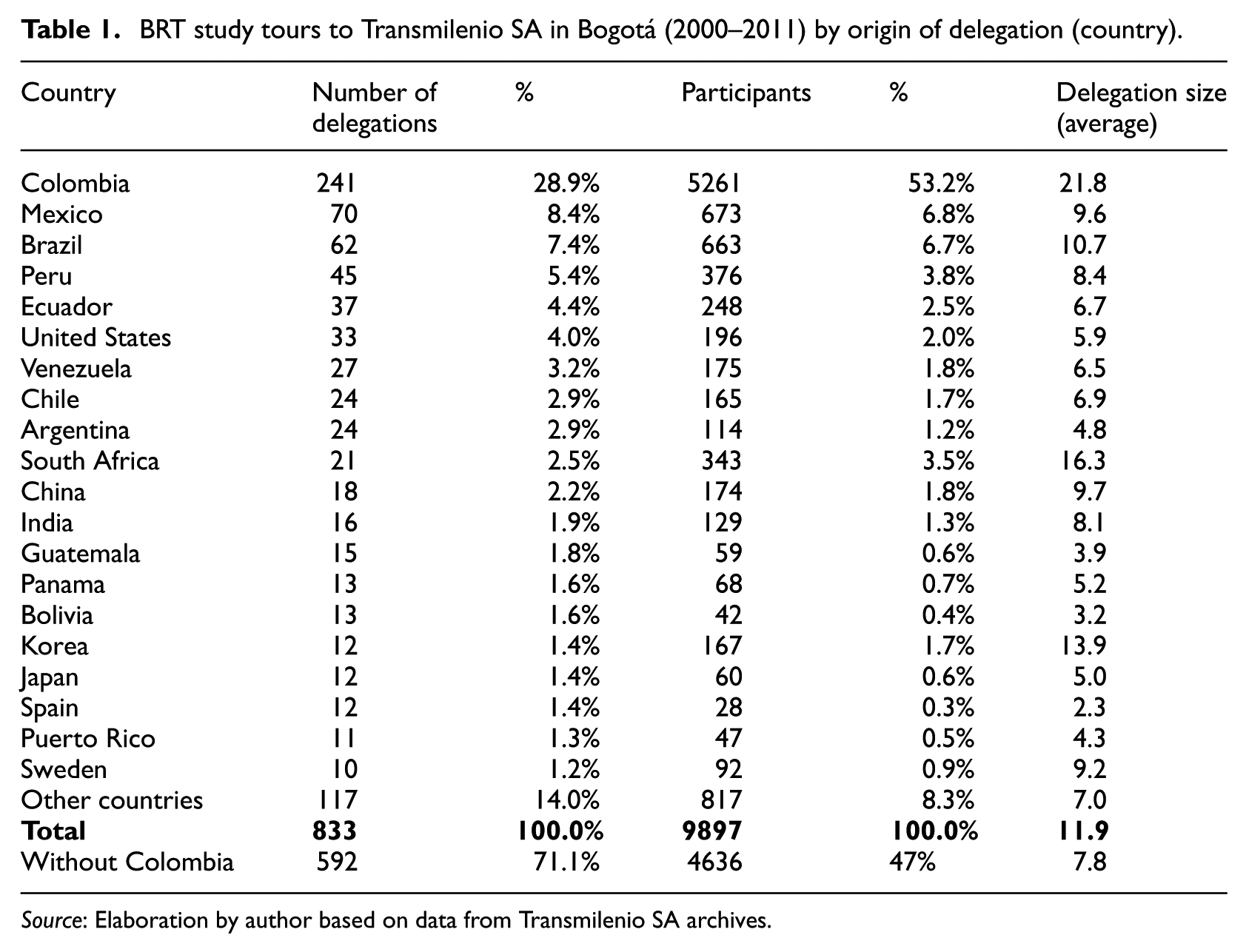
Source: Elaboration by author based on data from Transmilenio SA archives.
The circulation of Bogotá’s transport policies therefore cannot be conceptualised as an urban marketing campaign orchestrated from Bogotá or as a matter of South–South learning alone. Rather, the organisation and funding sources behind Bogotá’s study tours show that the circulation of Bogotá’s transport policies is part of a larger network of transnational actors, particularly global philanthropy and development banks, that have used Bogotá as a model to materialise a particular global development agenda – fighting climate change – through a particular logic of action: replicating a set of transport policy solutions or ‘best practices’ that can be easily communicated and replicated in other cities.
Increasing attention to cities as arenas to solve global development problems
While international development interventions have been legitimised since the 1970s under the broad goal of achieving ‘a world free of poverty’, several authors have shown how the project of development increasingly relies on narratives of sustainability and climate change to legitimise its interventions (Adams, 2003; Goldman, 2005). In this context, international development institutions are re-conceptualising the developing world not only as spaces for poverty and economic development interventions but also as places in need of being saved from environmental threats and global climate change through market mechanisms and cost-effective policies. Yet, given the constant failures and difficulties of reaching a multilateral climate agreement among national leaders, international organisations and global philanthropy have been increasingly turning their attention to cities and city models as a new way to intervene in global climate change (Graute, 2016; Wachsmuth et al., 2016). Because this emphasis on scaling up policy solutions has coincided with an increasing attention to cities as a space for sustainable development interventions, this has made philanthropists and development institutions increasingly interested in urban planning and the dynamics of inter-city policy transfer as new arenas to effect global impact.
For example, when I asked an official from the Global Environmental Fund (GEF) why they were working with cities he said: ‘there’s more attention recently to cities because they can take decisions by themselves. National decisions take longer … senate, debates, etc. … Mayors are more independent, they can take decisions faster’ (GEF official, personal interview, 2013). Yet not all decisions can be made by local governments. For instance, GEF would negotiate issues such as fuel standards with national governments but, he added, ‘recently, opportunities to work with local governments are increasing … as sustainable transportation is becoming a critical issue for local governments’ (GEF official, personal interview, 2013). Indeed, cities were explicitly included in the new UN Sustainable Development Goals with their own goal (‘Make cities and human settlements inclusive, safe, resilient and sustainable’). This has made not only the World Bank but also global philanthropy increasingly interested in urban planning and the dynamics of inter-city policy transfer as a way to effect global impact:
The change that happens in cities can change the world … And whether it is facilitating the spread of good ideas between cities to help mayors tackle some of their toughest challenges, or leading a global coalition of large cities to take real action against climate change, Bloomberg Philanthropies leverages the power of cities [to] create lasting change – especially when national and international bodies refuse to act. (Bloomberg Philanthropies, 2015, emphasis added)
6
This logic of action focused on cities is not limited to new foundations such as Bloomberg, the Clinton Climate Initiative, the World Resources Institute, or Hewlett. Established philanthropic organisations such as the Rockefeller Foundation are also quickly incorporating this emphasis on cities as, for instance, the recent Rockefeller Foundation programme ‘100 resilient cities challenge’ illustrates. Key to this ‘leveraging cities’ logic is the construction and mobilisation of a particular set of urban policies and planning mechanisms as world policy models. Through the circulation and replication of these models, often labelled ‘best practices’, philanthropic foundations and development banks satisfy their impact and performance metrics but also, and despite their invocations of political neutrality, intervene in the political realm by helping place particular topics and policy frames in local and global agendas.
And while Bogotá’s Transmilenio has become ‘the most powerful BRT reference for planners and practitioners worldwide’ (Hidalgo and Gutiérrez, 2013), as more cities around the world have implemented BRT, Bogotá or Curitiba are not the only cities that are able to produce inspiration and learning among urban policymakers and planners. My interviews for this project reveal the important role that ‘peer’ cities play in the circulation of urban ‘best practices’. As noted by a former director of Transmilenio and now senior consultant at EMBARQ’s office in Mexico City:
These days there are more city references for organizing BRT study tours. The captive market that Bogotá had for a while is, today, not the case anymore. For example, intermediate cities can now go to Pereira [a city of a half million people in Colombia] … Cities tend to look for their peers. (EMBARQ Senior Consultant, personal interview, 2013)
The fact that there are now other cities that can serve as BRT references does not mean that model cities such as Bogotá or Curitiba do not matter anymore. Rather, they work in combination with ‘peer’ cities. Size, urban structure, and similarities in the planning apparatus or stage in the planning process are important variables that delegates look for in other cities to identify ‘peer’ cities. For instance, in November 2011, a delegation of ten public officials from Ho Chi Minh City, Vietnam, visited Bogotá to learn about BRT. During their three days in Bogotá, they rode buses together, toured different station areas, and visited Transmilenio’s control centre. They also met with senior staff from Transmilenio SA, public officials at Bogotá’s Urban Transport Management and Planning Agency, and the local NGO Ciudad Humana. The visit was part of a larger study tour organised and funded by the World Bank. South–South Experience Exchange Facility. Vietnamese planners and engineers first visited a set of Asian cities (Guangzhou, Hong Kong, Jakarta) that had ‘newer systems in place’ so that they could learn from cities at an early stage in the planning process. Some months later, the World Bank brought another group of Vietnamese policymakers to a different set of Latin American cities (Bogotá, Curitiba, Rio) that had ‘mature BRT systems at work’ so that they could experience how BRT works in model cities with well-established systems. According to Andre Bald, a World Bank Senior Infrastructure Specialist, the lessons learned during the study tour influenced planning in Ho Chi Minh immediately and ‘the city identified a major transit corridor within which to develop its first BRT’. 7 Beyond the geographical or cultural proximity of these cities, the ways in which the World Bank presented these cities as ‘peers’ played an important role in persuading Vietnamese policymakers and transportation planners to implement a BRT system in Ho Chi Minh City. This decision also meant channelling government funding to BRT as opposed to other alternatives that could have also been considered sustainable transport such as expanding the metro system or improving public transport and reducing emissions in non-urban areas.
Conclusions: Leveraging cities and the limits of urban solutionism
One key finding of this article is that the fast and wide travels of the Bogotá model around the world cannot be understood without acknowledging the role of several international development organisations, particularly the World Bank, and two global think tanks – ITDP and EMBARQ – funded by global philanthropy. However, As this paper showed, the influence of philanthropic and development organisations goes beyond their provision of funding; it lies also in its increasing capacity of setting frameworks and methodologies of action to intervene in the global problems they deem appropriate. This, however, is not a story of a powerful set of international organisations imposing their agendas top-down in cities but rather an ongoing shift in the logics and modes of operation of the international development apparatus, which is increasingly focused on cities, urban policies, and urban planning mechanisms as a way to intervene in global development problems. In my analysis, I highlighted three key features that led to this current conjuncture. First, the rising influence of philanthropy in international development, which does not only reside in its funding resources but also in its capacity of setting frameworks and methodologies of action the philanthropists deem appropriate to intervene in the global problems they consider important. Second, I signal the turn of international development organisations to ‘solutionism’: an increasing focus on solutions and ‘best practices’ that can be quickly spread as a framework for development action. In this logic, it is important to have examples and ‘success stories’ to seduce policymakers worldwide and help these model solutions be quickly communicated and disseminated. Finally, given the constant failures at reaching a multilateral climate agreement among national leaders, international organisations and global philanthropy are increasingly turning their attention to cities and city models as a new way to intervene in global climate change or, as Bloomberg Philanthropies puts it, to ‘leverage the power of cities’ 8 to solve global climate change. This has made international development organisations and foundations increasingly interested in cities and urban planning as a key arena to promote the new 2030 Sustainable Development Agenda. Therefore, under the current historical conjuncture, global impact for international development organisations and global philanthropy is increasingly conceptualised through the lens of affecting the largest number of cities directly as opposed to traditional strategies, such as, for instance, structural adjustment recipes, where global change was conceptualised as affecting the national level, which was then supposed to trickle down to cities. Under this logic, the rapid circulation and global adoption of Bogotá’s Transmilenio and Ciclovía programmes can be conceptualised, then, as part of a larger set of cost-effective, impact-oriented, and financially sustainable policy models promoted by international development banks and global philanthropy to intervene in global climate change through their replication in as many cities as possible. In doing so, I related the increasing speed in the circulation of urban policy solutions with the changing landscape of actors, funding sources, and logics of intervention of the international development apparatus.
In his book To Save Everything, Click Here: The Follies of Technological Solutionism, Evgeny Morozov (2013) criticises ‘technological solutionism’ as an increasing tendency in our society to put faith in technology and algorithms to solve complex problems that, in reality, require changing political, economic and social structures. He concludes that a future dominated by technological solutions will be rather dark and undemocratic. Indeed, he cites urban design professor Michael Dobbins to show the limits of solutionism: ‘solutionism presumes rather than investigates the problem that it is trying to solve, reaching for the answer before the question has been fully asked’. In the absence of a common definition of how sustainable development should be implemented, the increasing circulation of sustainability policy models and ‘best practices’ can then be seen as a global battle about how to interpret and solve the problem of sustainable development. Against the high hopes of development and philanthropic organisations about the potential of cities and South–South policy exchanges to save the planet’s problems and move beyond the North–South structures that have traditionally characterised the international development apparatus, this article concludes with a note of caution. By promoting the circulation of urban policy solutions and ‘best practices’, whether they originate in the South or the North, this ‘leveraging cities’ logic contributes to the diffusion of a rapidly spreadable yet limited approach to sustainability, as this logic does not necessarily intervene in the structural factors and multiple scales that produce environmental degradation and climate change. In doing so, this article does not seek to undermine the value of mobilising ‘best practices’ to inspire change in cities but rather to criticise the prescriptive and acritical adoption of urban policy solutions from elsewhere to avoid the more complex, and needed, act of asking questions about how urban problems work, how they work differently in different cities, and how these urban problems are connected to larger and multi-scalar processes.
Footnotes
Acknowledgements
The author would like to thank Hillary Angelo and David Wachsmuth for their extensive feedback on different versions of this article. The article has also greatly benefited from comments received at NYU’s Democratizing the Green City workshop, UC Berkeley’s Ten Years of Global Metropolitan Studies event, a research seminar at Mexico’s CIDE-Aguascalientes and São Paulo’s International Conference on Policy Diffusion and Development Cooperation.
Funding
This study was funded by the Institute of Global Conflict and Cooperation: Dissertation Writing Fellowship; the UC Berkeley Institute of International Studies: John L. Simpson Memorial Research Fellowship; and the UC Pacific Rim Research Program: Graduate Student Dissertation Research.
