



Abstract
Recent policy initiatives for urban development have changed the relationships among stakeholders in China’s urban consolidation processes. Building upon Giddens’ (Giddens A (1984) The Constitution of Society: Outline of the Theory of Structuration. Berkeley, CA: University of California Press.) structuration theory and Ostrom’s (Ostrom E (2005) Understanding Institutional Diversity. Princeton, NJ: Princeton University Press) institutional analysis and development thesis, this paper develops a power arena analytic framework, and uses it to examine the new power relations among the stakeholders in a dilapidated residential redevelopment project in Shenzhen. Our findings reveal that Shenzhen’s new approach incentivised the developer to frame a local decision-making structure which aligned the property owners into two broad groups: those who supported the developer, or cooperative, and those who disputed with the developer, or un-cooperative. Shenzhen’s new attempt was unable to balance power distribution between the main stakeholders and caused intense conflicts and poor project outcomes. A range of factors, including passive participation of residents in project preparation, weak mechanisms to curb speculation, and policy inconsistency associated with tiers of governments, were responsible for the poor performance. These findings contribute to the understanding of the complexity in power relations underlying urban development influenced by planning policy.
Introduction
A recent shift in Chinese urban development policy is to move away from expansion of urban fringe areas towards consolidation of built-up urban areas. The rationale behind this is to lessen, if not to avoid completely, issues such as inefficient land use, environmental degradation, and rising local government debt, which are associated with the growth-oriented approach featured by rapid encroachment of rural land for urban construction (He and Wu, 2009; Zhou and Logan, 2008). Urban consolidation, which is a collection of an array of planning policies for encouraging development with higher density in existing urbanised areas and discouraging low-density urban sprawl to non-urbanised land (Han and O’Connor, 2008), has emerged in the form of Cun Liang Gui Hua (i.e. existing stock planning literally) as a direct response to the shift in urban development approach. 1 The policy is particularly popular in mega-cities where acute land scarcity in established areas hinders redevelopment (Ye, 2014).
Previous studies demonstrate that the core concern of urban consolidation policies is to intensify land use in urban built-up areas towards sustainable urban form (Bunker et al., 2002; Han and O’Connor, 2008; McCrea and Walters, 2012; Smith and Wales, 1997; Williams, 1999) and financial returns (Henneberry and Parris, 2013; McGreal et al., 2000). Market based community and economic development are important to urban redevelopment policies (McGreal et al., 2000; Roundy, 2017). In the Chinese context, the complexity associated with property rights and stakeholders’ interests in urban consolidation projects have raised substantial transaction costs (Zhao, 2014). Change in stakeholders’ relationship alters the existing pattern of power interplay, firm structure and redistributive outcome (Wu and Qin, 2018). It is critical and essential that the implementation of urban consolidation policies ensure redistributive fairness (Zhao, 2011; Zhao, 2014; Zou, 2015, 2017).
In Guangdong – one of the provinces that pioneered China’s economic reform (Hayter and Han, 1998) – the provincial government has initiated an interest-sharing mechanism into its urban consolidation policy in 2009, to guide redistribution practice among stakeholders in redevelopment projects (Li and Liu, 2017; Wu and Liu, 2018; Ye, 2011). In line with the provincial policy, Shenzhen, a Special Economic Zone which was set up by the central government but administratively a part of the Guangdong Province, started to experiment with market-oriented mechanisms to facilitate stakeholder interactions. It changed the role of local government in housing redevelopment projects from direct command to regulatory control. The transfer of land use rights was no longer match-made by the local government but through initiatives of developers and the sitting land users. This approach significantly alters power deployment among key stakeholders in dilapidated housing redevelopment projects. 2 It triggers important questions, such as, under the policy shift towards market allocation, how is power distributed among stakeholders? How does the new power dynamics influence redevelopment outcome? Do effective redevelopment models emerge in this experimental process?
This paper develops a theoretical framework and applies it to examine a dilapidated residential area redevelopment (DRAR) project in Shenzhen. The case study project – Mutoulong – was selected in 2016 after visits to all the eight approved DRAR projects as well as 12 face-to-face semi-structured interviews with officials from local land use planning and urban design departments at both municipal and district levels. Mutoulong is not an average urban consolidation project but one that demonstrates the widest range of conflicts with ongoing stakeholder negotiations for a long period of time. It was built in low density at a central city location and was chosen by the municipal government as one of the eight pioneer residential redevelopment projects in 2009 (Wong, 2017). With fragmented property rights, varied stakeholder interests and the largest residential population, Mutoulong stands out from the eight experimental projects as the most appropriate for an inquiry into the new power relations embedded in acute stakeholder conflict, sharp resident divide, and a strong urge for policy change. Our primary data include 15 semi-structured interviews: two officials from the Urban Redevelopment Authority in the Luohu District, two real estate managers, one urban designer, one real estate consultant, one lawyer, four households who signed the redevelopment agreement, and six households who objected to the project. The interviews are supplemented with information from local community residents’ online forum and public media reports.
Power relations in urban redevelopment
Past efforts in the study of power relations in urban redevelopment have placed individuals, groups and institutions at the centre of inquiry, which are fundamental for developing research questions and guiding the fieldworks for this research. These efforts began with Hunter (1953) whose analysis indicated that power was a property of individual influence and only a small set of people (the elites) could hold power to make major decisions in a community. Dahl (1961) challenged Hunter’s findings and claimed that power was an ability to make decisions based on the mobilisation of resources by many actors (thus the pluralist view). Only a small number of people possessed a high degree of direct influence in the decision-making process but most residents also had moderate indirect influence. Both elitist and pluralist arguments were criticised for treating cities in an institutional vacuum, thus failing to consider the external influences and power configuration in a more generalised situation (Harding and Blokland, 2014; Wellman and Leighton, 1979). Further, it is argued that patterns of human action were not exclusively determined by impersonal (e.g. natural and functional) forces as decision-making processes were shaped by individual behaviour (Judge et al., 1995).
The growth machine thesis refined the elitist argument by emphasising individuals and interest groups in a broader context of urban development rather than exclusively focusing on what affected local government decisions (Logan and Molotch, 1987; Molotch, 1976). Logan and Molotch (1987) found that a small set of ‘rentiers’ constantly strived to maximise the exchange value of their assets by forming a coalition with other interested players to enlarge their power for leading economic growth. Power, in this thesis, refers to the domination over the physical material, intellectual resources and capacity to attract investment (Harding, 1995). However, the core conceptual assumptions of power in the growth machine thesis have been widely criticised for being overly simplistic (Clarke, 1990; Dowding, 2001; Wood, 2005).
Stone’s urban regime thesis conceptualised the coalition of agents into a ‘regime’ from a hyper-pluralist perspective (Stone, 1989, 1998). Owing to the limited capacity of control, the government needs to mobilise and coordinate with other institutions and ‘brings about enough cooperation among disparate community elements to get things done’ (Stone, 1989: 227). Power is a capacity to act based on social production such as knowledge, information and other resources (Stone, 1998). This thesis directs attention away from a narrow focus on power as an issue of social control towards an understanding of power expressed through social production. It appears that the growth machine and urban regime theses heavily weight the role of individual actors but neglect the impact of institutional restructuring that shapes actor behaviour (Jessop et al., 1999; Kantor et al., 1997).
Healey’s institutionalist framework focuses on the analysis of the unidirectional impacts of institutional change on localised policy operation (Healey, 2004, 2006). Its heuristic functions present a macro-level analysis of dualistic interactions between institutional structure and agents. It has an emphasis on the ‘governance cultures’. Without sufficient specific tools to examine the power dynamic where actors deploy resources and create new rules to alter the structure, it is less effective to examine emerging institutional structure because of adaptive behaviour of stakeholders and their changing strategies. This ‘old institutional’ approach is extended in urban development theory from a collaborative network perspective (e.g. Henneberry and Parris, 2013). Less explored is a direct conflict and hierarchical perspective of actors’ strategic interaction and organisation change (Wu and Liu, 2018; Wu and Qin, 2018).
Studies on power relations in China’s urban (re)development present the view that power is nested in the existing institutional structure (Han and Wang, 2003; Li and Li, 2011; Li and Liu, 2017; Wu and Liu, 2018; Xu and Ng, 1998; Yang and Chang, 2007; Zhang, 2002). As China’s urban redevelopment operates within an authoritative governing structure, local government has supreme intervention and ultimate decision-making power (Schoon, 2014). The marketisation of land and decentralisation of power from the central government have positioned local governments onto the role of the dominant stakeholder in urban development (He and Wu, 2009; Xu and Ng, 1998). Developers and other stakeholders often gain, maintain and strengthen their power by forming an alliance with the government to effectively deal with project complexity, finance and implementation (Han and Wang, 2003). The local government forms pro-growth coalitions with non-government sector stakeholders in development projects (Yang and Chang, 2007). While the growth coalition represents the economically powerful stakeholders in the power structure, other interest groups such as local residents play a marginal role, if not completely absent, in the emerging power structure (Fang and Zhang, 2003; Zhang, 2002).
The recent urban consolidation policy changes in Shenzhen indicate that the central government is attempting to involve and empower developers and residents in redevelopment decision-making. These changes are consistent with the broader trend that ‘China’s central government is cautiously exploring the relation between governance and public participation’ (Enserink and Koppenjan, 2007: 469). Though it is openly expressed in policy and legal documents that an improved public participation will lead to better transparency and accountability of development initiatives, the lack of political will and the absence of appropriate community structure act against public participation (Tang et al., 2008: 68–69). How do the empowered stakeholders participate in urban projects under the new structure? Are there new patterns of stakeholder interaction and change in the institutional structure and individual behaviour? These questions point to an empirical research gap that none of the theories reviewed above have addressed. We propose a micro-level analytic framework for the strategic and power relations in the property redevelopment process. The framework draws ideas from Giddens’ structuration theory and Ostrom’s institutional analysis and development (IAD) thesis.
A power arena framework
In Giddens’ structuration theory, structures and actors are being shaped by each other – structures operate (by means of rules and resources) as constraints to actors’ action and actors work (by means of power) as the main agent constituting and reproducing a structure (Giddens, 1979, 1984). Power in this context is a transformative capability of individuals to make a difference in ‘a specific process or state of affairs’ (Giddens, 1984: 14). This capacity is characterised by possession of agent power and structural power (Giddens, 1979). The agent power is built upon allocative and authoritative resources (Giddens, 1984). ‘Allocative resources’ refers to the domination over material facilities such as finance, technology and news media. Authoritative resources consist of the human command over others through formal organisations and relations formed on the basis of belief and informal practices relating to reputation, authority, social relationships and coalitions (Cohen, 1989; Giddens, 1984; Phipps, 2000). The structural power originates from deployment of rules and resources that are recursively involved in institutions to form the relation between context and action. It includes the power stemming from laws, policies, regulations, and social norms. Rules are transformational prescriptions to form the production and reproduction of social practices, defining ‘the constitution of meaning’ and ‘modes of social conduct’ (Giddens, 1984: 18). Resources are ‘the media whereby transformative capacity is employed as power in the routine course of social interaction’ (Giddens, 1979: 92). Some criticise that the concept of rules is ambiguous and vague in describing an institution (Hodgson, 2006). It raises the concern that the structuration theory fails as a heuristic tool to scrutinise power dynamics in empirical analysis (Adams and Hastings, 2001; Gregson, 1989; Moos and Dear, 1986; Sewell, 1992).
Ostrom’s (2005) institutional analysis and development (IAD) framework emphasises actors’ behaviour in a structured social context. The IAD framework dissects structured human actor interactions into several interconnected action arenas. These arenas are connected sequentially or simultaneously but independently exist. Each arena contains two aspects – the action situation (i.e. structure) and the actors (i.e. agent). ‘Action situation’ is the specific social space where actors with diverse interests collaborate or compete. All action arenas are affected by exogenous forces, that is, material conditions, rules and attributes of the community and produce outcomes. Rules are the results of policy or norms to create positions and then require, permit or forbid actions. The IAD framework allows researchers to analyse the way actors organise their relationships in a social process with the influence of exogenous forces and examine modes of interactions and outcomes in specific community contexts. As the formation of action arenas is independent of local government’s design, the framework is used extensively for the evaluation of common-pool resources management (Fischer and Qaim, 2012; Ostrom, 1990; Ostrom et al., 1994; Schlager et al., 1994). The notion of power is implicitly stated in Ostrom’s (2005) discussion about control where the governance system is treated in a structured context by prescribed rules to order relationships. Rules in Ostrom’s theory refer to the prescriptions by constitution of meaning, not the Giddensian effects of social interaction. We argue that micro-level power dynamic in the local community or at project level involves changes in strategies. This argument holds despite the relative stability of external institutional structure.
Figure 1 outlines the power arena analytic framework, which is built on Giddens’ theory of power in the context of structure and actor relationship and Ostrom’s IAD framework about the interconnected action arenas. This combination allows the development of a new lens to observe an otherwise static screenshot of power relations by projecting it to a dynamic series of cross-sectional ‘relational arenas’ within which project stakeholders interact. These interactions are framed by exogenous and endogenous effects, whilst outcomes of the power interplays will then be evaluated by the principles of equity, institutional adaptability, and transaction cost, representing the redistribution effects, path dependence and efficiency, respectively, in project evaluation. (Re)development outcomes feed back to the arenas, the exogenous and endogenous influences as an evolving social communicative mechanism. Main exogenous factors include policies and contexts at local and central government levels, and attributes of the community. Endogenous influences refer to rules and resources discussed in Giddens (1979, 1984). Within each power arena, stakeholders (S1, S2, …Sn ) interact with each other according to their private interests and values. Endogenous forces affect what decisions they are empowered to make, how they make decisions, what actions they take, and what consequence or impact these will lead to. The three evaluation criteria are selected based on previous literature (Imperial, 1999; Ostrom, 2005), with equity measures the distribution of interests amongst stakeholders, adaptability measures stakeholders’ adaptation to changing power deployment, and transaction cost measures being the overall performance of the redevelopment process.
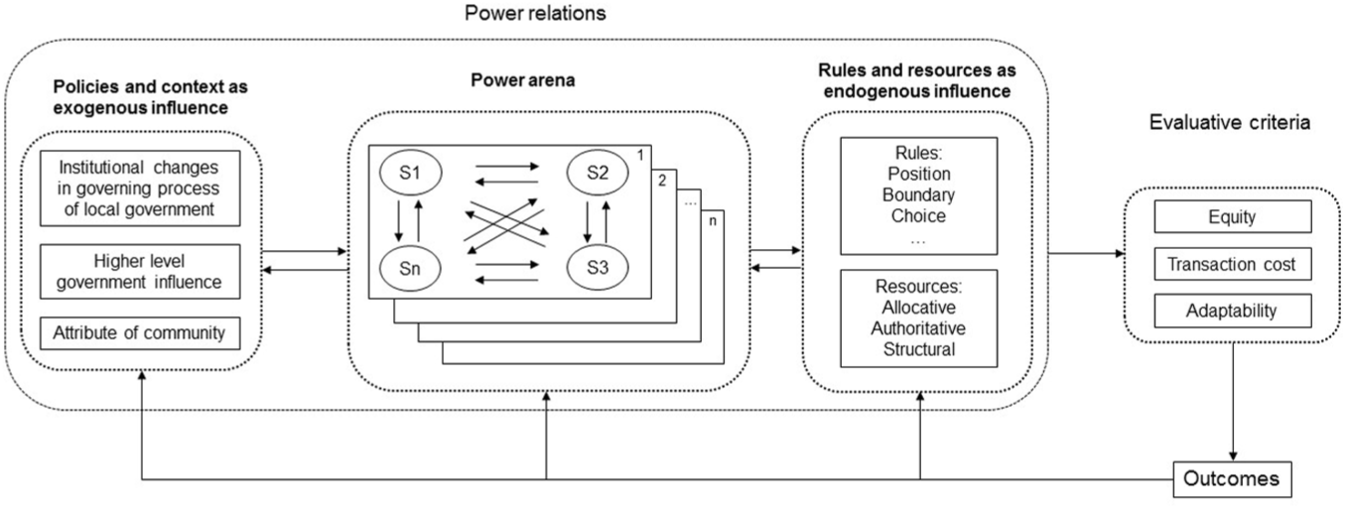
A power arena framework.
Note that endogenous rules and resources are not unrelated to exogenous forces. Policies and contexts set up the action situation whilst rules as principles, action channels and effects work together with the allocative and authoritative resources to regulate the unfolding power relation. Rules in varying forms may be applied to an array of actions, such as the use of (1) position rules to specify positions for participants in the urban consolidation process, (2) boundary rules to define how participants are chosen to occupy or leave these positions, (3) choice rules to constrain other actors’ action, (4) scope rules to allow or forbid the effect of other actors’ action, (5) aggregation rules to unite actors towards a collective action, (6) information rules to define approaches of communication among actors, and (7) payoff rules for the distribution of interests and costs among participants (Ostrom, 2005). The power arena analytic framework allows us to conduct micro-level evaluation of distributive context and outcome of urban redevelopment processes. The following sections apply the framework to a housing redevelopment project from Shenzhen focusing on power interplay, process, and outcome.
Exogenous influence of power arenas
Policy context of urban consolidationin Shenzhen
The redevelopment right transfer before endorsement of the urban consolidation policy was governed by a process in which local government assembles fragmented land use rights from the sitting users and auctions the acquired site to developers for redevelopment (Yeh and Wu, 1996). Local government and developer may gain above market premium causing concern about distributive inequality. This mode of value redistribution was increasingly appearing unfair through open expression of local residents’ dissatisfaction and incidents that sometimes threatened social stability. To address this, the Guangdong Provincial Government issued its urban consolidation policy (San Jiu Gai Zao) in 2009 (Li and Liu, 2017). The policy encourages local government to switch to an administrative role in urban redevelopment and allow multiple stakeholders, including local governments, collectives, sitting land users and the associated beneficiaries, to play their roles in an environment regulated by market mechanisms (Guangdong Provincial Government, 2009).
Immediately after the endorsement of the provincial policy, in 2009, the Shenzhen Municipal Government initiated a ‘market mechanism’ to encourage redevelopment of old towns, dilapidated residential areas, old industrial areas and urban villages. 3 The government changed focus to concentrate on policy-making and project approval whilst developers and residents were to directly negotiate compensation plans and land transfer. After site acquisition and payoff fees, the developer would be permitted to start demolition and construction. A two-round public participation rule was introduced to actively engage the community affected by the redevelopment. The first round was to seek support by affected residents for the redevelopment proposal. A minimum of two-thirds of households’ approval was required, otherwise the government would not approve the redevelopment application. The second round was for the developer to organise consent with relocating residents. As 100% consent is rarely achievable in high-density redevelopment, the developer would be able to obtain a demolition permit from local government for compulsory acquisition if they could achieve at least 90% approval rate by the residents. This two-round public participation created new structural power for the residents (Ye, 2011, 2014). With expectation of high project returns, many developers were keen to work on DRAR projects. In 2010, eight DRAR projects were approved according to the new urban consolidation policy.
Influence of central government policy
Change of national policies has significant impact on local power deployment. While the two-rounds participation rule was based on a valid demolition permit scheme established in 2001, the condition for awarding such a permit had changed since 2007. The demolition permit which aimed at speeding up urban redevelopment by allowing compulsory acquisition violated property rights and created social conflicts (Ye, 2014). In 2007, the central government endorsed the Property Rights Law with mechanisms to protect private property rights. Such conflict between legislation and administrative policy on demolition rights and private property rights escalated, which led to the ultimate abolishment of the demolition permit scheme in 2011 and partial policy reversal. The policy stipulates that compulsory land acquisition only applies to public interest purposes and only local government should take charge of the compulsory acquisition process. All affected property owners and residents should be appropriately compensated. The introduction of the Property Rights Law as nationwide legislation and the removal of the demolition permit scheme at the national level created a major challenge for assembling property rights in urban redevelopment projects in Shenzhen. It is particularly challenging in DRAR redevelopment projects as property rights are fragmented. Owing to the change, from 2011, developers have to obtain 100% consent from affected owners to commence redevelopment work (Shenzhen Municipal Government, 2012).
Attributes of the Mutoulong community
Mutoulong is a large Dilapidated Redevel-opment Area (DRA) located in central Luohu District (Figure 2). The area covers 100,000 m2, with 57 seven-storey buildings (1340 apartments), built by the local government in 1983. Its original occupants were workers and staff in major state-owned enterprises (SOE, e.g. Shenzhen power supply company). Through the 1990s housing reform, these apartment units were privatised and sold by asset holding work-units as fully transferable. The average age of the heads of these households is above 60 and some are laid-off workers from the previous SOE reforms in the 2000s. Since the majority of Mutoulong residents have lived there for over 30 years, there exists a strong social network in the local community. Unlike collectively governed ‘urban villages’ (Wu and Liu, 2018), residents in the DRA are of loose association.

The location of Mutoulong, Shenzhen.
For many local residents, the Mutoulong apartments are their principal asset even though building conditions have seriously deteriorated after over 30 years. Flooding was always one main concern as the ground of Mutoulong is 40 cm below the main road. Given the poor living conditions, most residents are supportive of major upgrades or redevelopment. However, the site’s location advantage has raised expectations of high appreciation post redevelopment. Some residents treated the redevelopment as a rare opportunity to maximise compensation from the developer or the government. All added to the cost of assembling the redevelopment site as the sole task of the developer.
Power relations and endogenous influences
The Mutoulong redevelopment adopted a developer-led approach. Since the project commenced in 2009, the developer, Yitian Group Co. Ltd (Yitian hereafter), was granted power to trail three strategies to secure residents’ support and consent. These strategies were implemented through three actions sequenced in time and unfolded in three ‘relational power arenas’, namely the publicity, physical, and negotiation arenas. In the process, local government consolidation policy helped maintain a stable heterogeneous regulatory environment. This allows the analysis to focus on owner–developer power interactions.
Publicity arena
At project commencement (2009), Yitian adopted a ‘publicity strategy’ to obtain residents’ consent. Yitian deployed its financial resource – an allocative resource – to employ two former local government senior officials with attractive remuneration to promote Yitian’s public image as reputable developer with strong financial capacity for urban redevelopment projects, including an attractive compensation and relocation package. The developer used organisation size, professional experience and financial strength as authoritative resources in initial negotiation. They were able to obtain over 70% (thus meeting the two-third threshold) of the households to sign the redevelopment agreement/consent.
After the redevelopment agenda was approved in 2010, Yitian applied the payoff rule by promising the residents a share of the project profit. This incentivised more residents to consent. Then the successful negotiation of a 3 billion RMB loan with the Industrial and Commercial Bank of China allowed Yitian to further increase the attractiveness of its compensation plan. The package included (1) new apartment with the same size as the original, (2) relocation grant to cover moving expenses, and (3) allowance to cover rental expense until the affected residents move back to their new apartment. Residents who relocated within 1 month after signing the contract would receive an extra 30,000 RMB. Yitian proclaimed that if all owners in the same building consent, each would be rewarded with an extra 50,000 RMB. By late 2010, Yitian announced in a press conference that it had secured 10 billion from the China Construction Bank. In the conference, the manager promised to the attending residents that ‘… [w]e will offer the highest ever Demolition Compensation Rate (DCR 1:1.3) 4 in Shenzhen to benefit the affected residents. The demolition and construction will start in May, 2011’ (Lu, 2010). These publicity actions were effective to build confidence to facilitate bargaining towards property owners’ consent.
On the opposite side, some residents who objected to the compensation offers formed a coalition to increase their influence as authoritative resource. They expressed their distrust to Yitian on posters posted in key locations in Mutoulong. By so doing, they hoped to discourage fellow residents from consenting and signing the agreement (by applying the choice rule) so as to minimise the effect of the developer’s publicity actions (by applying the scope rule). Despite the contest of the uncooperative residents, around 1100 property owners signed the agreement, and by August 2011 over 80% of the households had relocated. With substantial financial input, the developer-led approach led to a segregating effect of cooperative and conflictive sub-groups.
Physical arena
It was a major concern of Yitian as it failed to obtain 90% resident support by 2011. With the demolition permit scheme no longer applied, Yitian had no option but to try securing full (100%) resident support. Given the impossibility of achieving complete consent in multi-actor price bargaining processes, it had pressed Yitian to use physical actions as a non-price mechanism to force out the uncooperative residents. Yitian started by dropping the quality of property management and services to force out uncooperative residents (i.e. an application of the choice rule). This was made possible when Yitian officially took control of the property management in 2010, after the redevelopment agenda was approved and the managing agent left. As the interview of the uncooperative residents indicated, the fierce actions of the developer have resulted in residents’ negative perception of the developer and their distrust of the local government.
After the majority signed agreement and moved out, in August 2011, the developer built barrier to block the main entrance, smashed water pipes and cut power lines, and even vandalized all the street lamps. The security and cleaning services in this area were removed. We complained the developer’s terrible actions to the local government but did not get any active reply. We spotted that the managers of Yitian banqueted several relevant government officials in a luxury restaurant. The developer must develop a corrupted relationship with the local government to evade regulatory penalty. Mutoulong has been an enclave out of the control of laws. (Resident interview conducted at 11:00 am–12:00 pm on 07 December 2016; interview venue: Mutoulong)
Interestingly, in this power relation dynamic, some of the physical actions against the uncooperative residents were supported by the cooperative residents. They agreed to empty their units immediately after signing off the contract in order for Yitian, through a third-party demolition company, to knock down windows and doors. These actions not only deteriorated the relationship between Yitian and the uncooperative residents group, but also increased the tension among local residents. According to the cooperative residents:
The uncooperative residents are greedy and selfish. The only thing they want is higher compensation generated from the project. The minority should obey the majority since most of the affected residents have agreed on the redevelopment. Their behaviors hindered the redevelopment and did damage to the public interest because the redevelopment is a collective business. (Resident interview conducted at 4:00 pm–4:45 pm on 07 December 2016, interview venue: Mutoulong)
The collectivism norm added moral superiority to the cooperative residents and their strategic action. In March 2013, some of them returned to the site to persuade the uncooperative residents to stop their resistance, based on the moral superiority as an authoritative resource. The communication was ineffective and according to the news reports and field interviews, some even physically assaulted each other. 5 The physical actions did not resolve conflict with the uncooperative residents. It brought the bargaining process to a halt. From September 2011 to November 2013, only 55 households agreed to sign in addition to existing consents. In the meantime, more visible resistance was observed, including some who began to seize opportunities such as social media and TV programmes to publicise their resistance to the project, and complained that the developer’s behaviours were ‘cruel’ and ‘fierce’. This had generated public sympathy which devastated the developer’s reputation (Huang, 2013). By November 2013, the manager of the Mutoulong redevelopment project resigned from Yitian.
Negotiation arena
To reduce the tension between Yitian and the uncooperative residents, in 2014, Yitian hired a new manager to lead the project. By establishing an effective negotiation arena to improve communicative efficacy, the negotiation practice between Yitian and uncooperative residents resumed. Quoting the new manager:
conflict is not a solution to the project delay. We educated our staff to gain households’ trust and eliminate their grievances. In the negotiation process, we are frank to say that we are in an equal position to create a win-win situation. The developer is not condescending to rescue them from the poor living condition. (Personal interview of Yitian’s new manager, conducted at 3:00 pm–5:20 pm on 08 January 2017; interview venue: manager’s office located 5 munites walk from Mutoulong)
One further finding is that some households formed a new coalition to boost their authoritative resource and raise their bargaining power. In 2016, 30 households agreed to nominate two representatives (agents) to directly negotiate with the new manager on their behalf. After more than 80 rounds of communication, Yitian compromised and agreed to the households’ request – these households could stay in their units after consent signing until all agreements were signed. Said one of the representatives: ‘this cannot be achieved if we bargain with the developer individually. The coalition we formed strengthened our power and draw down enough patience and sincerity from the developer. We felt enough respect in the negotiation process and that’s the key to the agreement signing’ (Resident interview conducted at 1:15 pm–1:30 pm on 04 January 2017; interview venue: Mutoulong).
Although this coalition dissolved after accomplishing its mandate, the recognition of a powerful authoritative resource in their favour prompted some residents from the group taking further initiative to persuade the remaining uncooperative residents to trust the developer and sign the agreement. Since switching strategies, more than 150 ‘tough’ residents had signed the consent. By September 2017, there were 20 households still opposing the redevelopment associated relocation. Nonetheless the redevelopment remained postponed causing substantial project hold-up cost.
Outcome and evaluation
Negotiations between the developer and the uncooperative residents continued at the time of writing (2018). In this DRAR project, the proposed floor area ratio (FAR) is 7.22, which is far higher than the existing ratio of 1.55. Since the majority of the residents signed the consent and moved out, Yitian has been paying their rental cost. The cost has accumulated to 600 million RMB up to the end of 2017. The cooperative residents have suffered by living in temporary accommodation, whilst the uncooperative residents have to cope with poor living conditions. Both sides of the affected residents had complained to the government hoping for solutions. But both were disappointed because of a lack of policy alternative given the new market approach remains effective. The local government’s reputation was harmed. The new market approach in Shenzhen has led to a ‘triple-loss’ outcome causing severe social cost and loss. This section evaluates the outcomes from the aspects of equity, adaptation and transaction cost.
Equity evaluation of the outcome
Yitian has invested heavily but is expecting an enormous economic gain by new apartment sales. This expectation seems not unrealistic given that apartment prices in Shenzhen have been skyrocketing. For the property owners, without any investment, their living conditions and property value are expected to improve greatly. The government is also expecting high gains in this process as 15% of the land will be transferred free of charge from Yitian for the construction of public facilities. The urban environment will be significantly improved at lower relative cost to the government.
Despite the optimal benefit scenario, the distribution of project returns is probably not in line with the equity principle that those who receive greater benefits are expected to pay more (Imperial, 1999). In the absence of detailed calculation taking into account the unpredictable hiking rates of land value, infrastructure cost, and the administrative expenses, there are no concrete numbers but speculation about the winners. 6 On top of the doubt is whether the developer and the local government invested in proportion to their expected gains. Dramatic increases of market housing price provide evidence to support this speculation about the developer’s enormous gain, while the money value of 15% of free project land is probably difficult to be matched by government contribution. The discovery of ‘double-sided contract’ from fieldwork in Mutoulong provides further evidence to argue that residents are not treated equally. Yitian had to sign a ‘double-sided contract’ with some of the ‘tough’ households to satisfy their request for higher compensation. A double-sided contract comprises a formal contract on one side, identical to existing consents, and a hidden contract on the other, with a premium or higher pay-out. This apparently violates the equity principle for resource allocation or distributive justice.
Institutional adaptation of the new power structure
Individuals tend to learn from experiences in one arena and adapt to new circumstances by developing new strategies leading towards possible norms and rules, thus modifying power structure and resource distribution (Ostrom et al., 1993). In Mutoulong, all residents exercised their power of choice in dealing with contracts, and learned that the posters had limited effects in influencing residents’ decision about agreement signing. In the next arena, social media and traditional media were actively used to pressurise the developer. For the developer, as the agreement signing process was smooth and fast in the publicity arena, it failed to realise the empowerment of the residents and the change of power structure. In the physical arena, the developer took dramatic actions to influence residents’ choice (between stay and relocation). This caused additional tension between the developer and unsigned households and severely delayed the consent process. The developer drew lessons from the physical arena and changed its strategy in the negotiation arena and thereby facilitated the agreement signing process. Realising that excessive expansion of property owners’ power was the main cause for project delay as bargaining cost, the government had amended the market approach in 2014 in its urban consolidation policy. 7
Transaction cost and project delay
Transaction cost is incurred in the Mutoulong project for obtaining residents’ approval of the redevelopment proposal. The cost is tied with project delays because manpower cost and bank interest paid for the loans all increase in time. Field evidence shows that the transaction costs in Mutoulong are associated with power relations and stakeholders’ behaviour. In particular, active use of asymmetries of power (i.e. one side exercises an overwhelming power to exclude or put pressure on the other side, according to Imperial, 1999) led to project delays thus higher transaction cost. Likewise, the cost was increased by opportunist behaviour (i.e. the interest-seeking behaviour with deceit and absence of moral restraints, according to Williamson, 1993).
Power asymmetry characterised all three arenas, as the developer had many allocative and authoritative resources whilst the residents had much fewer resources. As long as the ‘powerful’ side was not aggressive in the power asymmetry environment, both power-holders could negotiate, thus the consenting process was quick and smooth. This happened in the publicity arena. In the physical arena, however, more power skewed to the developer side as residents who signed off the agreement changed side in the power balance. The ‘powerful’ developer became even more powerful with the new support. It subsequently changed its position from equal to dominant and the associated mobilisation of further resources to compel the uncooperative households occurred. This resulted in more resistance, which was not expected, and significant hold-up cost was incurred by the disputes and delays. In retreat, the developer repositioned itself by refraining from the use of aggressive resources in the negotiation arena. So far, the adjustment strategy has been working well to accelerate the consenting process.
Opportunistic behaviour is found for both the developer and the residents in Mutoulong project. To encourage residents to surrender their property rights, Yitian arranged bank loans to be used by the residents to pay for their temporary housing for the entire relocation period. This was a substantial financial burden to the developer which generated new pressure for Yitian to replace the ‘carrot’ approach (i.e. give incentives for those who signed the agreement) by a ‘stick’ approach (i.e. to make the living environment harsh by stopping services). These opportunistic actions destroyed the residents’ trust and caused project delay. On the other hand, some opposing residents knew that the developer was keen to complete the project in the shortest timeframe, which could add to their bargaining power. So, they refused to sign off contracts unless their demand for higher compensation was met. The opportunistic action of the residents to repeatedly bargain further delayed the project progress and raised hold-up cost. High transaction cost resulted in low efficacy of the redevelopment progress and sub-optimal distributional outcome.
Conclusion
This study contributes to the understanding of power relations in urban consolidation by examining the power arenas in Shenzhen via a new conceptual framework. Observation and analysis of structure dynamics and strategic social interaction at the micro-level show that instead of a domination of power by developer or government, the residents possess and exercise a considerable amount of power to influence the redevelopment process. The relationships among stakeholders and the coalitions in Mutoulong changed constantly as a result of learning from and changing circumstances. There is apparently no stable coalition that supported the redevelopment project throughout the study period in any sense.
With apparent policy loopholes and high transaction cost, Shenzhen’s new market approach hindered rather than facilitated the urban consolidation process in Mutoulong. The impossibility of all residents’ support seemed to be directly responsible for severe project delay, though the developer’s behaviour in project planning and implementation as well as the absence of government facilitation, especially when the tension between the developer and residents escalated, contributed to the severe social loss. Although a pioneer case in Shenzhen, Mutoulong is not an exception in urban redevelopment policy innovation and the associated processes as well as outcomes in China. The exogenous policy environment which is characterised by contradictions, as shown in sections ‘Policy context of urban consolidation in Shenzhen’ and ‘Influence of central government policy’ in this article, is applicable to cities all over China. Urban residents and the public in general are unprepared for exercising the newly acquired rights regarding their properties or as consumers, whilst the government and communities are unprepared to facilitate public participation in decision-making (Enserink and Koppenjan, 2007; Tang et al., 2008). Developers are profit driven, with little consideration of the equity and efficiency impact on societies, whilst the government is usually keen to make investment decisions but shy of discharging its governing responsibilities (Han and Wang, 2003).
Three reasons further explain the failure. First, the new market approach failed to include the residents in project planning. The proposed redevelopment plan and the terms of the relocation agreement were drafted solely by the developer without seriously engaging the households. The latter were only given an option to accept or refuse the agreement. This is a common problem in many participatory practices in China as there is a lack of political will to engage the public and also a popular belief that the government and experts are in a better position to make decisions (Enserink and Koppenjan, 2007; Tang et al., 2008). Second, the policy failed to provide an effective control mechanism for managing project delay. As the cost of delay to the developer is much higher than that to the unsigned households, project delay was used as a strategy by the ‘tough’ households in fighting for a high compensation. No one, including the developer and the local government, seems to have had an exit strategy. These findings agree with Schoon (2014) that the loss of regulatory power in China’s urban redevelopment increased informal activities and increased temporary systemic instability. Third, administrative conflicts between governments in different tiers of the hierarchy also result in project delays. Since the abolishment of demolition permits by the central government, developers have to solicit 100% residents’ support. The local government is not given the power for compulsory land acquisition in housing development. This policy change at the central government level was not effectively coordinated with associated policies, which substantially raised transaction cost. The cost of institutional vacuum can be extremely high in urban redevelopment.
With continuing urban reform, China’s local government may further ‘trial and error’ market mechanism to improve the efficacy of urban consolidation policy. The interplay between state and market, which has been a persisting characteristic in China’s urban transition (Han, 2000), will inevitably reconfigure the power relations. Mutoulong’s urban consolidation process and the underlying power relations provide insights to understand this complexity. In Shenzhen, as severe project delay occurred in all eight developer-led DRAR projects, the government amended relevant policies related to the institutionalised empowering of property owners in 2014. This did not affect Mutoulong in retrospect but it can be taken as a sign for launching experiments to balance power and interests between stakeholders in the ongoing urban redevelopment and consolidation.
Footnotes
Acknowledgements
We would like to thank the three anonymous referees who provided valuable comments on earlier drafts of this paper. Any remaining errors or omissions are the responsibility of the authors.
Declaration of conflicting interests
The author(s) declared no potential conflicts of interest with respect to the research, authorship, and/or publication of this article.
Funding
The author(s) received no financial support for the research, authorship, and/or publication of this article.