



Abstract
It is often reiterated that a better understanding of local networks and needs is key to risk reduction. Nevertheless, the crucial role of informal social networks and actors in the catering for human needs in disaster circumstances remains largely under-explored. If we have to rethink the ‘work’ that informality does for our understanding of urban areas, its contribution to resilience, and take it seriously in the ‘full spectrum of risk’ in urban and peri-urban centres, better and more balanced methods are needed. This paper attends to this gap. Examining the mechanisms of aid provision in the aftermath of the 2015 Gorkha Earthquake in Nepal, it details an experimental set of quantitative research methods to explore the role of informal social networks in the provision of critical human needs in natural disasters. Relying on a sample of 160 households across four districts and 16 villages in the built environment affected by the Gorkha earthquake, the paper reveals that, overall, a wide disparity exists in the comparative importance of organisations in the provision of aid and resources. Much crucial after-disaster care is catered for by a mix of relatives, temples, friends, neighbours and local clubs. It highlights the importance of informal networks in understanding, and theorising, governance (of disaster and of the ‘urban’ more in general), and calls for greater attention to its role. It is time, it argues, to revalue informal disaster governance networks as a crucial, not tacit, component of disaster response.
Introduction
The connection between disasters and cities might be one of the most pivotal challenges of our time. Most of the major international frameworks, such as the United Nations Sustainable Development Goals, now acknowledge that a better understanding of the mechanisms to reduce risk in cities is urgently needed given current demographic urban trends (Satterthwaite and Dodman, 2013). This is further heightened by the increasing exposure to natural and technological hazards and the projected climate change impacts on urban areas (Dickson, 2012). Within this context major international organisations and academia have increasingly paid attention to the social dimension in urban risk reduction. A clear proof of this is that the Sendai Framework, the main international voluntary agreement for Disaster and Risk Reduction (DRR), is intentionally explicit about the role of social factors in building resilience (Wahlström, 2017). In the last few years, terms such as ‘social resilience’, ‘community-based DRR’ and ‘people-centred approaches’ have become common in crisis management forums, with urban studies of disaster flagging their centrality in disaster response (Campanella, 2006). Seing this emphasis on society, the nexus of built environment and natural hazards, then, becomes an apt context where to investigate formal–informal dynamics, and vice versa urban informality emerges as a central reality for risk reduction. Informal responses to crises in cities can even come to dominate disaster relief and recovery, offering in several cases ‘collective security mechanisms’ beyond the formal sector (Pelling, 2013). Yet the value of mapping informal networks and actors in catering for human needs in disasters remains largely under-explored albeit social capital has been largely understood as the ‘main engine’ (Fussell, 2010) of long-term recovery. Here we seek to offer an empirically driven starting point that can attend to the importance of informal relations and recognise them more systematically across a variety of urban settings. We argue for informal networks to be better appreciated as key element in the governance of disaster, and offer evidence as to their tacit but crucial positioning.
The idea we propose is that after disasters, formal networks of institutions with formal procedures provide affected communities with resources that only partially meet disrupted human needs. Informal networks of actors emerge comparatively quickly to cater for the un-met needs. To explore these mechanisms this research led an empirical investigation in Nepal in the aftermath of the 2015 Gorkha earthquake. Paying particular attention to the urban dimension of this study allows us, as discussed below, to begin addressing questions of urban resilience, but also open up a conversation on the ‘neighbourhood’ dynamics that underpin the tacit networks of DRR shaping much disaster response in cities. The framing of the paper is purposefully explicit in methodology, data collection and discussion to offer a systematic view of both research results and research framing. This allows an open insight into what we would argue is a replicable method to trace ‘tacit’ (i.e. informal) DRR networks. Results of the research include a statistical analysis of distribution of needs covered by different organisations in the recovery phase, a social network analysis offering a view of the importance (weight and centrality) of specific formal and informal actors in the governance of aid, and a detailed cluster analysis of shelter provision to highlight relevant aid providers. If we have to ‘rethink informality’ as a critical ‘bricolage’ of social relations contributing to resilience as McFarlane (2012) or Pelling (2003) suggested, taking it seriously in the ‘full spectrum of risk’ in urban, sub-urban and peri-urban centres (Satterthwaite and Bartlett, 2017), our paper aims to demonstrate that more nuanced, systematic and balanced methods are urgently needed.
Networking needs, mapping informality
Disasters disrupt the provision of, or access to resources necessary to meet physiological requirements, such as water, food, shelter, clothing, medicines, whilst inflicting physiological injuries and psychological traumas. The concept of human needs is as a prism through which these impacts of disasters can be observed and studied (e.g. Yawson et al., 2015). For the purposes of this research, ‘human needs’ are defined as a set of physiological and psychological requirements, or otherwise put, materialistic and non-materialistic needs, that complement each other. With a holistic understanding of ‘human needs’, this research focuses on the provision and the providers of resources and aid, across the different disaster phases. To study and improve the catering for human needs in post-disaster circumstances a degree of analytical granularity is required: who provides what resources to whom at what time and where, in the aftermath of a natural disaster? These are central questions for anyone who wishes to appreciate the governance, not just government, of disaster. This starting point allows us to highlight informal networks as tangible instantiation of the operations of social capital in disaster response, and the importance of informality as a central element of the governance of crisis beyond the formalised channels of government. As we demonstrate below, informal actors and connections are in fact crucial elements of governance of DRR: not a secondary dimension but actually what distinguishes the governance from government of DRR. 1
In the academic literature, social networks are seen as key to maintain norms and reciprocity. They enhance trust and cooperation, benefiting their links with access to assistance and resources. They create a shared identity, establish solidarity and allow faster, cheaper flows of information and materials (Granovetter, 1982; OECD, 2001; Putnam, 2000). This is well paralleled in urban research where the study of social networks has received moderate but constant attention. This is especially true when it comes to discussing the fabric of socio-economic relations in the built environment (Gordon and McCann, 2000), but also more recently to chart the ways urban dwellers relate to the size, shape and ‘nature’ of cities (Batty, 2008). Formal social networks involve membership in an institution or an organisation (institutions by their very nature are formal). These membership-organisations will adhere to a specific, well-defined, social purpose. In contrast, informal social networks consist of unofficial, non-institutional ties between individuals that stem from personal relations; ordinary socialising in an individual’s living environment or in working and voluntary environments, neighbour-to-neighbour or peer-to-peer, respectively. These relations will occur outside the context of formal organisations. As past research demonstrated, social cohesion and networks strongly influence post-disaster mortality rates (Aldrich and Sawada, 2015), and community social networks give access to critical resources in natural disaster circumstances, for instance financial resources, physical aid and child care, essential information, materials and emotional support (Aldrich and Meyer, 2014; Elliott et al., 2010; Haines et al., 1996).
Applying these distinctions between networks and mechanisms of aid delivery is a first step to achieve a higher degree of analytical granularity in DRR research. Evidently, formal social networks are active in some DRR phases, for some time, catering for some requirements, whereas informal social networks play a pivotal role in complementing the provision of necessities. In other words, informal social networks of actors and organisations fill-in the void in the delivery of information and commodities left by international organisations, and in some instances, they do this to a significant extent (Tierney, 2014). This was for instance documented by Fussell during Hurricane Katrina: ‘it was natural for them [disaster-affected individuals] … to turn to their social networks for advice and assistance … after the disaster unfolded, these same (informal) networks were used to exchange information, emotional support, shelter and in-kind assistance’ (Fussell, 2012: 151). From a research and policy perspectives, it is beneficial to explore and analyse the mechanisms of informal social networks as these webs are perhaps better positioned among communities to deal with impending or recurring natural disasters, and to offer immediate assistance (Aldrich and Meyer, 2014).
As Daly et al. (2017) argued, compelling arguments ‘have been made that decentralizing disaster governance is especially necessary in urban environments’ as this allows us to account for ‘the complex social, political and economic dynamics common in cities, the multitude of overlapping stakeholders involved, and the potential lack of alignment between disaster-affected areas and political/administrative boundaries’. However, as they noted with particular reference to the Gorkha earthquake in question here, national disaster management plans emerging from the UN’s Hyogo and Sendai DRR frameworks have promoted the decentralisation of disaster governance (Bisri and Beniya, 2016), but are not ‘followed up with practical steps to empower local stakeholders and facilitate decentralization – and are readily dismissed in the face of a real emergency’ (Daly et al., 2017). A more systematic and data-driven look at the value of informal social networks in DRR, we would argue, can evidence that in a broader sense disaster response should be more effectively engaged with local and informal processes and, in fact, might already be decentralised in practice.
Data and methods
The information presented and analysed in this research is primary data collected in the field. It was gathered through semi-structured interviews of households’ representatives (Black, 1999). The sample comprises 160 households across different communities in areas affected by the Gorkha earthquake. The data collected were cleaned, coded, processed and analysed in-desk using descriptive statistical analysis and social network analysis techniques. Further details on the methods are provided on the next paragraphs.
The 2015 Gorkha earthquake
The 2015 Gorkha earthquake was the most severe natural disaster to strike Nepal since the 1934 Bihar earthquake. The tremor was of a 7.8Mw magnitude and a maximum of 9 (IX) on the Mercalli Intensity scale. The hypocentre of the earthquake was at a depth of approximately 8 km and its epicentre was east of Gorkha District, some 77 km from Kathmandu, at Barpak in Gorkha, giving the quake its name (USAID, 2015). A first earthquake struck on 25 April 2015 at 11:56 a.m. Nepal Standard Time. Smaller earthquakes followed throughout the country at intervals of 20 minutes, with an aftershock at a magnitude of 6.7 on 26 April and an aftershock at a magnitude of 7.3 on 12 May, both causing second-order damage such as landslides, avalanches and infrastructure breakdowns (Dey, 2015). In terms of economic losses, the US Geological Survey initially estimated economic losses from this quake at 9% to 50% of GDP, with an estimate of 35% (Dey, 2015). In the course of the event, 8786 people were killed, more than 20,000 injured, more than 2.8 million people left homeless or needed humanitarian assistance in urban and rural Nepal, where villages close to the epicentre and many buildings in the Kathmandu Valley collapsed. This paper therefore presents an image of an ‘urban’ challenge that needs to be read in the context of a broader peri-urban and rural reality which has equally been affected by the earthquake. As we discuss below, reading urban informality across this variety of urban settings is key to highlight both commonalities and differences across diverse forms (social as much as physical) of the built environment (Figure 1).
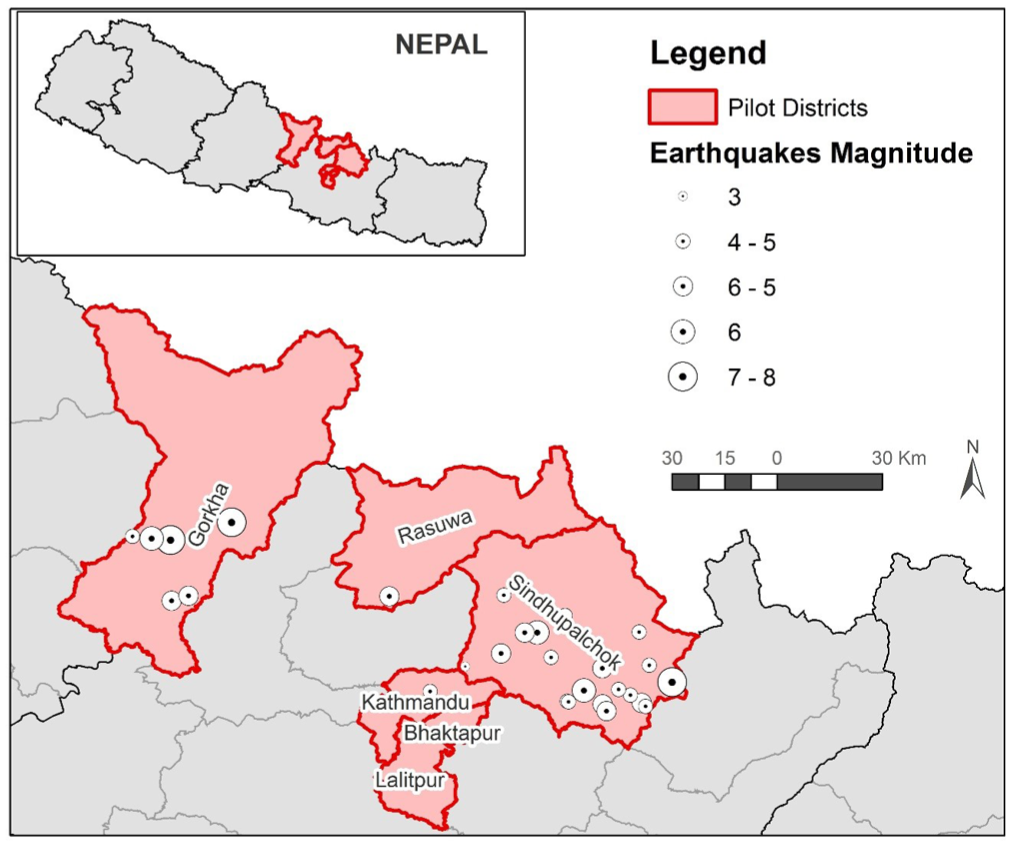
Fieldwork sites and the Gorkha earthquake.
A consortium of formal institutions including the International Red Cross, the World Bank, USAID’s Disaster Assistance Response Team (DART), International Organization for Migration (IOM), UN World Food Program (WFP), UN Population Fund (UNFPA), the Adventist Development and Relief Agency (CARE), the Family Planning Association of Nepal, Medair, Mercy Corps and Plan International, among others, provided relief commodities and support shelter, and water, sanitation, and hygiene (WASH) interventions for earthquake-affected populations. According to USAID (2015), since 10 June, the Logistics Cluster, a coordinating body for humanitarian logistics activities, has engaged with 94 organisations to coordinate deliveries of more than 5600 metric tonnes of items to earthquake-affected populations. In this context of devastation, as with other disasters affecting countries with rapid rates of urbanisation, the ‘informal’ nature of settlements has been often flagged as central to the impact of the earthquake. In fact, 2013 World Bank research was already pointing at these as critical resiliency factors, highlighting in a report on Nepal’s urban growth that ‘unplanned urban development’ in the Kathmandu Valley had ‘led to rapid and uncontrolled sprawl; irregular, substandard, and inaccessible housing development; loss of open space, and decreased livability’ whilst also ‘increas(ing) vulnerability to disasters, making Kathmandu one of the most earthquake-vulnerable cities in the world’ (Muzzini and Aparicio, 2013). 2 Urban informality, as well represented across much DRR literature, was pointed at again in 2015 as the source of instability. Yet what if this characteristic of urban sprawl is also, if not quite the contrary, the tacit fabric providing much of the crucial care in the disaster recovery phases? Whilst there have been efforts to map the response and resource flows through formal networks (for example, Basu et al., 2017), the role of informal social networks received less attention and thus offers little evidence to answer this query in a positive or negative way – something we attempted to redress by mapping informal networks. The challenge we pose here to this reading is that, in practice, informality and informal urbanism might in reality not just be a factor of risk but rather a driver of response and recovery and a central element in the governance of crisis.
Data acquisition and analysis
Four districts, heavily affected by the earthquake, were included in our fieldwork: Gorkha, Sindhupalchowk, Rasuwa and Kathmandu. Within these four districts, and after consulting with the local partners, 16 Village Development Committees (VDC) were selected to ensure the representation of different energy situations, including in rural and urban areas. 3 In each VDC, ten households were selected to represent a broad range of socio-economic situations within the village. One person was interviewed in each household, achieving a sample size of 160 participants. Efforts were made to achieve gender balance, having a composition of 42% of male and 58% female respondents. The fieldwork was conducted by a gender-mixed team of six local Nepali surveyors for 3 weeks, between 16 June and 5 July 2016. The survey was conducted using DataWinners on mobile phones, and then exported to a statistical software. Individual semi-structured interviews were conducted with each household representative in Nepali. Respondents were able to name as many organisations or individuals as they chose, either formal (e.g. government) or informal (e.g. neighbours). The questions were carefully discussed with the local team of surveyors, as well with other collaborators with DRR experience in the study sites prior to the fieldwork to minimise potential biases or favouring answers towards specific institutions or groups. All the interviews were conducted in Nepali during the fieldwork, and responses were later translated to English for analysis.
The data acquired in the field were used for two different types of analysis: (1) the distribution of needs, using descriptive statistics methods, and (2) analysis of Informal Social Networks, based on social network analysis (SNA) techniques.
(1) Distribution of needs analysis. Field data were coded and classified according to Maslow’s typology of needs (Maslow, 1970), based on a pyramidal understanding of human needs, including physiological, safety, and love and belonging needs. 4 Given its universality and versatility, this framework has been used to different degrees in DRR and emergency management literatures, in both technical and academic works (e.g. Da Silva et al., 2012; Joseph and Linley, 2005). Maslow’s typology was used to code and classify the data, which were then analysed by classical descriptive statistical analysis in the computer environment R.
(2) Informal Social Network Analysis. Field data was also used for a second complementary analysis, an informal Social Network Analysis, based on classic SNA techniques. SNA consists in analysing patterns of distribution of relational ties and drawing inferences about their networked nature. To perform the SNA, the field data were coded in a relational database where households, needs and needs providers were linked, and then exported to a SNA modelling environment. The SNA allowed us to visualise the full network activated after the earthquake, as well as to analyse the network architecture and its clusters.
Preliminary results
Distribution of needs
Results of the statistical analysis of the distribution of needs are shown in Table 1, where the graph lines represent the ten needs, the x axis represents the organisation or entity covering that need, and the y axis represents the percentage of the need covered by that specific organisation. This demonstrates the importance of international NGOs (INGOs) during the earthquake immediate response. INGOs were the main provider (50% of cases) of water and medicines, and a significant provider (30% of cases) of food, shelter, clothes and sleeping materials. The second most important players were local NGOs, which provided substantial support in the distribution of clothes, sleeping materials, medicines, food and shelter. In contrast, the government had a limited role among surveyed communities in the response phase, and was only a critical player in the provision of money (89% of cases). Together, relatives, neighbours and friends were either the second or the third most relevant players in the provision for most human needs. Comparatively, relatives (who participated in the provision of 90% of needs) and neighbours (70% of needs) appear to have played a bigger role in the VDC surveyed than friends (50%). Local clubs and private corporations played a varied role, between 1% and 15%, in the provision of five and seven needs, respectively. Local clubs were a relevant distributer of sleeping materials (15%) while private corporations delivered mainly cooking devices (14%). Temple authorities and Guthi (traditional patriarchal kinship organisations) assumed varied positions, from 0.4% to 10%, with Guthi concentrating on the provision of clothes. Self-help groups and school authorities played a minor role, with a maximum of 2.37% of needs provision focusing on shelter.
Needs and needs providers.
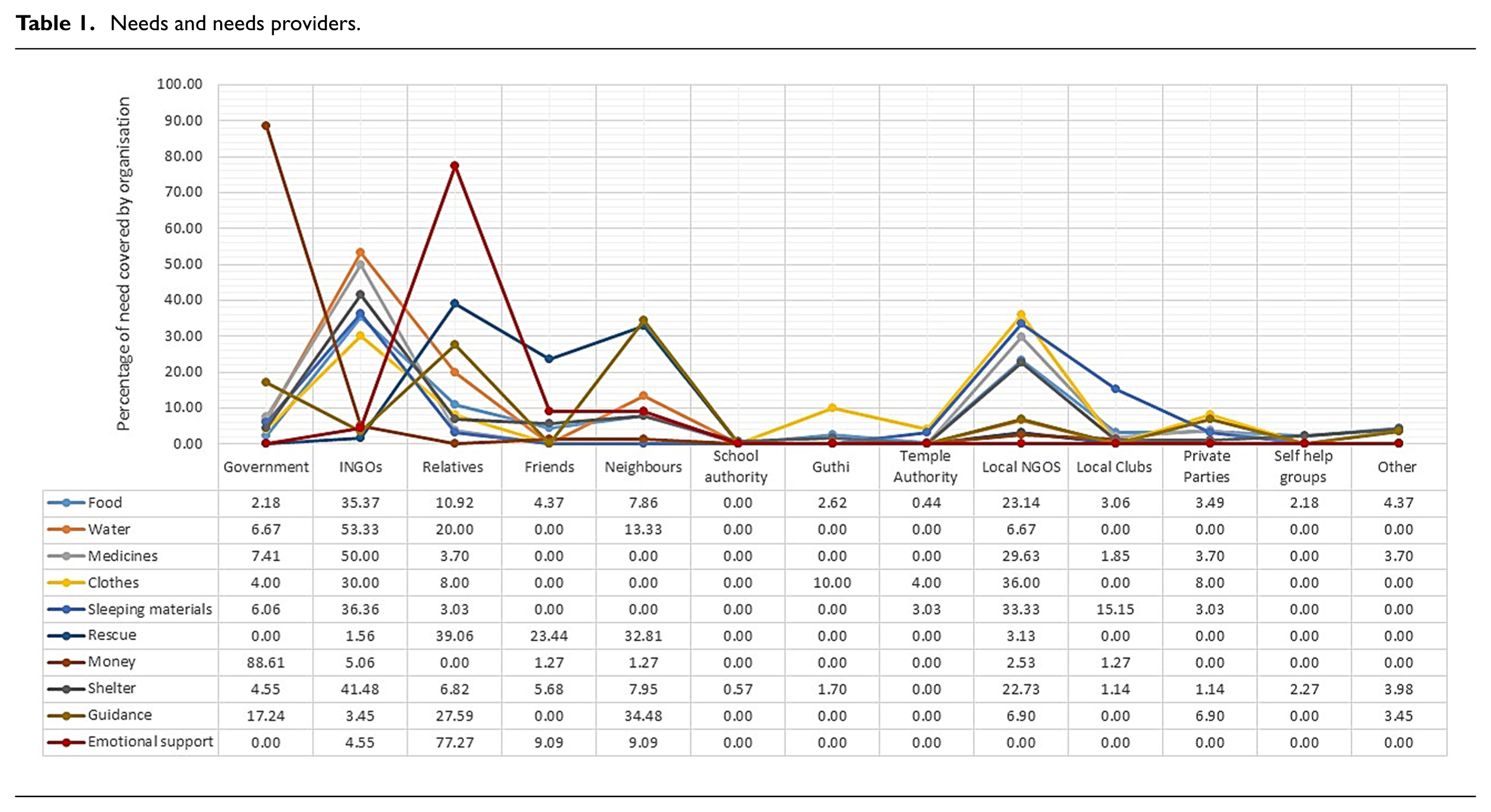
Overall, results display a variety in the relative importance of organisations and networks, formal and informal, in the delivery of information, materials and aid. The analysis underscores the fact that there is not a single predominant organisation in the social web of needs provision. In the vast majority of cases, relief was provided by a combination of agents and institutions, with the exception of the central government as the primary distributor of money in the disaster response phase. Informality emerges here as key in the governance of crisis response. As the data clearly show, it is essential to acknowledge both formalised disaster relief mechanisms as much as ‘unofficial’ channels for support to human needs and for attending to the crucial care required in these moments of disruption. From this viewpoint it seems blatant to us, and in line with much of the literature on social capital in DRM, that both formal and informal networks are to be considered as integral to the determinants of who, to paraphrase Lasswell’s famous definition of politics, gets ‘what, when and how’ (Lasswell, 1936). If McFarlane and Waibel (2012) have already pointed out how informality in its own right has effectively occupied a ‘peripheral’ position in urban studies needing more ‘spotlight’ positioning, our data offer additional evidence to this assertion. As we argue more extensively in the conclusion echoing recent scholarly and practitioner literature on the Gorkha earthquake (Twigg et al., 2017), self-recovery and informal ties hold an important role in the whole edifice of disaster response and recovery. The key here is in the mix, and hence in acknowledging informality as central component that allows us to speak of governance, not just of government, of crisis.
Informal social network analysis
Figure 2 describes the social network that was activated during the response to the Gorkha earthquake. Nodes represent entities (e.g. household, NGOs, schools) and edges represent any kind of connection established between entities (e.g. any of the human needs identified). The central nodes correspond to ‘human needs providers’ (i.e. organisations and institutions) while the exterior nodes at the circumference represent ‘needs receptors’ (i.e. the surveyed households). Identified human needs’ providers included relatives, friends, neighbours, school authorities, Guthi, temples, local NGOs, local clubs and associations, INGOs, government agencies, private corporations, self-help groups and ‘others’. Figure 2 also shows how formal and informal organisations interact among them and also with the surveyed households, producing a rich network of relations formed by over 700 connections distributed among 150 nodes. In addition, the analysis of the connections of this network confirms 100% of the households relied on the informal side of the network, that is, not on formally mandated disaster respondents, including friends, relatives, neighbours, self-help groups (SHG), schools, Guthi, health workers, as well as local NGOs, local clubs and private parties. All the households depended to some degree on these informal connections, at a minimum, for one of the analysed needs.
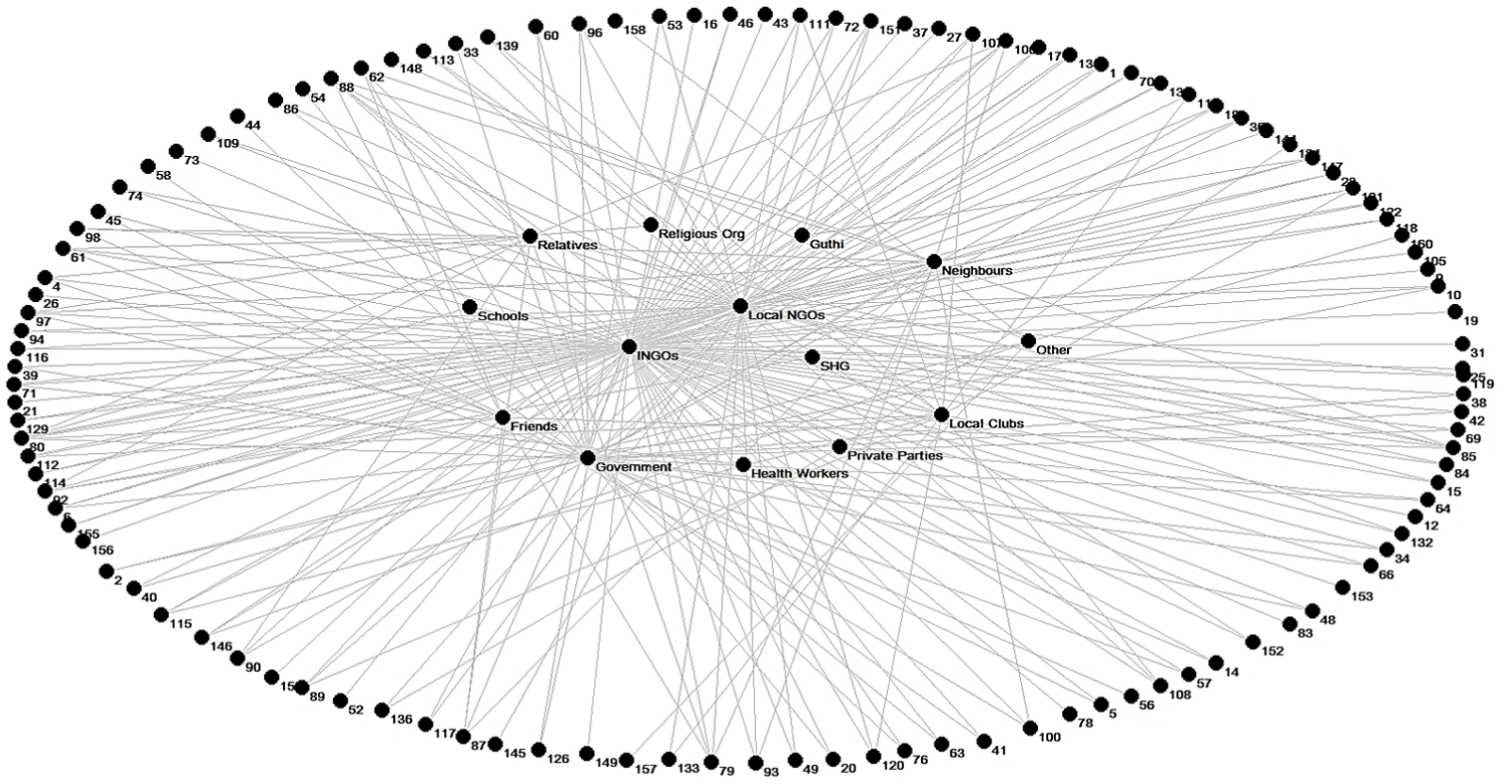
Social network activated to respond to the Gorkha earthquake.
The detailed analysis of the case of shelter provision allows us to understand better internal organisation and properties of this network. On the one hand, its network architecture (Figure 3) shows a difference on the location of institutional and non-institutional disaster response actors. Institutional respondents, such as government and INGOs, are more centrally located, indicating a wide reach across the surveyed communities. In contrast, non-institutional actors (with the exception of local NGOs) appear in the periphery of the network, indicating a partial and asymmetrical reach to the surveyed households. That is, these actors provided shelter only to a specific part of the network. Within these peripheral actors, some appear more nested (e.g. local NGOs, friends, relatives, neighbours and Guthi), reaching more communities, while others appear in more isolated locations, with a smaller reach radius (e.g. temples, schools and self-help groups).
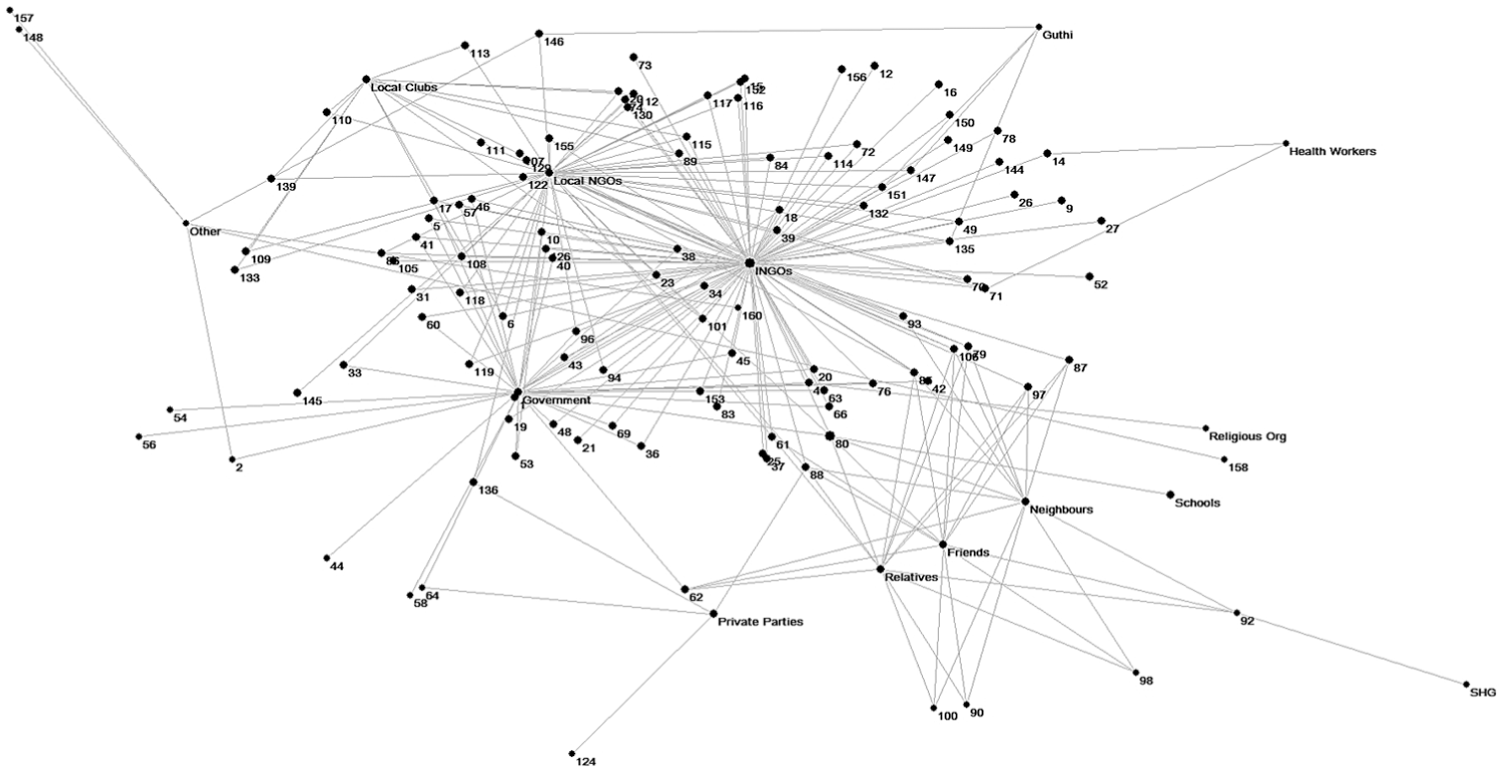
Network activated for the shelter provision: Network architecture.
Further analysis of the significance in terms of weight and centrality of the actors (Figure 4) depicts INGOs as a more relevant player than government for shelter distribution among the studied population. The most condensed area of Figure 4 shows the bulk of the households received shelter from either INGOs or a combination of INGOs with another actor. These ‘tandems’ (INGOs + Government, INGOs + Local NGOs, and INGOs + friend/family/neighbour) reached 30% of the population. A total of 19.29% of households accessed shelter solely via INGOs, while only 3.5% received this resource exclusively from the government. 5 In addition, most of the households attended by the government had also access to shelter via INGOs, indicating some overlapping or redundancy between these two systems. An isolated fraction of households (3.5%) depended exclusively on friends, relatives and neighbours for shelter acquisition. While another secluded fraction (6.14%) relied on the combination of local NGOs and local clubs.
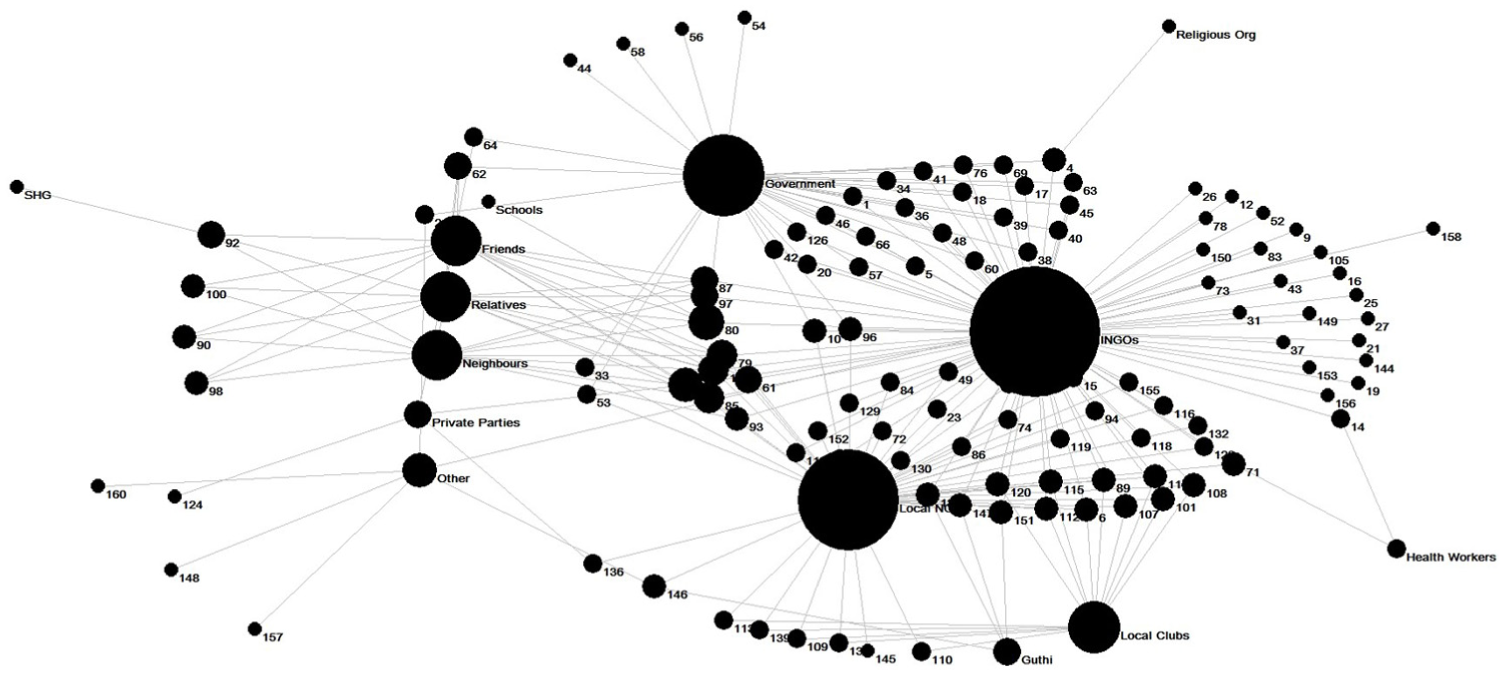
Network activated for the shelter provision: Actors’ significance.
This offers some important pointers as to the ‘urban’ quality of informality. Beyond the recurring rhetoric of an urban/rural divide (e.g. Cutter et al., 2010), the case of shelter shows communities located in urban centres behave somewhat similarly to the communities located in peri-urban and rural areas. Zooming in on the ‘urban’ elements of the network, Figure 5 shows that in these urban communities we see equivalent patterns to the ones presented in peri-urban and rural settings. INGOs appear again as the most central actor, followed by local NGOs and government. This offers an interesting connecting thread between urban, peri-urban and rural (or at least village) informalities which might call for more evidence-based considerations about their interplay. For instance, Roy (2005: 149) convincingly argued that in many parts of the world, and the South especially, ‘the site of new informality is the rural/urban interface’ but concluded that this is to be couched in a metropolitan expansion logic driven by ‘informal urban-ization’. Perhaps, within the cross-urban/rural logics of present debates on the planetary urbanisation of peri-urban spaces (Brenner, 2016), our evidence asks us to better appreciate the shared qualities of informality between different qualities of the ‘urban’. In our case, we found social bonds were similarly important in urban, semi-urban and rural communities, indicating that perhaps, the strength of the social fabric does not necessarily relate to the built infrastructure or rural or urban character, but primarily to a blend of the intrinsic historical, cultural, socio-economic and political aspects of the community. 6 This is, however, not to reject the importance of urban informality as a dimension of social relations. Remarkably, in the urban case, the percentage of households depending exclusively on family, friends and neighbours for shelter is higher, making up to 6%. Private parties also seem to play a more relevant role at the urban level, reaching 6% of households. On the other hand, the number of households depending exclusively on INGOs is much lower at 4.1%. The tandems local NGO/local clubs and INGO/family/friend/relative seem to work as well at the urban scale, covering 12.5% and 16.6% of households, respectively. This is possibly preliminary evidence as to some heightened socio-material complexity inherent in the ‘urban’ if not perhaps even some higher degrees of informality characterising DRR (and governance more in general) in the built environment. Here, in line with recent developments in the humanitarian and relief sector, it becomes evident that academia and practice need a much better grasp on the urban dimension of disasters and their implications for aid (Sanderson et al., 2016). Yet, from our viewpoint, this cannot be divorced from appreciation of informal forms of urbanism (and more broadly informal dimensions of disaster governance) as central to the dynamics of crisis response and, likely, recovery. 7
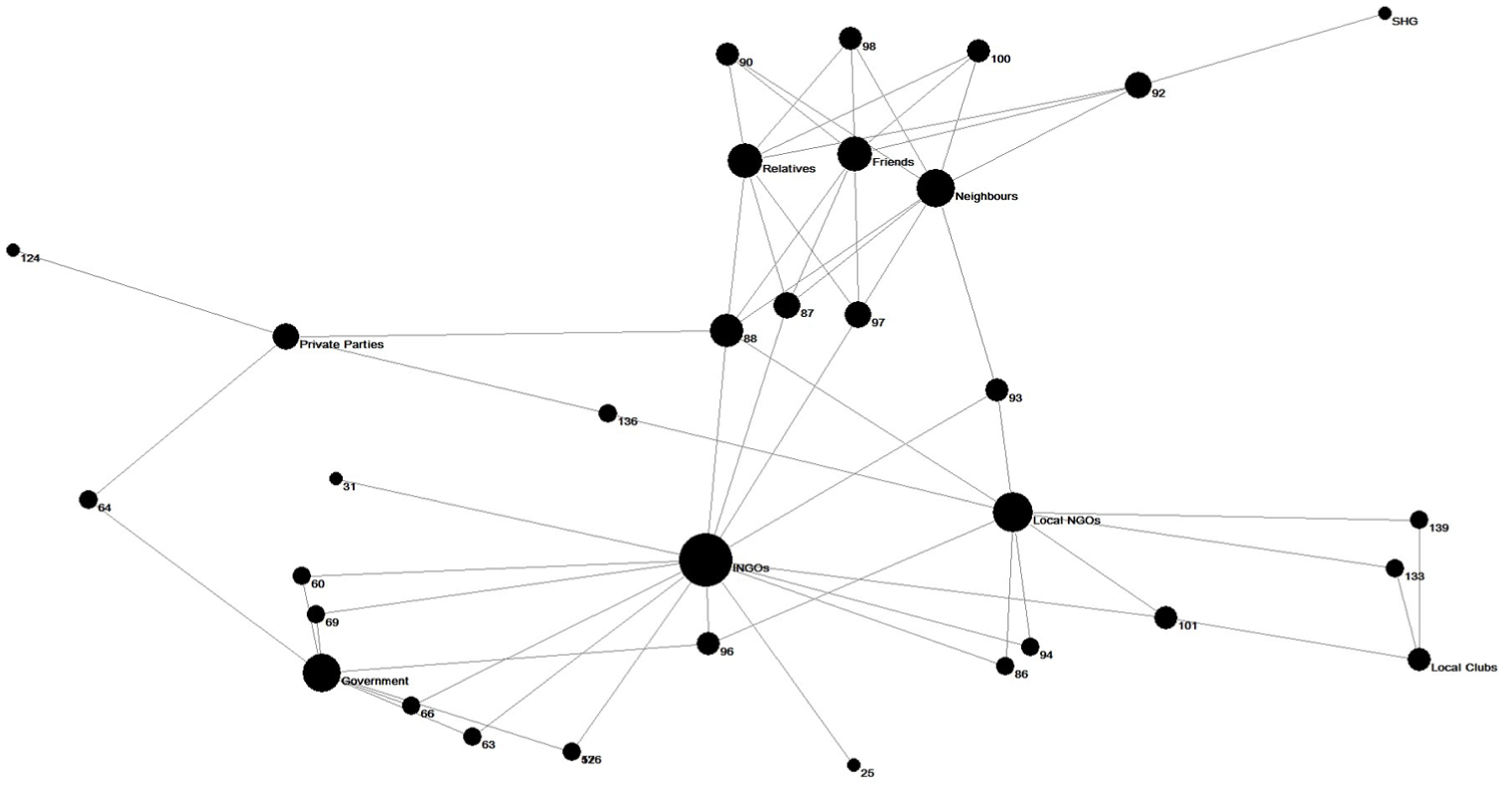
Zooming in the case of shelter provision: Network behaviour in urban areas.
Tacit networks: Acknowledging informality in governance
The case of the 2015 Gorkha earthquake shows empirical evidence on the importance of tacit networks in covering almost any need in emergency relief, reaffirming that it is critical to start incorporating these networks into DRR policies (Islama and Walkerdenb, 2017). 8 More generally it paints a picture that disproves strict lines between a formal reality and the ‘formal other’ of urban informality. The relationship between the two in constructing networks of disaster governance (if not urban governance more in general) calls for a scholarship that is centred on informality not as a static reality but as dialogue with a variety of ‘grey spaces’ (Yiftachel, 2009) that constitute urban governance. This illustrates a multifaceted dynamic between formal and informal defining the governance of crisis relief and response, and thus pointing to the importance not only of appreciating different kinds of urban informality but also their interdependent nature and the continuities between different kinds of urban spaces from the metropolitan core to the peri-urban periphery, if not to the village. Here we have sought to question the predominantly negative view of ‘informal settlements’: clearly the ‘neighbourhood’ dynamics (e.g. Daly et al., 2017; Tomba, 2014) of most of the settlements observed speak not just to their fragility but also to their resilience in the wake of disaster. These relationships are illustrating how less apparent socio-economic bonds weave a tight fabric of urban governance beyond the formality of the built environment, and how these networks present us with a rich realm for more investigation of DRR in cities, and urban informality more in general.
From the results obtained in this research, it seems informal networks might have similar features and be of equally great importance for disaster response in urban, semi-urban and more peripheral built environment areas. Equally, it points at the persistence of tacit community-based networks within urban settings. If the case of shelter acquisition has, for instance, illustrated how relatives, friends and neighbours were especially important to some otherwise isolated households, in the observed urban areas this phenomenon was even more noticeable. In addition, the same associations of actors, including tandems of institutional and not institutional actors, appear with the same arithmetic in both peripheral and urban settings. The differences between these contexts, such as a higher importance of the private sector or the absence of Guthi presence in some urban cases, also seems to reflect some of the particularities of the respective urban, peri-urban and village social fabric from pre-disasters times. Interestingly, as we noted, there appears to be some ‘urban’ quality to informality and an urbanisation of disaster response that cannot go unnoticed (e.g. Archer and Dodman, 2017). The networks emerging around the provision of shelter can highlight the importance of providing a temporary ‘urban’ (i.e. agglomerated social spaces and networked services to tender to needs) in disaster contexts where cities and peri-urban settings, but also villages, stop functioning. Equally they also highlight the centrality of non-governmental actors in building, providing for and maintaining these temporary urbanities, and once again the critical care role of informal networks in upholding them. However, perhaps as a reminder to the possible ‘methodological city-ism’ (Angelo and Wachsmuth, 2015) and general urban bias embedded in some of the informal urbanism literature, we also find some degree of commonality across urban, peri-urban and rural settings when it comes to the shape and dynamics of informal social networks.
Overall, our experience with Nepal pushes the horizon of experimentation of the analysis of informality towards greater efforts to engender replicable methods to convey, and potentially compare, the complexity of governance in crisis, as much as urban, contexts. The intricacy of the urban environment emerges here in the relation between informal social networks and the broader context of governance they remain embedded into. In this sense acknowledging the work that informality does in disaster relief efforts in the built environment becomes perhaps key to appreciate the different registers of authority and politics that shape cities and their surroundings. Paying greater and more systematic attention to the informal dimensions of governance is, as Magnusson (2013) puts it, a key ingredient to better ‘see like a city’ when speaking of the ways in which people organise in the built environment – whether in crisis or not.
In turn, appreciating more systematically the informal dynamics underpinning disaster response by gathering tangible data can support greater interdisciplinary integration towards a more ‘common operative research language’ (Quarantelli, 1982: 3) and against the limits of disciplinary jargon which still inhibits communication between researchers (Gall et al., 2015). This practice-oriented and explicitly methodological approach responds to growing calls to ‘open up’ current ‘epistemologies of the urban’ (Barnett and Parnell, 2016). Yet this does not have an academic application only, but also an explicit normative role in better acknowledging and including local response mechanisms on their own terms within the broader edifice of DRR. This means moving from a top-down view of disaster response, and understanding the durability rather than negative impact, of informality (Daly et al., 2017; Kaika, 2017). It also highlights how informal social networks affect not only the material landscape of response and recovery, but also the information ecosystem upon which people make decisions about their reaction to crisis. As already noted by Twigg et al. (2017) on the case of the Gorkha earthquake, families and communities recovering from disasters set priorities and take decisions based on the knowledge they have, their needs, and their means. This implies that disaster-affected people should be able to make choices on the basis of ‘good advice’ and having a well-informed opportunity for setting of priorities remaining with their family or community (Twigg et al., 2017). In this spirit we have attempted here to open up a more explicit methodological and evidence-based dialogue between DRR and urban studies, conscious that the ultimate purpose of this effort needs to be tied and engaged with that ‘field’ of practice, and tacit networks, we encountered in our study.
Footnotes
Acknowledgements
The authors would like to express their earnest gratitude to the Nepali surveyors team and collaborators, and the interviewees for participating in the study.
Funding
Research for this grant has been funded under the UK Engineering and Physical Research Council (EPSRC) research grant ‘Vaccinating the Nexus’ (EP/N005961/1). The authors would like to thank the Department of Science, Technology, Engineering and Public Policy at University College London (UCL STEaPP) for additional funding, and the support of the ‘Enhancing community resilience using renewable energy in Nepal’ (also UCL STEaPP funded) project, including Professor Yacob Mulugetta at UCL, in enabling the fieldwork for this study.
