




Abstract
This paper explores and discusses the experimental, critical and self-reflective use of differing methods in urban studies. In the context of frequent calls to investigate urban processes in a planetary and comparative perspective, the empirical groundedness of research is among the particularly complex challenges urban scholars are confronted with. The key question is: how can qualitative-empirical methods, such as ethnography or qualitative mapping, be adapted to explore contemporary urban conditions? This paper seeks to contribute to current debates by introducing a specific methodological design of a mobile ethnography that enables an analysis of large and heterogeneous urban territories, in three main ways: first, by offering a theoretically informed and empirically grounded transductive research design; second, by proposing a complementary set of cartographic, historiographic and comparative methods of which mobile ethnography is a part; and third, by suggesting post- and decolonial methodological perspectives, both conceptually by engaging with Latin American urbanisms, as well as empirically by furthering collaborative ways of knowledge production. To conclude, the paper stresses the need to continually develop new inventive methods for comparative urban research, for two main reasons: (1) to enable scholars to question established geographical representations and parochial imaginaries of urban space, and (2) to problematise methodological and theoretical dogmas with situated knowledge. By suggesting different representations of the urban, the paper thus emphasises how important it is to transductively entangle empirical and theoretical conceptualisations to further decentre and pluralize urban knowledge production.
Introduction
Confronted today with immensely unstable and far-reaching scenarios of urbanisation processes occurring at all spatial scales, and across diverse everyday realities, conventional methods of urban studies are paradoxically dealing with a relative dearth of data relating to urbanisation worldwide (see Brenner and Schmid, 2015; Schmid, 2018). Reliable survey data, GIS, or transparent statistics are not available in most ordinary cities of the world, indeed in many cases, such quantitative data are completely absent, restricted or strongly biased (e.g. Crampton, 2010; Parnell and Pieterse, 2015; Potts, 2012). At the same time, qualitative methods have been proven to be well suited to analyse everyday realities and social interactions in cities. Yet, if the scope of these methods were not mostly limited to an understanding of specific neighbourhoods on a micro scale, they would be even better suited for analysing current challenges in urban studies. In an effort to address these shortcomings, the field of urban anthropology, for instance, underwent a substantial transition over the past few decades, and scholars increasingly engage with the city as an urban region made up of complex spaces of flows, rather than viewing the city as a static setting (see Low, 2014). This so-called ‘spatial turn’ in urban anthropology links the discipline closely with human geography and lead to a deeper understanding of spatial theories in terms of socio-spatial relations and the meaning of everyday practices and experiences for the urban built environment (e.g. Ashutosh, 2018; Fraser, 2015). Hence, many of the more recently emerging urban ethnographic studies deal with the city as the point of articulation of transnational networks, complex local and global relationships, and flows of goods, money and people (e.g. Burawoy, 2009; Burawoy et al., 2000;Cresswell and Merriman, 2011; Tulson, 2015; Yi’En, 2014). However, a particular city lens – wherein concepts such as ‘city’ or ‘metropolitan region’ are indeed conceived as dynamic, yet still all too narrowly reduced to their spatial form – remains pervasive and anthropologists as well as urban scholars in general still struggle to let go of what Hillary Angelo and David Wachsmuth (2015) aptly called ‘methodological cityism’. This city lens, Angelo argues further, is ill-fitted for studying the increasingly diversified urban geographies of today, as it will ‘provide a less and less adequate representation of these spaces and people’ (2017: 171). Instead, scholars suggest moving toward urbanisation as a more appropriate approach (e.g. Angelo, 2017; Angelo and Wachsmuth, 2015; Brenner and Schmid, 2015; Schmid, 2018; Wachsmuth, 2014). As part of an ongoing effort to diversify the locations and subjects of urban theory and to develop decentred urban knowledge, urban scholars today thus need to advance new and different methods to counter the discussed shortcomings of the standard set of methods, as I argue in this paper. Moreover, cutting-edge methods are needed not only to inform the theoretical understanding of urban processes, but also to address the growing critique of systematically excluding views other than the ones already established within academia (e.g. Kenway and Fahey, 2009; Leitner and Sheppard, 2016; Robinson, 2011, 2016). Yet, despite increasing calls for such an experimental, interdisciplinary and more collaborative approach in comparative urban studies, only few studies to this date offer an operational empirical application of such an approach (e.g. Becker et al., 2014; Gough, 2012; Oldfield, 2014; Simone and Pieterse, 2017).
In the research project Ethnography of Urban Territories (Streule, 2018), I pursue the ambitious goal of outlining prevailing urbanisation processes that shape the metropolitan territories of Mexico City in a historical as well as in a contemporary perspective. My work is strongly influenced by current debates of Latin American urbanisms, in which post- and decolonial scholars push for a decentring of spatial imaginations (e.g. Coronil, 1996; Porto Gonçalves, 2006). For instance, João Marcelo Ehlert Maia diagnoses ‘a cognitive crisis concerning the city as a spatial framework for understanding Latin American territories’ (2011: 402). The above-outlined effort to destabilise the persistent methodological cityism resonates strongly with this approach. It is against this theoretical background that I suggest elaborating on a relational concept of urban territory. In my study, ‘territory’ proved to be a particularly apt tool for studying urbanisation in Mexico City, rather than using an analytical frame such as ‘city’ or ‘urban space’. Territory is a widely discussed term in Latin American urbanisms and is understood as a relational social product, deeply shaped by unequal power relations, yet, it is relatively unknown in the Anglophone context (see e.g. Echeverría and Rincón, 2000; Haesbaert, 2011; Porto Gonçalves, 2001, 2006; Raffestin, 1980; Santos, 1994; Schwarz and Streule, 2016). In its processual understanding, relational territory does vigorously resonate with conceptualizations of relational space (e.g. Massey, 1994). The focus of my research thus lies on the main actors involved in the production of the urban, asking how they engage in the formation of territorialities across Mexico City. Furthermore, I strive to understand how these emerging territories are transformed by such social everyday practices. In other words, a central question is: how are such urbanisation processes inscribed in the terrain, and how does geography shape this process? The study presumes that the formation of urban territory is a relational and dialectical process that is equally based on the everyday agency of the actors – ranging from professionals and practitioners to ordinary urban inhabitants; their perception and conception of urban territory and their collective imaginaries of the urban, as well as on the materiality of the built environment. Yet, what makes this socio-territorial approach different to conventional understandings of social space is its explicit focus on the unequal power relations that are deeply inscribed within these processes, as I have elaborated elsewhere (Schwarz and Streule, 2016).
It is this specific understanding of urban territory as a multi-layered and power-driven social process that persuaded me to develop multidimensional methods, and thus to adopt and adapt conventional methods in urban studies. Thus, aiming for an analysis of those processes on a metropolitan scale, I developed an experimental set of methods based on a triangulation of quantitative and qualitative data, combining multi-sited ethnographic field research with a historical analysis and cartographic synthesis, thereby moving beyond the usual predisposed set of data. Rather than serving only an illustrative function, ethnographic, cartographic and historical strategies are of equal heuristic importance for the analysis and are complementary of each other. With the goal of focusing on lived practices and embodied experiences of actors producing urban territories, I developed a specific methodological design of a mobile ethnography – a methodology and set of research strategies and techniques I elaborated on as part of my research project and in close connection with the comparative study Patterns and Pathways of Planetary Urbanization (Schmid et al., 2018). 1 Mobile ethnography in my framing draws particularly on well-established qualitative strategies of participative observation, walking, go-alongs, interviews and mapping, while triangulating them where available with quantitative data. Yet, as mentioned previously, the full potential of an ethnographic analysis of the social production of the urban through only these city-lens biased methods continues to be occluded and has only recently been developed further (e.g. Ashutosh, 2018; Low, 2014). Mobile ethnography addresses these shortcomings in three main ways: first, by offering a theoretically informed and empirically grounded transductive research design; second, by proposing a complementary set of cartographic, historiographic and comparative methods of which mobile ethnography is a part; and third, by suggesting post- and decolonial methodological perspectives, both conceptually by engaging with Latin American urbanisms, as well as empirically by furthering collaborative ways of knowledge production. Thus, if mobile ethnography pursues to study urbanisation processes ethnographically in a multi-sited field, and if urbanisation can be approached by a relational understanding of territory, conventional qualitative strategies of urban studies need to be reshaped. Framed as such, mobile ethnography provides a novel approach to qualitatively study large and heterogeneous metropolitan territories, by engendering profound insights into the qualities of the everyday lives of the inhabitants, and by foregrounding their knowledge of Mexico City alongside the expertise of local urban scholars, such as geographers, anthropologists, sociologists, planners, artists, activists and architects. Therefore, mobile ethnography is a notably adept mode of producing knowledge in a more collaborative and interdisciplinary way. Mobile ethnography hence not only furthers empirical knowledge in ways outlined above but also invites us to reflect on new possibilities for collaboration and dialogic methods of urban research (see also Sánchez Criado and Estalella, 2018).
This is not to say that there have been no mobilised ethnographic research strategies or any analytical attention to urban processes on a metropolitan scale. There is no shortage of studies applying a certain kind of mobile ethnography (particularly studies on everyday mobility, transport and commuting, see e.g. Pujadas and Maza, 2018; Urry, 2007). However, in general, they do not engage explicitly with conceptions of territoriality, still less with urban geographies of knowledge production in a decolonial perspective. But aside from a few rare and rather recent examples, those studies rarely combine an ethnographic, cartographic, historical and comparative perspective on urbanisation processes, while also comple-menting and challenging each of these methodological strategies. 2 By introducing the specific multi-dimensional methodological design of mobile ethnography, this paper seeks to contribute to an ongoing debate on reshaping the field of urban anthropology and its particular ability to examine the urban both from a macro and micro understanding of urban processes.
In this contribution, I focus primarily on the methodological issues tackled in my research on Mexico City. The main concern of this paper is thus to discuss novel strategies for empirical fieldwork and the collection, processing and analysis of data – as well as their translation into formats of representation, such as texts and maps. In what follows, I reflect on the challenges I was confronted with while aiming to ethnographically study contemporary urbanisation processes and the contested production of territories on a metropolitan scale. For this purpose, I engage with the following questions: How can qualitative-empirical methods fruitfully be adapted to explore contemporary urban conditions on a metropolitan scale? And, what new insights can be drawn from such a interdisciplinary methodology that can be fruitfully put to work within a comparative approach? The paper is structured in three parts: First, I give a brief overview of dynamic research practices such as walking, as examples of long-standing qualitative approaches in urban studies. Second, I will introduce mobile ethnography as an experimental and inventive method, which I developed on behalf of extended fieldwork and research experiences in Mexico City since 2005. In the third section, I present strategies for synthesising fieldwork data employing ethnographic writing and qualitative mapping. Based on the triangulation of data and methods, I will illustrate how writing and mapping became key heuristic features in my approach towards urbanisation processes of Mexico City. I then conclude by outlining mobile ethnography as a systematic and situated – and at the same time inventive and comparative – strategy to cope with the challenges of changing back and forth between different research scales, scopes and perspectives.
From a wandering city …
In his book The Practice of Everyday Life (1984) Michel de Certeau opens the chapter on spatial practices with the view from the 110th floor of the World Trade Center in New York and an invitation to profoundly change one’s perspective by going back down into the streets and merge with the crowd while walking the sidewalks of Manhattan (1984: 91–110). By doing so, as de Certeau argues, the representation of a ‘wandering city’ enters the cartographical and geometrical space. The latter concept is referring to an understanding of space that is characteristic for conventional maps, but also common in urban studies. In contrast, walking the city is depicted as an embodied and sensual experience, highlighted by de Certeau and others, such as Néstor García Canclini (1996) or Manuel Delgado (2007), as a crucial research practice that is extrinsic to the space of panoptic or parochial theoretical constructions. Dynamic practices such as walking, I argue, are profoundly modifying representations, and thus also imaginations of the urban: on the street level – where spatial social practices are being performed, materiality is embodied and specific regulations of space are lived – we can observe, reflect on and interpret the social production of urban territories. As an urban anthropologist, I am of course familiar with such ‘ethnographic’ strategies that de Certeau invites us to explore. As is known, ethnographic methods in urban research were originally applied in small-scale studies of street-corner societies, neighbourhood transformations or the use of public squares, as demonstrated in the pioneer work of scholars of the Chicago School of Sociology nearly a century ago.
If we consider the full range of social science disciplines, urban anthropology with ethnography as one of its key methodological elements seems particularly useful to empirically study very different sets of complex urban situations. 3 This is particularly well-reflected within Latin American urbanisms, where the subdiscipline urban anthropology is prestigious and strongly influencing urban knowledge production (e.g. Caldeira, 2000; Duhau and Giglia, 2008; García Canclini, 2005; Holston, 1989; Pérez-Taylor, 2001; Portal, 2017; Signorelli, 1999; among many others). Within the particular qualities of ethnography lies a variegated and flexible set of different qualitative techniques such as interviews or participant observations that a researcher can draw upon during extended field work, which gradually establishes a close and personal relation to the subjects of study (e.g. Benson and Nagar, 2006). In recent years, ethnography has seen a tremendous upsurge in the field of urban studies. Scholars with diverse disciplinary backgrounds acknowledge today the potential of such an empirical approach when it comes to focusing on everyday perspectives, social interaction, the agency of actors, as well as to emphasise significant aspects of everyday knowledge, and power relations (see e.g. Campkin and Duijzings, 2016; Hall, 2013; Simone, 2004). However, trying to make ethnography work for my study of metropolitan urbanisation processes of Mexico City, it became evident that conventional and more orthodox applied ethnography – i.e. based on the problematic ‘methodological cityism’ outlined above – entails serious limitations and shortcomings. Exemplary for such limited approaches is an exclusive focus on single administrative units such as neighbourhoods, or the tendency to reject wider-reaching theoretical assumptions on urbanisation, including a meta-perspective beyond the central areas of Mexico City known as the Federal District (recently renamed CDMX). Yet, when approaching urbanisation as an ever-changing dynamic process, and urban territory as socially produced, we need to keep in mind what Jennifer Robinson points out, namely how it is indispensable – if urban theory is to be reworked – to develop experimental and creative methodologies and rationales for urban studies that are coping with this task (2011, 2016). Hence, the analysis of current urbanisation processes in one of the largest cities in the world (with more than 21 million inhabitants) urgently calls for such a reconceptualisation of ethnographic methods.
… towards a mobile ethnography
To empirically research contemporary social phenomena and processes such as urbanisation, it is necessary, I argue, to question and refine classical ethnographic methods, and to engage with a dynamic perspective. As urbanisation cannot be reduced to a single site, there is a need to involve diverse perspectives, scales, sites, methods and data, in order to grasp the complexity of the relational and processual quality of urban territory (Hart, 2006; Massey, 2004; Pérez-Taylor, 2002; Schmid, 2015; Strathern, 1991). The methodological development of an extended-case method, as coined by Michael Burawoy (2009), into multi-sited research strategies is thus particularly useful here. Or, as George E Marcus (1995) suggests, multi-sitedness is in fact a necessary tool for working ethnographically, but beyond that, it is also imperative to define new, complex and surprising fields of research. The essence of multi-sited research is described by Mark-Anthony Falzon (2009: 2) as the act of following people, connections and relationships across space and time. The research design within such an approach consists of a series of juxtapositions, in which urbanisation processes are collapsed into and made an integral part of parallel, related local situations, rather than something monolithic or external to them. In terms of method, mobile ethnography involves a spatially dispersed field through which the ethnographer moves – that is, via field research in several sites, or conceptually, by means of triangulation of data and methods. The imperative of mobility highlights the relativity and the ability to ‘play’ with different scales as key features of any ethnographic project (Falzon, 2009: 15). From such a dynamic perspective, analysing, understanding and describing the specifics of a field is necessary only insofar as it contributes to an adequate comprehension of the production of territory (see also Nadai and Maeder, 2009: 246; Schmid, 2015). This includes distinguishing the main actors that produce a specific urban configuration as well as the lines of conflicts and alliances in this process, along with identifying power relations between and among different groups of interest (see also Schwarz and Streule, 2016).
Where is the field?
I argue that within the conceptualisation of an appropriate field-site for a mobile ethnography, it is key to think of territory as a social product. The classical concept of the ethnographic field as an enclosed and isolated space that is frozen in a specific time is highly controversial and has even been called – somewhat polemically – a ‘scientific myth’ (Cohen, 1992). So as not to completely reject the concept of a materialised field – which is indispensable for an empirical study of the production of territory – it needs to be re-conceptualised (see e.g. Candea, 2007). To transcend the still-widespread trope of ‘single tribe’ approach within anthropology and to focus on social processes that are constituted across multiple scales, temporalities and sites, Eva Nadai and Christoph Maeder (2009: 236) propose to derive the research subjects and fields from theoretical questions. In that respect, for my own research on urban processes in Mexico City, I mainly draw on the above-outlined relational understanding of territory to define meaningful fields and subjects of study. As suggested by the Grounded Theory (Glaser and Strauss, 1967), I thus gradually entangle the theoretical and empirical research processes through a transductive approach (see also Schmid, 2014). Such an iterative research process constantly produces (spatial) knowledge on behalf of a mobile ethnography, which then needs to be analysed considering the dialectical production of territory by both the researcher and the researched. To put it differently, mobile ethnography describes a more immediate and grounded undertaking, in which the researcher is being embedded in the urban settings being studied. And since the research act is always influenced by the researcher herself, this method is seen as a mobile ‘enacting of the social’ (Law and Urry, 2004). Mobile ethnography is thus not pretending to represent an objective insight in everyday life trajectories, but aims to ‘construct a usable, but not an innocent, doctrine of objectivity’ (Haraway, 1988: 582; see also Clifford and Marcus, 1986; Strathern, 1991). In this sense, mobile ethnography echoes Falzon’s considerations on multi-sited research, when he writes that ‘the very logic of contemporary understandings of space […] requires that ethnographers take responsibility for their production of their field sites’ (2009: 10). Thus, the field in which to study urbanisation is not a neutral tool and not a given reified space, but a theoretically and empirically co-produced relational territory, drawing on everyday experience as a site of knowing and knowledge production (Streule, 2018). With this conceptual move, the ethnographic field-site transforms into a research object of its own, multiply related with local, regional and global processes and not delineated by administrative boundaries. At the same time, such a multi-sited, dynamic and relational understanding of the field also opens up possibilities for comparative urban research within and between metropolitan territories. As Marcus writes: The object of study is ultimately mobile and multiply situated, so any ethnography of such an object will have a comparative dimension that is integral to it, in the form of juxtapositions of phenomena that conventionally have appeared to be (or conceptually have been kept) ‘worlds apart’. (Marcus, 1995: 102)
What I hope to make clear here is that mobile ethnography engages with a different research perspective on urban processes by drawing on a differentiated conceptualisation of the field-site. The focus of a mobile ethnography is thus not the description of a specific place or city, but the question of how and why certain urban processes are dominant in certain urban configurations, how they can be explained and how they shape urban territories (see also Schmid et al., 2018; Welz, 1998: 183). It is this consideration that allows me to apply ethnographic methodology within a socio-territorial perspective on metropolitan scale, to thus link local and metropolitan scales conceptually, and to define and map urban configurations based on grounded qualitative-empirical data. To summarise, neither the metropolitan scale of analysis, nor the local scale of the field site is thus a univocally fixed entity, defined by local administrative authorities. Instead, scales and field sites are key concerns of my study and are defined eventually through the ethnographic research itself. In contrast to employing an essentialised conception of metropolitan region, what a socio-territorial perspective and a relational understanding of territory necessitates, I argue, is a recalibration of existing ethnographic methodologies, away from place-based or footloose investigations, and toward those of dynamic and mobilised research techniques that enable us to follow urbanisation processes on the ground.
How to apply mobile ethnography?
Mobile ethnography thus aims for a holistic approach, as is common for ethnographic research in general, except that here it is being applied on a metropolitan scale. Its intent is to work towards an understanding of urbanisation and the actors involved in this process by focusing on their everyday socio-territorial practices. Now, to render mobile ethnography operational as a research tool, I draw on a range of interdisciplinary research techniques that are part of the well-established ethnographic register, such as explorative walks of participative observation, expert guided tours through specific urban areas and interviews (see e.g. Wildner, 2015). Through mobilising and adapting these techniques, I develop two complementary strategies. 4 First, the recorridos explorativos is a technique based on participant ‘floating’ observation, walking and perceiving urban space on metropolitan scale (see e.g. García Canclini, 1996; Ingold and Vergunst, 2008). Second, the entrevistas en movimiento is a technique of semi-structured interviews on the move, by conducting in-depth interviews during commented walks regarding multi-sited fields (see e.g. Kusenbach, 2003; Lee and Ingold, 2006). Interviewing a wide spectrum of people based on a theoretical sample of very different inhabitants and experts of the everyday in Mexico City, the technique focuses on multiple spatial practices, perceptions, interpretations and evaluations of the urban (see also Glaser and Strauss, 1967: 65). The added benefit of these entrevistas en movimiento compared with ordinary interview techniques – or also compared with the floating observations of the recorridos explorativos– is that they allow the researcher to foreground lived experience and the social practice of de- and re-territorialisation in spatially and temporally specific situations. Entrevistas en movimiento thus evoke spatial knowledge by addressing the biographical context, specific urban socialisation, and learning processes of the interviewees. The aim is to rethink the urban by interrogating the perspectives of typical users and inhabitants of the urban territories of Mexico City, and by suggesting collaborative ways of knowledge production such as, for example, a dialogical re-reading of the co-produced cartographic representations, as I will outline in the following.
Ways of analysing, interpreting and representing urban territories
The results of such a systematic ethnographic examination are then represented in a thick description of urbanisation processes to demonstrate how each of them shape different urban configurations within Mexico City. Moreover, I synthesise the socio-territorial analysis in a series of maps, which leads me to an increasingly more nuanced understanding of some predominant processes in the Mexican metropolis. As I developed mobile ethnography during my extended field research in Mexico City, the implications for the methodological design presented here are deeply situated in this context. Since I was employing mobile ethnography in a multi-sited field, and while interviewing a wide spectrum of people, as outlined above, mobile ethnography engenders a reconstruction of everyday knowledge concerning urban processes based on theoretical assumptions and empirically grounded data. As I understand urban territories as a social product, I am aware that my perceptions during the recorridos explorativos and my interpretations of the entrevistas en movimiento are to a certain degree structured by previous assumptions that are shaped by my own academic and personal disposition. It is this theoretical and individual background together with the specific context of Mexico City at a certain time that profoundly shapes the analysis and the final montage of knowledge by writing and mapping.
Ethnographic writing
Mobile ethnography combines participant observation and local everyday experiences to weave a closely knitted tissue of ethnographic knowledge, presented in a thick description of urban life that invites the reader into the particular social worlds of Mexico City. Thick description – a term popularised by Clifford Geertz (1973)– refers to a detailed description of social behaviour and social imaginaries, typically resulting from ethnography and sufficiently ‘thick’ in terms of depth to allow the reader to see below the material aspects of the urban by offering an understanding of the underlying territorial regulations and urban imaginaries that inform the meaning of what is seen on the surface (see also Amin and Thrift, 2012; Simone, 2015). Putting those mobile techniques into practice implies shifting between different scales of the urban such as zooming in and out on a map. Mobile ethnography thus works across multiple scales to examine how different actors produce different urban territories, from the micro scale of entrevistas en movimiento, the ethnographic interviews and walks, to the metropolitan scale of recorridos explorativos and the constant feedback provided through the practice of qualitative mapping (discussed in more detail in the following section). Therefore, mobile ethnography write-ups combine everyday experience on the street-level with socio-territorial relations on a metropolitan scale. Focusing on the agency of actors and on how people produce territories, ethnographic writing does not simply inform urban theory on Mexico City, but is rather a key component of actively reshaping conventional urban representations from the ground up (see also Holgersson, 2014). Thus, my research contributes to emerging novel ways of thinking about urban transformation based on the multi-sited research of the urbanisation processes under study. Such an empirical and theoretically informed approach shows how walking Mexico City – when adapted to the metropolitan scale by employing the original mobile ethnography method – can engender new insights about everyday realities and can become an integral part of how knowledge about a pluriversal urban future is being produced.
Qualitative mapping
For the analysis and interpretation of the obtained data – along with the discussed and ethnographically well-established thick description write-up – a specific qualitative mapping method was applied. This mapping method was collaboratively developed and designed as a part of the aforementioned comparative project. 5 My study of Mexico City particularly foregrounds qualitative mapping as a technique to translate the social production of urban territories from the bodily ethnographic experience into the geographical representation of a map. In a specific triangulation of data and methods (see Denzin, 1989; Flick, 2011), ethnographic writing and qualitative mapping become key elements to depict urbanisation processes on a metropolitan scale. One of the main practices of my research was to interview a range of local experts about their interpretation of the urban question in Mexico City. By inviting urban scholars with different backgrounds – such as geographers, anthropologists, sociologists, planers, artists, activists and architects – to share their knowledge on different topics related to urban space in Mexico City, a multi-layered map was drawn in several collaborative mapping sessions. Moreover, as a way of coping with the difficult question of representation within the colonial tradition of cartography, I once more invited local scholars to discuss the obtained preliminary results of these mapping sessions and to comment on the emerging maps. Through these constant feedback loops, I established a sort of dialogical re-reading of the socio-territorial map to gradually refine the cartographic representation of urbanisation in Mexico City (see Figure 1).
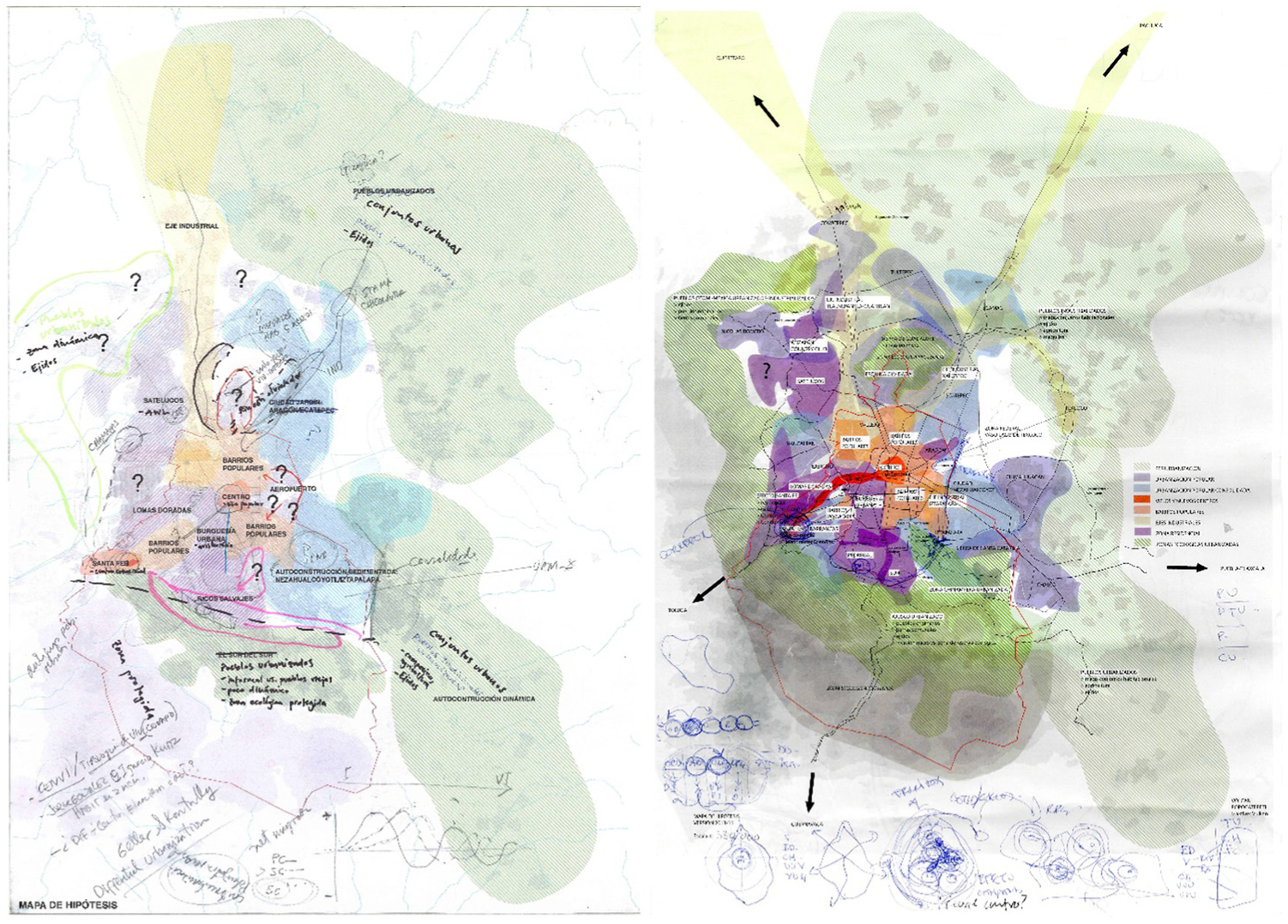
Two examples of a dialogical re-reading of socio-territorial maps to gradually refine the cartographic representation of urban configurations in Mexico City. Left, map revised together with a Mexican Geographer, 2010; right, map revised together with a Mexican Architect, 2013.
The eventually emerging map of urban configurations of Mexico City combines the data of these mapping sessions with the data generated by mobile ethnography, and thus represents a precise momentum, as the wandering city enters cartographical space. As de Certeau suggests, having experienced both the view from the top of the skyscraper and the walking in the streets of NYC, in my research of such a complex field such as the metropolitan territories of Mexico City, playing with scales and switching back and forth between different perspectives and sites becomes an important ingredient of the ethnographic research process. Moreover, the proposed experimental collaborations of mobile ethnography strive to link academic and ethnographic knowledge production with the mapped expert interviews and result in a very specific way of representing Mexico City (see also Sánchez Criado and Estalella, 2018). Mapping, as it is applied here, thus happens at the intersection of anthropology and geography and is drawing on qualities from both fields to create a useful technique for urban studies. Qualitative mapping can be understood as a process to analyse the urban configurations gradually, and more and more precisely in the course of research, and also to find blind spots of the ethnographic data in the process (see also Schmid et al., 2018; Tamayo and Wildner, 2004). Eventually, the qualitative data and the narrative elements drawn from mobile ethnography and the collective mapping sessions are synthesised and represented in the spatial transcript of the socio-territorial map, allowing a highly interrelated and simultaneous analysis of interview data and spatial data. Yet, this kind of qualitative mapping is as much defined by what is included as by what is excluded. Maps are powerful representations based on an abstraction, and yet, as Jeremy Crampton aptly puts it, ‘mapping is not just a reflection of reality, but the production of knowledge, and therefore, truth’ (2010: 46). As the creation of the socio-territorial map is based on constant feedback loops and dialogical re-readings, the map does not simply operate as an artifice through which various sets of data converge but represents a more collaborative project, an effort on the part of different actors to locate themselves and their knowledge within a common domain of operation. To summarise, qualitative mapping thus transductively entangles empirically grounded and theoretically informed conceptualisations. Furthermore, it is a valuable technique for developing different representations of urban space, with the goal to further decentre knowledge production and thus offering new and revisable imaginaries of urban territories.
Recalling a reflexive turn in urban studies
Ethnographic writing and qualitative mapping are used as analytical instruments and representations of findings and results. The ensuing text and map of urban configurations analyses the main urbanisation processes of Mexico City that are shaping these particular territories and thereby provides an overview of the main findings of the study in a condensed textual and visual format. The text and the map are thus like a snapshot in time of my interpretation of the ongoing and ever-changing urban realities of Mexico City, and thus a territorial abstraction of complex social and spatial situations. Hence, mobile ethnography – as any other qualitative research method – produces ‘situated knowledge’ (Haraway, 1988), resulting in a very close, yet partial, contextualised and embedded way of understanding a specific space in a particular time. Furthermore, it also produces deeply embodied, responsible and grounded knowledge (see Behar, 1993; Coffey, 1999; Degen and Rose, 2012; Massey, 2004; Rose, 1997; Strathern, 1995). Conceptualised as a ‘dialogical and open-ended mode of knowledge production’ (Peake, 2015: 226), mobile ethnography enables a more direct encounter with a variety of urban actors, yet, as has been shown, the engendered representation of the urbanisation processes is not free of power relations and objectivations of urban worlds (see also Savransky, 2017). Hence, to move towards a more dialogical research, self-reflective and critical engagement with power relations between researcher and researched is a must. Since the so-called reflexive turn of the mid-1980s, this has been a key issue within urban anthropology (see Behar, 1993; Clifford and Marcus, 1986; Strathern, 1991). Recent work on methodologies in urban studies more generally point towards a critical understanding of such relations, as they are built up during empirical field research. With the ongoing debate on decolonising methods (see Kaltmeier and Corona Berkin, 2012; Uddin, 2011; among others), I argue strongly in favour of creating more collaborative methods and ways of doing research that are sensitive to multiple voices, different urban imaginaries and multiple territorialities (see also Streule, 2017b). A differentiated understanding of the urban can be gained, I suggest, by focusing on actors involved in the production of urban territory, by naming the power relations within these processes, and, last but not least, by an epistemic reflexivity. If urban theory is to be both provisional and revisable, it is key to foreground the role of the corresponding methodological strategies – which means radically exposing researchers themselves (see also Bourdieu, 2004; Parnell and Pieterse, 2015; Sundberg, 2005). In brief, self-reflexivity and positionality is central to what I call doing mobile ethnography – a research strategy that differs fundamentally from one that displays a particular city as an urban laboratory, or from another that exposes different case studies in a city as local variants of a more general phenomenon. Instead of comparing cities or neighbourhoods, the focus is on how urban territories are constituted in relation to one another through power-laden practices in the multiple interconnected grounds of everyday life. Following Gillian Hart (2006), I believe that clarifying these connections and mutual processes of constitution in all their complexity and contradiction helps advance new understandings of urbanisation across different urban worlds.
Conclusions
This paper sought to contribute to current debates in the interdisciplinary field of urban studies, by addressing methodological and theoretical questions that invite scholars to move towards a more grounded understanding of urban processes. An appropriate methodology and set of research strategies and techniques, I argued, help generate empirical data on lived experiences of urbanisation – acknowledging everyday experience as a site of knowing and knowledge production – and make it possible to observe, describe, analyse and interpret urbanisation processes in novel ways, thus producing situated and relational knowledge. Derived from an extended research of the urbanisation of Mexico City, this paper introduced a different framework for doing mobile ethnography as a systematic and situated, and at the same time inventive and comparative method, which is well-dispositioned to cope with the challenge of alternating between different research scales, scopes and perspectives in urban research. The paper suggested two qualitative-empirical techniques – ethnographic writing and qualitative mapping – for the representation of contemporary urban conditions, which are especially appropriate for qualitative research of urbanisation processes on a metropolitan scale and with a strong focus on the representation of everyday life. In contrast to established mobile ethnographies, this paper suggests an unconventional focus on urban processes, analysing how and why these processes become dominant in certain urban configurations, and how they transform urban territories. This emphasis on urbanisation has profoundly reshaped my ethnographic approach. By employing an unusual socio-territorial perspective on a metropolitan scale, the suggested methodological design of the outlined mobile ethnography offers a way to define and map urban configurations based on grounded qualitative-empirical data.
What new insights can be drawn from such a grounded methodology that can be fruitfully put to work within a comparative approach? First, there is the grounded data generated through the empirical practice of mobile ethnography, which is indispensable in order to reconstruct and understand urban processes, not only for a specific case study, but also concerning different metropolitan territories in a comparative perspective. Second, mobile ethnography is developed in a specific urban context and adapted to a particular research question. Thus, this urban methodology is always in relation to particular situations and problems and therefore generating situated knowledge. At the same time, it is a strategy or tool that is, in part, alienable from specific problems or situations and can thus be used in multiple contexts within and between metropolitan territories. The paper showed how the methodological techniques of mobile ethnography, particularly in the case of qualitative mapping, were developed in close relation with other contexts, and reworked constantly through comparative moves across multiple scales (see Schmid et al., 2018). Research strategies such as mobile ethnography are thus not simply reproducible in multiple sites but are, rather, modifiable and modified in use. Depicted as such, mobile ethnography becomes an ‘inventive method’ (Lury and Wakeford, 2012), which is both influenced by and formative of a decentred urban theory. In the field of urban research particularly, there is a growing acknowledgement that urbanisation processes and comparative questions cannot be examined, analysed and interpreted using conventional methods of social science. Having this in mind, it is necessary to reflect on both theoretical questions and methodological approaches in order to put the urban worlds into conversation. It is through the development of new and inventive methods that we are able to problematise established geographical representations and parochial imaginaries on urban territories, and to simultaneously rework urban theory.
Footnotes
Acknowledgements
I am particularly grateful to all interview partners who shared their knowledge on Mexico City with me. An earlier version of this paper was presented at the AAG Annual Meeting 2016 in San Francisco. For their support, inspiration and discussion about the research on which this paper is based, I am grateful to Kathrin Wildner, Anke Schwarz, Sergio Ulloa, Rafael Pérez-Taylor, Rahel Nüssli, Stephanie Schöll and my colleagues of the research project Patterns and Pathways of Planetary Urbanization of ETH Zurich and the Future Cities Laboratory Singapore. The research team includes Naomi Hanakata, Pascal Kallenberger, Ozan Karaman, Anne Kockelkorn, Lindsay Sawyer, Christian Schmid, Rob Sullivan, Tammy Kit Ping Wong and myself. Thanks also to the Institute of Social and Cultural Anthropology at the Universidad Nacional Autónoma de México (IIA-UNAM) and the Institute of Advanced Studies at the University College London (IAS-UCL) for providing me with inspiring visiting research fellowships for my research and to revise this paper. I would also like to thank Katja Schwaller for revising my writing, as well as three anonymous referees and Christian Schmid, Haim Yacobi and Katherine Saunders-Hastings for their helpful comments on the paper. All errors and omissions remain my own.
Declaration of conflicting interests
The author(s) declared no potential conflicts of interest with respect to the research, authorship, and/or publication of this article.
Funding
The author(s) disclosed receipt of the following financial support for the research, authorship, and/or publication of this article: This paper was developed from research in Mexico City, partly funded by Swiss National Science Foundation with a Fellowship for Prospective Researchers in 2013.