




Abstract
Land conversion control in China remains in the shadow of the planned economy. Highly hierarchical governments fully control both land quotas and land approval, which are indispensable for each added area of construction land. But the actual mechanisms of land resource distribution, because they are masked by the ambiguity of institutional provisions, are opaque. This article discusses the theoretical influence of regional favouritism to birthplace on the expansion of construction land. Using a provincial-level dataset and detailed information about political cadres in the Ministry of Land and Resources, we estimate an econometric model that reflects the relationship between regional favouritism and construction land expansion. The results indicate that, all else equal, the birthplaces of political cadres receive a larger scale of construction land expansion than other locations. We further explore the paths of regional favouritism influencing construction land expansion. The results show that land approval and tolerance of illegal land due to regional favouritism together contribute to the expansion of construction land.
Introduction
Over the past 30 years, China’s industrialisation and urbanisation have advanced rapidly. The urbanisation rate rose from 31% in 1999 to 57% in 2016 (NBSC, 2017). Rapid urbanisation was accompanied by continuous expansion of urban construction land, 1 which increased by 153%, from 20,877 km2 in 1999 to 52,761 km2 in 2016 (NBSC-USEID, 2000–2017). Generally, urban expansion is a normal concomitant of economic growth, and as many studies point out, there is a strong relationship between economic growth and construction land expansion (Deng et al., 2008; Ho and Lin, 2004). However, the rapid expansion of construction land has caused the reduction of arable land at an unparalleled rate. To be precise, the area of cultivated land decreased by 130.9 million Mu 2 between 1999 and 2016 (NBSC, 2000–2017). However, sufficient farmland is vital for ‘self-reliance’ on crops, which is essential not only to safeguard national sovereignty but also to maintain social stability, according to many studies (Chen, 2007; He et al., 2013).
Faced with the rapid depletion of farmland, the central government proposed 1.8 billion Mu of cultivated land as an uncrossable red line in 2006. To meet this objective, the Chinese government has implemented ‘the most stringent rules of farmland protection’, including drafting farmland preservation plans, designating basic farmland protection districts and controlling land conversion from agricultural to non-agricultural use. All of these detailed policies suggest that the administration of land in China is still in the deep shadow of the planned economy. The planned economy is most characterised by land quotas and land approval, the mechanisms designed to restrict the conversion of land utilisation from agriculture to non-agriculture. Land quotas are allocated by highly hierarchical governments to low-level governments (i.e. central government distributes quotas to provinces, provincial governments to districts and so on); at the same time, each parcel of newly developed construction land must be approved by provincial governments or central government. Furthermore, dedicated land bureaucracies have been set up, at all levels of government, to cope with land affairs. For example, in terms of land quota distribution among provinces, National Overall Land Use Planning (2006–2020) formulates quotas for added value of construction land based on ‘differentiated regional land use policy, comprehensively considering the level of economic and social development, development trend, resources and environmental conditions, land use status and potential and other factors’.
Although a range of criteria are explicitly referred to in allocating land quotas, they are often ambiguous in practice, especially when invoked at central government level. This ambiguity of provisions allows officials to execute rules flexibly, making the decision making process ‘black box’ in nature. 3 What are the politics of land distribution inside the ‘black box’? Do land bureaucracies follow regular patterns to distribute land quotas? If they do, how are these determined? And how does the logic of distribution affect the expansion of construction land?
While it is important to acknowledge that market-orientated criteria do play a significant role in land allocation (Lu et al., 2010, have, for example, confirmed that the economic level of a district is an important criterion of land allocation in China), the framework of political power also plays an important role (Lefebvre, 1991). In this article, we focus on non-market factors, such as political forces, that might influence the allocation. 4 Specifically, we concentrate on the regional favouritism of political cadres to uncover the non-market forces at work in land allocation in China. Regional favouritism plays an important role in the distribution of economic resources both in democratic and autocratic countries. In America, regional favouritism is always rooted in political trade-off, where members of congress fight for more benefits for voters in return for political support (Cadot et al., 2006; Ferejohn, 1974). In autocratic countries, regional favouritism is usually driven by leaders’ personal preferences, such as ethnic favouritism or birthplace favouritism (Hodler and Raschky, 2014; Posner, 2005). In Sri Lanka, the largest port in the region is the Magampura Mahinda Rajapaksa Port located in Hambantota, where the prime minister Mahinda Rajapaksa was born (Sirimane, 2013). Similar cases can also be found in Zaire. The dictator Mobutu built luxury guesthouses and even an airport in Gbadolite, the Mobutus’ ancestral home, not to mention the best infrastructure (Edgerton, 2002). Regional favouritism also exists in China, a country with features of both democracy and autocracy. 5 Many studies have found that the regional favouritism of central leaders results in a higher proportion of economic resources and a higher rate of economic growth in favoured provinces (Bo, 1998; Naughton, 1988; Su and Yang, 2000). Not surprisingly, regional favouritism can also have an impact on land allocation, which is entirely controlled by higher-level governments. In this article, we use cadres in the Ministry of Land and Resources (MLR) 6 as our sample to examine how regional favouritism to birthplaces affects the expansion of construction land. 7 The MLR plays a decisive role in land governance, while other departments like the National Development and Reform Committee (NDRC) have secondary roles, according to their Three Fixed Programme Themes (sanding fangan, in Chinese). 8
This article makes several contributions to research on distributive politics, regional favouritism and urbanisation in China. First, we concentrate on the relation between political cadres in the MLR and land resources. These cadre members fully control land allocation in the context of China. Other studies have sought to establish a link between political leader favouritism and economic results – for example, scholars have attempted to explain economic growth with regional favouritism (Hodler and Raschky, 2014; Posner, 2005) – although in most cases even the supreme leader could not directly and fully control economic development. Our theoretical framework is based on the reality of land allocation in China, the feasibility of regional favouritism and the reasonability of distributive politics. Second, we contribute to literature on the politics of China. In a Nomenklatura system, where officials are appointed and promoted by their superiors, there is theoretically no need for political cadres to be partial to their hometowns for political support. However, we still empirically find that officials are inclined to allocate land resources to their hometowns. Third, we also contribute to an ignored area, that is, the role that the state-level institution plays in the expansion of construction land. Although many studies have noticed the role of political force in urban expansion, the focus of these studies is on how urban land responds to the incentives of local officials. Chen et al. (2017) found that construction land scale and utilisation efficiency are affected by the promotion incentives of local officials. However, they ignored the fact that the expansion of construction land in China has not only resulted from the activities of local governments, but has also been determined by the land administration system. For example, the activities of local officials to develop land are strictly constrained by land quotas, which are ultimately determined by the MLR. Therefore, it is not enough to focus on the power rooted in the locality. This article complements and expands upon existing literature by focusing on the power of central leaders.
The remainder of the article is organised as follows. The second section provides a literature review of regional favouritism, and analysis of the logic behind the relationship between regional favouritism and the expansion of construction land. Additionally, we here propose the hypotheses of this research. In the third section we introduce the data and the model. The next two sections present the results of the empirical study: the fourth section examines the impact of regional favouritism on construction land expansion, and the fifth section explores the path of regional favouritism in influencing construction land expansion. Concluding remarks are in the sixth section.
Regional favouritism and the background of land conversion
Review of regional favouritism
Politics ‘is about who gets what, when, and how’ (Lasswell, 1936). Research on distributive politics includes issues from federal grants distribution amongst local governments (Alperovich, 1984; Tavits, 2009), to the beneficiaries of education (Hawkins, 2010) and social welfare programmes (Weitz-Shapiro, 2006), to infrastructure construction (Blaydes, 2010), and many others.
The distribution of economic resources is significantly affected by regional favouritism. Although regional favouritism is sometimes driven by pork barrel politics (Ferejohn, 1974), we would like to focus on ethnic and birthplace favouritism. On this subject, Hodler and Raschky (2014) find that incumbent political leaders invest more in the regions of their birth, while Posner (2005) claims that presidents in Zambia prefer building schools, clinics and roads in their hometowns. Öhler and Nunnenkamp (2014) find that multilateral aid from the World Bank and the African Development Bank has flowed to political leaders’ home regions. Similarly, using 117 African leaders’ birthplaces and 1955 geocoded Chinese development financial projects, Dreher et al. (2015) find that the birth regions of incumbent political leaders received substantially more Chinese aid. They further argue that the allocation of aid based on regional favouritism instead of needs reduces the effectiveness of aid. With respect to ethnic favouritism, Farthing and Kohl (2014) show that natural resource revenues have been used to fund policies targeting indigenous regions in Bolivia, while Harrison (2009) has demonstrated that the Punjabi ethnic group controlling armed forces and key political institutions in Pakistan has diverted economic resources (e.g. gas, agricultural water) from other ethnic groups to benefit its own regions.
The connection between birthplace and resources allocation in China has already drawn a great amount of attention, both in scholarly studies and in everyday gossip. Su and Yang (2000) have defined this connection as informal access to central decision making. Due to the existence of birthplace favouritism, Third Front Programmes were mainly located in provinces such as Hu’nan (the birthplace of Mao Zedong and Liu Shaoqi), Sichuan (the birthplace of Deng Xiaoping and Zhu De) and Hubei (the birthplace of Lin Biao and Li Xiannian) from the mid-1960s to the mid-1970s (Naughton, 1988). Despite a more institutional context, birthplace favouritism still functions in contemporary China. Zhang et al. (2012) found that central committees contribute to an increase in investment rates in their hometowns, which promotes economic development in their provinces. Li and Xu (2016) drew a similar conclusion by using data at the city level, when interpreting economic growth as the result of officials’ identity.
In summary, previous studies have noted the importance of regional favouritism in distributive politics in western developed countries, authoritarian African countries and also in China. Although these studies have covered a wide range of regional favouritism in public affairs, this article extends coverage to include construction land expansion in China for the first time. More importantly, we provide a new perspective on the logic of construction land expansion in the situation where the land administration system still maintains the features of a planned economy.
Background and research hypothesis
All land in China is formally owned by the public. Urban land is owned by the state, while rural land is controlled by village collectives. 9 The current land-use rights system, derived from the land leasehold system in Hong Kong, was first introduced in Shenzhen in 1987 and formally approved in 1988 to accommodate the needs of foreign direct investments. Use rights are sold for an up-front land conveyance fee, which was historically determined by negotiation but is increasingly determined by competitive bidding (Ding, 2007). Rural land is available for development into commercial, residential or industrial use after being converted from rural (principally farmland) to urban status by land requisition. Local governments are required to provide compensation for land requisition, which is based on agricultural productivity and thus much lower than the conveyance fees. Unlike taxes, which are shared with the central government, profits from land transactions go directly to local governments. As a result, local governments are increasingly dependent on land revenue. As discussed in Ding and Lichtenberg (2011), land-related revenue grew from less than 10% of tax revenue in 1995 to 67% in 2010. Over the same period, land development has driven state-led Chinese urbanisation (Xu et al., 2011).
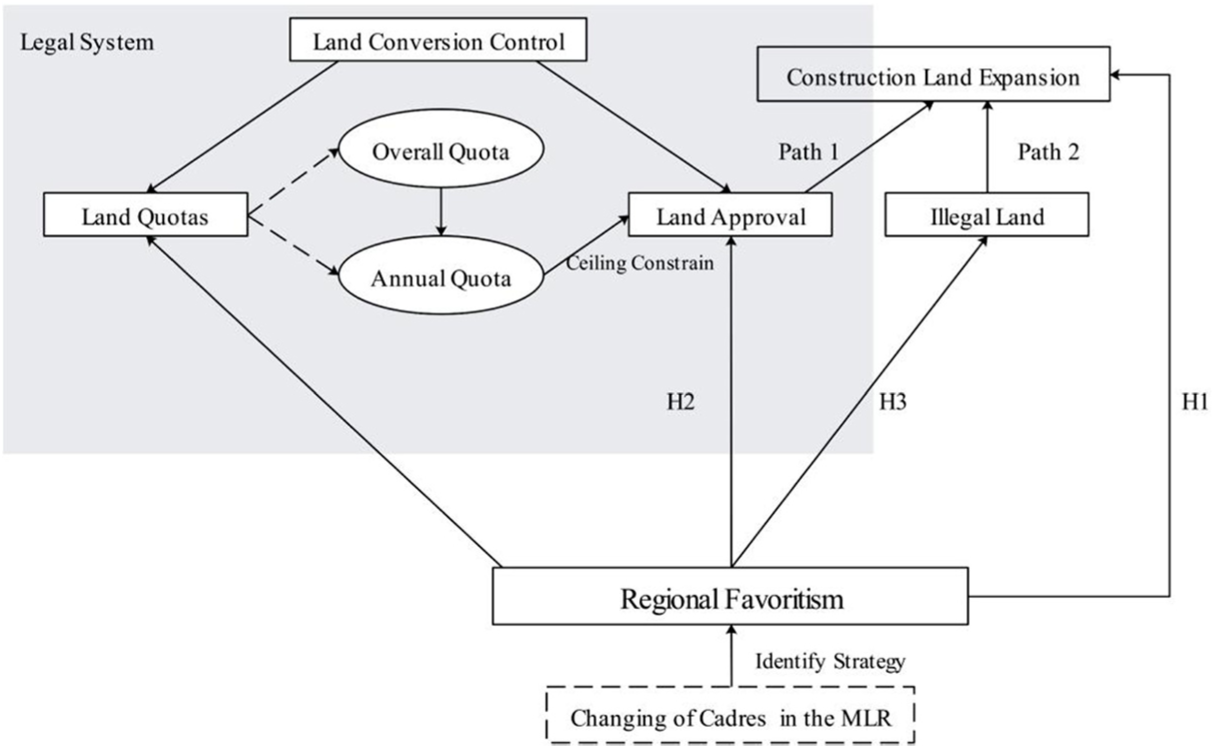
However, the rapid pace of urbanisation has given the central government considerable cause for concern due to food insecurity and social unrest caused by residents’ loss of land (Lichtenberg and Ding, 2008). Responding to these problems, the central government amended the Land Administration Law in 1998 to emphasise farmland protection through top-down control. Land quotas and land approval are the main measures used to ‘protect the loss of farmland and control the expansion of construction land’. On the one hand, land quotas govern the permissible conversion of land to non-agricultural use in a region (Chau and Zhang, 2011). Land quotas can be divided into overall quotas (guihua zhibiao) and annual quotas (jihua zhibiao). In principle, the amount of farmland newly developed for construction in a region during a planning period (usually 10–15 years) cannot exceed the total amount of the overall quota. On the premise of meeting the overall quotas, annual quotas further stipulate the amount of farmland that can be converted to construction land in a single year (Wang and Tao, 2009). Both overall and annual quotas are distributed by higher-level government bodies to lower-level ones. 10 On the other hand, newly developed construction land has to be approved by provincial or central governments, depending on the area added and the original utilisation of the occupied land. Cases which involve basic (high-quality) farmland, more than 35 hectares of farmland other than basic farmland or more than 70 hectares of other land must be approved by the state council or the provincial government, according to Article 45 of the Law of Land Administration. To sum up, the legal procedure of land conversion requires both compliance with quotas and approval from government. 11
Based on the existing literature on distributive politics from the perspective of regional favouritism, we conjecture that regional favouritism from political leaders plays a significant role in land conversion for the following reasons: (i) land quotas are fully controlled by highly hierarchical governments; (ii) each area of land converted to non-agricultural must be approved by highly hierarchical governments; (iii) a lack of institutional arrangements or specific regulations about quota distribution enables highly hierarchical governments to distribute quotas at discretion.
Based on the above analysis, our first hypothesis concerns the general relationship between regional favouritism and construction land expansion, while our second hypothesis relates to the essential role of land approval in land conversion control:
Hypothesis 1 (H1): The scale of construction land expansion is larger in the birthplaces of central leaders because of regional favouritism.
Hypothesis 2 (H2): The main mechanism of regional favouritism with respect to land resources is via land approval; specifically, favoured regions will have a higher scale of construction land approved by governments.
While the formal process of land approval makes the greatest contribution to construction land expansion (for example, of the overall amount (501,700 hm2) of construction land expansion in China in 2016, some 452,750 hm2 was legally approved), a smaller amount of illegal land use also typically contributes to the expansion of construction land (Ho and Lin, 2003). Illegal land, in this context, refers to land which is occupied without approval. 12 Strikingly, illegal land accounts for some 34% of construction land expansion when counted by the number of cases. 13 The MLR is the main handler of illegal land processing. The penalties for illegal land include not only disciplinary punishment (a grave punishment in the CPC) against the heads of the local departments in charge of land resources, but also admonition such as suggestions and interviews, which are much more moderate. However, again, the lack of unambiguous criteria leads to central official discretion in the penalisation of illegal land activities. We speculate that political cadres tolerate illegal land in their birthplaces, since the development of a region might be damaged through severe punishment, 14 and thus put forward hypothesis 3 as follows:
Hypothesis 3 (H3): Owing to regional favouritism, political cadres demonstrate greater tolerance for illegal land. As a result, favoured provinces will have a larger amount of illegal land.
The integrated analytical framework of this article is shown in Figure 1.
Analytical framework.
Data and models
Empirical strategy
A major challenge in estimating the impact of regional favouritism on construction land expansion is to isolate the effects of such favouritism from group-specific factors that might also affect construction land expansion. For example, if we found that cadres’ birthplaces have a greater amount of construction land expansion than other provinces, it would be difficult to know whether this association was a product of regional favouritism or of other factors such as these birthplaces themselves being more developed. Our strategy for solving this inferential problem is to leverage variations in the birthplaces of cadres and run our models with province fixed effects, which control for unchanging group-specific factors that may predispose one province to over- or under-perform compared with others. 15 This approach allows us to study the changing fortunes of each province over time, comparing its construction land expansion during periods when it has cadre members in the MLR and when it does not, holding province-specific characteristics constant. In addition to province fixed effects, each model also includes year fixed effects, which help to control for time-specific shocks that might impact the expansion of construction land. After controlling province fixed effects and time fixed effects, our models are a generalised difference-in-difference design (Angrist and Pischke, 2008). 16 The models we estimate are therefore:
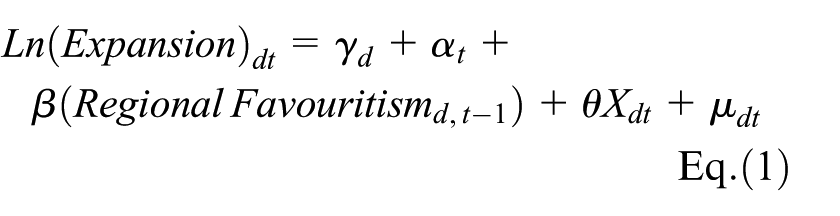
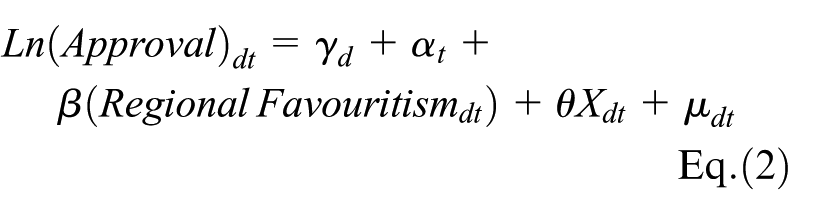
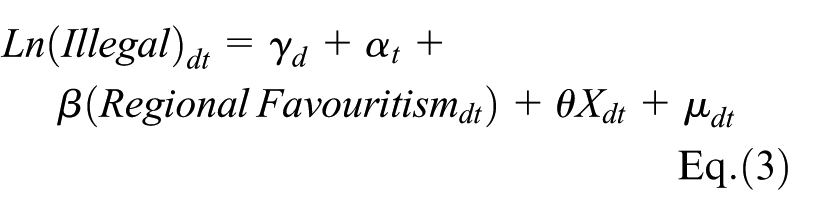
In the three equations, the dependent variables are, respectively, the logarithm of the added value of construction land, the scale of land approved by both provincial governments and central government and the scale of illegal land respectively for year t and province d.
17
X is a vector of control variables, and we add them progressively in these stepwise regression models. As noted, the regressions also control province fixed effects (
We add a series of economic characteristics in the light of existing literature on the expansion of construction land, including GDP, population, investment, unemployment rate and consumption (Angel, 2012; Seto and Kaufmann, 2003). Also, Lu et al. (2015) have argued that governments started to implement land supply policies biased to the central and western regions after 2003, which also has an impact on land quotas allocation and construction land expansion. Thus, we generate a dummy variable, assigned to 1 if year > 2003 and the province is in central or western regions, to capture biased policy. 18 Furthermore, the authority of land approval is partly decentralised to provincial governments, and Chen and Zhong (2016) found that the degree of decentralisation contributes to the amount of farmland occupied for construction. Hence, we control the degree of decentralisation, indicated by the proportion of land approved by provincial governments.
Regional favouritism
Our analysis tests our conjecture based on the political cadres of the Ministry of Land and Resources, who represent the CPC’s supreme authority in land affairs. We select the minister, vice ministers and ordinary members of the party group (dangzu cheng-yuan) in the MLR
19
as our sample, instead of all the officials, as these three kinds of political cadres in the party group have authority on most issues,
20
as Articles 6, 7 and 47 of the Working Rules of the MLR stipulate: The Ministry of Land and Resources implement the ministerial responsibility system, the minister leads the overall work; vice ministers assist the minister, and share responsibility for the subdivision they are in charge of … The files issued by the MLR should be examined by the deputy ministers and the members of the party group and then issued by the minister or by the vice minister appointed by the minister.
We then define regional favouritism for a certain province from three aspects, as an approach to robustness testing as well as an attempt to refine the idea of regional favouritism. First, we use an indicator variable, Regional Favouritism_Dummy, that takes a value 1 if a province d is the birthplace of officials in the MLR in year t, no matter how many officials the province has; and 0 otherwise. Second, as the CPC stresses the principle of collective leadership, greater provincial representation in the MLR might be accompanied by more efficient translation of regional favouritism to resources allocation; where a province has more than one official in the MLR, we generate a new variable, Regional Favouritism_Amount, which measures the number of officials in province d in year t, to capture the effect of the number of officials. For example, as there were two officials in 2014, Jiang Daming and Wang Shiyuan, who were both born in Shandong, the Regional Favouritism_Amount is assigned 2 in Shandong in 2014. Third, in light of the fact that the different ranks of officials also have an impact on public affairs (Zhang et al., 2012), we use another variable, Regional Favouritism_Rank, in which the minister of the MLR receives three points, the vice minister receives two points, while other ordinary members of the MLR are assigned one point, to reflect the hierarchical rankings of different memberships 21 (Su and Yang, 2000).
Thus, the Regional Favouritism_Rank for province d = 3 * number of ministers + 2 * number of vice ministers + number of ordinary members.
Data resources and description
We collected data in the following ways. The scale of construction land, land approval and illegal land, as well as the indicator of decentralisation, come from the China Land and Resources Statistical Yearbook 2000–2017. 22 Detailed information about the officials in the MLR was manually collected using the China Land and Resources Almanac. The GDP, population and infrastructure data come from the China Statistical Yearbook 2000–2017. Table 1 shows descriptive statistics for all of the variables.
Descriptive statistics of all of the variables.

Notes: The data for construction land expansion, approval and illegal land come from the China Land and Resources Statistical Yearbook. The data on regional favouritism is manually collected according to the China Land and Resources Almanac. The data on the macroeconomic variables come from the China Statistical Yearbook.
It should be noted that we omitted the added area of construction land in 2002, since the data in most of the provinces are of negative values. This resulted from official changes in Current Land Use Classification. Although the missing data in 2002 generate an unbalanced panel data, they actually have little impact on the validity of our regression because what we care about is the added area of construction land in province d for year t. It should also be noted that several data in Tibet are missing due to lack of information in the China Land and Resources Statistical Yearbook.
To begin, we provide some preliminary evidence to support our hypotheses. First, in Figure 2, we use ArcGIS to combine regional favouritism, as indicated by accumulated Regional Favouritism_Amount, and construction land expansion on the map of China. It is evident that in the period from 2000 to 2016, the favoured provinces continuously had a larger scale of construction land expansion than non-favoured provinces. Second, to preliminarily exclude the impact of economic performance, we divided provinces into favoured provinces and non-favoured provinces according to officials’ birthplaces and calculated the average scale of construction land expansion conditional on GDP in these two categories. Results are shown in Figure 3. The spike in 2009 was the result of the RMB 4 trillion stimulus policy in China. 23 Figure 3 also suggests that favoured provinces have a higher scale of construction land expansion. Third, the dynamic of construction land expansion corresponding with the changing of specific personnel in the MLR also implies the existence of regional favouritism. For example, Gan Cangchun was born in Hubei. When Gan was in power from 2006 to 2011, Hubei province saw an acceleration in construction land expansion. Once Gan was no longer in power, Hubei was no longer a birthplace of any officials, and the acceleration vanished almost immediately. However, the above evidence is quite rudimentary. Latent endogeneity exists and counter examples could be found. For example, Shanghai, a province that has repeatedly been the birthplace of central officials, has a comparatively small amount of construction land expansion, which is limited by its jurisdiction area. We thus turn to regression analysis to inject more rigour into the analysis.
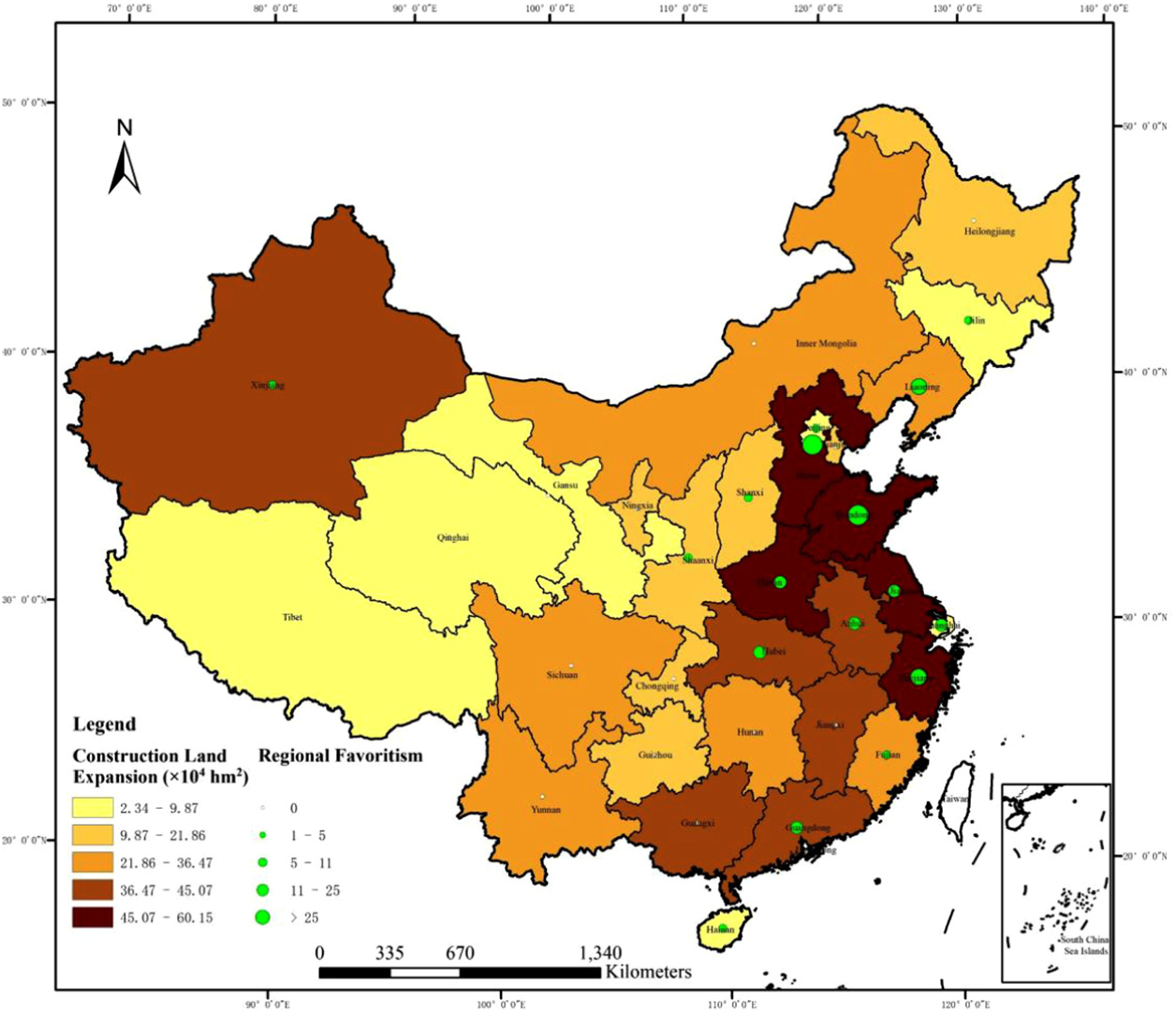
Regional favouritism and the expansion of construction land in China from 1999 to 2016.

The average expansion of construction land (conditional on GDP).
Regional favouritism and construction land expansion
Regression results are shown in Table 2. Columns (1), (3) and (5) without control variables show a significantly positive relationship between regional favouritism and construction land expansion. The results after controlling for other regional characteristics are shown in the remaining columns. Control variables are all consistent with the existing literature, that is, regions with biased policy and more outstanding economic performance have a larger scale of construction land expansion. The coefficients of regional favouritism are all positive and statistically significant at least at the 1% level, implying that with all else equal, favoured provinces tend to have a larger scale of construction land expansion. The results sit well with hypothesis 1. Specifically, the coefficient of Regional Favouritism_Dummy in column (2) implies that, on average, the scale of construction land expansion is 21.3% greater in provinces which are favoured by central officials than in other provinces. Such an effect is quite considerable when compared with other factors. For example, a 10% increase in GDP only leads to a 5.8% increase in construction land, only one-quarter of the effect of regional favouritism. These results are also consistent with Lefebvre’s (1991) argument that political power is essential in the expansion of space. The coefficients of the independent variables in columns (4) and (6) add further support. The former suggests that the scale of added construction land positively relates to the number of officials in the MLR, as shown in Figure 2. Column (6), which tests for a hierarchy rank effect, through the inclusion of the Regional Favouritism_Rank, also accords with expectations. The three indexes, built from different aspects as described above, together give confidence in hypothesis 1.
The effect of regional favouritism on construction land expansion.
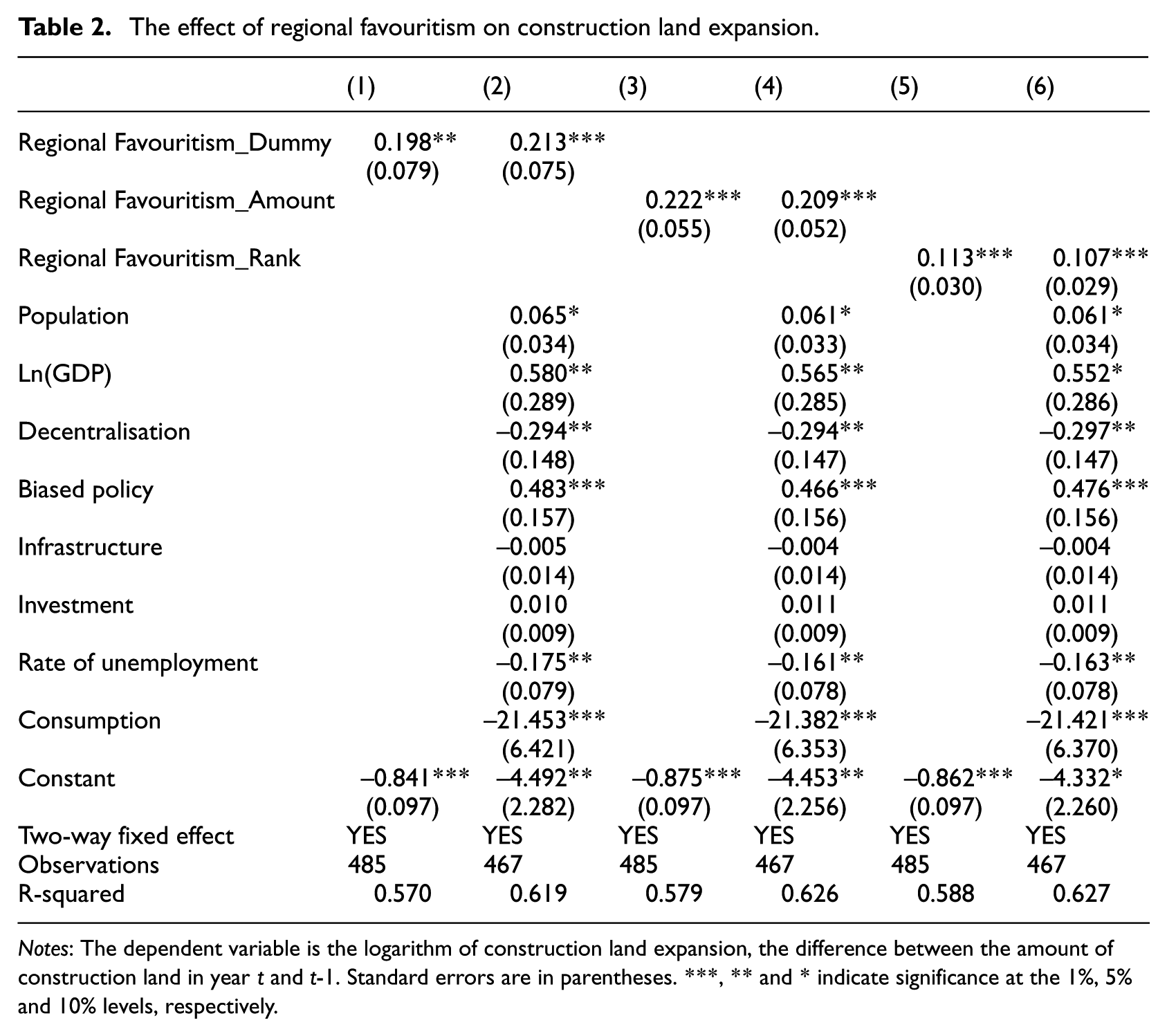
Notes: The dependent variable is the logarithm of construction land expansion, the difference between the amount of construction land in year t and t-1. Standard errors are in parentheses. ***, ** and * indicate significance at the 1%, 5% and 10% levels, respectively.
As a considerable amount of construction land is converted from farmland and the control of land use conversion from agriculture to construction is more stringent, we used Ln(occupy), the scale of occupied farmland due to construction for province d in year t, as a dependent variable to carry out additional sensitivity tests. The data here also comes from the China Land and Resources Statistical Yearbook. The results are shown in the first three columns in Table 3. It should be noted that the data for 2009–2012 are missing because of the second national land survey. As a result, the observations decrease to 384. Similar to the results above, all the coefficients of regional favouritism remain significant at the 1% level and become more prominent. The provinces favoured by central officials occupy more farmland for construction, implying the purpose of economic development, which goes against the intention of protecting cultivated land.
Further robustness check.
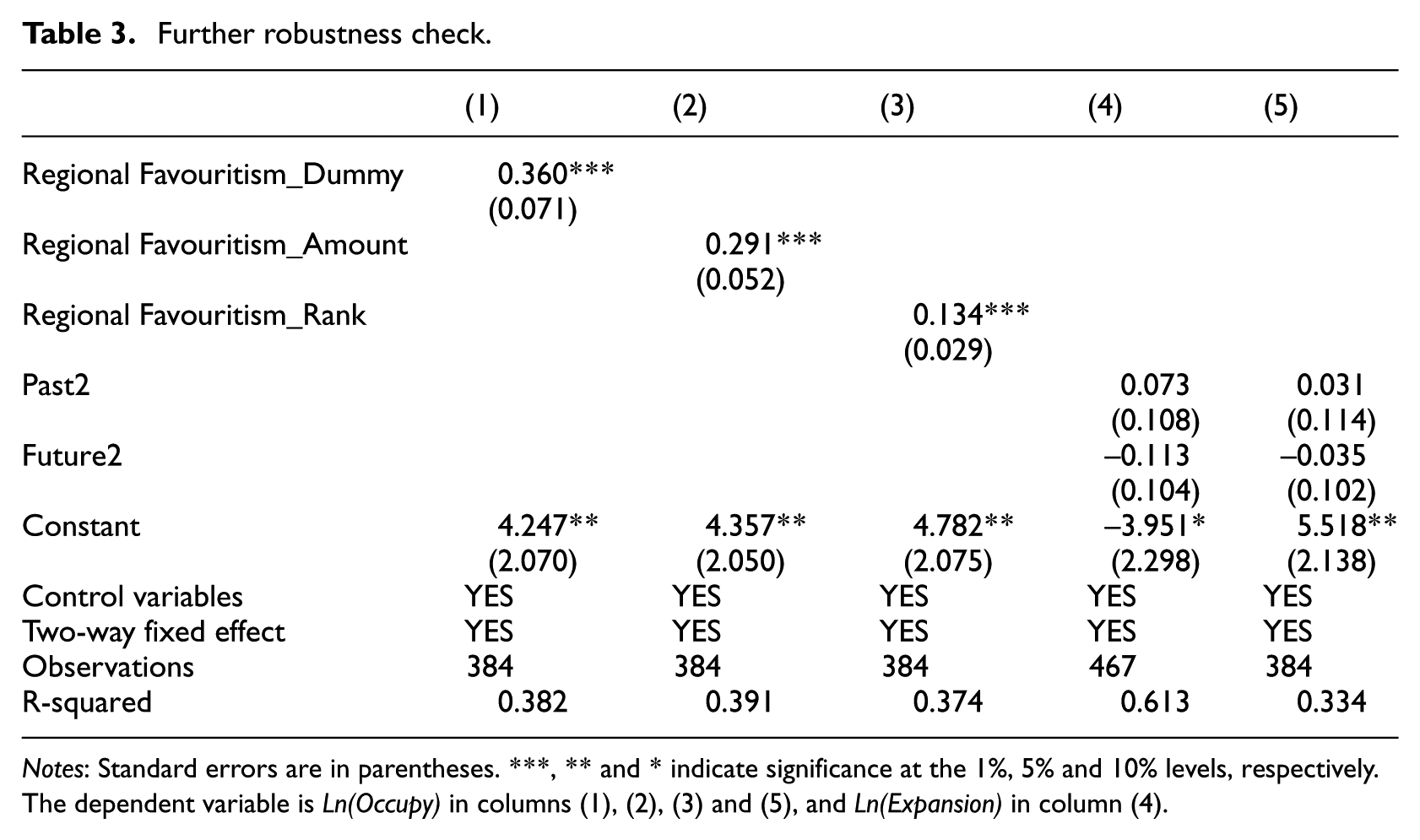
Notes: Standard errors are in parentheses. ***, ** and * indicate significance at the 1%, 5% and 10% levels, respectively. The dependent variable is Ln(Occupy) in columns (1), (2), (3) and (5), and Ln(Expansion) in column (4).
Some concerns remained to be addressed. The first is co-linearity between the economic development level and regional favouritism. A relationship between the promotion of politicians and local economic development in China has been reported elsewhere (Luo et al., 2015), and regional favouritism also promotes economic development. As a result, the existence of multicollinearity might impair the estimation (Wooldridge, 2015). We address this concern by calculating VIF and regressing step-by-step, both of which confirm that co-linearity does not undermine the validity of our results. Second, there is a potential endogeneity issue, as some more developed regions may simply have more land quotas and higher chances of being the leader’s birthplace than others. The use of region fixed effects already ensures that coefficient β is unaffected by time-invariant differences across regions. However, it could be that regions that become more important or economically active over time get more land quota and also become more likely to be the leader’s birthplace. Regional changes in economic activity and relative importance are likely to be gradual, while most changes in political leadership occur after elections. We would thus expect regions to have more construction land expansion already before becoming a birthplace, and possibly also after having been a birthplace, if regional changes in economic activity and relative importance were the primary reasons for more construction land expansion in the leader’s birthplace. To test whether there is such a pattern in the data, we focus on regions yet to be a birthplace or that have been a birthplace until recently. If these regions look no different in these years than in other years, we view it as suggestive evidence that a leader’s birthplace has more construction land expansion because of the political leader themselves rather than because of (other) changes in regional characteristics. This placebo test is listed in the last two columns in Table 3, where the dependent variables are Ln(Expansion) and Ln(Occupy) respectively. Future2 is a dummy variable equal to 1 if province d is the birthplace of the officials in the MLR in t+1, t+2, but not in t; and 0 otherwise. Past2 is a dummy variable assigned to 1 if province d is the birthplace of the officials in the MLR in t-1, t-2, but not in t; and 0 otherwise. Consistent with the conjecture, all of the counterfactual variables are statistically insignificant, suggesting that there is no positive trend before an official gets into power, and that the impact of regional favouritism on construction land expansion disappears once the official loses power. To sum up, the placebo test confirms that it is regional favouritism rather than other omitted variables playing a role. 24
Path of regional favouritism influencing construction land expansion
We now consider the ways in which regional favouritism from central officials affects construction land expansion. We first discuss the role of land approval in construction land expansion, as embodied in hypothesis 2, then examine the tolerance of illegal land.
Path 1: Land approval
Table 4 reports results based on equation (2). The dependent variable is Ln(Approval), the scale of construction land approved both by the central government and by provincial governments in logarithms, in the first three columns. All three columns show a significantly positive relationship between regional favouritism and the scale of approved construction land. Compared with the non-favoured provinces, the favoured provinces are approved to develop 42% more construction land on average.
Path 1: Regional favouritism and land approval.
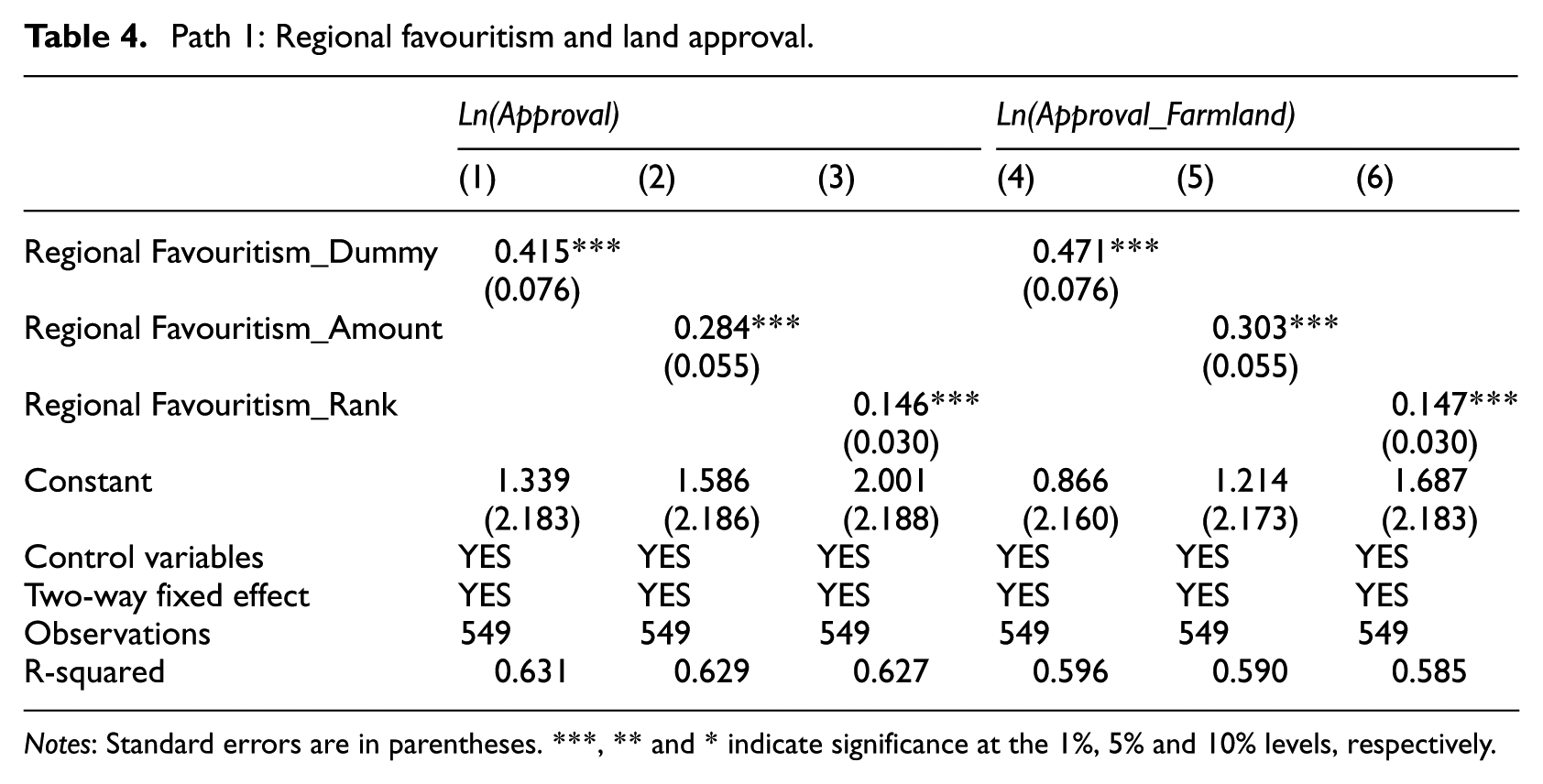
Notes: Standard errors are in parentheses. ***, ** and * indicate significance at the 1%, 5% and 10% levels, respectively.
To explore the robustness of the results, we turn to Ln(Approval_farmland), the area of farmland approved to convert to construction use, in the remaining three columns. Once again, the results show the positive impact of regional favouritism on land approval at the 1% level, consistent with hypothesis 2. It is not surprising that land approval is an essential path for translating regional favouritism to actual land resources, in view of the administration system where each added area of construction land requires approval either by central government or by provincial government.
Path 2: Toleration of illegal land
Results based on equation (3) are reported in Table 5. To ensure the robustness of our findings, we adopt various dependent variables again. In the first three columns, the dependent variable is Ln(Illegal), whereas it is Ln(Illegal_Farmland) in the remaining columns. The former represents the area of added construction land without approval and the latter is the scale of farmland involved in illegal activities. Although the Regional Favouritism_Dummy is not statistically significant in column (1) (p = 0.12), the other two indicators of regional favouritism are significant, which is consistent with hypothesis 3. Since a large amount of illegal land is converted to construction, it is likely that the impact of regional favouritism on construction land expansion is partly achieved by means of tolerating illegal land. However, the coefficients of regional favouritism are relatively small when compared with those in Table 4. We attribute the smaller coefficients and lower level of statistical significance to the supplementary role that path 2 plays, while official land approval is the main path. Theoretically, covering up illegal actions on land is risky for cadres. We think there are two reasons for cadres to do this. First, once a province suffers severe punishment for illegal land use, its land quotas for the next year are cut, which would hinder the pace of development. To protect their hometown, cadres would rather stay quiet about illegal actions. Second, we examined the working experiences of officials in the MLR and found that before they attained a post in the MLR, many of them had been working in their hometown for many years. 25 To avoid damaging their own reputation, cadre members also have strong incentives to tolerate illegal actions in their birthplaces.
Path 2: Regional favouritism and illegal land.
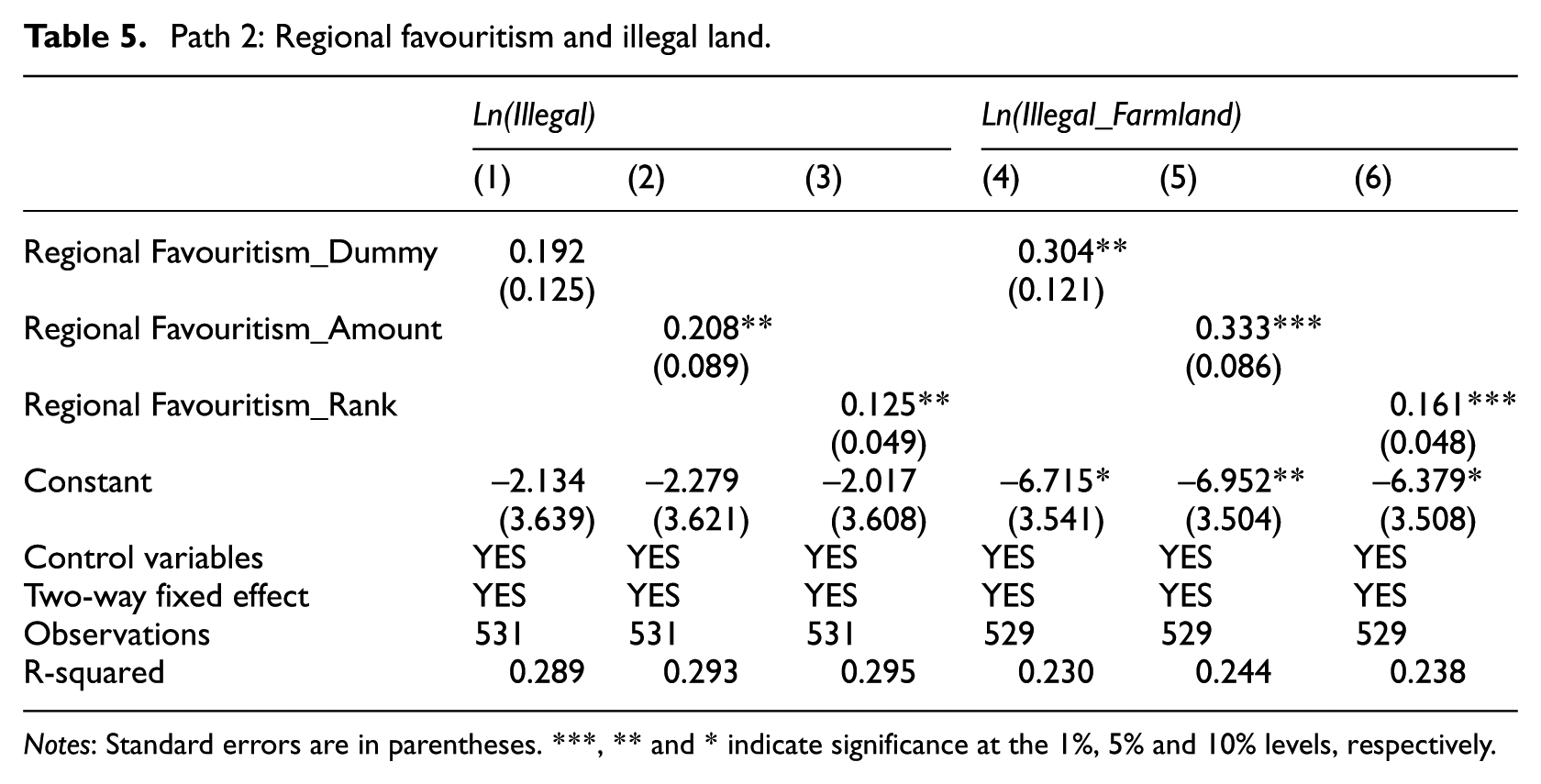
Notes: Standard errors are in parentheses. ***, ** and * indicate significance at the 1%, 5% and 10% levels, respectively.
Conclusion and discussion
The land administration system in China is under the dark shadow of the planned economy, which emphasises top-down control. To cope with conflicts between development and protection of farmland, the Chinese government has promulgated a series of regulations to restrict conversion of land to non-agricultural use, including land quotas and a requirement for construction land approval. Each area of added construction land is required to comply with quotas and to be approved by either provincial governments or central governments. The authorities responsible for the distribution of land quotas and the granting of land approval are fully controlled by highly hierarchical governments. Furthermore, the institutional criteria used for determining distribution and approval are ambiguous. To the extent that the quota setting and approval granting are unavoidable for construction land expansion in China, it is interesting to investigate the processes involved, and their outcomes. Although the exercise of top-down power is essential in construction land expansion, little attention has been focused on these issues in the existing literature. As such, this article attempts to fill the gap and expand understanding of these matters.
To explore this ‘black box’, we proposed that a key factor driving construction land expansion was regional favouritism from political cadres in the Ministry of Land and Resources. As regional favouritism is known to play a vital role in the distributive politics of both democratic countries and autocratic countries, it is not surprising that it might have an impact on the distribution of land resources in China. We conceptualised regional favouritism by combining provinces that were the birthplaces of central officials. Therefore, the definition of a favoured region is the region becoming the birth province of political cadres. Exploiting a provincial-level dataset as well as detailed information on leaders in the MLR from 1999 to 2016, we estimated an econometric model that reflects the relationship between regional favouritism and construction land expansion. The results indicate that favoured provinces have a larger scale of construction land expansion, a finding reinforced by robustness tests and placebo tests. We then explored the paths by which regional favouritism influences construction land expansion. The regression results, showing more approved construction land and more illegal land appearing in the favoured provinces, imply that land approval as well as tolerance of illegal land are affected by regional favouritism and together contribute to the expansion of construction land.
As an informal institution, regional favouritism appears to be significant in construction land expansion in China. Although it is common for political cadres to favour their birthplace and to strive for more economic resources for their hometowns, as found in Akerlof and Kranton (2000), regional favouritism still has some negative consequences for the process of urbanisation in China. For one thing, China’s urbanisation is characterised by regional disparity and imbalance. As the expansion of construction land reflects the speed of spatial urbanisation, our results suggest that the favoured provinces experience greater and faster urban growth, which undoubtedly exacerbates socio-economic inequalities within the nation. For another, the tolerance of illegal land driven by regional favouritism is detrimental to land governance in China. Furthermore, the existence of regional favouritism undermines state goals on land governance, such as protecting farmland and ensuring food supply security.
There remain some interesting issues for further studies. First, in March 2018, most of the functions of the MLR were restructured with those of other departments, including the National Development and Reform Commission, the Ministry of Housing and the Urban–Rural Development department. The authorities on land resource allocation and illegal land monitoring, which used to be dispersed across various departments (with the MLR leading), are now integrated into a newly formed department, the Ministry of Natural Resources. 26 Now that power is more concentrated, regional favouritism could in future play an even greater role in land resource allocation. Future monitoring is required in this regard. A further question is whether allocating land partly based on regional favouritism is economically efficient. There are several possibilities here. On the one hand, an informal institution (e.g. informal political connections) embedded in an ill-functioning bureaucracy acts to ‘grease the wheels’, which enhances efficiency (Méon and Sekkat, 2005). In the case of land allocation, the birthplace connections of political cadres might provide a channel conveying needs from the grassroots. On the other hand, however, birthplace favouritism could result in mismatches between the supply of and demand for land resources (Wang and Tao, 2009). If this is the case, allowing inter-regional land development rights transactions could substantially improve efficiency, such as the ‘Zhejiang Model’ discussed in Wang and Tao (2009). Further investigation is needed to distinguish between these possibilities.
Footnotes
Declaration of conflicting interests
The author(s) declared no potential conflicts of interest with respect to the research, authorship, and/or publication of this article.
Funding
The authors received no financial support for the research, authorship, and/or publication of this article.
