




Abstract
The 2010s have witnessed a growing body of literature on urban transformation and industrial restructuring in the global south, particularly China. However, insufficient attention has been paid to the interplay between the parallel processes in the transition of globalisation. The existing literature on urban transformation and industrial restructuring in China has focused on the analysis of internal dynamics at the national level, whereas the evolution of the lower levels of urban and rural settlements (i.e. towns and villages) in the changing dynamics of globalisation has not been thoroughly discussed. Drawing on the evolutionary notion of ‘strategic coupling’ from Global Production Network (GPN) theory, this study attempts to highlight connections between urban transformation and industrial restructuring in China. Particular attention is paid to the ongoing industrial upgrading, relocation and transformation that started in the mid-2000s, and the subsequent effects on the prevalent foreign direct investment (FDI)-induced exo(genous)-urbanisation in the Pearl River Delta (PRD). Drawing on years of extensive field investigation, particularly in-depth interviews with entrepreneurs, officials, migrants and villagers in representative towns in Dongguan, the current study argues that exo-urbanisation has undergone a paradigm shift and uneven patterns of transformation. Some towns (e.g. Humen and Chang’an) have witnessed stagnation due to the deliberate decoupling of low-skilled migrant labour and labour-intensive firms, whereas others (e.g. Songshanhu) have developed into high-tech zones driven by the strategic recoupling of technology-based domestic firms and a high-skilled workforce. This study sheds light on new avenues for future research on industrial restructuring and urban transformation amidst the changing global–local dynamics.
Introduction
Since the early 2000s, the dynamics of globalisation have been highlighted in the literature on urban studies and economic geography, as reflected by the proliferating applications of World City Network (WCN) (Friedmann, 1986) and Global Production Network (GPN) frameworks (Coe et al., 2011), respectively. Although both fields tackle globalisation impacts, the two strands of literature have evolved along separated trajectories with little connection with each other (Derruder and Witlox, 2010). Research linking urban transformation, e.g. urban governance studies (UGS) 2.0 (McCann, 2017) and industrial restructuring from the perspective of GPN 2.0 (Coe and Yeung, 2015), has been noticeably unavailable. Existing discussions on urban transformation have been generally confined to the analysis of internal dynamics in the national context, and little attention has been paid to external dynamics at the global level. Research on industrial restructuring has been primarily conducted at the subnational/regional level, whereas studies on the changes at lower-level urban and rural settlements, such as towns and villages, are insufficient. The central premise of the present study is that a tremendous potential for a much more sustained dialogue between urban transformation and industrial restructuring in response to the global and local dynamics is emerging, but that the implications of this have been inadequately examined in the literature (MGI, 2019).
In China, numerous studies have demonstrated urban development since the late 1970s as a salient pattern of ‘exo(genous)-urbanisation’ driven by foreign direct investments (FDI), particularly in the Pearl River Delta (PRD) (Lin, 1997; Sit and Yang, 1997). Recent literature has explored the transformation of urban development in China since the 2010s (Gu et al., 2015; He and Wu, 2009; Wu, 2015; Wu and Gaubatz, 2012; Zhou et al., 2019), especially the emerging shrinkage of cities characterised by a decline in terms of numbers of the urban population (Du and Li, 2017; Long and Wu, 2016) and governance transformation in the so-called ‘desakota’ peri-urban areas of the PRD (Chen et al., 2017; Li et al., 2014; Lin, 2006; Zhu and Guo, 2014). Meanwhile, increasing efforts have been made to delineate the transformation of the prevalent export-oriented industrialisation in China in the aftermath of the 2008 global financial crisis (Butollo, 2015; He et al., 2008; Yang, 2012). Researchers have attempted to examine the link between urban transformation and industrial restructuring in coastal regions, for example, the PRD and Yangtze River Delta (YRD) (Wei and Liao, 2013; Xue and Wu, 2015; Yeh et al., 2015a). Notably, Yeh et al. (2015b) initiated an examination of economic transformation, specifically producer service linkages and the growth of the PRD as a mega-city region. Xue and Wu (2015) presented a pilot study on the effects of the global financial crisis on the entrepreneurial urban governance in Dongguan, a promising manufacturing city in the PRD. Nevertheless, such work remains in its infancy. The interaction between industrial restructuring and urban transformation in the changing global–local dynamics remains underexplored.
Drawing on the focal notions of GPN theory, particularly the evolution of strategic coupling, decoupling and recoupling, this study examines the interplay between the transformation of the FDI-driven exo-urbanisation and ongoing industrial restructuring in the PRD that started in the late 2000s. The study argues that the industrial restructuring through decoupling of labour-intensive industries and low-skilled migrant labour and recoupling of technology-based industries and a high-skilled workforce has brought about uneven transformation in various towns of the PRD. As a result, some towns have witnessed marked shrinkages in population and economic growth, whereas others have developed into high-tech zones and innovative hotspots designated in the recently released plan outline of the Guangdong–Hong Kong–Macao Greater Bay Area (GBA, 2019). The objectives of this study are twofold: to highlight the connections between urban transformation and industrial restructuring in China, particularly in the PRD, and to explore the transformation of exo-urbanisation at the lower levels of urban and rural settlements, that is, in towns and villages, in the changing dynamics at global, national and local levels.
This article is organised into four main sections. First, it explores how GPN theory can be constructively applied to explore the changing dynamics and interaction between urban transformation and industrial restructuring in the global south. The current study advocates more research attuned to the multi-scalar factors that lead to urban transformation beyond national and local dynamics. Second, terminological issues, study areas and research design are presented. Third, the changing dynamics and restructuring of export-oriented industrialisation since the late 2000s in the PRD are examined. Fourth, the transformation of FDI-induced urbanisation driven by emerging decoupling and recoupling in the dynamic GPNs is investigated based on case studies of representative towns in Dongguan. The article concludes with a summary of the main findings and ideas for future research on urban transformation and industrial restructuring in the changing era of global–local dynamics.
Industrial restructuring and urban transformation in the global south in the changing era of globalisation
Connecting industrial restructuring and urban transformation: Evolutionary strategic coupling in GPN theory
Since the early 2000s, WCNs and Global Commodity Chains (GCCs) have developed into key analytical lenses for understanding the organisation and governance of the global economy. Research on urban transformation has been overly pre-occupied with the actual production of local industrialisation and intra-local relations that may underpin global dynamics (Storper and Scott, 2016). Robinson and Roy (2016) asserted that the universal theories based on agglomeration as a basic driving force in the global north do not accurately reflect the different institutions in the global south. McCann (2017) put forward ‘UGS 2.0’ to better understand cities, regions and global urbanism based on a transition from the ‘UGS 1.0’ Marxian political economic analysis of urbanisation. Meanwhile, the 2010s have witnessed the development of GPN frameworks from GPN 1.0 to GPN 2.0 (Coe and Yeung, 2015). The GPN 1.0 perspective offers a heuristic framework that interprets the evolving multi-scalar geographies of the global economy and subsequent effects on local development, whereas GPN 2.0 theory emphasises the complex intra-, inter- and extra-firm networks that constitute all production systems and examines how they are organisationally and geographically structured (Coe and Yeung, 2015). The embeddedness of GPNs, or how they constitute and are re-constituted by the economic, social and political arrangements of the places they inhabit, has been investigated. Although extensive empirical analyses of national and subnational/regional development in the global south have been carried out, relatively little has been conducted on the changing patterns at the lower levels of urban and rural settlements, such as towns and villages, in China. Furthermore, the conceptual evolutions of UGS from UGS 1.0 to UGS 2.0 and of GPN from GPN 1.0 to GPN 2.0 have taken place along separate trajectories with little connection to each other. Early in the 2010s, efforts were made to connect WCNs and GCCs (Derruder and Witlox, 2010), with some empirical studies of cities of the global south, such as Ho Chi Minh (Vind and Fold, 2010) and Mexico (Parnreiter, 2010). In a sympathetic critique of the attempts to forge a dialogue between WCNs and GCCs, Coe et al. (2010) challenged the utility of emphasising the common roots of the two approaches in world systems theory. Their research highlighted the potential dangers of essentialising the global system as one that is primarily shaped by certain kinds of connections – the intra-firm relationships of advanced producer service firms – between certain kinds of cities and the leading tiers of global cities.
Existing literature on industrial restructuring has mainly focused on the structural transformation of employment and value added in primary, secondary and tertiary industries based on the analysis of internal dynamics, with insufficient attention to external dynamics at the global level (Yang, 2017). Since the 2000s, GPN theory and its key concept of ‘strategic coupling’ have been widely used to explain the relationship of local development in the global south to the global economy, particularly in terms of industrial restructuring (Coe and Yeung, 2015). Strategic coupling is conceptualised as a deliberate articulation between regional assets and their counterparts in GPNs based on their strategic needs (Yeung, 2016). Although strategic coupling with GPNs is key to growth for developing countries, negative effects may appear as ‘dark sides’ (e.g. disinvestment and labour exploitation) of local development (Coe and Hess, 2011). Recent work has tended to explore the process of ‘decoupling’ (disarticulation of regional actors from existing partners in GPNs) and ‘recoupling’ (regional economic agents intentionally recombining with new actors/assets in existing or other production networks) (MacKinnon, 2012; Phelps et al., 2018), with empirical evidence in China (Yang, 2012) and India (Horner, 2014). Existing studies on industrial restructuring have been conducted at the level of industrial districts in European countries (Hassink and Shin, 2005), as well as recently in China (He and Wu, 2009), for example, Wenzhou (Wei 2009) and Dongguan (Yang, 2012; Xue and Wu, 2015; Yang and Fu, 2017), in the context of increasing globalisation. Existing literature has also mainly focused on the regional level, and research on the interaction between industrial restructuring and urban transformation is scarce, with Yeh et al. (2015a, 2015b) being amongst the few exceptions. Yeh et al.’s (2015a) study argues that a new form of urban development in the fourth stage of urbanisation is represented by the rapid growth of producer services and the development of central business districts. Yeh et al.’s (2015b) study on intra- and inter-firm producer service linkages and city connectivity in the PRD demonstrates that, in a manner different from manufacturing activities, producer service linkages bind cities into a hierarchical and localised regional system. Nevertheless, little research has been conducted on the interplay between restructuring of the export-oriented manufacturing and urban transformation in the unprecedented transition to globalisation since the 2000s. As argued in a recent report by the McKinsey Global Institute (2019), globalisation reached a marked turning point in the mid-2000s. However, this milestone was obscured by the Great Recession. Notably, less than 20% of the global goods trade is based on labour-cost arbitrage, and the share in many industries has been declining over the past decade. Meanwhile, global value chains and production networks have become knowledge-intensive and reliant on high-skilled labour (MGI, 2019). The changing dynamics of globalisation and its effects on industrial restructuring and urban transformation in the global south warrant up-to-date and comprehensive investigation.
Urban transformation amidst industrial restructuring in post-reform China
Recent literature on urban growth in China has focused on the development of city-centred metropolitan regions (Wu, 2015; Wu and Gaubatz, 2012; Zhou et al., 2019). However, relatively little attention has been paid to town-based urbanisation which prevailed in China’s coastal regions, particularly in the PRD, during the 1980s and 1990s (Lin, 1997; Shen et al., 2002; Sit and Yang, 1997). Peri-urban growth has been prominent in coastal regions, with simultaneous urbanisation in spread-out suburban and rural areas around megacities (Friedmann, 2016). McGee (1991) refers to such dynamic change as creating a salient pattern called ‘desakota’, which mixes agricultural and industrial land-use stretching for many miles along transportation corridors. McGee (1991) explains that as urbanisation progresses, the ‘desakota’ or peri-urban region becomes a major force in changing the spatial structure of the metropolitan regions in Asian countries. Lin (2006: 30) argues that ‘peri-urbanization is a hybrid, path-dependent, and locally constitutive process’. Since 2000, peri-urbanisation characterised by town-based urbanisation or ‘urbanisation from below’ (e.g. villages and units under the jurisdiction of towns) has experienced a dramatic social, economic and spatial transformation. In particular, the town-based urbanisation pattern in the PRD has been challenged in the context of the state-led ‘new type of urbanisation’ scheme initiated in 2008 (Chan, 2014), which would benefit from an updated investigation. The policies that ‘strictly control the development of large cities and actively develop small town’ (Chan, 2014: 7) brought about a rapid development in small towns in China and the PRD, particularly in the 1980s and 1990s. However, in 2000 a new phenomenon emerged – that of urban shrinkage – characterised by a decrease in the urban population in certain towns in Dongguan (Du and Li, 2017; Long and Wu, 2016). This study argues that the interpretation of urban transformation from the perspective of shrinking cities is primarily based on the decrease in the urban population. This neglects the emerging recoupling of urban development in the PRD with the dynamic GPNs, driven by industrial upgrading through automated production and technology-based advanced manufacturing. This study offers updated empirical evidence for urban transformation amidst industrial restructuring in various towns in the PRD. The empirical evidence echoes Zhou et al.’s (2019) recent paper, which argues that neoliberalism is unable to effectively capture the distinctive entanglement of capital, state and society in China.
The interplay between industrial restructuring and urban transformation in China has attracted increasing attention. Wu (2016) states that the foundation of Chinese state entrepreneurism is its economic development model of the ‘world factory’, which is characterised by a close association between local urban development and the global economy. Moreover, the model is supported by a particular mode of governance that requires the state’s land, as well as the labour of rural migrants. The spatial consequence of this development model is a scattered pattern of development and widespread ‘informal settlements’ that provide housing for rural migrants. During the urbanisation period before the 1980s and 1990s, local and city governments transformed themselves into market-friendly agents whose key goals were to form an alliance with more foreign capitals to promote local development. However, the 2000s witnessed a dynamic change in urban economic governance, which shed light on the limitations of urban entrepreneurial governance (Wu, 2016). A recent study on Dongguan by Xue and Wu (2015) postulated the failure of urban entrepreneurial governance during the economic restructuring, which has brought about fiscal crisis at the village level. The impact of industrial restructuring through industrial upgrading and relocation on urban development, especially in towns and villages, has rarely been studied.
This study develops an analytical framework (Figure 1) to examine the changing dynamics and transformation of FDI-induced urbanisation in the peri-urban areas of the PRD since the late 2000s, by incorporating the conceptual development of urban transformation studies and strategic coupling from GPN 2.0 theory. Drawing on the evolution of strategic coupling to decoupling and recoupling dynamics in GPN theory, this analytical framework forges dynamic connections between industrial restructuring and urban transformation in the dynamic global–local interaction. It argues that there has been a paradigm shift in urban development from FDI-induced to domestic firm-driven urban transformation, amidst industrial restructuring in the dynamic global and local settings. The connection between industrial restructuring and urban transformation, which has been overlooked in the existing literature, is examined by focusing on two aspects. First, the industrial relocation of labour-intensive industries out of the PRD and of indigenous high-tech firms from Shenzhen to Dongguan has engendered strategic decoupling and recoupling in the dynamic GPNs. Second, industrial upgrading through automated production has brought about decoupling from low-skilled migrant workers and recoupling with skilled high-calibre technicians in the changing global economy. The analytical framework helps facilitate investigation into the new dynamics of industrial restructuring and the impacts on the transformation of exo-urbanisation in the PRD in the changing dynamics of globalisation since the mid-2000s.
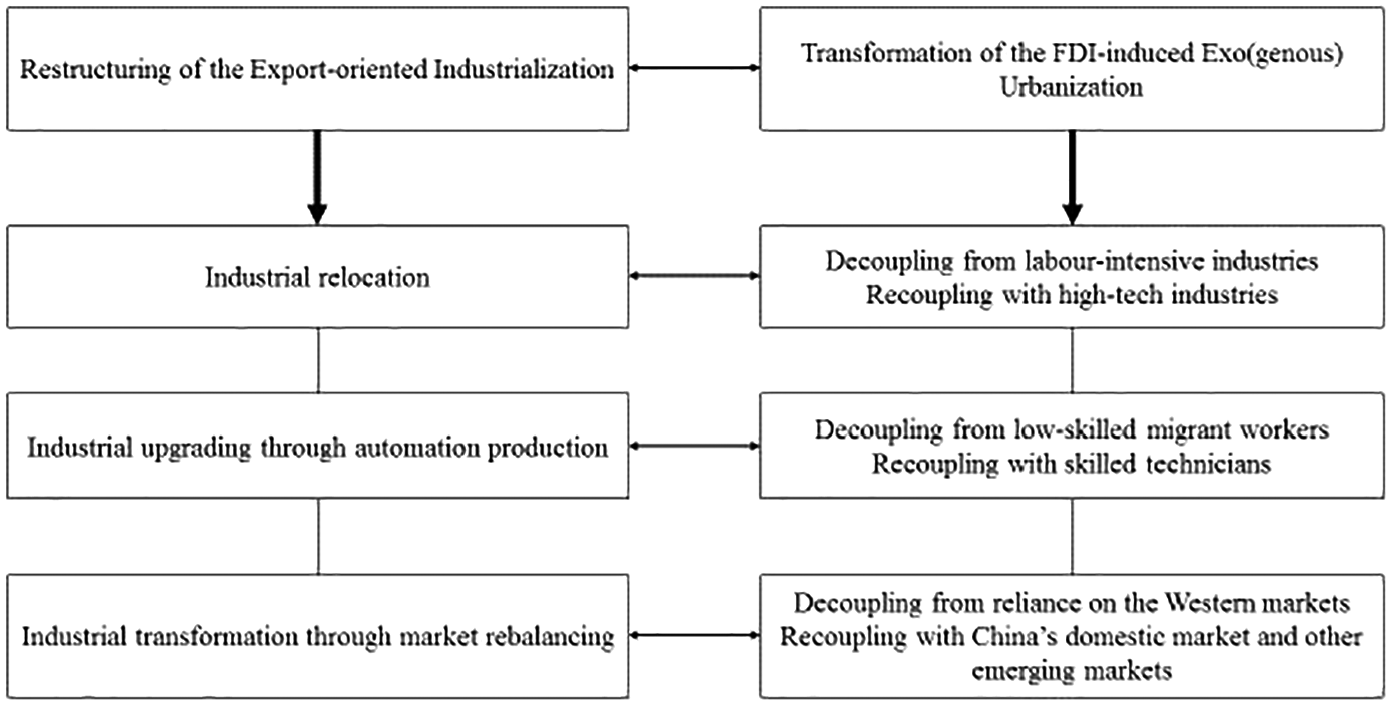
Urban transformation amidst industrial restructuring: An analytical framework.
The challenges of FDI-induced ‘urbanisation from below’ in the PRD: An updated investigation of towns in Dongguan
China’s urban transformation in the post-reform period has engendered a large amount of research output, focusing mainly on megacities and regions (Wu and Gaubatz, 2012; Wu, 2016). Little attention has been given to the transformation of lower urban settlements, particularly towns and villages, as ‘desakota’/peri-urban regions in the reshaping of global city regions. Towns, as the connectors between cities and rural areas, have played pivotal roles in China’s urbanisation (Lin, 1997; Ma and Fan, 1994; Sit and Yang, 1997). However, the role of these towns has fluctuated over time. As stated by Lin (2006: 50), the: emergence of new spaces of urbanization has not totally replaced the ‘old’ spaces under state capitalism. Instead, it is the co-existence and overlapping of the new and the old that have made the peri-urban region so complex, heterogeneous, and intensively mixed.
However, since the mid-2000s, towns have recorded a decline in numbers and population, compared with the rapid growth of the 1980s and 1990s. The total number of towns in the PRD dropped from 493 in 2000 to 321 in 2012. The percentage of the urban population living in towns decreased from 36.2% in 2000 (down 0.9 million on the previous year) to 24.2% in 2010 (down 2.9 million on the previous year). The changing roles of towns in the rapidly urbanising China of the post-reform period warrant updated exploration.
Situated between the two metropolises of Guangzhou and Shenzhen in the PRD, Dongguan (Figure 2) is a relatively advanced peri-urban region and can be regarded as ‘a rare and valuable laboratory’ (Lin, 2006) for the transformation of the ‘exo-urbanisation from below’ amidst industrial restructuring. Despite numerous studies on the functions and patterns of town-based urbanisation in the PRD, particularly on Dongguan as a desakota region in the 1980s and 1990s, an updated investigation on their transformation in the changing context of global–local dynamics, particularly in the wake of industrial restructuring since the late 2000s, is necessary. This study argues that the transformation of the widespread exo-urbanisation in the PRD, particularly Dongguan, can be better understood by examining the evolution of strategic coupling to decoupling and recoupling in the dynamic GPNs as induced by the ongoing industrial restructuring in terms of upgrading, transformation and relocation. Particular emphasis is placed on the uneven transformation of various towns in Dongguan, some of which have undergone demographic and economic shrinkage and some of which have experienced rapid growth in distinctive trajectories.
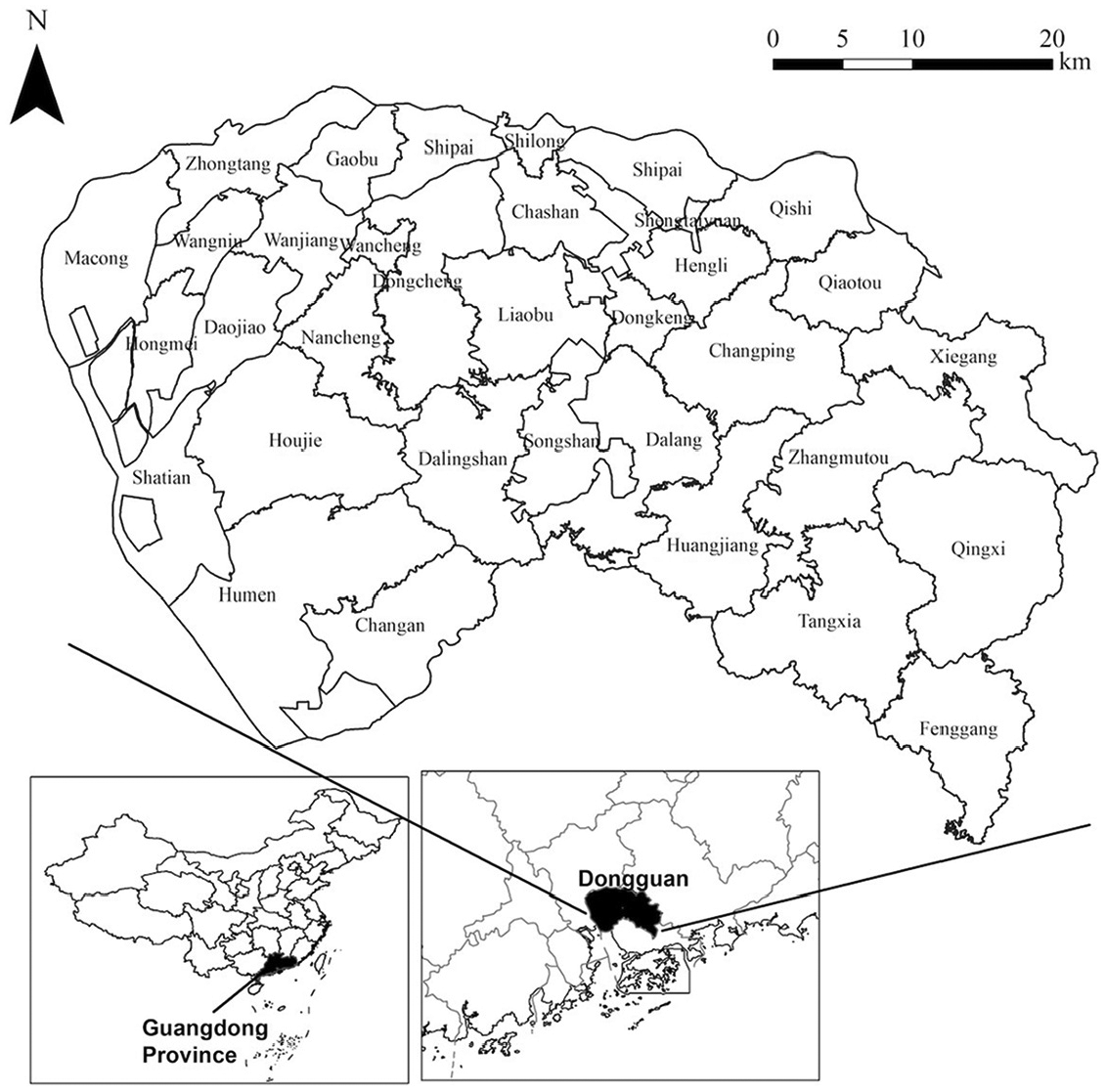
Location of Dongguan and the Pearl River Delta.
The data and information in this study have been obtained from continuous field investigations and observations by the author over several years since the mid-1990s, and the research questions used in this study have been sorted out, until a recent round of intensive fieldwork from 2015 and 2018. With the initial objectives of separately examining the industrial restructuring and urbanisation of the PRD and Dongguan, the author started from a different angle to examine the link between industrial restructuring and urban transformation, inspired by the information collected from field investigations. To maintain consistency and comparability, officially released statistical data were collected and analysed to identify general patterns and changes. Participant observation, semi-structured interviews and focus group meetings with those shareholders related to industrial restructuring and urban transformation in Dongguan, including government officials, foreign and domestic entrepreneurs, migrant labourers and local residents, were conducted in selected towns in Dongguan, that is, Chang’an, Qingxi, Humen and Songshanhu. Particular attention is paid to why some towns have experienced decoupling (e.g. Humen and Chang’an) whereas others (e.g. Songshanhu) have experienced recoupling with the dynamic GPNs, amidst the ongoing industrial restructuring and subsequent effects on the salient pattern of the peri-urban regions. The research period of the study is from the late 2000s, particularly in the aftermath of the 2008 global financial crisis, to the end of 2018.
The changing dynamics and restructuring of export-oriented industrialisation in the PRD since the late 2000s
Industrial relocation and paradigm shift: Evidence from Huawei’s relocation from Shenzhen to Dongguan
The salient pattern of export-oriented industrialisation has been attributed to the strategic coupling of local assets, such as low-cost labour and land, and the strategic needs of Transnational Corporations (TNCs), in the GPNs in a conducive institutional environment (Yang, 2012). However, since the mid-2000s, foreign-invested firms, particularly those from Hong Kong and Taiwan, have encountered unprecedented global and local challenges. Facing the shrinking external markets and other factors in China, such as the appreciation of the renminbi, labour shortages, a rise in the minimum wage, labour disputes and policy adjustments to processing trade, Hong Kong- and Taiwan-invested firms have adopted strategies to reduce the size of their workforce, increase investments in automation, promote research and development (R&D) and design activities, and expand the domestic sales market to sustain their competitiveness (Yang, 2012). Hong Kong manufacturers have approximately 4.5 million workers employed in the PRD, which is half the number from 10 years ago (FHKI, 2015). According to an interview with the Dongguan Association of Foreign-Invested Firms, nearly two-thirds of their member firms are hiring fewer general workers, with 40% hiring 35% fewer on average (interview in Dongguan, May 2016). Almost all the interviewed firms said that they are paying higher labour costs, and over one-third of them have experienced an increase of 25% to 45% in average wages (interview in Dongguan, November 2016).
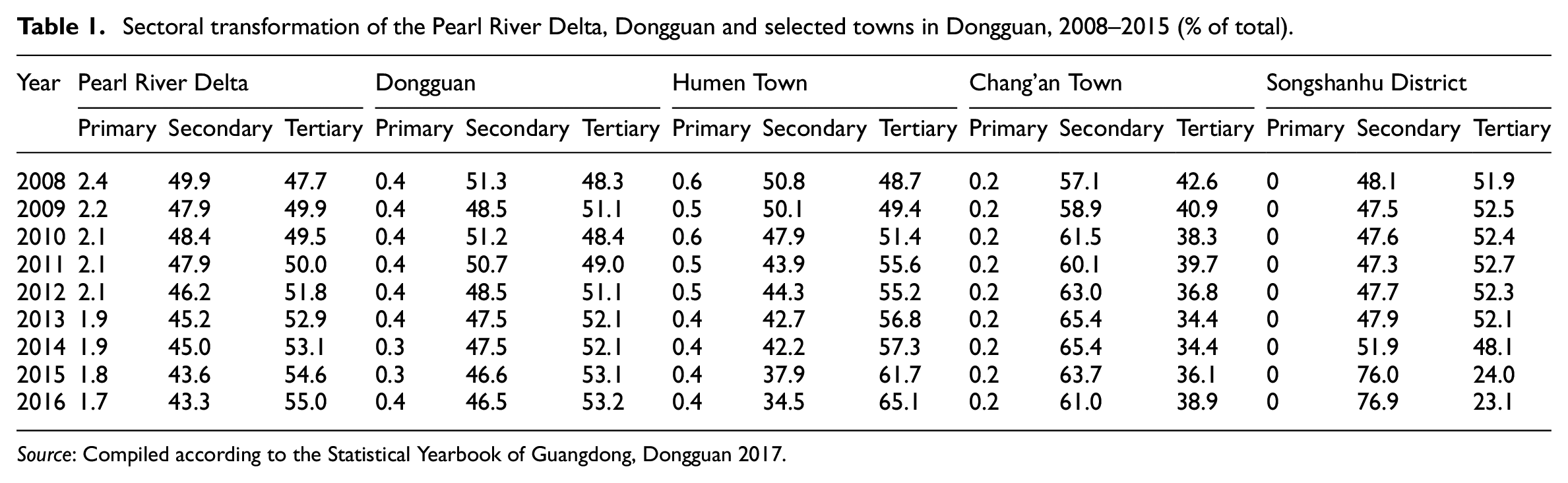
The relocation of production has not only become a firm-level strategy in the upsurge of labour costs but also a government strategy to foster industrial upgrading. In the mid-2000s, the Guangdong provincial government initiated its industrial upgrading strategy through relocation, upgrading and transformation, which consisted of ‘dual relocation’ processes in terms of labour-intensive firms and low-skilled labour out of the PRD to less developed areas of the province. The ongoing production relocations have been mostly of a partial nature, suggesting that most Hong Kong-funded manufacturers are still using the PRD as a production base while using their factories in the region to support and coordinate factories located in other countries (interview in Humen, August 2017). One of the investigated cases is the Aokang Group, an authorised leather goods supplier. It has strategically moved its R&D centre to Dongguan, which serves as evidence for the adapting ability and great determination of Dongguan under industrial transformation. The 2010s has witnessed a dramatic sectoral transformation in the PRD region and Dongguan. There was a marked declining contribution of the manufacturing sector to the GDP of the PRD from nearly 50% in 2008 to 43.3% in 2016, while in Dongguan the contribution fell from 51.3% to 46.5%. The towns in Dongguan recorded a drastic decline in the manufacturing sector, for example, Humen, which dropped from 51% to 35% between 2008 and 2016 (Table 1).
Sectoral transformation of the Pearl River Delta, Dongguan and selected towns in Dongguan, 2008–2015 (% of total).
Source: Compiled according to the Statistical Yearbook of Guangdong, Dongguan 2017.
Meanwhile, Dongguan has emerged as a relocation destination for domestic firms from Shenzhen – notably Huawei, a Chinese high-tech electronics firm. Adjacent to Shenzhen, Dongguan was the first choice for the expansion of Huawei. In July and August 2018, 2700 R&D personnel and 5400 employees of Huawei moved from Shenzhen to the Songshanhu High-tech Industrial Development Zone (hereinafter referred as ‘Songshanhu Park’) in Dongguan. By the end of 2018, Dongguan had 4058 high-tech firms and 2400 new high-tech business candidates, both ranking first among prefecture-level cities in the PRD. The added value of advanced manufacturing accounted for over half the total industrial output value in 2018. Songshanhu, which is located in the centre of Dongguan, is a new zone of 103 km2 and has become the most active ‘molecule’ of Dongguan’s transformation. The relocation of Huawei indicates the emergence of the ‘new Dongguan’, as remarked by one senior officer interviewed in Songshanhu Park (August 2018). Huawei’s move was not as simple as that of single firms. Instead, it initiated the migration of the whole industrial cluster/chain. Huawei’s software service providers, including Chinasoft International, eBao Software and Huawei Tomorrow, have also moved into Songshanhu Park (field investigation, July 2018). Apart from Huawei, high-tech firms, such as Lansi Science & Technology Corporation and Pulian Science and Technology Corporation, also relocated the production of their high-tech parts to Songshanhu Park. Among the newly established manufacturing firms in Songshanhu, nearly 80% are domestic firms and 20% are foreign-invested firms. This scenario indicates a paradigm shift from the FDI-driven industrialisation and exo-urbanisation that prevailed in the 1980s and 1990s, to a pattern driven by domestic firms and those targeting China’s domestic market and other emerging markets in the global south. The relocation of Huawei and other local high-tech firms from Shenzhen to Dongguan demonstrates an emerging recoupling of China-based TNCs as lead firms in the GPNs, whereas the prevalent strategic coupling of urban and regional development in the PRD has been primarily driven by the TNCs, mainly from Hong Kong and Taiwan over the past three decades.
Industrial upgrading and town-level transformation: New initiatives in machine substitution and automated production
Since the early 2010s, replacing manpower with industrial robots, known as ‘machine substitution’, has emerged as a firm-level response to the changing labour dynamics and state-led campaigns at various levels of government to foster the upgrading of China’s manufacturing. Digital automation and robotics have been named as one of the state-designated priority sectors that foster the development of intelligent manufacturing (MIIT, 2015). In the PRD, automated production has been advocated by provincial and various municipal governments to upgrade labour-intensive industries. The field investigation demonstrated the significant decrease in manpower in labour-intensive manufacturing firms. The CEO of a furniture firm in Houjie in Dongguan mentioned that 40 of their 200 employees had been laid off over the past two years after the installation of five robotic arms. The robots created payroll savings of 2 million yuan in 2016, equivalent to the previous year’s cost of the equipment. Profits rose to more than 15% in 2016, up from annual increases of approximately 8% before the robots were installed (interview in Houjie, May 2017).
Approximately 75% of the interviewed firms stated that their worker numbers had fallen dramatically since robots had been installed. Among these, unskilled workers were worst affected, with over 85% of the interviewed firms downsizing the number of frontline workers (interview in Humen, July 2017). According to estimates by the Development Research Centre, the think tank of the Guangdong provincial government, the adoption of industrial robots reduced the demand for migrant labour by 45,000 between 2004 and 2016 (interview in Guangzhou, May 2017). Such a transition has certainly changed the pattern of reliance by industrialisation and urbanisation on low-skilled migrants in labour-intensive industries over the past two decades.
Notably, the machine substitution initiative in the ongoing industrial restructuring has been driven by new waves of technological advancements, particularly industrial robots. Industrial robots and intelligent equipment are devices that deal with complex work traditionally performed by humans. China has become the largest market for industrial robots, with 36,560 of them sold in 2013, accounting for 20% of world sales. Although the majority of the interviewed firms claimed that workers lost through automation have been redeployed or retrained, labour disputes resulting from the robot deployment have increased (interview in Houjie, May 2017). The official statistical data indicated that approximately 200 firms have produced industrial robots in Dongguan and there were nearly 400 advanced manufacturing firms by the end of 2016. Data provided by the Dongguan Economic and Information Bureau indicated that from September 2014 to January 2017, the total investment in technological transformation increased by 51%. The production cost per unit decreased by 9.4% and the labour productivity increased 2.5 times, with nearly 200,000 fewer employees. Local government officials view the production of robots and automated equipment as a way to advance the city’s manufacturing sector and transform Dongguan from an original equipment manufacturer (OEM) base to an advanced manufacturing centre. Thus, the changes to the patterns of urban development warrant observation and investigation.
The transformation of FDI-induced urbanisation amidst industrial restructuring: The strategic recoupling of Dongguan in the global economy
The strategic decoupling of low-skilled migrants
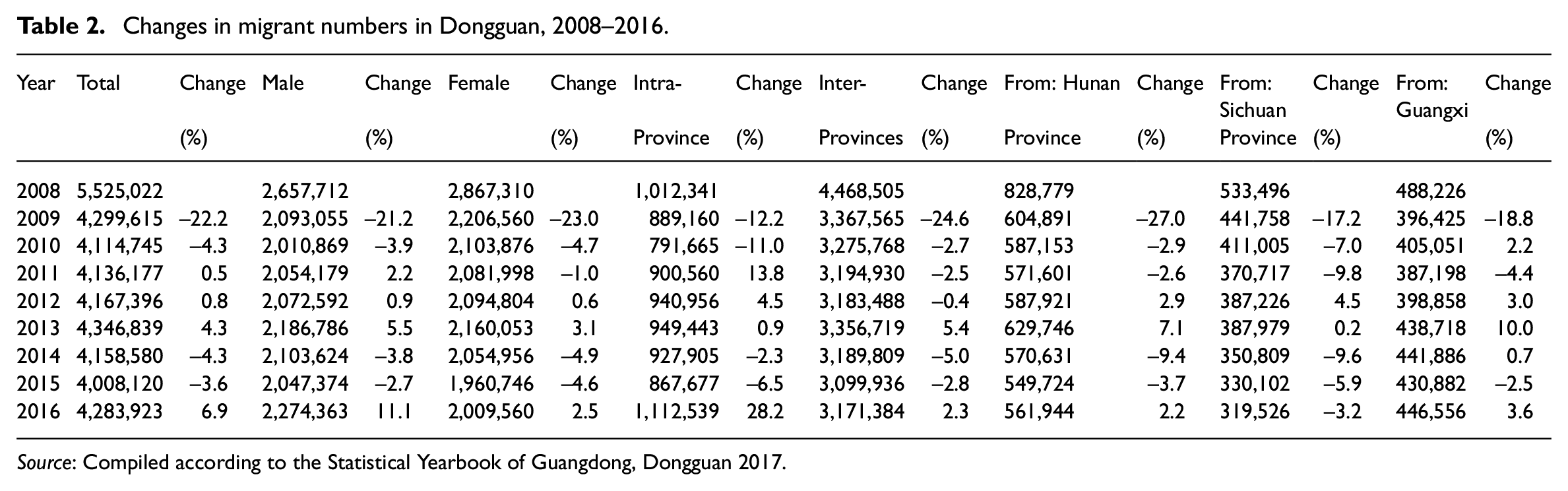
Since the early 1980s, migrant workers as competitive local assets have turned into crucial components of the export-oriented industrialisation that have strategically coupled with the GPNs. However, since the late 2000s, migrant labour in the PRD and Dongguan in particular has been decoupled. The decoupling has been proactively initiated by migrant workers since the early 2000s, and has been known as an emerging labour shortage (Chan, 2010). Almost all of the interviewed firms and business associations, such as the Hong Kong Chamber of Manufacturing Association (HKCMA) (interview with HKCMA, 2015), indicated that the situation has got more severe over time. According to HKCMA’s 2014 survey, the average employee numbers of the surveyed Hong Kong firms in the PRD decreased in 2013 from 703 persons to 599. The labour shortage rate increased from 16.9% in 2010 to 19.4% in 2013. Along with the shutdown and relocation of foreign-invested firms out of the PRD, a significant decline in migrant labour in major cities of the PRD since the late 2000s has been observed. As indicated in Table 2, the total migrant population significantly dropped by 1.24 million, from 5.5 million in 2008 to 4.3 million in 2016. The contribution of migrants to the total population in Dongguan has also declined. Notably, the number of female migrant workers recorded a more marked decline of 0.86 million compared with that of male workers of 0.4 million from 2008 to 2016. Sichuan and Hunan, the major destinations for industrial relocation of labour-intensive firms out of the PRD, have seen a dramatic decline in migrant numbers – with the Sichuan province from 0.5 million in 2008 to 0.3 million in 2016, and the Hunan province from 0.8 million in 2008 to 0.56 million in 2016. Evidently, the ongoing industrial restructuring has been changing the population structure of the PRD. Migrants account for 70% of the total population of Dongguan. Consequently, with this population returning home during the spring festival period, which usually occurs in February, Dongguan becomes the emptiest city in China during the holidays.
Changes in migrant numbers in Dongguan, 2008–2016.
Source: Compiled according to the Statistical Yearbook of Guangdong, Dongguan 2017.
Meanwhile, selected towns have experienced recoupling dynamics. For instance, Songshanhu recorded an increase in manufacturing contribution to the total GDP from 48% in 2008 to 77% in 2016, a marked increase of 30% in a short span of less than a decade (Table 1). The findings of the present study echo those of an earlier study by Du and Li (2017), which categorised the 32 towns of Dongguan into four types, namely significant expansion (e.g. Songshanhu, Houjie and Falang), significant shrinkage (e.g. Tangxia, Dalingshan and Zhangmutou) and others with emerging expansion and emerging shrinkage (e.g. Changpin, Qingxi and Shilong). This study argues that the interpretation of urban shrinkage with a focus on the decoupling dynamics has largely ignored the emerging recoupling of selected towns in the dynamic GPNs and has made the focus the changing landscape of urban transformation in Dongguan. As remarked by a local official in charge of urban planning in Dongguan, there are two possible scenarios for what could happen. Firstly, if the majority of migrant labourers leave Dongguan, then the patterns of urban development in the city will significantly change. Secondly, if migrant labourers remain, then the outcomes of industrial upgrading will make it difficult for them to survive in the changing context of the local economy (interview in Chang’an, April 2017). The co-existence of the decoupling of low-skilled labour and the recoupling of skilled migrant labour has had fundamental impacts on urban transformation in China, and the PRD in particular.
The uneven recoupling of towns in the dynamic GPNs
The FDI-induced urbanisation that prevailed in the 1980s and 1990s took place at the grassroots level. The majority of local residents who held the agricultural household registrations diversified their occupations and shifted away from farming into more profitable non-agricultural activities. Villages at the lowest position in the administrative hierarchy in China played pivotal roles in the salient pattern of ‘urbanisation from below’ in Dongguan. In developing the export-oriented industrialisation and exo-urbanisation of the 1980s and 1990s, local governments at the town and village levels established close coalitions with foreign-invested firms, particularly those from Hong Kong and Taiwan (Yang, 2012). Villagers expanded their housing to accommodate rural migrant workers and earned significant rental income from housing (Xue and Wu, 2015). The rental economy accounted for a significant proportion of village incomes, at approximately 70% before the outbreak of the global financial crisis and industrial restructuring (Dongguan Statistics Bureau, 2008). The income of rural collectives derives from the following sources: profit from village-owned enterprises, rental income from factory buildings, payments from contracting agricultural work to rural migrants from other regions and housing rent from rural migrants. In this way, villagers realised urbanisation through engagement in the so-called rental economy, and village communities developed public services through the rental income from foreign-invested firms and migrant labour. Instead of using spare village halls, villages managed to obtain loans from banks to develop factory buildings to rent out to investors. At the same time, the villagers expanded their properties to accommodate rural migrant workers and receive rental income.
Since 2000, particularly in the aftermath of the 2008 global financial crisis, the transformation of export-oriented production and the decline in rental income have seriously damaged the finances of rural collectives that were the backbone of entrepreneurial governance in the PRD and Dongguan in particular. The outbreak of the 2008 global financial crisis exacerbated the collapse of the rent-seeking industrialisation and urbanisation from below, particularly in local villages. The majority of the villages and towns faced increasing debt, thus making public services difficult to fund. In Humen, for example, the income of villages decreased from 3190 million yuan in 2005 to 1245 million yuan in 2016. During the same period, the debt value in Humen increased from 1420 million yuan to 2336 million yuan. As remarked by an interviewed migrant who has worked and lived in Dongguan for 20 years, ‘Dongguan’s development is attributed significantly to a large number of immigrants. But the power of the city is in the hands of local people, who have benefitted more from the prosperity of the city’ (interview in Chang’an, May 2017). Chang’an’s income decreased from 2014 million yuan in 2005 to 1303 million yuan in 2016, and its debt value increased from 1273 million yuan to 1673 million yuan during the same period (Dongguan Statistics Bureau, 2018). With the closing down of factories and the decrease in the number of migrant workers, the rental economy encountered serious difficulties. The rent for factory buildings declined from 15 yuan per square metre in 2008 to approximately 6 yuan per square metre in 2016, but the vacancy rate increased (interview with a local official in Chang’an, May 2017). Far from the plea for ‘inclusive urbanisation’ (Zhu and Tian, 2017), the case in Dongguan has indicated a salient ‘exclusive urbanisation’ through decoupling of low-skilled migrant workers and villagers in the industrial restructuring and urban transformation.
In comparison, towns, such as Humen and Chang’an, have continued to rely on the export-oriented processing trade and have experienced difficulties engaging in low-value added assembly in the transition to globalisation. Although firms in these towns have tried to exit the low-profit processing business, the share of the processing trade dropped from over 70% in 2000 to 37% in 2017, the latter of which is still higher than the national level of 29% (Guangdong Statistics Bureau, 2018). Industrial transformation in these towns became more challenging in the face of uncertainties in international trade, particularly the recent US–China trade friction in 2018–2019. Distinctively, the newly established Songshanhu Park has benefited from the support of the Dongguan municipal government in targeting high-end manufacturing by developing high-tech industries and becoming an innovative hotspot in the PRD, particularly the relocation of high-tech firms from Shenzhen, such as Huawei. Evidently, the urban transformation amidst industrial restructuring demonstrated an uneven pattern, with ‘spatial selectivity’ (Wu, 2016).
Conclusion and discussion
Although a growing body of literature has been devoted to the examination of industrial restructuring and urban/regional transformation in the global south, little research has examined the interplay between the two parallel processes in the dramatic transition of globalisation since the mid-2000s (MGI, 2019). Existing interpretation of urban transformation has mainly focused on the analysis of internal dynamics in the national context, with insufficient attention to the interplay between global and local dynamics. Recent studies on urban transformation in China, particularly in the PRD, have delineated the ‘dark side’ of strategic coupling in the GPNs, that is, shrinking towns and villages reflected by population decline (Du and Li, 2017; Long and Wu, 2017). However, this study argues that this interpretation neglects the emerging recoupling of skilled labour and the positive impacts of industrial upgrading on urban transformation at the town level in the long run. The study sheds light on the three important processes of industrial restructuring, namely industrial relocation, upgrading through automated production, and market rebalancing of the export-oriented manufacturing activities in the PRD. It argues that the prevalent exo-urbanisation has undergone an uneven transformation at the town level in Dongguan. Such exo-urbanisation is characterised by the emerging shrinkage of selected towns (e.g. Humen and Chang’an) induced by the decoupling of migrant labour and low value-added manufacturing firms and the emerging growth in selected towns (e.g. Songshanhu) through the recoupling of technology-based domestic manufacturing firms and high-skilled labour in relation to automated production. The study also sheds light on the uneven ‘spatial selectivity’ (Wu, 2016) in the transformation of the prevalent export-oriented industrialisation and exo-urbanisation in China in response to the dynamic changes and transition of globalisation since the mid-2000s.
The study provides vivid empirical evidence, which helps advance conceptual attempts to forge connections between urban transformation and industrial restructuring in the global south in the changing global economy. It enriches the literature on urban transformation by incorporating the analysis of global dynamics and its interplay with local factors, and extends the industrial restructuring studies to the local level, particularly towns and villages, in the evolutionary strategic coupling in the GPNs. The study advocates an empirical analysis of the changing roles of towns in the transformation of urbanisation in China, particularly in the context of the ‘new-type urbanisation’, which places more emphasis on metropolitan regions (Chan, 2014). The recently promulgated GBA planning framework by the State Council has confirmed the direction of urban transformation and industrial restructuring in the PRD. The framework aims to ‘expedite the structural adjustment of the manufacturing industry’ by ‘nurturing strategic emerging industries’, including ‘new-generation information technology, biotechnology, high-end equipment manufacturing and new materials’ (GBA, 2019). While still at the initial stage of implementation, the plan framework apparently complies with the decoupling and recoupling initiatives in the PRD as examined in this study.
The analysis of the representative towns in Dongguan provides two types of narratives of urban transformation and industrial restructuring in the global south. First, it shows the transformation from strategic coupling to decoupling through the relocation of labour-intensive industries out of Dongguan. Second, the study discusses the transformation from strategic coupling to recoupling through the relocation of domestic high-tech firms, such as Huawei from Shenzhen to Dongguan. The limitation of the study lies in its focus on Dongguan, a city that has developed based on export-oriented industrialisation and exo-urbanisation since the late 1970s. This sample may not reflect the scenarios in other cities in the PRD in response to the changing global–local dynamics. The study thus urges more empirical analyses on the multi-scalar dynamics at the global, national, regional, local and firm levels and on the subsequent effects on the decoupling and recoupling of urban development in the global south in the dynamic global economy. Echoing Phelps et al.’s (2018) recent ‘invitation’, the study sheds light on the paradigm shift of urbanisation in China and new avenues for future research on the ‘bright’ and ‘dark’ sides of the interplay between industrial restructuring and urban transformation in the transition of globalisation.
Footnotes
Acknowledgements
The author is indebted to the participants at the International Conference on China Urban Development held in London in May 2017 and annual conference of Urban China Research Networks (UCRN) held in Wuhan in 2018, for their constructive comments on the earlier versions of the paper. I am grateful for the three anonymous reviewers and the Editors of this special issue Professors Fulong Wu and Fangzhu Zhang, as well as Managing Editor Professor Jon Bannister for their insightful suggestions and comments which helped improve the paper. Particular thanks go to Huizeng Liu and Tialan Fu for compiling the map.
Declaration of conflicting interests
The author(s) declared no potential conflicts of interest with respect to the research, authorship, and/or publication of this article.
Funding
The author(s) disclosed receipt of the following financial support for the research, authorship, and/or publication of this article: National Natural Science Foundation of China (41571119), HK-Germany joint research (HKBU-G-205-16), as well as Hong Kong Baptist University Faculty Research Grant (FRG1/16-17/035 and FRG1/17-18/013).
