



Abstract
The article discusses the results of research on Chinese new towns focusing on three places: Tongzhou New Town, located in the eastern suburban expansion of Beijing; Zhaoqing New Area, currently being built approximately 20 km from the old city of Zhaoqing (Guandong Province); and Zhengdong New District, located near Zhengzhou (inland Henan Province). Tongzhou, Zhaoqing and Zhengdong have absolutely nothing in common: location, size, spaces, economies, inhabitants, or when and how they were built. However, studying these places allowed us to identify two issues that still seem to be in need of investigation both empirically and theoretically: the spatial features and regional scaling-up of the Chinese urbanisation processes. While presenting these issues, on the one hand, the article emphasises their specificity in the investigated contexts and, on the other, it transcends these specific cases in order to question urban studies beyond the (alleged) exceptionality of Chinese urbanisation. By adopting this approach, Chinese new towns become an object of study as well as a specific viewpoint from which to examine contemporary urbanisation and radically re-discuss old categories, conceptualisations and even the epistemology of the urban.
Introduction
In the early 21st century, the Chinese Government announced it had decided to build 20 new towns each year for the next 20 years; in total, approximately 400 new towns will be designed and built before 2020 (Fang and Yu, 2016; Shepard, 2015). New towns are not a novelty. They have an established history and well-known experiences (Wakeman, 2016). Building new towns in China is one of the strategies of ‘city making’, at least since the mid-20th century. Nevertheless, these strategies change over time, as do the results.
The satellite towns built between 1950 and 1980 were part of a policy of ‘industrialisation without urbanisation’ (Ren, 2013). Their main role was to encourage industrial enterprises to locate around big cities such as Beijing and Shanghai (Gu et al., 2015; Wu, 2015). After the 1970s, with the advent of economic reforms and the opening up of the market, new towns became one of the tools to implement economic development strategies, attract businesses and investments, promote real estate and launch the Special Economic Zones of Shenzhen, Zhuhai, Shantou and Xiamen (She, 2017; Wu, 1999; Yeung et al., 2009). Later, institutional reforms – especially decentralisation processes and the fiscal reform of the 1990s – redefined the relationship between central and local governments. In turn, the land reform in 2000 prompted local governments to implement entrepreneurial strategies and ‘land-based local development’ (Wu, 2016: 1139) which was, to a great extent, land-based urban development.
All these reforms sparked not only a new political-institutional set-up, but also a new spatial organisation that acknowledged urbanisation as one of the undeniably most efficient mechanisms with which to facilitate economic growth. Indeed, the Chinese transition or, better still, the institutional, economic and political transformation of China ‘away from state socialism’ (Ma, 2002) was boosted by the dynamics of urbanisation. The chiefly urban-based ‘rampant’ entrepreneurialism of local governments has often been linked to the market-oriented urban policies David Harvey wrote about in 1989, labelling it a sort of ‘inevitable destiny’ of Western countries in a late capitalist age. The growth machine became the reference model required to understand Chinese urban governance (Wu, 2015). However, institutional conditions radically called into question the ‘destiny’ acknowledged ‘as inevitable’ in the West, thus giving rise to the ‘Neoliberalism with Chinese characteristics’ (Harvey, 2005; Wang, 2003) created by the merger of Party, State and market. Although Zhou et al. (2019) question the consistency of ‘neoliberalism’ as a theoretical framework, Wu (2018: 1385) highlights that ‘local development and politics may not be limited to the growth machine and machine politics, but may include the need to maintain state power’ since they can be better inserted into the urban regime framework (Logan, 2018).
The suburbanisation phases identified by Wu and Shen (2015) describe the gradual opening-up of the market to urbanisation and suburbanisation. New towns become part of a new, emerging space; they act not only as a multifunctional ‘planned support’ for the market, but also as the new centres of the spatial reconfiguration of regional urban systems (Xu and Yeh, 2010) in which ‘the relationship between the central city and its suburbs [shifted] from one characterized by scattered industrial satellite towns with a vast rural area for vegetable cultivation, to one of suburban new towns and a globalizing central area that formed a unified global city region’ (Wu, 2016: 1139). Politically speaking, national government uses new towns to counter the localism and exasperated entrepreneurialism of municipal growth machines. The development of new towns in suburban areas composes and redefines the relations between the State and the market and gradually turns the suburbs (previously urban spaces) into spaces of capital accumulation (Shen and Wu, 2017).
Although Chinese new towns are part of this physical, institutional, political, economic, local and global framework, they are less well-known and difficult to include in a discourse or a tradition and process that has already taken place. 1 It is not even easy to say exactly what contemporary new towns in China really are. This is not a purely linguistic problem. The term ‘new town’ is used to indicate new towns, new districts, new areas, new cities, etc. that are even institutionally different (Chan, 2010). These nouns share the adjective ‘new’, but it can always be replaced by something even newer. In fact, imbuing the adjective new with its own interpretative content necessarily means specifying why it is new (compared with what).
Providing atlases and definitions, or identifying characteristics and models, do not help clarify an ambiguity that is partly constitutive and partly contingent: new towns are developing, they escape any sure-fire hypothesis, they ask questions and question us: where are their boundaries? What is their relationship with all the urbanisation processes they are part of? Which economic, political and design mechanisms create and legitimise them? Which idea of a city is designed and built in and by these new settlements? What orders, rules and hierarchies exist in these spaces which, all together, deny what exists and assert an alleged novelty? Asking these questions, new towns elude attempts to include their characteristics within the vagueness of tabula rasa, negation, mistake and defect: cities built from scratch (Herbert and Murray, 2015); examples of fast urbanisation disconnected from their physical and social context, global in form, logic, actors and imaginary (Datta and Shaban, 2016); experiments of a dystopian urban future, with no depth or quality (Pow, 2015).
It is so difficult to understand what contemporary Chinese new towns are that most of them are traced back to the exception of the exceptional nature of Chinese urbanisation. Many books and articles begin by talking about numbers and the speed with which change takes place: between 1978 and 2014 the urban population increased from 18% to 54.8% of the total population; migratory flows annually involve over 16 million inhabitants who move from rural to urban areas (National Bureau of Statistics of China, 2014). Urbanisation is prompted by national policies: the 2014–2020 National Urbanisation Plan aims to achieve a 60% urbanisation rate and an increase of 100 million new inhabitants in urban areas by 2020 (Zhang et al., 2016).
Data describe unquestionable processes of change which are, however, more questionable than they may appear at first sight. The methodological and empirical limits as well as the theoretical and more radically ontological aporias which, according to Brenner and Schmidt (2014), contradict the urban age thesis, appear to also be the limits and aporias of the attempts to reliably certify urbanisation processes in China. Chan (2010, 2014) has repeatedly emphasised how in China not only the system used to collect and process socio-economic and demographic data but also the delimitations of cities are extremely confused and complex. 2 Urban China seems to be an enigma, a huge puzzle that changes over a period of time and is practically impossible to solve. Nevertheless, it continues to be described as exceptional, regarding either huge numbers, or rapid changes ‘unprecedented in the history of humanity’ (Miller, 2012; World Bank, 2014), or as ‘the largest construction site in the world today’ (Zhu, 2009: 169) and ‘the largest mass migration the world has ever seen’ (Harvey, 2005: 127).
The thesis of Chinese exceptionalism applied to urbanisation facilitates our ability to acknowledge that Western urban theory is unsuited to narrate (and understand) Chinese cities. One of the main issues highlighted by He and Qian (2017) in their informed framework of the academic debate on urban China is the relation between the exceptional and the ordinary, and the need to open up a somehow revised ‘cosmopolitan approach’. 3 How can we account for the merger between the exceptional and the ordinary, between Chinese specificities and global traits (Pow, 2012)? China is different, both as regards Western urbanisation canons and the ones provided by subaltern and post-colonial theories that reject Eurocentrism, propose the so-called ‘provincialisation’ of urban theory, and encourage us to consider the cities that are ‘off the map’ or in the lower part of the ‘rankings’ of global cities (Robinson, 2006), China is not present. It is not off the map. Beginning in the late 1990s, Chinese cities are well and truly inscribed in the map of global cities, albeit with ‘Chinese characteristics’.
The ‘Chinese characteristics’ refrain is perhaps indicative of a possible mediation, which, however, should be applied everywhere and at all levels: neoliberalism, global cities, new towns, etc., with ‘European characteristics’, ‘Mediterranean characteristics’ and ‘Italian characteristics’. As a result, generalisations are determined within national or at least areal canons; they define a tradition, a specific story capable of limiting extensions. This kind of approach does not help us understand the way in which an ensemble of albeit localised specificities, as new towns are, surpass local transformation processes.
The ambiguity of new towns is not only an ineliminable fact, it is also a possibility to question the characteristics and contradictions of Chinese urbanisation processes, quite beyond the exceptionality of demographic data. In 2005, Doreen Massey asked: ‘what if we open up the imagination of the single narrative to give space (literally) for a multiplicity of trajectories?’ (p. 5). In line with her statement, this article uses the ambiguities of Chinese new towns to ‘shake up’ categories and models, point out the fallacies of some key assumptions of the conventional understanding of the exceptionalism of urban China and discuss the need to change our idea of contemporary urbanisation processes (Bonino et al., 2019). As a result, the ambiguity of Chinese new towns is the ambiguity of an observation inspired by the theoretical and conceptual frameworks (and experiences) of Western urbanism, and an openness towards an urban theory ‘beyond the West’ (Edensor and Jayne, 2012).
Most studies devoted to the process of Chinese urbanisation are mainly inscribed in a political economy approach, looking at cities (and new towns) as places of capital accumulation, at the complex governance issues related to them and at the redefinition of the relationships between the state and the market. Without denying this approach, our aim is to open the new towns and re-discuss excessively simple narrations that force them into conceptual models that are too old, too poor and too standard. The traditions behind new towns are outdated; the models currently used by the market to renew them are ephemeral and transitory (eco-city, techno city, low-carbon city, healthy city, smart city, etc.); the morphologies that inspired their spatial functions are poor; the expansion strategies tasked with decentralisation, completion and enhancement are standard. When we look at these places in constant formation, crossed by local and global relations, and to the role they play in the incredible urbanisation process of which they are part, Chinese new towns force us to open up interpretations and to move beyond conceptual and theoretical closures as well as general and generalisable models, wherever they come from and whatever their characteristics. By adopting a flexible and open interpretative framework, questioning new towns is a way to question what cities are (and what have they become) in China and elsewhere (Amin and Thrift, 2017).
The article is structured as follows. After the introduction, the next section presents three new towns: Tongzhou New Town, located in an old industrial district in the eastern suburban expansion of Beijing; Zhaoqing New Area, a new town currently being built approximately 20 km from the old city of Zhaoqing (Guandong Province); and Zhengdong New District, a new town located near Zhengzhou (inland Henan Province) (for a more detailed account of the empirical findings, and of the limits and possibilities of the fieldwork conducted, see Bonino et al., 2019). Through awareness of the institutional differences between new district, area and town, referring to these new towns allows us to ground our reasoning and scrutinise the spatial features of Chinese new towns (the following section) and their role in the regional scaling-up of Chinese urbanisation processes (penultimate section). Finally, these issues are critically discussed in the conclusion (final section) in order to question and redefine any old urban categories and models.
What does a new town do? Exploring Tongzhou, Zhaoqing and Zhengdong
Tongzhou New Town, Zhaoqing New Area and Zhengdong New District are radically different in size, geographical location, design date, state of construction and the administrative level that initiated their planning. They are not even exemplary; they cannot provide a comprehensive picture of the numerous identifiable situations or general features of the construction of new towns in China. Instead they can be used to debate the way in which the construction of new towns attempts to reconfigure consolidated regional conurbations.
Tongzhou (Figure 1) is a good example of how the season of satellite towns evolved into the season of current new towns and how, through decentralisation and displacement, a polycentric urban region takes shape.

Tongzhou New Town, 2017.
Tongzhou was previously a county, but in 1997 was upgraded as a district of the Beijing Municipality; it is located in the eastern expansion of Beijing where production has been located since the 1950s, bringing with it an influx of inhabitants (1,428,000 in 2016; Beijing Municipal Bureau of Statistics, 2017). The role of Tongzhou is fully acknowledged and implemented in the Beijing Masterplan 2004–2020, which aims to organise the polycentric development of the capital and the decentralisation of the population and ‘non-capital functions’ (Feng et al., 2008; Gu et al., 2015). The Masterplan divides Beijing into four areas – ‘core, development areas, new growth areas, and ecological conservation areas’ – and promotes a polycentric strategy with the formula ‘two axes, two belts and multiple centres’. The ‘two axes’ correspond to the traditional North/South expansion axis of Beijing and the new East/West axis along Chang’an Avenue; the ‘two belts’ correspond to the ‘western ecological belt’ and the ‘eastern developmental belt’, while three of the 11 ‘multiple centres’ are called new towns (Shunyi, Yizhuang and Tongzhou; Wu and Phelps, 2011). The development of Tongzhou new town began in 2010 (Yang et al., 2013), while in 2015 the Central Government chose it as the seat of the Beijing municipal offices (Beijing People’s Municipal Government, 2016). This decision represents the culmination of a long decentralisation process which is now part of a macro-regional strategy. In fact, in line with the mandate of the Thirteenth Five-Year Plan, Tongzhou new town is one of the new poles of the Beijing Municipality and part of the Jing-Jin-Ji Global City-Region strategy aiming to merge Beijing, Tianjin and the Hebei Province (Cartier, 2016). Apart from the now usual (and reiterated) need to reduce pressure on the central districts of Beijing by shifting ‘non capital’ functions and controlling the increase in the population, the Jing-Jin-Ji Cooperative Development Outline Plan for the Beijing-Tianjin-Hebei region (2015) indicates that ‘cooperative development’ of the city-region should be based on: coordinated environmental and transportation policies; technological and infrastructural integration; and effective relations between research centres and economic activities.
Zhaoqing new town (Figure 2) exemplifies the strengthening of the Pearl River Delta city-region and the role played by its municipalities, in particular by a ‘small city’ such as Zhaoqing (665,000 inhabitants and 85 km2; Statistics Bureau of Zhaoqing City, 2016).
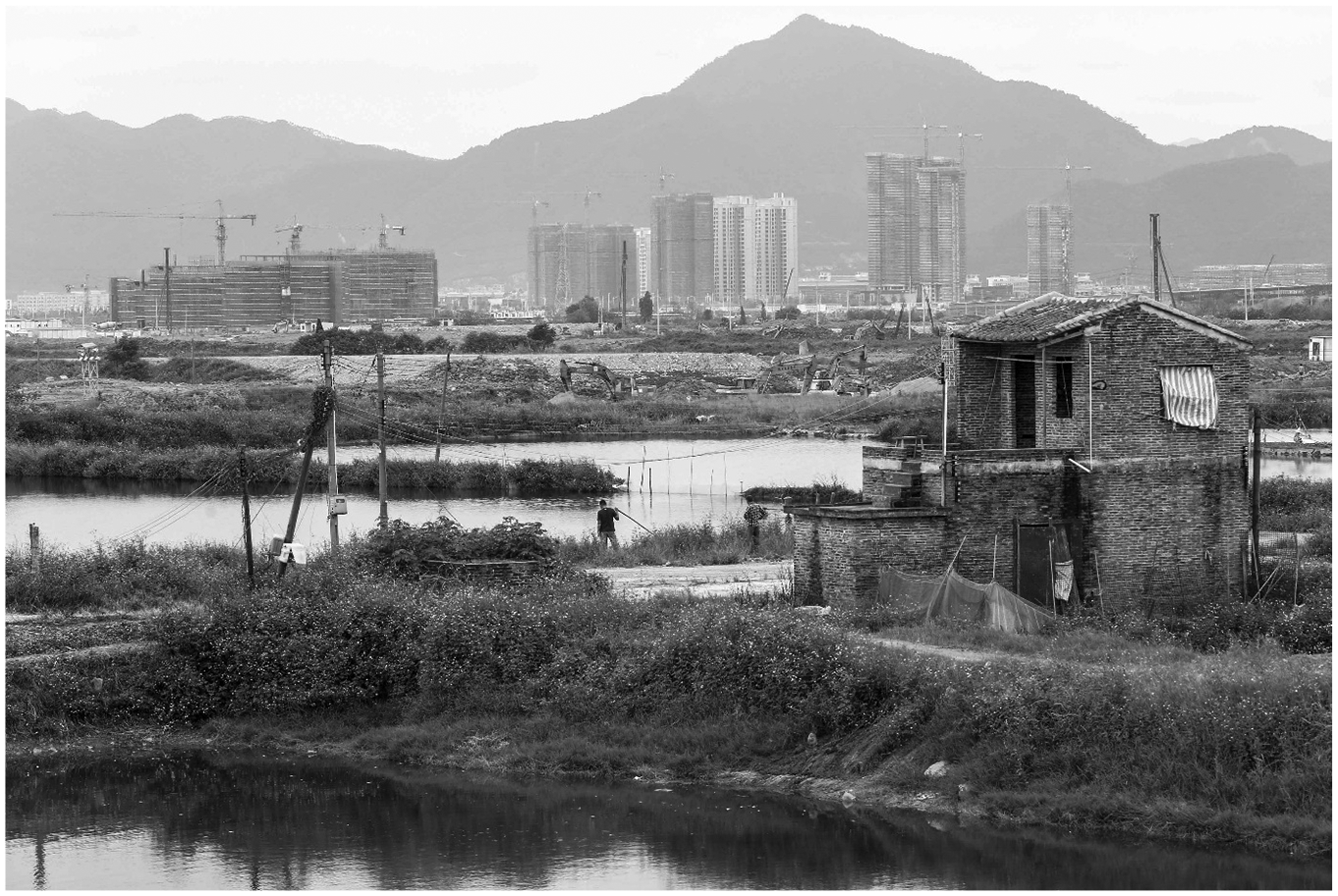
Fishponds in Zhaoqing New Town, 2017.
The Pearl River Delta is one of the most representative examples of economic and urban growth in China. In the last 50 years this mainly agricultural area has turned into a city-region (Ng and Tang, 1999) with a population of roughly 120 million inhabitants (UN-Habitat, 2010) and a clear inner hierarchy (Xu and Li, 2009). Compared with the rest of the sprawling agglomeration, Zhaoqing (located 80 km west of Guangzhou along the main infrastructures along the Pearl River) has remained a compact urban nucleus surrounded by waterways, mountains and small rural villages, separated from the main urbanisation by vast areas of agricultural land. However, the year 1985 saw the establishment of the Pearl River Delta economic zone and subsequent implementation of several initiatives by local governments (both municipal and provincial). In particular, in order to reinforce regional integration, the Reform and Development Planning Outline for the Pearl River Delta Region (2008–2020) divided the Pearl River Delta into three metropolitan areas: Shenzhen-Dongguan-Huizhou, Guangzhou-Foshan-Zhaoqing and Zhuhai-Zhongshan-Jiangmen. As part of this framework Zhaoqing was identified as one of the ‘two backbones with multiple poles that can promote the development of the peripheral areas’ (Guangzhou Municipality, 2010). The municipal government exploits this strategy and uses Zhaoqing new town as a way to enter the economic space of the city-region and thus the competitive dynamics of the global economy. Indeed, the Zhaoqing New Area Concept Planning, officially approved in October 2012 (Zhang, 2016), proposes a new settlement of 600,000 inhabitants in an area of 115 km2 on the east side of the old city (Zhaoqing New Area Development and Planning Bureau, 2012, 2016).
Finally, Zhengdong New District makes it possible to understand the evolution of the urbanisation logic in inner China. In fact, while the coastal regions have for many years been the privileged venue for the rapid urbanisation of the country, inland regions have been largely characterised by minor and diffuse agglomerations (Ren, 2013; Wu, 2015). In the last three decades these areas were included in infrastructure policies focusing on the design of new road and railway networks. Zhengzhou claimed its role as an infrastructure hub within this framework not only because of its geographical location, but also because of the infrastructures already in place as well as a huge increase in inhabitants (the urban population rose from 1.3 million in 1980 to 4.5 million in 2010; Zhengzhou Municipal Bureau of Statistics, 2017). In 2001 the municipality launched a competition for the construction of a new town aimed at turning Zhengzhou into a ‘national central city’ (Li, 2010a). Zhengdong New District doubles the extension (and population) of Zhengzhou thanks to a ‘mega urban project financed through entrepreneurial land development’ (Wu, 2015: 94) keenly promoted by the provincial government. Kisho Kurokawa Architects and Associates proposed a metabolist-style project that divided the land area into five clusters separated by ‘ecological corridors’ hosting the most important mobility infrastructures (Li, 2010b). Although still under construction, Zhengdong looks like the end result of an outdated idea that considered the construction of monumental centres as a way to empower vast regions. Since 2005, national policies have made this idea obsolete. In particular, the Eleventh and Twelfth Five-Year Plans (2005–2015) emphasised the need to develop inland regions by strengthening urban agglomerations (Fang and Yu, 2016).
The Central Rise Strategy acknowledged the role of Zhengzhou (Figure 3) as the capital of the Central Plains Urban Agglomeration, which produces 3.06% of China’s GDP and is home to 45.5 million inhabitants (3.39% of the total population) (Fang and Yu, 2016). Zhengbian New District is the outcome of this new season. Promoted in 2006 by the municipalities of Zhengzhou and Kaifeng and the government of Henan Province, Zhengbian New District is a linear, 80-km-long city intended to merge Zhengzhou and Kaifeng: it covers an area of 40,000 ha and has a current population of 4.5 million inhabitants (Wang, 2007; Wu, 2015).

Jailu River near Zhengzhou, 2017.
The space of the new towns
When considering the three aforementioned places it is possible to see how the infrastructures of the new towns and their vague development programmes establish distinctive traits of these peculiar bordered spaces scattered throughout the larger area of urbanised China. Looking at these few distinctive traits – delimitation, infrastructuring and programmes – this section highlights more specific features of the space of the investigated new towns, thus trying to mark a clearer distance between this ambiguous form of urbanisation and the city as we have known it so far.
In Tongzhou, the new town adapts to, and sometimes replaces, a rather large part of the Municipality. Here the new town takes the shape of an urban redevelopment that does not disrupt the current layout of big blocks nestling between mobility infrastructures, rivers and a complex pattern of public open spaces. It mostly renews them through plans that chiefly engulf and reorganise what they find, respecting nature and history and sometimes even turning them into heritage. In Zhaoqing, instead, everything is new. The sprawling agricultural land where the new town is to be built has already been cleared to make way for three main systems which, at least on paper, merge and are superimposed; the aim is to place a new city-park here: waterways, roads and big, natural open spaces. In Zhendong the new town is not a park. It looks and works more as a machine because of the way it is organised through a rigid system of huge mobility infrastructures connecting functional clusters that are separated and far from each other. Zhendong is implemented in Zhengbian thanks to plans that exploit and strip the already essential pattern of the original nucleus. Within the huge landscape that Zhengbian is going to cover, the new town is like a skeleton that joins separated and increasingly distant and dispersed nuclei. A new town? Or the minimum amount of infrastructure needed to organise a space that continues to dilate, dissolve and destroy all ties with the existing city?
An organism, a park, a machine in the form of an archipelago: all the many projects underway are very different. Numbers vary, as do the design cultures that inspired the plans of each delimited space. This delimitation can vary either during the construction process, or depending on investments and demand; in general, new towns tend to increase in size (Fang and Yu, 2016: 37), as in Tongzhou or Zhengzhou. It is useless to point out to what extent recent literature has insisted on the fact that new towns are too big (Woodworth and Wallace, 2017). In addition, it is true that some new towns are empty, that others – such as Zhengdong – have a hard time attracting inhabitants, and that still others could remain deserted for quite some time, Zhaoqing is a probable candidate. Although we do not know when and how the new towns will be filled, what we can, however, believe is that ‘urban housing in China has not yet reached the absolute oversupply’ and that ‘more housing is needed’ (Cao, 2015: 106). These forecasts mitigate the strong criticism of speculation and land consumption and prompt debate regarding the need to leave space, even ample space, inside the perimeters.
The infrastructure of the delimited space includes mobility infrastructure, energy infrastructure, the drinking water supply, the sewage system, the drainage and flood control system, the communication infrastructure, waste collection and disposal, nature infrastructure and obviously basic public utilities (Department of General Finance, Ministry of Construction, 2002). Despite many studies on the relationship between infrastructures and the central government, municipalities, private financiers, banks, the taxation system and the generation of local debt, the spatial outcomes of this infrastructure-driven development strategy are less investigated (Wu et al., 2016). In Zhaoqing, for example, infrastructuring is very clear-cut during this phase: free ground, devoid of everything (agriculture, vegetation, villages), is crossed by roads which, starting with the new station, stimulate the land and bring it to life in several scattered areas (convention centre, schools, hospital, stadium and the first residential buildings). In Zhengdong, infrastructuring is the most incisive feature of the metabolist layout. In Tongzhou, it facilitates the reinvention of the existing city. Finally, the infrastructures being built in Zhengbian spread across an enormous area, thereby preventing contiguity between the parts: a huge, disjointed structure providing new, extensive availability of spaces that are neither continuous nor interconnected.
The space of the new town looks like an empty area ready to be occupied in many different ways, so long as they are all compatible. The undecidability of the programmes and their possible reversal is the third strong feature of a new town, so much so that it resembles a production programme rather than an urban programme. The dynamic surface of new towns claims to change according to demand and opportunity, completely breaking down the link between programmes and spatial impact (Wu, 2015). This does not mean that the programme is irrelevant while the physical space of a new town is being built, but simply that it does not function in terms of morphological constructions. It simply uses them, when necessary, as a persuasive expedient. Apart from a few general settlement principles, a few measurements and a few boundaries, who really knows how new towns will develop? The results of the Tongzhou competition are shrouded in mist; some renders show the towers as the most muscular landmarks in the city, in others they dissolve into parks. The plans for Zhaoqing are based on some invariants immersed in a fluid space capable of creating an atmosphere rather than a system of rules. Although the original plans drafted for Zhengdong were extremely detailed, they were radically altered when the buildings were materially constructed. So, what forms will shape these new towns under construction? Clarification is not provided by the constant flow of plans and projects. Like a game of mirrors, this flow multiplies and blurs the images, so much so that until they are materially complete these new towns basically remain a mystery, a prophecy.
New towns and beyond
In 2015 Wu wrote: ‘In China, first and foremost, the new town is an investment and financing platform’ (p. 163). If this is the ‘first and foremost’, then quite apart from the mechanisms of land development and governance of urban expansion, the new towns of Tongzhou, Zhaoqing and Zhengzhou are also one of the strategies used to promote the polycentric development of urban regions and embody the evolution of the urban that goes beyond the growth model encapsulated in a single (but nevertheless large) scale.
According to Feng et al. (2008), suburbanisation processes are the main reason why the urban agglomeration around Beijing has assumed a polycentric structure that not only reorganises suburban expansion, but also stretches to Tianjin and Hebei Province where the global city-region Jing-Jin-Ji ‘is taking shape’. In fact, Beijing’s prospects of developing into a city–region are inscribed in both the redefinition of the spaces of the global economy at a regional level and in the radical transformation of the capital. Between 2002 and 2012 infrastructure investments increased by 335%, the population rose by 46%, and the GDP by 313% (Zou et al., 2015). As with the Centre and South of China with their (global) city-regions (Yangtze River Delta and Pearl River Delta) (Li and Wu, 2018; Li et al., 2014), the northern part of China is adjusting its own economic and spatial strategy, starting with Beijing. According to the formula ‘One Core (Beijing), two cities (Beijing and Tianjin), three axes (Beijing-Tianjin; Beijing-Baoding-Shijiazhuang and Beijing-Tangshan-Qinhuangdao), and four zones’ (Cartier, 2016), the Jing-Jin-Ji city-region reiterates the hierarchical-cooperative model envisaged by the Beijing Masterplan, but on a much bigger scale. In a rather simplified spatial pattern and just as simplified a functional specialisation of the various components, the envisaged polycentric model maintains hierarchical relations (albeit diluted and complexified) between the centre and suburban poles. However, ‘another’ urbanisation is superimposed on metropolisation and suburban expansion. This urbanisation does not originate in and from the city; it suggests not only the logic of centrality and decentralisation, but also recomposition, imbalance and connection; it shifts and ‘jumps’ between boundaries, geometries and geographies. In quite a similar way, the rationale behind Zhaoqing new town appears to deny the role not only of the ‘city’ as the centre of agglomeration and dispersion, but also of metropolisation processes as the only path leading to development. The relations between ‘new’ and ‘old’ Zhaoqing are weak, almost non-existent: the new town looks elsewhere, towards the (global) city-region of the Pearl River Delta, towards Foshan and Guangzhou. By offering its space (115 km2), start-ups and residential areas, the new town is the way in which the ‘small’ city of Zhaoqing, situated on the western edge of the Pearl River Delta, turns its marginal position to its own advantage and ‘locks on’ to the opportunity to be connected to the city-region. An offer without a sure-fire demand. In fact, even the offer is generic and abstract. Zhaoqing new town turns the non-spatial features of the (global) city-region into a pattern of axes, corridors, roads, blocks, etc. As far as the construction of the city-region of inland China is concerned, Zhengdong or Kaifeng are not considered towns (or even districts) in the ‘Central Plains Economic Plan’ (2012–2020): they are the ‘growth pole’ and ‘growth plate’ on which to re-organise regional space and reconnect central and peripheral areas. Zhengbian New District is the ‘pillar’ behind the competitive strategy for the complete transformation of a traditionally agricultural and rural region. This ‘pillar’ includes roads, railways, subways, stations, etc. Following the abstract nature of the designed strategies, infrastructure transcends all relations with urban, suburban and rural spaces; it neither connects nor recomposes. The linear expansion between Zhengdong and Kaifeng changes, shifts and moves the urban/rural interplay, merging and enhancing differences and preparing a new space for what may come to pass.
According to Wei (2007), the combination of ‘decentralisation, marketisation and globalisation’ changed the configuration of regional development models and restructured central power leading to the ‘emergence’ of the regional level as the privileged framework for state regulations (Wu, 2016; Xu and Yeh, 2010). Starting in the 21st century, the central government openly uses city-regions as a policy level, thus creating differences vis-à-vis local competition and the implementation of earlier mega-projects and fostering the ‘scaling up’ of urbanisation (Wu, 2015). 4 Indeed, the National Urban System Plan (2005–2020) assigned a key role to major cities and, above all, urban clusters and city-regions. The 11th Five-Year Plan (2006–-2010) considered city-regions as the cornerstone of urban development and the restructuring of the national economy. The 12th Five-Year Plan (2011–2015) reformulated the issue in terms of urban clusters, ‘a vital policy to improve the quality of urbanisation’ (Ye, 2014: 202).
Quite apart from promotional and marketing strategies, it is difficult to identify the role played by new towns vis-à-vis such ambitious but vague objectives. The fact a link exists between suburbanisation and city-regions is anything but a foregone conclusion. On the contrary. According to Soja (2011: 459), the emergence of forms of regional urbanisation is not so much a continuation of suburban expansion, but a sign of the ‘relative decline of what can be described as a distinctly metropolitan model of urban growth and change’. The point is not the urban sprawl, the urban population expansion involving the suburbanisation and the formation of mega-cities or just the moving outward from inner to outer metropolitan rings. Tongzhou, Zhengzhou and Zhaoqing are not only suburban poles or new centres in the abstract model of city-regions. They perform as outposts of a complex network of polycentric and expansive urbanisation where centre and periphery, urban, rural and suburban expansions are mixed, organising the economic dynamics, sustaining the effects of agglomeration, ‘alleviating’ the hyper-concentration of central cities. They constantly ‘pierce’ and superimpose different spatialities, both fluid and fixed, blur boundaries, increasingly blend, jump and meddle with different scales, spaces and logics. Roy (2009: 827) writes: ‘the 21st-century metropolis makes a fool of census jurisdictions, of the mapping of city and suburbs, and confounds the easy narratives of regional change’. Moving beyond the traditional idea of the city as a bounded and universally replicable settlement, the new towns of Tongzhou, Zhaoqing and Zhengzhou appear to follow suit.
Conclusions
New towns, new districts, new areas and new cities are found almost everywhere: in consolidated cities, on their outskirts, hundreds of kilometres away from old centres, between big industrial settlements, in the empty spaces between new infrastructures, or in free piecemeal sites of suburban expansion where once there were forests, water, deserts and the countryside. This astonishing transformation involves not only the so-called first-level cities (Beijing, Shanghai, Tianjin, Chongqing) but also other big and small cities, villages and rural areas, meandering and spreading everywhere. Moving westwards, new towns are called to do everything (or are presented and legitimised as such). They are one of the key tools of national strategies to: rebalance the traditional gap between Eastern and Western regions; reduce the concentration of the population and activities in coastal megacities; accommodate the rural population that annually emigrates towards cities; focus primarily on satisfying the demand for housing, consumption and production by the new urban elite; sustain national economic growth attracting businesses and activities; boost the revenue of local authorities; and, more in general, promote the Chinese urban dream (Taylor, 2015).
Chinese new towns are neither very exemplary nor new. When viewed from the point of view of the relationship with their hinterland, new towns do, however, appear more interesting than when observed within their boundaries. This is not due to any original traits they may have when compared with the external environment, but rather to the way in which their contradictory assertion pries open a world, and with it the language to describe it. A new physical and social urbanity is planned and presented using material infrastructures, new technologies, rhetoric and official speeches. The masterplans displayed in exhibition halls, and hung here and there in new areas, refer to a physical space that acts only as a purely technical support. It is not defined and designed based on modern urbanity models that continually compose and recompose differences and heterogeneous features around a centre or within an isotropic space outside the centre (Sieverts, 2003). Likewise, it does not involve only the reproduction of the ingredients of a uniform and unifying global urbanity (Thrift, 2000). Apart from a few spatial features, nothing is static in new towns: their creation involves the construction of infrastructures, within a perimeter, governed by a very loose programme. If, on the one hand, new towns appear to be somewhat undefined, their spatial features are interesting because they force us to rethink the city based on just a few traits devoid of symbolic elements, morphological patterns and principles of continuity. What is important locally is increased comfort, wealth and wellbeing achieved by creating a huge technical space which will first and foremost import inhabitants, jobs, institutions and everything that is needed for as long as time dictates. Since new towns encourage us to assign the term ‘city’ to a space in which living primarily involves accepting radical uncertainty, the most important and difficult task we will probably have to tackle is how to narrate this space without being influenced by moralism, prejudice and impressions. Although we can disregard this provocation, we cannot ignore the fact that, new town after new town, this space is materialising in the huge urbanised space in China: a disjointed and multiform space ready to be occupied in several different ways, when and if needed.
Perhaps the most appropriate image to describe Chinese new towns is that of a chameleon city/non-city that changes, adapts and camouflages itself within the urbanisation in which it is situated. According to Roy (2009: 827) this is the image of the ‘twenty-first century metropolis’ in which ‘margins become centres; centres become frontiers; regions become cities’. Chinese new towns are producing a variegated urban fabric that is not simply concentrated within nodal points confined within bounded regions but involves perforated and crosscut multiple spaces and scales. They reflect the differentiated, varied and multi-scalar nature of contemporary urban reality and the multiple constitutive dimension of contemporary urbanisation that contains concentration and extension, agglomeration and dispersion (Brenner and Schmidt, 2015). They represent an evolving urban world both Chinese and global, physically peripheral compared with consolidated centralities; yet they also define ‘new’ centralities in a broader urban field. This multiple urbanity defies a dichotomical understanding nor can it be pigeonholed and placed into predefined interpretations and design models: it invents and communicates its differences and alterity vis-à-vis the past, changing current urban reality and building alternative urban orders.
Footnotes
Acknowledgements
We would like to thank Michele Bonino and the CeNTO research group (Chinese New Towns – Negotiating Citizenship and Physical Form) for the opportunity they offered us to study the processes of urbanisation underway in China.
Declaration of conflicting interests
The author(s) declared no potential conflicts of interest with respect to the research, authorship, and/or publication of this article.
Funding
The author(s) received no financial support for the research, authorship, and/or publication of this article.
